steering Hyundai Terracan 2003 User Guide
[x] Cancel search | Manufacturer: HYUNDAI, Model Year: 2003, Model line: Terracan, Model: Hyundai Terracan 2003Pages: 349, PDF Size: 4.56 MB
Page 109 of 349
DRIVING YOUR HYUNDAI 2- 3
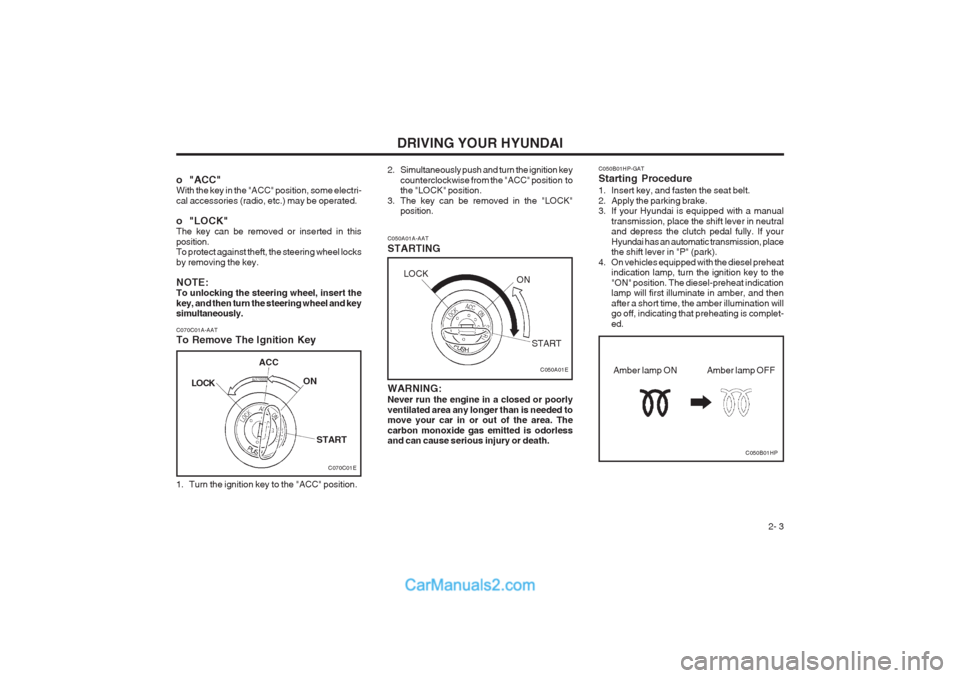
C070C01A-AAT
To Remove The Ignition Key
1. Turn the ignition key to the "ACC" position. C050A01A-AAT STARTING
C050A01E
WARNING: Never run the engine in a closed or poorly ventilated area any longer than is needed to move your car in or out of the area. The carbon monoxide gas emitted is odorless and can cause serious injury or death.
o "ACC"With the key in the "ACC" position, some electri- cal accessories (radio, etc.) may be operated.
o "LOCK" The key can be removed or inserted in this position. To protect against theft, the steering wheel locks by removing the key. NOTE: To unlocking the steering wheel, insert the key, and then turn the steering wheel and key simultaneously.
2. Simultaneously push and turn the ignition key
counterclockwise from the "ACC" position to the "LOCK" position.
3. The key can be removed in the "LOCK" position. C050B01HP-GAT Starting Procedure
1. Insert key, and fasten the seat belt.
2. Apply the parking brake.
3. If your Hyundai is equipped with a manual
transmission, place the shift lever in neutraland depress the clutch pedal fully. If your Hyundai has an automatic transmission, place the shift lever in "P" (park).
4. On vehicles equipped with the diesel preheat indication lamp, turn the ignition key to the "ON" position. The diesel-preheat indication lamp will first illuminate in amber, and then after a short time, the amber illumination will go off, indicating that preheating is complet- ed.
C050B01HP
Amber lamp OFF
Amber lamp ON
C070C01E
LOCK
ACC
ON
START
LOCK ON
START
Page 111 of 349
DRIVING YOUR HYUNDAI 2- 5
C070B01A-AAT Using the Clutch The clutch should be pressed all the way to the floor before shifting, then released slowly. The clutch pedal should always be used after fully returning to the original position. Do not rest your foot on the clutch pedal while driving. This can cause unnecessary wear. Do not partially en- gage the clutch to hold the car on an incline. This causes unnecessary wear. Use the parking brake to hold the car on an incline. Do not operate the clutch pedal rapidly and repeatedly. shift lever in N(Neutral) position and re-lease the clutch. Press the clutch pedal back down, and then shift into 1st or R(Reverse) gear position.
o Do not use the shift lever as a handrest
during driving, as this can result in prema- ture wear of the transmission shift forks.
CAUTION: When downshifting from fifth gear to fourth gear, caution should be taken not to inadvert- ently press the gear shift lever sideways in such a manner that second gear is engaged. Such a drastic downshift may cause the en- gine speed to increase to the point that the tachometer will enter the red-zone. Such over- revving of the engine may possibly cause engine damage. C070D02O-AAT Good Driving Practices
o Never take the car out of gear and coast down
a hill. This is extremely hazardous. Always leave the car in gear.
o Don't "ride" the brakes. This can cause them
to overheat and malfunction. Instead, when you are driving down a long hill, slow down and shift to a lower gear. When you do this, engine braking will help slow the car.
o Slow down before shifting to a lower gear. This will help avoid over-revving the engine, which can cause damage.
o Slow down when you encounter cross winds.
This gives you much better control of your car.
o Be sure the car is completely stopped before you attempt to shift into reverse. The trans- mission can be damaged if you do not. To shift into reverse, depress the clutch, move the shift lever to neutral, wait three seconds, then shift to the reverse position.
o Exercise extreme caution when driving on a slippery surface. Be especially careful when braking, accelerating or shifting gears. On a slippery surface, an abrupt change in vehicle speed can cause the drive wheels to lose traction and the vehicle to go out of control.
WARNING:
o Avoid high cornering speeds.
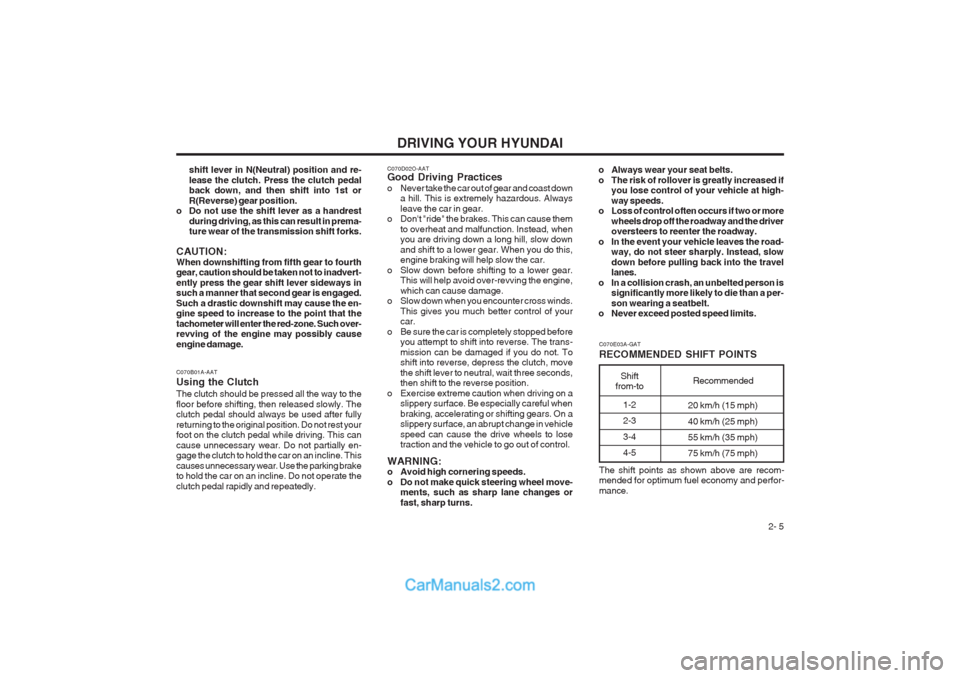
o Do not make quick steering wheel move- ments, such as sharp lane changes orfast, sharp turns. C070E03A-GAT RECOMMENDED SHIFT POINTS
1-2 2-3 3-4 4-5
Shift
from-to Recommended
20 km/h (15 mph) 40 km/h (25 mph) 55 km/h (35 mph)75 km/h (75 mph)
The shift points as shown above are recom- mended for optimum fuel economy and perfor- mance.
o Always wear your seat belts.
o The risk of rollover is greatly increased if
you lose control of your vehicle at high-way speeds.
o Loss of control often occurs if two or more
wheels drop off the roadway and the driver oversteers to reenter the roadway.
o In the event your vehicle leaves the road- way, do not steer sharply. Instead, slow down before pulling back into the travel lanes.
o In a collision crash, an unbelted person is significantly more likely to die than a per- son wearing a seatbelt.
o Never exceed posted speed limits.
Page 114 of 349
DRIVING YOUR HYUNDAI
2- 8
o Do not "ride" the brakes. This can cause them
to overheat and malfunction. Instead, when you are driving down a long hill, slow down and shift to a lower gear. When you do this, engine braking will help slow the car.
o Slow down before shifting to a lower gear.
Otherwise, the lower gear may not be en- gaged.
o Always use the parking brake. Do not depend on placing the transmission in "P" to keep the car from moving.
o Exercise extreme caution when driving on a
slippery surface. Be especially careful when braking, accelerating or shifting gears. On a slippery surface, an abrupt change in vehicle speed can cause the drive wheels to lose traction and the vehicle to go out of control.
WARNING:
o Avoid high cornering speeds.
o Do not make quick steering wheel move- ments, such as sharp lane changes orfast, sharp turns.
o Always wear your seat belts.
o The risk of rollover is greatly increased if you lose control of your vehicle at high-way speeds.
o Loss of control often occurs if two or more
wheels drop off the roadway and the driver oversteers to reenter the roadway.
o In the event your vehicle leaves the road- way, do not steer sharply. Instead, slow down before pulling back into the travel lanes. C120A02A-AAT ANTI-LOCK BRAKE SYSTEM (If installed) The Anti-Lock Brake System (ABS) is designed to prevent wheel lock-up during sudden braking or on hazardous road surfaces. The ABS control module monitors the wheel speed and controls the pressure applied to each brake. Thus, in emergency situations or on slick roads, ABS will increase vehicle control during braking. NOTE: During ABS operation, a slight pulsation may be felt in the brake pedal when the brakes are applied. Also, a noise may be heard in the engine compartment while braking. These conditions are normal and indicate that the anti-lock brake system is functioning prop- erly.
D090A01P-GAT FOUR-WHEEL DRIVE (4WD) You can send your engine power to all front and rear wheels for maximum power. 4WD is useful when you drive in snow, mud, ice, mountainous or sandy areas where good traction is required, or when your wheels lose traction using two- wheel drive.
WARNING:ABS will not prevent accidents due to im- proper or dangerous driving maneuvers. Even though vehicle control is improved during emergency braking, always maintain a safe distance between you and objects ahead. Vehicle speeds should always be reduced during extreme road conditions. The braking distance for cars equipped with an anti-lock braking system may be longer than for those without it in the following road conditions. During these conditions the ve- hicle should be driven at reduced speeds.
o Rough, gravel or snow-covered roads.
o With tire chains installed.
o Roads where the road surface is pitted or
has different surface height.
The safety features of an ABS equipped ve-hicle should not be tested by high speed driving or cornering. This could endanger the safety of yourself or others.
o In a collision crash, an unbelted person is
significantly more likely to die than a per-son wearing a seatbelt.
o Never exceed posted speed limits.
Page 115 of 349
DRIVING YOUR HYUNDAI 2- 9
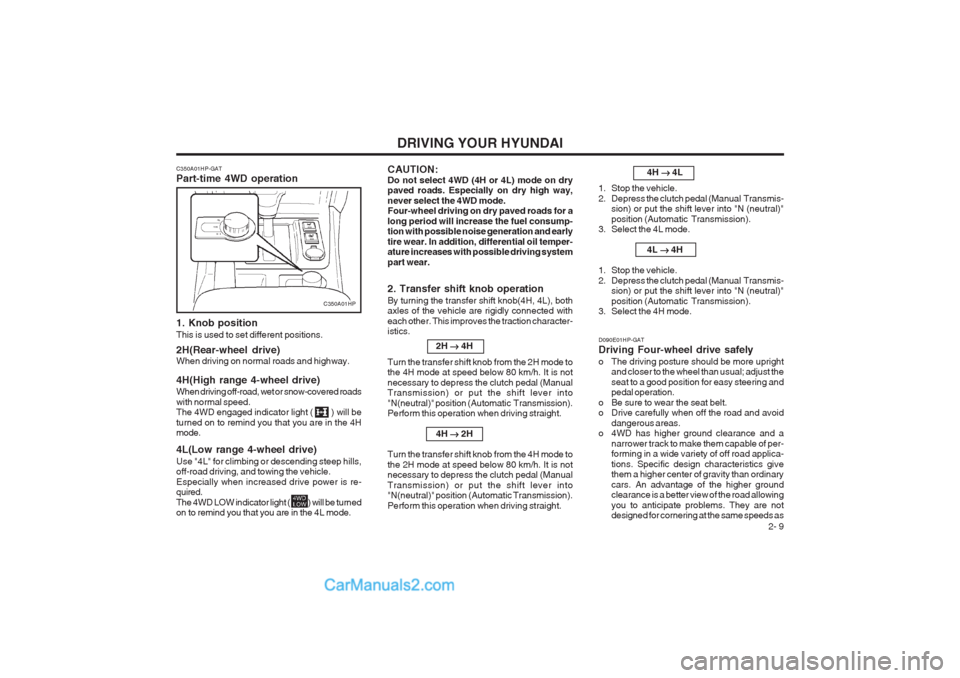
C350A01HP-GAT Part-time 4WD operation
1. Knob position This is used to set different positions. 2H(Rear-wheel drive) When driving on normal roads and highway. 4H(High range 4-wheel drive) When driving off-road, wet or snow-covered roads with normal speed. The 4WD engaged indicator light ( ) will be turned on to remind you that you are in the 4H mode. 4L(Low range 4-wheel drive) Use "4L" for climbing or descending steep hills, off-road driving, and towing the vehicle. Especially when increased drive power is re- quired. The 4WD LOW indicator light ( ) will be turned on to remind you that you are in the 4L mode.
2. Transfer shift knob operation By turning the transfer shift knob(4H, 4L), both axles of the vehicle are rigidly connected with each other. This improves the traction character- istics.2H
4H
Turn the transfer shift knob from the 2H mode tothe 4H mode at speed below 80 km/h. It is not necessary to depress the clutch pedal (Manual Transmission) or put the shift lever into "N(neutral)" position (Automatic Transmission). Perform this operation when driving straight.
4H
2H
Turn the transfer shift knob from the 4H mode to the 2H mode at speed below 80 km/h. It is not necessary to depress the clutch pedal (Manual Transmission) or put the shift lever into "N(neutral)" position (Automatic Transmission). Perform this operation when driving straight.
C350A01HP
D090E01HP-GAT Driving Four-wheel drive safely
o The driving posture should be more uprightand closer to the wheel than usual; adjust the seat to a good position for easy steering and pedal operation.
o Be sure to wear the seat belt.
o Drive carefully when off the road and avoid dangerous areas.
o 4WD has higher ground clearance and a
narrower track to make them capable of per-forming in a wide variety of off road applica- tions. Specific design characteristics give them a higher center of gravity than ordinary cars. An advantage of the higher ground clearance is a better view of the road allowing you to anticipate problems. They are not designed for cornering at the same speeds as 4H
4L
1. Stop the vehicle.
2. Depress the clutch pedal (Manual Transmis- sion) or put the shift lever into "N (neutral)"position (Automatic Transmission).
3. Select the 4L mode.
4L
4H
1. Stop the vehicle.
2. Depress the clutch pedal (Manual Transmis- sion) or put the shift lever into "N (neutral)"position (Automatic Transmission).
3. Select the 4H mode.
CAUTION: Do not select 4WD (4H or 4L) mode on dry paved roads. Especially on dry high way, never select the 4WD mode. Four-wheel driving on dry paved roads for a long period will increase the fuel consump- tion with possible noise generation and early tire wear. In addition, differential oil temper- ature increases with possible driving system part wear.
Page 116 of 349
DRIVING YOUR HYUNDAI
2- 10
conventional 2-wheel drive vehicles any more than low-slung sports cars are designed to perform satisfactorily under off-road condi- tions. If at all possible, avoid sharp turns or abrupt maneuvers. As with other vehicles of this type, failure to operate this vehicle cor- rectly may result in loss of control or vehicle rollover.
o Do not grip the inside or spokes of the steer-
ing wheel when driving off-road. The steering wheel could jerk and injure your hands. Al- ways firmly hold the outer steering wheel when you are driving off-road.
o Drive at lower speeds in strong crosswinds. Because of your vehicle’s high center of gravity, its stability will be affected in cross- winds. Slower speeds ensure better vehicle control.
o Check your brake condition once you are out
of mud or water. Press the brake several times as you move slowly until your feel normal braking forces return.
o Four-wheel driving on flat and normal roads
can result in a severe binding condition when turning the steering wheel.
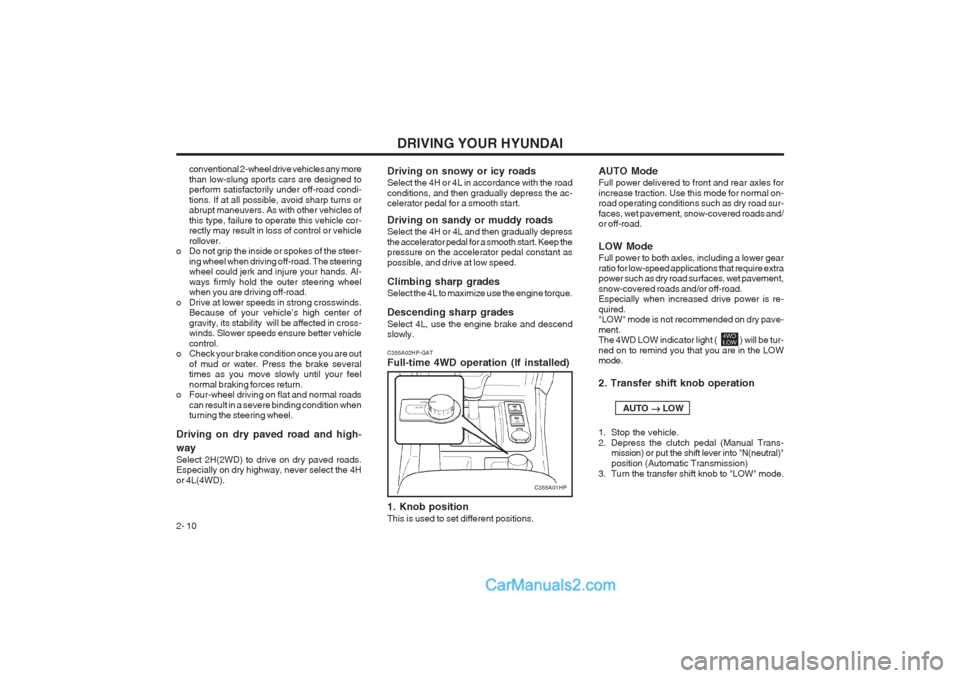
Driving on dry paved road and high- way Select 2H(2WD) to drive on dry paved roads. Especially on dry highway, never select the 4H or 4L(4WD). C355A02HP-GAT Full-time 4WD operation (If installed) 1. Knob position This is used to set different positions.Driving on snowy or icy roads Select the 4H or 4L in accordance with the road conditions, and then gradually depress the ac- celerator pedal for a smooth start. Driving on sandy or muddy roads Select the 4H or 4L and then gradually depress the accelerator pedal for a smooth start. Keep the pressure on the accelerator pedal constant as possible, and drive at low speed. Climbing sharp grades Select the 4L to maximize use the engine torque. Descending sharp grades Select 4L, use the engine brake and descend slowly. AUTO Mode Full power delivered to front and rear axles for increase traction. Use this mode for normal on- road operating conditions such as dry road sur- faces, wet pavement, snow-covered roads and/ or off-road. LOW Mode Full power to both axles, including a lower gear ratio for low-speed applications that require extra power such as dry road surfaces, wet pavement, snow-covered roads and/or off-road. Especially when increased drive power is re- quired. "LOW" mode is not recommended on dry pave- ment. The 4WD LOW indicator light ( ) will be tur- ned on to remind you that you are in the LOW mode. 2. Transfer shift knob operation AUTO
LOW
1. Stop the vehicle.
2. Depress the clutch pedal (Manual Trans- mission) or put the shift lever into "N(neutral)"position (Automatic Transmission)
3. Turn the transfer shift knob to "LOW" mode.
C355A01HP
Page 118 of 349
DRIVING YOUR HYUNDAI
2- 12 C130A01HP-GAT GOOD BRAKING PRACTICES WARNING: Nothing should be carried on top of the cargo area cover behind the rear seat. If there were an accident or a sudden stop, such objects could move forward and cause damage to the vehicle or injure the occupants.
o After being parked, check to be sure the
parking brake is not engaged and that the parking brake indicator light is out before driving away.
o Driving through water may get the brakes
wet. They can also get wet when the car is washed. Wet brakes can be dangerous! Your car will not stop as quickly if the brakes are wet. Wet brakes cause the car to pull to one side. To dry the brakes, apply the brakes lightly until the braking action returns to nor- mal, taking care to keep the car under control at all times. If the braking action does not return to normal, stop as soon as it is safe to do so and call your Hyundai dealer for assis- tance.
o Don’t coast down hills with the car out of gear.
This is extremely hazardous. Keep the car in gear at all times, use the brakes to slow down, then shift to a lower gear so that engine braking will help you maintain a safe speed.
D190A01O-GAT LIMITED-SLIP DIFFERENTIAL (If installed) A limited-slip differential, if equipped, is for the rear wheel differential only. The features of this limited-slip differential are described below: Just as with a conventional differential, the wheel on one side is allowed to turn at a different speed from the wheel on the other side when the vehicle is cornering. The difference between the limited- slip differential and a conventional differential is that if the wheel on one side of the vehicle loses traction, a greater amount of torque is applied to the rear wheel on the other side to improve traction.
WARNING:Keep away from the front of the vehicle while inspecting. This is very dangerous as the vehicle can jump forward and cause serious injury or death.
(9) When using tire chains, always attach them
to the rear wheels.
(10) I f the front or rear wheels get stuck in the
mud, do not spin them recklessly. The 4WD system could be damaged.
CAUTION:
o While the full-time 4WD vehicle is being raised on a jack, never start the engine orcause the tires to rotate. There is the danger that rotating tires touching the ground could cause the ve- hicle to go off the jack and to jump for- ward.
o If one of the front or rear wheels begins to
spin in mud, snow, etc., the vehicle can sometimes be driven out by depressing the accelerator pedal further; however, avoid running the engine continuously at high rpm because doing so could damage the 4WD system. WARNING:
o Avoid high cornering speeds.
o Do not make quick steering wheel move-
ments, such as sharp lane charges or fast,sharp turns.
o The risk of rollover is greatly increased if you lose control of your vehicle at high- way speeds.
o In a collision crash, an unbelted person is
significantly more likely to die than a per- son wear a seatbelt.
o Loss of control often occurs if two or more wheels drop off the roadway and the driver oversteers to reenter the roadway.
o In the event your vehicle leaves the road-
way, do not steer sharply. Instead, slow down before pulling back into the travel lanes.
Page 121 of 349
DRIVING YOUR HYUNDAI 2- 15
C160H01A-AAT Use Approved Anti-Freeze in Window Washer System To keep the water in the window washer system from freezing, add an approved anti-freeze solu- tion in accordance with instructions on the con- tainer. Window washer anti-freeze is available from Hyundai dealers and most auto parts out- lets. Do not use engine coolant or other types of anti-freeze as these may damage the finish.
C160F01A-AAT Check Spark Plugs and Ignition System Inspect your spark plugs as described in Section 6 and replace them if necessary. Also check all ignition wiring and components to be sure they are not cracked, worn or damaged in any way.
C160G02A-GAT To Keep Locks from Freezing To keep the locks from freezing, squirt an ap- proved de-icer fluid or glycerine into the key opening. If a lock is covered with ice, squirt it with an approved de-icing fluid to remove the ice. If the lock is frozen internally, you may be able to thaw it out by using a heated key. Handle the heated key with care to avoid
injury.
NOTE: The proper temperature for using the immo- bilizer key is from -40°C (-40°F) to 80°C (176°F). If you heat the immobilizer key over 80°C (176°F) to open the frozen lock, it may cause damage to the transponder in its head. C160I01HP-GAT Don’t Let Your Parking Brake Freeze Under some conditions your parking brake can freeze in the engaged position. This is most likely to happen when there is an accumulation of snow or ice around or near the rear brakes or if the brakes are wet. If there is a risk the parking brake may freeze, apply it only temporarily while you put the gear selector lever in "P" (automatic) or in first or reverse gear (manual transmission) and block the rear wheels so the car cannot roll. Then release the parking brake. C160K01A-AAT Carry Emergency Equipment Depending on the severity of the weather where you drive your car, you should carry appropriate emergency equipment. Some of the items you may want to carry include tire chains, tow straps or chains, flashlight, emergency flares, sand, a shovel, jumper cables, a window scraper, gloves, ground cloth, coveralls, a blanket, etc.
C160J01A-AAT Don’t Let Ice and Snow Accumulate Underneath Under some conditions, snow and ice can build up under the fenders and interfere with the steer- ing. When driving in severe winter conditions where this may happen, you should periodically check underneath the car to be sure the move- ment of the front wheels and the steering compo- nents is not obstructed.
C180A01A-AAT USE OF LIGHTS Check your lights regularly for correct operation and always keep them clean. When driving dur- ing the day in conditions of poor visibility, it is helpful to drive with headlights on low beam. This enables you to be seen as well as to see.
C170A01A-AAT HIGHER SPEED MOTORING Pre-Trip Inspections 1. Tires: Adjust the tire inflation pressures to specifica- tion. Low tire inflation pressures will result in overheating and possible failure of the tires. Avoid using worn or damaged tires which may result in reduced traction or tire failure. NOTE: Never exceed the maximum tire inflation pres- sure shown on the tires. 2. Fuel, engine coolant and engine oil: High speed travel consumes more fuel than urban motoring. Do not forget to check both engine coolant and engine oil. 3. Drive belt: A loose or damaged drive belt may result in overheating of the engine.
Page 123 of 349
DRIVING YOUR HYUNDAI 2- 17
NOTE:
1. Never load the trailer with more weight in
the back than in the front. About 60% ofthe trailer load should be in the front half on the trailer and the remaining 40% in the rear.
2. The total gross vehicle weight with trailer
must not exceed the Gross Vehicle Weight Rating (GVWR) shown on the vehicle iden- tification plate (see page 8-1). The total gross vehicle weight is the combined weight of the vehicle, driver, all passen- gers and their luggage, cargo, hitch, trailer tongue load and other optional equip- ment.
3. The front or rear mission weight must not exceed the Gross Axle Weight Rating (GAWR) shown on the vehicle identifica- tion plate (see page 8-1). It is possible that your towing package does not exceed the GVWR but exceeds the GAWR. Improper trailer loading and/or too much luggage in the cargo area can overload the rear mis- sion. Redistribute the load and check the mission weight again.
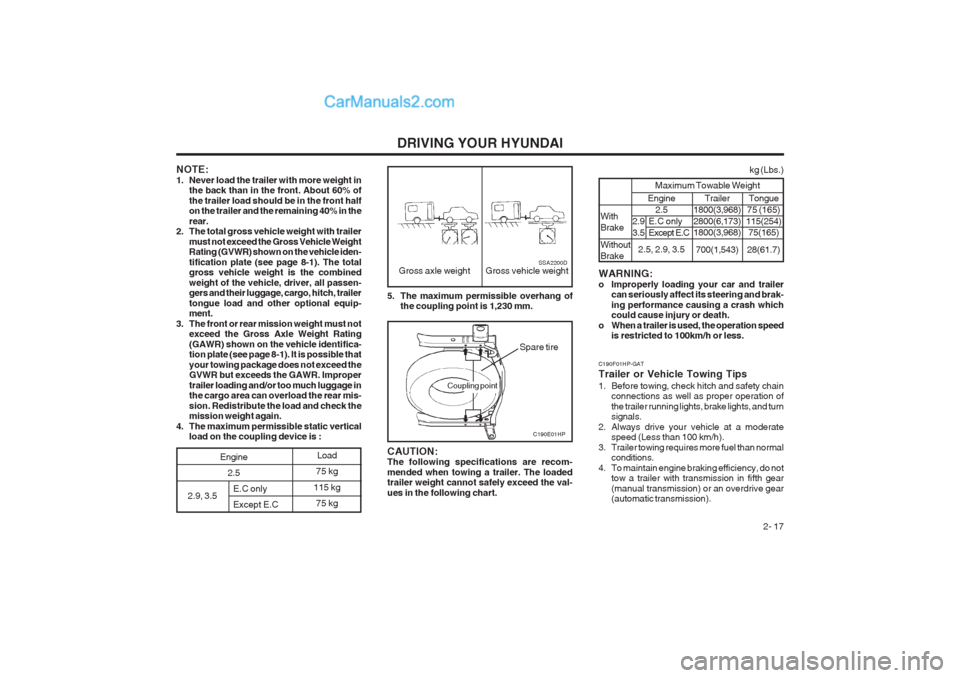
4. The maximum permissible static vertical load on the coupling device is : 5. The maximum permissible overhang of
the coupling point is 1,230 mm.
Gross axle weight Gross vehicle weightSSA2200D
C190E01HP
CAUTION: The following specifications are recom- mended when towing a trailer. The loaded trailer weight cannot safely exceed the val- ues in the following chart.
Spare tire
2.9, 3.5 E.C only Except E.C Load
75 kg
115 kg 75 kg
Engine 2.5
Coupling point
C190F01HP-GAT Trailer or Vehicle Towing Tips
1. Before towing, check hitch and safety chain connections as well as proper operation of the trailer running lights, brake lights, and turn
signals.
2. Always drive your vehicle at a moderate speed (Less than 100 km/h).
3. Trailer towing requires more fuel than normal conditions.
4. To maintain engine braking efficiency, do not tow a trailer with transmission in fifth gear(manual transmission) or an overdrive gear (automatic transmission).
WARNING:
o Improperly loading your car and trailer
can seriously affect its steering and brak-ing performance causing a crash which could cause injury or death.
o When a trailer is used, the operation speed is restricted to 100km/h or less. Engine
2.5
2.5, 2.9, 3.5
2.9 E.C only
3.5 Except E.C
kg (Lbs.)
Maximum Towable Weight
With Brake Without Brake Trailer
1800(3,968) 2800(6,173) 1800(3,968)
700(1,543) Tongue
75 (165)
115(254) 75(165)
28(61.7)
Page 133 of 349
WHAT TO DO IN AN EMERGENCY 3-9
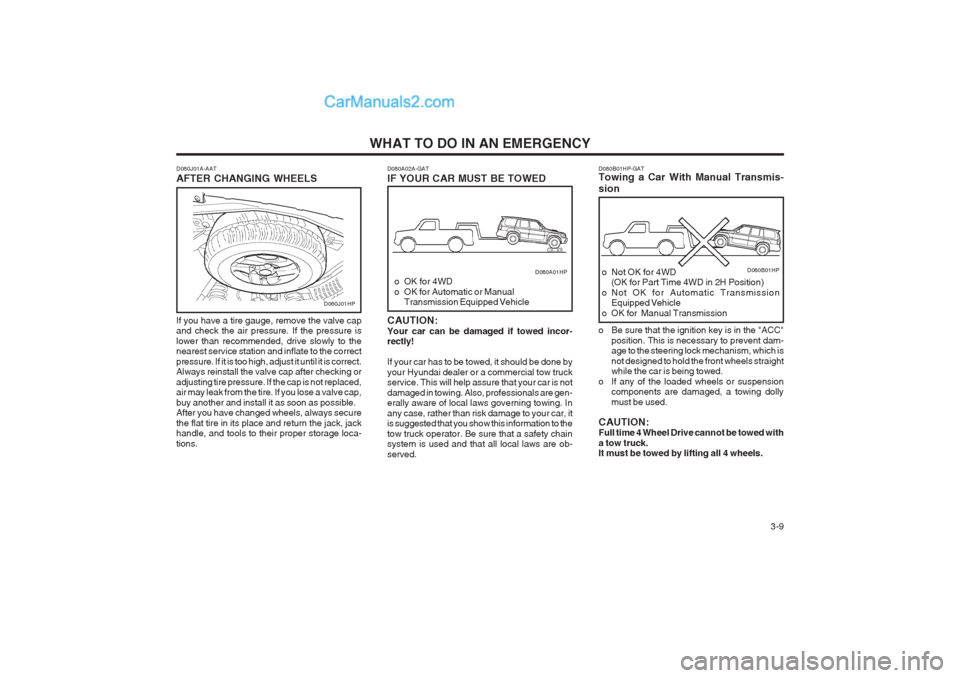
D060J01A-AAT AFTER CHANGING WHEELS If you have a tire gauge, remove the valve cap and check the air pressure. If the pressure is lower than recommended, drive slowly to the nearest service station and inflate to the correct pressure. If it is too high, adjust it until it is correct. Always reinstall the valve cap after checking or adjusting tire pressure. If the cap is not replaced, air may leak from the tire. If you lose a valve cap, buy another and install it as soon as possible. After you have changed wheels, always secure the flat tire in its place and return the jack, jack handle, and tools to their proper storage loca- tions.
D060J01HPD080A02A-GAT IF YOUR CAR MUST BE TOWED
o OK for 4WD
o OK for Automatic or Manual
Transmission Equipped Vehicle D080A01HP
CAUTION:Your car can be damaged if towed incor- rectly! If your car has to be towed, it should be done by your Hyundai dealer or a commercial tow truck service. This will help assure that your car is not damaged in towing. Also, professionals are gen- erally aware of local laws governing towing. In any case, rather than risk damage to your car, it is suggested that you show this information to the tow truck operator. Be sure that a safety chain system is used and that all local laws are ob- served. D080B01HP-GAT Towing a Car With Manual Transmis- siono Not OK for 4WD
(OK for Part Time 4WD in 2H Position)
o Not OK for Automatic Transmission Equipped Vehicle
o OK for Manual Transmission D080B01HP
o Be sure that the ignition key is in the "ACC" position. This is necessary to prevent dam- age to the steering lock mechanism, which is not designed to hold the front wheels straight while the car is being towed.
o If any of the loaded wheels or suspension components are damaged, a towing dolly must be used.
CAUTION: Full time 4 Wheel Drive cannot be towed with a tow truck. It must be towed by lifting all 4 wheels.
Page 134 of 349
WHAT TO DO IN AN EMERGENCY
3-10 D120A01A-GAT IF YOU LOSE YOUR KEYS If you lose your keys, many Hyundai dealers can make you a new key if you have your key number. If you lock the keys inside your car and you cannot obtain a new key, many Hyundai dealers can use special tools to open the door for you. Information about the key of immobilizer system (if installed) will be found on page 1-2.
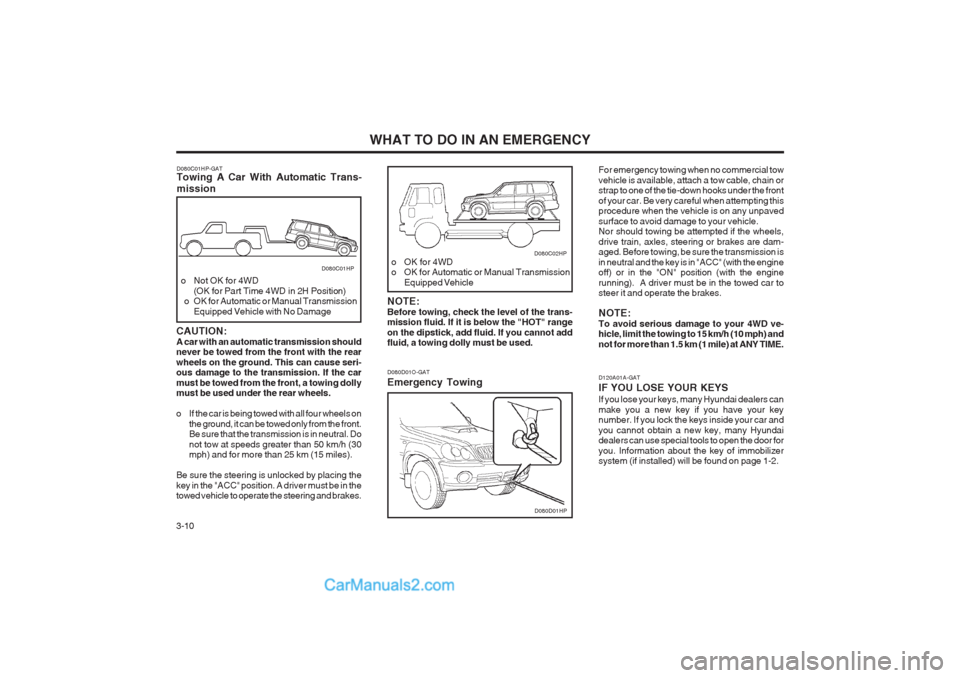
D080D01O-GAT Emergency Towing
D080D01HP For emergency towing when no commercial tow vehicle is available, attach a tow cable, chain or strap to one of the tie-down hooks under the front of your car. Be very careful when attempting this procedure when the vehicle is on any unpaved surface to avoid damage to your vehicle. Nor should towing be attempted if the wheels, drive train, axles, steering or brakes are dam- aged. Before towing, be sure the transmission is in neutral and the key is in "ACC" (with the engine off) or in the "ON" position (with the engine running). A driver must be in the towed car to steer it and operate the brakes. NOTE: To avoid serious damage to your 4WD ve- hicle, limit the towing to 15 km/h (10 mph) and not for more than 1.5 km (1 mile) at ANY TIME.
o OK for 4WD
o OK for Automatic or Manual Transmission
Equipped VehicleD080C02HP
NOTE: Before towing, check the level of the trans- mission fluid. If it is below the "HOT" range on the dipstick, add fluid. If you cannot add fluid, a towing dolly must be used.
D080C01HP-GAT Towing A Car With Automatic Trans- mission
CAUTION: A car with an automatic transmission should never be towed from the front with the rear wheels on the ground. This can cause seri- ous damage to the transmission. If the car must be towed from the front, a towing dolly must be used under the rear wheels.
o If the car is being towed with all four wheels on the ground, it can be towed only from the front. Be sure that the transmission is in neutral. Do not tow at speeds greater than 50 km/h (30 mph) and for more than 25 km (15 miles).
Be sure the steering is unlocked by placing the key in the "ACC" position. A driver must be in the towed vehicle to operate the steering and brakes.
o Not OK for 4WD (OK for Part Time 4WD in 2H Position)
o OK for Automatic or Manual Transmission
Equipped Vehicle with No Damage
D080C01HP