steering Hyundai Terracan 2003 Workshop Manual
[x] Cancel search | Manufacturer: HYUNDAI, Model Year: 2003, Model line: Terracan, Model: Hyundai Terracan 2003Pages: 349, PDF Size: 4.56 MB
Page 285 of 349
DRIVING YOUR HYUNDAI
2- 14 D190A01O-EAT
LIMITED-SLIP DIFFERENTIAL (Not all models)
A limited-slip differential, if equipped, is for the
rear wheel differential only. The features of this limited-slip differential are described below:
Just as with a conventional differential, the
wheel on one side is allowed to turn at adifferent speed from the wheel on the other sidewhen the vehicle is cornering. The differencebetween the limited-slip differential and a con-ventional differential is that if the wheel on oneside of the vehicle loses traction, a greateramount of torque is applied to the rear wheel onthe other side to improve traction.
SC140A1-E
EFFECTIVE BRAKING Braking system performance and friction mate-rial life are greatly affected by the driving styleadopted. The following suggestions are madeto assist in achieving the best results from thebraking system.
o Anticipate the road and conditions ahead in order that heavy braking may be avoided.
o When descending long gradients, use the engine to assist in retarding the vehicle tominimize the possibility of brake fade occur-ring. o When trailer towing, ensure that the trailer
brakes function correctly and use enginebraking to assist the vehicle braking system.
o Use only genuine Hyundai replacement brake pads and shoes to ensure consistentfriction characteristics and wear rates.
o After driving through deep water (e.g. fording), the brakes may become wet andperformance reduced. Always check brakeefficiency after emerging from the water anddry the brakes by lightly depressing thebrake pedal several times whilst driving slow-ly.
o Apply the parking brake only when the vehi- cle is at rest.
o Since the power assistance provided by the brake servo is derived from the engine,coasting with the engine turned off or towingof the vehicle with the engine turned off willresult in greatly increased pedal pressuresbeing required to stop the vehicle.
o Do not hold the vehicle on the upgrade with the accelerator pedal. This can cause thetransmission to overheat. Always use thebrake pedal or parking brake.
CAUTION:
o Whilst the full-time 4WD vehicle is being raised on a jack, never start the engine orcause the tyres to rotate. There is the danger that rotating tyres touching the ground could cause thevehicle to go off the jack and to jumpforward.
o If one of the front or rear wheels begins to spin in mud, snow, etc., the vehiclecan sometimes be driven out by depress-ing the accelerator pedal further; how-ever, avoid running the engine continu-ously at high rpm because doing so coulddamage the 4WD system.
WARNING:
o Avoid high cornering speeds.
o Do not make quick steering wheel move- ments, such as sharp lane charges or fast, sharp turns.
o The risk of rollover is greatly increased if you lose control of your vehicle at high-way speeds.
o In a collision crash, an unbelted person is significantly more likely to die than aperson wearing a seatbelt.
o Loss of control often occurs if two or more wheels drop off the roadway and thedriver oversteers to reenter the roadway.
o In the event your vehicle leaves the road- way, do not steer sharply. Instead, slowdown before pulling back into the travellanes.
Page 287 of 349
DRIVING YOUR HYUNDAI
2- 16 ZC170E1-E
Windscreen Washers & Wipers
The windscreen washer bottle should be filled with a solution of water and a proprietary winterscreen wash additive. The windscreen wipersshould not be used if the blades are frozen tothe windscreen or if they are covered withsnow, before this is removed. NOTE: Never allow undiluted screen washer fluid additive to spill upon the paintwork or useengine coolant anti-freeze since damage tothe paintwork may result.
o When driving in extreme conditions, the windscreen wiper blades may fail to clearthe screen properly due to the formation ofice upon the blade edge. It will therefore benecessary to periodically remove such iceto restore their efficiency.
o If the power operated door mirrors become frozen, attempts to adjust these may dam-age the mechanism.
o The formation of snow or ice build up inside the wheel arches may interfere with theroadwheels or steering mechanism. In suchinstances, unusual noises or an increase insteering effort may result. Therefore, ensurethat the wheelarches are checked periodi-cally and any accumulated snow or ice re-moved.
ZC170B1-E
Electrical System
Winter conditions impose severe demands upon
vehicle electrical systems, particularly the charg-ing circuit. The battery condition and perfor-mance along with the alternator performanceand drive belt condition should be checked priorto the onset of winter.
YC170C1-E
Anti-freeze/Corrosion inhibitor The cooling system must always contain anEthylene-Glycol based anti-freeze solution. Thesystem is filled during manufacture with solu-tion of the correct strength which should bechecked before the onset of winter and adjust-ed or changed as required. NOTE: The anti-freeze solution contains a corro- sion inhibitor to prevent degradation of thealuminium castings contained within theengine. Therefore, never, drain the systemand refill with water only. In addition, anti-freeze solution must ALWAYS be used in vehicles fitted with air conditioning,to prevent the heater matrix from freezing andsubsequently bursting with the refrigeration sys-tem in use. ZC170D1-E
Door Locks
Should the door lock mechanism become fro-zen, a proprietary lock de-icer should be used.Alternatively, warming the door key may thawthe door lock. However, the key should behandled carefully to avoid burning the fingers. Never attempt to thaw a frozen door lock using hot water, since the water will eventually freezeand compound the problem. NOTE: The proper temperature for using the immo-bilizer key is from -40°F to 176°F (-40°C to80°C). If you heat the immobilizer key over176°F to open the frozen lock, it may causedamage to the transponder in its head.
Page 289 of 349
DRIVING YOUR HYUNDAI
2- 18 NOTE:
1. Never load the trailer with more weight in the back than in the front. About 60% of the trailer load should be in the front halfon the trailer and the remaining 40% inthe rear.
2. The total gross vehicle weight with trailer must not exceed the Gross Vehicle WeightRating (GVWR) shown on the vehicleidentification plate (see page 8-1). Thetotal gross vehicle weight is the com-bined weight of the vehicle, driver, allpassengers and their luggage, cargo,towbar hitch, trailer nose weight and otheroptional equipment.
3. The front or rear axle weight must not exceed the Gross Axle Weight Rating(GAWR) shown on the vehicle identifica-tion plate (see page 8-1). It is possiblethat your towing package does not ex-ceed the GVWR but exceeds the GAWR. Improper trailer loading and/or too much luggage in the trunk can overload therear axle. Redistribute the load and checkthe axle weight again.
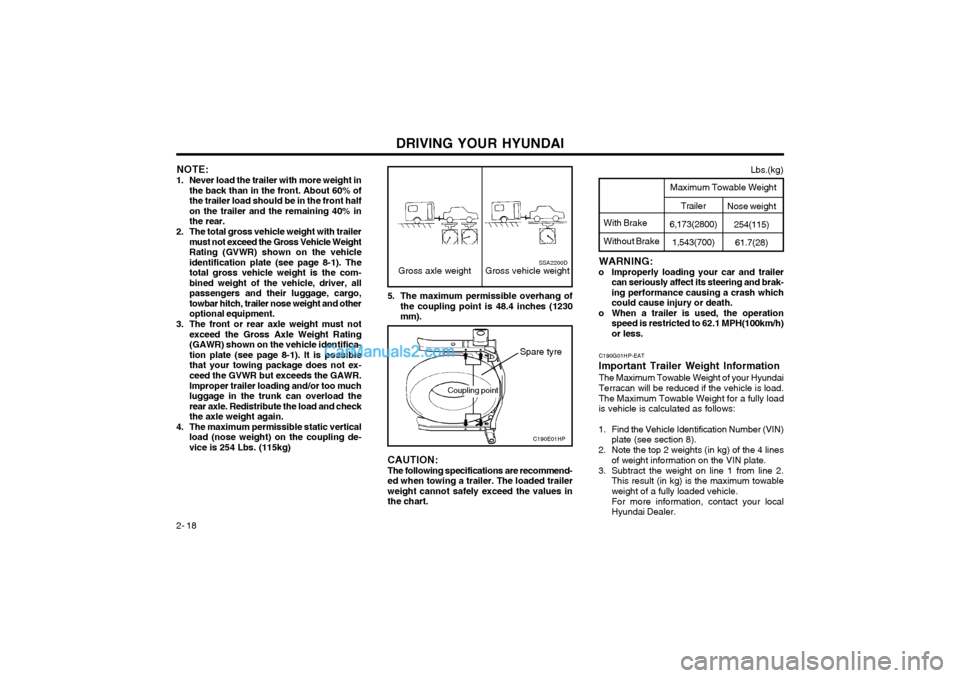
4. The maximum permissible static vertical load (nose weight) on the coupling de-vice is 254 Lbs. (115kg) 5. The maximum permissible overhang of
the coupling point is 48.4 inches (1230mm).
Gross axle weight Gross vehicle weightSSA2200D
CAUTION: The following specifications are recommend-ed when towing a trailer. The loaded trailerweight cannot safely exceed the values inthe chart.
Lbs.(kg)
Maximum Towable Weight
With Brake Without Brake Trailer
6,173(2800) 1,543(700) Nose weight
254(115)61.7(28)
WARNING:
o Improperly loading your car and trailer can seriously affect its steering and brak- ing performance causing a crash whichcould cause injury or death.
o When a trailer is used, the operation speed is restricted to 62.1 MPH(100km/h)or less.
C190E01HP
Spare tyre
Coupling point
C190G01HP-EAT
Important Trailer Weight Information
The Maximum Towable Weight of your Hyundai Terracan will be reduced if the vehicle is load. The Maximum Towable Weight for a fully load is vehicle is calculated as follows:
1. Find the Vehicle Identification Number (VIN) plate (see section 8).
2. Note the top 2 weights (in kg) of the 4 lines of weight information on the VIN plate.
3. Subtract the weight on line 1 from line 2. This result (in kg) is the maximum towableweight of a fully loaded vehicle. For more information, contact your local Hyundai Dealer.
Page 300 of 349
IN CASE OF EMERGENCY
3-10 D080B01HP-EAT
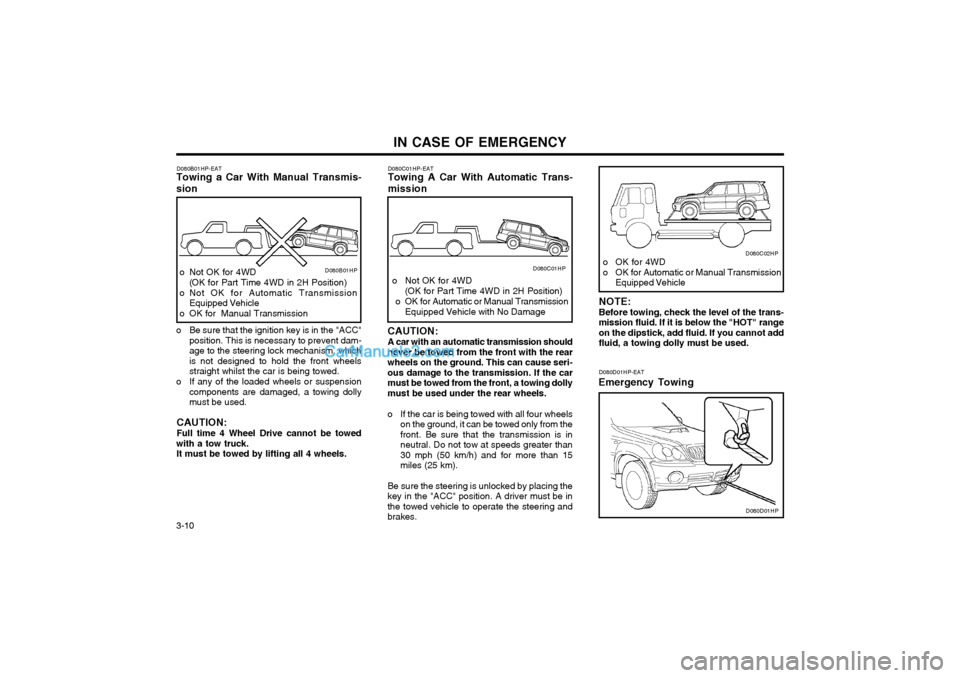
Towing a Car With Manual Transmis- sion
o Not OK for 4WD
(OK for Part Time 4WD in 2H Position)
o Not OK for Automatic Transmission Equipped Vehicle
o OK for Manual Transmission D080B01HP
o Be sure that the ignition key is in the "ACC" position. This is necessary to prevent dam- age to the steering lock mechanism, whichis not designed to hold the front wheelsstraight whilst the car is being towed.
o If any of the loaded wheels or suspension components are damaged, a towing dollymust be used.
CAUTION: Full time 4 Wheel Drive cannot be towed
with a tow truck. It must be towed by lifting all 4 wheels.
D080D01HP-EAT
Emergency Towing
D080D01HP
o OK for 4WD
o OK for Automatic or Manual Transmission Equipped VehicleD080C02HP
NOTE: Before towing, check the level of the trans- mission fluid. If it is below the "HOT" rangeon the dipstick, add fluid. If you cannot addfluid, a towing dolly must be used.
D080C01HP-EAT
Towing A Car With Automatic Trans- mission
CAUTION: A car with an automatic transmission should never be towed from the front with the rearwheels on the ground. This can cause seri-ous damage to the transmission. If the carmust be towed from the front, a towing dollymust be used under the rear wheels.
o If the car is being towed with all four wheels on the ground, it can be towed only from thefront. Be sure that the transmission is inneutral. Do not tow at speeds greater than30 mph (50 km/h) and for more than 15miles (25 km).
Be sure the steering is unlocked by placing thekey in the "ACC" position. A driver must be inthe towed vehicle to operate the steering andbrakes.
o Not OK for 4WD (OK for Part Time 4WD in 2H Position)
o OK for Automatic or Manual Transmission Equipped Vehicle with No Damage
D080C01HP
Page 301 of 349
IN CASE OF EMERGENCY 3-11
D120A01A-EAT
IF YOU LOSE YOUR KEYS
Information about the key of immobiliser sys-
tem will be found on page 1-2. For emergency towing when no commercial tow vehicle is available, attach a tow cable,chain or strap to one of the towing hooks underthe front of your car. Be very careful whenattempting this procedure when the vehicle ison any unpaved surface to avoid damage toyour vehicle. Nor should towing be attempted if the wheels, drive train, axles, steering or brakes are dam-aged. Before towing, be sure the transmissionis in neutral and the key is in "ACC" (with theengine off) or in the "ON" position (with theengine running). A driver must be in the towedcar to steer it and operate the brakes. NOTE: To avoid serious damage to your 4WD ve- hicle, limit the towing to 10 mph (15 km/h)and not for more than 1 mile (1.5 km) at ANYTIME.
Page 308 of 349
VEHICLE MAINTENANCE REQUIREMENTS
5- 4
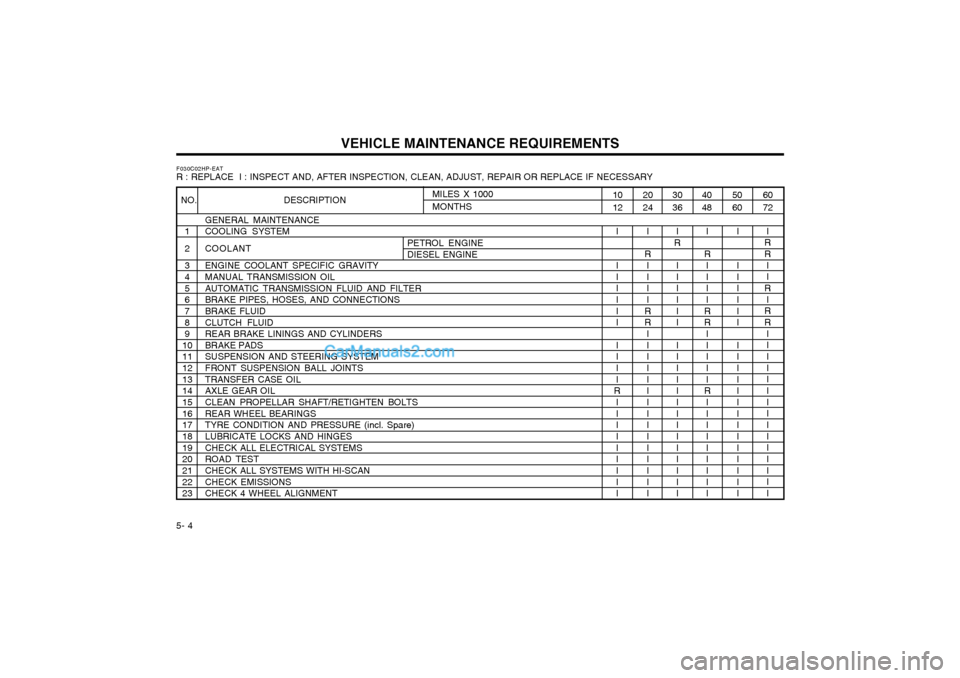
F030C02HP-EAT R : REPLACE I : INSPECT AND, AFTER INSPECTION, CLEAN, ADJUST, REPAIR OR REPLACE IF NECESSARY
GENERAL MAINTENANCE COOLING SYSTEM COOLANTENGINE COOLANT SPECIFIC GRAVITY MANUAL TRANSMISSION OIL AUTOMATIC TRANSMISSION FLUID AND FILTER BRAKE PIPES, HOSES, AND CONNECTIONSBRAKE FLUID CLUTCH FLUID REAR BRAKE LININGS AND CYLINDERSBRAKE PADSSUSPENSION AND STEERING SYSTEM FRONT SUSPENSION BALL JOINTS TRANSFER CASE OILAXLE GEAR OIL CLEAN PROPELLAR SHAFT/RETIGHTEN BOLTS REAR WHEEL BEARINGSTYRE CONDITION AND PRESSURE (incl. Spare) LUBRICATE LOCKS AND HINGES CHECK ALL ELECTRICAL SYSTEMSROAD TEST CHECK ALL SYSTEMS WITH HI-SCAN CHECK EMISSIONSCHECK 4 WHEEL ALIGNMENT
60 72
50 60
4048
I
R R
II
R
I
RR
III I II I II I II I II
I I I II I I I II I II I II I II I I
I
R I I II
RR I I II I
R II II I II I I
30 36
2024
I
R
I I II I I I II I II I II I II I I
I
R I I II
RR I I II I II I II I II I I
10 12
I I I II I I I II I
R
II II I II I I
MILES X 1000 MONTHS
NO. DESCRIPTION
1 23 4 5 67 8 9
1011 12 1314 15 1617 18 1920 21
22 23
PETROL ENGINE DIESEL ENGINE
Page 309 of 349
VEHICLE MAINTENANCE REQUIREMENTS 5-5
F040A05HP-EAT
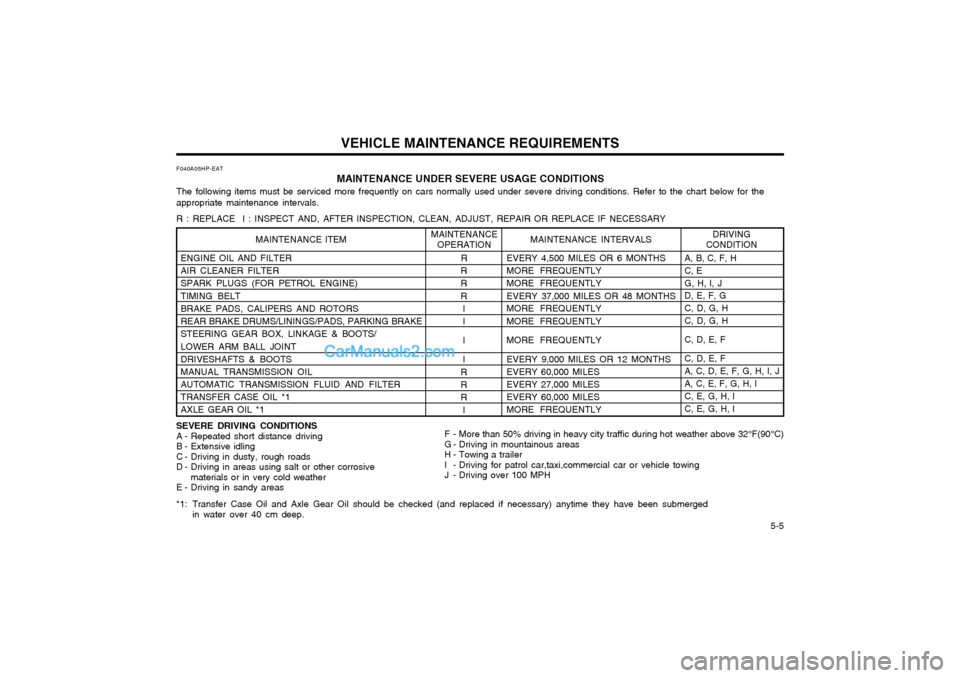
MAINTENANCE UNDER SEVERE USAGE CONDITIONS
The following items must be serviced more frequently on cars normally used under severe driving conditions. Refer to the chart below for the appropriate maintenance intervals. R : REPLACE I : INSPECT AND, AFTER INSPECTION, CLEAN, ADJUST, REPAIR OR REPLACE IF NECESSARY
SEVERE DRIVING CONDITIONS
A - Repeated short distance driving
B - Extensive idling
C - Driving in dusty, rough roads
D - Driving in areas using salt or other corrosive materials or in very cold weather
E - Driving in sandy areas ENGINE OIL AND FILTER AIR CLEANER FILTER SPARK PLUGS (FOR PETROL ENGINE) TIMING BELT BRAKE PADS, CALIPERS AND ROTORS REAR BRAKE DRUMS/LININGS/PADS, PARKING BRAKE STEERING GEAR BOX, LINKAGE & BOOTS/ LOWER ARM BALL JOINT DRIVESHAFTS & BOOTS MANUAL TRANSMISSION OIL AUTOMATIC TRANSMISSION FLUID AND FILTERTRANSFER CASE OIL *1AXLE GEAR OIL *1
EVERY 4,500 MILES OR 6 MONTHS MORE FREQUENTLY MORE FREQUENTLY EVERY 37,000 MILES OR 48 MONTHS MORE FREQUENTLY MORE FREQUENTLY MORE FREQUENTLYEVERY 9,000 MILES OR 12 MONTHS EVERY 60,000 MILESEVERY 27,000 MILESEVERY 60,000 MILES MORE FREQUENTLY
MAINTENANCE
OPERATIONMAINTENANCE ITEM
R
R R R II II
R R R I A, B, C, F, H C, EG, H, I, J D, E, F, G C, D, G, HC, D, G, H C, D, E, FC, D, E, F A, C, D, E, F, G, H, I, JA, C, E, F, G, H, I C, E, G, H, I C, E, G, H, I
MAINTENANCE INTERVALS
DRIVING
CONDITION
F - More than 50% driving in heavy city traffic during hot weather above 32°F(90°C)
G - Driving in mountainous areas
H - Towing a trailer
I - Driving for patrol car,taxi,commercial car or vehicle towing
J - Driving over 100 MPH
*1: Transfer Case Oil and Axle Gear Oil should be checked (and replaced if necessary) anytime they have been submerged in water over 40 cm deep.
Page 312 of 349
VEHICLE MAINTENANCE REQUIREMENTS
5- 8
F070M01B-AAT
o Steering gear box, linkage & boots/
lower arm ball joint, upper arm ball joint
With the vehicle stopped and engine off, check for excessive free-play in the steering wheel. Check the linkage for bends or damage. Check the dust boots and ball joints for deterioration,cracks, or damage. Replace any damagedparts. F070N01A-AAT
o Power steering pump, belt and hoses Check the power steering pump and hoses for leakage and damage. Replace any dam-aged or leaking parts immediately. Inspect thepower steering belt for evidence of cuts,cracks, excessive wear, oiliness and propertension. Replace or adjust it if necessary. F070P01HP-AAT o Driveshafts and bootsCheck the drive shafts, boots and clamps for cracks, deterioration, or damage. Replace anydamaged parts and, if necessary, repack thegrease. F070Q01A-AAT
o Air conditioning refrigerant
Check the air conditioning lines and connec-tions for leakage and damage. Check airconditioning performance according to therelevant shop manual if necessary.
Page 313 of 349
OWNER MAINTENANCE 6-1
SG000A1-E
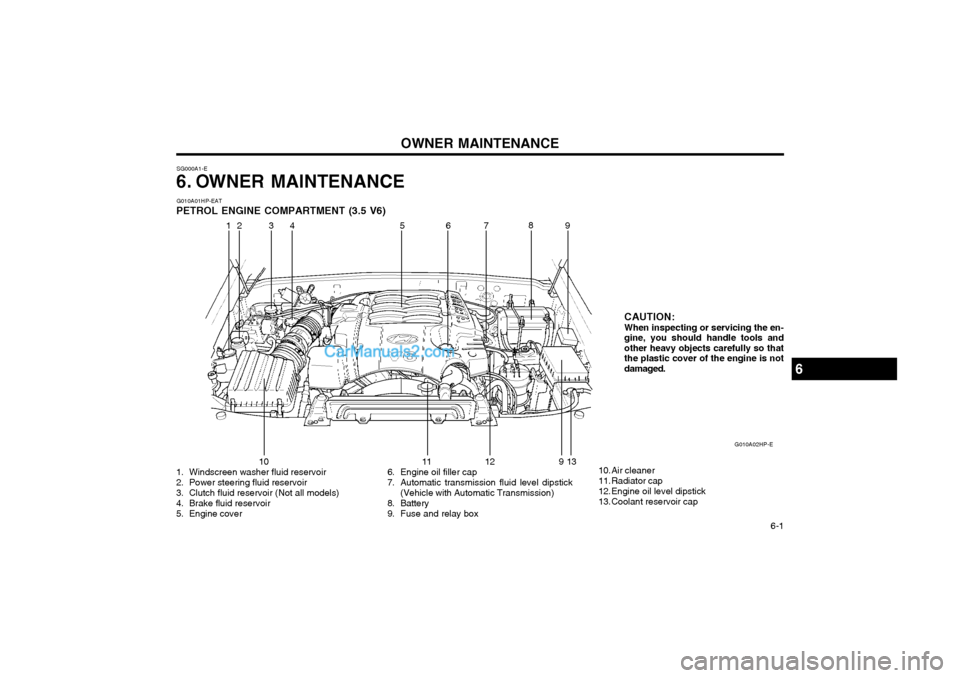
6. OWNER MAINTENANCE G010A01HP-EAT
PETROL ENGINE COMPARTMENT (3.5 V6)
1. Windscreen washer fluid reservoir
2. Power steering fluid reservoir
3. Clutch fluid reservoir (Not all models)
4. Brake fluid reservoir
5. Engine cover 6. Engine oil filler cap
7. Automatic transmission fluid level dipstick
(Vehicle with Automatic Transmission)
8. Battery
9. Fuse and relay box 10. Air cleaner
11. Radiator cap
12. Engine oil level dipstick
13. Coolant reservoir cap
6
G010A02HP-E
CAUTION: When inspecting or servicing the en- gine, you should handle tools andother heavy objects carefully so thatthe plastic cover of the engine is notdamaged.
1
234 5 6 7
8
9
10 9
11 12 13
Page 314 of 349
OWNER MAINTENANCE
6-2
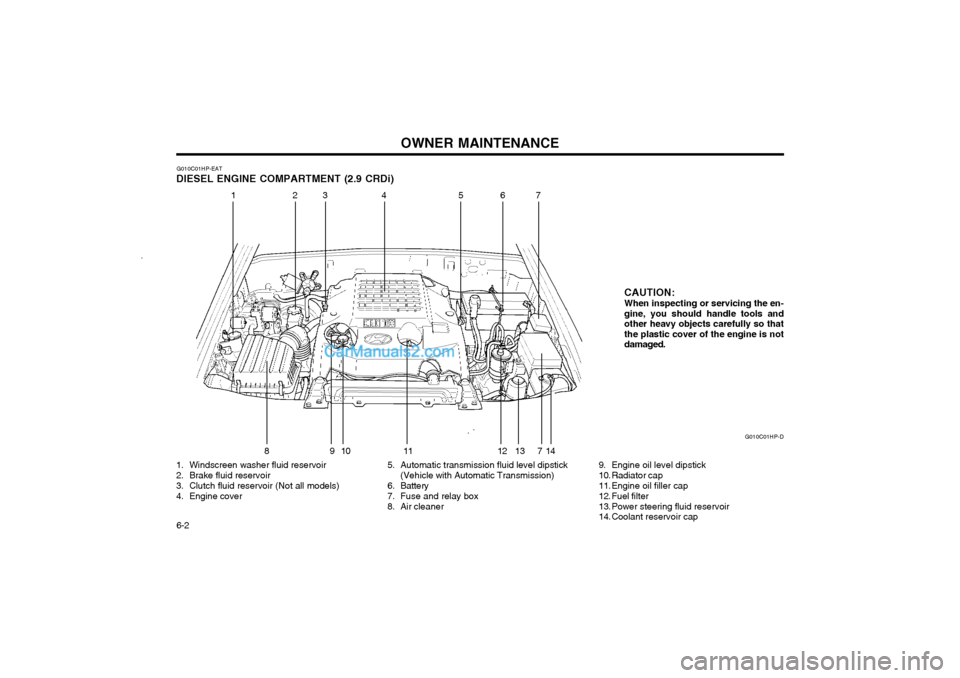
G010C01HP-EAT
DIESEL ENGINE COMPARTMENT (2.9 CRDi)
1. Windscreen washer fluid reservoir
2. Brake fluid reservoir
3. Clutch fluid reservoir (Not all models)
4. Engine cover 5. Automatic transmission fluid level dipstick
(Vehicle with Automatic Transmission)
6. Battery
7. Fuse and relay box
8. Air cleaner 9. Engine oil level dipstick
10. Radiator cap
11. Engine oil filler cap
12. Fuel filter
13. Power steering fluid reservoir
14. Coolant reservoir capG010C01HP-D
CAUTION: When inspecting or servicing the en- gine, you should handle tools andother heavy objects carefully so thatthe plastic cover of the engine is notdamaged.
12
34 56
8 9 10 11 12 7 137
14