lock Hyundai Terracan 2003 Workshop Manual
[x] Cancel search | Manufacturer: HYUNDAI, Model Year: 2003, Model line: Terracan, Model: Hyundai Terracan 2003Pages: 349, PDF Size: 4.56 MB
Page 150 of 349
DO-IT-YOURSELF MAINTENANCE
6-4
G020A01A-AAT GENERAL CHECKS Engine Compartment The following should be checked regularly:
o Engine oil level and condition
o Transmission fluid level and condition
o Brake fluid level
o Clutch fluid level
o Engine coolant level
o Windshield washer fluid level
o Accessory drive belt condition
o Engine coolant hose condition
o Fluid leaks (on or below components)
o Power steering fluid level
o Battery condition
o Air filter condition G020B01A-AAT Vehicle Exterior The following should be checked monthly:
o Overall appearance and condition
o Wheel condition and wheel nut torque
o Exhaust system condition
o Light condition and operation
o Windshield glass condition
o Wiper blade condition
o Paint condition and body corrosion
o Fluid leaks
o Door and hood lock condition
o Tire pressure and condition (including
spare tire) G020C01A-AAT Vehicle InteriorThe following should be checked each time when the vehicle is driven:
o Lights operation
o Windshield wiper operation
o Horn operation
o Defroster, heating system operation (and air
conditioning, if installed)
o Steering operation and condition
o Mirror condition and operation
o Turn signal operation
o Accelerator pedal operation
o Brake operation, including parking brake
o Manual transmission operation, including clutch operation
o Automatic transmission operation, including "Park" mechanism operation
o Seat control condition and operation
o Seat belt condition and operation
o Sunvisor operation If you notice anything that does not operate correctly or appears to be functioning incorrect- ly, inspect it carefully and seek assistance from your Hyundai dealer if service is needed. G030A01A-AAT CHECKING THE ENGINE OILEngine oil is essential to the performance and service of the engine. It is suggested that you check the oil level at least once a week in normal use and more often if you are on a trip or driving in severe conditions. G030B03HP-GAT Recommended Oil 1. Gasoline Engine
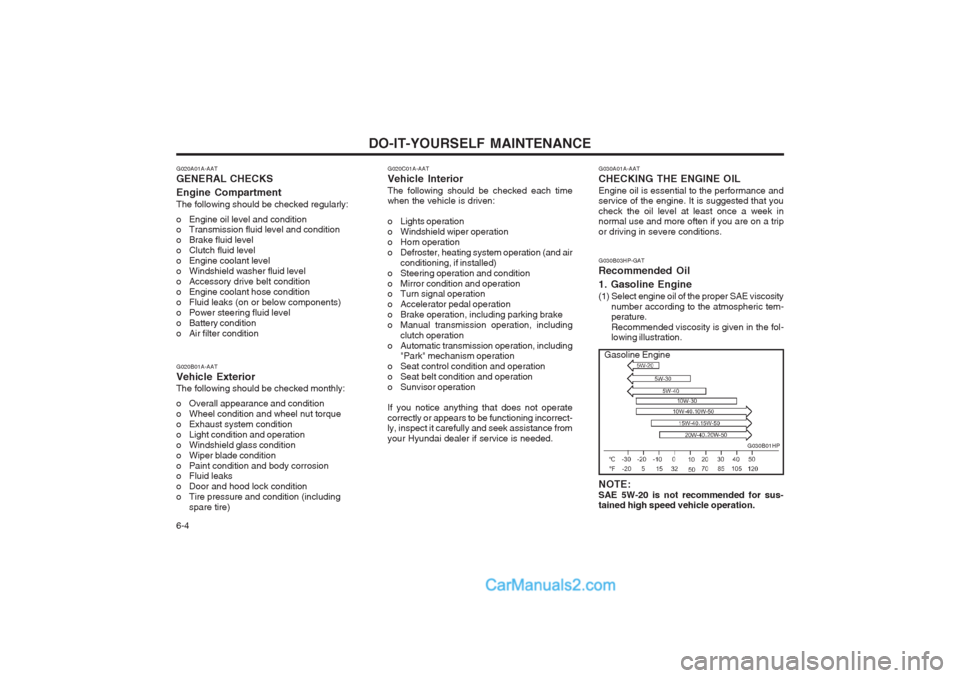
(1) Select engine oil of the proper SAE viscosity
number according to the atmospheric tem- perature. Recommended viscosity is given in the fol- lowing illustration.
G030B01HP
NOTE: SAE 5W-20 is not recommended for sus- tained high speed vehicle operation.
Gasoline Engine
Page 152 of 349
DO-IT-YOURSELF MAINTENANCE
6-6
G350A01A-GAT ENGINE OIL CONSUMPTION Function of Engine Oil Engine oil has the primary function of lubricat- ing and cooling the inside of the engine. Engine oil consumption It is normal that an engine should consume
some engine oil while normal driving. The cause of oil consumption in a normal engine are as follows;
o Engine oil is used to lubricate pistons, piston rings and cylinders. A thin film of oil is left on the cylinder wall
when a piston moves downwards in the cylinder. High negative pressure generated during engine operation sucks some of the oil into the combustion chamber. This oil with some oil of the cylinder wall is
burned by the high temperature combustion gases during the combustion process.
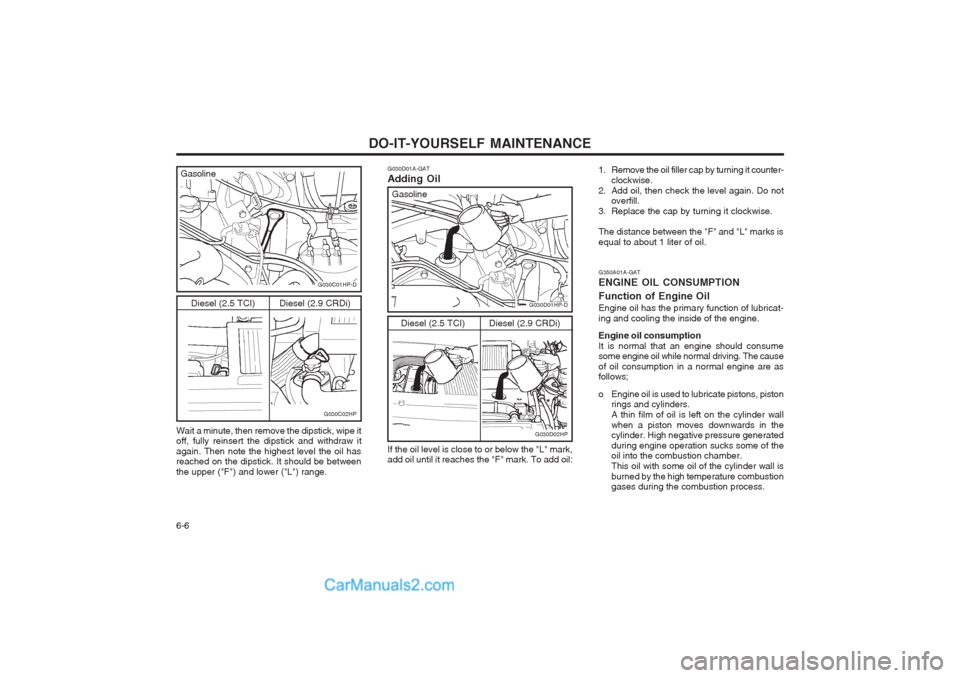
1. Remove the oil filler cap by turning it counter-
clockwise.
2. Add oil, then check the level again. Do not overfill.
3. Replace the cap by turning it clockwise. The distance between the "F" and "L" marks is equal to about 1 liter of oil.
G030D01A-GAT Adding Oil
G030D01HP-D
Gasoline
G030D02HP
Diesel (2.9 CRDi)
Diesel (2.5 TCI)
G030C01HP-D
G030C02HP
Diesel (2.9 CRDi)
Diesel (2.5 TCI)
Gasoline
Wait a minute, then remove the dipstick, wipe it off, fully reinsert the dipstick and withdraw it again. Then note the highest level the oil has reached on the dipstick. It should be between the upper ("F") and lower ("L") range. If the oil level is close to or below the "L" mark, add oil until it reaches the "F" mark. To add oil:
Page 153 of 349
DO-IT-YOURSELF MAINTENANCE 6-7
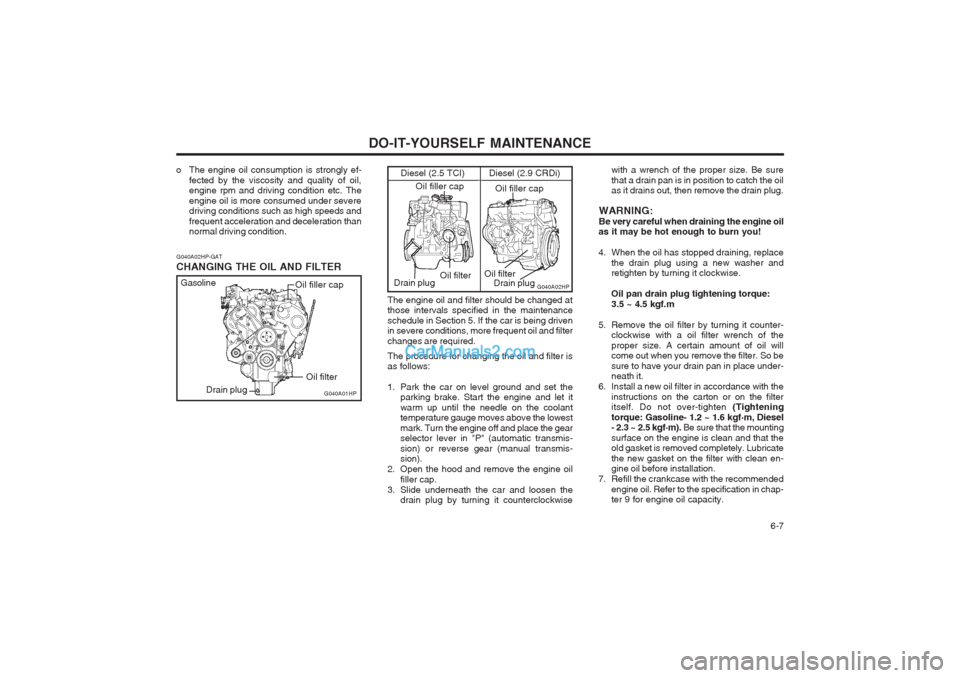
The engine oil and filter should be changed at those intervals specified in the maintenance schedule in Section 5. If the car is being driven in severe conditions, more frequent oil and filter changes are required. The procedure for changing the oil and filter is as follows:
1. Park the car on level ground and set theparking brake. Start the engine and let it warm up until the needle on the coolant temperature gauge moves above the lowest mark. Turn the engine off and place the gear selector lever in "P" (automatic transmis- sion) or reverse gear (manual transmis- sion).
2. Open the hood and remove the engine oil filler cap.
3. Slide underneath the car and loosen the drain plug by turning it counterclockwise with a wrench of the proper size. Be sure that a drain pan is in position to catch the oil as it drains out, then remove the drain plug.
WARNING: Be very careful when draining the engine oil
as it may be hot enough to burn you!
4. When the oil has stopped draining, replace
the drain plug using a new washer and retighten by turning it clockwise. Oil pan drain plug tightening torque: 3.5 ~ 4.5 kgf.m
5. Remove the oil filter by turning it counter- clockwise with a oil filter wrench of theproper size. A certain amount of oil will come out when you remove the filter. So be sure to have your drain pan in place under- neath it.
6. Install a new oil filter in accordance with the instructions on the carton or on the filteritself. Do not over-tighten (Tightening
torque: Gasoline- 1.2 ~ 1.6 kgf .
m, Diesel
- 2.3 ~ 2.5 kgf .
m). Be sure that the mounting
surface on the engine is clean and that theold gasket is removed completely. Lubricate the new gasket on the filter with clean en- gine oil before installation.
7. Refill the crankcase with the recommended engine oil. Refer to the specification in chap-ter 9 for engine oil capacity.
G040A02HP
Diesel (2.9 CRDi)
Diesel (2.5 TCI)
Oil filter
Oil filler cap
Oil filler cap
Drain plug Oil filter
Drain plug
G040A02HP-GAT CHANGING THE OIL AND FILTER
o The engine oil consumption is strongly ef-
fected by the viscosity and quality of oil, engine rpm and driving condition etc. The engine oil is more consumed under severe driving conditions such as high speeds and
frequent acceleration and deceleration than normal driving condition.
G040A01HP
Gasoline
Oil filter
Drain plug Oil filler cap
Page 155 of 349
DO-IT-YOURSELF MAINTENANCE 6-9
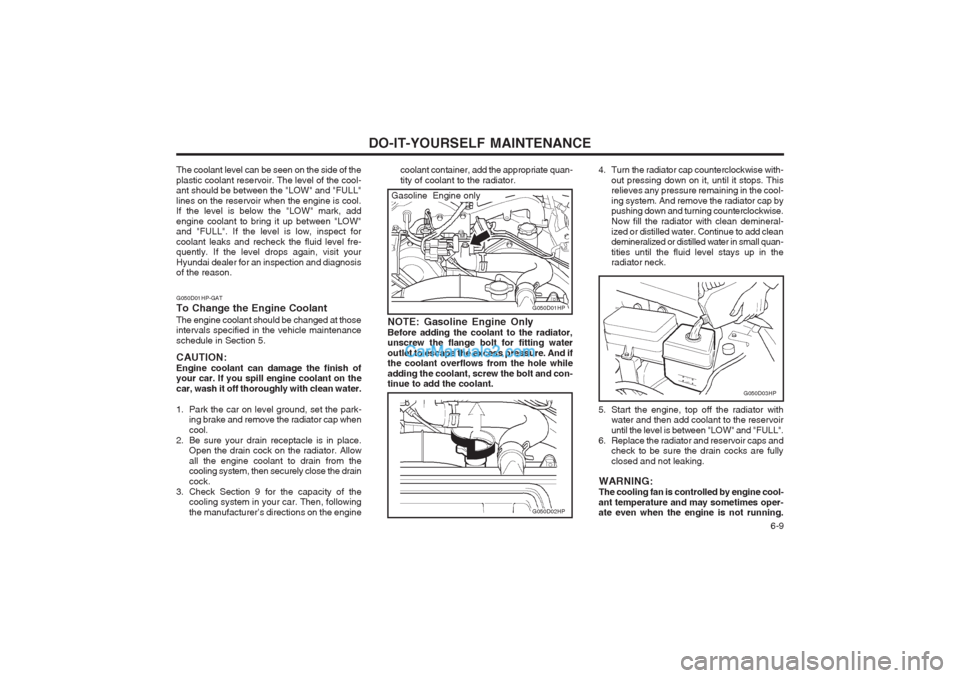
coolant container, add the appropriate quan- tity of coolant to the radiator.
G050D03HP
G050D01HP
G050D02HP
NOTE: Gasoline Engine Only Before adding the coolant to the radiator, unscrew the flange bolt for fitting water outlet to escape the excess pressure. And if the coolant overflows from the hole while adding the coolant, screw the bolt and con- tinue to add the coolant. 4. Turn the radiator cap counterclockwise with-
out pressing down on it, until it stops. Thisrelieves any pressure remaining in the cool- ing system. And remove the radiator cap by pushing down and turning counterclockwise. Now fill the radiator with clean demineral-ized or distilled water. Continue to add clean demineralized or distilled water in small quan- tities until the fluid level stays up in the radiator neck.
5. Start the engine, top off the radiator with water and then add coolant to the reservoir until the level is between "LOW" and "FULL".
6. Replace the radiator and reservoir caps and check to be sure the drain cocks are fullyclosed and not leaking.
WARNING:The cooling fan is controlled by engine cool-
ant temperature and may sometimes oper- ate even when the engine is not running.
Gasoline Engine only
The coolant level can be seen on the side of the plastic coolant reservoir. The level of the cool- ant should be between the "LOW" and "FULL" lines on the reservoir when the engine is cool. If the level is below the "LOW" mark, add engine coolant to bring it up between "LOW" and "FULL". If the level is low, inspect for coolant leaks and recheck the fluid level fre- quently. If the level drops again, visit your Hyundai dealer for an inspection and diagnosis of the reason.
G050D01HP-GAT To Change the Engine CoolantThe engine coolant should be changed at those intervals specified in the vehicle maintenance schedule in Section 5. CAUTION: Engine coolant can damage the finish of your car. If you spill engine coolant on the car, wash it off thoroughly with clean water.
1. Park the car on level ground, set the park-
ing brake and remove the radiator cap when cool.
2. Be sure your drain receptacle is in place. Open the drain cock on the radiator. Allowall the engine coolant to drain from the cooling system, then securely close the drain cock.
3. Check Section 9 for the capacity of the cooling system in your car. Then, followingthe manufacturer’s directions on the engine
Page 158 of 349
DO-IT-YOURSELF MAINTENANCE
6-12
G110D02HP-GAT
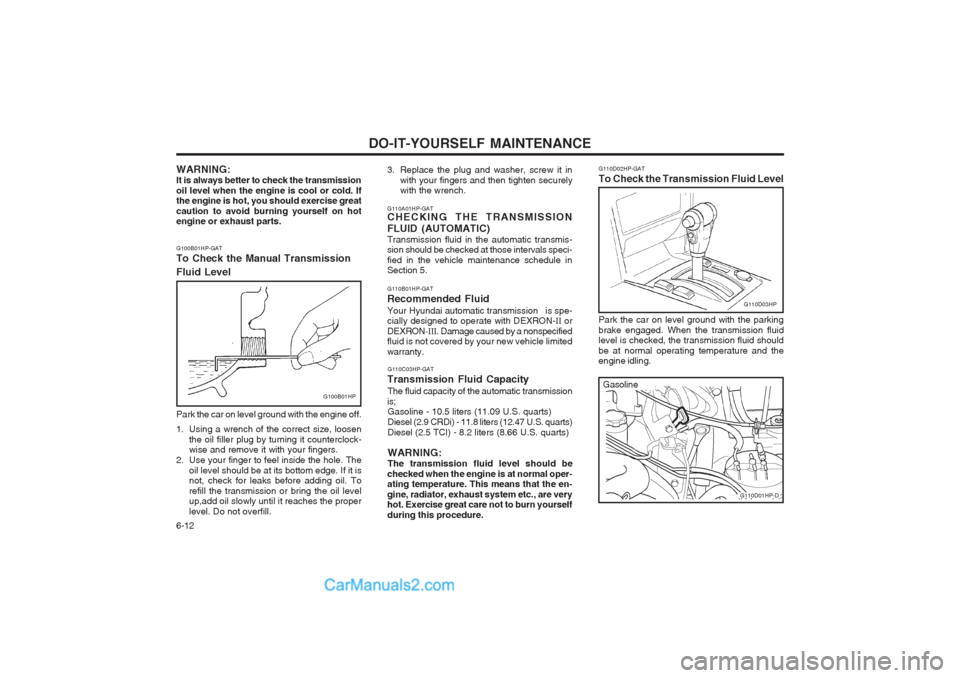
To Check the Transmission Fluid Level
G110D03HP
Park the car on level ground with the parking brake engaged. When the transmission fluid level is checked, the transmission fluid should be at normal operating temperature and the engine idling.
G110C03HP-GAT
Transmission Fluid Capacity The fluid capacity of the automatic transmission
is; Gasoline - 10.5 liters (11.09 U.S. quarts) Diesel (2.9 CRDi) - 11.8 liters (12.47 U.S. quarts)
Diesel (2.5 TCI) - 8.2 liters (8.66 U.S. quarts)
WARNING:The transmission fluid level should be
checked when the engine is at normal oper- ating temperature. This means that the en- gine, radiator, exhaust system etc., are very hot. Exercise great care not to burn yourself during this procedure.
G110A01HP-GAT
CHECKING THE TRANSMISSION FLUID (AUTOMATIC) Transmission fluid in the automatic transmis- sion should be checked at those intervals speci- fied in the vehicle maintenance schedule in Section 5. G110B01HP-GAT Recommended FluidYour Hyundai automatic transmission is spe- cially designed to operate with DEXRON- II or
DEXRON -III. Damage caused by a nonspecified
fluid is not covered by your new vehicle limited warranty.
3. Replace the plug and washer, screw it in
with your fingers and then tighten securely with the wrench.
G110D01HP-D
Gasoline
G100B01HP-GAT To Check the Manual Transmission Fluid LevelG100B01HP
WARNING: It is always better to check the transmissionoil level when the engine is cool or cold. If the engine is hot, you should exercise great caution to avoid burning yourself on hot engine or exhaust parts. Park the car on level ground with the engine off.
1. Using a wrench of the correct size, loosen
the oil filler plug by turning it counterclock- wise and remove it with your fingers.
2. Use your finger to feel inside the hole. The oil level should be at its bottom edge. If it isnot, check for leaks before adding oil. To refill the transmission or bring the oil level up,add oil slowly until it reaches the proper level. Do not overfill.
Page 175 of 349
CONSUMER INFORMATION 8-1
8. CONSUMER
INFORMATION
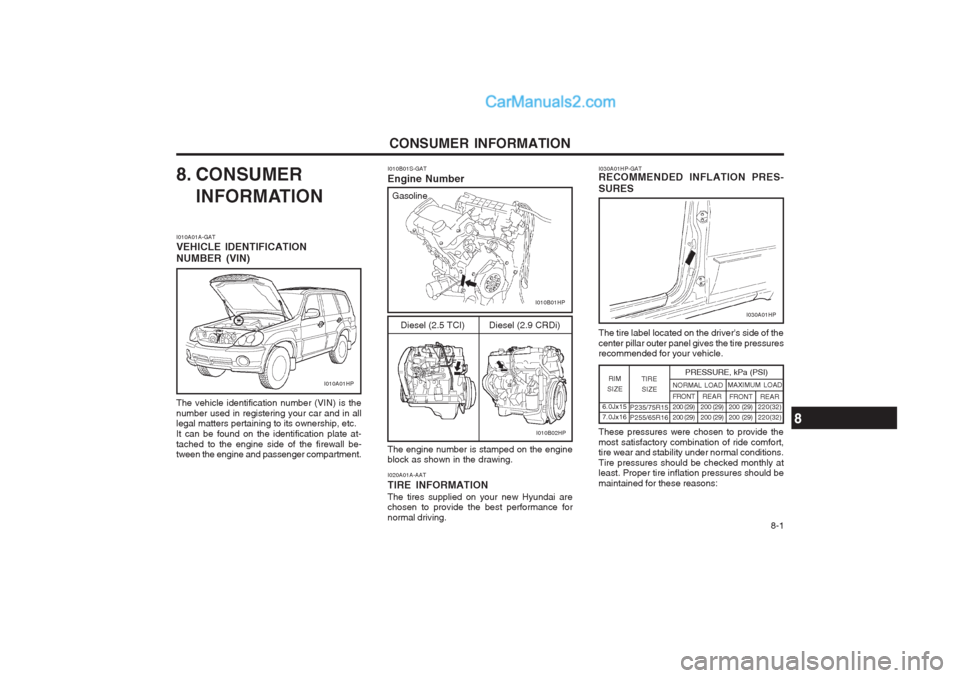
I010A01A-GAT VEHICLE IDENTIFICATION NUMBER (VIN) The vehicle identification number (VIN) is the number used in registering your car and in all legal matters pertaining to its ownership, etc. It can be found on the identification plate at-tached to the engine side of the firewall be- tween the engine and passenger compartment. I020A01A-AAT TIRE INFORMATIONThe tires supplied on your new Hyundai are chosen to provide the best performance for normal driving.
I010A01HP I030A01HP-GAT RECOMMENDED INFLATION PRES- SURES
The tire label located on the driver's side of the center pillar outer panel gives the tire pressures recommended for your vehicle.
I030A01HP
I010B01S-GAT Engine Number The engine number is stamped on the engine block as shown in the drawing.
I010B02HP
8
I010B01HP
Diesel (2.9 CRDi)
Diesel (2.5 TCI)
Gasoline
6.0Jx15 7.0Jx16
TIRE
SIZE
RIM
SIZE PRESSURE, kPa (PSI)
P235/75R15 P255/65R16 REAR
200 (29) 200 (29) FRONT
200 (29)200 (29)
NORMAL LOAD
MAXIMUM LOAD
REAR
220(32)220(32)
FRONT200 (29)200 (29)
These pressures were chosen to provide the most satisfactory combination of ride comfort, tire wear and stability under normal conditions. Tire pressures should be checked monthly at least. Proper tire inflation pressures should be maintained for these reasons:
Page 182 of 349
INDEX 10-1
A Air bag
................................................................................... 1-29 ~ 1-32
Air Cleaner Filter ............................................................................... 6-10
Air Conditioning Care .............................................................................................. 6-14
Operation .............................................................................. 1-72, 6-15
Switch ............................................................................................ 1-71
Air Filter (For Evaporator and Blower Uni t) ............................. 1-78, 6-15
Antenna ............................................................................................. 1-98
Ashtray .............................................................................................. 1-52
Audio Fault Code .............................................................................. 1-95
Automatic Heating and Cooling Control System ................... 1-73 ~ 1-77
BBattery ...................................................................................... 2-14, 6-18
Bi-Level Heating ................................................................................ 1-69
Brake
Anti-lock system .............................................................................. 2-8
Checking the brakes ..................................................................... 6-13
Fluid ............................................................................................... 6-13
Pedal clearance ............................................................................ 6-17
Pedal free-play .............................................................................. 6-17
Practices ....................................................................................... 2-12
Breaking-In your New Hyundai ........................................................... 1-2 CCare of Cass
ette Tapes ................................................................... 1-96
Care of Disc ...................................................................................... 1-96
Cassette Tape Player Operation (H240) ............................... 1-84 ~ 1-85
Cassette Tape Player Operation (H280) ............................... 1-89 ~ 1-90
Catalytic Con verte .............................................................................. 7-1
CD Auto changer (H280) ............................................. 1-59, 1-93 ~ 1-94
Child Restraint System .......................................................... 1-23 ~ 1-27
Child-Protector Rear Door Lock ......................................................... 1-7
Cigarette Lighter ................................................................................ 1-51
Clock ................................................................................................. 1-50
Clutch Checking fluid ................................................................................ 6-14
Pedal free-play .............................................................................. 6-17
Combination Light Headlight flasher ........................................................................... 1-48
Headlight switch ............................................................................ 1-48
High-beam switch .......................................................................... 1-48
Lane change signal ....................................................................... 1-47
Parking light auto cut .................................................................... 1-48
Turn signal operation .................................................................... 1-47
Compact Disc Player Operation (H280) ................................ 1-91 ~ 1-92
Cooling Fans ..................................................................................... 6-20
Corrosion protection
Cleaning the interior ........................................................................ 4-3
Protecting your Hyundai from corrosion ......................................... 4-1Washing and waxing ....................................................................... 4-2
Cruise Control ........................................................................ 1-64 ~ 1-66
10. INDEX
10
Page 183 of 349
INDEX
10-2
D Defrosting/Defogging
......................................................................... 1-70
Door
Locking, unlocking front door with a key ........................................ 1-6
Drink Holder ...................................................................................... 1-52
Drive Belts ............................................................................... 6-15, 6-18
Driving
Driving for economy ...................................................................... 2-13
Smooth cornering .......................................................................... 2-14
Winter driving ................................................................................ 2-14
E
Emission Control System ................................................................... 7-1
Engine
Before starting the engine ............................................................... 2-2
Compartment (3.5 V6) ..................................................................... 6-1
Compartment (2.5 TCI) ................................................................... 6-2
Compartment (2.9 CRDi) ................................................................ 6-3
Coolant ............................................................................................ 6-7
Coolant temperature gauge ........................................................... 1-42
If the engine overheats ................................................................... 3-2
Number ............................................................................................ 8-1
Oil .................................................................................................... 6-4Starting ............................................................................................ 2-3
Engine Exhaust Can Be Dangerous ................................................... 2-1
FFan Speed Control ................................................................... 1-66, 1-75 Fog Light
Front .............................................................................................. 1-47
Rear .............................................................................................. 1-47
Front Seats Adjustable front seats ................................................................... 1-11
Adjustable headrests ..................................................................... 1-12
Adjusting seat forward and rearward ............................................1-11
Adjusting seatback angle .............................................................. 1-11
Fuel Capacity .......................................................................................... 9-1
Gauge ............................................................................................ 1-42
Unleaded gasoline ........................................................................... 1-1
Fuel Filler Lid Remote release ............................................................................. 1-61
Full-time 4WD Operation ....................................................... 2-10 ~ 2-12
Fuses ................................................................................................ 6-18
GGeneral Checks .................................................................................. 6-4
Glove Box ......................................................................................... 1-55
HHazard Warning System ................................................................... 1-50
Headlight Aiming Adjustment ............................................................ 6-24
Headlight Leveling Device System ...................................................1-64
Heating and Ventilation Air flow control ......................................................... 1-67 ~ 1-68, 1-76
Temperature control ...................................................................... 1-68
Page 184 of 349
INDEX 10-3
High-Mounted Rear Stoplight ............................................................
1-61
Hood Release ................................................................................... 1-62
Horn .................................................................................................. 1-63
I
Ignition Switch ..................................................................................... 2-2Immobilizer System .................................................................... 1-3 ~ 1-6
Limp Home Procedures ....................................... 1-3 ~ 1-4, 1-5 ~ 1-6
Key ........................................................................................... 1-3, 1-4
Instrument Cluster and Indicator ............................................ 1-34 ~ 1-37
Instrument Panel Light Control (Rheostat) .......................................1-51
Instruments and Controls ............. ..................................................... 1-33
Intermittent Wiper .............................................................................. 1-49
JJump Starting ...................................................................................... 3-1
K
Key ...................................................................................................... 1-2 If you lose your keys .................................................................... 3-10
Positions .......................................................................................... 2-2
L
Light Bulbs Replacement ............. ..................................................... 6-23
Limited-Slip Differential ..................................................................... 2-12Luggage Compartment
Cargo Security Screen .................................................................. 1-60
Light ............................................................................................... 1-59
Net ................................................................................................. 1-59
MMaintenance Intervals Explanation of scheduled maintenance items ........................ 5-7 ~ 5-8
Maintenance under severe usage conditions ................................. 5-6
Scheduled maintenance ......................................................... 5-2 ~ 5-5
Service requirements ...................................................................... 5-1
Mirrors Day-night inside rearview ................................................... 1-57 ~ 1-58
Outside rear view .......................................................................... 1-55
Multimeter ............................................................................... 1-44 ~ 1-46
Altimeter ........................................................................................ 1-45
Azimuth compass .......................................................................... 1-44
Barometer ...................................................................................... 1-46
Digital Clock .................................................................................. 1-46
Relative altimeter ........................................................................... 1-45
OOdometer .......................................................................................... 1-43
PParking Brake ................................................................................... 1-58
Part-time 4WD Operation ......................................................... 2-9 ~ 2-10
Power Driver's Seat .......................................................................... 1-13
Page 197 of 349
CONTROLS AND EQUIPMENT1- 3
The key number should be recorded and kept in
a safe place in case the need to order further keys arises. New keys are available from anyHyundai dealer by quoting the relevant key num-ber.
In the interest of security, the metal tag attached
to the keys which bears the key number shouldbe removed from the key ring after you receive
your new vehicle. In addition, key numbers can-
not be provided by Hyundai for security reasons.
If you need additional keys or if you should lose
your keys, your authorized Hyundai dealer canmake new keys if you can supply the key num-ber and ID key.
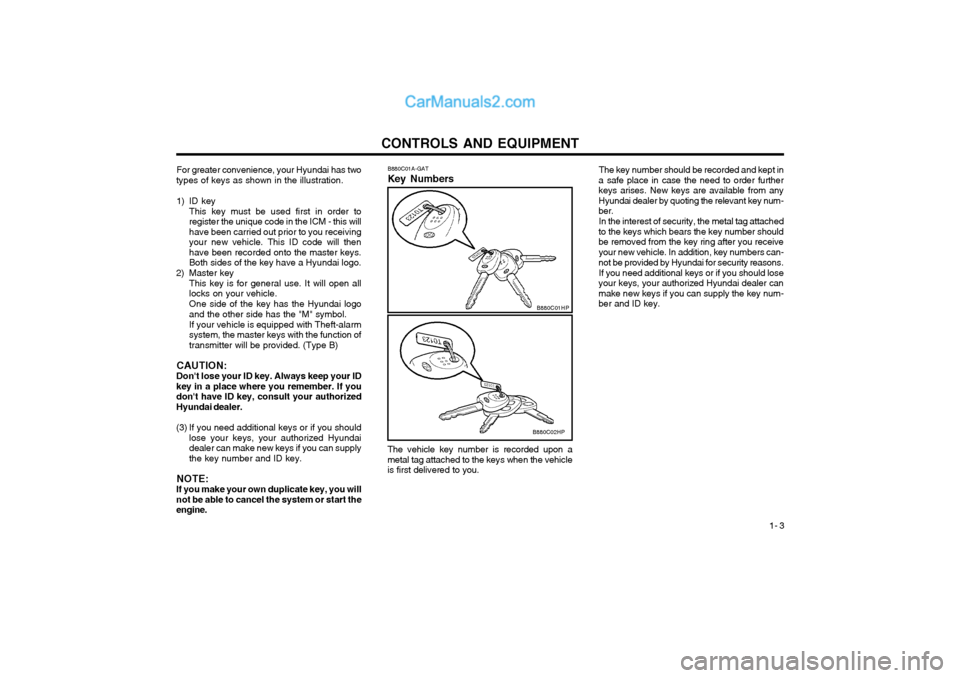
For greater convenience, your Hyundai has two
types of keys as shown in the illustration.
1) ID key This key must be used first in order toregister the unique code in the ICM - this willhave been carried out prior to you receivingyour new vehicle. This ID code will thenhave been recorded onto the master keys.Both sides of the key have a Hyundai logo.
2) Master key This key is for general use. It will open alllocks on your vehicle. One side of the key has the Hyundai logo and the other side has the "M" symbol. If your vehicle is equipped with Theft-alarm system, the master keys with the function oftransmitter will be provided. (Type B)
CAUTION:
Don't lose your ID key. Always keep your IDkey in a place where you remember. If youdon't have ID key, consult your authorizedHyundai dealer.
(3) If you need additional keys or if you should lose your keys, your authorized Hyundai dealer can make new keys if you can supplythe key number and ID key.
NOTE:
If you make your own duplicate key, you willnot be able to cancel the system or start theengine. B880C01A-GAT Key Numbers The vehicle key number is recorded upon a metal tag attached to the keys when the vehicleis first delivered to you.
B880C01HP
B880C02HP