fuel system Hyundai Terracan 2003 Owner's Manual
[x] Cancel search | Manufacturer: HYUNDAI, Model Year: 2003, Model line: Terracan, Model: Hyundai Terracan 2003Pages: 349, PDF Size: 4.56 MB
Page 4 of 349
A050A04A-AATHYUNDAI MOTOR COMPANY
Note: Because future owners will also need the information included in this manual, if you sell this Hyundai,
please leave the manual in the vehicle for their use. Thank you. CAUTION: Severe engine and transmission damage may result from the use of poor quality fuels and lubricants that do not meet Hyundai specifications. You must always use high quality fuels and lubricantsthat meet the specifications listed on Page 9-3 in the Vehicle Specifications section of the Owner'sManual. Copyright 2003 Hyundai Motor Company. All rights reserved. No part of this publication may be reproduced, stored in any retrieval system or transmitted in any form or by any means without the prior written permission of Hyundai Motor Company.
A040A01A-GAT
FOREWORD
Thank you for choosing Hyundai. We are pleased to welcome you to the growing number of discriminatingpeople who drive Hyundai. The advanced engineering and high-quality construction of each Hyundai webuild is something of which we’re very proud. Your Owner’s Manual will introduce you to the features and operation of your new Hyundai. It is suggested that you read it carefully because the information it contains can contribute greatly to the satisfaction you receive from your new car. The manufacturer also recommends that all service and maintenance on your car be performed by an authorized Hyundai dealer. Hyundai dealers are prepared to provide high-quality service, maintenance andany other assistance that may be required.
Page 9 of 349
FEATURES OF YOUR HYUNDAI 1- 1
1. FEATURES OF
YOUR HYUNDAI
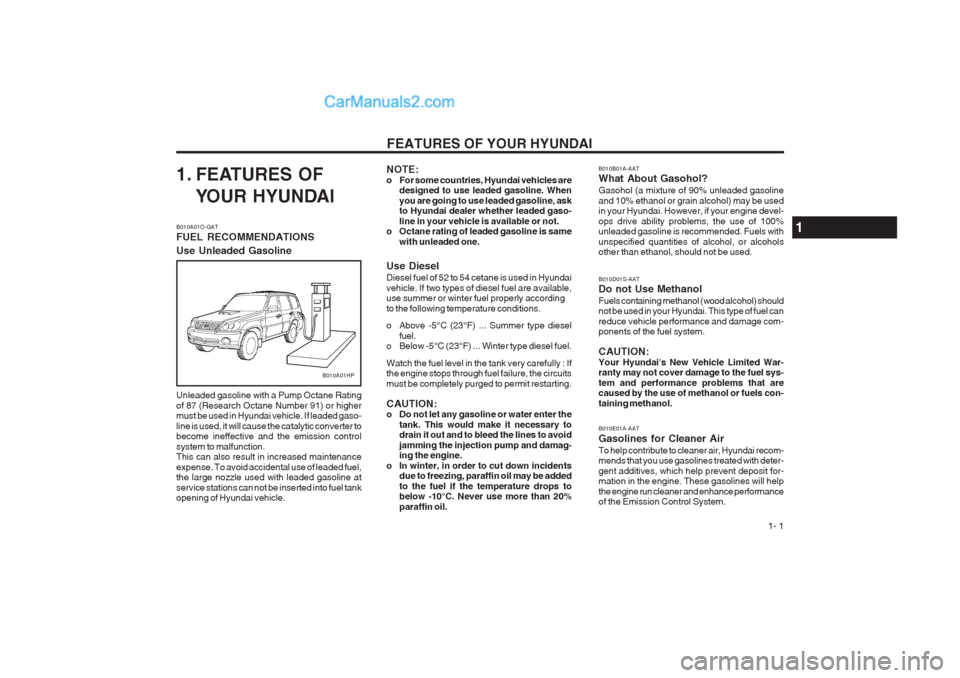
B010A01O-GAT FUEL RECOMMENDATIONS Use Unleaded Gasoline Unleaded gasoline with a Pump Octane Rating of 87 (Research Octane Number 91) or higher must be used in Hyundai vehicle. If leaded gaso- line is used, it will cause the catalytic converter to become ineffective and the emission control system to malfunction. This can also result in increased maintenance expense. To avoid accidental use of leaded fuel, the large nozzle used with leaded gasoline at service stations can not be inserted into fuel tank opening of Hyundai vehicle. NOTE:
o For some countries, Hyundai vehicles are
designed to use leaded gasoline. Whenyou are going to use leaded gasoline, ask to Hyundai dealer whether leaded gaso- line in your vehicle is available or not.
o Octane rating of leaded gasoline is same
with unleaded one. B010B01A-AAT What About Gasohol? Gasohol (a mixture of 90% unleaded gasoline and 10% ethanol or grain alcohol) may be used in your Hyundai. However, if your engine devel- ops drive ability problems, the use of 100% unleaded gasoline is recommended. Fuels with unspecified quantities of alcohol, or alcohols other than ethanol, should not be used. B010D01S-AAT Do not Use Methanol Fuels containing methanol (wood alcohol) should
not be used in your Hyundai. This type of fuel can reduce vehicle performance and damage com- ponents of the fuel system. CAUTION: Your Hyundai's New Vehicle Limited War- ranty may not cover damage to the fuel sys- tem and performance problems that are caused by the use of methanol or fuels con- taining methanol.
B010A01HP
B010E01A-AAT Gasolines for Cleaner AirTo help contribute to cleaner air, Hyundai recom- mends that you use gasolines treated with deter- gent additives, which help prevent deposit for- mation in the engine. These gasolines will help the engine run cleaner and enhance performance of the Emission Control System.
Use Diesel Diesel fuel of 52 to 54 cetane is used in Hyundai vehicle. If two types of diesel fuel are available, use summer or winter fuel properly according to the following temperature conditions.
o Above -5°C (23°F) ... Summer type diesel
fuel.
o Below -5°C (23°F) ... Winter type diesel fuel. Watch the fuel level in the tank very carefully : If the engine stops through fuel failure, the circuits must be completely purged to permit restarting. CAUTION:
o Do not let any gasoline or water enter the
tank. This would make it necessary todrain it out and to bleed the lines to avoid jamming the injection pump and damag- ing the engine.
o In winter, in order to cut down incidents due to freezing, paraffin oil may be added to the fuel if the temperature drops to below -10°C. Never use more than 20% paraffin oil.
1
Page 41 of 349
FEATURES OF YOUR HYUNDAI 1- 33
8
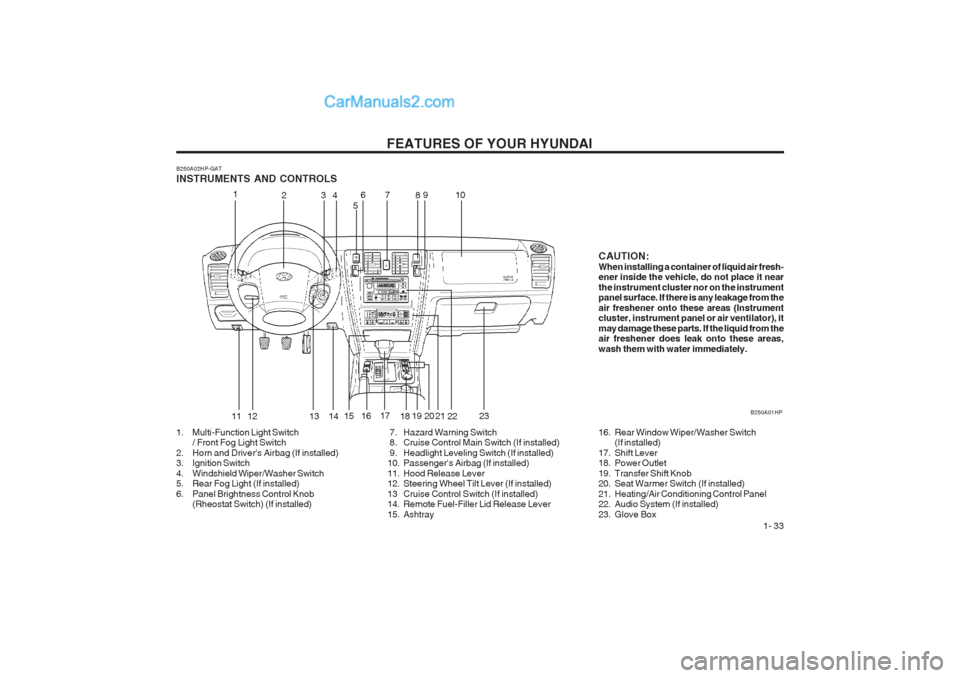
B250A02HP-GAT INSTRUMENTS AND CONTROLS
1. Multi-Function Light Switch
/ Front Fog Light Switch
2. Horn and Driver's Airbag (If installed)
3. Ignition Switch
4. Windshield Wiper/Washer Switch
5. Rear Fog Light (If installed)
6. Panel Brightness Control Knob (Rheostat Switch) (If installed) 7. Hazard Warning Switch
8. Cruise Control Main Switch (If installed)
9. Headlight Leveling Switch (If installed)
10. Passenger's Airbag (If installed)
11. Hood Release Lever
12. Steering Wheel Tilt Lever (If installed)
13 Cruise Control Switch (If installed)
14. Remote Fuel-Filler Lid Release Lever
15. Ashtray B250A01HP1
23 4
56
11 79
12 13 15 16
17
18
19 2014
16. Rear Window Wiper/Washer Switch(If installed)
17. Shift Lever
18. Power Outlet
19. Transfer Shift Knob
20. Seat Warmer Switch (If installed)
21. Heating/Air Conditioning Control Panel
22. Audio System (If installed)
23. Glove Box21
10
2223 CAUTION: When installing a container of liquid air fresh- ener inside the vehicle, do not place it near the instrument cluster nor on the instrument panel surface. If there is any leakage from the air freshener onto these areas (Instrument cluster, instrument panel or air ventilator), it may damage these parts. If the liquid from the air freshener does leak onto these areas, wash them with water immediately.
Page 43 of 349
FEATURES OF YOUR HYUNDAI 1- 35
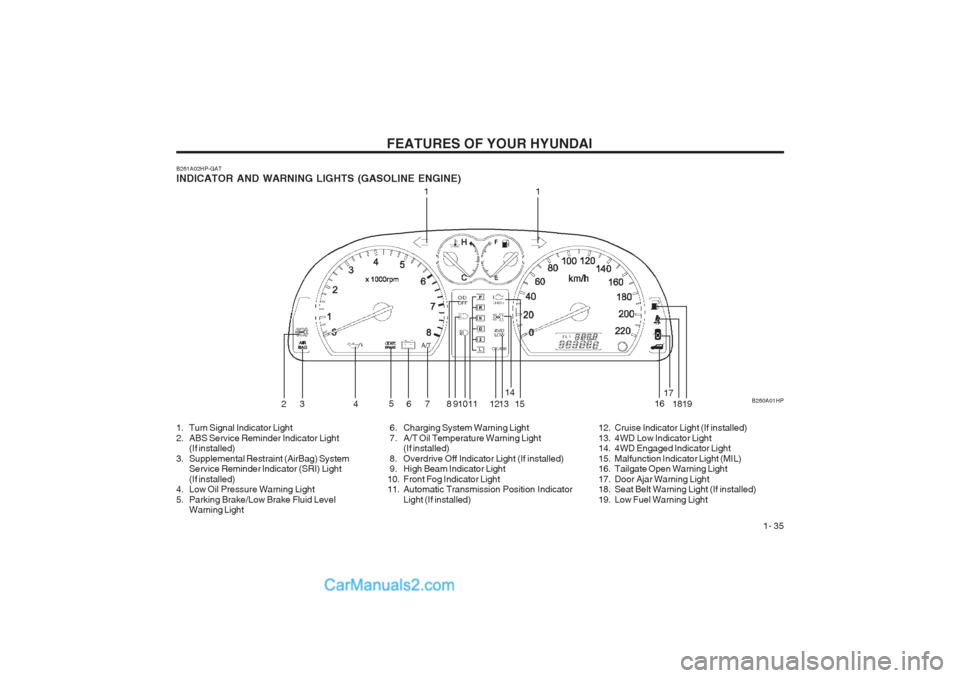
B261A02HP-GAT INDICATOR AND WARNING LIGHTS (GASOLINE ENGINE) B260A01HP
11
23 4 5
6 7 8 910 11 1213 14
15 1617
18
19
1. Turn Signal Indicator Light
2. ABS Service Reminder Indicator Light (If installed)
3. Supplemental Restraint (AirBag) System Service Reminder lndicator (SRI) Light(If installed)
4. Low Oil Pressure Warning Light
5. Parking Brake/Low Brake Fluid Level Warning Light 6. Charging System Warning Light
7. A/T Oil Temperature Warning Light
(If installed)
8. Overdrive Off Indicator Light (If installed)
9. High Beam Indicator Light
10. Front Fog Indicator Light
11. Automatic Transmission Position Indicator Light (If installed) 12. Cruise Indicator Light (If installed)
13. 4WD Low Indicator Light
14. 4WD Engaged Indicator Light
15. Malfunction Indicator Light (MIL)
16. Tailgate Open Warning Light
17. Door Ajar Warning Light
18. Seat Belt Warning Light (If installed)
19. Low Fuel Warning Light
Page 45 of 349
FEATURES OF YOUR HYUNDAI 1- 37
B260A02HP
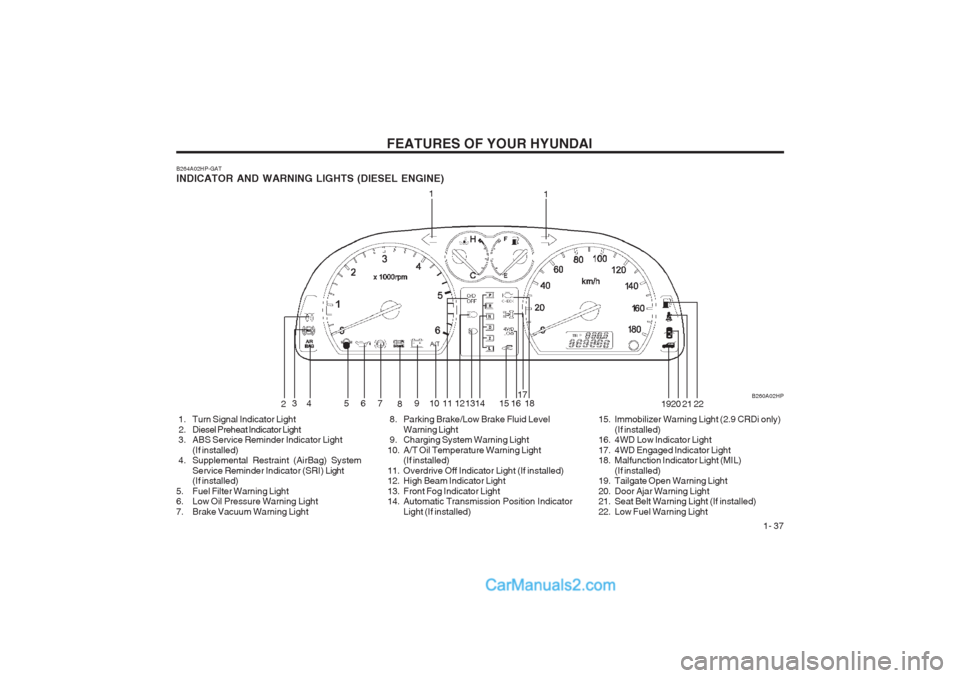
B264A02HP-GAT INDICATOR AND WARNING LIGHTS (DIESEL ENGINE)
1
2 34 5 6
7
8910111213 15 17
18 1920 21
1
22
1416
1. Turn Signal Indicator Light
2. Diesel Preheat Indicator Light
3. ABS Service Reminder Indicator Light(If installed)
4. Supplemental Restraint (AirBag) System
Service Reminder Indicator (SRI) Light
(If installed)
5. Fuel Filter Warning Light
6. Low Oil Pressure Warning Light
7. Brake Vacuum Warning Light 8. Parking Brake/Low Brake Fluid Level
Warning Light
9. Charging System Warning Light
10. A/T Oil Temperature Warning Light (If installed)
11. Overdrive Off Indicator Light (If installed)
12. High Beam Indicator Light
13. Front Fog Indicator Light
14. Automatic Transmission Position Indicator Light (If installed) 15. Immobilizer Warning Light (2.9 CRDi only)
(If installed)
16. 4WD Low Indicator Light
17. 4WD Engaged Indicator Light
18. Malfunction Indicator Light (MIL)
(If installed)
19. Tailgate Open Warning Light
20. Door Ajar Warning Light
21. Seat Belt Warning Light (If installed)
22. Low Fuel Warning Light
Page 47 of 349
FEATURES OF YOUR HYUNDAI 1- 39
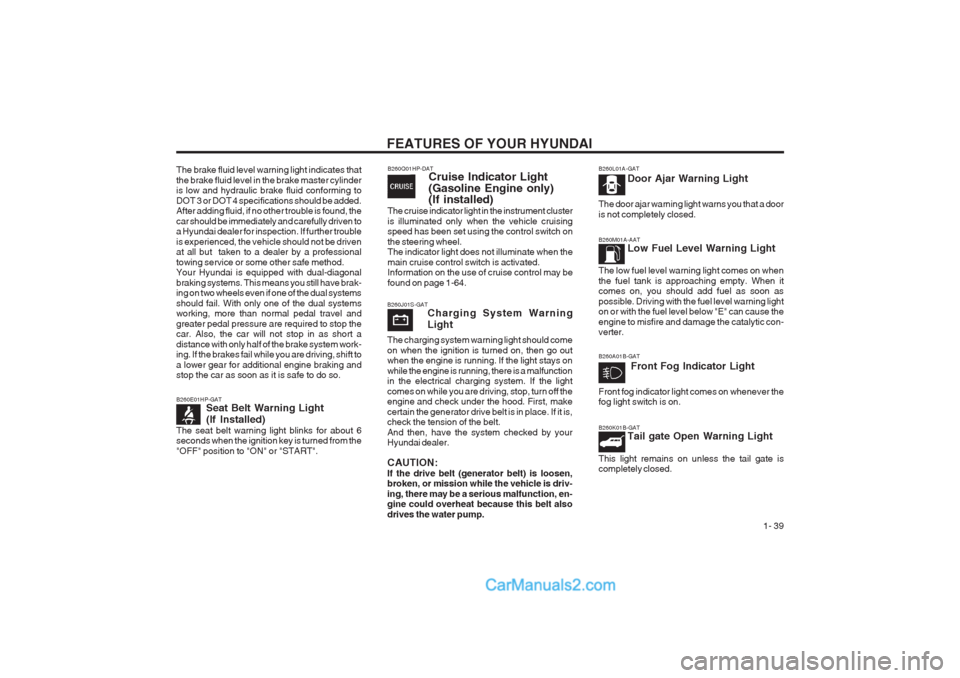
B260M01A-AATLow Fuel Level Warning Light
The low fuel level warning light comes on when the fuel tank is approaching empty. When it comes on, you should add fuel as soon as possible. Driving with the fuel level warning light on or with the fuel level below "E" can cause the engine to misfire and damage the catalytic con- verter. B260K01B-GAT Tail gate Open Warning Light
This light remains on unless the tail gate is completely closed.
B260E01HP-GAT
Seat Belt Warning Light (If Installed)
The seat belt warning light blinks for about 6 seconds when the ignition key is turned from the "OFF" position to "ON" or "START".
B260L01A-GAT
Door Ajar Warning Light
The door ajar warning light warns you that a door is not completely closed.
B260A01B-GAT Front Fog Indicator Light
Front fog indicator light comes on whenever the fog light switch is on.
B260J01S-GAT Charging System Warning Light
The charging system warning light should come on when the ignition is turned on, then go out when the engine is running. If the light stays on while the engine is running, there is a malfunction in the electrical charging system. If the light comes on while you are driving, stop, turn off the engine and check under the hood. First, make certain the generator drive belt is in place. If it is, check the tension of the belt. And then, have the system checked by your Hyundai dealer. CAUTION: If the drive belt (generator belt) is loosen, broken, or mission while the vehicle is driv- ing, there may be a serious malfunction, en- gine could overheat because this belt also drives the water pump.
B260Q01HP-DAT Cruise Indicator Light (Gasoline Engine only) (If installed)
The cruise indicator light in the instrument cluster is illuminated only when the vehicle cruising speed has been set using the control switch on the steering wheel. The indicator light does not illuminate when the main cruise control switch is activated. Information on the use of cruise control may be found on page 1-64.
The brake fluid level warning light indicates thatthe brake fluid level in the brake master cylinder is low and hydraulic brake fluid conforming to DOT 3 or DOT 4 specifications should be added. After adding fluid, if no other trouble is found, the car should be immediately and carefully driven to a Hyundai dealer for inspection. If further trouble is experienced, the vehicle should not be driven at all but taken to a dealer by a professional towing service or some other safe method. Your Hyundai is equipped with dual-diagonal braking systems. This means you still have brak- ing on two wheels even if one of the dual systems should fail. With only one of the dual systems working, more than normal pedal travel and greater pedal pressure are required to stop the car. Also, the car will not stop in as short a distance with only half of the brake system work- ing. If the brakes fail while you are driving, shift to a lower gear for additional engine braking and stop the car as soon as it is safe to do so.
Page 49 of 349
FEATURES OF YOUR HYUNDAI 1- 41
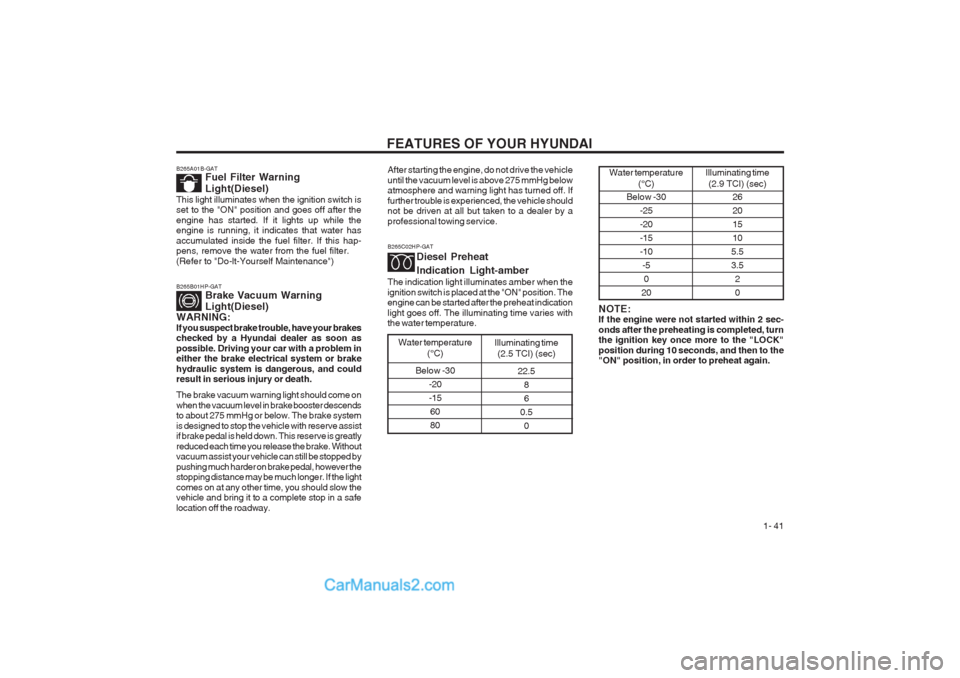
NOTE: If the engine were not started within 2 sec- onds after the preheating is completed, turn the ignition key once more to the "LOCK" position during 10 seconds, and then to the "ON" position, in order to preheat again.
After starting the engine, do not drive the vehicle until the vacuum level is above 275 mmHg below atmosphere and warning light has turned off. If further trouble is experienced, the vehicle should not be driven at all but taken to a dealer by a professional towing service. B265C02HP-GAT
Diesel Preheat Indication Light-amber
The indication light illuminates amber when the ignition switch is placed at the "ON" position. The engine can be started after the preheat indication light goes off. The illuminating time varies with the water temperature.
Water temperature (°C)
Below -30 -20 -156080 Illuminating time
(2.5 TCI) (sec)
22.586
0.5 0
B265A01B-GAT Fuel Filter Warning Light(Diesel)
This light illuminates when the ignition switch is set to the "ON" position and goes off after the engine has started. If it lights up while the engine is running, it indicates that water has accumulated inside the fuel filter. If this hap- pens, remove the water from the fuel filter. (Refer to "Do-lt-Yourself Maintenance") B265B01HP-GAT Brake Vacuum Warning Light(Diesel)
WARNING: If you suspect brake trouble, have your brakes checked by a Hyundai dealer as soon as possible. Driving your car with a problem in either the brake electrical system or brake hydraulic system is dangerous, and could result in serious injury or death. The brake vacuum warning light should come on when the vacuum level in brake booster descends to about 275 mmHg or below. The brake system is designed to stop the vehicle with reserve assist if brake pedal is held down. This reserve is greatly reduced each time you release the brake. Without vacuum assist your vehicle can still be stopped by pushing much harder on brake pedal, however the stopping distance may be much longer. If the light comes on at any other time, you should slow the vehicle and bring it to a complete stop in a safe location off the roadway.Water temperature
(°C)
Below -30
-25 -20-15-10-50
20 Illuminating time
(2.9 TCI) (sec)
26201510
5.53.5 20
Page 50 of 349
FEATURES OF YOUR HYUNDAI
1- 42
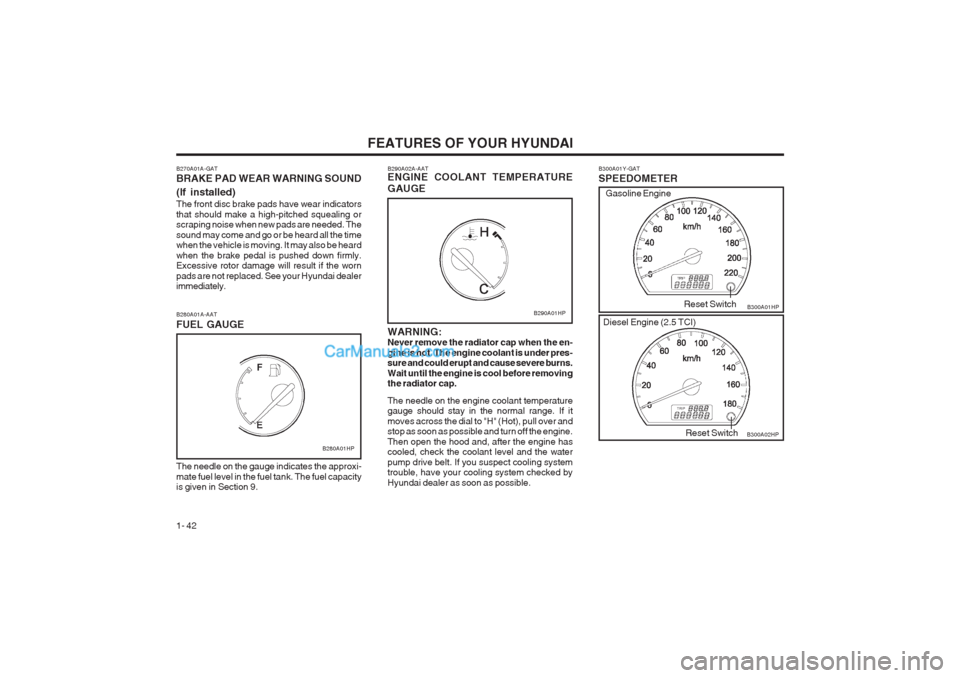
B300A01Y-GAT SPEEDOMETER B300A01HP
B300A02HP
Reset Switch
Reset Switch
Gasoline Engine
Diesel Engine (2.5 TCI)
B280A01A-AAT FUEL GAUGE
B280A01HP
The needle on the gauge indicates the approxi- mate fuel level in the fuel tank. The fuel capacity is given in Section 9. B290A02A-AAT ENGINE COOLANT TEMPERATURE GAUGE WARNING: Never remove the radiator cap when the en- gine is hot. The engine coolant is under pres- sure and could erupt and cause severe burns. Wait until the engine is cool before removing the radiator cap. The needle on the engine coolant temperature gauge should stay in the normal range. If it moves across the dial to "H" (Hot), pull over and stop as soon as possible and turn off the engine. Then open the hood and, after the engine has cooled, check the coolant level and the water pump drive belt. If you suspect cooling system trouble, have your cooling system checked by Hyundai dealer as soon as possible.
B290A01HP
B270A01A-GAT BRAKE PAD WEAR WARNING SOUND (If installed) The front disc brake pads have wear indicators that should make a high-pitched squealing or scraping noise when new pads are needed. The sound may come and go or be heard all the time when the vehicle is moving. It may also be heard when the brake pedal is pushed down firmly. Excessive rotor damage will result if the worn pads are not replaced. See your Hyundai dealer immediately.
Page 108 of 349
DRIVING YOUR HYUNDAI
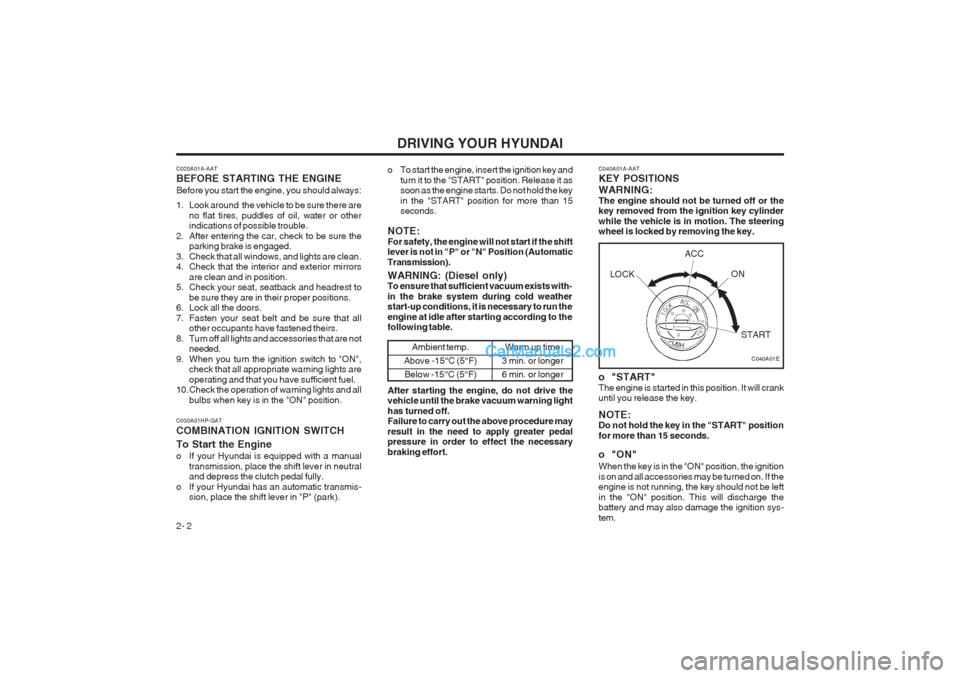
2- 2 C040A01A-AAT KEY POSITIONS WARNING: The engine should not be turned off or the key removed from the ignition key cylinder while the vehicle is in motion. The steering wheel is locked by removing the key.
o "START" The engine is started in this position. It will crank until you release the key. NOTE: Do not hold the key in the "START" position for more than 15 seconds.
o "ON" When the key is in the "ON" position, the ignition is on and all accessories may be turned on. If the engine is not running, the key should not be left in the "ON" position. This will discharge the battery and may also damage the ignition sys- tem.
C020A01A-AAT BEFORE STARTING THE ENGINE Before you start the engine, you should always:
1. Look around the vehicle to be sure there are
no flat tires, puddles of oil, water or other indications of possible trouble.
2. After entering the car, check to be sure the parking brake is engaged.
3. Check that all windows, and lights are clean.
4. Check that the interior and exterior mirrors are clean and in position.
5. Check your seat, seatback and headrest to
be sure they are in their proper positions.
6. Lock all the doors.
7. Fasten your seat belt and be sure that all other occupants have fastened theirs.
8. Turn off all lights and accessories that are not needed.
9. When you turn the ignition switch to "ON", check that all appropriate warning lights areoperating and that you have sufficient fuel.
10. Check the operation of warning lights and all
bulbs when key is in the "ON" position. o To start the engine, insert the ignition key and
turn it to the "START" position. Release it as soon as the engine starts. Do not hold the key in the "START" position for more than 15 seconds.
NOTE: For safety, the engine will not start if the shift lever is not in "P" or "N" Position (Automatic Transmission).
C030A01HP-GAT COMBINATION IGNITION SWITCH To Start the Engine
o If your Hyundai is equipped with a manual transmission, place the shift lever in neutral and depress the clutch pedal fully.
o If your Hyundai has an automatic transmis- sion, place the shift lever in "P" (park).
C040A01E
WARNING: (Diesel only) To ensure that sufficient vacuum exists with- in the brake system during cold weather start-up conditions, it is necessary to run the engine at idle after starting according to the following table.
Ambient temp.
Above -15°C (5°F) Below -15°C (5°F)Warm up time
3 min. or longer 6 min. or longer
After starting the engine, do not drive the vehicle until the brake vacuum warning light has turned off. Failure to carry out the above procedure may result in the need to apply greater pedal pressure in order to effect the necessary braking effort. LOCK
ACC
ON
START
Page 115 of 349
DRIVING YOUR HYUNDAI 2- 9
C350A01HP-GAT Part-time 4WD operation
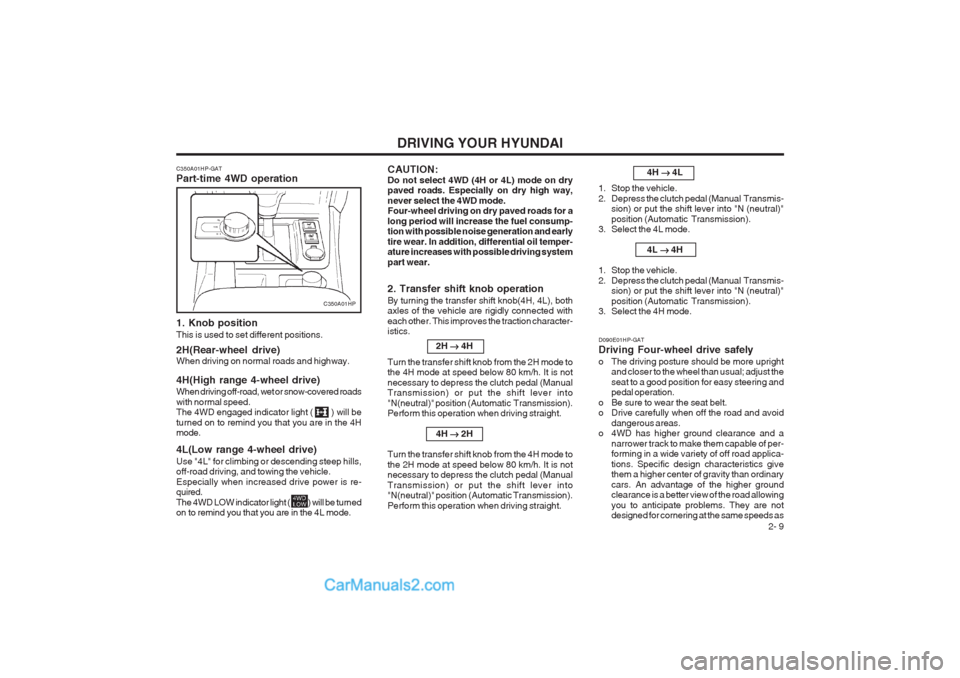
1. Knob position This is used to set different positions. 2H(Rear-wheel drive) When driving on normal roads and highway. 4H(High range 4-wheel drive) When driving off-road, wet or snow-covered roads with normal speed. The 4WD engaged indicator light ( ) will be turned on to remind you that you are in the 4H mode. 4L(Low range 4-wheel drive) Use "4L" for climbing or descending steep hills, off-road driving, and towing the vehicle. Especially when increased drive power is re- quired. The 4WD LOW indicator light ( ) will be turned on to remind you that you are in the 4L mode.
2. Transfer shift knob operation By turning the transfer shift knob(4H, 4L), both axles of the vehicle are rigidly connected with each other. This improves the traction character- istics.2H
4H
Turn the transfer shift knob from the 2H mode tothe 4H mode at speed below 80 km/h. It is not necessary to depress the clutch pedal (Manual Transmission) or put the shift lever into "N(neutral)" position (Automatic Transmission). Perform this operation when driving straight.
4H
2H
Turn the transfer shift knob from the 4H mode to the 2H mode at speed below 80 km/h. It is not necessary to depress the clutch pedal (Manual Transmission) or put the shift lever into "N(neutral)" position (Automatic Transmission). Perform this operation when driving straight.
C350A01HP
D090E01HP-GAT Driving Four-wheel drive safely
o The driving posture should be more uprightand closer to the wheel than usual; adjust the seat to a good position for easy steering and pedal operation.
o Be sure to wear the seat belt.
o Drive carefully when off the road and avoid dangerous areas.
o 4WD has higher ground clearance and a
narrower track to make them capable of per-forming in a wide variety of off road applica- tions. Specific design characteristics give them a higher center of gravity than ordinary cars. An advantage of the higher ground clearance is a better view of the road allowing you to anticipate problems. They are not designed for cornering at the same speeds as 4H
4L
1. Stop the vehicle.
2. Depress the clutch pedal (Manual Transmis- sion) or put the shift lever into "N (neutral)"position (Automatic Transmission).
3. Select the 4L mode.
4L
4H
1. Stop the vehicle.
2. Depress the clutch pedal (Manual Transmis- sion) or put the shift lever into "N (neutral)"position (Automatic Transmission).
3. Select the 4H mode.
CAUTION: Do not select 4WD (4H or 4L) mode on dry paved roads. Especially on dry high way, never select the 4WD mode. Four-wheel driving on dry paved roads for a long period will increase the fuel consump- tion with possible noise generation and early tire wear. In addition, differential oil temper- ature increases with possible driving system part wear.