engine overheat Hyundai Terracan 2004 User Guide
[x] Cancel search | Manufacturer: HYUNDAI, Model Year: 2004, Model line: Terracan, Model: Hyundai Terracan 2004Pages: 361, PDF Size: 4.69 MB
Page 179 of 361
EMISSION CONTROL SYSTEMS 7-1
7. EMISSION
CONTROL SYSTEMS
H010A01A-GAT EMISSION CONTROL SYSTEMS (If installed) Your Hyundai is equipped with an emission control system to meet all requirements of the Emission prohibition rules of your province. There are three emission control systems which are as follows. (1) Crankcase emission control system (For a Gasoline Engine)
(2) Evaporative emission control system (For a Gasoline Engine)
(3) Exhaust emission control system In order to assure the proper function of the emission control systems, it is recommended that you have your car inspected and main- tained by an authorized Hyundai dealer in ac- cordance with the maintenance schedule in this manual. H010C02Y-GAT 2. Evaporative Emission Control
System; For a Gasoline Engine
The Evaporative Emission Control System is
designed to prevent fuel vapors from escaping into the atmosphere. Canister While the engine is inoperative, fuel vapors
generated inside the fuel tank are absorbed and stored in the canister. When the engine is
running, the fuel vapors absorbed in the canis- ter are drawn into the induction system through the purge control solenoid valve. Purge Control Solenoid Valve The purge control solenoid valve is controlled
by the ECM; when the engine coolant tempera- ture is low, and during idling, it closes, so that evaporated fuel is not taken into the surge tank.
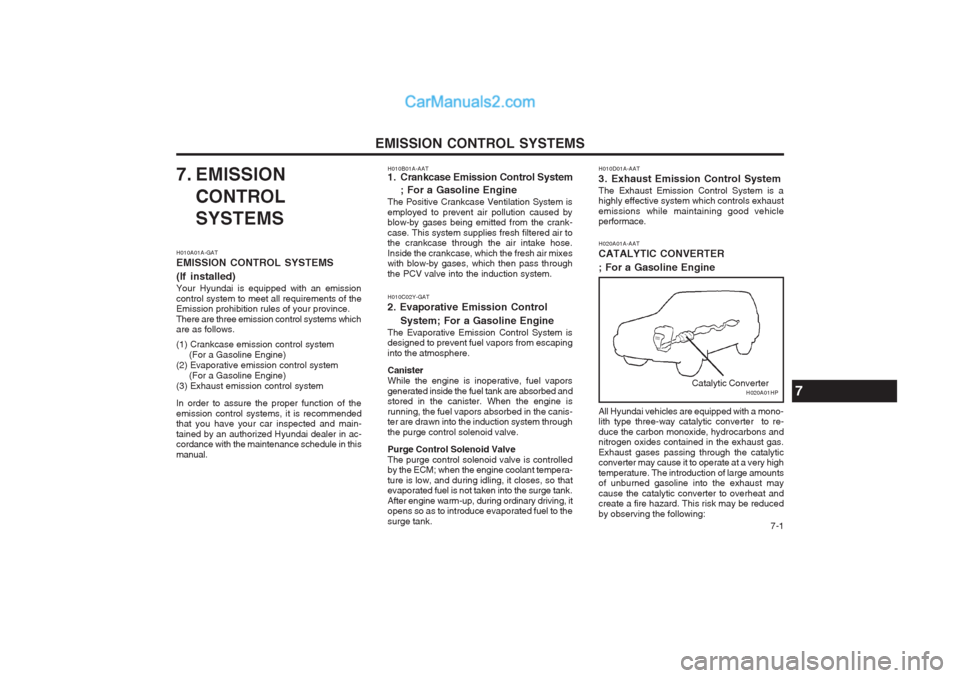
After engine warm-up, during ordinary driving, it opens so as to introduce evaporated fuel to the surge tank. H020A01A-AAT CATALYTIC CONVERTER ; For a Gasoline Engine
H020A01HP
Catalytic Converter
All Hyundai vehicles are equipped with a mono- lith type three-way catalytic converter to re- duce the carbon monoxide, hydrocarbons and nitrogen oxides contained in the exhaust gas. Exhaust gases passing through the catalytic converter may cause it to operate at a very high temperature. The introduction of large amounts of unburned gasoline into the exhaust may cause the catalytic converter to overheat and create a fire hazard. This risk may be reduced by observing the following:
H010B01A-AAT
1. Crankcase Emission Control System
; For a Gasoline Engine
The Positive Crankcase Ventilation System is employed to prevent air pollution caused by blow-by gases being emitted from the crank- case. This system supplies fresh filtered air to the crankcase through the air intake hose. Inside the crankcase, which the fresh air mixes with blow-by gases, which then pass through the PCV valve into the induction system.7
H010D01A-AAT
3. Exhaust Emission Control SystemThe Exhaust Emission Control System is a highly effective system which controls exhaust emissions while maintaining good vehicle performace.
Page 180 of 361

7-2EMISSION CONTROL SYSTEMS
WARNING:
o Use unleaded fuel only.
o Maintain the engine in good operating condition. Extremely high catalytic con-verter temperatures can result from im- proper operation of the electrical, igni- tion or multiport electronic fuel injection.
o If your engine stalls, pings, knocks, or is hard to start, have your Hyundai dealerinspect and repair the problem as soon as possible.
o Avoid driving with a very low fuel level. Running out of gasoline may cause theengine to misfire and result in damage to the catalytic converter.
o Avoid idling the engine for periods long- er than 10 minutes.
o The vehicle should not be pushed or pulled to get started. This may cause the catalytic converter to overheat and cre- ate a fire hazard.
o Do not touch the catalytic converter or any other part of the exhaust systemwhile the catalytic converter is hot. Shut off the engine, wait for at least one hour before touching the catalytic converter or any other part of the exhaust system.
o Remember that your Hyundai dealer is your best source of assistance.
o Do not stop your Hyundai over any com- bustible material such as grass, paper,leaves or rags. These materials might contact the hot catalytic converter and a fire might result. H020C01HP-GAT EGR SYSTEM ; For a Diesel Engine (If installed) This system helps control oxides of nitrogen by recirculating a part of the exhaust gas into the engine, there by reducing cylinder combustion temperature.The EGR system helps reduce Nox (Oxides of Nitrogen) emission gasses.
H020D01S-GAT CATALYTIC CONVERTER ; For a Diesel Engine (If installed) All Hyundai vehicles are equipped with oxida- tion type catalytic converter to reduce the car- bon monoxide, hydrocarbons and particulates contained in the exhaust gas.
Page 189 of 361
INDEX
10-2 D Defrosting/Defogging
......................................................................... 1-71
Door Locking, unlocking front door with a key ........................................ 1-6
Drink Holder ...................................................................................... 1-53
Drive Belts ............................................................................... 6-15, 6-18
Driving Driving for economy ...................................................................... 2-14
Smooth cornering .......................................................................... 2-15
Winter driving ................................................................................ 2-15
E Emission Control System ................................................................... 7-1
Engine
Before starting the engine ............................................................... 2-2Compartment (3.5 V6) ..................................................................... 6-1
Compartment (2.5 TCI) ................................................................... 6-2
Compartment (2.9 CRDi) ................................................................ 6-3
Coolant ............................................................................................ 6-7
Coolant temperature gauge ........................................................... 1-43
If the engine overheats ................................................................... 3-2
Number ............................................................................................ 8-1
Oil .................................................................................................... 6-4Starting ............................................................................................ 2-3
Engine Exhaust Can Be Dangerous ................................................... 2-1
FFan Speed Con trol ................................................................... 1-66, 1-75Fog Light
Front .............................................................................................. 1-48
Rear .............................................................................................. 1-48
Front Seats
Adjustable front seats ................................................................... 1-11
Adjustable headrests ..................................................................... 1-12
Adjusting seat forward and rearward ............................................1-11
Adjusting seatback angle .............................................................. 1-11
Fuel Capacity .......................................................................................... 9-1
Gauge ............................................................................................ 1-43
Unleaded gasoline ........................................................................... 1-1
Fuel Filler Lid Remote release ............................................................................. 1-62
Full-time 4WD Operation .................... ................................... 2-10 ~ 2-13
Fuses ................................................................................................ 6-18
G General Checks .................................................................................. 6-4
Glove Box ......................................................................................... 1-56
H Hazard Warning System ................................................................... 1-51
Headlight Aiming Adjustment ............................................................ 6-24
Headlight Leveling Device System ................................................... 1-65
Heating and Ventilation
Air flow control ......................................................... 1-68 ~ 1-69, 1-77
Temperature control ...................................................................... 1-69
Page 241 of 361
CONTROLS AND EQUIPMENT1- 41
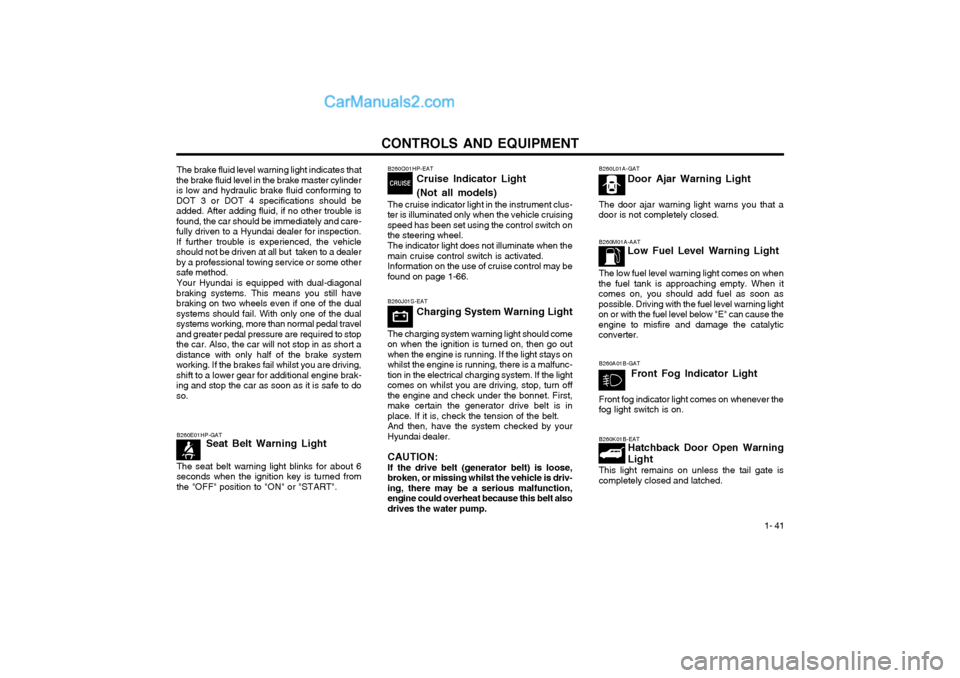
B260M01A-AATLow Fuel Level Warning Light
The low fuel level warning light comes on when
the fuel tank is approaching empty. When it comes on, you should add fuel as soon aspossible. Driving with the fuel level warning lighton or with the fuel level below "E" can cause theengine to misfire and damage the catalyticconverter.
B260K01B-EAT Hatchback Door Open Warning Light
This light remains on unless the tail gate is completely closed and latched.
B260E01HP-GAT
Seat Belt Warning Light
The seat belt warning light blinks for about 6seconds when the ignition key is turned fromthe "OFF" position to "ON" or "START".
B260L01A-GAT Door Ajar Warning Light
The door ajar warning light warns you that a
door is not completely closed.
B260A01B-GAT
Front Fog Indicator Light
Front fog indicator light comes on whenever the fog light switch is on.
B260J01S-EAT Charging System Warning Light
The charging system warning light should come on when the ignition is turned on, then go outwhen the engine is running. If the light stays onwhilst the engine is running, there is a malfunc-tion in the electrical charging system. If the lightcomes on whilst you are driving, stop, turn offthe engine and check under the bonnet. First,make certain the generator drive belt is inplace. If it is, check the tension of the belt.And then, have the system checked by yourHyundai dealer. CAUTION: If the drive belt (generator belt) is loose, broken, or missing whilst the vehicle is driv-ing, there may be a serious malfunction,engine could overheat because this belt alsodrives the water pump.
B260Q01HP-EAT Cruise Indicator Light (Not all models)
The cruise indicator light in the instrument clus-
ter is illuminated only when the vehicle cruising speed has been set using the control switch onthe steering wheel.
The indicator light does not illuminate when the
main cruise control switch is activated. Information on the use of cruise control may be
found on page 1-66.
The brake fluid level warning light indicates that
the brake fluid level in the brake master cylinderis low and hydraulic brake fluid conforming toDOT 3 or DOT 4 specifications should beadded. After adding fluid, if no other trouble isfound, the car should be immediately and care-fully driven to a Hyundai dealer for inspection.If further trouble is experienced, the vehicleshould not be driven at all but taken to a dealerby a professional towing service or some othersafe method.
Your Hyundai is equipped with dual-diagonal
braking systems. This means you still havebraking on two wheels even if one of the dualsystems should fail. With only one of the dualsystems working, more than normal pedal traveland greater pedal pressure are required to stopthe car. Also, the car will not stop in as short adistance with only half of the brake systemworking. If the brakes fail whilst you are driving,shift to a lower gear for additional engine brak-ing and stop the car as soon as it is safe to doso.
Page 297 of 361
DRIVING YOUR HYUNDAI
2- 14 D190A01O-EAT
LIMITED-SLIP DIFFERENTIAL (Not all models)
A limited-slip differential, if equipped, is for the
rear wheel differential only. The features of this limited-slip differential are described below:
Just as with a conventional differential, the
wheel on one side is allowed to turn at adifferent speed from the wheel on the other sidewhen the vehicle is cornering. The differencebetween the limited-slip differential and a con-ventional differential is that if the wheel on oneside of the vehicle loses traction, a greateramount of torque is applied to the rear wheel onthe other side to improve traction.
SC140A1-E
EFFECTIVE BRAKING Braking system performance and friction mate-rial life are greatly affected by the driving styleadopted. The following suggestions are madeto assist in achieving the best results from thebraking system.
o Anticipate the road and conditions ahead in order that heavy braking may be avoided.
o When descending long gradients, use the engine to assist in retarding the vehicle tominimize the possibility of brake fade occur-ring. o When trailer towing, ensure that the trailer
brakes function correctly and use enginebraking to assist the vehicle braking system.
o Use only genuine Hyundai replacement brake pads and shoes to ensure consistentfriction characteristics and wear rates.
o After driving through deep water (e.g. fording), the brakes may become wet andperformance reduced. Always check brakeefficiency after emerging from the water anddry the brakes by lightly depressing thebrake pedal several times whilst driving slow-ly.
o Apply the parking brake only when the vehi- cle is at rest.
o Since the power assistance provided by the brake servo is derived from the engine,coasting with the engine turned off or towingof the vehicle with the engine turned off willresult in greatly increased pedal pressuresbeing required to stop the vehicle.
o Do not hold the vehicle on the upgrade with the accelerator pedal. This can cause thetransmission to overheat. Always use thebrake pedal or parking brake.
CAUTION:
o Whilst the full-time 4WD vehicle is being raised on a jack, never start the engine orcause the tyres to rotate. There is the danger that rotating tyres touching the ground could cause thevehicle to go off the jack and to jumpforward.
o If one of the front or rear wheels begins to spin in mud, snow, etc., the vehiclecan sometimes be driven out by depress-ing the accelerator pedal further; how-ever, avoid running the engine continu-ously at high rpm because doing so coulddamage the 4WD system.
WARNING:
o Avoid high cornering speeds.
o Do not make quick steering wheel move- ments, such as sharp lane charges or fast, sharp turns.
o The risk of rollover is greatly increased if you lose control of your vehicle at high-way speeds.
o In a collision crash, an unbelted person is significantly more likely to die than aperson wearing a seatbelt.
o Loss of control often occurs if two or more wheels drop off the roadway and thedriver oversteers to reenter the roadway.
o In the event your vehicle leaves the road- way, do not steer sharply. Instead, slowdown before pulling back into the travellanes.
Page 300 of 361
DRIVING YOUR HYUNDAI 2- 17
YC200D2-E
Safety Cables
Should the towbar connection between your car
and the trailer or vehicle you are towing fail, the trailer or vehicle could wander dangerouslyacross other lanes of traffic and ultimately leavethe roadway. To eliminate this potentially dan-gerous situation, safety cables, attached be-tween your car and the trailer or towed vehicle,are required.
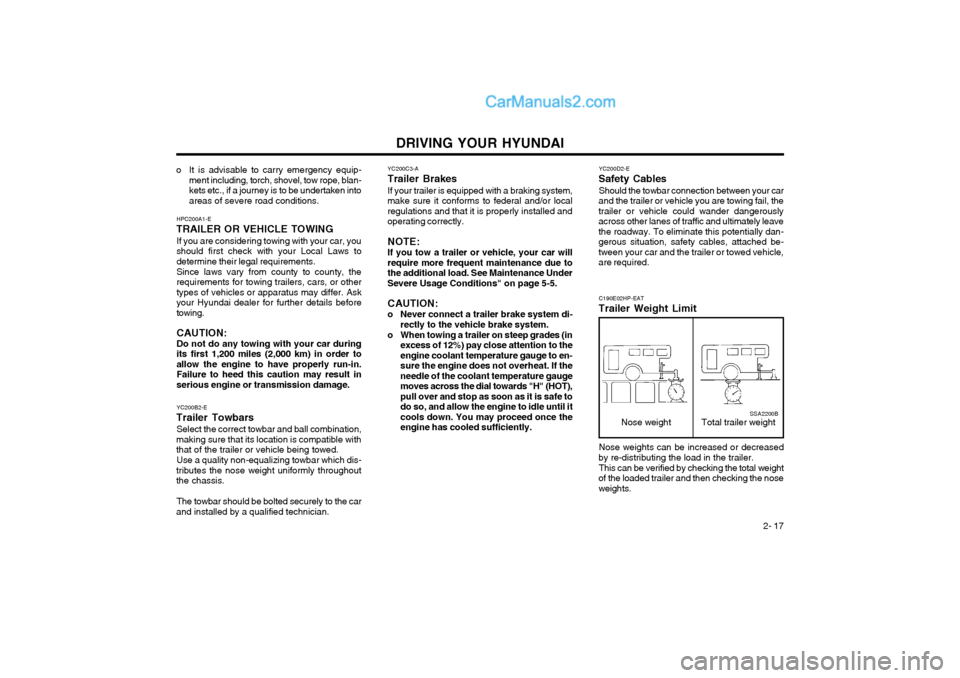
Nose weight Total trailer weightSSA2200B
C190E02HP-EAT
Trailer Weight Limit
Nose weights can be increased or decreased
by re-distributing the load in the trailer.
This can be verified by checking the total weight
of the loaded trailer and then checking the nose weights.
YC200C3-A
Trailer Brakes
If your trailer is equipped with a braking system,
make sure it conforms to federal and/or localregulations and that it is properly installed andoperating correctly.
NOTE: If you tow a trailer or vehicle, your car will
require more frequent maintenance due to the additional load. See Maintenance UnderSevere Usage Conditions" on page 5-5.
CAUTION:
o Never connect a trailer brake system di- rectly to the vehicle brake system.
o When towing a trailer on steep grades (in excess of 12%) pay close attention to theengine coolant temperature gauge to en-sure the engine does not overheat. If theneedle of the coolant temperature gaugemoves across the dial towards "H" (HOT),pull over and stop as soon as it is safe todo so, and allow the engine to idle until itcools down. You may proceed once theengine has cooled sufficiently.
HPC200A1-E
TRAILER OR VEHICLE TOWING
If you are considering towing with your car, youshould first check with your Local Laws todetermine their legal requirements. Since laws vary from county to county, the requirements for towing trailers, cars, or othertypes of vehicles or apparatus may differ. Askyour Hyundai dealer for further details beforetowing. CAUTION: Do not do any towing with your car duringits first 1,200 miles (2,000 km) in order toallow the engine to have properly run-in.Failure to heed this caution may result inserious engine or transmission damage. YC200B2-E
Trailer Towbars Select the correct towbar and ball combination,
making sure that its location is compatible with that of the trailer or vehicle being towed.
Use a quality non-equalizing towbar which dis-
tributes the nose weight uniformly throughoutthe chassis.
The towbar should be bolted securely to the car
and installed by a qualified technician.
o It is advisable to carry emergency equip-
ment including, torch, shovel, tow rope, blan-kets etc., if a journey is to be undertaken intoareas of severe road conditions.
Page 302 of 361
DRIVING YOUR HYUNDAI 2- 19
CAUTION: If overheating should occur when towing,
(temperature gauge reads near red zone), taking the following action may reduce oreliminate the problem.
1. Turn off the air conditioner.
2. Reduce highway speed.
3. Select a lower gear when going uphill.
4. Whilst in stop and go traffic, place the gear selector in park or neutral and idle the engine at a higher speed.
HPC200E1-E
Trailer or Vehicle Towing Tips
1. Before towing, check towbar and safety cable connections as well as proper operation of the trailer running lights, brake lights, andturn signals.
2. Always drive your vehicle at a moderate speed (Less than 60 mph)
3. Trailer towing requires more fuel than nor- mal conditions.
4. To maintain engine braking efficiency and electrical charging performance, do not usefifth gear (manual transmission).
5. Always secure items in the trailer to prevent load shift whilst driving.
6. Check the condition and air pressure of all tyres on the trailer and your car. Low tyrepressure can seriously affect the handling.Also check the spare tyre.
7. The vehicle/trailer combination is more af- fected by crosswind and buffeting. When being passed by a large vehicle, keep a constant speed and steer straight ahead.If there is too much wind buffeting slowdown to get out of the other vehicle's airturbulence.
8. When parking your car and trailer, especial- ly on a hill, be sure to follow all the normalprecautions. Turn your front wheel into thecurb, set the parking brake firmly, and putthe transmission in 1st or Reverse (manual)or Park (automatic). In addition, place wheelchocks at each of the trailer's tyres. 9. If the trailer has electric brakes, start your
vehicle and trailer moving, and then applythe trailer brake controller by hand to besure the brakes are working. This lets youcheck your electrical connection at the sametime.
10. During your trip, check occasionally to be sure that the load is secure, and that thelights and any trailer brakes are still working.
11. Avoid jerky starts, sudden acceleration or sudden stops.
12. Avoid sharp turns and rapid lane changes.
13. Avoid holding the brake pedal down too long or too frequently. This could cause the brakes to overheat, resulting in reduced brakingefficiency.
14. When going down a hill, shift into a lower gear and use the engine braking effect. When ascending a long grade, downshift the transmission to a lower gear and reducespeed to reduce chances of engine over-loading and/or overheating.
15. If you have to stop whilst going uphill, do not hold the vehicle in place by pressing on theaccelerator. This can cause the automatictransmission to overheat. Use the parkingbrake or footbrake.
NOTE: When towing, check transmission fluid more
frequently.
Page 304 of 361
IN CASE OF EMERGENCY
3-2
CAUTION:
Personal injury and damage to the vehicle
may occur if jump starting is not performed correctly. If any doubt exists as to how thisoperation should be performed, seek assis-tance from qualified personnel. WARNING:
Motor vehicle batteries contain sulphuric
acid and emit hydrogen gas. Protective cloth- ing should be worn and care exercised toprevent the acid from coming into contactwith skin or clothing and the vehicle. Nakedlights should not be permitted in the vicinityof the battery. Care should be exercised toprevent sparks occurring during connec-tion. If acid accidentally comes into contactwith skin or eyes, the affected area shouldimmediately be flushed with copious CAUTION: If the jump cable is incorrectly installed, damage to the vehicle electrical system mayoccur, in particular the electronic compo-nents such as the Fuel Injection system
computer and the Automatic Transmissioncomputer. The battery must never be dis-connected whilst the engine is running.
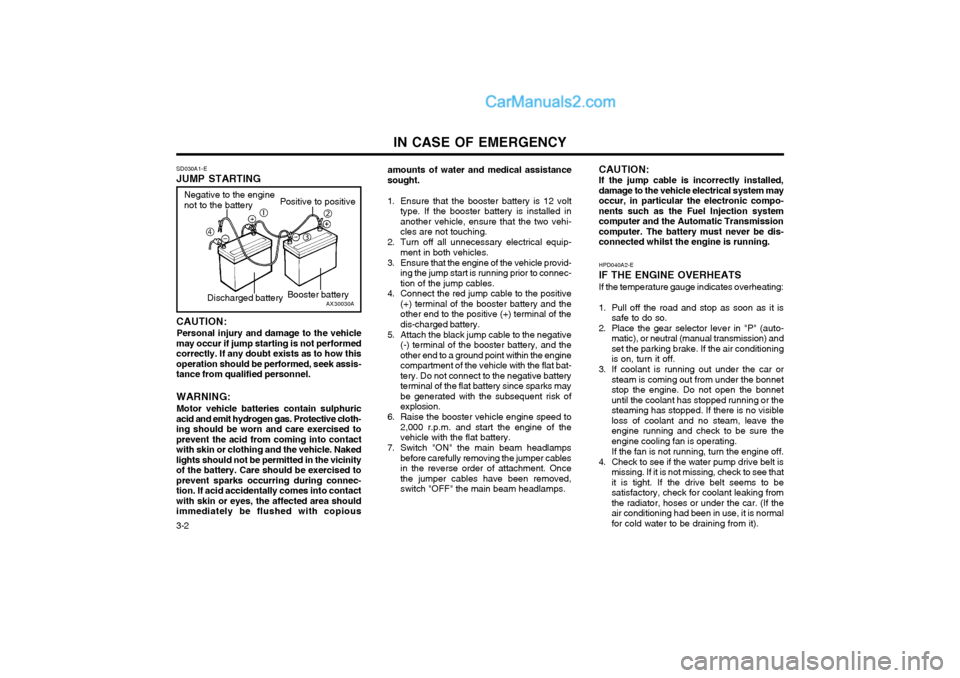
SD030A1-E JUMP STARTING
amounts of water and medical assistance sought.
1. Ensure that the booster battery is 12 volt type. If the booster battery is installed inanother vehicle, ensure that the two vehi-cles are not touching.
2. Turn off all unnecessary electrical equip- ment in both vehicles.
3. Ensure that the engine of the vehicle provid- ing the jump start is running prior to connec-tion of the jump cables.
4. Connect the red jump cable to the positive (+) terminal of the booster battery and theother end to the positive (+) terminal of thedis-charged battery.
5. Attach the black jump cable to the negative (-) terminal of the booster battery, and theother end to a ground point within the enginecompartment of the vehicle with the flat bat-tery. Do not connect to the negative batteryterminal of the flat battery since sparks maybe generated with the subsequent risk ofexplosion.
6. Raise the booster vehicle engine speed to 2,000 r.p.m. and start the engine of thevehicle with the flat battery.
7. Switch "ON" the main beam headlamps before carefully removing the jumper cablesin the reverse order of attachment. Oncethe jumper cables have been removed,switch "OFF" the main beam headlamps. HPD040A2-E IF THE ENGINE OVERHEATS If the temperature gauge indicates overheating:
1. Pull off the road and stop as soon as it is
safe to do so.
2. Place the gear selector lever in "P" (auto- matic), or neutral (manual transmission) and set the parking brake. If the air conditioningis on, turn it off.
3. If coolant is running out under the car or steam is coming out from under the bonnetstop the engine. Do not open the bonnetuntil the coolant has stopped running or thesteaming has stopped. If there is no visibleloss of coolant and no steam, leave theengine running and check to be sure theengine cooling fan is operating. If the fan is not running, turn the engine off.
4. Check to see if the water pump drive belt is missing. If it is not missing, check to see that it is tight. If the drive belt seems to besatisfactory, check for coolant leaking fromthe radiator, hoses or under the car. (If theair conditioning had been in use, it is normalfor cold water to be draining from it).
AX30030A
Negative to the engine not to the battery
Positive to positive
Booster battery
c
e
f d
Discharged battery
Page 305 of 361
IN CASE OF EMERGENCY 3-3
WARNING: Whilst the engine is running, keep hands
and clothing away from moving parts such as the fan and drive belts to prevent injury.
WARNING (Diesel only): Never work on injection system with engine
running or within 30 seconds after shutting off engine. High pressure pump, rail, injec-tors and high pressure pipes are subject tohigh pressure even after the engine stopped.The fuel jet produced by fuel leaks maycause serious injury, if it touch the body.People using pacemakers should not movethan 30cm closer to the ECU or wiring har-ness within the engine room while engine isrunning, since the high currents in the Com-mon Rail system produce considerable mag-netic fields.
5. If the water pump drive belt is broken or coolant is leaking out, stop the engine imme- diately and call the nearest Hyundai dealerfor assistance.
WARNING: Do not remove the radiator cap when the
engine is hot since steam and boiling water may be ejected from the radiator resulting inburns or scalding. YD050A1-E
SPARE TYRE For Full Size
The following instructions for the FULL SIZE
spare tyre should be observed:
Check inflation pressure as soon as possible
after installing the spare tyre, and adjust to the specified pressure. The tyre pressure shouldbe periodically checked and maintained at thespecified pressure whilst the tyre is stored.
Spare Tyre Pressure
Inflation Pressure
Tyre Size
FULL SIZE 29 psi (200 kPa)
6. If the cause of the overheating cannot be
found, wait until the engine temperature has returned to normal. Then, if coolant hasbeen lost, carefully remove the radiator capand add water to bring the fluid level in thereservoir up to the base of the radiator fillopening. Fill the coolant expansion tank tothe halfway mark.
7. Proceed with caution until it is established that the engine is operating normally. If theengine overheats repeatedly, the advice of aHyundai dealer should be sought.
CAUTION: Serious loss of coolant indicates there is a
leak in the cooling system and this should be checked as soon as possible by a Hyundaidealer.
D040B01HP
D040B03HP-EAT
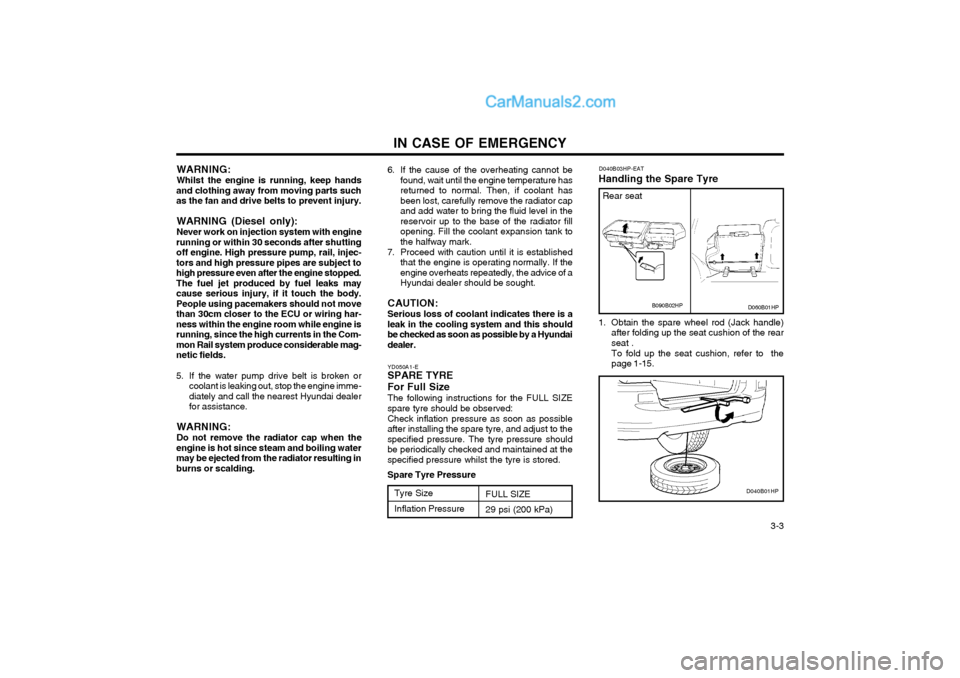
Handling the Spare Tyre
1. Obtain the spare wheel rod (Jack handle) after folding up the seat cushion of the rear seat . To fold up the seat cushion, refer to the page 1-15.
D060B01HPB090B02HP
Rear seat
Page 330 of 361
OWNER MAINTENANCE
6-6
To replace the oil and filter, proceed as follows:
1. Ensure that the engine is at normal operat- ing temperature and park the vehicle on level ground with the parking brake securelyapplied and the engine turned off.
2. Open the bonnet and remove the oil filler cap.
3. Prepare a suitable receptacle to collect the displaced oil and remove the drain plug fromthe sump.
CAUTION: The oil being drained from the engine will be
hot. Care should be exercised to prevent scalding.
4. When the oil has drained from the sump, replace the drain plug using a new washer ensuring that the plug is not over tightened. Tightening torque is: 3.5 ~ 4.5 kgf.m
5. Remove the oil filter by rotating counter- clockwise, using a proprietary oil filter re- moval tool if necessary. Note that the oilfilter will contain approximately 0.5 litres ofoil and this should be collected in a suitablereceptacle.
6. Install a new oil filter having smeared the sealing ring with clean oil and rotating clock-wise until the filter contacts the mountingand then a further one half turn. Do not over-tighten. Tightening torque: Petrol Engine - 1.2 ~ 1.6 kgf.mDiesel Engine - 2.3 ~ 2.5 kgf.m
7. Pour the specified quantity of the recom- mended oil into the engine and replace the filler cap. Start the engine and ensure thatno oil leaks exist. Turn off the engine andafter a couple minutes, recheck the oil level.
WARNING: Prolonged and repeated contact with used engine oils may result in serious skin disor-ders including dermatitis and cancer. Avoidcontact with skin as far as possible andalways wash thoroughly after any contact.Keep used oils out of reach of children. It isillegal to pollute drains, water courses andsoil. Use only authorized waste collectionfacilities including civic amenity sites andgarages for the disposal of used oil and oilfilters. If in doubt, contact the local authorityfor disposal instructions. SG050A1-E
ENGINE COOLANT CHECKING AND REPLACING
WARNING: Do not remove the radiator cap when the engine is hot, since the system is pressur-ized and coolant may be ejected from theradiator resulting in scalding. SG050B1-E
Coolant recommendations Only ethylene glycol based coolant with a cor- rosion inhibitor suited to aluminium alloy enginecomponents should be used in the coolingsystem. No further additives or inhibitors shouldbe used. The coolant specific gravity should bechecked as prescribed in the maintenanceschedule to ensure adequate frost and corro-sion protection. In addition, the engine coolantmust be replaced at the specified interval sincethe corrosion inhibitor properties deteriorate withtime. It is important to note that whilst an increase in the concentration of anti freeze gives an in-crease in the level of frost protection, a solutionwhich is in excess of 65% anti freeze will resultin reduced frost protection and engine over-heating. Therefore the recommended concen-tration of 50% should not be exceeded forgeneral use.The use of methanol based anti freeze com-pounds may result in engine overheating andwill invalidate the vehicle warranty.