towing Hyundai Terracan 2004 User Guide
[x] Cancel search | Manufacturer: HYUNDAI, Model Year: 2004, Model line: Terracan, Model: Hyundai Terracan 2004Pages: 361, PDF Size: 4.69 MB
Page 149 of 361
VEHICLE MAINTENANCE REQUIREMENTS
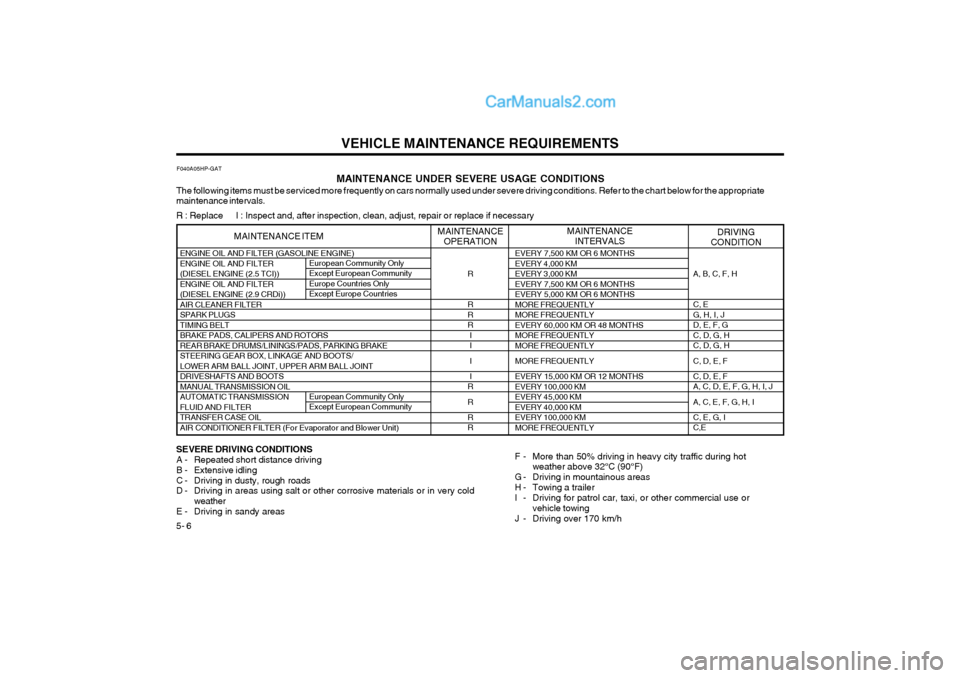
5- 6 ENGINE OIL AND FILTER (GASOLINE ENGINE) ENGINE OIL AND FILTER(DIESEL ENGINE (2.5 TCI))ENGINE OIL AND FILTER
(DIESEL ENGINE (2.9 CRDi))AIR CLEANER FILTERSPARK PLUGSTIMING BELTBRAKE PADS, CALIPERS AND ROTORSREAR BRAKE DRUMS/LININGS/PADS, PARKING BRAKESTEERING GEAR BOX, LINKAGE AND BOOTS/LOWER ARM BALL JOINT, UPPER ARM BALL JOINTDRIVESHAFTS AND BOOTSMANUAL TRANSMISSION OILAUTOMATIC TRANSMISSIONFLUID AND FILTERTRANSFER CASE OILAIR CONDITIONER FILTER (For Evaporator and Blower Unit)
R R RR
II I I
R R R R
European Community OnlyExcept European CommunityEurope Countries OnlyExcept Europe Countries
A, B, C, F, H C, E G, H, I, JD, E, F, GC, D, G, HC, D, G, H C, D, E, F C, D, E, F A, C, D, E, F, G, H, I, J A, C, E, F, G, H, I C, E, G, I C,E
F040A05HP-GAT
MAINTENANCE UNDER SEVERE USAGE CONDITIONS
The following items must be serviced more frequently on cars normally used under severe driving conditions. Refer to the chart below for the appropriate maintenance intervals. R : Replace I : Inspect and, after inspection, clean, adjust, repair or replace if necessary SEVERE DRIVING CONDITIONS
A - Repeated short distance driving
B - Extensive idling
C - Driving in dusty, rough roads
D - Driving in areas using salt or other corrosive materials or in very cold weather
E - Driving in sandy areas F - More than 50% driving in heavy city traffic during hot
weather above 32°C (90°F)
G - Driving in mountainous areas
H - Towing a trailer
I - Driving for patrol car, taxi, or other commercial use or
vehicle towing
J - Driving over 170 km/h
MAINTENANCE ITEM
European Community Only Except European Community
DRIVING
CONDITION
MAINTENANCE
OPERATION MAINTENANCE
INTERVALS
EVERY 7,500 KM OR 6 MONTHS EVERY 4,000 KMEVERY 3,000 KMEVERY 7,500 KM OR 6 MONTHSEVERY 5,000 KM OR 6 MONTHSMORE FREQUENTLYMORE FREQUENTLYEVERY 60,000 KM OR 48 MONTHSMORE FREQUENTLYMORE FREQUENTLY MORE FREQUENTLY EVERY 15,000 KM OR 12 MONTHS EVERY 100,000 KMEVERY 45,000 KMEVERY 40,000 KMEVERY 100,000 KMMORE FREQUENTLY
Page 192 of 361
INDEX 10-5
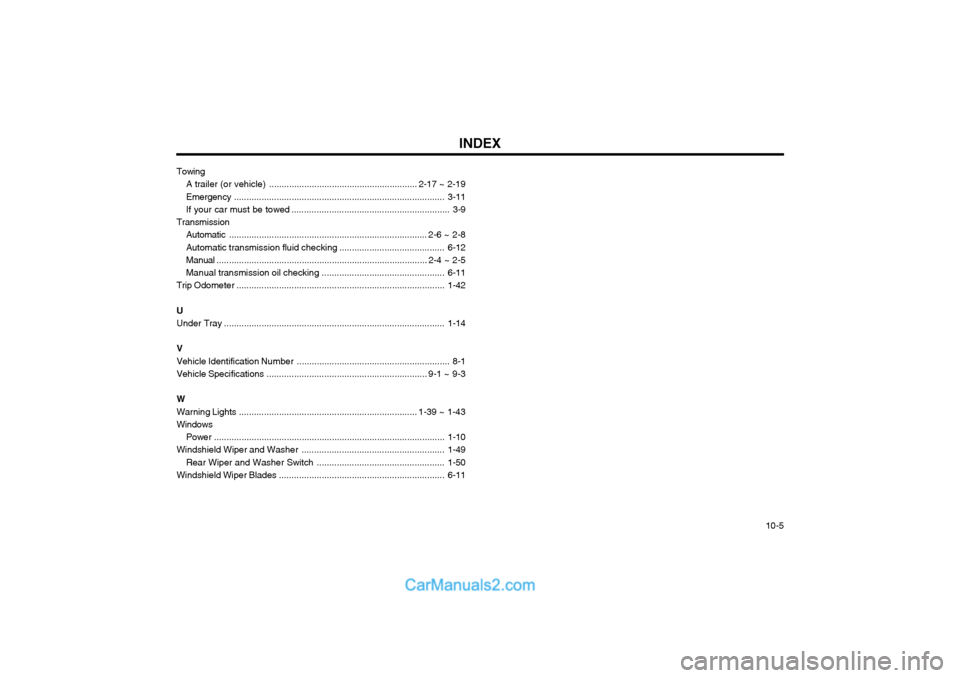
Towing
A trailer (or vehicle) ........................................................... 2-17 ~ 2-19
Emergency .................................................................................... 3-11
If your car must be towed ............................................................... 3-9
Transmission Automatic ............................................................................... 2-6 ~ 2-8
Automatic transmission fluid checking ..........................................6-12
Manual .................................................................................... 2-4 ~ 2-5
Manual transmission oil che cking ................................................. 6-11
Trip Odometer ................................................................................... 1-42
U Under Tray ........................................................................................ 1-14
VVehicle Identification Number ............................................................. 8-1
Vehicle Specifications ................................................................ 9-1 ~ 9-3
W
Warning Lights ....................................................................... 1-39 ~ 1-43
Windows
Power ............................................................................................ 1-10
Windshield Wiper and Washer ......................................................... 1-49
Rear Wiper and Washer Switch ................................................... 1-50
Windshield Wiper Blades ................ ..................................................6-11
Page 202 of 361
CONTROLS AND EQUIPMENT
1- 2 YB020A1-E BEFORE ENTERING THE VEHICLE
o Ensure that all windows, mirrors and lamps are clean.
o Check condition of all tyres.
o Ensure that no fluid leaks are evident.
o Ensure that the area around the vehicle is clear before driving off.
YB020B1-E AFTER ENTERING THE VEHICLE
o Ensure that all occupants fasten and cor- rectly adjust seat belts.
o Ensure that seat and headrestraint positions are adjusted for optimum safety, control and comfort.
o Adjust interior and exterior rear view mir- rors.
o Verify correct operation of lamps, horn and other electrical equipment.
o Ensure that warning lamps illuminate when ignition is turned on.
NOTE: Fluid levels such as engine oil, engine cool- ant, brake and windscreen washer fluidshould be checked daily or at each refuel-ling, whichever occurs sooner. B020A01FC-EAT RUNNING IN YOUR NEW HYUNDAIThe longevity and performance of the vehicle are greatly affected by the care exercised dur-ing the first 1000 miles of motoring. Because ofmodern manufacturing techniques, rigid guide-lines regarding maximum road speeds havebecome unnecessary. However, certain pre-cautions should be observed in order to obtainthe best possible performance and useful lifefrom the vehicle.
1) Do not race the engine without a load (i.e revving the engine in neutral).
2) During the first 500 miles the maximum engine speed should be restricted to 3000rpm and gradually increased thereafter.
3) Avoid prolonged constant speed operation. The internal components of the engine willbecome run-in more quickly if the operation
speed is varied during the running in period.
4) Never allow the engine to labour. Use the gearbox freely and avoid large throttle open-ings when the engine speed is below 1500rpm.
5) Avoid rapid acceleration and maximum throttle openings.
6) Avoid harsh braking during the first 100 miles of urban motoring or 1000 miles ofmotorway driving to allow the friction facingsof the brake pads and shoes to bed againstthe discs and drums properly.
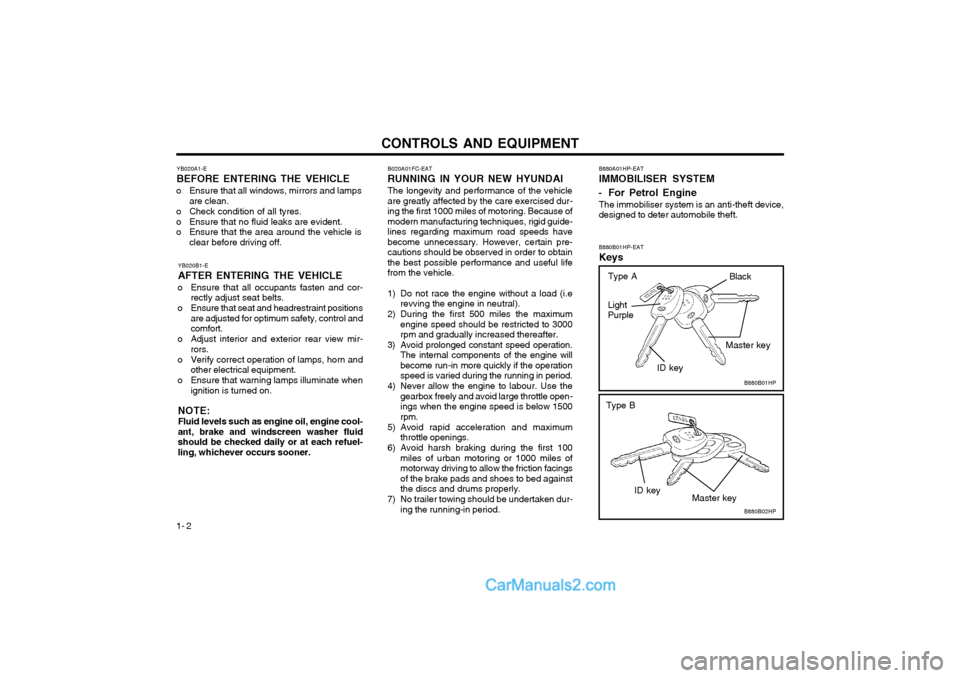
7) No trailer towing should be undertaken dur- ing the running-in period. B880A01HP-EAT IMMOBILISER SYSTEM
- For Petrol Engine The immobiliser system is an anti-theft device, designed to deter automobile theft. B880B01HP-EAT Keys
B880B01HP
B880B02HP
Light Purple
ID key
ID key Master key
Master key
Type B
Black
Type A
Page 241 of 361
CONTROLS AND EQUIPMENT1- 41
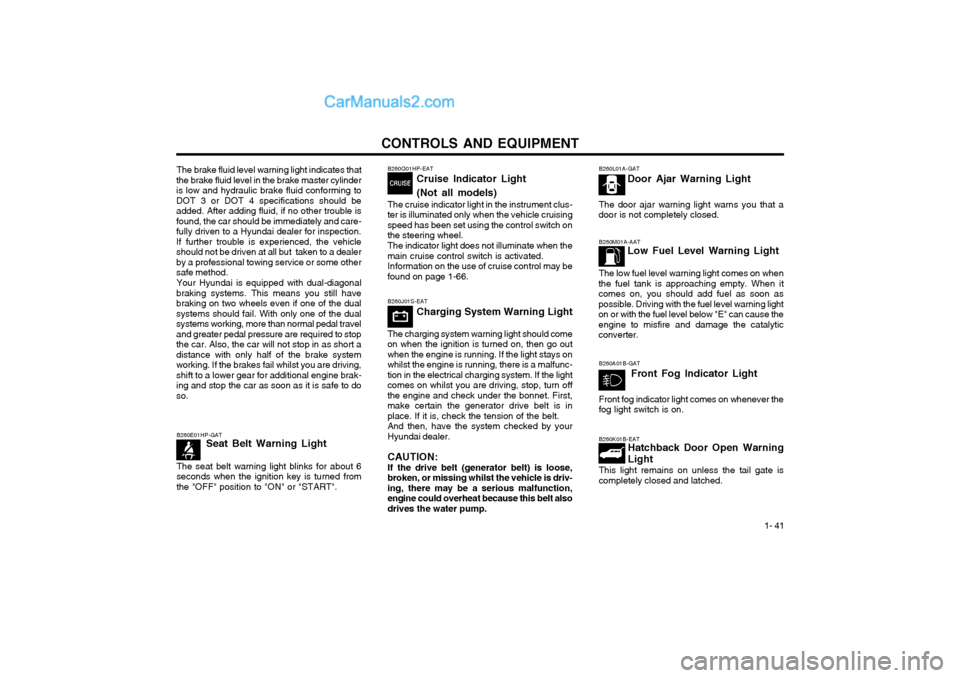
B260M01A-AATLow Fuel Level Warning Light
The low fuel level warning light comes on when
the fuel tank is approaching empty. When it comes on, you should add fuel as soon aspossible. Driving with the fuel level warning lighton or with the fuel level below "E" can cause theengine to misfire and damage the catalyticconverter.
B260K01B-EAT Hatchback Door Open Warning Light
This light remains on unless the tail gate is completely closed and latched.
B260E01HP-GAT
Seat Belt Warning Light
The seat belt warning light blinks for about 6seconds when the ignition key is turned fromthe "OFF" position to "ON" or "START".
B260L01A-GAT Door Ajar Warning Light
The door ajar warning light warns you that a
door is not completely closed.
B260A01B-GAT
Front Fog Indicator Light
Front fog indicator light comes on whenever the fog light switch is on.
B260J01S-EAT Charging System Warning Light
The charging system warning light should come on when the ignition is turned on, then go outwhen the engine is running. If the light stays onwhilst the engine is running, there is a malfunc-tion in the electrical charging system. If the lightcomes on whilst you are driving, stop, turn offthe engine and check under the bonnet. First,make certain the generator drive belt is inplace. If it is, check the tension of the belt.And then, have the system checked by yourHyundai dealer. CAUTION: If the drive belt (generator belt) is loose, broken, or missing whilst the vehicle is driv-ing, there may be a serious malfunction,engine could overheat because this belt alsodrives the water pump.
B260Q01HP-EAT Cruise Indicator Light (Not all models)
The cruise indicator light in the instrument clus-
ter is illuminated only when the vehicle cruising speed has been set using the control switch onthe steering wheel.
The indicator light does not illuminate when the
main cruise control switch is activated. Information on the use of cruise control may be
found on page 1-66.
The brake fluid level warning light indicates that
the brake fluid level in the brake master cylinderis low and hydraulic brake fluid conforming toDOT 3 or DOT 4 specifications should beadded. After adding fluid, if no other trouble isfound, the car should be immediately and care-fully driven to a Hyundai dealer for inspection.If further trouble is experienced, the vehicleshould not be driven at all but taken to a dealerby a professional towing service or some othersafe method.
Your Hyundai is equipped with dual-diagonal
braking systems. This means you still havebraking on two wheels even if one of the dualsystems should fail. With only one of the dualsystems working, more than normal pedal traveland greater pedal pressure are required to stopthe car. Also, the car will not stop in as short adistance with only half of the brake systemworking. If the brakes fail whilst you are driving,shift to a lower gear for additional engine brak-ing and stop the car as soon as it is safe to doso.
Page 243 of 361
CONTROLS AND EQUIPMENT1- 43
B270A01A-EAT BRAKE PAD WEAR WARNING SOUND (Not all models) The front disc brake pads have wear indicators
that should make a high-pitched squealing or scraping noise when new pads are needed.The sound may come and go or be heard all thetime when the vehicle is moving. It may also beheard when the brake pedal is pushed downfirmly. Excessive rotor damage will result if theworn pads are not replaced. See your Hyundaidealer immediately. NOTE: If the engine were not started within 2 sec-
onds after the preheating is completed, turn the ignition key once more to the "LOCK"position during 10 seconds, and then to the"ON" position, in order to preheat again.
it to a complete stop in a safe location off theroadway.
After starting the engine, do not drive the vehi-
cle until the vacuum level is above 275 mmHgbelow atmosphere and warning light has turnedoff. If further trouble is experienced, the vehicleshould not be driven at all but taken to a dealerby a professional towing service. B265C02HP-EAT
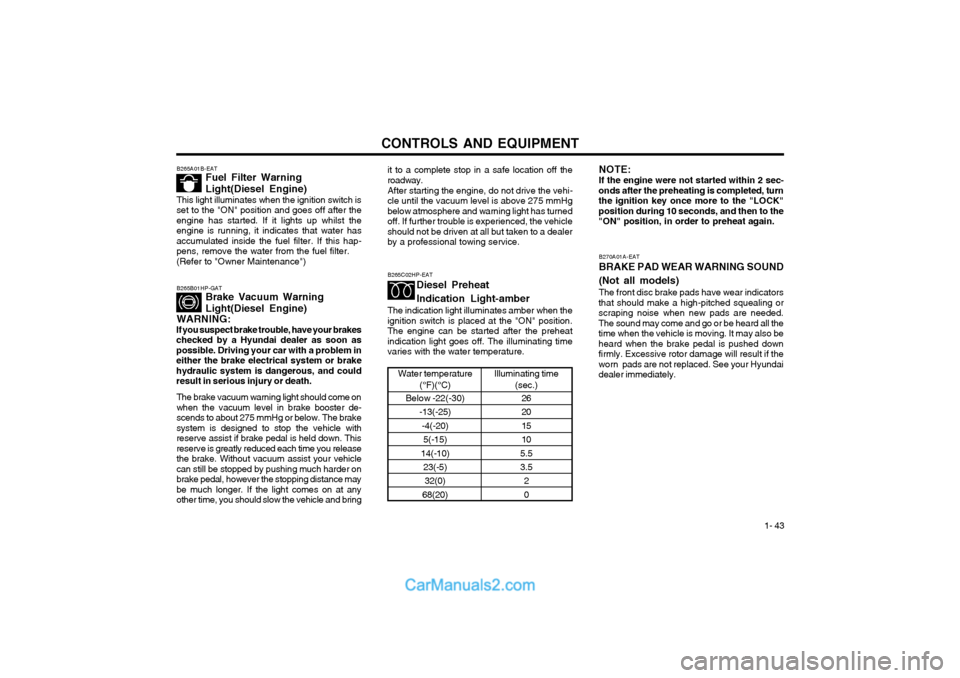
Diesel Preheat Indication Light-amber
The indication light illuminates amber when the ignition switch is placed at the "ON" position.The engine can be started after the preheatindication light goes off. The illuminating timevaries with the water temperature.
B265A01B-EAT Fuel Filter Warning Light(Diesel Engine)
This light illuminates when the ignition switch is set to the "ON" position and goes off after theengine has started. If it lights up whilst theengine is running, it indicates that water hasaccumulated inside the fuel filter. If this hap-pens, remove the water from the fuel filter. (Refer to "Owner Maintenance") B265B01HP-GAT Brake Vacuum Warning Light(Diesel Engine)
WARNING:
If you suspect brake trouble, have your brakes checked by a Hyundai dealer as soon aspossible. Driving your car with a problem ineither the brake electrical system or brakehydraulic system is dangerous, and couldresult in serious injury or death.
The brake vacuum warning light should come onwhen the vacuum level in brake booster de-scends to about 275 mmHg or below. The brakesystem is designed to stop the vehicle withreserve assist if brake pedal is held down. Thisreserve is greatly reduced each time you releasethe brake. Without vacuum assist your vehiclecan still be stopped by pushing much harder onbrake pedal, however the stopping distance maybe much longer. If the light comes on at anyother time, you should slow the vehicle and bring
Water temperature (°F)(°C)
Below -22(-30)
-13(-25)-4(-20)
5(-15)
14(-10) 23(-5)32(0)
68(20) Illuminating time
(sec.)
26 201510
5.53.5 20
Page 292 of 361
DRIVING YOUR HYUNDAI 2- 9
o Ensure that the overdrive switch is at the
"ON" position for maximum economy.
o If rapid acceleration is required, fully de- press the accelerator pedal. In this condi- tion, the kickdown mechanism will be oper-ated and the transmission will automaticallydownshift according to the vehicle speed.
C120A02A-EAT
ANTI-LOCK BRAKE SYSTEM (Not all models)
The Anti-Lock Brake System (ABS) is designed
to prevent wheel lock-up during sudden braking or on hazardous road surfaces. The ABS con-trol module monitors the wheel speed and con-trols the pressure applied to each brake. Thus,in emergency situations or on slick roads, ABSwill increase vehicle control during braking.
NOTE: During ABS operation, a slight pulsation
may be felt in the brake pedal when the brakes are applied. Also, a noise may beheard in the engine compartment whilst brak-ing. These conditions are normal and indi-cate that the anti-lock brake system is func-tioning properly. WARNING: ABS will not prevent accidents due to im-
proper or dangerous driving manoeuvres. Even though vehicle control is improvedduring emergency braking, always maintaina safe distance between you and objectsahead. Vehicle speeds should always bereduced during extreme road conditions.
The braking distance for cars equipped with
an anti-lock braking system may be longerthan for those without it in the followingroad conditions.
o Driving on rough, gravel or snow-cov- ered roads.
o Driving with tire chains installed.
o Driving on roads where the road surface is pitted or has different surface height.
These roads should be driven at reduced
speeds. The safety features of an ABS equipped vehicle should not be tested byhigh speed driving or cornering. This couldendanger the safety of yourself or others.
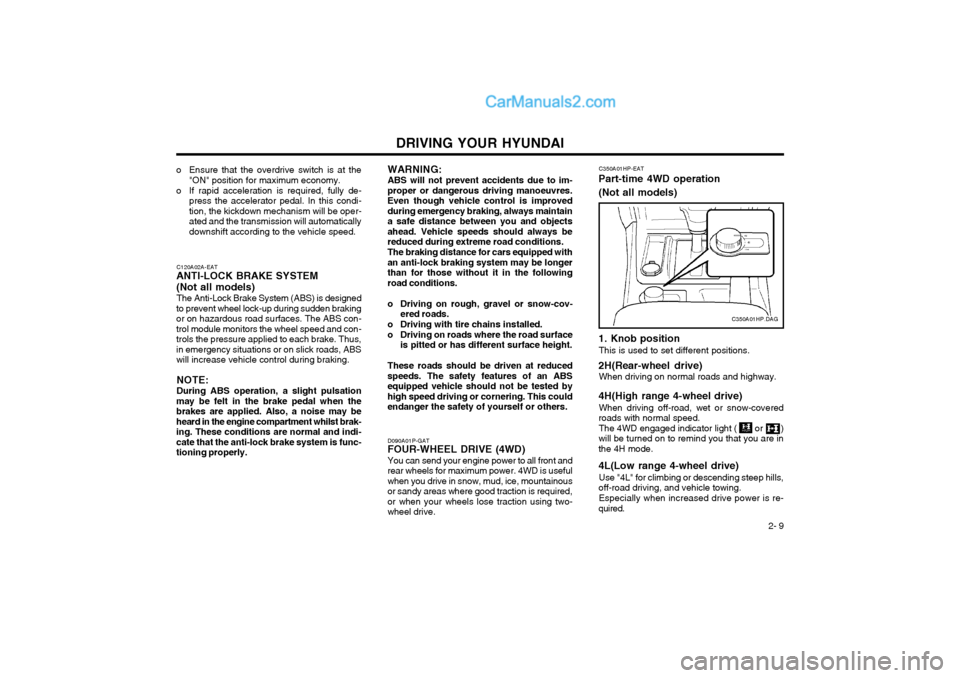
C350A01HP-EAT
Part-time 4WD operation (Not all models)
1. Knob position
This is used to set different positions.
2H(Rear-wheel drive) When driving on normal roads and highway.
4H(High range 4-wheel drive) When driving off-road, wet or snow-covered
roads with normal speed. The 4WD engaged indicator light ( or )
will be turned on to remind you that you are in the 4H mode. 4L(Low range 4-wheel drive)
Use "4L" for climbing or descending steep hills,
off-road driving, and vehicle towing.
Especially when increased drive power is re-
quired.
C350A01HP.DAG
D090A01P-GAT
FOUR-WHEEL DRIVE (4WD)
You can send your engine power to all front and
rear wheels for maximum power. 4WD is useful when you drive in snow, mud, ice, mountainousor sandy areas where good traction is required,or when your wheels lose traction using two-wheel drive.
Page 295 of 361
DRIVING YOUR HYUNDAI
2- 12 Driving 4WD Safely
(1) Be sure to wear the seat belt.
(2) Drive at lower speeds in strong crosswinds.
Because of your vehicle's high centre of gravity, its stability will be affected in cross-winds. Slower speeds ensure better vehiclecontrol.
(3) Check the brake condition after driving in wet or muddy conditions. Press the brakeseveral times as you move slowly until youfeel normal braking forces return.
(4) Do not drive the vehicle through water. (i.e. streams, rivers, lakes, etc.)
(5) The stopping distance of the full-time 4WD vehicle differs very little from that of the2WD vehicle.
When driving on a snow-covered road or a slippery, muddy surface, make sure thatyou keep a sufficient distance between yourvehicle and the one ahead of you.
(6) Since the driving torque is always applied to the 4 wheels, the performance of the full-time 4WD vehicle is greatly affected by thecondition of the tyres. Be sure to equip itwith all four tyres of the same size and type.o When replacement of any of the tyres or disc wheels is necessary, replace all ofthem.
o Rotate the tyres and check the tyre pres- sure at regular intervals.
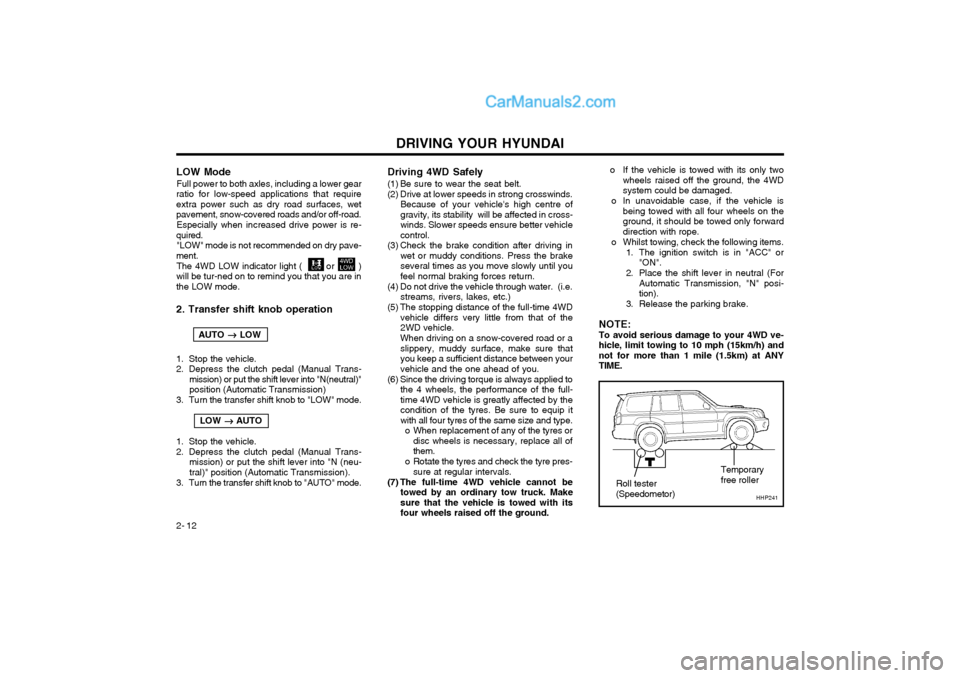
(7) The full-time 4WD vehicle cannot be towed by an ordinary tow truck. Makesure that the vehicle is towed with itsfour wheels raised off the ground. o If the vehicle is towed with its only two
wheels raised off the ground, the 4WDsystem could be damaged.
o In unavoidable case, if the vehicle is being towed with all four wheels on theground, it should be towed only forwarddirection with rope.
o Whilst towing, check the following items.
1. The ignition switch is in "ACC" or"ON".
2. Place the shift lever in neutral (For Automatic Transmission, "N" posi-tion).
3. Release the parking brake.
NOTE: To avoid serious damage to your 4WD ve- hicle, limit towing to 10 mph (15km/h) andnot for more than 1 mile (1.5km) at ANYTIME.
HHP241
Roll tester (Speedometor) Temporaryfree roller
LOW Mode
Full power to both axles, including a lower gear
ratio for low-speed applications that require extra power such as dry road surfaces, wetpavement, snow-covered roads and/or off-road.
Especially when increased drive power is re-
quired. "LOW" mode is not recommended on dry pave-
ment.
The 4WD LOW indicator light ( or )
will be tur-ned on to remind you that you are inthe LOW mode. 2. Transfer shift knob operation
AUTO
LOW
1. Stop the vehicle.
2. Depress the clutch pedal (Manual Trans- mission) or put the shift lever into "N(neutral)"position (Automatic Transmission)
3. Turn the transfer shift knob to "LOW" mode.
LOW
AUTO
1. Stop the vehicle.
2. Depress the clutch pedal (Manual Trans- mission) or put the shift lever into "N (neu-tral)" position (Automatic Transmission).
3. Turn the transfer shift knob to "AUTO" mode.
Page 297 of 361
DRIVING YOUR HYUNDAI
2- 14 D190A01O-EAT
LIMITED-SLIP DIFFERENTIAL (Not all models)
A limited-slip differential, if equipped, is for the
rear wheel differential only. The features of this limited-slip differential are described below:
Just as with a conventional differential, the
wheel on one side is allowed to turn at adifferent speed from the wheel on the other sidewhen the vehicle is cornering. The differencebetween the limited-slip differential and a con-ventional differential is that if the wheel on oneside of the vehicle loses traction, a greateramount of torque is applied to the rear wheel onthe other side to improve traction.
SC140A1-E
EFFECTIVE BRAKING Braking system performance and friction mate-rial life are greatly affected by the driving styleadopted. The following suggestions are madeto assist in achieving the best results from thebraking system.
o Anticipate the road and conditions ahead in order that heavy braking may be avoided.
o When descending long gradients, use the engine to assist in retarding the vehicle tominimize the possibility of brake fade occur-ring. o When trailer towing, ensure that the trailer
brakes function correctly and use enginebraking to assist the vehicle braking system.
o Use only genuine Hyundai replacement brake pads and shoes to ensure consistentfriction characteristics and wear rates.
o After driving through deep water (e.g. fording), the brakes may become wet andperformance reduced. Always check brakeefficiency after emerging from the water anddry the brakes by lightly depressing thebrake pedal several times whilst driving slow-ly.
o Apply the parking brake only when the vehi- cle is at rest.
o Since the power assistance provided by the brake servo is derived from the engine,coasting with the engine turned off or towingof the vehicle with the engine turned off willresult in greatly increased pedal pressuresbeing required to stop the vehicle.
o Do not hold the vehicle on the upgrade with the accelerator pedal. This can cause thetransmission to overheat. Always use thebrake pedal or parking brake.
CAUTION:
o Whilst the full-time 4WD vehicle is being raised on a jack, never start the engine orcause the tyres to rotate. There is the danger that rotating tyres touching the ground could cause thevehicle to go off the jack and to jumpforward.
o If one of the front or rear wheels begins to spin in mud, snow, etc., the vehiclecan sometimes be driven out by depress-ing the accelerator pedal further; how-ever, avoid running the engine continu-ously at high rpm because doing so coulddamage the 4WD system.
WARNING:
o Avoid high cornering speeds.
o Do not make quick steering wheel move- ments, such as sharp lane charges or fast, sharp turns.
o The risk of rollover is greatly increased if you lose control of your vehicle at high-way speeds.
o In a collision crash, an unbelted person is significantly more likely to die than aperson wearing a seatbelt.
o Loss of control often occurs if two or more wheels drop off the roadway and thedriver oversteers to reenter the roadway.
o In the event your vehicle leaves the road- way, do not steer sharply. Instead, slowdown before pulling back into the travellanes.
Page 300 of 361
DRIVING YOUR HYUNDAI 2- 17
YC200D2-E
Safety Cables
Should the towbar connection between your car
and the trailer or vehicle you are towing fail, the trailer or vehicle could wander dangerouslyacross other lanes of traffic and ultimately leavethe roadway. To eliminate this potentially dan-gerous situation, safety cables, attached be-tween your car and the trailer or towed vehicle,are required.
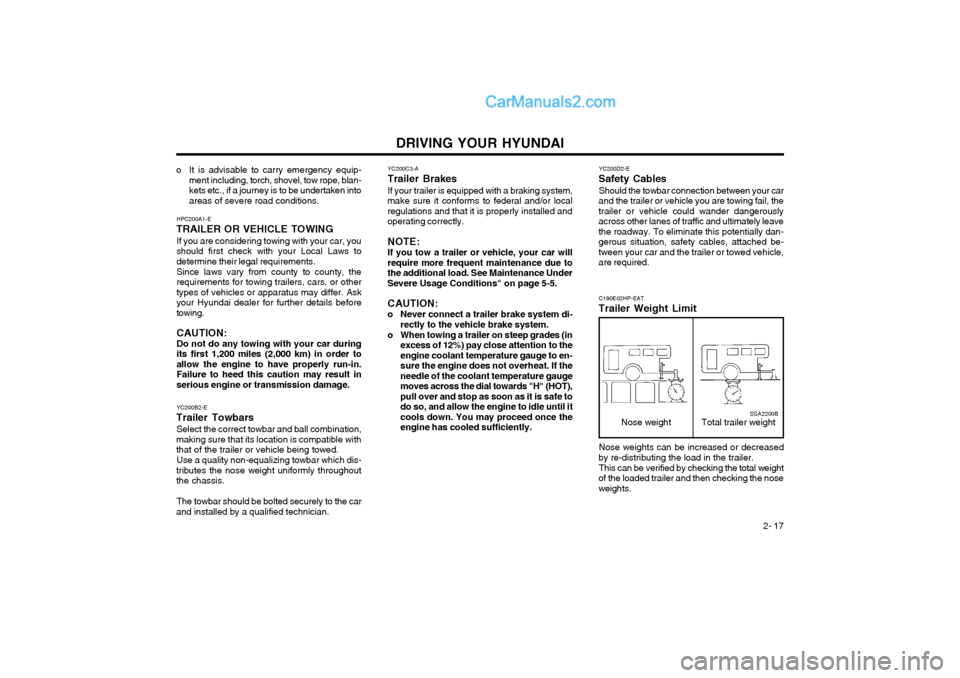
Nose weight Total trailer weightSSA2200B
C190E02HP-EAT
Trailer Weight Limit
Nose weights can be increased or decreased
by re-distributing the load in the trailer.
This can be verified by checking the total weight
of the loaded trailer and then checking the nose weights.
YC200C3-A
Trailer Brakes
If your trailer is equipped with a braking system,
make sure it conforms to federal and/or localregulations and that it is properly installed andoperating correctly.
NOTE: If you tow a trailer or vehicle, your car will
require more frequent maintenance due to the additional load. See Maintenance UnderSevere Usage Conditions" on page 5-5.
CAUTION:
o Never connect a trailer brake system di- rectly to the vehicle brake system.
o When towing a trailer on steep grades (in excess of 12%) pay close attention to theengine coolant temperature gauge to en-sure the engine does not overheat. If theneedle of the coolant temperature gaugemoves across the dial towards "H" (HOT),pull over and stop as soon as it is safe todo so, and allow the engine to idle until itcools down. You may proceed once theengine has cooled sufficiently.
HPC200A1-E
TRAILER OR VEHICLE TOWING
If you are considering towing with your car, youshould first check with your Local Laws todetermine their legal requirements. Since laws vary from county to county, the requirements for towing trailers, cars, or othertypes of vehicles or apparatus may differ. Askyour Hyundai dealer for further details beforetowing. CAUTION: Do not do any towing with your car duringits first 1,200 miles (2,000 km) in order toallow the engine to have properly run-in.Failure to heed this caution may result inserious engine or transmission damage. YC200B2-E
Trailer Towbars Select the correct towbar and ball combination,
making sure that its location is compatible with that of the trailer or vehicle being towed.
Use a quality non-equalizing towbar which dis-
tributes the nose weight uniformly throughoutthe chassis.
The towbar should be bolted securely to the car
and installed by a qualified technician.
o It is advisable to carry emergency equip-
ment including, torch, shovel, tow rope, blan-kets etc., if a journey is to be undertaken intoareas of severe road conditions.
Page 301 of 361
DRIVING YOUR HYUNDAI
2- 18 NOTE:
1. Never load the trailer with more weight in the back than in the front. About 60% of the trailer load should be in the front halfon the trailer and the remaining 40% inthe rear.
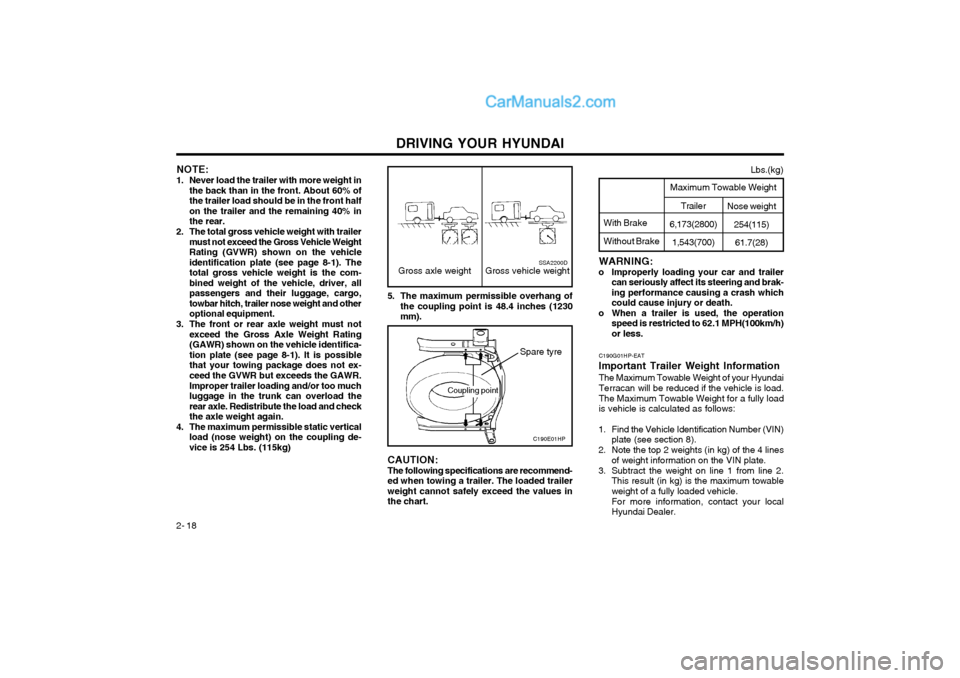
2. The total gross vehicle weight with trailer must not exceed the Gross Vehicle WeightRating (GVWR) shown on the vehicleidentification plate (see page 8-1). Thetotal gross vehicle weight is the com-bined weight of the vehicle, driver, allpassengers and their luggage, cargo,towbar hitch, trailer nose weight and otheroptional equipment.
3. The front or rear axle weight must not exceed the Gross Axle Weight Rating(GAWR) shown on the vehicle identifica-tion plate (see page 8-1). It is possiblethat your towing package does not ex-ceed the GVWR but exceeds the GAWR. Improper trailer loading and/or too much luggage in the trunk can overload therear axle. Redistribute the load and checkthe axle weight again.
4. The maximum permissible static vertical load (nose weight) on the coupling de-vice is 254 Lbs. (115kg) 5. The maximum permissible overhang of
the coupling point is 48.4 inches (1230mm).
Gross axle weight Gross vehicle weightSSA2200D
CAUTION: The following specifications are recommend-ed when towing a trailer. The loaded trailerweight cannot safely exceed the values inthe chart.
Lbs.(kg)
Maximum Towable Weight
With Brake Without Brake Trailer
6,173(2800) 1,543(700) Nose weight
254(115)61.7(28)
WARNING:
o Improperly loading your car and trailer can seriously affect its steering and brak- ing performance causing a crash whichcould cause injury or death.
o When a trailer is used, the operation speed is restricted to 62.1 MPH(100km/h)or less.
C190E01HP
Spare tyre
Coupling point
C190G01HP-EAT
Important Trailer Weight Information
The Maximum Towable Weight of your Hyundai Terracan will be reduced if the vehicle is load. The Maximum Towable Weight for a fully load is vehicle is calculated as follows:
1. Find the Vehicle Identification Number (VIN) plate (see section 8).
2. Note the top 2 weights (in kg) of the 4 lines of weight information on the VIN plate.
3. Subtract the weight on line 1 from line 2. This result (in kg) is the maximum towableweight of a fully loaded vehicle. For more information, contact your local Hyundai Dealer.