towing Hyundai Terracan 2004 Owner's Guide
[x] Cancel search | Manufacturer: HYUNDAI, Model Year: 2004, Model line: Terracan, Model: Hyundai Terracan 2004Pages: 361, PDF Size: 4.69 MB
Page 302 of 361
DRIVING YOUR HYUNDAI 2- 19
CAUTION: If overheating should occur when towing,
(temperature gauge reads near red zone), taking the following action may reduce oreliminate the problem.
1. Turn off the air conditioner.
2. Reduce highway speed.
3. Select a lower gear when going uphill.
4. Whilst in stop and go traffic, place the gear selector in park or neutral and idle the engine at a higher speed.
HPC200E1-E
Trailer or Vehicle Towing Tips
1. Before towing, check towbar and safety cable connections as well as proper operation of the trailer running lights, brake lights, andturn signals.
2. Always drive your vehicle at a moderate speed (Less than 60 mph)
3. Trailer towing requires more fuel than nor- mal conditions.
4. To maintain engine braking efficiency and electrical charging performance, do not usefifth gear (manual transmission).
5. Always secure items in the trailer to prevent load shift whilst driving.
6. Check the condition and air pressure of all tyres on the trailer and your car. Low tyrepressure can seriously affect the handling.Also check the spare tyre.
7. The vehicle/trailer combination is more af- fected by crosswind and buffeting. When being passed by a large vehicle, keep a constant speed and steer straight ahead.If there is too much wind buffeting slowdown to get out of the other vehicle's airturbulence.
8. When parking your car and trailer, especial- ly on a hill, be sure to follow all the normalprecautions. Turn your front wheel into thecurb, set the parking brake firmly, and putthe transmission in 1st or Reverse (manual)or Park (automatic). In addition, place wheelchocks at each of the trailer's tyres. 9. If the trailer has electric brakes, start your
vehicle and trailer moving, and then applythe trailer brake controller by hand to besure the brakes are working. This lets youcheck your electrical connection at the sametime.
10. During your trip, check occasionally to be sure that the load is secure, and that thelights and any trailer brakes are still working.
11. Avoid jerky starts, sudden acceleration or sudden stops.
12. Avoid sharp turns and rapid lane changes.
13. Avoid holding the brake pedal down too long or too frequently. This could cause the brakes to overheat, resulting in reduced brakingefficiency.
14. When going down a hill, shift into a lower gear and use the engine braking effect. When ascending a long grade, downshift the transmission to a lower gear and reducespeed to reduce chances of engine over-loading and/or overheating.
15. If you have to stop whilst going uphill, do not hold the vehicle in place by pressing on theaccelerator. This can cause the automatictransmission to overheat. Use the parkingbrake or footbrake.
NOTE: When towing, check transmission fluid more
frequently.
Page 311 of 361
IN CASE OF EMERGENCY 3-9
D060J01HP
Lower the car to the ground by moving the jack
handle up and down. Then position the wheel brace as shown in the drawing and tighten thewheel nuts. Be sure the socket is seated com-pletely over the nut. Do not stand on the wrenchor use an extension pipe over the wrenchhandle.
Go around the wheel tightening every other nut
until they are all tight. Then double-check eachnut for tightness. After changing wheels, have atechnician tighten the wheel nuts to their propertorque as soon as possible.
Wheel nut tightening torque: Steel wheel & aluminium alloy wheel:90-110 N.m (65-80 lb.ft) D060J02O-EAT
AFTER CHANGING WHEELS
If you have a tyre gauge, remove the valve cap
and check the air pressure. If the pressure is lower than recommended, drive slowly to thenearest service station and inflate to the correctpressure. If it is too high, adjust it until it iscorrect. Always reinstall the valve cap afterchecking or adjusting tyre pressure. If the capis not replaced, air may leak from the tyre. If youlose a valve cap, buy another and install it assoon as possible.
After you have changed wheels, always secure
the flat tyre in its place and return the jack andtools to their proper storage locations. D080A02A-EAT
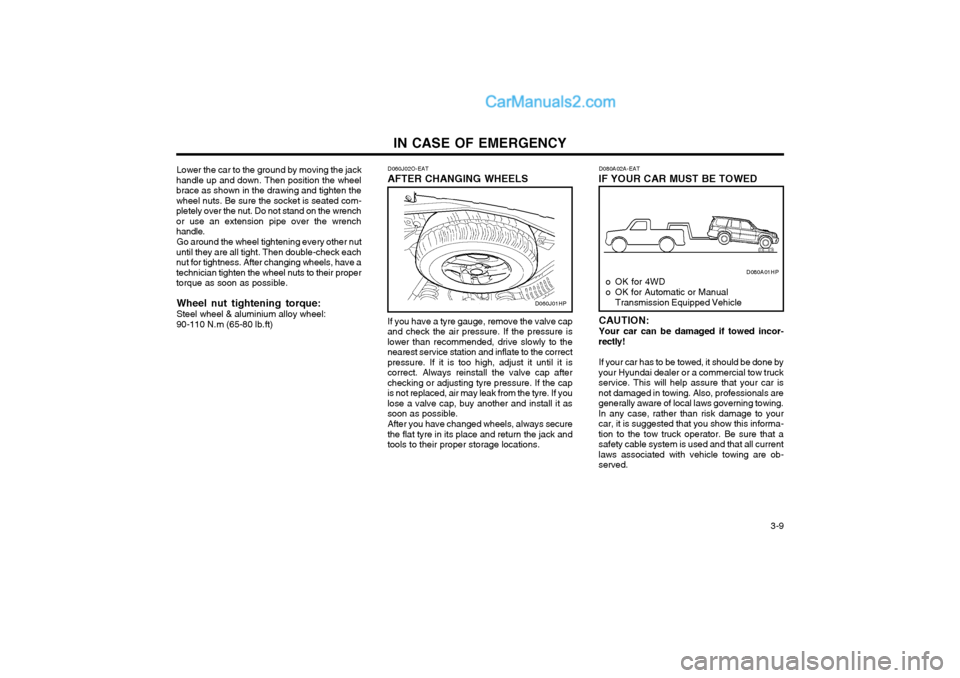
IF YOUR CAR MUST BE TOWED
o OK for 4WD
o OK for Automatic or Manual Transmission Equipped Vehicle D080A01HP
CAUTION:Your car can be damaged if towed incor-
rectly!
If your car has to be towed, it should be done by
your Hyundai dealer or a commercial tow truck service. This will help assure that your car isnot damaged in towing. Also, professionals aregenerally aware of local laws governing towing.In any case, rather than risk damage to yourcar, it is suggested that you show this informa-tion to the tow truck operator. Be sure that asafety cable system is used and that all currentlaws associated with vehicle towing are ob-served.
Page 312 of 361
IN CASE OF EMERGENCY
3-10 D080B01HP-EAT
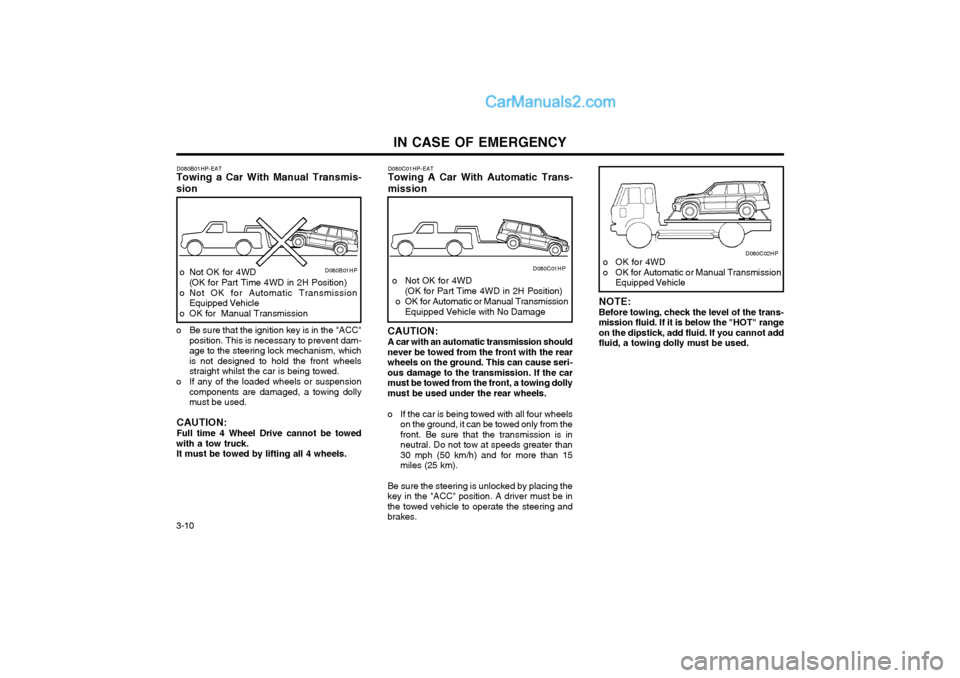
Towing a Car With Manual Transmis- sion
o Not OK for 4WD
(OK for Part Time 4WD in 2H Position)
o Not OK for Automatic Transmission Equipped Vehicle
o OK for Manual Transmission D080B01HP
o Be sure that the ignition key is in the "ACC" position. This is necessary to prevent dam- age to the steering lock mechanism, whichis not designed to hold the front wheelsstraight whilst the car is being towed.
o If any of the loaded wheels or suspension components are damaged, a towing dollymust be used.
CAUTION: Full time 4 Wheel Drive cannot be towed
with a tow truck. It must be towed by lifting all 4 wheels.o OK for 4WD
o OK for Automatic or Manual Transmission Equipped VehicleD080C02HP
NOTE: Before towing, check the level of the trans- mission fluid. If it is below the "HOT" rangeon the dipstick, add fluid. If you cannot addfluid, a towing dolly must be used.
D080C01HP-EAT
Towing A Car With Automatic Trans- mission
CAUTION: A car with an automatic transmission should never be towed from the front with the rearwheels on the ground. This can cause seri-ous damage to the transmission. If the carmust be towed from the front, a towing dollymust be used under the rear wheels.
o If the car is being towed with all four wheels on the ground, it can be towed only from thefront. Be sure that the transmission is inneutral. Do not tow at speeds greater than30 mph (50 km/h) and for more than 15miles (25 km).
Be sure the steering is unlocked by placing thekey in the "ACC" position. A driver must be inthe towed vehicle to operate the steering andbrakes.
o Not OK for 4WD (OK for Part Time 4WD in 2H Position)
o OK for Automatic or Manual Transmission Equipped Vehicle with No Damage
D080C01HP
Page 313 of 361
IN CASE OF EMERGENCY 3-11
D120A01A-EAT
IF YOU LOSE YOUR KEYS Information about the key of immobiliser sys-
tem will be found on page 1-2.
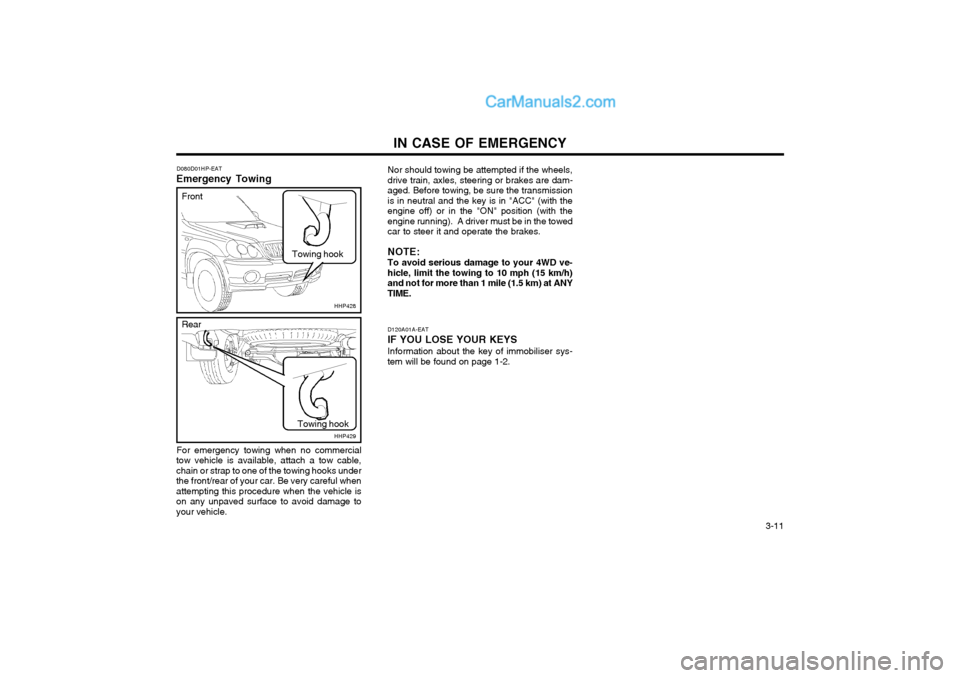
D080D01HP-EAT
Emergency Towing Nor should towing be attempted if the wheels, drive train, axles, steering or brakes are dam-aged. Before towing, be sure the transmissionis in neutral and the key is in "ACC" (with theengine off) or in the "ON" position (with theengine running). A driver must be in the towedcar to steer it and operate the brakes. NOTE: To avoid serious damage to your 4WD ve- hicle, limit the towing to 10 mph (15 km/h)and not for more than 1 mile (1.5 km) at ANYTIME.
HHP428
Front Rear
HHP429
Towing hook
Towing hook
For emergency towing when no commercial
tow vehicle is available, attach a tow cable, chain or strap to one of the towing hooks underthe front/rear of your car. Be very careful whenattempting this procedure when the vehicle ison any unpaved surface to avoid damage toyour vehicle.
Page 321 of 361
VEHICLE MAINTENANCE REQUIREMENTS 5-5
F040A05HP-EAT
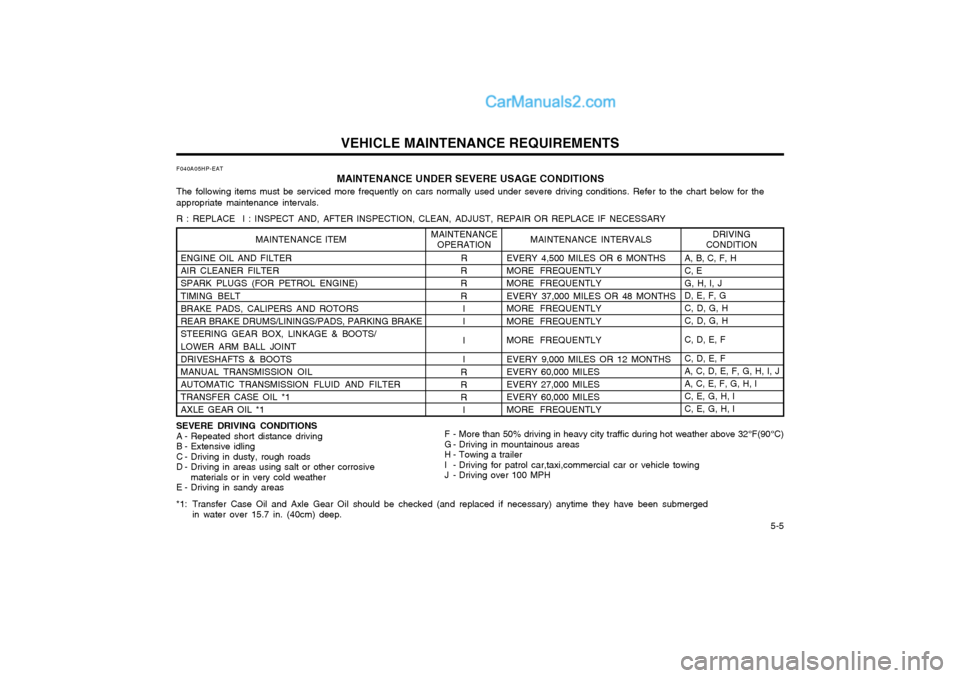
MAINTENANCE UNDER SEVERE USAGE CONDITIONS
The following items must be serviced more frequently on cars normally used under severe driving conditions. Refer to the chart below for the appropriate maintenance intervals. R : REPLACE I : INSPECT AND, AFTER INSPECTION, CLEAN, ADJUST, REPAIR OR REPLACE IF NECESSARY
SEVERE DRIVING CONDITIONS
A - Repeated short distance driving
B - Extensive idling
C - Driving in dusty, rough roads
D - Driving in areas using salt or other corrosive materials or in very cold weather
E - Driving in sandy areas ENGINE OIL AND FILTER AIR CLEANER FILTER SPARK PLUGS (FOR PETROL ENGINE) TIMING BELT BRAKE PADS, CALIPERS AND ROTORS REAR BRAKE DRUMS/LININGS/PADS, PARKING BRAKE STEERING GEAR BOX, LINKAGE & BOOTS/ LOWER ARM BALL JOINT DRIVESHAFTS & BOOTS MANUAL TRANSMISSION OIL AUTOMATIC TRANSMISSION FLUID AND FILTERTRANSFER CASE OIL *1AXLE GEAR OIL *1
EVERY 4,500 MILES OR 6 MONTHS MORE FREQUENTLY MORE FREQUENTLY EVERY 37,000 MILES OR 48 MONTHS MORE FREQUENTLY MORE FREQUENTLY MORE FREQUENTLYEVERY 9,000 MILES OR 12 MONTHS EVERY 60,000 MILESEVERY 27,000 MILESEVERY 60,000 MILES MORE FREQUENTLY
MAINTENANCE
OPERATIONMAINTENANCE ITEM
R
R R R II II
R R R I A, B, C, F, H C, EG, H, I, J D, E, F, G C, D, G, HC, D, G, H C, D, E, FC, D, E, F A, C, D, E, F, G, H, I, JA, C, E, F, G, H, I C, E, G, H, I C, E, G, H, I
MAINTENANCE INTERVALS
DRIVING
CONDITION
F - More than 50% driving in heavy city traffic during hot weather above 32°F(90°C)
G - Driving in mountainous areas
H - Towing a trailer
I - Driving for patrol car,taxi,commercial car or vehicle towing
J - Driving over 100 MPH
*1: Transfer Case Oil and Axle Gear Oil should be checked (and replaced if necessary) anytime they have been submerged in water over 15.7 in. (40cm) deep.
Page 360 of 361
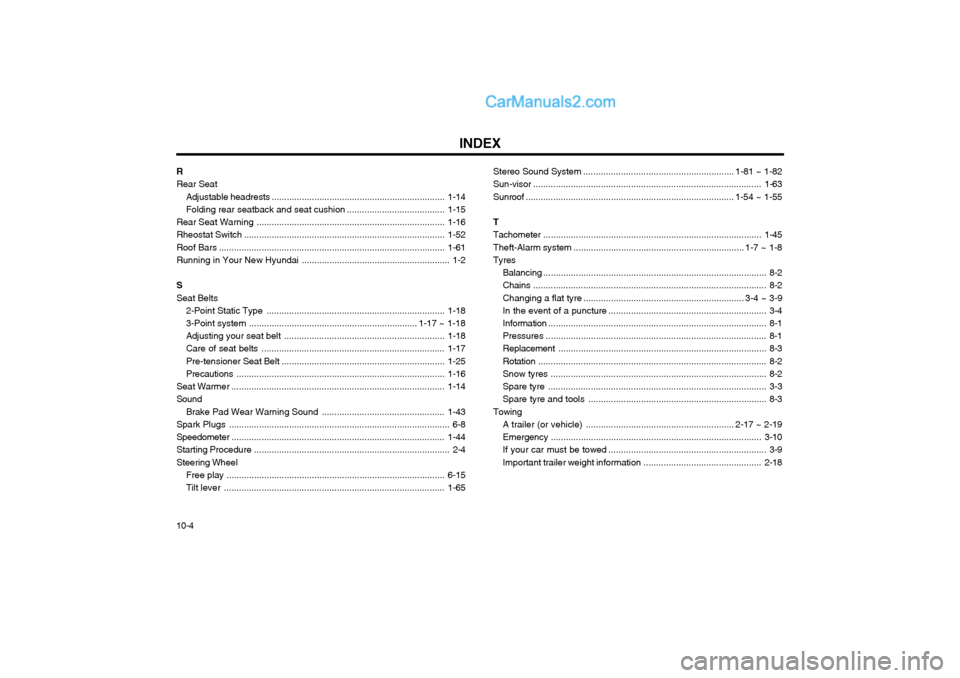
INDEX
10-4 R Rear Seat
Adjustable headrests ..................................................................... 1-14
Folding rear seatback and seat cushion ....................................... 1-15
Rear Seat Warning........................................................................... 1-16
Rheostat Switch ................................................................................ 1-52
Roof Bars .......................................................................................... 1-61
Running in Your New Hyundai ........................................................... 1-2
S Seat Belts 2-Point Sta tic Type ....................................................................... 1-18
3-Point system ................................................................... 1-17 ~ 1-18
Adjusting your seat belt ................................................................ 1-18
Care of seat belts ......................................................................... 1-17
Pre-tensioner Seat Belt ................................................................. 1-25
Precautions ................................................................................... 1-16
Seat Warmer ..................................................................................... 1-14
Sound
Brake Pad Wear Warning Sound .................................................1-43
Spark Plugs ........................................................................................ 6-8
Speedometer ..................................................................................... 1-44
Starting Procedure .............................................................................. 2-4Steering Wheel Free play ....................................................................................... 6-15
Tilt lever ........................................................................................ 1-65Stereo Sound System ............................................................ 1-81 ~ 1-82 Sun-visor
........................................................................................... 1-63
Sunroof ................................................................................... 1-54 ~ 1-55
TTachometer ....................................................................................... 1-45
Theft-Alarm system .................................................................... 1-7 ~ 1-8
Tyres
Balancing ......................................................................................... 8-2
Chains ............................................................................................. 8-2
Changing a flat ty re ................................................................ 3-4 ~ 3-9
In the event of a puncture ..... .......................................................... 3-4
Information ....................................................................................... 8-1
Pressures ........................................................................................ 8-1Replacement ................................................................................... 8-3
Rotation ........................................................................................... 8-2
Snow tyres ...................................................................................... 8-2
Spare tyre ....................................................................................... 3-3 Spare tyre and tools ....................................................................... 8-3
Towing A trailer (or vehicle) ........................................................... 2-17 ~ 2-19
Emergency .................................................................................... 3-10
If your car must be towed ..... .......................................................... 3-9
Important trailer weight information ............................................... 2-18