heating Hyundai Terracan 2004 Service Manual
[x] Cancel search | Manufacturer: HYUNDAI, Model Year: 2004, Model line: Terracan, Model: Hyundai Terracan 2004Pages: 361, PDF Size: 4.69 MB
Page 280 of 361
CONTROLS AND EQUIPMENT
1- 80 B740D01Y-AAT Operation Tips
o If the interior of the car is hot when you first get in, open the windows for a few minutes to expel the hot air.
o When you are using the air conditioning system, keep all windows closed to keephot air out.
o When moving slowly, as in heavy traffic, shift to a lower gear. This increases enginespeed, which in turn increases the speed ofthe air conditioning compressor.
o On steep grades, turn the air conditioning off to avoid the possibility of the engine over-heating.
o During winter months or in periods when the air conditioning is not used regularly, run theair conditioning once every month for a fewminutes. This will help circulate the lubri-cants and keep your system in peak operat-ing condition.
Page 284 of 361
DRIVING YOUR HYUNDAI 2- 1
YC010A1-A
2. DRIVING THE HYUNDAI
C010A01O-EAT WARNING: ENGINE EXHAUST CAN BE DANGEROUS!
Engine exhaust gases are potentially lethal. If at any time engine exhaust gas is detected within the passenger compartment, move the vehicle to an open area and open all windows. o Never inhale exhaust gas. Exhaust gases contain Carbon Monoxide which is colourless and odourless. Carbon Monoxide is poisonous and can cause unconsciousness and death by asphyxiation. o Exhaust System Maintenance. Ensure that the exhaust system is maintained in good condition and is free from excessive corrosion and damage which may result in leakage. If the vehicle is driven over an object which strikes the exhaust system, ensure that the exhaustsystem is inspected at the first available opportunity to ensure that no leakage exists. o Confined Areas. Do not run the engine in confined spaces, allowing the engine to idle in a garage, even when the doors are open is dangerous practice. Only start the engine immediately prior to moving the vehicle out of the garage. o Prolonged Idling. If it is necessary to allow the vehicle to idle for prolonged periods, ensure that the heating system air intake control is set to the "Fresh" position, the blower is set to high speed operation and that the vehicle is standing in an open area. o Load Carrying. If it is necessary to carry long objects which do not permit the hatchback door to be fully closed, the side windows must remain closed and the heating air intake control set to the "Fresh" position with the blower running at the highest speedsetting. To ensure correct operation of the heater system, the air intake grilles at the base of the windscreen must not be obstructed by snow leaves etc..
2
Page 287 of 361
DRIVING YOUR HYUNDAI
2- 4 low the engine to idle for 20 seconds or so before driving the vehicle. CAUTION: Do not leave the vehicle unattended whilst idling. Never allow the vehicle to idle orwarm up in a confined space (ie garage)longer than is necessary to move the vehi-cle into an open area.
HPC060A1-E
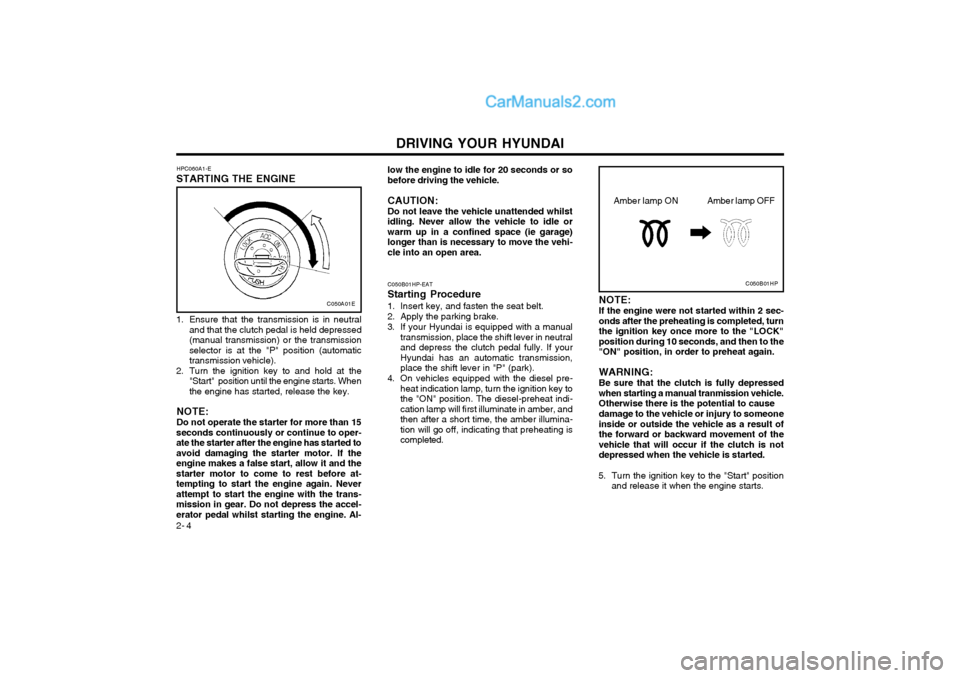
STARTING THE ENGINE
1. Ensure that the transmission is in neutral and that the clutch pedal is held depressed (manual transmission) or the transmissionselector is at the "P" position (automatictransmission vehicle).
2. Turn the ignition key to and hold at the "Start" position until the engine starts. Whenthe engine has started, release the key.
NOTE: Do not operate the starter for more than 15
seconds continuously or continue to oper- ate the starter after the engine has started toavoid damaging the starter motor. If theengine makes a false start, allow it and thestarter motor to come to rest before at-tempting to start the engine again. Neverattempt to start the engine with the trans-mission in gear. Do not depress the accel-erator pedal whilst starting the engine. Al-
C050A01E
C050B01HP-EAT
Starting Procedure
1. Insert key, and fasten the seat belt.
2. Apply the parking brake.
3. If your Hyundai is equipped with a manual transmission, place the shift lever in neutral and depress the clutch pedal fully. If yourHyundai has an automatic transmission,place the shift lever in "P" (park).
4. On vehicles equipped with the diesel pre- heat indication lamp, turn the ignition key tothe "ON" position. The diesel-preheat indi-cation lamp will first illuminate in amber, andthen after a short time, the amber illumina-tion will go off, indicating that preheating iscompleted.C050B01HP
Amber lamp OFF
Amber lamp ON
NOTE: If the engine were not started within 2 sec- onds after the preheating is completed, turnthe ignition key once more to the "LOCK"position during 10 seconds, and then to the"ON" position, in order to preheat again. WARNING: Be sure that the clutch is fully depressed when starting a manual tranmission vehicle.Otherwise there is the potential to cause damage to the vehicle or injury to someone inside or outside the vehicle as a result ofthe forward or backward movement of thevehicle that will occur if the clutch is notdepressed when the vehicle is started.
5. Turn the ignition key to the "Start" position and release it when the engine starts.
Page 289 of 361
DRIVING YOUR HYUNDAI
2- 6
o Ensure that the engine is not over-revved
by upshifting before the tachometer needle enters the red zone.
o Do not coast with the shift lever at the neutral position.
o When descending long gradients, make use of the engine braking to assist thefootbrake to avoid brake fade or over-heating.
o When slippery conditions are encoun- tered, increased caution should be exer-cised when gear changing, braking oraccelerating. Abrupt changes in speedmay cause a loss of traction or control ofthe vehicle.
o During cold weather, shifting may be dif- ficult until the transmission lubricant haswarmed up. This is normal and not harm-ful to the transmission.
o If you've come to a complete stop and it's hard to shift into 1 st
or R(Reverse), put
the shift lever in N(Neutral) position andrelease the clutch. Press the clutch pedalback down, and then shift into 1 st
or
R(Reverse) gear position.
o Do not use the shift lever as a handrest during driving, as this can result in pre-mature wear of the transmission shiftforks. C070B01A-EAT
Using the Clutch
The clutch should be pressed all the way to the
floor before shifting, then released slowly. Theclutch pedal should aways be used after fullyreturning to the original position. Do not restyour foot on the clutch pedal whilst driving. Thiscan cause unnecessary wear.
Do not partially engage the clutch to hold the
car on an incline. This causes unnecessarywear. Use the parking brake to hold the car onan incline. Do not operate the clutch pedalrapidly and repeatedly.
The shift points as shown above are recom-
mended for optimum fuel economy and per-formance. C070E03A-EAT
RECOMMENDED SHIFT POINTS
Shift
from-to
1-2 2-33-4 4-5 Recommended
mph (km/h)
15 (20)25 (40) 35 (55)45 (75)
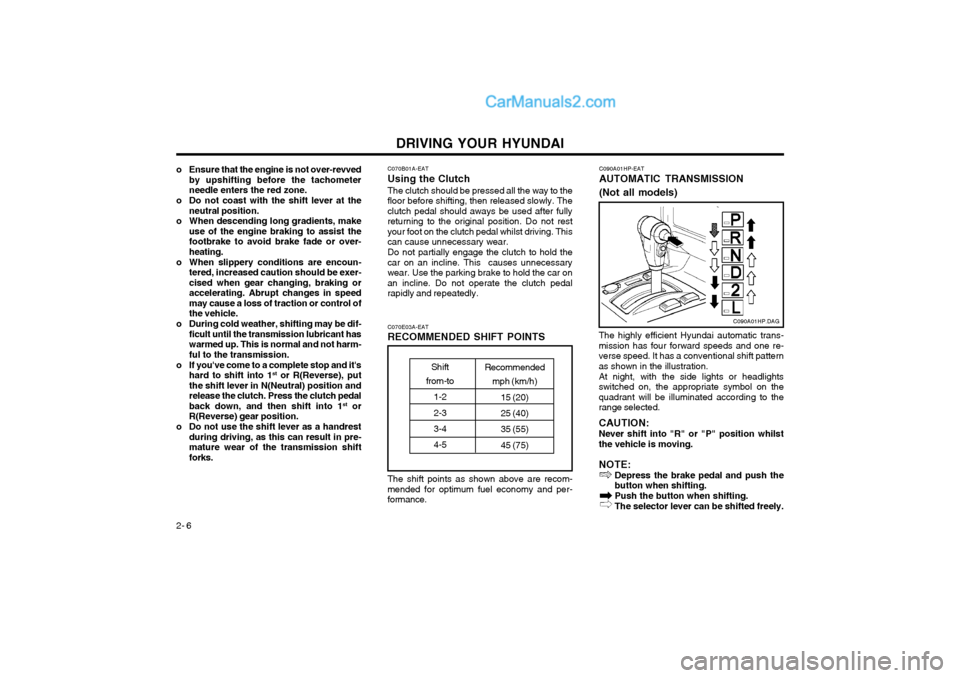
The highly efficient Hyundai automatic trans- mission has four forward speeds and one re-verse speed. It has a conventional shift patternas shown in the illustration. At night, with the side lights or headlights switched on, the appropriate symbol on thequadrant will be illuminated according to therange selected. CAUTION: Never shift into "R" or "P" position whilst the vehicle is moving. NOTE: Depress the brake pedal and push the button when shifting. Push the button when shifting. The selector lever can be shifted freely.
C090A01HP-EAT
AUTOMATIC TRANSMISSION (Not all models)
C090A01HP.DAG
Page 302 of 361
DRIVING YOUR HYUNDAI 2- 19
CAUTION: If overheating should occur when towing,
(temperature gauge reads near red zone), taking the following action may reduce oreliminate the problem.
1. Turn off the air conditioner.
2. Reduce highway speed.
3. Select a lower gear when going uphill.
4. Whilst in stop and go traffic, place the gear selector in park or neutral and idle the engine at a higher speed.
HPC200E1-E
Trailer or Vehicle Towing Tips
1. Before towing, check towbar and safety cable connections as well as proper operation of the trailer running lights, brake lights, andturn signals.
2. Always drive your vehicle at a moderate speed (Less than 60 mph)
3. Trailer towing requires more fuel than nor- mal conditions.
4. To maintain engine braking efficiency and electrical charging performance, do not usefifth gear (manual transmission).
5. Always secure items in the trailer to prevent load shift whilst driving.
6. Check the condition and air pressure of all tyres on the trailer and your car. Low tyrepressure can seriously affect the handling.Also check the spare tyre.
7. The vehicle/trailer combination is more af- fected by crosswind and buffeting. When being passed by a large vehicle, keep a constant speed and steer straight ahead.If there is too much wind buffeting slowdown to get out of the other vehicle's airturbulence.
8. When parking your car and trailer, especial- ly on a hill, be sure to follow all the normalprecautions. Turn your front wheel into thecurb, set the parking brake firmly, and putthe transmission in 1st or Reverse (manual)or Park (automatic). In addition, place wheelchocks at each of the trailer's tyres. 9. If the trailer has electric brakes, start your
vehicle and trailer moving, and then applythe trailer brake controller by hand to besure the brakes are working. This lets youcheck your electrical connection at the sametime.
10. During your trip, check occasionally to be sure that the load is secure, and that thelights and any trailer brakes are still working.
11. Avoid jerky starts, sudden acceleration or sudden stops.
12. Avoid sharp turns and rapid lane changes.
13. Avoid holding the brake pedal down too long or too frequently. This could cause the brakes to overheat, resulting in reduced brakingefficiency.
14. When going down a hill, shift into a lower gear and use the engine braking effect. When ascending a long grade, downshift the transmission to a lower gear and reducespeed to reduce chances of engine over-loading and/or overheating.
15. If you have to stop whilst going uphill, do not hold the vehicle in place by pressing on theaccelerator. This can cause the automatictransmission to overheat. Use the parkingbrake or footbrake.
NOTE: When towing, check transmission fluid more
frequently.
Page 304 of 361
IN CASE OF EMERGENCY
3-2
CAUTION:
Personal injury and damage to the vehicle
may occur if jump starting is not performed correctly. If any doubt exists as to how thisoperation should be performed, seek assis-tance from qualified personnel. WARNING:
Motor vehicle batteries contain sulphuric
acid and emit hydrogen gas. Protective cloth- ing should be worn and care exercised toprevent the acid from coming into contactwith skin or clothing and the vehicle. Nakedlights should not be permitted in the vicinityof the battery. Care should be exercised toprevent sparks occurring during connec-tion. If acid accidentally comes into contactwith skin or eyes, the affected area shouldimmediately be flushed with copious CAUTION: If the jump cable is incorrectly installed, damage to the vehicle electrical system mayoccur, in particular the electronic compo-nents such as the Fuel Injection system
computer and the Automatic Transmissioncomputer. The battery must never be dis-connected whilst the engine is running.
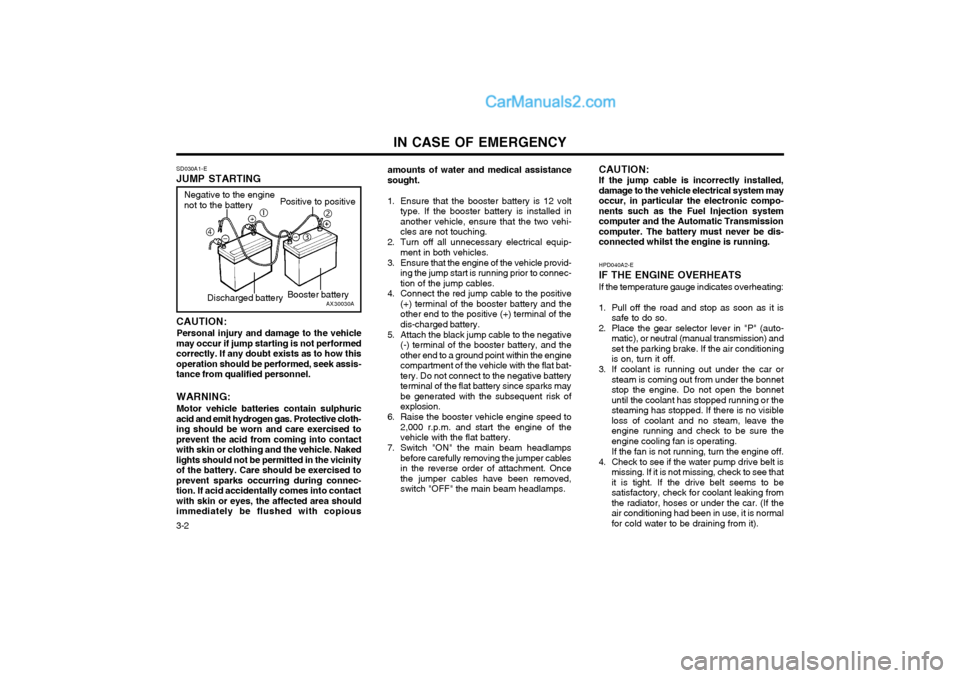
SD030A1-E JUMP STARTING
amounts of water and medical assistance sought.
1. Ensure that the booster battery is 12 volt type. If the booster battery is installed inanother vehicle, ensure that the two vehi-cles are not touching.
2. Turn off all unnecessary electrical equip- ment in both vehicles.
3. Ensure that the engine of the vehicle provid- ing the jump start is running prior to connec-tion of the jump cables.
4. Connect the red jump cable to the positive (+) terminal of the booster battery and theother end to the positive (+) terminal of thedis-charged battery.
5. Attach the black jump cable to the negative (-) terminal of the booster battery, and theother end to a ground point within the enginecompartment of the vehicle with the flat bat-tery. Do not connect to the negative batteryterminal of the flat battery since sparks maybe generated with the subsequent risk ofexplosion.
6. Raise the booster vehicle engine speed to 2,000 r.p.m. and start the engine of thevehicle with the flat battery.
7. Switch "ON" the main beam headlamps before carefully removing the jumper cablesin the reverse order of attachment. Oncethe jumper cables have been removed,switch "OFF" the main beam headlamps. HPD040A2-E IF THE ENGINE OVERHEATS If the temperature gauge indicates overheating:
1. Pull off the road and stop as soon as it is
safe to do so.
2. Place the gear selector lever in "P" (auto- matic), or neutral (manual transmission) and set the parking brake. If the air conditioningis on, turn it off.
3. If coolant is running out under the car or steam is coming out from under the bonnetstop the engine. Do not open the bonnetuntil the coolant has stopped running or thesteaming has stopped. If there is no visibleloss of coolant and no steam, leave theengine running and check to be sure theengine cooling fan is operating. If the fan is not running, turn the engine off.
4. Check to see if the water pump drive belt is missing. If it is not missing, check to see that it is tight. If the drive belt seems to besatisfactory, check for coolant leaking fromthe radiator, hoses or under the car. (If theair conditioning had been in use, it is normalfor cold water to be draining from it).
AX30030A
Negative to the engine not to the battery
Positive to positive
Booster battery
c
e
f d
Discharged battery
Page 305 of 361
IN CASE OF EMERGENCY 3-3
WARNING: Whilst the engine is running, keep hands
and clothing away from moving parts such as the fan and drive belts to prevent injury.
WARNING (Diesel only): Never work on injection system with engine
running or within 30 seconds after shutting off engine. High pressure pump, rail, injec-tors and high pressure pipes are subject tohigh pressure even after the engine stopped.The fuel jet produced by fuel leaks maycause serious injury, if it touch the body.People using pacemakers should not movethan 30cm closer to the ECU or wiring har-ness within the engine room while engine isrunning, since the high currents in the Com-mon Rail system produce considerable mag-netic fields.
5. If the water pump drive belt is broken or coolant is leaking out, stop the engine imme- diately and call the nearest Hyundai dealerfor assistance.
WARNING: Do not remove the radiator cap when the
engine is hot since steam and boiling water may be ejected from the radiator resulting inburns or scalding. YD050A1-E
SPARE TYRE For Full Size
The following instructions for the FULL SIZE
spare tyre should be observed:
Check inflation pressure as soon as possible
after installing the spare tyre, and adjust to the specified pressure. The tyre pressure shouldbe periodically checked and maintained at thespecified pressure whilst the tyre is stored.
Spare Tyre Pressure
Inflation Pressure
Tyre Size
FULL SIZE 29 psi (200 kPa)
6. If the cause of the overheating cannot be
found, wait until the engine temperature has returned to normal. Then, if coolant hasbeen lost, carefully remove the radiator capand add water to bring the fluid level in thereservoir up to the base of the radiator fillopening. Fill the coolant expansion tank tothe halfway mark.
7. Proceed with caution until it is established that the engine is operating normally. If theengine overheats repeatedly, the advice of aHyundai dealer should be sought.
CAUTION: Serious loss of coolant indicates there is a
leak in the cooling system and this should be checked as soon as possible by a Hyundaidealer.
D040B01HP
D040B03HP-EAT
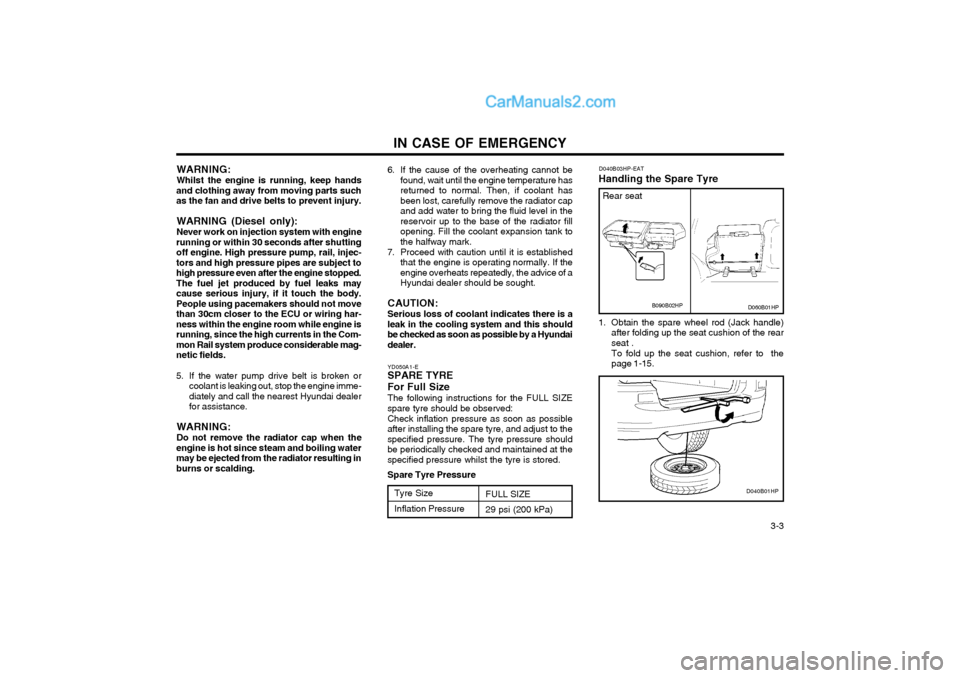
Handling the Spare Tyre
1. Obtain the spare wheel rod (Jack handle) after folding up the seat cushion of the rear seat . To fold up the seat cushion, refer to the page 1-15.
D060B01HPB090B02HP
Rear seat
Page 315 of 361
APPEARANCE CARE
4-2 JE070A1-E
POLISHING
The exterior paint work should be polished with
a proprietary wax polish when water no longer collects in bead form on the paint work. Theinstructions of the product manufacturer shouldbe adhered to. JE120A1-E
WINDOWS A proprietary glass cleaner should be used toclean the inside of the windows. However, therear heated windscreen must only be cleanedusing a light horizontal cleaning action. Careshould be exercised to avoid the use of abra-sive cleaners or contact with items of jewellerywhich may damage the heating elements.
Plastic wheel covers should be cleaned using a
sponge and water. Cast alloy wheels should becleaned using a mild soap or neutral detergent.Abrasive compounds must not be used since inthe event of these damaging the lacquer coat-ing, oxidisation of the aluminium wheel willoccur, spoiling the appearance.
The use of a toothbrush will facilitate cleaning
between the wheel "spokes". and ensure that accidental spillages are imme-diately flushed with water.
Do not use abrasive cleaning materials whichmay damage the bumpers.Avoid subjecting the bumpers to high tempera-tures such as may be encountered in high bakepaint ovens. JE110A1-E
INTERIOR VALETING
The soft trim and carpets should be maintainedwith the regular use of a vacuum cleaner. Heavysoiling should be removed with a dry cleaningagent recommended for this purpose followingthe instructions of the product manufacturer.Paint thinner, solvents or other such cleaningmaterials should not be used since damage tothe upholstery may result.
JE060A1-E
STAIN/SPOT REMOVAL Should tree sap, dead insects or tar prove to be
difficult to remove from the paint film, turpentineor a proprietary paint cutting compound may beused. Ensure that the area to be cleaned is notrubbed intensively to prevent breaking throughthe colour coat and exposing the under coat.
JE080A1-E
BUMPER MAINTENANCE The special material from which the bumpers
are manufactured warrants special attention topreserve the appearance of the bumpers. Avoidcontact with battery electrolyte or brake fluid JE090A1-E
ACCIDENT REPAIRS
In the event of the body work sustaining dam-age, the following points should be noted priorto repairs being undertaken. If body panels are replaced or repaired, anti corrosion treatment must be applied to therepair area. The product used must be compat-ible with those used in manufacture. It is recom-mended that repairs are entrusted to a Hyundaidealer to ensure that replacement parts usedare of the same high quality as those used inmanufacture of the vehicle and that the correctrepair methods and materials will ensure ade-quate levels of corrosion protection and thecontinued validity of the Anti Perforation War-ranty. JE100A1-E
SEAT BELTS
Seat belts should be cleaned only with a mild soap solution. Strong detergents, solvens orbleaches may damage the belt webbing andtherefore reduce the effectiveness of the belt.Belts which display signs of fraying, wear or cutshould be replaced.
Page 330 of 361
OWNER MAINTENANCE
6-6
To replace the oil and filter, proceed as follows:
1. Ensure that the engine is at normal operat- ing temperature and park the vehicle on level ground with the parking brake securelyapplied and the engine turned off.
2. Open the bonnet and remove the oil filler cap.
3. Prepare a suitable receptacle to collect the displaced oil and remove the drain plug fromthe sump.
CAUTION: The oil being drained from the engine will be
hot. Care should be exercised to prevent scalding.
4. When the oil has drained from the sump, replace the drain plug using a new washer ensuring that the plug is not over tightened. Tightening torque is: 3.5 ~ 4.5 kgf.m
5. Remove the oil filter by rotating counter- clockwise, using a proprietary oil filter re- moval tool if necessary. Note that the oilfilter will contain approximately 0.5 litres ofoil and this should be collected in a suitablereceptacle.
6. Install a new oil filter having smeared the sealing ring with clean oil and rotating clock-wise until the filter contacts the mountingand then a further one half turn. Do not over-tighten. Tightening torque: Petrol Engine - 1.2 ~ 1.6 kgf.mDiesel Engine - 2.3 ~ 2.5 kgf.m
7. Pour the specified quantity of the recom- mended oil into the engine and replace the filler cap. Start the engine and ensure thatno oil leaks exist. Turn off the engine andafter a couple minutes, recheck the oil level.
WARNING: Prolonged and repeated contact with used engine oils may result in serious skin disor-ders including dermatitis and cancer. Avoidcontact with skin as far as possible andalways wash thoroughly after any contact.Keep used oils out of reach of children. It isillegal to pollute drains, water courses andsoil. Use only authorized waste collectionfacilities including civic amenity sites andgarages for the disposal of used oil and oilfilters. If in doubt, contact the local authorityfor disposal instructions. SG050A1-E
ENGINE COOLANT CHECKING AND REPLACING
WARNING: Do not remove the radiator cap when the engine is hot, since the system is pressur-ized and coolant may be ejected from theradiator resulting in scalding. SG050B1-E
Coolant recommendations Only ethylene glycol based coolant with a cor- rosion inhibitor suited to aluminium alloy enginecomponents should be used in the coolingsystem. No further additives or inhibitors shouldbe used. The coolant specific gravity should bechecked as prescribed in the maintenanceschedule to ensure adequate frost and corro-sion protection. In addition, the engine coolantmust be replaced at the specified interval sincethe corrosion inhibitor properties deteriorate withtime. It is important to note that whilst an increase in the concentration of anti freeze gives an in-crease in the level of frost protection, a solutionwhich is in excess of 65% anti freeze will resultin reduced frost protection and engine over-heating. Therefore the recommended concen-tration of 50% should not be exceeded forgeneral use.The use of methanol based anti freeze com-pounds may result in engine overheating andwill invalidate the vehicle warranty.
Page 348 of 361
EMISSION CONTROL SYSTEMS 7-1
vehicle may be damaged. You should inspect the exhaust system each time the car is raisedfor lubrication or oil change. To check condition
1. Holes and gas leaks due to corrosion, dam-
age, etc., should be rectified.
2. The joints should be checked for loose con- nections and gas leakage.
3. The hanger rubber and brackets should be checked for damage. DH010B1-E
1. CRANKCASE EMISSION CONTROL
SYSTEM ; For a Petrol Engine
The positive crankcase ventilation system is
employed to prevent air pollution caused by blow-by gases being emitted from the crank-case.
This system supplies fresh air to the crankcase
through the air cleaner. Inside the crankcase,the fresh air mixes with blow-by gases, thenpasses through the PCV valve into the intakesystem.
ZH010C1-E
2. EVAPORATIVE EMISSION CON-
TROL SYSTEM ; For a Petrol Engine
The Evaporative Emission Control System is designed to prevent fuel vapors from escapinginto the atmosphere.
Canister While the engine is inoperative, fuel vaporsgenerated inside the fuel tank are absorbed andstored in the canister. When the engine isrunning, the fuel vapors absorbed in the canis-ter are drawn into the induction system throughthe purge control solenoid valve.
YH000A1-A
7. EMISSION CON-
TROL SYSTEMS
YH020A1-E
EXHAUST GAS WARNING
Exhaust gases contain carbon monoxide, a
potentially toxic gas that is colorless and odor-less. Avoid breathing exhaust gases.
o Do not run the engine in confined areas, such as garages, any longer than neces- sary to move the car in or out.
o Do not drive with the trunk open. An open trunk may draw exhaust gases into the pas-senger compartment. If you must drive withthe trunk open, drive only with all the win-dows wide open and the blower motor onhigh speed.
o If it is necessary to sit in a parked car with the engine running for more than a shortperiod, adjust your heating system to forceoutside air into the car by placing the airselector button of the heater in the FRESHAIR position and mode control in the VENTposition. Set the fan at high speed and thecontrols in any position desired.
Inspect the exhaust system Whenever a change is noticed in the sound of
the exhaust system, the underside or rear of the ZH010A1-E EMISSION CONTROL SYSTEMS (Not all models) Your Hyundai is equipped with an emission control systems. There are three emission control systems which are as follows. (1) Crankcase emission control system (2) Evaporative emission control system(3) Exhaust emission control system In order to assure the proper function of the emission control system, it is recommendedthat you have your car inspected and main-tained by an authorized Hyundai dealer in ac-cordance with the schedule in this manual.
7