belt Hyundai Terracan 2004 Repair Manual
[x] Cancel search | Manufacturer: HYUNDAI, Model Year: 2004, Model line: Terracan, Model: Hyundai Terracan 2004Pages: 361, PDF Size: 4.69 MB
Page 226 of 361
CONTROLS AND EQUIPMENT
1- 26 tion key is turned to "ON" or if it remains illuminated after blinking for approxi-mately 6 seconds, or if it illuminates whilstthe vehicle is being driven, please havean authorized Hyundai dealer inspect thepre-tensioner seat belts and SRS airbagsystem as soon as possible.
WARNING:
o Pre-tensioners are designed to operate only one time. After activation, pre-tensioner seat belts must be replaced.All seat belts, of any type, should alwaysbe replaced after they have been wornduring a collision.
o The pre-tensioner seat belt assembly mechanisms become hot during activa-tion. Do not touch the pre-tensioner seatbelt assemblies for several minutes afterthey have been activated.
o Do not attempt to inspect or replace the pre-tensioner seat belts yourself. Thismust be done by an authorized Hyundaidealer.
o Do not strike the pre-tensioner seat belt assemblies.
o Do not attempt to service or repair the pre-tensioner seat belt system in anymanner.
o Improper handling of the pre-tensioner seat belt assemblies, and failure to heedthe warnings to not strike, modify, insp-ect, replace, service or repair the pre-tensioner seat belt assemblies may lead to improper operation or inadvertent ac-tivation and serious injury.
o Always wear seat belts when driving or riding in a motor vehicle.
NOTE:
o Both the driver's and front passenger's pre-tensioner seat belts will be activatedin certain frontal collisions. The pre-tensioner seat belts can be activated aloneor, where the frontal collision is severeenough, together with the airbags.
o When the pre-tensioner seat belts are activated, a loud noise may be heard andfine dust, which may appear to be smoke,may be visible in the passenger compart-ment. These are normal operating condi-tions and are not hazardous.
o Although it is harmless, the fine dust may cause skin irritation and should notbe breathed for prolonged periods. Washyour hands and face thoroughly after anaccident in which the pre-tensioner seatbelts were activated.
CAUTION:
o Because the sensor that activates the SRS airbag is connected with pre-tensioner seat belt, the SRS airbag warn-ing light on the instrument panel willblink for approximately 6 seconds afterthe ignition key has been turned to the"ON" position, and then it should turnoff.
o If pre-tensioner seat belt is not working properly, this warning light will illumi-nate even if there is no malfunction of theSRS airbag. If the SRS airbag warninglight does not illuminate when the igni-
AIR
BAG
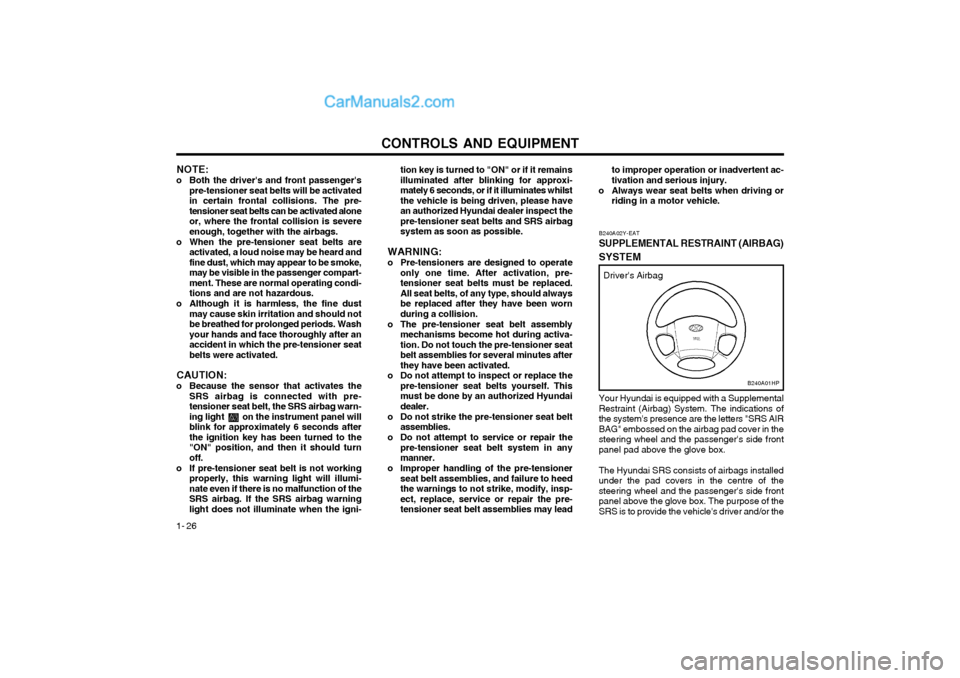
Your Hyundai is equipped with a Supplemental Restraint (Airbag) System. The indications ofthe system's presence are the letters "SRS AIRBAG" embossed on the airbag pad cover in thesteering wheel and the passenger's side frontpanel pad above the glove box. The Hyundai SRS consists of airbags installed under the pad covers in the centre of thesteering wheel and the passenger's side frontpanel above the glove box. The purpose of theSRS is to provide the vehicle's driver and/or the
B240A01HP
Driver's Airbag
B240A02Y-EAT
SUPPLEMENTAL RESTRAINT (AIRBAG)
SYSTEM
Page 227 of 361
CONTROLS AND EQUIPMENT1- 27
B240B02A-EAT SRS Components and Functions
B240B01L-D
The SRS consists of the following components:
- Driver's Airbag Module
- Passenger's Airbag Module
- Knee Bolster
- SRS Service Reminder Indicator (SRI)
- SRS Control Module (SRSCM)
The SRSCM continually monitors all elements
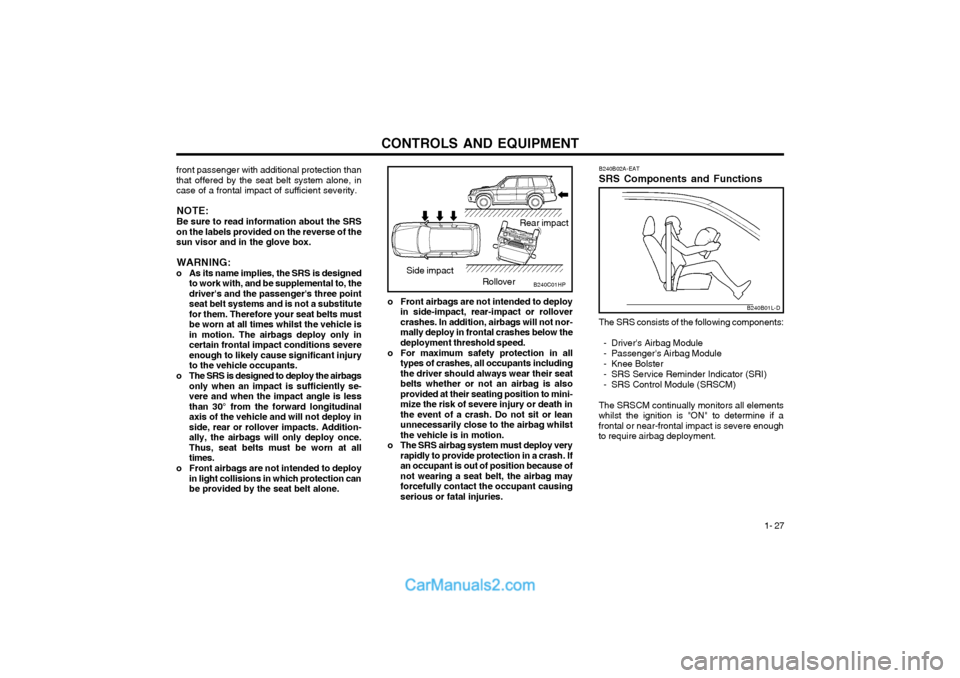
whilst the ignition is "ON" to determine if a frontal or near-frontal impact is severe enoughto require airbag deployment.o Front airbags are not intended to deploy in side-impact, rear-impact or rollover crashes. In addition, airbags will not nor-mally deploy in frontal crashes below thedeployment threshold speed.
o For maximum safety protection in all types of crashes, all occupants includingthe driver should always wear their seatbelts whether or not an airbag is alsoprovided at their seating position to mini-mize the risk of severe injury or death inthe event of a crash. Do not sit or leanunnecessarily close to the airbag whilstthe vehicle is in motion.
o The SRS airbag system must deploy very rapidly to provide protection in a crash. Ifan occupant is out of position because ofnot wearing a seat belt, the airbag mayforcefully contact the occupant causingserious or fatal injuries.
front passenger with additional protection thanthat offered by the seat belt system alone, incase of a frontal impact of sufficient severity.
NOTE: Be sure to read information about the SRS
on the labels provided on the reverse of the sun visor and in the glove box.
WARNING:
o As its name implies, the SRS is designed to work with, and be supplemental to, thedriver's and the passenger's three pointseat belt systems and is not a substitutefor them. Therefore your seat belts mustbe worn at all times whilst the vehicle isin motion. The airbags deploy only incertain frontal impact conditions severeenough to likely cause significant injuryto the vehicle occupants.
o The SRS is designed to deploy the airbags only when an impact is sufficiently se-vere and when the impact angle is lessthan 30° from the forward longitudinalaxis of the vehicle and will not deploy inside, rear or rollover impacts. Addition-ally, the airbags will only deploy once.Thus, seat belts must be worn at alltimes.
o Front airbags are not intended to deploy in light collisions in which protection canbe provided by the seat belt alone.
B240C01HP
Rear impact
Side impact Rollover
Page 228 of 361
CONTROLS AND EQUIPMENT
1- 28
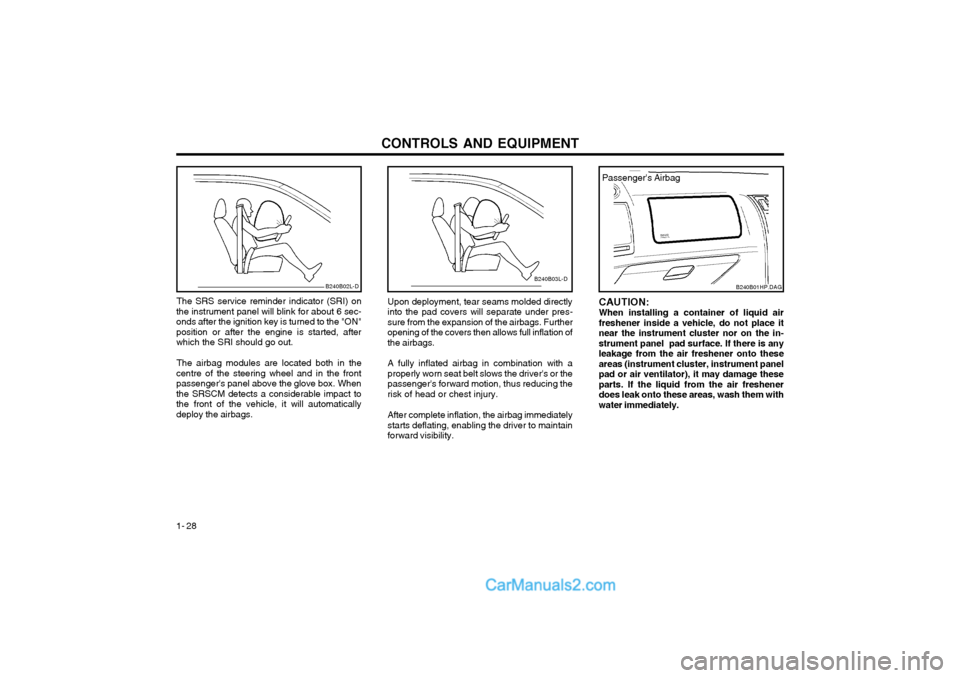
Upon deployment, tear seams molded directly into the pad covers will separate under pres-sure from the expansion of the airbags. Furtheropening of the covers then allows full inflation ofthe airbags. A fully inflated airbag in combination with a properly worn seat belt slows the driver's or thepassenger's forward motion, thus reducing the risk of head or chest injury. After complete inflation, the airbag immediately starts deflating, enabling the driver to maintainforward visibility.
B240B02L-D
The SRS service reminder indicator (SRI) on
the instrument panel will blink for about 6 sec- onds after the ignition key is turned to the "ON"position or after the engine is started, afterwhich the SRI should go out.
The airbag modules are located both in the
centre of the steering wheel and in the frontpassenger's panel above the glove box. Whenthe SRSCM detects a considerable impact tothe front of the vehicle, it will automaticallydeploy the airbags.B240B03L-D
CAUTION: When installing a container of liquid airfreshener inside a vehicle, do not place itnear the instrument cluster nor on the in-strument panel pad surface. If there is anyleakage from the air freshener onto theseareas (instrument cluster, instrument panelpad or air ventilator), it may damage theseparts. If the liquid from the air freshenerdoes leak onto these areas, wash them withwater immediately.
B240B01HP.DAG
Passenger's Airbag
Page 233 of 361
CONTROLS AND EQUIPMENT1- 33
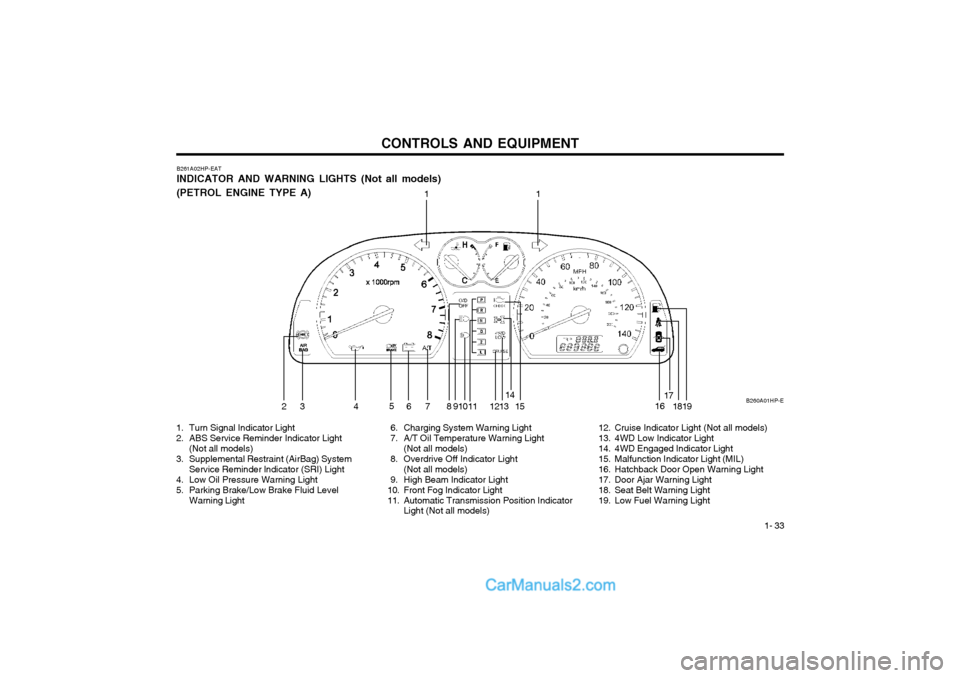
B261A02HP-EAT INDICATOR AND WARNING LIGHTS (Not all models) (PETROL ENGINE TYPE A)
11
23 4 5
6 7 8 91011 1213 14
15 1617
18
19
1. Turn Signal Indicator Light
2. ABS Service Reminder Indicator Light (Not all models)
3. Supplemental Restraint (AirBag) System Service Reminder lndicator (SRI) Light
4. Low Oil Pressure Warning Light
5. Parking Brake/Low Brake Fluid Level
Warning Light 6. Charging System Warning Light
7. A/T Oil Temperature Warning Light
(Not all models)
8. Overdrive Off Indicator Light (Not all models)
9. High Beam Indicator Light
10. Front Fog Indicator Light
11. Automatic Transmission Position Indicator Light (Not all models) 12. Cruise Indicator Light (Not all models)
13. 4WD Low Indicator Light
14. 4WD Engaged Indicator Light
15. Malfunction Indicator Light (MIL)
16. Hatchback Door Open Warning Light
17. Door Ajar Warning Light
18. Seat Belt Warning Light
19. Low Fuel Warning LightB260A01HP-E
Page 235 of 361
CONTROLS AND EQUIPMENT1- 35
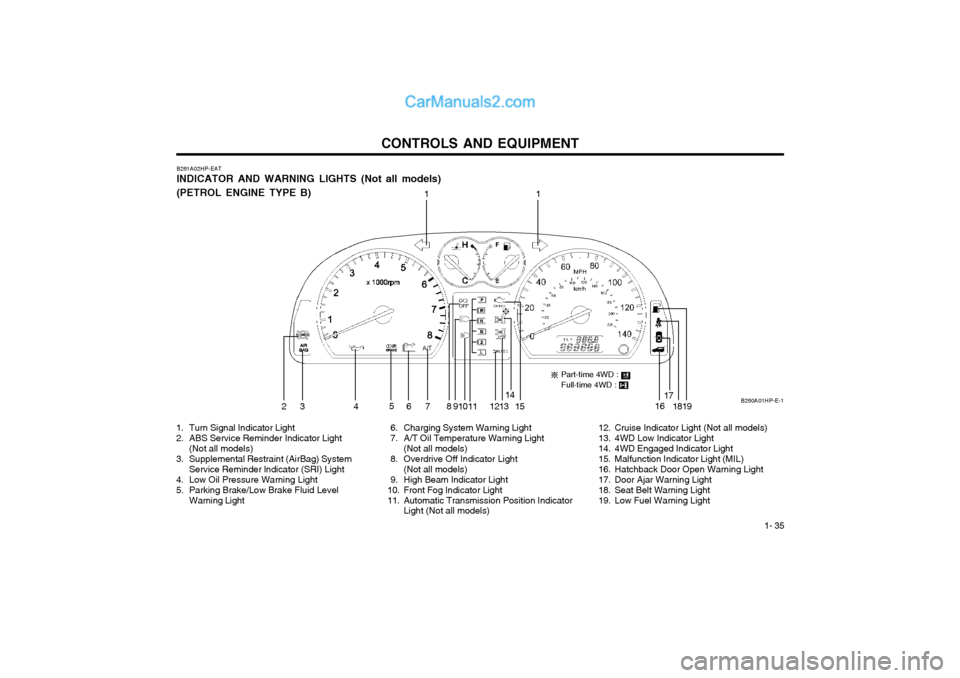
B261A02HP-EAT INDICATOR AND WARNING LIGHTS (Not all models) (PETROL ENGINE TYPE B)
11
23 4 5
6 7 8 91011 1213 14
15 1617
18
19
1. Turn Signal Indicator Light
2. ABS Service Reminder Indicator Light (Not all models)
3. Supplemental Restraint (AirBag) System Service Reminder lndicator (SRI) Light
4. Low Oil Pressure Warning Light
5. Parking Brake/Low Brake Fluid Level
Warning Light 6. Charging System Warning Light
7. A/T Oil Temperature Warning Light
(Not all models)
8. Overdrive Off Indicator Light (Not all models)
9. High Beam Indicator Light
10. Front Fog Indicator Light
11. Automatic Transmission Position Indicator Light (Not all models) 12. Cruise Indicator Light (Not all models)
13. 4WD Low Indicator Light
14. 4WD Engaged Indicator Light
15. Malfunction Indicator Light (MIL)
16. Hatchback Door Open Warning Light
17. Door Ajar Warning Light
18. Seat Belt Warning Light
19. Low Fuel Warning LightB260A01HP-E-1
Part-time 4WD :Full-time 4WD :
Page 237 of 361
CONTROLS AND EQUIPMENT1- 37
B260A03HP-E
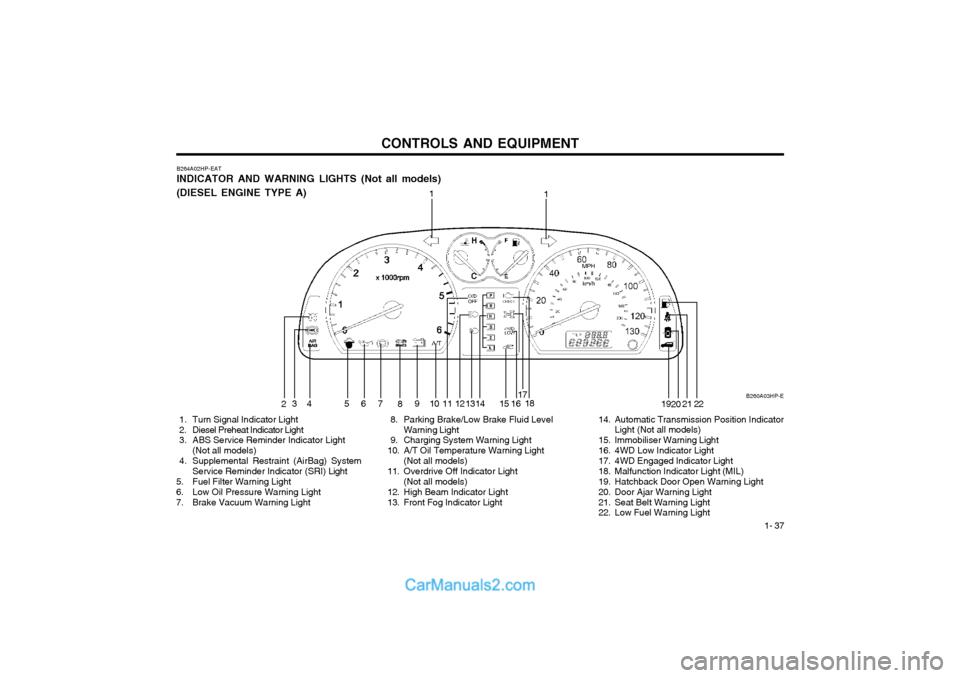
B264A02HP-EAT INDICATOR AND WARNING LIGHTS (Not all models) (DIESEL ENGINE TYPE A)
1
2 34 5 6
7
8910111213 15 17
18 192021
1
22
1416
1. Turn Signal Indicator Light
2. Diesel Preheat Indicator Light
3. ABS Service Reminder Indicator Light(Not all models)
4. Supplemental Restraint (AirBag) System Service Reminder Indicator (SRI) Light
5. Fuel Filter Warning Light
6. Low Oil Pressure Warning Light
7. Brake Vacuum Warning Light 8. Parking Brake/Low Brake Fluid Level
Warning Light
9. Charging System Warning Light
10. A/T Oil Temperature Warning Light
(Not all models)
11. Overdrive Off Indicator Light (Not all models)
12. High Beam Indicator Light
13. Front Fog Indicator Light 14. Automatic Transmission Position Indicator
Light (Not all models)
15. Immobiliser Warning Light
16. 4WD Low Indicator Light
17. 4WD Engaged Indicator Light
18. Malfunction Indicator Light (MIL)
19. Hatchback Door Open Warning Light
20. Door Ajar Warning Light
21. Seat Belt Warning Light
22. Low Fuel Warning Light
Page 239 of 361
CONTROLS AND EQUIPMENT1- 39
B260A03HP-E-1
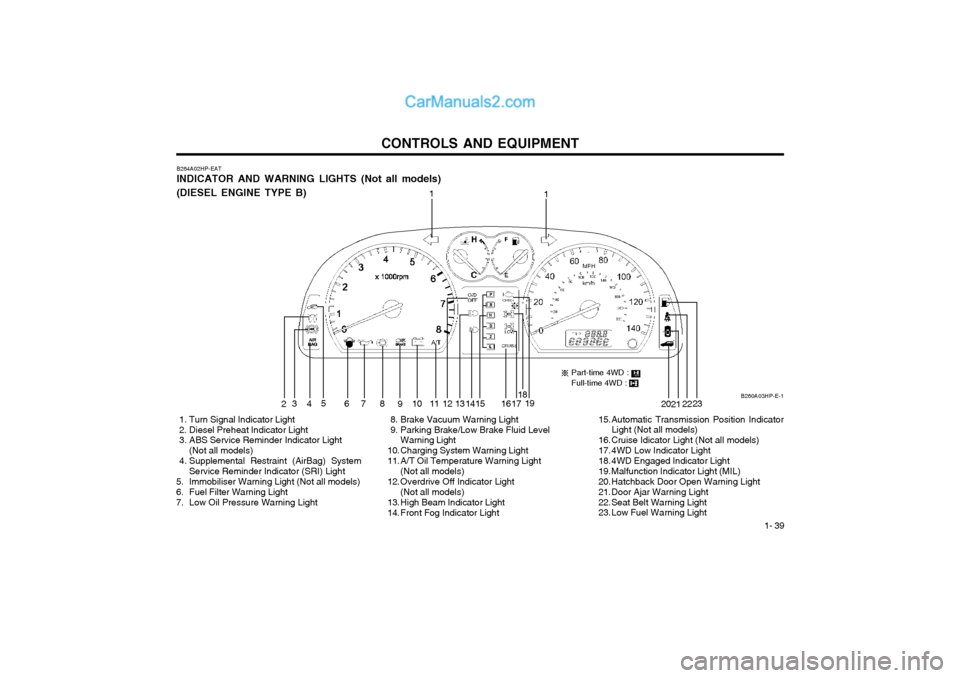
B264A02HP-EAT INDICATOR AND WARNING LIGHTS (Not all models) (DIESEL ENGINE TYPE B)
1
2 34 6 7
8
910 11 12 13 14 17 18
19 202122
1
1516
1. Turn Signal Indicator Light
2. Diesel Preheat Indicator Light
3. ABS Service Reminder Indicator Light
(Not all models)
4. Supplemental Restraint (AirBag) System Service Reminder Indicator (SRI) Light
5. Immobiliser Warning Light (Not all models)
6. Fuel Filter Warning Light
7. Low Oil Pressure Warning Light 8. Brake Vacuum Warning Light
9. Parking Brake/Low Brake Fluid Level
Warning Light
10. Charging System Warning Light
11. A/T Oil Temperature Warning Light (Not all models)
12. Overdrive Off Indicator Light (Not all models)
13. High Beam Indicator Light
14. Front Fog Indicator Light 15. Automatic Transmission Position Indicator
Light (Not all models)
16. Cruise Idicator Light (Not all models)
17. 4WD Low Indicator Light
18. 4WD Engaged Indicator Light
19. Malfunction Indicator Light (MIL)
20. Hatchback Door Open Warning Light
21. Door Ajar Warning Light
22. Seat Belt Warning Light
23. Low Fuel Warning Light
5 23
Part-time 4WD : Full-time 4WD :
Page 241 of 361
CONTROLS AND EQUIPMENT1- 41
B260M01A-AATLow Fuel Level Warning Light
The low fuel level warning light comes on when
the fuel tank is approaching empty. When it comes on, you should add fuel as soon aspossible. Driving with the fuel level warning lighton or with the fuel level below "E" can cause theengine to misfire and damage the catalyticconverter.
B260K01B-EAT Hatchback Door Open Warning Light
This light remains on unless the tail gate is completely closed and latched.
B260E01HP-GAT
Seat Belt Warning Light
The seat belt warning light blinks for about 6seconds when the ignition key is turned fromthe "OFF" position to "ON" or "START".
B260L01A-GAT Door Ajar Warning Light
The door ajar warning light warns you that a
door is not completely closed.
B260A01B-GAT
Front Fog Indicator Light
Front fog indicator light comes on whenever the fog light switch is on.
B260J01S-EAT Charging System Warning Light
The charging system warning light should come on when the ignition is turned on, then go outwhen the engine is running. If the light stays onwhilst the engine is running, there is a malfunc-tion in the electrical charging system. If the lightcomes on whilst you are driving, stop, turn offthe engine and check under the bonnet. First,make certain the generator drive belt is inplace. If it is, check the tension of the belt.And then, have the system checked by yourHyundai dealer. CAUTION: If the drive belt (generator belt) is loose, broken, or missing whilst the vehicle is driv-ing, there may be a serious malfunction,engine could overheat because this belt alsodrives the water pump.
B260Q01HP-EAT Cruise Indicator Light (Not all models)
The cruise indicator light in the instrument clus-
ter is illuminated only when the vehicle cruising speed has been set using the control switch onthe steering wheel.
The indicator light does not illuminate when the
main cruise control switch is activated. Information on the use of cruise control may be
found on page 1-66.
The brake fluid level warning light indicates that
the brake fluid level in the brake master cylinderis low and hydraulic brake fluid conforming toDOT 3 or DOT 4 specifications should beadded. After adding fluid, if no other trouble isfound, the car should be immediately and care-fully driven to a Hyundai dealer for inspection.If further trouble is experienced, the vehicleshould not be driven at all but taken to a dealerby a professional towing service or some othersafe method.
Your Hyundai is equipped with dual-diagonal
braking systems. This means you still havebraking on two wheels even if one of the dualsystems should fail. With only one of the dualsystems working, more than normal pedal traveland greater pedal pressure are required to stopthe car. Also, the car will not stop in as short adistance with only half of the brake systemworking. If the brakes fail whilst you are driving,shift to a lower gear for additional engine brak-ing and stop the car as soon as it is safe to doso.
Page 244 of 361
CONTROLS AND EQUIPMENT
1- 44
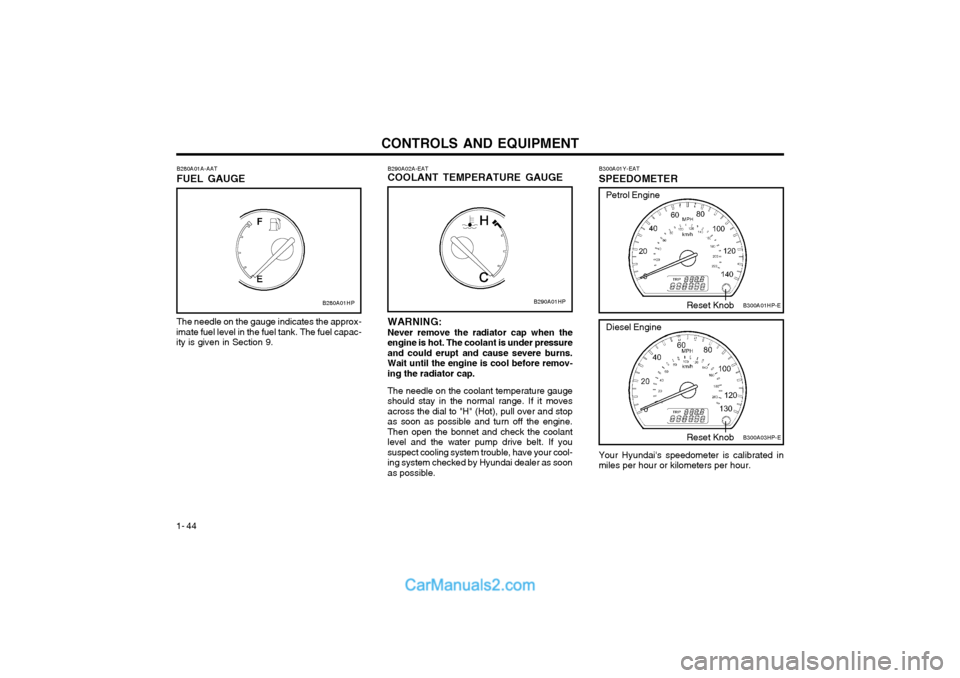
B300A01Y-EAT SPEEDOMETER Your Hyundai's speedometer is calibrated in miles per hour or kilometers per hour. B300A03HP-EB290A02A-EAT COOLANT TEMPERATURE GAUGE WARNING: Never remove the radiator cap when the engine is hot. The coolant is under pressureand could erupt and cause severe burns.Wait until the engine is cool before remov-ing the radiator cap. The needle on the coolant temperature gauge should stay in the normal range. If it movesacross the dial to "H" (Hot), pull over and stopas soon as possible and turn off the engine.Then open the bonnet and check the coolantlevel and the water pump drive belt. If yoususpect cooling system trouble, have your cool-ing system checked by Hyundai dealer as soonas possible.
B280A01A-AAT FUEL GAUGE The needle on the gauge indicates the approx-
imate fuel level in the fuel tank. The fuel capac- ity is given in Section 9.
B280A01HPB290A01HP
Petrol Engine
Reset Knob
B300A01HP-E
Diesel EngineReset Knob
Page 285 of 361
DRIVING YOUR HYUNDAI
2- 2 C020A01A-EAT
BEFORE STARTING THE ENGINE
Before you start the engine, you should always:
1. Look around the vehicle to be sure there are no flat tyres, puddles of oil or water or other indications of possible trouble.
2. After entering the car, check to be sure the parking brake is engaged.
3. Check that all windows, and lights are clean.
4. Check that the interior and exterior mirrors are clean and in position.
5. Check your seat, seatback and headrest to be sure they are in their proper positions.
6. Close all the doors.
7. Fasten your seat belt and be sure that all other occupants have fastened theirs.
8. Turn off all lights and accessories that are not needed.
9. When you turn the ignition switch to "ON" check that all appropriate warning lights are operating and that you have sufficient fuel.
10.Check the operation of warning lights and all bulbs when key is in the "ON" position. C030A01HP-EAT COMBINATION IGNITION SWITCH AND STEERING LOCK To Start the Engine
o If your Hyundai is equipped with a manual
transmission, place the shift lever in neutral and depress the clutch pedal fully.
o If your Hyundai has an automatic transmis- sion, place the shift lever in "P" (park).
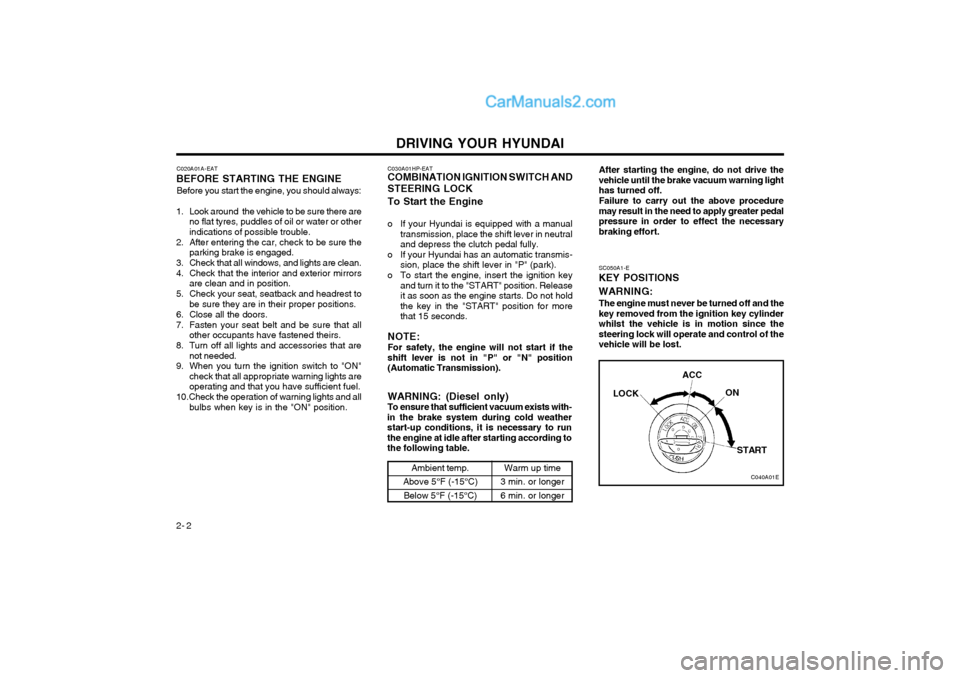
o To start the engine, insert the ignition key and turn it to the "START" position. Releaseit as soon as the engine starts. Do not holdthe key in the "START" position for morethat 15 seconds.
NOTE: For safety, the engine will not start if the shift lever is not in "P" or "N" position(Automatic Transmission). SC050A1-E
KEY POSITIONS WARNING:
The engine must never be turned off and the key removed from the ignition key cylinderwhilst the vehicle is in motion since thesteering lock will operate and control of thevehicle will be lost.
C040A01E
LOCK
ACC
ON
START
WARNING: (Diesel only) To ensure that sufficient vacuum exists with-
in the brake system during cold weatherstart-up conditions, it is necessary to runthe engine at idle after starting according tothe following table.
Ambient temp.
Above 5°F (-15°C) Below 5°F (-15°C)Warm up time
3 min. or longer 6 min. or longer After starting the engine, do not drive the vehicle until the brake vacuum warning lighthas turned off. Failure to carry out the above procedure may result in the need to apply greater pedalpressure in order to effect the necessarybraking effort.