light Hyundai Terracan 2005 Owner's Manual
[x] Cancel search | Manufacturer: HYUNDAI, Model Year: 2005, Model line: Terracan, Model: Hyundai Terracan 2005Pages: 539, PDF Size: 18.03 MB
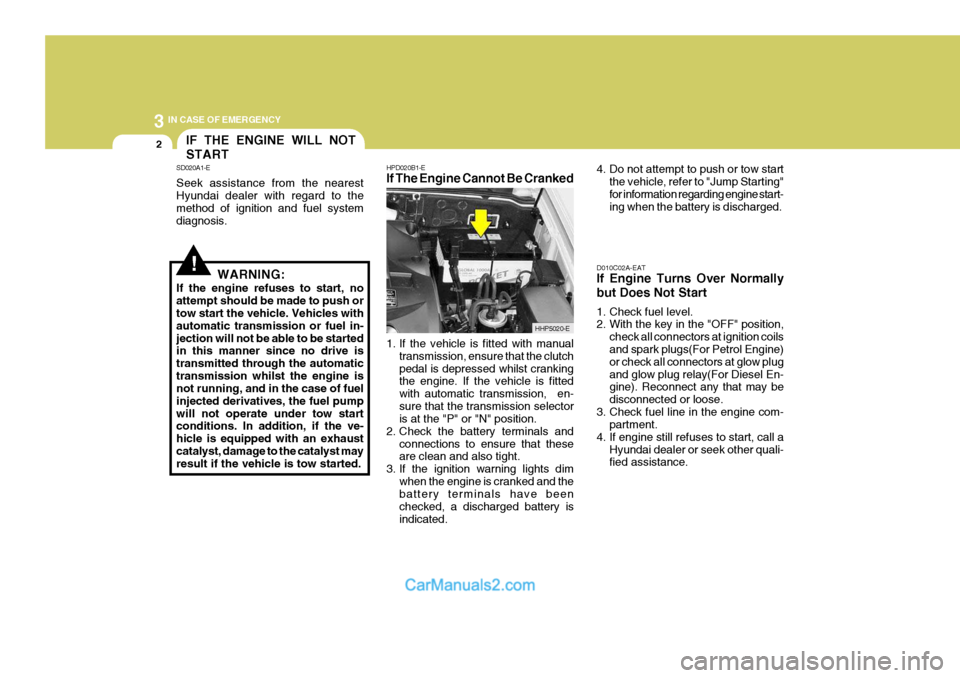
Page 446 of 539
3 IN CASE OF EMERGENCY
2
!WARNING:
If the engine refuses to start, no attempt should be made to push or tow start the vehicle. Vehicles with automatic transmission or fuel in-jection will not be able to be started in this manner since no drive is transmitted through the automatictransmission whilst the engine is not running, and in the case of fuel injected derivatives, the fuel pumpwill not operate under tow start conditions. In addition, if the ve- hicle is equipped with an exhaustcatalyst, damage to the catalyst may result if the vehicle is tow started. HPD020B1-E If The Engine Cannot Be Cranked
1. If the vehicle is fitted with manual
transmission, ensure that the clutch pedal is depressed whilst cranking the engine. If the vehicle is fitted with automatic transmission, en-sure that the transmission selector is at the "P" or "N" position.
2. Check the battery terminals and
connections to ensure that theseare clean and also tight.
3. If the ignition warning lights dim
when the engine is cranked and thebattery terminals have been checked, a discharged battery isindicated. 4. Do not attempt to push or tow start
the vehicle, refer to "Jump Starting"for information regarding engine start- ing when the battery is discharged.
D010C02A-EAT If Engine Turns Over Normally but Does Not Start
1. Check fuel level.
2. With the key in the "OFF" position, check all connectors at ignition coilsand spark plugs(For Petrol Engine) or check all connectors at glow plugand glow plug relay(For Diesel En- gine). Reconnect any that may be disconnected or loose.
3. Check fuel line in the engine com- partment.
4. If engine still refuses to start, call a Hyundai dealer or seek other quali- fied assistance.
IF THE ENGINE WILL NOT START
SD020A1-E Seek assistance from the nearest Hyundai dealer with regard to the method of ignition and fuel system diagnosis.
HHP5020-E
Page 447 of 539
3
IN CASE OF EMERGENCY
3
!
D010A01A-EAT If Engine Stalls Whilst Driving
1. Reduce your speed gradually, keep-
ing a straight line. Move cautiously off the road to a safe place.
2. Turn on your emergency flashers.
3. Try starting the engine again. If your
vehicle will not start, contact Hyundai dealer or seek other qualified assis- tance.
CAUTION:
Personal injury and damage to thevehicle may occur if jump starting isnot performed correctly. If any doubt exists as to how this operation should be performed, seek assistance fromqualified personnel. WARNING:
Motor vehicle batteries containsulphuric acid and emit hydrogen gas. Protective clothing should be worn and care exercised to preventthe acid from coming into contact with skin or clothing and the ve- hicle. Naked lights should not bepermitted in the vicinity of the bat- tery. Care should be exercised to prevent sparks occurring duringconnection. If acid accidentally comes into contact with skin or eyes, the affected area should im- mediately be flushed with copious amounts of water and medical as-sistance sought.
!
JUMP STARTING
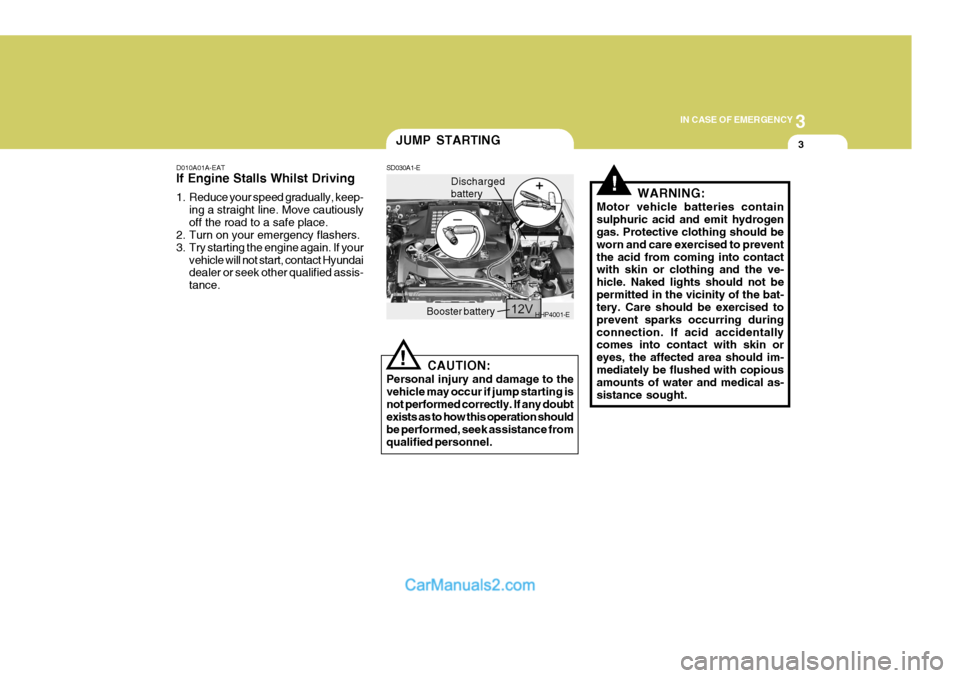
SD030A1-E
HHP4001-EBooster battery Discharged battery
Page 453 of 539
3
IN CASE OF EMERGENCY
9
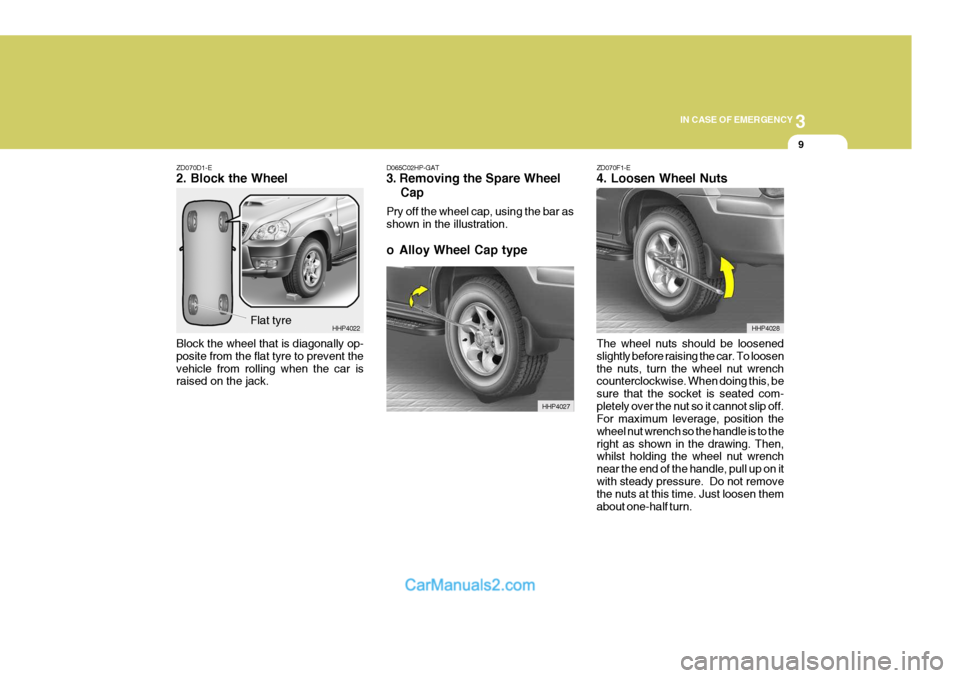
ZD070D1-E 2. Block the Wheel Block the wheel that is diagonally op- posite from the flat tyre to prevent thevehicle from rolling when the car is raised on the jack.
Flat tyre HHP4022D065C02HP-GAT
3. Removing the Spare Wheel Cap Pry off the wheel cap, using the bar as shown in the illustration.
o Alloy Wheel Cap type
HHP4027 ZD070F1-E 4. Loosen Wheel Nuts The wheel nuts should be loosened slightly before raising the car. To loosenthe nuts, turn the wheel nut wrench counterclockwise. When doing this, be sure that the socket is seated com-pletely over the nut so it cannot slip off. For maximum leverage, position the wheel nut wrench so the handle is to theright as shown in the drawing. Then, whilst holding the wheel nut wrench near the end of the handle, pull up on itwith steady pressure. Do not remove the nuts at this time. Just loosen them about one-half turn.
HHP4028
Page 464 of 539
4
CORROSION PREVENTION AND APPEARANCE CARE
3
4
APPEARANCE CARE
3
ZE020C1-E Interior During the winter period, it is possible that the carpet within the passengercompartment may become wet. The carpet should not be allowed to remain in this condition for prolonged periodssince the carpet may begin to create musty smells and promote internal corrosion of the floorpan. Use only a shampoo intended for thepurpose and ensure that the body workis thoroughly wetted to soften the dirt film prior to attempting to remove this. After removing the dirt film with a softsponge, the body work should be thor- oughly rinsed and then dried with a good quality chamois leather to pre-vent streaking or spotting of the paint work. Household detergents, solvents andabrasive cleaning materials should not be used in order to avoid damaging the paint film.Plastic wheel covers should be cleaned using a sponge and water. Cast alloy wheels should be cleaned using a mildsoap or neutral detergent. Abrasive compounds must not be used since in the event of these damaging the lac-quer coating, oxidisation of the alu- minium wheel will occur, spoiling the appearance.The use of a toothbrush will facilitate cleaning between the wheel "spokes".VALETING
JE050A1-E Regular cleaning of the exterior paintwork serves two important func- tions. Firstly, the removal of abrasive dirt and contaminants will maintain thelustre of the paintwork and will prevent discolouration and dulling due to pro- longed contact.Secondly, the presence of damage through impact or abrasion will be ap- parent allowing early rectification to bemade thus preventing corrosion from becoming established and spreading beneath the paint film. To avoid "waterspotting" the vehicle should not be washed in direct sunlight particularly in the case of vehicles having dark bodycolours. The heat from the sun rays is absorbed by the paint film increasing the surface temperature. This actioncauses water used for washing to evaporate quickly leaving behind the deposits from the water and the sham-poo used.
Page 466 of 539
4
CORROSION PREVENTION AND APPEARANCE CARE
5
4
APPEARANCE CARE
5
JE100A1-E SEAT BELTS Seat belts should be cleaned only with a mild soap solution. Strong deter-gents, solvens or bleaches may dam- age the belt webbing and therefore reduce the effectiveness of the belt.Belts which display signs of fraying, wear or cut should be replaced.INTERIOR VALETING
JE110A1-E The soft trim and carpets should be maintained with the regular use of a vacuum cleaner. Heavy soiling should be removed with a dry cleaning agentrecommended for this purpose follow- ing the instructions of the product manufacturer. Paint thinner, solventsor other such cleaning materials should not be used since damage to the up- holstery may result. JE120A1-E WINDOWS A proprietary glass cleaner should be used to clean the inside of the win-dows. However, the rear heated windscreen must only be cleaned us- ing a light horizontal cleaning action.Care should be exercised to avoid the use of abrasive cleaners or contact with items of jewellery which may dam-age the heating elements. YE010A1-E To Clean Leather Upholstery (Not all models) In the normal course of use, leather upholstered surfaces will, like any material, pick-up dust and dirt. Thisdust and dirt MUST be cleaned off or it may work into the surface of the leather, causing damage.Fine leather needs care. This care, as with all fine things, need not be elabo- rated, but should include cleaning whennecessary. Washing leather thoroughly with soap and water will keep your leather lustrous, beautiful and ensureyou have many years of wear. Take a piece of cheese cloth and using any mild soap and lukewarm water,work up a good lather. Thoroughly wash the leather. Wipe clean with a slightly damp cloth and dry with softcloth. Do this as often as the leather becomes soiled.
Page 478 of 539
Engine Compartment ................................................... 6-2
Daily Operating Checks ............................................... 6-4
Engine Oil ..................................................................... 6-4
Engine Oil and Filter Replacement .............................. 6-8
Engine Coolant Checking and Replacing .................... 6-9Spark Plug................................................................... 6-12
Changing the Air Cleaner Filte r ...................................6-13
Manual Transmission Lubricant ..................................6-16
Automatic Transmission Lubricant ..............................6-17
Brake System Checking ............................................. 6-19
Checking the Clutch Fluid ........................................... 6-20
Air Conditioning System Maintenance ........................ 6-21
Checking Engine Drive Belts ...................................... 6-24
Fusible Links ............................................................... 6-25
Battery Mai ntenance ................................................... 6-27
Checking Electric Cooling Fans .................................6-28
Fuel Filter ..................................................................... 6-30
Power Steering Fluid Level ......................................... 6-29
Replacing Headlight Bulbs .......................................... 6-31
Headlight Aiming Adjustment ...................................... 6-33
Bulb Wattages ............................................................. 6-35
Fuse Panel D escription ............................................... 6-36
OWNER MAINTENANCE
6
6
Page 481 of 539
6 OWNER MAINTENANCE
4
G030B03HP-EAT
Recommended Oil
1. Petrol Engine
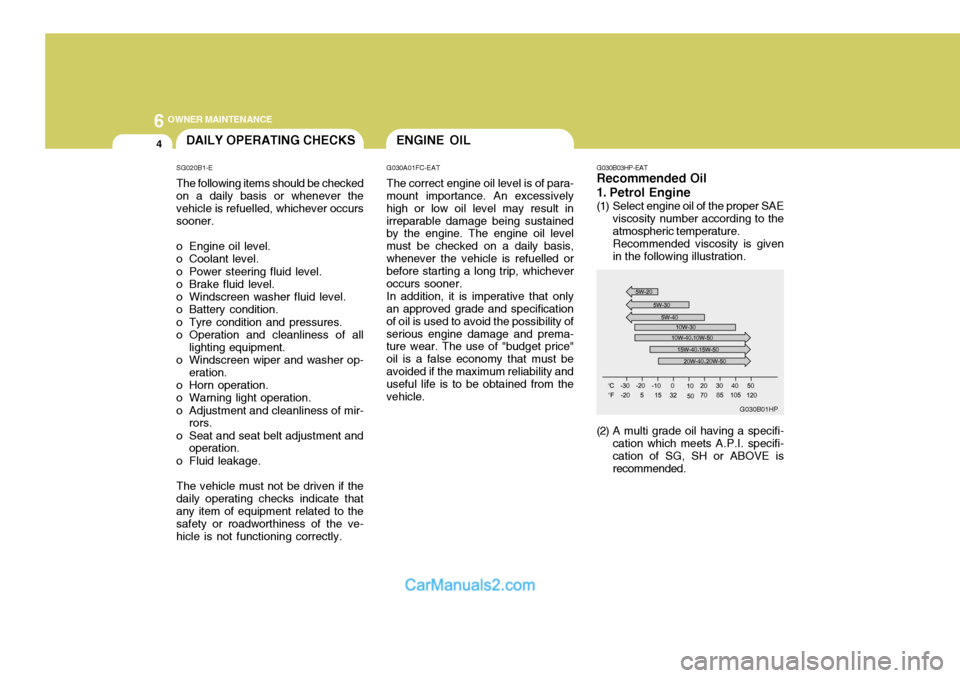
(1) Select engine oil of the proper SAE
viscosity number according to the atmospheric temperature.Recommended viscosity is givenin the following illustration.
(2) A multi grade oil having a specifi- cation which meets A.P.I. specifi-cation of SG, SH or ABOVE isrecommended.DAILY OPERATING CHECKS
SG020B1-E The following items should be checked on a daily basis or whenever the vehicle is refuelled, whichever occurssooner.
o Engine oil level.
o Coolant level.
o Power steering fluid level.
o Brake fluid level.
o Windscreen washer fluid level.
o Battery condition.
o Tyre condition and pressures.
o Operation and cleanliness of all lighting equipment.
o Windscreen wiper and washer op-
eration.
o Horn operation.
o Warning light operation.
o Adjustment and cleanliness of mir- rors.
o Seat and seat belt adjustment and operation.
o Fluid leakage. The vehicle must not be driven if the daily operating checks indicate that any item of equipment related to the safety or roadworthiness of the ve-hicle is not functioning correctly.ENGINE OIL
G030A01FC-EAT The correct engine oil level is of para-
mount importance. An excessively high or low oil level may result inirreparable damage being sustained by the engine. The engine oil level must be checked on a daily basis,whenever the vehicle is refuelled or before starting a long trip, whichever occurs sooner.
In addition, it is imperative that only
an approved grade and specificationof oil is used to avoid the possibility ofserious engine damage and prema- ture wear. The use of "budget price" oil is a false economy that must beavoided if the maximum reliability and useful life is to be obtained from the vehicle.
G030B01HP
Page 491 of 539
6 OWNER MAINTENANCE
14
CAUTION:
o Do not operate the wipers on dry glass. This can result in more rapid wear of the wiper bladesand may scratch the glass.
o Keep the blade rubber out of contact with petroleum productssuch as engine oil, petrol, etc.
!
G080B01HR-EAT
Replacing the Wiper Blades
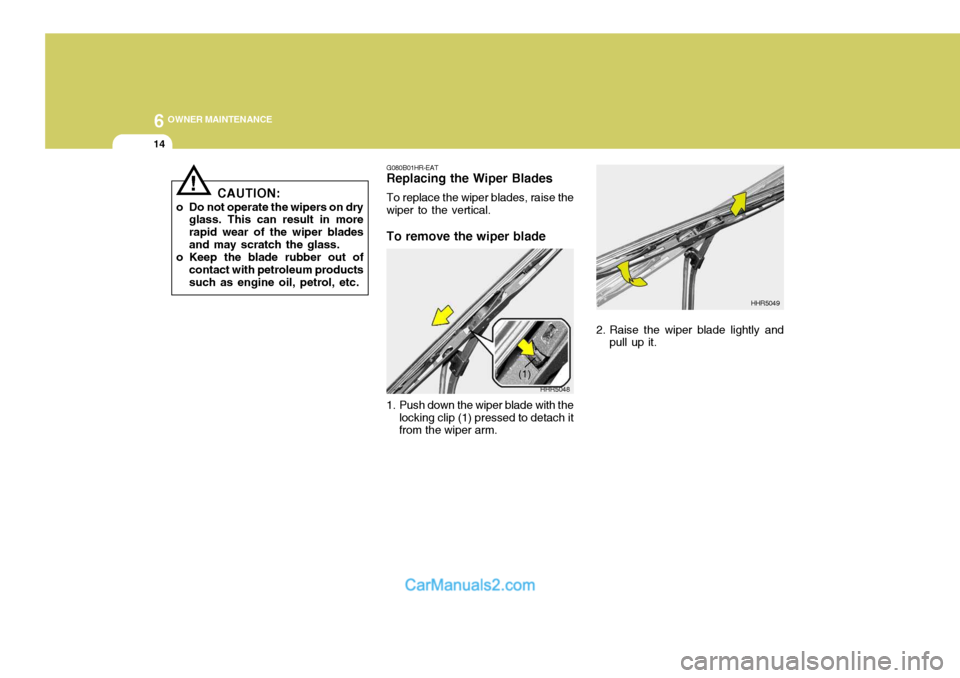
To replace the wiper blades, raise the
wiper to the vertical. To remove the wiper blade
1. Push down the wiper blade with the locking clip (1) pressed to detach it from the wiper arm. 2. Raise the wiper blade lightly and
pull up it.
HHR5048 HHR5049
(1)
Page 497 of 539
6 OWNER MAINTENANCE
20
!
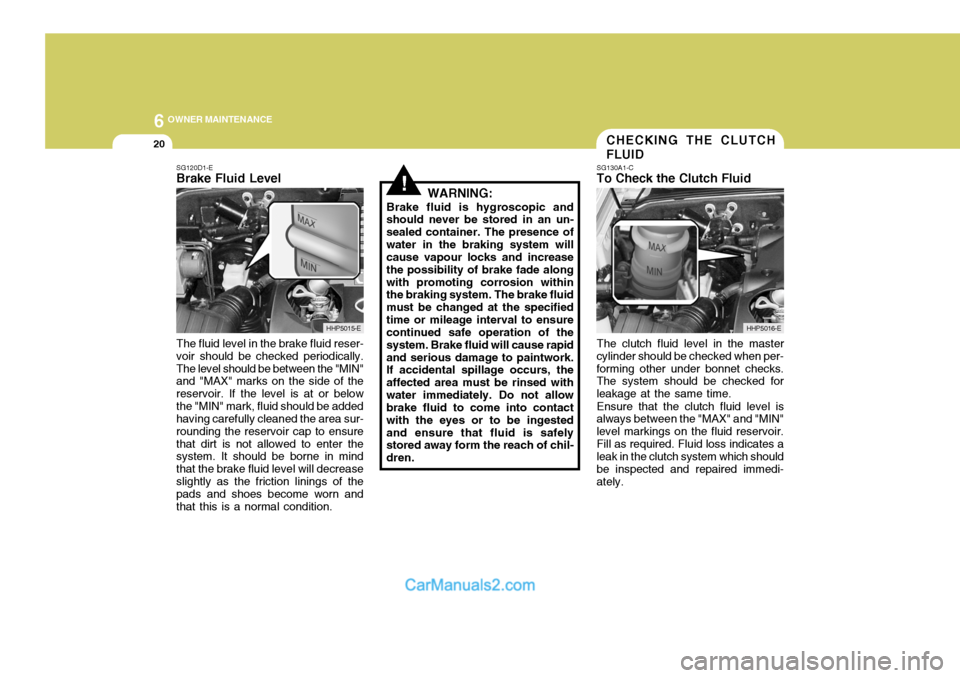
SG120D1-E Brake Fluid Level The fluid level in the brake fluid reser- voir should be checked periodically.The level should be between the "MIN" and "MAX" marks on the side of the reservoir. If the level is at or belowthe "MIN" mark, fluid should be added having carefully cleaned the area sur- rounding the reservoir cap to ensurethat dirt is not allowed to enter the system. It should be borne in mind that the brake fluid level will decreaseslightly as the friction linings of the pads and shoes become worn and that this is a normal condition. WARNING:
Brake fluid is hygroscopic and
should never be stored in an un-sealed container. The presence ofwater in the braking system will cause vapour locks and increase the possibility of brake fade alongwith promoting corrosion within the braking system. The brake fluid must be changed at the specifiedtime or mileage interval to ensure continued safe operation of the system. Brake fluid will cause rapidand serious damage to paintwork. If accidental spillage occurs, the affected area must be rinsed withwater immediately. Do not allow brake fluid to come into contact with the eyes or to be ingestedand ensure that fluid is safely stored away form the reach of chil- dren. The clutch fluid level in the master
cylinder should be checked when per-forming other under bonnet checks. The system should be checked for leakage at the same time.
Ensure that the clutch fluid level is
always between the "MAX" and "MIN"level markings on the fluid reservoir.Fill as required. Fluid loss indicates a leak in the clutch system which should be inspected and repaired immedi-ately.
HHP5015-E
CHECKING THE CLUTCH FLUID
SG130A1-C
To Check the Clutch Fluid
HHP5016-E
Page 500 of 539
6
OWNER MAINTENANCE
23
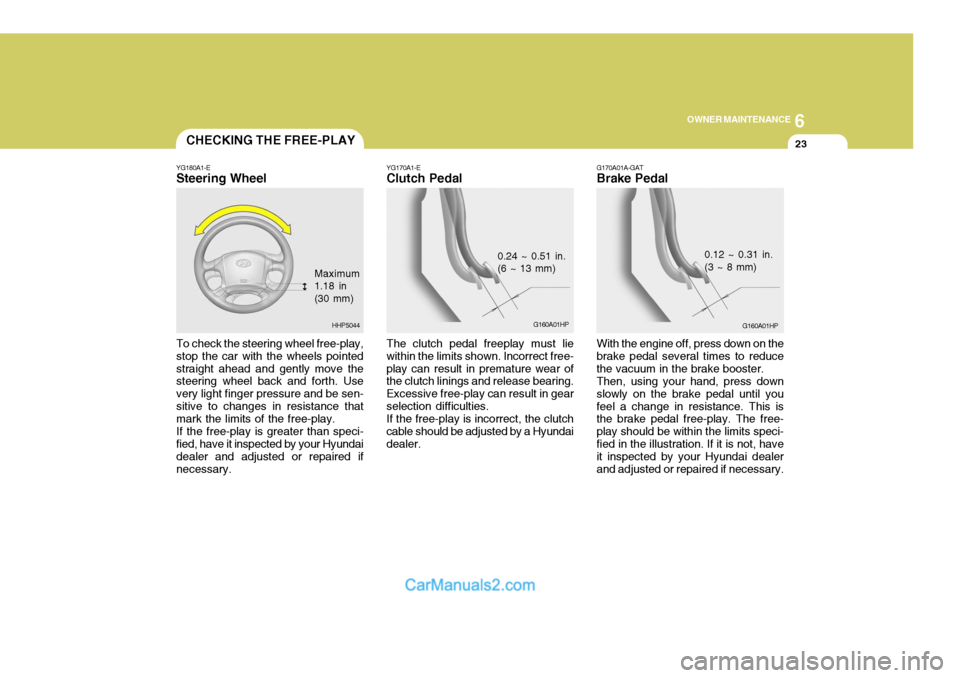
To check the steering wheel free-play, stop the car with the wheels pointedstraight ahead and gently move the steering wheel back and forth. Use very light finger pressure and be sen-sitive to changes in resistance that mark the limits of the free-play. If the free-play is greater than speci- fied, have it inspected by your Hyundai dealer and adjusted or repaired if necessary. YG170A1-E
Clutch Pedal
The clutch pedal freeplay must lie
within the limits shown. Incorrect free-play can result in premature wear of the clutch linings and release bearing. Excessive free-play can result in gearselection difficulties. If the free-play is incorrect, the clutch
cable should be adjusted by a Hyundaidealer. G170A01A-GAT Brake Pedal With the engine off, press down on the brake pedal several times to reducethe vacuum in the brake booster.Then, using your hand, press downslowly on the brake pedal until youfeel a change in resistance. This is the brake pedal free-play. The free- play should be within the limits speci-fied in the illustration. If it is not, have it inspected by your Hyundai dealer and adjusted or repaired if necessary.CHECKING THE FREE-PLAY
YG180A1-E
Steering Wheel
Maximum 1.18 in(30 mm)
HHP5044
0.24 ~ 0.51 in. (6 ~ 13 mm)
G160A01HP0.12 ~ 0.31 in. (3 ~ 8 mm)
G160A01HP