battery Hyundai Terracan 2006 User Guide
[x] Cancel search | Manufacturer: HYUNDAI, Model Year: 2006, Model line: Terracan, Model: Hyundai Terracan 2006Pages: 539, PDF Size: 18.11 MB
Page 189 of 539
3 WHAT TO DO IN AN EMERGENCY
2
!
IF THE ENGINE WILL NOT START
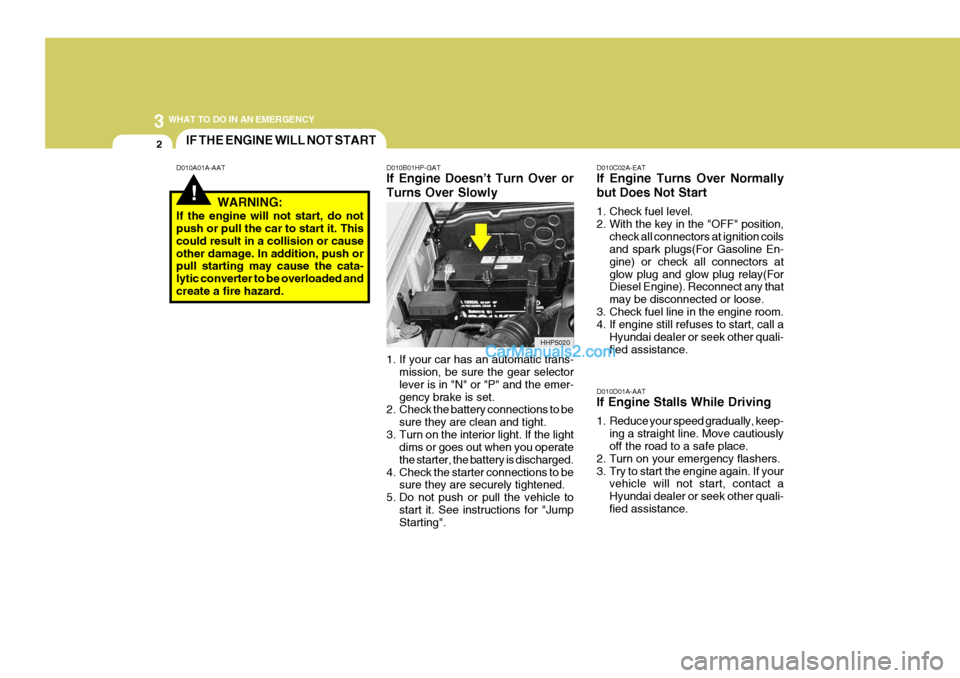
D010A01A-AAT D010B01HP-GAT If Engine Doesn’t Turn Over or Turns Over Slowly
1. If your car has an automatic trans- mission, be sure the gear selector lever is in "N" or "P" and the emer-gency brake is set.
2. Check the battery connections to be
sure they are clean and tight.
3. Turn on the interior light. If the light dims or goes out when you operatethe starter, the battery is discharged.
4. Check the starter connections to be sure they are securely tightened.
5. Do not push or pull the vehicle to start it. See instructions for "Jump Starting". D010C02A-EAT If Engine Turns Over Normally but Does Not Start
1. Check fuel level.
2. With the key in the "OFF" position,
check all connectors at ignition coils and spark plugs(For Gasoline En- gine) or check all connectors atglow plug and glow plug relay(For Diesel Engine). Reconnect any that may be disconnected or loose.
3. Check fuel line in the engine room.
4. If engine still refuses to start, call a
Hyundai dealer or seek other quali- fied assistance.
WARNING:
If the engine will not start, do not push or pull the car to start it. This could result in a collision or causeother damage. In addition, push or pull starting may cause the cata- lytic converter to be overloaded andcreate a fire hazard.
D010D01A-AAT If Engine Stalls While Driving
1. Reduce your speed gradually, keep-ing a straight line. Move cautiously off the road to a safe place.
2. Turn on your emergency flashers.
3. Try to start the engine again. If your vehicle will not start, contact aHyundai dealer or seek other quali-fied assistance.
HHP5020
Page 190 of 539
3
WHAT TO DO IN AN EMERGENCY
3JUMP STARTING
!
D020A02A-AAT
WARNING:
The gas produced by the battery during the jump-start operation is highly explosive. If these instruc- tions are not followed exactly, seri-ous personal injury and damage to the vehicle may occur! If you are not sure how to follow this proce-dure, seek qualified assistance. Automobile batteries contain sul- furic acid. This is poisonous andhighly corrosive. When jump start- ing, wear protective glasses and be careful not to get acid on yourself,your clothing or on the car. o If you should accidentally get acid
on your skin or in your eyes,immediately remove any contami- nated clothing and flush the area with clear water for at least 15 min-utes. Then promptly obtain medical attention. If you must be transported to an emergency facility, continue toapply water to the affected area with a sponge or cloth.
o The gas produced by the battery
during the jump-start operation ishighly explosive. Do not smoke or allow a spark or an open flame inthe vicinity.
o The battery being used to provide
the jump start must be 12-volt. If youcannot determine that it is a 12-volt battery, do not attempt to use it for the jump start.
o To jump start a car with a discharged battery, follow this procedure ex-actly:
1. If the booster battery is installed in another vehicle, be sure the twovehicles are not touching. 2. Turn off all unnecessary lights and
acces-sories in both vehicles.
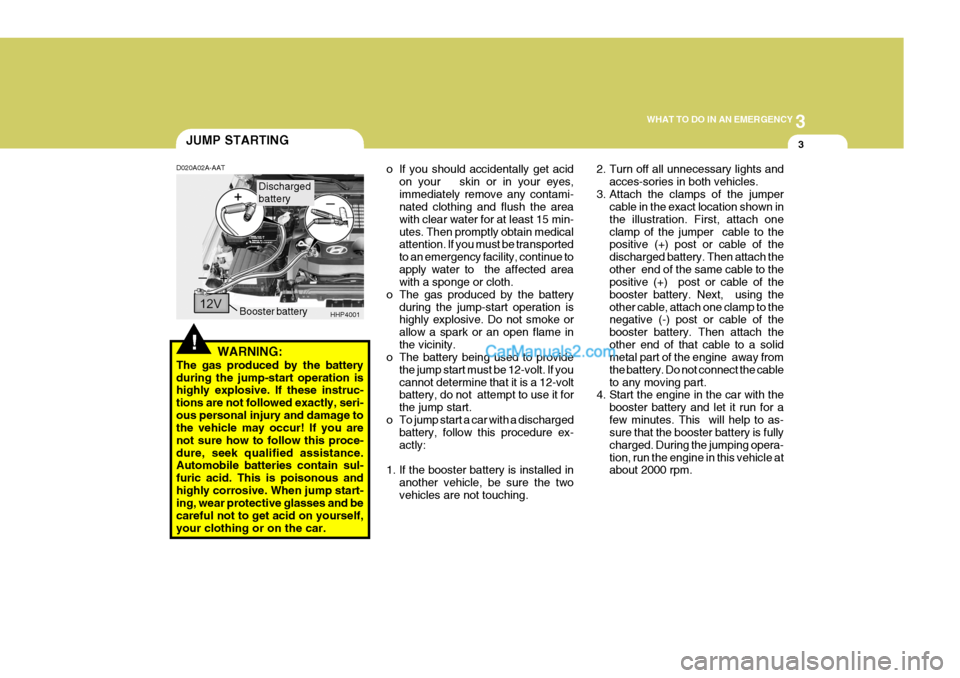
3. Attach the clamps of the jumper cable in the exact location shown inthe illustration. First, attach oneclamp of the jumper cable to the positive (+) post or cable of the discharged battery. Then attach theother end of the same cable to the positive (+) post or cable of the booster battery. Next, using theother cable, attach one clamp to the negative (-) post or cable of the booster battery. Then attach theother end of that cable to a solid metal part of the engine away from the battery. Do not connect the cableto any moving part.
4. Start the engine in the car with the
booster battery and let it run for afew minutes. This will help to as- sure that the booster battery is fully charged. During the jumping opera-tion, run the engine in this vehicle at about 2000 rpm.
HHP4001
Booster battery
Discharged battery
Page 191 of 539
3 WHAT TO DO IN AN EMERGENCY
4IF THE ENGINE OVERHEATS
!
5. Start the engine in the car with the
discharged battery using the nor- mal starting procedure. After the engine starts, leave the jumper cables connected and let the enginerun at fast idle or about 2000 rpm for several minutes.
6. Carefully remove the jumper cables in the reverse order of attachment.
If you do not know why your battery became discharged (because the lights were left on, etc.), have the charging system checked by your Hyundaidealer. D030A02HP-AAT If your temperature gauge indicates overheating, you experience a loss of power, or hear loud pinging or knock- ing, the engine is probably too hot. Ifthis happens to you, you should:
1. Pull off the road and stop as soon as
it is safe to do so.
2. Place the gear selector lever in "P"
(automatic), or neutral (manual transmission) and set the parking brake. If the air conditioning is on, turn it off.
3. If engine coolant is running out un- der the car or steam is coming outfrom under the hood, stop the en-gine. Do not open the hood until the engine coolant has stopped running or the steaming has stopped. If thereis no visible loss of coolant and no steam, leave the engine running and check to be sure the enginecooling fan is operating. If the fan is not running, turn the engine off. 4. Check to see if the water pump drive
belt is missing. If it is not missing, check to see that it is tight. If the drive belt seems to be satisfactory, check for engine coolant leakingfrom the radiator, hoses or under the car. (If the air conditioning had been in use, it is normal for coldwater to be draining from it when you stop).
WARNING:
While the engine is running, keephands and clothing away from mov- ing parts such as the fan and drivebelts to prevent injury.
Page 228 of 539
Engine Compartment .................................................... 6-2
General Checks ........................................................... 6-5
Checking the Engine Oil .............................................. 6-6 Changing the Engine Oil and Filter ............................. 6-10
Checking and Changing the Engine Coolant ..............6-11
Changing the Air Cleaner Filte r ...................................6-14
Checking the Transmission Oil (Manual)................... 6-17
Checking the Transmission Fluid (Automatic)............6-18
Checking the Brakes .................................................. 6-21
Checking the Clutch Fluid ........................................... 6-22
Air Conditioning Care .................................................. 6-23
Changing the Climate Control Air Filter .. ....................6-24
Checking Drive Belts .................................................. 6-27
Checking and Replacing Fuses ..................................6-28
Checking The Battery ................................................. 6-31
Checking The Electric Cooling Fans ..........................6-33
Power Steering Fluid Level ......................................... 6-33
Fuel Filter ..................................................................... 6-34
Replacement of Headlight Bulbs ................................. 6-38
Headlight Aiming Adjustment ...................................... 6-39
Bulb Wattages ............................................................. 6-42
Fuse Panel D escription ............................................... 6-43
DO-IT-YOURSELF MAINTENANCE
6
6
Page 229 of 539
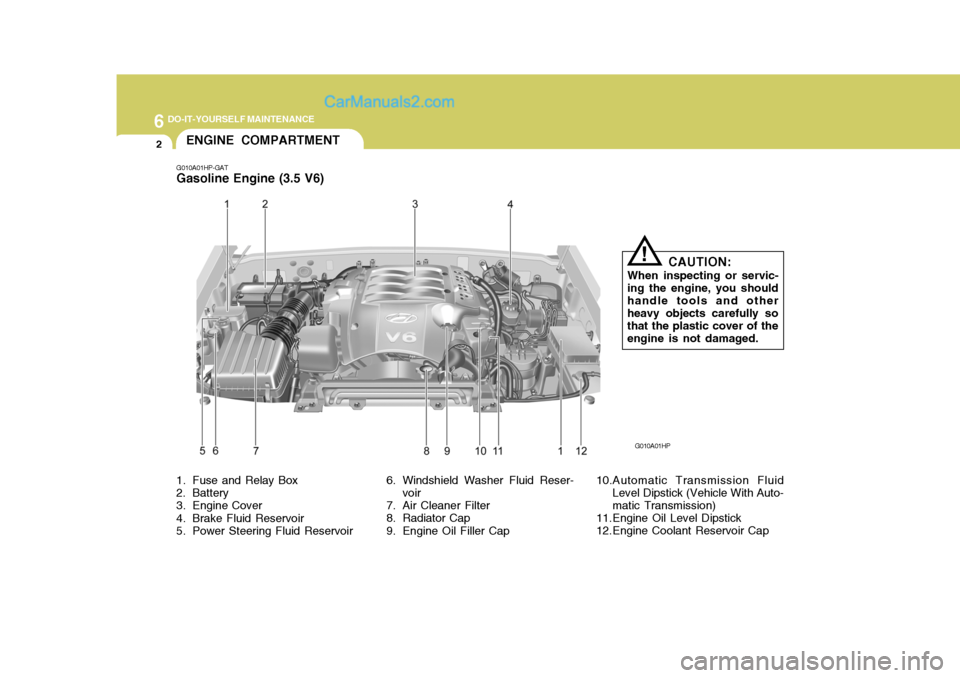
6 DO-IT-YOURSELF MAINTENANCE
2
1. Fuse and Relay Box
2. Battery
3. Engine Cover
4. Brake Fluid Reservoir
5. Power Steering Fluid Reservoir 6. Windshield Washer Fluid Reser-
voir
7. Air Cleaner Filter
8. Radiator Cap
9. Engine Oil Filler Cap 10.Automatic Transmission Fluid
Level Dipstick (Vehicle With Auto- matic Transmission)
11.Engine Oil Level Dipstick
12.Engine Coolant Reservoir Cap G010A01HP
G010A01HP-GAT Gasoline Engine (3.5 V6)
CAUTION:
When inspecting or servic-
ing the engine, you should handle tools and other heavy objects carefully so that the plastic cover of theengine is not damaged.
!
ENGINE COMPARTMENT
Page 230 of 539
6
DO-IT-YOURSELF MAINTENANCE
3
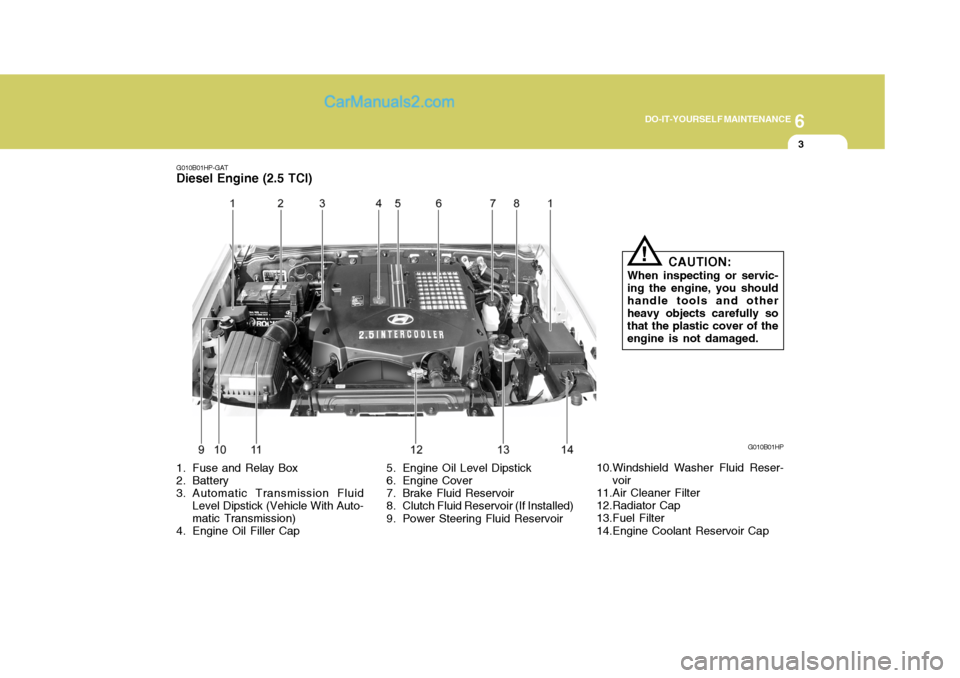
G010B01HP-GAT
Diesel Engine (2.5 TCI)
G010B01HP
1. Fuse and Relay Box
2. Battery
3. Automatic Transmission Fluid Level Dipstick (Vehicle With Auto- matic Transmission)
4. Engine Oil Filler Cap 5. Engine Oil Level Dipstick
6. Engine Cover
7. Brake Fluid Reservoir
8. Clutch Fluid Reservoir (If Installed)
9. Power Steering Fluid Reservoir
10.Windshield Washer Fluid Reser-
voir
11.Air Cleaner Filter
12.Radiator Cap
13.Fuel Filter
14.Engine Coolant Reservoir Cap CAUTION:
When inspecting or servic- ing the engine, you shouldhandle tools and other heavy objects carefully so that the plastic cover of theengine is not damaged.
!
Page 231 of 539
6 DO-IT-YOURSELF MAINTENANCE
4
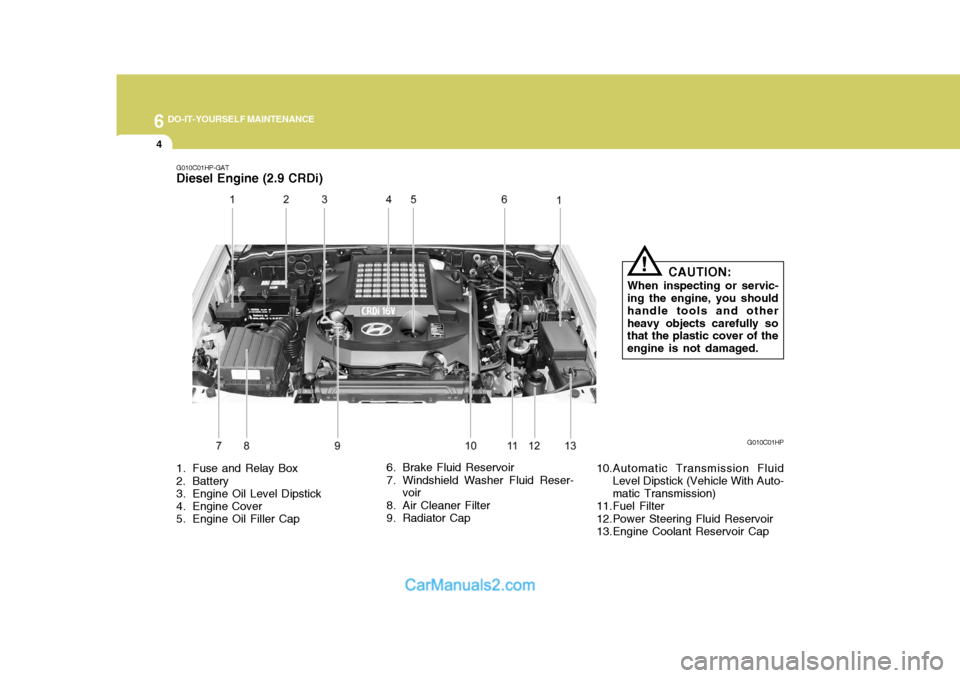
1. Fuse and Relay Box
2. Battery
3. Engine Oil Level Dipstick
4. Engine Cover
5. Engine Oil Filler Cap 6. Brake Fluid Reservoir
7. Windshield Washer Fluid Reser-
voir
8. Air Cleaner Filter
9. Radiator Cap 10.Automatic Transmission Fluid
Level Dipstick (Vehicle With Auto-matic Transmission)
11.Fuel Filter
12.Power Steering Fluid Reservoir
13.Engine Coolant Reservoir Cap G010C01HP
G010C01HP-GAT Diesel Engine (2.9 CRDi)
CAUTION:
When inspecting or servic-
ing the engine, you should handle tools and otherheavy objects carefully so that the plastic cover of the engine is not damaged.
!
Page 232 of 539
6
DO-IT-YOURSELF MAINTENANCE
5GENERAL CHECKS
G020A01HP-GAT
Engine Compartment
The following should be checked regu- larly:
o Engine oil level and condition
o Transmission fluid level and condi- tion
o Brake fluid level
o Clutch fluid level
o Engine coolant level
o Windshield washer fluid level
o Accessory drive belt condition
o Engine coolant hose condition
o Fluid leaks
(on or below components)
o Power steering fluid level
o Battery condition
o Air filter condition G020B01A-AAT
Vehicle Exterior
The following should be checked
monthly:
o Overall appearance and condition
o Wheel condition and wheel nut torque
o Exhaust system condition
o Light condition and operation
o Windshield glass condition
o Wiper blade condition
o Paint condition and body corrosion
o Fluid leaks
o Door and hood lock condition
o Tire pressure and condition
(including spare tire) o Defroster, heating system operation
(and air conditioning, if installed)
o Steering operation and condition
o Mirror condition and operation
o Turn signal operation
o Accelerator pedal operation
o Brake operation, including parking brake
o Manual transmission operation, in- cluding clutch operation
o Automatic transmission operation, including "Park" mechanism opera- tion
o Seat control condition and opera- tion
o Seat belt condition and operation
o Sun visor operation If you notice anything that does not operate correctly or appears to befunctioning incorrectly, inspect it care- fully and seek assistance from your Hyundai dealer if service is needed.
G020C01HP-GAT
Vehicle Interior
The following should be checked each
time when the vehicle is driven:
o Lights operation
o Windshield wiper operation
o Horn operation
Page 256 of 539
6
DO-IT-YOURSELF MAINTENANCE
29
G200B02HP-GAT
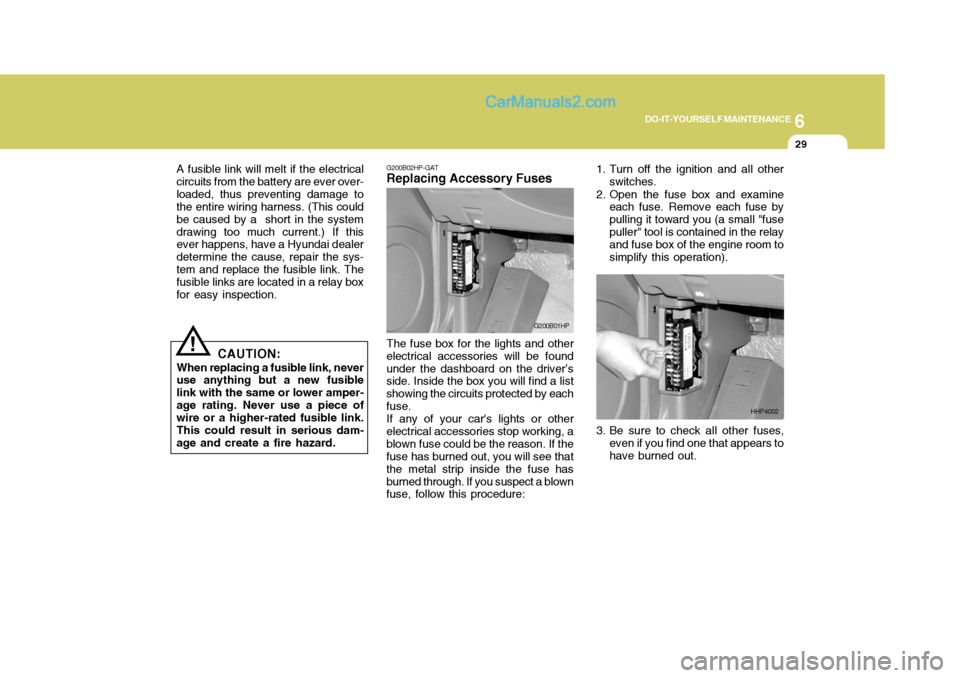
Replacing Accessory Fuses
The fuse box for the lights and other
electrical accessories will be found under the dashboard on the driver’s side. Inside the box you will find a list showing the circuits protected by eachfuse. If any of your car's lights or other
electrical accessories stop working, ablown fuse could be the reason. If the fuse has burned out, you will see that the metal strip inside the fuse hasburned through. If you suspect a blown fuse, follow this procedure: G200B01HP
!
A fusible link will melt if the electrical
circuits from the battery are ever over- loaded, thus preventing damage to the entire wiring harness. (This could be caused by a short in the systemdrawing too much current.) If this ever happens, have a Hyundai dealer determine the cause, repair the sys-tem and replace the fusible link. The fusible links are located in a relay box for easy inspection.
CAUTION:
When replacing a fusible link, never use anything but a new fusible link with the same or lower amper-age rating. Never use a piece of wire or a higher-rated fusible link. This could result in serious dam-age and create a fire hazard. 3. Be sure to check all other fuses,
even if you find one that appears tohave burned out.
1. Turn off the ignition and all other
switches.
2. Open the fuse box and examine each fuse. Remove each fuse bypulling it toward you (a small "fusepuller" tool is contained in the relay and fuse box of the engine room to simplify this operation).
HHP4002
Page 257 of 539
6 DO-IT-YOURSELF MAINTENANCE
30
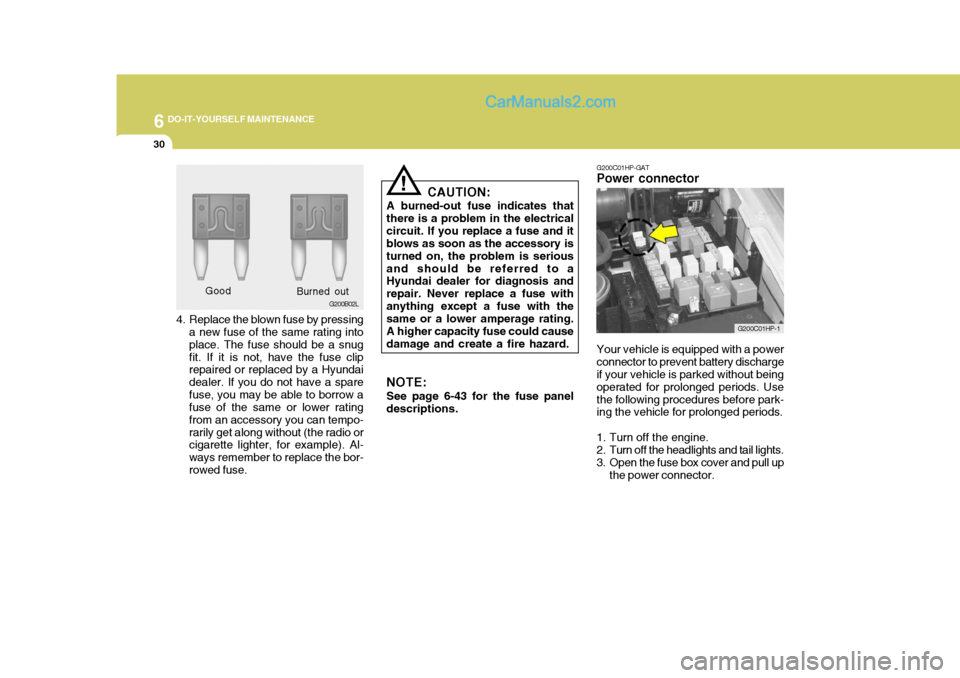
4. Replace the blown fuse by pressing
a new fuse of the same rating into place. The fuse should be a snugfit. If it is not, have the fuse clip repaired or replaced by a Hyundai dealer. If you do not have a sparefuse, you may be able to borrow a fuse of the same or lower rating from an accessory you can tempo-rarily get along without (the radio or cigarette lighter, for example). Al- ways remember to replace the bor-rowed fuse. Good
G200B02L
Burned out CAUTION:
A burned-out fuse indicates thatthere is a problem in the electricalcircuit. If you replace a fuse and it blows as soon as the accessory is turned on, the problem is seriousand should be referred to a Hyundai dealer for diagnosis and repair. Never replace a fuse withanything except a fuse with the same or a lower amperage rating. A higher capacity fuse could causedamage and create a fire hazard. NOTE: See page 6-43 for the fuse panel descriptions.
! G200C01HP-GAT
Power connector
Your vehicle is equipped with a power connector to prevent battery discharge if your vehicle is parked without being operated for prolonged periods. Usethe following procedures before park- ing the vehicle for prolonged periods.
1. Turn off the engine.
2. Turn off the headlights and tail lights.
3. Open the fuse box cover and pull up the power connector.
G200C01HP-1