roof INFINITI FX35 2004 Repair Manual
[x] Cancel search | Manufacturer: INFINITI, Model Year: 2004, Model line: FX35, Model: INFINITI FX35 2004Pages: 4449, PDF Size: 99.66 MB
Page 4084 of 4449

SEAT BELTS
SB-7
C
D
E
F
G
I
J
K
L
MA
B
SB
Revision: 2004 November 2004 FX35/FX45
REMOVAL OF REAR SEAT BELT RETRACTOR
1. Remove the rear seat. Refer to SE-109, "REMOVAL" .
2. Remove the rear wheel house finisher assembly and luggage side finisher assembly. Refer to EI-44,
"Removal and Installation" .
3. Remove the center seat retractor cover.
4. Remove the roof rear garnish assembly. Refer to EI-44, "
Removal and Installation" .
5. Remove the outer and inner anchor bolts.
6. Remove the outer side retractor and center seat retractor mounting anchor bolts.
7. Remove the seat belt assembly.
INSTALLATION OF REAR SEAT BELT RETRACTOR
Install in the reverse order of removal.
Page 4089 of 4449
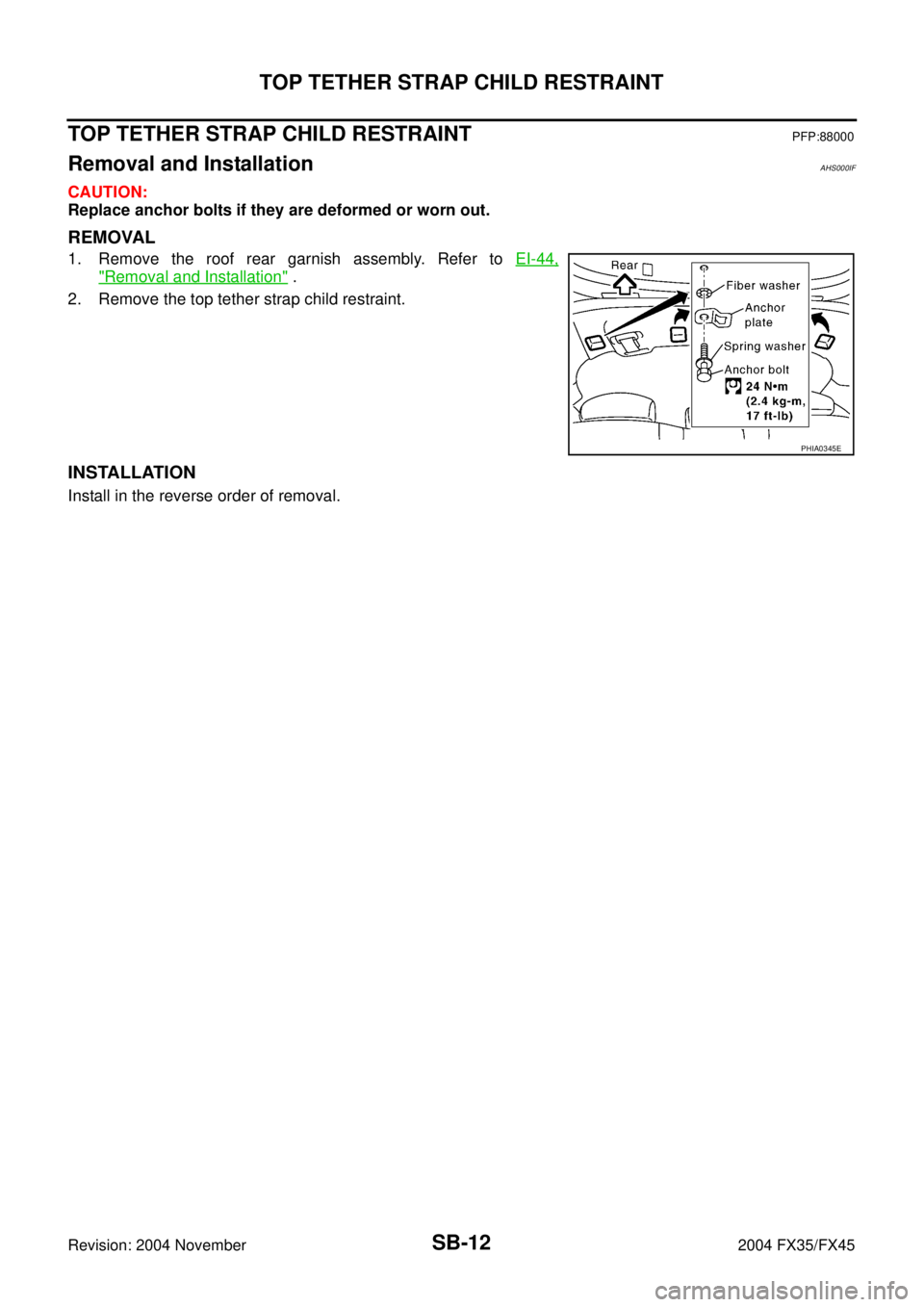
SB-12
TOP TETHER STRAP CHILD RESTRAINT
Revision: 2004 November 2004 FX35/FX45
TOP TETHER STRAP CHILD RESTRAINTPFP:88000
Removal and InstallationAHS000IF
CAUTION:
Replace anchor bolts if they are deformed or worn out.
REMOVAL
1. Remove the roof rear garnish assembly. Refer to EI-44,
"Removal and Installation" .
2. Remove the top tether strap child restraint.
INSTALLATION
Install in the reverse order of removal.
PHIA0345E
Page 4130 of 4449

SE-1
SEAT
I BODY
CONTENTS
C
D
E
F
G
H
J
K
L
M
SECTION SE
A
B
SE
Revision: 2004 November 2004 FX35/FX45
SEAT
PRECAUTIONS .......................................................... 3
Precautions for Supplemental Restraint System
(SRS) “AIR BAG” and “SEAT BELT PRE-TEN-
SIONER” .................................................................. 3
Service Notice .......................................................... 3
Precautions for Work ................................................ 3
PREPARATION ........................................................... 4
Special Service Tools ............................................... 4
Commercial Service Tools ........................................ 4
SQUEAK AND RATTLE TROUBLE DIAGNOSIS ...... 5
Work Flow ................................................................ 5
CUSTOMER INTERVIEW ..................................... 5
DUPLICATE THE NOISE AND TEST DRIVE ....... 6
CHECK RELATED SERVICE BULLETINS ........... 6
LOCATE THE NOISE AND IDENTIFY THE
ROOT CAUSE ...................................................... 6
REPAIR THE CAUSE ........................................... 6
CONFIRM THE REPAIR ....................................... 7
Generic Squeak and Rattle Troubleshooting ........... 7
INSTRUMENT PANEL .......................................... 7
CENTER CONSOLE ............................................. 7
DOORS ................................................................. 7
TRUNK .................................................................. 8
SUNROOF/HEADLINING ..................................... 8
SEATS ................................................................... 8
UNDERHOOD ....................................................... 8
Diagnostic Worksheet .............................................. 9
AUTOMATIC DRIVE POSITIONER ...........................11
System Description ................................................. 11
MANUAL OPERATION ........................................ 11
AUTOMATIC OPERATION .................................. 11
MEMORY STORING AND KEY FOB INTER-
LOCK STORING .................................................. 11
MEMORY SWITCH OPERATION ....................... 13
ENTRY OPERATION .......................................... 13
EXITING OPERATION ........................................ 13
KEY FOB INTERLOCK OPERATION ................. 14
FAIL- SAFE MODE ............................................. 14
CANCEL OF FAIL-SAFE MODE ......................... 14
Component Parts and Harness Connector Location ... 15CAN Communication System Description .............. 16
CAN Communication Unit ....................................... 16
Schematic ............................................................... 17
Wiring Diagram–AUT/DP– ...................................... 19
Terminals and Reference Values for BCM .............. 30
Terminals and Reference Values for Automatic
Drive Positioner Control Unit .................................. 30
Terminals and Reference Values for Driver Seat
Control Unit ............................................................. 32
Work Flow ............................................................... 34
Preliminary Check .................................................. 35
SETTING CHANGE FUNCTION ......................... 35
CHECK POWER SUPPLY AND GROUND ......... 35
CONSULT-II Function ............................................. 38
CONSULT-II INSPECTION PROCEDURE .......... 38
SELF-DIAGNOSIS RESULTS ............................. 39
CAN DIAGNOSIS SUPPORT MONITOR ............ 40
DATA MONITOR ................................................. 40
ACTIVE TEST ..................................................... 41
Can Communication Inspection Using CONSULT-
II (Self-diagnosis) .................................................... 42
Symptom Chart ....................................................... 42
Sliding Motor Circuit Check .................................... 44
Reclining Motor Circuit Check ................................ 45
Front Lifting Motor Circuit Check ............................ 46
Rear Lifting Motor Circuit Check ............................. 48
Telescopic Motor Circuit Check .............................. 49
Tilt Motor Circuit Check .......................................... 51
Driver Side Mirror Motor Circuit Check ................... 52
Passenger Side Mirror Motor Circuit Check ........... 54
Sliding Sensor Circuit Check .................................. 56
Reclining Sensor Circuit Check .............................. 57
Front Lifting Sensor Circuit Check .......................... 58
Rear Lifting Sensor Circuit Check .......................... 59
Telescopic Sensor Circuit Check ............................ 60
Tilt Sensor Circuit Check ........................................ 61
Driver Side Mirror Sensor Circuit Check ................. 62
Passenger Side Mirror Sensor Circuit Check ......... 63
Steering and Door Mirror Sensor Power and Ground
Circuit Check .......................................................... 64
Page 4137 of 4449

SE-8
SQUEAK AND RATTLE TROUBLE DIAGNOSIS
Revision: 2004 November 2004 FX35/FX45
TRUNK
Trunk noises are often caused by a loose jack or loose items put into the trunk by the owner.
In addition look for:
1. Trunk lid dumpers out of adjustment
2. Trunk lid striker out of adjustment
3. The trunk lid torsion bars knocking together
4. A loose license plate or bracket
Most of these incidents can be repaired by adjusting, securing or insulating the item(s) or component(s) caus-
ing the noise.
SUNROOF/HEADLINING
Noises in the sunroof/headlining area can often be traced to one of the following:
1. Sunroof lid, rail, linkage or seals making a rattle or light knocking noise
2. Sunvisor shaft shaking in the holder
3. Front or rear windshield touching headlining and squeaking
Again, pressing on the components to stop the noise while duplicating the conditions can isolate most of these
incidents. Repairs usually consist of insulating with felt cloth tape.
SEATS
When isolating seat noise it's important to note the position the seat is in and the load placed on the seat when
the noise is present. These conditions should be duplicated when verifying and isolating the cause of the
noise.
Cause of seat noise include:
1. Headrest rods and holder
2. A squeak between the seat pad cushion and frame
3. The rear seatback lock and bracket
These noises can be isolated by moving or pressing on the suspected components while duplicating the con-
ditions under which the noise occurs. Most of these incidents can be repaired by repositioning the component
or applying urethane tape to the contact area.
UNDERHOOD
Some interior noise may be caused by components under the hood or on the engine wall. The noise is then
transmitted into the passenger room.
Causes of transmitted underhood noise include:
1. Any component mounted to the engine wall
2. Components that pass through the engine wall
3. Engine wall mounts and connectors
4. Loose radiator mounting pins
5. Hood bumpers out of adjustment
6. Hood striker out of adjustment
These noises can be difficult to isolate since they cannot be reached from the interior of the vehicle. The best
method is to secure, move or insulate one component at a time and test drive the vehicle. Also, engine RPM
or load can be changed to isolate the noise. Repairs can usually be made by moving, adjusting, securing, or
insulating the component causing the noise.