bulb ISUZU KB P190 2007 Workshop Manual PDF
[x] Cancel search | Manufacturer: ISUZU, Model Year: 2007, Model line: KB P190, Model: ISUZU KB P190 2007Pages: 6020, PDF Size: 70.23 MB
Page 5307 of 6020
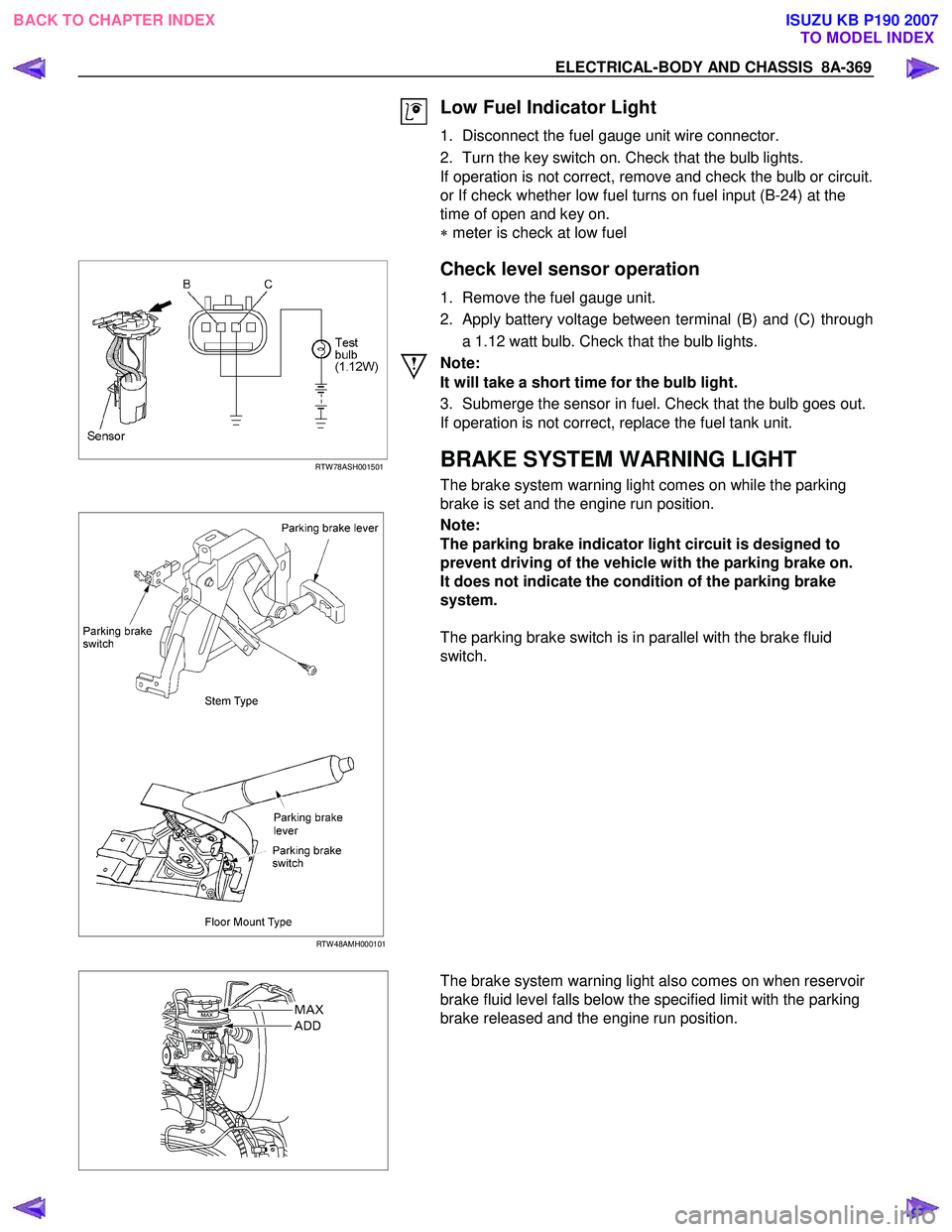
ELECTRICAL-BODY AND CHASSIS 8A-369
Low Fuel Indicator Light
1. Disconnect the fuel gauge unit wire connector.
2. Turn the key switch on. Check that the bulb lights.
If operation is not correct, remove and check the bulb or circuit.
or If check whether low fuel turns on fuel input (B-24) at the
time of open and key on.
∗ meter is check at low fuel
RTW 78ASH001501
Check level sensor operation
1. Remove the fuel gauge unit.
2. Apply battery voltage between terminal (B) and (C) through a 1.12 watt bulb. Check that the bulb lights.
Note:
It will take a short time for the bulb light.
3. Submerge the sensor in fuel. Check that the bulb goes out.
If operation is not correct, replace the fuel tank unit.
BRAKE SYSTEM WARNING LIGHT
The brake system warning light comes on while the parking
brake is set and the engine run position.
RTW 48AMH000101
Note:
The parking brake indicator light circuit is designed to
prevent driving of the vehicle with the parking brake on.
It does not indicate the condition of the parking brake
system.
The parking brake switch is in parallel with the brake fluid
switch.
The brake system warning light also comes on when reservoir
brake fluid level falls below the specified limit with the parking
brake released and the engine run position.
BACK TO CHAPTER INDEX TO MODEL INDEXISUZU KB P190 2007
Page 5651 of 6020
9A-16 SUPPLEMENTAL RESTRAINT SYSTEM
RTW 79ASH000201
Seat Belt with Pretensioner (If so
equipped)
The seat belt comprises a seat belt and a cylinder (a
cylinder filled with powder and an ignition device). In
cases of frontal collision which cause a shock
exceeding a specified level, the controller lets current
flow to the inflation circuit. The current ignites the
cylinder of the seat belt, producing gas. The gas helps
tighten the seat belt to restrain firmly the driver’s uppe
r
half in his seat.
RTW 49JSH000201
Steering Column
The steering column absorbs energy and is designed
to compress in a frontal crash to decrease the chance
of injury to the driver.
060R300038
Knee Bolster
The knee bolsters are used to absorb energy to
protect knees and control the forward movement o
f
the vehicle's front seat occupants during a frontal
crash, by limiting leg movement.
Definitions
Air Bag
An inflatable cloth cushion designed to deploy in
certain frontal crashes. It supplements the protection
offered by the seat belts by distributing the impact load
more evenly over the vehicle occupant's head and
torso.
Asynchronous
Performed in a non-periodic fashion, (i.e., no defined
time or interval).
B+
Battery voltage, (B+) The voltage available at the
battery at the time of the indicated measurement.
W ith the key “ON” and the engine not running, the
system voltage will likely be between 12 and 12.5
volts. At idle, the voltage may be 14 to 16 volts. The
voltage could be as low as 10 volts during engine
cranking.
Bulb Check
The SRS control unit will cause the “SRS” warning
lamp to flash seven times and then go “OFF”
whenever the ignition switch transitions to the ON
position from any other ignition switch position and no
malfunctions are detected.
BACK TO CHAPTER INDEX TO MODEL INDEXISUZU KB P190 2007
Page 5697 of 6020

RESTRAINT CONTROL SYSTEM 9A1-15
Chart C “SRS” Warning Lamp Does Not Come “ON” Steady
Step Action Yes No
1
1. W hen measurements are requested in this chart, use a 5-
8840-0366-0DMM with a correct terminal adapter from 5-
8840-0385-0.
2. Ignition switch is at “LOCK”.
3. Remove and inspect the “METER” fuse to the “SRS” warning lamp.
Is the fuse good? Go to Step 2 Go to Step 7
2
1. Ignition switch is at “LOCK”.
2. Disconnect the SRS coil and passenger air bag assembly
yellow connector which is located at the base of the steering
column and behind the glove box assembly.
3. Disconnect the SRS control unit.
4. Ignition switch is “ON”.
5. Measure the voltage on the SRS control unit harness connector from the terminal “4” to terminal “3” (ground).
Is system voltage present on terminal “4”? Go to Step 4 Go to Step 3
3
1. Ignition switch is at “LOCK”.
2. Remove instrument meter cluster.
3. Check for proper connection to instrument cluster at the SRS warning lamp circuit terminal.
4. If ok, then remove and inspect the “AIR BAG” bulb.
Is the bulb good? Go to Step 5 Replace bulb.
Go to Step 6
4
1. Ignition switch is at “LOCK”.
2. Disconnect instrument meter cluster harness connector.
3. Ignition switch is “ON”.
4. Measure the voltage on the SRS control unit harness
connector from terminal “4” to terminal “3” (ground).
Is the voltage 1 volt or less? Go to Chart A Replace SRS
harness.
Go to Step 6
5
1. Install the bulb.
2. Measure the resistance from the instrument meter cluster
harness connector SRS warning lamp circuit terminal to the
SRS control unit harness connector terminal “4”.
Is the resistance 5.0 ohms or less? Service instrument
meter cluster.
Install instrument meter cluster. Go to Step 6 Replace SRS
harness.
Go to Step 6
6 Reconnect all SRS components and ensure all components are
properly mounted.
Is this step finished? Repeat the “SRS
Diagnostic System Check” Go to Step 6
7
Perform chart C.
Is this step finished? Go to Step 8 Go to Step 1
8
1. Replace the “METER” fuse.
2. Ignition switch is “ON”. W ait 10 Seconds then ignition switch
is at “LOCK”.
3. Remove and inspect the “METER” fuse.
Is the fuse good? Install “METER”
fuse.
Go to Step 10 Go to Step 9
BACK TO CHAPTER INDEX
TO MODEL INDEX
ISUZU KB P190 2007
Page 5700 of 6020

9A1-18 RESTRAINT CONTROL SYSTEM
DTC Will Clear When
Resistance value returns specified resistance value.
DTC Chart Test Description
Number(s) below refer to step number(s) on the
diagnostic chart:
2. This test determines whether the malfunction is in
the SRS control unit.
3. This test verifies proper connection of the yello
w
connector.
4. This test checks for proper contact and/or corrosion
of the yellow connector terminals.
5. This test checks for a malfunctioning passenger ai
r
bag assembly.
6. This test determines whether the malfunction is due
to a high resistance in the wiring.
Diagnostic Aids
An intermittent condition is likely to be caused by a poor
connection at the passenger air bag assembly harness
connector terminals “1” and “2”, SRS control unit
terminal “17” and “16”, or a poor wire to terminal
connection in circuits “Passenger Bag High” and
“Passenger Bag Low”. The test for this diagnostic
trouble code is only run while the “SRS” warning lamp is
performing the bulb check. W hen the scan tool “Clea
r
Codes” command is issued and the malfunction is still
present, the DTC will not reappear until the next ignition
cycle.
DTC B0015 (Flash Code 15) Passenger Air Bag Squib Circuit High Resistance
Step Action Yes No
1 W as the “SRS Diagnostic System Check” Performed?
Go to Step 2 Go to The “SRS
Diagnostic System Check”
2
1. Check the passenger air bag squib circuit for open.
2. If a problem is found, repair as necessary.
W as a problem found? Verify repair Go to Step 3
3
1. Ignition switch is at “LOCK”.
2. Make sure the passenger air bag assembly yellow connector
located behind the glove box assembly is seated properly.
Is the yellow connector connected properly? Go to Step 4 Seat passenger Air
Bag assembly
yellow connector properly.
Go to Step 7
4
1. Disconnect and inspect the passenger air bag assembly
yellow connector located behind the glove box assembly.
2. If OK, reconnect the passenger air bag assembly connector.
3. Ignition switch is “ON”.
Is DTC B0015 current? Go to Step 5 Go to Step 7
5
1. Ignition switch is at “LOCK”.
2. Disconnect the SRS coil and passenger air bag assembly,
yellow connector located at the base of the steering column
and behind the glove box assembly.
3. Connect a 5-8840-2421-0 SRS driver / passenger load tool
and appropriate adapters to the SRS coil and passenger air
bag assembly harness connectors.
4. Ignition switch is “ON”.
Is DTC B0015 Current? Go to Step 6 Ignition switch
“LOCK”.
Replace the
passenger air bag assembly.
Go to Step 7
BACK TO CHAPTER INDEX TO MODEL INDEX
ISUZU KB P190 2007
Page 5703 of 6020

RESTRAINT CONTROL SYSTEM 9A1-21
DTC Will Clear When
Resistance value returns to specified resistance value.
DTC Chart Test Description
Number(s) below refer to step number(s) on the
diagnostic chart:
2. This test determines whether the malfunction is in
the SRS control unit.
3. This test verifies connection of the yellow connector.
4. This test checks for proper operation of the shorting
clip on the yellow connector.
5. This test checks for a malfunctioning passenger ai
r
bag assembly.
6. This test determines whether the malfunction is due
to shortening in the wiring.
Diagnostic Aids
An intermittent condition is likely to be caused by a short
between circuits “Passenger Bag High” and “Passenge
r
Bag Low” or a malfunctioning shorting clip on the
passenger air bag assembly which would require
replacement of the air bag assembly. The test for this
diagnostic trouble code is only run while the “SRS”
warning lamp is performing the bulb check. W hen the
scan tool “Clear Codes” command is issued and the
malfunction is still present, the DTC will not reappea
r
until the next ignition cycle.
DTC B0016 (Flash Code 16) Passenger Air Bag Squib Circuit Low Resistance
Step Action Yes No
1 W as the “SRS Diagnostic System Check” performed?
Go to Step 2 Repeat the “SRS
Diagnostic System Check”
2
1. Check the passenger air bag squib circuit for short to voltage
or short to ground.
2. If a problem is found, repair as necessary.
W as a problem found? Verify repair Go to Step 3
3
1. Ignition switch is at “LOCK”.
2. Make sure the passenger air bag assembly yellow connector
located behind the glove box assembly is seated properly.
Is the yellow connector connected properly? Go to Step 4 Seat passenger air
bag assembly
yellow connector properly.
Go to Step 7
4
1. Disconnect and inspect the passenger air bag assembly
yellow connector located behind the glove box assembly.
2. If ok, reconnect the passenger air bag assembly connector.
3. Ignition switch is “ON”.
Is DTC B0016 Current? Go to Step 5 Go to Step 7
5
1. Ignition switch is at “LOCK”.
2. Disconnect the SRS coil and passenger air bag assembly
yellow connector located at the base of the steering column
and behind the glove box assembly.
3. Connect 5-8840-2421-0 SRS driver/passenger load tool and
appropriate adapters to the SRS coil and the passenger air
bag assembly harness connectors.
4. Ignition switch is “ON”.
Is DTC B0016 current? Go to Step 6 Ignition switch
“LOCK”.
Replace the
passenger air bag assembly.
Go to Step 7
BACK TO CHAPTER INDEX TO MODEL INDEX
ISUZU KB P190 2007
Page 5711 of 6020

RESTRAINT CONTROL SYSTEM 9A1-29
DTC Will Set When
The combined resistance of the driver air bag
assembly, the SRS Coil assembly, the harness wiring
circuits “Driver Bag High” and “Driver Bag Low”, and
connector terminal contact is above a specified value.
This test runs once for each ignition cycle during the
“Resistance Measurement Test” when:
1. No “higher priority faults” are detected during “Turn–
ON”.
2. “Ignition 1” voltage is in the specified value.
Action Taken
The SRS control unit turns “ON” the “SRS” warning
lamp and sets DTC B0021.
DTC Will Clear When
Resistance value returns to specified resistance value.
DTC Chart Test Description
Number(s) below refer to step number(s) on the
diagnostic chart:
2. This test determines whether the malfunction is in
the SRS control unit.
3. This test verifies proper connection of the yello
w
connector at the base of the steering column.
4. This test checks for proper contact and/or corrosion
of the connector terminals at the base of the steering
column.
5. This test isolates the malfunction to one side of the
SRS coil assembly yellow connector located at the
base of the steering column.
6. This test determines whether the malfunction is due
to high resistance in the wiring.
7. This test determines whether the malfunction is in
the SRS coil assembly or the driver air bag
assembly.
Diagnostic Aids
An intermittent condition is likely to be caused by a poor
connection at terminals “1” and “2” of the SRS coil
connector at the base of the steering column, terminal
“1” and “2” of the driver air bag assembly connector at
the top of the steering column, the SRS control unit
terminals “14” and “13” or a poor wire to terminal
connection in circuit “Driver Bag High” or “Driver Bag
Low” The test for this diagnostic trouble code is only run
while the “SRS” warning lamp is performing the bulb
check. W hen a scan tool “Clear Codes” command is
issued and the malfunction is still present, the DTC will
not reappear until the next ignition cycle.
DTC B0021 (Flash Code 21) Driver Air Bag Squib Circuit High Resistance
Step Action Yes No
1 Perform the “SRS Diagnostic System Check”.
W as the “SRS Diagnostic System Check” performed? Go to Step 2 Repeat the “SRS
Diagnostic System Check”
2
1. Check the driver air bag squib circuit for open.
2. If a the problem is found, repair as necessary.
W as a problem found? Verify repair Go to Step 3
3
1. Ignition switch to “LOCK”.
2. Disconnect the SRS coil assembly yellow connector located
at the base of the steering column and check it is seated
properly.
Is the connector connected properly? Go to Step 4 Seat SRS coil
assembly
connector properly. Go to Step 8
BACK TO CHAPTER INDEX TO MODEL INDEX
ISUZU KB P190 2007
Page 5714 of 6020

9A1-32 RESTRAINT CONTROL SYSTEM
DTC Will Set When
The combined resistance of the driver air bag
assembly, SRS Coil assembly, harness wiring circuits
“Driver Bag High” and “Driver Bag Low”, and connecto
r
terminal contact is above a specified value. This test is
run once for each ignition cycle during the “Resistance
Measurement Test” when:
1. No “higher priority faults” are detected during “Turn–
ON”
2. “Ignition 1” voltage is in the specified value.
Action Taken
The SRS control unit turns “ON” the “SRS” warning
lamp and sets DTC B0022.
DTC Will Clear When
Resistance value returns to specified resistance value.
DTC Chart Test Description
Number(s) below refer to circled number(s) on the
diagnostic chart:
2. This test determines whether the malfunction is in
the SRS control unit.
3. This test verifies proper connection of the yello
w
connector at the base of the steering column.
4. This test checks for proper operation of the shorting
clip in the yellow connector.
5. This test isolates the malfunction to one side of the
SRS coil assembly yellow connector located at the
base of the steering column.
6. This test determines whether the malfunction is due
to shortening in the wiring.
7. This test determines whether the malfunction is in
the SRS coil assembly or the driver air bag
assembly.
Diagnostic Aids
An intermittent condition is likely to be caused by a short
between circuit “Driver Bag High” or “Driver Bag Low”
and a malfunctioning shorting clip on the driver air bag
assembly or the SRS coil assembly which would require
replacement of the component. The test for this
diagnostic trouble code is only run while the “SRS”
warning lamp is performing the bulb check. W hen the
scan tool “Clear Codes” command is issued and the
malfunction is still present, the DTC will not reappea
r
until the next ignition cycle.
DTC B0022 (Flash Code 22) Driver Air Bag Squib Circuit Low Resistance
Step Action Yes No
1 Perform the “SRS Diagnostic System Check.”
W as the “SRS Diagnostic System Check” performed? Go to Step 2 Go to the “SRS
Diagnostic System Check”
2
1. Check the driver air bag squib circuit for short to voltage or
short to ground.
2. If a problem is found, repair as necessary.
W as a problem found? Verify repair Go to Step 3
3
1. Ignition switch to “LOCK”.
2. Make sure the SRS coil assembly yellow connector located at
the base of steering column is seated properly.
Is the connector connected properly? Go to Step 4 Seat driver air bag
assembly
connector properly. Go to Step 8
4
1. Disconnect and inspect the SRS coil assembly yellow
connector located at the base of the steering column.
2. If ok, reconnect the SRS coil assembly yellow connector.
3. Ignition switch is “ON”.
Is DTC B0022 current? Go to Step 5 Go to Step 8
BACK TO CHAPTER INDEX
TO MODEL INDEX
ISUZU KB P190 2007
Page 5723 of 6020

RESTRAINT CONTROL SYSTEM 9A1-41
DTC Will Set When
The combined resistance of the passenger air
pretensioner assembly, harness wiring circuits
“Passenger Pretensioner High” and “Passenge
r
Pretensioner Low”, and connector terminal contact is
above a specified value. This test is run once each
ignition cycle during the “Resistance Measurement
Test” when:
1. No “higher priority faults” are detected during “Turn–
ON”,
2. “Ignition 1” voltage is in the specified value.
Action Taken
SRS control unit turns “ON” the “AIR BAG” warning
lamp and sets a diagnostic trouble code.
DTC Will Clear When
The ignition switch is at “LOCK”.
DTC Chart Test Description
Number(s) below refer to step number(s) on the
diagnostic chart:
2. This test determines whether the malfunction is in
the SRS control unit.
3. This test verifies proper connection of the yello
w
connector.
4. This test checks for proper contact and/or corrosion
of the yellow connector terminals.
5. The test checks for a malfunctioning passenge
r
pretensioner assembly.
6. This test determines whether the malfunction is due
to high resistance in the wiring.
Diagnostic Aids
An intermittent condition is likely to be caused by a poor
connection at the passenger pretensioner assembly
harness connector terminals “1” and “2”, SRS control
unit terminal “11” and “10”, or a poor wire to terminal
connection in circuits “Passenger Pretensioner High”
and “Passenger Pretensioner Low”. This test for this
diagnostic trouble code is only run while the “AIR BAG”
warning lamp is performing the bulb check. W hen a
scan tool “Clear Codes” command is issued and the
malfunction is still present, the DTC will not reappea
r
until the next ignition cycle.
BACK TO CHAPTER INDEX TO MODEL INDEX
ISUZU KB P190 2007
Page 5726 of 6020

9A1-44 RESTRAINT CONTROL SYSTEM
DTC Will Set When
The combined resistance of the passenger pretensioner
assembly, harness wiring circuits “Passsenger
Pretensioner High” and “Passenger Pretensioner Low”,
and connector terminal contact is above a specified
value. This test is run once each ignition cycle during
the “Resistance Measurement Test” when:
1. No “higher priority faults” are detected during “Turn–
ON”,
2. “Ignition 1” voltage is in the specified value.
Action Taken
SRS control unit turns “ON” the “AIR BAG” warning
lamp and sets a diagnostic trouble code.
DTC Will Clear When
The ignition switch is turned “LOCK”.
DTC Chart Test Description
Number(s) below refer to step number(s) on the
diagnostic chart:
2. This test determines whether the malfunction is in
the SRS control unit.
3. This test verifies connection of the yellow connector.
4. This test cheeks for proper operation of the shorting
clip in the yellow connector.
5. The test checks for a malfunction passenge
r
pretensioner assembly.
6. This test determines whether the malfunctioning is
due to shortening in the wiring.
Diagnostic Aids
An intermittent condition is likely to be caused by a short
between circuits “Passenger Pretensioner High” and
“Passenger Pretensioner Low” or a malfunctioning
shorting clip on the passenger pretensioner assembl
y
which would require replacement of the pretensione
r
assembly. The test for this diagnostic trouble code is
only run while “AIR BAG” warning lamp is performing
the bulb check. W hen a scan tool “Clear Codes”
command is issued and the malfunction is still present,
the DTC will not reappear until the next ignition cycle.
BACK TO CHAPTER INDEX TO MODEL INDEX
ISUZU KB P190 2007
Page 5734 of 6020

9A1-52 RESTRAINT CONTROL SYSTEM
DTC Will Set When
The combined resistance of the driver pretensioner
assembly, harness wiring circuits “Driver Pretensioner
High” and “Driver Pretensioner Low”, and connector
terminal contact is above a specified value. This test is
run once each ignition cycle during the “Resistance
Measurement Test” when:
1. No “higher priority faults” are detected during “Turn–
ON”
2. “Ignition 1” voltage is in the specified value.
Action Taken
SRS control unit turns “ON” the “AIR BAG” warning
lamp and sets DTC B0041.
DTC Will Clear When
The ignition switch is turned “LOCK”.
DTC Chart Test Description
Number(s) below refer to circled number(s) on the
diagnostic chart:
2. This test determines whether the malfunction is in
the SRS control unit.
3. This test verifies proper connection of the yello
w
connector at the base of the driver seat.
4. This test checks for proper operation of the shorting
clip in the yellow connector.
5. This test isolate the malfunction to one side of the
SRS coil assembly yellow connector located at the
base of the driver seat.
6. This test determines whether the malfunction is due
to shortening in the wiring.
7. This test determines whether the malfunction is in
the driver pretensionerassembly.
Diagnostic Aids
An intermittent condition is likely to be caused by a short
between circuit “Driver Pretensioner High” or “Drive
r
Pretensioner Low” or a malfunctioning shorting clip on
the driver pretensioner assembly which would require
replacement of the component. The test for this
diagnostic trouble code is only run while the “AIR BAG”
warning lamp is performing the bulb check. W hen a
scan tool “Clear Codes” command is issued and the
malfunction is still present, the DTC will not reappea
r
until the next ignition cycle.
DTC B0041 (Flash Code 41) Driver Pretensioner Squib Circuit Low Resistance
Step Action Yes No
1 Perform the “SRS Diagnostic System Check.”
W as the “SRS Diagnostic System Check” performed? Go to Step 2 Go to the “SRS
Diagnostic System Check”
2
1. Check the driver pretensioner squib circuit for short to voltage
or short to ground.
2. If the problem found, repair as necessary.
W as a problem found? Verify repair Go to Step 3
3
1. Ignition switch is at “LOCK”.
2. Make sure the pretensioner assembly yellow connector
located at the base of the driver seat connected properly.
Is the connector connected properly? Go to Step 4 Seat driver
pretensioner assembly
connector properly.
Go to Step 8
BACK TO CHAPTER INDEX TO MODEL INDEX
ISUZU KB P190 2007