torque ISUZU KB P190 2007 Workshop Repair Manual
[x] Cancel search | Manufacturer: ISUZU, Model Year: 2007, Model line: KB P190, Model: ISUZU KB P190 2007Pages: 6020, PDF Size: 70.23 MB
Page 4402 of 6020

7A2-118 TRANSMISSION CONTROL SYSTEM (JR405E)
J1: Transmission Fluid Leaks from Breather
J2: Transmission Fluid Leaks Between Engine and Converter Housing
J3: Transmission Fluid Leaks Between Converter Housing and Transmission Case
J4: Transmission Fluid Leaks Between Transmission Case and Extension Housing
J3: Transmission Fluid Leaks from Oil Pan
J3: Transmission Fluid Leaks from Manual Shaft Oil Seal
J3: Transmission Fluid Leaks from Oil Cooler Pipe Joint
Z1: Transmission Overheat
Transmission Fluid Checks Inspect the transmission fluid for the following conditions. If the transmission
fluid is extremely blacked, contaminated or smells burnt, slipping of clutch is
suspected.
• Low quantity
• Contamination
• Smell
Control Valve Body Checks Inspect the valve body for the following conditions.
• Faulty operation
• Sticking spool valve
• Sticking TCC solenoid valve. Perform function check. Refer to On- Vehicle Service section.
• Clogged hydraulic circuit
Sensor Checks Inspect the TFT sensor. Use the Temperature vs. Resistance table to test
the TFT sensor at various temperature levels to evaluate the possibility of a
skewed sensor.
Checks
Action
Checks Action
Definition:
Transmission fluid leaks from breather.
Diagnosis Hints Transmission fluid quantity is excessively high.
Checks Action
Definition:
Transmission fluid leaks between engine and converter housing.
Transmission fluid leaks between converter housing and transmission case.
Transmission fluid leaks between transmission case and extension housing.
Transmission fluid leaks from oil pan.
Transmission fluid leaks from manual shaft oil seal.
Transmission fluid leaks from oil cooler pipe joint.
Diagnosis Hints Faulty oil seal or contact surface is suspected.
Checks Action
Definition:
Smells burnt or smoke from transmission.
Diagnosis Hints • Transmission fluid quantity is excessively high.
• Slipping of the clutch is suspected. Gear ratio error DTC might be set.
• Clogged oil cooler.
• Faulty operation of oil pump.
• Faulty torque converter clutch (TCC) piston.
BACK TO CHAPTER INDEX
TO MODEL INDEX
ISUZU KB P190 2007
Page 4406 of 6020

7A2-122 TRANSMISSION CONTROL SYSTEM (JR405E)
Standard Value
Diagnosis 1. If the line pressure is lower than the standard value at idle in all ranges.
• Abraded oil pump.
• Faulty operation of each solenoid valve.
• Sticking of pressure regulator spool valve or pilot spool valve.
• Fatigued pressure regulator spool valve spring or pilot spool valve spring.
• Transmission fluid leaking from the oil strainer, oil pump, pressure regulator spool valve, torque
converter relief spool valve or pressure relief valve.
2. If the line pressure is lower than the standard value at idle in D, 3, 2 and L range.
• Transmission fluid leaking from the low clutch hydraulic circuit.
3. If the line pressure is lower than the standard value at idle in R range.
• Transmission fluid leaking from the reverse clutch hydraulic circuit.
• Transmission fluid leaking from the low & reverse brake hydraulic circuit.
4. If the line pressure is lower that the standard value at idle in L or R range.
• Transmission fluid leaking from the low & reverse brake hydraulic circuit.
5. If the line pressure is higher than the standard value at idle in all ranges.
• Faulty accelerator pedal position signal.
• Faulty transmission fluid temperature (TFT) sensor.
• Faulty operation of low clutch solenoid valve.
• Sticking pilot spool valve.
• Sticking pressure regulator spool valve or plug.
6. If the line pressure is lower than the standard value at stall speed in all ranges.
• Faulty accelerator pedal position signal.
• Faulty operation of pressure control (PC) solenoid valve.
• Faulty operation of low clutch solenoid valve.
• Sticking pilot spool valve.
• Sticking pressure regulator spool valve or plug.
Selector lever position Engine
speed Line pressure (kPa/ psi)
D, 3, 2 or D Idle 350 - 480 / 51 - 70
R Stall 1050 - 1250 / 152 - 182
Idle 450 - 650 / 65 - 95
Stall 1400 - 1630 / 203 - 237
BACK TO CHAPTER INDEX
TO MODEL INDEX
ISUZU KB P190 2007
Page 4407 of 6020

TRANSMISSION CONTROL SYSTEM (JR405E) 7A2-123
Stall Test
Stall Test Procedure1. Fully apply the parking brake and chock all wheels.
2. Check the level of the engine oil, coolant and transmission fluid. Replenish as necessary.
3. Start the engine and warm up (allow engine coolant temperature to reach at least 70 °C
[158 °F]).
Important: Stall test must be finished within 5 seconds.
Prolonged test time may break the transmission.
4. Fully depress the brake pedal with your left foot.
5. Move the selector lever to the D range and fully depress the accelerator pedal. Record the engine
speed as soon as the stall speed.
6. Move the selector lever to the N range and let idle for at least 1 minute.
7. Repeat the stall test (step 4 to 6) in R, 3, 2 and L range.
Standard Value Diagnosis
1. If the stall speed is higher than the standard value in all ranges.
• Low line pressure.
• Abraded oil pump.
• Faulty operation of low clutch.
• Faulty transmission range switch.
• Transmission fluid leaking from the oil pump, valve body or transmission case.
• Sticking of pressure regulator spool valve or pilot spool valve.
2. If the stall speed is higher than the standard value in D, 3, 2 and L ranges.
• Slipping of low clutch
• Slipping of low one-way clutch
3. If the stall speed is higher than the standard value in R range.
• Slipping of low & reverse brake
• Slipping of reverse clutch
4. If the stall speed is lower than the standard value is all ranges.
• Slipping of torque converter one-way clutch
• Problem in engine
Stall speed Pre condition
2050 ± 150 RPM Ambient temperature between 10
and 40 °C [50 and 104 °F]
BACK TO CHAPTER INDEX
TO MODEL INDEX
ISUZU KB P190 2007
Page 4409 of 6020

TRANSMISSION CONTROL SYSTEM (JR405E) 7A2-125
Road Test
Road Test Procedure
*1: Shifting at high vehicle speed, the transmission may
hold the gear position until vehicle speed gets down to
prevent engine overruning.
Notice: Perform this test at the normal transmission
fluid temperature between 50 to 80 °C (122 to 176 °F).
Drive the vehicle on level ground so as not to change to
up slope mode and down slope mode.
1. D range road test in normal and power drive mode. • Select into the D range and hold the accelerator pedal constant at the 50% and 100% accelerator
pedal position.
• 1 to 2, 2 to 3, 3 to 4 upshift and lock up should take place, and shift points should match those shown
in the shift speed chart.
• Also check to see that downshift is made from 4 to 3, 3 to 2 and 2 to 1 point is within the limits shown
in the shift speed chart.
2. 3 range road test in normal and power drive mode. • Select into the 3 range and hold the accelerator pedal constant at the 50% and 100% accelerator
pedal position.
• 1 to 2, 2 to 3 upshift and lock up should take place, and shift points should match those shown in the
shift speed chart.
• While running in the 3 range, does not upshift from 3 to 4.
3. 2 range road test in normal mode. • Select into the 2 range and hold the accelerator
pedal constant at the 50% and 100% accelerator
pedal position.
• 1 to 2 upshift should take place, and shift points should match those shown in the shift speed chart.
• While running in the 2 range, does not upshift from 2 to 3 or 3 to 4, and lock-up does not operate.
4. L range road test in normal mode.
• While running in the L range, does not upshift from 1 to 2, 2 to 3 or 3 to 4, and lock-up does not
operate.
5. R range road test. • Select into the R range and check for slipping.
6. P range road test. • Stop the vehicle on a grade and release the park brake after selecting into the P range. Then check
to see that the parking lock pawl holds the vehicle
in place.
Diagnosis 1. If there is no 1 to 2 upshift.• Faulty operation of 2-4 brake
• Faulty operation of 2-4 brake hydraulic circuits
• Sticking of 2-4 brake solenoid valve
• Refer to symptom diagnosis No. D1: Faulty Gear Shifting or DTC P0731 - P0734 Incorrect Gear
Ratio diagnosis.
2. If there is no 2 to 3 upshift.
• Faulty operation of high clutch
• Faulty operation of high clutch hydraulic circuits
• Sticking of high clutch solenoid valve
• Refer to symptom diagnosis No. D1: Faulty Gear Shifting or DTC P0731 - P0734 Incorrect Gear
Ratio diagnosis.
3. If there is no 3 to 4 upshift.
• Faulty operation of 2-4 brake
• Faulty operation of 2-4 brake hydraulic circuits
• Sticking of 2-4 brake solenoid valve
• Refer to symptom diagnosis No. D1: Faulty Gear Shifting or DTC P0731 - P0734 Incorrect Gear
Ratio diagnosis.
4. If there is no lock up in 2nd, 3rd and 4th. • Faulty operation of torque converter clutch (TCC) piston
• Faulty operation of lock up hydraulic circuit
• Sticking of TCC solenoid valve
• Refer to symptom diagnosis No. I1: No Lock-up
5. If there is no reverse. • Faulty operation of reverse clutch
• Faulty operation of reverse clutch hydraulic circuits
• Faulty operation of low & reverse brake hydraulic circuits
Selector lever
position GearshiftSelected gear
position
P
R
N
D
3
2
L 1st
2nd 3rd4th1st
2nd 3rd
4th(*1) 1st
2nd
3rd(*1) 4th(*1) 1st
2nd(*1) 3rd(*1)4th(*1)
Reverse
BACK TO CHAPTER INDEX
TO MODEL INDEX
ISUZU KB P190 2007
Page 4410 of 6020
7A2-126 TRANSMISSION CONTROL SYSTEM (JR405E)
• Sticking of low & reverse brake solenoid valve
• Refer to symptom diagnosis No. A2: Vehicle Dose Not Run in R Range
6. If there is no parking. • Faulty parking pawl
• Refer to symptom diagnosis No. G1: Vehicle Moves in P Range or Parking Gear in Not
Disengaged other than P Range.
Notice: The check for the cause of abnormal noise and
vibration must be made with extreme care as it could
also be due to loss of balance in the propeller shaft,
differential, the torque converter, etc. Or insufficient
bending, rigidity, etc. in the powertrain.
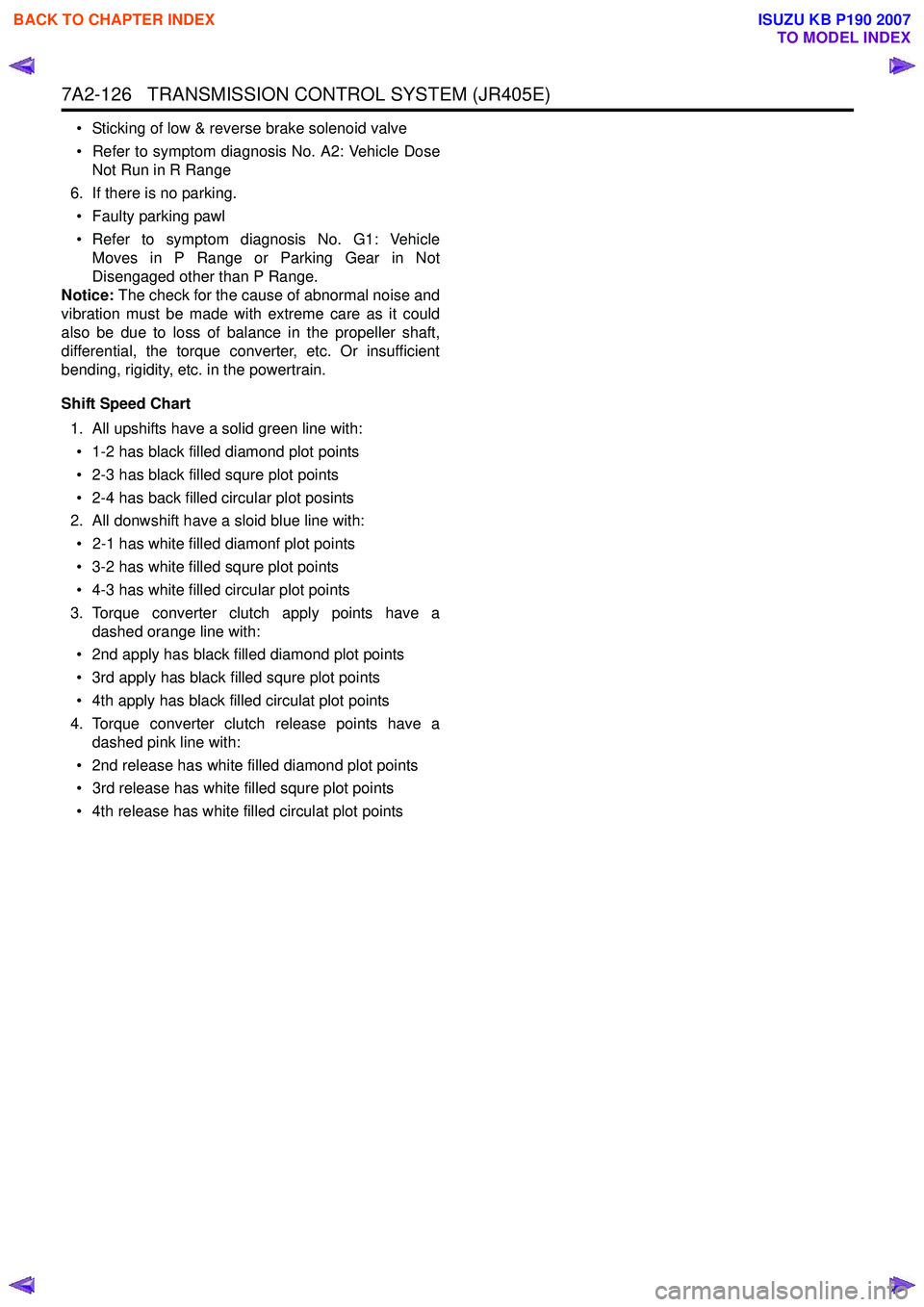
Shift Speed Chart 1. All upshifts have a solid green line with:• 1-2 has black filled diamond plot points
• 2-3 has black filled squre plot points
• 2-4 has back filled circular plot posints
2. All donwshift have a sloid blue line with:
• 2-1 has white filled diamonf plot points
• 3-2 has white filled squre plot points
• 4-3 has white filled circular plot points
3. Torque converter clutch apply points have a dashed orange line with:
• 2nd apply has black filled diamond plot points
• 3rd apply has black filled squre plot points
• 4th apply has black filled circulat plot points
4. Torque converter clutch release points have a dashed pink line with:
• 2nd release has white filled diamond plot points
• 3rd release has white filled squre plot points
• 4th release has white filled circulat plot points
BACK TO CHAPTER INDEX
TO MODEL INDEX
ISUZU KB P190 2007
Page 4422 of 6020
7A2-138 TRANSMISSION CONTROL SYSTEM (JR405E)
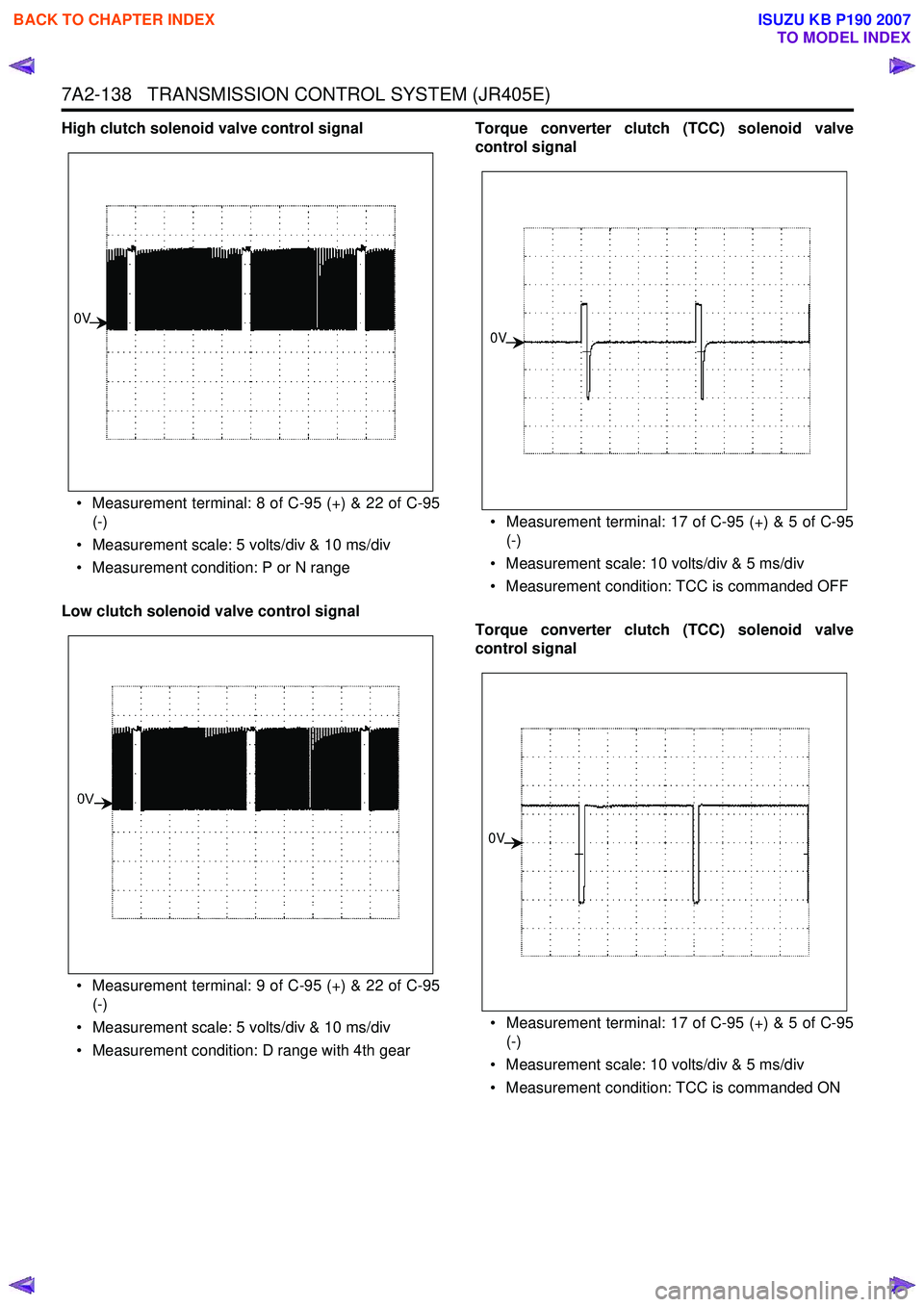
High clutch solenoid valve control signal• Measurement terminal: 8 of C-95 (+) & 22 of C-95 (-)
• Measurement scale: 5 volts/div & 10 ms/div
• Measurement condition: P or N range
Low clutch solenoid valve control signal
• Measurement terminal: 9 of C-95 (+) & 22 of C-95 (-)
• Measurement scale: 5 volts/div & 10 ms/div
• Measurement condition: D range with 4th gear Torque converter clutch (TCC) solenoid valve
control signal
• Measurement terminal: 17 of C-95 (+) & 5 of C-95 (-)
• Measurement scale: 10 volts/div & 5 ms/div
• Measurement condition: TCC is commanded OFF
Torque converter clutch (TCC) solenoid valve
control signal
• Measurement terminal: 17 of C-95 (+) & 5 of C-95 (-)
• Measurement scale: 10 volts/div & 5 ms/div
• Measurement condition: TCC is commanded ON
0V
0V
0V
BACK TO CHAPTER INDEX
TO MODEL INDEX
ISUZU KB P190 2007
Page 4427 of 6020
TRANSMISSION CONTROL SYSTEM (JR405E) 7A2-143
Description and Operation
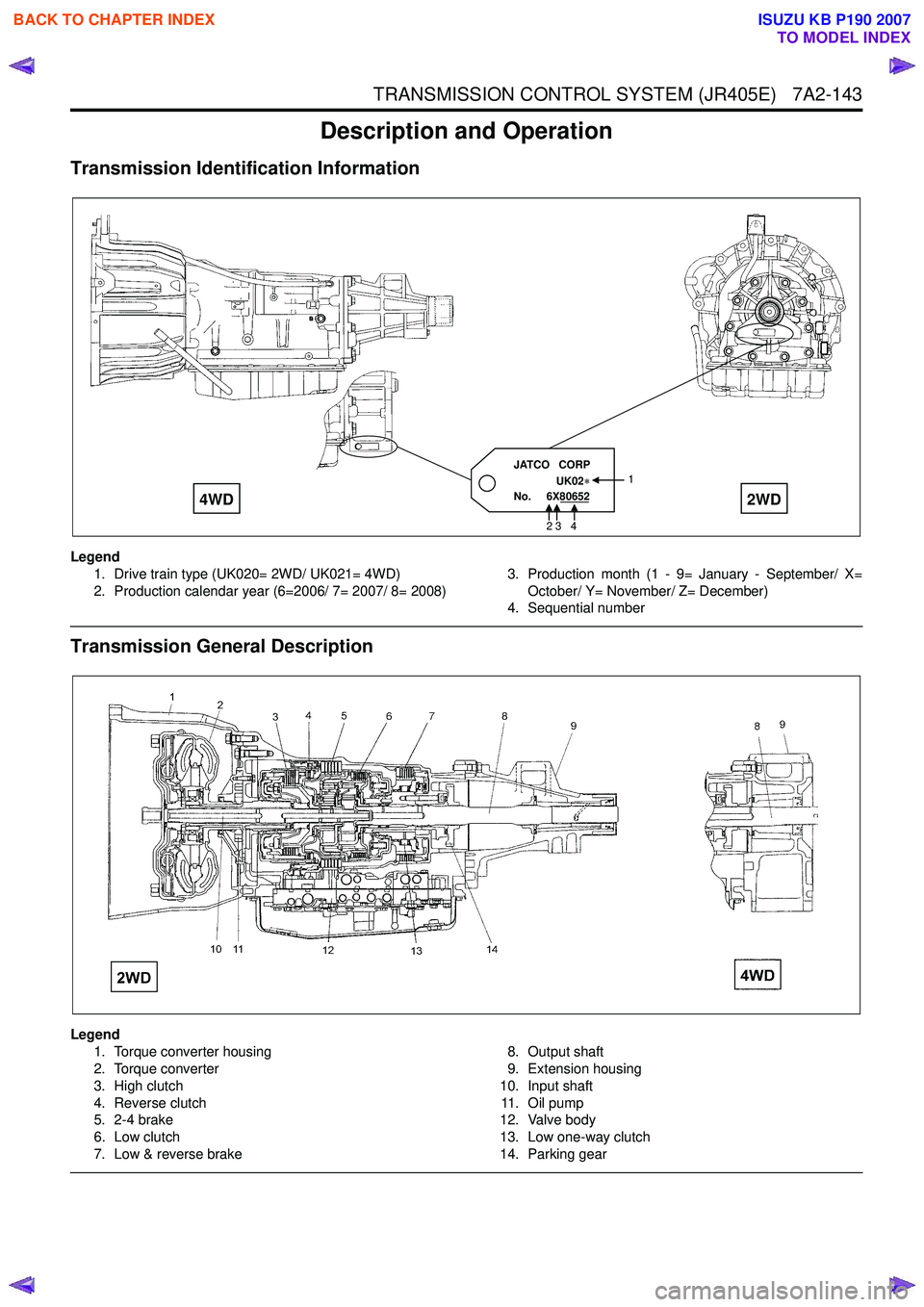
Transmission Identification Information
Legend1. Drive train type (UK020= 2WD/ UK021= 4WD)
2. Production calendar year (6=2006/ 7= 2007/ 8= 2008) 3. Production month (1 - 9= January - September/ X=
October/ Y= November/ Z= December)
4. Sequential number
Transmission General Description
Legend
1. Torque converter housing
2. Torque converter
3. High clutch
4. Reverse clutch
5. 2-4 brake
6. Low clutch
7. Low & reverse brake 8. Output shaft
9. Extension housing
10. Input shaft 11 . O i l p u m p
12. Valve body
13. Low one-way clutch
14. Parking gear
JATCO CORP
UK02
No. 6X80652 1
2 3 4
4WD
2WD
BACK TO CHAPTER INDEX
TO MODEL INDEX
ISUZU KB P190 2007
Page 4428 of 6020

7A2-144 TRANSMISSION CONTROL SYSTEM (JR405E)
The JR405E automatic transmission is electrically
controlled by a transmission control module (TCM).
There are four forward speeds and one reverse speed.
This JR405E automatic transmission employs a clutch
pressure direct control system (Direct Electronic Shift
Control: DESC) using duty cycle type solenoid valves,
which ensure high shift quality. This transmission also
has a learning function and constantly checks the time
of each clutch and brake required for the shift in order
to match this time with the target value for the optimum
shift. The TCM will automatically select the most
appropriate shift points and lock-up points depending
on the accelerator pedal opening, the vehicle speed
and the vehicle load. If any trouble arises in the speed
sensor, solenoid valve, etc., the fail-safe control
function is activated to keep the running performance.
The JR405E automatic transmission consists of the
torque converter, oil pump, input shaft, out put shaft,
planetary gears and valve body. The gear train consists
of two planetary gear sets and three multiple plate
clutches in combination with two multiple plate brakes
and a one-way clutch.
Transmission Component Description
Torque Converter
Legend
1. Pump impeller
2. Turbine runner
3. Stator
4. Converter front cover
5. One-way clutch
6. Torque converter clutch (TCC) piston
7. Torsion damper
The torque converter is a device for transmitting the
engine torque to the transmission. It transmits power by
means of oil when the lock up clutch is disengaged,
and by means of a lock up clutch when it is engaged. The torque converter is of the symmetrical, three-
element, single-stage, two-phase type. As shown in the
picture, the symmetrical three-elements refer to three
elements (components) consisting of impeller (1),
turbine (2) and stator (3) that are arranged
symmetrically. Single-stage means that there is only
one turbine as an output element; two-phase means
that the pump impeller acts as a torque converter when
the turbine speed is comparatively low, and as a fluid
coupling when the speed is high. Lock up refers to a
fixed state of the lock up clutch (=torque converter
clutch (TCC) inside the torque converter and thus
connects the engine directly to the transmission.
Oil Pump
Legend 1. Torque converter
2. Oil pump
BACK TO CHAPTER INDEX
TO MODEL INDEX
ISUZU KB P190 2007
Page 4429 of 6020
TRANSMISSION CONTROL SYSTEM (JR405E) 7A2-145
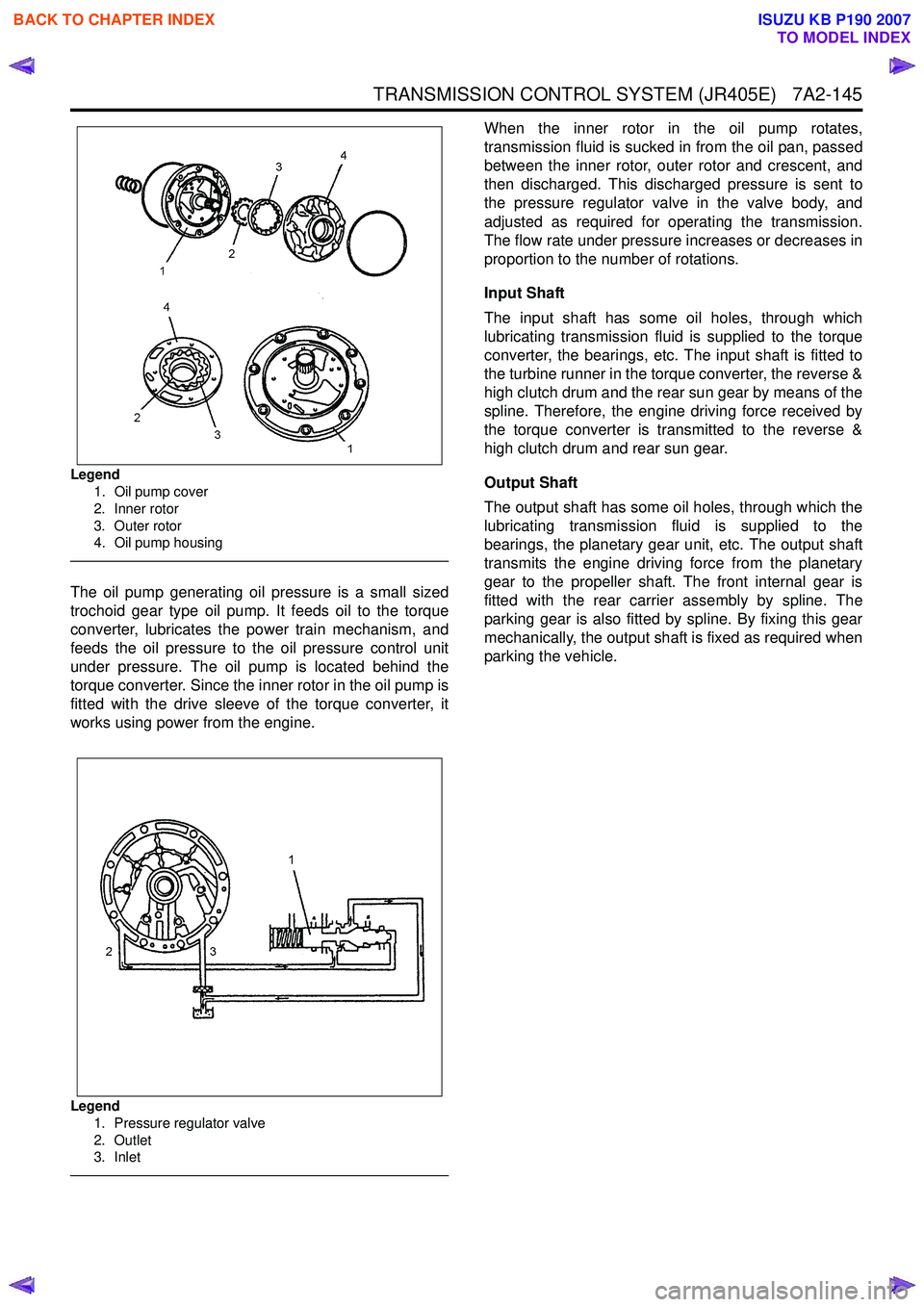
Legend1. Oil pump cover
2. Inner rotor
3. Outer rotor
4. Oil pump housing
The oil pump generating oil pressure is a small sized
trochoid gear type oil pump. It feeds oil to the torque
converter, lubricates the power train mechanism, and
feeds the oil pressure to the oil pressure control unit
under pressure. The oil pump is located behind the
torque converter. Since the inner rotor in the oil pump is
fitted with the drive sleeve of the torque converter, it
works using power from the engine.
Legend
1. Pressure regulator valve
2. Outlet
3. Inlet
When the inner rotor in the oil pump rotates,
transmission fluid is sucked in from the oil pan, passed
between the inner rotor, outer rotor and crescent, and
then discharged. This discharged pressure is sent to
the pressure regulator valve in the valve body, and
adjusted as required for operating the transmission.
The flow rate under pressure increases or decreases in
proportion to the number of rotations.
Input Shaft
The input shaft has some oil holes, through which
lubricating transmission fluid is supplied to the torque
converter, the bearings, etc. The input shaft is fitted to
the turbine runner in the torque converter, the reverse &
high clutch drum and the rear sun gear by means of the
spline. Therefore, the engine driving force received by
the torque converter is transmitted to the reverse &
high clutch drum and rear sun gear.
Output Shaft
The output shaft has some oil holes, through which the
lubricating transmission fluid is supplied to the
bearings, the planetary gear unit, etc. The output shaft
transmits the engine driving force from the planetary
gear to the propeller shaft. The front internal gear is
fitted with the rear carrier assembly by spline. The
parking gear is also fitted by spline. By fixing this gear
mechanically, the output shaft is fixed as required when
parking the vehicle.
BACK TO CHAPTER INDEX
TO MODEL INDEX
ISUZU KB P190 2007
Page 4432 of 6020
7A2-148 TRANSMISSION CONTROL SYSTEM (JR405E)
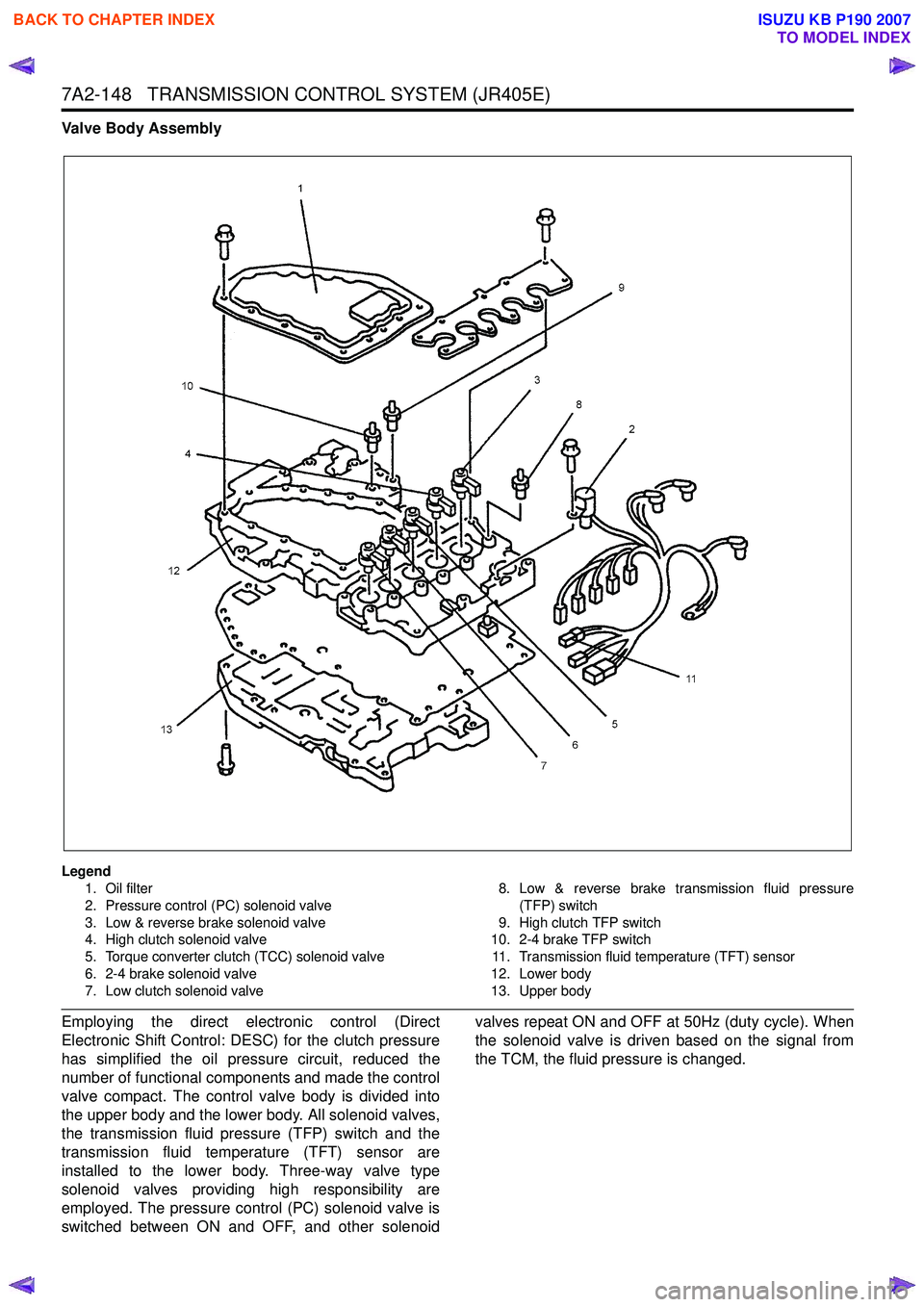
Valve Body Assembly
Legend1. Oil filter
2. Pressure control (PC) solenoid valve
3. Low & reverse brake solenoid valve
4. High clutch solenoid valve
5. Torque converter clutch (TCC) solenoid valve
6. 2-4 brake solenoid valve
7. Low clutch solenoid valve 8. Low & reverse brake transmission fluid pressure
(TFP) switch
9. High clutch TFP switch
10. 2-4 brake TFP switch
11. Transmission fluid temperature (TFT) sensor
12. Lower body
13. Upper body
Employing the direct electronic control (Direct
Electronic Shift Control: DESC) for the clutch pressure
has simplified the oil pressure circuit, reduced the
number of functional components and made the control
valve compact. The control valve body is divided into
the upper body and the lower body. All solenoid valves,
the transmission fluid pressure (TFP) switch and the
transmission fluid temperature (TFT) sensor are
installed to the lower body. Three-way valve type
solenoid valves providing high responsibility are
employed. The pressure control (PC) solenoid valve is
switched between ON and OFF, and other solenoid valves repeat ON and OFF at 50Hz (duty cycle). When
the solenoid valve is driven based on the signal from
the TCM, the fluid pressure is changed.
BACK TO CHAPTER INDEX
TO MODEL INDEX
ISUZU KB P190 2007