engine ISUZU TROOPER 1998 Service Repair Manual
[x] Cancel search | Manufacturer: ISUZU, Model Year: 1998, Model line: TROOPER, Model: ISUZU TROOPER 1998Pages: 3573, PDF Size: 60.36 MB
Page 1537 of 3573
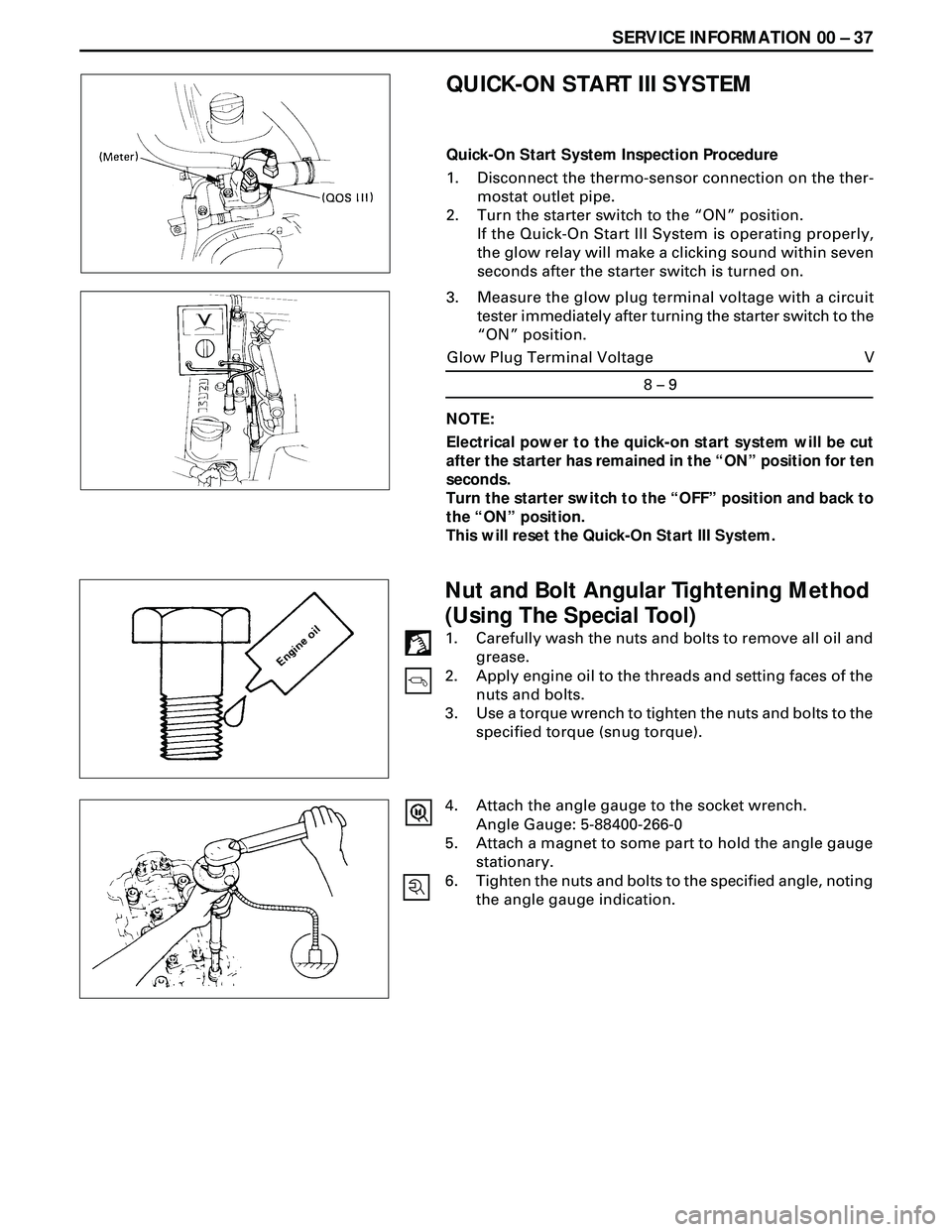
SERVICE INFORMATION 00 Ð 37
3. Measure the glow plug terminal voltage with a circuit
tester immediately after turning the starter switch to the
ÒONÓ position.
8 – 9
V Glow Plug Terminal Voltage
QUICK-ON START III SYSTEM
Quick-On Start System Inspection Procedure
1. Disconnect the thermo-sensor connection on the ther-
mostat outlet pipe.
2. Turn the starter switch to the ÒONÓ position.
If the Quick-On Start III System is operating properly,
the glow relay will make a clicking sound within seven
seconds after the starter switch is turned on.
NOTE:
Electrical power to the quick-on start system will be cut
after the starter has remained in the ÒONÓ position for ten
seconds.
Turn the starter switch to the ÒOFFÓ position and back to
the ÒONÓ position.
This will reset the Quick-On Start III System.
Nut and Bolt Angular Tightening Method
(Using The Special Tool)
1. Carefully wash the nuts and bolts to remove all oil and
grease.
2. Apply engine oil to the threads and setting faces of the
nuts and bolts.
3. Use a torque wrench to tighten the nuts and bolts to the
specified torque (snug torque).
4. Attach the angle gauge to the socket wrench.
Angle Gauge: 5-88400-266-0
5. Attach a magnet to some part to hold the angle gauge
stationary.
6. Tighten the nuts and bolts to the specified angle, noting
the angle gauge indication.
Page 1543 of 3573
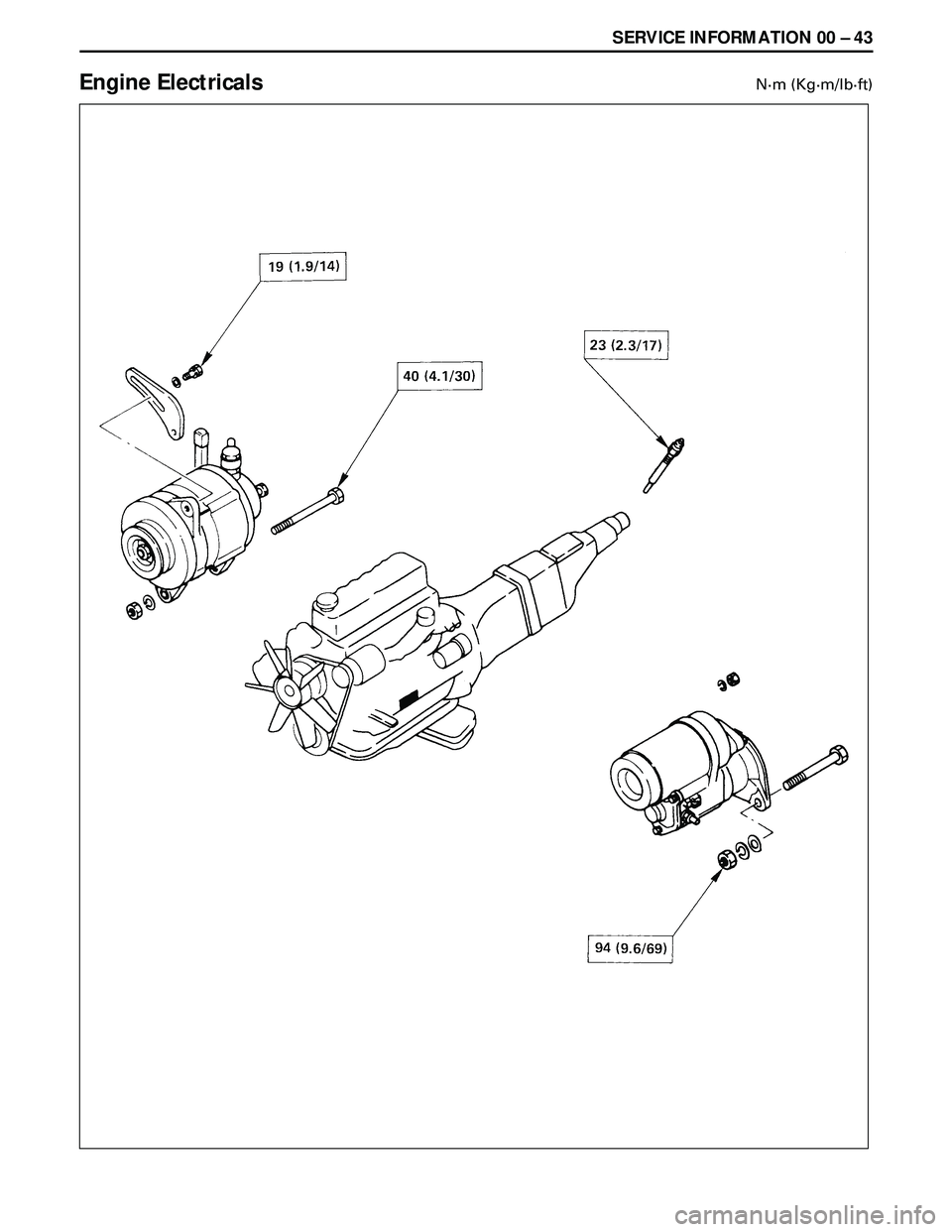
SERVICE INFORMATION 00 Ð 43
Engine ElectricalsNám (Kgám/lbáft)
Page 1544 of 3573
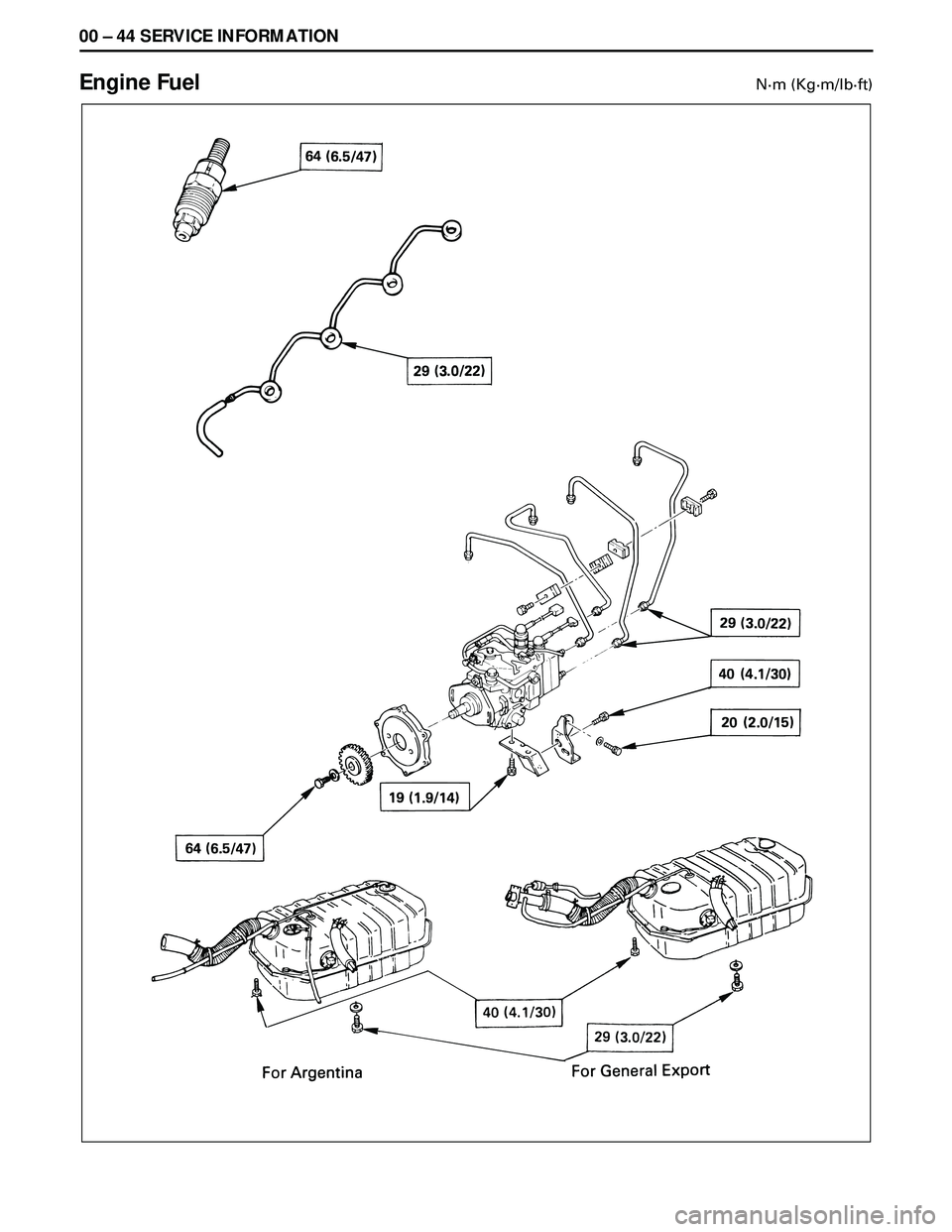
00 Ð 44 SERVICE INFORMATION
Engine FuelNám (Kgám/lbáft)
Page 1545 of 3573
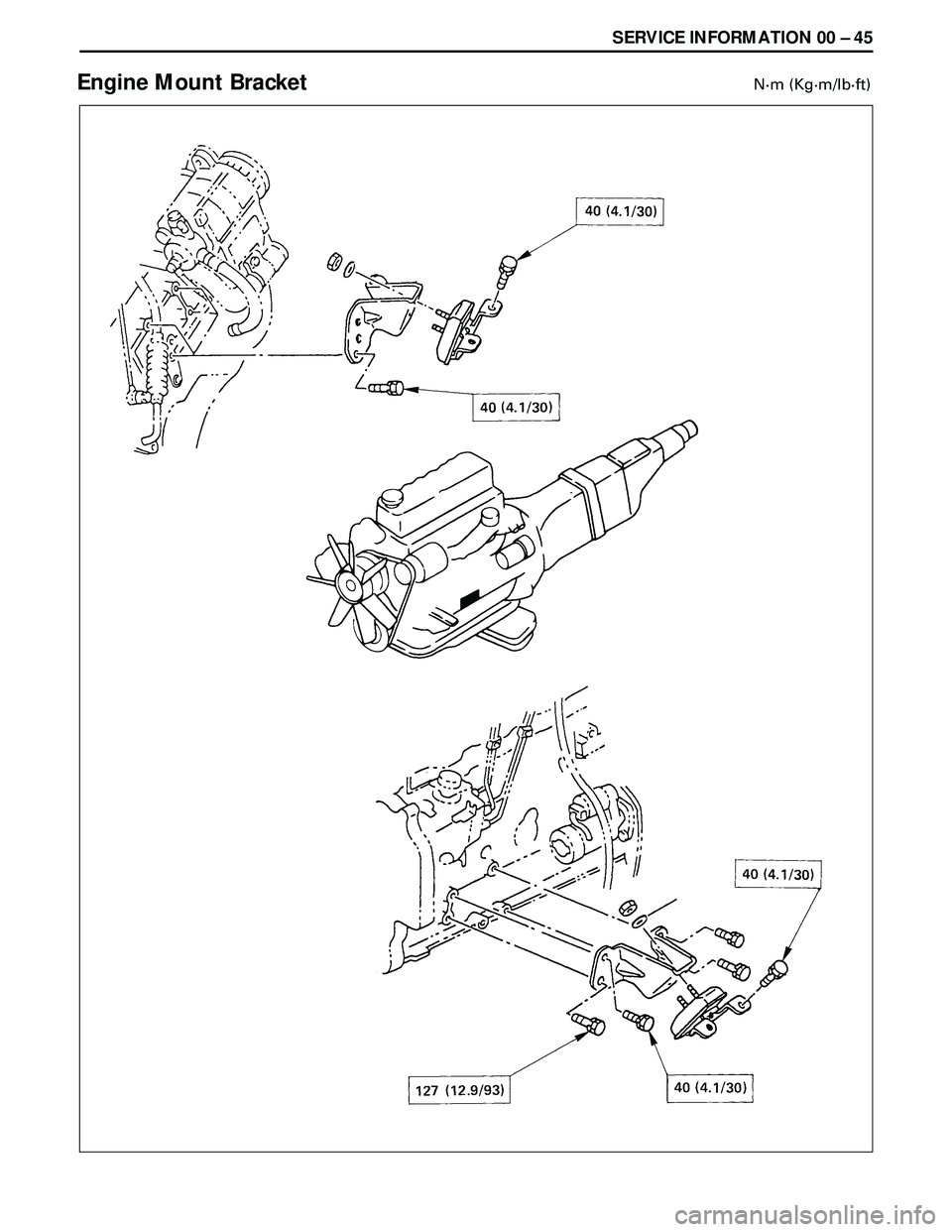
SERVICE INFORMATION 00 Ð 45
Engine Mount BracketNám (Kgám/lbáft)
Page 1548 of 3573
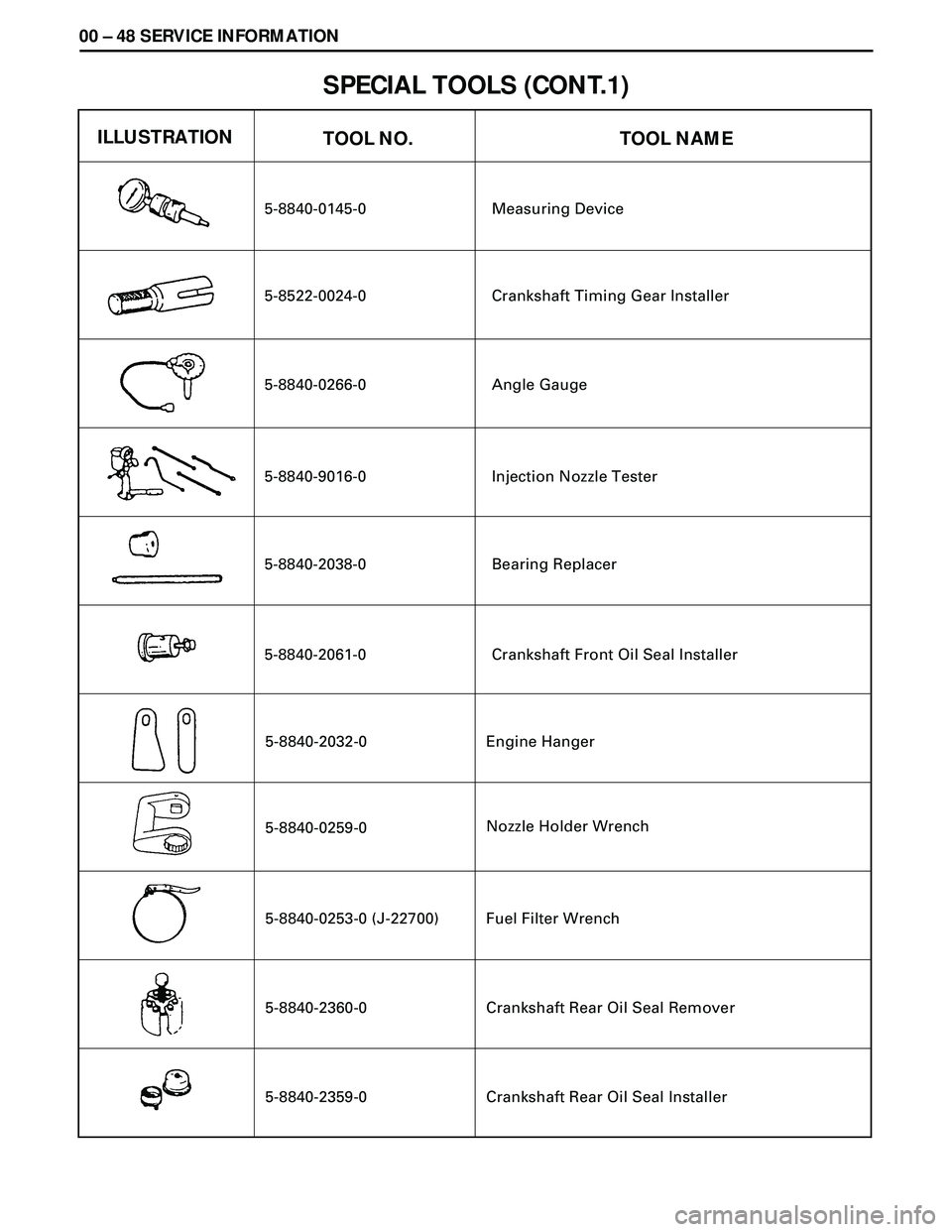
00 Ð 48 SERVICE INFORMATION
SPECIAL TOOLS (CONT.1)
5-8840-0145-0
5-8522-0024-0
5-8840-0266-0
5-8840-9016-0
5-8840-2038-0
5-8840-2061-0
ILLUSTRATION
TOOL NAME TOOL NO.
Measuring Device
Crankshaft Timing Gear Installer
Angle Gauge
Injection Nozzle Tester
Bearing Replacer
Crankshaft Front Oil Seal Installer
5-8840-2032-0
5-8840-0259-0
5-8840-0253-0 (J-22700)Engine Hanger
Nozzle Holder Wrench
Fuel Filter Wrench
5-8840-2360-0 Crankshaft Rear Oil Seal Remover
5-8840-2359-0 Crankshaft Rear Oil Seal Installer
Page 1551 of 3573
ENGINE MECHANICAL 6A Ð 1
SECTION 6A
ENGINE MECHANICAL
CONTENTS
PAGE
Cylinder Head ..................................................................................................................6A- 2
Valve Springs, Valve Stem Oil Seal, Valve, Valve Guide, Push rod ........................... 6A- 7
Camshaft, Tappet ............................................................................................................ 6A-14
Rocker Arm Assembly .................................................................................................... 6A-19
Oil pump .......................................................................................................................... 6A-21
Crankshaft ........................................................................................................................ 6A-25
Piston and Connecting Rod ............................................................................................ 6A-34
Cylinder Block .................................................................................................................. 6A-42
Page 1552 of 3573
6A Ð 2 ENGINE MECHANICAL
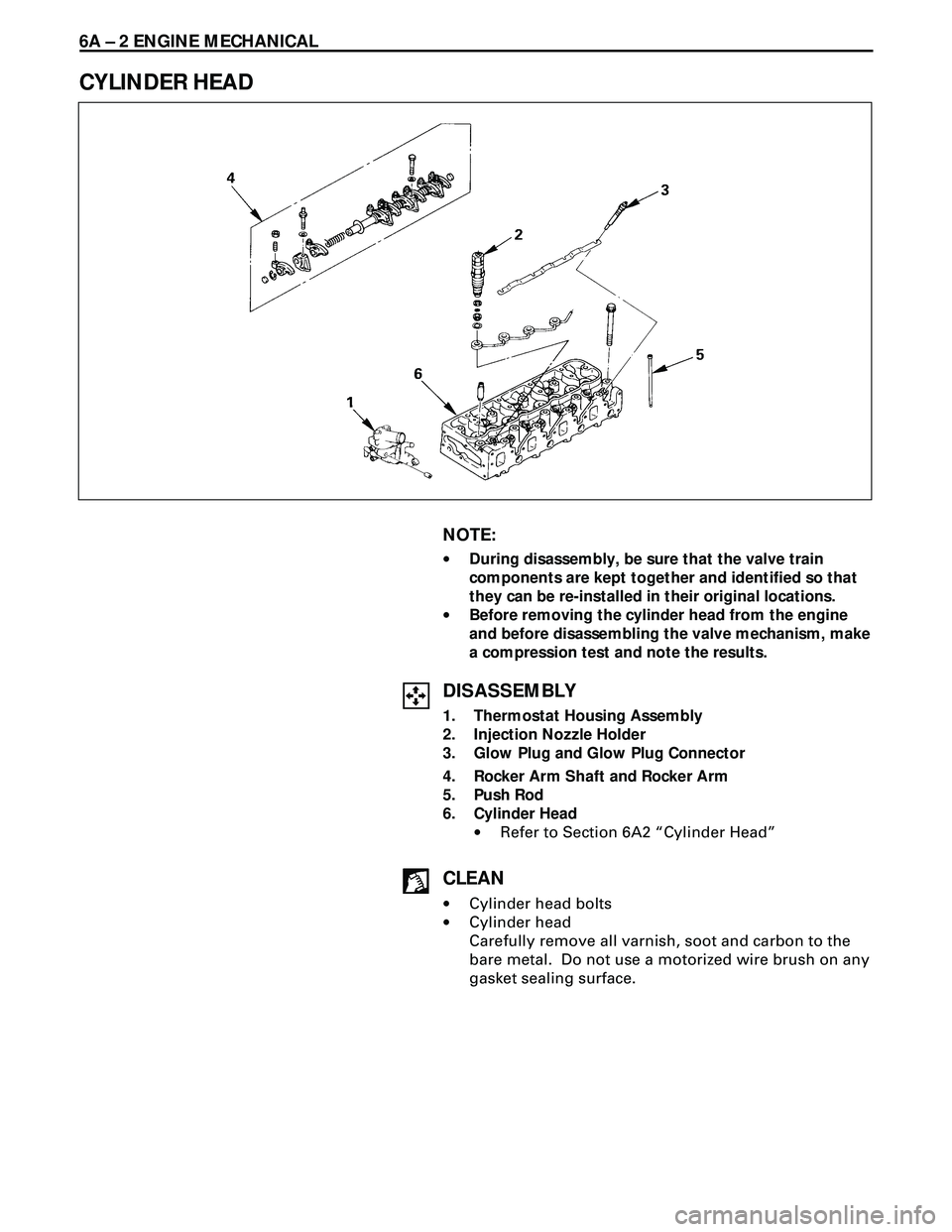
CYLINDER HEAD
NOTE:
·During disassembly, be sure that the valve train
components are kept together and identified so that
they can be re-installed in their original locations.
·Before removing the cylinder head from the engine
and before disassembling the valve mechanism, make
a compression test and note the results.
DISASSEMBLY
1. Thermostat Housing Assembly
2. Injection Nozzle Holder
3. Glow Plug and Glow Plug Connector
4. Rocker Arm Shaft and Rocker Arm
5. Push Rod
6. Cylinder Head
·Refer to Section 6A2 ÒCylinder HeadÓ
CLEAN
·Cylinder head bolts
·Cylinder head
Carefully remove all varnish, soot and carbon to the
bare metal. Do not use a motorized wire brush on any
gasket sealing surface.
Page 1553 of 3573
ENGINE MECHANICAL 6A Ð 3
INSPECTION AND REPAIR
Make the necessary adjustments, repairs, and part re-
placements if excessive wear or damage is discovered
during inspection.
·Cylinder head gasket and mating surfaces for leaks,
corrosion and blow-by. If the gasket has failed,
determine the cause;
Ð Improper installation
Loose or warped cylinder head
Ð Insufficient torque on head bolts
Ð Warped case surface
1. Cylinder head bolts for damaged threads or stretch-
ing and damaged heads caused by improper use of
tools.
CAUTION:
Suspected bolts must be replaced.
2. Cylinder head for cracks, especially between valve
seats and in the exhaust ports.
3. Cylinder head deck for corrosion, sand particles in
head and porosity.
CAUTION:
Do not attempt to weld the cylinder head. Replace it.
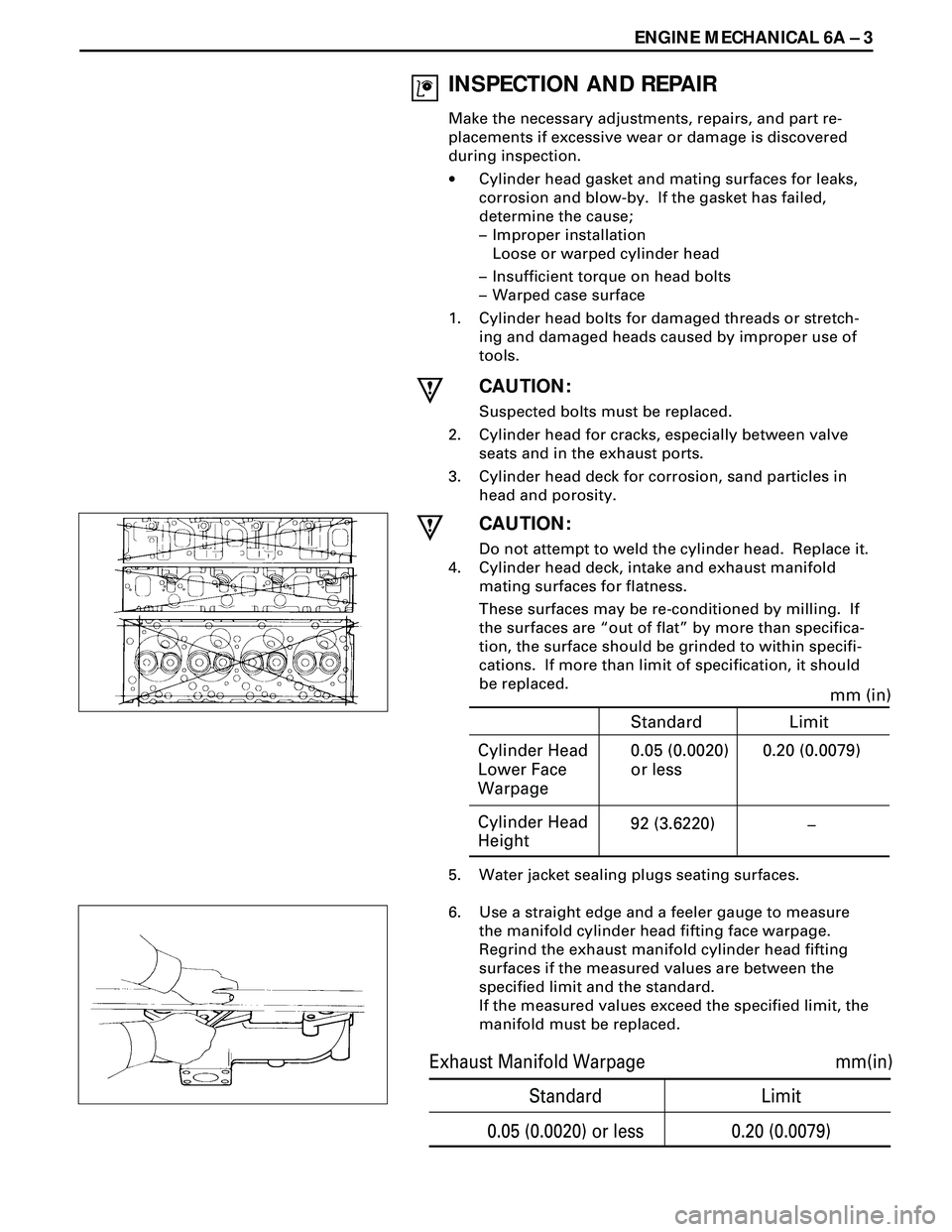
4. Cylinder head deck, intake and exhaust manifold
mating surfaces for flatness.
These surfaces may be re-conditioned by milling. If
the surfaces are Òout of flatÓ by more than specifica-
tion, the surface should be grinded to within specifi-
cations. If more than limit of specification, it should
be replaced.
5. Water jacket sealing plugs seating surfaces.
6. Use a straight edge and a feeler gauge to measure
the manifold cylinder head fifting face warpage.
Regrind the exhaust manifold cylinder head fifting
surfaces if the measured values are between the
specified limit and the standard.
If the measured values exceed the specified limit, the
manifold must be replaced.
Cylinder Head
Lower Face
Warpagemm (in)
0.05 (0.0020)
or less0.20 (0.0079)
Cylinder Head
Height92 (3.6220)
–
Standard Limit
Standard Limit
mm(in)
0.05 (0.0020) or less 0.20 (0.0079) Exhaust Manifold Warpage
Page 1554 of 3573
6A Ð 4 ENGINE MECHANICAL
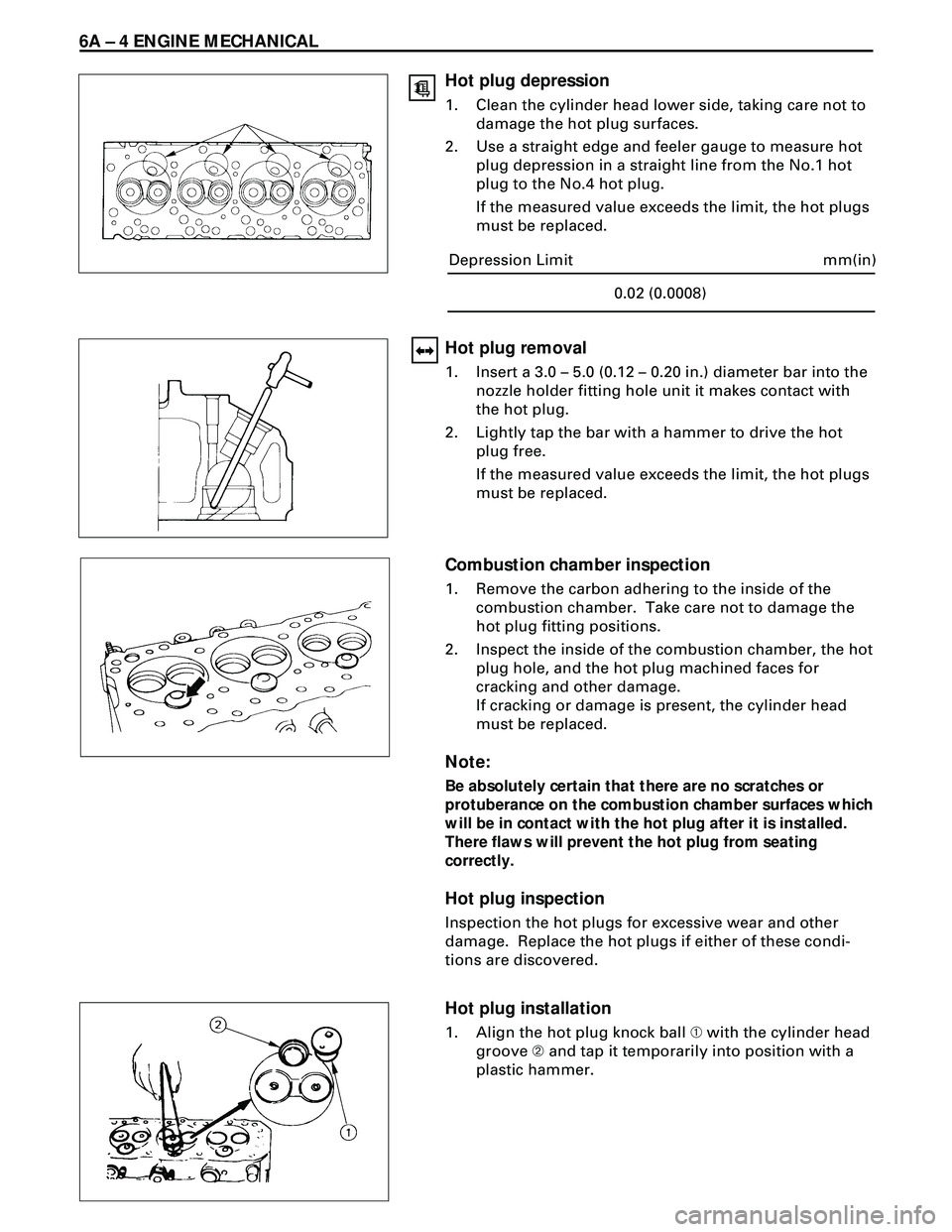
Hot plug depression
1. Clean the cylinder head lower side, taking care not to
damage the hot plug surfaces.
2. Use a straight edge and feeler gauge to measure hot
plug depression in a straight line from the No.1 hot
plug to the No.4 hot plug.
If the measured value exceeds the limit, the hot plugs
must be replaced.
Hot plug removal
1. Insert a 3.0 Ð 5.0 (0.12 Ð 0.20 in.) diameter bar into the
nozzle holder fitting hole unit it makes contact with
the hot plug.
2. Lightly tap the bar with a hammer to drive the hot
plug free.
If the measured value exceeds the limit, the hot plugs
must be replaced.
mm(in)
0.02 (0.0008) Depression Limit
Combustion chamber inspection
1. Remove the carbon adhering to the inside of the
combustion chamber. Take care not to damage the
hot plug fitting positions.
2. Inspect the inside of the combustion chamber, the hot
plug hole, and the hot plug machined faces for
cracking and other damage.
If cracking or damage is present, the cylinder head
must be replaced.
Note:
Be absolutely certain that there are no scratches or
protuberance on the combustion chamber surfaces which
will be in contact with the hot plug after it is installed.
There flaws will prevent the hot plug from seating
correctly.
Hot plug inspection
Inspection the hot plugs for excessive wear and other
damage. Replace the hot plugs if either of these condi-
tions are discovered.
Hot plug installation
1. Align the hot plug knock ball À with the cylinder head
groove Á and tap it temporarily into position with a
plastic hammer.
Page 1555 of 3573
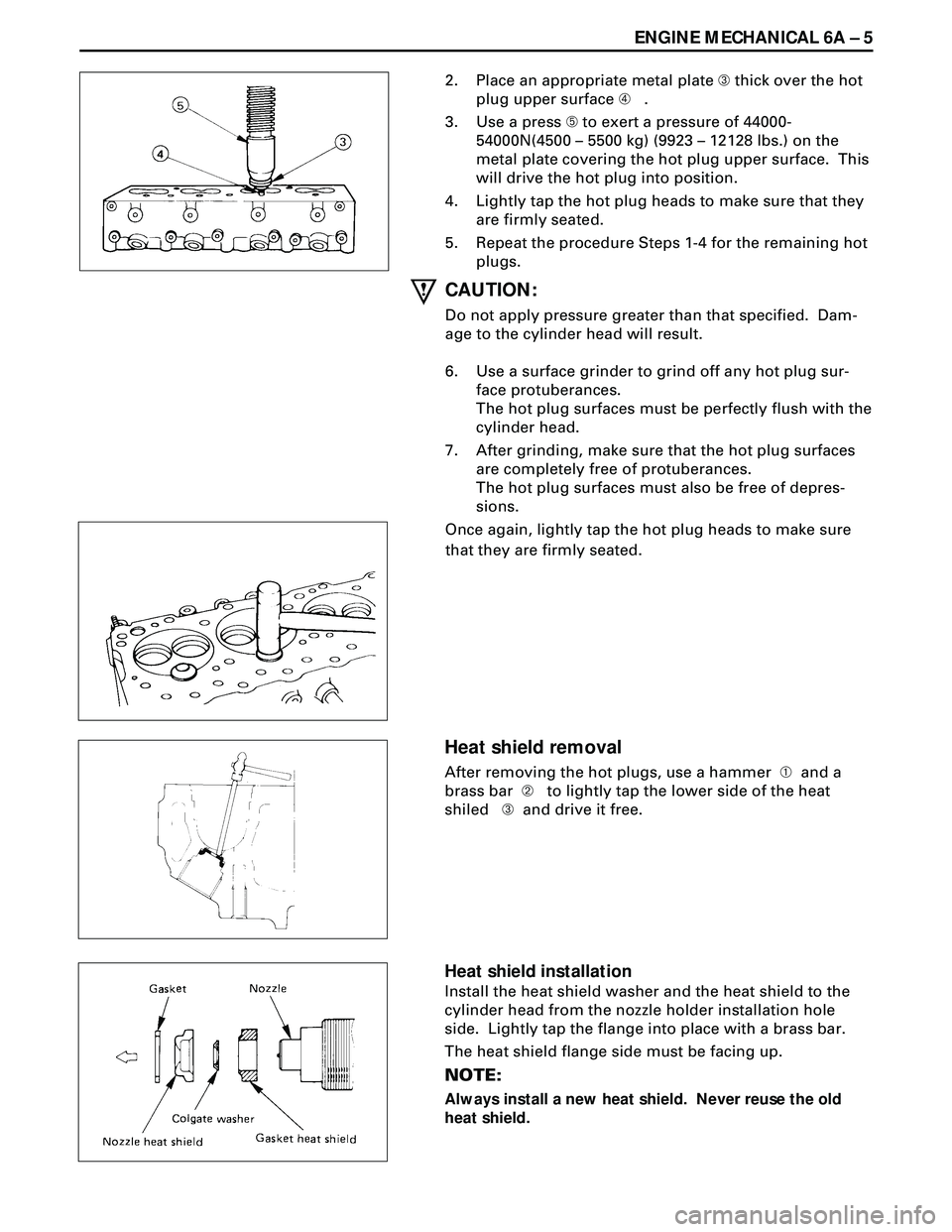
ENGINE MECHANICAL 6A Ð 5
2. Place an appropriate metal plate  thick over the hot
plug upper surface à .
3. Use a press Ä to exert a pressure of 44000-
54000N(4500 Ð 5500 kg) (9923 Ð 12128 lbs.) on the
metal plate covering the hot plug upper surface. This
will drive the hot plug into position.
4. Lightly tap the hot plug heads to make sure that they
are firmly seated.
5. Repeat the procedure Steps 1-4 for the remaining hot
plugs.
CAUTION:
Do not apply pressure greater than that specified. Dam-
age to the cylinder head will result.
6. Use a surface grinder to grind off any hot plug sur-
face protuberances.
The hot plug surfaces must be perfectly flush with the
cylinder head.
7. After grinding, make sure that the hot plug surfaces
are completely free of protuberances.
The hot plug surfaces must also be free of depres-
sions.
Once again, lightly tap the hot plug heads to make sure
that they are firmly seated.
Heat shield removal
After removing the hot plugs, use a hammer À and a
brass bar Á to lightly tap the lower side of the heat
shiled  and drive it free.
Heat shield installation
Install the heat shield washer and the heat shield to the
cylinder head from the nozzle holder installation hole
side. Lightly tap the flange into place with a brass bar.
The heat shield flange side must be facing up.
NOTE:
Always install a new heat shield. Never reuse the old
heat shield.