front bearing JAGUAR X308 1998 2.G User Guide
[x] Cancel search | Manufacturer: JAGUAR, Model Year: 1998, Model line: X308, Model: JAGUAR X308 1998 2.GPages: 2490, PDF Size: 69.81 MB
Page 313 of 2490
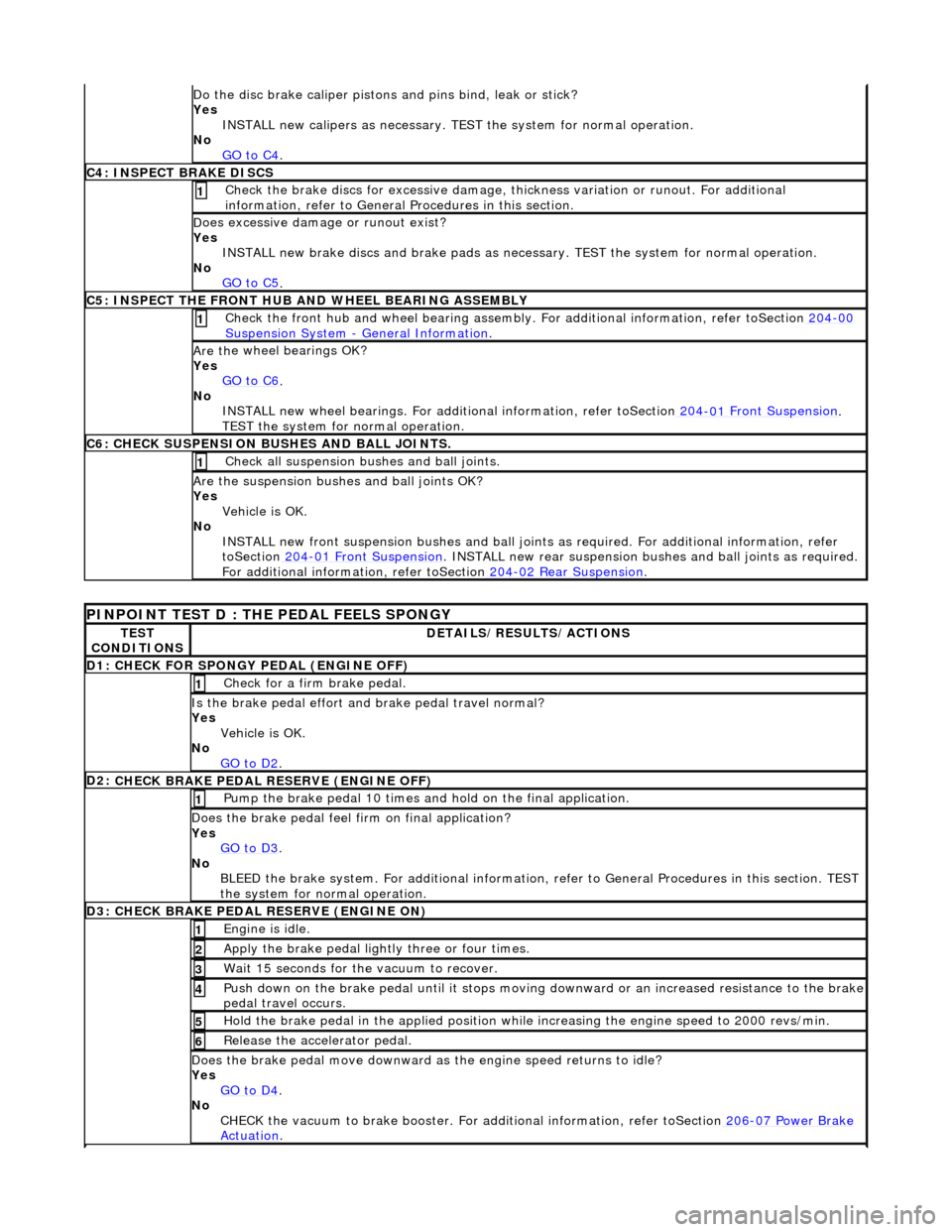
Do t
he disc brake caliper pistons
and pins bind, leak or stick?
Yes INSTALL new calipers as necessary. TE ST the system for normal operation.
No GO to C4
.
C4: INSPECT BR
AKE DISCS
Check the brake discs fo
r excess
ive damage, thickness variatio n or runout. For additional
information, refer to General Procedures in this section.
1
D
oes excessive damage or runout exist?
Yes INSTALL new brake discs and brak e pads as necessary. TEST the system for normal operation.
No GO to C5
.
C5: INSPECT THE FRONT HU
B AND WHEEL BEARING ASSEMBLY
Check the fr
ont hub and wheel bearing assembly.
For additional information, refer toSection 204
-00
Su
spension System
- General
Information
. 1
Are th
e wheel bearings OK?
Yes GO to C6
.
No
INSTALL new wheel bearings. For additional inform ation, refer toSection 204
-01
Front Suspension
.
TEST the system
for normal operation.
C
6: CHECK SUSPENSION BUSHES AND BALL JOINTS.
Chec
k all suspension bu
shes and ball joints.
1
Are th
e suspension bushes and ball joints OK?
Yes Vehicle is OK.
No INSTALL new front suspension bushes and ball joints as required. For additional information, refer
toSection 204
-01
Front Suspension
. INSTALL n
ew rear suspension bush
es and ball joints as required.
For additional informat ion, refer toSection 204
-0
2 Rear Suspension
.
P
INPOINT TEST D : THE PEDAL FEELS SPONGY
TE
ST
CONDITIONS
D
ETAILS/RESULTS/ACTIONS
D
1: CHECK FOR SPONGY PEDAL (ENGINE OFF)
Check f
or a firm brake pedal.
1
Is th
e brake pedal effort an
d brake pedal travel normal?
Yes Vehicle is OK.
No GO to D2
.
D2:
CHECK BRAKE PEDAL RESERVE (ENGINE OFF)
Pump th
e brake pedal 10 times and
hold on the final application.
1
Does th
e brake pedal feel fi
rm on final application?
Yes GO to D3
.
No
BLEED the brake system. For additional information, re fer to General Procedures in this section. TEST
the system for normal operation.
D3:
CHECK BRAKE PEDAL RESERVE (ENGINE ON)
Engine is
idle.
1
Apply the brake pedal ligh
tl
y three or four times.
2
W
ait 15 seconds for the vacuum to recover.
3
Push down on
the brake pedal until it stops moving
downward or an increased resistance to the brake
pedal travel occurs.
4
Hol
d the brake pedal in the applied position while increasing the engine speed to 2000 revs/min.
5
Re
lease the accelerator pedal.
6
Does th
e brake pedal move downward as
the engine speed returns to idle?
Yes GO to D4
.
No
CHECK the vacuum to brake booster. For additional information, refer toSection 206
-0
7 Power Brake
Actuation.
Page 317 of 2490
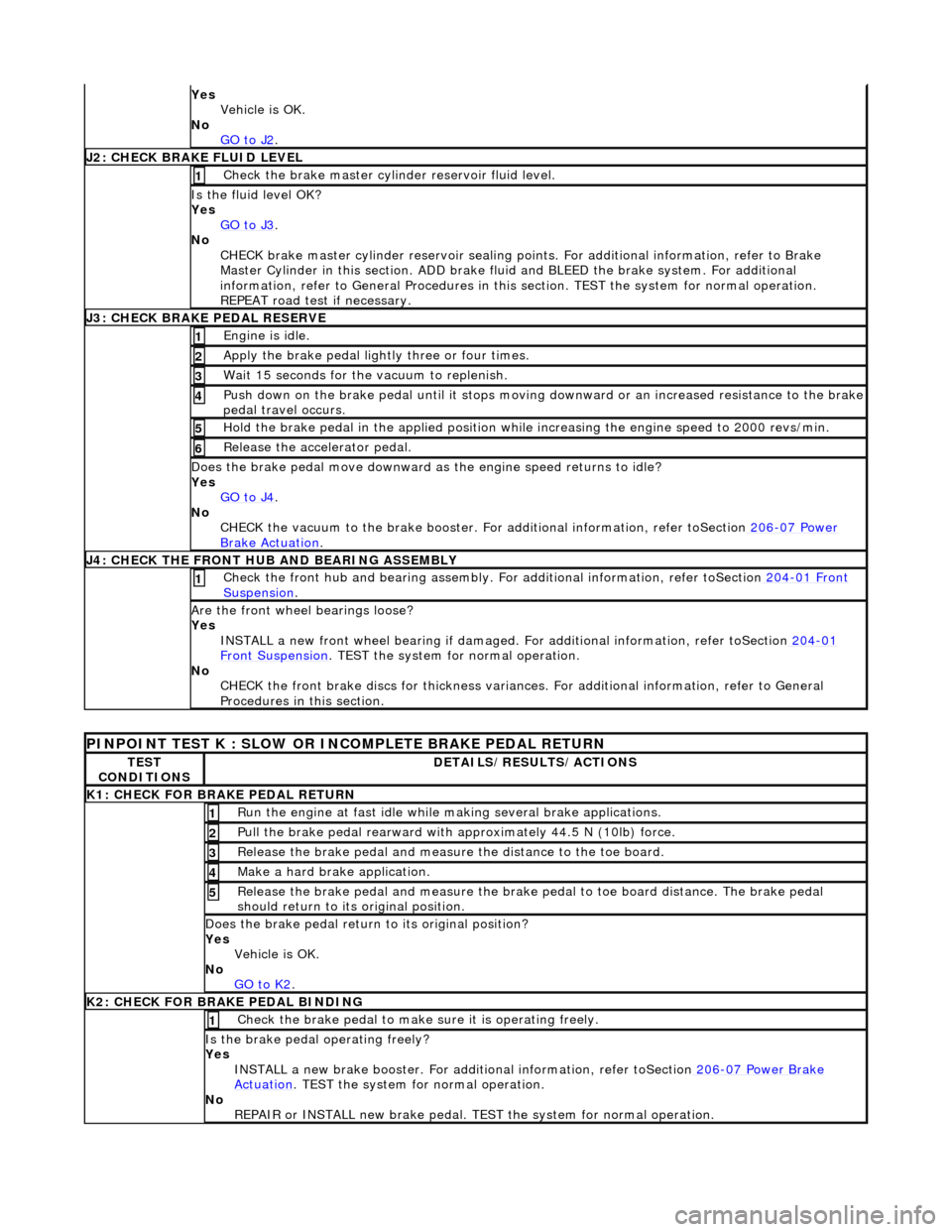
Yes
Vehicle is OK.
No GO to J2
.
J
2: CHECK BRAKE FLUID LEVEL
Check the brake master cyli
nder reservoir fluid level.
1
Is the fl
uid level OK?
Yes GO to J3
.
No
CHECK brake master cylinder reservoir sealing points. For additional information, refer to Brake
Master Cylinder in this section. ADD brake fl uid and BLEED the brake system. For additional
information, refer to General Proc edures in this section. TEST the system for normal operation.
REPEAT road test if necessary.
J
3: CHECK BRAKE PEDAL RESERVE
Engine is
idle.
1
Apply the brake pedal ligh
tl
y three or four times.
2
W
ait 15 seconds for the vacuum to replenish.
3
Push down on
the brake pedal until it stops moving
downward or an increased resistance to the brake
pedal travel occurs.
4
Hol
d the brake pedal in the applied position while increasing the engine speed to 2000 revs/min.
5
Re
lease the accelerator pedal.
6
Does th
e brake pedal move downward as
the engine speed returns to idle?
Yes GO to J4
.
No
CHECK the vacuum to the brake booster. Fo r additional information, refer toSection 206
-0
7 Power
Brake Ac
tuation
.
J
4: CHECK THE FRONT HUB AND BEARING ASSEMBLY
Check the fr
ont hub and bearing assembly. Fo
r additional information, refer toSection 204
-01
Front
Suspe
nsion
. 1
Are th
e front wheel bearings loose?
Yes INSTALL a new front wheel bearin g if damaged. For additional information, refer toSection 204
-01
F
ront Suspension
. TEST
the system for normal operation.
No CHECK the front brake discs for thickness variances. For additional information, refer to General
Procedures in this section.
PINPO
INT TEST K : SLOW OR INCOMPLETE BRAKE PEDAL RETURN
TE
ST
CONDITIONS
D
ETAILS/RESULTS/ACTIONS
K1: C
HECK FOR BRAKE PEDAL RETURN
Ru
n the engine at fast idle while
making several brake applications.
1
Pull the
brake pedal rearward with approximately 44.5 N (10lb) force.
2
Relea
se the brake pedal and measure
the distance to the toe board.
3
Make a hard brake
application.
4
Relea
se the brake pedal and measure the brake
pedal to toe board distance. The brake pedal
should return to its original position.
5
Does th
e brake pedal return
to its original position?
Yes Vehicle is OK.
No GO to K2
.
K
2: CHECK FOR BRAKE PEDAL BINDING
Check the brake pedal to make
s
ure it is operating freely.
1
Is th
e brake pedal operating freely?
Yes INSTALL a new brake booster. For addi tional information, refer toSection 206
-0
7 Power Brake
Actuation. TEST
the system for normal operation.
No REPAIR or INSTALL new brake pedal. TE ST the system for normal operation.
Page 324 of 2490
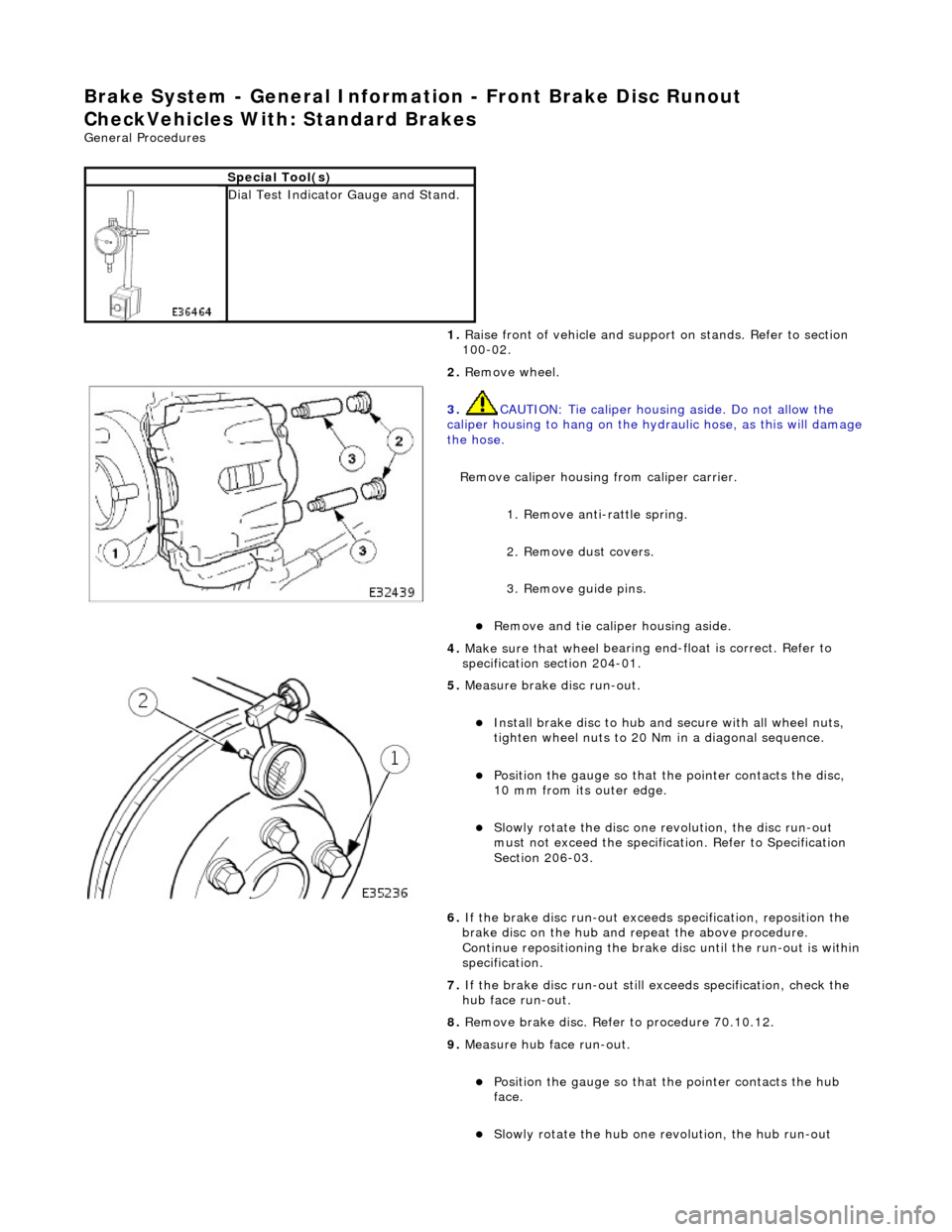
Brake System - Gener
al Information - Front Brake Disc Runout
CheckVehicles With: Standard Brakes
Gen e
ral Procedures
S
p
ecial Tool(s)
Dial Test Indicator
G
auge and Stand.
1. Raise front of vehicle and support on stands. Refer to section
100-02.
2. Remove wheel.
3. CAUT
ION: Tie caliper housing aside. Do not allow the
caliper housing to hang on the hydraulic hose, as this will damage
the hose.
Remove caliper housing from caliper carrier.
1. Remove anti-rattle spring.
2. Remove dust covers.
3. Remove guide pins.
Remove an
d tie caliper housing aside.
4.
Make sure that wheel
bearing en
d-float is correct. Refer to
specification section 204-01.
5. Measure brake d
isc run-out.
Inst
al
l brake disc to hub and secure with all wheel nuts,
tighten wheel nuts to 20 Nm in a diagonal sequence.
Posi
tion the gauge so that the pointer contacts the disc,
10 mm from its outer edge.
Slo w
ly rotate the disc one revolution, the disc run-out
must not exceed the specification. Refer to Specification
Section 206-03.
6. If the brake disc run-out exceeds specification, reposition the
brake disc on the hub and re peat the above procedure.
Continue repositioning the brake di sc until the run-out is within
specification.
7. If the brake disc run-out still exceeds specification, check the
hub face run-out.
8. Remove brake disc. Refer to procedure 70.10.12.
9. Measure hub face run-out.
Posi
tion the gauge so that the pointer contacts the hub
face.
Slo w
ly rotate the hub one revolution, the hub run-out
Page 437 of 2490
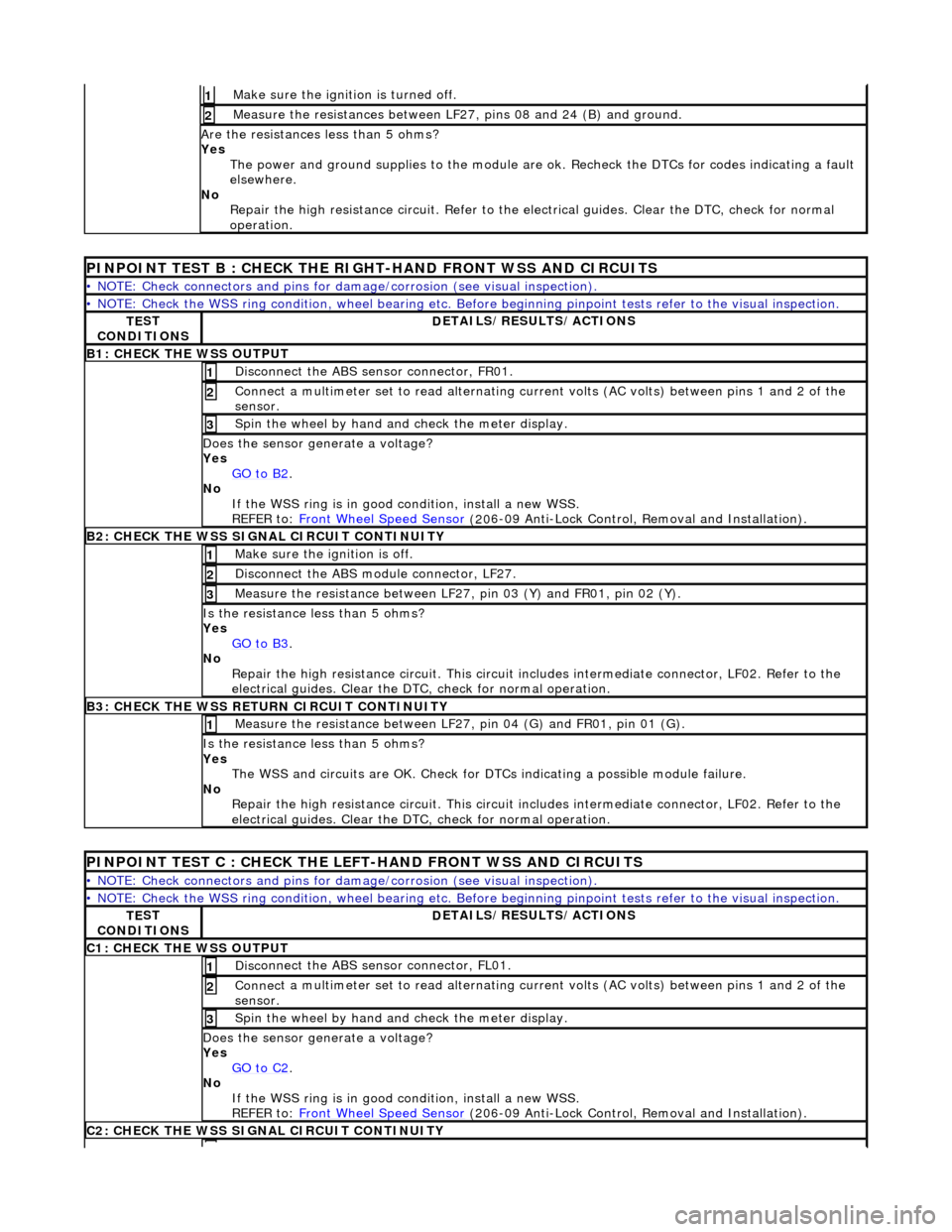
Make sure the ignition is turned off. 1
Meas
ure the resistances between LF27,
pins 08 and 24 (B) and ground.
2
Are
the resistances less than 5 ohms?
Yes The power and ground supplies to the module are ok . Recheck the DTCs for codes indicating a fault
elsewhere.
No Repair the high resistance circui t. Refer to the electrical guides. Clear the DTC, check for normal
operation.
PINPOINT TE
ST B : CHECK THE RIGHT-HAND FRONT WSS AND CIRCUITS
•
NOTE: Check connectors and pins for damage/corrosion
(see visual inspection).
•
NOTE: Check the WSS ring condition, whee
l bearing etc. Before beginning pinpoint test s refer to the visual inspection.
TE
ST
CONDITIONS
D
ETAILS/RESULTS/ACTIONS
B1: CHECK
THE WSS OUTPUT
Disc
onnect the ABS sensor connector, FR01.
1
Connec
t a multimeter set
to read alternating curr ent volts (AC volts) between pins 1 and 2 of the
sensor.
2
Spin
the wheel by hand and check the meter display.
3
Doe
s the sensor generate a voltage?
Yes GO to B2
.
No
If the WSS ring is in good condition, install a new WSS.
REFER to: Front Wheel Speed Sensor
(20
6-09 Anti-Lock Control, Removal and Installation).
B2:
CHECK THE WSS SIGNAL CIRCUIT CONTINUITY
Make sure the ignition is off. 1
Di
sconnect the ABS module connector, LF27.
2
Meas
ure the resistance between LF27
, pin 03 (Y) and FR01, pin 02 (Y).
3
I
s the resistance less than 5 ohms?
Yes GO to B3
.
No
Repair the high resistance circui t. This circuit includes intermediate connector, LF02. Refer to the
electrical guides. Clear the DTC, check for normal operation.
B3:
CHECK THE WSS RETURN CIRCUIT CONTINUITY
Meas
ure the resistance between LF27
, pin 04 (G) and FR01, pin 01 (G).
1
I
s the resistance less than 5 ohms?
Yes The WSS and circuits are OK. Check for DTCs indicating a possible module failure.
No Repair the high resistance circui t. This circuit includes intermediate connector, LF02. Refer to the
electrical guides. Clear the DTC, check for normal operation.
P
INPOINT TEST C : CHECK THE LEFT-HAND FRONT WSS AND CIRCUITS
•
NOTE: Check connectors and pins for damage/corrosion
(see visual inspection).
•
NOTE: Check the WSS ring condition, whee
l bearing etc. Before beginning pinpoint test s refer to the visual inspection.
TE
ST
CONDITIONS
D
ETAILS/RESULTS/ACTIONS
C1
: CHECK THE WSS OUTPUT
Disc
onnect the ABS sensor connector, FL01.
1
Connec
t a multimeter set
to read alternating curr ent volts (AC volts) between pins 1 and 2 of the
sensor.
2
Spin
the wheel by hand and check the meter display.
3
Doe
s the sensor generate a voltage?
Yes GO to C2
.
No
If the WSS ring is in good condition, install a new WSS.
REFER to: Front Wheel Speed Sensor
(20
6-09 Anti-Lock Control, Removal and Installation).
C2
: CHECK THE WSS SIGNAL CIRCUIT CONTINUITY
Page 521 of 2490
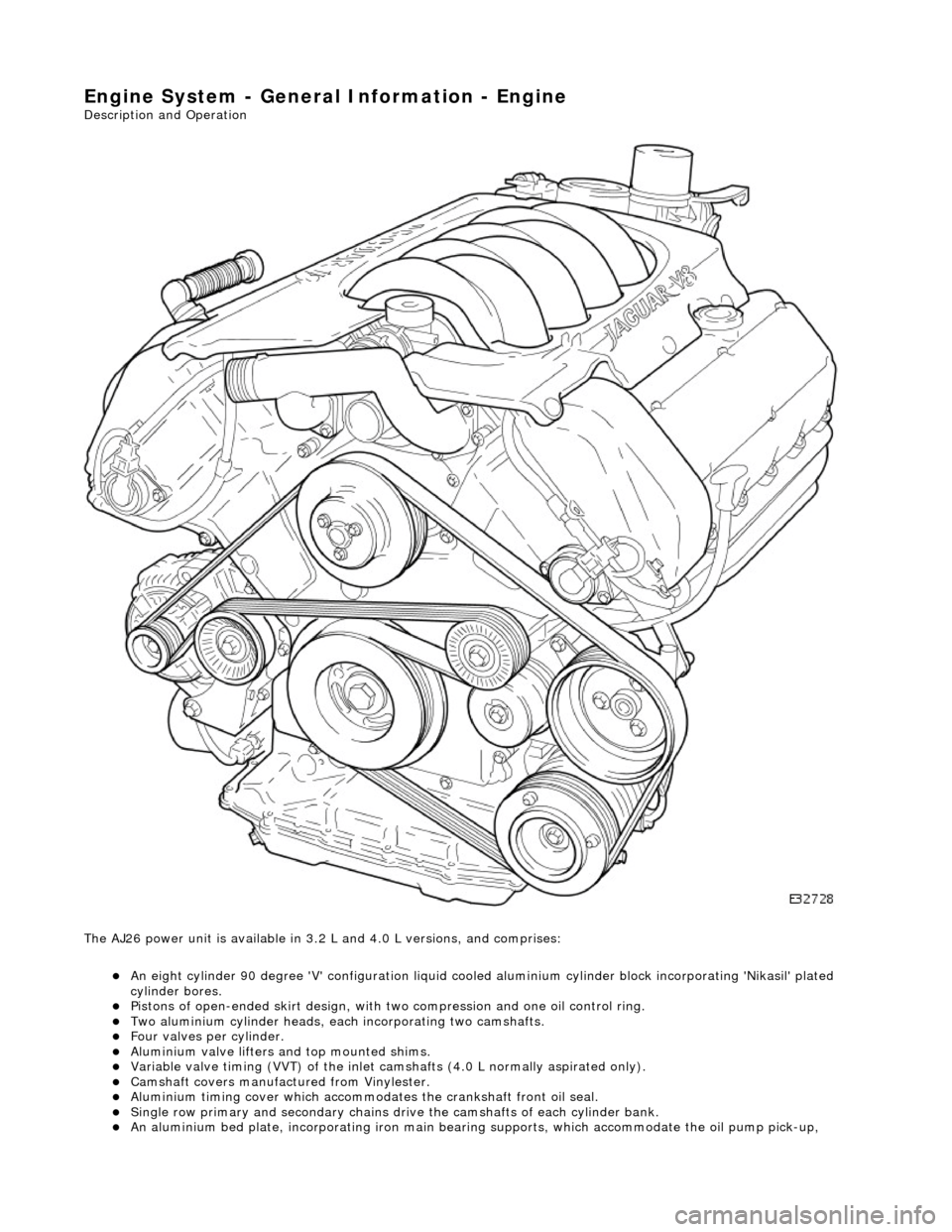
Engine System - General Infor
mation - Engine
Description an
d Operation
The AJ26 power unit is available in 3.2 L and 4.0 L versions, and comprises:
An eight cylinder 9
0 degree 'V' config
uration liquid cooled aluminium cylinder block incorporating 'Nikasil' plated
cylinder bores.
Pi
stons of open-ended skirt design, with
two compression and one oil control ring.
Two al
uminium cylinder heads, each
incorporating two camshafts.
F
our valves per cylinder.
Al
uminium valve lifters and top mounted shims.
Vari
able valve timing (VVT) of the inlet camshafts (4.0 L normally aspirated only).
Camshaft
covers manufactured from Vinylester.
Al
uminium timing cover which accommodat
es the crankshaft front oil seal.
Sin
gle row primary and secondary chains dr
ive the camshafts of each cylinder bank.
An alu
minium bed pl
ate, incorporating iron main bearing supports, which accomm odate the oil pump pick-up,
Page 522 of 2490
diverter val
ve (if fitted) and oil filter.
Main
bearings
which are grooved in the upper positions and plain in
the lower positions. They are manufactured from
aluminium / tin material.
A c
rankshaft with under
cuts and rolled fillets for extra strength.
Fracture
-split connecting rods in sintered-forged steel.
Brackets
bolted to the front of
the cylinder
block are used to mo unt all accessories.
A sin
gle, seven ribbed vee belt
drives the accessories.
An au
tomatic belt tensioner for the front accessory drive,
incorporating a wear indicator.
An advanced en
gine management system inco
rporating electronic throttle control.
The un
it meets the requirements of the CARB OBDII USA legislation.
Ancillary Systems
The an
ci
llary systems, driven by the engine, each have a
detailed Description and Operation along with Diagnostic
Procedures, and Removal and Installation instructions ; refer to the following sections of this manual:
Power Steeri
ng Pump - Section 211-02
Ai
r Conditioning Compressor - Sectio
n 412-03
Engine
C
ooling Pump - Section 303-03
Generator
- Sectio
n 414-02
The drive belt, idler pulley and automatic tensioner are described in Section 303-05.
The engine starting system is described in Section 303-06.
En
gine Management and Emission Control System
Engine Control Modu
le (ECM)
Engine
management and exhaust emissions are controlled by the ECM, which has the
following main functions:
Fu
el injection
Idle
s
peed
Ignition Ev
aporative loss system
Engine
cooling fans Clim
ate control compressor clutch demand
The microprocessor within the ECM receiv es signals from various sensors and other modules and uses a pre-determined
program to compute engine management functions.
Adaptive functions are incorporated in the ECM to cater for co ntinuous adjustments to its computations to suit prevailing
conditions. Because the system also controls emissions to suit all modes, neither CO levels nor idle speed require service
attention or adjustment, except if an error should occur.
On Board Diagnostics are controlled by the ECM with the continuous monitoring of incoming signals and the subsequent
verification against what the module expects to 'see'. Should a si gnal be incorrect or missing, the ECM will substitute a fixed
value to provide the 'limp home mode' and alert the driver of the problem. Fixed values may be adopted for:
Transmission oil
temperature
Mechanica
l
guar
d position
Throttle blade angle Camshaft position
Inta
k
e air temperature
Diagnostic trouble codes (DTC), including OBD II codes, are stored in the ECM memo ry and can be read by an appropriate
retrieval tool.
Should either the ECM or TCM fa il, ensure that the control housing cooling fan is operating correctly. Failure of the cooling
fan MUST be rectified before renewing a control module and details of a fa n failure should accompany a returned control
module.
Page 552 of 2490
Engine - Connecting Rod Bearings
In-vehic
le Repair
Remov
a
l
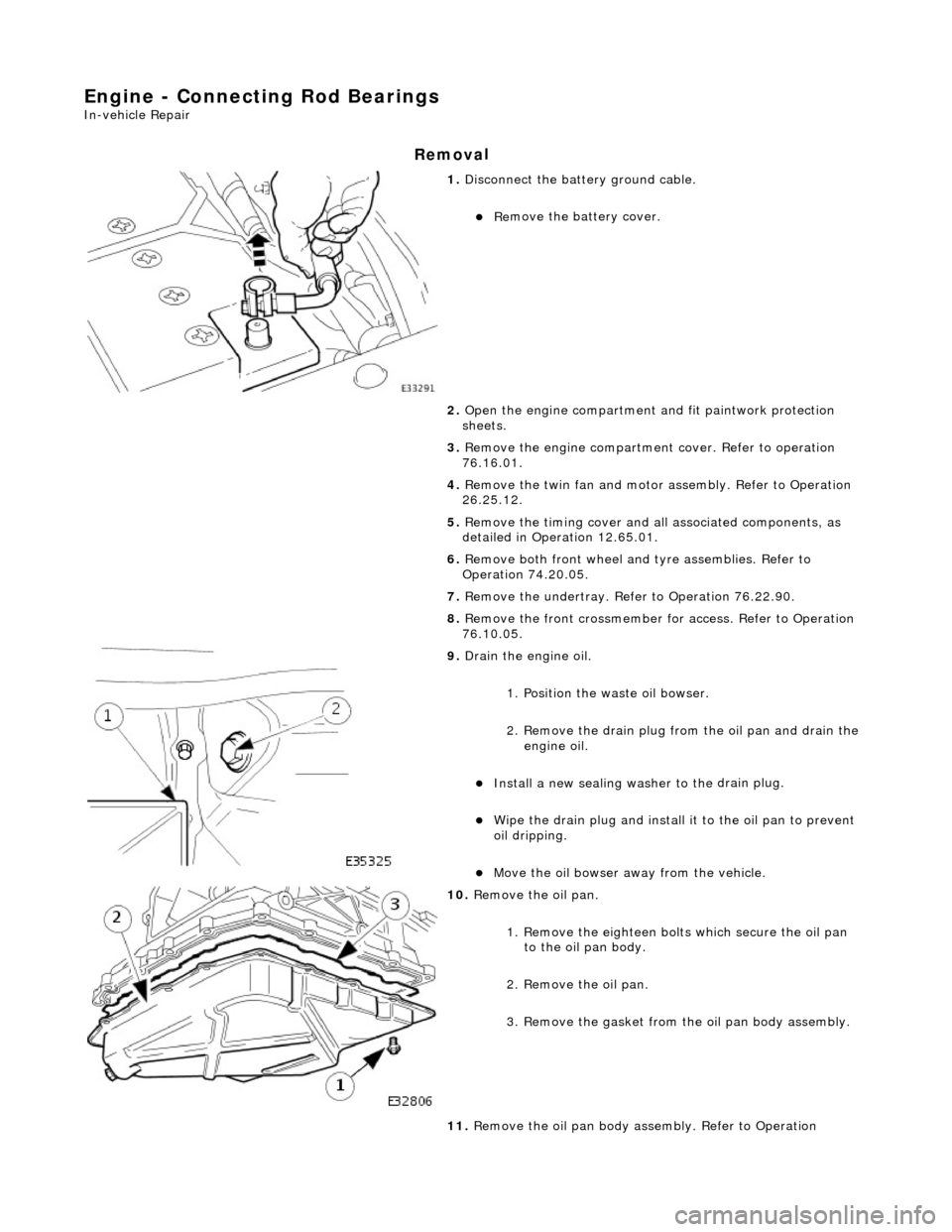
1.
Disc
onnect the batt
ery ground cable.
Re
move the battery cover.
2. Open the engine compartment and fit paintwork protection
sheets.
3. Remove the engine compartmen t cover. Refer to operation
76.16.01.
4. Remove the twin fan and motor assembly. Refer to Operation
26.25.12.
5. Remove the timing cover and al l associated components, as
detailed in Operation 12.65.01.
6. Remove both front wheel and tyre assemblies. Refer to
Operation 74.20.05.
7. Remove the undertray. Re fer to Operation 76.22.90.
8. Remove the front crossmember fo r access. Refer to Operation
76.10.05.
9. Drai
n the engine oil.
1. Position the waste oil bowser.
2. Remove the drain plug from the oil pan and drain the engine oil.
Install a new sealing wash er to the
drain plug.
Wipe the drain plug an
d
install
it to the oil pan to prevent
oil dripping.
Move the oil bowser away f
rom the vehicle.
10 . Re
move the oil pan.
1. Remove the eighteen bolt s which secure the oil pan
to the oil pan body.
2. Remove the oil pan.
3. Remove the gasket from the oil pan body assembly.
11. Remove the oil pan body a ssembly. Refer to Operation
Page 636 of 2490

14. Stag
e 5 - tighten the two M8 bolts at the front of the cylinder head to 25
Nm.
15. I
nstall the tappet and shim assemblies.
Lubrica
te each tappet assembly.
1. Install each tappet and shim asse mbly to its previously identified
position in the cylinder head.
16. Apply oil (EP-90) to the camshaft and bearing surfaces, as follows:
Page 637 of 2490

To th
e upper face of each bearing surface (two places) in the cylinder
head.
To th
e upper face of each bearing surface (two places) in each bearing
cap.
On
the cam lobes ONLY, not on the base circle area.
17
.
Install the camshafts.
1. Install the camshafts to position in the cylinder head, with the timing flats uppermost.
2. Install the camshaft caps to their respective locations (inlet 0 to 4 and exhaust 5 to 9 from the front) and in the correct orientation
(arrow to front of engine).
3. Install and tighten the cap securing bolts. Tighten evenly, in stages, to 10 Nm.
18. Install the camshaft locking tool 303 - 530, align the camshafts as
necessary.
19
.
Install the chain guide.
• NOTE: The chain guide must be installed so that the slotted hole is
towards the top, and the raised shoulder to the cylinder block. 1. Install the chain guide to the block and locate it onto the upper retaining pin.
2. Install the retaining bolt and tighten it to 12 Nm.
20
.
Push the secondary chain tensioner piston into the body to provide
clearance for installing the chain.
1. Insert a thin rigid wire through the hole in the end of the tensioner
piston to displace the ball from the non-return valve seat.
2. With the wire in position, press the piston fully into the tensioner body.
Re
move the wire.
21
.
Install the secondary chain tensioner to the engine.
1. Fully seat the tensioner to the cylinder head.
2. Install the two bolts which secure the tensioner and tighten to 12 Nm.
22. Install the VVT unit to the engine.
A
ssemble the VVT unit, the exhaust camshaft sprocket and the
Page 926 of 2490
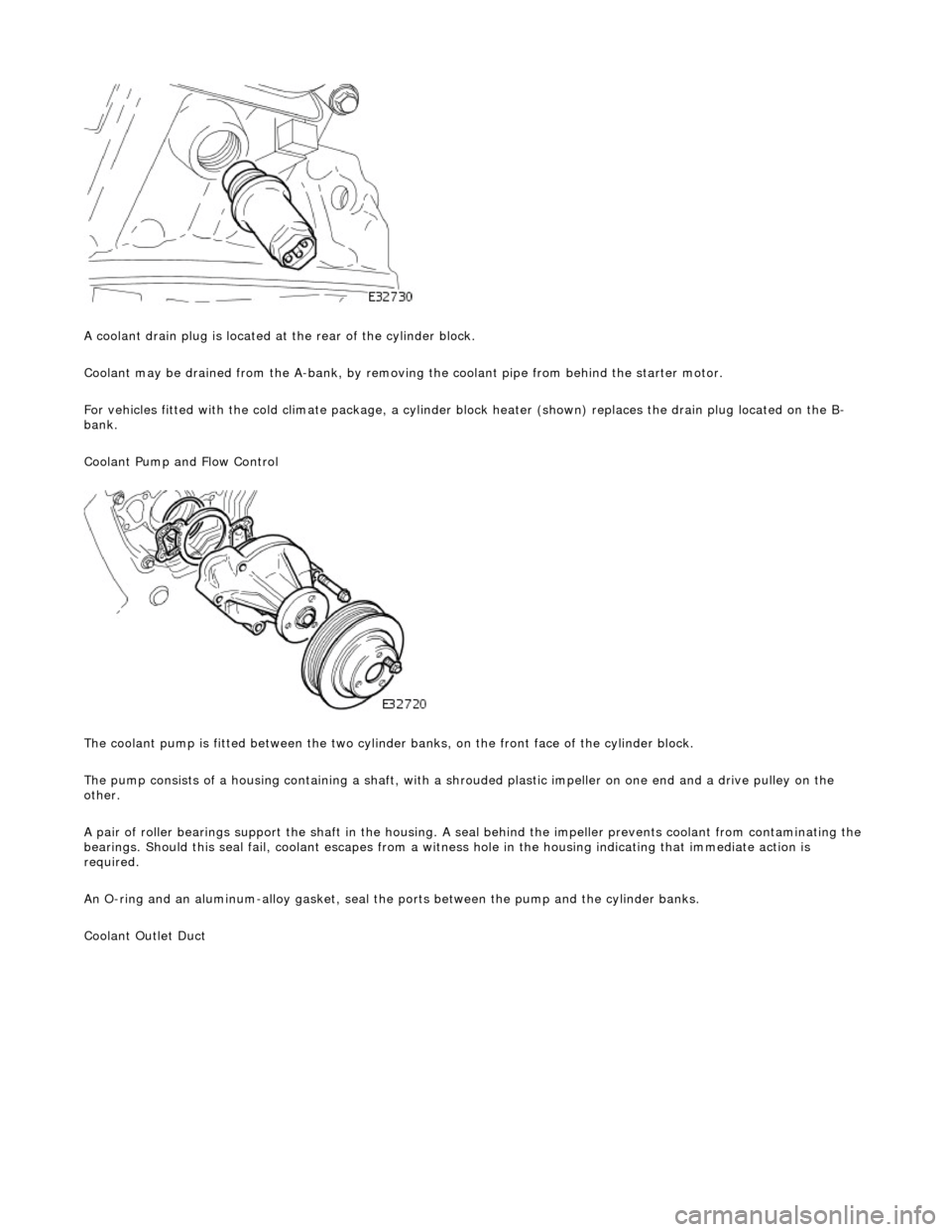
A coola n
t drain plug is located at the rear of the cylinder block.
Coolant may be drained from the A-bank, by removing the coolant pipe from behind the starter motor.
For vehicles fitted with the cold climate package, a cylinder block heater (shown) replaces the drain plug located on the B-
bank.
Coolant Pump and Flow Control
The coolant pump is fitted between the two cylinder banks, on the front face of the cylinder block.
The pump consists of a housing containing a shaft, with a sh rouded plastic impeller on one end and a drive pulley on the
other.
A pair of roller bearings support the shaft in the housing. A seal behind the impeller prevents coolant from contaminating the
bearings. Should this seal fail, coolant escapes from a witness hole in the housin g indicating that immediate action is
required.
An O-ring and an aluminum-alloy gasket, seal the ports between the pump and the cylinder banks.
Coolant Outlet Duct