wheel bolts JAGUAR X308 1998 2.G Owner's Manual
[x] Cancel search | Manufacturer: JAGUAR, Model Year: 1998, Model line: X308, Model: JAGUAR X308 1998 2.GPages: 2490, PDF Size: 69.81 MB
Page 195 of 2490

Rear
Suspension - Spring
Re
moval and Installation
Remov
al
S
pecial Tool(s)
Spri
ng Compressors
204-179 (JD 199)
Spri
ng Retaining straps
204-179-1 (JD 199-1)
1. CAUTION: Replacement of nuts and bolts: Various
thread-locking devices are used on nuts and bolts throughout the
vehicle. These devices restrict the number of times a nut or bolt
can be used.
For additional informat ion, refer to Section 100
-0
0 General
Informati
on
.
R
aise the rear of the vehicle
and support on axle stands.
For additional informat ion, refer to Section 100
-0
2 Jacking and
Liftin
g
.
2.
R
emove the relevant rear wheel.
For additional informat ion, refer to Section 204
-04
Wheels and
Tire
s
.
3. CAUTI
ON: Do not suspend the caliper from the brake
hose as this will damage the hose.
Remove the brake caliper from the carrier.
1. Remove the caliper spring clip.
2. Remove the guide pin dust caps.
3. Slacken and withdr aw the guide pins.
4. Remove the caliper from the carrier and secure to the suspension mounting bracket using a tie strap.
4. Di
sconnect the wheel speed sensor electrical connector.
Page 222 of 2490
Remova
l
2
05-2
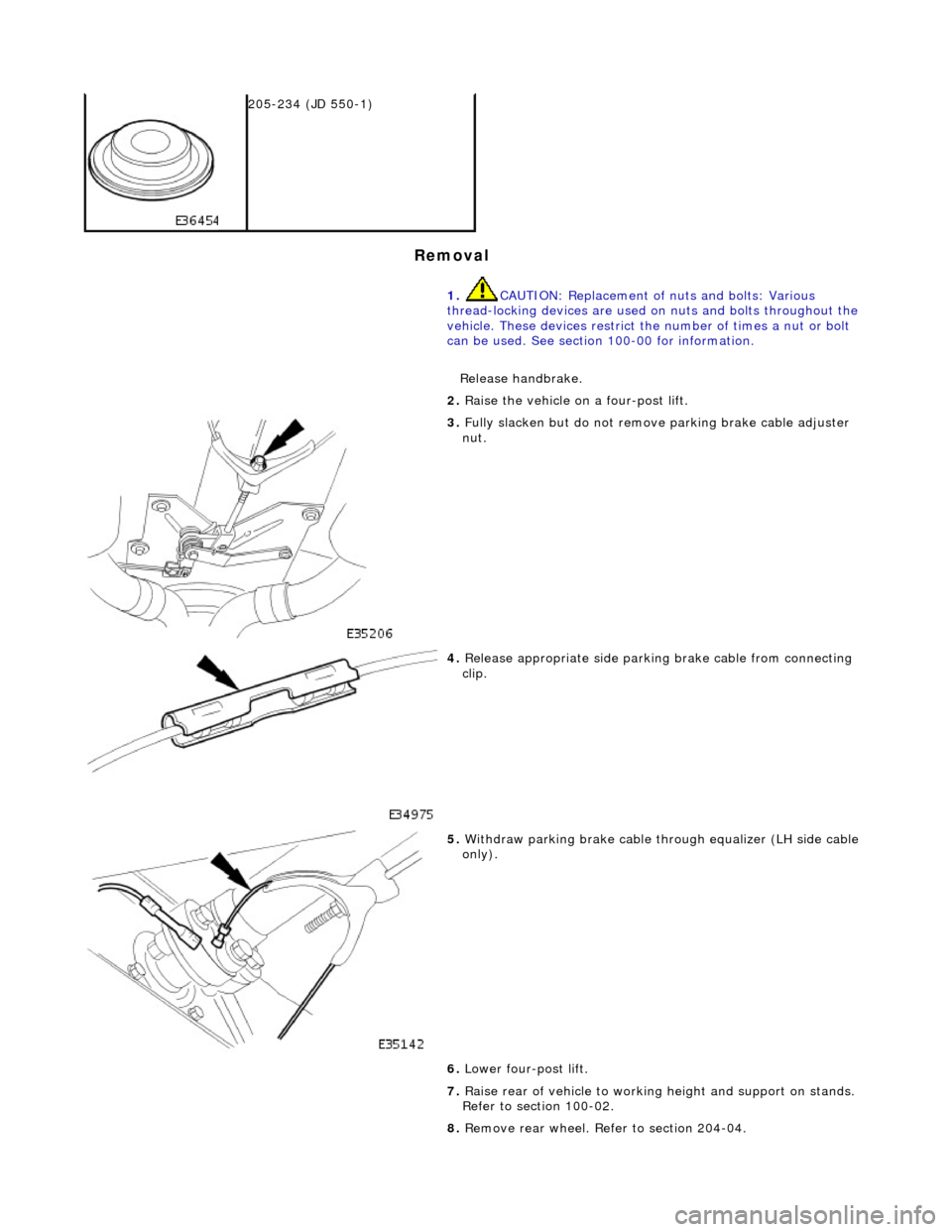
34 (JD 550-1)
1. CAUTION: Replacement of nuts and bolts: Various
thread-locking devices are used on nuts and bolts throughout the
vehicle. These devices restrict the number of times a nut or bolt
can be used. See section 100-00 for information.
Release handbrake.
2. Ra
ise the vehicle on a four-post lift.
3. Fully slacken bu
t do not remove parking brake cable adjuster
nut.
4. Relea s
e appropriate side parkin
g brake cable from connecting
clip.
5. With draw parkin
g brake cable th
rough equalizer (LH side cable
only).
6. Lower four-post lift.
7. Raise rear of vehicle to workin g height and support on stands.
Refer to section 100-02.
8. Remove rear wheel. Refer to section 204-04.
Page 237 of 2490

Rear Suspension - Wheel Hub
Seal
Re
moval and Installation
Remov
al
S
pecial Tool(s)
Hub Holdin
g Tool
204-195 (JD227)
Hub Pu
ller
204-011 (JD 1D)
R
ear-Hub Remover
204-113 (JD 132)
O
il Seal Remover/Replacer
205-234 (JD 550-1)
1. CAUTION: Replacement of nuts and bolts: Various
thread-locking devices are used on nuts and bolts throughout the
vehicle. These devices restrict the number of times a nut or bolt
can be used. See section 100-00 for information.
Release parking brake.
2. R
aise the vehicle on a four-post lift.
3. Fully
slacken but do not remove parking brake cable adjuster
nut.
4. Release appropriate side parkin g brake cable from connecting
Page 310 of 2490
oc
curs only with the parking brake, th
e concern is in the rear brake system.
If the concern becomes evident during this check, verify it fits the description given before the road test. If the concern is
not evident, attempt to duplicate the condition using the information from the description.
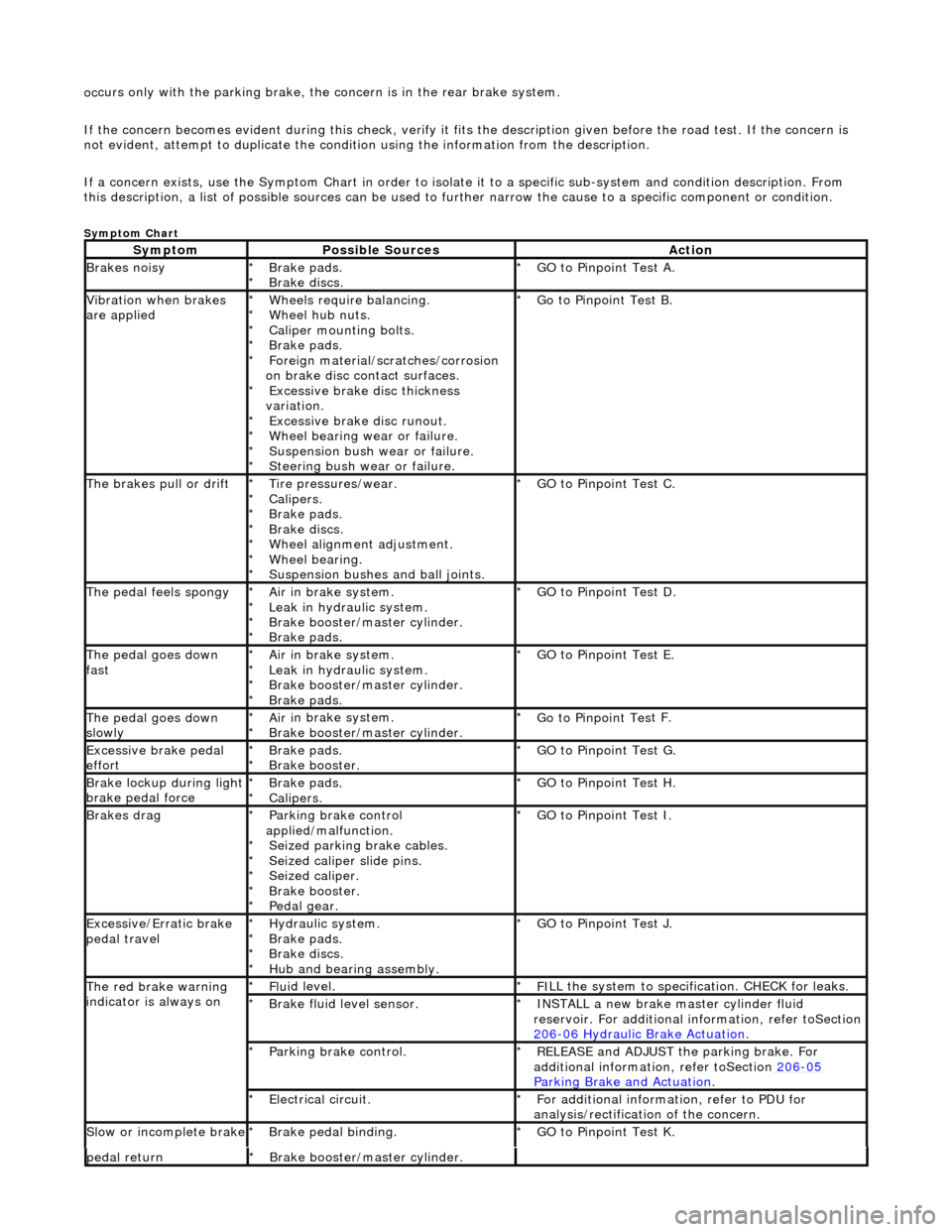
If a concern exists, use the Symptom Chart in order to isolate it to a specific sub-system and condition description. From
this description, a list of possible sources can be used to further narrow the cause to a specific component or condition.
Sym
ptom Chart
Sy
m
ptom
Possib
l
e Sources
Acti
o
n
Brakes
n
oisy
Brake pads.
Brake di
scs
.
*
*
GO to Pinpoint
Tes
t A.
*
Vibration wh
en brakes
are applied
Wh eels require bala
ncing.
Wheel hub nuts.
Caliper mounting bolts.
Brake pads.
Foreign material/scr atches/corrosion
on brake disc contact surfaces. Excessive brake disc thickness
variation. Excessive brake disc runout.
Wheel bearing wear or failure.
Suspension bush wear or failure.
Steering bush wear or failure.
*
*
*
*
*
*
*
*
*
*
Go to Pinpoint
Tes
t B.
*
The brakes pull or drif tTire pressures/wear.
Calipers.
Brake pads.
Brake di
scs.
Wheel alignment adjustment.
Wheel bearing.
Suspension bushes and ball joints.
*
*
*
*
*
*
*
GO to Pinpoint
Tes
t C.
*
The pedal feels spongyAir i
n brake system.
Leak in hydraulic system.
Brake booster/master cylinder.
Brake pads.
*
*
*
*
GO to Pinpoint Tes
t D.
*
The pedal goes down
fa s
t
Ai
r i
n brake system.
Leak in hydraulic system.
Brake booster/master cylinder.
Brake pads.
*
*
*
*
GO to Pinpoint
Tes
t E.
*
The pedal goes down
slowl yAir i
n brake system.
Brake booster/master cylinder.
*
*
Go to Pinpoint
Tes
t F.
*
Excessive brake pedal
effor tBrake pads.
Brake booster.
*
*GO to Pinpoint
Tes
t G.
*
Brake lockup du ring ligh
t
brake pedal force
Brake pads.
Calipers.
*
*GO to Pinpoint
Tes
t H.
*
Brakes d r
ag
Parkin
g brake con
trol
applied/malfunction. Seized parking brake cables.
Seized caliper slide pins.
Seized caliper.
Brake booster.
Pedal gear.
*
*
*
*
*
*
GO to Pinpoint
Tes
t I.
*
Exce ssi
ve/Erratic brake
pedal travel
Hydrau li
c system.
Brake pads.
Brake discs.
Hub and bearing assembly.
*
*
*
*
GO to Pinpoint
Tes
t J.
*
The red brak e warning
indi
cator is always on
Fl
ui
d level.
*
F I
LL the system to specification. CHECK for leaks.
*
Brake flu i
d level sensor.
*
I N
STALL a new brake master cylinder fluid
reservoir. For additional in formation, refer toSection
206
-0 6
Hydraulic Brake Actuation
.
*
Parkin
g brake con
trol.
*
REL
E
ASE and ADJUST the parking brake. For
additional information, refer toSection 206
-05
Parkin g Brake an
d Actuation
.
*
E
l
ectrical circuit.
*
F or additional
information, refer to PDU for
analysis/rectification of the concern.
*
Sl
ow or i
ncomplete brake
Brake peda
l binding.
*
GO to Pinpoint Tes
t K.
*
pedal retu rnBr
ake booster/master cylinder.
*
Page 326 of 2490
Fr
ont Brake Disc Runout Check Vehicles With: Brembo Brakes
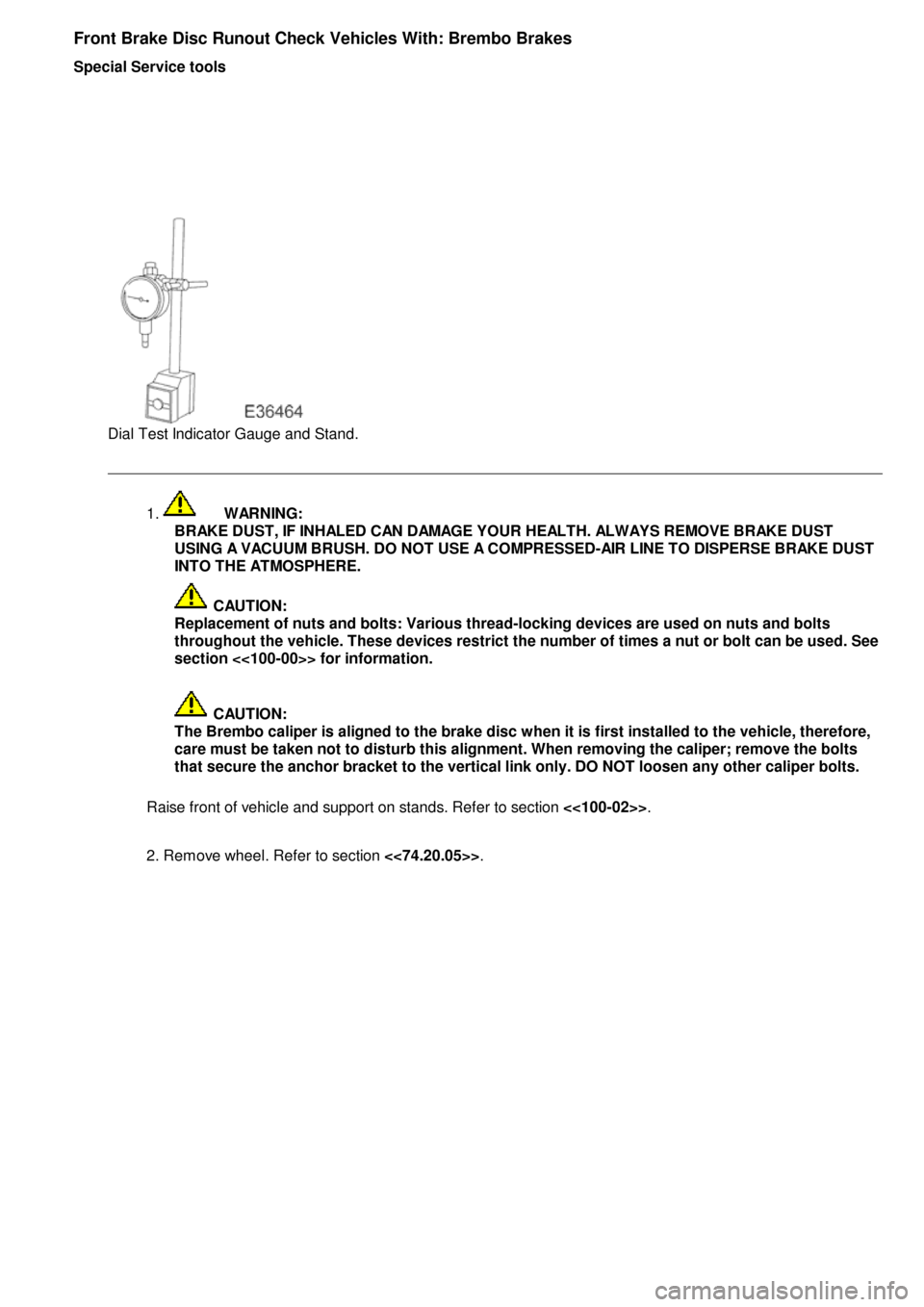
Special Service tools
Di
al Test Indicator Gauge and Stand.
1.
WA
RNING:
BRAKE DUST, IF INHALED CAN DAMAGE YOUR HEALTH. ALWAYS REMOVE BRAKE DUST USING A VACUUM BRUSH. DO NOT USE A COMPRESSED-AIR LINE TO DISPERSE BRAKE DUST
INTO THE ATMOSPHERE.
CA
UTION:
Replacement of nuts and bolts: Various thread-locking devices are used on nuts and bolts
throughout the vehicle. These devices restrict the number of times a nut or bolt can be used. See
section <<100-00>> for information.
CA
UTION:
The Brembo caliper is aligned to the brake disc when it is first installed to the vehicle, therefore,
care must be taken not to disturb this alignment. When removing the caliper; remove the bolts
that secure the anchor bracket to the vertical link only. DO NOT loosen any other caliper bolts.
Raise front of vehicle and support on stands. Refer to section <<100-02>>.
2. Remove wheel. Refer to section <<74.20.05>>.
Page 334 of 2490
Rear
Brake Disc Runout Check Vehicles With: Brembo Brakes
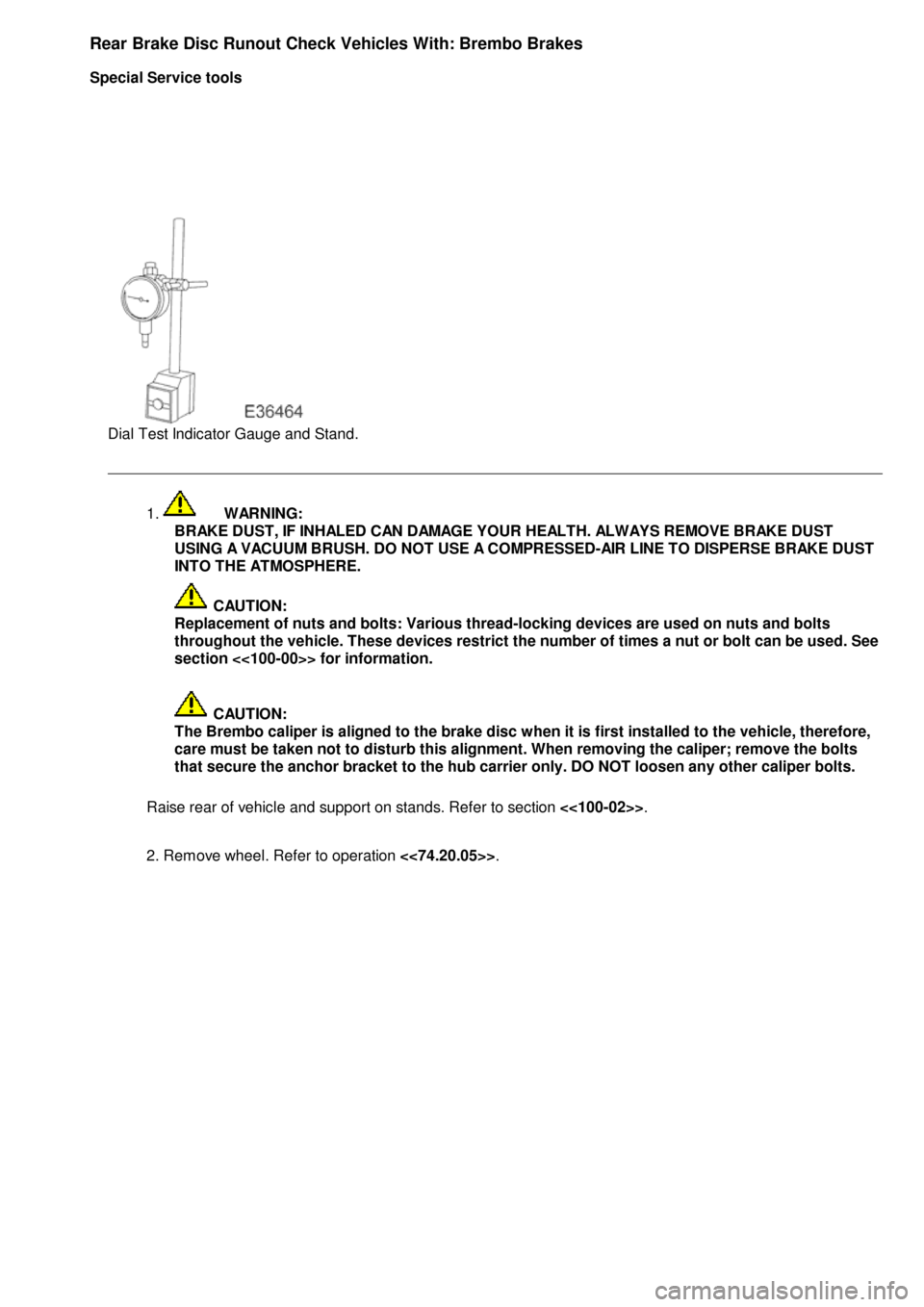
Special Service tools
Di
al Test Indicator Gauge and Stand.
1.
WA
RNING:
BRAKE DUST, IF INHALED CAN DAMAGE YOUR HEALTH. ALWAYS REMOVE BRAKE DUST USING A VACUUM BRUSH. DO NOT USE A COMPRESSED-AIR LINE TO DISPERSE BRAKE DUST
INTO THE ATMOSPHERE.
CA
UTION:
Replacement of nuts and bolts: Various thread-locking devices are used on nuts and bolts
throughout the vehicle. These devices restrict the number of times a nut or bolt can be used. See
section <<100-00>> for information.
CA
UTION:
The Brembo caliper is aligned to the brake disc when it is first installed to the vehicle, therefore,
care must be taken not to disturb this alignment. When removing the caliper; remove the bolts
that secure the anchor bracket to the hub carrier only. DO NOT loosen any other caliper bolts.
Raise rear of vehicle and support on stands. Refer to section <<100-02>>.
2. Remove wheel. Refer to operation <<74.20.05>>.
Page 340 of 2490
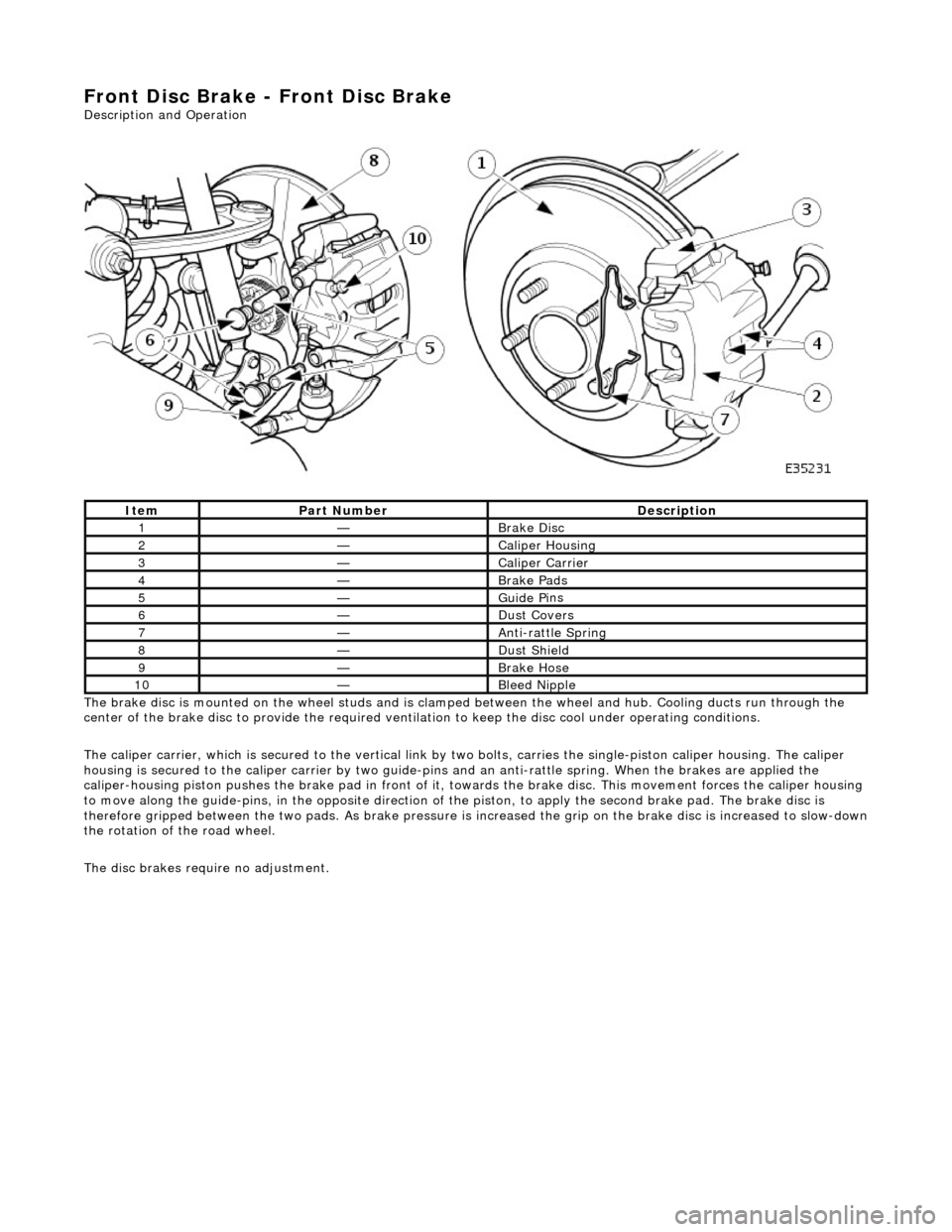
Front Disc Brake - Front Disc Brake
Description and Operation
The brake disc is mounted on the wheel studs and is clamped between the wheel and hub. Cooling ducts run through the
center of the brake disc to provide the required ventilation to keep the disc cool under operating conditions.
The caliper carrier, which is se cured to the vertical link by two bolts, carries the single-pis ton caliper housing. The caliper
housing is secured to the caliper carrier by two guide-pins and an anti-rattle spring. When the brakes are applied the
caliper-housing piston pushes th e brake pad in front of it, towards the brake di sc. This movement forces the caliper housing
to move along the guide-pins, in the oppo site direction of the piston, to apply the second brake pad. The brake disc is
therefore gripped between the two pads. As brake pressure is increased the grip on the brake disc is increased to slow-down
the rotation of the road wheel.
The disc brakes requ ire no adjustment.
It
e
m
Par
t
Number
De
scr
iption
1—B
r
ake Disc
2—Caliper Housin
g
3—Caliper Carrier
4—Brake Pads
5—Guide P i
ns
6—Du
st
Covers
7—An
ti
-rattle Spring
8—Du
st
Shield
9—Brake Hos
e
10—Bleed Nipp
le
Page 341 of 2490
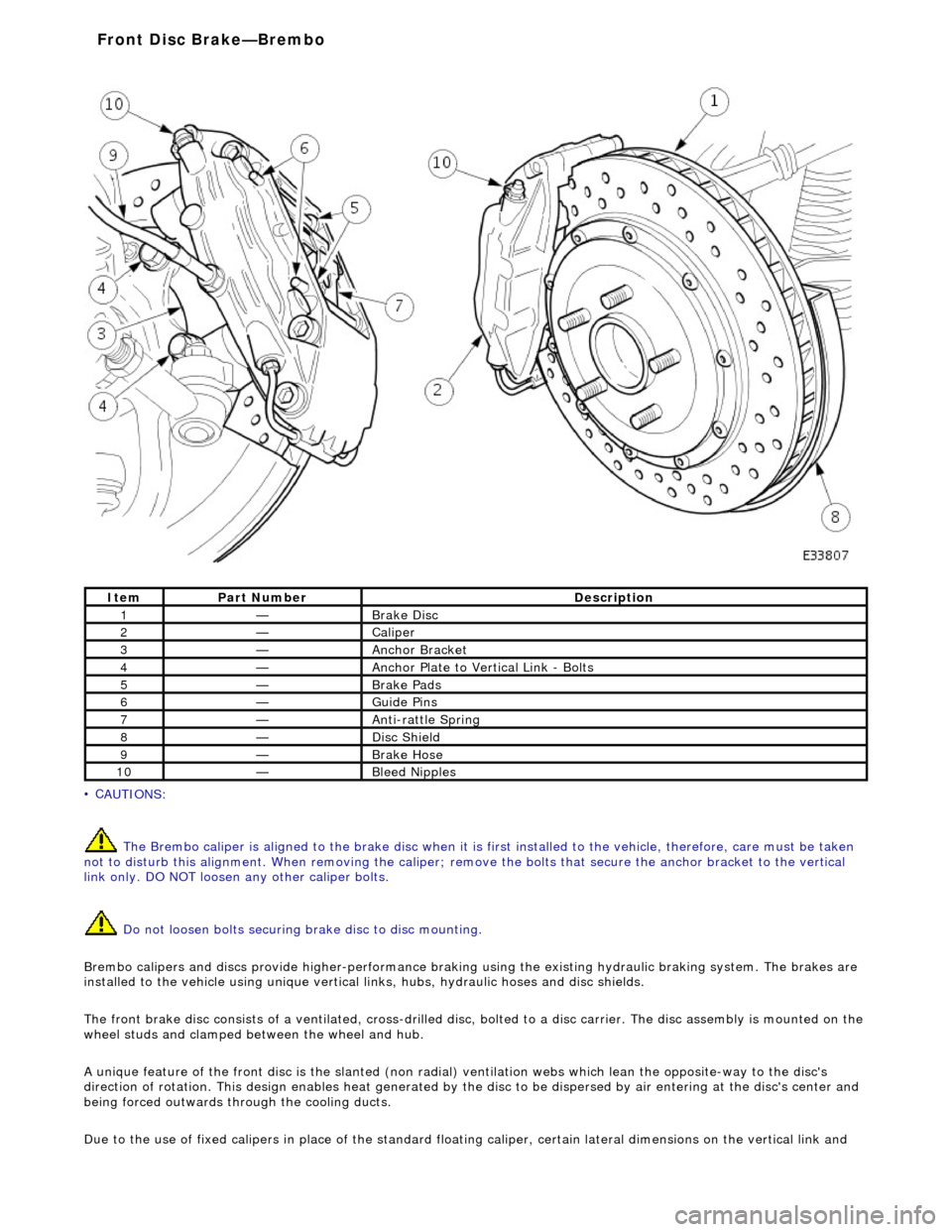
• C
AUTIONS:
The Brembo caliper is aligned to the brak e disc when it is first installed to the vehicle, therefore, care must be taken
not to disturb this alignment. When removi ng the caliper; remove the bolts that secure the anchor bracket to the vertical
link only. DO NOT loosen any other caliper bolts.
Do not loosen bolts securing brake disc to disc mounting.
Brembo calipers and discs provide higher -performance braking using the existing hydraulic braking system. The brakes are
installed to the vehicle using unique vertical links, hubs, hydraulic hoses and disc shields.
The front brake disc consists of a ventilated, cross-drilled disc, bolted to a disc carrier. The disc assemb ly is mounted on the
wheel studs and clamped be tween the wheel and hub.
A unique feature of the front disc is th e slanted (non radial) ventilation webs which lean the opposite-way to the disc's
direction of rotation. This design enables he at generated by the disc to be dispersed by air entering at the disc's center and
being forced outwards through the cooling ducts.
Due to the use of fixed calipers in place of the standard floating caliper, certain lateral dimensions on the vertical link and
It
em
Par
t Number
De
scription
1—B
rake Disc
2—Caliper
3—Anch
or Bracket
4—Anchor Pl
ate to Vertical Link - Bolts
5—Brake Pad
s
6—Guide P
ins
7—Anti-r
attle Spring
8—Di
sc Shield
9—Brake Hos
e
10—Bleed Nipp
les
Front Disc Brake—
Brembo
Page 343 of 2490
Front Disc Brake - Brake CaliperVehicles
With: Standard Brakes
Re
moval and Installation
Remov
al
W
ARNING: BRAKE DUST, IF INHALED CAN DAMAGE YOUR
HEALTH. ALWAYS REMOVE BRAKE DUST USING A VACUUM
BRUSH. DO NOT USE A COMPRESSED-AIR LINE TO DISPERSE BRAKE DUST INTO THE ATMOSPHERE.
• CAUTIONS:
Replacement of nuts and bolts: Various thread-locking de vices are used on nuts and bolts throughout the vehicle.
These devices restrict the number of times a nut or bolt can be used. See section 100-00 for information.
Remove brake fluid spilla ge immediately from paint work, with clean water.
A new brake hose must be installe d when replacing a brake caliper.
The brake pad adhesive backing must not be reused, therefore always install new brake pads, irrespective of the
condition of the original pads when replacing a brake caliper. Always replace brake pads as an axle set.
S
pecial Tool(s)
Brake Pedal
Hold Tool
JDS 9013
1. O
pen engine compartment and fit
paint work protection covers
to fenders.
2. Raise vehicle on a four-post lift.
3. Raise front of vehicle and support on stands. Refer to Section
100-02.
4. Remove front wheels. See Section 204-04.
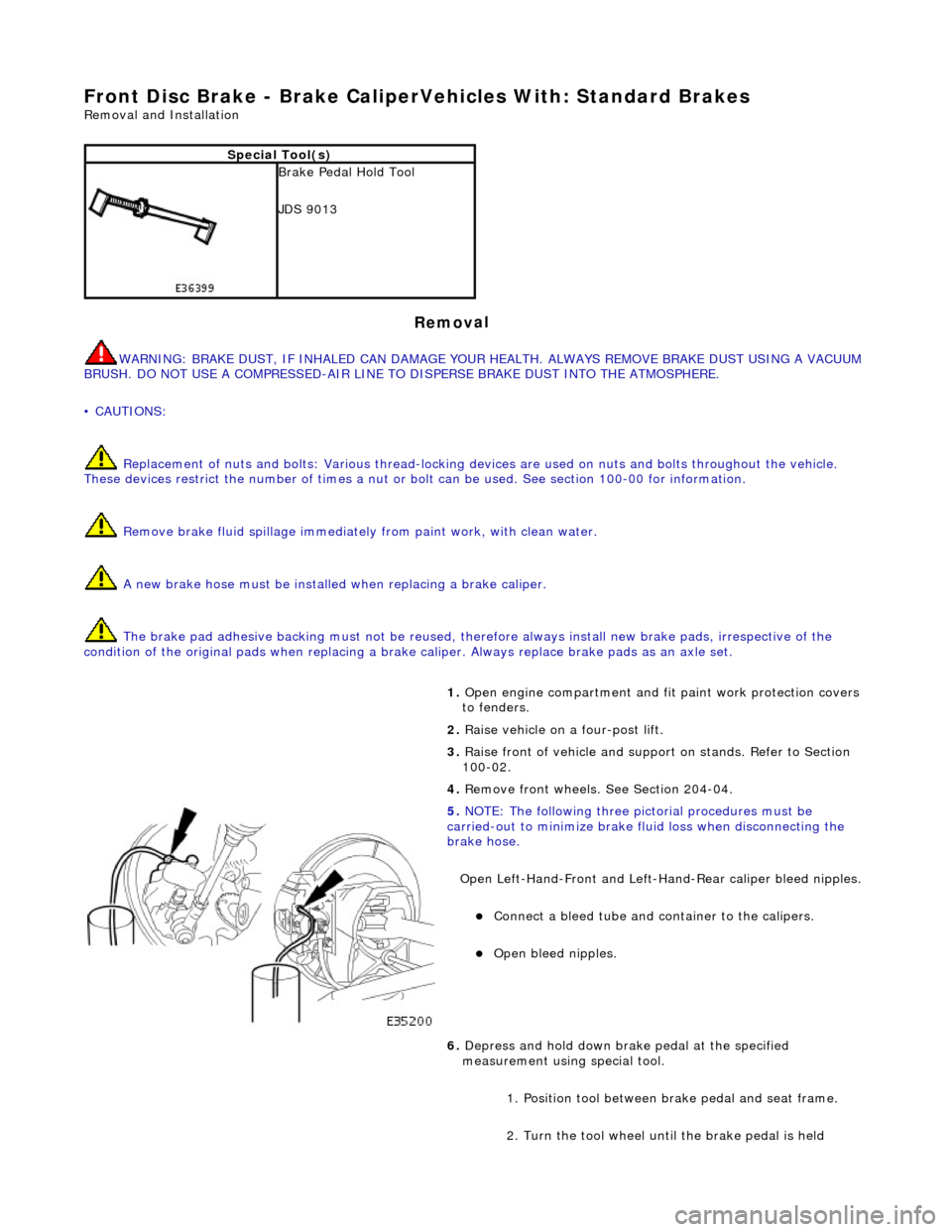
5. NOTE
: The following three pictorial procedures must be
carried-out to minimize brake fl uid loss when disconnecting the
brake hose.
Open Left-Hand-Front and Left-H and-Rear caliper bleed nipples.
Connect
a bleed tube and co
ntainer to the calipers.
O
pen bleed nipples.
6. Depress and hold down brak e pedal at the specified
measurement using special tool.
1. Position tool between brake pedal and seat frame.
2. Turn the tool wheel unti l the brake pedal is held
Page 347 of 2490

Front Disc Brake - Brake CaliperVehicles With: High Performance Brakes
Re
moval and Installation
Remov
al
S
pecial Tool(s)
Brake Pedal
Hold Tool
JDS 9013
1. WARNING: BRAKE DUST, IF INHALED CAN DAMAGE
YOUR HEALTH. ALWAYS REMOVE BRAKE DUST USING A VACUUM
BRUSH. DO NOT USE A COMPRE SSED-AIR LINE TO DISPERSE
BRAKE DUST INTO THE ATMOSPHERE.
• CAUTIONS:
Replacement of nuts and bolts: Various thread-locking
devices are used on nuts and bolts throughout the vehicle. These
devices restrict the number of ti mes a nut or bolt can be used.
See section 100-00 for information.
Remove brake fluid spillage immediately from paint work,
with clean water.
The Brembo caliper is aligned to the brake disc when it is
first installed to the vehicle, therefore, care must be taken not to
disturb this alignment. When removing the caliper; remove the
bolts that secure the anchor bracket to the vertical link only. DO
NOT loosen any other caliper bolts.
Open engine compartment and fit paint work protection covers
to fenders.
2. R
aise vehicle on a four-post lift.
3. Raise front of vehicle and support on stands. Refer to Section
100-02.
4. Remove front wheels. Refe r to operation 74.20.05.
5. NOTE
: The following three pictorial procedures must be
carried-out to minimize brake fl uid loss when disconnecting the
brake hose.
Open Left-Hand-Front and Left-H and-Rear caliper bleed nipples.
Connect
a bleed tube and co
ntainer to the calipers.
O
pen bleed nipples.
6. Depress and hold down brak e pedal at the specified
measurement using the special tool.