206 JAGUAR X308 1998 2.G Workshop Manual
[x] Cancel search | Manufacturer: JAGUAR, Model Year: 1998, Model line: X308, Model: JAGUAR X308 1998 2.GPages: 2490, PDF Size: 69.81 MB
Page 5 of 2490

Rear Drive Axle and Diffe rential
General Procedures
Differential Output Shaft End Float Check (51.10.24)
In‐Vehicle Repair
Axle Shaft (47.10.01)
Differential Output Shaft Bearing (51.10.22)
Drive Pinion Flange and Drive Pinion Seal (51.20.01)
Removal and Installation
Axle Assembly (51.25.13)
206: Brake System
206‐00: Brake System ‐ Gen
eral Information
Specification
Description and Operation
Brake System
Diagnosis and Testing
Brake System
General Procedures
Brake System Bleeding (70.25.03) ‐ Vehicles With: Standard Brakes
Brake System Bleeding (70.25.03) ‐ Vehicles With: High Performance Brakes
Front Brake Disc Runout Check ‐ Vehicles With: Standard Brakes
Front Brake Disc Runout Chec
k ‐ Vehicles With: High Performance Brakes
Rear Brake Disc Runout Check (70.12.36) ‐ Vehicles With: Standard Brakes
Rear Brake Disc Runout Check (70.12.36) ‐ Vehicles With: High Performance
Brakes
206‐03: Front Disc Brake
Specification
Description and Operation
Front Disc Brake
Removal and Installation
Brake Caliper (70.55.02) ‐ Vehicles With: Standard Brakes
Brake Caliper (70.55.02) ‐ Vehicles With: High Perfo
rmance Brakes
Brake Disc (70.10.10) ‐ Vehicles With: Standard Brakes
Brake Disc (70.10.10) ‐ Vehicles With: High Performance Brakes
Brake Pads (70.40.02) ‐ Vehicles With: Standard Brakes
Page 6 of 2490

Brake Pads (70.40.02) ‐ Vehicles With:
High Performance Brakes
206‐04: Rear Disc Brake
Specification
Description and Operation
Rear Disc Brake
Removal and Installation
Brake Caliper (70.55.03) (70.55.25) ‐ Vehicles With: Standard Brakes
Brake Caliper (70.55.03) (70.55.25) ‐ Vehicles With: High Performance Brakes
Brake Disc (70.10.11) ‐ Vehicles With: Standard Brakes
Brake Dis
c (70.10.11) ‐ Vehicles With: High Performance Brakes
Brake Pads (70.40.03) ‐ Vehicles With: Standard Brakes
Brake Pads (70.40.03) ‐ Vehicles With: High Performance Brakes
206‐05: Parking Brake and Actuation
Specification
Description and Operation
Parking Brake
General Procedures
Parking Brake Cable Adjustment (70.35.10)
Parking Brake Shoe and Li
ning Adjustment (70.35.37)
Removal and Installation
Parking Brake Control (70.35.08)
Parking Brake Control Shroud (76.13.63)
Parking Brake Shoes (70.40.05)
Parking Brake Warning Indicator Switch (86.65.45)
206‐06: Hydraulic Brake Actuation
Specification
Description and Operation
Hydraulic Brake Actuation
Removal and Installation
Brake Fluid Reservoir (70.30.16)
Brake Master Cylinder (70.30.
08)
Brake Pedal and Bracket (70.35.03)
Brake Pedal and Bracket, Brake Booster and Brake Master Cylinder (70.35.39)
Page 7 of 2490

206‐07: Powe r Brake Actuation
Specif
ication
Description and Operation
Brake Booster
Removal and Installation
Brake Booster (70.50.17)
Brake Booster and Brake Master Cylinder (70.50.18)
206‐09: Anti ‐Lock Control
Specification
Description and Operation
Anti‐Lock Control
Diagnosis and Testing
Anti‐Lock Control
Removal and Installation
Anti‐Lock Brake System (ABS) Module (70.60.02)
Front Wheel Speed Sensor (70.60.03)
Hydraulic Cont
rol Unit (HCU)
Rear Wheel Speed Sensor (70.60.04)
Wheel Speed Sensor Ring (70.60.25)
211: Steering System
211‐00: Steering System ‐ General Information
Specification
Description and Operation
Steering System
Diagnosis and Testing
Steering Sy
stem
General Procedures
Power Steering System Filling and Bleeding
Power Steering System Flushing (57.15.08)
Power Steering System Vacuum Filling and Bleeding
Steering Gear Centralizing
Page 136 of 2490

Remova
l
CAUTI
O
N: Replacement of
nuts and bolts: Various thread-locking devises are used on nuts and bolts throughout the
vehicle. These devises restrict the number of times a nut or bolt can be used. See section 100-00 for information.
1 8
G 1004
1.
Re
move vertical link and hub as
sembly. Refer to 60.25.38.90.
2. Re
move brake disc shield from vertical link.
1. Remove screws.
2. Remove disc shield.
3. Us
ing special tool, secure vertical link and hub assembly in a
vise.
Secure special tool
in a vise.
Posit
i
on hub in tool.
Inst
al
l wheel nuts.
4. Re
move rotor nut spring-clip.
5. Remove rotor nut.
Us
ing special tool 206-066A remove rotor nut.
Page 143 of 2490
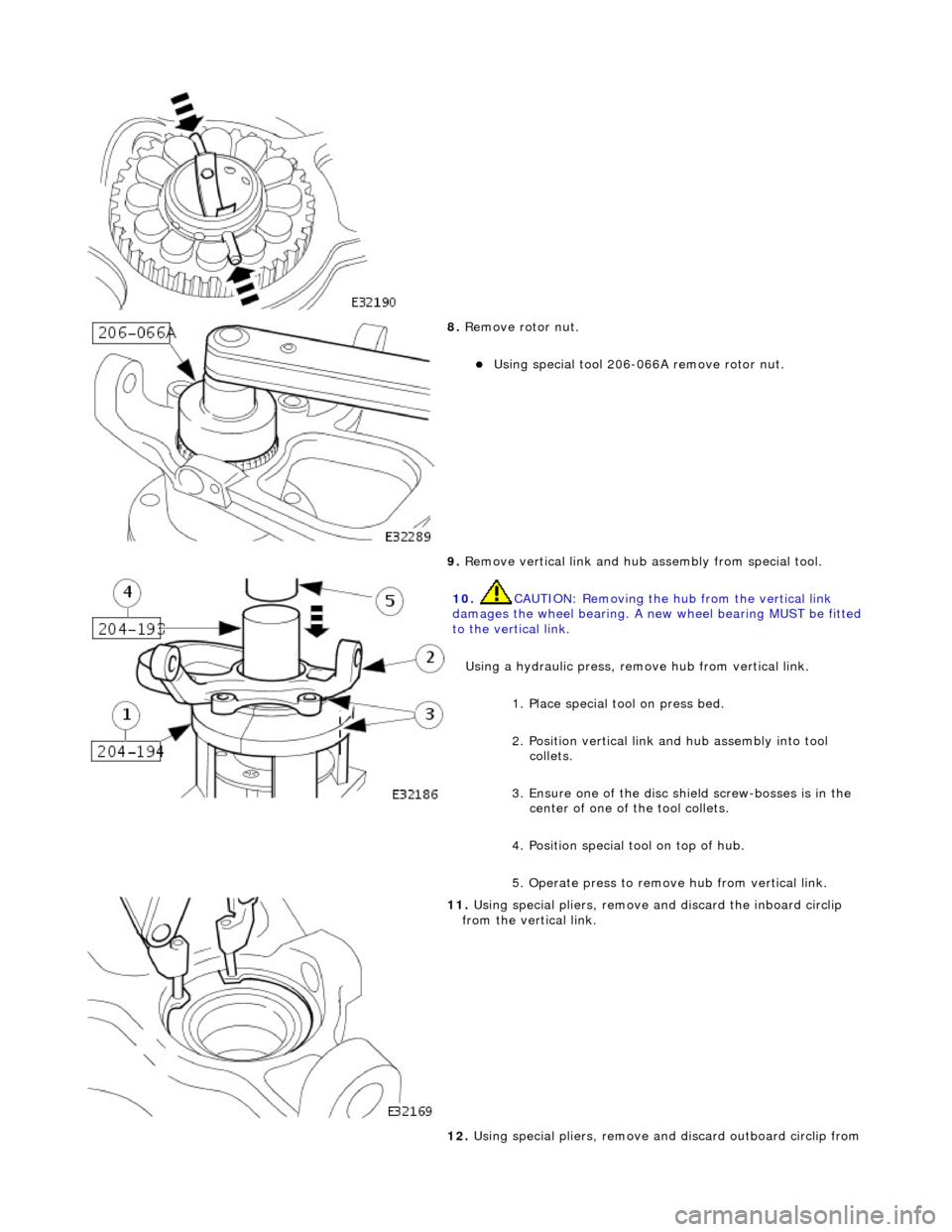
8. R
emove rotor nut.
U
sing special tool 206-066A remove rotor nut.
9. Remove vertical link and hub assembly from special tool.
10
.
CAUTION: Removing the hu b from the vertical link
damages the wheel bearing. A new wheel bearing MUST be fitted
to the vertical link.
Using a hydraulic press, remo ve hub from vertical link.
1. Place special tool on press bed.
2. Position vertical link and hub assembly into tool collets.
3. Ensure one of the disc sh ield screw-bosses is in the
center of one of the tool collets.
4. Position special tool on top of hub.
5. Operate press to remove hub from vertical link.
11
.
Using special pliers, remove an d discard the inboard circlip
from the vertical link.
12. Using special pliers, remove an d discard outboard circlip from
Page 268 of 2490
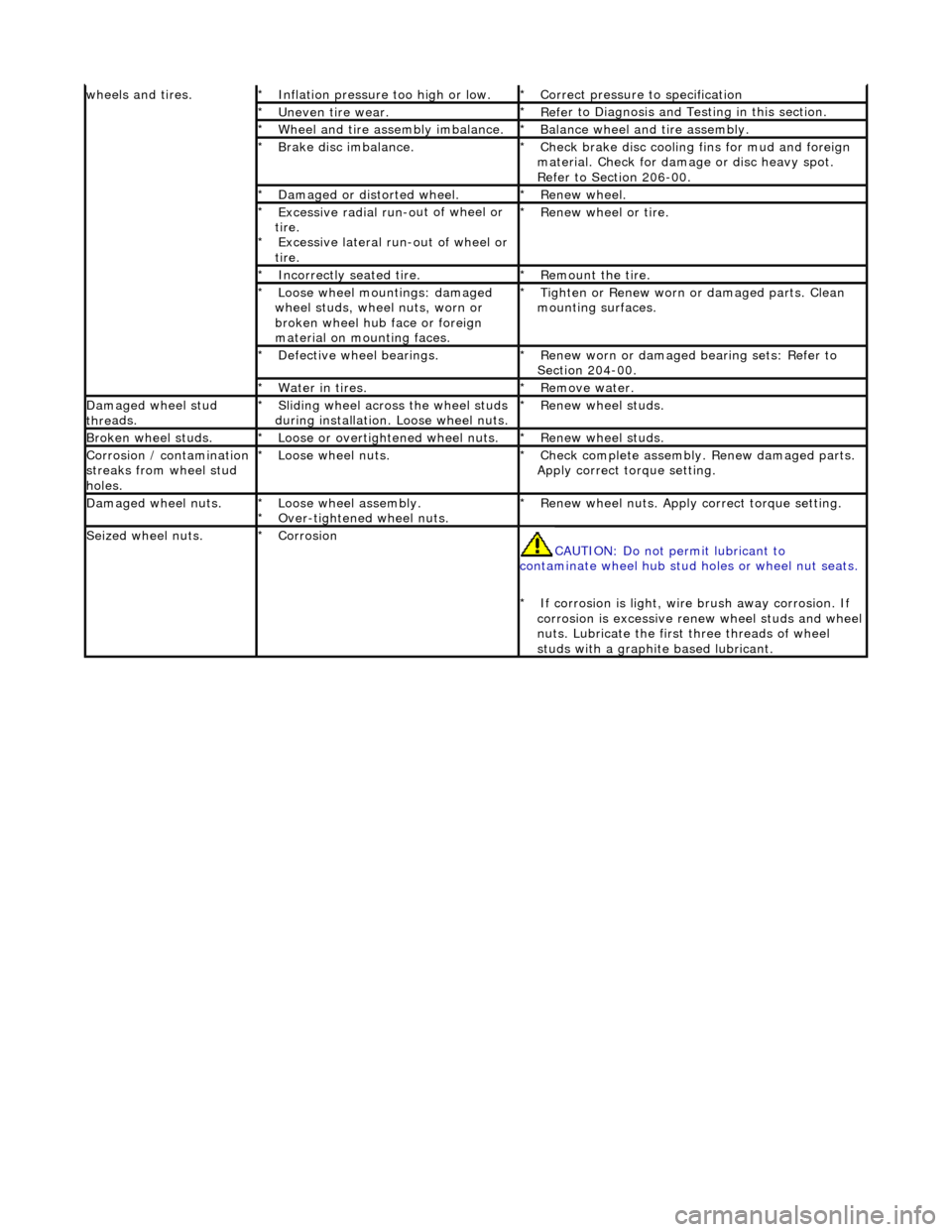
wheels
and tires.
Infl
atio
n pressure too high or low.
*
Cor r
ect pressure to specification
*
Uneven ti re wear.
*Re fe
r to Diagnosis and Testing in this section.
*
Wh ee
l and tire assembly imbalance.
*
Balance wheel an d tire assembly.
*
Brake disc imbalan c
e.
*
Check brak e disc co
oling fins for mud and foreign
material. Check for damage or disc heavy spot.
Refer to Section 206-00.
*
Damaged or distor
ted wh
eel.
*
Renew wh eel.
*
Excessive radial run-o
ut of wheel or
tire. Excessive lateral run-out of wheel or
tire.
*
*
Renew wh
eel or tire.
*
Incorrectl y
seated tire.
*
R e
mount the tire.
*
Loose wh eel mo
untings: damaged
wheel studs, whee l nuts, worn or
broken wheel hub face or foreign
material on mounting faces.
*
Tigh
te
n or Renew worn or
damaged parts. Clean
mounting surfaces.
*
De
fe
ctive wheel bearings.
*
Renew worn
or damaged bearing sets: Refer to
Section 204-00.
*
W
a
ter in tires.
*
R e
move water.
*
Damaged wh eel stud
thre
ads.
Sli
d
ing wheel across the wheel studs
during installation. Loose wheel nuts.
*
Renew wh
eel studs.
*
Broken wh eel
studs.
Loose or overti
ght
ened wheel nuts.
*
Renew wh eel studs.
*
C o
rrosion / contamination
streaks from wheel stud
holes.
Loose wh eel
nuts.
*
Chec k com
plete assembly. Renew damaged parts.
Apply correct torque setting.
*
Damaged wh
eel nu
ts.
Loose wh
eel
assembly.
Over-tightened wheel nuts.
*
*
Renew wh
eel nu
ts. Apply correct torque setting.
*
Se ize
d wheel nuts.
Cor
rosion
*
CAUTI O
N: Do not permit lubricant to
contaminate wheel hub stud holes or wheel nut seats.
If corrosion is light, wire brush away corrosion. If
corrosion is excessive renew wheel studs and wheel
nuts. Lubricate th e first three threads of wheel
studs with a graphite based lubricant.
*
Page 308 of 2490
Brake System - Gener
al Information - Brake System
Description an
d Operation
Details of the Brake System can be found in sections 206-03, 206-04, 206-05, 206-06, 206-07 and 206-09.
Page 310 of 2490
oc
curs only with the parking brake, th
e concern is in the rear brake system.
If the concern becomes evident during this check, verify it fits the description given before the road test. If the concern is
not evident, attempt to duplicate the condition using the information from the description.
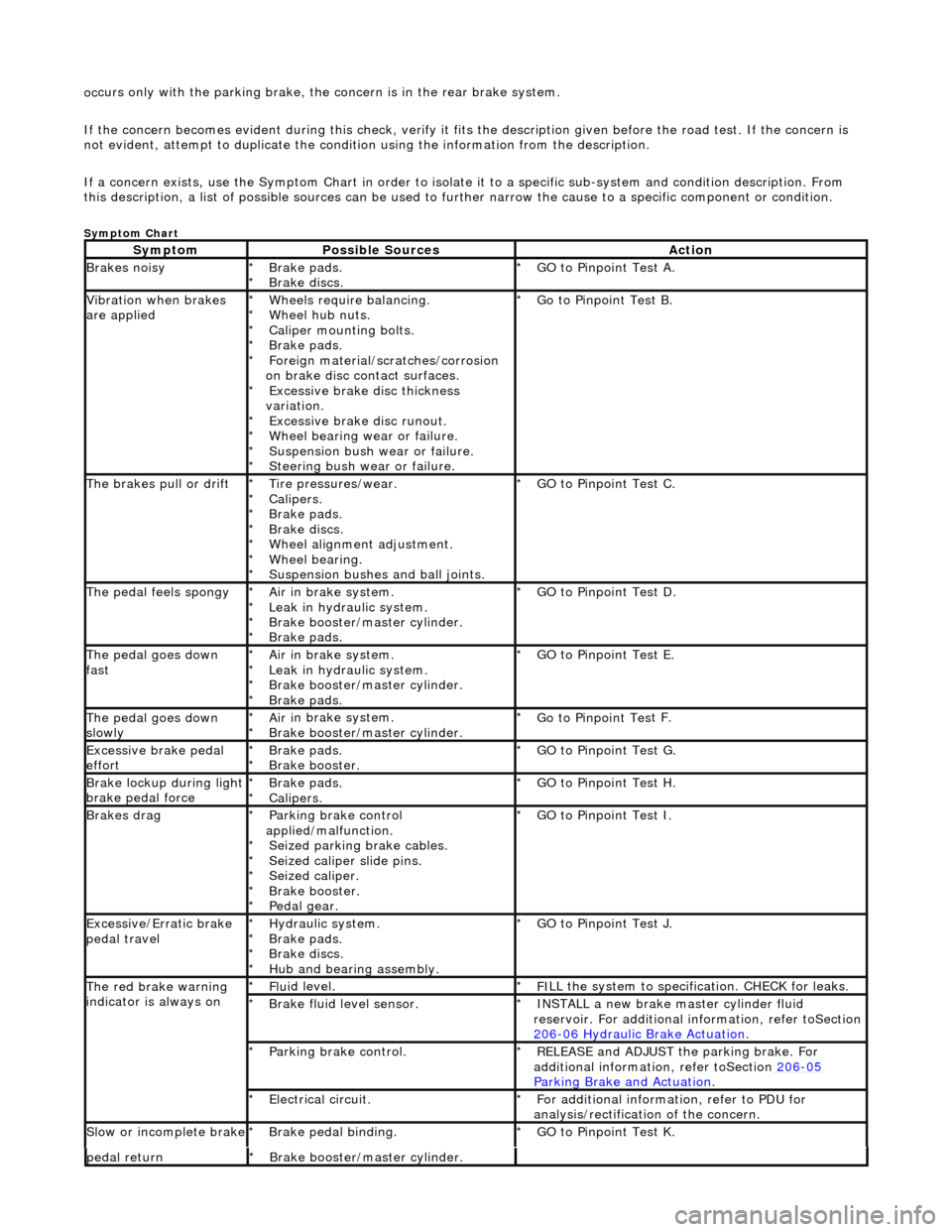
If a concern exists, use the Symptom Chart in order to isolate it to a specific sub-system and condition description. From
this description, a list of possible sources can be used to further narrow the cause to a specific component or condition.
Sym
ptom Chart
Sy
m
ptom
Possib
l
e Sources
Acti
o
n
Brakes
n
oisy
Brake pads.
Brake di
scs
.
*
*
GO to Pinpoint
Tes
t A.
*
Vibration wh
en brakes
are applied
Wh eels require bala
ncing.
Wheel hub nuts.
Caliper mounting bolts.
Brake pads.
Foreign material/scr atches/corrosion
on brake disc contact surfaces. Excessive brake disc thickness
variation. Excessive brake disc runout.
Wheel bearing wear or failure.
Suspension bush wear or failure.
Steering bush wear or failure.
*
*
*
*
*
*
*
*
*
*
Go to Pinpoint
Tes
t B.
*
The brakes pull or drif tTire pressures/wear.
Calipers.
Brake pads.
Brake di
scs.
Wheel alignment adjustment.
Wheel bearing.
Suspension bushes and ball joints.
*
*
*
*
*
*
*
GO to Pinpoint
Tes
t C.
*
The pedal feels spongyAir i
n brake system.
Leak in hydraulic system.
Brake booster/master cylinder.
Brake pads.
*
*
*
*
GO to Pinpoint Tes
t D.
*
The pedal goes down
fa s
t
Ai
r i
n brake system.
Leak in hydraulic system.
Brake booster/master cylinder.
Brake pads.
*
*
*
*
GO to Pinpoint
Tes
t E.
*
The pedal goes down
slowl yAir i
n brake system.
Brake booster/master cylinder.
*
*
Go to Pinpoint
Tes
t F.
*
Excessive brake pedal
effor tBrake pads.
Brake booster.
*
*GO to Pinpoint
Tes
t G.
*
Brake lockup du ring ligh
t
brake pedal force
Brake pads.
Calipers.
*
*GO to Pinpoint
Tes
t H.
*
Brakes d r
ag
Parkin
g brake con
trol
applied/malfunction. Seized parking brake cables.
Seized caliper slide pins.
Seized caliper.
Brake booster.
Pedal gear.
*
*
*
*
*
*
GO to Pinpoint
Tes
t I.
*
Exce ssi
ve/Erratic brake
pedal travel
Hydrau li
c system.
Brake pads.
Brake discs.
Hub and bearing assembly.
*
*
*
*
GO to Pinpoint
Tes
t J.
*
The red brak e warning
indi
cator is always on
Fl
ui
d level.
*
F I
LL the system to specification. CHECK for leaks.
*
Brake flu i
d level sensor.
*
I N
STALL a new brake master cylinder fluid
reservoir. For additional in formation, refer toSection
206
-0 6
Hydraulic Brake Actuation
.
*
Parkin
g brake con
trol.
*
REL
E
ASE and ADJUST the parking brake. For
additional information, refer toSection 206
-05
Parkin g Brake an
d Actuation
.
*
E
l
ectrical circuit.
*
F or additional
information, refer to PDU for
analysis/rectification of the concern.
*
Sl
ow or i
ncomplete brake
Brake peda
l binding.
*
GO to Pinpoint Tes
t K.
*
pedal retu rnBr
ake booster/master cylinder.
*
Page 311 of 2490
P
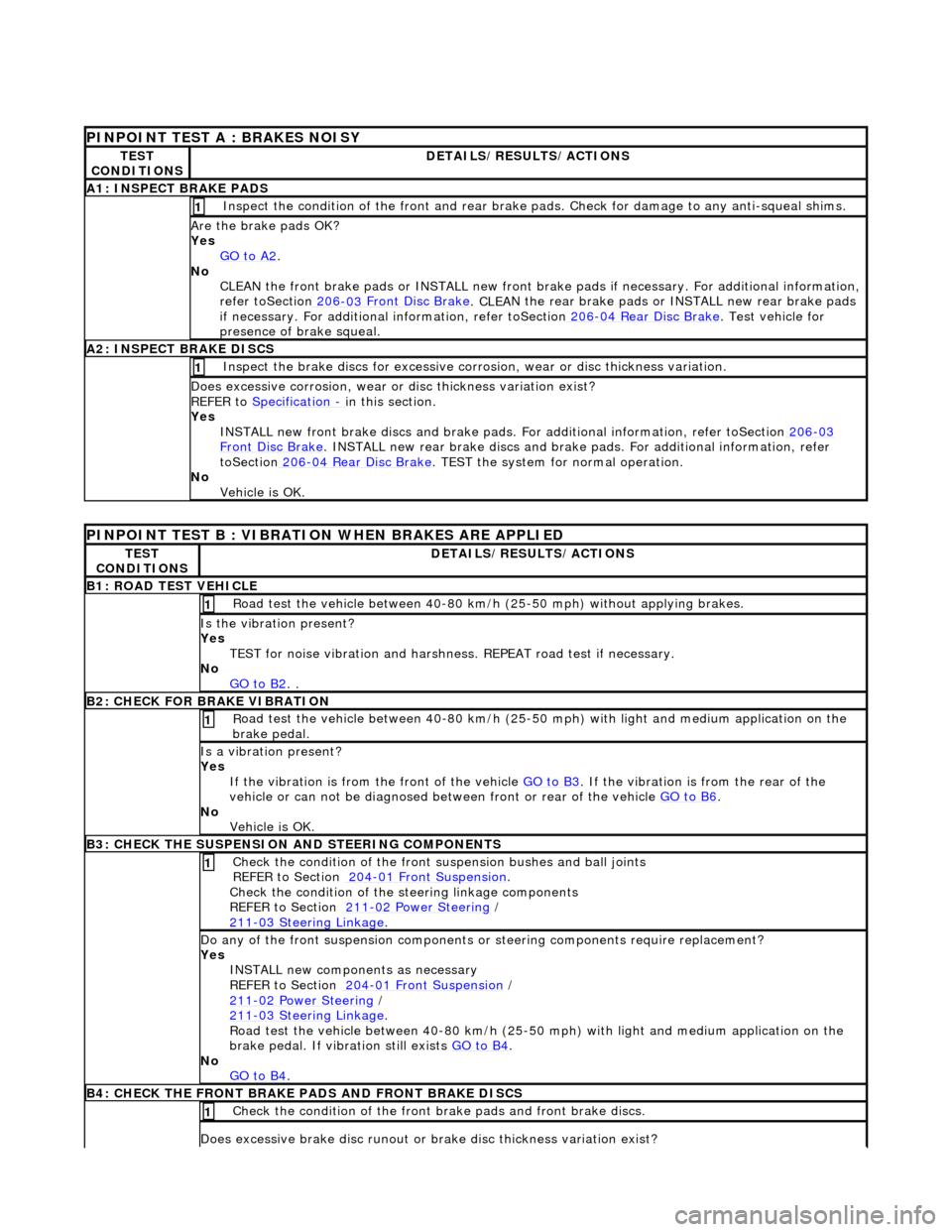
INPOINT TEST A : BRAKES NOISY
TE
ST
CONDITIONS
D
ETAILS/RESULTS/ACTIONS
A1
: INSPECT BRAKE PADS
Inspect the condi
tion of the front and rear brake
pads. Check for damage to any anti-squeal shims.
1
Are th
e brake pads OK?
Yes GO to A2
.
No
CLEAN the front brake pads or INSTALL new front brak e pads if necessary. For additional information,
refer toSection 206
-03
Front Disc Brake
. CLEA
N the rear brake pads or INSTALL new rear brake pads
if necessary. For additional information, refer toSection 206
-0
4 Rear Disc Brake
.
Test vehicle for
presence of brake squeal.
A2
: INSPECT BRAKE DISCS
Inspe
ct the brake discs for excessive corrosi
on, wear or disc thickness variation.
1
D
oes excessive corrosion, wear or
disc thickness variation exist?
REFER to Specification
- in t
his section.
Yes INSTALL new front brake discs and brake pads. For additional information, refer toSection 206
-03
Fr
ont Disc Brake
. INSTALL n
ew rear brake discs and brake
pads. For additional information, refer
toSection 206
-0
4 Rear Disc Brake
. TEST
the system for normal operation.
No Vehicle is OK.
P
INPOINT TEST B : VIBRATIO
N WHEN BRAKES ARE APPLIED
TE
ST
CONDITIONS
D
ETAILS/RESULTS/ACTIONS
B1
: ROAD TEST VEHICLE
R
oad test the vehicle between 40-80 km/h (25-50 mph) without applying brakes.
1
Is th
e vibration present?
Yes TEST for noise vibration and harshness. REPEAT road test if necessary.
No GO to B2
. .
B2
: CHECK FOR BRAKE VIBRATION
R
oad test the vehicle between 40-80 km/h (25-50
mph) with light and medium application on the
brake pedal.
1
Is a vibration
present?
Yes If the vibration is from the front of the vehicle GO to B3
. If
the vibration is
from the rear of the
vehicle or can not be di agnosed between front or rear of the vehicle GO to B6
.
No
Vehicle is OK.
B3: CHECK
THE SUSPENSION
AND STEERING COMPONENTS
Chec
k the condition of the front susp
ension bushes and ball joints
REFER to Section 204
-01
Front Suspension
.
Chec
k the condition of the steering linkage components
REFER to Section 211
-0
2 Power Steering
/
211
-0
3 Steering Linkage
.
1
D
o any of the front suspension components or steering comp
onents require replacement?
Yes INSTALL new components as necessary
REFER to Section 204
-01
Front Suspension
/
211
-0
2 Power Steering
/
211
-0
3 Steering Linkage
.
R
oad test the vehicle between 40-80 km/h (25-50
mph) with light and medium application on the
brake pedal. If vibr ation still exists GO to B4
.
No
GO to B4
.
B4: CHECK
THE FRONT BRAKE PA
DS AND FRONT BRAKE DISCS
Chec
k the condition of the front br
ake pads and front brake discs.
1
D
oes excessive brake disc runout or br
ake disc thickness variation exist?
Page 312 of 2490
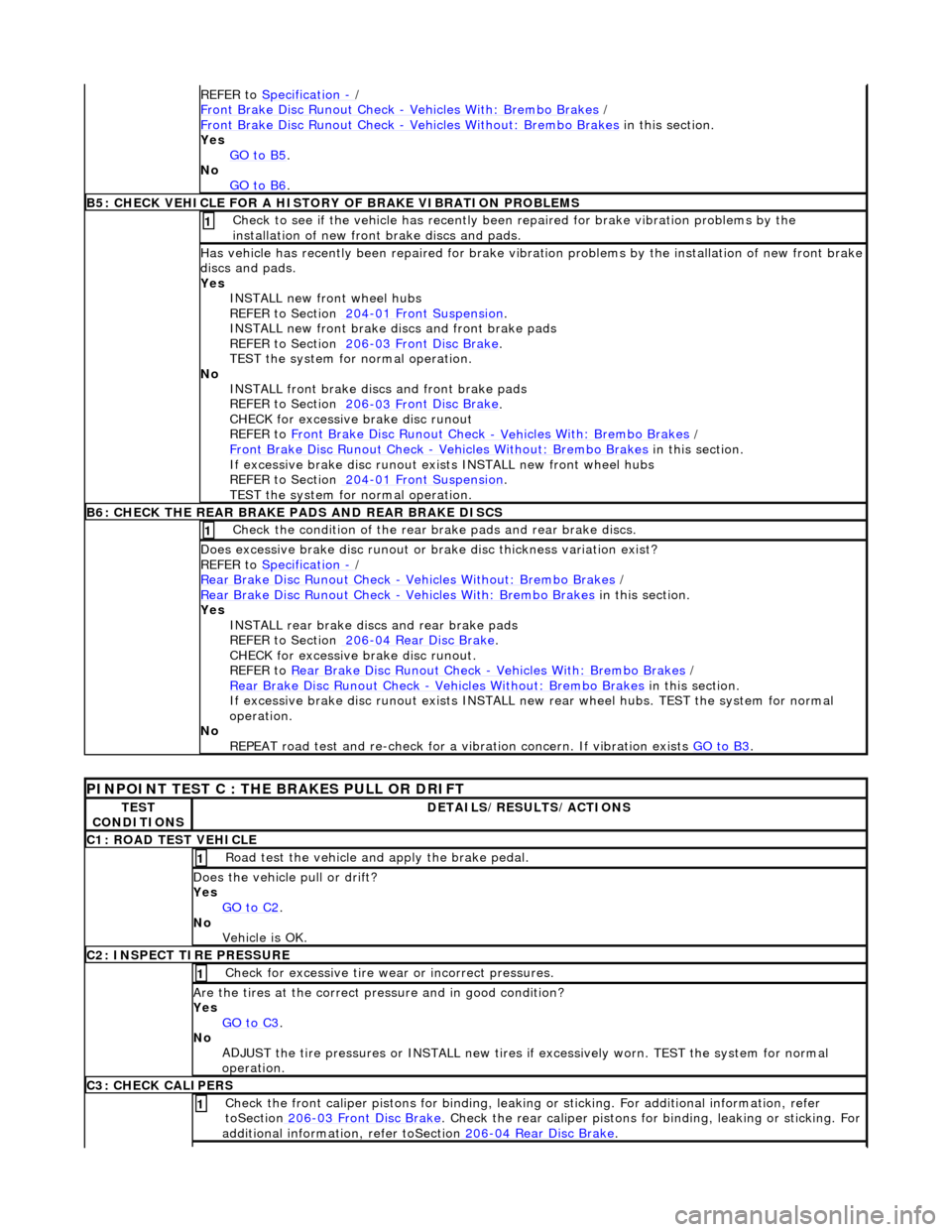
REFE
R to
Specification
- /
F r
ont Brake Disc Runout Check
- V
eh
icles With: Brembo Brakes
/
F
ront Brake Disc Runout Check
- V
e
hicles Without: Brembo Brakes
in this
section.
Yes GO to B5
.
No
GO to B6
.
B5: CHECK VEHICLE
FOR A HISTORY OF BRAKE VIBRATION PROBLEMS
Chec
k to se
e if the vehicle has recently been
repaired for brake vibration problems by the
installation of new front brake discs and pads.
1
Has vehicl
e has recently been repaired for brake vibrat
ion problems by the installation of new front brake
discs and pads.
Yes INSTALL new front wheel hubs
REFER to Section 204
-01 Fron
t Suspension
.
INST ALL new fr
ont brake disc
s and front brake pads
REFER to Section 206
-03 Fr
ont Disc Brake
.
TEST the system for normal
operation.
No INSTALL front brake discs and front brake pads
REFER to Section 206
-03 Fr
ont Disc Brake
.
CHECK for excessiv
e brake disc runout
REFER to Front Brake Disc Runout Check
- Veh
icles With: Brembo Brakes
/
F
ront Brake Disc Runout Check
- V
e
hicles Without: Brembo Brakes
in this
section.
If excessive brake disc runout exis ts INSTALL new front wheel hubs
REFER to Section 204
-01 Fron
t Suspension
.
TEST the system for normal
operation.
B
6:
CHECK THE REAR BRAKE PADS AND REAR BRAKE DISCS
Chec
k
the condition of the rear brake pads and rear brake discs.
1
D
o
es excessive brake disc runout or br
ake disc thickness variation exist?
REFER to Specification
- /
Rear B
rake Disc Runout Check
- Ve
hicles Without: Brembo Brakes
/
Rear
Brake Disc Runout Check
- Veh
icles With: Brembo Brakes
in this
section.
Yes INSTALL rear brake discs and rear brake pads
REFER to Section 206
-04
Rear Disc Brake
.
CHECK for excessiv
e brake disc runout.
REFER to Rear Brake Disc Runout Check
- Veh
icles With: Brembo Brakes
/
Rear
Brake Disc Runout Check
- V
e
hicles Without: Brembo Brakes
in this
section.
If excessive brake disc runout exists INSTALL ne w rear wheel hubs. TEST the system for normal
operation.
No REPEAT road test and re-check for a vi bration concern. If vibration exists GO to B3
.
PINPOINT TEST
C : THE BRAKES PULL OR DRIFT
TE
S
T
CONDITIONS
D E
TAILS/RESULTS/ACTIONS
C1
:
ROAD TEST VEHICLE
Road test th
e veh
icle and apply the brake pedal.
1
D
o
es the vehicle pull or drift?
Yes GO to C2
.
No
Vehicle is OK.
C2:
INS
PECT TIRE PRESSURE
Check f
or ex
cessive tire wear
or incorrect pressures.
1
Are the ti
res at the correct pressure and in good condition?
Yes GO to C3
.
No
AD
JUST the tire pressures or IN
STALL new tires if excessively wo rn. TEST the system for normal
operation.
C3 : CH
ECK CALIPERS
Check the fr
on
t caliper pistons for binding, leakin
g or sticking. For additional information, refer
toSection 206
-03 Fr
ont Disc Brake
. Check the rear cal
i
per pistons for
binding, leaking or sticking. For
additional information, refer toSection 206
-04
Rear Disc Brake
.
1