wash JAGUAR XF 2009 1.G User Guide
[x] Cancel search | Manufacturer: JAGUAR, Model Year: 2009, Model line: XF, Model: JAGUAR XF 2009 1.GPages: 391, PDF Size: 19.32 MB
Page 138 of 391
Transmission
138
P should be selected before switching off the
engine. However, it is possible to switch the
engine off with R, D or S selected - the selector
will automatica lly select P, while retracting into
the centre console.
Note: If the engine is switched off with N
selected, the system will wait for 10 minutes
before selecting P. This procedure is to allow
the vehicle to be conveyed through a car wash
only and should not be used for vehicle
recovery purposes.
To prevent the transmission from
automatically selecting P (e.g. for vehicle
recovery purposes), it is necessary to activate
the Emergency Park Release.
See TRANSPORTING THE VEHICLE
(page 254).
Selector positions
P - Park: Use when parked. In this position the
transmission is locked, do not attempt to select
P if the vehicle is moving.
Note: P will be selected automatically when the
engine is switched off.
R - Reverse: Do not select if the vehicle is
moving forward.
N - Neutral: Disconnects drive to the wheels.
Use the parking brake when stopping
temporarily with N selected.
D - Drive: Gear changing is automatic for all six
forward gears. The shift points are determined
by accelerator pedal pos ition and road speed,
to provide the best ba lance of performance,
refinement and fuel economy, for the large
majority of driving conditions.
S - Sport: Gear changing is automatic for all six
forward gears, with modified gear shift points
to maximise the ve hicle response in
demanding driving condi tions. This mode is
not suitable for town or highway cruising. Note:
Both D and S positions also offer
additional features, wh ich are listed under
Automatic mode and Sport mode , later in this
section.
Stationary vehicle
When the vehicle is stationary, the selector
may be left in D or S, unless the vehicle is to be
parked. When stopping fo r extended periods,
either select P or apply the parking brake and
select N.
Selector interlock
The transmission is equippe d with an interlock,
to prevent inadvertent selection of a drive gear
(D , S or R) from the P or N positions. To
release the interlock to select a drive gear,
press the brake pedal while making the
selection.
Ensure the required driv ing range has selected
prior to releasing the brake pedal. The range
indicator ( R, D or S) on the selector and
message centre disp lays, will illuminate
continuously to confirm selection.
Note: If the brake pedal is released too early
during selector rotation from P or N to a driving
range ( R, D or S), then the selected range will
not be engaged. The selected range will flash
on the selector and message centre displays.
To obtain the selected range, press the brake
pedal, select P or N and reselect the required
range, ensuring the brake pedal is depressed.
If N is selected for less than 2 seconds (e.g.
when moving the selector between R and D),
the interlock will not ac tivate and the brake
pedal will not need to be pressed.
Note: The interlock is deactivated when the
vehicle is travelling at more than 5 km/h
(3 mph).
Page 187 of 391
187
Vehicle care
CLEANING THE ALLOY WHEELS
Wash the wheels with soap and water, this
should be done more frequently when the
wheels are exposed to heavy dirt deposits, salt,
clay etc. If you are unsure how often to clean
the wheels in particular conditions, seek advice
from your Dealer/A uthorised Repairer.
Jaguar approved wheel cleaner should be used
to remove heavy soiling.
CLEANING THE EXTERIOR
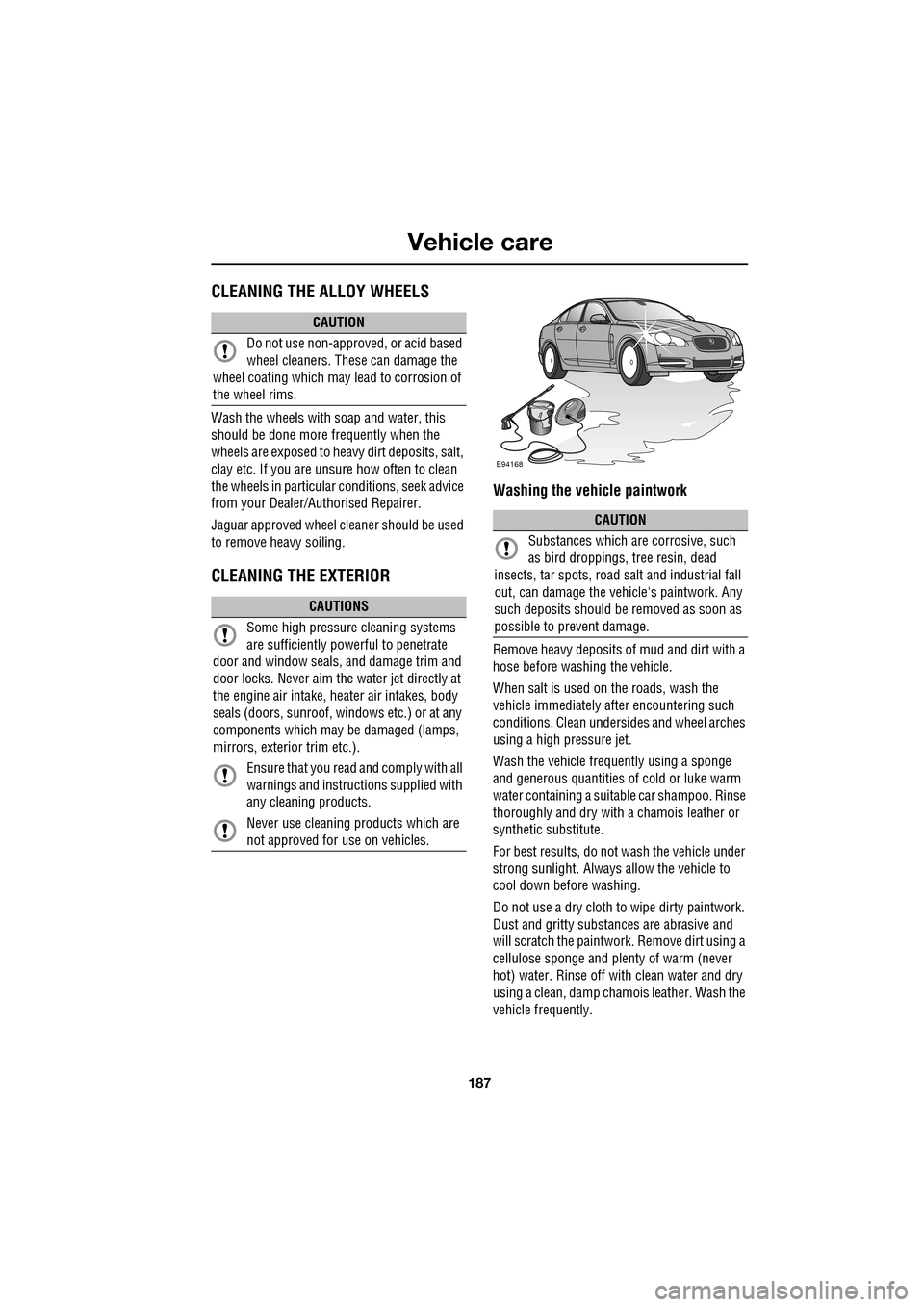
Washing the vehicle paintwork
Remove heavy deposits of mud and dirt with a
hose before washing the vehicle.
When salt is used on the roads, wash the
vehicle immediately after encountering such
conditions. Clean undersid es and wheel arches
using a high pressure jet.
Wash the vehicle frequently using a sponge
and generous quantities of cold or luke warm
water containing a suitable car shampoo. Rinse
thoroughly and dry with a chamois leather or
synthetic substitute.
For best results, do not wash the vehicle under
strong sunlight. Always allow the vehicle to
cool down before washing.
Do not use a dry cloth to wipe dirty paintwork.
Dust and gritty substances are abrasive and
will scratch the paintwork. Remove dirt using a
cellulose sponge and plen ty of warm (never
hot) water. Rinse off with clean water and dry
using a clean, damp cham ois leather. Wash the
vehicle frequently.
CAUTION
Do not use non-approved, or acid based
wheel cleaners. These can damage the
wheel coating which may lead to corrosion of
the wheel rims.
CAUTIONS
Some high pressure cleaning systems
are sufficiently powe rful to penetrate
door and window seals, and damage trim and
door locks. Never aim the water jet directly at
the engine air intake, he ater air intakes, body
seals (doors, sunroof, windows etc.) or at any
components which may be damaged (lamps,
mirrors, exterior trim etc.).
Ensure that you read and comply with all
warnings and instruct ions supplied with
any cleaning products.
Never use cleaning products which are
not approved for use on vehicles.
CAUTION
Substances which are corrosive, such
as bird droppings, tree resin, dead
insects, tar spots, road salt and industrial fall
out, can damage the vehic le's paintwork. Any
such deposits should be removed as soon as
possible to prevent damage.
E94168
Page 188 of 391
Vehicle care
188
Do not use household soaps or detergents. The
use of Jaguar Vehicle Shampoo is
recommended.
Note: The vehicle's brightwork should be
cleaned using a sponge and generous
quantities of cold or lukewarm water only.
Rinse thoroughly and dry with a chamois
leather or synthetic substitute.
Using an automatic wash
Note: Regular use of automatic car washes
tends to dull the lustre of the paintwork.
1. Drive up to the entry of the car wash and
onto the conveyor.
2. Select N (Neutral) using the JaguarDrive
selector.
3. Press and release the engine START/STOP
button to stop the engine. The JaguarDrive
selector should remain raised and the
selector and message centre should
indicate that N is selected. 4.
The vehicle should rema in in this condition
while it is conveyed through the car wash.
5. At the end of the wash cycle, when directed
to start the engine by the car wash
instructions, press the brake pedal and
press and release the engine START/STOP
button to start the engine.
6. Select D (Drive) using the JaguarDrive
selector and drive away.
Do not start the engine or change the
JaguarDrive selector position during the car
wash.
After leaving the car wash, switch on the
windscreen wiper immediately to remove water
and prevent a build up of wax.
Underbonnet cleaning
CAUTIONS
Commercially operated automatic car
washes, jet washes and power-operated
mops, are not recommen ded. The detergents
used can contain certain chemicals which
may, over time, be detrimental to some
exterior parts of the vehicle. Prolonged usage
of automatic car wash es and power-operated
mops will also cause fine scratches in the paint
surface.
Ensure that Auto wipe is not selected
when entering a car wash, or damage to
the wiper blades and arms can occur if they
operate during the wash cycle.
Ensure that when using an automatic
drive through car wash, N (Neutral) is
selected and that the ignition is left in
convenience mode for the duration of the
wash.
CAUTIONS
Do not use a high pr essure washer or
steam cleaner in the engine
compartment. Damage to components could
occur.
Ensure that the brake fluid reservoir is
kept dry at all times. Only use a clean,
dry cloth to clean the brake fluid cap and
reservoir.
Page 189 of 391
189
Vehicle care
Glass surfaces
Clean the rear window with a soft cloth to avoid
damaging the heating element. Do not scrape
the glass or use any abrasive cleaning fluid.
Mirror glass is particularly susceptible to
damage. Wash with soapy water. Do not use
abrasive cleaning compounds or metal
scrapers to remove ice.
The following products will ensure glass
surfaces and windscreen wipers are kept in
good condition:
• Jaguar Screen Clean Paste - Apply only to
the windscreen exterior to ensure effective
operation of the windscreen wiper.
• Jaguar Glass Cleaner - Interior and exterior
of all other glass surfaces.
• Jaguar Screen Wash - Washer reservoir
additive.
• Jaguar Winter Care Kit comprising de-icer,
ice scraper, anti-mist wipe cloth and aerial
cleaner - for use in adverse weather
conditions.
Cleaning the rear screen
To avoid damaging the heating elements when
cleaning the inside of th e rear screen, use only
a soft damp cloth/chamois leather. Do not use
solvents or sharp objects to clean the glass.
Removing grease and tar
Remove grease or tar with Jaguar Tar Remover
or methylated spirit (a lcohol). White spirit is
also effective, but mu st not be applied to
rubber, particularly the windscreen wiper
blades.
Bird droppings
Do not allow bird droppings or tree sap to
harden. Remove from paintwork immediately
with a lukewarm soap and water solution.
Polishing
For maximum protection against road dust,
salts, industrial fall-out etc., it is recommended
that the vehicle is polished regularly using
Jaguar polish and a polishing cloth.
CLEANING THE INTERIOR
CAUTION
Ensure that after using methylated or
white spirit, the area is washed
immediately with soapy water, to remove all
traces of spirit.
CAUTION
Chrome polish, or other abrasive
cleaners, must not be used on the
vehicle's brightwork. The vehicle's brightwork
should be cleaned using a sponge and
generous quantities of cold or lukewarm water
only. Rinse thoroughly a nd dry with a chamois
leather or synthetic substitute.
WARNING
Ensure that you read all of the
information and instructions for use
provided with cleaning products.
Some products contain substances that are
harmful and can cause he alth problems if used
incorrectly.
CAUTIONS
Some products, if used incorrectly can
cause damage to the in terior surfaces of
the vehicle.
To prevent airbag damage, the steering
wheel centre pad and other areas
containing airbags s hould only be cleaned
sparingly with a damp cl oth, warm water and a
non-detergent soap. Do not allow these areas
to be flooded with chemical solvents, liquids,
furniture cream or polishes.
Page 190 of 391
Vehicle care
190
Leather
Leather is an easy to maintain natural product.
However, dust and subs tances can penetrate
the pores and crease the leather, causing
surface wear and brittleness.
To prevent ingrained dirt and staining, inspect
the seat upholstery regularly and clean every
one to two months, as follows:
• Wipe off fine dust from the seat surfaces
using a clean, damp, non-coloured cloth.
Change frequently to a clean area of cloth,
to avoid abrasive action on the leather
surface. Avoid over-wetting.
• If this is not suffic ient, use a cloth which
has been dampened with warm soapy
water and then wrung out. Use only mild
non-caustic soap.
• Use Jaguar Leather Cleaner for heavily
soiled areas. Dry off and rub with a clean
soft cloth, changing surfaces regularly.
When staining (e.g. from clothing) or spillage
occurs, clean the affected area immediately as
described above.
Use Jaguar Leather Cleaner several times a
year to maintain its appearance and
suppleness. The clea ner will nourish and
moisturise and help to improve the surface
protective film agains t dust and substances.
• Do not use solvents. Do not use
detergents, furniture polish or household
cleaners. While these products may
initially give impressi ve results, their use
will lead to rapid deterioration of the
leather and will inva lidate the warranty.
Jaguar recommend a basic set of products
that have been specially selected for the
type of leather in your vehicle.
• Dark clothing may stain leather seats just
like other upholstery products. •
Sharp objects such as belts, zip fasteners,
rivets, etc., can leave permanent scratches
and scratch marks on the leather surface.
• Unless spillages such as tea, coffee or ink
are washed away immediately, permanent
staining may have to be accepted.
If a valet service is used, ensure that the
specialist concerned is aware of, and follows,
these instructions precisely.
Cloth and fabric
Use Jaguar Upholstery Cleaner, following the
instructions. Avoid over-wetting.
Removing stains
Most stains on woollen fabric can be removed
if treatment is carried out immediately, before
the stain has a chance to dry-in.
Most stains can be treated with one of three
cleaning fluids: Jaguar U pholstery Cleaner, dry
cleaning fluid or clean water. Follow the
instructions on the package.
Instrument pack, clock, and audio
equipment
Only use a soft dry cloth to clean the
instrument pack, clock and audio equipment.
Do not use cleaning fluids or sprays.
CAUTIONS
Never use soap, ammonia, bleach or
other cleaners intended for use on hard
surfaces.
Do not use upholst ery cleaner on
electrical equipment such as fascia
switches.
When cleaning around electrical
equipment such as switches, ensure
that fluids do not leak into any gaps around the
components or between panels or trim.
Page 192 of 391
Maintenance
192
GENERAL INFORMATION
Regular systematic maintenance is the key to
ensuring the continued reliability and efficiency
of your vehicle.
Maintenance is the owner's responsibility and
you must ensure that owner maintenance
operations, oil services, inspections and brake
fluid and coolant changes are carried out when
required and according to the manufacturer's
recommendations.
The routine maintenance requirements for your
vehicle are shown in th e Service Portfolio book.
Most of this necessar y workshop maintenance
requires specialised knowledge and
equipment, and should preferably be entrusted
to a Dealer/Authorised Repairer.
Service Portfolio
The Service Portfolio book includes a Service
Record section, which enables a record to be
kept of all the servicing and inspections that are
carried out on the vehicle. This section of the
book also has an area for brake fluid changes
to be recorded.
Ensure your service provider signs and stamps
the book after each se rvice and inspection.
Owner maintenance
In addition to the routine services and
inspections, a number of simple checks must
be carried out more frequently. These checks
can be carried out by th e owner and advice is
given on the pages that follow.
Daily checks
• Operation of lamps, horn, direction
indicators, wipers, washers and warning
indicators.
• Operation of seat belts and brakes.
• Look for fluid deposits underneath the
vehicle that might indicate a leak.
Condensation drips from the air
conditioning is normal.
CAUTION
Severe damage to the electrical system
and electronic components can occur, if
any attempt is made to diagnose faults in the
electrical system using conventional
diagnostic equipment (e .g. the use of test
lamps or low impedanc e voltmeters). The
fitting of any electric al accessory should only
be entrusted to a Deal er/Authorised Repairer.CAUTION
Any significant or sudden drop in fluid
levels, or uneven tyre wear, should be
reported to a qualifie d technician without
delay.
Page 193 of 391
193
Maintenance
Weekly checks
•Engine oil level (non- electronic dipstick
vehicles). See ENGINE OIL CHECK - V6
Petrol engines (page 197).
• Engine coolant check. See ENGINE
COOLANT CHECK (page 204).
• Brake fluid level. See BRAKE FLUID
CHECK (page 206).
• Power steering fluid level. See POWER
STEERING FLUID CHECK (page 208).
• Screen washer fluid level. See WASHER
FLUID CHECK (page 209).
• Tyre pressures and condition. See TYRE
CARE (page 217).
• Operate air conditioning. See AUTOMATIC
CLIMATE CONTROL (page 116).
Note: The engine oil level on V6 petrol engines,
should be checked more frequently if the
vehicle is driven for prolonged periods at high
speeds. The engine oil level on diesel and V8
petrol engines is checked automatically at all
times by the electronic dipstick.
Severe driving conditions
When a vehicle is operated in severe
conditions, more frequent attention must be
paid to servicing requirements.
Severe driving conditions include:
• Driving in dusty and/or sandy conditions.
• Driving on rough and/or muddy roads
and/or wading. •
Driving in extremely hot or cold
conditions.
• Driving in areas using road salt or other
corrosive materials.
• Towing a trailer or driving in mountainous
conditions.
Contact your Dealer/Authorised Repairer for
advice.
Emission control
Your vehicle is fitted with various items of
emission and evaporati ve control equipment,
designed to meet specific territorial
requirements. You should be aware that
unauthorised replacemen t, modification or
tampering with this equipment by an owner or
repair shop, may be unlawful and subject to
legal penalties.
In addition, engine se ttings must not be
tampered with. These have been established to
ensure that your vehicle complies with
stringent exhaust em ission regulations.
Incorrect engine settings may adversely affect
exhaust emissi ons, engine performance and
fuel consumption. The y may also cause high
temperatures, which will result in damage to
the catalytic converter and the vehicle.
Road testing dynamometers (rolling
roads)
Because your vehicle is equipped with anti-lock
brakes, it is essential that any dynamometer
testing is carried out only by a qualified person,
familiar with the dynamometer testing and
safety procedures practised by
Dealers/Authorised Repairers.
CAUTION
Ensure that you take notice of any
message centre information and
warnings relating to engi ne oil level (V8 petrol
and diesel engines only). Top-up the level
when advised to do so. See ENGINE OIL
CHECK - V8 Petrol engines (page 199).
Page 194 of 391
Maintenance
194
Safety in the garageFuel system
Poisonous fluids
Fluids used in motor vehicles are poisonous
and should not be consumed or brought into
contact with open wounds. These include;
battery acid, antifreeze, brake, clutch and
power steering fluid, petrol, diesel, engine oil
and windscreen washer additives.
For your own safety, always read and obey all
instructions printed on labels and containers.
Used engine oil
Prolonged contact with engine oil may cause
serious skin disorders, including dermatitis
and cancer of the skin. Always wash
thoroughly after contact.
It is illegal to pollute drains, water
courses or soil. Use authorised
waste disposal site s to dispose of
used oil and toxic chemicals.
WARNINGS
If the vehicle has been driven
recently, do not touch exhaust and
cooling system components until the
engine has cooled.
Never leave the engi ne running in an
unventilated area - exhaust gases are
poisonous and extremely dangerous.
Do not work beneath the vehicle with
the wheel changing jack as the only
means of support.
Keep your hands and clothing away
from drive belts, pulleys and fans.
Some fans may continue to operate
after the engi ne has stopped.
Remove metal wrist bands and
jewellery, before working in the
engine compartment.
Do not touch electrical leads or
components while the engine is
running, or with the starter switch
turned on.
Do not allow tools or metal parts of
the vehicle to make contact with the
battery leads or terminals.WARNINGS
Under no circumstances should any
part of the fuel system be dismantled
or replaced by anyone other than a
suitably qualified vehicle technician. Failure to
comply with this instruct ion, may result in fuel
spillage with a consequent serious risk of fire.
Ensure sparks and naked lights are
kept away from the engine
compartment.
Wear protective cl othing, including,
where practicable, gloves made from
an impervious material.
Page 196 of 391
Maintenance
196
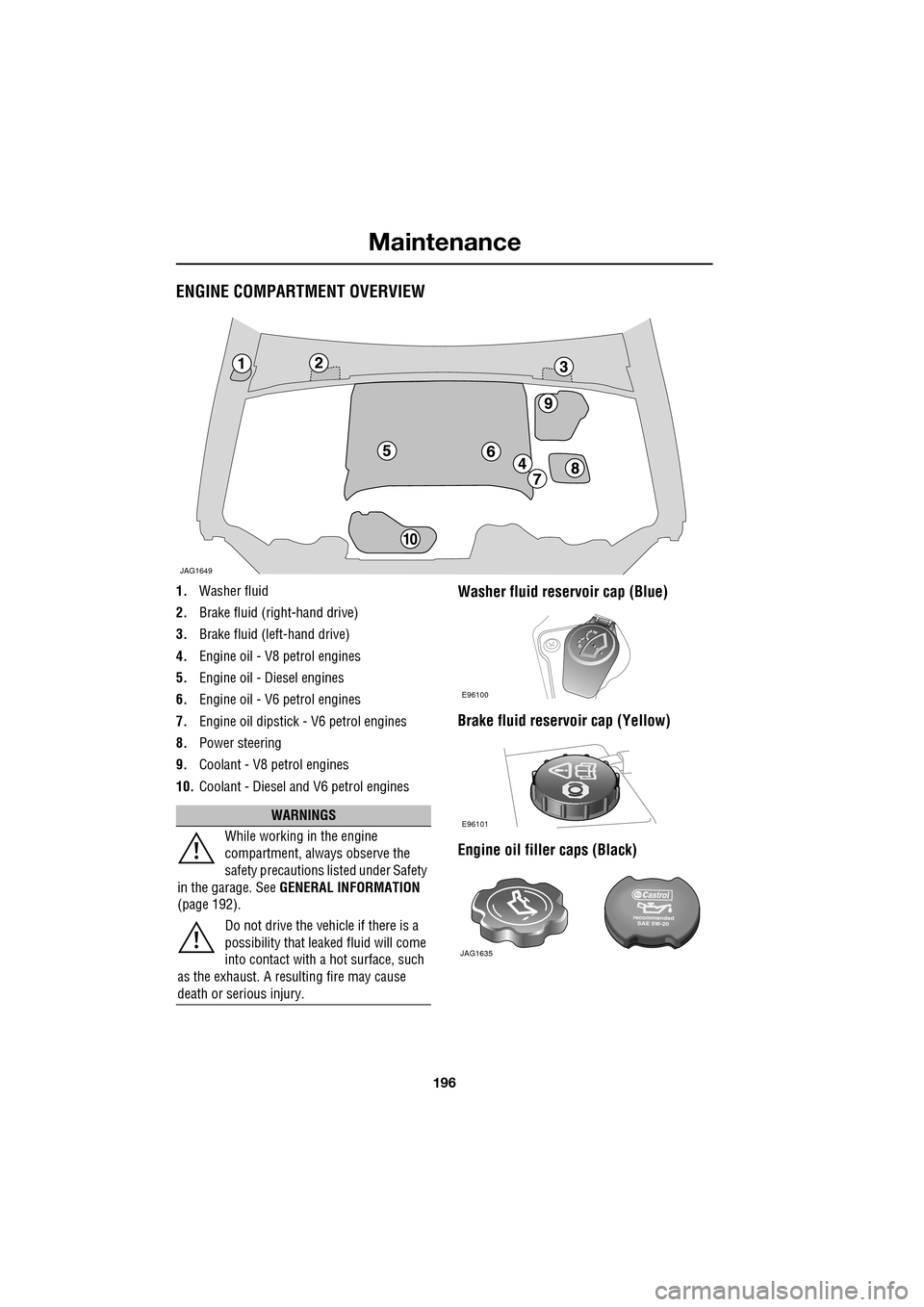
ENGINE COMPARTMENT OVERVIEW
1.Washer fluid
2. Brake fluid (right-hand drive)
3. Brake fluid (left-hand drive)
4. Engine oil - V8 petrol engines
5. Engine oil - Diesel engines
6. Engine oil - V6 petrol engines
7. Engine oil dipstick - V6 petrol engines
8. Power steering
9. Coolant - V8 petrol engines
10. Coolant - Diesel and V6 petrol enginesWasher fluid reservoir cap (Blue)
Brake fluid reservoir cap (Yellow)
Engine oil filler caps (Black)
JAG1649
WARNINGS
While working in the engine
compartment, always observe the
safety precautions listed under Safety
in the garage. See GENERAL INFORMATION
(page 192).
Do not drive the vehicle if there is a
possibility that leaked fluid will come
into contact with a hot surface, such
as the exhaust. A resulting fire may cause
death or serious injury.
E96100
E96101
JAG1635
Page 205 of 391
205
Maintenance
Topping up the coolant
Top-up to the upper level indicator mark
located on the side of the expansion tank. Use
only a 50% mix of water and antifreeze to
specification WSS M97B44 (coloured orange)
Extended Life Coolant.
Note: In an emergency - and only if the
approved antifreeze is unavailable - top-up the
cooling system with clea n water, but be aware
of the resultant reduction in frost protection.
Do not top-up or refill with conventional
antifreeze formulations . If in doubt consult a
qualified technician.
Ensure the cap is tightened fully after top-up is
completed by turning the cap until the ratchet
cap clicks.
Antifreeze
Antifreeze contains important corrosion
inhibitors. The antifreeze content of the coolant
must be maintained at 50% ± 5% all year round
(not just in cold conditions). To ensure that the
anti-corrosion properties of the coolant are
retained, the antifreeze content should be
checked once a year and completely renewed
every ten years, regardless of distance
travelled. Failure to do so may cause corrosion
of the radiator and engine components.
The specific gravity of a 50% antifreeze
solution at 20°C (68°F) is 1.068 and protects
against frost down to -40°C (-40°F).
Use antifreeze to specification WSS M97B44
(coloured orange) Extended Life Coolant.
WARNINGS
Never remove the filler cap when the
engine is hot - escaping steam or
scalding water coul d cause serious
personal injury.
Antifreeze is highly inflammable. Do
not allow antifreeze to come into
contact with naked flames or other
sources of ignition (e.g. a hot engine) - a fire
may result.
Unscrew the filler cap slowly,
allowing the pressure to escape
before removing completely.
CAUTION
When travelling in territories where the
water supply contains salt, always
ensure you carry a supply of fresh (rain or
distilled) water. Topping up with salt water will
cause serious e ngine damage.
WARNINGS
Antifreeze is poisonous and can be
fatal if swallowed - keep containers
sealed and out of the reach of
children. If accident al consumption is
suspected, seek medical attention
immediately.
If the fluid comes into contact with
the skin or eyes, rinse immediately
with plenty of water.
CAUTIONS
The use of non-approved antifreeze will
have an adverse effect on the engine
cooling system and therefore engine
durability.
Antifreeze will damage painted surfaces;
soak up any spillage with an absorbent
cloth immediately and wash the area with a
mixture of car shampoo and water.