FUEL JAGUAR XF 2009 1.G Owner's Manual
[x] Cancel search | Manufacturer: JAGUAR, Model Year: 2009, Model line: XF, Model: JAGUAR XF 2009 1.GPages: 391, PDF Size: 19.32 MB
Page 180 of 391
Fuel and refuelling
180
DIESEL MISFUELLING PROTECTION
DEVICE
Diesel engine vehicles in some markets are
equipped with a misfuelling protection device,
incorporated into the fuel filler neck, designed
to alert that the wrong fuel type has been
selected. If the narrow filler nozzle fitted to
pumps delivering unleaded petrol is correctly
inserted (i.e. fully inserted) into the filler neck,
the misfuel protection de vice will activate.
The protection device c ontinually interrupts the
fuel flow from the pump, until the protector
mechanism in the filler neck is reset.
When activated, the yellow protection device
will be visible in the f iller neck. The device will
need to be reset before the tank can be
correctly filled with dies el fuel. This is achieved
using the reset tool, lo cated in the luggage
compartment, clipped onto the battery
restraining bar.
Note: It is the driver’s responsibility to fill the
vehicle with the correct fuel. The diesel
misfuelling protection devi ce only reduces the
risk of filling the vehicle with the incorrect fuel.
Note: When refuelling the vehicle using a
disposable fuel canister, use a canister
designed for diesel fuel where possible. The
spout on petrol canist ers may activate the
protection device. The device may also be
activated by fuel pumps with a smaller nozzle
than those fitted to standard diesel pumps.
Resetting the protection device
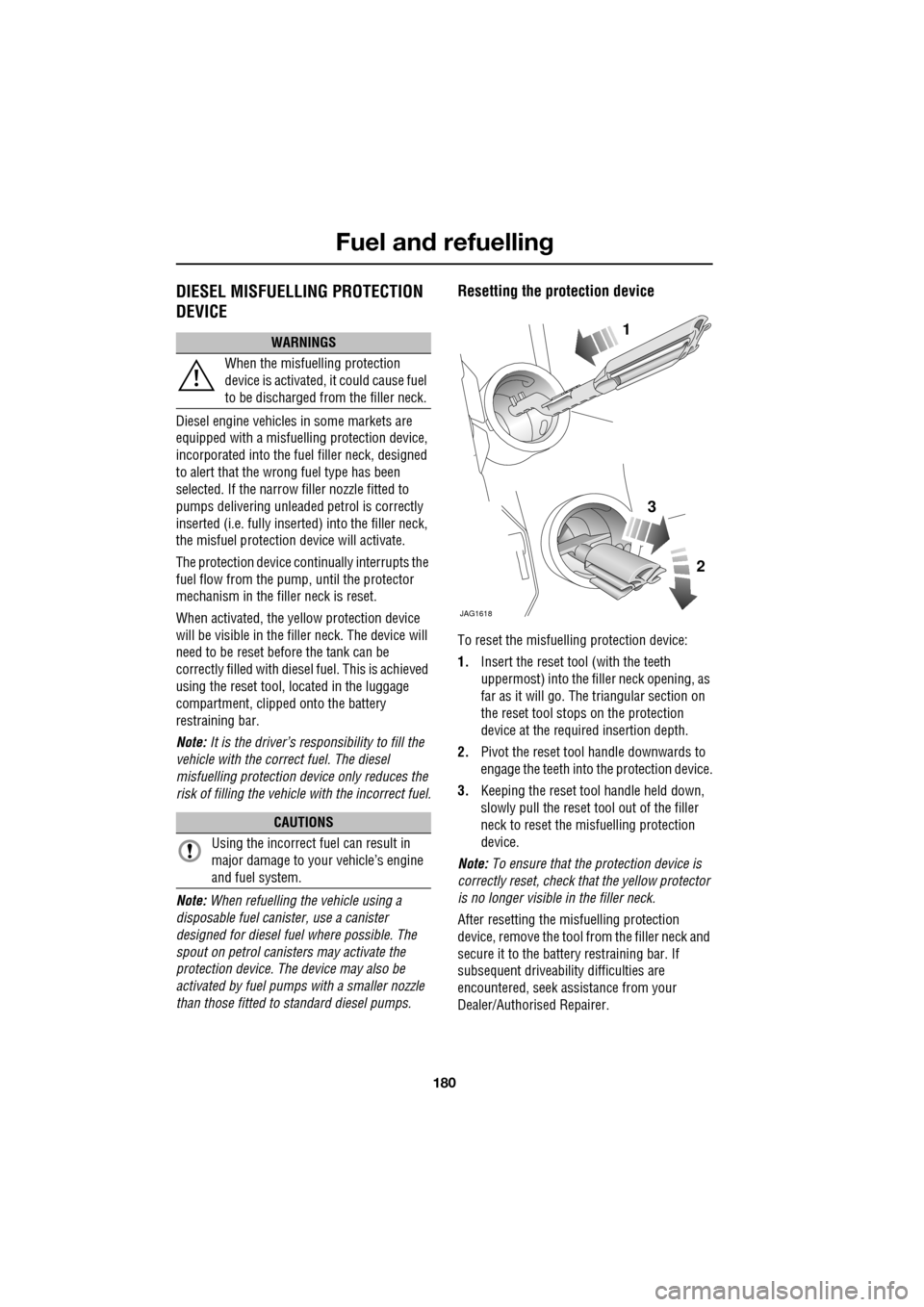
To reset the misfuelling protection device:
1. Insert the reset tool (with the teeth
uppermost) into the fi ller neck opening, as
far as it will go. The triangular section on
the reset tool stop s on the protection
device at the requi red insertion depth.
2. Pivot the reset tool handle downwards to
engage the teeth into the protection device.
3. Keeping the reset tool handle held down,
slowly pull the reset tool out of the filler
neck to reset the misfuelling protection
device.
Note: To ensure that the pr otection device is
correctly reset, check that the yellow protector
is no longer visible in the filler neck.
After resetting the misfuelling protection
device, remove the tool fr om the filler neck and
secure it to the battery restraining bar. If
subsequent driveability difficulties are
encountered, seek assistance from your
Dealer/Authorised Repairer.
WARNINGS
When the misfuelling protection
device is activated, it could cause fuel
to be discharged from the filler neck.
CAUTIONS
Using the incorrect fuel can result in
major damage to your vehicle’s engine
and fuel system.
JAG1618
1
2
3
Page 181 of 391
181
Fuel and refuelling
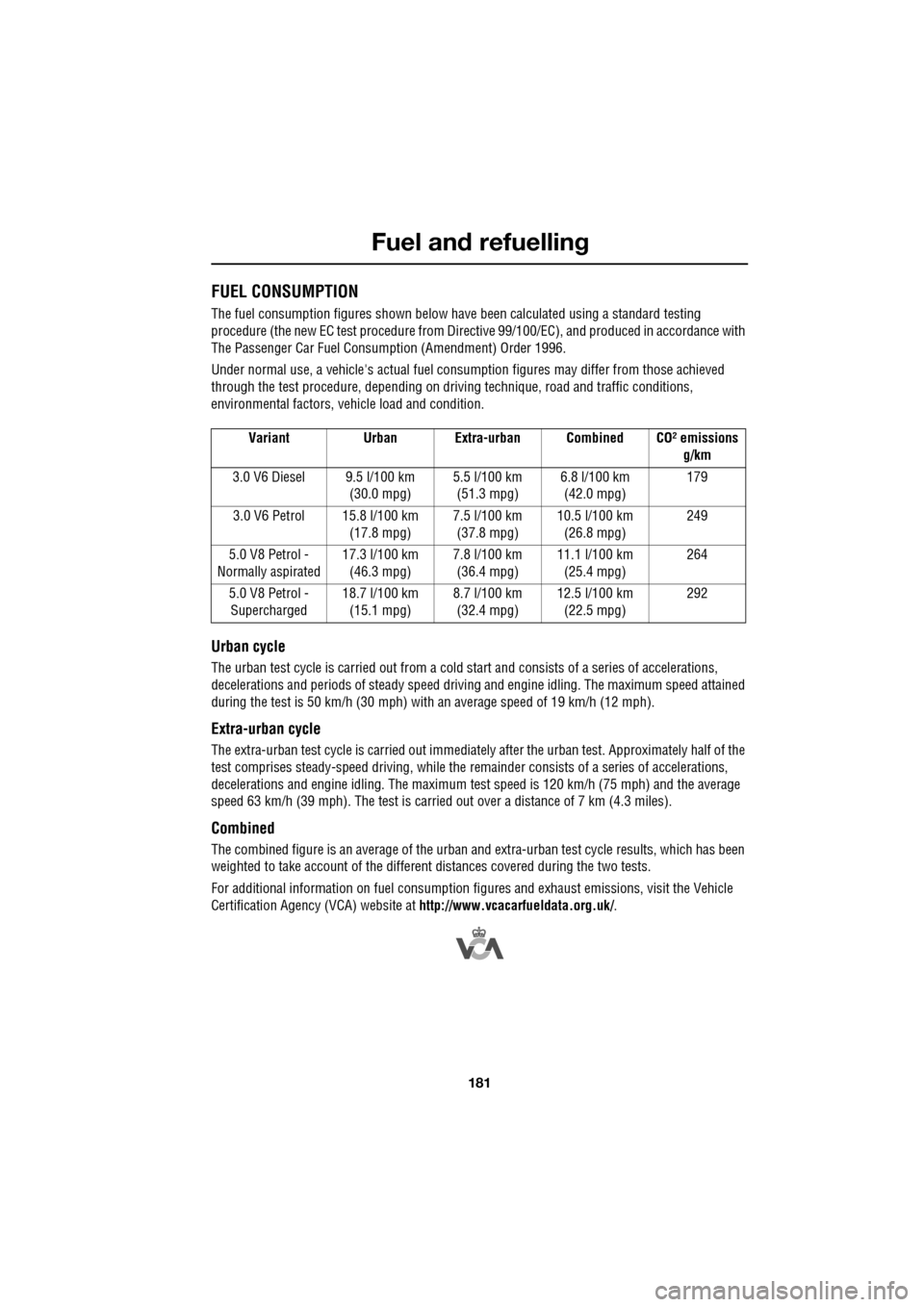
FUEL CONSUMPTION
The fuel consumption figures shown below have been calculated using a standard testing
procedure (the new EC test proc edure from Directive 99/100/EC), and produced in accordance with
The Passenger Car Fuel Cons umption (Amendment) Order 1996.
Under normal use, a vehicle's actu al fuel consumption figures may differ from those achieved
through the test procedure, de pending on driving technique, ro ad and traffic conditions,
environmental factors, ve hicle load and condition.
Urban cycle
The urban test cycle is carried out from a cold start and cons ists of a series of accelerations,
decelerations and periods of stea dy speed driving and engine idling. The maximum speed attained
during the test is 50 km/h (30 mph) with an average speed of 19 km/h (12 mph).
Extra-urban cycle
The extra-urban test cycle is carried out immediatel y after the urban test. Approximately half of the
test comprises steady-speed driving, while the re mainder consists of a series of accelerations,
decelerations and engine idling . The maximum test speed is 120 km/h (75 mph) and the average
speed 63 km/h (39 mph). The test is carried out over a distance of 7 km (4.3 miles).
Combined
The combined figure is an average of the urban an d extra-urban test cycle results, which has been
weighted to take account of the differ ent distances covered during the two tests.
For additional information on fuel consumption figures and exhaust emissions, visit the Vehicle
Certification Agency (VCA) website at http://www.vcacarfueldata.org.uk/.
Variant
Urban Extra-urban Combined CO² emissions
g/km
3.0 V6 Diesel 9.5 l/100 km (30.0 mpg)5.5 l/100 km
(51.3 mpg) 6.8 l/100 km
(42.0 mpg) 179
3.0 V6 Petrol 15.8 l/100 km (17.8 mpg)7.5 l/100 km
(37.8 mpg) 10.5 l/100 km
(26.8 mpg) 249
5.0 V8 Petrol -
Normally aspirated 17.3 l/100 km
(46.3 mpg) 7.8 l/100 km
(36.4 mpg) 11.1 l/100 km
(25.4 mpg) 264
5.0 V8 Petrol - Supercharged 18.7 l/100 km
(15.1 mpg) 8.7 l/100 km
(32.4 mpg) 12.5 l/100 km
(22.5 mpg) 292
Page 193 of 391
193
Maintenance
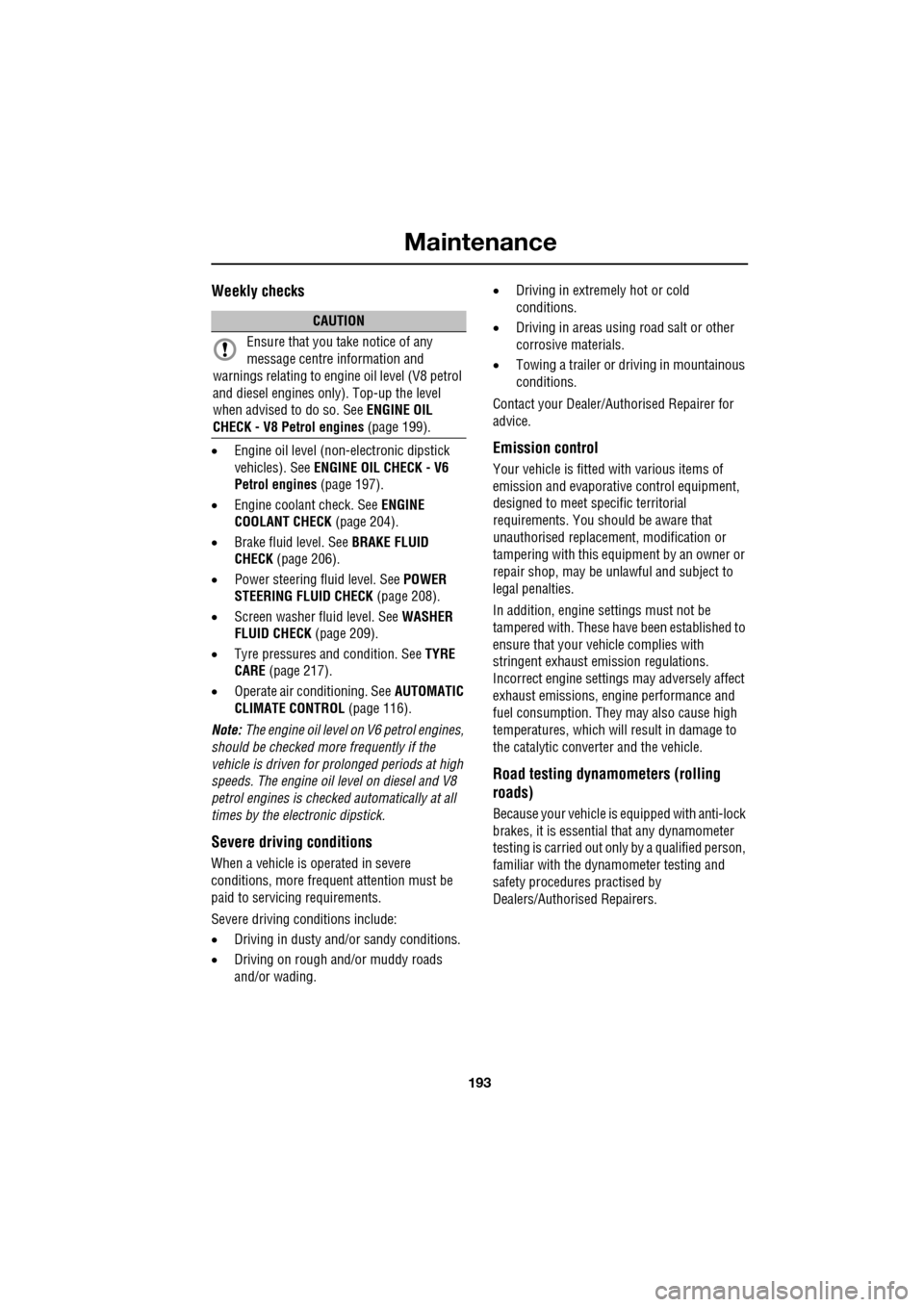
Weekly checks
•Engine oil level (non- electronic dipstick
vehicles). See ENGINE OIL CHECK - V6
Petrol engines (page 197).
• Engine coolant check. See ENGINE
COOLANT CHECK (page 204).
• Brake fluid level. See BRAKE FLUID
CHECK (page 206).
• Power steering fluid level. See POWER
STEERING FLUID CHECK (page 208).
• Screen washer fluid level. See WASHER
FLUID CHECK (page 209).
• Tyre pressures and condition. See TYRE
CARE (page 217).
• Operate air conditioning. See AUTOMATIC
CLIMATE CONTROL (page 116).
Note: The engine oil level on V6 petrol engines,
should be checked more frequently if the
vehicle is driven for prolonged periods at high
speeds. The engine oil level on diesel and V8
petrol engines is checked automatically at all
times by the electronic dipstick.
Severe driving conditions
When a vehicle is operated in severe
conditions, more frequent attention must be
paid to servicing requirements.
Severe driving conditions include:
• Driving in dusty and/or sandy conditions.
• Driving on rough and/or muddy roads
and/or wading. •
Driving in extremely hot or cold
conditions.
• Driving in areas using road salt or other
corrosive materials.
• Towing a trailer or driving in mountainous
conditions.
Contact your Dealer/Authorised Repairer for
advice.
Emission control
Your vehicle is fitted with various items of
emission and evaporati ve control equipment,
designed to meet specific territorial
requirements. You should be aware that
unauthorised replacemen t, modification or
tampering with this equipment by an owner or
repair shop, may be unlawful and subject to
legal penalties.
In addition, engine se ttings must not be
tampered with. These have been established to
ensure that your vehicle complies with
stringent exhaust em ission regulations.
Incorrect engine settings may adversely affect
exhaust emissi ons, engine performance and
fuel consumption. The y may also cause high
temperatures, which will result in damage to
the catalytic converter and the vehicle.
Road testing dynamometers (rolling
roads)
Because your vehicle is equipped with anti-lock
brakes, it is essential that any dynamometer
testing is carried out only by a qualified person,
familiar with the dynamometer testing and
safety procedures practised by
Dealers/Authorised Repairers.
CAUTION
Ensure that you take notice of any
message centre information and
warnings relating to engi ne oil level (V8 petrol
and diesel engines only). Top-up the level
when advised to do so. See ENGINE OIL
CHECK - V8 Petrol engines (page 199).
Page 194 of 391
Maintenance
194
Safety in the garageFuel system
Poisonous fluids
Fluids used in motor vehicles are poisonous
and should not be consumed or brought into
contact with open wounds. These include;
battery acid, antifreeze, brake, clutch and
power steering fluid, petrol, diesel, engine oil
and windscreen washer additives.
For your own safety, always read and obey all
instructions printed on labels and containers.
Used engine oil
Prolonged contact with engine oil may cause
serious skin disorders, including dermatitis
and cancer of the skin. Always wash
thoroughly after contact.
It is illegal to pollute drains, water
courses or soil. Use authorised
waste disposal site s to dispose of
used oil and toxic chemicals.
WARNINGS
If the vehicle has been driven
recently, do not touch exhaust and
cooling system components until the
engine has cooled.
Never leave the engi ne running in an
unventilated area - exhaust gases are
poisonous and extremely dangerous.
Do not work beneath the vehicle with
the wheel changing jack as the only
means of support.
Keep your hands and clothing away
from drive belts, pulleys and fans.
Some fans may continue to operate
after the engi ne has stopped.
Remove metal wrist bands and
jewellery, before working in the
engine compartment.
Do not touch electrical leads or
components while the engine is
running, or with the starter switch
turned on.
Do not allow tools or metal parts of
the vehicle to make contact with the
battery leads or terminals.WARNINGS
Under no circumstances should any
part of the fuel system be dismantled
or replaced by anyone other than a
suitably qualified vehicle technician. Failure to
comply with this instruct ion, may result in fuel
spillage with a consequent serious risk of fire.
Ensure sparks and naked lights are
kept away from the engine
compartment.
Wear protective cl othing, including,
where practicable, gloves made from
an impervious material.
Page 211 of 391
211
Maintenance
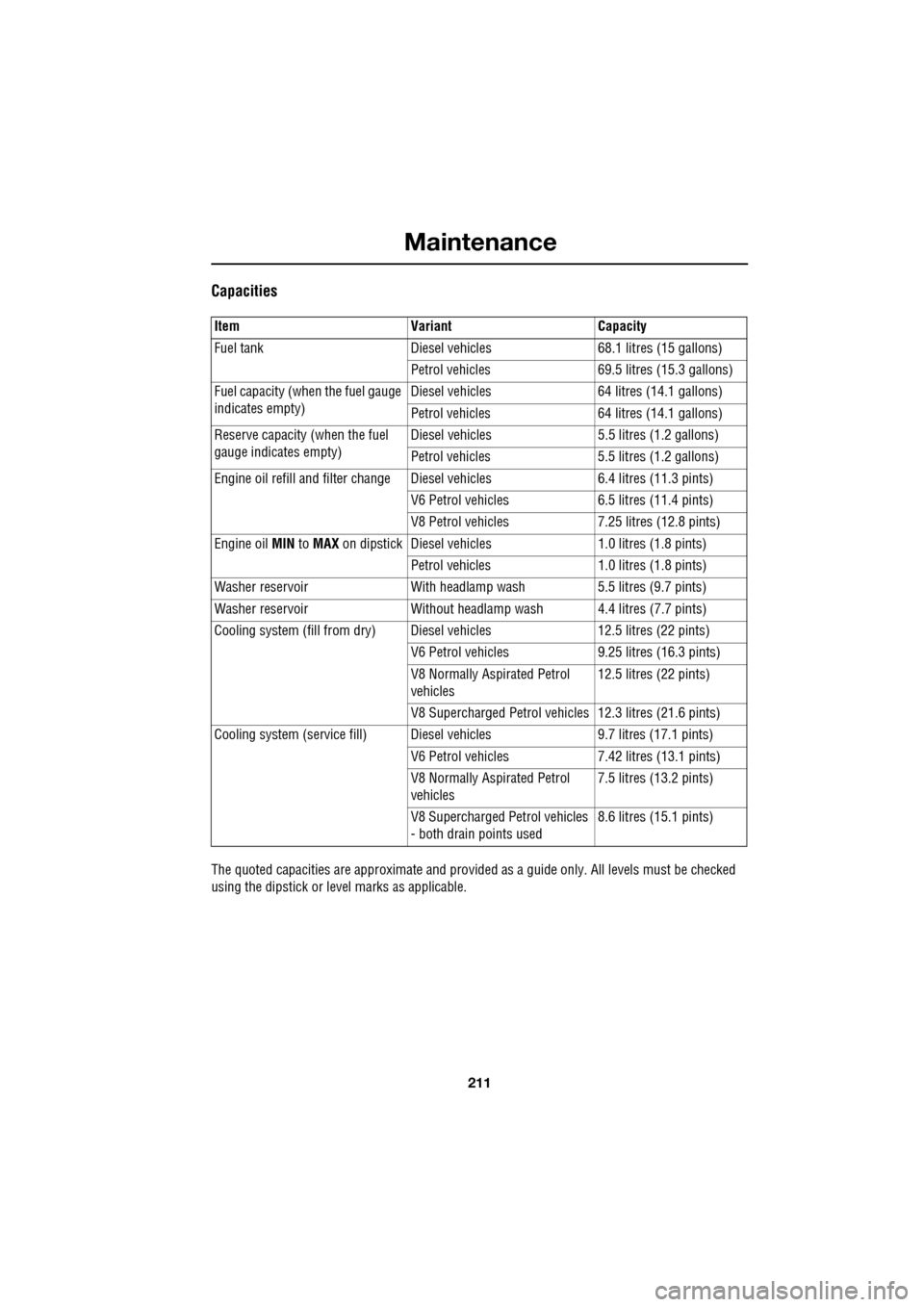
Capacities
The quoted capacities are approximate and provided as a guide only. All levels must be checked
using the dipstick or le vel marks as applicable.
Item Variant Capacity
Fuel tank Diesel vehicles 68.1 litres (15 gallons)
Petrol vehicles 69.5 litres (15.3 gallons)
Fuel capacity (when the fuel gauge
indicates empty) Diesel vehicles 64
litres (14.1 gallons)
Petrol vehicles 64 litres (14.1 gallons)
Reserve capacity (when the fuel
gauge indicates empty) Diesel vehicles 5.5 litres (1.2 gallons)
Petrol vehicles 5.5 li
tres (1.2 gallons)
Engine oil refill and filter change Diesel vehicles 6.4 litres (11.3 pints)
V6 Petrol vehicles 6.5 litres (11.4 pints)
V8 Petrol vehicles 7.25 litres (12.8 pints)
Engine oil MIN to MAX on dipstick Diesel vehicl es1.0 litres (1.8 pints)
Petrol vehicles 1.0 litres (1.8 pints)
Washer reservoir With headlamp wash 5.5 litres (9.7 pints)
Washer reservoir Without headlamp wash 4.4 litres (7.7 pints)
Cooling system (fill from dry) Diesel vehicles 12.5 litres (22 pints)
V6 Petrol vehicles 9.25 litres (16.3 pints)
V8 Normally As pirated Petrol
vehicles 12.5 litres (22 pints)
V8 Supercharged Petrol vehi cles 12.3 litres (21.6 pints)
Cooling system (service fill) Diesel vehicles 9.7 litres (17.1 pints)
V6 Petrol vehicles 7.42 litres (13.1 pints)
V8 Normally As pirated Petrol
vehicles 7.5 litres (13.2 pints)
V8 Supercharged Petrol vehicles
- both drain points used 8.6 litres (15.1 pints)
Page 218 of 391
Wheels and tyres
218
All of the vehicle's tyres (including the spare)
should be checked regularly for damage, wear
and distortion. If you are in any doubt about the
condition of a tyre, have it checked immediately
by a tyre repair centre or your
Dealer/Authorised repairer.
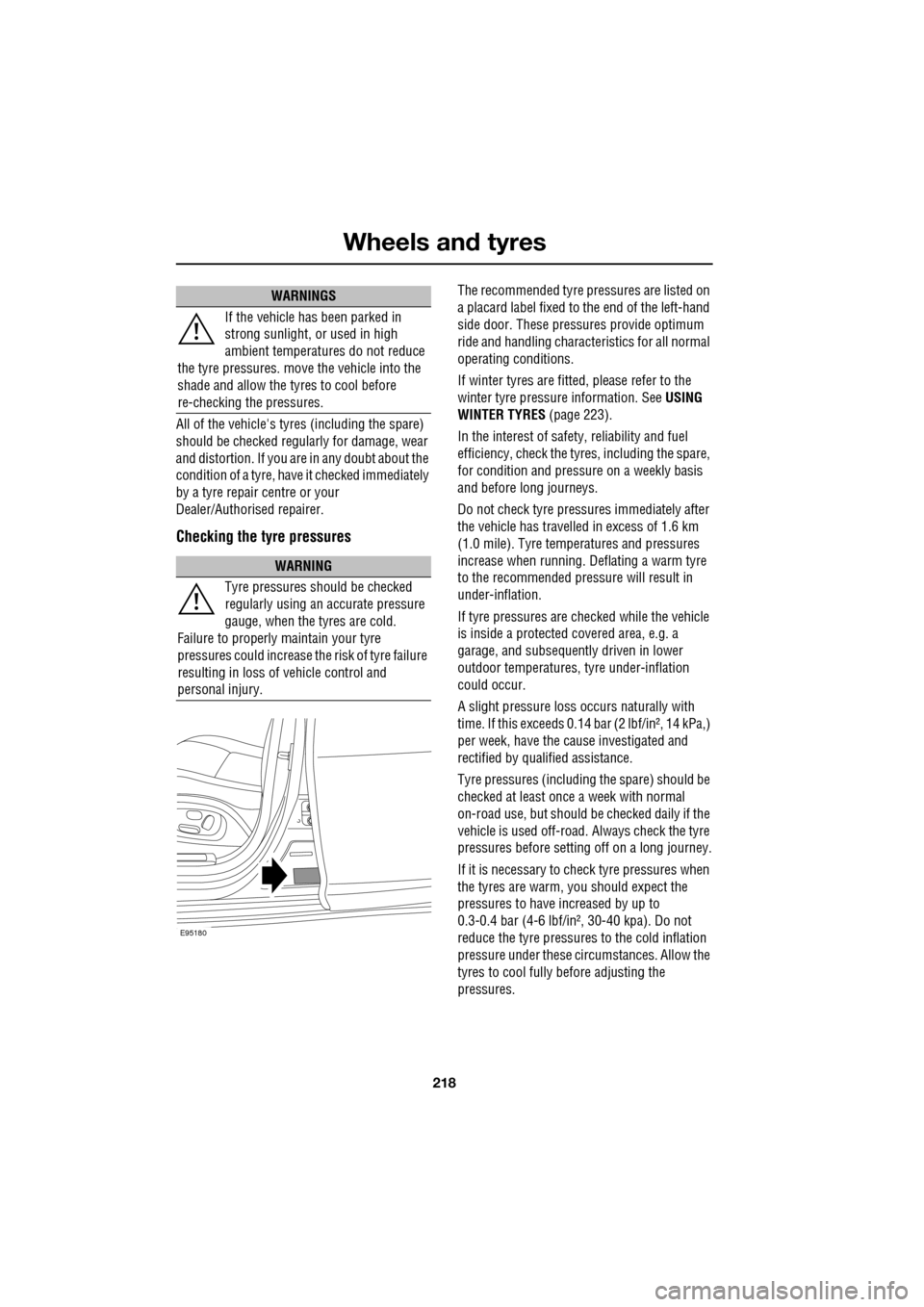
Checking the tyre pressures
The recommended tyre pressures are listed on
a placard label fixed to the end of the left-hand
side door. These pressures provide optimum
ride and handling charac teristics for all normal
operating conditions.
If winter tyres are fitted, please refer to the
winter tyre pressure information. SeeUSING
WINTER TYRES (page 223).
In the interest of safe ty, reliability and fuel
efficiency, check the tyres, including the spare,
for condition and pressu re on a weekly basis
and before long journeys.
Do not check tyre pressures immediately after
the vehicle has travelled in excess of 1.6 km
(1.0 mile). Tyre temperatures and pressures
increase when running. Deflating a warm tyre
to the recommended pressure will result in
under-inflation.
If tyre pressures are checked while the vehicle
is inside a protected covered area, e.g. a
garage, and subsequent ly driven in lower
outdoor temperatures, tyre under-inflation
could occur.
A slight pressure loss occurs naturally with
time. If this exceeds 0.14 bar (2 lbf/in², 14 kPa,)
per week, have the cause investigated and
rectified by qualified assistance.
Tyre pressures (including the spare) should be
checked at least once a week with normal
on-road use, but should be checked daily if the
vehicle is used off-road. Always check the tyre
pressures before setti ng off on a long journey.
If it is necessary to check tyre pressures when
the tyres are warm, you should expect the
pressures to have increased by up to
0.3-0.4 bar (4-6 lbf/in², 30-40 kpa). Do not
reduce the tyre pressures to the cold inflation
pressure under these circumstances. Allow the
tyres to cool fully before adjusting the
pressures.
If the vehicle has been parked in
strong sunlight, or used in high
ambient temperatures do not reduce
the tyre pressures. move the vehicle into the
shade and allow the tyres to cool before
re-checking the pressures.
WARNING
Tyre pressures should be checked
regularly using an accurate pressure
gauge, when the tyres are cold.
Failure to properly maintain your tyre
pressures could increase the risk of tyre failure
resulting in loss of vehicle control and
personal injury.
WARNINGS
E95180
Page 238 of 391
Wheels and tyres
238
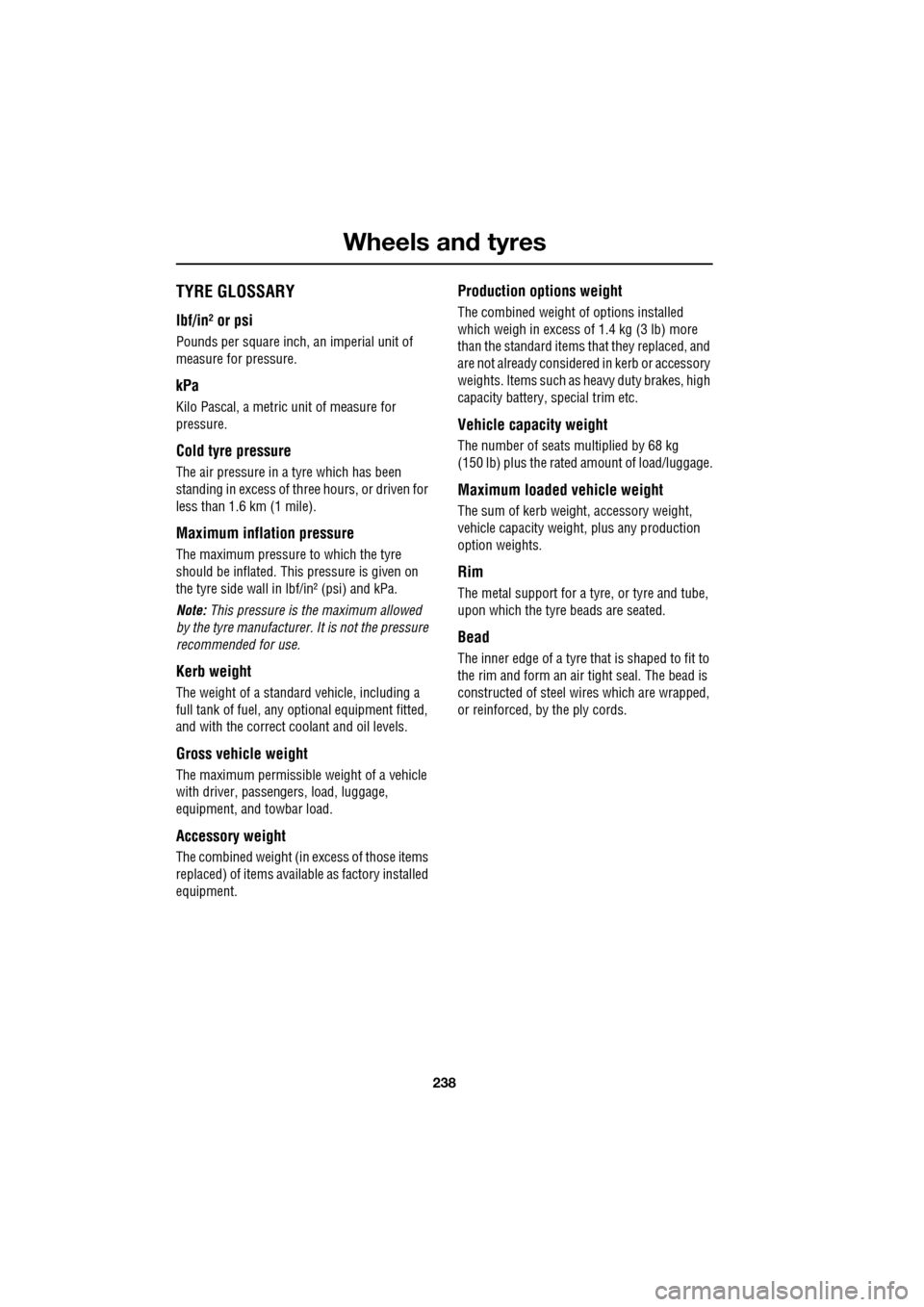
TYRE GLOSSARY
lbf/in² or psi
Pounds per square inch, an imperial unit of
measure for pressure.
kPa
Kilo Pascal, a metric unit of measure for
pressure.
Cold tyre pressure
The air pressure in a tyre which has been
standing in excess of th ree hours, or driven for
less than 1.6 km (1 mile).
Maximum inflation pressure
The maximum pressure to which the tyre
should be inflated. This pressure is given on
the tyre side wall in lbf/in² (psi) and kPa.
Note: This pressure is the maximum allowed
by the tyre manufacturer. It is not the pressure
recommended for use.
Kerb weight
The weight of a standa rd vehicle, including a
full tank of fuel, any optional equipment fitted,
and with the correct coolant and oil levels.
Gross vehicle weight
The maximum permissible weight of a vehicle
with driver, passen gers, load, luggage,
equipment, and towbar load.
Accessory weight
The combined weight (in excess of those items
replaced) of items available as factory installed
equipment.
Production options weight
The combined weight of options installed
which weigh in excess of 1.4 kg (3 lb) more
than the standard items that they replaced, and
are not already considered in kerb or accessory
weights. Items such as heavy duty brakes, high
capacity battery, special trim etc.
Vehicle capacity weight
The number of seats multiplied by 68 kg
(150 lb) plus the rated amount of load/luggage.
Maximum loaded vehicle weight
The sum of kerb wei ght, accessory weight,
vehicle capacity weig ht, plus any production
option weights.
Rim
The metal support for a ty re, or tyre and tube,
upon which the tyre beads are seated.
Bead
The inner edge of a tyre th at is shaped to fit to
the rim and form an air tight seal. The bead is
constructed of steel wires which are wrapped,
or reinforced, by the ply cords.
Page 246 of 391
Fuses
246
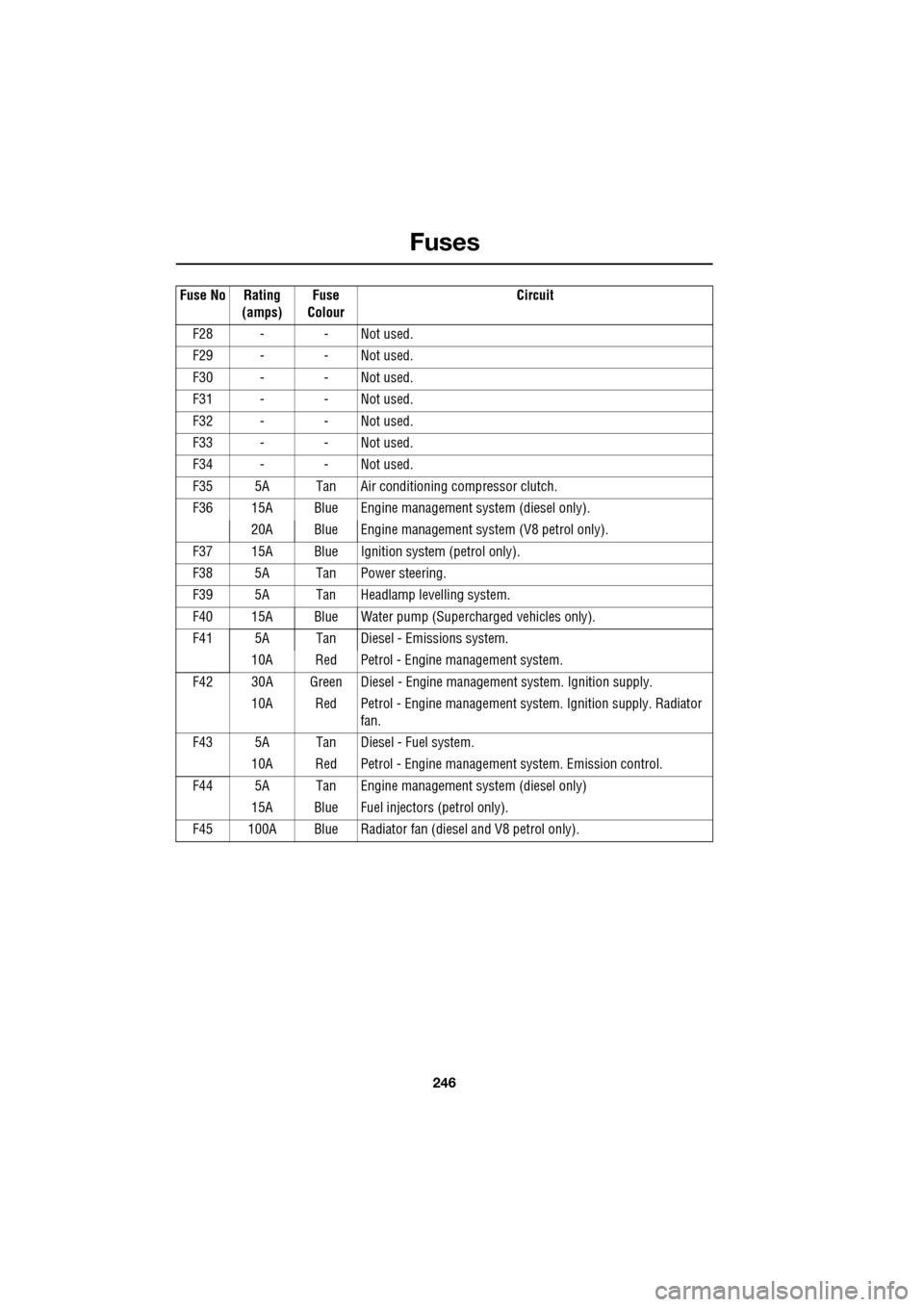
F28 - - Not used.
F29 - - Not used.
F30 - - Not used.
F31 - - Not used.
F32 - - Not used.
F33 - - Not used.
F34 - - Not used.
F35 5A Tan Air conditioning compressor clutch.
F36 15A Blue Engine management system (diesel only).
20A Blue Engine management sy stem (V8 petrol only).
F37 15A Blue Ignition s ystem (petrol only).
F38 5A Tan Power steering.
F39 5A Tan Headlamp levelling system.
F40 15A Blue Water pump (Superc harged vehicles only).
F41 5A Tan Diesel - Emissions system.
10A Red Petrol - Engine management system.
F42 30A Green Diesel - Engi ne management system. Ignition supply.
10A Red Petrol - Engine management system. Ignition supply. Radiator
fan.
F43 5A Tan Diesel - Fuel system. 10A Red Petrol - Engine manageme nt system. Emission control.
F44 5A Tan Engine management system (diesel only)
15A Blue Fuel injectors (petrol only).
F45 100A Blue Radiator fan (diesel and V8 petrol only).
Fuse No Rating
(amps) Fuse
Colour Circuit
Page 249 of 391
249
Fuses
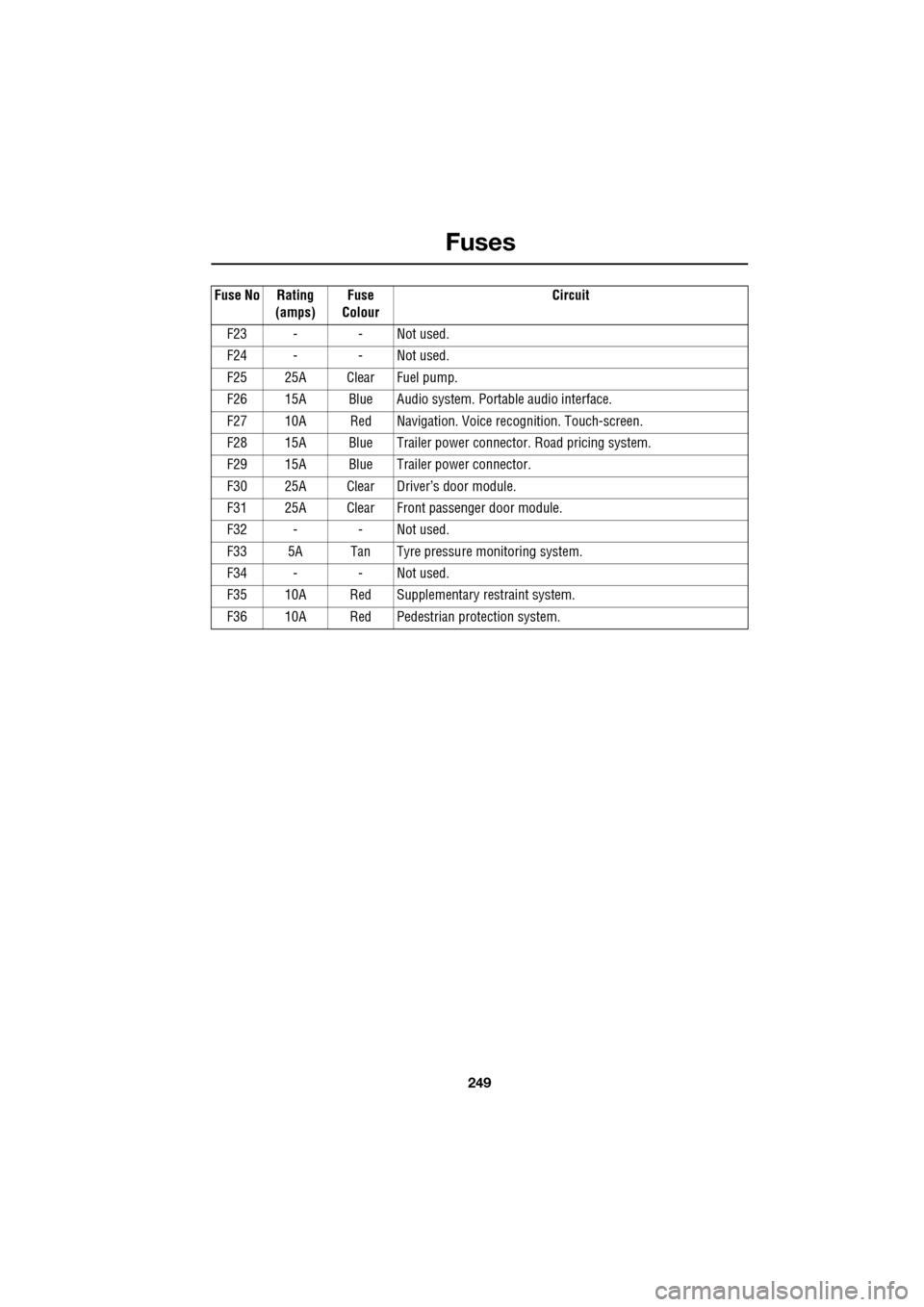
F23 - - Not used.
F24 - - Not used.
F25 25A Clear Fuel pump.
F26 15A Blue Audio system. Portable audio interface.
F27 10A Red Navigation. Voic e recognition. Touch-screen.
F28 15A Blue Trailer power conne ctor. Road pricing system.
F29 15A Blue Trailer power connector.
F30 25A Clear Driver’s door module.
F31 25A Clear Front passenger door module.
F32 - - Not used.
F33 5A Tan Tyre pressure monitoring system.
F34 - - Not used.
F35 10A Red Supplementary restraint system.
F36 10A Red Pedestrian protection system.
Fuse No Rating
(amps) Fuse
Colour Circuit
Page 251 of 391
251
Status after a collision
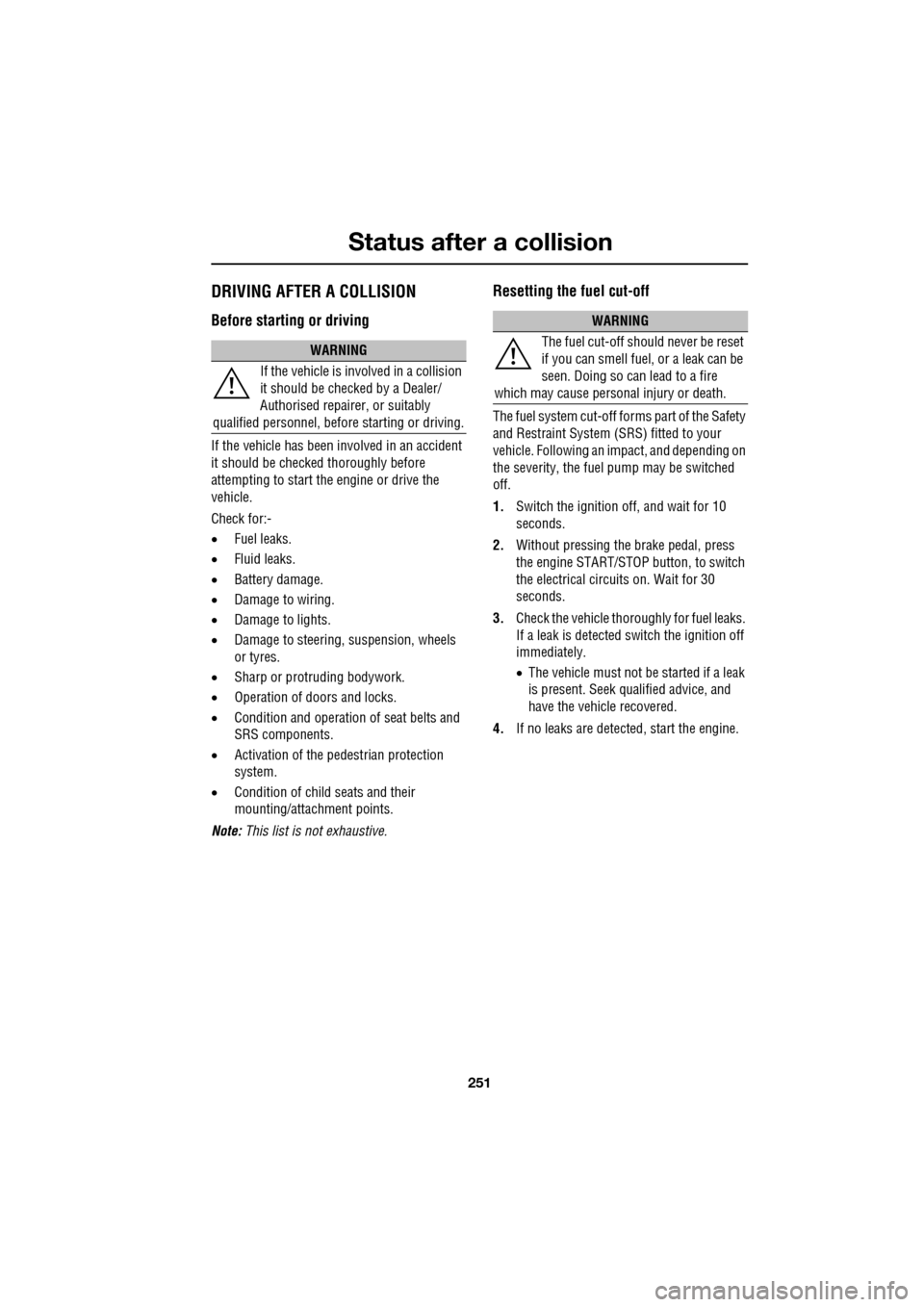
DRIVING AFTER A COLLISION
Before starting or driving
If the vehicle has been involved in an accident
it should be checked thoroughly before
attempting to start the engine or drive the
vehicle.
Check for:-
• Fuel leaks.
• Fluid leaks.
• Battery damage.
• Damage to wiring.
• Damage to lights.
• Damage to steering, suspension, wheels
or tyres.
• Sharp or protruding bodywork.
• Operation of doors and locks.
• Condition and operation of seat belts and
SRS components.
• Activation of the pe destrian protection
system.
• Condition of chil d seats and their
mounting/attach ment points.
Note: This list is not exhaustive.
Resetting the fuel cut-off
The fuel system cut-off forms part of the Safety
and Restraint System (SRS) fitted to your
vehicle. Following an impact, and depending on
the severity, the fuel pump may be switched
off.
1.Switch the ignition off, and wait for 10
seconds.
2. Without pressing the brake pedal, press
the engine START/STOP button, to switch
the electrical circuits on. Wait for 30
seconds.
3. Check the vehicle thoroughly for fuel leaks.
If a leak is detected switch the ignition off
immediately.
•The vehicle must not be started if a leak
is present. Seek qualified advice, and
have the vehicle recovered.
4. If no leaks are detected, start the engine.
WARNING
If the vehicle is involved in a collision
it should be checked by a Dealer/
Authorised repairer, or suitably
qualified personnel, before starting or driving.
WARNING
The fuel cut-off should never be reset
if you can smell fuel, or a leak can be
seen. Doing so can lead to a fire
which may cause personal injury or death.