wheel JAGUAR XFR 2010 1.G Owners Manual
[x] Cancel search | Manufacturer: JAGUAR, Model Year: 2010, Model line: XFR, Model: JAGUAR XFR 2010 1.GPages: 3039, PDF Size: 58.49 MB
Page 391 of 3039
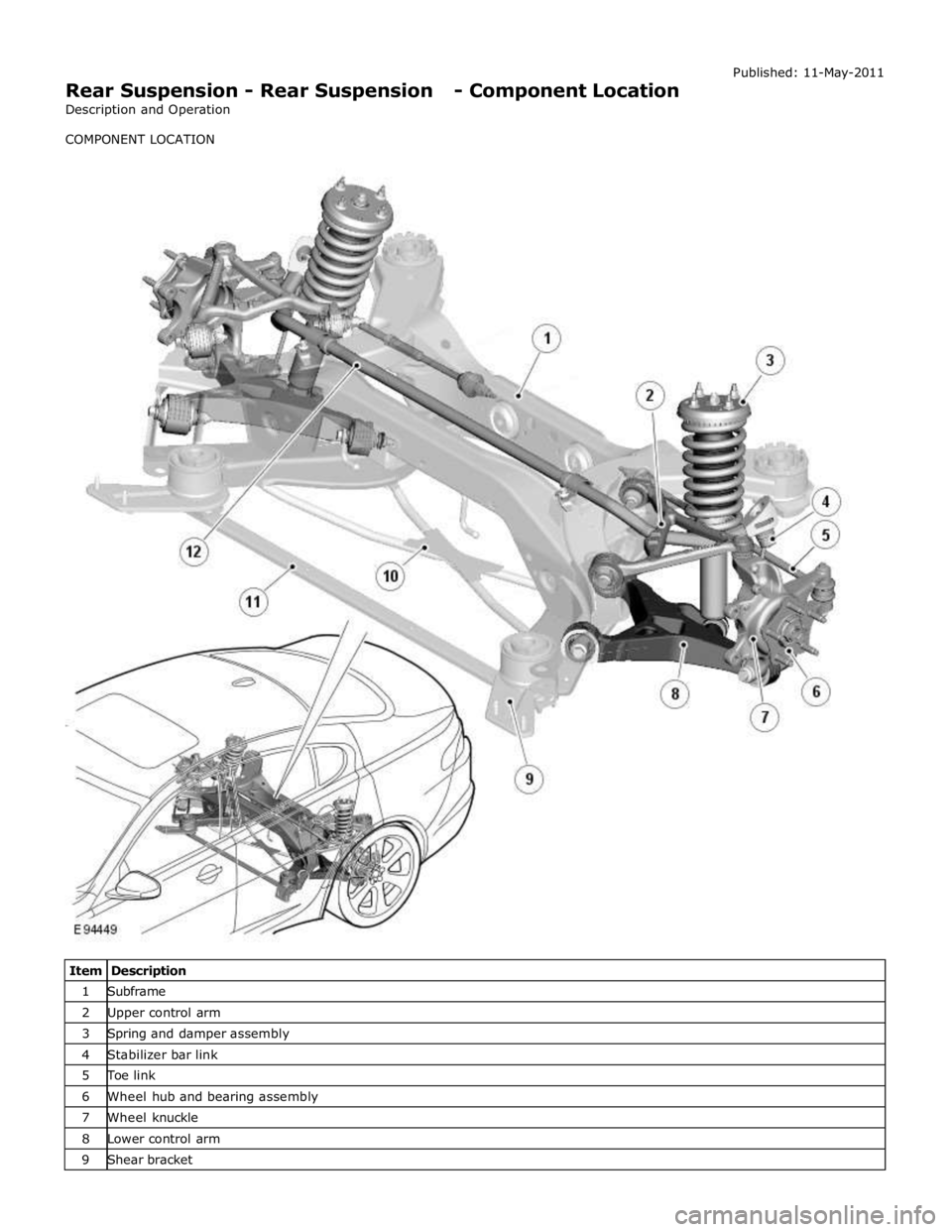
Rear Suspension - Rear Suspension - Component Location
Description and Operation
COMPONENT LOCATION Published: 11-May-2011
Item Description 1 Subframe 2 Upper control arm 3 Spring and damper assembly 4 Stabilizer bar link 5 Toe link 6 Wheel hub and bearing assembly 7 Wheel knuckle 8 Lower control arm 9 Shear bracket
Page 393 of 3039
Rear Suspension - Rear Suspension - Overview
Description and Operation
OVERVIEW Published: 11-May-2011
The double wishbone type rear-suspension is a fully independent design assembled on a steel subframe; large diameter
bushes isolate the subframe from the vehicle's body.
A toe-link located between the wheel knuckle and the subframe is used to adjust the toe angle of the rear wheels.
The wheel knuckle attaches to the upper and lower control arms, and the coil spring and damper assembly is located between
the lower control arm and the vehicle body.
Dependant on vehicle model there are three types of coil spring and damper available:
a standard oil passive damper (All models except supercharged),
an adaptive damper, also known as Computer Active Technology Suspension (CATS) on 4.2L supercharged vehicles up to
2010MY, For additional information refer to Vehicle Dynamic Suspension 4.2L.
a continuously variable adaptive damper, also known as Adaptive Dynamics System on 5.0L supercharged vehicles from
2010MY. For additional information refer to Vehicle Dynamic Suspension 5.0L.
Page 394 of 3039
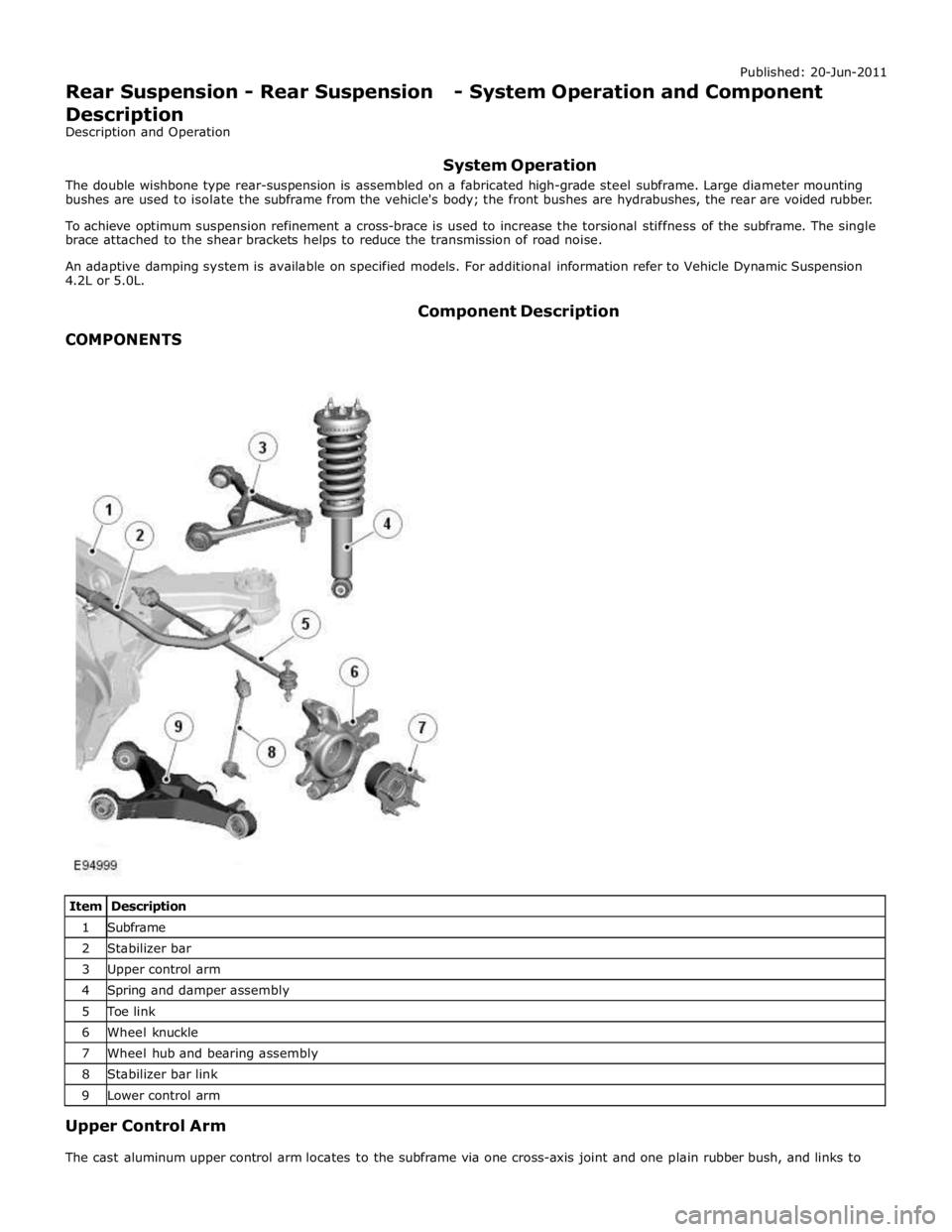
1 Subframe 2 Stabilizer bar 3 Upper control arm 4 Spring and damper assembly 5 Toe link 6 Wheel knuckle 7 Wheel hub and bearing assembly 8 Stabilizer bar link 9 Lower control arm Upper Control Arm
The cast aluminum upper control arm locates to the subframe via one cross-axis joint and one plain rubber bush, and links to
Page 395 of 3039
the aluminum wheel knuckle via an integral ball-joint.
Lower Control Arm
The aluminum lower arm locates to the subframe via one cross-axis joint and one plain rubber bush, and to the wheel knuckle
via a second plain rubber bush.
The rear of the control arm has mounting points for the damper and the stabilizer link.
Toe-Link
The toe-link is located between the wheel knuckle and brackets on the subframe.
The toe-link comprises an inner rod with integral axial ball joint. The inner ball joint has a threaded spigot which locates in a
bracket on the subframe and is secured with a locknut. The rod has an internal thread which accepts the outer rod.
The outer rod has a cross-axis joint at its outer end which is located in a clevis on the wheel knuckle, and is secured with a
bolt and locknut.
The length of the toe-link can be adjusted by rotating the inner rod. This allows for adjustment of the toe angle for the rear
wheel. Once set the inner rod can be locked in position by tightening a locknut on the outer rod against the inner rod.
Wheel Knuckle
The cast aluminum wheel knuckle attaches to:
the upper control arm via a ball-joint located in the arm,
the lower control arm via a plain rubber bush located in the arm,
the toe-link via a cross-axis joint located in the toe link.
The wheel knuckle also provides the mounting locations for the:
wheel hub assembly,
wheel bearing,
wheel speed sensor,
brake caliper,
and disc shield.
Stabilizer Bar
The solid construction stabilizer bar and bushes have been designed to provide particular characteristics in maintaining roll
rates, specifically in primary ride comfort. There are six derivatives of rear stabilizer bar, with different diameters, to support
the various powertrains:
V6 gasoline - 12.7 mm solid bar
V8 4.2L and 5.0L gasoline - 13.6 mm solid bar
V6 2.7L diesel -14.5 mm solid bar
V6 3.0L diesel - 14.5 mm solid bar
V6 3.0L diesel with Adaptive Damping – 16mm tubular
V8 4.2L gasoline supercharged – 16mm tubular
V8 5.0L gasoline supercharged
- SV8 - 17mm tubular
- XFR - 18mm tubular
The stabilizer bar is attached to the top of the subframe with two bushes and mounting brackets. The stabilizer bar has
crimped, 'anti-shuffle' collars pressed in position on the inside edges of the bushes. The collars prevent sideways movement of
the stabilizer bar.
Each end of the stabilizer bar curves rearward to attach to a ball joint on each stabilizer link. Each link is attached via a
second ball joint to a cast bracket on the lower control arm. The links allow the stabilizer bar to move with the wheel travel
providing maximum effectiveness.
Spring and Damper Assembly
The spring and damper assembly are attached to cast brackets on the lower control arms and to the vehicle body by four studs
secured by locking nuts. Dependant on vehicle model there are three types of coil spring and damper available:
a standard oil passive damper (All models except supercharged),
an adaptive damper, also known as Computer Active Technology Suspension (CATS) on 4.2L supercharged vehicles up to
2010MY, For additional information refer to Vehicle Dynamic Suspension 4.2L.
a continuously variable adaptive damper, also known as Adaptive Dynamics System on 5.0L supercharged vehicles from
2010MY. For additional information refer to Vehicle Dynamic Suspension 5.0L.
The dampers are a monotube design with a spring located by a circlip onto the damper tube. The lower end of the damper has
a spherical joint which locates in the lower control arm and is secured with a bolt.
The damper piston is connected to a damper rod which is sealed at its exit point from the damper body. The threaded outer
end of the damper rod locates through a hole in the top mount. A self locking nut secures the top mount to the damper rod.
The damper rod on the adaptive damper has an electrical connector on the outer end of the damper rod. www.JagDocs.com
Page 399 of 3039
Rear Suspension - Lower Arm
Removal and Installation Published: 11-May-2011
NOTES: Removal
Before commencing work on the vehicle ensure the park brake is in the off position.
LH shown RH similar.
1. WARNING: Make sure to support the vehicle with axle stands.
Raise the vehicle.
2. Remove the wheel and tire.
For additional information, refer to: W heel and Tire (204-04 Wheels and Tires, Removal and Installation).
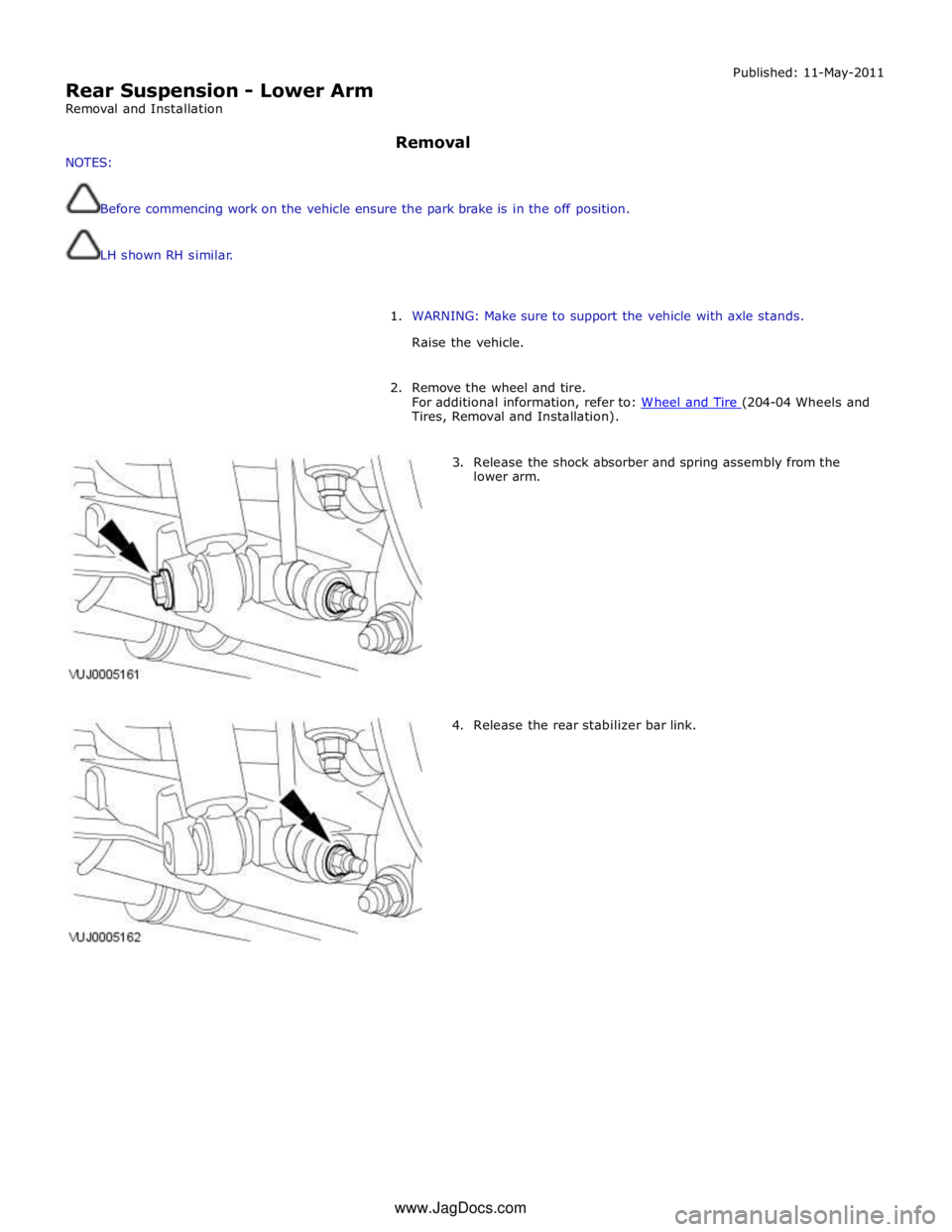
3. Release the shock absorber and spring assembly from the
lower arm.
4. Release the rear stabilizer bar link. www.JagDocs.com
Page 400 of 3039
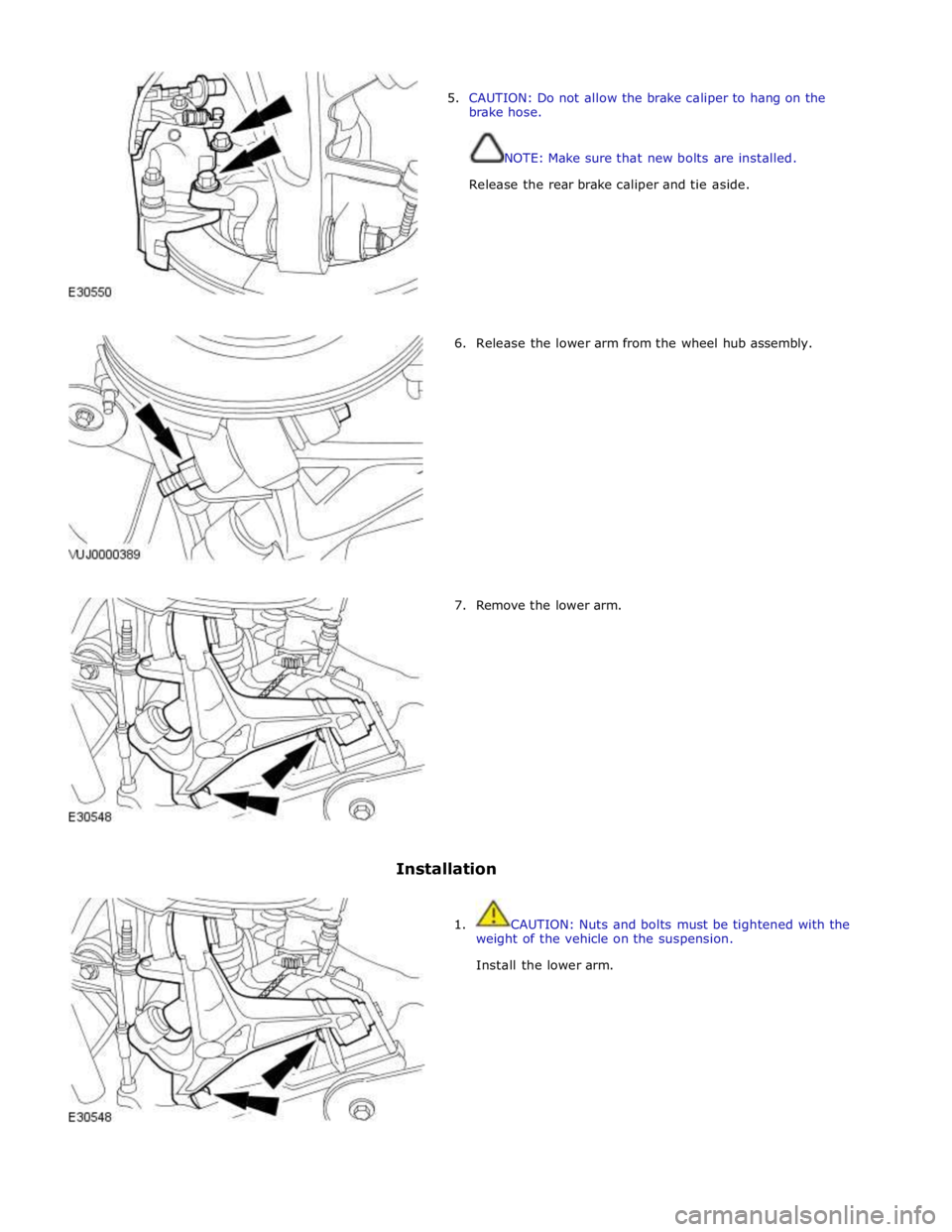
5. CAUTION: Do not allow the brake caliper to hang on the
brake hose.
NOTE: Make sure that new bolts are installed.
Release the rear brake caliper and tie aside.
6. Release the lower arm from the wheel hub assembly.
7. Remove the lower arm.
Installation
1. CAUTION: Nuts and bolts must be tightened with the
weight of the vehicle on the suspension.
Install the lower arm.
Page 401 of 3039
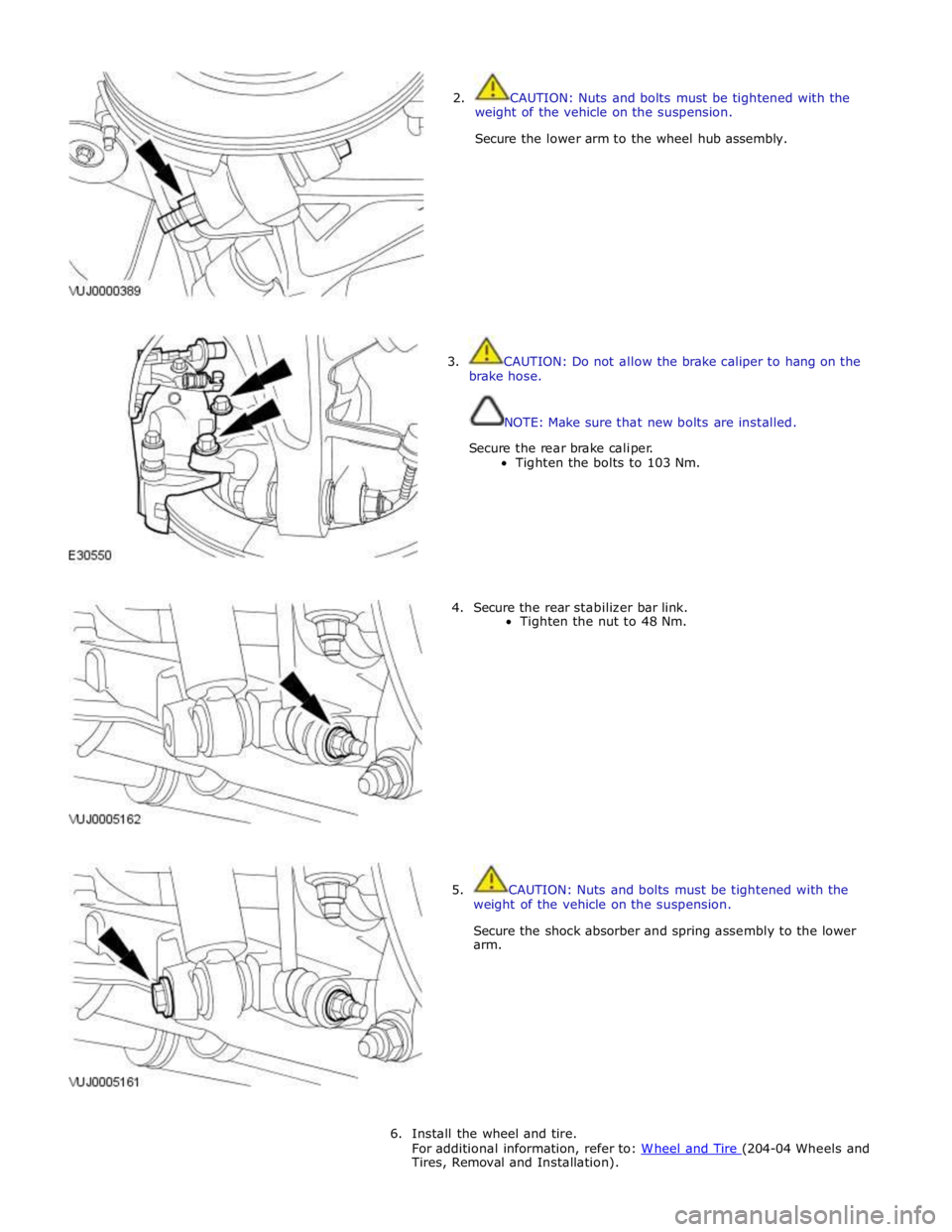
2. CAUTION: Nuts and bolts must be tightened with the
weight of the vehicle on the suspension.
Secure the lower arm to the wheel hub assembly.
3. CAUTION: Do not allow the brake caliper to hang on the
brake hose.
NOTE: Make sure that new bolts are installed.
Secure the rear brake caliper.
Tighten the bolts to 103 Nm.
4. Secure the rear stabilizer bar link.
Tighten the nut to 48 Nm.
5. CAUTION: Nuts and bolts must be tightened with the
weight of the vehicle on the suspension.
Secure the shock absorber and spring assembly to the lower
arm.
6. Install the wheel and tire.
For additional information, refer to: W heel and Tire (204-04 Wheels and Tires, Removal and Installation).
Page 403 of 3039
Interior Trim and Ornamentation, Removal and Installation).
Vehicles with active damping
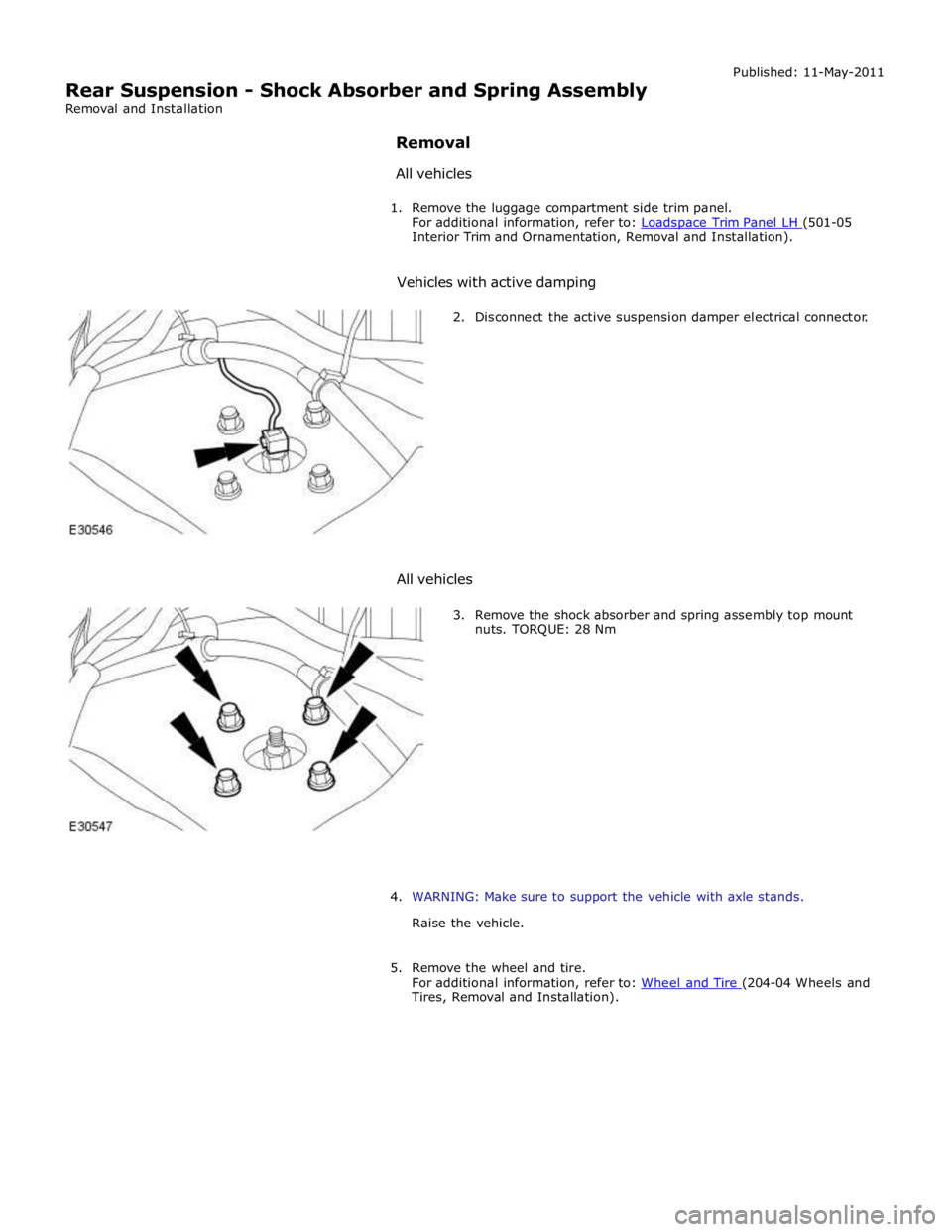
2. Disconnect the active suspension damper electrical connector.
All vehicles
3. Remove the shock absorber and spring assembly top mount
nuts. TORQUE: 28 Nm
4. WARNING: Make sure to support the vehicle with axle stands.
Raise the vehicle.
5. Remove the wheel and tire.
For additional information, refer to: Wheel and Tire (204-04 Wheels and Tires, Removal and Installation).
Page 407 of 3039
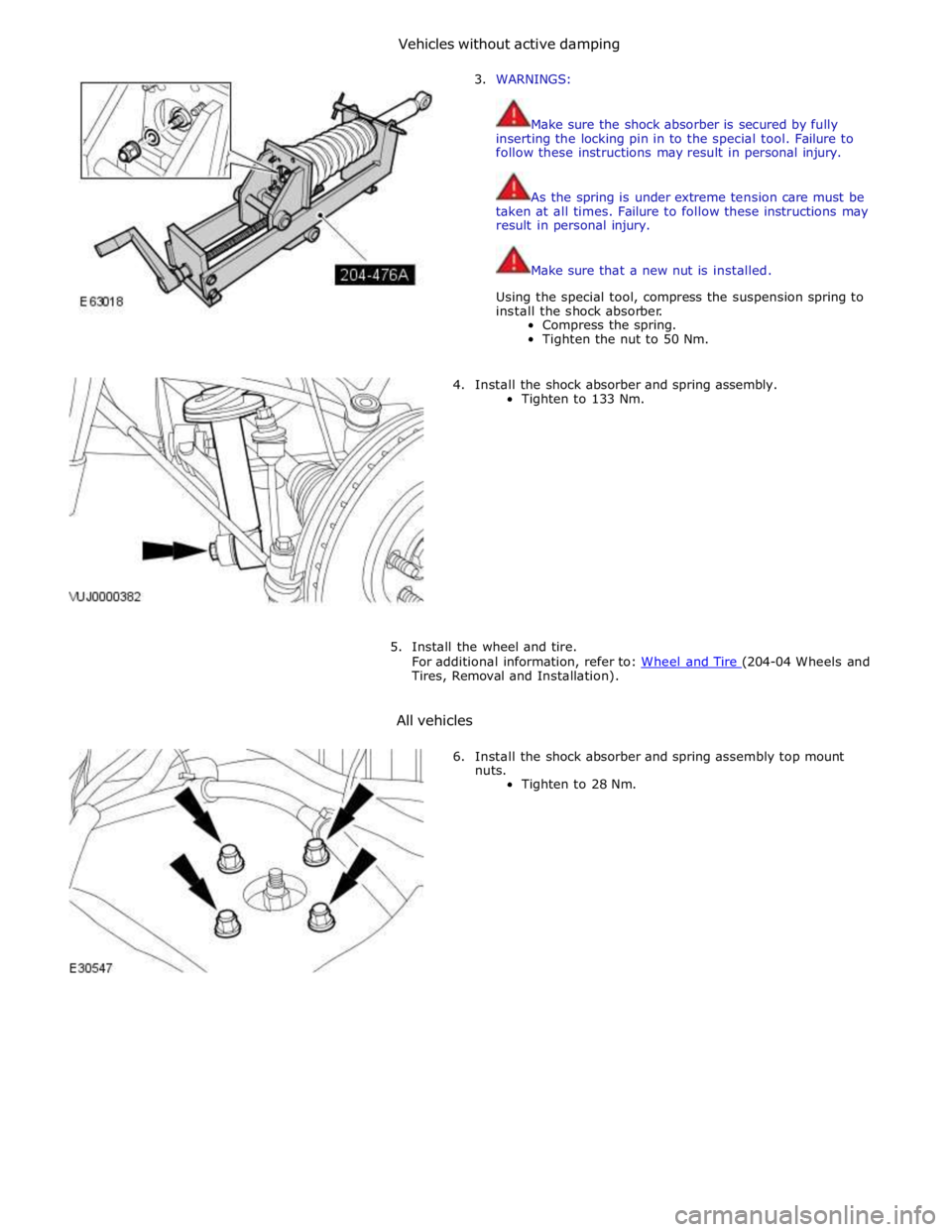
3. WARNINGS:
Make sure the shock absorber is secured by fully
inserting the locking pin in to the special tool. Failure to
follow these instructions may result in personal injury.
As the spring is under extreme tension care must be
taken at all times. Failure to follow these instructions may
result in personal injury.
Make sure that a new nut is installed.
Using the special tool, compress the suspension spring to
install the shock absorber.
Compress the spring.
Tighten the nut to 50 Nm.
4. Install the shock absorber and spring assembly.
Tighten to 133 Nm.
5. Install the wheel and tire.
For additional information, refer to: Wheel and Tire (204-04 Wheels and Tires, Removal and Installation).
All vehicles
6. Install the shock absorber and spring assembly top mount
nuts.
Tighten to 28 Nm.
Vehicleswithoutactivedamping
Page 412 of 3039
Rear Suspension - Rear Stabilizer Bar
Removal and Installation Published: 06-Jun-2013
Removal
1. Disconnect the battery ground cable.
For additional information, refer to: Battery Disconnect and Connect (414-01 Battery, Mounting and Cables, General Procedures).
2. WARNING: Make sure to support the vehicle with axle stands.
Raise and support the vehicle.
3. Remove both rear wheels and tires.
For additional information, refer to: Wheel and Tire (204-04 Wheels and Tires, Removal and Installation).
4. Drain the fuel tank.
For additional information, refer to: Fuel Tank Draining (310-00 Fuel System - General Information, General Procedures).
5. Remove the exhaust system.
For additional information, refer to: Front Muffler (309-00B Exhaust System - V6 3.0L Petrol, Removal and Installation).
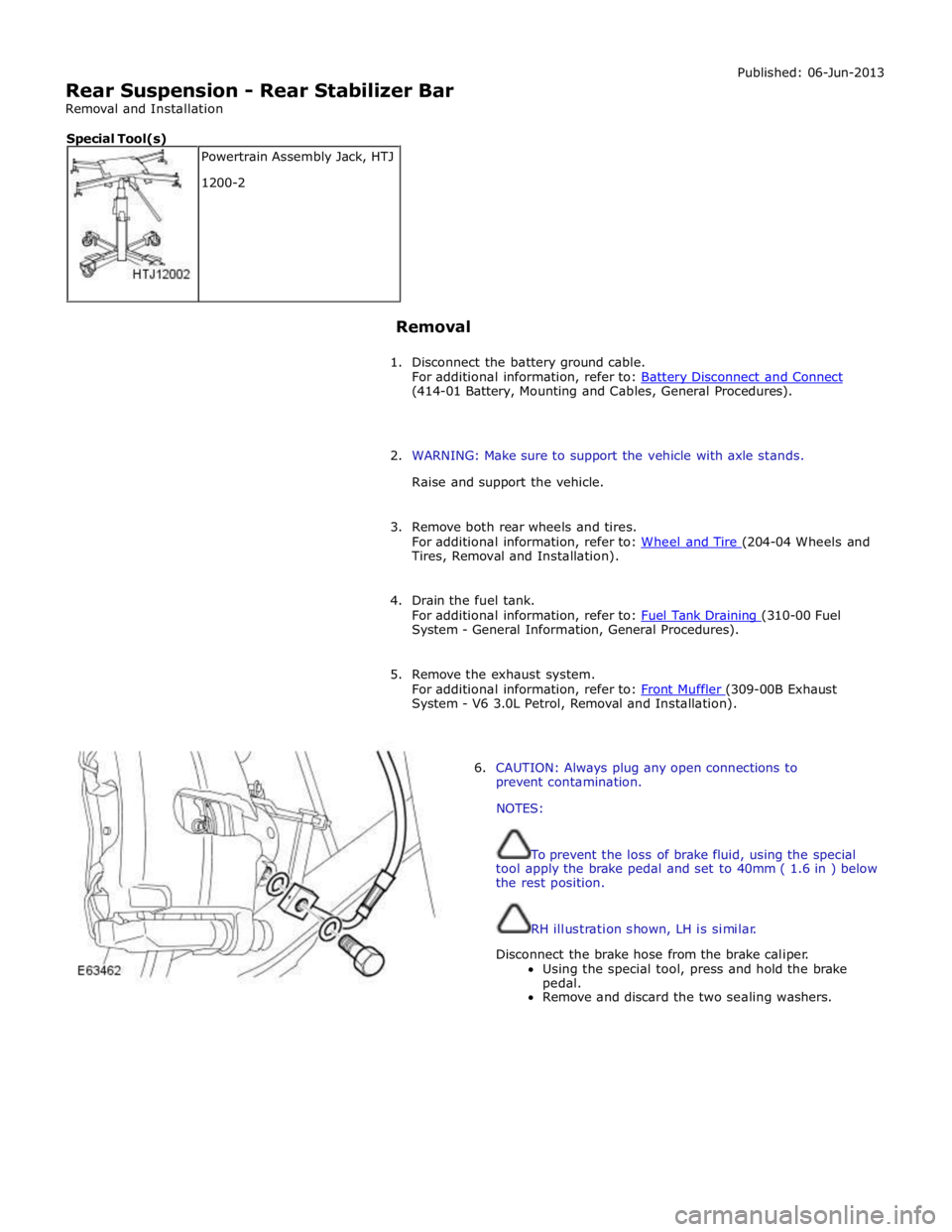
6. CAUTION: Always plug any open connections to
prevent contamination.
NOTES:
To prevent the loss of brake fluid, using the special
tool apply the brake pedal and set to 40mm ( 1.6 in ) below
the rest position.
RH illustration shown, LH is similar.
Disconnect the brake hose from the brake caliper.
Using the special tool, press and hold the brake
pedal.
Remove and discard the two sealing washers. Powertrain Assembly Jack, HTJ
1200-2 Special Tool(s)