ABS JAGUAR XFR 2010 1.G User Guide
[x] Cancel search | Manufacturer: JAGUAR, Model Year: 2010, Model line: XFR, Model: JAGUAR XFR 2010 1.GPages: 3039, PDF Size: 58.49 MB
Page 63 of 3039

Highly flammable, flammable - observe No Smoking policy
Pressurized Equipment
See High Pressure Air, Lubrication and Oil Test Equipment.
Solder
Solders are a mixture of metals such that the melting point of the mixture is below that of the constituent metals (normally
lead and tin). Solder application does not normally give rise to toxic lead fumes, provided a gas/air flame is used.
Oxy-acetylene flames should not be used, as they are much hotter and will cause lead fumes to be produced.
Some fumes may be produced by the application of any flame to surfaces coated with grease etc. and inhalation of these
should be avoided.
Removal of excess solder should be undertaken with care, to make sure that fine lead dust is not produced, which can give
toxic effects if inhaled. Respiratory protection may be necessary.
Solder spillage and filings should be collected and removed promptly to prevent general air contamination by lead.
High standards of personal hygiene are necessary in order to avoid ingestion of lead or inhalation of solder dust from clothing.
Solvents
See also Chemical Materials, Fuels (Kerosene), Fire.
e.g. acetone, white spirit, toluene, xylene, trichloroethane.
Used in cleaning and de-waxing materials, paints, plastics, resins, thinners etc.
Some may be highly flammable or flammable.
Skin contact will degrease the skin and may result in irritation and dermatitis following repeated or prolonged contact. Some
can be absorbed through the skin in toxic or harmful quantities.
Splashes in the eye may cause severe irritation and could lead to loss of vision.
Brief exposure to high concentrations of vapors or mists will cause eye and throat irritation, drowsiness, dizziness, headaches
and, in the worst circumstances, unconsciousness.
Repeated or prolonged exposure to excessive but lower concentrations of vapors or mists, for which there might not be
adequate warning indications, can cause more serious toxic or harmful effects.
Aspiration into the lungs (e.g. through vomiting) is the most serious consequence of swallowing.
Avoid splashes to the skin, eyes and clothing. Wear protective gloves, goggles and clothing if necessary.
Ensure good ventilation when in use, avoid breathing fumes, vapors and spray mists and keep containers tightly sealed. Do not
use in confined spaces.
When spraying materials containing solvents, e.g. paints, adhesive, coatings, use extraction ventilation or personal respiratory
protection in the absence of adequate general ventilation.
Do not apply heat or flame except under specific and detailed manufacturer's instructions.
Sound Insulation
See Fibre Insulation, Foams.
Suspended Loads
CAUTION: Never improvise lifting tackle.
There is always a danger when loads are lifted or suspended. Never work under an unsupported, suspended or raised load e.g.
suspended engine, etc.
Always make sure that lifting equipment such as jacks, hoists, axle stands, slings, etc., are adequate and suitable for the job,
in good condition and regularly maintained.
Transmission Brake Bands
See Asbestos.
Underseal
See Corrosion Protection.
Page 64 of 3039

Viton
In common with many other manufacturers' vehicles, some components installed to the Jaguar range have 'O' rings, seals or
gaskets which contain a material known as 'Viton'.
Viton is a fluoroelastomer, that is a synthetic rubber type which contains Fluorine. It is commonly used for 'O' rings, gaskets
and seals of all types. Although Viton is the most well known fluoroelastomer, there are others, including Fluorel and
Tecmoflon.
When used under design conditions fluoroelastomers are perfectly safe. If, however, they are exposed to temperatures in
excess of 400º C, the material will not burn, but will decompose, and one of the products formed is hydrofluoric acid.
This acid is extremely corrosive and may be absorbed directly, through contact, into the body.
'O' rings, seals or gaskets which have been exposed to very high temperatures will appear charred or as a black sticky
substance.
DO NOT, under any circumstances touch them or the attached components.
Enquiries should be made to determine whether Viton or any other fluoroelastomer has been used in the affected 'O' ring, seal
or gasket. If they are of natural rubber or nitrile there is no hazard. If in doubt, be cautious and assume that the material may
be Viton or any fluoroelastomer.
If Viton or any other fluoroelastomers have been used, the affected area should be decontaminated before the commencement
of work.
Disposable heavy duty plastic gloves should be worn at all times, and the affected area washed down using wire wool and a
limewater (calcium hydroxide) solution to neutralize the acid before disposing of the decomposed Viton residue and final
cleaning of the area. After use, the plastic gloves should be discarded carefully and safely.
Welding
See also Fire, Electric Shock, Gas Cylinders.
Welding processes include Resistance Welding (Spot Welding), Arc Welding and Gas Welding (and cutting).
Resistance Welding (Spot Welding)
This process may cause particles of molten metal to be emitted at a high velocity, and the eyes and skin must be protected.
Arc Welding
This process emits a high level of ultraviolet radiation which may cause arc-eye and skin burns to the operator and to other
persons nearby. Gas-shielded welding processes are particularly hazardous in this respect. Personal protection must be worn,
and screens used to shield other people.
CONTACT LENS WEARERS ARE ADVISED TO REVERT TO ORDINARY SPECTACLES WHEN ARC WELDING as the arc spectrum is
believed to emit microwaves which dry out the fluid between the lens and the eye. This may result in blindness when the lens
is removed from the eye.
Metal spatter will also occur, and appropriate eye and skin protection is necessary.
The heat of the welding arc will produce fumes and gases from the metals being welded, the rods and from any applied
coatings or contamination on the surfaces being worked on. These gases and fumes may be toxic and inhalation of these
should be avoided. The use of extraction ventilation to remove the fumes from the working area may be necessary particularly
in cases where the general ventilation is poor, or where considerable welding work is anticipated. In extreme cases or confined
spaces where adequate ventilation cannot be provided, air-fed respirators may be necessary.
Gas Welding (and Cutting)
Oxy-acetylene torches may be used for welding and cutting, and special care must be taken to prevent leakage of these gases,
with consequent risk of fire and explosion.
The process will produce metal spatter and eye and skin protection is necessary.
The flame is bright, and eye protection should be used, but the ultraviolet emission is much less than that from arc welding,
and lighter filters may be used.
The process itself produces few toxic fumes, but such fumes and gases may be produced from coatings on the work,
particularly during cutting away of damaged body parts, and inhalation of the fumes should be avoided.
In brazing, toxic fumes may be produced from the metals in the brazing rod, and a severe hazard may arise if brazing rods
containing cadmium are used. In this event particular care must be taken to avoid inhalation of fumes and expert advice may
be required.
SPECIAL PRECAUTIONS MUST BE TAKEN BEFORE ANY WELDING OR CUTTING TAKES PLACE ON VESSELS WHICH HAVE
CONTAINED COMBUSTIBLE MATERIALS, E.G. BOILING OR STEAMING OUT OF FUEL TANKS.
Warning Symbols on Vehicles
Decals showing warning symbols will be found on various vehicle components.
Page 70 of 3039
Published: 11-May-2011
General Information - Petrol and Petrol-Ethanol Fuel Systems Health and
Safety Precautions
Description and Operation
WARNINGS:
Fuel may not give adequate warning before toxic or harmful effects arise.
Exposure to fuel can be harmful and can cause severe health damage or death.
Extreme care must be exercised when handling hot fluids. Always wash off spilled fluids from affected areas of skin
immediately.
Highly flammable mixtures are always present and may ignite when working on fuel systems. Do not allow naked flames,
sparks or lighted substances to come near fuel related components.
Fuel must not be used as a cleaning agent.
Keep fuel containers tightly closed, out of direct sunlight and in a cool area. Keep away from heat sources, ignition
sources and oxidizing agents.
SKIN CONTACT: Excessive or prolonged skin contact with diesel fuel may cause serious skin disorders including skin
cancer.
SKIN CONTACT: Fuel is mildly irritating to the skin and may cause dermatitis due to defatting effect. Remove
contaminated clothing. Wash affected areas of skin with soap and water. Seek medical attention for any persistent skin
irritation or abnormality. Wash contaminated clothing before reuse.
EYE CONTACT: Fuel is mildly irritating to the eyes. Flush with plenty of running water, blinking as often as possible. Do
not force the eyelid open. Seek medical attention for any persistent eye irritation or abnormality.
SWALLOWED: Fuel is moderately toxic and tends to foam on vomiting. If drawn into the lungs, inflammation may
develop. Do not induce vomiting. If spontaneous vomiting occurs place the victim in a forward position to reduce the risk of
fuel being drawn into the lungs. Give nothing by mouth. If breathing but unconscious, place in the recovery position. If
breathing has stopped, apply artificial respiration. Seek immediate medical attention.
INHALED: Fuel is toxic to the respiratory and other body systems. Exposure may result in various symptoms including
drowsiness, unconsciousness or severe health damage. Move a victim to fresh air. Keep a victim warm and at rest. If
unconscious, place in the recovery position. If not breathing, apply artificial respiration. Give cardiac massage if necessary.
Seek immediate medical attention.
CAUTIONS:
Fuel injection equipment is manufactured to very precise tolerances and fine clearances. It is essential that absolute
cleanliness is observed when working with these components.
Make sure that the workshop area in which the vehicle is being worked on is as clean and as dust free as possible.
www.JagDocs.com
Page 71 of 3039

General Information - Solvents, Sealants and Adhesives
Description and Operation Published: 11-May-2011
WARNING: Always handle all solvents, sealers and adhesives with extreme care. Some contain chemicals or give off
fumes which can be dangerous to health. Always follow the manufacturers instructions. If in doubt about any substance,
particularly a solvent, DO NOT use it.
CAUTION: If in doubt about the suitability of any proprietary solvent or sealer for a particular application, contact the
manufacturer of the product for information regarding storage, handling and application.
The Solvents, Sealers and Adhesives subsection refers to some commonly used chemicals and materials, hazards associated
with their use, and safety measures to be taken.
Adhesives and Sealers
Highly flammable, flammable, combustible – observe No Smoking policy.
Generally should be stored in No Smoking' areas. Cleanliness and tidiness in use should be observed e.g. disposable paper
covering benches; should be dispensed from applicators where possible; containers, including secondary containers, should be
labelled appropriately.
Solvent - based Adhesives/Sealers - See Solvents
Follow manufacturer's instructions.
Water - based Adhesives/Sealers
Those based on polymer emulsions and rubber latexes may contain small amounts of volatile toxic and harmful chemicals. Skin
and eye contact should be avoided and adequate ventilation provided during use.
Hot Melt Adhesives
In the solid state, they are safe. In the molten state they may cause burns and health hazards may arise from the inhalation
of toxic fumes.
Use appropriate protective clothing and a thermostatically controlled heater with a thermal cut - out and adequate extraction.
Resin - based Adhesives/Sealers e.g. Epoxide and Formaldehyde Resin - based
Mixing should be carried out in well ventilated areas, as harmful or toxic volatile chemicals may be released.
Skin contact with uncured resins and hardeners can result in irritation, dermatitis, and absorption of toxic or harmful chemicals
through the skin. Splashes can damage the eyes.
Provide adequate ventilation and avoid skin and eye contact.
Anaerobic, Cyanoacrylate (Super - glues) and other Acrylic Adhesives Many are irritant, sensitizing or harmful to the skin and/or respiratory tract. Some are eye irritants.
Skin and eye contact should be avoided and the manufacturer's instructions followed.
Cyanoacrylate adhesives (super-glues) MUST NOT contact the skin or eyes. If skin or eye tissue is bonded, cover with a clean
moist pad and seek immediate medical attention. Do not attempt to pull tissue apart. Use in well ventilated areas as vapors
can cause irritation to the nose and eyes.
For two - pack systems see Resin - based and Isocyanate Adhesives/Sealers.
Isocyanate (Polyurethane) Adhesives/Sealers
See also Resin - based Adhesives
Individuals suffering from asthma or respiratory allergies should not work with or near these materials as sensitivity reactions
can occur.
Over exposure is irritating to the eyes and respiratory system. Excessive concentrations may produce effects on the nervous
system including drowsiness. In extreme cases, loss of consciousness may result. Long term exposure to vapor concentrations
may result in adverse health effects.
Prolonged contact with the skin may lead to skin irritation and, in some cases, dermatitis.
Splashes entering the eye will cause discomfort and possible damage.
Any spraying should preferably be carried out in exhaust ventilated booths removing vapors and spray droplets from the
breathing zone.
Wear appropriate gloves, eye and respiratory protection.
Page 101 of 3039
Published: 11-May-2011
General Information - Supplemental Restraint System (SRS) Health and
Safety Precautions
Description and Operation
WARNINGS:
Only qualified technicians are allowed to work on pyrotechnic components.
INHALED: Exposure to pyrotechnic residue may cause low blood pressure, severe headache, irritation of mucous
membranes, fainting, shortness of breath or rapid pulse. Move a victim to fresh air. Seek immediate medical attention.
EYE CONTACT: Exposure to unburned pyrotechnic residue may cause irritation, burning and etching of the eyes. Flush
immediately with plenty of cold running water for at least 15 minutes. Seek immediate medical attention.
EYE CONTACT: Exposure to burned pyrotechnic residue may cause irritation, burning and etching of the eyes. Flush
immediately with diluted boric acid solution. Seek immediate medical attention.
SKIN CONTACT: Unburned pyrotechnic residue may be rapidly absorbed through the skin in toxic quantities. Wash
immediately with plenty of soap and water. Seek medical attention.
SKIN CONTACT: Burned pyrotechnic residue may be rapidly absorbed through the skin in toxic quantities. Wash with
plenty of water. Do not use soap. Seek medical attention.
SWALLOWED: Unburned pyrotechnic residue is extremely toxic. If conscious drink plenty of water then induce vomiting.
Seek immediate medical attention. If unconscious, or in convulsions do not attempt to induce vomiting or give anything by
mouth. Seek immediate medical attention.
SWALLOWED: Burned pyrotechnic residue is extremely toxic. Drink plenty of water and seek immediate medical attention.
The deployment key must only be accessible to authorized personnel.
Make sure that the deployment key remains removed from the deployment equipment except during deployment.
If permenantly disabling or enabling the passenger air bag a new seat belt for vehicles without or with a passenger air
bag must be installed.
Undeployed pyrotechnic components must not be deployed in the vehicle.
Pyrotechnic components must be deployed following local regulations.
Check thoroughly that no loose objects can be spread during the deployment of pyrotechnic components.
Pyrotechnic components must be transported following local regulations.
Never carry out any electrical measurement on disconnected, undeployed pyrotechnic components.
Pyrotechnic components must not be disassembled.
Pyrotechnic components are not interchangeable between vehicles.
Always carry a live air bag module away from the body with the air bag or trim cover pointing upwards.
Page 117 of 3039

DTC Description Possible Causes Action Sensor or Left Rear
Vertical Acceleration
Sensor or Right Rear
Vertical Acceleration
Sensor supply partial
short to other circuit
or ground
Left Front Vertical
Acceleration Sensor or
Right Front Vertical
Acceleration Sensor or
Left Rear Vertical
Acceleration Sensor or
Right Rear Vertical
Acceleration Sensor
internal failure
Internal control
module failure U0001-88
High speed CAN
communication
bus - Bus off
Lost Communication
With Engine Control
Module (ECM) (CAN
Bus circuit fault)
Check Engine Control Module for stored DTCs. Refer to the
electrical circuit diagrams and check CAN Bus circuit for faults,
check CAN circuits for open circuits or shorts to power, ground
or other circuits U0100-00
Lost
Communication
With ECM/PCM A
- No sub type
information
Missing message from
ECM
Check Engine Control Module for stored DTCs. Refer to the
electrical circuit diagrams and check CAN Bus for circuit fault U0101-00
Lost
Communication
with TCM - No
sub type
information
Lost Communication
with Transmission
control module (TCM)
(CAN Bus circuit fault)
Check Transmission Control Module for stored DTCs. Refer to
the electrical circuit diagrams and check CAN Bus for circuit
fault U0103-00
Lost
Communication
With Gear Shift
Control Module
A - No sub type
information
Lost Communication
With Gear Shift
Module (GSM) (CAN
Bus circuit fault)
Check Gear Shift Module for stored DTCs. Refer to the
electrical circuit diagrams and check Can Bus for circuit faults U0121-00
Lost
Communication
With Anti-Lock
Brake System
(ABS) Control
Module - No sub type information
Lost Communication
With Anti-Lock Brake
System (ABS) Control
Module (CAN Bus
circuit fault)
Check Anti lock Brake System Control Module for stored DTCs.
Refer to the electrical circuit diagrams and check Can Bus
circuit to Anti lock Brake System Control Module for circuit
faults U0132-00 Lost
Lost Communication
Check Air Suspension Control Module for stored DTCs. Refer to Communication With Suspension With Air Suspension the electrical circuit diagrams and check CAN Bus circuit to Air Control Module Control Module (CAN Suspension Control Module for circuit faults A - No sub type Bus circuit fault information U0136-00
Lost
Communication
With Differential
Control Module -
Rear - No sub type information
Lost Communication
With Rear Differential
Control Module (CAN
Bus circuit fault)
Check Rear Differential Control Module for stored DTCs. Refer
to the electrical circuit diagrams and check Can Bus circuit to
Rear Differential Control Module for circuit faults U0140-00
Lost
Communication
With Body
Control Module -
No sub type
information
Lost Communication
With Body Control
Module (Front Smart
Junction Box) (CAN
Bus circuit fault)
Check Body Control Module for stored DTCs. Refer to the
electrical circuit diagrams and check CAN Bus circuit to Body
Control Module for faults U0142-00
Lost
Communication
With Body
Control Module
B - No sub type
information
Lost Communication
with rear smart
junction box (CAN Bus
circuit fault)
Check Rear Smart Junction Box for stored DTCs. Refer to the
electrical circuit diagrams and check Can Bus circuit to Rear
Smart Junction Box for faults U0155-00
Lost
Communication
With Instrument
Panel Cluster
Lost Communication
With Instrument Panel
Cluster (IPC) Control
Check Instrument Panel Cluster for stored DTCs. Refer to the
electrical circuit diagrams and check CAN Bus to Instrument
Panel Cluster for circuit fault
Page 118 of 3039

DTC Description Possible Causes Action (IPC) Control
Module - No sub
type information Module (CAN bus
circuit fault) U0300-00
Internal control
module software
incompatibility -
No sub type
information
CAN master
configuration ID
incorrect
Check Front Smart Junction Box vehicle configuration file,
check part number of adaptive damping control module U0401-68
Invalid Data
Received from
ECM/PCM A -
Event
information
Invalid Data Received
from Engine Control
Module
Check Engine Control Module for DTCs. Refer to the relevant
DTC index U0402-68
Invalid Data
Received from TCM - Event
information
Invalid Data Received
from Transmission
control module
Check for Transmission Control Module DTCs. Refer to relevant
DTC index U0404-68
Invalid Data
Received from
Gear Shift
Control Module
A - Event
information
Invalid data received
from gear shift control
module
Check Gear Shift Control Module for DTCs. Refer to the
relevant DTC index U0415-68
Invalid Data
Received From
Anti-Lock Brake
System (ABS)
Control Module -
Event
information
Invalid Data Received
From Anti-Lock Brake
System (ABS) Control
Module
Check for Anti lock Brake System DTCs. Refer to the relevant
DTC index U0421-68
Invalid Data
Received from
Suspension
Control Module
A - Event
information
Invalid Data Received
From Air Suspension
Control Module
Check Air Suspension Control Module for stored DTCs. Refer to
the relevant DTC index U0422-68
Invalid Data
Received From
Body Control
Module - Event
information
Invalid Data Received
From Body Control
Module (Front Smart
Junction Box)
Check Body Control Module (Front Smart Junction Box) for
stored DTCs. Refer to the relevant DTC index U0437-68
Invalid Data
Received From
Differential
Control Module -
Rear - Event
information
Invalid Data Received
From Rear Differential
Control Module
Check Rear Differential Control Module for stored DTCs. Refer
to the relevant DTC index U0443-68
Invalid Data
Received From
Body Control
Module B -
Event
information
Invalid Data Received
From body control
module B (Rear Smart
Junction Box)
Check rear smart junction box for DTCs and refer to relevant
DTC index U1A14-00 CAN
initialization
failure - No sub type information
CAN network harness
short, disconnected
Refer to circuit diagrams and check CAN Bus circuit for fault
(short to power, ground or open circuit) U2100-00
Initial
Configuration
Not Complete -
No sub type
information
Car Configuration
Data not loaded (New
Body Control Module
(Front Smart Junction
Box) fitted to vehicle
and not initialized)
Internal Body Control
Module (Front Smart
Junction Box) failure
Install car config to Front Smart Junction Box. Clear DTC and
retest systems U2101-00
Control Module
Configuration
Incompatible -
No sub type
information
Car Configuration
Data transmitted over
CAN does not match
adaptive damping
control module
internal config
Carry out the new module software installation procedure
Page 120 of 3039
Published: 17-Apr-2014
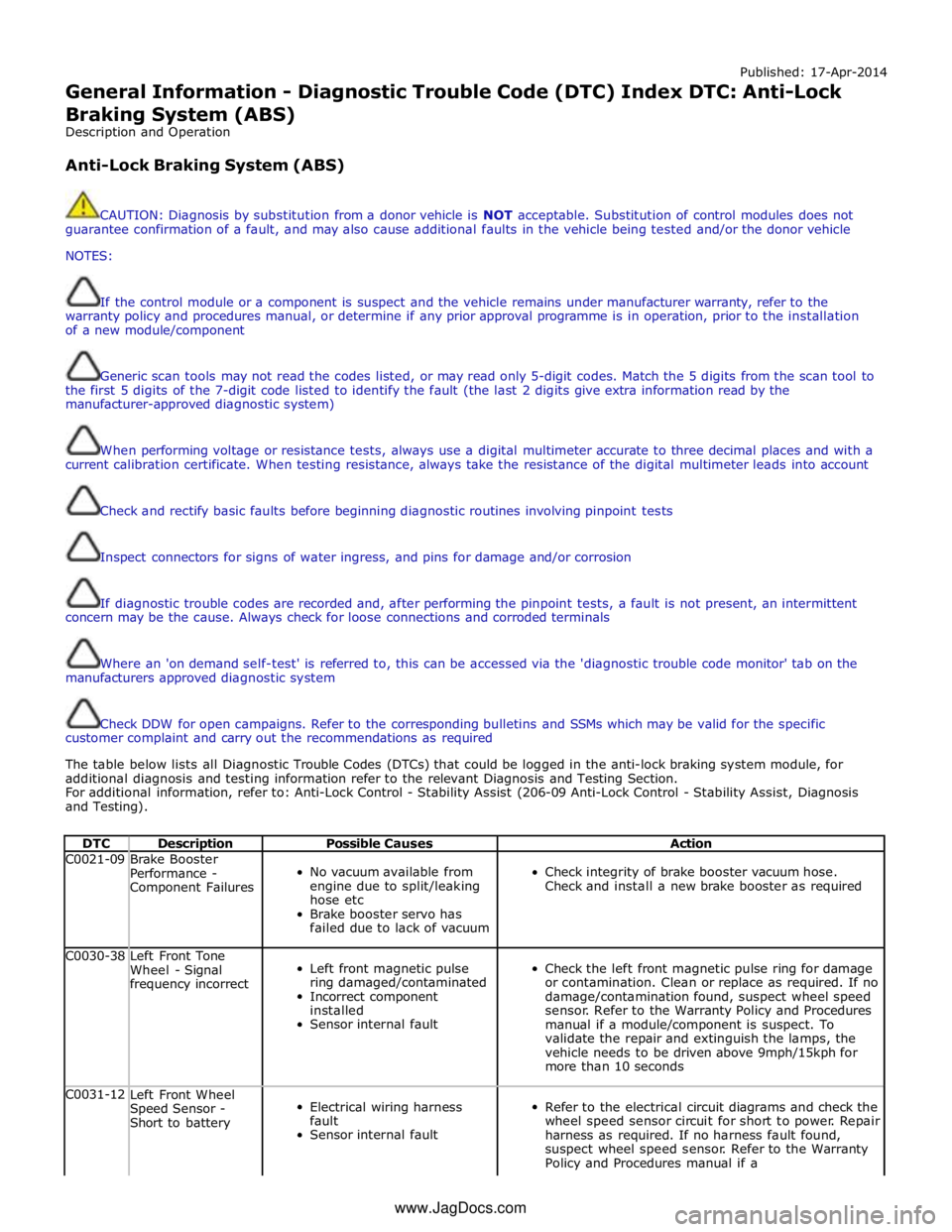
General Information - Diagnostic Trouble Code (DTC) Index DTC: Anti-Lock Braking System (ABS)
Description and Operation
Anti-Lock Braking System (ABS)
CAUTION: Diagnosis by substitution from a donor vehicle is NOT acceptable. Substitution of control modules does not
guarantee confirmation of a fault, and may also cause additional faults in the vehicle being tested and/or the donor vehicle
NOTES:
If the control module or a component is suspect and the vehicle remains under manufacturer warranty, refer to the
warranty policy and procedures manual, or determine if any prior approval programme is in operation, prior to the installation
of a new module/component
Generic scan tools may not read the codes listed, or may read only 5-digit codes. Match the 5 digits from the scan tool to
the first 5 digits of the 7-digit code listed to identify the fault (the last 2 digits give extra information read by the
manufacturer-approved diagnostic system)
When performing voltage or resistance tests, always use a digital multimeter accurate to three decimal places and with a
current calibration certificate. When testing resistance, always take the resistance of the digital multimeter leads into account
Check and rectify basic faults before beginning diagnostic routines involving pinpoint tests
Inspect connectors for signs of water ingress, and pins for damage and/or corrosion
If diagnostic trouble codes are recorded and, after performing the pinpoint tests, a fault is not present, an intermittent
concern may be the cause. Always check for loose connections and corroded terminals
Where an 'on demand self-test' is referred to, this can be accessed via the 'diagnostic trouble code monitor' tab on the
manufacturers approved diagnostic system
Check DDW for open campaigns. Refer to the corresponding bulletins and SSMs which may be valid for the specific
customer complaint and carry out the recommendations as required
The table below lists all Diagnostic Trouble Codes (DTCs) that could be logged in the anti-lock braking system module, for
additional diagnosis and testing information refer to the relevant Diagnosis and Testing Section.
For additional information, refer to: Anti-Lock Control - Stability Assist (206-09 Anti-Lock Control - Stability Assist, Diagnosis
and Testing).
DTC Description Possible Causes Action C0021-09
Brake Booster
Performance -
Component Failures
No vacuum available from
engine due to split/leaking
hose etc
Brake booster servo has
failed due to lack of vacuum
Check integrity of brake booster vacuum hose.
Check and install a new brake booster as required C0030-38
Left Front Tone
Wheel - Signal
frequency incorrect
Left front magnetic pulse
ring damaged/contaminated
Incorrect component
installed
Sensor internal fault
Check the left front magnetic pulse ring for damage
or contamination. Clean or replace as required. If no
damage/contamination found, suspect wheel speed
sensor. Refer to the Warranty Policy and Procedures
manual if a module/component is suspect. To
validate the repair and extinguish the lamps, the
vehicle needs to be driven above 9mph/15kph for
more than 10 seconds C0031-12
Left Front Wheel
Speed Sensor -
Short to battery
Electrical wiring harness
fault
Sensor internal fault
Refer to the electrical circuit diagrams and check the
wheel speed sensor circuit for short to power. Repair
harness as required. If no harness fault found,
suspect wheel speed sensor. Refer to the Warranty
Policy and Procedures manual if a www.JagDocs.com
Page 132 of 3039

DTC Description Possible Causes Action the CAN network U0140-00
Lost Communication
With Body Control
Module - No sub type
information
No sub type information
Refer to the electrical circuit diagrams and check
the power and ground connections to the module.
Using the manufacturer approved diagnostic
system, complete a CAN network integrity test.
Refer to the electrical circuit diagrams and check
the CAN network between the Central Junction
Box and Blind Spot Monitoring System Module U0155-00
Lost Communication
With Instrument Panel
Cluster (IPC) Control
Module - No sub type
information
No sub type information
Refer to the electrical circuit diagrams and check
the power and ground connections to the module.
Using the manufacturer approved diagnostic
system, complete a CAN network integrity test.
Refer to the electrical circuit diagrams and check
the CAN network between the Instrument Cluster
and Blind Spot Monitoring System Module U0232-00
Lost Communication
With Blind Spot
Monitoring System
Module - Left - No sub
type information
CAN bus circuit fault
Harness fault between left
side mirror and left side
module
Refer to the electrical circuit diagrams and check
the power and ground connections to the module.
Using the manufacturer approved diagnostic
system, complete a CAN network integrity test.
Refer to the electrical circuit diagrams and check
the CAN network between the left Blind Spot
Monitoring System Module and the right Blind
Spot Monitoring System Module
Refer to the electrical circuit diagrams and check
the left side harness between the left side mirror
and left hand module U0233-00
Lost Communication
With Blind Spot
Monitoring System
Module - Right - No sub
type information
CAN bus circuit fault
Harness fault between
right side mirror and right
side module
Refer to the electrical circuit diagrams and check
the power and ground connections to the module.
Using the manufacturer approved diagnostic
system, complete a CAN network integrity test.
Refer to the electrical circuit diagrams and check
the CAN network between the left Blind Spot
Monitoring System Module and the right Blind
Spot Monitoring System Module
Refer to the electrical circuit diagrams and check
the right side harness between the right side
mirror and right hand module U0300-00
Internal Control Module
Software Incompatibility
- No sub type
information
No sub type information
Check Central Junction Box for related DTCs and
refer to the relevant DTC Index. Check Restraints
Control Module for related DTCs and refer to DTC
Index. Check correct components are installed
and that the latest software version is installed U0415-68
Invalid Data Received
From Anti-Lock Brake
System (ABS) Control
Module - event
information
Event information
Using the manufacturer approved diagnostic
system check the central junction box and the
anti-lock brake system (ABS) control module for
related DTCs and refer to the relevant DTC Index U0422-68
Invalid Data Received
From Body Control
Module - Event
information
Event information
Check the Central Junction Box for related DTCs
and refer to the relevant DTC index U2100-00
Initial Configuration Not
Complete - No sub type
information
Car Configuration File
information not received
completely
Check/amend Car Configuration File using
manufacturer approved diagnostic system U2101-00
Control Module
Configuration
Incompatible - No sub
type information
Car Configuration File
information incompatible
to Control module
Check/amend Car Configuration File using
manufacturer approved diagnostic system U3000-44
Control Module - Data
memory failure
Control module data
memory failure
Refer to the electrical circuit diagrams and check
the power and ground circuits to the component.
Refer to the warranty policy and procedures
manual if a module is suspect
Page 161 of 3039

DTC Description Possible Causes Action system, complete a CAN network integrity test.
Refer to the electrical circuit diagrams and check
the CAN network U0103-00
Lost communication
With Gear Shift Module
A - No sub type
information
Gear shift control module /
system fault
Wiring harness fault
Check the Gear Shift Control Module for related
DTCs and refer to the relevant DTC index
Refer to the electrical circuit diagrams and check
the power and ground connections to the module.
Using the manufacturer approved diagnostic
system, complete a CAN network integrity test.
Refer to the electrical circuit diagrams and check
the CAN network U0104-00 Lost communication
Speed control module /
Check the Speed Control Module for related DTCs With Cruise Control Module A - No sub type system fault and refer to the relevant DTC index information Wiring harness fault Refer to the electrical circuit diagrams and check the power and ground connections to the module. Using the manufacturer approved diagnostic system, complete a CAN network integrity test. Refer to the electrical circuit diagrams and check the CAN network U0121-00
Lost communication
with Anti-Lock Braking
System (ABS) Control
Module - No sub type
information
Anti-Lock Braking System
control module / system
fault
Wiring harness fault
Check the Anti-Lock Braking System Control
Module for related DTCs and refer to the relevant
DTC index
Refer to the electrical circuit diagrams and check
the power and ground connections to the module.
Using the manufacturer approved diagnostic
system, complete a CAN network integrity test.
Refer to the electrical circuit diagrams and check
the CAN network U0155-00
Lost Communication
With Instrument Panel
Cluster (IPC) Control
Module - No sub type
information
Instrument Cluster /
system fault
Wiring harness fault
Check the Instrument Cluster for related DTCs
and refer to the relevant DTC index
Refer to the electrical circuit diagrams and check
the power and ground connections to the module.
Using the manufacturer approved diagnostic
system, complete a CAN network integrity test.
Refer to the electrical circuit diagrams and check
the CAN network U0300-00
Internal Control Module
Software
Incompatibility - No sub
type information
Car configuration file
stored in Park Brake
Module does not match the
master car configuration
file
Master car configuration
file not being transmitted
by master control module
Check all control modules for related DTCs and
refer to the relevant DTC index
Check the components installed on the vehicle
were installed by the factory or a dealer
Install the original components or a new one as
required U0401-00
Invalid Data Received
From ECM/PCM - No sub
type information
Invalid message from the
Engine Control Module
Check the Engine Control Module for related DTCs
and refer to the relevant DTC index U0404-00
Invalid Data Received
From Gear Shift Control
Module A - No sub type
information
Invalid message from the
gear shift control module
Check the Gear Shift Control Module for related
DTCs and refer to the relevant DTC index U0415-00
Invalid Data Received
From Anti-Lock Braking
System (ABS) Control
Module - No sub type
information
Invalid message from the
anti-lock Braking system
module
NOTE: This DTC may be stored even though no fault
condition is present and should be ignored unless the
customer has reported a electronic park brake concern.
Clear the DTC and retest. Verify the customer concern
prior to diagnosis
Check the Anti-Lock Braking System Control
Module for related DTCs and refer to the relevant
DTC index U0422-00
Invalid data received
from Central Junction
Box - No sub type
information
Invalid message from the
Central Junction Box
Check the Central Junction Box for related DTCs
and refer to the relevant DTC index