Exhaust JAGUAR XFR 2010 1.G User Guide
[x] Cancel search | Manufacturer: JAGUAR, Model Year: 2010, Model line: XFR, Model: JAGUAR XFR 2010 1.GPages: 3039, PDF Size: 58.49 MB
Page 166 of 3039
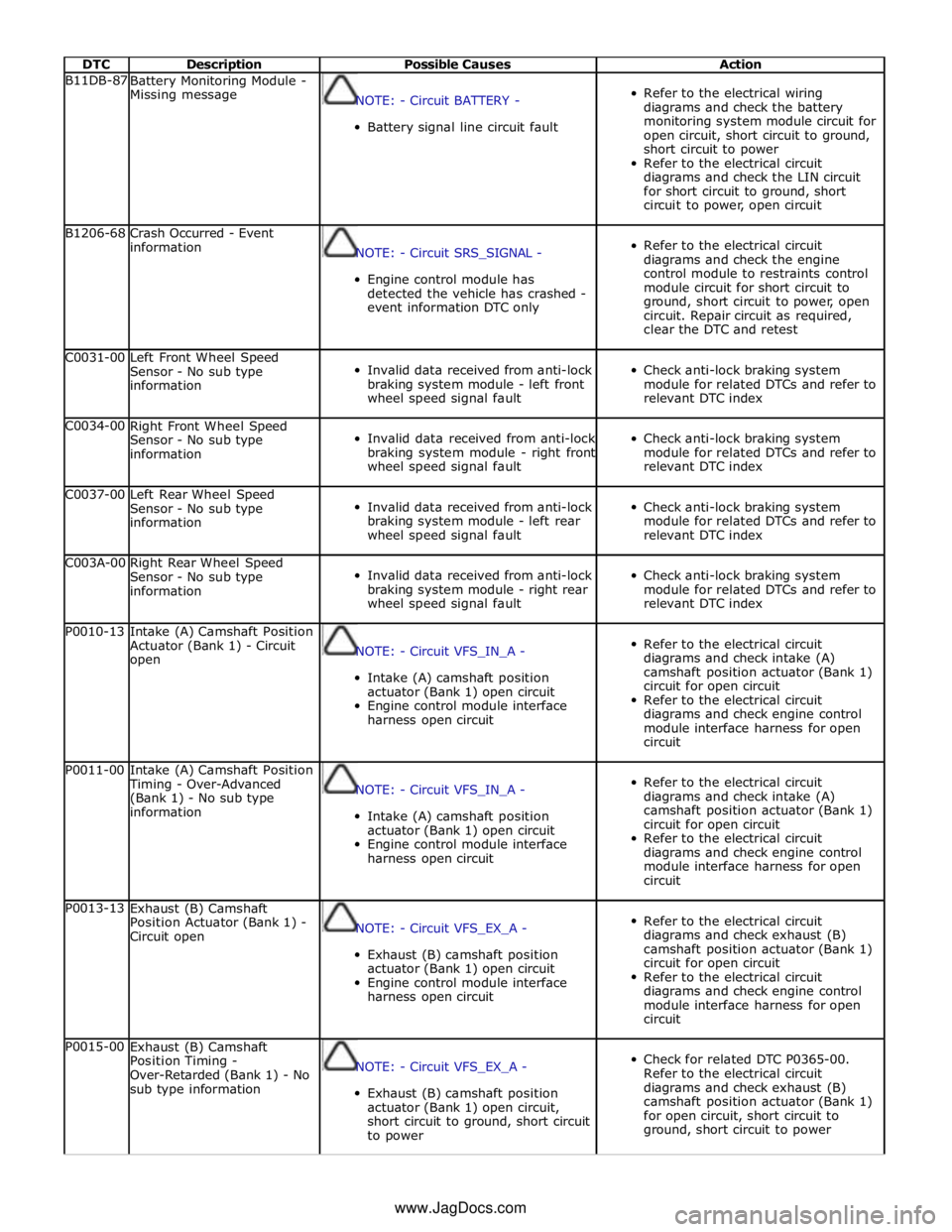
DTC Description Possible Causes Action B11DB-87
Battery Monitoring Module -
Missing message
NOTE: - Circuit BATTERY -
Battery signal line circuit fault
Refer to the electrical wiring
diagrams and check the battery
monitoring system module circuit for
open circuit, short circuit to ground,
short circuit to power
Refer to the electrical circuit
diagrams and check the LIN circuit
for short circuit to ground, short
circuit to power, open circuit B1206-68
Crash Occurred - Event
information
NOTE: - Circuit SRS_SIGNAL -
Engine control module has
detected the vehicle has crashed -
event information DTC only
Refer to the electrical circuit
diagrams and check the engine
control module to restraints control
module circuit for short circuit to
ground, short circuit to power, open
circuit. Repair circuit as required,
clear the DTC and retest C0031-00
Left Front Wheel Speed
Sensor - No sub type
information
Invalid data received from anti-lock
braking system module - left front
wheel speed signal fault
Check anti-lock braking system
module for related DTCs and refer to
relevant DTC index C0034-00
Right Front Wheel Speed
Sensor - No sub type
information
Invalid data received from anti-lock
braking system module - right front
wheel speed signal fault
Check anti-lock braking system
module for related DTCs and refer to
relevant DTC index C0037-00
Left Rear Wheel Speed
Sensor - No sub type
information
Invalid data received from anti-lock
braking system module - left rear
wheel speed signal fault
Check anti-lock braking system
module for related DTCs and refer to
relevant DTC index C003A-00
Right Rear Wheel Speed
Sensor - No sub type
information
Invalid data received from anti-lock
braking system module - right rear
wheel speed signal fault
Check anti-lock braking system
module for related DTCs and refer to
relevant DTC index P0010-13
Intake (A) Camshaft Position
Actuator (Bank 1) - Circuit
open
NOTE: - Circuit VFS_IN_A -
Intake (A) camshaft position
actuator (Bank 1) open circuit
Engine control module interface
harness open circuit
Refer to the electrical circuit
diagrams and check intake (A)
camshaft position actuator (Bank 1)
circuit for open circuit
Refer to the electrical circuit
diagrams and check engine control
module interface harness for open
circuit P0011-00
Intake (A) Camshaft Position
Timing - Over-Advanced
(Bank 1) - No sub type
information
NOTE: - Circuit VFS_IN_A -
Intake (A) camshaft position
actuator (Bank 1) open circuit
Engine control module interface
harness open circuit
Refer to the electrical circuit
diagrams and check intake (A)
camshaft position actuator (Bank 1)
circuit for open circuit
Refer to the electrical circuit
diagrams and check engine control
module interface harness for open
circuit P0013-13
Exhaust (B) Camshaft
Position Actuator (Bank 1) -
Circuit open
NOTE: - Circuit VFS_EX_A -
Exhaust (B) camshaft position
actuator (Bank 1) open circuit
Engine control module interface
harness open circuit
Refer to the electrical circuit
diagrams and check exhaust (B)
camshaft position actuator (Bank 1)
circuit for open circuit
Refer to the electrical circuit
diagrams and check engine control
module interface harness for open
circuit P0015-00
Exhaust (B) Camshaft
Position Timing -
Over-Retarded (Bank 1) - No
sub type information
NOTE: - Circuit VFS_EX_A -
Exhaust (B) camshaft position
actuator (Bank 1) open circuit,
short circuit to ground, short circuit
to power
Check for related DTC P0365-00.
Refer to the electrical circuit
diagrams and check exhaust (B)
camshaft position actuator (Bank 1)
for open circuit, short circuit to
ground, short circuit to power www.JagDocs.com
Page 167 of 3039
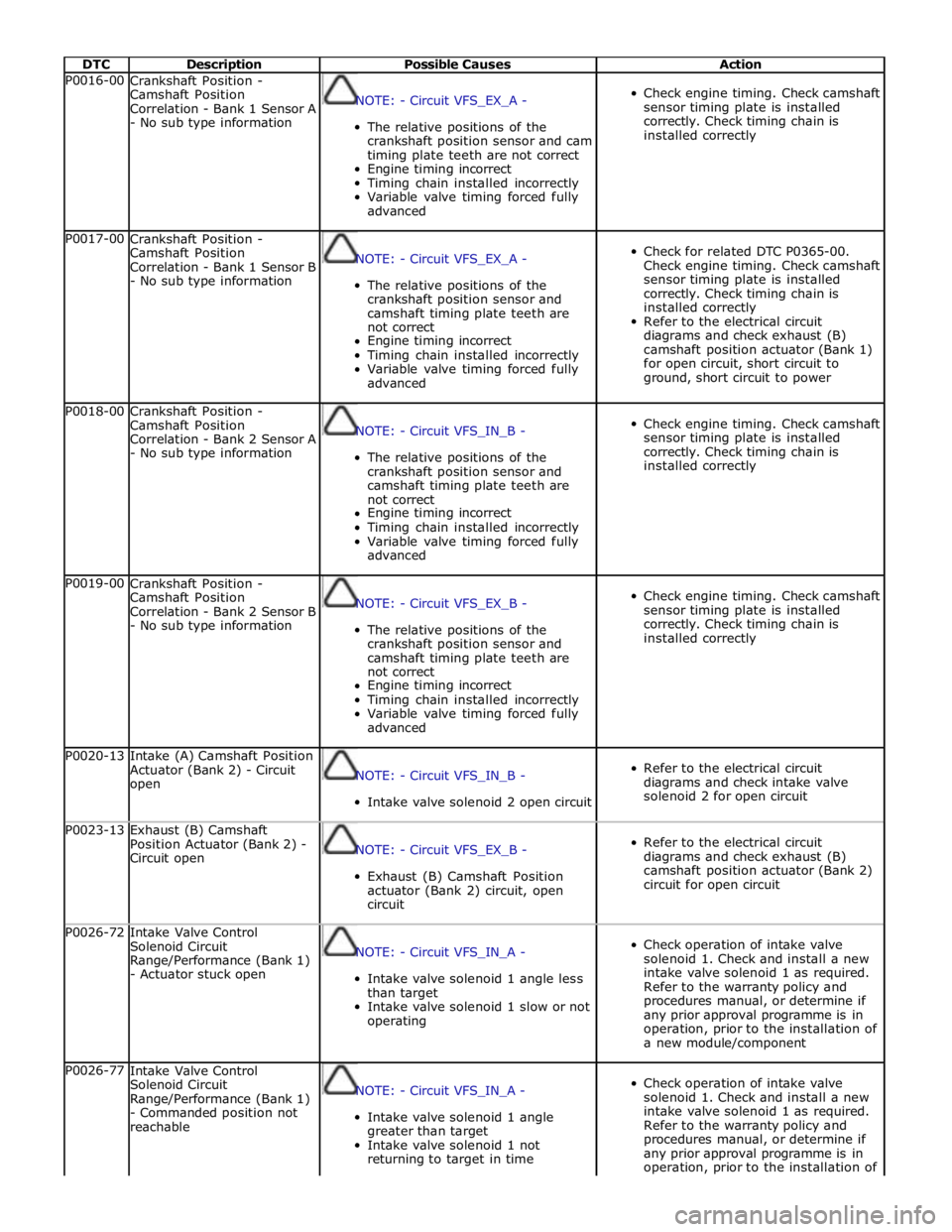
DTC Description Possible Causes Action P0016-00
Crankshaft Position -
Camshaft Position
Correlation - Bank 1 Sensor A
- No sub type information
NOTE: - Circuit VFS_EX_A -
The relative positions of the
crankshaft position sensor and cam
timing plate teeth are not correct
Engine timing incorrect
Timing chain installed incorrectly
Variable valve timing forced fully
advanced
Check engine timing. Check camshaft
sensor timing plate is installed
correctly. Check timing chain is
installed correctly P0017-00
Crankshaft Position -
Camshaft Position
Correlation - Bank 1 Sensor B
- No sub type information
NOTE: - Circuit VFS_EX_A -
The relative positions of the
crankshaft position sensor and
camshaft timing plate teeth are
not correct
Engine timing incorrect
Timing chain installed incorrectly
Variable valve timing forced fully
advanced
Check for related DTC P0365-00.
Check engine timing. Check camshaft
sensor timing plate is installed
correctly. Check timing chain is
installed correctly
Refer to the electrical circuit
diagrams and check exhaust (B)
camshaft position actuator (Bank 1)
for open circuit, short circuit to
ground, short circuit to power P0018-00
Crankshaft Position -
Camshaft Position
Correlation - Bank 2 Sensor A
- No sub type information
NOTE: - Circuit VFS_IN_B -
The relative positions of the
crankshaft position sensor and
camshaft timing plate teeth are
not correct
Engine timing incorrect
Timing chain installed incorrectly
Variable valve timing forced fully
advanced
Check engine timing. Check camshaft
sensor timing plate is installed
correctly. Check timing chain is
installed correctly P0019-00
Crankshaft Position -
Camshaft Position
Correlation - Bank 2 Sensor B
- No sub type information
NOTE: - Circuit VFS_EX_B -
The relative positions of the
crankshaft position sensor and
camshaft timing plate teeth are
not correct
Engine timing incorrect
Timing chain installed incorrectly
Variable valve timing forced fully
advanced
Check engine timing. Check camshaft
sensor timing plate is installed
correctly. Check timing chain is
installed correctly P0020-13
Intake (A) Camshaft Position
Actuator (Bank 2) - Circuit
open
NOTE: - Circuit VFS_IN_B -
Intake valve solenoid 2 open circuit
Refer to the electrical circuit
diagrams and check intake valve
solenoid 2 for open circuit P0023-13
Exhaust (B) Camshaft
Position Actuator (Bank 2) -
Circuit open
NOTE: - Circuit VFS_EX_B -
Exhaust (B) Camshaft Position
actuator (Bank 2) circuit, open
circuit
Refer to the electrical circuit
diagrams and check exhaust (B)
camshaft position actuator (Bank 2)
circuit for open circuit P0026-72
Intake Valve Control
Solenoid Circuit
Range/Performance (Bank 1)
- Actuator stuck open
NOTE: - Circuit VFS_IN_A -
Intake valve solenoid 1 angle less
than target
Intake valve solenoid 1 slow or not
operating
Check operation of intake valve
solenoid 1. Check and install a new
intake valve solenoid 1 as required.
Refer to the warranty policy and
procedures manual, or determine if
any prior approval programme is in
operation, prior to the installation of
a new module/component P0026-77
Intake Valve Control
Solenoid Circuit
Range/Performance (Bank 1)
- Commanded position not
reachable
NOTE: - Circuit VFS_IN_A -
Intake valve solenoid 1 angle
greater than target
Intake valve solenoid 1 not
returning to target in time
Check operation of intake valve
solenoid 1. Check and install a new
intake valve solenoid 1 as required.
Refer to the warranty policy and
procedures manual, or determine if
any prior approval programme is in
operation, prior to the installation of
Page 168 of 3039
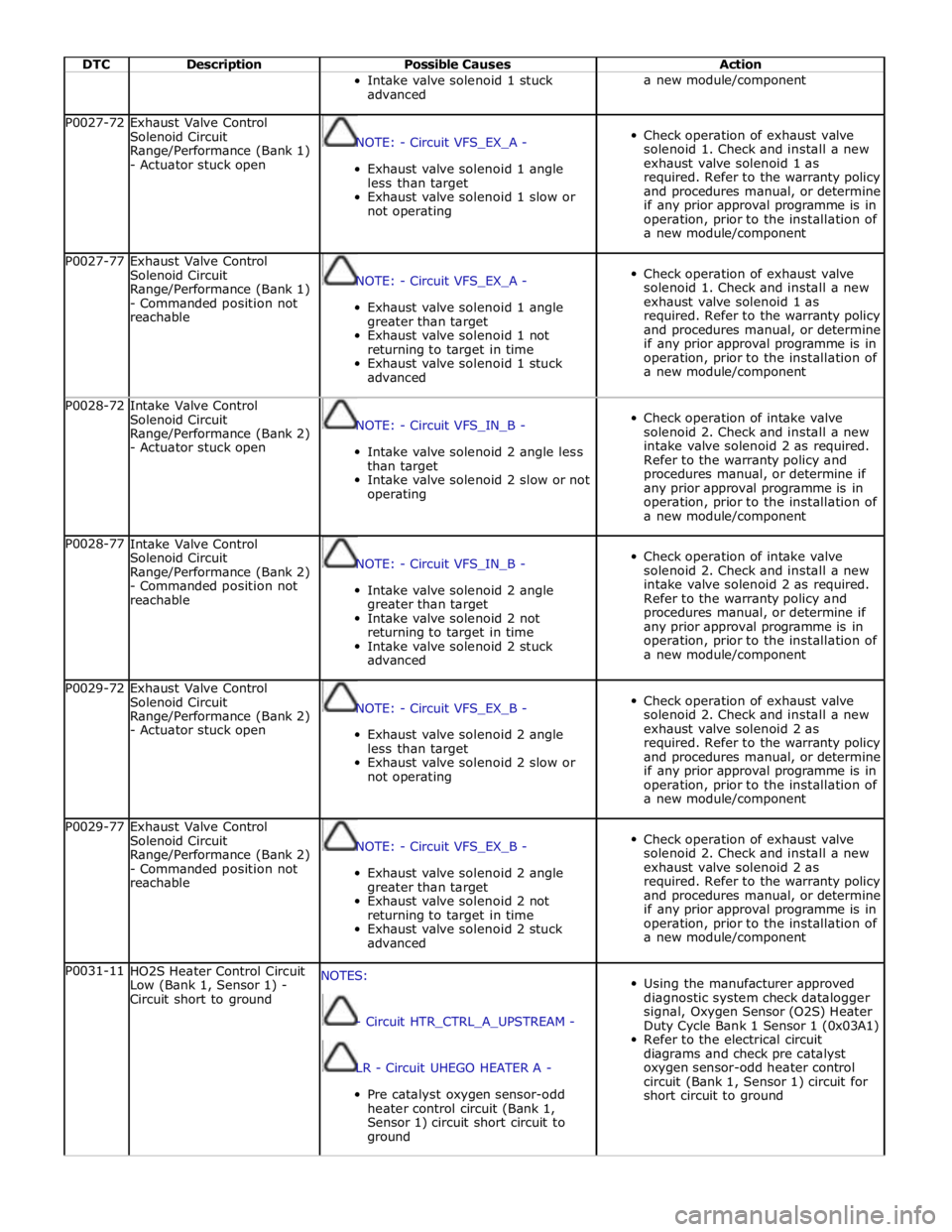
DTC Description Possible Causes Action Intake valve solenoid 1 stuck
advanced a new module/component P0027-72
Exhaust Valve Control
Solenoid Circuit
Range/Performance (Bank 1)
- Actuator stuck open
NOTE: - Circuit VFS_EX_A -
Exhaust valve solenoid 1 angle
less than target
Exhaust valve solenoid 1 slow or
not operating
Check operation of exhaust valve
solenoid 1. Check and install a new
exhaust valve solenoid 1 as
required. Refer to the warranty policy
and procedures manual, or determine
if any prior approval programme is in
operation, prior to the installation of
a new module/component P0027-77
Exhaust Valve Control
Solenoid Circuit
Range/Performance (Bank 1)
- Commanded position not
reachable
NOTE: - Circuit VFS_EX_A -
Exhaust valve solenoid 1 angle
greater than target
Exhaust valve solenoid 1 not
returning to target in time
Exhaust valve solenoid 1 stuck
advanced
Check operation of exhaust valve
solenoid 1. Check and install a new
exhaust valve solenoid 1 as
required. Refer to the warranty policy
and procedures manual, or determine
if any prior approval programme is in
operation, prior to the installation of
a new module/component P0028-72
Intake Valve Control
Solenoid Circuit
Range/Performance (Bank 2)
- Actuator stuck open
NOTE: - Circuit VFS_IN_B -
Intake valve solenoid 2 angle less
than target
Intake valve solenoid 2 slow or not
operating
Check operation of intake valve
solenoid 2. Check and install a new
intake valve solenoid 2 as required.
Refer to the warranty policy and
procedures manual, or determine if
any prior approval programme is in
operation, prior to the installation of
a new module/component P0028-77
Intake Valve Control
Solenoid Circuit
Range/Performance (Bank 2)
- Commanded position not
reachable
NOTE: - Circuit VFS_IN_B -
Intake valve solenoid 2 angle
greater than target
Intake valve solenoid 2 not
returning to target in time
Intake valve solenoid 2 stuck
advanced
Check operation of intake valve
solenoid 2. Check and install a new
intake valve solenoid 2 as required.
Refer to the warranty policy and
procedures manual, or determine if
any prior approval programme is in
operation, prior to the installation of
a new module/component P0029-72
Exhaust Valve Control
Solenoid Circuit
Range/Performance (Bank 2)
- Actuator stuck open
NOTE: - Circuit VFS_EX_B -
Exhaust valve solenoid 2 angle
less than target
Exhaust valve solenoid 2 slow or
not operating
Check operation of exhaust valve
solenoid 2. Check and install a new
exhaust valve solenoid 2 as
required. Refer to the warranty policy
and procedures manual, or determine
if any prior approval programme is in
operation, prior to the installation of
a new module/component P0029-77
Exhaust Valve Control
Solenoid Circuit
Range/Performance (Bank 2)
- Commanded position not
reachable
NOTE: - Circuit VFS_EX_B -
Exhaust valve solenoid 2 angle
greater than target
Exhaust valve solenoid 2 not
returning to target in time
Exhaust valve solenoid 2 stuck
advanced
Check operation of exhaust valve
solenoid 2. Check and install a new
exhaust valve solenoid 2 as
required. Refer to the warranty policy
and procedures manual, or determine
if any prior approval programme is in
operation, prior to the installation of
a new module/component P0031-11
HO2S Heater Control Circuit
Low (Bank 1, Sensor 1) -
Circuit short to ground NOTES:
- Circuit HTR_CTRL_A_UPSTREAM -
LR - Circuit UHEGO HEATER A -
Pre catalyst oxygen sensor-odd
heater control circuit (Bank 1,
Sensor 1) circuit short circuit to
ground
Using the manufacturer approved
diagnostic system check datalogger
signal, Oxygen Sensor (O2S) Heater
Duty Cycle Bank 1 Sensor 1 (0x03A1)
Refer to the electrical circuit
diagrams and check pre catalyst
oxygen sensor-odd heater control
circuit (Bank 1, Sensor 1) circuit for
short circuit to ground
Page 177 of 3039
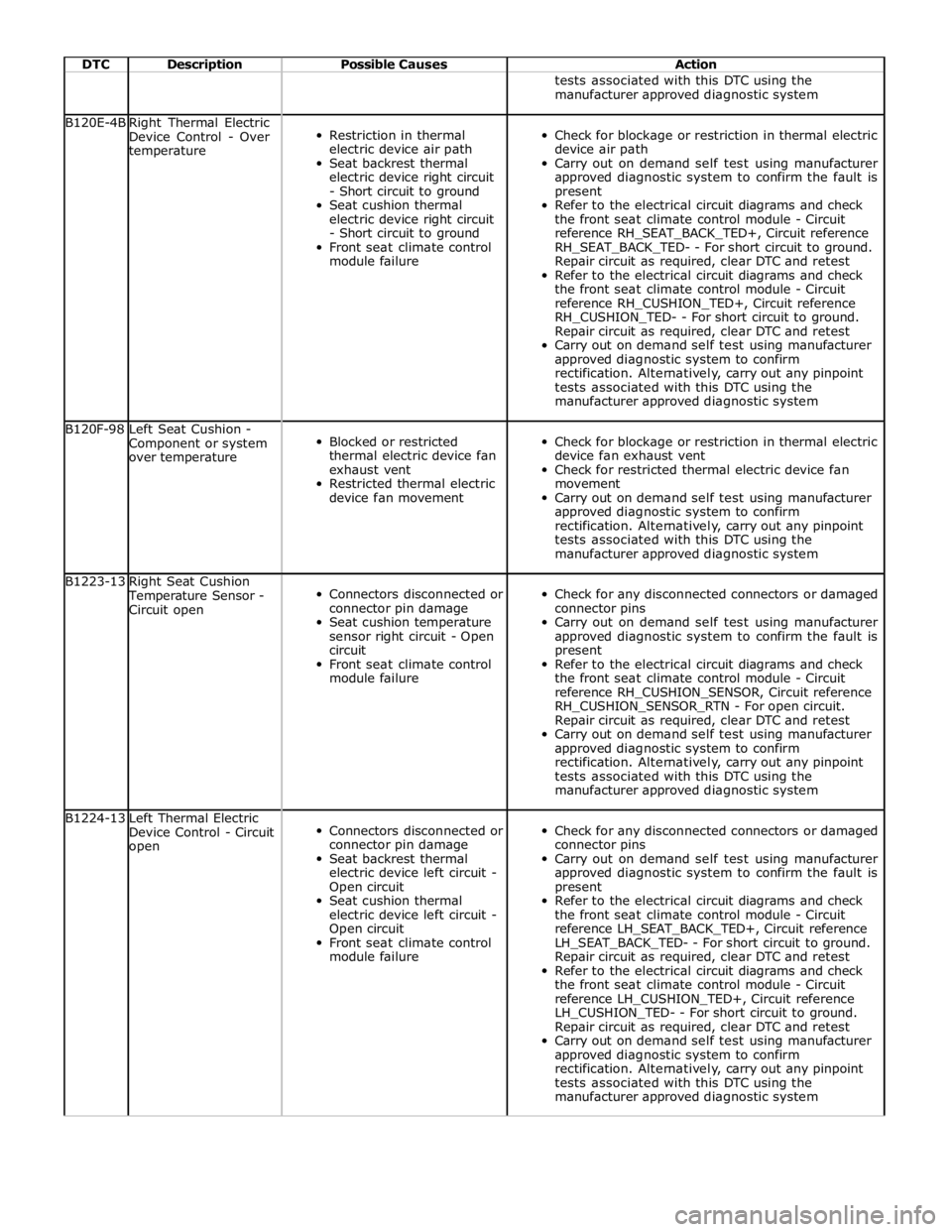
DTC Description Possible Causes Action tests associated with this DTC using the
manufacturer approved diagnostic system B120E-4B
Right Thermal Electric
Device Control - Over
temperature
Restriction in thermal
electric device air path
Seat backrest thermal
electric device right circuit
- Short circuit to ground
Seat cushion thermal
electric device right circuit
- Short circuit to ground
Front seat climate control
module failure
Check for blockage or restriction in thermal electric
device air path
Carry out on demand self test using manufacturer
approved diagnostic system to confirm the fault is
present
Refer to the electrical circuit diagrams and check
the front seat climate control module - Circuit
reference RH_SEAT_BACK_TED+, Circuit reference
RH_SEAT_BACK_TED- - For short circuit to ground.
Repair circuit as required, clear DTC and retest
Refer to the electrical circuit diagrams and check
the front seat climate control module - Circuit
reference RH_CUSHION_TED+, Circuit reference
RH_CUSHION_TED- - For short circuit to ground.
Repair circuit as required, clear DTC and retest
Carry out on demand self test using manufacturer
approved diagnostic system to confirm
rectification. Alternatively, carry out any pinpoint
tests associated with this DTC using the
manufacturer approved diagnostic system B120F-98
Left Seat Cushion -
Component or system
over temperature
Blocked or restricted
thermal electric device fan
exhaust vent
Restricted thermal electric
device fan movement
Check for blockage or restriction in thermal electric
device fan exhaust vent
Check for restricted thermal electric device fan
movement
Carry out on demand self test using manufacturer
approved diagnostic system to confirm
rectification. Alternatively, carry out any pinpoint
tests associated with this DTC using the
manufacturer approved diagnostic system B1223-13
Right Seat Cushion Temperature Sensor -
Circuit open
Connectors disconnected or
connector pin damage
Seat cushion temperature
sensor right circuit - Open
circuit
Front seat climate control
module failure
Check for any disconnected connectors or damaged
connector pins
Carry out on demand self test using manufacturer
approved diagnostic system to confirm the fault is
present
Refer to the electrical circuit diagrams and check
the front seat climate control module - Circuit
reference RH_CUSHION_SENSOR, Circuit reference
RH_CUSHION_SENSOR_RTN - For open circuit.
Repair circuit as required, clear DTC and retest
Carry out on demand self test using manufacturer
approved diagnostic system to confirm
rectification. Alternatively, carry out any pinpoint
tests associated with this DTC using the
manufacturer approved diagnostic system B1224-13
Left Thermal Electric
Device Control - Circuit
open
Connectors disconnected or
connector pin damage
Seat backrest thermal
electric device left circuit -
Open circuit
Seat cushion thermal
electric device left circuit -
Open circuit
Front seat climate control
module failure
Check for any disconnected connectors or damaged
connector pins
Carry out on demand self test using manufacturer
approved diagnostic system to confirm the fault is
present
Refer to the electrical circuit diagrams and check
the front seat climate control module - Circuit
reference LH_SEAT_BACK_TED+, Circuit reference
LH_SEAT_BACK_TED- - For short circuit to ground.
Repair circuit as required, clear DTC and retest
Refer to the electrical circuit diagrams and check
the front seat climate control module - Circuit
reference LH_CUSHION_TED+, Circuit reference
LH_CUSHION_TED- - For short circuit to ground.
Repair circuit as required, clear DTC and retest
Carry out on demand self test using manufacturer
approved diagnostic system to confirm
rectification. Alternatively, carry out any pinpoint
tests associated with this DTC using the
manufacturer approved diagnostic system
Page 180 of 3039
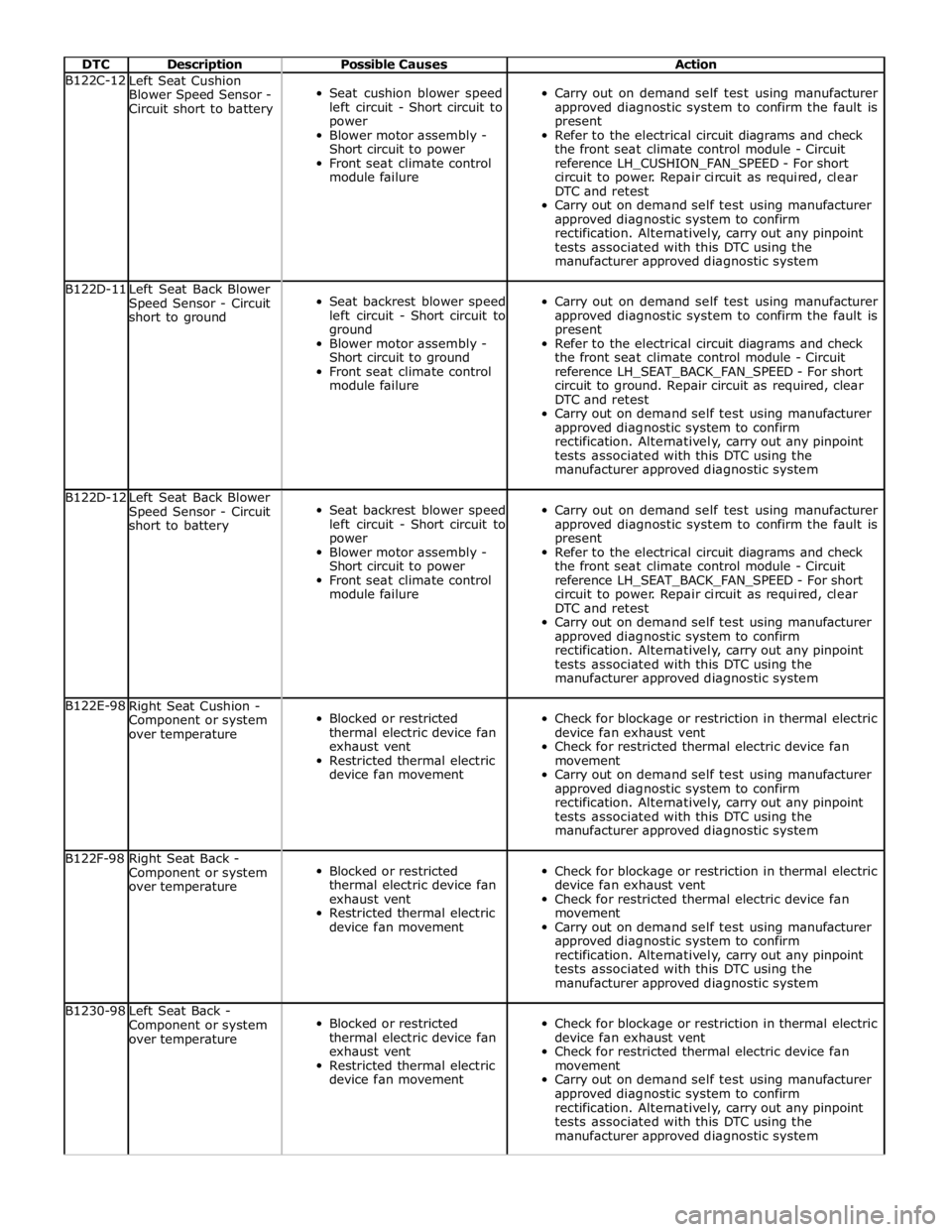
DTC Description Possible Causes Action B122C-12
Left Seat Cushion
Blower Speed Sensor -
Circuit short to battery
Seat cushion blower speed
left circuit - Short circuit to
power
Blower motor assembly -
Short circuit to power
Front seat climate control
module failure
Carry out on demand self test using manufacturer
approved diagnostic system to confirm the fault is
present
Refer to the electrical circuit diagrams and check
the front seat climate control module - Circuit
reference LH_CUSHION_FAN_SPEED - For short
circuit to power. Repair circuit as required, clear
DTC and retest
Carry out on demand self test using manufacturer
approved diagnostic system to confirm
rectification. Alternatively, carry out any pinpoint
tests associated with this DTC using the
manufacturer approved diagnostic system B122D-11
Left Seat Back Blower
Speed Sensor - Circuit
short to ground
Seat backrest blower speed
left circuit - Short circuit to
ground
Blower motor assembly -
Short circuit to ground
Front seat climate control
module failure
Carry out on demand self test using manufacturer
approved diagnostic system to confirm the fault is
present
Refer to the electrical circuit diagrams and check
the front seat climate control module - Circuit
reference LH_SEAT_BACK_FAN_SPEED - For short
circuit to ground. Repair circuit as required, clear
DTC and retest
Carry out on demand self test using manufacturer
approved diagnostic system to confirm
rectification. Alternatively, carry out any pinpoint
tests associated with this DTC using the
manufacturer approved diagnostic system B122D-12
Left Seat Back Blower
Speed Sensor - Circuit
short to battery
Seat backrest blower speed
left circuit - Short circuit to
power
Blower motor assembly -
Short circuit to power
Front seat climate control
module failure
Carry out on demand self test using manufacturer
approved diagnostic system to confirm the fault is
present
Refer to the electrical circuit diagrams and check
the front seat climate control module - Circuit
reference LH_SEAT_BACK_FAN_SPEED - For short
circuit to power. Repair circuit as required, clear
DTC and retest
Carry out on demand self test using manufacturer
approved diagnostic system to confirm
rectification. Alternatively, carry out any pinpoint
tests associated with this DTC using the
manufacturer approved diagnostic system B122E-98
Right Seat Cushion -
Component or system
over temperature
Blocked or restricted
thermal electric device fan
exhaust vent
Restricted thermal electric
device fan movement
Check for blockage or restriction in thermal electric
device fan exhaust vent
Check for restricted thermal electric device fan
movement
Carry out on demand self test using manufacturer
approved diagnostic system to confirm
rectification. Alternatively, carry out any pinpoint
tests associated with this DTC using the
manufacturer approved diagnostic system B122F-98
Right Seat Back -
Component or system
over temperature
Blocked or restricted
thermal electric device fan
exhaust vent
Restricted thermal electric
device fan movement
Check for blockage or restriction in thermal electric
device fan exhaust vent
Check for restricted thermal electric device fan
movement
Carry out on demand self test using manufacturer
approved diagnostic system to confirm
rectification. Alternatively, carry out any pinpoint
tests associated with this DTC using the
manufacturer approved diagnostic system B1230-98
Left Seat Back -
Component or system
over temperature
Blocked or restricted
thermal electric device fan
exhaust vent
Restricted thermal electric
device fan movement
Check for blockage or restriction in thermal electric
device fan exhaust vent
Check for restricted thermal electric device fan
movement
Carry out on demand self test using manufacturer
approved diagnostic system to confirm
rectification. Alternatively, carry out any pinpoint
tests associated with this DTC using the
manufacturer approved diagnostic system
Page 181 of 3039

DTC Description Possible Causes Action B1231-7A
Right Seat - Fluid leak
or seal failure
Seat backrest assembly -
Air path leaking
Seat cushion assembly -
Air path leaking
Seat assembly damaged
Check for blockage or restriction in seat
backrest/seat cushion thermal electric device fan
ducts
Check seat backrest/seat cushion thermal electric
device fan exhaust vent is clear
Carry out on demand self test using manufacturer
approved diagnostic system to confirm
rectification. Alternatively, carry out any pinpoint
tests associated with this DTC using the
manufacturer approved diagnostic system B1232-7A
Left Seat - Fluid leak or
seal failure
Seat backrest assembly -
Air path leaking
Seat cushion assembly -
Air path leaking
Seat assembly damaged
Check for blockage or restriction in seat
backrest/seat cushion thermal electric device fan
ducts
Check seat backrest/seat cushion thermal electric
device fan exhaust vent is clear
Carry out on demand self test using manufacturer
approved diagnostic system to confirm
rectification. Alternatively, carry out any pinpoint
tests associated with this DTC using the
manufacturer approved diagnostic system B1235-13
Left Seat Cushion Temperature Sensor -
Circuit open
Connectors disconnected or
connector pin damage
Seat cushion temperature
sensor left circuit - Open
circuit
Front seat climate control
module failure
Check for any disconnected connectors or damaged
connector pins
Carry out on demand self test using manufacturer
approved diagnostic system to confirm the fault is
present
Refer to the electrical circuit diagrams and check
the front seat climate control module - Circuit
reference LH_CUSHION_SENSOR, Circuit reference
LH_CUSHION_SENSOR_RTN - For open circuit.
Repair circuit as required, clear DTC and retest
Carry out on demand self test using manufacturer
approved diagnostic system to confirm
rectification. Alternatively, carry out any pinpoint
tests associated with this DTC using the
manufacturer approved diagnostic system U0010-88
Medium Speed CAN
Communication Bus -
Bus off
Medium speed CAN
communication - Bus off
Refer to the electrical circuit diagrams and check
the power and ground connections to the module
Using the manufacturer approved diagnostic
system, complete a CAN network integrity test
Carry out on demand self test using manufacturer
approved diagnostic system to confirm rectification U0140-00
Lost Communication
With Body Control
Module - No sub type
information
Lost communication with
central junction box
NOTE: This DTC may be stored even though no fault
condition is present and should be ignored unless the
customer has reported a climate seat concern. Clear the
DTC and retest. Verify the customer concern prior to
diagnosis
Refer to the electrical circuit diagrams and check
the power and ground connections to the module
Using the manufacturer approved diagnostic
system, complete a CAN network integrity test
Refer to the electrical circuit diagrams and check
the CAN network between the front seat climate
control module and central junction box
Carry out on demand self test using manufacturer
approved diagnostic system to confirm rectification U0142-00 Lost Communication
Lost communication with
Refer to the electrical circuit diagrams and check With Body Control Module "B" - No sub rear junction box the power and ground connections to the module type information Using the manufacturer approved diagnostic system, complete a CAN network integrity test Refer to the electrical circuit diagrams and check the CAN network between the front seat climate control module and rear junction box Carry out on demand self test using manufacturer approved diagnostic system to confirm rectification www.JagDocs.com
Page 295 of 3039
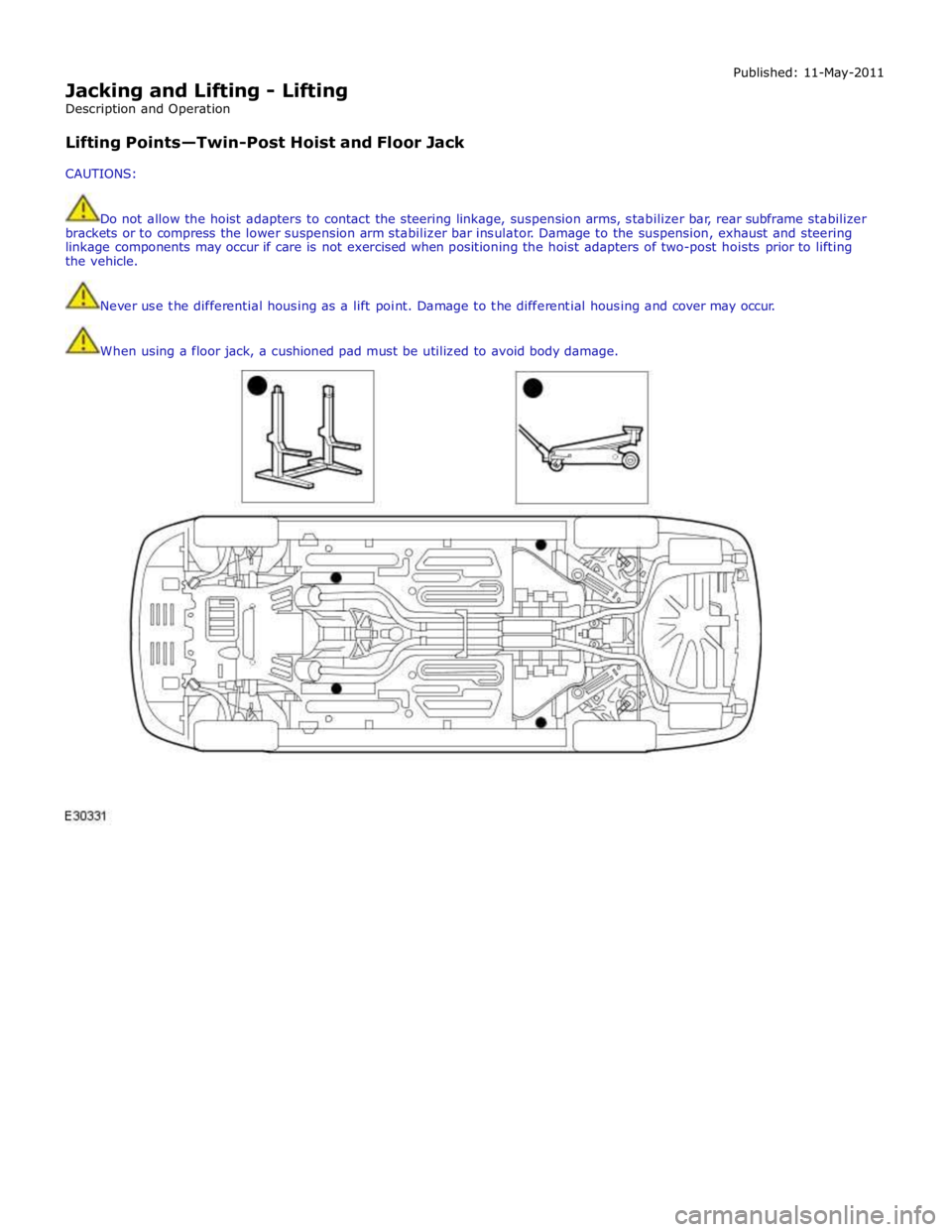
Jacking and Lifting - Lifting
Description and Operation
Lifting Points—Twin-Post Hoist and Floor Jack
CAUTIONS: Published: 11-May-2011
Do not allow the hoist adapters to contact the steering linkage, suspension arms, stabilizer bar, rear subframe stabilizer
brackets or to compress the lower suspension arm stabilizer bar insulator. Damage to the suspension, exhaust and steering
linkage components may occur if care is not exercised when positioning the hoist adapters of two-post hoists prior to lifting
the vehicle.
Never use the differential housing as a lift point. Damage to the differential housing and cover may occur.
When using a floor jack, a cushioned pad must be utilized to avoid body damage.
Page 299 of 3039

Published: 16-Sep-2013
Noise, Vibration and Harshness - Noise, Vibration and Harshness (NVH)
Diagnosis and Testing
Principle of Operation
For a detailed description of Noise, Vibration and Harshness issues, refer to the Description and Operation section of the
workshop manual.
REFER to: Noise, Vibration and Harshness (NVH) (100-04 Noise, Vibration and Harshness, Description and Operation).
Inspection and Verification
1. Verify the customer's concerns by operating the vehicle to duplicate the condition.
2. Visually inspect the vehicle to determine any obvious cause(s) of the concern(s).
3. If the inspection reveals obvious causes that can be readily identified, repair as necessary.
4. If the concern(s) remains after the inspection, determine the symptom(s) and refer to the Symptom Chart.
How To Use This Diagnostic Procedure Section
Noise, vibration and harshness (NVH) concerns have become more important as vehicles have become more sensitive to
these vibrations. This section is designed as an aid to identifying these situations
The section provides diagnostic procedures based on symptoms. If the condition occurs at high speed, for instance, the
most likely place to start is under High Speed Shake
The road test procedure will tell how to sort the conditions into categories and how to tell a vibration from a shake
A series of Road Test Quick Checks is provided to make sure that a cause is either pinpointed or eliminated
Name the condition, proceed to the appropriate section and locate the correct diagnosis. When the condition is
identified, the job is partly done
Follow the diagnostic procedure as outlined
Quick Checks are described within the step, while more involved tests and adjustments are outlined in General
Procedures
Always follow each step exactly and make notes to recall important findings later
Customer Interview
The road test and customer interview (if available) provide information that will help identify the concerns and will provide
direction to the correct starting point for diagnosis.
Identify the Condition
NVH problems usually occur in a number of areas:
tires
engine accessories
suspension
driveline
air leakage (wind noise)
squeaks and rattles
heating ventilation and air conditioning (HVAC)
electrical (e.g. motor noise)
transmission
engine
It is important, therefore, that an NVH concern be isolated into its specific area(s) as soon as possible. The easiest and
quickest way to do this is to carry out the Road Test as outlined.
Noise Diagnostic Procedure
Non-Axle Noise
The five most important sources of non-axle noise are exhaust, tires, roof racks, trim and mouldings, and transmission.
Therefore, make sure that none of the following conditions are the cause of the noise before proceeding with a driveline tear
down and diagnosis.
Under certain conditions, the pitch of the exhaust may sound very much like gear noise. At other times, it can be
mistaken for a wheel bearing rumble
Tires, especially snow tires, can have a high pitched tread whine or roar, similar to gear noise. Radial tires, to some
degree, have this characteristic. Also, any non-standard tire with an unusual tread construction may emit a roar or
whine type noise
Trim and mouldings can also cause whistling or a whining noise
Clunk may be a metallic noise heard when the automatic transmission is engaged in reverse or drive, or it may occur
when the throttle is applied or released. It is caused by backlash somewhere in the driveline
Bearing rumble sounds like marbles being tumbled. This condition is usually caused by a damaged wheel bearing
Page 300 of 3039
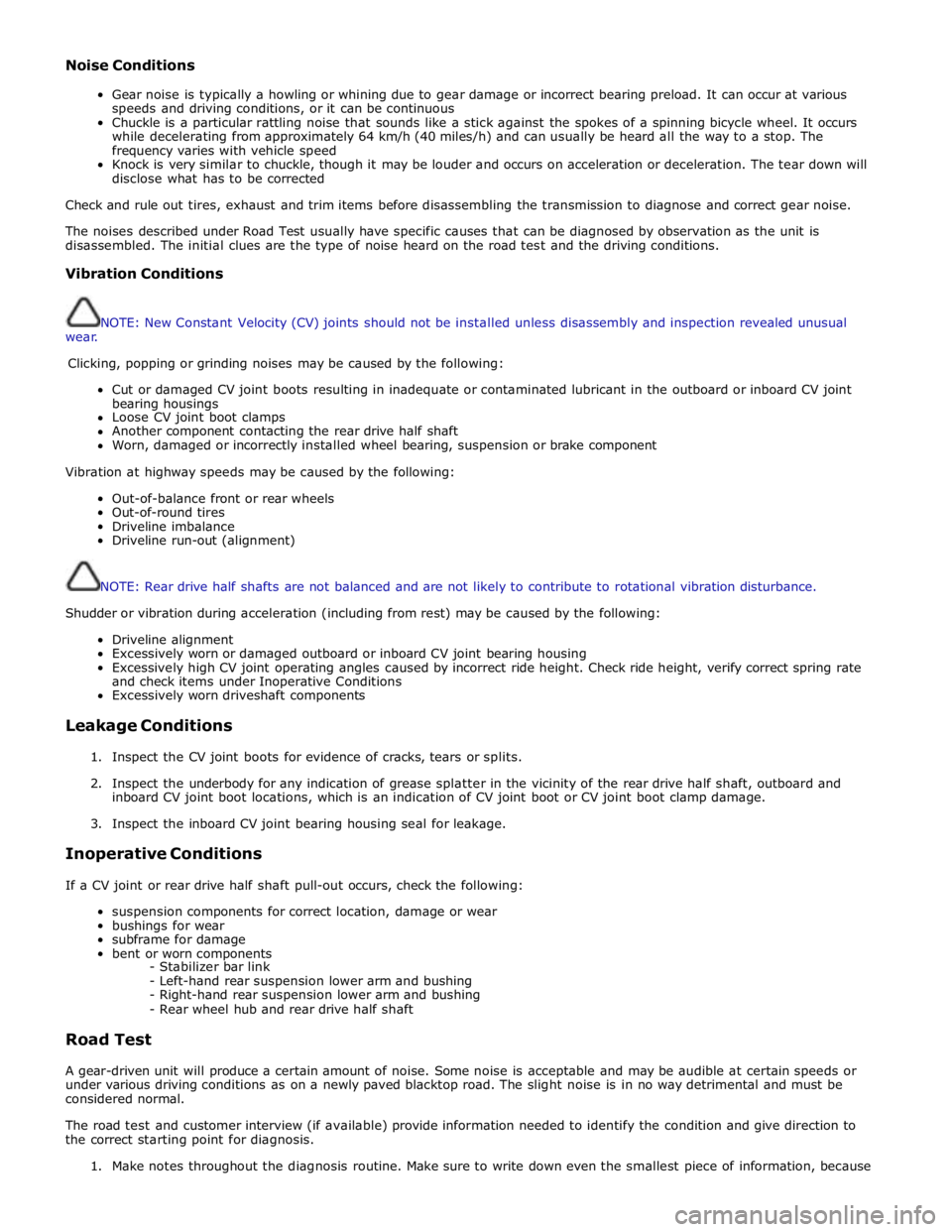
Noise Conditions
Gear noise is typically a howling or whining due to gear damage or incorrect bearing preload. It can occur at various
speeds and driving conditions, or it can be continuous
Chuckle is a particular rattling noise that sounds like a stick against the spokes of a spinning bicycle wheel. It occurs
while decelerating from approximately 64 km/h (40 miles/h) and can usually be heard all the way to a stop. The
frequency varies with vehicle speed
Knock is very similar to chuckle, though it may be louder and occurs on acceleration or deceleration. The tear down will
disclose what has to be corrected
Check and rule out tires, exhaust and trim items before disassembling the transmission to diagnose and correct gear noise.
The noises described under Road Test usually have specific causes that can be diagnosed by observation as the unit is
disassembled. The initial clues are the type of noise heard on the road test and the driving conditions.
Vibration Conditions
wear. NOTE: New Constant Velocity (CV) joints should not be installed unless disassembly and inspection revealed unusual
Clicking, popping or grinding noises may be caused by the following:
Cut or damaged CV joint boots resulting in inadequate or contaminated lubricant in the outboard or inboard CV joint
bearing housings
Loose CV joint boot clamps
Another component contacting the rear drive half shaft
Worn, damaged or incorrectly installed wheel bearing, suspension or brake component
Vibration at highway speeds may be caused by the following:
Out-of-balance front or rear wheels
Out-of-round tires
Driveline imbalance
Driveline run-out (alignment)
NOTE: Rear drive half shafts are not balanced and are not likely to contribute to rotational vibration disturbance.
Shudder or vibration during acceleration (including from rest) may be caused by the following:
Driveline alignment
Excessively worn or damaged outboard or inboard CV joint bearing housing
Excessively high CV joint operating angles caused by incorrect ride height. Check ride height, verify correct spring rate
and check items under Inoperative Conditions
Excessively worn driveshaft components
Leakage Conditions
1. Inspect the CV joint boots for evidence of cracks, tears or splits.
2. Inspect the underbody for any indication of grease splatter in the vicinity of the rear drive half shaft, outboard and
inboard CV joint boot locations, which is an indication of CV joint boot or CV joint boot clamp damage.
3. Inspect the inboard CV joint bearing housing seal for leakage.
Inoperative Conditions
If a CV joint or rear drive half shaft pull-out occurs, check the following:
suspension components for correct location, damage or wear
bushings for wear
subframe for damage
bent or worn components
- Stabilizer bar link
- Left-hand rear suspension lower arm and bushing
- Right-hand rear suspension lower arm and bushing
- Rear wheel hub and rear drive half shaft
Road Test
A gear-driven unit will produce a certain amount of noise. Some noise is acceptable and may be audible at certain speeds or
under various driving conditions as on a newly paved blacktop road. The slight noise is in no way detrimental and must be
considered normal.
The road test and customer interview (if available) provide information needed to identify the condition and give direction to
the correct starting point for diagnosis.
1. Make notes throughout the diagnosis routine. Make sure to write down even the smallest piece of information, because
Page 302 of 3039
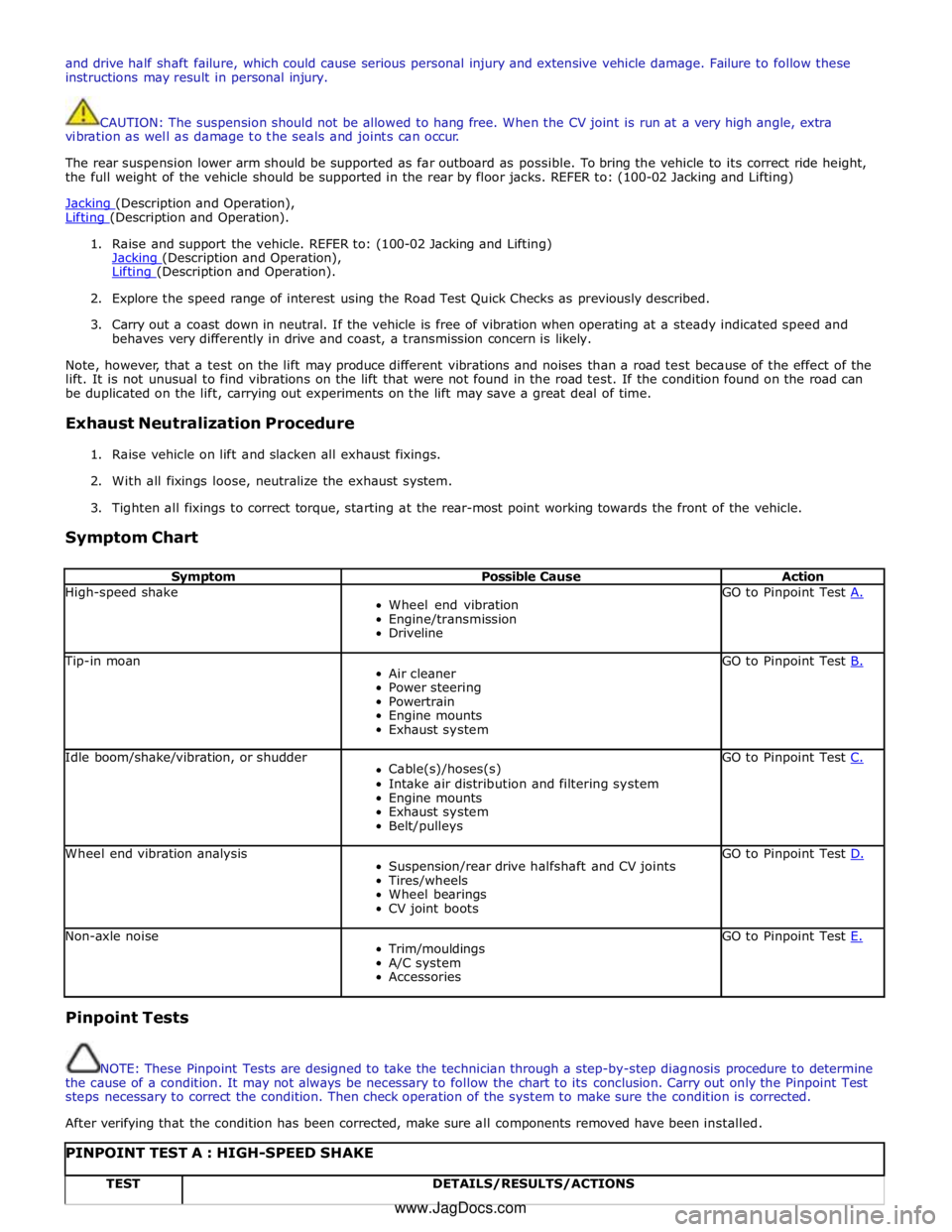
and drive half shaft failure, which could cause serious personal injury and extensive vehicle damage. Failure to follow these
instructions may result in personal injury.
CAUTION: The suspension should not be allowed to hang free. When the CV joint is run at a very high angle, extra
vibration as well as damage to the seals and joints can occur.
The rear suspension lower arm should be supported as far outboard as possible. To bring the vehicle to its correct ride height,
the full weight of the vehicle should be supported in the rear by floor jacks. REFER to: (100-02 Jacking and Lifting)
Jacking (Description and Operation), Lifting (Description and Operation).
1. Raise and support the vehicle. REFER to: (100-02 Jacking and Lifting)
Jacking (Description and Operation), Lifting (Description and Operation).
2. Explore the speed range of interest using the Road Test Quick Checks as previously described.
3. Carry out a coast down in neutral. If the vehicle is free of vibration when operating at a steady indicated speed and
behaves very differently in drive and coast, a transmission concern is likely.
Note, however, that a test on the lift may produce different vibrations and noises than a road test because of the effect of the
lift. It is not unusual to find vibrations on the lift that were not found in the road test. If the condition found on the road can
be duplicated on the lift, carrying out experiments on the lift may save a great deal of time.
Exhaust Neutralization Procedure
1. Raise vehicle on lift and slacken all exhaust fixings.
2. With all fixings loose, neutralize the exhaust system.
3. Tighten all fixings to correct torque, starting at the rear-most point working towards the front of the vehicle.
Symptom Chart
Symptom Possible Cause Action High-speed shake
Wheel end vibration
Engine/transmission
Driveline GO to Pinpoint Test A. Tip-in moan
Air cleaner
Power steering
Powertrain
Engine mounts
Exhaust system GO to Pinpoint Test B. Idle boom/shake/vibration, or shudder
Cable(s)/hoses(s)
Intake air distribution and filtering system
Engine mounts
Exhaust system
Belt/pulleys GO to Pinpoint Test C. Wheel end vibration analysis
Suspension/rear drive halfshaft and CV joints
Tires/wheels
Wheel bearings
CV joint boots GO to Pinpoint Test D. Non-axle noise
Trim/mouldings
A/C system
Accessories GO to Pinpoint Test E. Pinpoint Tests
NOTE: These Pinpoint Tests are designed to take the technician through a step-by-step diagnosis procedure to determine
the cause of a condition. It may not always be necessary to follow the chart to its conclusion. Carry out only the Pinpoint Test
steps necessary to correct the condition. Then check operation of the system to make sure the condition is corrected.
After verifying that the condition has been corrected, make sure all components removed have been installed.
PINPOINT TEST A : HIGH-SPEED SHAKE TEST DETAILS/RESULTS/ACTIONS www.JagDocs.com