service JAGUAR XFR 2010 1.G User Guide
[x] Cancel search | Manufacturer: JAGUAR, Model Year: 2010, Model line: XFR, Model: JAGUAR XFR 2010 1.GPages: 3039, PDF Size: 58.49 MB
Page 108 of 3039

DTC Description Possible Causes Action C1030-14
Left Rear
vertical
acceleration
sensor - Short
to ground, open
circuit
Left rear vertical
acceleration sensor
circuit short to
ground, open circuit
Vertical acceleration
sensor fault
Refer to the electrical circuit diagrams and check left Rear
vertical acceleration sensor circuit for short to ground, open
circuit. If no fault found on wiring suspect sensor. Replace
sensor, clear DTC and retest the system C1030-22
Left Rear
vertical
acceleration
sensor - Signal
amplitude >
maximum
Left Rear vertical
acceleration sensor
insecurely mounted
Left Rear vertical
acceleration sensor
signal circuit short to
another circuit
Left Rear vertical
acceleration sensor
internal fault
With vehicle parked on a level surface, read Left Rear Vertical
Accelerometer voltage and check it lies in range 1.9 to 2.1
volts. If not OK then check electrical wiring for shorts, loose
connections and repair as required. If wiring OK then suspect
faulty sensor/incorrectly fitted sensor. Check the sensor is
correctly mounted, secure or replace sensor as required. Refer
to the new module/component installation note at the top of
the DTC Index, clear DTC and retest system C1030-26
Left Rear
vertical
acceleration
sensor - Signal
rate of change
below threshold
Left Rear vertical
acceleration sensor
signal circuit short to
another circuit
Left Rear vertical
acceleration sensor
internal fault
Refer to the electrical circuit diagrams and check Left Rear
Vertical Accelerometer signal circuit for faults, if circuit is
correct suspect faulty sensor, refer to the new
module/component installation note at the top of the DTC
Index. Replace the sensor, clear the DTC and retest the
system C1030-78
Left Rear
vertical
acceleration
sensor -
Alignment or
adjustment
incorrect
Left Rear vertical
acceleration sensor
bracket bent
Left Rear vertical
acceleration sensor
damaged
Check Left Rear Vertical Accelerometer for location and
security, if correct suspect faulty Accelerometer, refer to the
new module installation note at the top of the DTC Index.
Replace the sensor/bracket as required, clear the DTC and
retest the system C1A03-12
Left Front
Height Sensor -
Circuit short to
power
Height sensor circuit
shorted to another
cable
Height sensor internal
fault
Refer to the electrical circuit diagrams and check Front Left
Height Sensor circuit for short to power, If circuit correct
suspect Sensor internal fault, replace as required C1A03-14
Left Front
Height Sensor -
Circuit short to
ground or open
Wiring to sensor
(signal) open circuit
Wiring to height
sensor partial short to
ground
Wiring to height
sensor short to other
cable
Height sensor internal
electrical fault
Disconnect electrical connector to height sensor and inspect
connector pins & terminals for evidence of corrosion or water
ingress. If no corrosion found, disconnect harness at Control
Module. A: Check for short circuits between any of the 3
terminals and vehicle ground. B: Check for electrical continuity
between the two connectors for each of the 3 terminals.
Reconnect electrical connector at Control Module only. C:
Check voltages at terminals within height sensor connector
(sensor not connected), with respect to vehicle body. •
Voltage to sensor ground connection should be ~0v • Voltage
to sensor signal connection should be ~0v • Voltage to sensor
supply connection should be ~5v All voltages should be within
± 0.15v C1A03-21
Left Front
Height Sensor -
Signal amplitude
< minimum
Height sensor linkage
not connected
Height sensor or
bracket loose
Height sensor bracket
bent
Incorrect height
calibration
Height sensor linkage
toggled
Height sensor water
ingress
Wiring to height
sensor partial short to
ground
Wiring to height
sensor short to other
cable
Height sensor
Inspect for damage or loose fixings. NOTE If any height
sensor fixings were slackened or found to be loose or if a
height sensor was changed, the vehicle ride height MUST be
re-calibrated. Confirm that the correct height sensor part
number is fitted, as specified in the service parts database.
To check height sensor: Disconnect electrical connector to
height sensor and inspect connecter pins & terminals for
evidence of corrosion or water ingress. If no corrosion found,
disconnect harness at Control Module. A: Check for short
circuits between any of the 3 terminals and vehicle ground. B:
Check for electrical continuity between the two connectors for
each of the 3 terminals. Reconnect electrical connector at
Control Module only. C: Check voltages at terminals within
height sensor connector (sensor not connected), with respect
to vehicle body. • Voltage to sensor ground connection should
be ~0v • Voltage to sensor signal connection should be ~0v •
Voltage to sensor supply connection should be ~5v All
voltages should be within ± 0.15v. To check sensor operation
on the vehicle: Check for water ingress around the height
Page 109 of 3039
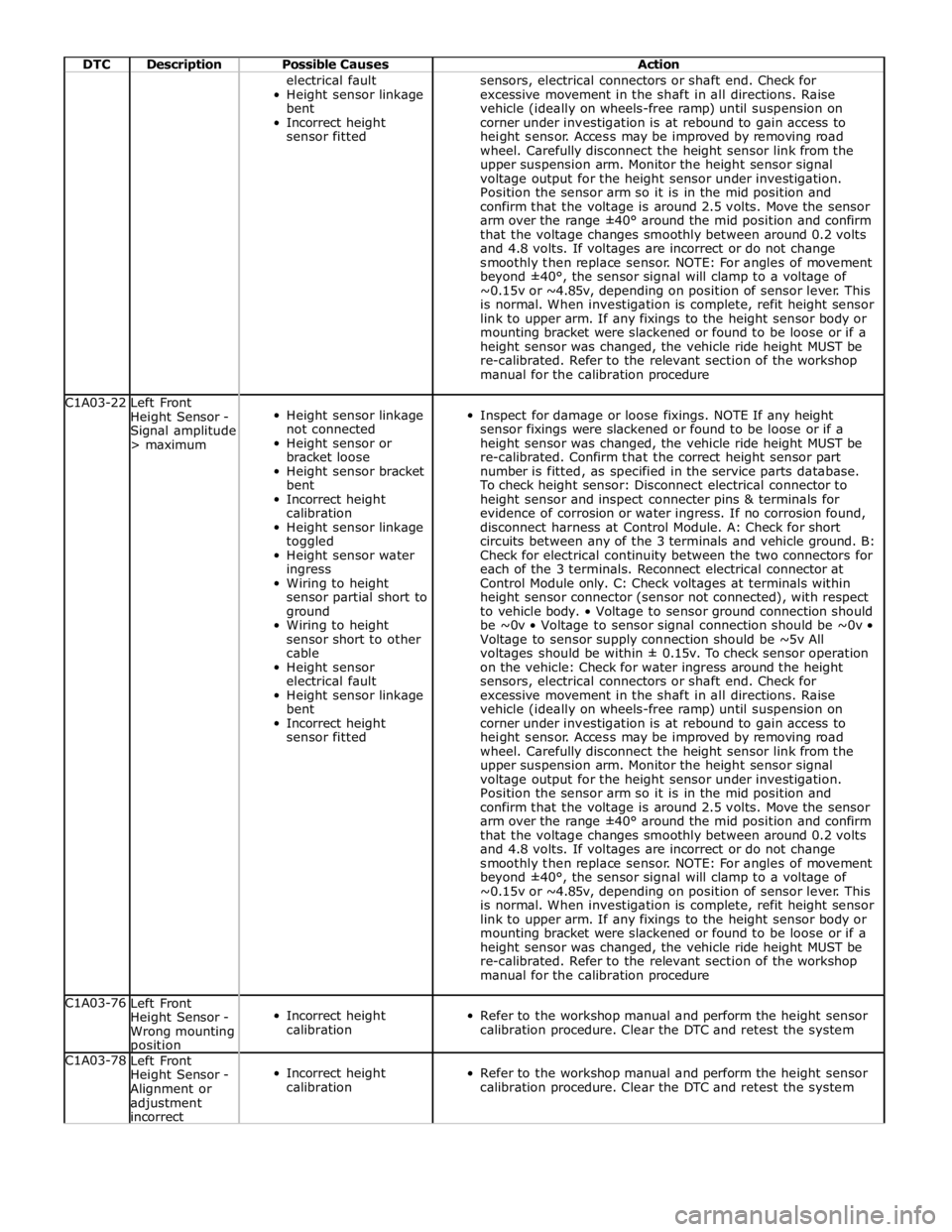
DTC Description Possible Causes Action electrical fault
Height sensor linkage
bent
Incorrect height
sensor fitted sensors, electrical connectors or shaft end. Check for
excessive movement in the shaft in all directions. Raise
vehicle (ideally on wheels-free ramp) until suspension on
corner under investigation is at rebound to gain access to
height sensor. Access may be improved by removing road
wheel. Carefully disconnect the height sensor link from the
upper suspension arm. Monitor the height sensor signal
voltage output for the height sensor under investigation.
Position the sensor arm so it is in the mid position and
confirm that the voltage is around 2.5 volts. Move the sensor
arm over the range ±40° around the mid position and confirm
that the voltage changes smoothly between around 0.2 volts
and 4.8 volts. If voltages are incorrect or do not change
smoothly then replace sensor. NOTE: For angles of movement
beyond ±40°, the sensor signal will clamp to a voltage of
~0.15v or ~4.85v, depending on position of sensor lever. This
is normal. When investigation is complete, refit height sensor
link to upper arm. If any fixings to the height sensor body or
mounting bracket were slackened or found to be loose or if a
height sensor was changed, the vehicle ride height MUST be
re-calibrated. Refer to the relevant section of the workshop
manual for the calibration procedure C1A03-22
Left Front
Height Sensor -
Signal amplitude
> maximum
Height sensor linkage
not connected
Height sensor or
bracket loose
Height sensor bracket
bent
Incorrect height
calibration
Height sensor linkage
toggled
Height sensor water
ingress
Wiring to height
sensor partial short to
ground
Wiring to height
sensor short to other
cable
Height sensor
electrical fault
Height sensor linkage
bent
Incorrect height
sensor fitted
Inspect for damage or loose fixings. NOTE If any height
sensor fixings were slackened or found to be loose or if a
height sensor was changed, the vehicle ride height MUST be
re-calibrated. Confirm that the correct height sensor part
number is fitted, as specified in the service parts database.
To check height sensor: Disconnect electrical connector to
height sensor and inspect connecter pins & terminals for
evidence of corrosion or water ingress. If no corrosion found,
disconnect harness at Control Module. A: Check for short
circuits between any of the 3 terminals and vehicle ground. B:
Check for electrical continuity between the two connectors for
each of the 3 terminals. Reconnect electrical connector at
Control Module only. C: Check voltages at terminals within
height sensor connector (sensor not connected), with respect
to vehicle body. • Voltage to sensor ground connection should
be ~0v • Voltage to sensor signal connection should be ~0v •
Voltage to sensor supply connection should be ~5v All
voltages should be within ± 0.15v. To check sensor operation
on the vehicle: Check for water ingress around the height
sensors, electrical connectors or shaft end. Check for
excessive movement in the shaft in all directions. Raise
vehicle (ideally on wheels-free ramp) until suspension on
corner under investigation is at rebound to gain access to
height sensor. Access may be improved by removing road
wheel. Carefully disconnect the height sensor link from the
upper suspension arm. Monitor the height sensor signal
voltage output for the height sensor under investigation.
Position the sensor arm so it is in the mid position and
confirm that the voltage is around 2.5 volts. Move the sensor
arm over the range ±40° around the mid position and confirm
that the voltage changes smoothly between around 0.2 volts
and 4.8 volts. If voltages are incorrect or do not change
smoothly then replace sensor. NOTE: For angles of movement
beyond ±40°, the sensor signal will clamp to a voltage of
~0.15v or ~4.85v, depending on position of sensor lever. This
is normal. When investigation is complete, refit height sensor
link to upper arm. If any fixings to the height sensor body or
mounting bracket were slackened or found to be loose or if a
height sensor was changed, the vehicle ride height MUST be
re-calibrated. Refer to the relevant section of the workshop
manual for the calibration procedure C1A03-76
Left Front
Height Sensor -
Wrong mounting position
Incorrect height
calibration
Refer to the workshop manual and perform the height sensor
calibration procedure. Clear the DTC and retest the system C1A03-78
Left Front
Height Sensor -
Alignment or
adjustment
incorrect
Incorrect height
calibration
Refer to the workshop manual and perform the height sensor
calibration procedure. Clear the DTC and retest the system
Page 110 of 3039

DTC Description Possible Causes Action C1A04-12
Right Front
Height Sensor -
Circuit short to
power
Height sensor circuit
shorted to another
cable
Height sensor internal
fault
Refer to the electrical circuit diagrams and check Front Right
Height Sensor circuit for short to power, If circuit correct
suspect Sensor internal fault, replace as required C1A04-14
Right Front
Height Sensor -
Circuit short to
ground or open
Wiring to sensor
(signal) open circuit
Wiring to height
sensor partial short to
ground
Wiring to height
sensor short to other
cable
Height sensor internal
electrical fault
Disconnect electrical connector to height sensor and inspect
connector pins & terminals for evidence of corrosion or water
ingress. If no corrosion found, disconnect harness at Control
Module. A: Check for short circuits between any of the 3
terminals and vehicle ground. B: Check for electrical continuity
between the two connectors for each of the 3 terminals.
Reconnect electrical connector at Control Module only. C:
Check voltages at terminals within height sensor connector
(sensor not connected), with respect to vehicle body. •
Voltage to sensor ground connection should be ~0v • Voltage
to sensor signal connection should be ~0v • Voltage to sensor
supply connection should be ~5v All voltages should be within
± 0.15v C1A04-21
Right Front
Height Sensor -
Signal amplitude
< minimum
Height sensor linkage
not connected
Height sensor or
bracket loose
Height sensor bracket
bent
Incorrect height
calibration
Height sensor linkage
toggled
Height sensor water
ingress
Wiring to height
sensor partial short to
ground
Wiring to height
sensor short to other
cable
Height sensor
electrical fault
Height sensor linkage
bent
Incorrect height
sensor fitted
Inspect for damage or loose fixings. NOTE If any height
sensor fixings were slackened or found to be loose or if a
height sensor was changed, the vehicle ride height MUST be
re-calibrated. Confirm that the correct height sensor part
number is fitted, as specified in the service parts database.
To check height sensor: Disconnect electrical connector to
height sensor and inspect connecter pins & terminals for
evidence of corrosion or water ingress. If no corrosion found,
disconnect harness at Control Module. A: Check for short
circuits between any of the 3 terminals and vehicle ground. B:
Check for electrical continuity between the two connectors for
each of the 3 terminals. Reconnect electrical connector at
Control Module only. C: Check voltages at terminals within
height sensor connector (sensor not connected), with respect
to vehicle body. • Voltage to sensor ground connection should
be ~0v • Voltage to sensor signal connection should be ~0v •
Voltage to sensor supply connection should be ~5v All
voltages should be within ± 0.15v. To check sensor operation
on the vehicle: Check for water ingress around the height
sensors, electrical connectors or shaft end. Check for
excessive movement in the shaft in all directions. Raise
vehicle (ideally on wheels-free ramp) until suspension on
corner under investigation is at rebound to gain access to
height sensor. Access may be improved by removing road
wheel. Carefully disconnect the height sensor link from the
upper suspension arm. Monitor the height sensor signal
voltage output for the height sensor under investigation.
Position the sensor arm so it is in the mid position and
confirm that the voltage is around 2.5 volts. Move the sensor
arm over the range ±40° around the mid position and confirm
that the voltage changes smoothly between around 0.2 volts
and 4.8 volts. If voltages are incorrect or do not change
smoothly then replace sensor. NOTE: For angles of movement
beyond ±40°, the sensor signal will clamp to a voltage of
~0.15v or ~4.85v, depending on position of sensor lever. This
is normal. When investigation is complete, refit height sensor
link to upper arm. If any fixings to the height sensor body or
mounting bracket were slackened or found to be loose or if a
height sensor was changed, the vehicle ride height MUST be
re-calibrated. Refer to the relevant section of the workshop
manual for the calibration procedure C1A04-22
Right Front
Height Sensor -
Signal amplitude
> maximum
Height sensor linkage
not connected
Height sensor or
bracket loose
Height sensor bracket
bent
Incorrect height
calibration
Height sensor linkage
toggled
Height sensor water
ingress
Wiring to height
Inspect for damage or loose fixings. NOTE If any height
sensor fixings were slackened or found to be loose or if a
height sensor was changed, the vehicle ride height MUST be
re-calibrated. Confirm that the correct height sensor part
number is fitted, as specified in the service parts database.
To check height sensor: Disconnect electrical connector to
height sensor and inspect connecter pins & terminals for
evidence of corrosion or water ingress. If no corrosion found,
disconnect harness at Control Module. A: Check for short
circuits between any of the 3 terminals and vehicle ground. B:
Check for electrical continuity between the two connectors for
each of the 3 terminals. Reconnect electrical connector at
Control Module only. C: Check voltages at terminals within www.JagDocs.com
Page 111 of 3039

DTC Description Possible Causes Action sensor partial short to
ground
Wiring to height
sensor short to other
cable
Height sensor
electrical fault
Height sensor linkage
bent
Incorrect height
sensor fitted height sensor connector (sensor not connected), with respect
to vehicle body. • Voltage to sensor ground connection should
be ~0v • Voltage to sensor signal connection should be ~0v •
Voltage to sensor supply connection should be ~5v All
voltages should be within ± 0.15v. To check sensor operation
on the vehicle: Check for water ingress around the height
sensors, electrical connectors or shaft end. Check for
excessive movement in the shaft in all directions. Raise
vehicle (ideally on wheels-free ramp) until suspension on
corner under investigation is at rebound to gain access to
height sensor. Access may be improved by removing road
wheel. Carefully disconnect the height sensor link from the
upper suspension arm. Monitor the height sensor signal
voltage output for the height sensor under investigation.
Position the sensor arm so it is in the mid position and
confirm that the voltage is around 2.5 volts. Move the sensor
arm over the range ±40° around the mid position and confirm
that the voltage changes smoothly between around 0.2 volts
and 4.8 volts. If voltages are incorrect or do not change
smoothly then replace sensor. NOTE: For angles of movement
beyond ±40°, the sensor signal will clamp to a voltage of
~0.15v or ~4.85v, depending on position of sensor lever. This
is normal. When investigation is complete, refit height sensor
link to upper arm. If any fixings to the height sensor body or
mounting bracket were slackened or found to be loose or if a
height sensor was changed, the vehicle ride height MUST be
re-calibrated. Refer to the relevant section of the workshop
manual for the calibration procedure C1A04-76
Right Front
Height Sensor -
Wrong mounting position
Incorrect height
calibration
Refer to the workshop manual and perform the height sensor
calibration procedure. Clear the DTC and retest the system C1A04-78
Right Front
Height Sensor -
Alignment or
adjustment
incorrect
Incorrect height
calibration
Refer to the workshop manual and perform the height sensor
calibration procedure. Clear the DTC and retest the system C1A05-12
Left Rear Height
Sensor - Circuit
short to power
Height sensor circuit
shorted to another
cable
Height sensor internal
fault
Refer to the electrical circuit diagrams and check Rear Left
Height Sensor circuit for short to power, If circuit correct
suspect Sensor internal fault, replace as required C1A05-14
Left Rear Height
Sensor - Circuit
short to ground
or open
Wiring to sensor
(signal) open circuit
Wiring to height
sensor partial short to
ground
Wiring to height
sensor short to other
cable
Height sensor internal
electrical fault
Disconnect electrical connector to height sensor and inspect
connector pins & terminals for evidence of corrosion or water
ingress. If no corrosion found, disconnect harness at Control
Module. A: Check for short circuits between any of the 3
terminals and vehicle ground. B: Check for electrical continuity
between the two connectors for each of the 3 terminals.
Reconnect electrical connector at Control Module only. C:
Check voltages at terminals within height sensor connector
(sensor not connected), with respect to vehicle body. •
Voltage to sensor ground connection should be ~0v • Voltage
to sensor signal connection should be ~0v • Voltage to sensor
supply connection should be ~5v All voltages should be within
± 0.15v C1A05-21
Left Rear Height
Sensor - Signal
amplitude <
minimum
Height sensor linkage
not connected
Height sensor or
bracket loose
Height sensor bracket
bent
Incorrect height
calibration
Height sensor linkage
toggled
Height sensor water
ingress
Wiring to height
sensor partial short to
ground
Wiring to height
sensor short to other
Inspect for damage or loose fixings. NOTE If any height
sensor fixings were slackened or found to be loose or if a
height sensor was changed, the vehicle ride height MUST be
re-calibrated. Confirm that the correct height sensor part
number is fitted, as specified in the service parts database.
To check height sensor: Disconnect electrical connector to
height sensor and inspect connecter pins & terminals for
evidence of corrosion or water ingress. If no corrosion found,
disconnect harness at Control Module. A: Check for short
circuits between any of the 3 terminals and vehicle ground. B:
Check for electrical continuity between the two connectors for
each of the 3 terminals. Reconnect electrical connector at
Control Module only. C: Check voltages at terminals within
height sensor connector (sensor not connected), with respect
to vehicle body. • Voltage to sensor ground connection should
be ~0v • Voltage to sensor signal connection should be ~0v •
Voltage to sensor supply connection should be ~5v All
Page 112 of 3039
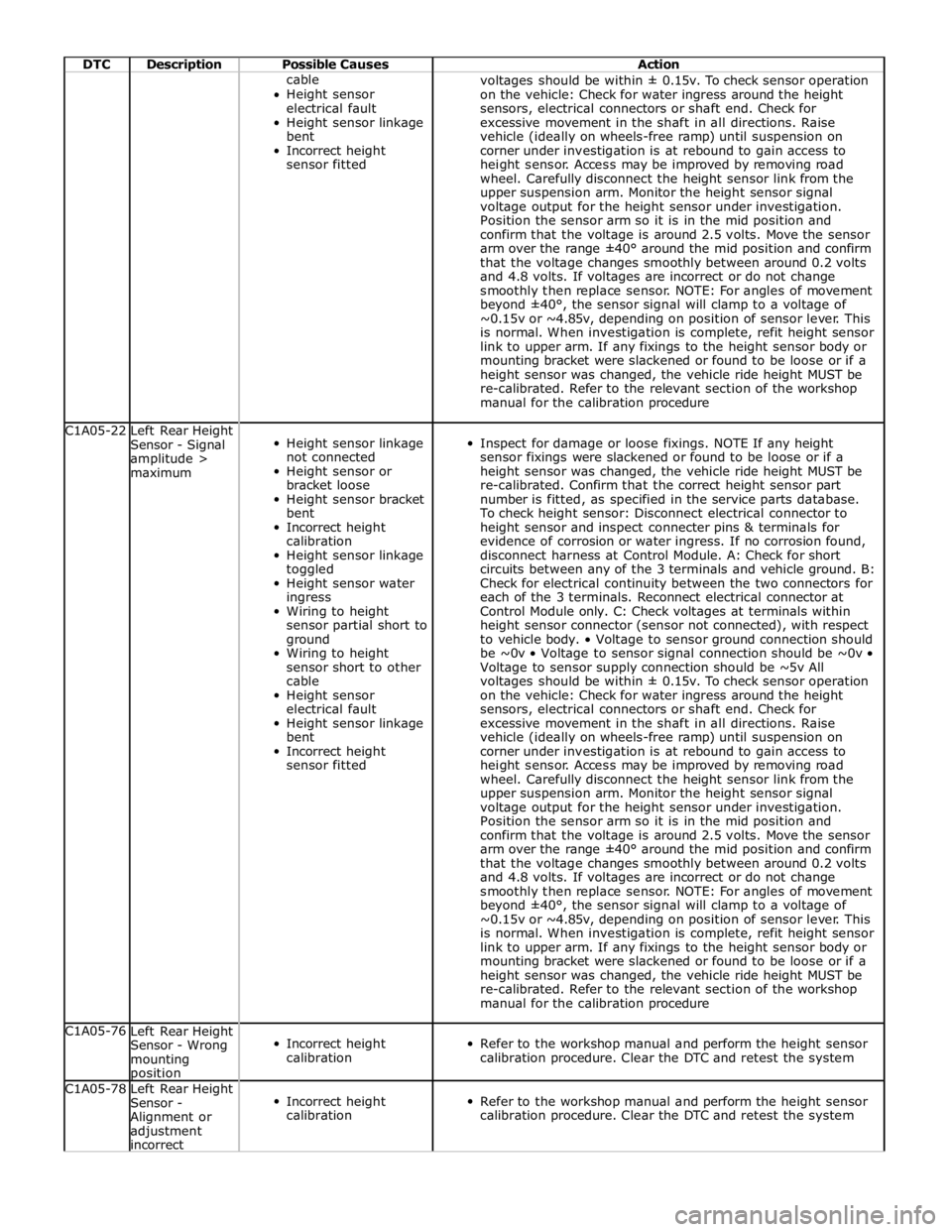
DTC Description Possible Causes Action cable
Height sensor
electrical fault
Height sensor linkage
bent
Incorrect height
sensor fitted voltages should be within ± 0.15v. To check sensor operation
on the vehicle: Check for water ingress around the height
sensors, electrical connectors or shaft end. Check for
excessive movement in the shaft in all directions. Raise
vehicle (ideally on wheels-free ramp) until suspension on
corner under investigation is at rebound to gain access to
height sensor. Access may be improved by removing road
wheel. Carefully disconnect the height sensor link from the
upper suspension arm. Monitor the height sensor signal
voltage output for the height sensor under investigation.
Position the sensor arm so it is in the mid position and
confirm that the voltage is around 2.5 volts. Move the sensor
arm over the range ±40° around the mid position and confirm
that the voltage changes smoothly between around 0.2 volts
and 4.8 volts. If voltages are incorrect or do not change
smoothly then replace sensor. NOTE: For angles of movement
beyond ±40°, the sensor signal will clamp to a voltage of
~0.15v or ~4.85v, depending on position of sensor lever. This
is normal. When investigation is complete, refit height sensor
link to upper arm. If any fixings to the height sensor body or
mounting bracket were slackened or found to be loose or if a
height sensor was changed, the vehicle ride height MUST be
re-calibrated. Refer to the relevant section of the workshop
manual for the calibration procedure C1A05-22
Left Rear Height
Sensor - Signal
amplitude >
maximum
Height sensor linkage
not connected
Height sensor or
bracket loose
Height sensor bracket
bent
Incorrect height
calibration
Height sensor linkage
toggled
Height sensor water
ingress
Wiring to height
sensor partial short to
ground
Wiring to height
sensor short to other
cable
Height sensor
electrical fault
Height sensor linkage
bent
Incorrect height
sensor fitted
Inspect for damage or loose fixings. NOTE If any height
sensor fixings were slackened or found to be loose or if a
height sensor was changed, the vehicle ride height MUST be
re-calibrated. Confirm that the correct height sensor part
number is fitted, as specified in the service parts database.
To check height sensor: Disconnect electrical connector to
height sensor and inspect connecter pins & terminals for
evidence of corrosion or water ingress. If no corrosion found,
disconnect harness at Control Module. A: Check for short
circuits between any of the 3 terminals and vehicle ground. B:
Check for electrical continuity between the two connectors for
each of the 3 terminals. Reconnect electrical connector at
Control Module only. C: Check voltages at terminals within
height sensor connector (sensor not connected), with respect
to vehicle body. • Voltage to sensor ground connection should
be ~0v • Voltage to sensor signal connection should be ~0v •
Voltage to sensor supply connection should be ~5v All
voltages should be within ± 0.15v. To check sensor operation
on the vehicle: Check for water ingress around the height
sensors, electrical connectors or shaft end. Check for
excessive movement in the shaft in all directions. Raise
vehicle (ideally on wheels-free ramp) until suspension on
corner under investigation is at rebound to gain access to
height sensor. Access may be improved by removing road
wheel. Carefully disconnect the height sensor link from the
upper suspension arm. Monitor the height sensor signal
voltage output for the height sensor under investigation.
Position the sensor arm so it is in the mid position and
confirm that the voltage is around 2.5 volts. Move the sensor
arm over the range ±40° around the mid position and confirm
that the voltage changes smoothly between around 0.2 volts
and 4.8 volts. If voltages are incorrect or do not change
smoothly then replace sensor. NOTE: For angles of movement
beyond ±40°, the sensor signal will clamp to a voltage of
~0.15v or ~4.85v, depending on position of sensor lever. This
is normal. When investigation is complete, refit height sensor
link to upper arm. If any fixings to the height sensor body or
mounting bracket were slackened or found to be loose or if a
height sensor was changed, the vehicle ride height MUST be
re-calibrated. Refer to the relevant section of the workshop
manual for the calibration procedure C1A05-76
Left Rear Height
Sensor - Wrong
mounting position
Incorrect height
calibration
Refer to the workshop manual and perform the height sensor
calibration procedure. Clear the DTC and retest the system C1A05-78
Left Rear Height
Sensor -
Alignment or
adjustment
incorrect
Incorrect height
calibration
Refer to the workshop manual and perform the height sensor
calibration procedure. Clear the DTC and retest the system
Page 113 of 3039

DTC Description Possible Causes Action C1A06-12
Right Rear
Height Sensor -
Circuit short to
power
Height sensor circuit
shorted to another
cable
Height sensor internal
fault
Refer to the electrical circuit diagrams and check Rear Right
Height Sensor circuit for short to power, If circuit correct
suspect Sensor internal fault, replace as required C1A06-14
Right Rear
Height Sensor -
Circuit short to
ground or open
Wiring to sensor
(signal) open circuit
Wiring to height
sensor partial short to
ground
Wiring to height
sensor short to other
cable
Height sensor internal
electrical fault
Disconnect electrical connector to height sensor and inspect
connector pins & terminals for evidence of corrosion or water
ingress. If no corrosion found, disconnect harness at Control
Module. A: Check for short circuits between any of the 3
terminals and vehicle ground. B: Check for electrical continuity
between the two connectors for each of the 3 terminals.
Reconnect electrical connector at Control Module only. C:
Check voltages at terminals within height sensor connector
(sensor not connected), with respect to vehicle body. •
Voltage to sensor ground connection should be ~0v • Voltage
to sensor signal connection should be ~0v • Voltage to sensor
supply connection should be ~5v All voltages should be within
± 0.15v C1A06-21
Right Rear
Height Sensor -
Signal amplitude
< minimum
Height sensor linkage
not connected
Height sensor or
bracket loose
Height sensor bracket
bent
Incorrect height
calibration
Height sensor linkage
toggled
Height sensor water
ingress
Wiring to height
sensor partial short to
ground
Wiring to height
sensor short to other
cable
Height sensor
electrical fault
Height sensor linkage
bent
Incorrect height
sensor fitted
Inspect for damage or loose fixings. NOTE If any height
sensor fixings were slackened or found to be loose or if a
height sensor was changed, the vehicle ride height MUST be
re-calibrated. Confirm that the correct height sensor part
number is fitted, as specified in the service parts database.
To check height sensor: Disconnect electrical connector to
height sensor and inspect connecter pins & terminals for
evidence of corrosion or water ingress. If no corrosion found,
disconnect harness at Control Module. A: Check for short
circuits between any of the 3 terminals and vehicle ground. B:
Check for electrical continuity between the two connectors for
each of the 3 terminals. Reconnect electrical connector at
Control Module only. C: Check voltages at terminals within
height sensor connector (sensor not connected), with respect
to vehicle body. • Voltage to sensor ground connection should
be ~0v • Voltage to sensor signal connection should be ~0v •
Voltage to sensor supply connection should be ~5v All
voltages should be within ± 0.15v. To check sensor operation
on the vehicle: Check for water ingress around the height
sensors, electrical connectors or shaft end. Check for
excessive movement in the shaft in all directions. Raise
vehicle (ideally on wheels-free ramp) until suspension on
corner under investigation is at rebound to gain access to
height sensor. Access may be improved by removing road
wheel. Carefully disconnect the height sensor link from the
upper suspension arm. Monitor the height sensor signal
voltage output for the height sensor under investigation.
Position the sensor arm so it is in the mid position and
confirm that the voltage is around 2.5 volts. Move the sensor
arm over the range ±40° around the mid position and confirm
that the voltage changes smoothly between around 0.2 volts
and 4.8 volts. If voltages are incorrect or do not change
smoothly then replace sensor. NOTE: For angles of movement
beyond ±40°, the sensor signal will clamp to a voltage of
~0.15v or ~4.85v, depending on position of sensor lever. This
is normal. When investigation is complete, refit height sensor
link to upper arm. If any fixings to the height sensor body or
mounting bracket were slackened or found to be loose or if a
height sensor was changed, the vehicle ride height MUST be
re-calibrated. Refer to the relevant section of the workshop
manual for the calibration procedure C1A06-22
Right Rear
Height Sensor -
Signal amplitude
> maximum
Height sensor linkage
not connected
Height sensor or
bracket loose
Height sensor bracket
bent
Incorrect height
calibration
Height sensor linkage
toggled
Height sensor water
ingress
Wiring to height
Inspect for damage or loose fixings. NOTE If any height
sensor fixings were slackened or found to be loose or if a
height sensor was changed, the vehicle ride height MUST be
re-calibrated. Confirm that the correct height sensor part
number is fitted, as specified in the service parts database.
To check height sensor: Disconnect electrical connector to
height sensor and inspect connecter pins & terminals for
evidence of corrosion or water ingress. If no corrosion found,
disconnect harness at Control Module. A: Check for short
circuits between any of the 3 terminals and vehicle ground. B:
Check for electrical continuity between the two connectors for
each of the 3 terminals. Reconnect electrical connector at
Control Module only. C: Check voltages at terminals within
Page 135 of 3039
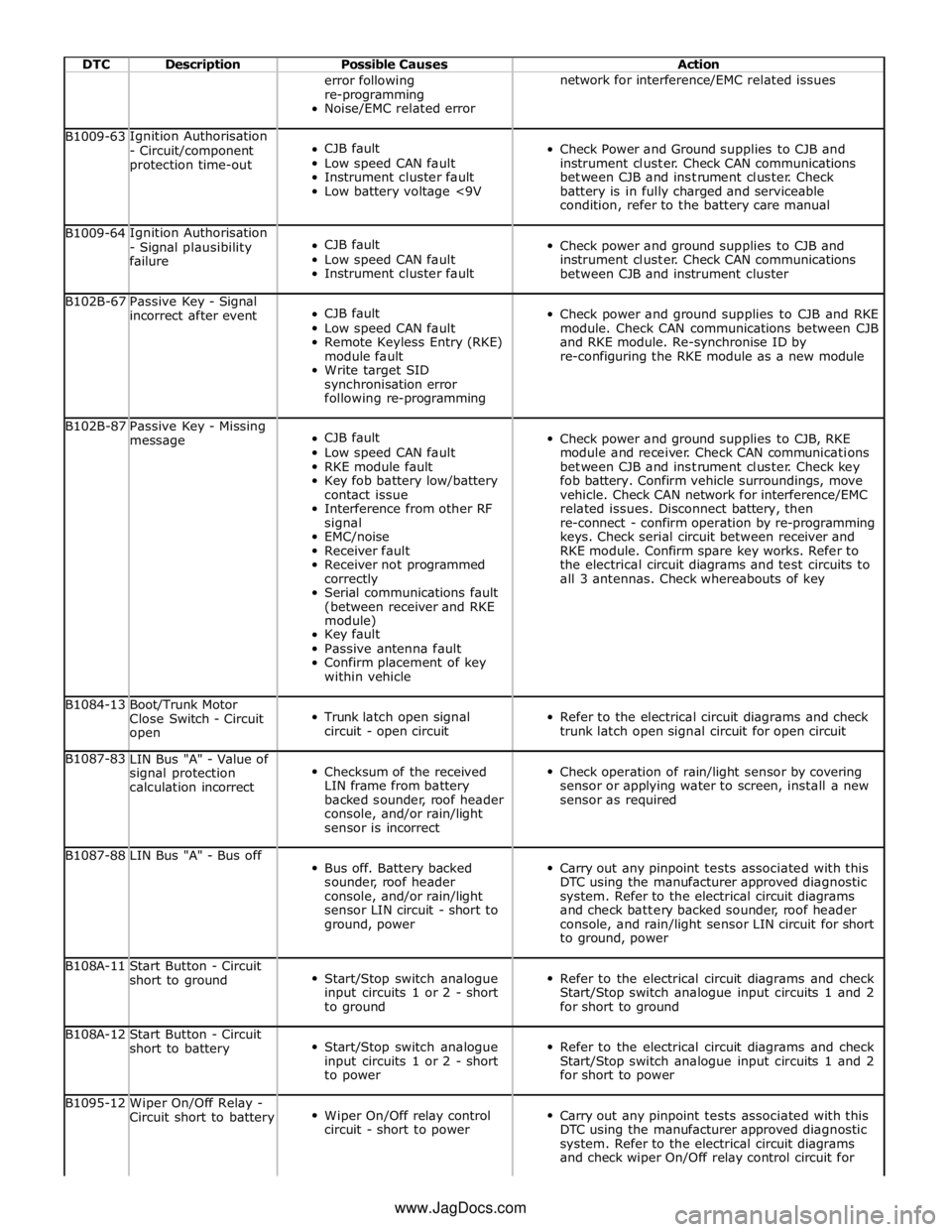
DTC Description Possible Causes Action error following
re-programming
Noise/EMC related error network for interference/EMC related issues B1009-63 Ignition Authorisation
- Circuit/component
protection time-out
CJB fault
Low speed CAN fault
Instrument cluster fault
Low battery voltage <9V
Check Power and Ground supplies to CJB and
instrument cluster. Check CAN communications
between CJB and instrument cluster. Check
battery is in fully charged and serviceable
condition, refer to the battery care manual B1009-64 Ignition Authorisation
- Signal plausibility
failure
CJB fault
Low speed CAN fault
Instrument cluster fault
Check power and ground supplies to CJB and
instrument cluster. Check CAN communications
between CJB and instrument cluster B102B-67
Passive Key - Signal
incorrect after event
CJB fault
Low speed CAN fault
Remote Keyless Entry (RKE)
module fault
Write target SID
synchronisation error
following re-programming
Check power and ground supplies to CJB and RKE
module. Check CAN communications between CJB
and RKE module. Re-synchronise ID by
re-configuring the RKE module as a new module B102B-87
Passive Key - Missing
message
CJB fault
Low speed CAN fault
RKE module fault
Key fob battery low/battery
contact issue
Interference from other RF
signal
EMC/noise
Receiver fault
Receiver not programmed
correctly
Serial communications fault
(between receiver and RKE
module)
Key fault
Passive antenna fault
Confirm placement of key
within vehicle
Check power and ground supplies to CJB, RKE
module and receiver. Check CAN communications
between CJB and instrument cluster. Check key
fob battery. Confirm vehicle surroundings, move
vehicle. Check CAN network for interference/EMC
related issues. Disconnect battery, then
re-connect - confirm operation by re-programming
keys. Check serial circuit between receiver and
RKE module. Confirm spare key works. Refer to
the electrical circuit diagrams and test circuits to
all 3 antennas. Check whereabouts of key B1084-13
Boot/Trunk Motor
Close Switch - Circuit
open
Trunk latch open signal
circuit - open circuit
Refer to the electrical circuit diagrams and check
trunk latch open signal circuit for open circuit B1087-83
LIN Bus "A" - Value of
signal protection
calculation incorrect
Checksum of the received
LIN frame from battery
backed sounder, roof header
console, and/or rain/light
sensor is incorrect
Check operation of rain/light sensor by covering
sensor or applying water to screen, install a new
sensor as required B1087-88 LIN Bus "A" - Bus off
Bus off. Battery backed
sounder, roof header
console, and/or rain/light
sensor LIN circuit - short to
ground, power
Carry out any pinpoint tests associated with this
DTC using the manufacturer approved diagnostic
system. Refer to the electrical circuit diagrams
and check battery backed sounder, roof header
console, and rain/light sensor LIN circuit for short
to ground, power B108A-11
Start Button - Circuit
short to ground
Start/Stop switch analogue
input circuits 1 or 2 - short
to ground
Refer to the electrical circuit diagrams and check
Start/Stop switch analogue input circuits 1 and 2
for short to ground B108A-12
Start Button - Circuit
short to battery
Start/Stop switch analogue
input circuits 1 or 2 - short
to power
Refer to the electrical circuit diagrams and check
Start/Stop switch analogue input circuits 1 and 2
for short to power B1095-12
Wiper On/Off Relay -
Circuit short to battery
Wiper On/Off relay control
circuit - short to power
Carry out any pinpoint tests associated with this
DTC using the manufacturer approved diagnostic
system. Refer to the electrical circuit diagrams
and check wiper On/Off relay control circuit for www.JagDocs.com
Page 147 of 3039
Published: 17-Apr-2014
General Information - Diagnostic Trouble Code (DTC) Index DTC: Driver Door
Module/Passenger Door Module (DDM/PDM)
Description and Operation
Driver/Passenger Door Module (DDM/PDM)
CAUTION: Diagnosis by substitution from a donor vehicle is NOT acceptable. Substitution of control modules does not
guarantee confirmation of a fault, and may also cause additional faults in the vehicle being tested and/or the donor vehicle
NOTES:
If the control module or a component is suspect and the vehicle remains under manufacturer warranty, refer to the
Warranty Policy and Procedures manual, or determine if any prior approval programme is in operation, prior to the installation
of a new module/component.
Generic scan tools may not read the codes listed, or may read only 5-digit codes. Match the 5 digits from the scan tool to
the first 5 digits of the 7-digit code listed to identify the fault (the last 2 digits give extra information read by the
manufacturer-approved diagnostic system)
When performing voltage or resistance tests, always use a digital multimeter accurate to three decimal places and with a
current calibration certificate. When testing resistance, always take the resistance of the digital multimeter leads into account
Check and rectify basic faults before beginning diagnostic routines involving pinpoint tests
Inspect connectors for signs of water ingress, and pins for damage and/or corrosion
If diagnostic trouble codes are recorded and, after performing the pinpoint tests, a fault is not present, an intermittent
concern may be the cause. Always check for loose connections and corroded terminals
Check DDW for open campaigns. Refer to the corresponding bulletins and SSMs which may be valid for the specific
customer complaint and carry out the recommendations as required.
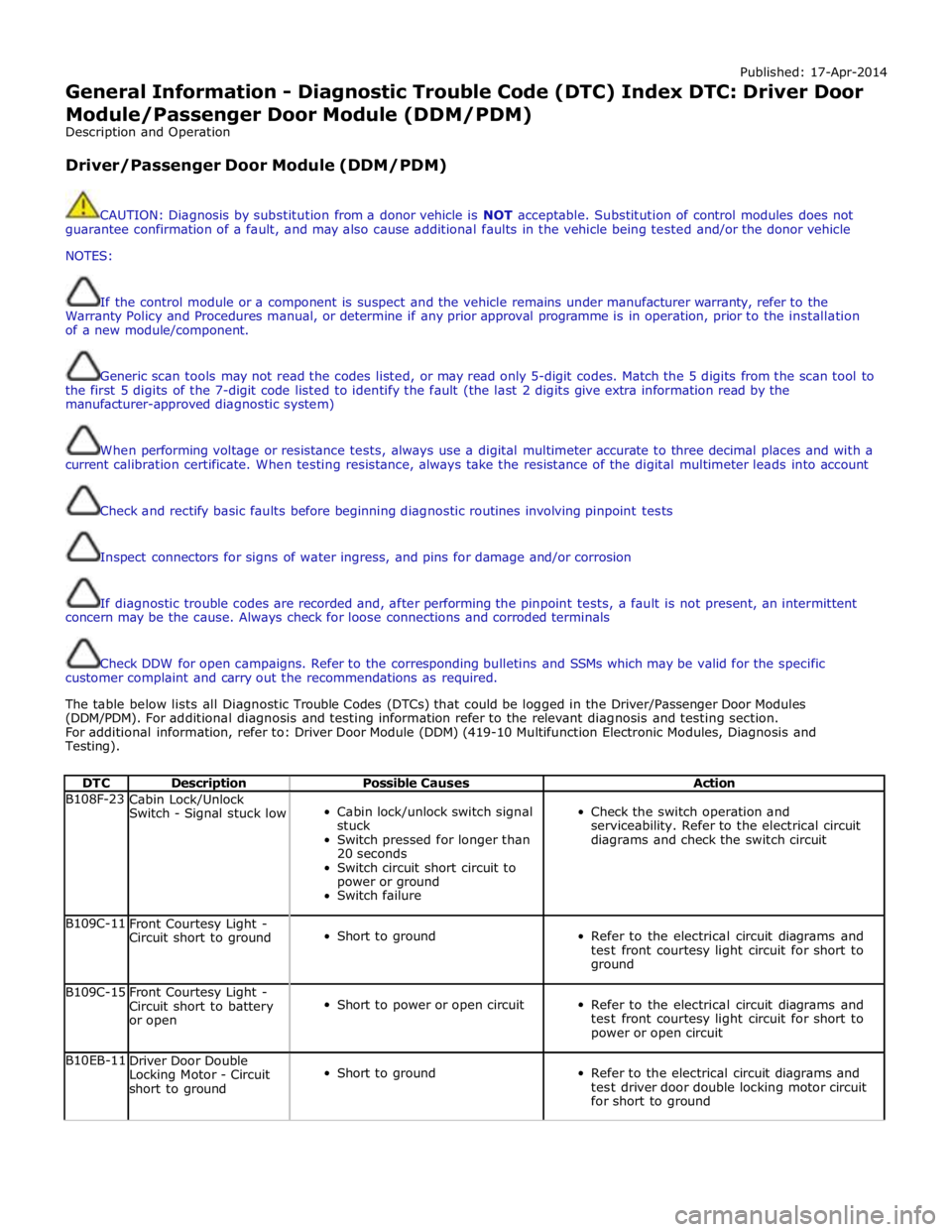
The table below lists all Diagnostic Trouble Codes (DTCs) that could be logged in the Driver/Passenger Door Modules
(DDM/PDM). For additional diagnosis and testing information refer to the relevant diagnosis and testing section.
For additional information, refer to: Driver Door Module (DDM) (419-10 Multifunction Electronic Modules, Diagnosis and
Testing).
DTC Description Possible Causes Action B108F-23
Cabin Lock/Unlock
Switch - Signal stuck low
Cabin lock/unlock switch signal
stuck
Switch pressed for longer than
20 seconds
Switch circuit short circuit to
power or ground
Switch failure
Check the switch operation and
serviceability. Refer to the electrical circuit
diagrams and check the switch circuit B109C-11
Front Courtesy Light -
Circuit short to ground
Short to ground
Refer to the electrical circuit diagrams and
test front courtesy light circuit for short to
ground B109C-15
Front Courtesy Light -
Circuit short to battery
or open
Short to power or open circuit
Refer to the electrical circuit diagrams and
test front courtesy light circuit for short to
power or open circuit B10EB-11
Driver Door Double
Locking Motor - Circuit
short to ground
Short to ground
Refer to the electrical circuit diagrams and
test driver door double locking motor circuit
for short to ground
Page 159 of 3039

DTC Description Possible Causes Action suspect the switch. Refer to the Warranty Policy
and Procedures manual if a module/component is
suspect P1571-64
Brake Switch - Signal
plausibility failure
Wiring harness fault
Brake pedal switch fault
The signal from the hardwired brake pedal switch
does not agree with the brake status message
broadcast on CAN. Refer to the electrical circuit
diagrams and check the brake pedal switch
circuits for short circuit or open circuit. Repair
wiring harness as required
If there are no wiring harness faults suspect
switch. Refer to the Warranty Policy and
Procedures manual if a module/component is
suspect C1127-31
Position Sensor - No
Signal
Parking brake motor hall
effect position sensor
power circuit fault
Parking brake motor hall
effect position sensor
ground circuit fault
Parking brake motor hall
effect position sensor
signal circuit fault
Mechanical fault with
sensor/actuator
Inspect mechanical linkages for faults/damage.
Repair as required. Refer to the electrical circuit
diagrams and check parking brake motor hall
effect position sensor circuits for short, open
circuit. Check and install a new sensor actuator as
required C1129-39
Actuator engage -
Incorrect has too few
pulses
Motor engage current
reached before full apply
travel distance
Service brake adjustment
incorrect after brake lining
replacement
Brake cables broken,
seized, trapped.
Caliper malfunction
Carry out parking brake calibration procedure.
check for mechanical failure of parking brake
system C1129-3A
Actuator engage -
Incorrect has too many
pulses
Motor engage current not
reached or travelled too far
upon apply
Service brake adjustment
incorrect after brake lining
replacement
Brake cables broken,
seized, trapped
Caliper malfunction
Carry out parking brake calibration procedure.
check for mechanical failure of parking brake
system C112A-39
Actuator disengage -
Incorrect has too few
pulses
Intermittent motor or
circuit - open circuit
Actuator malfunction
Check for additional motor or circuit DTCs and
refer to DTC index. check for mechanical failure of
parking brake C1D00-11 Park brake apply switch
- Circuit short to ground
Connector fault - bent,
loose or corroded pin(s)
Harness fault - short to
ground
Switch fault
Refer to electrical circuit diagrams and check the
switch primary and secondary apply circuits for
short to ground. Repair circuit faults or install a
new switch as required C1D00-15
Park brake apply switch
circuit - Circuit short to
battery or open
Connector fault - bent,
loose or corroded pin(s)
Harness fault - short to
power or open circuit
Switch fault
Refer to electrical circuit diagrams and check the
switch primary and secondary apply circuits for
short to power or open circuit. Repair circuit faults
or install a new switch as required C1D00-1C Park brake apply switch
- Voltage out of range
Connector fault - bent,
loose or corroded pin(s)
Harness fault - low
resistance to ground
Switch fault
Refer to the electrical circuit diagrams and test
primary parking brake apply switch circuits for
short to ground
Check and install a new switch as required
Page 165 of 3039

DTC Description Possible Causes Action module/component B10AC-82 Cruise Control Switch - Alive / sequence counter incorrect / not updated
Cruise buttons alive counter is not
incrementing. Which suggests that
the LIN bus is faulty
Steering wheel module is not
connected
Steering wheel module failure
Refer to the electrical circuit
diagrams and check the speed
control switch circuit for open circuit,
short circuit to power, short circuit to
ground, disconnected
Refer to the electrical circuit
diagrams and check the LIN bus
between steering wheel module and
the CAN gateway
Check and install a new steering
wheel module as required. Refer to
the warranty policy and procedures
manual, or determine if any prior
approval programme is in operation,
prior to the installation of a new
module/component B10AC-83
Cruise Control Switch - Value
of signal protection
calculation incorrect
Cruise buttons checksum incorrect,
incorrect cruise switches fitted to
vehicle
Check and install new cruise
switches as required. Refer to the
warranty policy and procedures
manual, or determine if any prior
approval programme is in operation,
prior to the installation of a new
module/component B10AC-96
Cruise Control Switch -
Component internal failure
Speed control switch circuit, open
circuit, short circuit to power, short
circuit to ground, disconnected
Speed control switch failure
Steering wheel module failure
Check for related DTCs in other
central junction boxes
Refer to the electrical circuit
diagrams and check the speed
control switch circuit for open circuit,
short circuit to power, short circuit to
ground, disconnected
Check and install a new speed
control switch as required. Check and
install a new steering wheel module
as required. Refer to the warranty
policy and procedures manual, or
determine if any prior approval
programme is in operation, prior to
the installation of a new
module/component B10FF-68
Ignition Control - Event
information
Spark plug(s) fault
Wiring harness fault
Ignition coil(s) fault
Refer to repair manual and check
spark plug(s) for condition and
security. Replace any defective
components as required
Refer to electrical wiring diagrams
and check ignition coil circuit for
intermittent open circuit, short
circuit to power, short circuit to
ground
Check and install a new coil(s) as
required. Refer to the warranty policy
and procedures manual, or determine
if any prior approval programme is in
operation, prior to the installation of
a new module/component B11DB-01
Battery Monitoring Module -
General electrical failure
NOTE: - Circuit BATTERY -
Charging system fault Battery
monitoring signal line
circuit fault
Vehicle battery fault
Refer to electrical wiring diagrams
and check charging system for faults.
Perform any repairs required
Refer to the electrical wiring
diagrams and check the battery
monitoring system module circuit for
open circuit, short circuit to ground,
short circuit to power
Refer to the workshop manual and
the battery care manual, inspect the
vehicle battery and ensure it is fully
charged and serviceable before
performing further tests