service JAGUAR XFR 2010 1.G Owner's Guide
[x] Cancel search | Manufacturer: JAGUAR, Model Year: 2010, Model line: XFR, Model: JAGUAR XFR 2010 1.GPages: 3039, PDF Size: 58.49 MB
Page 398 of 3039
NOTE: If a significant quantity of fluid has leaked out of the damper, the dividing piston will be displaced upwards in the
tube by the pressure of the gas below it. This will limit the downward travel of the piston. 1 Remove the suspension strut assembly REFER to: Shock Absorber and Spring Assembly (204-02 Rear Suspension, Removal and Installation). 2 Remove the spring 3 Remove the bump stop 4 Push the damper piston fully into the damper tube
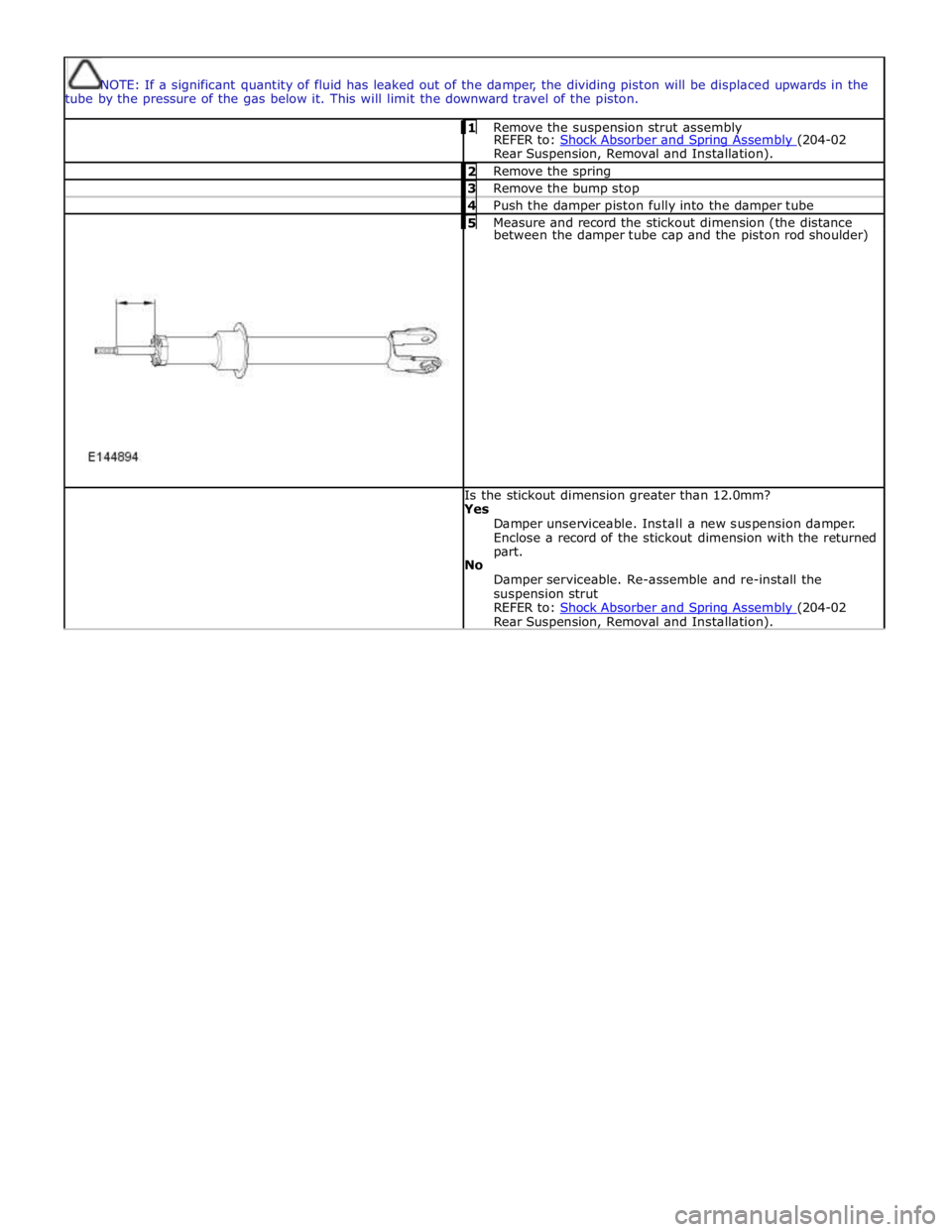
5 Measure and record the stickout dimension (the distance between the damper tube cap and the piston rod shoulder) Is the stickout dimension greater than 12.0mm?
Yes
Damper unserviceable. Install a new suspension damper.
Enclose a record of the stickout dimension with the returned
part.
No
Damper serviceable. Re-assemble and re-install the
suspension strut
REFER to: Shock Absorber and Spring Assembly (204-02 Rear Suspension, Removal and Installation).
Page 439 of 3039
Wheels and Tires - Wheels and Tires - Overview
Description and Operation
OVERVIEW Published: 25-May-2012
A number of alloy wheel designs are available ranging from 17 to 20 inch in diameter. A Tire Pressure Monitoring System
(TPMS) is used to monitor the air pressure in each tire and inform the driver if the pressure falls below predetermined
thresholds.
All wheels are of cast construction in aluminum alloy with the choice of wheel design dependant on the vehicle trim level and
engine derivative.
On normally aspirated petrol models and all diesel models a 4J X 18 inch temporary spare wheel is supplied as standard,
supercharged petrol models are supplied with a 4Jx19 inch temporary spare wheel. In some major European markets an Instant
Mobility System is offered as an alternative to the spare wheel. The Instant Mobility System is capable of providing a
temporary repair and tire inflation to a puncture of up to 6mm in diameter in the tread area of the tire. A puncture in the tire
wall cannot be repaired using the system.
The vehicle jack and accessories are stored in the spare wheel-well in the luggage compartment.
Tire Changing
WARNINGS:
Tires must be inflated to the recommended pressures when the tires are cold (ambient temperature) only. Refer to label
on the 'B' pillar for recommended tire pressures. If the tires have been subjected to use or exposed to direct sunlight, move
the vehicle into a shaded position and allow the tires to cool before checking or adjusting the pressures.
Valve stem seal, washer nut, valve core and cap should be replaced at every tire change. Valve stem seal, washer and
nut must be replaced if the valve retention nut is loosened. Sensor units and nuts must be fitted using correct torque figures
and associated profile. Damage to the vehicle and consequently injury to the vehicle's occupants may result if these
instructions are not adhered to.
NOTE: The TPMS valve should be serviced using the suitable service kit, each time the tyre is dismounted, to ensure an
air tight seal. Attention should be made to the detail of fitting this kit.
Vehicles fitted with TPMS can be visually identified by an external metal locknut and valve of the tire pressure sensor on the
road wheels. Vehicles without TPMS will have rubber tire valve.
www.JagDocs.com
Page 491 of 3039
Published: 11-May-2011
Vehicle Dynamic Suspension - Front Suspension Vertical Accelerometer
Removal and Installation
Removal
NOTE: Removal steps in this procedure may contain installation details.
1. WARNING: Do not work on or under a vehicle supported only by a jack.
Always support the vehicle on safety stands.
Raise and support the vehicle.
2. Refer to: Fender Splash Shield (501-02 Front End Body Panels, Removal and Installation).
Installation
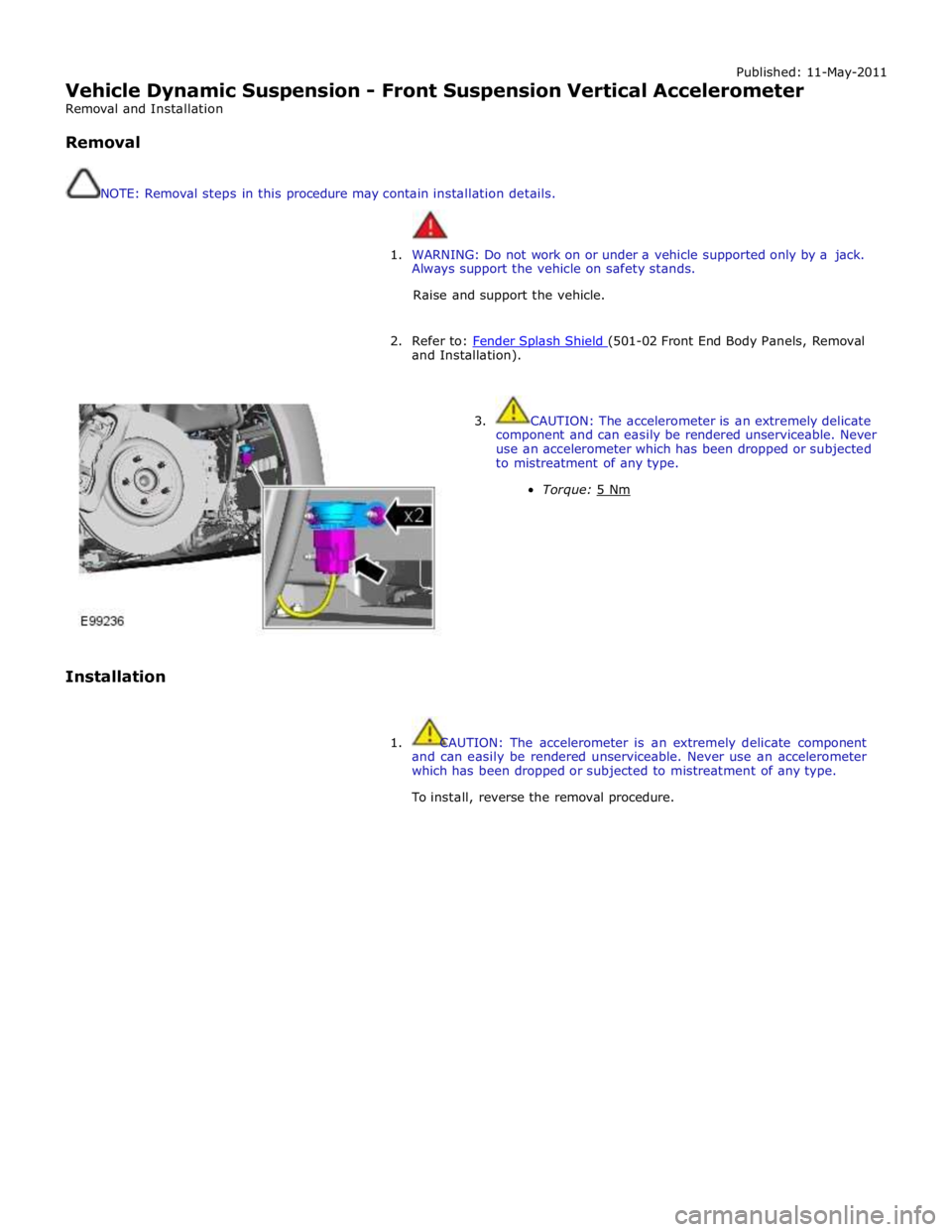
3. CAUTION: The accelerometer is an extremely delicate
component and can easily be rendered unserviceable. Never
use an accelerometer which has been dropped or subjected
to mistreatment of any type.
Torque: 5 Nm
1. CAUTION: The accelerometer is an extremely delicate component
and can easily be rendered unserviceable. Never use an accelerometer
which has been dropped or subjected to mistreatment of any type.
To install, reverse the removal procedure.
Page 492 of 3039
Published: 11-May-2011
Vehicle Dynamic Suspension - Rear Suspension Vertical Accelerometer
Removal and Installation
Removal
NOTE: Removal steps in this procedure may contain installation details.
1. Refer to: Loadspace Trim Panel LH (501-05 Interior Trim and Ornamentation, Removal and Installation).
Installation
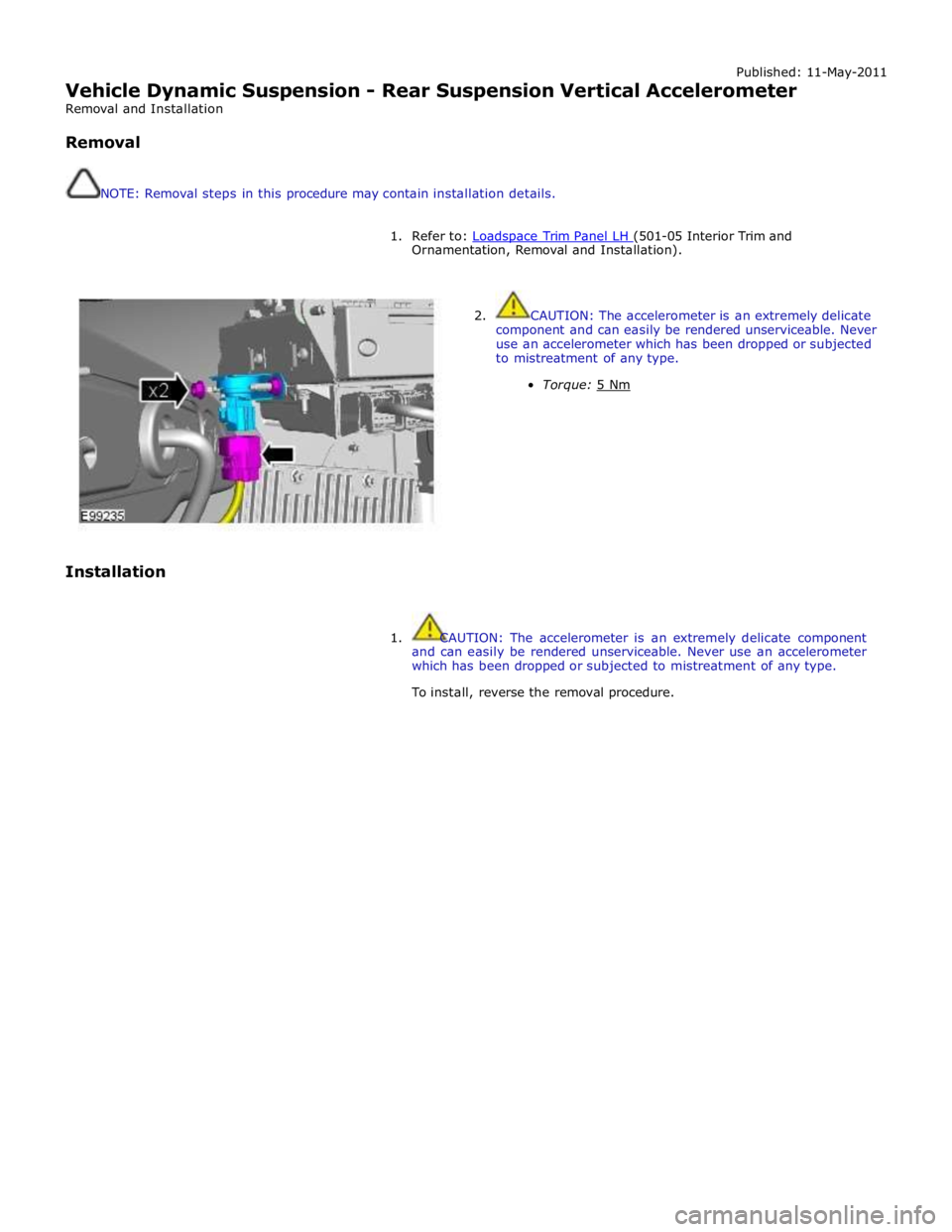
2. CAUTION: The accelerometer is an extremely delicate
component and can easily be rendered unserviceable. Never
use an accelerometer which has been dropped or subjected
to mistreatment of any type.
Torque: 5 Nm
1. CAUTION: The accelerometer is an extremely delicate component
and can easily be rendered unserviceable. Never use an accelerometer
which has been dropped or subjected to mistreatment of any type.
To install, reverse the removal procedure.
Page 499 of 3039
Driveline System - General Information - Driveline System
Diagnosis and Testing
Principle of Operation Published: 11-May-2011
For a detailed description of driveline operation, refer to the relevant Description and Operation section in the workshop
manual. REFER to:
Driveshaft (205-01 Driveshaft, Description and Operation), Driveshaft (205-01 Driveshaft, Description and Operation), Driveshaft (205-01 Driveshaft, Description and Operation), Rear Drive Axle and Differential (205-02, Description and Operation),
Rear Drive Axle and Differential (205-02, Description and Operation),
Rear Drive Axle and Differential (205-02, Description and Operation),
Rear Drive Halfshafts (205-05 Rear Drive Halfshafts, Description and Operation), Rear Drive Halfshafts (205-05 Rear Drive Halfshafts, Description and Operation), Rear Drive Halfshafts (205-05 Rear Drive Halfshafts, Description and Operation).
Inspection and Verification
CAUTION: Only serviceable items can be renewed or adjusted. Failure to follow this instruction may result in the warranty
of the component being rejected.
Certain driveline trouble symptoms are also common to the engine, transmission, wheel bearings, tires, and other parts of the
vehicle. For this reason, make sure that the cause of the trouble is in the driveline before adjusting, repairing, or installing any
new components. For additional information, refer to Workshop Manual section 100-04 Noise, Vibration and Harshness.
1. Verify the customer concern by carrying out a road test of the vehicle.
2. Visually inspect for obvious signs of mechanical damage and system integrity.
3. If an obvious cause for an observed or reported concern is found, correct the cause (if possible) before proceeding to
the next step.
4. If the concern is not visually evident, verify the symptom and refer to the Symptom Chart.
Identify the Condition
Gear Howl and Whine
Howling or whining of the ring gear and pinion is due to an incorrect gear pattern, gear damage or incorrect bearing preload.
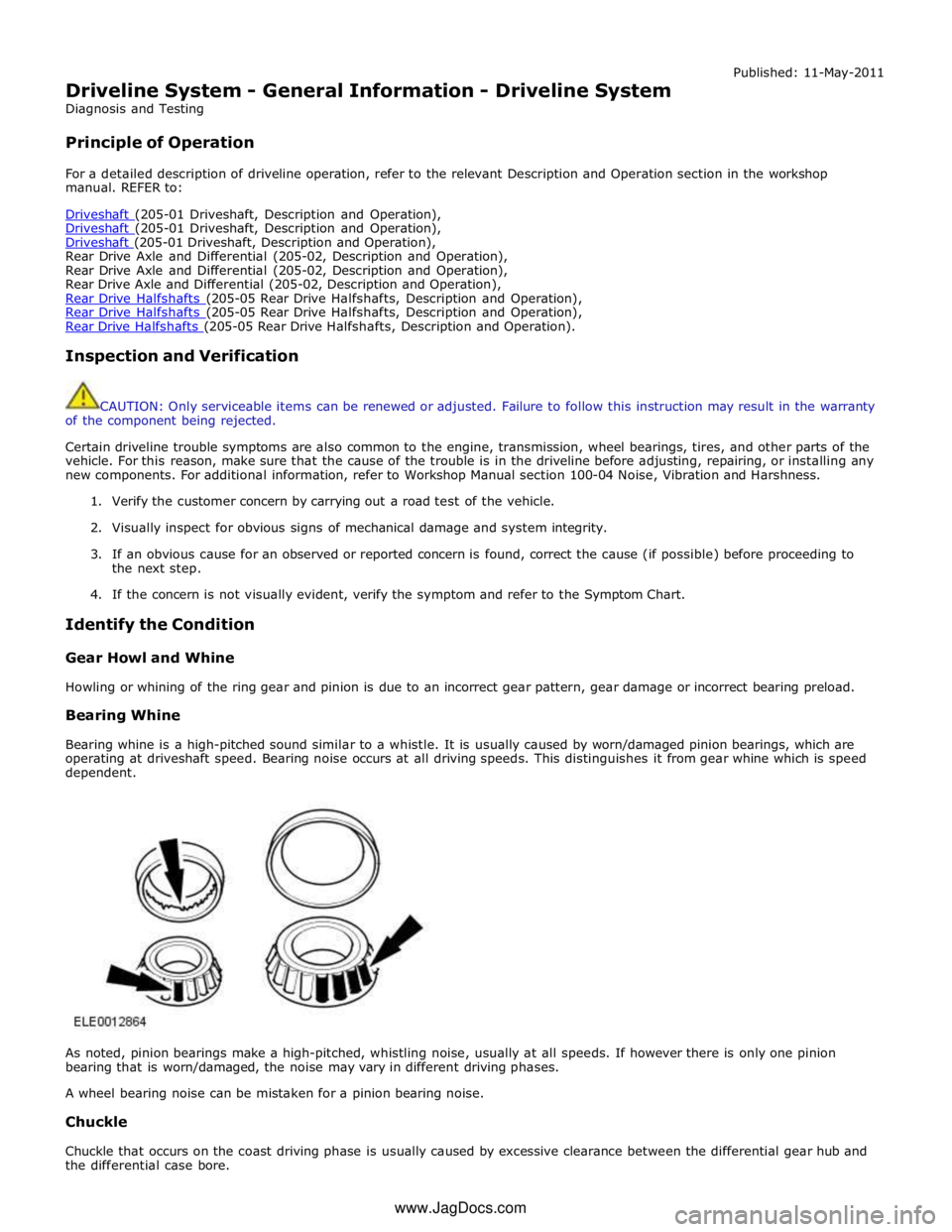
Bearing Whine
Bearing whine is a high-pitched sound similar to a whistle. It is usually caused by worn/damaged pinion bearings, which are
operating at driveshaft speed. Bearing noise occurs at all driving speeds. This distinguishes it from gear whine which is speed
dependent.
As noted, pinion bearings make a high-pitched, whistling noise, usually at all speeds. If however there is only one pinion
bearing that is worn/damaged, the noise may vary in different driving phases.
A wheel bearing noise can be mistaken for a pinion bearing noise.
Chuckle
Chuckle that occurs on the coast driving phase is usually caused by excessive clearance between the differential gear hub and
the differential case bore. www.JagDocs.com
Page 528 of 3039

Differential fluid - vehicles without supercharger Castrol SAF XO (75W 90) Differential fluid - vehicles with supercharger Castrol BOT 720 (75W 90) Initial Specifications
Item Specification Differential fluid capacity - vehicles without supercharger 0.9 Liters Differential fluid capacity - vehicles with supercharger 1.3 Liters Service Specifications
Item Specification Differential fluid capacity - vehicles without supercharger 0.85 Liters Differential fluid capacity - vehicles with supercharger 1.25 Liters Torque Specifications
Description Nm lb-ft lb-in Differential case front retaining bolt 90 66 - Differential case rear retaining bolts 192 142 - Differential filler plug 27 20 - Differential drain plug 27 20 - Halfshaft constant velocity joint nut 300 221 - Driveshaft retaining bolts 73 54 - www.JagDocs.com
Page 633 of 3039
Published: 02-Oct-2012
Rear Disc Brake - TDV6 3.0L Diesel /V8 5.0L Petrol/V8 S/C 5.0L Petrol - Brake
Caliper Vehicles With: High Performance Brakes
Removal and Installation
Removal
WARNING: Failure to release the tension and calibrate the electric parking brake during rear parking brake related service
procedures, could cause the parking brake to function incorrectly or become inoperative.
CAUTION: Brake fluid will damage paint finished surfaces. If spilled, immediately remove the fluid and clean the area
with water.
NOTE: Removal steps in this procedure may contain installation details.
1. WARNING: Do not work on or under a vehicle supported only by a jack.
Always support the vehicle on safety stands.
Raise and support the vehicle.
2. Refer to: Wheel and Tire (204-04 Wheels and Tires, Removal and Installation).
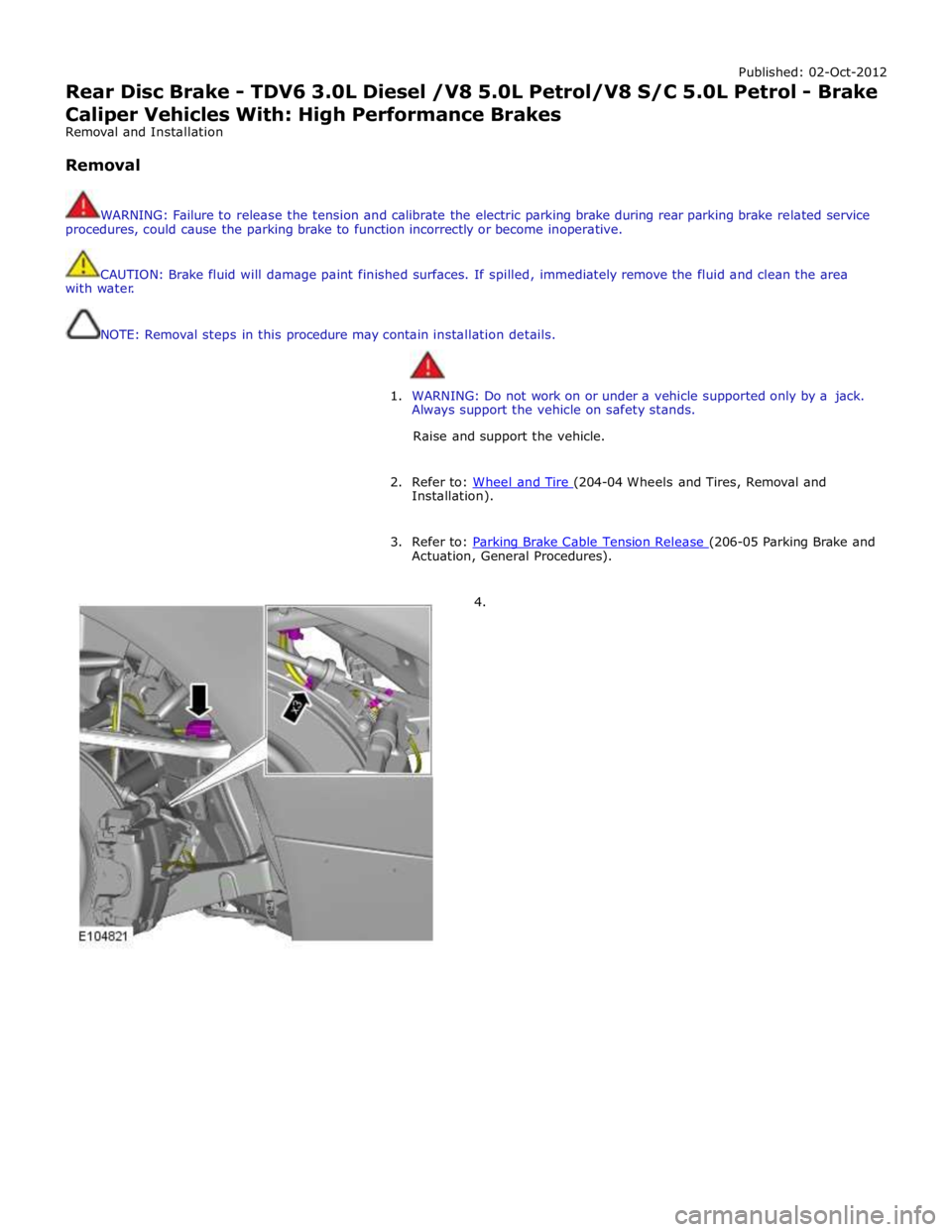
3. Refer to: Parking Brake Cable Tension Release (206-05 Parking Brake and Actuation, General Procedures).
4.
Page 638 of 3039
Published: 11-May-2011
Rear Disc Brake - TDV6 3.0L Diesel /V8 5.0L Petrol/V8 S/C 5.0L Petrol - Brake
Pads Vehicles With: High Performance Brakes
Removal and Installation
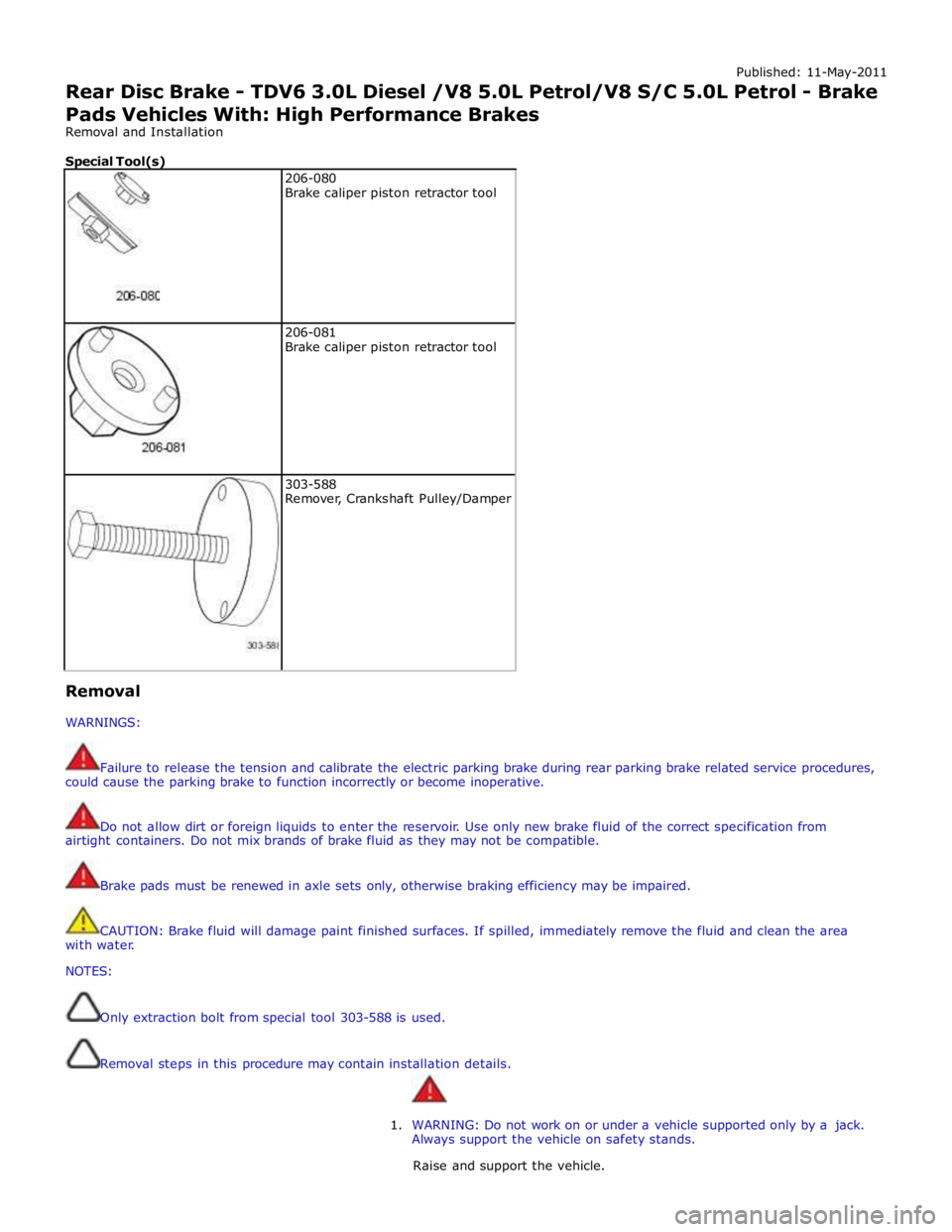
Special Tool(s)
206-080
Brake caliper piston retractor tool
206-081
Brake caliper piston retractor tool
303-588
Remover, Crankshaft Pulley/Damper Removal
WARNINGS:
Failure to release the tension and calibrate the electric parking brake during rear parking brake related service procedures,
could cause the parking brake to function incorrectly or become inoperative.
Do not allow dirt or foreign liquids to enter the reservoir. Use only new brake fluid of the correct specification from
airtight containers. Do not mix brands of brake fluid as they may not be compatible.
Brake pads must be renewed in axle sets only, otherwise braking efficiency may be impaired.
CAUTION: Brake fluid will damage paint finished surfaces. If spilled, immediately remove the fluid and clean the area
with water.
NOTES:
Only extraction bolt from special tool 303-588 is used.
Removal steps in this procedure may contain installation details.
1. WARNING: Do not work on or under a vehicle supported only by a jack.
Always support the vehicle on safety stands.
Raise and support the vehicle.
Page 653 of 3039
Parking Brake and Actuation - Parking Brake
Diagnosis and Testing
Principle of Operation Published: 12-May-2014
For a detailed description of the Parking Brake operation, refer to the relevant Description and Operation section of the
workshop manual. REFER to: (206-05 Parking Brake and Actuation)
Parking Brake (Description and Operation), Parking Brake (Description and Operation), Parking Brake (Description and Operation).
Parking Brake Calibration
The parking brake system must be calibrated whenever the battery has been disconnected or has been in a state of discharge,
or repairs have been carried out to the rear service or parking brake system.
NOTE: If new rear brake pads have been installed, pressure must be applied to the brake pedal a minimum of five times
prior to calibration of the parking brake system.
To calibrate the parking brake system:
1. Place gear selector lever in 'P' Park position.
2. Release parking brake cable tension to service position.
REFER to: Parking Brake Cable Tension Release (206-05 Parking Brake and Actuation, General Procedures).
3. Set the ignition status to 'ON'.
4. Apply and hold the footbrake then pull up the parking brake switch.
5. To release the parking brake, apply and hold the footbrake then release and press down the parking brake switch.
Inspection and Verification
CAUTION: Diagnosis by substitution from a donor vehicle is NOT acceptable. Substitution of control modules does not
guarantee confirmation of a fault, and may also cause additional faults in the vehicle being tested and/or the donor vehicle.
1. Verify the customer concern.
2. Visually inspect for obvious signs of damage and system integrity.
Visual Inspection
Mechanical Electrical
Parking brake cable
Parking brake actuator
Brake caliper
Brake pads
Stabilizer bar drop link caps
Fuse(s)
Wiring harness/electrical connectors
Check for bent/corroded pins
Parking brake switch
Parking brake module
3. If an obvious cause for an observed or reported concern is found, correct the cause (if possible) before proceeding to
the next step.
4. If the cause is not visually evident check the system for any logged Diagnostic Trouble Codes (DTCs) and proceed to
the DTC Index , alternatively, verify the customer concern and refer to the Symptom Chart.
Symptom Chart
Symptom Possible Cause Action The parking brake will not
engage or release (with no
parking brake warning
message)
Cables fouled, trapped or damaged
Cables incorrectly routed or installed
Rear lining wear
Service brake incorrectly adjusted following
lining change
Caliper malfunction
Check the rear and primary
cables for correct installation
and damage
Inspect the rear brake linings for
wear
Re-calibrate the parking brake,
refer to the calibration procedure
Check the rear service brake for
correct installation and operation
Page 654 of 3039

Symptom Possible Cause Action The parking brake will not
engage or release (with
parking brake warning
message)
Cables fouled, trapped or damaged
Cables incorrectly routed or installed
Rear lining wear
Actuator malfunction
Caliper malfunction
Check the rear and primary
cables for correct installation
and damage
Inspect the rear brake linings for
wear
Re-calibrate the parking brake,
refer to the calibration procedure
Check the rear service brake for
correct installation and operation No communication with the
parking brake module
Fuse
Module off Bus
CAN network error
Parking brake module fault
Check fuses
Ensure battery is fully charged
and in serviceable condition.
Check battery voltage at parking
brake module
Check CAN network using
manufacturer approved
diagnostic system 'Park brake Fault' displayed on
message center with
associated warning lamps
Parking brake system fault
Check the parking brake module
for DTCs and refer to DTC Index Brakes drag
Parking brake not re-calibrated after battery has
been disconnected or has been in a state of
discharge, or repairs have been carried out to
the rear service or parking brake system
Service brake system fault
Re-calibrate parking brake, refer
to the calibration procedure
Check the service brake for
correct operation DTC Index
For a list of diagnostic trouble codes that could be logged on this vehicle, please refer to Section 100-00.
REFER to: Diagnostic Trouble Code (DTC) Index - DTC: Electric Parking Brake (PBM) (100-00 General Information, Description and Operation).