service JAGUAR XFR 2010 1.G Owner's Manual
[x] Cancel search | Manufacturer: JAGUAR, Model Year: 2010, Model line: XFR, Model: JAGUAR XFR 2010 1.GPages: 3039, PDF Size: 58.49 MB
Page 182 of 3039

DTC Description Possible Causes Action U0155-00
Lost Communication
With Instrument Panel
Cluster (IPC) Control
Module - No sub type
information
Lost communication with
instrument cluster
Refer to the electrical circuit diagrams and check
the power and ground connections to the module
Using the manufacturer approved diagnostic
system, complete a CAN network integrity test
Refer to the electrical circuit diagrams and check
the CAN network between the front seat climate
control module and instrument cluster
Carry out on demand self test using manufacturer
approved diagnostic system to confirm rectification U0156-00 Lost Communication
Lost communication with
Refer to the electrical circuit diagrams and check With Information Center "A" - No sub rear seat entertainment the power and ground connections to the module type information control module Using the manufacturer approved diagnostic system, complete a CAN network integrity test Refer to the electrical circuit diagrams and check the CAN network between the front seat climate control module and rear seat entertainment control module Carry out on demand self test using manufacturer approved diagnostic system to confirm rectification U0300-00
Internal Control Module
Software
Incompatibility - No
sub type information
Software stored in front
seat climate control
module is not compatible
with master configuration
Check the front seat climate control module is
configured correctly
Reconfigure the front seat climate control module
using the manufacturer approved diagnostic
system. Clear the DTC and retest the system
Carry out on demand self test using manufacturer
approved diagnostic system to confirm rectification U0401-00
Invalid Data Received
From ECM/PCM - No
sub type information
The engine control module
has transmitted engine
speed quality factor CAN
signal at a specific value
for a greater than expected
time period
Check the engine control module for related DTCs
and refer to the relevant DTC index
On software levels previous to 8X23-14B663-AE
clear the DTC and take no further action if the
system is operating correctly U2101-00 Control module
Compatible central car
Using the manufacturer approved diagnostic Configuration Incompatible - No sub configuration file not system check and update the car configuration file type information received by front seat as required. Carry out on demand self test using climate control module manufacturer approved diagnostic system to confirm rectification. Clear the DTC and retest U3000-04
Control Module -
System internal
failures
Front seat climate control
module - Internal failure
Check and install new front seat climate control
module as required. Carry out on demand self test
using manufacturer approved diagnostic system to
confirm rectification U3003-62
Battery Voltage -
Signal compare failure
Wiring harness fault
Battery internal failure
Charging system fault
Refer to the electrical circuit diagrams and check
the power and ground connections to the front
seat climate control module and the central
junction box
Refer to the battery care manual and verify that
the vehicle battery is fully charged and serviceable
before continuing with further diagnostic tests
Check the vehicle charging system
Page 188 of 3039

DTC Description Possible Causes Action Instrument cluster power
and ground supply circuits -
short, open circuit
Incorrect CJB or instrument
cluster installed
Target SID synchronization
error following
re-programming
Noise/EMC related error electrical circuit diagrams and check CJB ignition,
power and ground supply circuits for short, open
circuit and instrument cluster power and ground
supply circuits for short, open circuit. Check
correct CJB and instrument cluster installed.
Perform the Immobilisation application from the
Set-up menu using the manufacturer approved
diagnostic system. Check CAN network for
interference/EMC related issues B1009-87
Ignition Authorisation -
Missing message
CJB ignition, power and
ground supply circuits -
short, open circuit
LS CAN fault
Instrument cluster power
and ground supply circuits -
short, open circuit
Low battery voltage <9
volts
Carry out any pinpoint tests associated with this
DTC using the manufacturer approved diagnostic
system. Refer to the electrical circuit diagrams
and check CJB ignition, power and ground supply
circuits for short, open circuit and instrument
cluster power and ground supply circuits for
short, open circuit. Check CAN communications
between CJB and instrument cluster. Check
battery is in serviceable condition and fully
charged B100A-62 Fuel Pump Authorisation
- Signal compare failure
LS CAN fault
RJB power and ground
supply circuits - short, open
circuit
Instrument cluster power
and ground supply circuits -
short, open circuit
Incorrect RJB or instrument
cluster installed
Target SID synchronization
error following
re-programming
Noise/EMC related error
Carry out any pinpoint tests associated with this
DTC using the manufacturer approved diagnostic
system. Check CAN communications between
RJB and instrument cluster. Refer to the
electrical circuit diagrams and check RJB power
and ground supply circuits for short, open circuit
and instrument cluster power and ground supply
circuits for short, open circuit. Check correct RJB
and instrument cluster installed. Perform the
Immobilisation application from the Set-up menu
using the manufacturer approved diagnostic
system. Check CAN network for interference/EMC
related issues B100A-64 Fuel Pump Authorisation
- Signal plausibility
failure
Target SID synchronization
error following
re-programming
RJB power and ground
supply circuits - short, open
circuit
LS CAN fault
Carry out any pinpoint tests associated with this
DTC using the manufacturer approved diagnostic
system. Perform the Immobilisation application
from the Set-up menu using the manufacturer
approved diagnostic system. Refer to the
electrical circuit diagrams and check RJB power
and ground supply circuits for short, open circuit.
Check CAN communications between RJB and
instrument cluster B100A-87 Fuel Pump Authorisation
- Missing message
RJB power and ground
supply circuits - short, open
circuit
LS CAN fault
Instrument cluster power
and ground supply circuits -
short, open circuit
Low battery voltage <9
volts
Carry out any pinpoint tests associated with this
DTC using the manufacturer approved diagnostic
system. Refer to the electrical circuit diagrams
and check RJB power and ground supply circuits
for short, open circuit and instrument cluster
power and ground supply circuits for short, open
circuit. Check CAN communications between RJB
and instrument cluster. Check battery is in
serviceable condition and fully charged B100B-67
Column Lock Ground
Authorisation - Signal
incorrect after event
Algorithm based failure-
signal is incorrect after the
event
Instrument cluster power
and ground supply circuits -
short, open circuit
LS CAN fault
RJB power and ground
supply circuits - short, open
circuit
Vehicle speed present when
attempting to power ESCL
Engine speed present when
attempting to power ESCL
PowerMode status > 4 when
attempting to perform lock
action
If a non start issue has not been identified,
clear the DTC and check vehicle starts correctly.
If a non start issue has been identified run the
manufacturers approved diagnostic system Start
Authorisation Application. Carry out any pinpoint
tests associated with this DTC using the
manufacturer approved diagnostic system. Refer
to the electrical circuit diagrams and check RJB
power and ground supply circuits for short, open
circuit and instrument cluster power and ground
supply circuits for short, open circuit. Check CAN
communications between RJB and instrument
cluster. Check for invalid vehicle speed signal
from ABS/instrument cluster gateway. Check for
invalid engine speed signal from ECM/instrument
cluster gateway. Check for invalid signal from
CJB
Page 193 of 3039

DTC Description Possible Causes Action Instrument cluster power
and ground supply circuits -
short, open circuit
ECM or instrument cluster
incorrectly configured circuit diagrams and check ECM ignition, power
and ground supply circuits for short, open circuit
and instrument cluster power and ground supply
circuits for short, open circuit. Perform the
Immobilisation application from the Set-up menu
using the manufacturer approved diagnostic
system B1B33-62 Target I.D. Transfer -
Signal compare failure
CAN fault
ECM ignition, power and
ground supply circuits -
short, open circuit
Instrument cluster power
and ground supply circuits -
short, open circuit
Incorrect ECM or instrument
cluster installed
Synchronisation error
following re-programming
Noise/EMC related error
Carry out any pinpoint tests associated with this
DTC using the manufacturer approved diagnostic
system. Check CAN communications between
ECM and instrument cluster. Refer to electrical
circuit diagrams and check ECM ignition, power
and ground supply circuits for short, open circuit
and instrument cluster power and ground supply
circuits for short, open circuit. Check correct ECM
and instrument cluster installed. Perform the
Immobilisation application from the Set-up menu
using the manufacturer approved diagnostic
system. Check CAN network for interference/EMC
related issues B1B33-64 Target identification
transfer - Signal
plausibility failure
Algorithm based failure -
signal plausibility failure
CAN fault
ECM ignition, power and
ground supply circuits -
short, open circuit
Instrument cluster power
and ground supply circuits -
short, open circuit
electronic steering column
lock status incomplete
Race condition caused by
closing driver door and
pressing the start button
within a small time window
If the customer has not reported a non start
issue, clear the DTC and check vehicle starts
correctly. If a non start has been reported run
the manufacturers approved diagnostic system
Start Authorisation Application and follow the
actions required for this DTC. Carry out any
pinpoint tests associated with this DTC using
the manufacturer approved diagnostic system.
Check CAN communications between ECM and
instrument cluster. Refer to electrical circuit
diagrams and check ECM ignition, power and
ground supply circuits for short, open circuit and
instrument cluster power and ground supply
circuits for short, open circuit. Check electronic
steering column lock operation. Advise customer
of starting sequence and to allow time to elapse
between closing door and pressing start button B1B33-87 Target I.D. Transfer -
Missing message
CAN fault
ECM ignition, power and
ground supply circuits -
short, open circuit
Instrument cluster power
and ground supply circuits -
short, open circuit
Low battery voltage
Carry out any pinpoint tests associated with this
DTC using the manufacturer approved diagnostic
system. Check CAN communications between
ECM and instrument cluster. Refer to electrical
circuit diagrams and check ECM ignition, power
and ground supply circuits for short, open circuit
and instrument cluster power and ground supply
circuits for short, open circuit. Check battery is
in serviceable condition and is fully charged,
check terminals etc B1C32-77
Steering Column Tilt
Solenoid - Commanded
position not reachable
TILT axis fails to move
minimum distance within
allotted time period. Motion
may have been prohibited
due to motor jamming,
stalling or solenoid pin not
engaging
Check for restricted/jammed steering column
motor mechanism. Refer to the electrical circuit
diagrams and check steering column motor
UP/IN, DOWN/OUT circuit for short, open circuit B1C32-94
Steering Column Tilt
Solenoid - Unexpected
operation
TELE axis moves when it
has not been commanded
to. Motion may have
occurred due to solenoid pin
not disengaging or
mechanism has been
jammed on, whilst REACH
axis has been commanded
to move
Check for stuck/jammed solenoid/switch. Refer
to the electrical circuit diagrams and check
steering column motor UP/IN, DOWN/OUT circuit
for short, open circuit B1C33-12
Steering Column Tilt
Feedback Signal - Circuit
short to battery
Steering column tilt
feedback signal circuit -
short to power
Refer to the electrical circuit diagrams and check
steering column tilt feedback signal circuit for
short to power
Page 205 of 3039

DTC Description Possible Causes Action U3000-04
Control Module -
System Internal
Failures
Occupancy seat module
internal electronic failure
Check and install a new occupancy seat module as
required. Refer to the warranty policy and procedures
manual, or determine if any prior approval programme is
in operation, prior to the installation of a new
module/component U3000-54
Control Module -
Missing calibration
This diagnostic trouble
code is set if a 'calibrate
occupancy seat module
empty seat offset'
routine is requested and
fails due to one of the
pre-conditions to
execute the routine
Check the following criteria have all been achieved:
Ignition status set to RUN/START. Verify seat is always
empty after power-up before re-zero is requested. The
occupancy seat module has gone through the seat
assembly plant calibration. No collision event received
from the restraints control module during the current
ignition cycle. No faults present in the current ignition
cycle. The trigger message for calibrate empty seat
offset has been received from the diagnostic tool.
Occupancy seat module has enough time to begin
classification. Temperature is between 6C (42F) and 36C
(97F) U3003-16
Battery Voltage -
Circuit voltage
below threshold
Circuit voltage below
threshold
Check battery is in fully charged and serviceable
condition. Check integrity of charging system U3003-17
Battery Voltage -
Circuit voltage
above threshold
Circuit voltage above
threshold
Check battery is in fully charged and serviceable
condition. Check integrity of charging system
Page 220 of 3039

DTC Description Possible Causes Action B100A-51 Fuel Pump Authorisation
- Not programmed
RJB fault
Low speed CAN fault
Instrument cluster fault
Check power and ground supplies to RJB. Check CAN
communications between RJB and instrument
cluster. Check power and ground supplies to
instrument cluster B100A-62 Fuel Pump Authorisation
- Signal compare failure
Low speed CAN fault
RJB fault
Instrument cluster fault
Incorrect module
installed
(RJB/Instrument cluster)
Write target SID
synchronisation error
following
re-programming
Noise/EMC related error
Check CAN communications between RJB and
instrument cluster. Check power and ground supplies
to RJB and instrument cluster. Confirm correct
module installed. Re-synchronise ID by
re-configuring the RJB as a new module. Check CAN
network for interference/EMC related issues B100A-63 Fuel Pump Authorisation
- Circuit/component
protection time-out
RJB fault
Low speed CAN fault
Instrument cluster fault
Low battery voltage <9V
Check power and ground supplies to RJB and
instrument cluster. Check CAN communications
between RJB and instrument cluster. Check battery
is in fully charged and serviceable condition, refer to
the battery care manual B1026-12
Steering Column Lock -
Circuit short to battery
Steering column lock
ground circuit - short to
power
Refer to the electrical circuit diagrams and check
steering column lock ground circuit for short to
power B1087-83
LIN Bus "A" - Value of
signal protection
calculation incorrect
The checksum of the
received LIN frame is
incorrect
Check the battery monitoring system and rear
parking aid system for DTCs and refer to relevant
DTC Index B1087-86
LIN Bus "A" - Signal
invalid
The header of the LIN
message received is
incorrect
Carry out any pinpoint test associated with this DTC
using the manufacturer approved diagnostic system.
Check the battery monitoring system and rear
parking aid system for DTCs and refer to relevant
DTC Index B1087-88 LIN Bus "A" - Bus off
Battery monitoring
system LIN circuit -
short to ground, power
Carry out any pinpoint test associated with this DTC
using the manufacturer approved diagnostic system.
Refer to the electrical circuit diagrams and check
battery monitoring system LIN circuit for short to
ground, power B108A-23
Start Button - Signal
stuck low
Start/Stop switch digital
input signal circuit -
stuck low
Carry out any pinpoint test associated with this DTC
using the manufacturer approved diagnostic system.
Refer to the electrical circuit diagrams and check
Start/Stop switch digital input signal circuit for short
to ground B10A1-11 Trailer Tow Detection -
Circuit short to ground
Trailer tow detection
digital input circuit -
short to ground
Carry out any pinpoint test associated with this DTC
using the manufacturer approved diagnostic system.
Refer to the electrical circuit diagrams and check
trailer tow detection digital input circuit for short to
ground B10AF-12
Blower Fan Relay -
Circuit short to battery
High Side output not
driven - Diagnosis
feedback indicates
output is short to power
Refer to the electrical circuit diagrams and check
blower motor supply circuit for short to power B10AF-14
Blower Fan Relay -
Circuit short to ground
or open
High Side output not
driven - Diagnosis
feedback indicates
output is short to
ground, open circuit
Refer to the electrical circuit diagrams and check
blower motor supply circuit for short to ground, open
circuit
Page 223 of 3039

DTC Description Possible Causes Action or short to power short to power B1124-11
Lamp Fade Control -
Circuit short to ground
Interior lamp fade
control circuit - short to
ground
Refer to the electrical circuit diagrams and check
interior lamp fade control circuit for short to ground B1124-12
Lamp Fade Control -
Circuit short to battery
Interior lamp fade
control circuit - short to
power
Refer to the electrical circuit diagrams and check
interior lamp fade control circuit for short to power B113C-12
Hazard Switch
Illumination - Circuit
short to battery
Hazard switch
illumination control
circuit - short to power
Refer to the electrical circuit diagrams and check
hazard switch illumination control circuit for short to
power B113C-14
Hazard Switch
Illumination - Circuit
short to ground or open
Hazard switch
illumination control
circuit - short to ground,
open circuit
Refer to the electrical circuit diagrams and check
hazard switch illumination control circuit for short to
ground, open circuit B113E-12
External Boot/Trunk
Release Switch - Circuit
short to battery
External luggage
compartment lid release
switch digital input
circuit - short to power
Refer to the electrical circuit diagrams and check
external luggage compartment lid release switch
digital input circuit for short to power B113E-23
External Boot/Trunk
Release Switch - Signal
stuck low
External luggage
compartment lid release
switch digital input
circuit - signal stuck low
Carry out any pinpoint test associated with this DTC
using the manufacturer approved diagnostic system.
Refer to the electrical circuit diagrams and check
external luggage compartment lid release switch
digital input circuit for short to ground B11D9-49
Vehicle Battery -
Internal electronic
failure
Vehicle battery
damaged/worn out
Check battery is in fully charged and serviceable
condition using the Midtronics battery tester and
the battery care manual B11DB-49
Battery Monitoring
Module - Internal
electronic failure
Internal electronic
failure
Suspect the battery monitoring module. Check and
install a new module as required, refer to the new
module/component installation note at the top of
the DTC Index B11DB-87
Battery Monitoring
Module - Missing
message
Battery monitoring
module connector
dis-connected/poor
connection
Battery monitoring
module to RJB LIN
circuit - open circuit
Battery monitoring
module to battery
positive monitor circuit -
open circuit
Battery monitoring
module/RJB failure
Carry out any pinpoint test associated with this DTC
using the manufacturer approved diagnostic system.
If additional DTCs B108783, B108786, B108787 are
logged, suspect the RJB. Check and install a new
RJB as required, refer to the new module/component
installation note at the top of the DTC Index. If
additional DTCs B108783, B108786, B108787 are
NOT logged, check for good/clean contact at battery
monitoring module connector, refer to electrical
circuit diagrams and check battery monitoring
module to RJB LIN circuit and battery monitoring
module to battery positive monitor circuit for open
circuit. Clear DTC and repeat automated diagnostic
procedure using manufacturer approved diagnostic
system. If DTC remains suspect the battery
monitoring module, check and install a new battery
monitoring module as required, refer to the new
module/component installation note at the top of
the DTC Index B123A-11 Left Front Turn Indicator
- Circuit short to ground
Left front turn signal
lamp control circuit -
short to ground
Refer to the electrical circuit diagrams and check left
front turn signal lamp control circuit for short to
ground B123A-12 Left Front Turn Indicator
- Circuit short to battery
Left front turn signal
lamp control circuit -
short to power
Refer to the electrical circuit diagrams and check left
front turn signal lamp control circuit for short to
power
Page 242 of 3039
Published: 17-Apr-2014
General Information - Diagnostic Trouble Code (DTC) Index DTC: Steering
Column Lock Module (VIM)
Description and Operation
Steering Column Lock Module (VIM)
CAUTION: Diagnosis by substitution from a donor vehicle is NOT acceptable. Substitution of control modules does not
guarantee confirmation of a fault and may also cause additional faults in the vehicle being checked and/or the donor vehicle.
NOTES:
If the control module or a component is suspect and the vehicle remains under manufacturer warranty, refer to the
Warranty Policy and Procedures manual, or determine if any prior approval programme is in operation, prior to the installation
of a new module/component.
Generic scan tools may not read the codes listed, or may read only 5-digit codes. Match the 5 digits from the scan tool to
the first 5 digits of the 7-digit code listed to identify the fault (the last 2 digits give extra information read by the
manufacturer approved diagnostic system).
When performing voltage or resistance tests, always use a digital multimeter (DMM) accurate to three decimal places,
and with an up-to-date calibration certificate. When testing resistance, always take the resistance of the DMM leads into
account.
Check and rectify basic faults before beginning diagnostic routines involving pinpoint tests.
If DTCs are recorded and, after performing the pinpoint tests a fault is not present, an intermittent concern may be the
cause. Always check for loose connections and corroded terminals.
Where an 'on demand self-test' is referred to, this can be accessed via the 'DTC Monitor' tab on the manufacturers
approved diagnostic system.
Check DDW for open campaigns. Refer to the corresponding bulletins and SSMs which may be valid for the specific
customer complaint and carry out the recommendations as required.
The table below lists all Diagnostic Trouble Codes (DTCs) that could be logged in the Steering Column Lock Module, for
additional Diagnosis and Testing information refer to the relevant Diagnosis and Testing Section.
For additional information, refer to: Steering Column Switches (211-05 Steering Column Switches, Diagnosis and Testing).
DTC Description Possible Causes Action B100D-51
Column Lock
Authorisation - Not
programmed
Module not programmed
Configure the Steering Column Lock Module using the
manufacturers approved diagnostic system B100D-62
Column Lock
Authorisation -
Signal compare
failure
Signal compare failure
- This DTC will be
logged if the
encrypted data
exchange does
not match
between Steering
Column Lock and
the Central
Junction Box
Configure the modules using the manufacturers approved
diagnostic system. If the problem persists, complete a
CAN network integrity test using the manufacturers
approved diagnostic system. Perform an on demand
self-test and retest B100D-64
Column Lock
Authorisation -
Signal plausibility
failure
Signal plausibility failure
Steering Column Lock
unable to perform lock
action
CAN Network fault
Anti-lock Braking
System, Engine Control
Module, Central Junction
Box fault
NOTE: Prior to clearing this DTC, carry out the Vehicle
Functional Reset application using the manufacturer approved
diagnostic system
Check the serviceability of the steering column and lock.
Clear the DTC and retest. If the problem persists, carry
out CAN Network Integrity Test and Module Self Test
using the manufacturer approved diagnostic system.
Alternatively, refer to the electrical circuit diagrams and
Page 294 of 3039

Jacking and Lifting - Jacking
Description and Operation
Safety Precautions Published: 11-May-2011
WARNING: The jack provided with the vehicle is intended to be used in an emergency for changing a deflated tire. To
avoid damage to the vehicle, never use the jack to raise the vehicle for any other purpose. Refer to the Driver Handbook when
using the jack supplied with the vehicle. Failure to follow these instructions may result in personal injury.
The following safety precautions must be observed when raising the vehicle to carry out service operations:
Never rely on a jack alone to support a vehicle. Always use suitable vehicle stands to provide rigid support.
When working beneath a vehicle, whenever possible use a vehicle hoist instead of a jack and vehicle stands.
Make sure that the vehicle is standing on firm, level ground before using a jack.
Do not rely on the parking brake alone; chock the wheels and put the automatic transmission into Park if possible.
Check that any lifting equipment used has adequate capacity for the load being lifted and is in correct working order.
Page 332 of 3039

Upper Control Arm
The forged-aluminum upper control arm is a wishbone design and connects to the vehicle body through two plain bushes, and
links to the swan neck wheel knuckle by an integral ball joint. The upper control arm is inclined to provide anti-dive
characteristics under heavy braking, while also controlling geometry for vehicle straight-line stability.
Lower Control Arm
The forged aluminum lower control arms are of the wishbone design; the arms separate to allow for optimum bush tuning:
The rear lateral control arm is fitted with a bush at its inner end which locates between brackets on the subframe. The
arm is secured with an eccentric bolt which provides the adjustment of the suspension camber geometry. The outer end
of the control arm has a tapered hole which locates on a ball joint fitted to the wheel knuckle. An integral clevis bracket
on the forward face of the lateral control arm allows for the attachment of the forward control arm. A bush is fitted
below the clevis bracket to provide for the attachment of the stabilizer bar link. A cross-axis joint is fitted to a
cross-hole in the control arm to provide the location for the clevis attachment of the spring and damper assembly.
The forward control arm is fitted with a fluid-block rubber bush at its inner end which locates between brackets on the
subframe. The arm is secured with an eccentric bolt which provides adjustment of the castor and camber geometry. The
outer end of the control arm is fitted with a cross-axis joint and locates in the integral clevis bracket on the lateral
control arm.
Wheel Knuckle
The cast aluminum wheel knuckle is a swan neck design and attaches to the upper control arm and lower lateral control arm.
The lower lateral control arm locates on a non serviceable ball-joint integral with the wheel knuckle. The lower boss on the
rear of the knuckle provides for the attachment of the steering gear tie-rod ball joint.
The wheel knuckle also provides the mounting locations for the:
wheel hub and bearing assembly
the wheel speed sensor (integral to the wheel hub and bearing assembly)
brake caliper and disc shield.
Stabilizer Bar
The stabilizer bar is attached to the front of the subframe with bushes and mounting brackets. The pressed steel mounting
brackets locate over the bushes and are attached to the cross member with bolts screwed into threaded locations in the
subframe. The stabilizer bar has crimped, 'anti-shuffle' collars pressed in position on the inside edges of the bushes. The
collars prevent sideways movement of the stabilizer bar.
The stabilizer bar is manufactured from 32mm diameter tubular steel on supercharged models and 31mm diameter tubular
steel on diesel and normally aspirated models and has been designed to provide particular characteristics in maintaining roll
rates, specifically in primary ride comfort.
Each end of the stabilizer bar curves rearwards to attach to a ball joint on a stabilizer link. Each stabilizer link is secured to a
bush in the lower lateral arm with a bolt and locknut. The links allow the stabilizer bar to move with the wheel travel providing
maximum effectiveness.
The only difference between the front stabilizer bars, in addition to the diameter, is in the shape to accommodate engine
variant:
a slightly curved bar, between bush centers, for V6 diesel (31 mm dia) and V8 gasoline supercharged (32 mm dia),
a straight bar, between bush centers, for V6 and V8 normally aspirated gasoline engines (31 mm dia).
Spring and Damper Assembly
The spring and damper assemblies are located between the lower lateral arm and the front suspension housing in the inner
wing. Dependant on vehicle model there are three types of coil spring and damper available:
a standard oil passive damper (All models except supercharged),
an adaptive damper, also known as Computer Active Technology Suspension (CATS) on 4.2L supercharged vehicles up to
2010MY, For additional information refer to Vehicle Dynamic Suspension 4.2L.
a continuously variable adaptive damper, also known as Adaptive Dynamics System on 5.0L supercharged vehicles from
2010MY. For additional information refer to Vehicle Dynamic Suspension 5.0L.
The dampers are a monotube design with a spring seat secured by a circlip onto the damper tube. The damper's lower
spherical joint is an integral part of the lateral lower control-arm, and the damper takes the form of a clevis-end, which
straddles the spherical joint.
The damper piston is connected to a damper rod which is sealed at its exit point from the damper body. The threaded outer
end of the damper rod locates through a hole in the top mount. A self locking nut secures the top mount to the damper rod.
The damper rod on the adaptive damper has an electrical connector on the outer end of the damper rod.
Supercharged 4.2L vehicles up to 2010MY: The adaptive damper functions by restricting the flow of hydraulic fluid through
internal galleries in the damper's piston. The adaptive damper has a solenoid operated valve, which when switched allows a
greater flow of hydraulic fluid through the damper's piston. This provides a softer damping characteristic from the damper. The
adaptive damper defaults to a firmer setting when not activated. The solenoid is computer controlled and can switch between
soft and hard damping settings depending on road wheel inputs and vehicle speed.
Supercharged 5.0L vehicles from 2010MY: The variable damper functions by adjustment of a solenoid operated variable orifice,
which opens up an alternative path for oil flow within the damper. When de-energized the bypass is closed and all the oil flows
Page 335 of 3039
NOTE: If a significant quantity of fluid has leaked out of the damper, the dividing piston will be displaced upwards in the
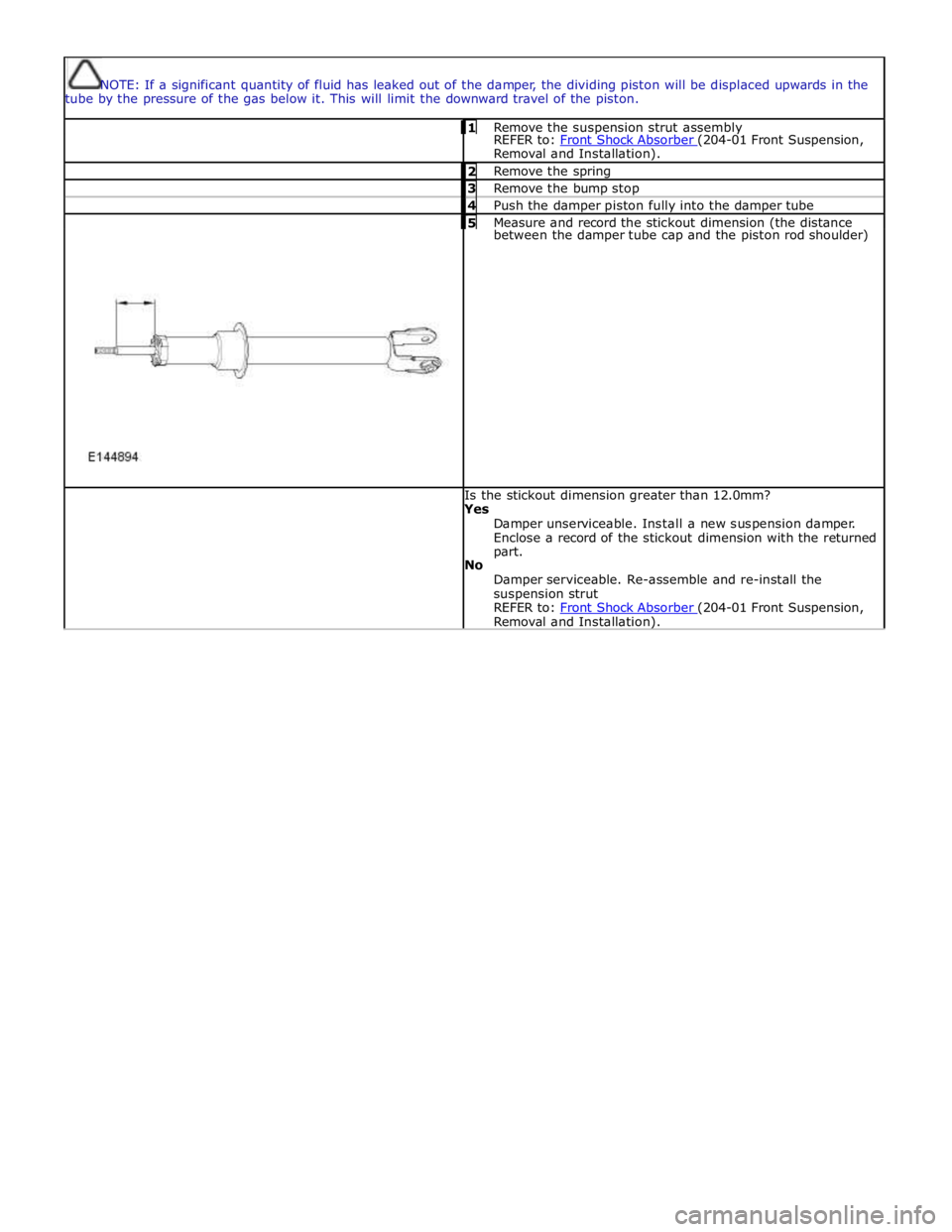
tube by the pressure of the gas below it. This will limit the downward travel of the piston. 1 Remove the suspension strut assembly REFER to: Front Shock Absorber (204-01 Front Suspension, Removal and Installation). 2 Remove the spring 3 Remove the bump stop 4 Push the damper piston fully into the damper tube
5 Measure and record the stickout dimension (the distance between the damper tube cap and the piston rod shoulder) Is the stickout dimension greater than 12.0mm?
Yes
Damper unserviceable. Install a new suspension damper.
Enclose a record of the stickout dimension with the returned
part.
No
Damper serviceable. Re-assemble and re-install the
suspension strut
REFER to: Front Shock Absorber (204-01 Front Suspension, Removal and Installation).