electrical JAGUAR XFR 2010 1.G Workshop Manual
[x] Cancel search | Manufacturer: JAGUAR, Model Year: 2010, Model line: XFR, Model: JAGUAR XFR 2010 1.GPages: 3039, PDF Size: 58.49 MB
Page 2350 of 3039

DTC Description Possible Causes Action DTC and retest
Carry out on demand self test using manufacturer
approved diagnostic system to confirm
rectification. Alternatively, carry out any pinpoint
tests associated with this DTC using the
manufacturer approved diagnostic system B122B-12
Right Seat Back Blower
Speed Sensor - Circuit
short to battery
Seat backrest blower speed
right circuit - Short circuit
to power
Blower motor assembly -
Short circuit to power
Front seat climate control
module failure
Carry out on demand self test using manufacturer
approved diagnostic system to confirm the fault is
present
Refer to the electrical circuit diagrams and check
the front seat climate control module - Circuit
reference RH_SEAT_BACK_FAN_SPEED - For short
circuit to power. Repair circuit as required, clear
DTC and retest
Carry out on demand self test using manufacturer
approved diagnostic system to confirm
rectification. Alternatively, carry out any pinpoint
tests associated with this DTC using the
manufacturer approved diagnostic system B122C-11
Left Seat Cushion
Blower Speed Sensor -
Circuit short to ground
Seat cushion blower speed
left circuit - Short circuit to
ground
Blower motor assembly -
Short circuit to ground
Front seat climate control
module failure
Carry out on demand self test using manufacturer
approved diagnostic system to confirm the fault is
present
Refer to the electrical circuit diagrams and check
the front seat climate control module - Circuit
reference LH_CUSHION_FAN_SPEED - For short
circuit to ground. Repair circuit as required, clear
DTC and retest
Carry out on demand self test using manufacturer
approved diagnostic system to confirm
rectification. Alternatively, carry out any pinpoint
tests associated with this DTC using the
manufacturer approved diagnostic system B122C-12
Left Seat Cushion
Blower Speed Sensor -
Circuit short to battery
Seat cushion blower speed
left circuit - Short circuit to
power
Blower motor assembly -
Short circuit to power
Front seat climate control
module failure
Carry out on demand self test using manufacturer
approved diagnostic system to confirm the fault is
present
Refer to the electrical circuit diagrams and check
the front seat climate control module - Circuit
reference LH_CUSHION_FAN_SPEED - For short
circuit to power. Repair circuit as required, clear
DTC and retest
Carry out on demand self test using manufacturer
approved diagnostic system to confirm
rectification. Alternatively, carry out any pinpoint
tests associated with this DTC using the
manufacturer approved diagnostic system B122D-11
Left Seat Back Blower
Speed Sensor - Circuit
short to ground
Seat backrest blower speed
left circuit - Short circuit to
ground
Blower motor assembly -
Short circuit to ground
Front seat climate control
module failure
Carry out on demand self test using manufacturer
approved diagnostic system to confirm the fault is
present
Refer to the electrical circuit diagrams and check
the front seat climate control module - Circuit
reference LH_SEAT_BACK_FAN_SPEED - For short
circuit to ground. Repair circuit as required, clear
DTC and retest
Carry out on demand self test using manufacturer
approved diagnostic system to confirm
rectification. Alternatively, carry out any pinpoint
tests associated with this DTC using the
manufacturer approved diagnostic system B122D-12
Left Seat Back Blower
Speed Sensor - Circuit
short to battery
Seat backrest blower speed
left circuit - Short circuit to
power
Blower motor assembly -
Short circuit to power
Front seat climate control
module failure
Carry out on demand self test using manufacturer
approved diagnostic system to confirm the fault is
present
Refer to the electrical circuit diagrams and check
the front seat climate control module - Circuit
reference LH_SEAT_BACK_FAN_SPEED - For short
circuit to power. Repair circuit as required, clear
DTC and retest
Carry out on demand self test using manufacturer
approved diagnostic system to confirm
rectification. Alternatively, carry out any pinpoint
Page 2351 of 3039

DTC Description Possible Causes Action tests associated with this DTC using the
manufacturer approved diagnostic system B122E-98
Right Seat Cushion -
Component or system
over temperature
Blocked or restricted
thermal electric device fan
exhaust vent
Restricted thermal electric
device fan movement
Check for blockage or restriction in thermal electric
device fan exhaust vent
Check for restricted thermal electric device fan
movement
Carry out on demand self test using manufacturer
approved diagnostic system to confirm
rectification. Alternatively, carry out any pinpoint
tests associated with this DTC using the
manufacturer approved diagnostic system B122F-98
Right Seat Back -
Component or system
over temperature
Blocked or restricted
thermal electric device fan
exhaust vent
Restricted thermal electric
device fan movement
Check for blockage or restriction in thermal electric
device fan exhaust vent
Check for restricted thermal electric device fan
movement
Carry out on demand self test using manufacturer
approved diagnostic system to confirm
rectification. Alternatively, carry out any pinpoint
tests associated with this DTC using the
manufacturer approved diagnostic system B1230-98
Left Seat Back -
Component or system
over temperature
Blocked or restricted
thermal electric device fan
exhaust vent
Restricted thermal electric
device fan movement
Check for blockage or restriction in thermal electric
device fan exhaust vent
Check for restricted thermal electric device fan
movement
Carry out on demand self test using manufacturer
approved diagnostic system to confirm
rectification. Alternatively, carry out any pinpoint
tests associated with this DTC using the
manufacturer approved diagnostic system B1231-7A
Right Seat - Fluid leak
or seal failure
Seat backrest assembly -
Air path leaking
Seat cushion assembly -
Air path leaking
Seat assembly damaged
Check for blockage or restriction in seat
backrest/seat cushion thermal electric device fan
ducts
Check seat backrest/seat cushion thermal electric
device fan exhaust vent is clear
Carry out on demand self test using manufacturer
approved diagnostic system to confirm
rectification. Alternatively, carry out any pinpoint
tests associated with this DTC using the
manufacturer approved diagnostic system B1232-7A
Left Seat - Fluid leak or
seal failure
Seat backrest assembly -
Air path leaking
Seat cushion assembly -
Air path leaking
Seat assembly damaged
Check for blockage or restriction in seat
backrest/seat cushion thermal electric device fan
ducts
Check seat backrest/seat cushion thermal electric
device fan exhaust vent is clear
Carry out on demand self test using manufacturer
approved diagnostic system to confirm
rectification. Alternatively, carry out any pinpoint
tests associated with this DTC using the
manufacturer approved diagnostic system B1235-13
Left Seat Cushion Temperature Sensor -
Circuit open
Connectors disconnected or
connector pin damage
Seat cushion temperature
sensor left circuit - Open
circuit
Front seat climate control
module failure
Check for any disconnected connectors or damaged
connector pins
Carry out on demand self test using manufacturer
approved diagnostic system to confirm the fault is
present
Refer to the electrical circuit diagrams and check
the front seat climate control module - Circuit
reference LH_CUSHION_SENSOR, Circuit reference
LH_CUSHION_SENSOR_RTN - For open circuit.
Repair circuit as required, clear DTC and retest
Carry out on demand self test using manufacturer
approved diagnostic system to confirm
rectification. Alternatively, carry out any pinpoint
tests associated with this DTC using the
manufacturer approved diagnostic system
Page 2352 of 3039

DTC Description Possible Causes Action U0010-88
Medium Speed CAN
Communication Bus -
Bus off
Medium speed CAN
communication - Bus off
Refer to the electrical circuit diagrams and check
the power and ground connections to the module
Using the manufacturer approved diagnostic
system, complete a CAN network integrity test
Carry out on demand self test using manufacturer
approved diagnostic system to confirm rectification U0140-00
Lost Communication
With Body Control
Module - No sub type
information
Lost communication with
central junction box
NOTE: This DTC may be stored even though no fault
condition is present and should be ignored unless the
customer has reported a climate seat concern. Clear the
DTC and retest. Verify the customer concern prior to
diagnosis
Refer to the electrical circuit diagrams and check
the power and ground connections to the module
Using the manufacturer approved diagnostic
system, complete a CAN network integrity test
Refer to the electrical circuit diagrams and check
the CAN network between the front seat climate
control module and central junction box
Carry out on demand self test using manufacturer
approved diagnostic system to confirm rectification U0142-00 Lost Communication
Lost communication with
Refer to the electrical circuit diagrams and check With Body Control Module "B" - No sub rear junction box the power and ground connections to the module type information Using the manufacturer approved diagnostic system, complete a CAN network integrity test Refer to the electrical circuit diagrams and check the CAN network between the front seat climate control module and rear junction box Carry out on demand self test using manufacturer approved diagnostic system to confirm rectification U0155-00
Lost Communication
With Instrument Panel
Cluster (IPC) Control
Module - No sub type
information
Lost communication with
instrument cluster
Refer to the electrical circuit diagrams and check
the power and ground connections to the module
Using the manufacturer approved diagnostic
system, complete a CAN network integrity test
Refer to the electrical circuit diagrams and check
the CAN network between the front seat climate
control module and instrument cluster
Carry out on demand self test using manufacturer
approved diagnostic system to confirm rectification U0156-00 Lost Communication
Lost communication with
Refer to the electrical circuit diagrams and check With Information Center "A" - No sub rear seat entertainment the power and ground connections to the module type information control module Using the manufacturer approved diagnostic system, complete a CAN network integrity test Refer to the electrical circuit diagrams and check the CAN network between the front seat climate control module and rear seat entertainment control module Carry out on demand self test using manufacturer approved diagnostic system to confirm rectification U0300-00
Internal Control Module
Software
Incompatibility - No
sub type information
Software stored in front
seat climate control
module is not compatible
with master configuration
Check the front seat climate control module is
configured correctly
Reconfigure the front seat climate control module
using the manufacturer approved diagnostic
system. Clear the DTC and retest the system
Carry out on demand self test using manufacturer
approved diagnostic system to confirm rectification U0401-00
Invalid Data Received
From ECM/PCM - No
sub type information
The engine control module
has transmitted engine
speed quality factor CAN
signal at a specific value
for a greater than expected
time period
Check the engine control module for related DTCs
and refer to the relevant DTC index
On software levels previous to 8X23-14B663-AE
clear the DTC and take no further action if the
system is operating correctly
Page 2353 of 3039
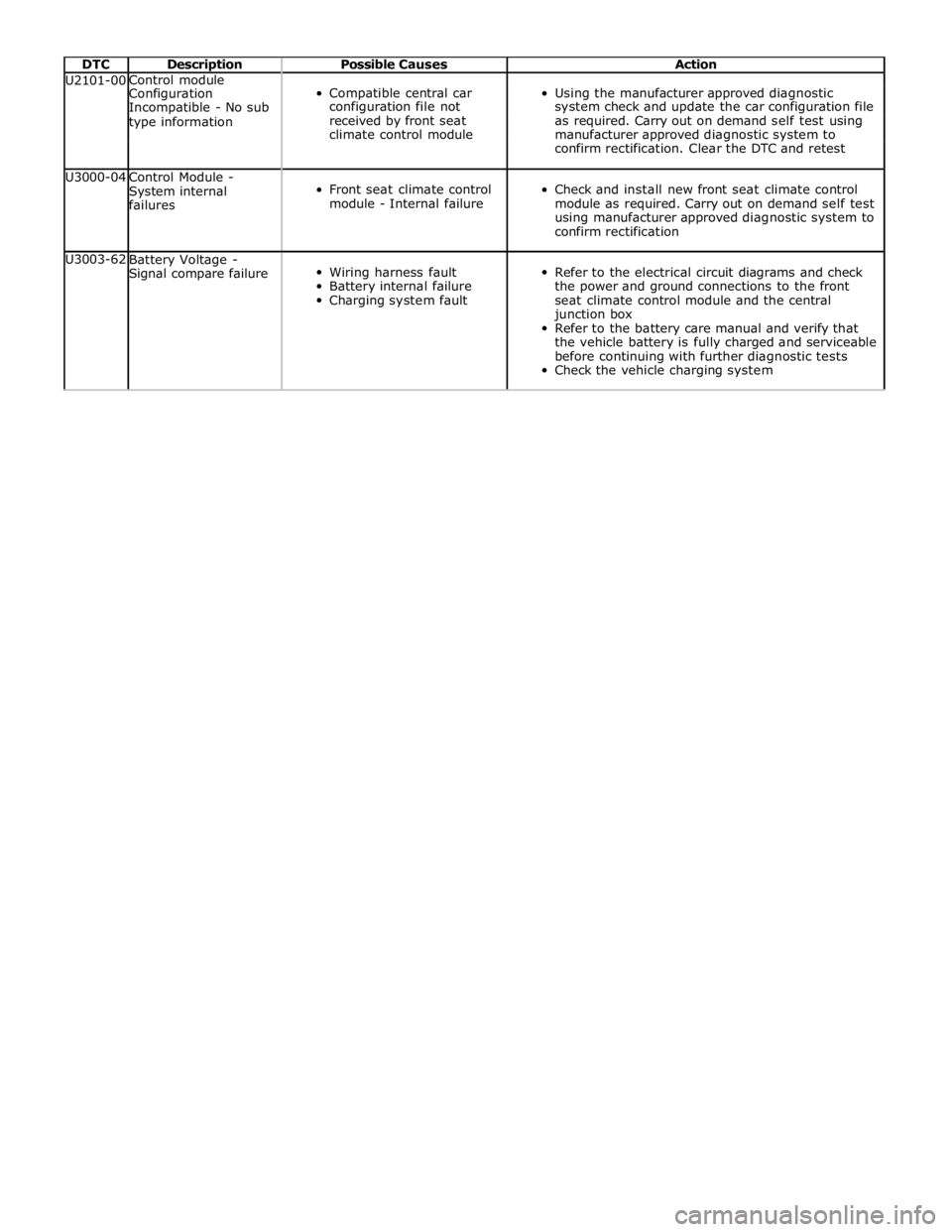
DTC Description Possible Causes Action U2101-00 Control module
Compatible central car
Using the manufacturer approved diagnostic Configuration Incompatible - No sub configuration file not system check and update the car configuration file type information received by front seat as required. Carry out on demand self test using climate control module manufacturer approved diagnostic system to confirm rectification. Clear the DTC and retest U3000-04
Control Module -
System internal
failures
Front seat climate control
module - Internal failure
Check and install new front seat climate control
module as required. Carry out on demand self test
using manufacturer approved diagnostic system to
confirm rectification U3003-62
Battery Voltage -
Signal compare failure
Wiring harness fault
Battery internal failure
Charging system fault
Refer to the electrical circuit diagrams and check
the power and ground connections to the front
seat climate control module and the central
junction box
Refer to the battery care manual and verify that
the vehicle battery is fully charged and serviceable
before continuing with further diagnostic tests
Check the vehicle charging system
Page 2354 of 3039
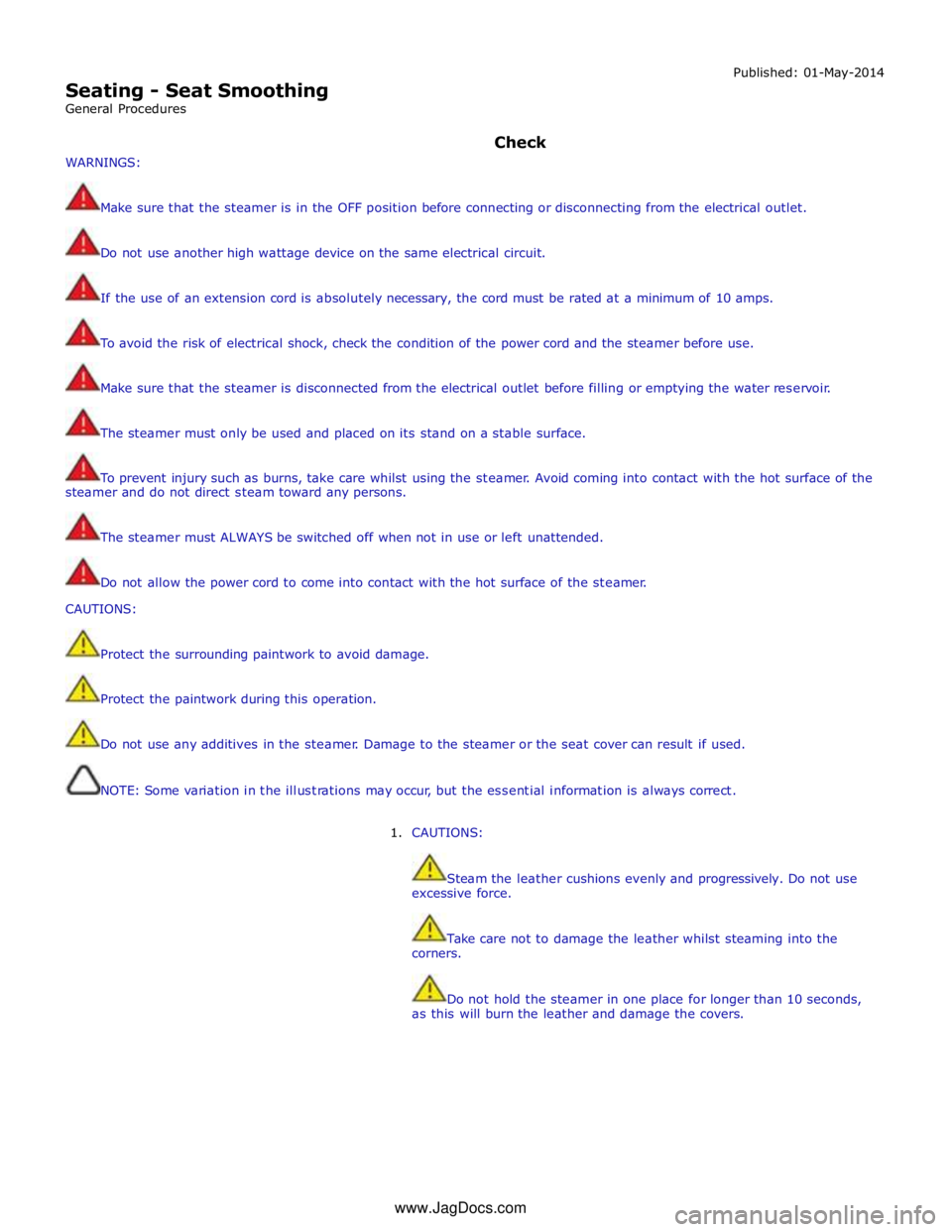
Seating - Seat Smoothing
General Procedures Published: 01-May-2014
WARNINGS: Check
Make sure that the steamer is in the OFF position before connecting or disconnecting from the electrical outlet.
Do not use another high wattage device on the same electrical circuit.
If the use of an extension cord is absolutely necessary, the cord must be rated at a minimum of 10 amps.
To avoid the risk of electrical shock, check the condition of the power cord and the steamer before use.
Make sure that the steamer is disconnected from the electrical outlet before filling or emptying the water reservoir.
The steamer must only be used and placed on its stand on a stable surface.
To prevent injury such as burns, take care whilst using the steamer. Avoid coming into contact with the hot surface of the
steamer and do not direct steam toward any persons.
The steamer must ALWAYS be switched off when not in use or left unattended.
Do not allow the power cord to come into contact with the hot surface of the steamer.
CAUTIONS:
Protect the surrounding paintwork to avoid damage.
Protect the paintwork during this operation.
Do not use any additives in the steamer. Damage to the steamer or the seat cover can result if used.
NOTE: Some variation in the illustrations may occur, but the essential information is always correct.
1. CAUTIONS:
Steam the leather cushions evenly and progressively. Do not use
excessive force.
Take care not to damage the leather whilst steaming into the
corners.
Do not hold the steamer in one place for longer than 10 seconds,
as this will burn the leather and damage the covers. www.JagDocs.com
Page 2358 of 3039
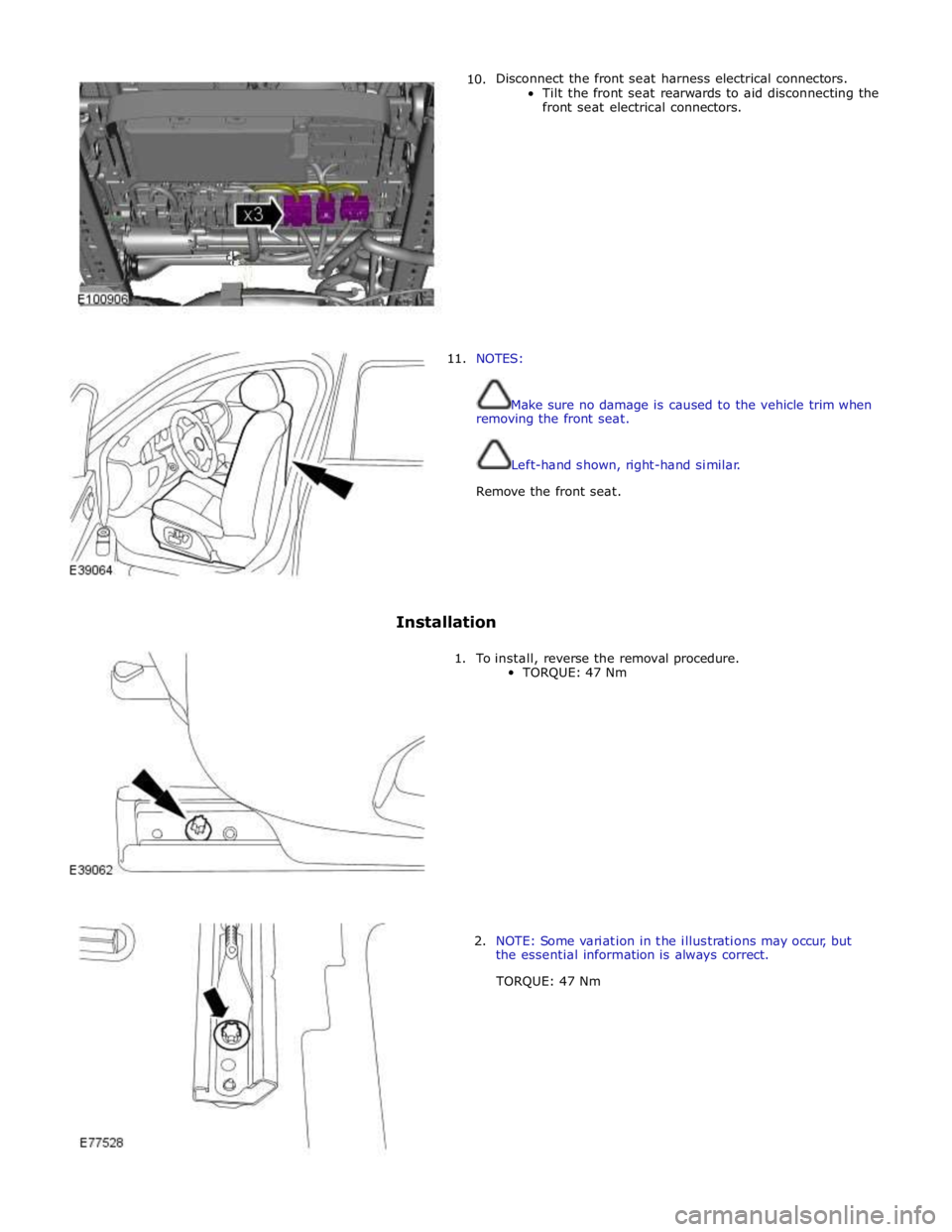
10. Disconnect the front seat harness electrical connectors.
Tilt the front seat rearwards to aid disconnecting the
front seat electrical connectors.
11. NOTES:
Make sure no damage is caused to the vehicle trim when
removing the front seat.
Left-hand shown, right-hand similar.
Remove the front seat.
Installation
1. To install, reverse the removal procedure.
TORQUE: 47 Nm
2. NOTE: Some variation in the illustrations may occur, but
the essential information is always correct.
TORQUE: 47 Nm
Page 2363 of 3039
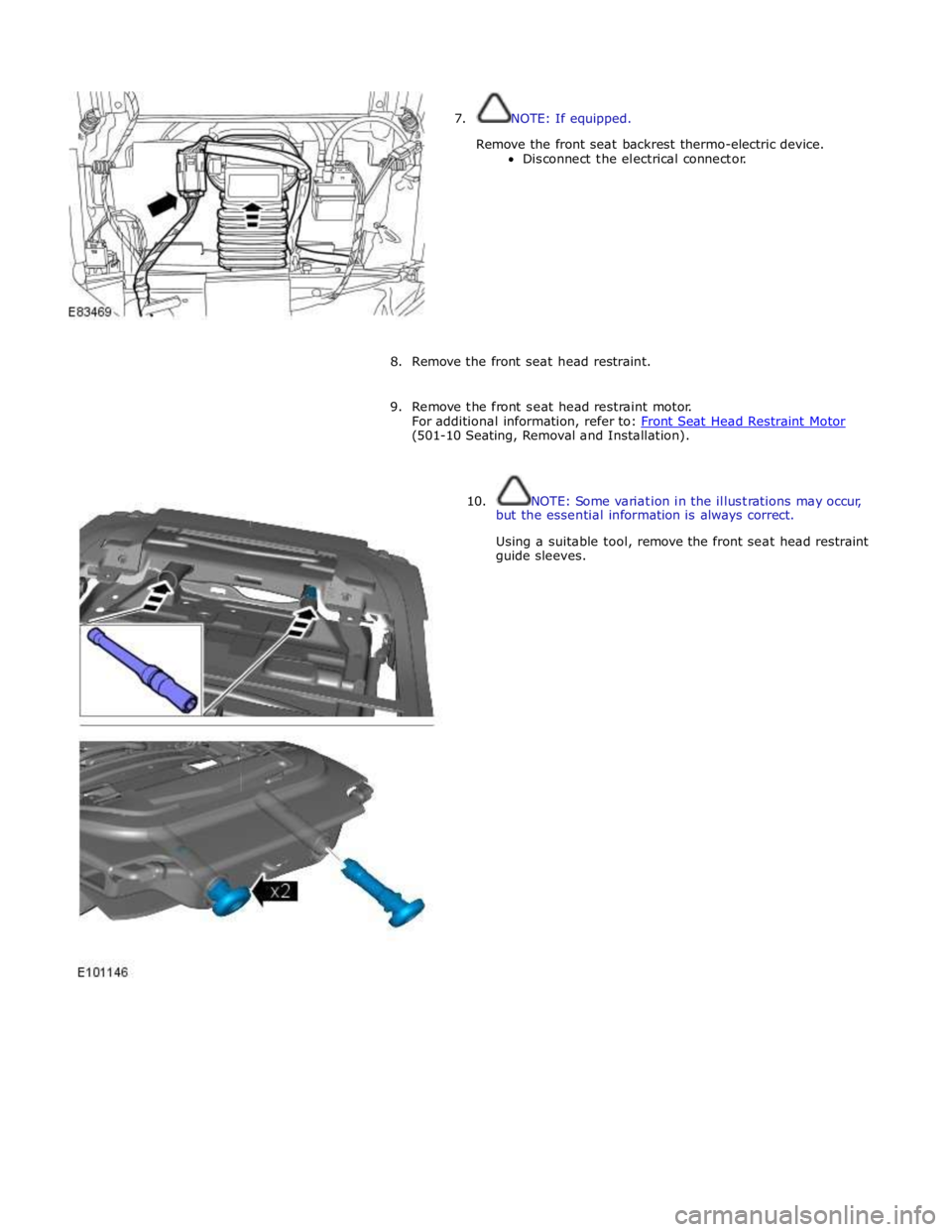
7. NOTE: If equipped.
Remove the front seat backrest thermo-electric device.
Disconnect the electrical connector.
8. Remove the front seat head restraint.
9. Remove the front seat head restraint motor.
For additional information, refer to: Front Seat Head Restraint Motor (501-10 Seating, Removal and Installation).
10. NOTE: Some variation in the illustrations may occur,
but the essential information is always correct.
Using a suitable tool, remove the front seat head restraint
guide sleeves.
Page 2376 of 3039

Seating - Seat Base
Removal and Installation
Removal
WARNINGS: Published: 11-May-2011
To avoid accidental deployment, the restraints control module backup power supply must be depleted. Wait at least one
minute after disconnecting the battery ground cable(s) before commencing any repair or adjustment to the supplemental
restraint system (SRS), or any component(s) adjacent to the SRS sensors. Failure to follow these instructions may result in
personal injury.
Always wear safety glasses when working on an air bag equipped vehicle and when handling an air bag module. Failure to
follow this instruction may result in personal injury.
To minimize the possibility of premature deployment, do not use radio key code savers when working on the
supplemental restraint system. Failure to follow this instruction may result in personal injury.
To minimize the possibility of injury in the event of premature deployment, always carry a live air bag module with the
bag and trim cover pointed away from the body. Failure to follow this instruction may result in personal injury.
To minimize the possibility of premature deployment, live air bag modules must only be placed on work benches which
have been ground bonded and with the trim cover facing up. Failure to follow these instructions may result in personal injury.
Never probe the electrical connectors of air bag modules or any other supplemental restraint system component. Failure
to follow this instruction may result in personal injury.
Painting over the driver air bag module trim cover or instrument panel could lead to deterioration of the trim cover and air
bags. Do not for any reason attempt to paint discolored or damaged air bag module trim covers or instrument panel. Install a
new component. Failure to follow this instruction may result in personal injury.
NOTES:
Some variation in the illustrations may occur, but the essential information is always correct.
Removal steps in this procedure may contain installation details.
1. Make the air bag supplemental restraint system (SRS) safe.
Refer to: Standard Workshop Practices (100-00 General Information, Description and Operation).
2. Refer to: Front Seat (501-10 Seating, Removal and Installation).
3. Refer to: Front Safety Belt Buckle (501-20A Safety Belt System, Removal and Installation).
4. Refer to: Front Seat Cushion Cover (501-10 Seating, Removal and Installation).
Page 2413 of 3039

Published: 11-May-2011
Glass, Frames and Mechanisms - Glass, Frames and Mechanisms - Overview
Description and Operation
Overview
The windshield is manufactured from laminated green-tinted glass with two variants of windshield being available: standard
and heated.
The rear window is manufactured from toughened green-tinted glass. The heated rear window grid-wire and antennas are
incorporated in the rear window. There are two variants of rear window dependant on the TV antenna specification.
The door windows are manufactured from green-tinted toughened glass. The driver and passenger windows are electrically
operated; the rear glass sections in the rear doors are fixed units. Door windows can be operated individually, or by the driver's
window control switch. An anti-trap function is included that stops the window's travel when an obstacle is detected in the in
the window's path.
Page 2416 of 3039

Rear Window
The rear window, manufactured from toughened 4mm green-tinted glass, is positioned to the vehicle's body by two locator
pins, one in each top corner of the windshield. This allows for the centralizing movement of the windshield across the car upon
fitment. The window is bonded and sealed to the vehicle body aperture using PU adhesive. The window finisher is a
three-sided extruded flip, taped onto the inner surface of the glass; this helps to centralize the glass in the aperture.
The heated rear window grid wire and antennas are incorporated in the rear window. There are two derivatives of rear window
dependant on the TV antenna specification.
Refer to: Video System (415-01, Description and Operation).
Door Windows
The door windows are manufactured from 4.85mm green-tinted toughened glass. The driver and passenger windows are
electrically operated, and are raised and lowered by a cable mechanism; the rear glass sections in the rear doors are fixed
units.
All windows can be operated individually, or by the driver's window control switch. The operation of the windows is proportional
to the switch activation. The driver window can be controlled by 'one touch' in an upward or downward direction. When the 'one
touch' operation is activated in the upwards direction an anti-trap sensor is automatically checked prior to the window closing.
If the anti-trap sensor is inoperative the window will not close. When the anti-trap sensor detects an obstacle in the window's
path, the upward travel of the window will automatically cease. Downward travel of the window will begin and then stop when a
preset time has elapsed.