coolant temperature JAGUAR XJ6 1994 2.G User Guide
[x] Cancel search | Manufacturer: JAGUAR, Model Year: 1994, Model line: XJ6, Model: JAGUAR XJ6 1994 2.GPages: 521, PDF Size: 17.35 MB
Page 67 of 521
Cooling System (VI 2)
0
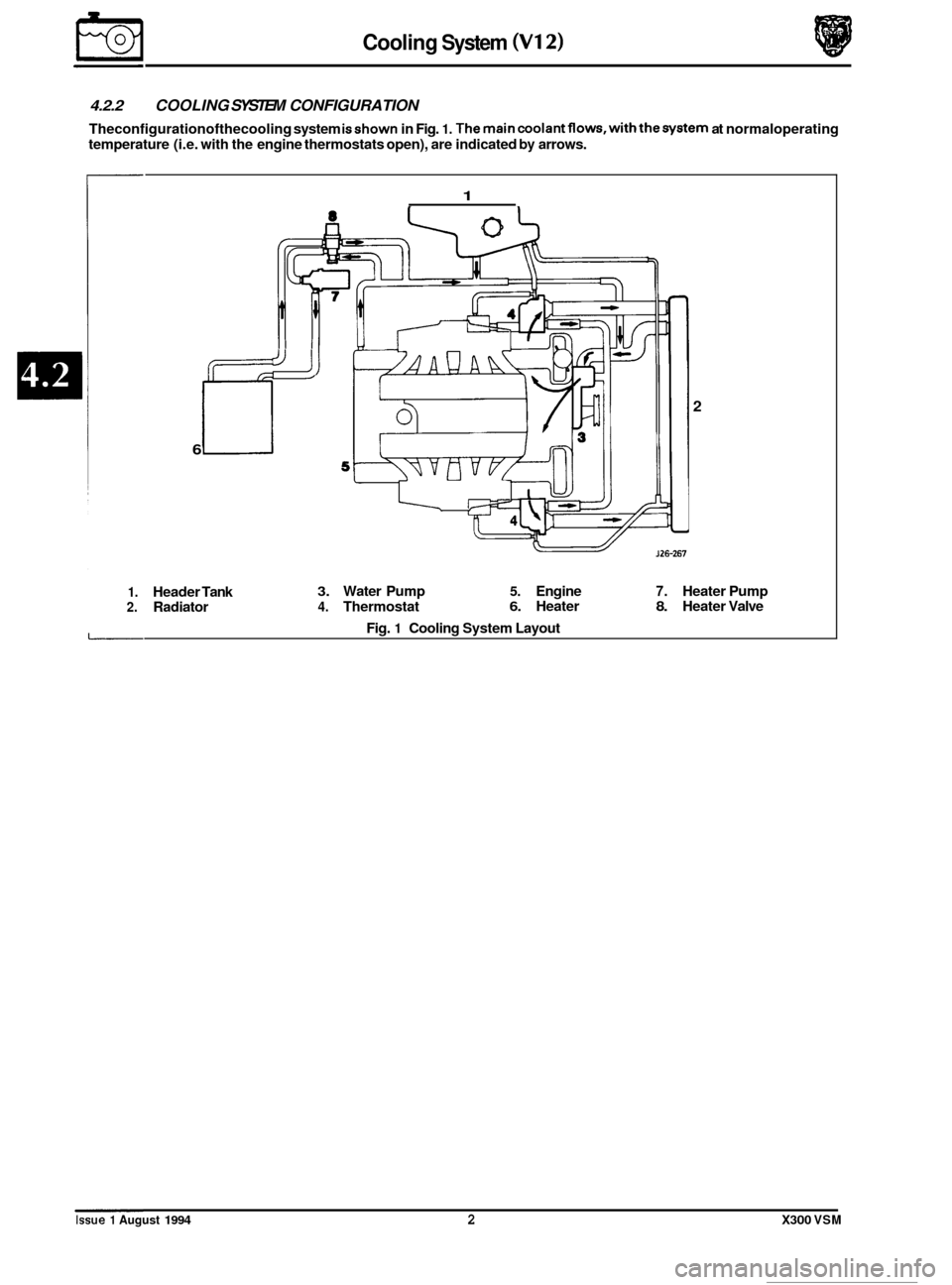
4.2.2 COOLING SYSTEM CONFIGURATION
Theconfigurationofthecooling system isshown in Fig. 1. Themaincoolantflows,withthesystem at normaloperating
temperature (i.e. with the engine thermostats open), are indicated
by arrows.
6 rr
1
2
1. Header Tank 3. Water Pump 5. Engine 7. Heater Pump
2. Radiator 4. Thermostat 6. Heater 8. Heater Valve
Fig.
1 Cooling System Layout
Issue 1 August 1994 2 X300 VSM
Page 68 of 521
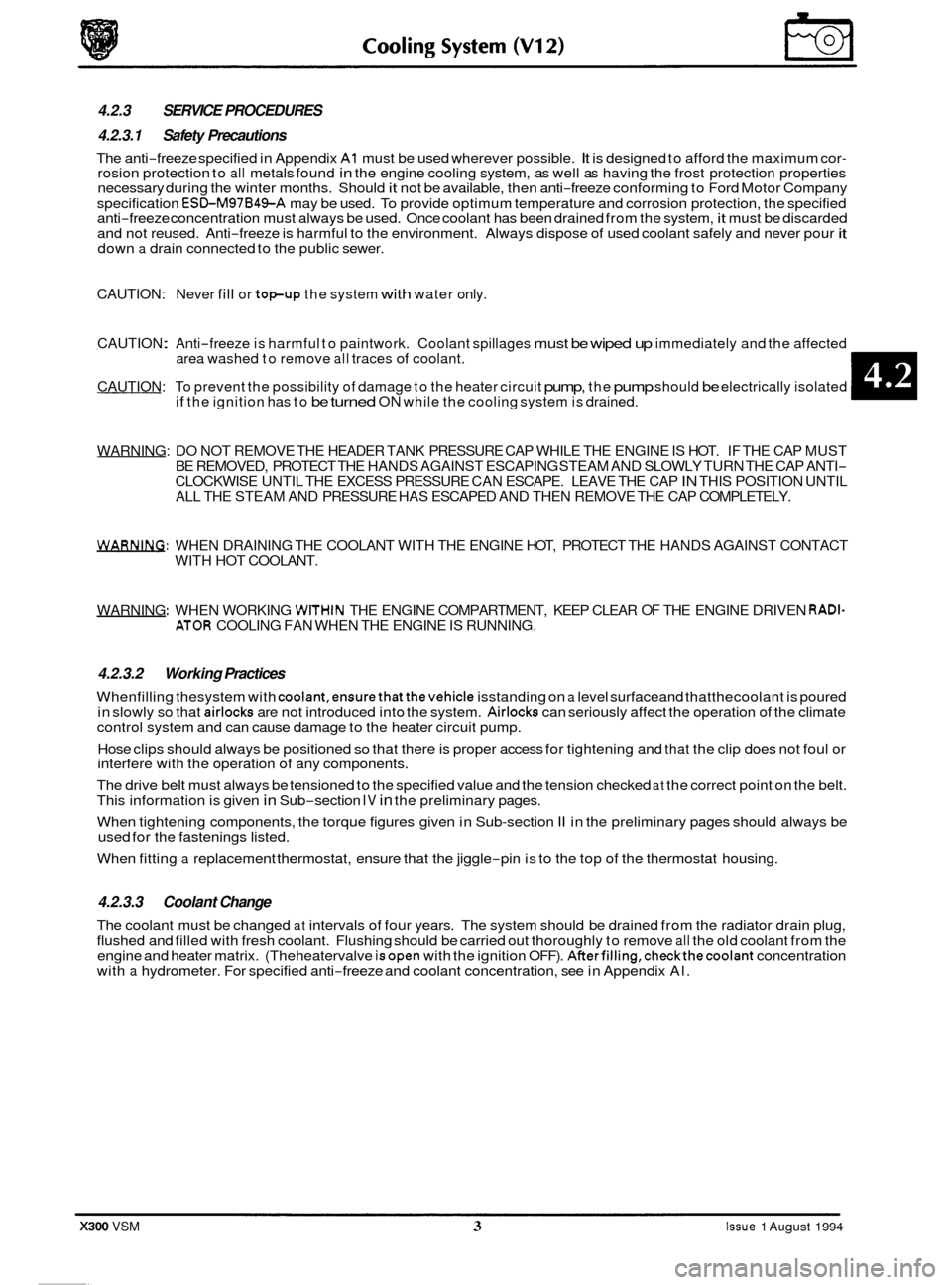
WARNING: DO NOT REMOVE THE HEADER TANK PRESSURE CAP WHILE THE ENGINE IS HOT. IF THE CAP MUST
BE REMOVED, PROTECT THE HANDS AGAINST ESCAPING STEAM AND SLOWLY TURN THE CAP ANTI- CLOCKWISE UNTIL THE EXCESS PRESSURE CAN ESCAPE. LEAVE THE CAP IN THIS POSITION UNTIL
ALL THE STEAM AND PRESSURE HAS ESCAPED AND THEN REMOVE THE CAP COMPLETELY.
WARNING: WHEN DRAINING THE COOLANT WITH THE ENGINE HOT, PROTECT THE HANDS AGAINST CONTACT
WITH HOT COOLANT.
WARNING
: WHEN WORKING WITHIN THE ENGINE COMPARTMENT, KEEP CLEAR OF THE ENGINE DRIVEN RADI- ATOR COOLING FAN WHEN THE ENGINE IS RUNNING.
4.2.3.2 Working Practices
Whenfilling thesystem with coolant,ensurethatthevehicle isstanding on a level surfaceand thatthecoolant is poured
in slowly so that airlocks are not introduced into the system. Airlocks can seriously affect the operation of the climate
control system and can cause damage to the heater circuit pump.
Hose clips should always be positioned
so that there is proper access for tightening and that the clip does not foul or
interfere with the operation of any components.
4.2.3 SERVICE PROCEDURES
4.2.3.1 Safety Precautions
The anti-freeze specified in Appendix A1 must be used wherever possible. It is designed to afford the maximum cor- rosion protection to all metals found in the engine cooling system, as well as having the frost protection properties
necessary during the winter months. Should it not be available, then anti-freeze conforming to Ford Motor Company
specification
ESBM97B49-A may be used. To provide optimum temperature and corrosion protection, the specified
anti-freeze concentration must always be used. Once coolant has been drained from the system, it must be discarded
and not reused. Anti-freeze is harmful to the environment. Always dispose of used coolant safely and never pour it down a drain connected to the public sewer.
CAUTION: Never fill or topup the system with water only.
CAUTION
: Anti-freeze is harmful to paintwork. Coolant spillages must be wiped up immediately and the affected
area washed to remove all traces of coolant.
CAUTION: To prevent the possibility of damage to the heater circuit
pump, the pump should be electrically isolated if the ignition has to be turned ON while the cooling system is drained.
The drive belt must always be tensioned to the specified value and the tension checked at the correct point on the belt.
This information is given in Sub-section IV in the preliminary pages.
When tightening components, the torque figures given in Sub
-section II in the preliminary pages should always be
used for the fastenings listed.
When fitting a replacement thermostat, ensure that the jiggle-pin is to the top of the thermostat housing.
4.2.3.3 Coolant Change
The coolant must be changed at intervals of four years. The system should be drained from the radiator drain plug,
flushed and filled with fresh coolant. Flushing should be carried out thoroughly to remove all the old coolant from the
engine and heater matrix. (The heatervalve isopen with the ignition OFF). AfterfilIing,checkthecoolant concentration
with a hydrometer. For specified anti-freeze and coolant concentration, see in Appendix Al.
X300 VSM 3 Issue 1 August 1994
Page 69 of 521
€3 Cooling System (V12)
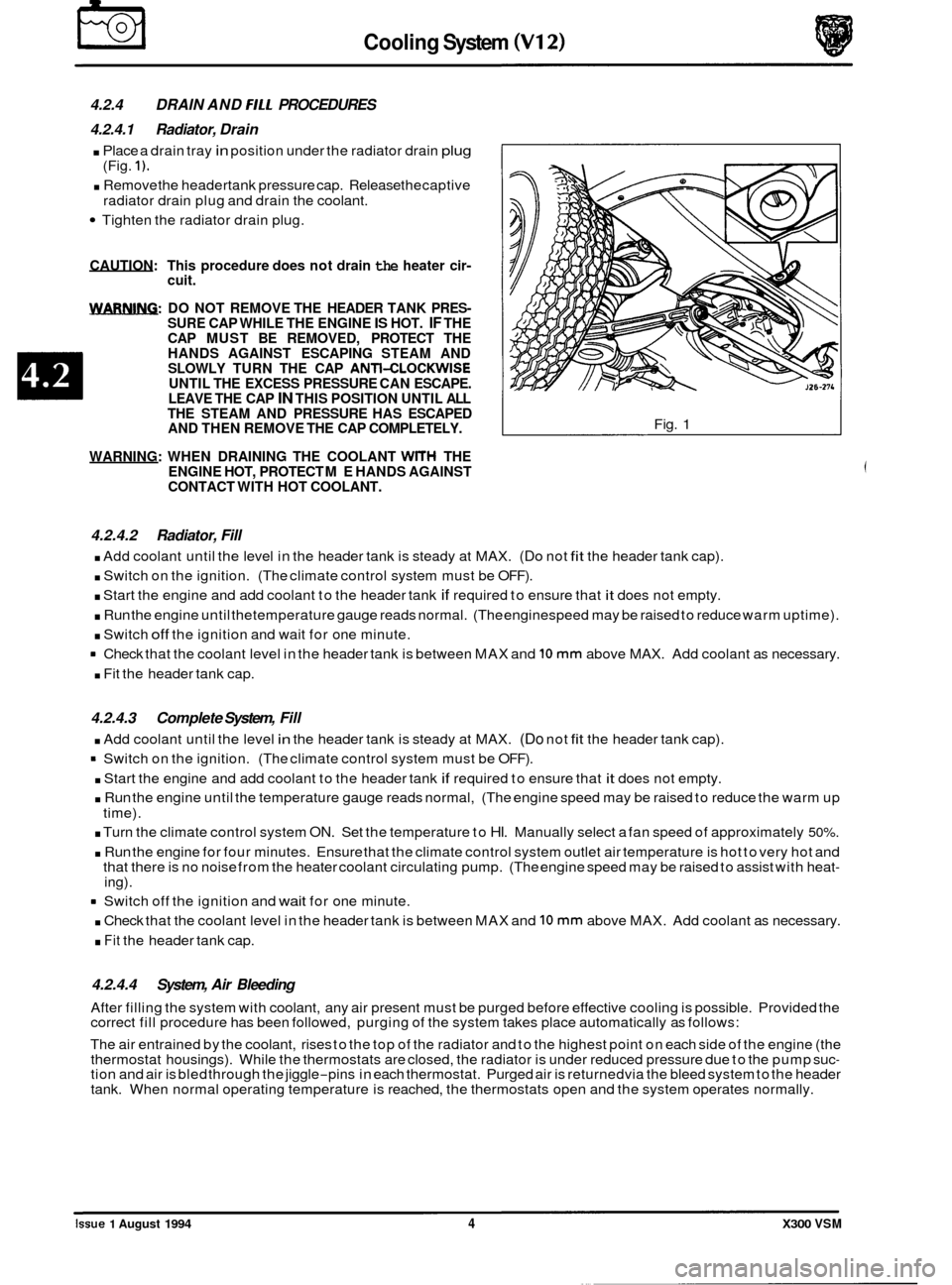
4.2.4 DRAIN AND FILL PROCEDURES
4.2.4.1 Radiator, Drain
. Place a drain tray in position under the radiator drain plug
. Remove the headertank pressure cap. Release thecaptive
Tighten the radiator drain plug.
(Fig.
1).
radiator drain
plug and drain the coolant.
CAUTION: This procedure does not drain the heater cir- cuit.
m: DO NOT REMOVE THE HEADER TANK PRES- SURE CAP WHILE THE ENGINE IS HOT. IF THE
CAP MUST BE REMOVED, PROTECT THE
HANDS AGAINST ESCAPING STEAM AND
SLOWLY TURN THE CAP
ANTI-CLOCKWISE UNTIL THE EXCESS PRESSURE CAN ESCAPE.
LEAVE THE CAP IN THIS POSITION UNTIL ALL
THE STEAM AND PRESSURE HAS ESCAPED
AND THEN REMOVE THE CAP COMPLETELY.
WARNING: WHEN DRAINING THE COOLANT
WITH THE
ENGINE HOT, PROTECT ME HANDS AGAINST
CONTACT WITH HOT COOLANT.
Fig. 1
4.2.4.2 Radiator, Fill
. Add coolant until the level in the header tank is steady at MAX. (Do not fit the header tank cap).
. Switch on the ignition. (The climate control system must be OFF).
. Start the engine and add coolant to the header tank if required to ensure that it does not empty.
. Run the engine until thetemperature gauge reads normal. (The enginespeed may be raised to reduce warm uptime).
. Switch off the ignition and wait for one minute.
Check that the coolant level in the header tank is between MAX and
10 mm above MAX. Add coolant as necessary.
. Fit the header tank cap.
4.2.4.3 Complete System, Fill
. Add coolant until the level in the header tank is steady at MAX. (Do not fit the header tank cap).
= Switch on the ignition. (The climate control system must be OFF).
. Start the engine and add coolant to the header tank if required to ensure that it does not empty.
. Run the engine until the temperature gauge reads normal, (The engine speed may be raised to reduce the warm up
. Turn the climate control system ON. Set the temperature to HI. Manually select a fan speed of approximately 50%.
. Run the engine for four minutes. Ensure that the climate control system outlet air temperature is hot to very hot and
that there is no noise from the heater coolant circulating pump. (The engine speed may be raised to assist with heat- ing).
time).
8 Switch
off the ignition and wait for one minute.
. Check that the coolant level in the header tank is between MAX and 10 mm above MAX. Add coolant as necessary.
. Fit the header tank cap.
4.2.4.4 System, Air Bleeding
After filling the system with coolant, any air present must be purged before effective cooling is possible. Provided the
correct fill procedure has been followed, purging of the system takes place automatically as follows:
The air entrained by the coolant, rises to the top of the radiator and to the highest point on each side of the engine (the
thermostat housings). While the thermostats are closed, the radiator is under reduced pressure due to the pump suc
- tion and air is bled through the jiggle-pins in each thermostat. Purged air is returnedvia the bleed system to the header
tank. When normal operating temperature is reached, the thermostats open and the system operates normally. ~~
Issue 1 August 1994 4 X300 VSM
Page 70 of 521
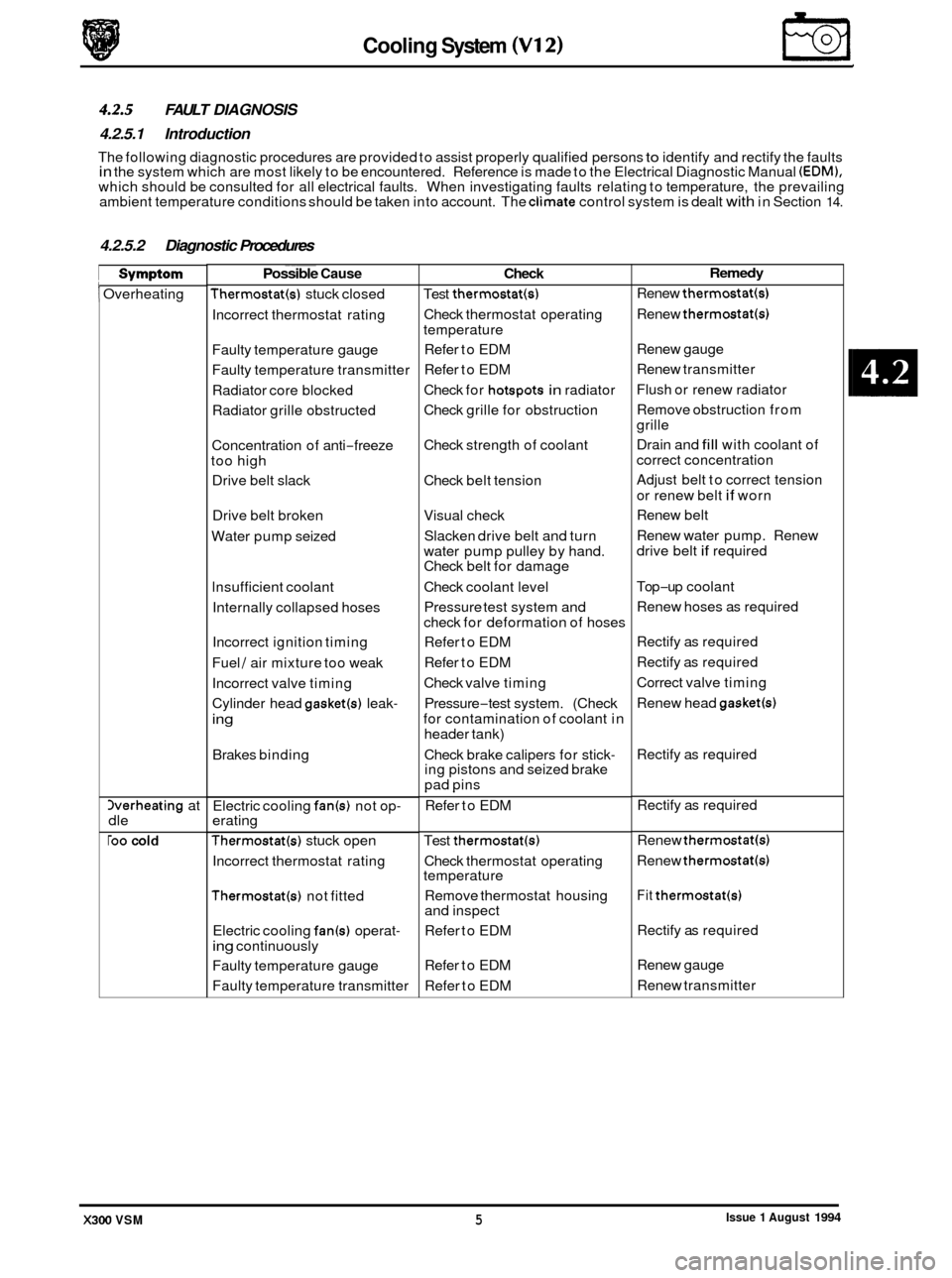
4.2.5.2 Diagnostic Procedures
1
I Symptom ..
Overheating
herheating at
dle
roo cold ~~~
Possible Cause
Thermostat(s) stuck
closed
Incorrect thermostat rating
Faulty temperature gauge
Faulty temperature transmitter
Radiator core blocked
Radiator grille obstructed
Concentration of anti
-freeze
too high
Drive belt slack
Drive belt broken
Water pump seized
lnsuff icient coolant
Internally collapsed hoses
Incorrect ignition timing
Fuel
/ air mixture too weak
Incorrect valve timing
Cylinder head
gasket(s) leak-
ing
Brakes binding
Electric cooling
fan(s) not op- erating
Thermostat(s) stuck open
Incorrect thermostat rating
Thermostatb) not fitted
Electric cooling
fan(s) operat-
ing continuously
Faulty temperature gauge
Faulty temperature transmitter
Check
Cooling System (V12)
4.2.5 FAULT DIAGNOSIS
4.2.5.1 Introduction
The following diagnostic procedures are provided to assist properly qualified persons to identify and rectify the faults in the system which are most likely to be encountered. Reference is made to the Electrical Diagnostic Manual (EDM), which should be consulted for all electrical faults. When investigating faults relating to temperature, the prevailing
ambient temperature conditions should be taken into account. The climate control system is dealt with in Section 14.
Test thermostat(s)
Check thermostat operating
temperature
Refer to EDM
Refer to EDM
Check for
hotspots in radiator
Check grille for obstruction
Check strength of coolant
Check belt tension
Visual check Slacken drive belt and turn
water pump pulley by hand.
Check belt for damage
Check coolant level
Pressure test system and
check for deformation of hoses
Refer to EDM
Refer to EDM
Check valve timing
Pressure
-test system. (Check
for contamination of coolant in
header tank)
Check brake calipers for stick
- ing pistons and seized brake
pad pins
..
Refer to EDM
Test
thermostat(4
Check thermostat operating
temperature
Remove thermostat housing
and inspect
Refer to EDM
Refer to EDM
Refer to EDM
Remedy
Renew thermostat(s)
Renew thermostat(s1
Renew gauge
Renew transmitter
Flush or renew radiator
Remove obstruction from
grille
Drain and
fill with coolant of
correct concentration
Adjust belt to correct tension
or renew belt
if worn
Renew belt
Renew water pump. Renew
drive belt
if required
Top
-up coolant
Renew hoses as required
Rectify as required
Rectify as required
Correct valve timing
Renew head
gasket(s)
Rectify as required
Rectify as required
Renew
thermostat(s1
Renew thermostatb)
Fit thermostat(s)
Rectify as required
Renew gauge
Renew transmitter
Issue 1 August 1994 X300 VSM 5
Page 310 of 521
Climate Control Systems
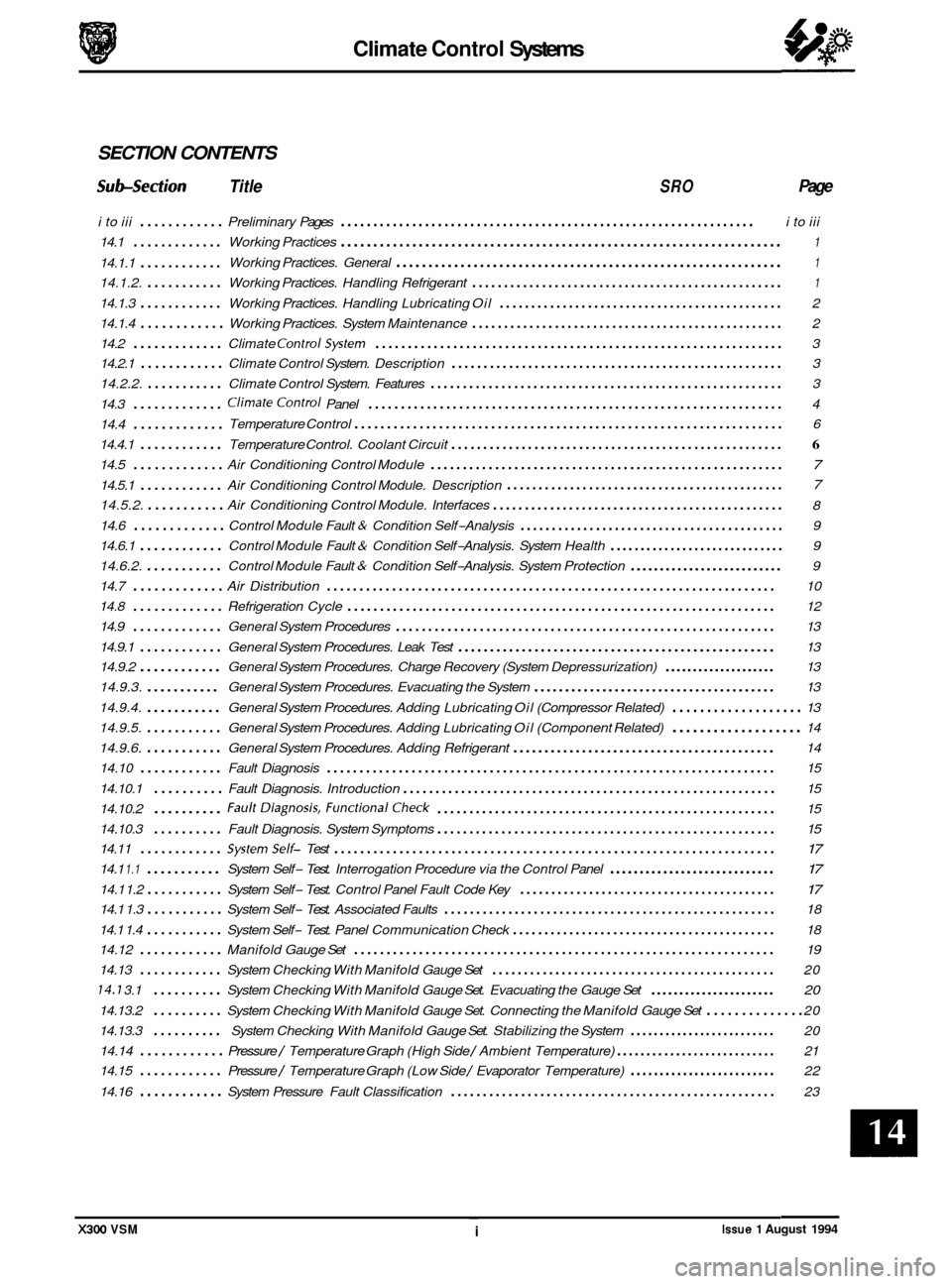
SECTION CONTENTS
Subsection Title SRO Page
i to iii ............ Preliminary Pages ................................................................ i to iii
14.1
............. Working Practices .................................................................... 1
Working Practices. General ............................................................ 1 14.1.1 ............
14.1.2. ........... Working Practices. Handling Refrigerant ................................................. 1
14.1.3 ............ Working Practices. Handling Lubricating Oil ............................................. 2
14.1.4
............ Working Practices. System Maintenance ................................................. 2
14.2
............. Climate ControlSystem ............................................................... 3
14.2.1
............ Climate Control System. Description .................................................... 3
14.2.2.
........... Climate Control System. Features ....................................................... 3
14.3
............. ClimateControl Panel ................................................................ 4
14.4
.............
14.4.1 ............ Temperature Control. Coolant Circuit .................................................... 6
14.5 ............. Air Conditioning Control Module ....................................................... 7
14.5.1 ............ Air Conditioning Control Module. Description 7
14.5.2. ........... Air Conditioning Control Module. Interfaces .............................................. 8
14.6
............. Control Module Fault & Condition Self-Analysis .......................................... 9
14.6.1
............ Control Module Fault & Condition Self-Analysis. System Health ............................. 9
14.6.2.
........... Control Module Fault & Condition Self-Analysis. System Protection .......................... 9
14.7
............. Air Distribution ..................................................................... 10
14.8
............. Refrigeration Cycle .................................................................. 12
14.9
............. General System Procedures ........................................................... 13
14.9.1
............ General System Procedures. Leak Test .................................................. 13
14.9.2
............ General System Procedures. Charge Recovery (System Depressurization) .................... 13
14.9.3.
........... General System Procedures. Evacuating the System ....................................... 13
14.9.4.
........... General System Procedures. Adding Lubricating Oil (Compressor Related) ................... 13
14.9.5.
........... General System Procedures. Adding Lubricating Oil (Component Related) ................... 14
14.9.6.
........... General System Procedures. Adding Refrigerant .......................................... 14
14.10
............ Fault Diagnosis ..................................................................... 15
14.10.1
.......... Fault Diagnosis. Introduction .......................................................... 15
14.10.2
.......... FaultDiagnosis. FunctionalCheck ..................................................... 15
14.10.3
14.11
............ Systemself- Test .................................................................... 17
14.1 1.1 ........... System Self- Test. Interrogation Procedure via the Control Panel ............................ 17
14.1 1.2 ........... System Self- Test. Control Panel Fault Code Key ......................................... 17
14.1 1.4 ........... System Self- Test. Panel Communication Check .......................................... 18
14.13
............ System Checking With Manifold Gauge Set ............................................. 20
14.7 3.1 .......... System Checking With Manifold Gauge Set. Evacuating the Gauge Set ...................... 20
14.13.2 .......... System Checking With Manifold Gauge Set. Connecting the Manifold Gauge Set .............. 20
14.13.3
.......... System Checking With Manifold Gauge Set. Stabilizing the System ......................... 20
14.14
............ Pressure / Temperature Graph (High Side / Ambient Temperature) ........................... 21
14.15
............ Pressure / Temperature Graph (Low Side / Evaporator Temperature) ......................... 22
14.16
............ System Pressure Fault Classification ................................................... 23
Temperature
Control
.................................................................. 6
............................................ a
.......... Fault Diagnosis. System Symptoms ..................................................... 15 a
14.1 1.3 ........... System Self- Test. Associated Faults .................................................... 18
14.12
............ Manifold Gauge Set ................................................................. 19
X300 VSM ~ i Issue 1 August 1994
Page 316 of 521
Climate Control Systems
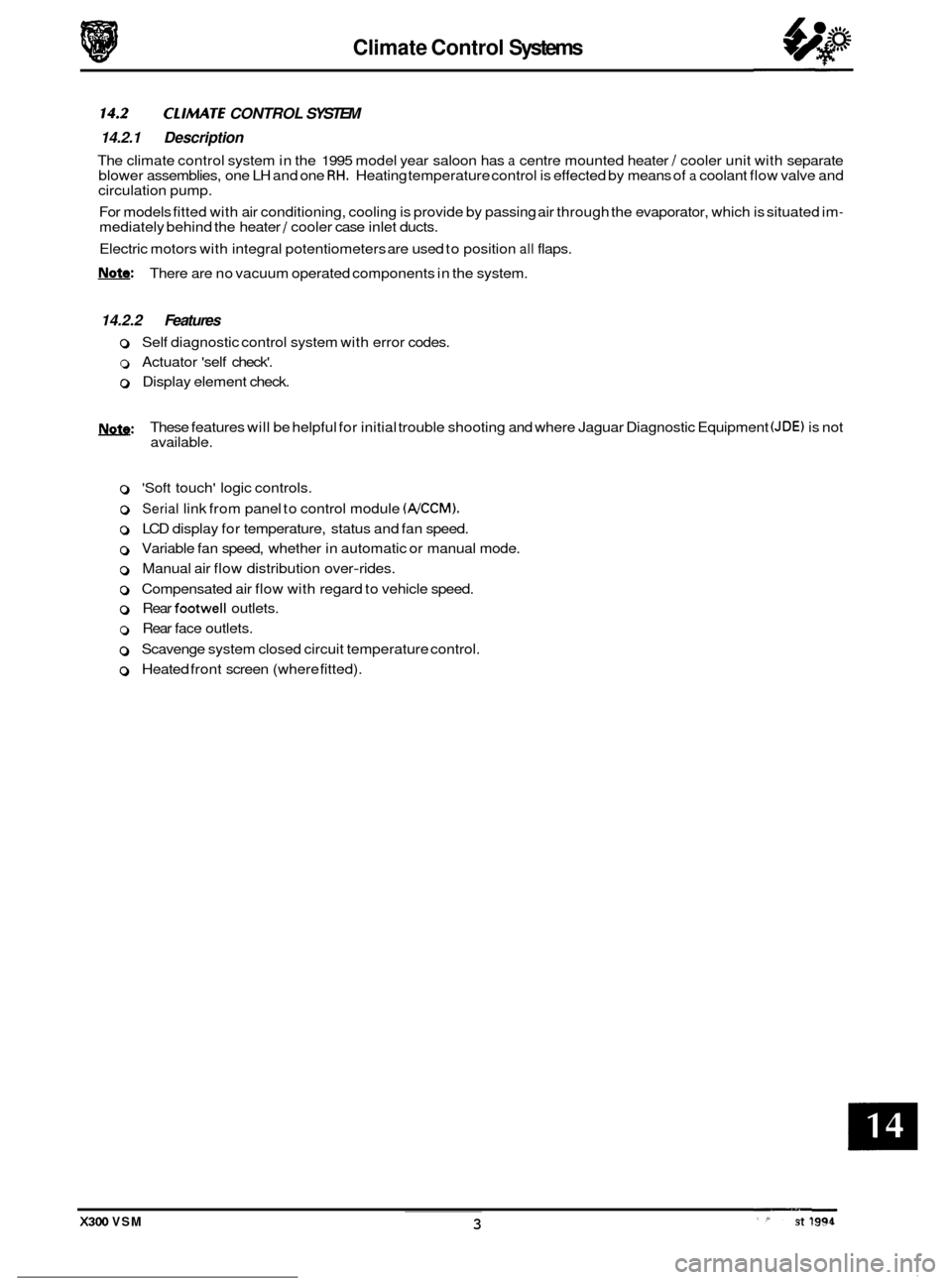
CL /MATE CONTROL SYSTEM 0 14*2 14.2.1 Description
The climate control system in the 1995 model year saloon has a centre mounted heater / cooler unit with separate
blower assemblies, one LH and one RH. Heating temperature control is effected by means of a coolant flow valve and
circulation pump.
For models fitted with air conditioning, cooling is provide by passing air through the evaporator, which is situated im
- mediately behind the heater / cooler case inlet ducts.
Electric motors with integral potentiometers are used to position
all flaps.
W: There are no vacuum operated components in the system.
14.2.2 Features
o Self diagnostic control system with error codes.
0 Actuator 'self check'.
0 Display element check.
m: These features will be helpful for initial trouble shooting and where Jaguar Diagnostic Equipment (JDE) is not
available.
0 'Soft touch' logic controls. 0
0 Serial link from panel to control module (NCCM).
0 LCD display for temperature, status and fan speed.
0 Variable fan speed, whether in automatic or manual mode.
0 Manual air flow distribution over-rides.
0 Compensated air flow with regard to vehicle speed.
0 Rear footwell outlets.
0 Rear face outlets.
0 Scavenge system closed circuit temperature control.
0 Heated front screen (where fitted).
x300 VSM 3
Page 319 of 521
Climate Control Systems
14.4 TEMPERATURE CONTROL
14.4.1 Coolant Circuit
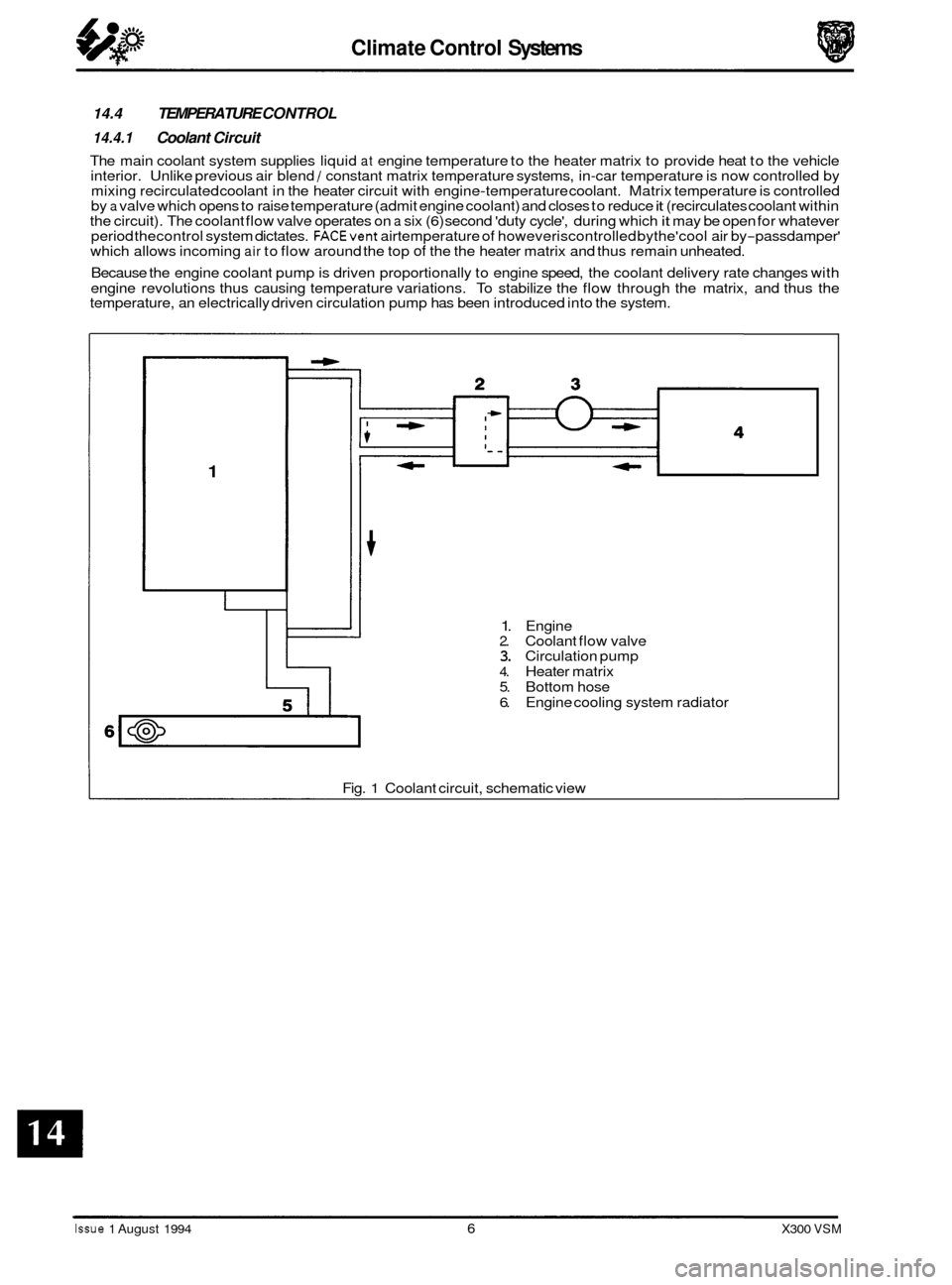
The main coolant system supplies liquid at engine temperature to the heater matrix to provide heat to the vehicle
interior. Unlike previous air blend / constant matrix temperature systems, in-car temperature is now controlled by
mixing recirculated coolant in the heater circuit with engine-temperature coolant. Matrix temperature is controlled
by a valve which opens to raise temperature (admit engine coolant) and closes to reduce it (recirculates coolant within
the circuit). The coolant flow valve operates on a six (6) second 'duty cycle', during which it may be open for whatever
period thecontrol system dictates. FACEvent airtemperature of howeveriscontrolled bythe'cool air by-passdamper'
which allows incoming air to flow around the top of the the heater matrix and thus remain unheated.
Because the engine coolant pump is driven proportionally to engine speed, the coolant delivery rate changes with
engine revolutions thus causing temperature variations. To stabilize the flow through the matrix, and thus the
temperature, an electrically driven circulation pump has been introduced into the system.
1
1. Engine 2. Coolant flow valve 3. Circulation pump
4. Heater matrix
5. Bottom hose
6. Engine cooling system radiator
Fig.
1 Coolant circuit, schematic view
Issue 1 August 1994 6 X300 VSM
Page 320 of 521
Climate Control Systems
Manual Inputs
Automatic inputs
outputs
14.5 AIR CONDITIONING CONTROL MODULE (A/CCM)
14.5.1 Description
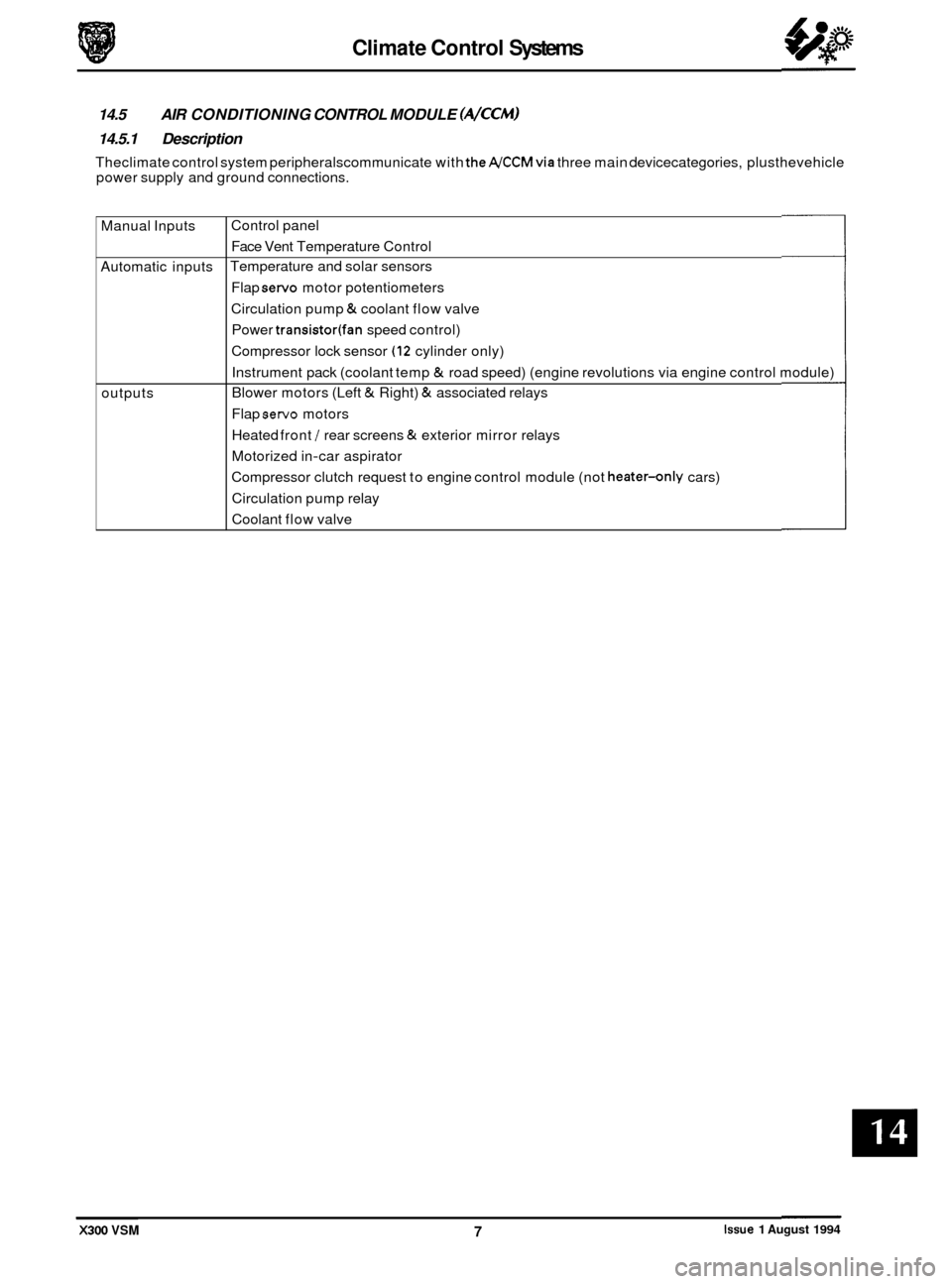
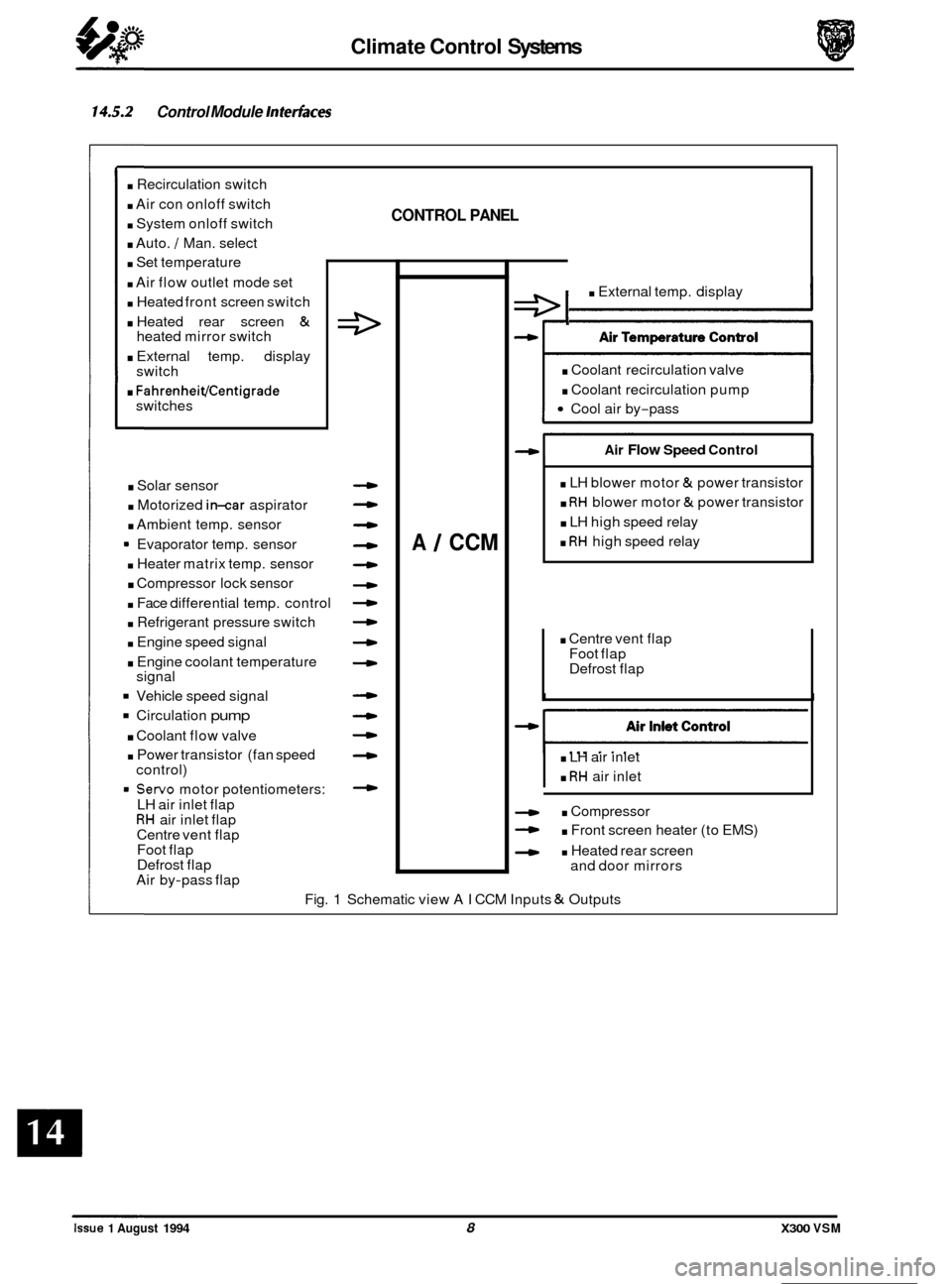
Theclimate control system peripheralscommunicate with theA/CCMvia three main devicecategories, plusthevehicle
power supply and ground connections.
Control panel Face Vent Temperature Control
Temperature and solar sensors
Flap
servo motor potentiometers
Circulation pump
& coolant flow valve
Power
transistor(fan speed control)
Compressor lock sensor
(12 cylinder only)
Instrument pack (coolant temp
& road speed) (engine revolutions via engine control module)
Blower motors (Left
& Right) & associated relays
Flap
servo motors
Heated front
/ rear screens & exterior mirror relays
Motorized in
-car aspirator
Compressor clutch request to engine control module (not
heater-only cars)
Circulation pump relay
Coolant flow valve
X300 VSM Issue 1 August 1994 7
Page 321 of 521
Climate Control Systems
. Centre vent flap
Foot flap
Defrost flap
I I
14.5.2 Control Module Interfaces
. Recirculation switch
. Air con onloff switch
. System onloff switch
. Auto. / Man. select
. Set temperature
. Air flow outlet mode set
. Heated front screen switch
. Heated rear screen &
. External temp. display
. FahrenheiVCentigrade
heated mirror switch
switch
switches
. Solar sensor
. Motorized in-car aspirator
. Ambient temp. sensor
9 Evaporator temp. sensor
. Heater matrix temp. sensor
. Compressor lock sensor
. Face differential temp. control
. Refrigerant pressure switch
. Engine speed signal
. Engine coolant temperature
Vehicle speed signal
Circulation pump
. Coolant flow valve
. Power transistor (fan speed
= Servo motor potentiometers:
signal
control)
LH air inlet flap
RH air inlet flap
Centre vent flap
Foot flap
Defrost flap
Air by
-pass flap
CONTROL PANEL
4
-
4
4
4
4
4
4
A 1 CCM
e I . External temp. display
. Coolant recirculation valve
. Coolant recirculation pump
Cool air by-pass
Air Flow Speed Control
. LH blower motor & power transistor
. RH blower motor & power transistor
. LH high speed relay
. RH high speed relay
. LH air inlet
. RH air inlet
. Compressor
- . Front screen heater (to EMS)
- . Heated rear screen
and door mirrors
Fig.
1 Schematic view AI CCM Inputs & Outputs
0
0
0
0
Issue 1 August 1994 8 X300 VSM
Page 329 of 521
Climate Control Systems
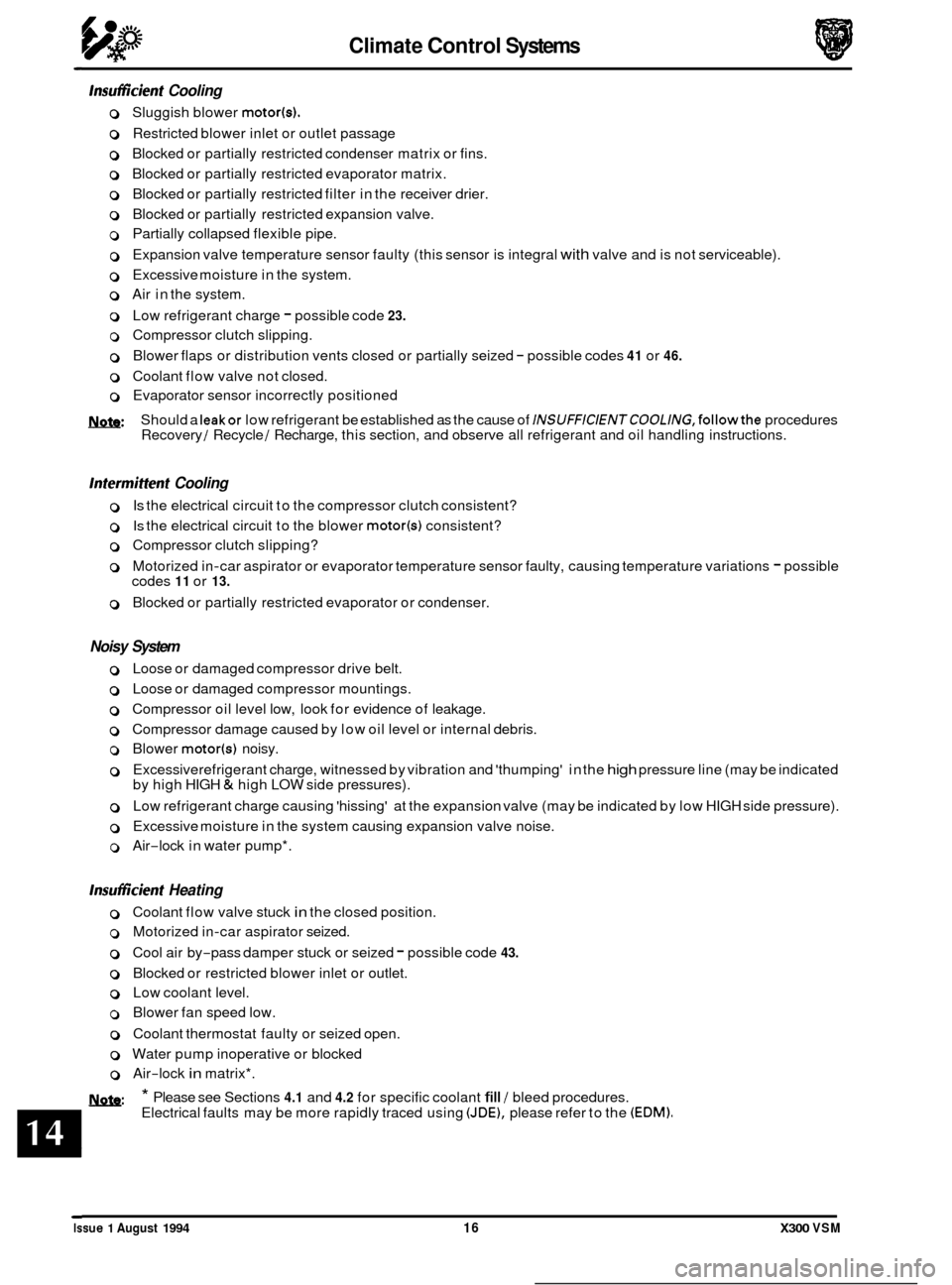
lnsufficent Cooling
0 Sluggish blower motor(s).
0 Restricted blower inlet or outlet passage
0 Blocked or partially restricted condenser matrix or fins.
0 Blocked or partially restricted evaporator matrix.
0 Blocked or partially restricted filter in the receiver drier.
0 Blocked or partially restricted expansion valve.
0 Partially collapsed flexible pipe.
0 Expansion valve temperature sensor faulty (this sensor is integral with valve and is not serviceable).
0 Excessive moisture in the system.
0 Air in the system.
0 Low refrigerant charge - possible code 23.
0 Compressor clutch slipping.
0 Blower flaps or distribution vents closed or partially seized - possible codes 41 or 46.
0 Coolant flow valve not closed.
0 Evaporator sensor incorrectly positioned
m: Should a leakor low refrigerant be established as the cause of /NSUff/C/€NTCOOL/NG,followthe procedures
Recovery / Recycle / Recharge, this section, and observe all refrigerant and oil handling instructions.
lntermiffent Cooling
0 Is the electrical circuit to the compressor clutch consistent?
0 Is the electrical circuit to the blower motor(s) consistent?
0 Compressor clutch slipping?
0 Motorized in-car aspirator or evaporator temperature sensor faulty, causing temperature variations - possible
codes 11 or 13.
0 Blocked or partially restricted evaporator or condenser.
Noisy System
0 Loose or damaged compressor drive belt.
0 Loose or damaged compressor mountings.
0 Compressor oil level low, look for evidence of leakage.
0 Compressor damage caused by low oil level or internal debris.
0 Blower motor(s) noisy.
0 Excessive refrigerant charge, witnessed by vibration and 'thumping' in the high pressure line (may be indicated
by high HIGH & high LOW side pressures).
0 Low refrigerant charge causing 'hissing' at the expansion valve (may be indicated by low HIGH side pressure).
0 Excessive moisture in the system causing expansion valve noise.
0 Air-lock in water pump*.
lnsufficent Heating
0 Coolant flow valve stuck in the closed position.
0 Motorized in-car aspirator seized.
0 Cool air by-pass damper stuck or seized - possible code 43.
0 Blocked or restricted blower inlet or outlet.
0 Low coolant level.
0 Blower fan speed low.
0 Coolant thermostat faulty or seized open.
0 Water pump inoperative or blocked
0 Air-lock in matrix*.
m: * Please see Sections 4.1 and 4.2 for specific coolant fill / bleed procedures.
Electrical faults may be more rapidly traced using
(JDE), please refer to the (EDM).
Issue 1 August 1994 16 X300 VSM