differential JAGUAR XJ6 1994 2.G User Guide
[x] Cancel search | Manufacturer: JAGUAR, Model Year: 1994, Model line: XJ6, Model: JAGUAR XJ6 1994 2.GPages: 521, PDF Size: 17.35 MB
Page 203 of 521
@ Steering
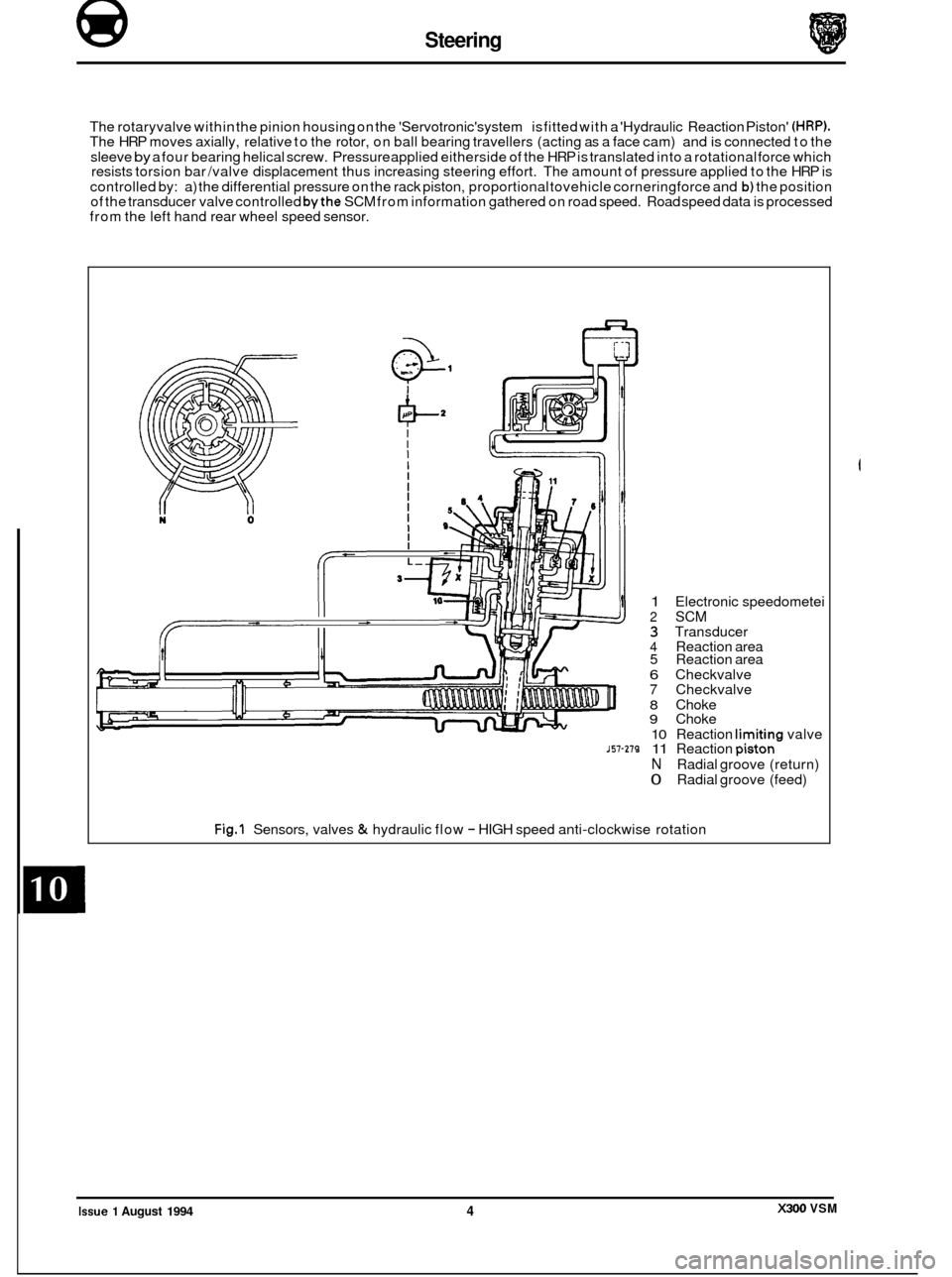
The rotaryvalve within the pinion housing on the 'Servotronic'system is fitted with a 'Hydraulic Reaction Piston' (HRP). The HRP moves axially, relative to the rotor, on ball bearing travellers (acting as a face cam) and is connected to the
sleeve
by a four bearing helical screw. Pressure applied eitherside of the HRP is translated into a rotational force which
resists torsion bar /valve displacement thus increasing steering effort. The amount of pressure applied to the HRP is
controlled by: a) the differential pressure on the rack piston, proportional tovehicle corneringforce and
b) the position
of the transducer valve controlled bythe SCM from information gathered on road speed. Road speed data is processed
from the left hand rear wheel speed sensor.
1 Electronic speedometei
2 SCM 3 Transducer 4 Reaction area 5 Reaction area
6 Checkvalve 7 Checkvalve
8 Choke 9 Choke
10 Reaction limitina valve 157-279 11 Reaction piston-
N Radial groove (return)
0 Radial groove (feed)
Fig.1 Sensors, valves & hydraulic flow - HIGH speed anti-clockwise rotation
X300 VSM Issue 1 August 1994 4
Page 215 of 521
Suspension Systems
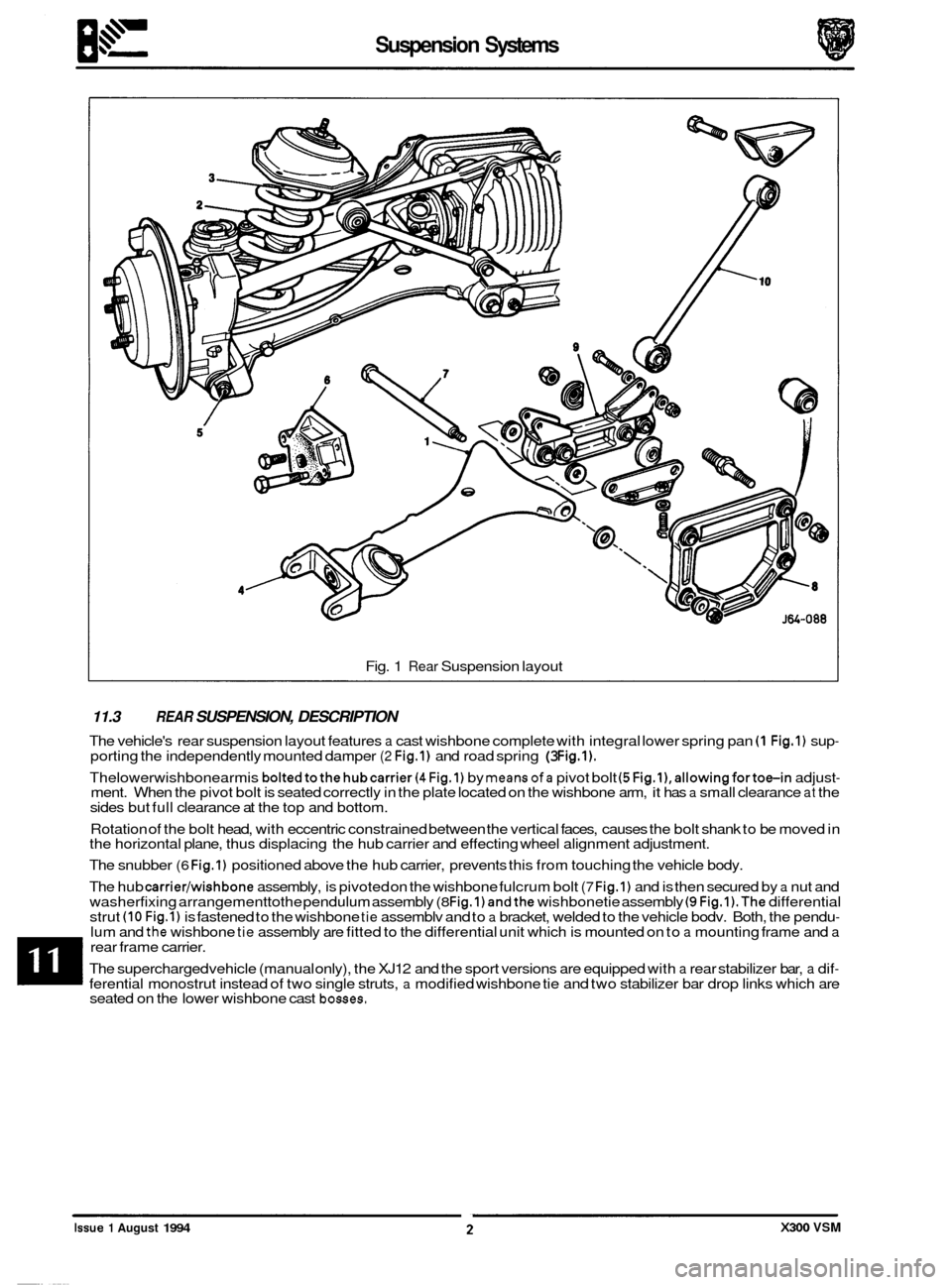
Fig. 1 Rear Suspension layout
11.3 REAR SUSPENSION, DESCRIPTION
The vehicle's rear suspension layout features a cast wishbone complete with integral lower spring pan (1 Fig.1) sup- porting the independently mounted damper (2 Fig.1) and road spring (3 Fig.1).
Thelowerwishbonearmis boltedtothehubcarrier(4 Fig.1) by meansofa pivot bolt (5Fig.l),allowingfortoe-in adjust- ment. When the pivot bolt is seated correctly in the plate located on the wishbone arm, it has a small clearance at the
sides but full clearance at the top and bottom.
Rotation of the bolt head, with eccentric constrained between the vertical faces, causes the bolt shank to be moved in
the horizontal plane, thus displacing the hub carrier and effecting wheel alignment adjustment.
The snubber
(6 Fig.1) positioned above the hub carrier, prevents this from touching the vehicle body.
The hub
carrier/wishbone assembly, is pivoted on the wishbone fulcrum bolt (7 Fig.1) and is then secured by a nut and
washerfixing arrangementtothe pendulum assembly (8 Fig.1) andthe wishbonetie assembly (9 Fig.l).The differential
strut (10 Fia.1) is fastened to the wishbone tie assemblv and to a bracket, welded to the vehicle bodv. Both, the pendu- lum and the wishbone tie assembly are fitted to the differential unit which is mounted on to a mounting frame and a rear frame carrier.
The supercharged vehicle (manual only), the XJ12 and the sport versions are equipped with
a rear stabilizer bar, a dif- ferential monostrut instead of two single struts, a modified wishbone tie and two stabilizer bar drop links which are
seated on the lower wishbone cast bosses.
0
0
e
Issue 1 August 1994 X300 VSM
Page 276 of 521
Body Components & Trim ~
issue 1 August 1994 X300 VSM 21
13.3.17 Fascia Board, Renew
SRO 76.46.01
. Remove
the battery cover and disconnect the battery.
Remove the drivers side and passenger side underscuttle
pads, see sub
-sections 13.3.19 and 13.3.20.
. Remove the drivers airbag module, see section 15.5.
Remove the steering wheel, section 10.
Remove the drivers side and passenger side fascia closing
. Remove the fascia center veneer panel, see subsection
Remove the fascia board for access, see subsection
. Disconnect the air conditioning differential potentiometer
Remove the differential potentiometer assembly.
. Displace and reposition the through panel connectors
from the fascia assembly.
. Displace the fascia vent motor / gearbox assemblies har- ness multi-plug from the mounting bracket.
. Disconnect and reposition the fascia harness to console
harness
multi-plug from the mounting bracket.
. Disconnect the BPU harness multi-plugs.
Remove the tiestraps securing the harness to the fascia.
. Reposition the fascia on a bench.
= Displace and reposition the solar sensor assembly from
Disconnect the solar sensor harness multi-plug.
Remove the solar sensor assembly.
= Undo and remove the defrost vents securing screws.
Displace and reposition the defrost vent assemblies.
. Disconnect the tweeter speaker harness multi-plugs.
. Remove the defrost vent assemblies.
. Displace the fascia harness grommet from the fascia.
. Route the harness through the aperture.
Remove the fascia harness assembly.
. Undo and remove passenger airbag deployment door to
fascia securing bolts ( one bolt is removed with the fascia).
. Displace and remove the deployment door assembly.
. Undo and remove the passenger airbag module to fascia
. Displace and remove the airbag module assembly.
. Undo and remove the airbag module I BPU mounting
bracket assembly to fascia securing nuts 1 bolts.
= Displace and remove the mounting bracket assembly.
. Retrieve the spacing washers.
. Displace and remove the side vent outlets from the fascia.
. Displace and remove the side vent ducts securing clips.
. Displace and remove the side vent ducts.
. Undo and remove the center vent flap assembly to fascia
. Displace and remove the center vent flap assembly.
Undo and remove fascia location bracket securing nuts.
Displace and remove the location bracket.
panels, see
sub
-sections 13.3.22 and 13.3.21.
13.3.23. 13.3.17.
harness multi
-plug.
the fascia.
securing bolts.
securing nuts.
Page 278 of 521
Body Components & Trim
. Reposition and fit the motor/gearbox assemblies harness
. Fully seat the through panel connectors to the fascia.
. Place the air conditioning differential potentiometer to the
fascia and route the differential potentiometer harness
through the vent aperture.
. Reconnect the differential potentiometer harness multi-
Plug.
Refit the fascia board.
. Refit the center veneer panel.
. Refit the fascia closing panels.
. Refit the steering wheel.
. Refit the drivers airbag module.
. Refit the underscuttle pads.
. Reconnect the battery and refit the battery cover.
multi
-plug
to the mounting bracket.
X300 VSM 23 Issue 1 August 1994
Page 283 of 521
Body Components & Trim -
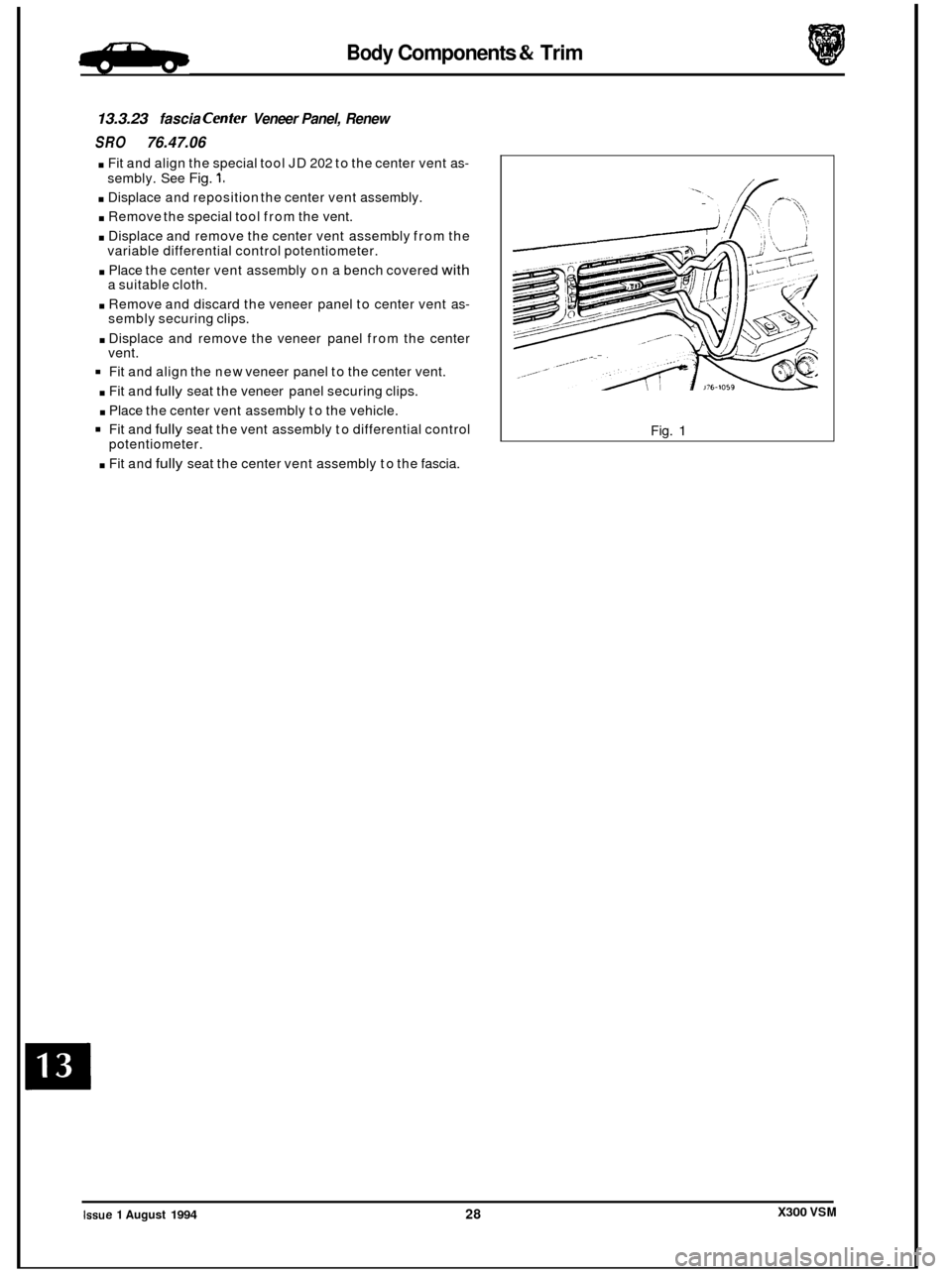
13.3.23 fascia Cenfer Veneer Panel, Renew
SRO 76.47.06
. Fit and align the special tool JD 202 to the center vent as-
. Displace and reposition the center vent assembly.
. Remove the special tool from the vent.
. Displace and remove the center vent assembly from the
. Place the center vent assembly on a bench covered with
. Remove and discard the veneer panel to center vent as-
. Displace and remove the veneer panel from the center
Fit and align the new veneer panel to the center vent.
. Fit and fully seat the veneer panel securing clips.
. Place the center vent assembly to the vehicle.
Fit and fully seat the vent assembly to differential control
. Fit and fully seat the center vent assembly to the fascia.
sembly.
See
Fig. 1.
variable differential control potentiometer.
a suitable cloth.
sembly securing clips.
vent.
potentiometer.
._-
Fig. 1
X300 VSM Issue 1 August 1994 28
Page 321 of 521
Climate Control Systems
. Centre vent flap
Foot flap
Defrost flap
I I
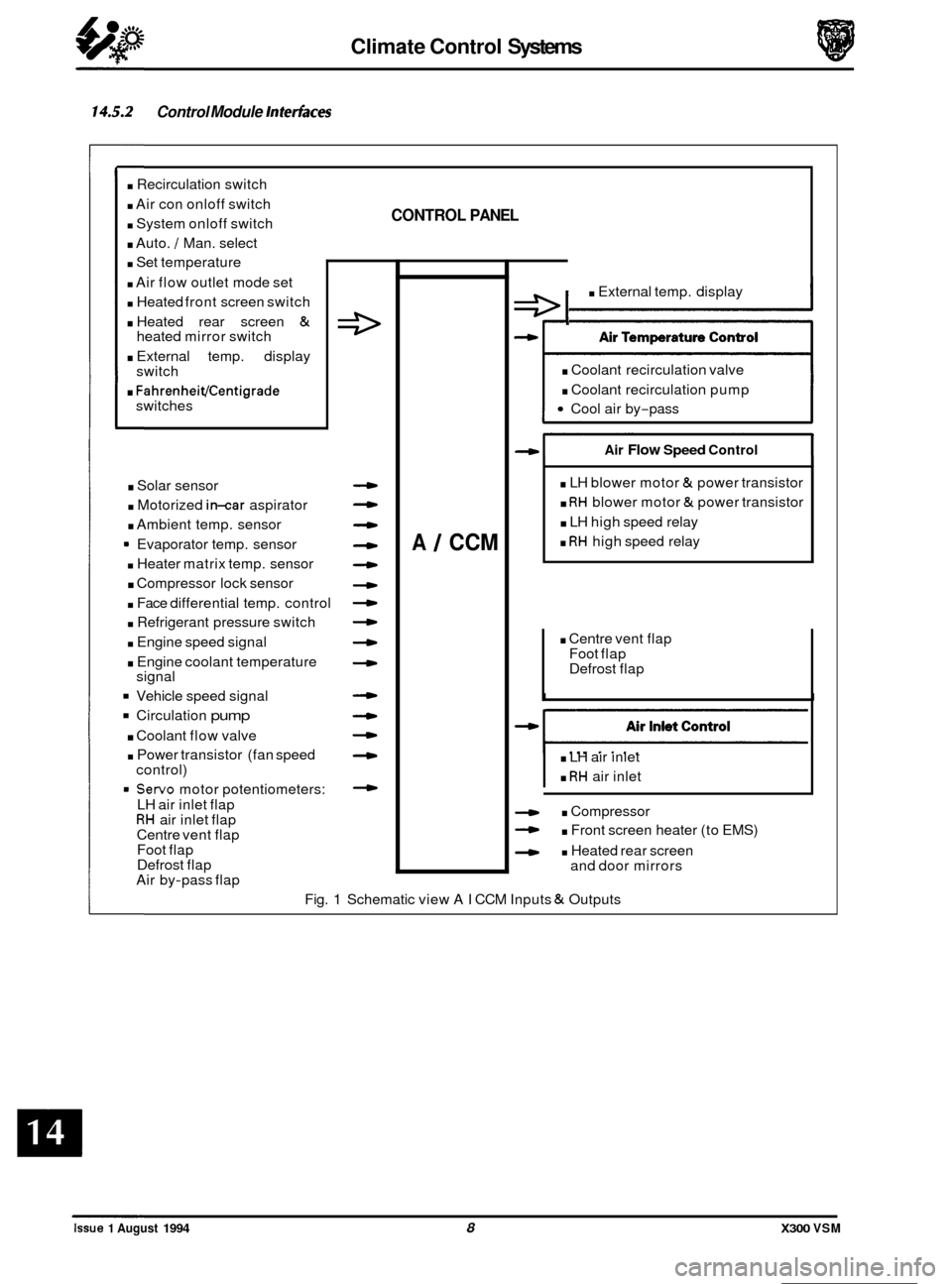
14.5.2 Control Module Interfaces
. Recirculation switch
. Air con onloff switch
. System onloff switch
. Auto. / Man. select
. Set temperature
. Air flow outlet mode set
. Heated front screen switch
. Heated rear screen &
. External temp. display
. FahrenheiVCentigrade
heated mirror switch
switch
switches
. Solar sensor
. Motorized in-car aspirator
. Ambient temp. sensor
9 Evaporator temp. sensor
. Heater matrix temp. sensor
. Compressor lock sensor
. Face differential temp. control
. Refrigerant pressure switch
. Engine speed signal
. Engine coolant temperature
Vehicle speed signal
Circulation pump
. Coolant flow valve
. Power transistor (fan speed
= Servo motor potentiometers:
signal
control)
LH air inlet flap
RH air inlet flap
Centre vent flap
Foot flap
Defrost flap
Air by
-pass flap
CONTROL PANEL
4
-
4
4
4
4
4
4
A 1 CCM
e I . External temp. display
. Coolant recirculation valve
. Coolant recirculation pump
Cool air by-pass
Air Flow Speed Control
. LH blower motor & power transistor
. RH blower motor & power transistor
. LH high speed relay
. RH high speed relay
. LH air inlet
. RH air inlet
. Compressor
- . Front screen heater (to EMS)
- . Heated rear screen
and door mirrors
Fig.
1 Schematic view AI CCM Inputs & Outputs
0
0
0
0
Issue 1 August 1994 8 X300 VSM
Page 322 of 521
Climate Control Systems
CONTROL MODULE FAULT & CONDITION SELF-ANALYSIS
0 14.6 14.6.1 System Health
The climate control system has a 'self-test' facility, accessible from the control panel. The self test sequence has two
basic modes:
0 System error information is stored in the A/CCM up to a maximum of five faults. Should a fault occur there will
be an audible 'beep' and the message 'Er' will be displayed on the control panel LCD for approximately five (5)
seconds after ignition on. Please note that this will happen only once in any ignition switch cycle. The error
source may be accessed by the procedure described in 'Self Test System Diagnosis', this section.
0 Panel communication check may be initiated by following the instruction in 'Self Test System Diagnosis', this
section.
Nsfe: Displayed error codes are NOT directly related to Jaguar Diagnostic Equipment (JDE) but more detailed fault
related information may be accessed using Portable Diagnostic Unit (PDU).
14.6.2 System Protection
Power to the compressor clutch may be cut should either the engine management or air conditioning control systems
detect certain conditions; these conditions may be caused by Fault or Demand and can be classified thus:
0 Engine coolant overheat,
0 Refrigerant excessive pressure.
0 Refrigerant, insufficient pressure or low charge weight.
0 Speed differential between compressor and crankshaft caused by belt slippage or compressor seizure (indi-
cated by A/C state lamp flashing once per second) - 12 cylinder engine only. This feature, 'lock sensing' is fully
explained
in the EDM.
Demand
0 Engine maximum power requirement
0 Electrical system drain at engine idle.
X300 VSM 9 Issue 1 August 1994
Page 325 of 521
Climate Control Systems
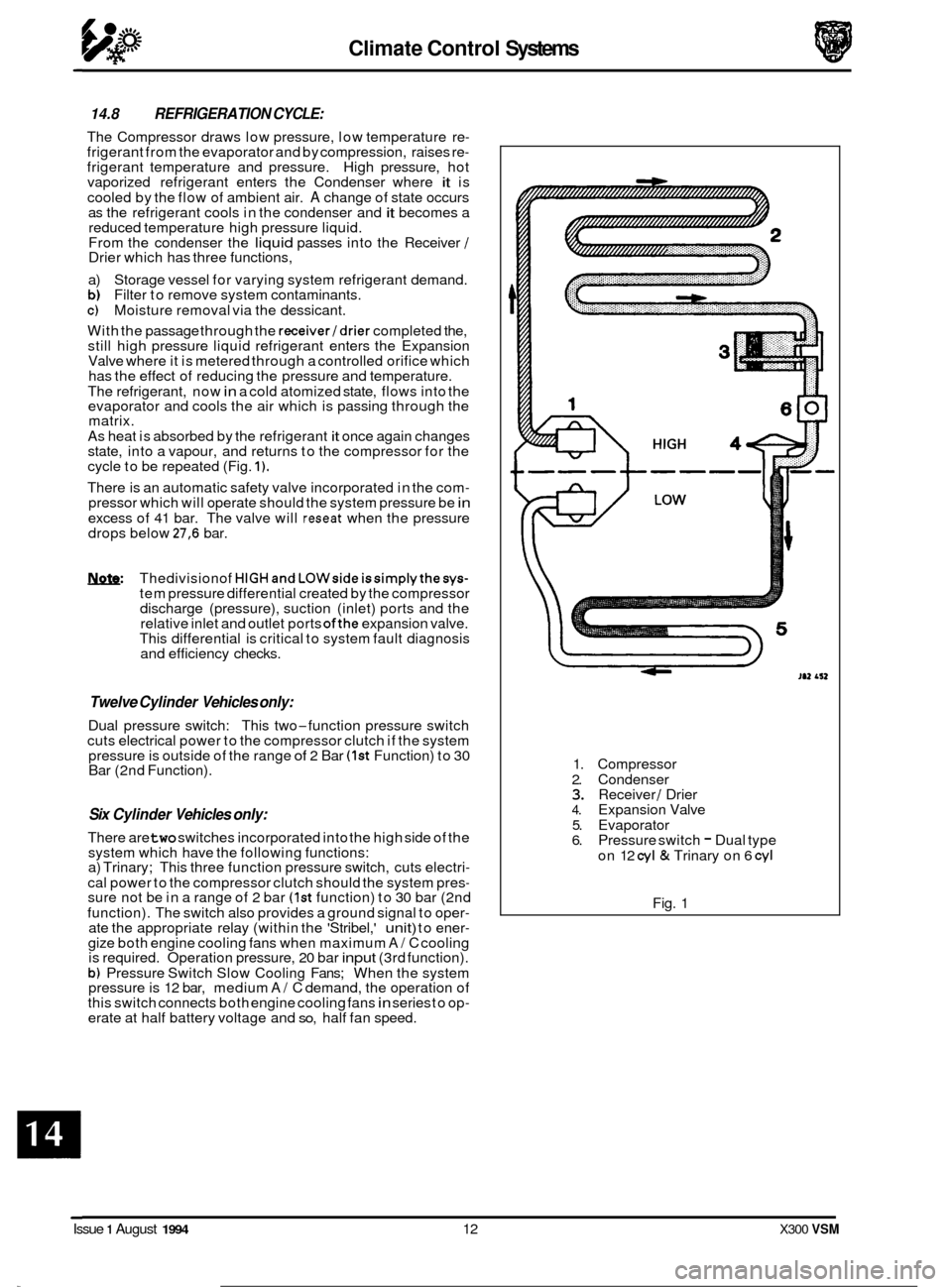
14.8 REFRIGERATION CYCLE:
The Compressor draws low pressure, low temperature re- frigerant from the evaporator and by compression, raises re- frigerant temperature and pressure. High pressure, hot
vaporized refrigerant enters the Condenser where it is
cooled by the flow of ambient air.
A change of state occurs
as the refrigerant cools in the condenser and it becomes a
reduced temperature high pressure liquid.
From the condenser the
liquid passes into the Receiver / Drier which has three functions,
a) Storage vessel for varying system refrigerant demand.
b) Filter to remove system contaminants. c) Moisture removal via the dessicant.
With the passage through the
receiver/drier completed the,
still high pressure liquid refrigerant enters the Expansion
Valve where it is metered through a controlled orifice which
has the effect of reducing the pressure and temperature.
The refrigerant, now
in a cold atomized state, flows into the
evaporator and cools the air which is passing through the
matrix.
As heat is absorbed by the refrigerant
it once again changes
state, into a vapour, and returns to the compressor for the
cycle to be repeated (Fig.
1).
There is an automatic safety valve incorporated in the com- pressor which will operate should the system pressure be in
excess of 41 bar. The valve will reseat when the pressure
drops below 27,6 bar.
W Thedivisionof HIGHandLOWsideissimplythesys- tem pressure differential created by the compressor
discharge (pressure), suction (inlet) ports and the
relative inlet and outlet ports
ofthe expansion valve.
This differential is critical to system fault diagnosis
and efficiency checks.
Twelve Cylinder Vehicles only:
Dual pressure switch: This two-function pressure switch
cuts electrical power to the compressor clutch if the system
pressure is outside of the range
of 2 Bar (1st Function) to 30
Bar (2nd Function).
Six Cylinder Vehicles only:
There are two switches incorporated into the high side of the
system which have the following functions:
a) Trinary; This three function pressure switch, cuts electri
-
cal power to the compressor clutch should the system pres- sure not be in a range of 2 bar (1st function) to 30 bar (2nd
function). The switch also provides a ground signal to oper
- ate the appropriate relay (within the 'Stribel,' unit) to ener- gize both engine cooling fans when maximum A/ C cooling
is required. Operation pressure, 20 bar input (3rd function).
b) Pressure Switch Slow Cooling Fans; When the system
pressure is 12 bar, medium A/ C demand, the operation of
this switch connects both engine cooling fans in series to op- erate at half battery voltage and so, half fan speed. 1.
Compressor
2. Condenser
3. Receiver / Drier 4. Expansion Valve
5. Evaporator
6. Pressure switch - Dual type
on 12
cyl & Trinary on 6 cyl
Fig. 1
0
0
Issue 1 August 1994 12 X300 VSM
Page 437 of 521

Body Systems & Body Repair
Location
Centre line of the front crossmember rear mounting, at the
main floor
RH longitudinal
A4.2.2.1 Datum location, Example
The FRONT MASTER DATUM (front crossmember rear mounting at the inner face ofthe main floor RH longitudi- nal) is nominally 359,5mm to the right-hand side of the body center line. The LH side front datum is measured 717,0/ 721,Omm from the RH. Please refer to the illustration on the following page.
Expressed as
a true position in three planes, the front master datum is:
Position
X 300,O
Y 359.5 Z -50.0
0
Datum
Front Master Datum
Plan
A4.2.2.2 Key, Plan View
Please refer to the illustration on the opposite page.
Key Location
1
2
3
4
5 Driveshaft centre bearing fixings
6
7
8
9
10 Front
face body
- bumper strut / mounting point
Rearmost hole, Vee
-mount to crush tube
Front Master Datum Plan, centre line
of the front crossmember rear mounting at the main floor RH longi-
tudinal
Rearmost hole, transmission mounting
at the main floor RH longitudinal
Rear Master Datum Plan, rear longitudinal
Tapped boss, rear suspension
'A' frame mounting bush
Rear suspension spring
-pan damper mounting
Rear suspension differential strut mounting
Rear face body
- bumper strut / mounting point
X300 VSM Issue 1 August 1994 10
Page 439 of 521

E 12
Rear face bodv - bumDer strut / mountina Doint
Body Systems
I
& Body
side vww
the illustration on the opposite page.
Repair
Location
Front face body - bumper strut / mounting point
Front Master Datum Vertical. centre line of the front crossmember rear mountina
Front
face body - bumper strut / mounting point
Front Master Datum Vertical, centre line of the front crossmember rear mounting
Transmission mountings
at the main floor longitudinal
Driveshaft centre bearing fixings
Rear Master Datum
Vertical, rear longitudinal
Tapped boss, rear suspension
'A' frame mounting bush
Rear suspension spring
-pan damper mounting
Rear suspension differential strut mounting
Rear face body
- bumper strut / mounting point
Transmission
mountings
at the main floor longitudinal
Driveshaft centre bearing fixings
Rear Master Datum
Vertical, rear longitudinal
Tapped boss, rear suspension
'A' frame mounting bush
Rear suspension spring
-pan damper mounting
Rear
susoension differential strut mounting
Wheel centre to
bummr cover face I
Wheel base I
Wheel centre to bumper cover face
Body Systems & Body Repair
A4.2.2.3 Key, Side Vww
Please refer to the illustration on the opposite page.
0
0
0
X300 VSM Issue 1 August 1994 12