weight JAGUAR XJ6 1994 2.G User Guide
[x] Cancel search | Manufacturer: JAGUAR, Model Year: 1994, Model line: XJ6, Model: JAGUAR XJ6 1994 2.GPages: 521, PDF Size: 17.35 MB
Page 187 of 521
Driveshafts & Final Drive
9.2 DRIVE SHAm, ALIGN
SRO 47.15.51
CAUTION: To preserve 'drive line' refinement, individual parts, other than fixings, MUST NOT be renewed. In the
event of any balance or drive shaft component related problem, the complete assembly must be renewed.
Under no circumstances must the flexible coupling (or its fixings) be loosened or removed from the drive
shaft flange.
Preliminary Checks
Before this procedure is actioned it is advisable to ensure that:
The gearbox mounting center stud is positioned centrally in relation to the crossmember inspection hole.
The crossmember is central on the body fixings and not 'hard over' to one side.
The differential spigot radial
run-out is within specification, see preliminary pages.
If the vehicle has been standing for
a period the tires may be 'flat-spotted'. If so, this will clear in approximate.;
400 km (250 miles). After this distance the source of vibration should be reassessed.
12 Cylinder
8 Remove exhaust center section.
All
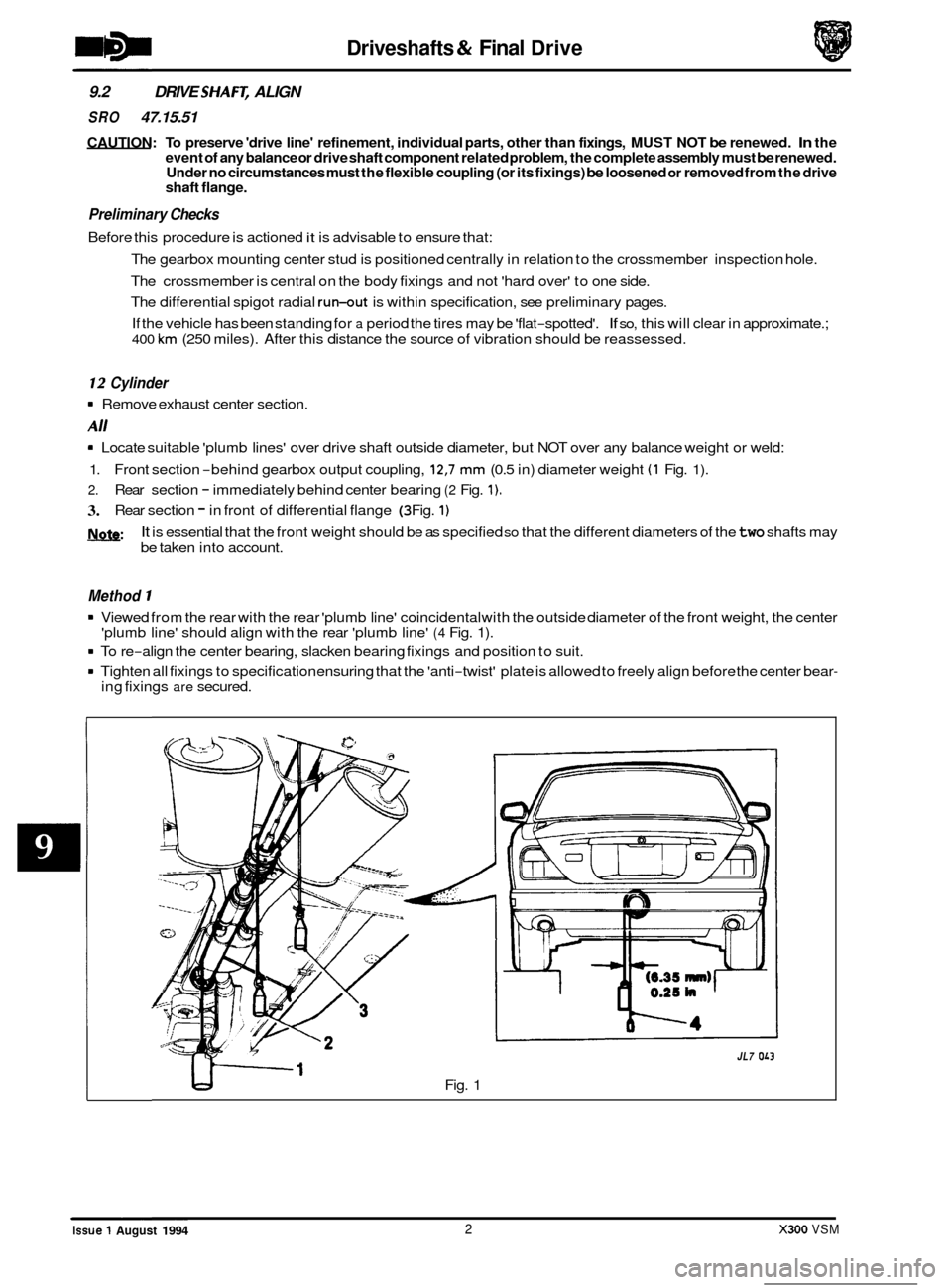
8 Locate suitable 'plumb lines' over drive shaft outside diameter, but NOT over any balance weight or weld:
1.
2.
3.
l\lnfe:
Front section -behind gearbox output coupling, 12,7 mm (0.5 in) diameter weight (1 Fig. 1).
Rear section - immediately behind center bearing (2 Fig. 1).
Rear section - in front of differential flange (3 Fig. 1)
It is essential that the front weight should be as specified so that the different diameters of the two shafts may
be taken into account.
Method 1
8 Viewed from the rear with the rear 'plumb line' coincidental with the outside diameter of the front weight, the center
8 To re-align the center bearing, slacken bearing fixings and position to suit.
8 Tighten all fixings to specification ensuring that the 'anti-twist' plate is allowed to freely align before the center bear-
'plumb line' should align with the rear 'plumb line' (4 Fig. 1).
ing fixings are secured.
Fig. 1
1
JL7 OL3
0
0
0
0 ~~~~
Issue 1 August 1994 2 X300 VSM
Page 188 of 521

0
0
Driveshafts & Final Drive ~ ~~~
Method 2
A refinement
to Method 1 may be made by stretching a line horizontally along the center line of the vehicle to touch
the outside diameter of the front weight and the rear ‘plumb line’. Take care not to bias the vertical lines with the hori- zontal line.
. Set the center ‘plumb line‘ to touch the horizontal line by movement of the center bearing (Fig. 1).
9 To realign the center bearing, slacken bearing fixings and position to suit.
. Tighten all fixings to specification ensuring that the ‘anti-twist’ plate is allowed to freely align before the center bear- ing fixings are secured.
I
6
101
H
-=I- ---
Fig. 1
Recommended /oca//y made tools
Plumb line Locally made Weight Locally made 12.7 mm (0,5 in) diameter mild steel
X300 VSM Issue 1 August 1994 3
Page 312 of 521
Climate Control Systems
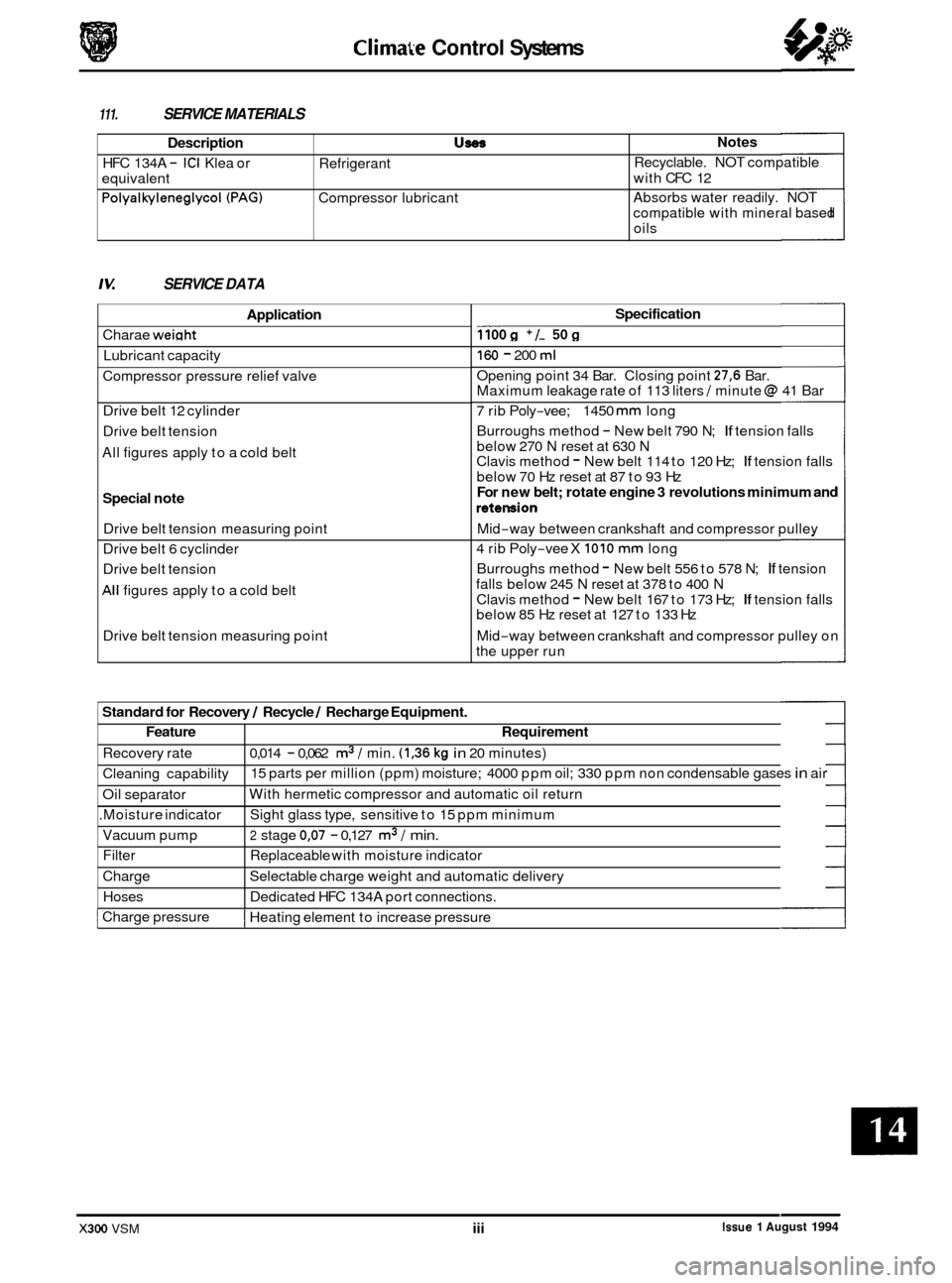
Description U-
HFC 134A - ICI Klea or
equivalent
Polyalkyleneglycol (PAG) Compressor lubricant
Refrigerant
111.
Notes
Recyclable. NOT
compatible
with CFC 12
Absorbs water readily. NOT
compatible with mineral based
oils
SERVICE MATERIALS
Standard for Recovery I Recycle 1 Recharge Equipment.
Recovery rate
Cleaning capability
Oil separator
.Moisture indicator
Vacuum pump
Filter Replaceable with moisture indicator
Charge Hoses
Feature Requirement
0,014 - 0,062 m3 / min. (1,36 kg in 20 minutes)
15 parts per million (ppm) moisture; 4000 ppm oil; 330 ppm non condensable gases
in air
With hermetic compressor and automatic oil return
Sight glass type, sensitive to 15 ppm minimum
2 stage 0,07 - 0,127 m3 I min.
Selectable charge weight and automatic delivery
Dedicated HFC 134A port connections.
Iv. SERVICE DATA
Application
Charae weight
Lubricant capacity
Compressor pressure relief valve
Drive belt 12 cylinder
Drive belt tension
All figures apply to a cold belt
Special note
Drive belt tension measuring point
Drive belt 6 cyclinder
Drive belt tension
All figures apply to a cold belt
Drive belt tension measuring point
Specification
160 - 200 ml
Opening point 34 Bar. Closing point 27,6 Bar.
Maximum leakage rate of 113 liters 1 minute @ 41 Bar
7 rib Poly
-vee; 1450 mm long
Burroughs method
- New belt 790 N; If tension falls
below 270 N reset at 630 N
Clavis method
- New belt 114 to 120 Hz; If tension falls
below 70 Hz reset at 87 to 93 Hz
For new belt; rotate engine 3 revolutions minimum and
retension
Mid-way between crankshaft and compressor pulley ~
4
rib Poly-vee X 1010 mm long
Burroughs method
- New belt 556 to 578 N; If tension
falls below 245 N reset at 378 to 400
N
Clavis method - New belt 167 to 173 Hz; If tension falls
below 85 Hz reset at 127 to 133 Hz
Mid
-way between crankshaft and compressor pulley on
the upper run
1 Charge pressure I Heating element to increase pressure
Issue 1 August 1994 X300 VSM iii
Page 315 of 521
Climate Control Systems
0 Because HFC 134A is fully recycleable it may be 'cleaned' by the recovery equipment and re-used following
removal from a system.
0 Leak tests should only be carried out with an electronic analyzer which is dedicated to HFC 134A. Never use a CFC 12 analyzer or naked flame type.
0 Do not attempt to 'guess' the amount of refrigerant in a system, always recover and recharge with the correct
charge weight. In this context do not depress the charge or discharge port valves to check for the presence of
refrigerant.
14.1.3 Handling Lubricating Oil
0 Avoid breathing lubricant mist, it may cause irritation to your respiratory system.
0 Always decant fresh oil from a sealed container and do not leave oil exposed to the atmosphere for any reason
other than to fill or empty a system. PAG oil is very hygroscopic (absorbs water) and will rapidly become con-
taminated by atmospheric moisture.
PAG oil is
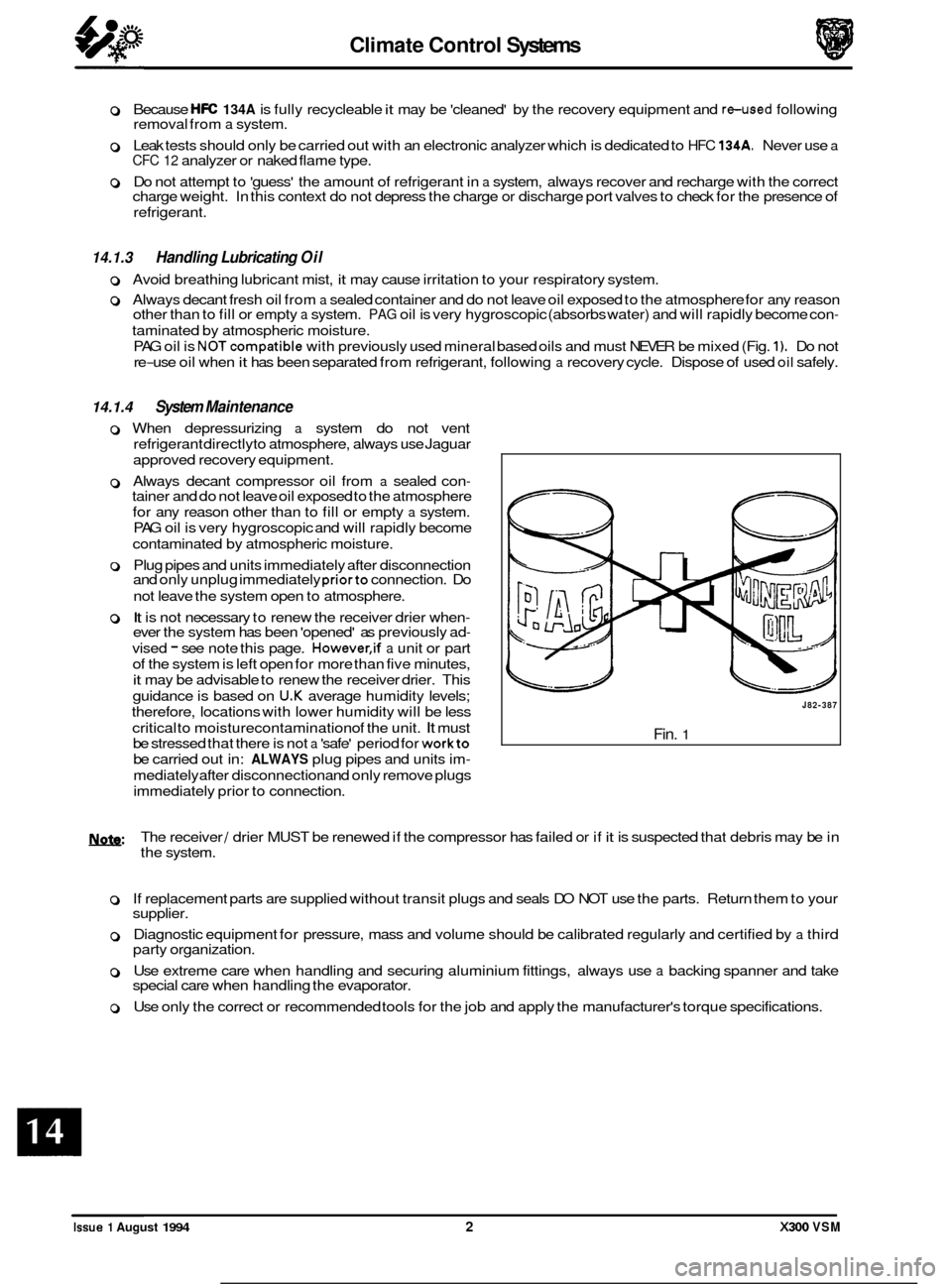
NOTcompatible with previously used mineral based oils and must NEVER be mixed (Fig. 1). Do not
re
-use oil when it has been separated from refrigerant, following a recovery cycle. Dispose of used oil safely.
14.1.4 System Maintenance
0 When depressurizing a system do not vent
refrigerant directlyto atmosphere, always use Jaguar
approved recovery equipment.
0 Always decant compressor oil from a sealed con- tainer and do not leave oil exposed to the atmosphere
for any reason other than to fill or empty
a system.
PAG oil is very hygroscopic and will rapidly become
contaminated by atmospheric moisture.
0 Plug pipes and units immediately after disconnection
and only unplug immediately priorto connection. Do
not leave the system open to atmosphere.
0 It is not necessary to renew the receiver drier when- ever the system has been 'opened' as previously ad-
vised - see note this page. However,if a unit or part
of the system is left open for more than five minutes,
it may be advisable to renew the receiver drier. This
guidance is based on
U.K average humidity levels;
therefore, locations with lower humidity will be less
critical to moisturecontamination of the unit.
It must
be stressed that there is not
a 'safe' period for workto
be carried out in: ALWAYS plug pipes and units im-
mediately after disconnection and only remove plugs
immediately prior to connection.
J82-387
Fin. 1
U: The receiver / drier MUST be renewed if the compressor has failed or if it is suspected that debris may be in
the system.
0 If replacement parts are supplied without transit plugs and seals DO NOT use the parts. Return them to your
supplier.
0 Diagnostic equipment for pressure, mass and volume should be calibrated regularly and certified by a third
party organization.
0 Use extreme care when handling and securing aluminium fittings, always use a backing spanner and take
special care when handling the evaporator.
0 Use only the correct or recommended tools for the job and apply the manufacturer's torque specifications.
Issue 1 August 1994 2 X300 VSM
Page 322 of 521
Climate Control Systems
CONTROL MODULE FAULT & CONDITION SELF-ANALYSIS
0 14.6 14.6.1 System Health
The climate control system has a 'self-test' facility, accessible from the control panel. The self test sequence has two
basic modes:
0 System error information is stored in the A/CCM up to a maximum of five faults. Should a fault occur there will
be an audible 'beep' and the message 'Er' will be displayed on the control panel LCD for approximately five (5)
seconds after ignition on. Please note that this will happen only once in any ignition switch cycle. The error
source may be accessed by the procedure described in 'Self Test System Diagnosis', this section.
0 Panel communication check may be initiated by following the instruction in 'Self Test System Diagnosis', this
section.
Nsfe: Displayed error codes are NOT directly related to Jaguar Diagnostic Equipment (JDE) but more detailed fault
related information may be accessed using Portable Diagnostic Unit (PDU).
14.6.2 System Protection
Power to the compressor clutch may be cut should either the engine management or air conditioning control systems
detect certain conditions; these conditions may be caused by Fault or Demand and can be classified thus:
0 Engine coolant overheat,
0 Refrigerant excessive pressure.
0 Refrigerant, insufficient pressure or low charge weight.
0 Speed differential between compressor and crankshaft caused by belt slippage or compressor seizure (indi-
cated by A/C state lamp flashing once per second) - 12 cylinder engine only. This feature, 'lock sensing' is fully
explained
in the EDM.
Demand
0 Engine maximum power requirement
0 Electrical system drain at engine idle.
X300 VSM 9 Issue 1 August 1994
Page 326 of 521
Climate Control Systems
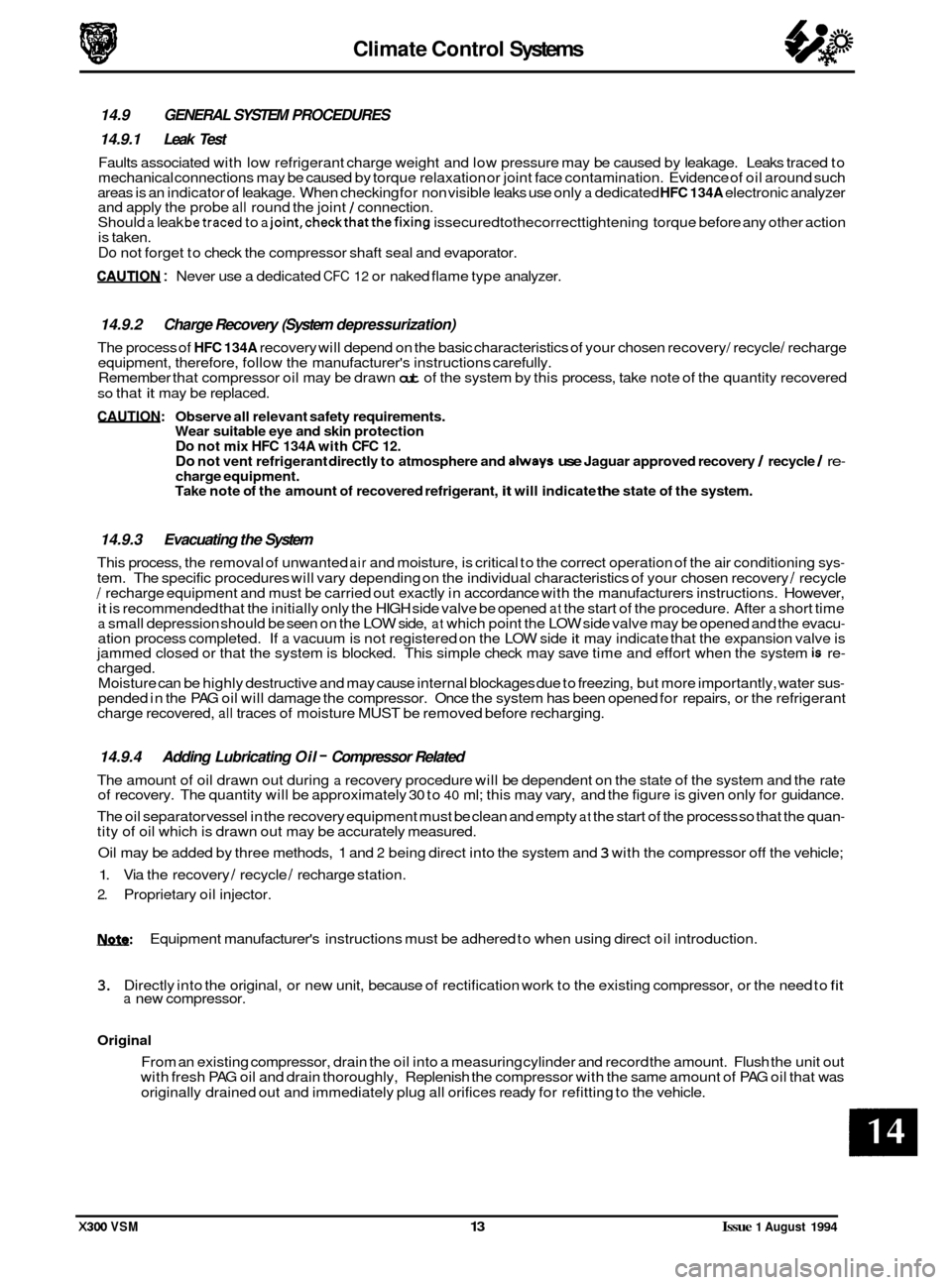
0 14.9 GENERAL SYSTEM PROCEDURES
14.9.1 Leak Test
Faults associated with low refrigerant charge weight and low pressure may be caused by leakage. Leaks traced to
mechanical connections may be caused by torque relaxation or joint face contamination. Evidence of oil around such
areas is an indicator of leakage. When checking for non visible leaks use only
a dedicated HFC 134A electronic analyzer
and apply the probe all round the joint / connection.
Should a leak betraced to a joint,checkthatthefixing issecuredtothecorrecttightening torque before any other action
is taken.
Do not forget to check the compressor shaft seal and evaporator.
CAUTION : Never use a dedicated CFC 12 or naked flame type analyzer.
14.9.2 Charge Recovery (System depressurization)
The process of HFC 134A recovery will depend on the basic characteristics of your chosen recovery/ recycle I recharge
equipment, therefore, follow the manufacturer's instructions carefully.
Remember that compressor oil may be drawn
out of the system by this process, take note of the quantity recovered
so that it may be replaced.
CAUTION: Observe all relevant safety requirements.
Wear suitable eye and skin protection
Do not mix HFC 134A with CFC 12. Do not vent refrigerant directly to atmosphere and always use Jaguar approved recovery I recycle I re- charge equipment.
Take note of the amount of recovered refrigerant, it will indicate the state of the system. 0
14.9.3 Evacuating the System
This process, the removal of unwanted air and moisture, is critical to the correct operation of the air conditioning sys-
tem. The specific procedures will vary depending on the individual characteristics of your chosen recovery I recycle / recharge equipment and must be carried out exactly in accordance with the manufacturers instructions. However,
it is recommended that the initially only the HIGH side valve be opened at the start of the procedure. After a short time a small depression should be seen on the LOW side, at which point the LOW side valve may be opened and the evacu- ation process completed. If a vacuum is not registered on the LOW side it may indicate that the expansion valve is
jammed closed or that the system is blocked. This simple check may save time and effort when the system is re- charged.
Moisture can be highly destructive and may cause internal blockages due to freezing, but more importantly, water sus- pended in the PAG oil will damage the compressor. Once the system has been opened for repairs, or the refrigerant
charge recovered, all traces of moisture MUST be removed before recharging.
14.9.4
The amount of oil drawn out during a recovery procedure will be dependent on the state of the system and the rate
of recovery. The quantity will be approximately 30 to 40 ml; this may vary, and the figure is given only for guidance.
The oil separator vessel in the recovery equipment must be clean and empty
at the start of the process so that the quan- tity of oil which is drawn out may be accurately measured.
Oil may be added by three methods,
1 and 2 being direct into the system and 3 with the compressor off the vehicle;
1. Via the recovery I recycle 1 recharge station.
2. Proprietary oil injector.
Adding Lubricating Oil - Compressor Related
1ynfa: Equipment manufacturer's instructions must be adhered to when using direct oil introduction.
3. Directly into the original, or new unit, because of rectification work to the existing compressor, or the need to fit a new compressor.
Original
From an existing compressor, drain the oil into a measuring cylinder and record the amount. Flush the unit out
with fresh PAG oil and drain thoroughly, Replenish the compressor with the same amount of PAG oil that was
originally drained out and immediately plug all orifices ready for refitting to the vehicle.
X300 VSM 13 Issue 1 August 1994
Page 327 of 521
Climate Control Systems
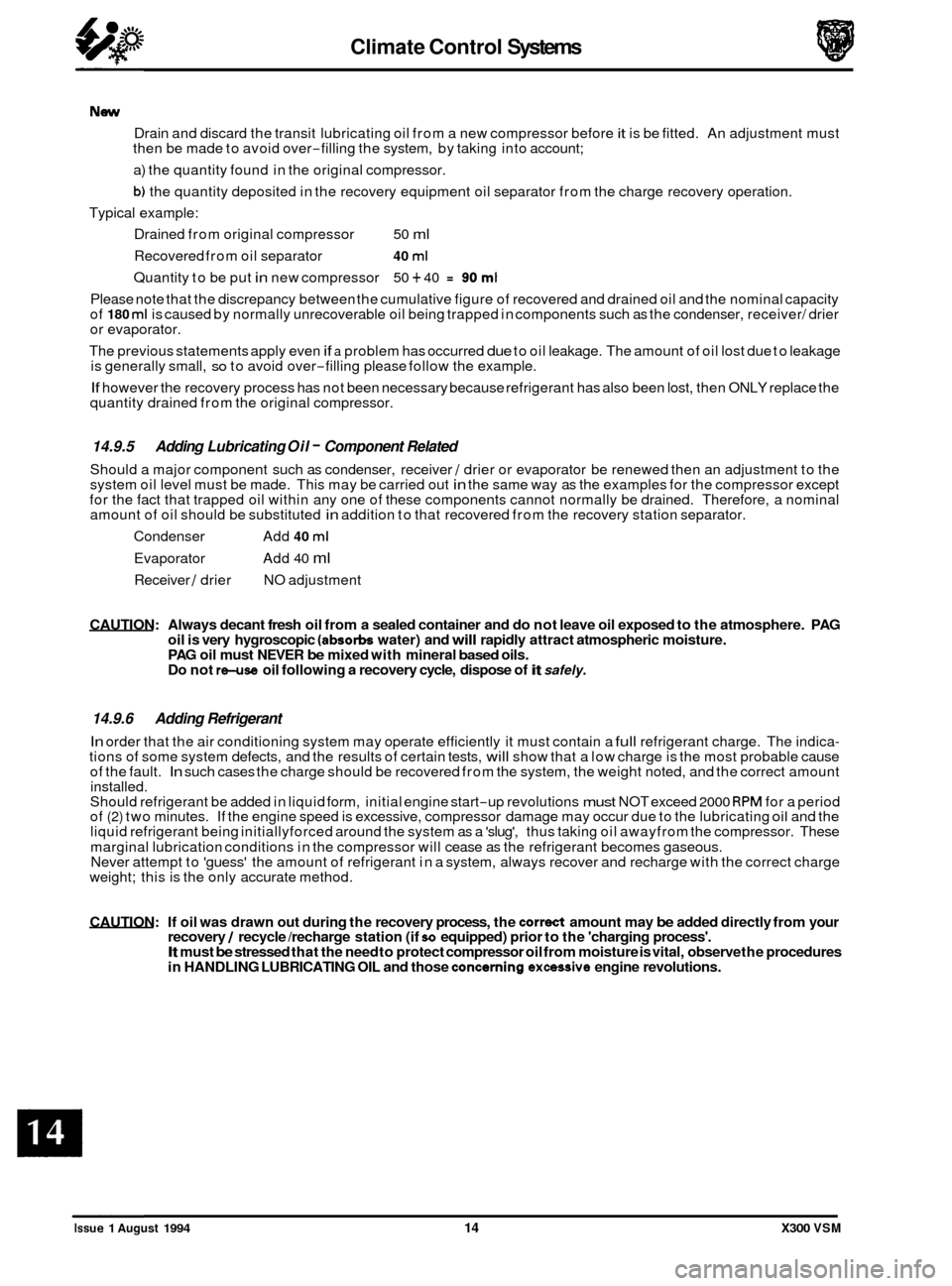
New
Drain and discard the transit lubricating oil from a new compressor before it is be fitted. An adjustment must
then be made to avoid over-filling the system, by taking into account;
a) the quantity found in the original compressor.
b) the quantity deposited in the recovery equipment oil separator from the charge recovery operation.
Drained from original compressor
50 ml
Recovered from oil separator 40 ml
Quantity to be put in new compressor 50 + 40 = 90 ml
Typical example:
Please note that the discrepancy between the cumulative figure of recovered and drained oil and the nominal capacity
of
180 ml is caused by normally unrecoverable oil being trapped in components such as the condenser, receiver/ drier
or evaporator.
The previous statements apply even
if a problem has occurred due to oil leakage. The amount of oil lost due to leakage
is generally small, so to avoid over-filling please follow the example.
If however the recovery process has not been necessary because refrigerant has also been lost, then ONLY replace the
quantity drained from the original compressor.
14.9.5
Should a major component such as condenser, receiver / drier or evaporator be renewed then an adjustment to the
system oil level must be made. This may be carried out in the same way as the examples for the compressor except
for the fact that trapped oil within any one of these components cannot normally be drained. Therefore, a nominal
amount of oil should be substituted
in addition to that recovered from the recovery station separator.
Adding Lubricating Oil - Component Related
Condenser Add 40 ml
Evaporator Add 40 ml
Receiver / drier NO adjustment
CAUTION: Always decant fresh oil from a sealed container and do not leave oil exposed to the atmosphere. PAG
oil is very hygroscopic (absoh water) and will rapidly attract atmospheric moisture.
PAG oil must NEVER be mixed with mineral based oils.
Do not re-use oil following a recovery cycle, dispose of it safely.
14.9.6 Adding Refrigerant
In order that the air conditioning system may operate efficiently it must contain a full refrigerant charge. The indica- tions of some system defects, and the results of certain tests, will show that a low charge is the most probable cause
of the fault. In such cases the charge should be recovered from the system, the weight noted, and the correct amount
installed.
Should refrigerant be added in liquid form, initial engine start
-up revolutions must NOT exceed 2000 RPM for a period
of (2) two minutes. If the engine speed is excessive, compressor damage may occur due to the lubricating oil and the
liquid refrigerant being initiallyforced around the system as a 'slug', thus taking oil awayfrom the compressor. These
marginal lubrication conditions in the compressor will cease as the refrigerant becomes gaseous.
Never attempt to 'guess' the amount of refrigerant in a system, always recover and recharge with the correct charge
weight; this is the only accurate method.
CAUTION: If oil was drawn out during the recovery process, the corM amount may be added directly from your
recovery / recycle /recharge station (if so equipped) prior to the 'charging process'. It must be stressed that the need to protect compressor oil from moisture is vital, observe the procedures
in HANDLING LUBRICATING OIL and those concerning excessive engine revolutions.
Issue 1 August 1994 14 X300 VSM
Page 382 of 521
Snecif icat ion W -I- ..........
e
0
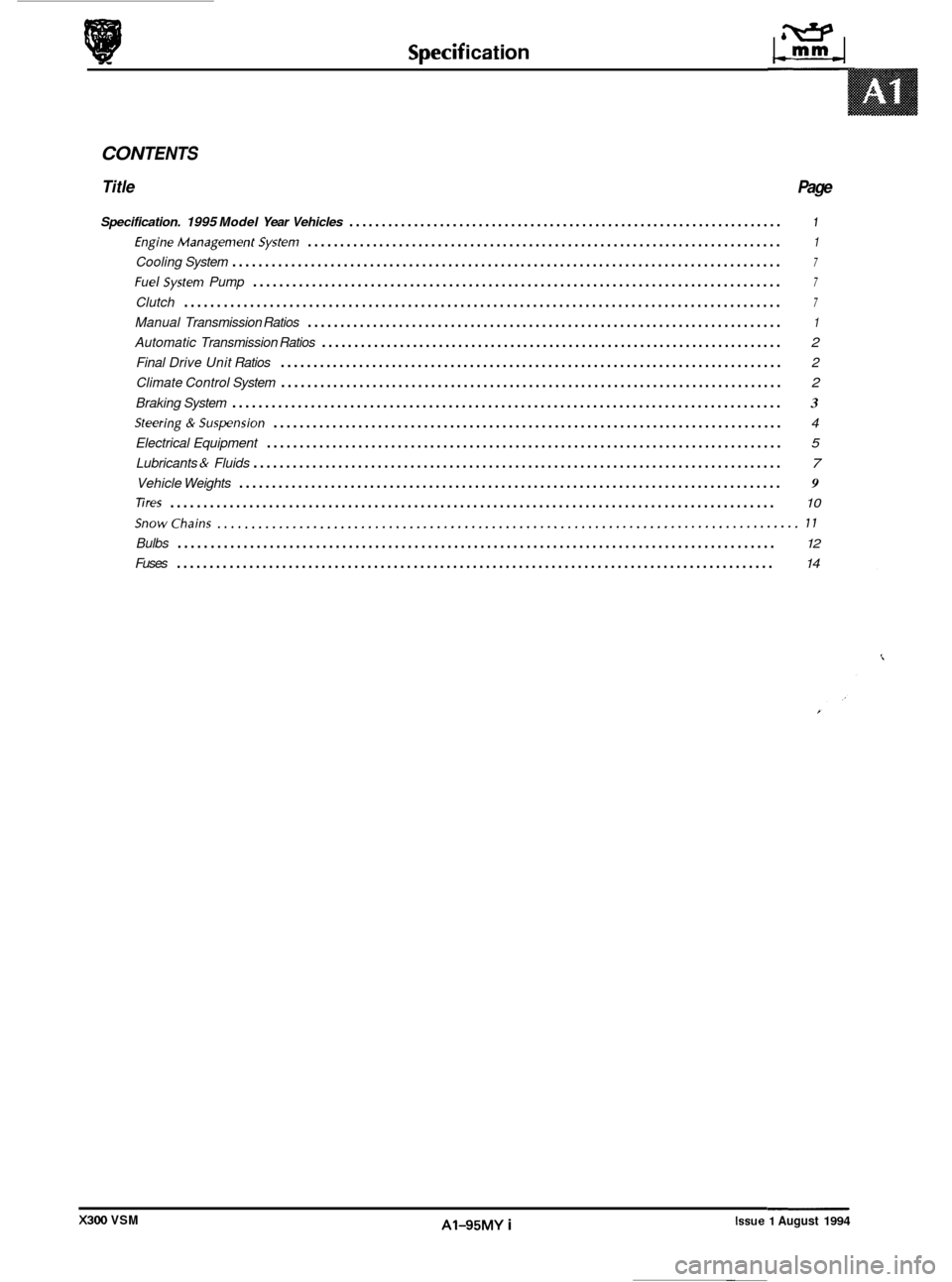
CON TENTS
Title Page
Specification. 1995 Model Year Vehicles ................................................................... 1
EngineManagementSystem ........................................................................\
. 1
Cooling System ........................................................................\
............ 7
Fuelsystem Pump ........................................................................\
......... 7
Clutch ........................................................................\
................... 7
Manual Transmission Ratios ........................................................................\
. 1
Automatic Transmission Ratios ....................................................................... \
2
Final Drive Unit Ratios ........................................................................\
..... 2
Climate Control System ........................................................................\
..... 2
Braking System ........................................................................\
............ 3
Steering&Suspension ........................................................................\
...... 4
Electrical Equipment ........................................................................\
....... 5
Lubricants & Fluids ........................................................................\
......... 7
Vehicle Weights ........................................................................\
........... 9
Tires ........................................................................\
.................... 10
Snowchains ........................................................................\
............. 17
Bulbs ........................................................................\
................... 12
Fuses ........................................................................\
................... 14
Issue 1 August 1994 AI-95MY i X300 VSM
Page 385 of 521

Specification
W
. fmmJ
Automatic Transmission Ratios (ZF)
First .............................................................. 2. 48. 1
Second ............................................................ 1. 48.1
Third
.............................................................. 1. 00. 1
Fourth ............................................................. 0. 73.1
Reverse
........................................................... 2.09:l
Automatic Transmission Ratios (Powertrain)
First ............................................................. 2. 482. 1
Second ........................................................... 1. 482. 1
Third ............................................................ 1. 000. 1
Fourth ........................................................... 0. 750.1
Reverse
......................................................... 2. 077 : 1
Final Drive Unit Ratios
3.2 liter Manual .................................................... 3. 77:1
3.2 liter Automatic
.................................................. 4. 08:1
4.0 liter Automatic
.................................................. 3. 54:1
4.0 liter Manual
.................................................... 3. 54:1
4.0 liter Supercharged
.............................................. 3. 27:1
6.0 liter ........................................................... 3. 54:1
Climate Control (air condit;oning) System
Compressor ....................................................... Nippondenso 1OPA17C
Compressor lubricant .............................................. ND Oil 8
Refrigerant ........................................................ R134A
Refrigerant Charge Weight .......................................... 1100g
X300 VSM Issue 1 August 1994 A1-95MY 2
Page 392 of 521
Specification
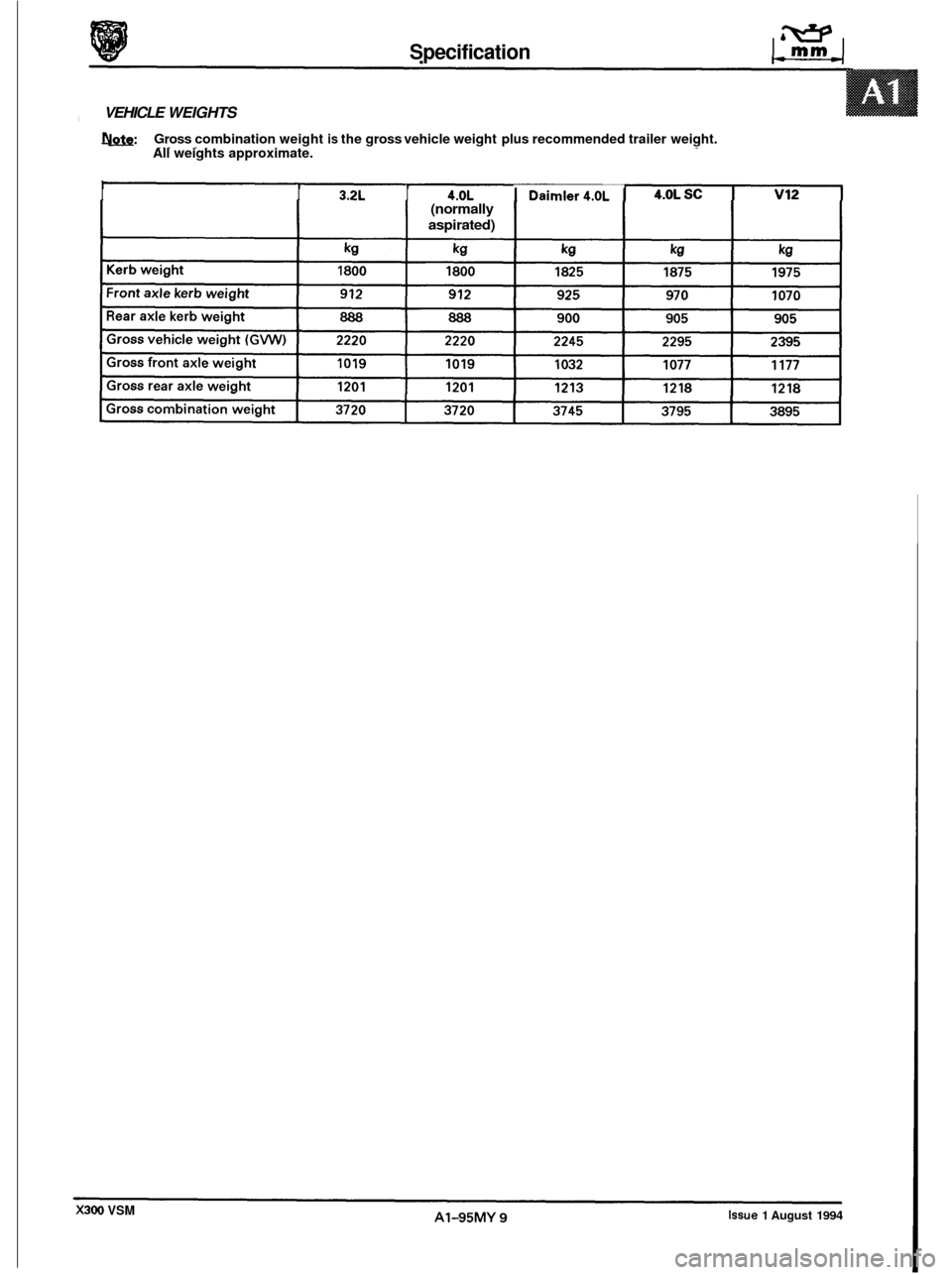
I Infe: Gross combination weight is the gross vehicle weight plus recommended trailer weight. ... . ~
(normally
aspirated)
VEHICLE WEIGHTS
J! All weights approximate.
I I 3.2L I 4.0L I Daimler4.OL I
A1-95MY 9 Issue 1 August 1994 X300 VSM