radiator JAGUAR XJ6 1994 2.G Owner's Manual
[x] Cancel search | Manufacturer: JAGUAR, Model Year: 1994, Model line: XJ6, Model: JAGUAR XJ6 1994 2.GPages: 521, PDF Size: 17.35 MB
Page 71 of 521
rn Cooling System (VI 2)
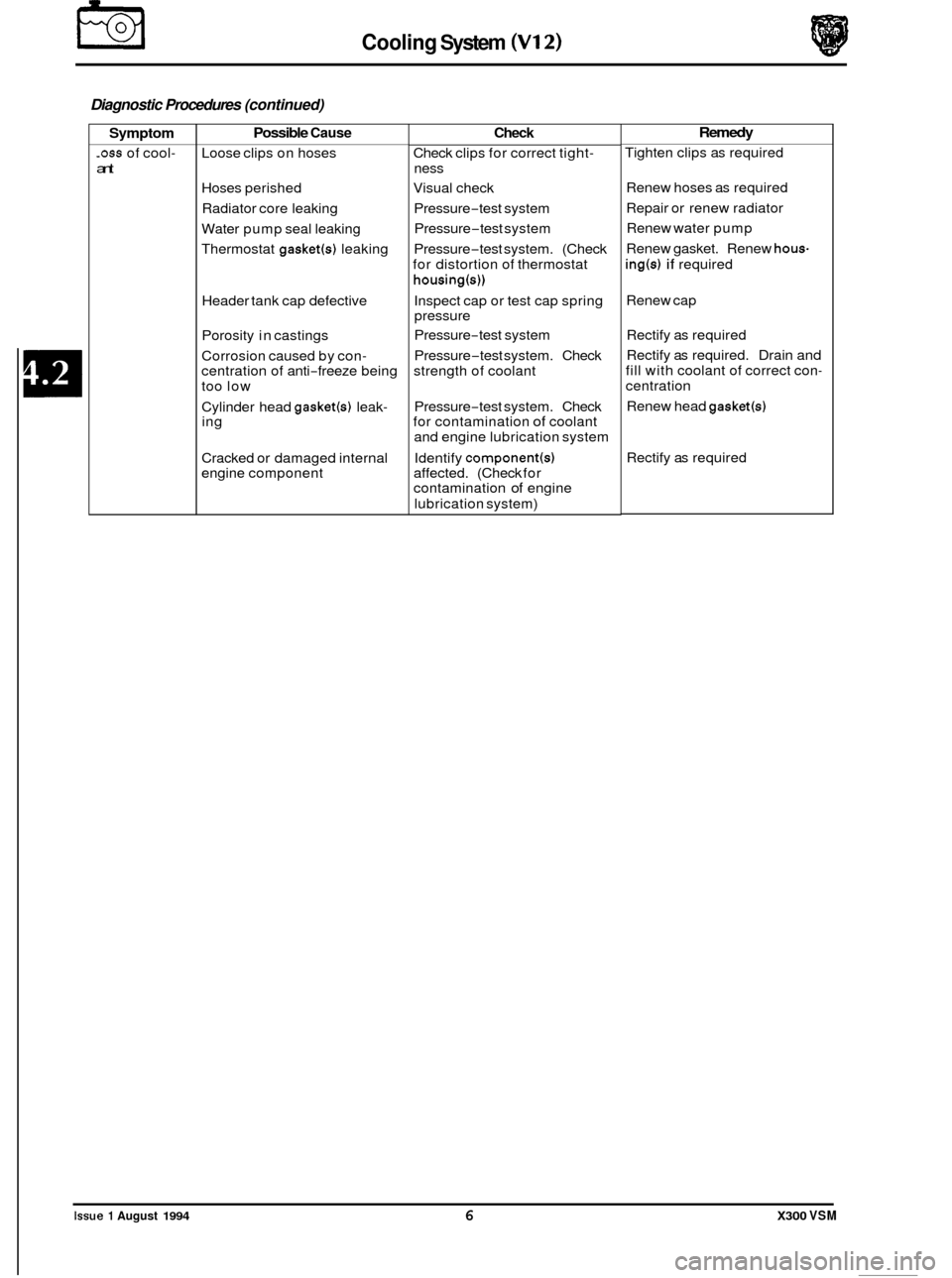
Diagnostic Procedures (continued)
Symptom
-0ss of cool-
ant
Possible Cause
Loose clips on hoses
Hoses perished
Radiator core leaking
Water pump seal leaking
Thermostat
gasket(s) leaking
Header tank cap defective
Porosity in castings
Corrosion caused by con
- centration of anti-freeze being
too low
Cylinder head
gasket(4 leak- ing
Cracked or damaged internal
engine component
Check
Check clips for correct tight-
ness
Visual check
Pressure
-test system
Pressure
-test system
Pressure
-test system. (Check
for distortion of thermostat
housing(s))
Inspect cap or test cap spring
pressure
Pressure
-test system
Pressure
-test system. Check
strength of coolant
Pressure
-test system. Check
for contamination of coolant
and engine lubrication system
Identify
component(s) affected. (Check for
contamination of engine
lubrication system)
Remedy
Tighten clips as required
Renew hoses as required
Repair or renew radiator
Renew water pump
Renew gasket. Renew
hous-
ing(s) if required
Renew cap Rectify as required
Rectify as required. Drain and
fill with coolant of correct con
-
centration
Renew head
gasket(s)
Rectify as required
Issue 1 August 1994 6 X300 VSM
Page 98 of 521
Fuel, Emission Control & Engine Management (V12) ~~ ~
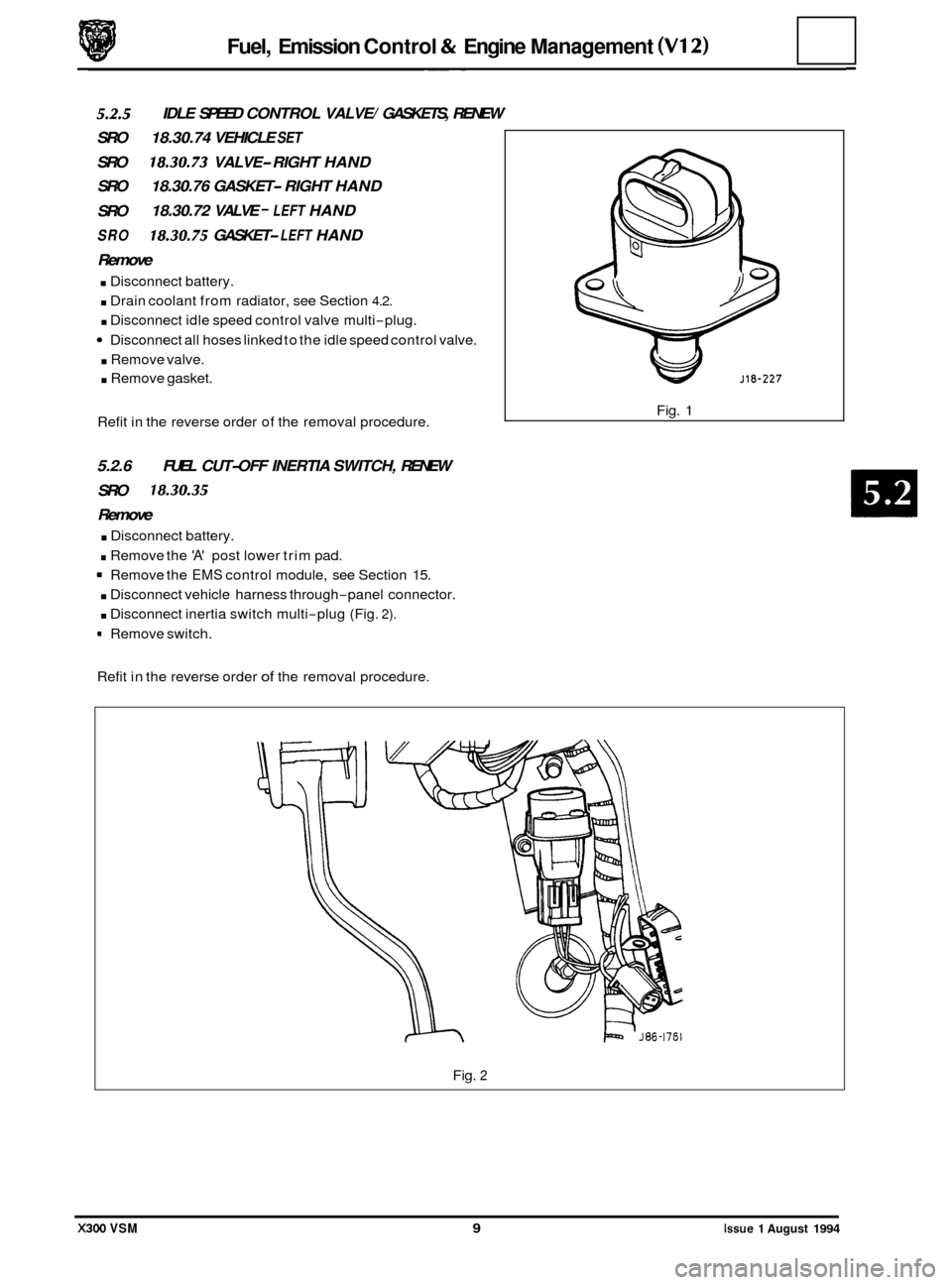
5.2.5
SRO
18.30.74 VEHICLE SET
IDLE SPEED CONTROL VALVE/ GASKETS, RENEW
SRO
18.30.73 VALVE- RIGHT HAND
SRO 18.30.76 GASKET
- RIGHT HAND
SRO
SRO 18.30.75 GASKET- LEFT HAND
18.30.72
VALVE
- LEFT HAND
Remove
. Disconnect battery.
. Drain coolant from radiator, see Section 4.2.
. Disconnect idle speed control valve multi-plug.
Disconnect all hoses linked to the idle speed control valve.
. Remove valve.
. Remove gasket.
Refit in the reverse order of the removal procedure.
5.2.6 FUEL CUT-OFF INERTIA SWITCH, RENEW
SRO
18.30.35
Remove
. Disconnect battery.
. Remove the 'A' post lower trim pad.
= Remove the EMS control module, see Section 15.
. Disconnect vehicle harness through-panel connector.
. Disconnect inertia switch multi-plug (Fig. 2).
9 Remove switch.
Refit in the reverse order
of the removal procedure. Fig.
1
Fig. 2
X300 VSM 9 Issue 1 August 1994
Page 201 of 521
@ Steering
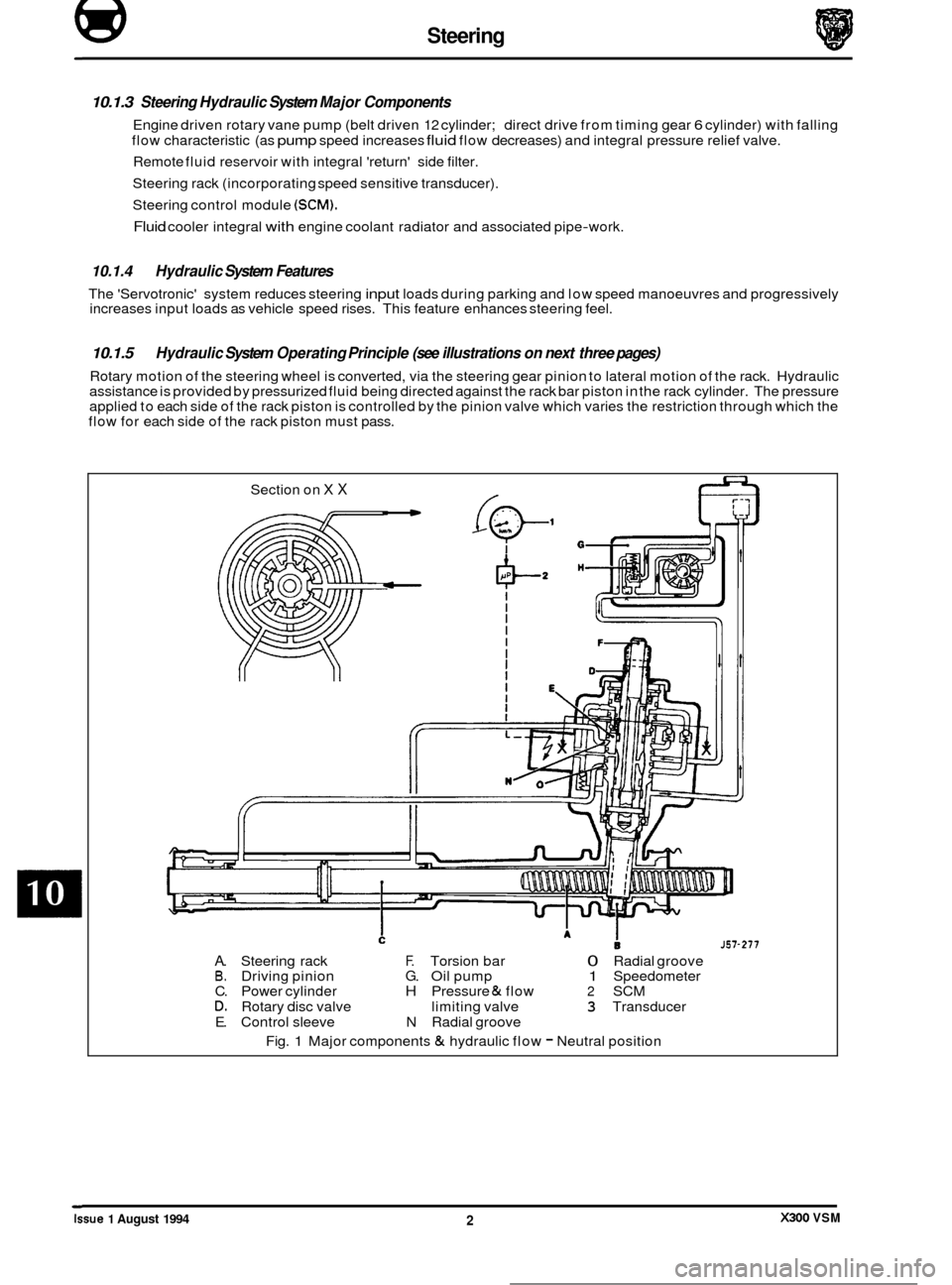
10.1.3 Steering Hydraulic System Major Components
Engine driven rotary vane pump (belt driven 12 cylinder; direct drive from timing gear 6 cylinder) with falling
flow characteristic (as
pump speed increases fluid flow decreases) and integral pressure relief valve.
Remote fluid reservoir with integral 'return' side filter.
Steering rack (incorporating speed sensitive transducer).
Steering control module
(SCM).
Fluid cooler integral with engine coolant radiator and associated pipe-work.
10.1.4 Hydraulic System Features
The 'Servotronic' system reduces steering input loads during parking and low speed manoeuvres and progressively
increases input loads as vehicle speed rises. This feature enhances steering feel.
10.1.5
Rotary motion of the steering wheel is converted, via the steering gear pinion to lateral motion of the rack. Hydraulic
assistance is provided by pressurized fluid being directed against the rack bar piston in the rack cylinder. The pressure
applied to each side of the rack piston is controlled by the pinion valve which varies the restriction through which the
flow for each side of the rack piston must pass.
Hydraulic System Operating Principle (see illustrations on next three pages)
Section on X X
J57-277
A. Steering rack F. Torsion bar 0 Radial groove B. Driving pinion G. Oil pump 1 Speedometer
C. Power cylinder H Pressure & flow 2 SCM D. Rotary disc valve limiting valve 3 Transducer
E. Control sleeve N Radial groove
Fig.
1 Major components & hydraulic flow - Neutral position ~
Issue 1 August 1994 X300 VSM 2
Page 207 of 521
@ Steering
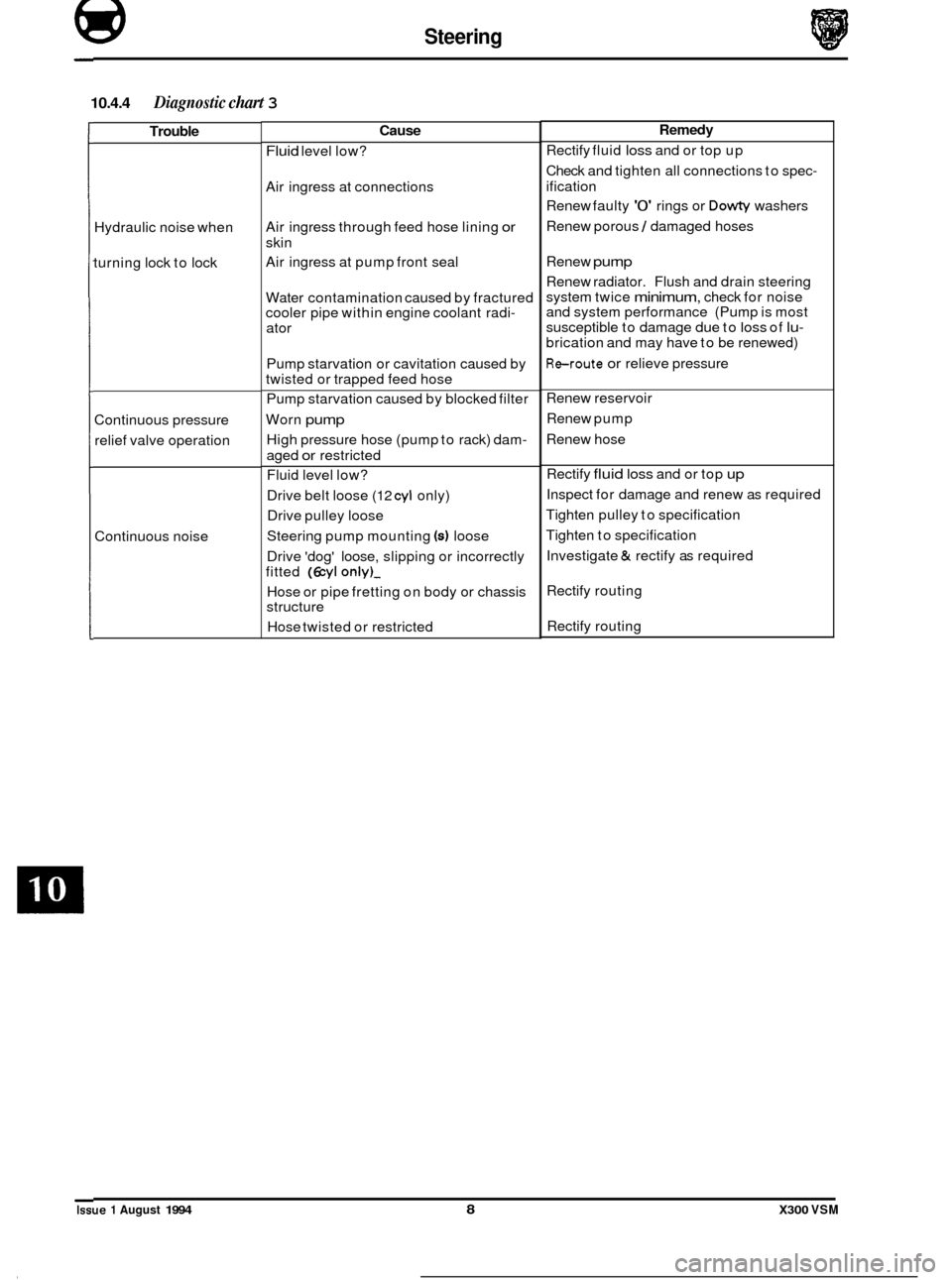
10.4.4 Diagnostic chart 3
Trouble
Hydraulic noise when
turning lock to lock
Continuous pressure
relief valve operation
Continuous noise
Cause
Fluid level low?
Air ingress at connections
Air ingress through feed hose lining
or
skin
Air ingress at pump front seal
Water contamination caused by fractured
cooler pipe within engine coolant radi
-
ator
Pump starvation or cavitation caused by
twisted or trapped feed hose
Pump starvation caused by blocked filter
Worn
pump
High pressure hose (pump to rack) dam-
aged or restricted
Fluid level low?
Drive belt loose
(12 cyl only)
Drive pulley loose
Steering pump mounting
(4 loose
Drive 'dog' loose, slipping or incorrectly
fitted
(6 cyl only)-
Hose or pipe fretting on body or chassis
structure
Hose twisted or restricted
Remedy
Rectify fluid loss and or top up
Check and tighten all connections to spec
-
ification
Renew faulty
'0' rings or Dowty washers
Renew porous
1 damaged hoses
Renew
pump
Renew radiator. Flush and drain steering
system twice
minimum, check for noise
and system performance (Pump is most
susceptible to damage due to
loss of lu-
brication and may have to be renewed)
Reroute or relieve pressure
Renew reservoir
Renew pump
Renew hose
Rectify
fluid loss and or top up
Inspect for damage and renew as required
Tighten pulley to specification
Tighten to specification
Investigate
& rectify as required
Rectify routing
Rectify routing
Issue 1 August 1994 8 X300 VSM
Page 297 of 521
Body Components & Trim a
13.5 HOOD
13.5.1 Hood, Description
The hood is fitted with black moulded covers over the inner fenders and behind the headlamp units; the right hand
fender cover incorporates compartments for spare fuses and tool kit (where fitted). Two gas struts attached by press- on fittings on the body and hood support the hood cover.
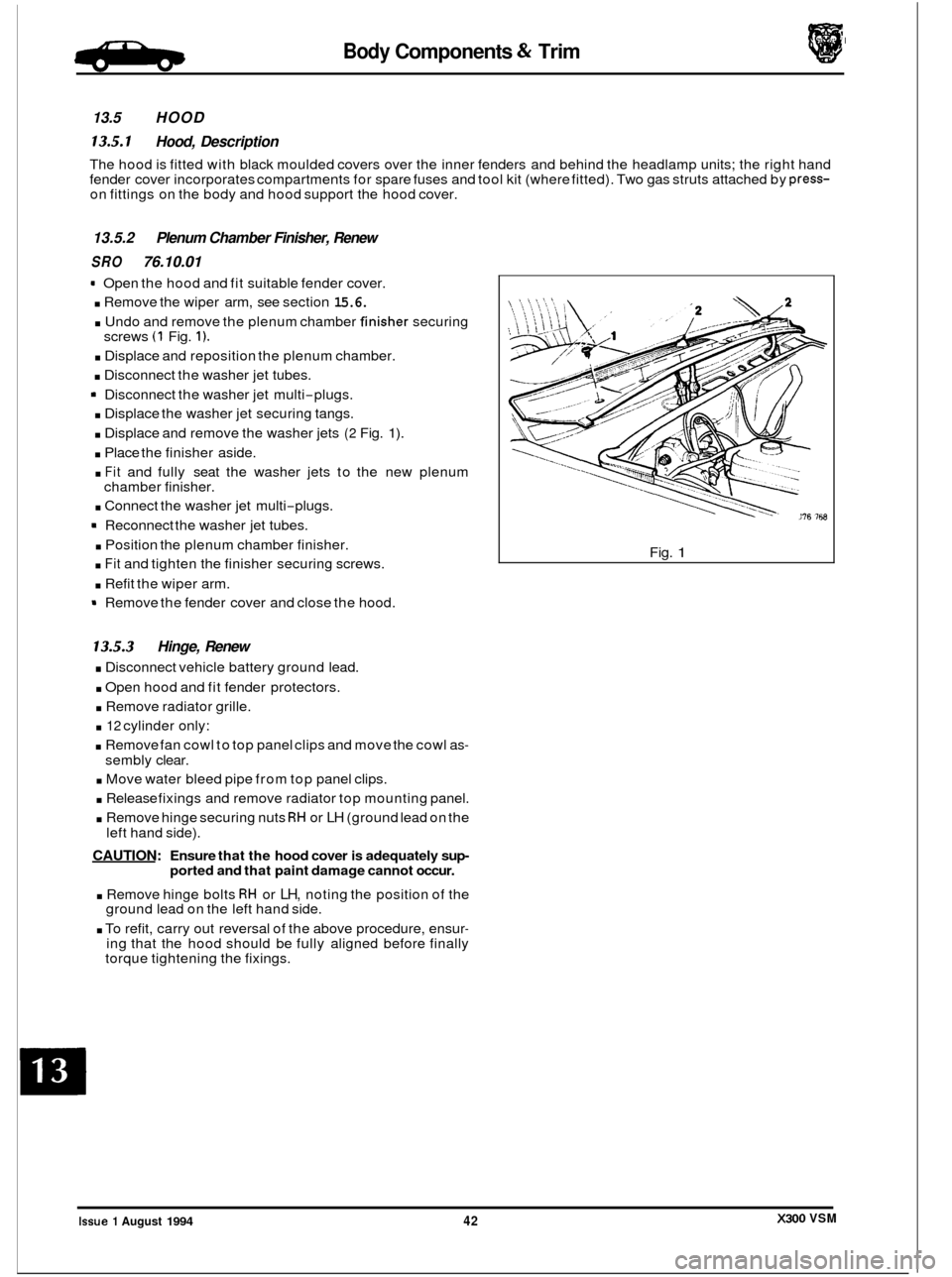
13.5.2 Plenum Chamber Finisher, Renew
SRO 76.10.01
9 Open the hood and fit suitable fender cover.
. Remove the wiper arm, see section 15.6.
. Undo and remove the plenum chamber finis..er securing
. Displace and reposition the plenum chamber.
. Disconnect the washer jet tubes.
9 Disconnect the washer jet multi-plugs.
. Displace the washer jet securing tangs.
. Displace and remove the washer jets (2 Fig. 1).
. Place the finisher aside.
. Fit and fully seat the washer jets to the new plenum
. Connect the washer jet multi-plugs.
9 Reconnect the washer jet tubes.
. Position the plenum chamber finisher.
. Fit and tighten the finisher securing screws.
. Refit the wiper arm.
9 Remove the fender cover and close the hood.
screws
(1 Fig. 1).
chamber
finisher.
13.5.3 Hinge, Renew
. Disconnect vehicle battery ground lead.
. Open hood and fit fender protectors.
. Remove radiator grille.
. 12 cylinder only:
. Remove fan cowl to top panel clips and move the cowl as-
sembly clear.
. Move water bleed pipe from top panel clips.
. Release fixings and remove radiator top mounting panel.
. Remove hinge securing nuts RH or LH (ground lead on the
CAUTION: Ensure that the hood cover is adequately sup- ported and that paint damage cannot occur.
. Remove hinge bolts RH or LH, noting the position of the
ground lead on the left hand side.
. To refit, carry out reversal of the above procedure, ensur- ing that the hood should be fully aligned before finally
torque tightening the fixings.
left
hand side).
I
0
Fig. 1
X300 VSM Issue 1 August 1994 42
Page 319 of 521
Climate Control Systems
14.4 TEMPERATURE CONTROL
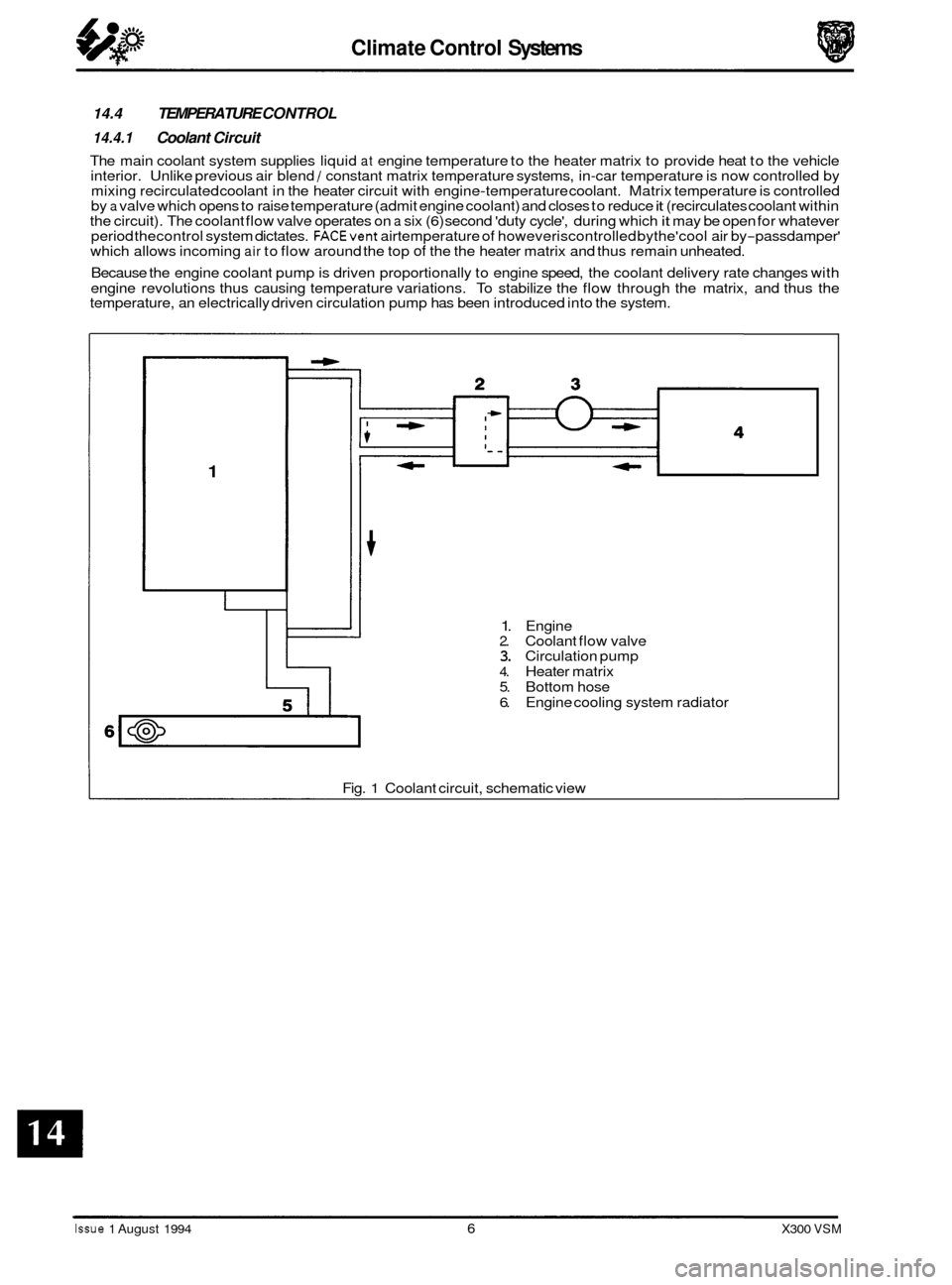
14.4.1 Coolant Circuit
The main coolant system supplies liquid at engine temperature to the heater matrix to provide heat to the vehicle
interior. Unlike previous air blend / constant matrix temperature systems, in-car temperature is now controlled by
mixing recirculated coolant in the heater circuit with engine-temperature coolant. Matrix temperature is controlled
by a valve which opens to raise temperature (admit engine coolant) and closes to reduce it (recirculates coolant within
the circuit). The coolant flow valve operates on a six (6) second 'duty cycle', during which it may be open for whatever
period thecontrol system dictates. FACEvent airtemperature of howeveriscontrolled bythe'cool air by-passdamper'
which allows incoming air to flow around the top of the the heater matrix and thus remain unheated.
Because the engine coolant pump is driven proportionally to engine speed, the coolant delivery rate changes with
engine revolutions thus causing temperature variations. To stabilize the flow through the matrix, and thus the
temperature, an electrically driven circulation pump has been introduced into the system.
1
1. Engine 2. Coolant flow valve 3. Circulation pump
4. Heater matrix
5. Bottom hose
6. Engine cooling system radiator
Fig.
1 Coolant circuit, schematic view
Issue 1 August 1994 6 X300 VSM
Page 384 of 521
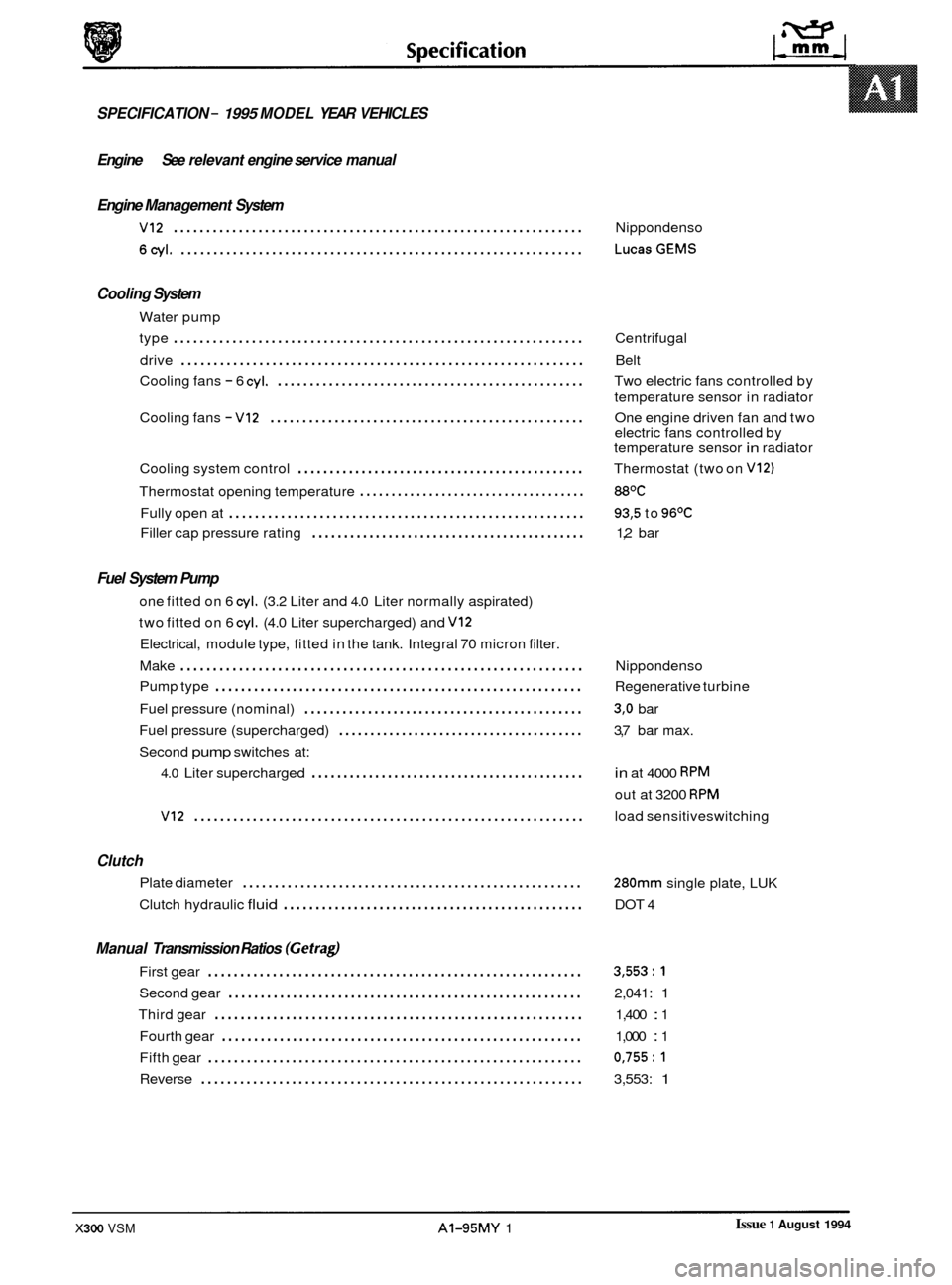
SPECIFICATION - 1995 MODEL YEAR VEHICLES
Engine See relevant engine service manual
Engine Management System
VI2 ............................................................... Nippondenso
6cyl. .............................................................. LucasGEMS
Cooling System
Water pump
type
............................................................... Centrifugal
Cooling fans
- 6 cyl. ................................................ Two electric fans controlled by
Cooling fans
- VI2 ................................................. One engine driven fan and two
Cooling system control
............................................. Thermostat (two on V12)
Thermostat opening temperature .................................... 88OC
Fully open at ....................................................... 93,5 to 96OC
Filler cap pressure rating ........................................... 1,2 bar
drive
.............................................................. Belt
temperature sensor in radiator
electric fans controlled by
temperature sensor
in radiator
Fuel System Pump
one fitted on 6 cyl. (3.2 Liter and 4.0 Liter normally aspirated)
two fitted on 6
cyl. (4.0 Liter supercharged) and VI2
Electrical, module type, fitted in the tank. Integral 70 micron filter.
Make
.............................................................. Nippondenso
Fuel pressure (nominal)
............................................ 3,O bar
Second
pump switches at:
Pump
type
......................................................... Regenerative turbine
Fuel pressure (supercharged)
....................................... 3,7 bar max.
4.0 Liter supercharged ........................................... in at 4000 RPM
out at 3200 RPM
VI2 ............................................................ load sensitiveswitching
Clutch
Plate diameter .....................................................
Clutch hydraulic fluid ............................................... DOT 4
280mm single plate, LUK
Manual Transmission Ratios (Gefragl
First gear .......................................................... 3,553:l
Second gear ....................................................... 2,041: 1
Third gear ......................................................... 1,400 : 1
Fourth gear
........................................................ 1,000 : 1
Fifth gear
.......................................................... 0,755:l
Reverse ........................................................... 3,553: 1
Issue 1 August 1994 X300 VSM AI-95MY 1
Page 409 of 521
Routine Maintenance
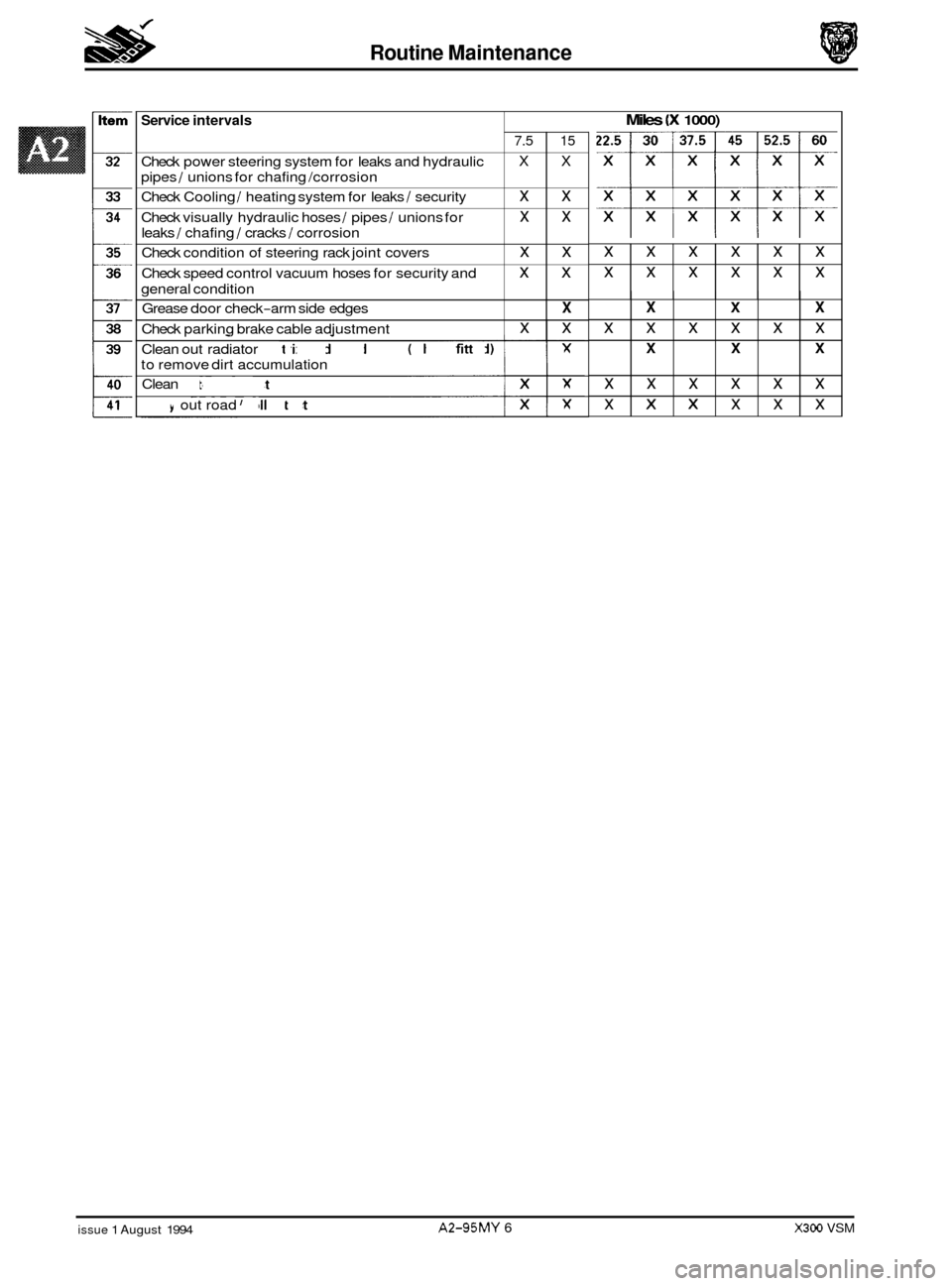
Service intervals
Check power steering system for leaks and hydraulic
pipes
/ unions for chafing /corrosion
Check Cooling
/ heating system for leaks / security
Check visually hydraulic hoses
/ pipes / unions for
leaks
/ chafing / cracks / corrosion
Check condition of steering rack joint covers
Check speed control vacuum hoses for security and
general condition
Grease door check
-arm side edges
Check parking brake cable adjustment
Miles (X 1000)
7.5 15
X X
xx
xx
xx
xx
X
xx
xxxxxx
xxxxxx
x
X X X
xxxxxx
X X X
xxxxxx
XIX x x x
-
Clean out radiator matrix and condenser (where fitted)
to remove dirt accumulation
Clean antenna mast
xx
Carry out road / roller test Ix
i
0
0
0
X
x
issue 1 August 1994 A2-95MY 6 X300 VSM