check oil JAGUAR XJ6 1994 2.G Workshop Manual
[x] Cancel search | Manufacturer: JAGUAR, Model Year: 1994, Model line: XJ6, Model: JAGUAR XJ6 1994 2.GPages: 521, PDF Size: 17.35 MB
Page 44 of 521
Engine
3.1.3 ENGINE OIL, RENEW
SRO 12.60.00
. Undo and remove the sump plug positioned at the rear of
the sump, drain the engine oil into a suitable receptacle
and dispose of
it in a safe and environmentally friendly
manner.
Replenish the engine oil, to the correct level on the dip-
stick (see Fig. 1).
When the oil is renewed, start the engine, wait for the oil
light to extinguish and switch off the engine for 30 sec- onds.
. Finally remove and wipe clean the dip stick,
check the oil level - replenish if necessary.
. For recommended engine oil refer to Appendix AI.
3.1.4 OIL FILTER CARTRIDGE, RENEW
SRO 12.60.04
The white oil filter cartridge displaying the Jaguar logo, is lo- cated on the left-hand side of the engine below the throttle
assembly (Fig. 2).
When refitting, tighten the oil filter cartridge using hand
pressure only.
On no account use an oil filter strap designed
forthe removal
of cartridges.
m: The normal tightening torque of the oil filter is a 3/8 to 1/2 turn after initial contact.
1 JLX-076
Fig. 1
-~ ~ ~~~~~ Issue 1 August 1994 X300 VSM 3
Page 50 of 521
Engine (V12)
3.2.3 ENGINE OIL, RENEW
SRO 12.60.00
. Undo and remove the sump plug positioned at the rear of
the sump, drain the engine oil into a suitable receptacle
and dispose of
it in a safe and environmentally friendly
manner.
. Replenishtheengineoiltothecorrect level (1 Fig. 1) onthe
dipstick.
1ynfa: If the '0' ring on the on the filler cap is damaged, re- move the '0' ring and clean the groove. Secure a
new '0' ring in position using silicon sealant. Treat
the screw threads with copper grease, and grease
the top face of the oil filler with Hylosil lubricant.
When the oil is renewed, start the engine, wait for the oil
light to extinguish and switch off the engine for 30 sec- onds.
. Finally remove and wipe clean the dip stick
(Fig. l), check the oil level - replenish as necessary.
For recommended engine oil refer to Appendix AI. Fig.
1
3.2.4
OIL FILTER CARTRIDGE, RENEW
SRO 12.60.04
The white oil filter cartridge displaying the Jaguar logo, is lo- cated on the lower left-hand side of the engine, near side of
the sump. Access for removing the cartridge is from under- neath the vehicle (Fig. 2).
Remove the catalyst heat shield (where fitted) and use a coil
spring type filter wrench to remove the cartridge.
Start and run the engine for a few seconds to charge the
filter, then stop the engine and
checkthe oil level. Replenish
as necessary.
I Fig. 2
Issue 1 August 1994 X300 VSM 3
r
Page 126 of 521
Manual Transmission & Clutch (AJ16)
GEAR SELECTOR SHAFT- REAR, OVERHAUL
iRY 37.16.41
. Remove the gear selector remote control assembly, see
Displace the selector shaft cover (1 Fig. 1).
. Remove the selector shaft to selector shaft yoke retaining
. Clean all components thoroughly and check for wear and
. Replace worn or damaged components as necessary.
Lubricate and fit the selector shaft yoke to the selector
. Reposition the selector shaft cover.
. Refit the gear selector remote control assembly, see
37.16.20.
pin
(2 Fig. I), and remove the yoke (3 Fig. 1).
damage.
shaft and secure with the retaining pin.
37.16.20.
7.1.10 REVERSE LAMP SWITCH, RENEW
SRO 37.27.01
. Raise the vehicle on a ramp.
. Note and disconnect reverse lamp switch multi-way
= Slacken off and remove the switch.
Clean the mating face.
Fit a new switch.
. Connect the multi-way connector.
. Lower the ramp.
connector.
7.1.11 LAYSHAFT FRONT SEAL, RENEW
SRO 37.23.07
a Remove the transmission assembly, see Sub-Section
. Removethefront oilseal assembly,seeSub-Section7.1.3.
. Using suitable oil seal remover tool, remove and discard
. Clean the transmission face and the front oil seal assem-
. Fit and fully seat the new seal to the casing.
= Refit the transmission front seal assembly.
. Refit the transmission.
7.1.2
layshaft plug
seal.
bly. Fig.
1
X300 VSM Issue 1 August 1994 9
Page 128 of 521
Manual Transmission & Clutch (AJl6)
0
7.1.13 CLUTCH FAULT DIAGNOSIS
symptom
lifficult gear ?ngagement
3attling clutch
squeaking clutch
dibrating clutch or
:lutch judder (often pre- :eded by clutch grab)
stiff clutch operation
Possible Cause
Hydraulic system
defects
Operating mechan
- ism faults
Clutch unit faults
Primary pinion bear
-
ing fault
Clutch unit faults
Defects other than in
clutch unit
Operating linkage
fault
Check
Check fluid level in reservoir
Check for air in the system
Check for defective pedal
Check for damaged pressure plate
Check splines on clutch driven
plate and primary pinion shaft for
wear
Check clutch driven plate for loose
or broken springs and for warping
Check for wear in the clutch with
- drawal mechanism
Check for worn primary pinion
bearing
Check for seizing on primary shaft
or in flywheel
Check the clutch driven plate for
distortion and damage and for
loose or broken torque damper
springs
Check for oil and other foreign
matter on the clutch friction linings
Check for incorrectly fitted clutch
pressure
plate
Check that contact witness on fric-
tion linings is evenlv distributed -
Check for loose flvwheel fixings
and flywheel
run-out
Check for loose engine mountings
Check for worn drive (propeller)
shaft universal joints
Check for bent primary pinion
shaft
-
Check for damaged moving parts
in operating linkage
- -
Check for seized linkage, recheck
operation after remedv
Remedy
Replenish as necessary and
bleed system if necessary
Bleed the system
Renew return spring if
necessary
Renew pressure plate
Renew as necessary clutch
plate or primary pinion
Renew driven plate
Renew as necessary
Renew as necessary
Lubricate or renew as
necessary
Renew driven plate
Renew driven plate and clean
related parts
Dismantle from clutch and
refit where applicable
Renew driven plate as
necessary
Tighten to correct torque
loading
Lubricate linkage as
necess-
X300 VSM 11 Issue 1 August 1994
Page 129 of 521
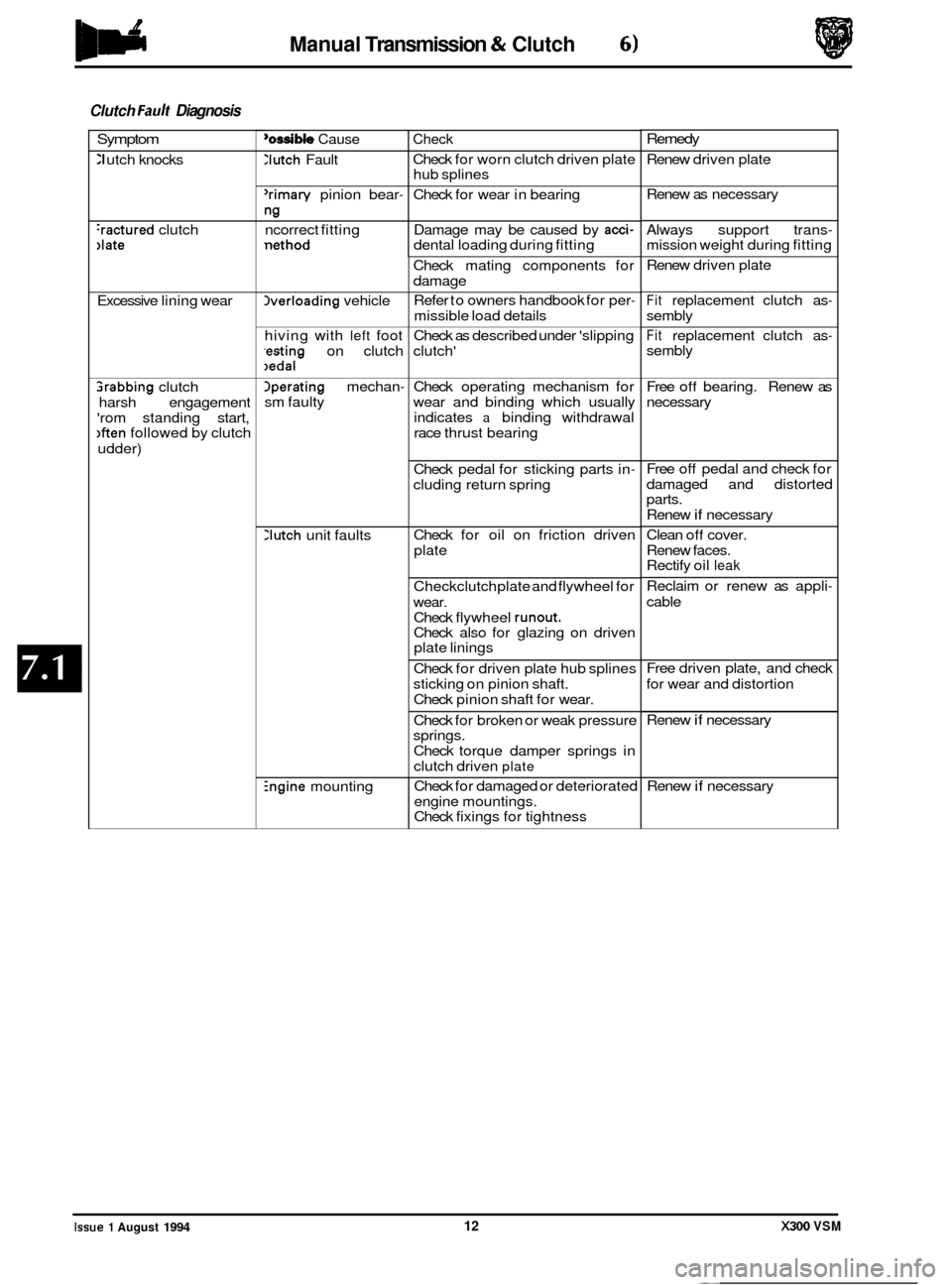
Manual Transmission & Clutch (AJ16)
'ossible Cause
:Iutch Fault
'rimary pinion bear-
ng
ncorrect fitting nethod
Clutch Fault Diagnosis
Check
Check for worn clutch driven plate
hub splines
Check for wear in bearing
Damage may be caused by
acci- dental loading during fitting
Symptom
:I utch knocks
herloading vehicle
hiving with
left foot
,esting on clutch )edal
:ractured clutch )late
Check mating components for
damage
Refer to owners handbook for per
-
missible load details
Check as described under 'slipping
clutch'
Excessive
lining wear
lperating mechan-
sm faulty
:Iutch unit faults
3rabbing clutch
harsh engagement
'rom standing start,
Iften followed by clutch
udder) Check
operating mechanism for
wear and binding which usually
indicates
a binding withdrawal
race thrust bearing
Check pedal for sticking parts in
-
cluding return spring
Check for oil on friction driven
plate
Checkclutch plate and flywheel for
wear. Check flywheel
runout. Check also for glazing on driven
plate linings
Check for driven plate hub splines
sticking on pinion shaft.
Check pinion shaft for wear.
Check for broken or weak pressure
springs.
Check torque damper springs in
clutch driven
plate
hgine mounting Check
for damaged or deteriorated
engine mountings.
Check fixings for tightness
Remedy
Renew driven plate
Renew as necessary
Always support trans
- mission weight during fitting
Renew driven plate
Fit replacement clutch as-
sembly
Fit replacement clutch as- sembly
Free
off bearing. Renew as
necessary
Free
off pedal and check for
damaged and distorted
parts.
Renew
if necessary
Clean
off cover.
Renew faces.
Rectify oil
leak
Reclaim or renew as appli-
cable
Free driven plate, and check
for wear and distortion
Renew
if necessary
Renew
if necessary
Issue 1 August 1994 12 X300 VSM
Page 130 of 521
![JAGUAR XJ6 1994 2.G Workshop Manual Clutch Fault Diagnosis
Symptom
Slipping clutch
[indicated by vehicle
speed not responding to
engine speed increase)
]ragging or spinning :lutch
Manual Transmission & Clutch (AJ16)
Poss](/img/21/7690/w960_7690-129.png "JAGUAR XJ6 1994 2.G Workshop Manual Clutch Fault Diagnosis
Symptom
Slipping clutch
[indicated by vehicle
speed not responding to
engine speed increase)
]ragging or spinning :lutch
Manual Transmission & Clutch (AJ16)
Poss")
Clutch Fault Diagnosis
Symptom
Slipping clutch
[indicated by vehicle
speed not responding to
engine speed increase)
]ragging or spinning :lutch
Manual Transmission & Clutch (AJ16)
Possible Cause
Poor driving tech- nique
Operating mechan
-
ism faulty
Clutch unit faults
Operating mechan
-
ism faulty
Zlutch unit faults
2lutch unit faults
Check
Ensure that none of the remedy
conditions prevail
Checkfor binding withdrawal lever
Check for binding of clutch pedal
movement components
Check for oil on friction faces
Check for binding withdrawal lever
Check for binding of clutch pedal
movement components
Check for oil on friction faces
Check for broken or weak pressure
springs
.-
Check clutch plates and flywheel
for wear and distortion
Check clutch driven plate for frac
- tures and distortion.
Damage may be caused by acci
-
dental loading during assembly of
transmission to engine.
Always support transmission
weight during refitting
Check for primary pinion bearing
seized
Check clutch driven hub for bind
- ing on primary pinion splines.
Check for too thick friction linings.
Ensure linings
are good
Check for foreign matter in clutch
unit
Remedv
Do not increase engine speed
with clutch paGially' en-
gaged. Do not drive with left foot
resting on clutch pedal.
Free lever and check for wear
and distortion
Free
off seized or binding
components
Clean
off metal faces.
Renew driven plate.
Rectify oil leak.
Free lever and check for wear
and distortion
Free
off seized or binding
components
Clean
off metal faces.
Renew driven plate.
Rectify oil leaks.
Renew cover as necessary
Reclaim or renewclutch
plate
as applicable
Renew driven plate and
check mating components
for damage
Rectify or renew as necess
-
ary
Renew as necessary
Clean and renew compo
-
nents as necessary
X300 VSM 13 Issue 1 August 1994
Page 180 of 521

Driveshafts & Final Drive
SECTION CONTENTS
Sub
-Section Title SRO Page
it0 iv ............ PreliminaryPages ................................................................. itov
9.1 .............. Major Component Description ......................................................... 1
9.2 .............. Drive Shaft. Align .............................................. 47.15.51 ............. 2
9.3
.............. Final Drive Unit Output Shaft End Float. Check ..................... 51.10.24 ............. 4
9.4
.............. Final Drive Unit Output Shaft Housing '0' Ring. Renew .............. 51.20.19 ............. 4
9.5
.............. Final Drive Unit Oil Seal Pinion Flange. Renew ..................... 51.20.01 ............. 4
9.6
.............. Final Drive Unit Output Shaft Bearing. Renew ...................... 51.10.22 ............. 5
9.7 .............. Final Drive Unit Output Shaft Oil Seal. Renew ...................... 51.20.04 ............. 5
9.8
.............. Final Drive Unit. Renew ........................................ 51.25.13 ............. 6
9.9. .............. Axle Shaft Assembly, Renew ..................................... 47.10.01 ............. 7
9.10
............. Rear Hub Bearing. Renew ....................................... 64.15.14 ............. 8
9.11 ............. Rear Hub Oil Seal . Renew ....................................... 64.15.15 ............. 8
Page 189 of 521
Driveshafts & Final Drive
9.3
SRO 51.10.24
Disconnect vehicle battery ground lead.
. Support the vehicle at the rear.
OUTPUT SHAFT END FLOAT, CHECK
Mount a dial test indicator (DTI) to the differential housing with the probe resting on the output shaft flange (DTI probe must be parallel to the output shaft center line and NOT at an angle).
. Push the wheel 1 shaft assembly inwards and zero the DTI; pull outwards and note the reading.
. If the end float exceeds 0,15 mm; firstly verify the shim preload and if this is found to be correct, renew the output
shaft bearing. See 51.10.22. this section, for shim check and renew operations.
9.4
SRO 51.20.19
rn Disconnect vehicle battery ground lead.
See operation 51.10.22. this section, for process detail, less bearing 1 oil seal renew.
OUTPUT SHAFT HOUSING ‘0’ RING, RENEW
Prior to removal of shaft assembly check output shaft end float in accordance with operation 51.10.24.
9.5 OIL SEAL - PINION FLANGE, RENEW
SRO 51.20.01
. Disconnect vehicle battery ground lead.
. Support the vehicle at the rear.
. Disconnect main handbrake cable at compensator.
’Match mark‘ the FLEXIBLE COUPLING to the differential DRIVE FLANGE and remove fixings.
Remove fixings center bearing to crossmember and push drive shaft rear section forward to disengage from pinion
spigot.
CAUTION: Under no circumstances must the flexible coupling (or its fixings) be loosened or removed from the drive
shaft flange.
Support the drive shaft, do not allow it to hang.
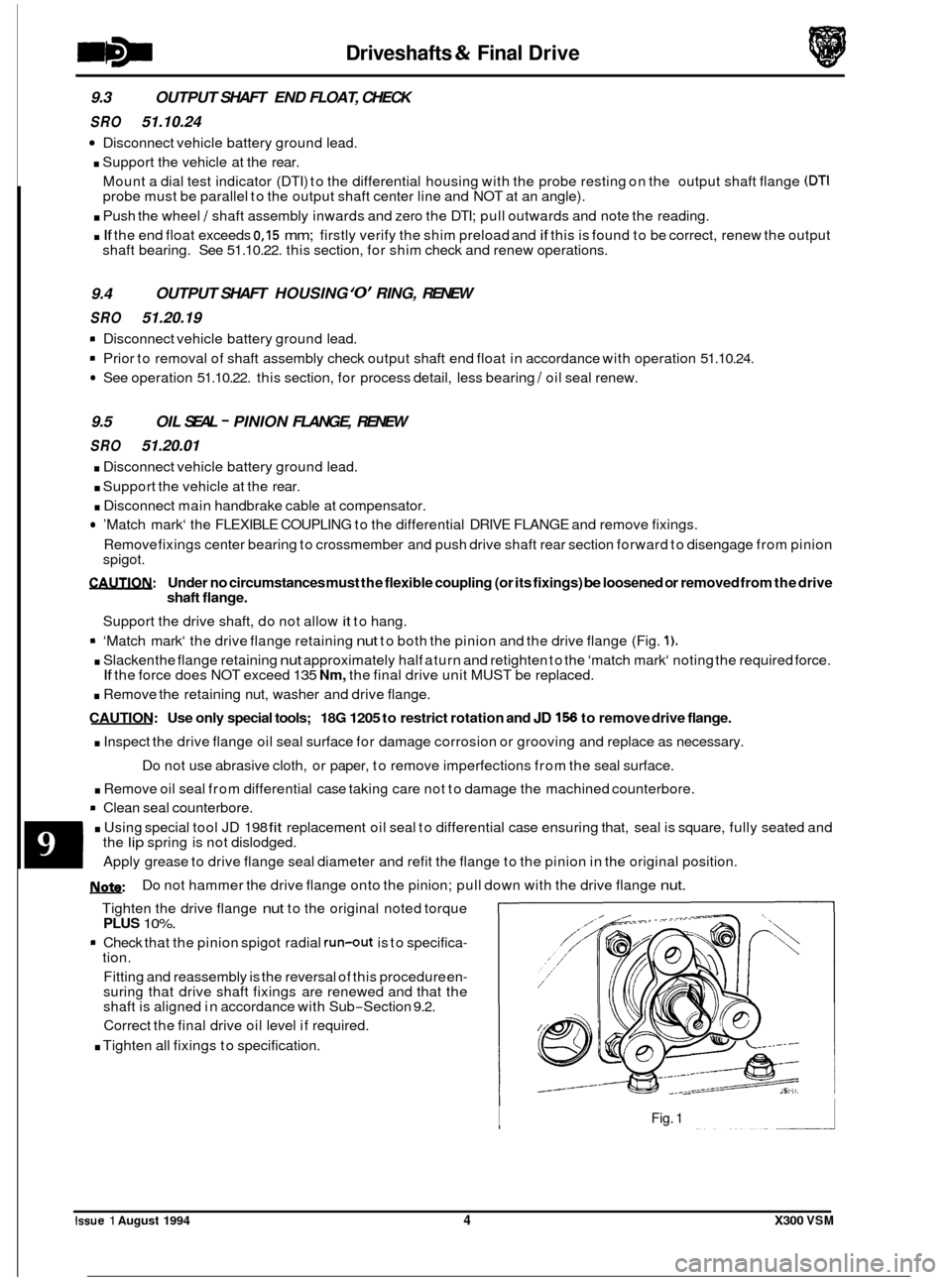
9 ‘Match mark‘ the drive flange retaining nut to both the pinion and the drive flange (Fig. 1).
. Slacken the flange retaining nut approximately half a turn and retighten to the ‘match mark‘ noting the required force.
. Remove the retaining nut, washer and drive flange.
CAUTION: Use only special tools; 18G 1205 to restrict rotation and JD 156 to remove drive flange.
. Inspect the drive flange oil seal surface for damage corrosion or grooving and replace as necessary.
. Remove oil seal from differential case taking care not to damage the machined counterbore.
rn Clean seal counterbore.
. Using special tool JD 198 fit replacement oil seal to differential case ensuring that, seal is square, fully seated and
If the force does NOT exceed 135 Nm, the final drive unit MUST be replaced.
Do not use abrasive cloth, or paper, to remove imperfections from the seal surface.
the
lip spring is not dislodged.
Apply grease to drive flange seal diameter and refit the flange to the pinion in the original position.
U: Do not hammer the drive flange onto the pinion; pull down with the drive flange nut.
Tighten the drive flange nut to the original noted torque PLUS 10%.
* Check that the pinion spigot radial run-out is to specifica- tion.
Fitting and reassembly is the reversal of this procedure en
- suring that drive shaft fixings are renewed and that the
shaft is aligned in accordance with Sub-Section 9.2.
Correct the final drive oil level if required.
. Tighten all fixings to specification.
Fig. 1
0
Issue 1 August 1994 4 X300 VSM
Page 190 of 521
Driveshafts & Final Drive
9.6 OUTPUT SHAFT BEARING, RENEW
@ SRO 51.10.22
9.7
SRO 51.20.04
. Disconnect vehicle battery ground lead.
. Support the vehicle at the rear and remove the rear road wheel (or wheels).
9 'Match mark' the axle shaft flange to the output shaft flange and remove fixings, note camber shim.
. Thoroughly clean the area around the output shaft housing and differential case.
. Release fixings and remove output shaft assembly, discard '0' ring.
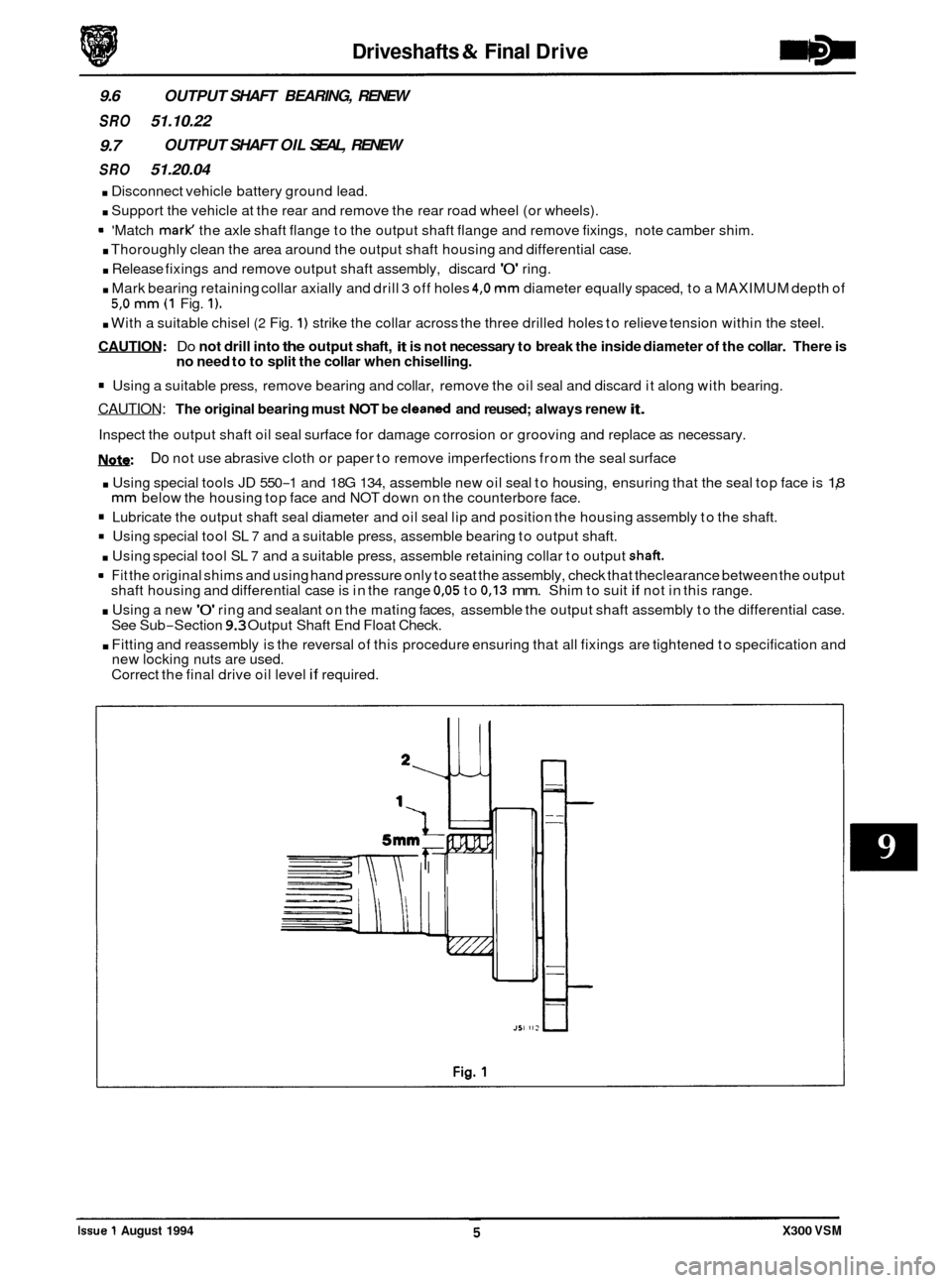
. Mark bearing retaining collar axially and drill 3 off holes 4,O mm diameter equally spaced, to a MAXIMUM depth of
. With a suitable chisel (2 Fig. 1) strike the collar across the three drilled holes to relieve tension within the steel.
CAUTION: Do not drill into the output shaft, it is not necessary to break the inside diameter of the collar. There is
no need to to split the collar when chiselling.
Using a suitable press, remove bearing and collar, remove the oil seal and discard it along with bearing.
CAUTION: The original bearing must NOT be cleaned and reused; always renew it.
Inspect the output shaft oil seal surface for damage corrosion or grooving and replace as necessary.
W:
OUTPUT SHAFT OIL SEAL, RENEW
5,O mm (1 Fig. 1).
Do not use abrasive cloth or paper to remove imperfections from the seal surface
. Using special tools JD 550-1 and 18G 134, assemble new oil seal to housing, ensuring that the seal top face is 1,8 mm below the housing top face and NOT down on the counterbore face.
Lubricate the output shaft seal diameter and oil seal lip and position the housing assembly to the shaft.
Using special tool SL 7 and a suitable press, assemble bearing to output shaft.
. Using special tool SL 7 and a suitable press, assemble retaining collar to output shaft.
= Fit the original shims and using hand pressure only to seat the assembly, check that theclearance between the output
. Using a new '0' ring and sealant on the mating faces, assemble the output shaft assembly to the differential case.
. Fitting and reassembly is the reversal of this procedure ensuring that all fixings are tightened to specification and
shaft
housing and differential case is in the range
0,05 to 0,13 mm. Shim to suit if not in this range.
See Sub
-Section 9.3 Output Shaft End Float Check.
new locking nuts are used.
Correct the final drive oil level
if required.
Issue 1 August 1994 X300 VSM
Page 192 of 521
Driveshafts & Final Drive
. Remove upper link assembly from differential and wide mounting bracket / 'A' frame.
. Release fixings, 'A' frame to differential, 'A' frame to wishbone tie and wide mounting bracket to 'A' frame.
. Remove wishbone tie assembly, rear mounting bracket and pendulum assembly.
. Release fixings differential nose to wide mounting bracket.
. Assembly and fitting is the reversal of this procedure, taking note of the following:
Drive shaft must be aligned in accordance with Sub
-Section 9.2.
Renew all self locking nuts.
Renew all bolts that were originally fitted with thread locking adhesive.
Replace all locking wire and split pins (cotter pins).
Tighten all fixings to the specified torque.
Correct the final drive oil level
if required.
Check and adjust rear wheel camber setting as required.
9.9 AXLE SHAFT ASSEMBLY, RENEW
SRO
47.10.01
Disconnect vehicle battery ground lead.
. Slacken appropriate axle shaft hub nut.
. Support the vehicle at the rear and remove rear road
. Remove brake caliper in accordance with 70.55.03. Sec-
wheel.
tion 12, but do not disconnect hydraulics.
Slacken hub carrier fulcrum and remove ABS sensor from
hub carrier.
. Remove axle shaft hub nut and collar.
. Remove fixings axle shaft to differential output shaft
flange, note camber shim.
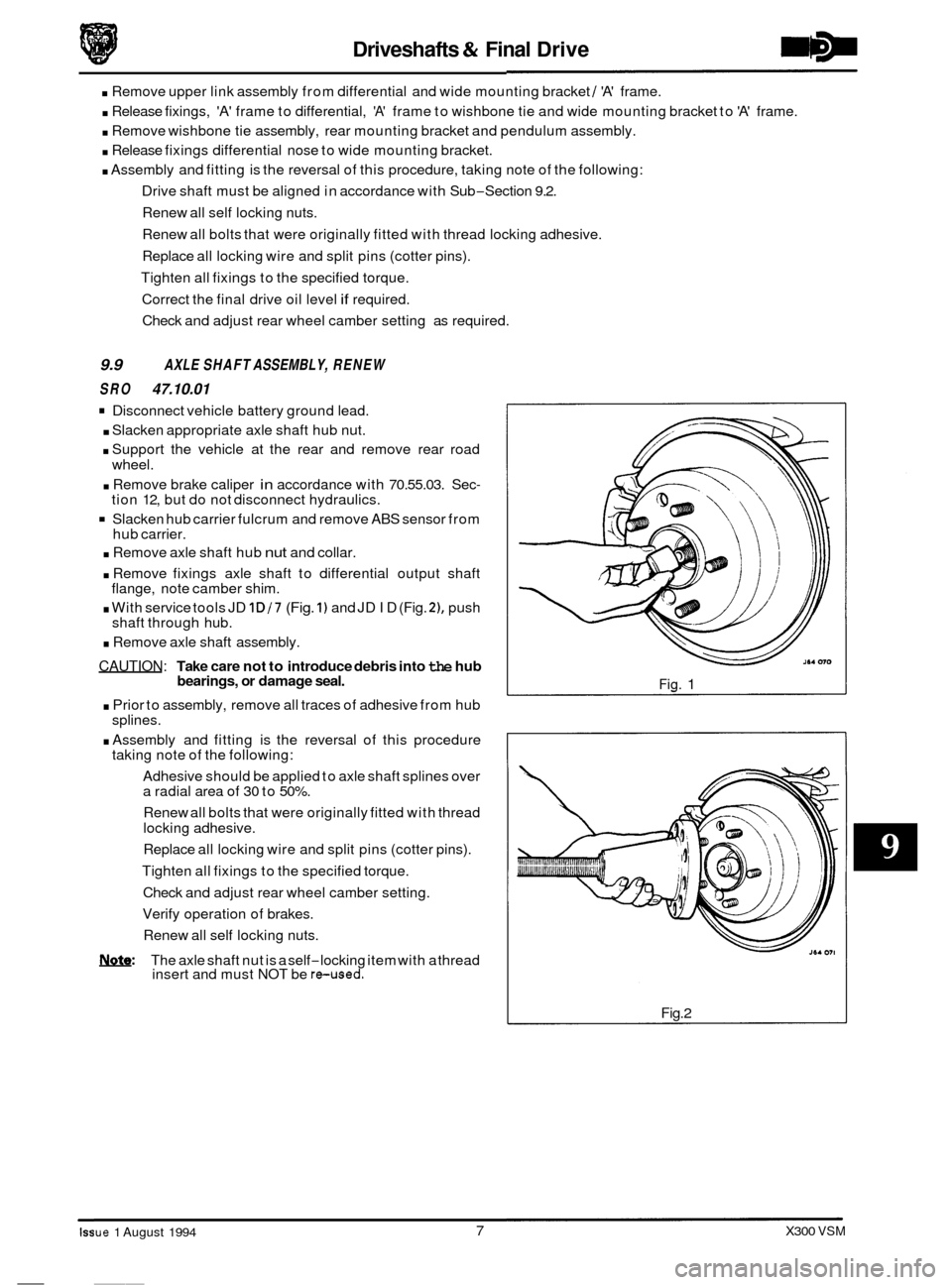
. With service tools JD 1D/7 (Fig. 1) and JD ID (Fig. 21, push
shaft through hub.
. Remove axle shaft assembly.
CAUTION: Take care not to introduce debris into the hub
bearings, or damage seal.
. Prior to assembly, remove all traces of adhesive from hub
. Assembly and fitting is the reversal of this procedure
Adhesive should be applied to axle shaft splines over
a radial area of
30 to 50%.
Renew all bolts that were originally fitted with thread
locking adhesive.
Replace all locking wire and split pins (cotter pins).
Tighten all fixings to the specified torque.
Check and adjust rear wheel camber setting.
Verify operation of brakes.
Renew all self locking nuts.
splines.
taking
note of the following:
0
NQ&: The axle shaft nut is a self-locking item with a thread
insert and must NOT be reused.
Fig. 1
Fig.2
- Iss ue 1 August 1994
__~
7 X300 VSM