transmission JAGUAR XJ6 1994 2.G Owner's Manual
[x] Cancel search | Manufacturer: JAGUAR, Model Year: 1994, Model line: XJ6, Model: JAGUAR XJ6 1994 2.GPages: 521, PDF Size: 17.35 MB
Page 46 of 521
SECTION CONTENTS
-
Engine (V12)
m
X300 VSM i Issue 1 August 1994
Sub-section Title SRO Page
Ito111 ............ PreliminaryPages .................................................................... i
3.2.7 . . . . . . . . . . . . . Engine,General . . . . . . . . . . . . . . . . . . . . . . . . . . . . . . . . . . . . . . . . . . . . . . . . . . . . . . . . . . . . . . . . . . . . . . 1
3.2.2.. . . . . . . . . . . . Engine/ Transmission Unit, Renew. . . . . . . . . . . . . . . . . . . . . . . . . . . , . . . . 12.37. 01/90 . . . . . . . . . . 2
3.2.3
. . . . . . . . . . . . . Engine Oil, Renew . . . . . . . . . . . . . . . . . . . . . . . . . . . . . . . . . . . . . . . . . . . . . 12.60.00 . . . . . . . . . . . . . 3
3.2.4
. . . . . . . . . . . . . Oil Filter Canister, Renew . . . . . . . . . . . . . . . . . . . . . . . . . . . . . . . . . . . . . . . 12.60.04 . . . . . . . . . . . . . 3
3.2.5..
. . . . . . . . . . . Oil Cooler . . . . . . . . . . . . . . . . . . . . . . . . . . . . . . . . . . . . . . . . . . . . . . . . . . . . 12.60.68 . . . . . . . . . . . . . 4
3.2.6
. . . . . . . . . . . . Front Engine Mounting Bracket Assembly, Renew . . . . . . . . . . . . . . . . . . . 12.45.01 LH
12.45.03 RH ... . . . . , . . 4
3.1.7
. . . . . . . . . . . . Rear Engine Mounting Assembly, Renew . . . . . . . . . . . . . . . . . . . . . . . . . . . 12.45.08 . . . . . . . . . . . . . 5
Page 48 of 521
Engine (V12)
3.2.1 ENGINE, GENERAL
The twelve cylinder, vee formation engine has a capacity of 6.0 liters. Each cylinder bank has a single overhead
camshaft and two valves percylinder. The engine has a fully mapped engine management system with digital ignition
and two ignition coils.
This section describes the service procedures to be carried out with the engine in situ.
It also covers the renewal of
the engine / transmission unit.
For information relating
tostrip-down, inspedion,fault diagnosis, renovation and rebuild work, referto the VI2 Engine
Service Manual.
X300 VSM 1 Issue 1 August 1994
Page 49 of 521
3.2.2 ENGINE - GEARBOX/ TRANSMISSION
ASSEMBLY, RENEW
SRO 12.37.01/90
The engine /transmission unit on the V12 6.0 liter model is mounted on three engine mounting / bracket assemblies
fitted to the front crossmember on either side of the engine bay. The engine/ transmission rear mount is a mounting
bracket and spring assembly fitted and secured to body underframe longitudinal members. For access to remove the
engine carry
out the following procedures:
WARNING: WHEN WORKING WITHIN THE ENGINE COMPARTMENT, KEEP CLEAR OF THE RADIATOR COOLING
FANS AS THEY COULD START WITHOUT WARNING, EVEN IF THE ENGINE IS NOT RUNNING.
. Remove the hood, see SRO 76.16.01, section 13.
. Remove the two air cleaner assemblies, see SRO’s 19.10.01 & 19.10.02.
. Remove the engine cover, see SRO 12.29.93 (V12 Engine Service Manual).
Depressurize the fuel system, see SRO 19.50.02, section 5.1.
In line with the relevant SRO’s and sections, remove all appropriate obstructing parts, including their fixing and
. Disconnect all mechanical and isolate all electrical linkages leading to and from the engine.
. De-gas the air conditioning system, see section 14, Charge Recovery (System depressurization).
Disconnect
the battery.
mounting arrangements.
CAUTION: Do
not vent refrigerant directly to the atmosphere and always use Jaguar approved recovery/recycle/ra charge equipment.
Drain the engine oil, see 3.2.3 this section.
Drain the coolant, see SRO 26.10.01, section 4.1.
WARNING: DO NOT REMOVE THE HEADER TANK PRESSURE CAP WHILE THE ENGINE IS HOT. IF THE CAP MUST
BE REMOVED, PROTECT THE HANDS AGAINST ESCAPING STEAM AND SLOWLY TURN THE CAP ANTI- CLOCKWISE UNTIL THE EXCESS PRESSURE CAN ESCAPE. LEAVE THE CAP IN THIS POSITION UNTIL ALL
STEAM AND PRESSURE HAS ESCAPED AND THEN REMOVE THE CAP COMPLETELY.
Before
lifting the complete engine/transmission unit with an engine hoist from the engine bay, ensure that two engine
lifting brackets (tool 18G. 1465) are secured equallyspaced to the inlet manifold studs. The four engine lifting brackets
should be positioned towards the front and the rear of the assembly. Ensure the front of thevehicle is jacked
up secure- ly on stands when removing the assembly.
X300 VSM Issue 1 August 1994 2
Page 51 of 521
Engine (V12)
3.2.5 OIL COOLER, RENEW
SRO 12.60.68
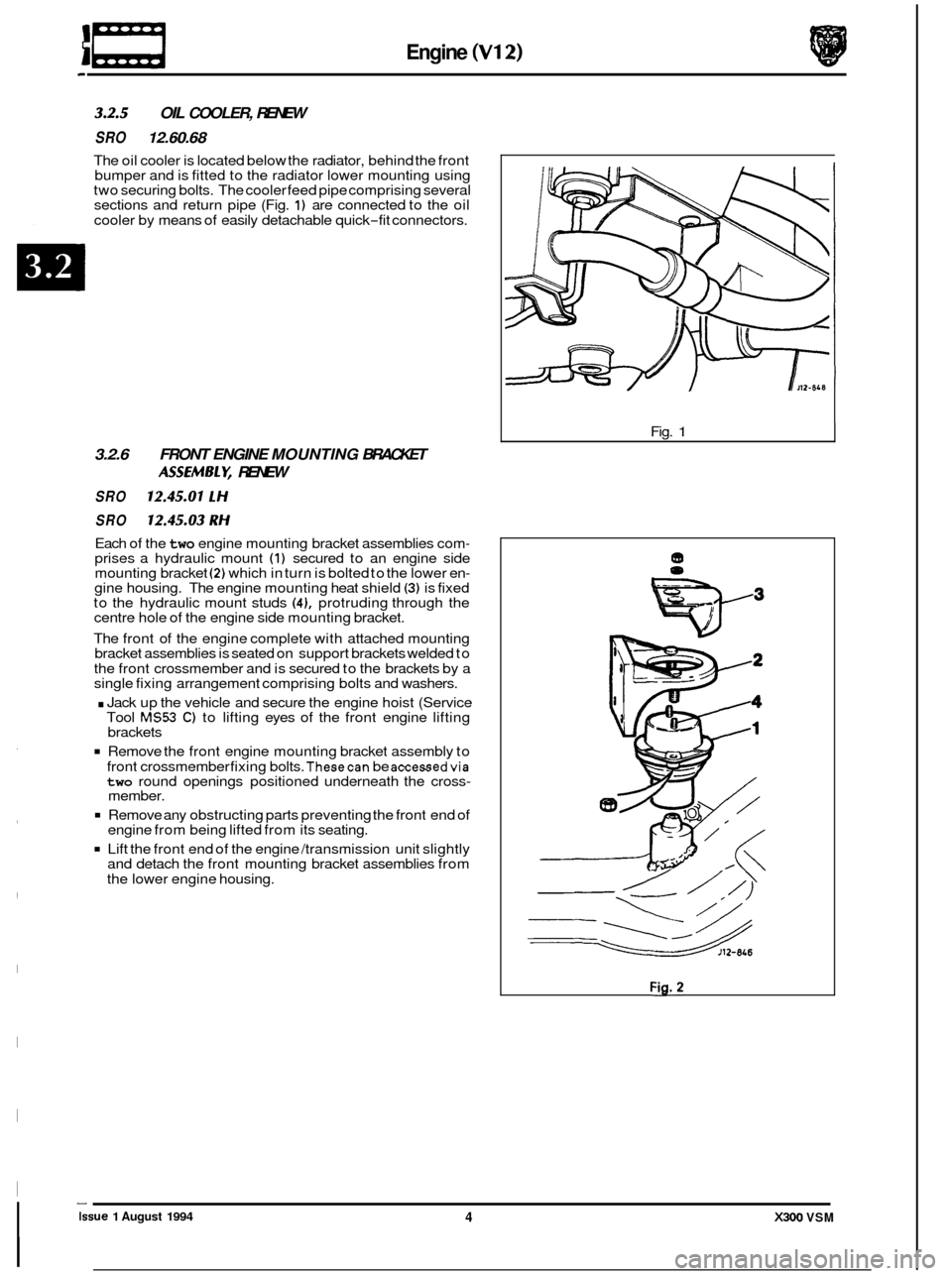
The oil cooler is located below the radiator, behind the front
bumper and is fitted to the radiator lower mounting using
two securing bolts. The cooler feed pipe comprising several
sections and return pipe (Fig.
1) are connected to the oil
cooler by means of easily detachable quick
-fit connectors.
3.2.6 FRONT ENGINE MOUNTING BRACKET
SRO 12.45.01 LH
SRO 12.45.03 RH
Each of the two engine mounting bracket assemblies com- prises a hydraulic mount (1) secured to an engine side
mounting bracket (2) which in turn is bolted to the lower en- gine housing. The engine mounting heat shield (3) is fixed
to the hydraulic mount studs (41, protruding through the
centre hole of the engine side mounting bracket.
The front of the engine complete with attached mounting
bracket assemblies is seated on support brackets welded to
the front crossmember and is secured to the brackets by a
single fixing arrangement comprising bolts and washers.
. Jack up the vehicle and secure the engine hoist (Service
Tool MS53 C) to lifting eyes of the front engine lifting
brackets
Remove the front engine mounting bracket assembly to
front crossmember fixing bolts.
Thesecan be accessedvia two round openings positioned underneath the cross- member.
Remove any obstructing parts preventing the front end of
engine from being lifted from its seating.
Lift the front end of the engine /transmission unit slightly
and detach the front mounting bracket assemblies from
the lower engine housing.
ASSEMBLV, RENEW
Fig. 1
4 X300 VSM Issue 1 August 1994
Page 56 of 521
Cooling System (AJl6) m
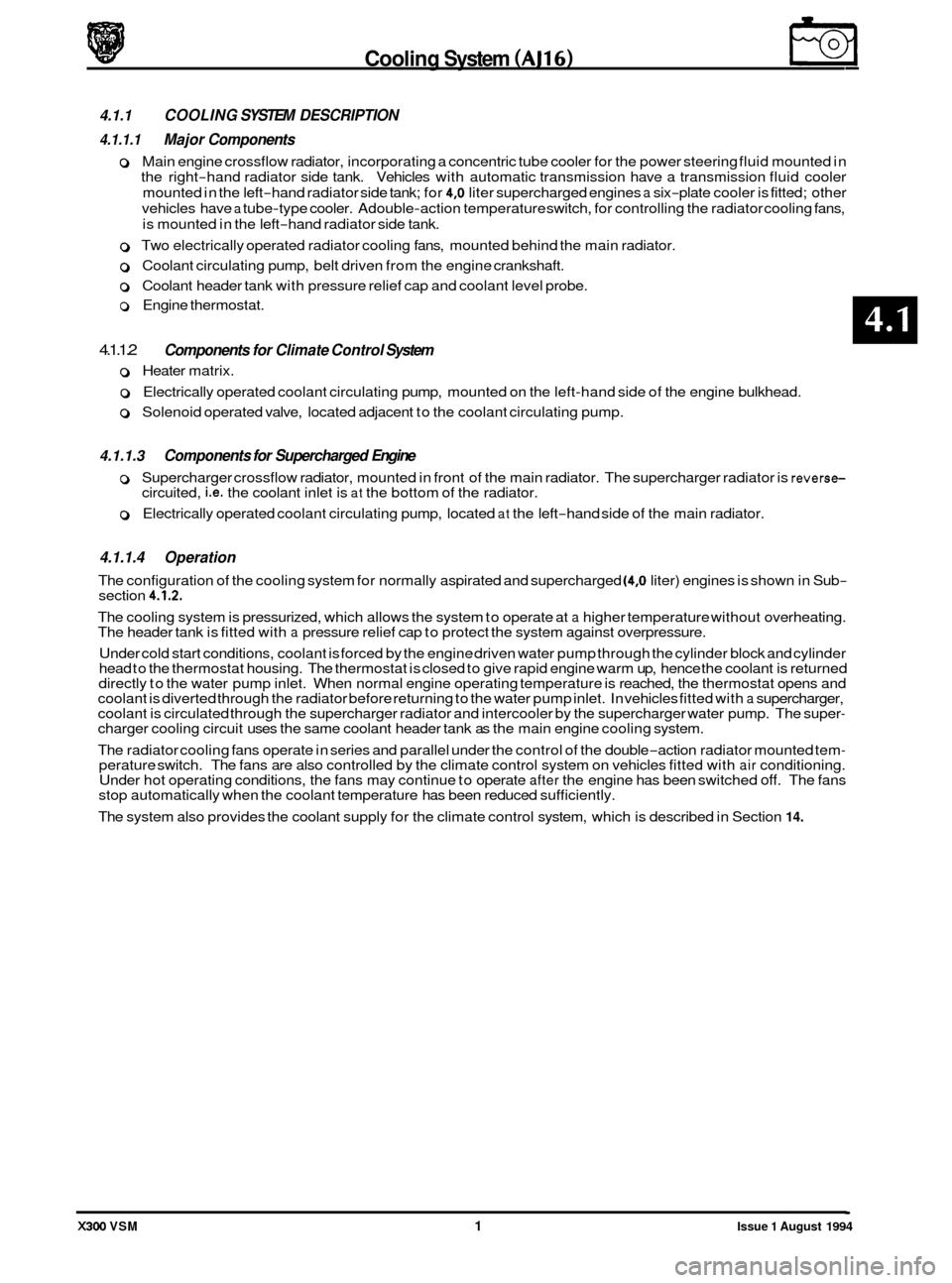
4.1.1 COOLING SYSTEM DESCRIPTION
4.1.1.1 Major Components
o Main engine crossflow radiator, incorporating a concentric tube cooler for the power steering fluid mounted in
the right
-hand radiator side tank. Vehicles with automatic transmission have a transmission fluid cooler
mounted in the left
-hand radiator side tank; for 4,O liter supercharged engines a six-plate cooler is fitted; other
vehicles have
a tube-type cooler. Adouble-action temperature switch, for controlling the radiator cooling fans,
is mounted in the left
-hand radiator side tank.
0 Two electrically operated radiator cooling fans, mounted behind the main radiator.
0 Coolant circulating pump, belt driven from the engine crankshaft.
0 Coolant header tank with pressure relief cap and coolant level probe.
o Engine thermostat.
4.1.1.2
0 Heater matrix.
o Electrically operated coolant circulating pump, mounted on the left-hand side of the engine bulkhead.
o Solenoid operated valve, located adjacent to the coolant circulating pump.
Components for Climate Control System
4.1.1.3 Components for Supercharged Engine
0 0 Supercharger crossflow radiator, mounted in front of the main radiator. The supercharger radiator is reverse- circuited, i.e. the coolant inlet is at the bottom of the radiator.
0 Electrically operated coolant circulating pump, located at the left-hand side of the main radiator.
4.1.1.4 Operation
The configuration of the cooling system for normally aspirated and supercharged (4,O liter) engines is shown in Sub- section 4.1.2.
The cooling system is pressurized, which allows the system to operate at a higher temperature without overheating.
The header tank is fitted with a pressure relief cap to protect the system against overpressure.
Under cold start conditions, coolant is forced by the engine driven water pump through the cylinder block and cylinder
head to the thermostat housing. The thermostat is closed to give rapid engine warm up, hence the coolant is returned
directly to the water pump inlet. When normal engine operating temperature is reached, the thermostat opens and
coolant is diverted through the radiator before returning to the water pump inlet. In vehicles fitted with
a supercharger,
coolant is circulated through the supercharger radiator and intercooler by the supercharger water pump. The super- charger cooling circuit uses the same coolant header tank as the main engine cooling system.
The radiator cooling fans operate in series and parallel under the control of the double
-action radiator mounted tem- perature switch. The fans are also controlled by the climate control system on vehicles fitted with air conditioning.
Under hot operating conditions, the fans may continue to operate after the engine has been switched off. The fans
stop automatically when the coolant temperature has been reduced sufficiently.
The system also provides the coolant supply for the climate control system, which is described in Section
14.
X300 VSM 1 Issue 1 August 1994
Page 66 of 521
Cooling System (V12
4.2.1 COOLING SYSTEM DESCRIPTION I
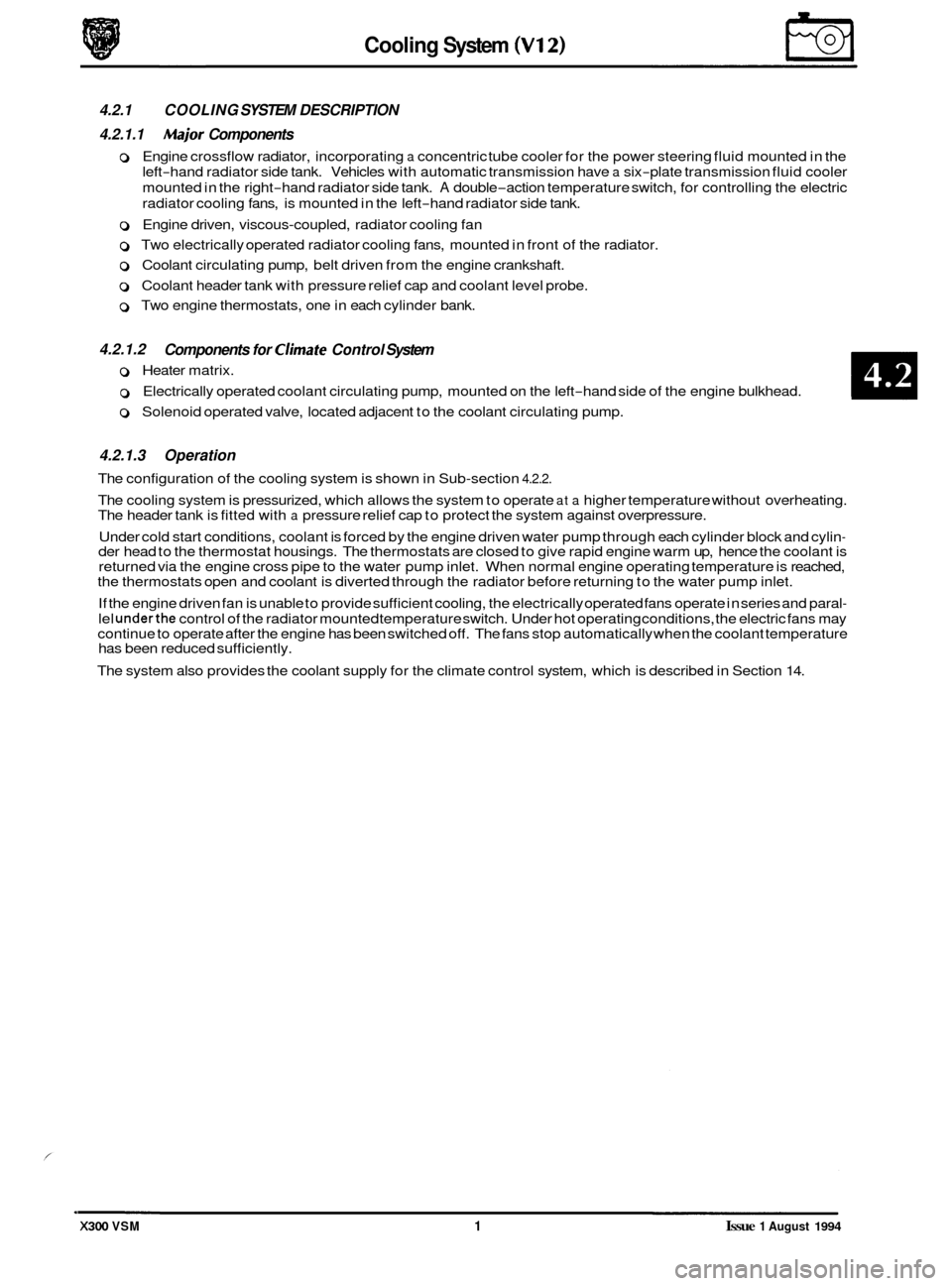
4.2.1.1 Major Components
o Engine crossflow radiator, incorporating a concentric tube cooler for the power steering fluid mounted in the
left
-hand radiator side tank. Vehicles with automatic transmission have a six-plate transmission fluid cooler
mounted in the right
-hand radiator side tank. A double-action temperature switch, for controlling the electric
radiator cooling fans, is mounted in the left
-hand radiator side tank.
0 Engine driven, viscous-coupled, radiator cooling fan
0 Two electrically operated radiator cooling fans, mounted in front of the radiator.
o Coolant circulating pump, belt driven from the engine crankshaft.
0 Coolant header tank with pressure relief cap and coolant level probe.
0 Two engine thermostats, one in each cylinder bank.
4.2.1.2
0 Heater matrix.
0 Electrically operated coolant circulating pump, mounted on the left-hand side of the engine bulkhead.
o Solenoid operated valve, located adjacent to the coolant circulating pump.
Components for Climate Control System
1
4.2.1.3 Operation
The configuration of the cooling system is shown in Sub-section 4.2.2.
The cooling system is pressurized, which allows the system to operate at a higher temperature without overheating.
The header tank is fitted with a pressure relief cap to protect the system against overpressure.
Under cold start conditions, coolant is forced by the engine driven water pump through each cylinder block and cylin
- der head to the thermostat housings. The thermostats are closed to give rapid engine warm up, hence the coolant is
returned via the engine cross pipe to the water pump inlet. When normal engine operating temperature is reached,
the thermostats open and coolant is diverted through the radiator before returning to the water pump inlet.
If the engine driven fan is unable to provide sufficient cooling, the electrically operated fans operate in series and paral
-
lel underthe control of the radiator mounted temperature switch. Under hot operating conditions, the electric fans may
continue to operate after the engine has been switched off. The fans stop automatically when the coolant temperature
has been reduced sufficiently.
The system also provides the coolant supply for the climate control system, which is described in Section 14.
I
I X300 VSM 1 Issue 1 August 1994
Page 107 of 521
Exhaust
ridion in Exhaust Systems
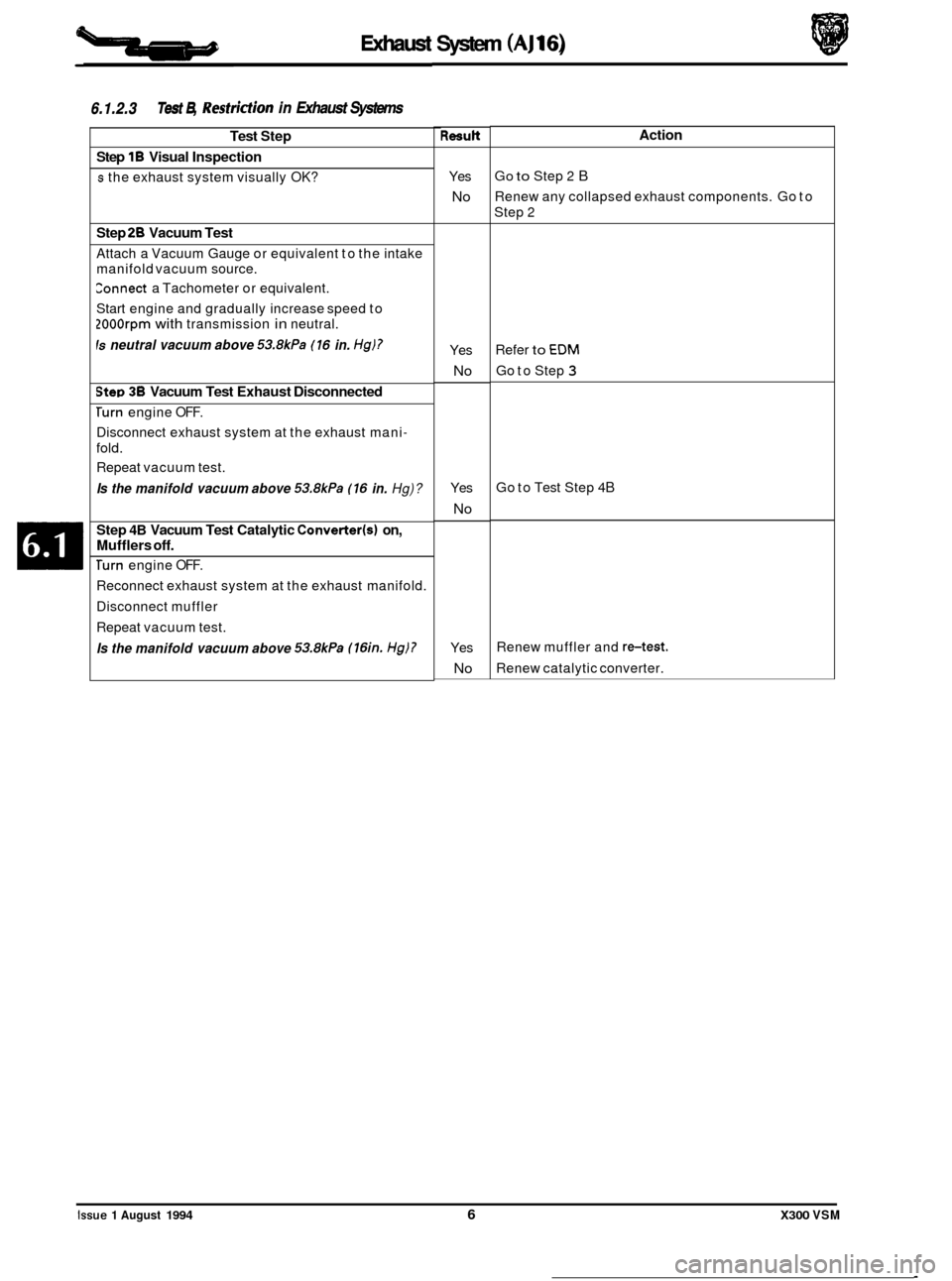
Test Step
Step
1B Visual Inspection
s the exhaust system visually OK?
Step 28 Vacuum Test
Attach a Vacuum Gauge or equivalent to the intake
manifold vacuum source.
Eonnect a Tachometer or equivalent.
Start engine and gradually increase speed to
2OOOrpm with transmission in neutral.
Is neutral vacuum above 53.8kPa (16 in. Hg)?
Step 38 Vacuum Test Exhaust Disconnected
rurn engine OFF.
Disconnect exhaust system at the exhaust mani-
fold.
Repeat vacuum test.
Is the manifold vacuum above 53.8kPa (16 in. Hg)?
Step 4B Vacuum Test Catalytic Converter(s1 on,
Mufflers off.
+
6.1.2.3 Test B, Rest1
Turn engine OFF.
Reconnect exhaust system at the exhaust manifold.
Disconnect muffler
Repeat vacuum test.
Is the manifold vacuum above 53.8kPa (16in. Hg)?
System (AJ 1 6)
Resutt
Yes
No
Yes
No
Yes
No
Yes
No
Action
Go to Step 2 B
Renew any collapsed exhaust components. Go to
Step
2
Refer to EDM
Go to Step 3
Exhaust System (AJ16)
6.1.2.3 Test B, Restridion in Exhaust Systems
Go to Test Step 4B
Renew muffler and retest.
Renew catalytic converter.
Issue 1 August 1994 6 X300 VSM
Page 114 of 521
Manual Transmission & Clutch (AJ16)
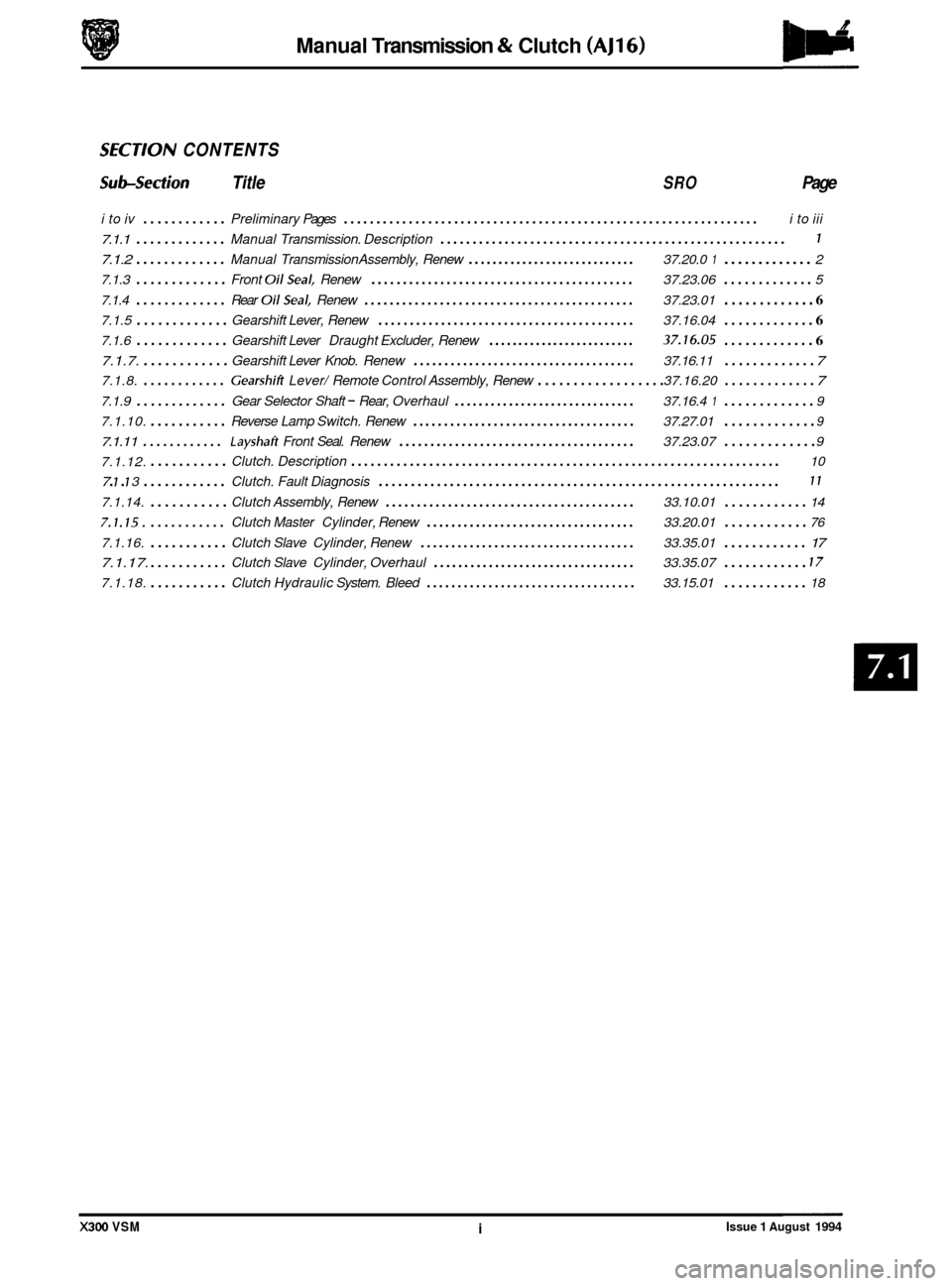
SECTlON CONTENTS
Sub-section Title SRO Page
i to iv ............ Preliminary Pages ................................................................ i to iii
7.1.1 ............. Manual Transmission. Description ...................................................... 1
7.1.2 ............. Manual Transmission Assembly, Renew ............................ 37.20.0 1 ............. 2
7.1.3
............. Front OilSeal. Renew .......................................... 37.23.06 ............. 5
7.1.4
............. Rear OilSeal. Renew ........................................... 37.23.01 ............. 6
7.1.5 ............. Gearshift Lever, Renew ......................................... 37.16.04 ............. 6
7.1.6 ............. Gearshift Lever Draught Excluder, Renew ......................... 37.16.05 ............. 6
7.1.7. ............ Gearshift Lever Knob. Renew .................................... 37.16.11 ............. 7
7.1.8. ............ Gearshifi Lever/ Remote Control Assembly, Renew .................. 37.16.20 ............. 7
7.1.9 ............. Gear Selector Shaft - Rear, Overhaul .............................. 37.16.4 1 ............. 9
7.1.10.
........... Reverse Lamp Switch. Renew .................................... 37.27.01 ............. 9
7.1.11 ............ Layshaft Front Seal. Renew ...................................... 37.23.07 ............. 9
7.1.12.
........... Clutch. Description .................................................................. 10
7.1.14.
........... Clutch Assembly, Renew ........................................ 33.10.01 ............ 14
7.1.15. ........... Clutch Master Cylinder, Renew .................................. 33.20.01 ............ 76
7.1.16. ........... Clutch Slave Cylinder, Renew ................................... 33.35.01 ............ 17
7.1.17.
........... Clutch Slave Cylinder, Overhaul ................................. 33.35.07 ............ 17
7.1.18. ........... Clutch Hydraulic System. Bleed .................................. 33.15.01 ............ 18
7 . 1 . 7 3 ............ Clutch. Fault Diagnosis .............................................................. 11
X300 VSM i Issue 1 August 1994
Page 115 of 521
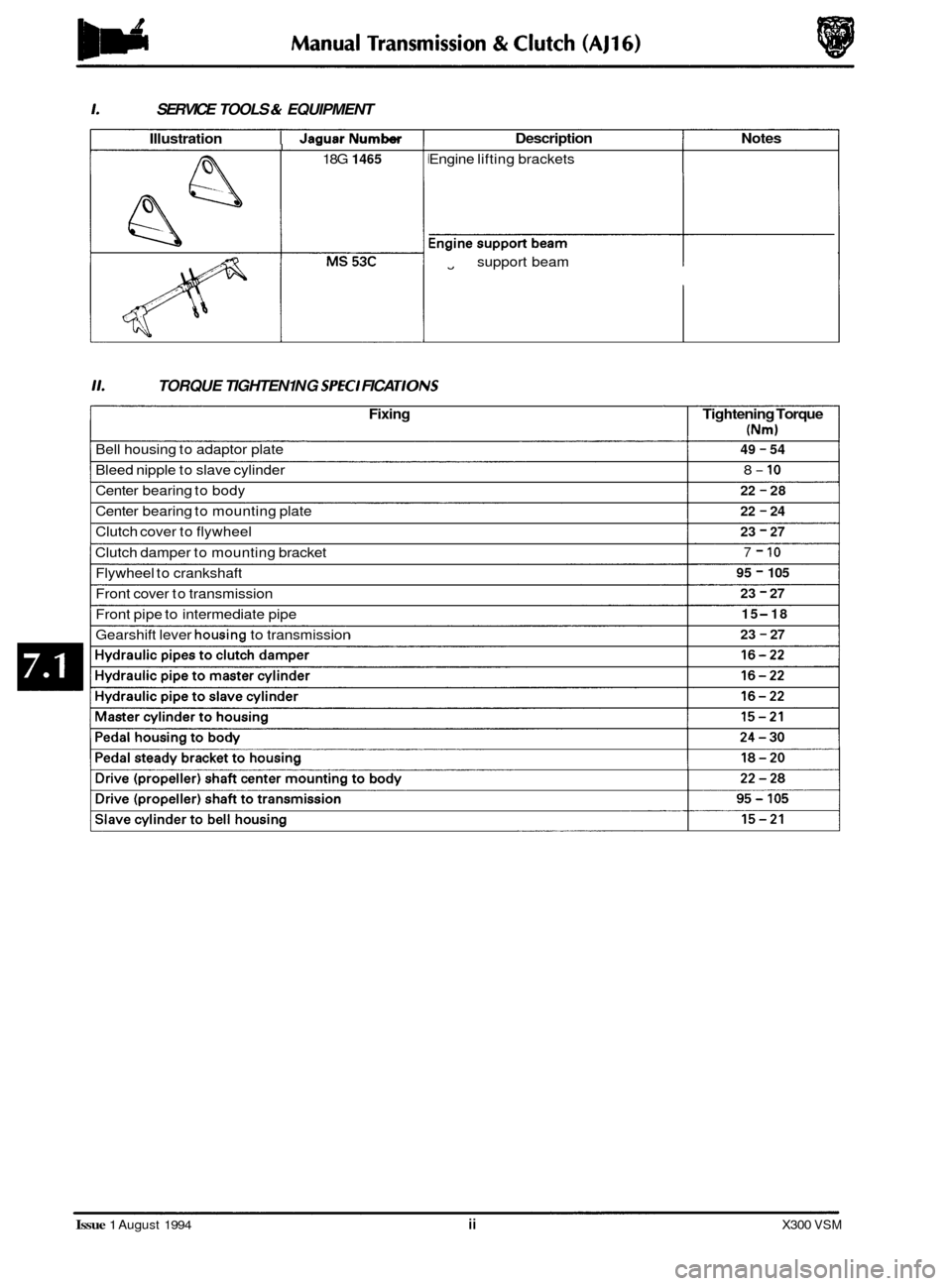
1. SERVICE TOOLS & EQUIPMENT
Illustration I JaauarNumber I -
18G 1465
Description Notes
Engine lifting brackets
Engine
fl support beam
11. TORQUE TIGHTEN1 NG SPEC1 FICA TIONS
Fixing Tightening Torque
(Nm)
49 - 54
8- 10
22 - 28
22
- 24
23 - 27
7 - 10
95 - 105
23
- 27
15
-18
23
- 27
Bell housing to adaptor plate
Bleed nipple to slave cylinder
Center bearing to body
Center bearing to mounting plate
Clutch cover to flywheel
Clutch damper to mounting bracket
Flywheel to crankshaft
Front cover to transmission
Front pipe to intermediate pipe
Gearshift lever
housing to transmission
Issue 1 August 1994 ii X300 VSM
Page 116 of 521
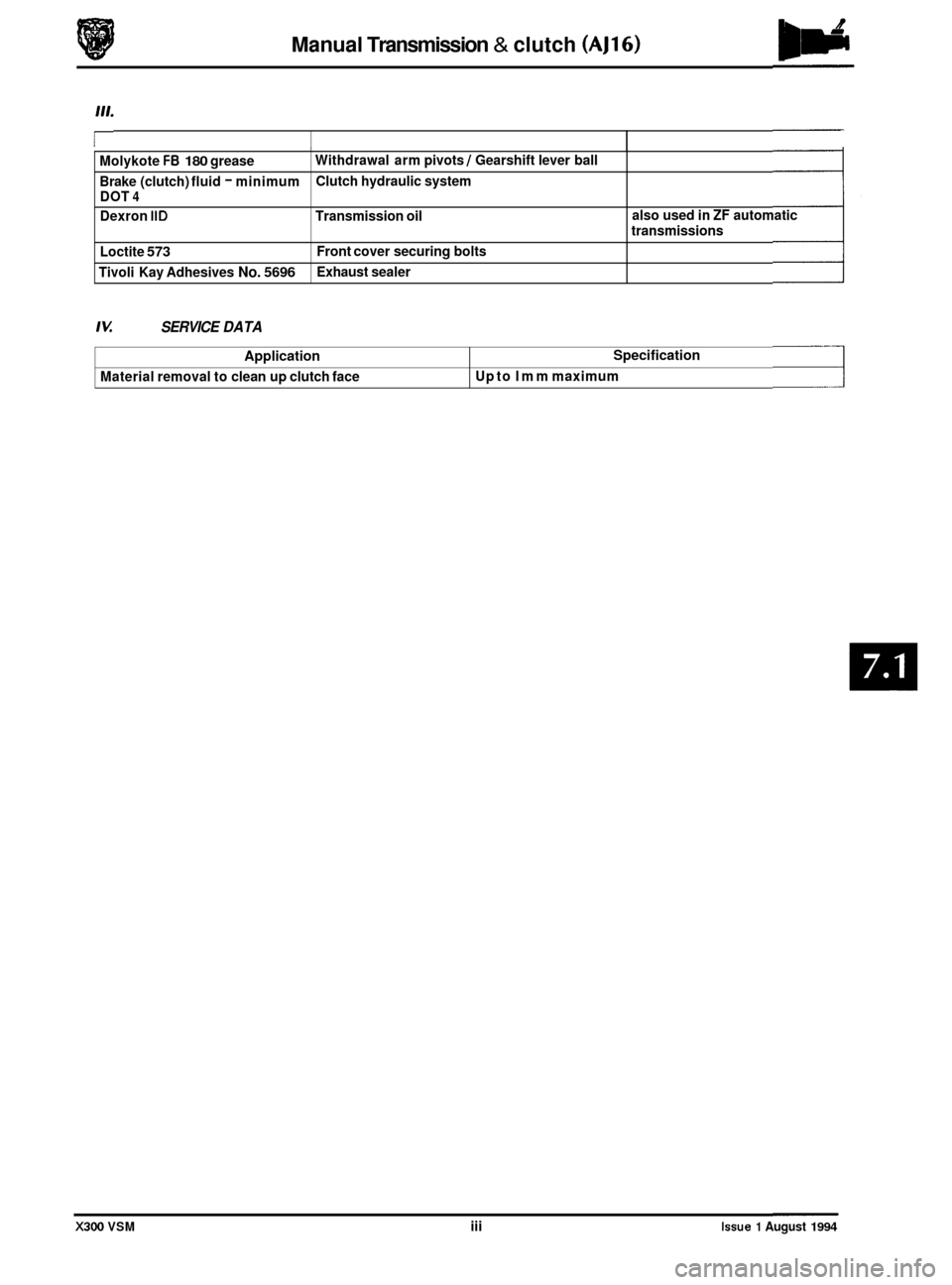
Manual Transmission & clutch (AJ16)
I Molykote FB 180 grease
Brake (clutch) fluid
- minimum
DOT 4
Dexron IID Transmission oil
Loctite
573
Tivoli Kay Adhesives No. 5696
Withdrawal arm pivots / Gearshift lever ball
Clutch hydraulic system
Front cover securing bolts
Exhaust sealer also used
in
ZF automatic
transmissions
Application
Material removal to clean up clutch face
IU SERVICE DATA
Specification
Up to lmm maximum
X300 VSM iii Issue 1 August 1994