ABS JAGUAR XJ6 1994 2.G Owner's Guide
[x] Cancel search | Manufacturer: JAGUAR, Model Year: 1994, Model line: XJ6, Model: JAGUAR XJ6 1994 2.GPages: 521, PDF Size: 17.35 MB
Page 303 of 521
Body Components & Trim a
13.8 SEATING AND SEAT BELTS
13.8.1 Seating, Description
The front seats are available in a range of materials consisting of sculptured fabric / leather, leather, sports cloth / leather, embossed leather / leather and autolux. Both seats are available as 'manual', ie manually adjustable with elec- tric rise and fall, manual height adjustment headrests, 'power', ie 12-way electric adjustment, 'power with memory', ie memory controlled, 12-way electric adjustment of seat, steering column and exterior rear view mirrors and 'heated',
ie with integral heating.
Front seats are based on a non
-handed, one-piece frame which includes cushion and squab frames and seat adjuster
mechanisms. The seat switchpacks (powerseats) are fitted to the outboard side of driver and passenger seats; on 'man- ual'seats, the seat height adjustment switch is similarly located. Seat control modules SCMs are contained within the
seat assemblies. The seats are secured through four mounting points to the vehicle floor.
Rear seats are of the bench type with
full width removable cushion and individual seat squabs.
Electrical components installed on the heel board below the rear passenger seat are protected
by two covers secured
by two locating brackets on the floor and by two latches on the cover. The latches are released by pushing down on
the two recesses in the top edge of the cover.
13.8.2 Front Manual Seat, Renew
. Disconnect vehicle battery ground lead.
. Disconnect electrical connections as required.
. Remove the seat forward fixings.
Move the seat fully forward.
. Remove the rear fixing / slide covers.
. Remove the seat rear fixings.
. Reposition seat for access and remove seat from vehicle.
. To refit seat, carry out reversal of above procedure.
13.8.3
. Disconnect vehicle battery ground lead.
. Move the seat fully forward to gain access to squab back
Remove squab side fixings, disconnect lamp harness and
. To refit, carry out reversal of the above procedure.
Front Seat (Power Operated) Squab Back
Cover, Renew
cover outer fixings.
remove squab back cover.
13.8.4
. Position seat as required for access.
. Disconnect vehicle battery ground lead.
. Release sound insulation retainers and displace insula-
. Remove SCM cover, move SCM aside and remove seat
. Remove the seat forward fixings and move the seat fully
. Remove the seat rearward fixing covers and remove the
. Disconnect multi-plugs, seat switch and motor harness to
. Release harness tie strap and remove seat assembly from
Front Seat (Power Operated), Renew
tion.
switch
multi-plug from its mounting bracket.
forward. seat rearward fixings.
SCM.
vehicle.
. To refit, carry out reversal of the above procedure, ensur- ing that fixings are tightened to the correct torque.
Issue 1 August 1994 48 X300 VSM
0
0
0
Page 312 of 521
Climate Control Systems
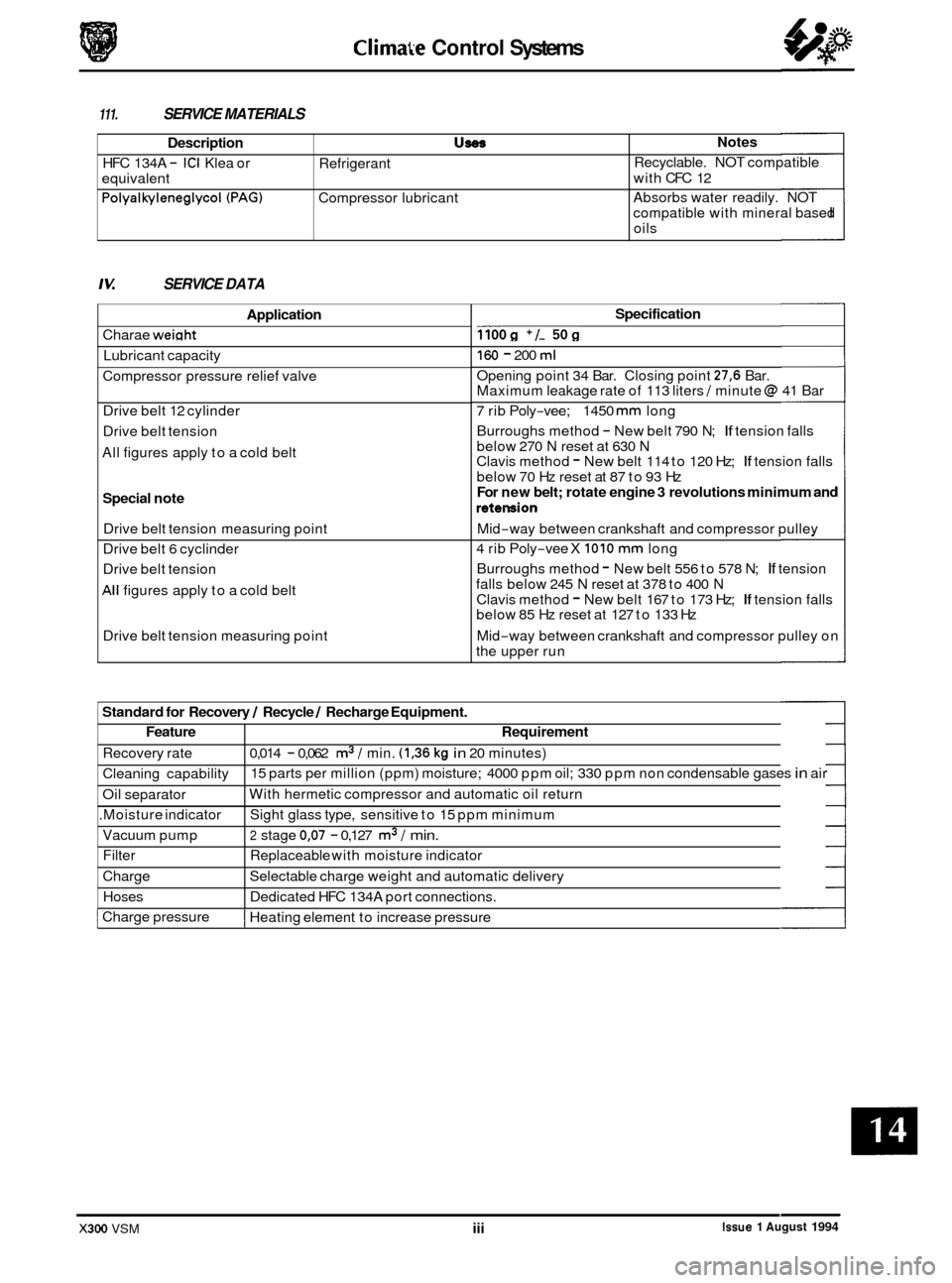
Description U-
HFC 134A - ICI Klea or
equivalent
Polyalkyleneglycol (PAG) Compressor lubricant
Refrigerant
111.
Notes
Recyclable. NOT
compatible
with CFC 12
Absorbs water readily. NOT
compatible with mineral based
oils
SERVICE MATERIALS
Standard for Recovery I Recycle 1 Recharge Equipment.
Recovery rate
Cleaning capability
Oil separator
.Moisture indicator
Vacuum pump
Filter Replaceable with moisture indicator
Charge Hoses
Feature Requirement
0,014 - 0,062 m3 / min. (1,36 kg in 20 minutes)
15 parts per million (ppm) moisture; 4000 ppm oil; 330 ppm non condensable gases
in air
With hermetic compressor and automatic oil return
Sight glass type, sensitive to 15 ppm minimum
2 stage 0,07 - 0,127 m3 I min.
Selectable charge weight and automatic delivery
Dedicated HFC 134A port connections.
Iv. SERVICE DATA
Application
Charae weight
Lubricant capacity
Compressor pressure relief valve
Drive belt 12 cylinder
Drive belt tension
All figures apply to a cold belt
Special note
Drive belt tension measuring point
Drive belt 6 cyclinder
Drive belt tension
All figures apply to a cold belt
Drive belt tension measuring point
Specification
160 - 200 ml
Opening point 34 Bar. Closing point 27,6 Bar.
Maximum leakage rate of 113 liters 1 minute @ 41 Bar
7 rib Poly
-vee; 1450 mm long
Burroughs method
- New belt 790 N; If tension falls
below 270 N reset at 630 N
Clavis method
- New belt 114 to 120 Hz; If tension falls
below 70 Hz reset at 87 to 93 Hz
For new belt; rotate engine 3 revolutions minimum and
retension
Mid-way between crankshaft and compressor pulley ~
4
rib Poly-vee X 1010 mm long
Burroughs method
- New belt 556 to 578 N; If tension
falls below 245 N reset at 378 to 400
N
Clavis method - New belt 167 to 173 Hz; If tension falls
below 85 Hz reset at 127 to 133 Hz
Mid
-way between crankshaft and compressor pulley on
the upper run
1 Charge pressure I Heating element to increase pressure
Issue 1 August 1994 X300 VSM iii
Page 315 of 521
Climate Control Systems
0 Because HFC 134A is fully recycleable it may be 'cleaned' by the recovery equipment and re-used following
removal from a system.
0 Leak tests should only be carried out with an electronic analyzer which is dedicated to HFC 134A. Never use a CFC 12 analyzer or naked flame type.
0 Do not attempt to 'guess' the amount of refrigerant in a system, always recover and recharge with the correct
charge weight. In this context do not depress the charge or discharge port valves to check for the presence of
refrigerant.
14.1.3 Handling Lubricating Oil
0 Avoid breathing lubricant mist, it may cause irritation to your respiratory system.
0 Always decant fresh oil from a sealed container and do not leave oil exposed to the atmosphere for any reason
other than to fill or empty a system. PAG oil is very hygroscopic (absorbs water) and will rapidly become con-
taminated by atmospheric moisture.
PAG oil is
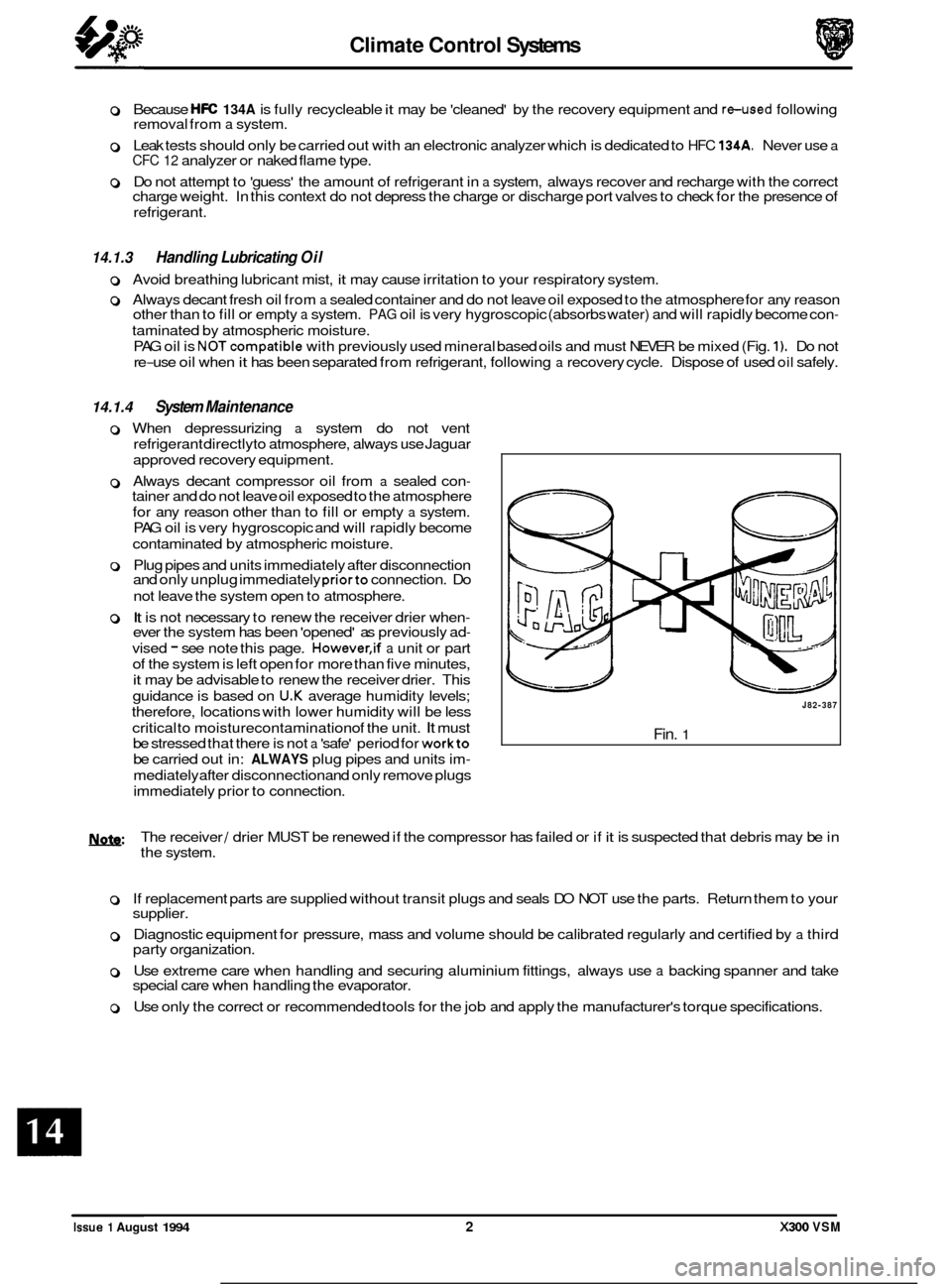
NOTcompatible with previously used mineral based oils and must NEVER be mixed (Fig. 1). Do not
re
-use oil when it has been separated from refrigerant, following a recovery cycle. Dispose of used oil safely.
14.1.4 System Maintenance
0 When depressurizing a system do not vent
refrigerant directlyto atmosphere, always use Jaguar
approved recovery equipment.
0 Always decant compressor oil from a sealed con- tainer and do not leave oil exposed to the atmosphere
for any reason other than to fill or empty
a system.
PAG oil is very hygroscopic and will rapidly become
contaminated by atmospheric moisture.
0 Plug pipes and units immediately after disconnection
and only unplug immediately priorto connection. Do
not leave the system open to atmosphere.
0 It is not necessary to renew the receiver drier when- ever the system has been 'opened' as previously ad-
vised - see note this page. However,if a unit or part
of the system is left open for more than five minutes,
it may be advisable to renew the receiver drier. This
guidance is based on
U.K average humidity levels;
therefore, locations with lower humidity will be less
critical to moisturecontamination of the unit.
It must
be stressed that there is not
a 'safe' period for workto
be carried out in: ALWAYS plug pipes and units im-
mediately after disconnection and only remove plugs
immediately prior to connection.
J82-387
Fin. 1
U: The receiver / drier MUST be renewed if the compressor has failed or if it is suspected that debris may be in
the system.
0 If replacement parts are supplied without transit plugs and seals DO NOT use the parts. Return them to your
supplier.
0 Diagnostic equipment for pressure, mass and volume should be calibrated regularly and certified by a third
party organization.
0 Use extreme care when handling and securing aluminium fittings, always use a backing spanner and take
special care when handling the evaporator.
0 Use only the correct or recommended tools for the job and apply the manufacturer's torque specifications.
Issue 1 August 1994 2 X300 VSM
Page 325 of 521
Climate Control Systems
14.8 REFRIGERATION CYCLE:
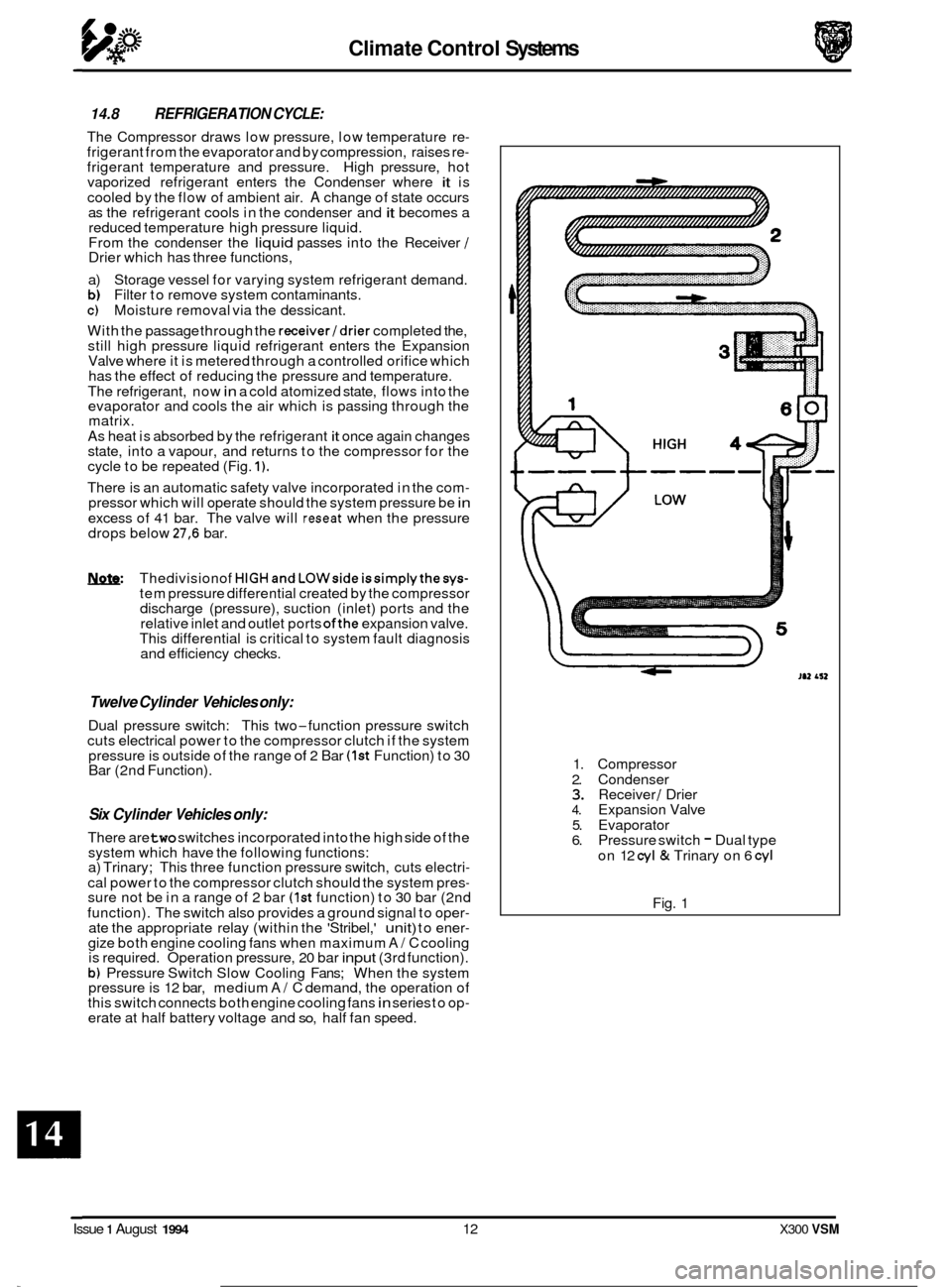
The Compressor draws low pressure, low temperature re- frigerant from the evaporator and by compression, raises re- frigerant temperature and pressure. High pressure, hot
vaporized refrigerant enters the Condenser where it is
cooled by the flow of ambient air.
A change of state occurs
as the refrigerant cools in the condenser and it becomes a
reduced temperature high pressure liquid.
From the condenser the
liquid passes into the Receiver / Drier which has three functions,
a) Storage vessel for varying system refrigerant demand.
b) Filter to remove system contaminants. c) Moisture removal via the dessicant.
With the passage through the
receiver/drier completed the,
still high pressure liquid refrigerant enters the Expansion
Valve where it is metered through a controlled orifice which
has the effect of reducing the pressure and temperature.
The refrigerant, now
in a cold atomized state, flows into the
evaporator and cools the air which is passing through the
matrix.
As heat is absorbed by the refrigerant
it once again changes
state, into a vapour, and returns to the compressor for the
cycle to be repeated (Fig.
1).
There is an automatic safety valve incorporated in the com- pressor which will operate should the system pressure be in
excess of 41 bar. The valve will reseat when the pressure
drops below 27,6 bar.
W Thedivisionof HIGHandLOWsideissimplythesys- tem pressure differential created by the compressor
discharge (pressure), suction (inlet) ports and the
relative inlet and outlet ports
ofthe expansion valve.
This differential is critical to system fault diagnosis
and efficiency checks.
Twelve Cylinder Vehicles only:
Dual pressure switch: This two-function pressure switch
cuts electrical power to the compressor clutch if the system
pressure is outside of the range
of 2 Bar (1st Function) to 30
Bar (2nd Function).
Six Cylinder Vehicles only:
There are two switches incorporated into the high side of the
system which have the following functions:
a) Trinary; This three function pressure switch, cuts electri
-
cal power to the compressor clutch should the system pres- sure not be in a range of 2 bar (1st function) to 30 bar (2nd
function). The switch also provides a ground signal to oper
- ate the appropriate relay (within the 'Stribel,' unit) to ener- gize both engine cooling fans when maximum A/ C cooling
is required. Operation pressure, 20 bar input (3rd function).
b) Pressure Switch Slow Cooling Fans; When the system
pressure is 12 bar, medium A/ C demand, the operation of
this switch connects both engine cooling fans in series to op- erate at half battery voltage and so, half fan speed. 1.
Compressor
2. Condenser
3. Receiver / Drier 4. Expansion Valve
5. Evaporator
6. Pressure switch - Dual type
on 12
cyl & Trinary on 6 cyl
Fig. 1
0
0
Issue 1 August 1994 12 X300 VSM
Page 327 of 521
Climate Control Systems
New
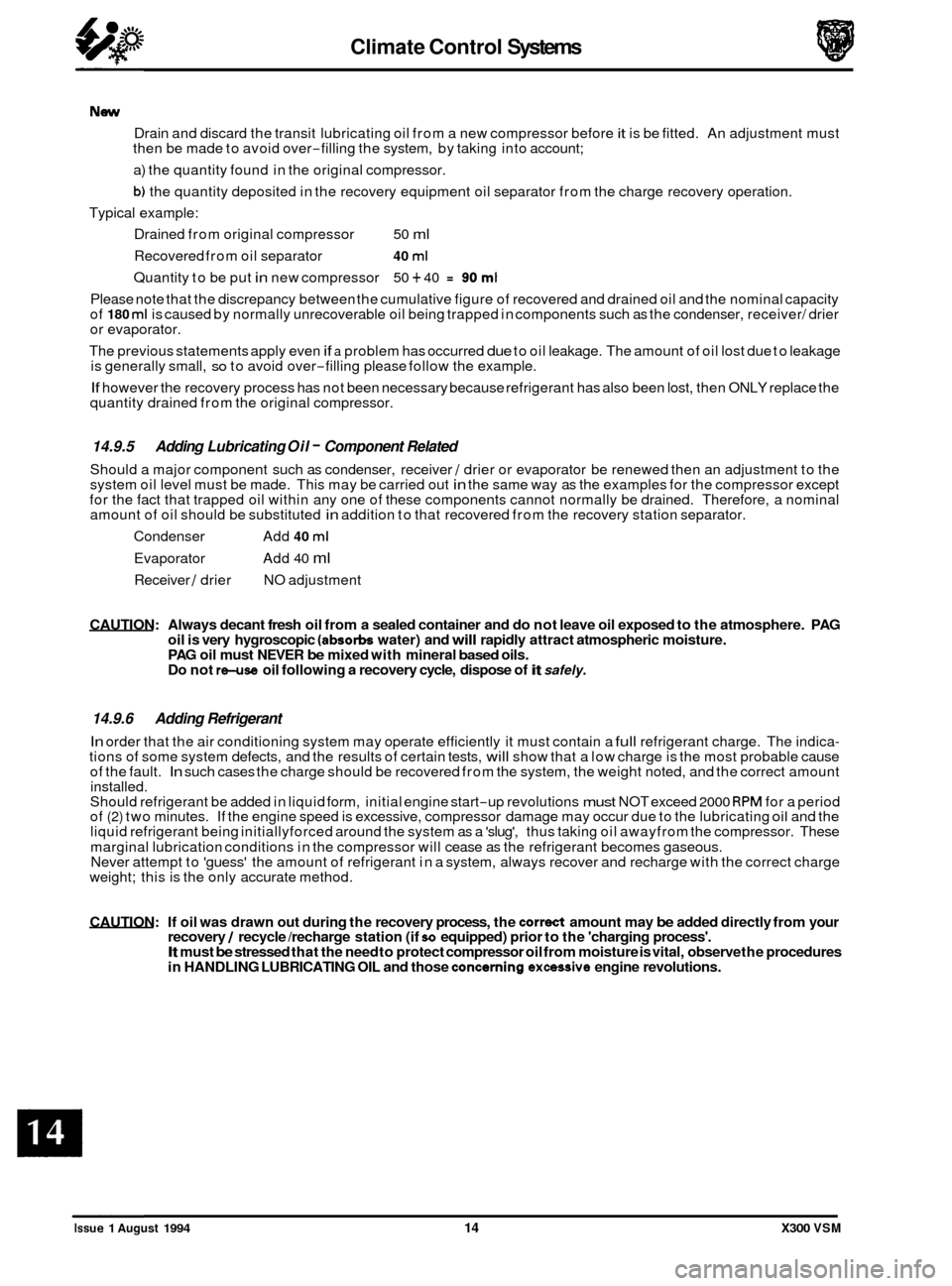
Drain and discard the transit lubricating oil from a new compressor before it is be fitted. An adjustment must
then be made to avoid over-filling the system, by taking into account;
a) the quantity found in the original compressor.
b) the quantity deposited in the recovery equipment oil separator from the charge recovery operation.
Drained from original compressor
50 ml
Recovered from oil separator 40 ml
Quantity to be put in new compressor 50 + 40 = 90 ml
Typical example:
Please note that the discrepancy between the cumulative figure of recovered and drained oil and the nominal capacity
of
180 ml is caused by normally unrecoverable oil being trapped in components such as the condenser, receiver/ drier
or evaporator.
The previous statements apply even
if a problem has occurred due to oil leakage. The amount of oil lost due to leakage
is generally small, so to avoid over-filling please follow the example.
If however the recovery process has not been necessary because refrigerant has also been lost, then ONLY replace the
quantity drained from the original compressor.
14.9.5
Should a major component such as condenser, receiver / drier or evaporator be renewed then an adjustment to the
system oil level must be made. This may be carried out in the same way as the examples for the compressor except
for the fact that trapped oil within any one of these components cannot normally be drained. Therefore, a nominal
amount of oil should be substituted
in addition to that recovered from the recovery station separator.
Adding Lubricating Oil - Component Related
Condenser Add 40 ml
Evaporator Add 40 ml
Receiver / drier NO adjustment
CAUTION: Always decant fresh oil from a sealed container and do not leave oil exposed to the atmosphere. PAG
oil is very hygroscopic (absoh water) and will rapidly attract atmospheric moisture.
PAG oil must NEVER be mixed with mineral based oils.
Do not re-use oil following a recovery cycle, dispose of it safely.
14.9.6 Adding Refrigerant
In order that the air conditioning system may operate efficiently it must contain a full refrigerant charge. The indica- tions of some system defects, and the results of certain tests, will show that a low charge is the most probable cause
of the fault. In such cases the charge should be recovered from the system, the weight noted, and the correct amount
installed.
Should refrigerant be added in liquid form, initial engine start
-up revolutions must NOT exceed 2000 RPM for a period
of (2) two minutes. If the engine speed is excessive, compressor damage may occur due to the lubricating oil and the
liquid refrigerant being initiallyforced around the system as a 'slug', thus taking oil awayfrom the compressor. These
marginal lubrication conditions in the compressor will cease as the refrigerant becomes gaseous.
Never attempt to 'guess' the amount of refrigerant in a system, always recover and recharge with the correct charge
weight; this is the only accurate method.
CAUTION: If oil was drawn out during the recovery process, the corM amount may be added directly from your
recovery / recycle /recharge station (if so equipped) prior to the 'charging process'. It must be stressed that the need to protect compressor oil from moisture is vital, observe the procedures
in HANDLING LUBRICATING OIL and those concerning excessive engine revolutions.
Issue 1 August 1994 14 X300 VSM
Page 380 of 521
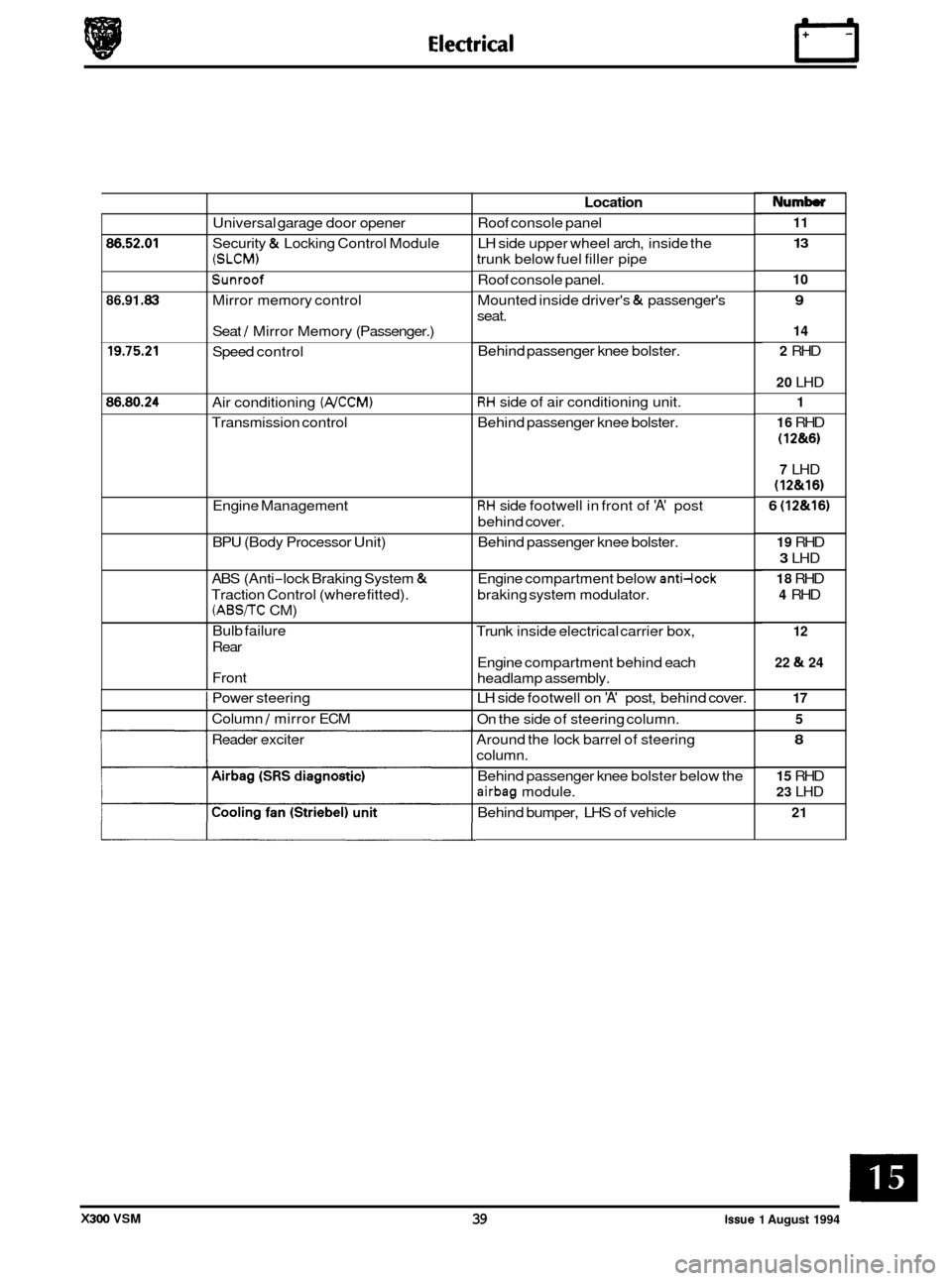
86.52.01
86.91 -83
19.75.21
86.80.24
Universal garage door opener
Security
& Locking Control Module
(SLCM)
Sunroof
Mirror memory control
Seat
/ Mirror Memory (Passenger.)
Speed control
Air conditioning
(NCCM)
Transmission control
Engine Management
BPU (Body Processor Unit)
ABS (Anti
-lock Braking System &
Traction Control (where fitted).
(ABS/TC CM)
Bulb failure
Rear
Front
I Power steering
I Column / mirror ECM
Reader exciter
Location
Roof console panel
LH side upper wheel arch, inside the
trunk below fuel filler pipe
Roof console panel.
Mounted inside driver's
& passenger's
seat.
Behind passenger knee bolster.
RH side of air conditioning unit.
Behind passenger knee bolster.
RH side footwell in front of 'A' post
behind cover.
Behind passenger knee bolster.
Engine compartment below
anti-lock
braking system modulator.
Trunk inside electrical carrier box,
Engine compartment behind each
headlamp assembly.
LH side footwell on
'A' post, behind cover.
On the side of steering column.
Around the lock barrel of steering
column.
Behind passenger knee bolster below the
airbag module.
Behind bumper, LHS of vehicle
Numb
11
13
10
9
14
2
RHD
20 LHD
1
16
RHD
(1 2&6)
7 LHD
(12&16)
6 (12&16)
19 RHD
3 LHD
18 RHD
4 RHD
12
22
& 24
17 5
8
15 RHD
23 LHD
21
X300 VSM 39 issue 1 August 1994
Page 386 of 521
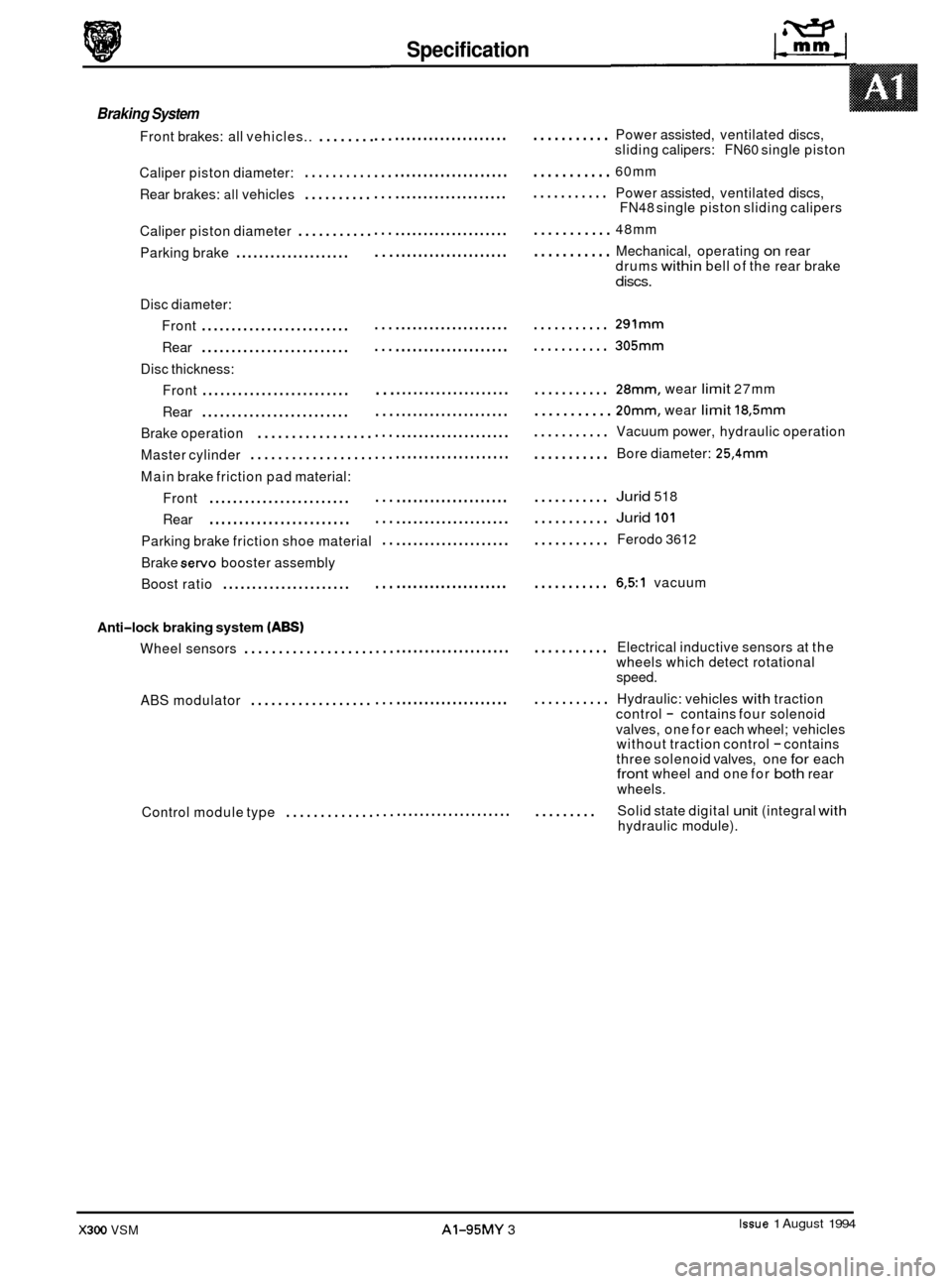
e LmmJ
Power assisted, ventilated discs,
sliding calipers: FN60 single piston
60mm Power assisted, ventilated discs,
FN48 single piston sliding calipers
48mm Mechanical, operating
on rear
drums within bell of the rear brake
discs.
291mm
305mm
28mm. wear limit 27mm
20mm, wear limit 18,5mm
Vacuum power, hydraulic operation
Bore diameter:
25,4mm
Jurid 518
Jurid 101
Ferodo 3612
6,51 vacuum
Electrical inductive sensors at the
wheels which detect rotational
speed.
Hydraulic: vehicles
with traction
control - contains four solenoid
valves, one for each wheel; vehicles
without traction control
- contains
three solenoid valves, one for each front wheel and one for both rear
wheels.
Solid state digital
unit (integral with hydraulic module).
Specification
Braking System
Front brakes: all vehicles.. ........ .................... ........... ...
Caliper piston diameter: ..........
Rear brakes: all vehicles ..........
...
...
....................
....................
...........
...........
Caliper piston diameter ...........
Parking brake ....................
...
...
....................
....................
...........
...........
Disc diameter:
Front
.........................
Rear .........................
Front .........................
Rear .........................
Brake operation .................
Master cylinder ..................
Main brake friction pad material:
Front
........................
Rear ........................
Parking brake friction shoe material
Brake
servo booster assembly
Boost ratio
......................
Disc thickness:
...
... ....................
....................
...........
...........
...
...
...
...
....................
....................
....................
....................
...........
...........
...........
...........
...
...
.. ....................
....................
....................
...........
...........
...........
... .................... ...........
Anti-lock braking system (ABSI
Wheel sensors ................... ... .................... ...........
ABS modulator .................. ... .................... ...........
0
0
Control module type ............. ... .................... .........
Issue 1 August 1994 X300 VSM AI-95MY 3
Page 399 of 521
Specification
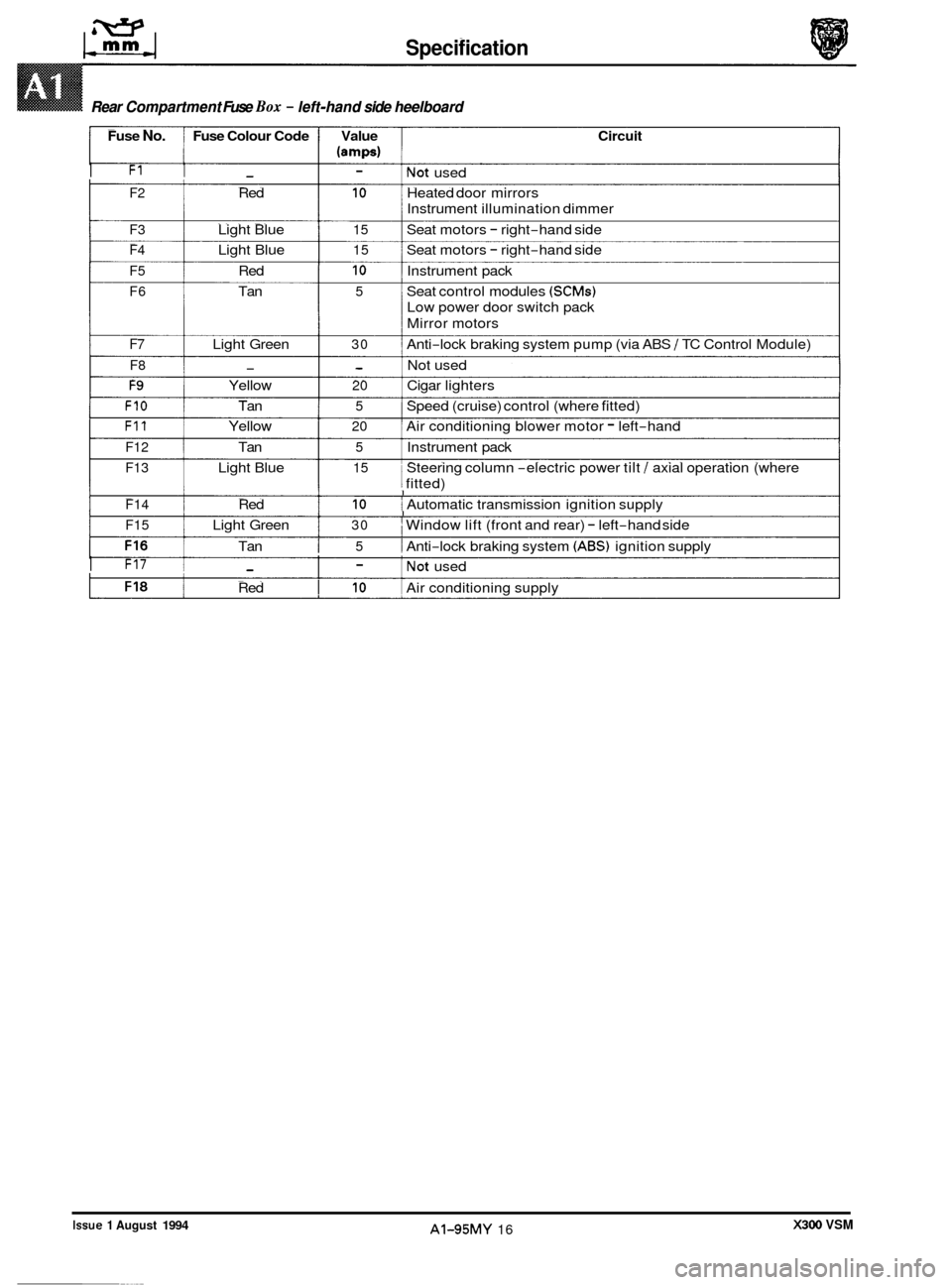
Rear Compartment Fuse Box - left-hand side heelboard
Fuse No. Fuse Colour Code Value Circuit
(amps)
I F1 I - I - lNot used
F2 Red 10 Heated door mirrors
F3 Light Blue 15 Seat motors - right-hand side
F4 Light Blue 15 Seat motors - right-hand side
F5 Red 10 Instrument pack
F6 Tan 5 Seat control modules (SCMs)
Low power door switch pack
Mirror motors
Instrument
illumination dimmer
F7 Light Green 30 Anti-lock braking system pump (via ABS / TC Control Module)
F8 - - Not used
F9 Yellow 20 Cigar lighters
FIO Tan 5 Speed (cruise) control (where fitted)
F11 Yellow 20 Air conditioning blower motor - left-hand
F12 Tan 5 Instrument pack
F13 Light Blue 15 Steering column -electric power tilt / axial operation (where
j fitted) 1 I I F14 Red 10 i Automatic transmission ignition supply I I I F15 Light Green 30 I Window lift (front and rear) - left-hand side
Tan
I 5 1 Anti-lock braking system (ABS) ignition supply
I F17 1 - I - lNot used
Red
I 10 I Air conditioning supply
Rear Compartment Fuse Box - left-hand side heelboard ~~
X300 VSM Issue 1 August 1994 AI-95MY 16
0
0
0
Page 400 of 521
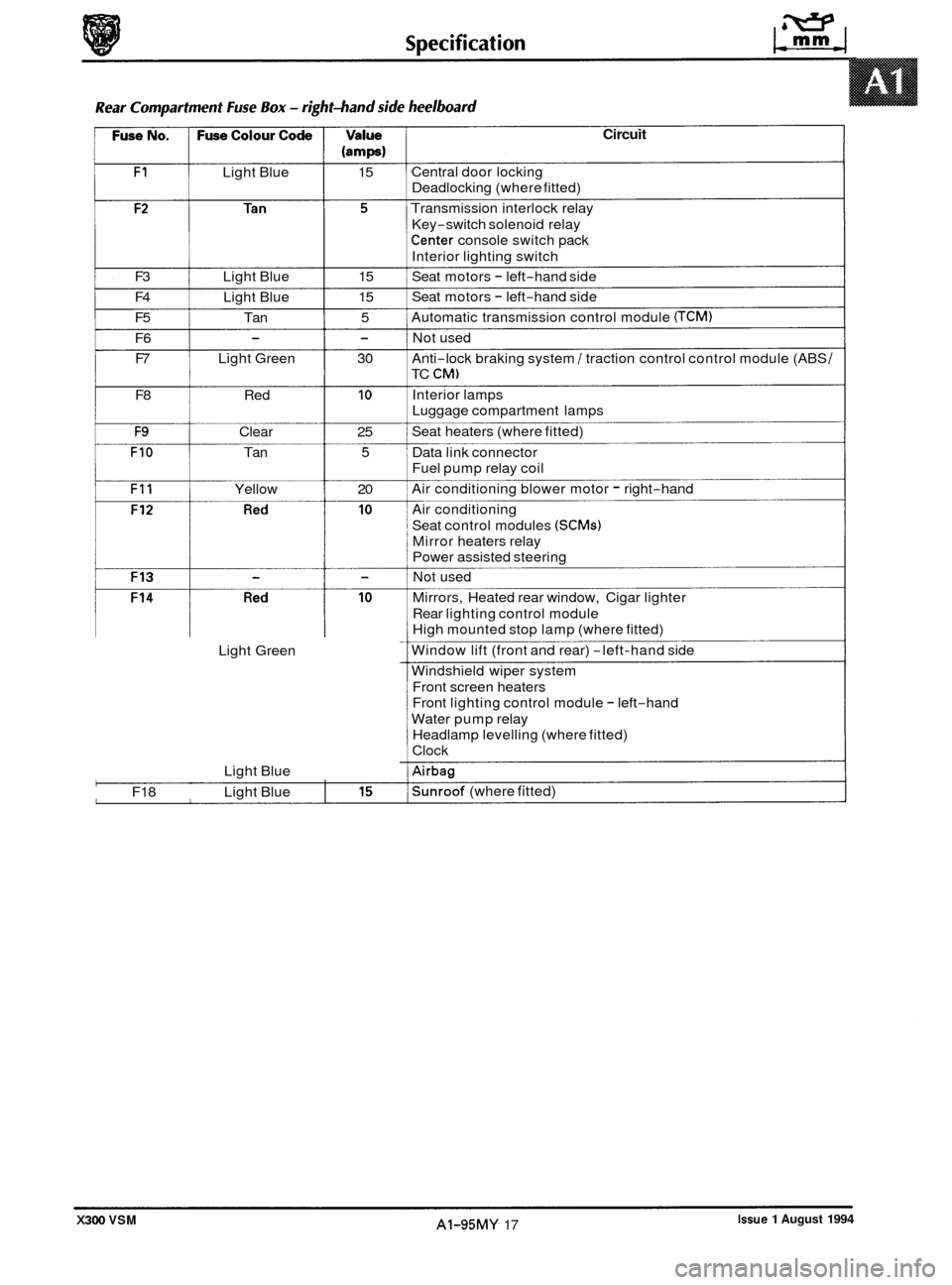
(amps)
F1 Light Blue 15
F3 Light Blue 15
F4 Light Blue 15
F5 Tan 5
F6 F7 Light Green 30
- -
F8 Red 10
F9 Clear 25
FIO Tan 5
F11 Yellow 20 0
Light Green
Light Blue
F18 Light Blue
0'
I
Circuit
Central door locking
Deadlocking (where fitted)
Transmission interlock relay
Key
-switch solenoid relay
Center console switch pack
Interior lighting switch
Seat motors
- left-hand side
Seat motors
- left-hand side
Automatic transmission control module
(TCM)
Not used
Anti
-lock braking system / traction control control module (ABS /
TC CM)
Interior lamps
Luggage compartment lamps
Seat heaters (where fitted)
Data link connector
Fuel pump relay coil
Air conditioning blower motor
- right-hand
Air conditioning
Seat control modules
(SCMs)
Mirror heaters relay
Power assisted steering
Not used
Mirrors, Heated rear window, Cigar lighter
Rear lighting control module
High mounted stop lamp (where fitted)
Window lift (front and rear)
-left-hand side
Windshield wiper system Front screen heaters
Front lighting control module
- left-hand
Water pump relay
Headlamp levelling (where fitted)
Clock
Airbag
Sunroof (where fitted)
Issue 1 August 1994 AI-95MY 17 X300 VSM
Page 413 of 521
General Fitting Instructions
A3.2 GENERAL FITTING INSTRUCTIONS
A3.2.1
Always fit covers to protect the wings before commencing work in the engine compartment. Cover the seats and
carpets, wear clean overalls and wash hands or wear gloves before working inside the car. Avoid spilling hydraulic
fluid, anti
-freeze or battery acid on the paintwork. In the event of spillage, wash off with water immediately. Use poly- thene sheets in the boot to protect carpets. Always use the recommended service tool, or a satisfactory equivalent,
where specified. Protect temporarily exposed screw threads by replacing nuts or fitting caps.
Precautions Against Damage To The Vehicle
A3.2.2 Preparation
Before disassembly, clean the surrounding area as thoroughly as possible. When components have been removed,
blank off any exposed openings using greaseproof paper and masking tape. Immediately seal fuel, oil and hydraulic
lines when separated, using plastic caps or plugs, to prevent loss of fluid and the entry of dirt. Close the open ends
of oilways, exposed by component removal, with tapered hardwood plugs or readily visible plastic plugs. Immediately
a component is removed, place
it in a suitable container; use a separate container for each component and its asso- ciated parts. Before dismantling a component, clean it thoroughly with a recommended cleaning agent: check that the
agent will not damage any of the materials within the component. Clean the bench and obtain marking materials, la-
bels, containers and locking wire before dismantling a component.
A3.2.3 Dismantling
Observe scrupulous cleanliness when dismantling components, particularly when parts of the brake, fuel or hydraulic
system are being worked on. A particle of dirt or a fragment of cloth could cause a dangerous malfunction if trapped in these systems. Clean all tapped holes, crevices, oilways and fluid passages with compressed air.
WRNIFLG: DO NOT PERMIT COMPRESSED AIR TO ENTER AN OPEN WOUND. ALWAYS USE EVE PROTECTION
WHEN USING COMPRESSED AIR.
Ensure that any 'O'-rings used for sealing are correctly refitted or renewed if disturbed. Mark mating parts to ensure
that they are replaced as dismantled. Whenever possible use marking materials which avoid the possibilities of caus- ing distortion or the initiation of cracks, which could occur if a center punch or scriber were used. Wire together mating
parts where necessary to prevent accidental interchange (e.g roller bearing components). Tie labels on to all parts to
be renewed and to parts requiring further inspection before being passed for reassembly.
Place labelled parts and other parts for rebuild
in separate containers.
Do not discard a part which is due for renewal until it has been compared with the new part, to ensure that the correct
part has been obtained.
A3.2.4 Inspection
Before inspecting a component for wear or performing a dimensional check, ensure that it is absolutely clean; a slight
smear of grease can conceal an incipient failure. When a component is to be checked dimensionally against figures
quoted for
it, use the correct equipment (surface plates, micrometers, dial gauges etc.) in serviceable condition. The
use of makeshift equipment can be dangerous. Reject a component if its dimensions are outside the limits quoted,
or if damage is apparent. A part may be refitted if its critical dimension is exactly to the limit size and it is otherwise
satisfactory. Use Plastigauge 12 Type PG-1 for checking bearing surface clearance e.g. big end bearing shell to crank
journal. Instructions for the use of Plastigauge and a scale giving bearing clearances in steps of
0,0025 mm (0.0001
in) are supplied with the package.
0
0
0
X300 VSM Issue 1 August 1994 2