ABS JAGUAR XJ6 1994 2.G Owner's Manual
[x] Cancel search | Manufacturer: JAGUAR, Model Year: 1994, Model line: XJ6, Model: JAGUAR XJ6 1994 2.GPages: 521, PDF Size: 17.35 MB
Page 239 of 521
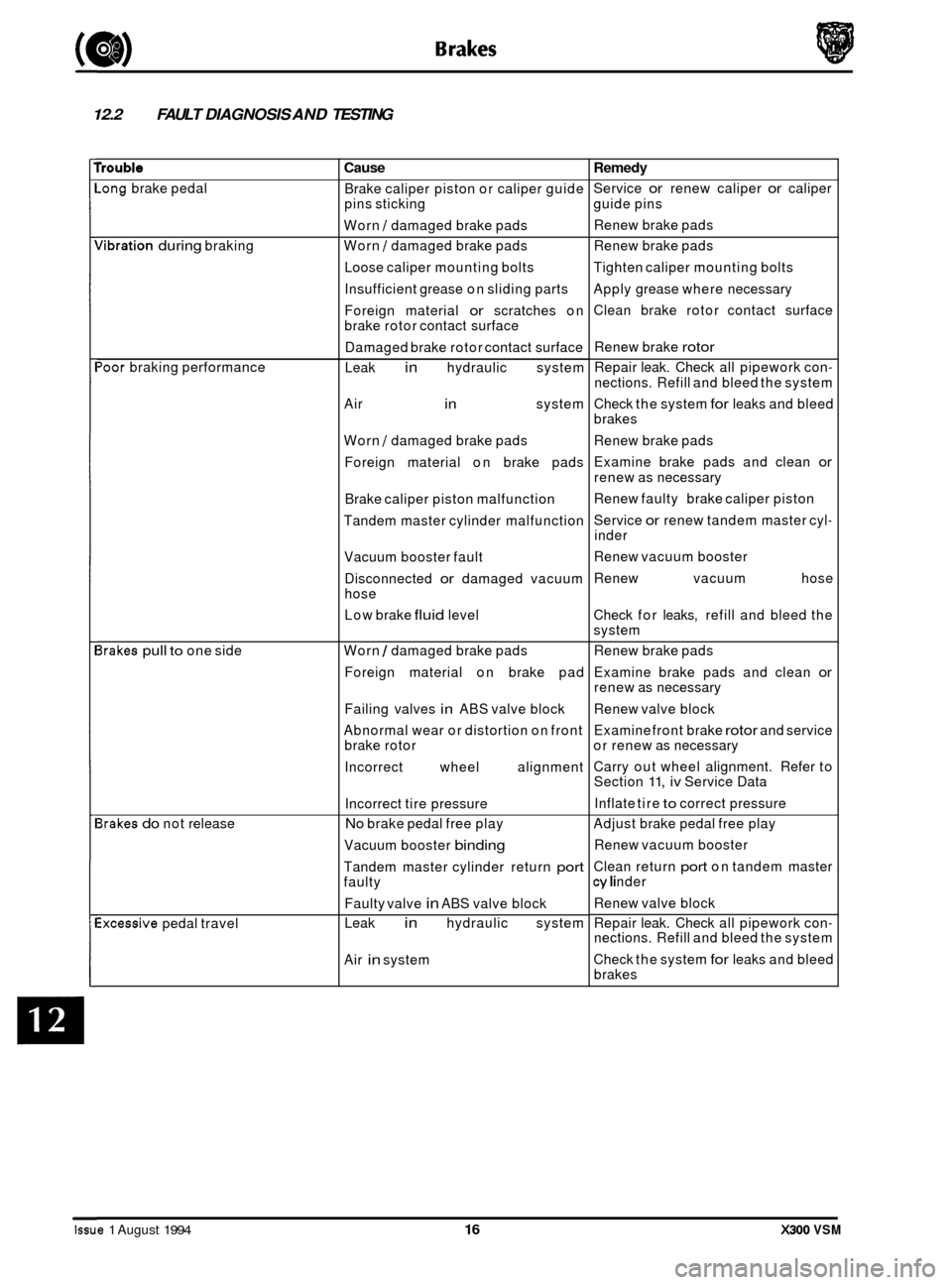
12.2 FAULT DIAGNOSIS AND TESTING
rrouble
-ong brake pedal
dibration during braking
'oor braking performance
3rakes pull to one side
3rakes do not release
ixcessive pedal travel
Cause
Brake caliper piston or caliper guide
pins sticking
Worn
I damaged brake pads
Worn
1 damaged brake pads
Loose caliper mounting bolts
Insufficient grease on sliding parts
Foreign material
or scratches on
brake rotor contact surface
Damaged brake rotor contact surface
Leak
in hydraulic system
Air
in system
Worn
I damaged brake pads
Foreign material on brake pads
Brake caliper piston malfunction
Tandem master cylinder malfunction
Vacuum booster fault
Disconnected
or damaged vacuum
hose
Low brake
fluid level
Worn
I damaged brake pads
Foreign material on brake pad
Failing valves
in ABS valve block
Abnormal wear or distortion on front
brake rotor
Incorrect wheel alignment
Incorrect tire pressure
No brake pedal free play
Vacuum booster
binding
Tandem master cylinder return port faulty
Faulty valve
in ABS valve block
Leak
in hydraulic system
Air
in system
Remedy
Service or renew caliper or caliper
guide pins
Renew brake pads
Renew brake pads
Tighten caliper mounting bolts
Apply grease where necessary
Clean brake rotor contact surface
Renew brake
rotor
Repair leak. Check all pipework con-
nections. Refill and bleed the system
Check the system
for leaks and bleed
brakes
Renew brake pads
Examine brake pads and clean
or
renew as necessary
Renew faulty brake caliper piston
Service
or renew tandem master cyl- inder
Renew vacuum booster
Renew vacuum hose
Check for leaks, refill and bleed the
system
Renew brake pads
Examine brake pads and clean
or renew as necessary
Renew valve block
Examine front brake
rotor and service
or renew as necessary
Carry out wheel alignment. Refer to
Section
11, iv Service Data
Inflate tire
to correct pressure
Adjust brake pedal free play
Renew vacuum booster
Clean return
port on tandem master cy I i nder
Renew valve block
Repair leak. Check all pipework con
- nections. Refill and bleed the system
Check the system
for leaks and bleed
brakes
0
0
0
Issue 1 August 1994 16 X300 VSM
Page 241 of 521
12.3 BRAKE FLUID LEVEL CHECK
WARNING: AVOID SKIN / EYE CONTACT OR INGESTION OF BRAKE FLUID. IF SKIN OR EYES ARE ACCIDENTALLY
SPLASHED WITH BRAKE FLUID, RINSE THE AFFECTED AREA IMMEDIATELY WITH PLENTY OF WATER
AND SEEK MEDICAL AlTENTlON IMMEDIATELY.
Checking the fluid level
CAUTION: Fluid must not be allowed to contact the vehicle paintwork. Remove any spilt fluid from the paintwork
by rinsing away with running water. Methylated spirit (denatured alcohol) must not be used to clean the contaminated area.
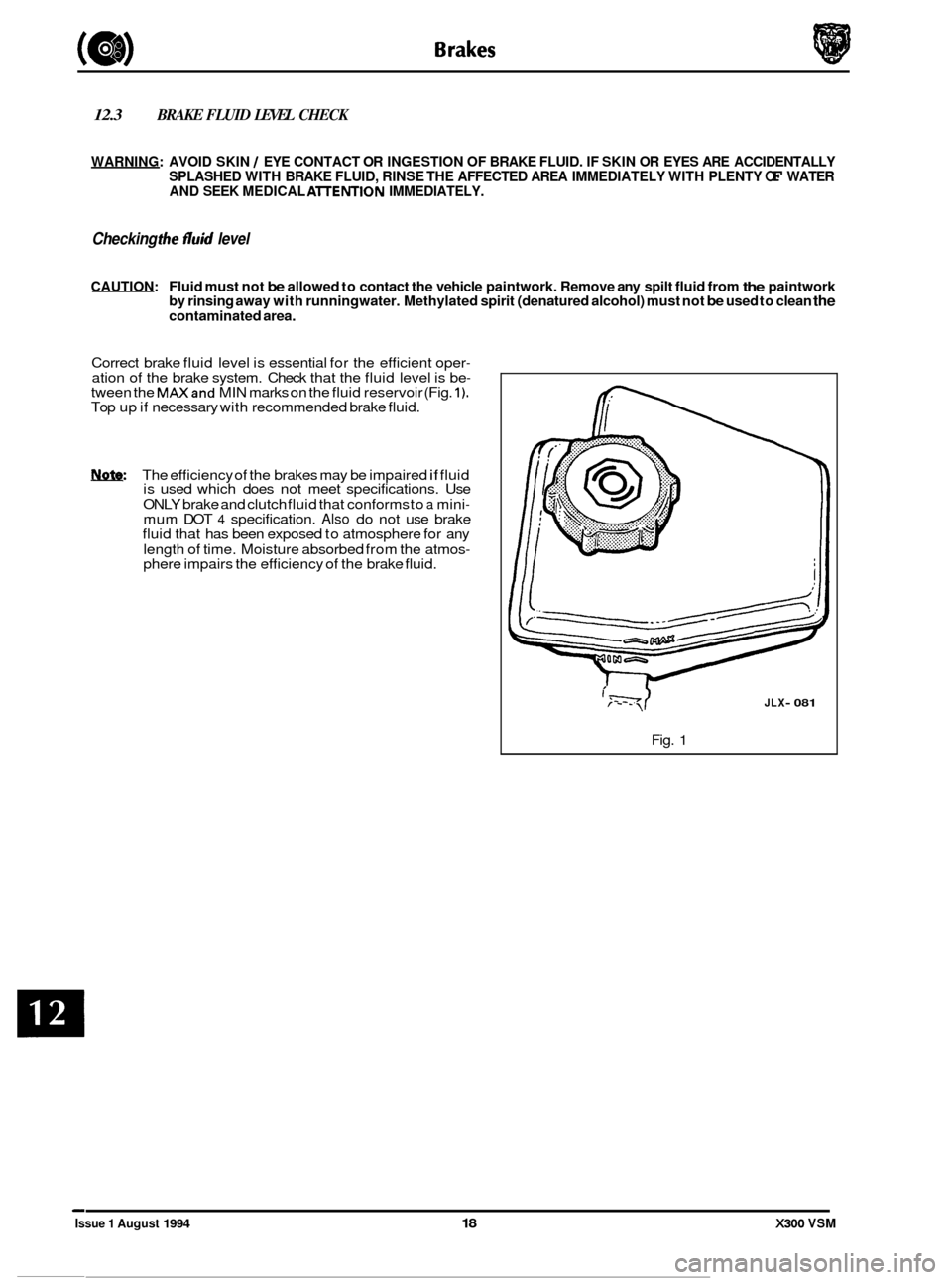
Correct brake fluid level is essential for the efficient oper- ation of the brake system. Check that the fluid level is be- tween the MAXand MIN marks on the fluid reservoir (Fig. 1). Top up if necessary with recommended brake fluid.
BMQ: The efficiency of the brakes may be impaired if fluid
is used which does not meet specifications. Use
ONLY brake and clutch fluid that conforms to
a mini- mum DOT 4 specification. Also do not use brake
fluid that has been exposed to atmosphere for any
length of time. Moisture absorbed from the atmos
- phere impairs the efficiency of the brake fluid.
JLX- 081
Fig. 1
Issue 1 August 1994 18 X300 VSM
Page 242 of 521
Brakes
12.4 BRAKE SYSTEM BLEEDING
WAR-: GREAT CARE MUST BE EXERCISED WHEN SERVICING OR REPAIRING THE SYSTEM. AVOID SKIN/ EYE
CONTACT OR INGESTION OF BRAKE FLUID. IF SKIN OR EYES ARE ACCIDENTALLY SPLASHED WITH
BRAKE FLUID,
RINSETHE AFFECTED AREA IMMEDIATELY WITH PLENTY OF WATER AND SEEK MEDICAL
ATTENTION. IF BRAKE FLUID IS INGESTED, SEEK MEDICAL ATTENTION IMMEDIATELY.
CAUm: Fluid must not be allowed to contact the vehicle paintwork. Remove any spilt fluid from the paintwork
by rinsing away with running water. Methylated spirit (denatured alcohol) must not be used to clean the
contaminated area.
CAUTION: Never use methylated spirit (denatured alcohol) for component cleaning purposes. Use only a proprietary
brake cleaning fluid.
WARNING : THROUGHOUT THE FOLLOWING MAINTENANCE / SERVICE OPERATIONS, ABSOLUTE CLEANLINESS
MUST BE OBSERVED TO PREVENT FOREIGN MATTER CONTAMINATING THE BRAKE SYSTEM.
12.4.1 System Bleeding - General Instructions
Use a brake bleeder bottle with a clear bleeder tube. Also recommended is a filler unit with a fill pressure of 1.0 bar. If a filler unit is not used, ensure that their is sufficient brake fluid in the reservoir throughout the bleeding procedure.
m: Always bleed the caliper furthest away from the actuation unit first. On right hand drive vehicles, bleed in the
following order: front
left (FL),front right (FR), rear left (RL) and rear right (RR). On left hand drive vehicles bleed in the following order: FR, FL, RR and RL.
12.4.2
. Ensure that the vehicle is standing level. Switch the igni-
tion off.
Check that the fluid level in the reservoir is between the min and max marks.
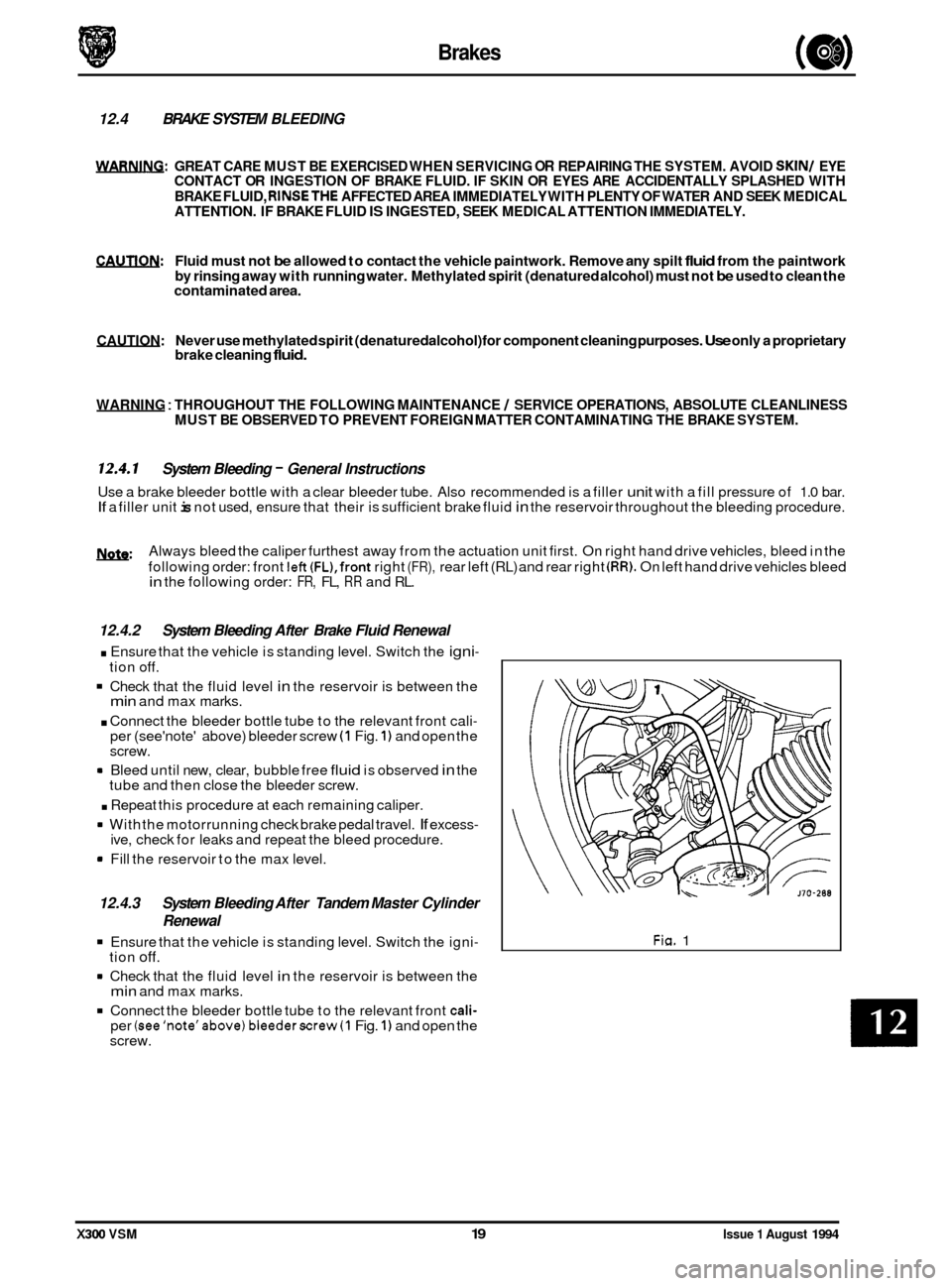
. Connect the bleeder bottle tube to the relevant front cali- per (see'note' above) bleeder screw (1 Fig. 1) and open the
screw.
rn Bleed until new, clear, bubble free fluid is observed in the
tube and then close the bleeder screw.
. Repeat this procedure at each remaining caliper.
With the motorrunning check brake pedal travel.
If excess- ive, check for leaks and repeat the bleed procedure.
Fill the reservoir to the max level.
System Bleeding After Brake Fluid Renewal
12.4.3 System Bleeding After Tandem Master Cylinder
Renewal
Ensure that the vehicle is standing level. Switch the igni- tion off.
rn Check that the fluid level in the reservoir is between the min and max marks.
Connect the bleeder bottle tube to the relevant front cali- per (see'note'above) bleederscrew(1 Fig. 1) and open the
screw.
Ficr. 1
X300 VSM 19 Issue 1 August 1994
Page 244 of 521
Brakes
a 12.5 GENERAL FI77lNG lNSTRUCTlONS
12.5.1 Brake Fluid
WARNING: BRAKE FLUID IS CORROSIVE. EXTREME CARE MUST BE TAKEN WHEN HANDLING. AVOID SKIN OR EYE
CONTACT. AVOID INGESTION. IF SKIN OR EYES ARE ACCIDENTALLY SPLASHED WITH BRAKE FLUID,
RINSE THE AFFECTED AREA IMMEDIATELY WITH PLENTY OF WATER AND SEEK MEDICAL ATTENTION.
IF BRAKE FLUID
IS INGESTED, SEEK MEDICAL ATTENTION IMMEDIATELY.
CAUTION:
Fluid must not be allowed to contact the vehicle paintwork. Remove any spilt fluid from the paintwork
by rinsing away with running water. Methylated spirit (denatured alcohol) must not be used to clean the
contaminated area.
Cleaning Solvents
CAUTION: Never use methylated spirit (denatured alcohol) for cleaning purposes. Use only a proprietary brake
cleaning fluid.
m: THROUGHOUT THE FOLLOWING MAINTENANCE / SERVICE OPERATIONS, ABSOLUTE CLEANLINESS
MUST BE OBSERVED TO PREVENT GRIT OR OTHER FOREIGN MATTER CONTAMINATING THE BRAKE
TION. TO CLEAN BRAKE SYSTEM COMPONENTS, WASH
IN A PROPRIETARY BRAKE CLEANING FLUID.
REMOVE ALL TRACES OF CLEANING FLUID BEFORE REASSEMBLY. ALL BRAKE SYSTEM RUBBER COh PONENTS MUST BE DIPPED IN CLEAN BRAKE FLUID AND ASSEMBLED USING THE FINGERS ONLY.
SYSTEM.
IFTHE SYSTEM IS TO
BE FLUSHED, USE CLEAN BRAKE FLUID TO MINIMUM DOT 4 SPECIFICA-
12.5.2 Hoses
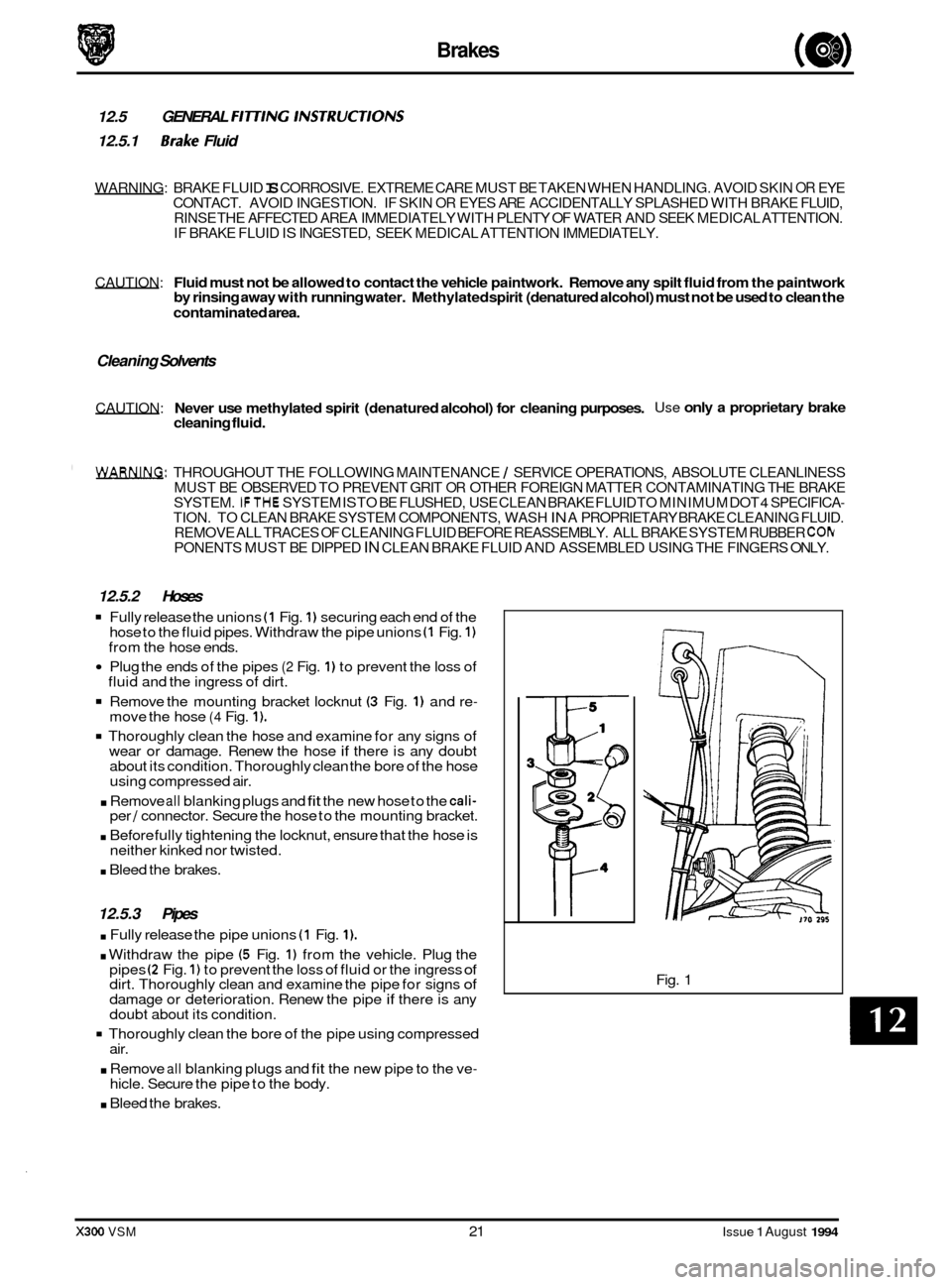
Fully release the unions (1 Fig. 1) securing each end of the
hose to the fluid pipes. Withdraw the pipe unions (1 Fig. 1) from the hose ends.
Plug the ends of the pipes (2 Fig. 1) to prevent the loss of
fluid and the ingress of dirt.
Remove the mounting bracket locknut (3 Fig. 1) and re- move the hose (4 Fig. 1).
Thoroughly clean the hose and examine for any signs of
wear or damage. Renew the hose if there is any doubt
about its condition. Thoroughly clean the bore of the hose
using compressed air.
. Remove all blanking plugs and fit the new hose to the cali- per / connector. Secure the hose to the mounting bracket.
. Before fully tightening the locknut, ensure that the hose is
neither kinked nor twisted.
. Bleed the brakes.
12.5.3 Pipes
. Fully release the pipe unions (1 Fig. 1).
. Withdraw the pipe (5 Fig. 1) from the vehicle. Plug the
pipes (2 Fig. 1) to prevent the loss of fluid or the ingress of dirt. Thoroughly clean and examine the pipe for signs of damage or deterioration. Renew the pipe if there is any
doubt about its condition.
Thoroughly clean the bore of the pipe using compressed
air.
. Remove all blanking plugs and fit the new pipe to the ve- hicle. Secure the pipe to the body.
. Bleed the brakes.
17
Fig. 1
X300 VSM 21 Issue 1 August 1994
Page 246 of 521
Brakes
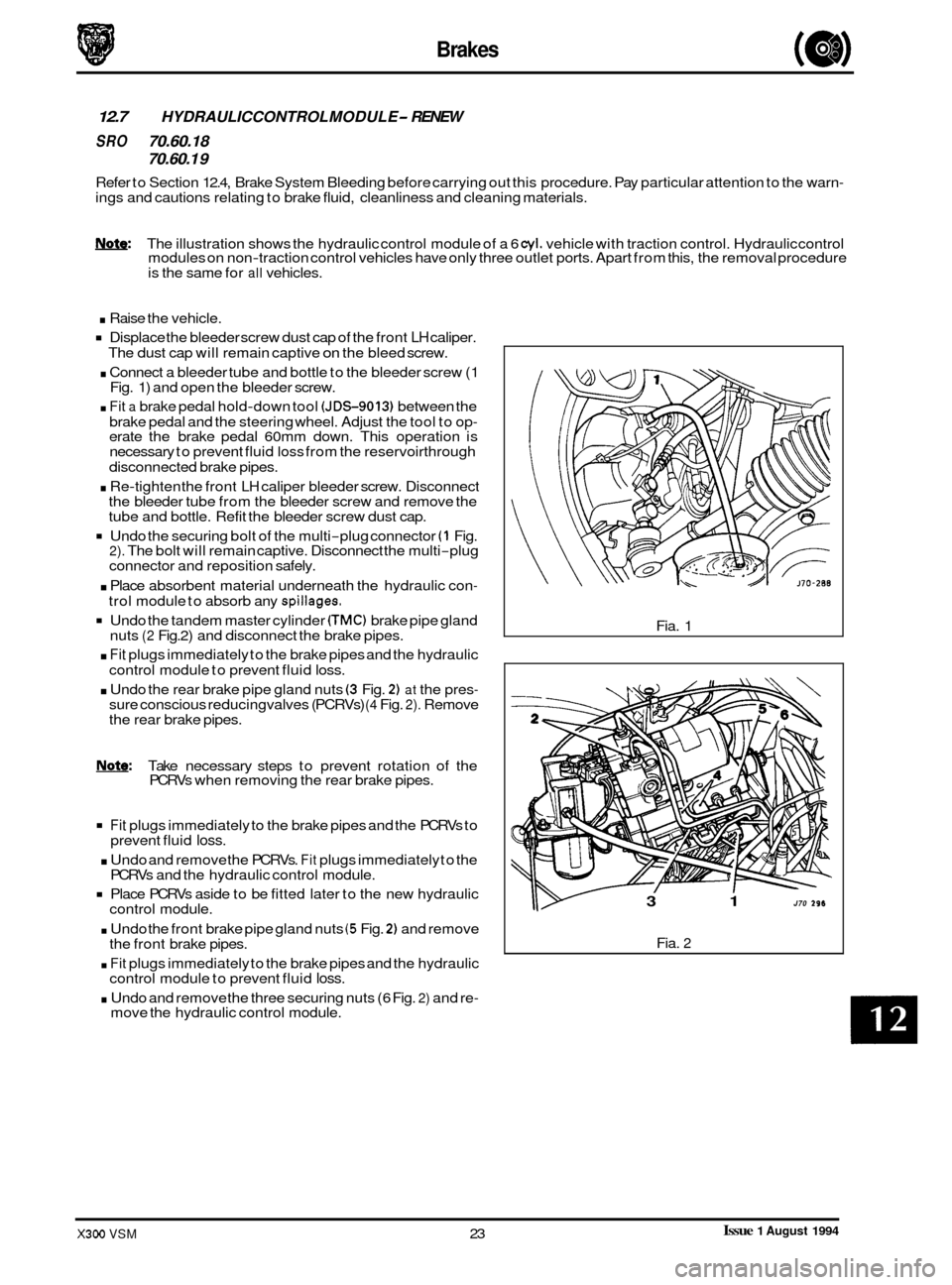
12.7 HYDRAULICCONTROL MODULE- RENEW
SRO 70.60.18
70.60.1
9
Refer to Section 12.4, Brake System Bleeding before carrying out this procedure. Pay particular attention to the warn- ings and cautions relating to brake fluid, cleanliness and cleaning materials.
W: The illustration shows the hydraulic control module of a 6 cyl. vehicle with traction control. Hydraulic control
modules on non-traction control vehicles have only three outlet ports. Apart from this, the removal procedure
is the same for all vehicles.
. Raise the vehicle.
Displace the bleeder screw dust cap of the front LH caliper.
The dust cap will remain captive
on the bleed screw.
. Connect a bleeder tube and bottle to the bleeder screw (1
Fig. 1) and open the bleeder screw.
. Fit a brake pedal hold-down tool (JDS-9013) between the
brake pedal and the steering wheel. Adjust the tool to op
- erate the brake pedal 60mm down. This operation is
necessary to prevent fluid loss from the reservoirthrough
. Re-tighten the front LH caliper bleeder screw. Disconnect
the bleeder tube from the bleeder screw and remove the
tube and bottle. Refit the bleeder screw dust cap.
Undo the securing bolt of the multi-plug connector (1 Fig. 2). The bolt will remain captive. Disconnect the multi-plug
connector and reposition safely.
. Place absorbent material underneath the hydraulic con-
trol module to absorb any spillages.
Undo the tandem master cylinder CTMC) brake pipe gland
nuts (2 Fig.2) and disconnect the brake pipes.
. Fit plugs immediately to the brake pipes and the hydraulic
control module to prevent fluid
loss.
. Undo the rear brake pipe gland nuts (3 Fig. 2) at the pres- sure conscious reducing valves (PCRVs) (4 Fig. 2). Remove
the rear brake pipes.
disconnected brake pipes.
Note: Take necessary steps to prevent rotation of the
PCRVs when removing the rear brake pipes.
Fit plugs immediately to the brake pipes and the PCRVs to
. Undo and remove the PCRVs. Fit plugs immediately to the
Place PCRVs aside to be fitted later to the new hydraulic
. Undo the front brake pipe gland nuts (5 Fig. 2) and remove
. Fit plugs immediately to the brake pipes and the hydraulic
. Undo and remove the three securing nuts (6 Fig. 2) and re-
0 prevent fluid loss.
PCRVs and the hydraulic control module.
control module.
the front brake pipes.
control module to prevent fluid
loss.
move the hydraulic control module. Fia.
1
3 1 J70 296
Fia. 2
Issue 1 August 1994 X300 VSM 23
Page 247 of 521

Remove the absorbent material and clean the mounting bracket and surrounding area.
Fit and align a new hydraulic control module to the mounting bracket. Ensure that the mounting cup tangs fully en-
9 Fit and tighten the securing nuts (6 Fig. 1).
. Place absorbent material underneath the hydraulic con- trol module to absorb any spillages.
. Connect the front hydraulic brake pipes (5 Fig. 1) tothe hy- drauliccontrol module, removing plugs immediately prior
to connection. Tighten the gland nuts.
Fit the PCRVs (4 Fig. 1) to the hydrauliccontrol module, re- moving plugs immediately prior to connection. Tighten
the PCRVs.
Connect the rear hydraulic brake pipes (3 Fig. 1) to the
PCRVs, removing the plugs immediately prior to connec- tion. Tighten the gland nuts.
gage
the bracket slots.
&&a: Take necessary steps to prevent rotation of the
PCRVs when fitting the rear brake pipes.
Connect
theTMC hydraulic brake pipes (2 Fig. 1) to the hy- draulic control module, removing the plugs immediately
prior to connection. Tighten the gland nuts.
. Remove the absorbent material and clean thesurrounding
area.
. Reposition and connect the multi-plug connector. Tighten
the securing bolt (1 Fig. 1).
. Ensure that all fixings are torque tightened to specified tol- erances.
. Release the brake pedal hold-down tool and remove.
. Bleed the brake system (refer to sub-section 12.4.4).
. Examine the hydraulic control module for leaks.
3 1 J70 296
Fig. 1
Issue 1 August 1994 ~~ X300 VSM
Page 248 of 521
Brakes
12.8
SRO 70.60.21
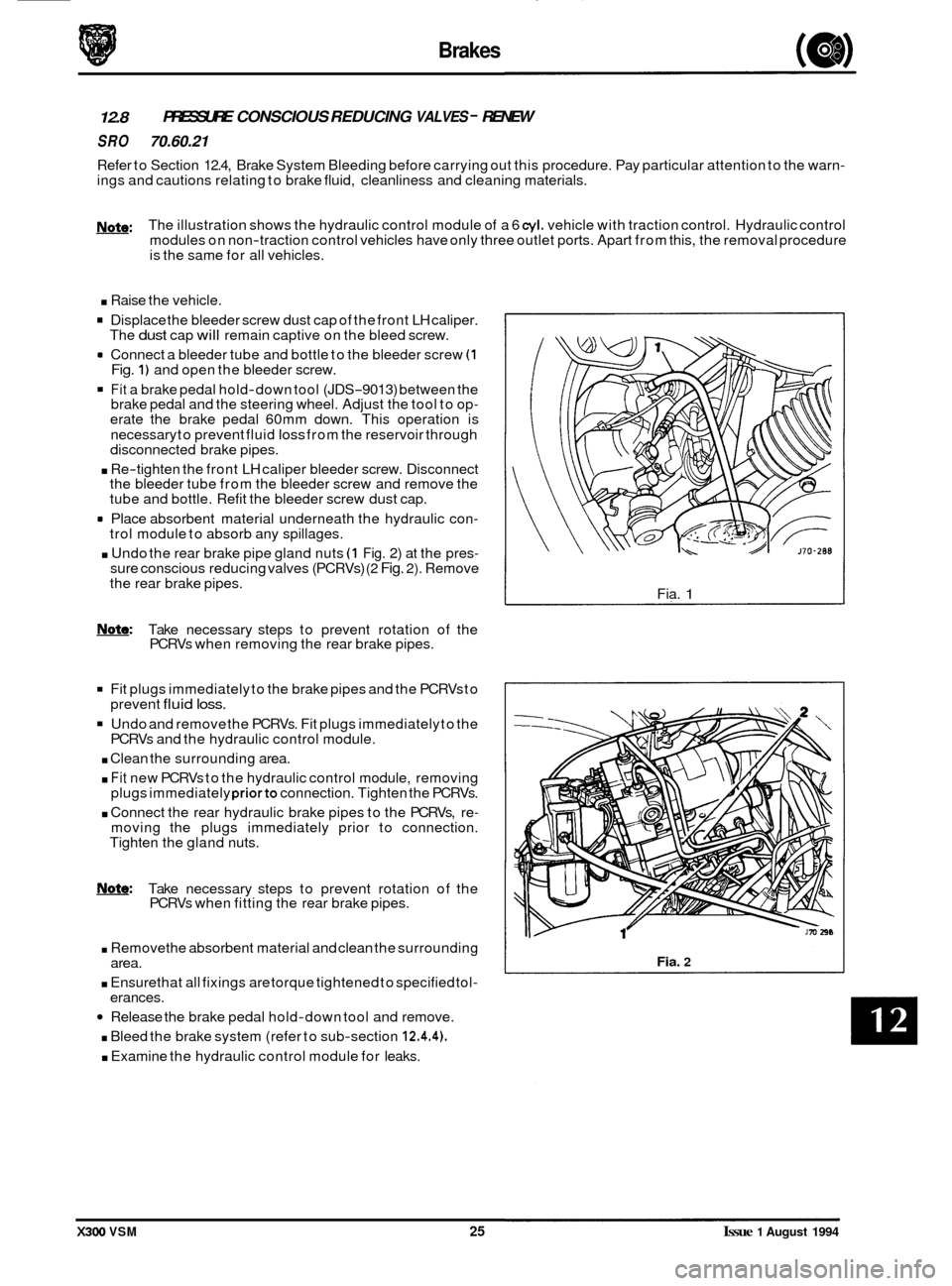
PRESSURE CONSCIOUS REDUCING VALVES - RENEW
Refer to Section 12.4, Brake System Bleeding before carrying out this procedure. Pay particular attention to the warn- ings and cautions relating to brake fluid, cleanliness and cleaning materials.
Note: The illustration shows the hydraulic control module of a 6 cyl. vehicle with traction control. Hydraulic control
modules on non-traction control vehicles have only three outlet ports. Apart from this, the removal procedure
is the same for all vehicles.
. Raise the vehicle.
Displace the bleeder screw dust cap of the front LH caliper.
The dust cap will remain captive on the bleed screw.
rn Connect a bleeder tube and bottle to the bleeder screw (1 Fig. 1) and open the bleeder screw.
Fit a brake pedal hold-down tool (JDS-9013) between the
brake pedal and the steering wheel. Adjust the tool to op- erate the brake pedal 60mm down. This operation is
necessary to prevent fluid
loss from the reservoir through
disconnected brake pipes.
. Re-tighten the front LH caliper bleeder screw. Disconnect
the bleeder tube from the bleeder screw and remove the
tube and bottle. Refit the bleeder screw dust cap.
rn Place absorbent material underneath the hydraulic con- trol module to absorb any spillages.
. Undo the rear brake pipe gland nuts (1 Fig. 2) at the pres- sure conscious reducing valves (PCRVs) (2 Fig. 2). Remove
the rear brake pipes.
m: Take necessary steps to prevent rotation of the
PCRVs when removing the rear brake pipes.
Fit plugs immediately to the brake pipes and the PCRVs to
Undo and remove the PCRVs. Fit plugs immediately to the
. Clean the surrounding area.
. Fit new PCRVs to the hydraulic control module, removing
plugs immediately priorto connection. Tighten the PCRVs.
. Connect the rear hydraulic brake pipes to the PCRVs, re- moving the plugs immediately prior to connection.
Tighten the gland nuts.
prevent
fluid loss.
PCRVs
and the hydraulic control module.
0
Note: Take necessary steps to prevent rotation of the
PCRVs when fitting the rear brake pipes.
. Removethe absorbent material and clean the surrounding
. Ensure that all fixings are torque tightened to specified tol-
Release the brake pedal hold-down tool and remove.
. Bleed the brake system (refer to sub-section 12.4.4).
. Examine the hydraulic control module for leaks.
area.
erances. Fia.
1
Fia. 2
X300 VSM 25 Issue 1 August 1994
Page 249 of 521
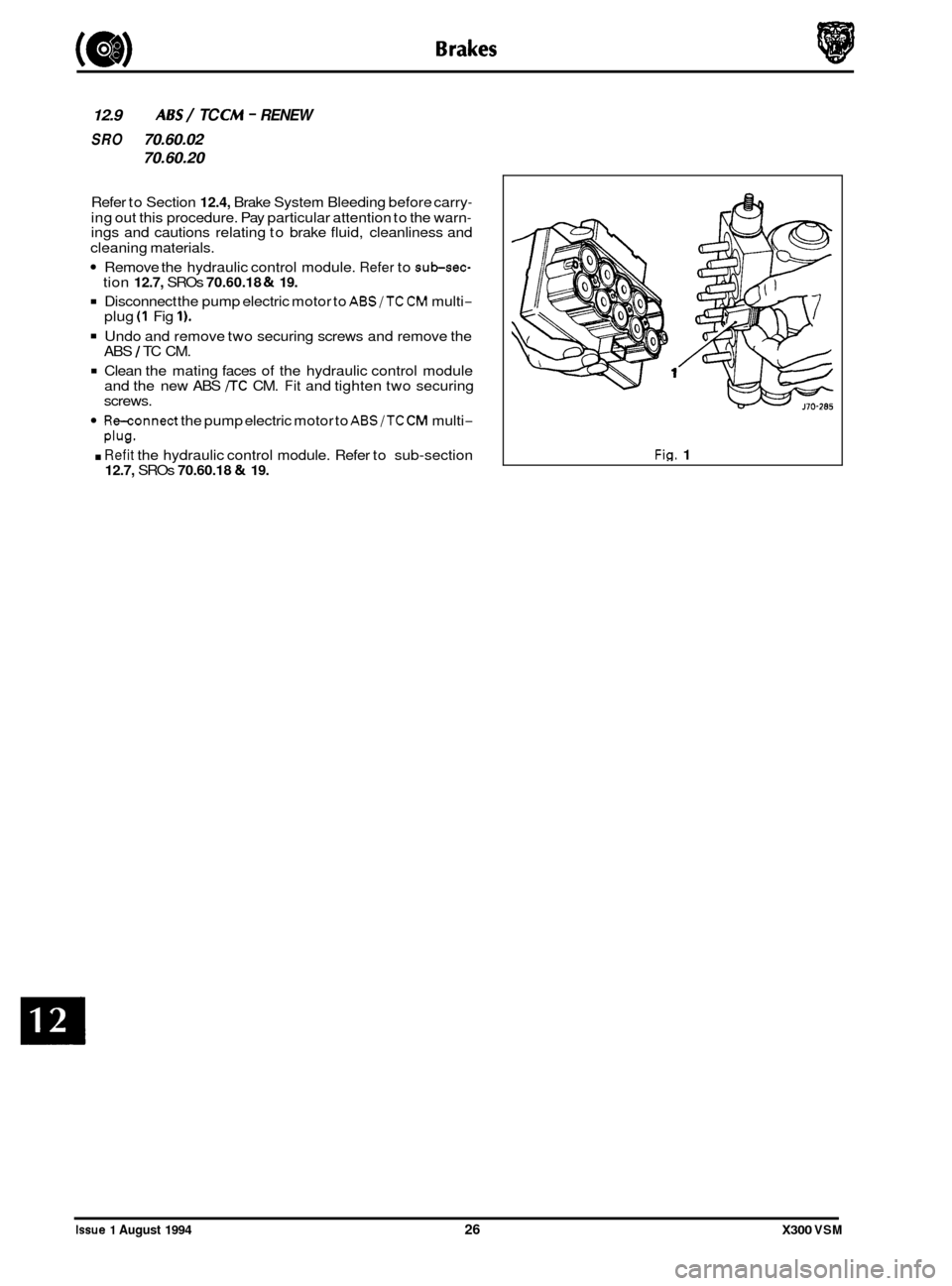
12.9 ABS/ TC CM - RENEW
SRO 70.60.02
70.60.20
Refer to Section 12.4, Brake System Bleeding before carry-
ing out this procedure. Pay particular attention to the warn- ings and cautions relating to brake fluid, cleanliness and
cleaning materials.
Remove the hydraulic control module. Refer to sub-sec- tion 12.7, SROs 70.60.18 & 19.
Disconnect the pump electric motor to ABS/TC CM multi- plug (1 Fig 1).
Undo and remove two securing screws and remove the
ABS 1 TC CM.
Clean the mating faces of the hydraulic control module
and the new ABS /TC CM. Fit and tighten two securing
screws.
Re-connect the pump electric motor to ABS/TC CM multi-
Plug.
. Refit the hydraulic control module. Refer to sub-section 12.7, SROs 70.60.18 & 19.
Fig. 1
Issue 1 August 1994 26 X300 VSM
0
e
Page 257 of 521

Body Components & Trim d-!P
13.2
13.2.1 Doors, Description
Doors are of welded, mild steel frames welded to the door panels; sponge rubber primary and secondary seals are
mounted on the doors. Internal insulation is provided by a foam water shedder attached to the door by press fitting and doublesided adhesive tape.
Front and rear door armrests are attached to supports riveted to each door frame; the attaching screws are fitted
with access covers. Upper and lower trim pads and a door pocket are attached to each of the doors by clips and screws. multi-plug connectors are used to provide a means of connecting the guard lamps, window lift switches and loud- speakers, external mirror and regulator (front doors only), which are housed within the doors.
Central locking is provided subject to market variations: Dead Locking for UK
/ Europe and Driver only unlock for N America. Door locks are eight disc, bayonet fixing, barrels with integral lock / unlock switches. Keys include ‘in-key’
transponders which are programmed to the vehicle via the Jaguar Diagnostic System also operate the engine immobi
- lisation system.
CAUTION: When removing the door panel water shedder, a foam membrane attached to each door panel by a com- bination of pressfitting (upper area) and bydouble-sided tape (bottom area), it is important that the shed- der is refitted correctly to maintain the water seal.
It is advisable not to disturb the bottom (taped) portion of the water shedder unless absolutely necessary
- it is possible to unclip the top of the shedder and bend it over to gain access to the inner panel.
If
it is necessary to disturb the bottom attachment, eg to remove the water shedder from the door panel,
the existing water shedder must be discarded and a new one fitted to ensure that the seal is maintained.
On refitting, the new water shedder should be pressed onto the door panel at the top and then the adhes- ive tape backing strip peeled off to enable the shedder to be pressed home at the bottom.
DOORS AND FUEL FILLER FLAP
13.2.2 front and Rear Door Trim Pad Veneer Panel,
Renew
SRO 76.47.11
76.47.12
. Reposition the inner door handle. See Fig. 1.
Remove the inner handle escutcheon plate blanking plate.
Undo and remove the inner handle escutcheon plate se-
. Remove the plate and gasket.
. Carefully Undo and remove the veneer panel.
Undo and remove the retaining clip securing screws.
. Remove the retaining clip assemblies.
9 Place the veneer panel aside.
Place the new veneer panel to the front.
Fit the retaining clip assemblies.
. Fit and tighten the retaining clip securing screws.
. Fit and fully seat the veneer panel to the door.
. Reposition the inner door handle.
. Fit the gasket and plate over the inner door handle.
. Fit and tighten the escutcheon plate securing screw.
. Refit the blanking plate.
curing
screw.
Fig.
1
0
0
0
0
Issue 1 August 1994 2 X300 VSM
Page 301 of 521
Body Components & Trim a
13.7.4
Localized stains caused by accidental spillage may be one of three types:
0 Water based stainscaused byfoodstuffs,starches, sugars, soft drinks,fruit stains, washable inketc. These stains
adhere readily to the pile and do not respond to vacuum cleaning. They are best removed immediately using
the procedure detailed below.
0 Oil /grease based stains caused by spillage or other contamination by butter, grease, hand cream, ball point pen
ink, crayon, lipstick etc.
0 A combination of both these types.
Spot Cleaning - Localized Stains
To remove water based stains:
. Blot up liquids and /or scrape off semi-solids using a spatula.
. Sponge the affected area with clean luke-warm water. Use a clean, damp, undyed, cotton cloth to absorb as much
. If the stain persists, apply a suitable carpet shampoo solution made up to the manufacturers instructions, again work-
= Rinse with clean, warm water, taking care not to over-wet the carpet.
Absorb excess moisture by laying dry, undyed cloths or white paper towels over the moist carpet under light pres-
. When the carpet is thoroughly dry, vacuum clean the area to lift the carpet pile.
CAUTION: When liquids are applied to the pile, use only a clean cloth or sponge. Do not apply liquids directly to the
carpet - when attempting to remove stains, blot the pile as heavy rubbing can destroy the yarn structure of the carpet.
of the moisture as possible, working from the edge to the centre of the stain.
ing from the edge to the centre of the stain.
sure; replace when necessary.
To remove oil /grease based stains:
. Using a suitable aerosol containing solvent loaded with absorbent powder, spray the affected areas of the carpet.
= Allow the solvent to evaporate and remove the powder containing the grease by using a vacuum cleaner or brush.
m:
CAUTION: Solvents must only be used in well-ventilated areas where naked lights and smoking are prohibited.
The solvent loosens the grease from the fibre and the powder then absorbs the grease-carrying solvent.
Neat solvent, eg dry cleaning
fluid, may be used, but should be used sparingly from a clean white cloth.
To remove stains which are a combination of oil and water based contamination (usually resulting from food or drink):
. Treat combination stains as for water based stains.
. Allow to dry out.
. Treat as for grease based stains.
Issue 1 August 1994 46 X300 VSM