service JAGUAR XJ6 1994 2.G Repair Manual
[x] Cancel search | Manufacturer: JAGUAR, Model Year: 1994, Model line: XJ6, Model: JAGUAR XJ6 1994 2.GPages: 521, PDF Size: 17.35 MB
Page 193 of 521
Driveshafts & Final Drive
9.10 REAR HUB BEARING, RENEW
SRO 64.15.14
9.11
SRO 64.15.15
REAR HUB OIL SEAL, RENEW
Removal
= Disconnect vehicle battery ground lead.
= Slacken appropriate axle shaft hub nut.
. Support the vehicle at the rear and remove rear road
m: To aid assembly, markthe position of the head of the
hub carrier fulcrum, relative to the wishbone slot.
. Disconnect handbrake cable inner and outer.
. Remove brake caliper in accordance with Section 12, but do not disconnect hydraulics.
. Slacken hub carrier fulcrum and remove ABS sensor from
hub carrier.
. Remove axle shaft hub nut (and discard), collar and hub
carrier fulcrum.
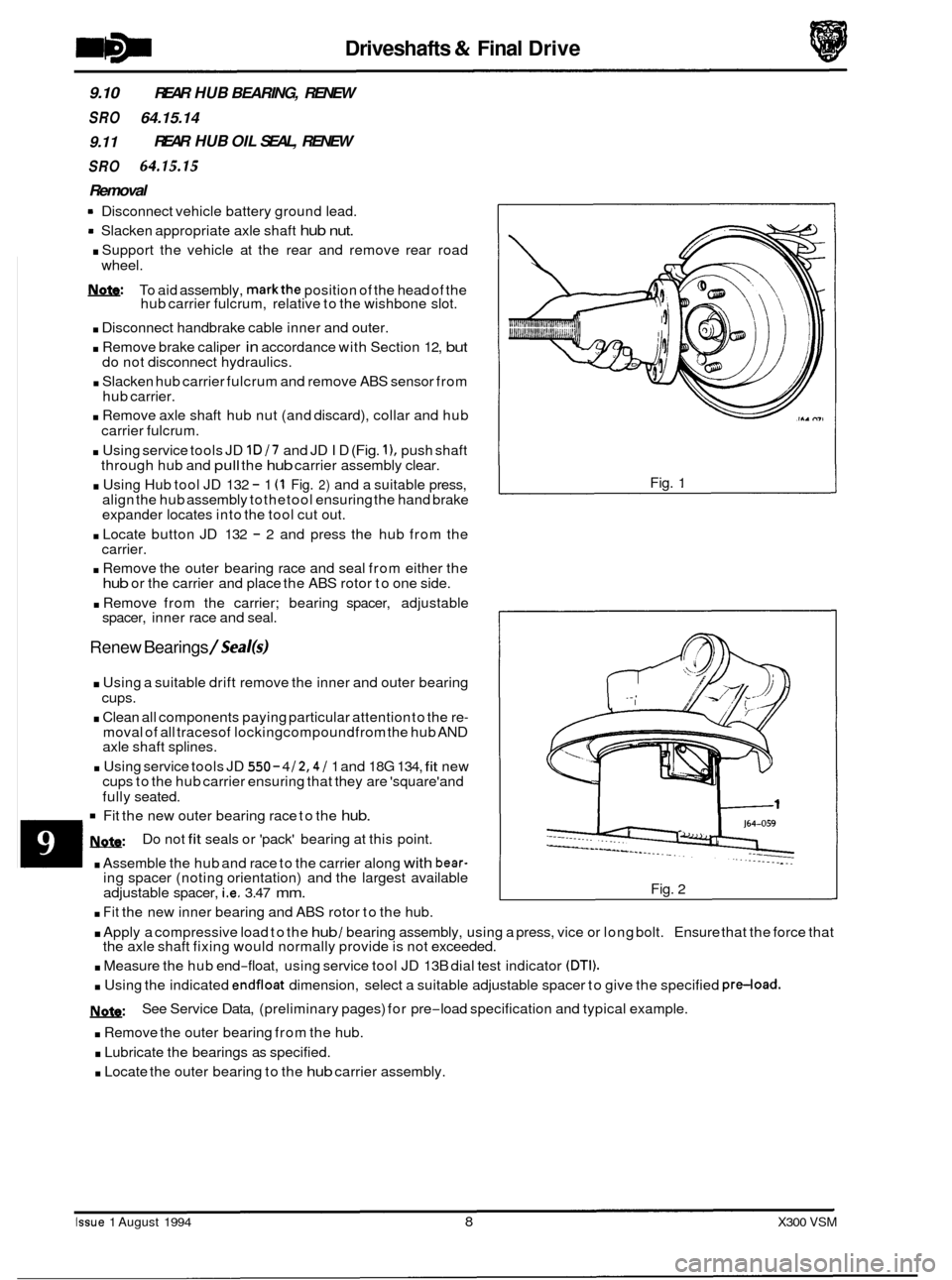
. Using service tools JD 1D/7 and JD ID (Fig. I), push shaft
through hub and pull the hub carrier assembly clear.
. Using Hub tool JD 132 - 1 (1 Fig. 2) and a suitable press,
align the hub assembly tothetool ensuring the hand brake
expander locates into the tool cut out.
. Locate button JD 132 - 2 and press the hub from the
carrier.
. Remove the outer bearing race and seal from either the hub or the carrier and place the ABS rotor to one side.
. Remove from the carrier; bearing spacer, adjustable
spacer, inner race and seal.
Renew Bearings /Sea/($
wheel.
. Using a suitable drift remove the inner and outer bearing
cups.
. Clean all components paying particular attention to the re- moval of all tracesof lockingcompoundfrom the hub AND
axle shaft splines.
. Using service tools JD 550 - 4 /2,4 / 1 and 18G 134, fit new
cups to the hub carrier ensuring that they are 'square'and
fully seated.
Fit the new outer bearing race to the hub.
&&Q:
. Assemble the hub and race to the carrier along with bear-
Do not fit seals or 'pack' bearing at this point.
ing spacer (noting orientation) and the largest available
adjustable spacer,
i.e. 3.47 mm.
. Fit the new inner bearing and ABS rotor to the hub. Fig.
1
Fig.
2
. Apply a compressive load to the hub / bearing assembly, using a press, vice or long bolt. Ensure that the force that
. Measure the hub end-float, using service tool JD 13B dial test indicator (DTI).
. Using the indicated endfloat dimension, select a suitable adjustable spacer to give the specified pre-load.
m:
. Remove the outer bearing from the hub.
. Lubricate the bearings as specified.
. Locate the outer bearing to the hub carrier assembly.
the axle shaft
fixing would normally provide is not exceeded.
See Service Data, (preliminary pages) for pre
-load specification and typical example.
Issue 1 August 1994 8 X300 VSM
Page 196 of 521
SECTION CONTENTS 0
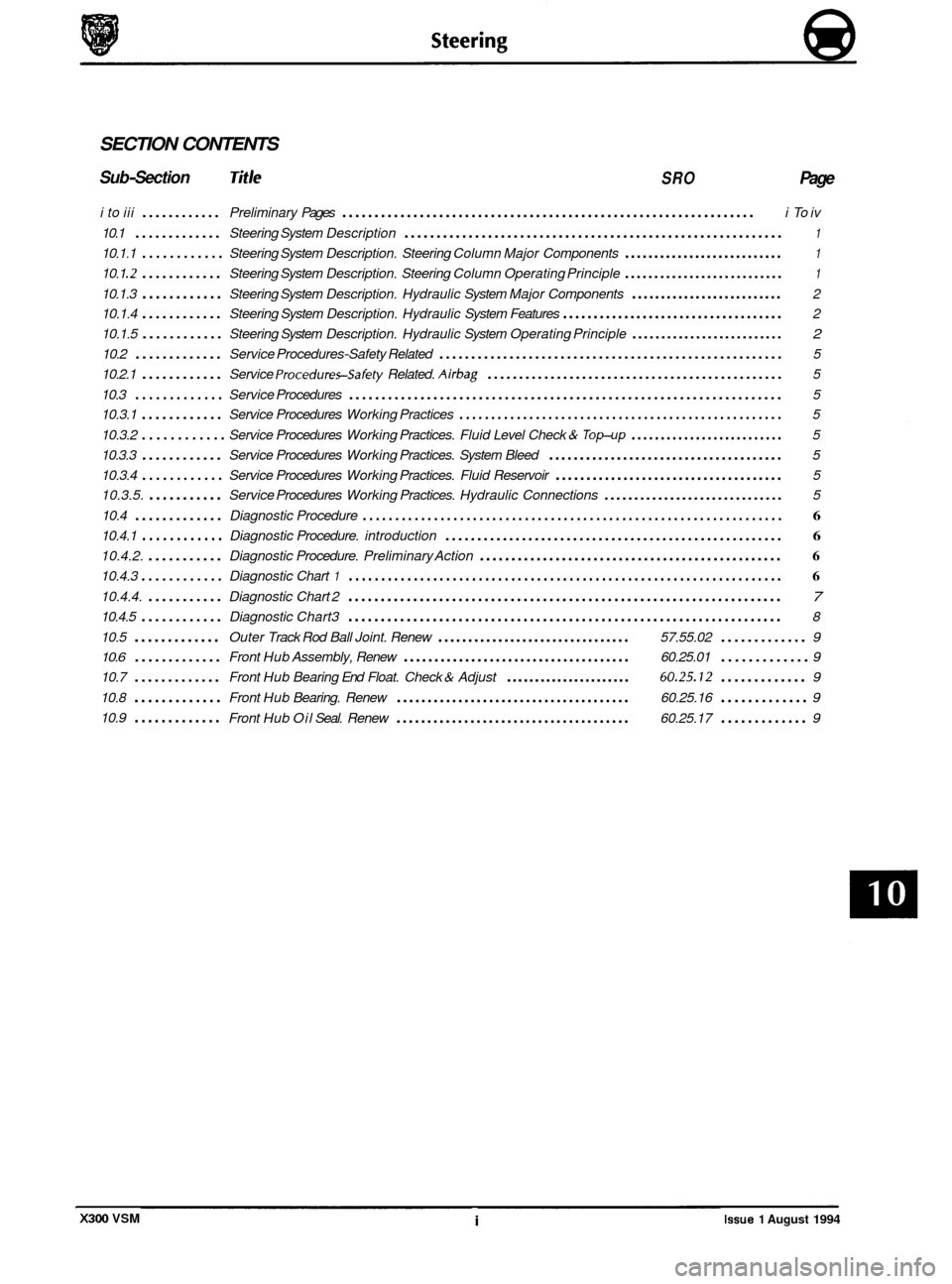
Sub-Section Title SRO Page
i to iii ............ Preliminary Pages ................................................................ i To iv
10.1
............. Steering System Description ........................................................... 1
10.1.1 ............ Steering System Description. Steering Column Major Components ........................... 1
10.1 .2 ............ Steering System Description. Steering Column Operating Principle ........................... 1
10.1.3 ............ Steering System Description. Hydraulic System Major Components .......................... 2
10.1.4
............ Steering System Description. Hydraulic System Features .................................... 2
10.1.5
............ Steering System Description. Hydraulic System Operating Principle .......................... 2
10.2 ............. Service Procedures-Safety Related ...................................................... 5
10.2.1
............ Service ProceduresSafety Related. Airbag ............................................... 5
10.3
............. Service Procedures ................................................................... 5
10.3.1
............ Service Procedures Working Practices ................................................... 5
10.3.2
............ Service Procedures Working Practices. Fluid Level Check & Topup .......................... 5
10.3.3
............ Service Procedures Working Practices. System Bleed ...................................... 5
10.3.4
............ Service Procedures Working Practices. Fluid Reservoir ..................................... 5
10.3.5.
........... Service Procedures Working Practices. Hydraulic Connections .............................. 5
10.4
............. Diagnostic Procedure ................................................................. 6
10.4.1 ............ Diagnostic Procedure. introduction ..................................................... 6
10.4.2. ........... Diagnostic Procedure. Preliminary Action ................................................ 6
10.4.3 ............ Diagnostic Chart 1 ................................................................... 6
10.4.4. ........... Diagnostic Chart 2 ................................................................... 7
10.4.5 ............ Diagnostic Chart3 ................................................................... 8
10.5
............. Outer Track Rod Ball Joint. Renew ................................ 57.55.02 ............. 9
10.6 ............. Front Hub Assembly, Renew ..................................... 60.25.01 ............. 9
10.7
............. Front Hub Bearing End Float. Check & Adjust ...................... 60.25.12 ............. 9
10.8
............. Front Hub Bearing. Renew ...................................... 60.25.16 ............. 9
10.9
............. Front Hub Oil Seal. Renew ...................................... 60.25.17 ............. 9
X300 VSM i Issue 1 August 1994
Page 197 of 521
@ Steering
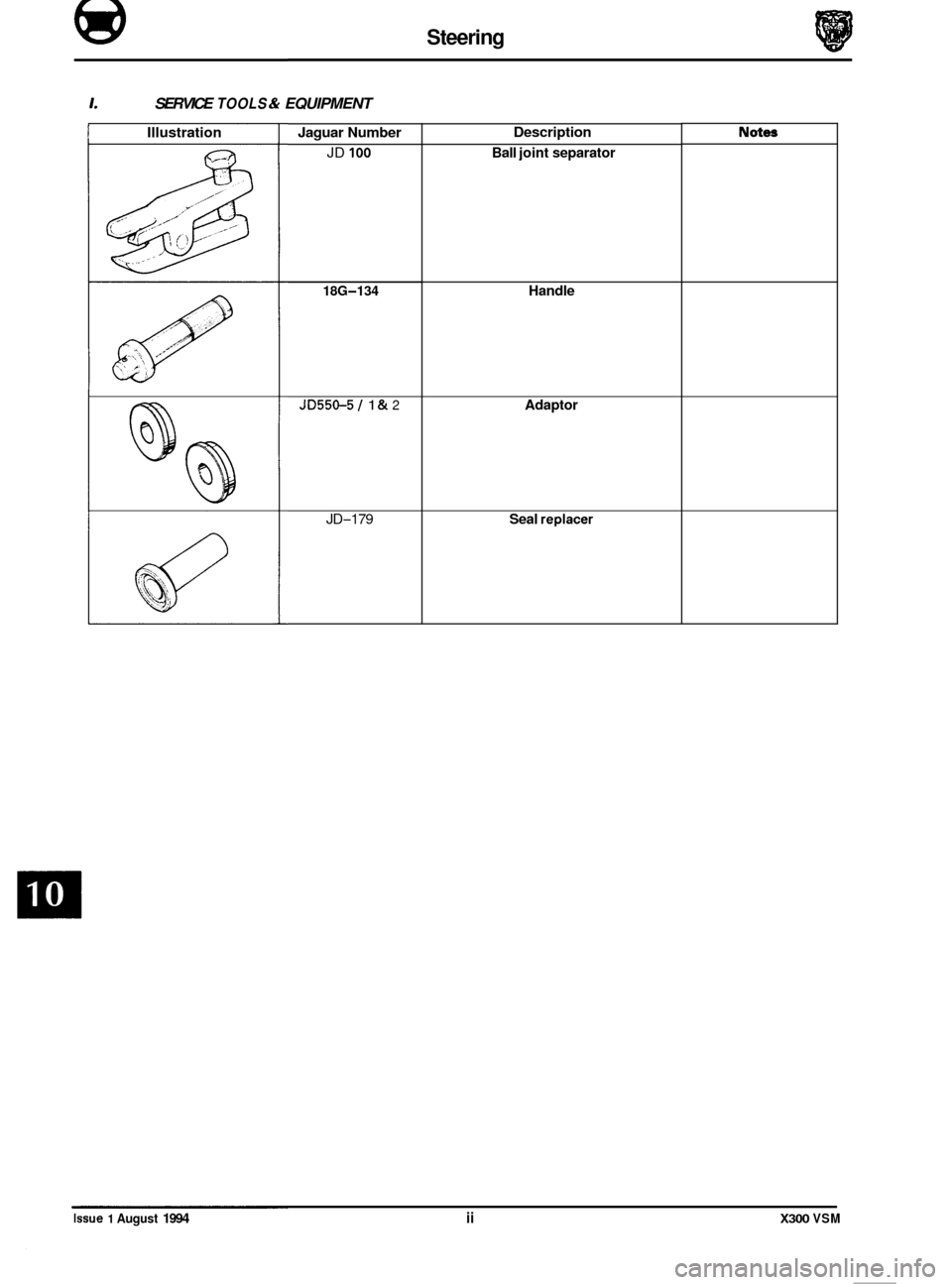
1. SERVICE TOOLS & EQUIPMENT
I Illustration Jaguar Number
JD 100
18G-134
JD550-5 / 1 & 2
JD-179
Description
Ball joint separator
Handle
Adaptor
Seal
replacer
Not- 0
e
0
0
Issue 1 August 1994 ii X300 VSM
Page 199 of 521
@ Steering
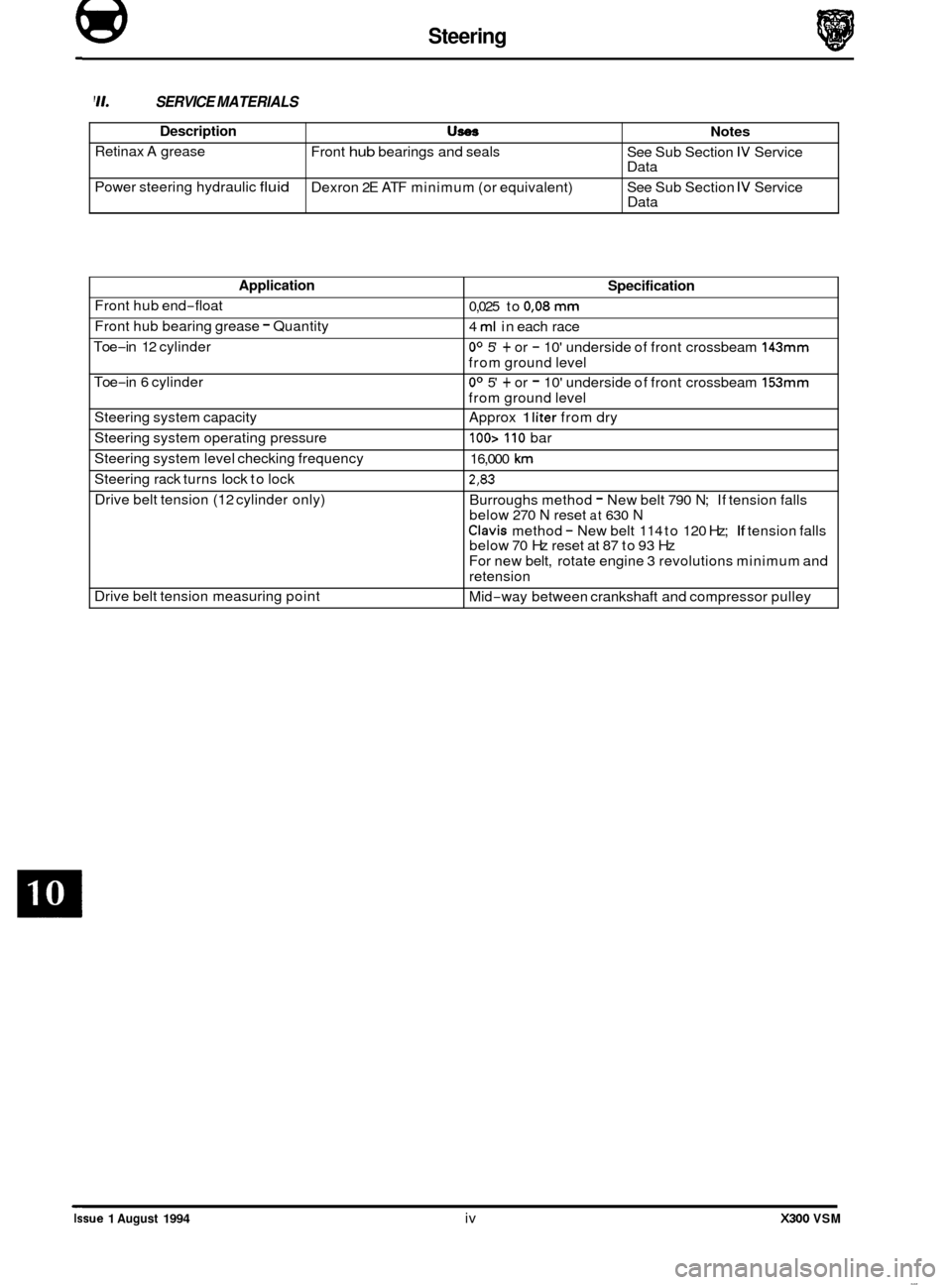
Description
Retinax A grease
Power steering hydraulic
fluid
'11. SERVICE MATERIALS
U- Notes
Front hub bearings and seals
Dexron 2E ATF minimum (or equivalent) See
Sub Section IV Service
Data
See Sub Section
IV Service
Data
Application
Front hub end-float
Front hub bearing grease
- Quantity
Toe
-in 12 cylinder
Toe
-in 6 cylinder
Steering system capacity
Steering system operating pressure
Steering system level checking frequency
Drive belt tension (12 cylinder only)
Steering
rack turns lock to lock
Drive belt tension measuring point
Specification
0,025 to 0,08 mm
4 ml in each race
Oo 5' + or - 10' underside of front crossbeam 143mm
from ground level
Oo 5' + or - 10' underside of front crossbeam 153mm
from ground level
Approx
1 liter from dry
100> 110 bar
16,000
km
2,83
Burroughs method - New belt 790 N; If tension falls
below 270 N reset at 630 N
Clavis method - New belt 114 to 120 Hz; If tension falls
below 70 Hz reset at 87 to 93 Hz
For new belt, rotate engine 3 revolutions minimum and
retension
Mid
-way between crankshaft and compressor pulley
Issue 1 August 1994 iv X300 VSM
Page 204 of 521
10.2 SERVICE
PROCEDURES - SAFETY RELATED
10.2.1
Airbag
The electrically activated driver's side airbag is attached to the steering wheel hub and is fed by two wires from the
column stalk assembly. Electrical input to the column stalk assembly for the airbag is provided by a dedicated harness
which is encased in a yellow sleeve. A mechanism in the stalk assembly called the 'cable reel cassette' provides conti
-
nuity from the static column to the steering wheel. The 'cable reel cassette' is driven by a tang which locates in the
steering wheel. Because the connection is by wires, and the cassette assembly is only capable of approximately five
(5) full turns,
it is critically important that initial positioning is correct, see Section 15. It is equally important that fitting of the steering wheel, connection of the column, lower shaft and steering rackshould
ONLY be made with the steering rack in the center of its travel.
WARNING: DO NOT REMOVE THE STEERING COLUMN FROM THE VEHICLE WITH THE STEERING WHEEL AT- TACHED UNLESS THE STEERING IS CENTERED AND THE COLUMN LOCK IS ENGAGED. IF THE LOCK
BARREL
IS TO BE RENEWED, 'LOCK-WIRE THE ASSEMBLY TO PREVENT ROTATION. FAILURE TO OB- SERVE THIS AND CONSEQUENT DAMAGE TO THE 'CABLE REEL CASSETTE MAY RESULT IN AN INOP- ERATIVE AIRBAG SYSTEM. SEE LABEL ON STEERING WHEEL HUB.
10.3 SERVICE PROCEDURES
10.3.1 Working Practices
It is not recommended that either the steering rack or engine driven pump assemblies are repaired in any way other
than in accordance with the repair procedures described in this manual. The fluid reservoir and filter is a disposable
assembly and no attempt should be made to clean it internally. Genuine replacement units must be fitted following
routine service or diagnostic confirmation of the failure of any component.
The importance of cleanliness cannot be over
-stressed, not only with new parts but also those which may havefailed.
In-service contamination of the hydraulic system is a major cause of failures and may be avoided with good working
practices and care. All new units and pipes must be supplied with suitable blanks in every orifice. Should a unit not
have blanks fitted, do not use
it - return it to the supplier with an appropriate reason for your action.
To help the manufacturer diagnose problems and avoid post-removal contamination; provide full details of the fault
and plug all connections as soon as they are released. All suspect units must be returned to Jaguar Cars complete
with relevant documentation.
CAUTION: It is imperative that the power steering system does not become contaminated in any way. Always de- cant fluid from afresh sealed container and clean the area around the reservoir neck both before and after topping-up. Never return drained fluid to the system.
10.3.2
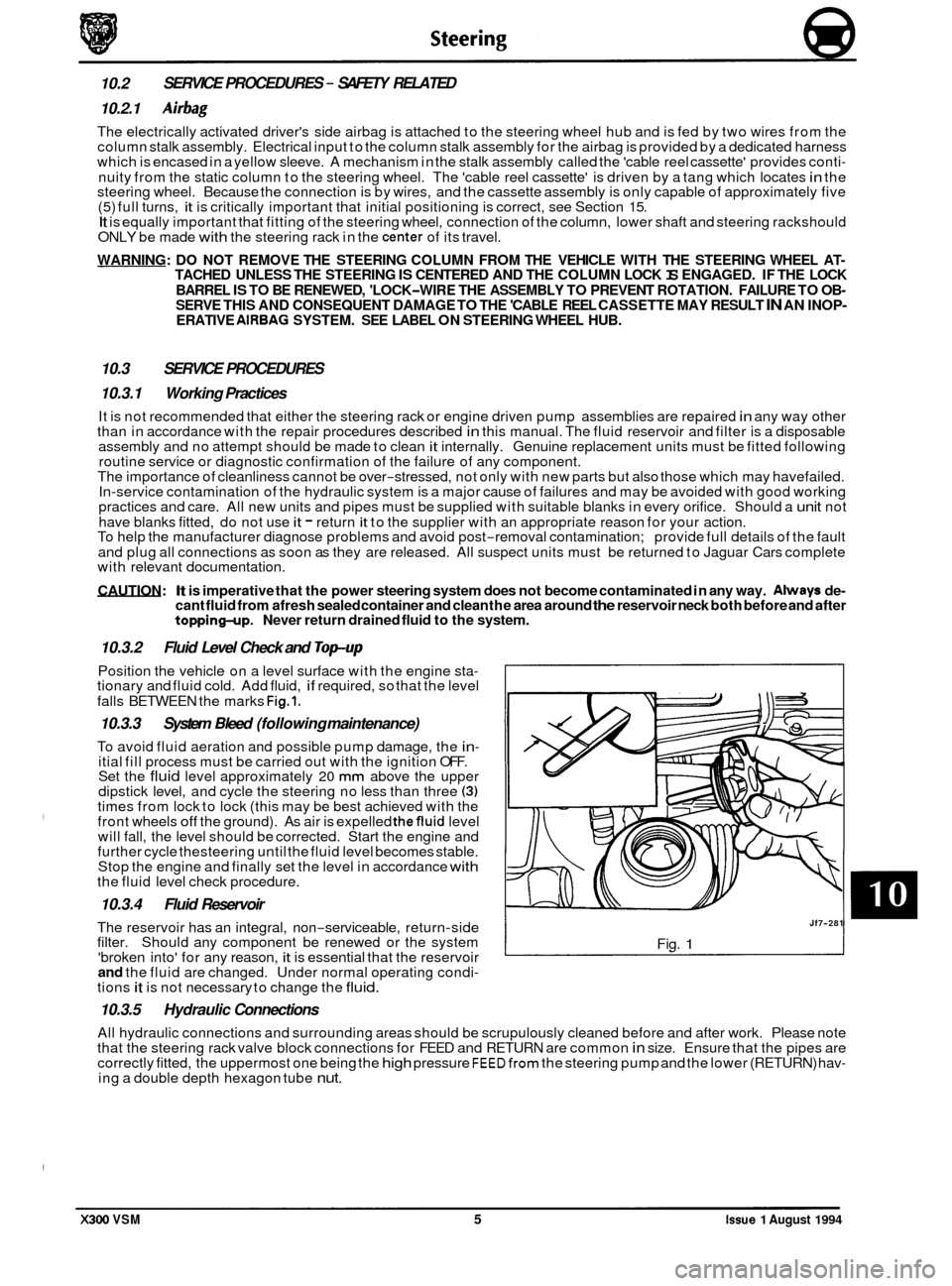
Position the vehicle on a level surface with the engine sta- tionary and fluid cold. Add fluid, if required, so that the level
falls BETWEEN the marks
Fig.1.
10.3.3 System Bleed (following maintenance)
To avoid fluid aeration and possible pump damage, the in- itial fill process must be carried out with the ignition OFF.
Set the fluid level approximately 20 mm above the upper
dipstick level, and cycle the steering no less than three (3) times from lock to lock (this may be best achieved with the
front wheels off the ground). As air is expelled thefluid level
will fall, the level should be corrected. Start the engine and
further cycle thesteering until the fluid level becomes stable.
Stop the engine and finally set the level in accordance
with the fluid level check procedure.
10.3.4 Fluid Reservoir
The reservoir has an integral, non-serviceable, return-side
filter. Should any component be renewed or the system
'broken into' for any reason,
it is essential that the reservoir and the fluid are changed. Under normal operating condi- tions it is not necessary to change the fluid.
10.3.5 Hydraulic Connections
Fluid
Level Check and
Top-up
Jf7-281
Fig. 1
All hydraulic connections and surrounding areas should be scrupulously cleaned before and after work. Please note
that the steering rack valve block connections for FEED and RETURN are common in size. Ensure that the pipes are
correctly fitted, the uppermost one being the high pressure FEEDfrom the steering pump and the lower (RETURN) hav- ing a double depth hexagon tube nut.
X300 VSM 5 issue 1 August 1994
Page 208 of 521
10.5 OUTER
TRACK ROD BALL JOINT, RENEW
sRo . Disconnect 57.55.02 vehicle battery ground lead.
. Raise the front of the vehicle and remove the appropriate
road wheel
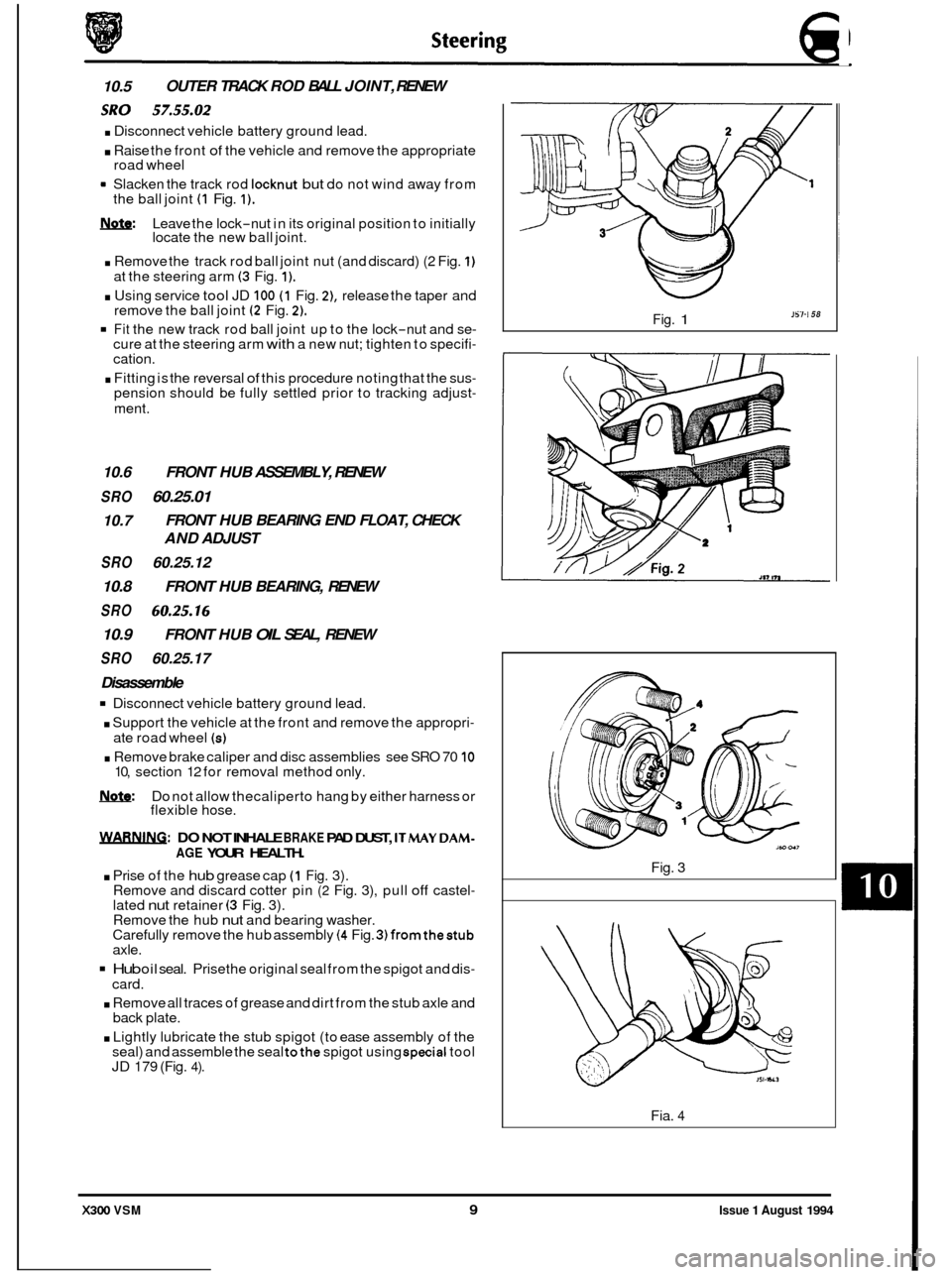
Slacken the track rod
locknut but do not wind away from
the ball joint (1 Fig. 1).
m: Leave the lock-nut in its original position to initially
locate the new ball joint.
. Remove the track rod ball joint nut (and discard) (2 Fig. 1)
at the steering arm (3 Fig. 1).
. Using service tool JD 100 (1 Fig. 2), release the taper and
remove the ball joint (2 Fig. 2).
Fit the new track rod ball joint up to the lock-nut and se- cure at the steering arm with a new nut; tighten to specifi- cation.
. Fitting is the reversal of this procedure noting that the sus- pension should be fully settled prior to tracking adjust-
ment.
0 10.6 FRONT HUB ASSEMBLY, RENEW
SRO 60.25.01
10.7
SRO 60.25.12
10.8 FRONT HUB BEARING, RENEW
SRO 60.25.16
10.9
SRO 60.25.17
Disassemble
Disconnect vehicle battery ground lead.
. Support the vehicle at the front and remove the appropri-
. Remove brake caliper and disc assemblies see SRO 70 10
IWQ: Do not allow thecaliperto hang by either harness or
flexible hose.
FRONT HUB BEARING END FLOAT, CHECK
AND ADJUST
FRONT HUB
OIL SEAL, RENEW
ate road wheel (s)
10, section 12 for removal method only.
WARNIM: DO NOT INHALE BRAKE PAD DUST, ITMAY DAM-
0
AGE YOUR HEALTH.
. Prise of the hub grease cap (1 Fig. 3).
Remove and discard cotter pin (2 Fig. 3), pull off castel- lated nut retainer (3 Fig. 3).
Remove the hub nut and bearing washer.
Carefully remove the hub assembly (4 Fig. 3)fromthestub axle.
Hub oil seal. Prise the original seal from the spigot and dis-
card.
. Remove all traces of grease and dirt from the stub axle and
back plate.
. Lightly lubricate the stub spigot (to ease assembly of the
seal) and assemble the seal tothe spigot using special tool JD 179 (Fig. 4).
JS7-i 58 Fig. 1
Fig. 3
Fia.
4
X300 VSM 9 Issue 1 August 1994
Page 209 of 521

@ Steering
. Pack the annular gaps of the oil seal lips with grease.
. Bearing. Wash the hub assembly thoroughly and 'drift' the affected bearing cup(s) from the hub.
!&!$Q:
rn Hub. At this point the hub may be renewed if required.
Assembly
. Bearing. Assemble the inner bearing track to the hub using service tool 18G 134 and adaptor JD 550 - 5 / 1.
Ensure that the hub inner seal diameter is free of debris or damage and is lightly lubricated prior to assembly.
Only replace complete bearings, never cup or race in isolation.
Assemble the outer bearing cup to the hub using service tool
18G 134 and adaptor JD 550 - 5 / 2. Pack each race with approximately 4 ml of grease and position the inner race onto the stub axle.
Apply a smear of grease to hub inner surfaces and bearing cups. Assemble the hub to the stub axle followed by
outer race, bearing washer and hub nut.
It is not necessary to fill the hub cavity with grease, merely protect from corrosion with a coat of IubricanL'Seat'the bear-
ings by slightly tightening the hub nut whilst rotating the hub. Do not apply load without rotation. m:
. End float. Set a Dial Test Indicator (DTI) as shown in Fig. 1 and adjust the hub nut to achieve the correct end float.
As the adjustment is made, continually load the hub axial-
ly in both directions.
. Without disturbing the end float setting, fit the castellated
nut retainer so that it aligns with both hub nut and stub
axle drilling.
. Secure nut retainer using a new cotter pin.
9 Assembly and fitting is the reversal of this procedure not- ing that; all fixings MUST be tightened to specification
and operation of the braking system verified.
Fig. 1
Issue 1 August 1994 10 X300 VSM
Page 211 of 521

1. SERVICE TOOLS & EQUIPMENT
Illustration
Not illustrated
Jaguar Number
JDID
JD 60
JDIOO
JD115
JD133
JD135
JD143
JD143-1
50143-2
JD143-3
Description
Hub Remover Rear Suspension
Nishbone Upper Bush Remover
1 Replacer
Remover Steering Arm and Swivel
Hub Ball Pins
Spring Compressor Front Suspension
Camber Tie Down Link (Front)
RemoverIRenewer Front Damper
Lower Bush
Remover
1 Renewer Suspension
Bushes (Main
Tool)
Adaptor Ring Front Sub Frame Rear
Bushes
Anvil adapter
Adaptor Remover
1 Renewer
Suspension Bushes
Issue 1 August 1994 ii X300 VSM
Page 212 of 521

Suspension Systems
Not illustrated
1. SERVICE TOOLS & EQUIPMENT (continued)
JD199
0
Fixing
To be issued
Tightening Torque
(Nm)
JD199-1 Not i II ustrated
Description US98
LM Multi - purpose grease
Molib Alloy
PI907 No1
Molykote 11 1
Lower damper bolt
Wishbone to crossmember fulcrum shaft
Stabilizer mounting bushes
& rear damper top
guide bush
Caliper to carrier bolts
/ guide pins
Description
Notes
Adaptor Remover / Renewer
Suspension Bushes (Bottom Front
Wishbone Inner)
____~ ~ Spring
Compressor Rear Suspension
Damper Retaining Tie Rear
Suspension
Adaptor
Replacer Rear Hub Pivot
Bearing Cup
Driver Handle
Adaptor Remover
Main Shaft Pilot
Bearing Outer Track
Impulse Extractor (slide Hammer)
UNF. Basic Tool
Notes
Issue 1 August 1994 X300 VSM iii
Page 217 of 521
Suspension Systems
11.4.3 Front End Inspection
Do not check and adjust front wheel alignment without carrying out the following inspection for front end damage and
wear:
. Check for specified air pressure in all four tires.
Raise front of vehicle off the floor; grasping upper and lower surface of the tire, shake each front wheel to check for
. Check front suspension lower arm ball joint and mounts for looseness, wear and damage.
Check steering gear mountings and all steering linkages for looseness.
. Renew parts if necessary.
. Grasp upper and lower surface of tire and shake each wheel to check wheel bearing end play.
. Check the action of the front dampers and the condition of their attachments, as sticking or binding front dampers
worn
bearings.
Check brake caliper mountings.
may not allow the vehicle to settle in to a normal level position, possibly affecting the front-wheel alignment.
m: Front wheel bearings are adjustable (0.001 to 0.003 in. endfloat).
11.4.4
. Check the wheel bearings.
. Inspect the front suspension upper joint and renew front suspension lower wishbone if needed.
Raise vehicle and position floor jacks beneath the front suspension lower wishbone.
Grasp the lower edge of the tire and move the wheel in and out.
While moving the wheel, observe the upper and lower wishbone.
. Movement between the vertical links and the wishbones indicates abnormal ball joint wear.
. Renew ball joints.
. Check the front wheel bearings.
. Check for excessive play and wear.
Upper / Lower Ball Joint Inspection
11.4.5 Damper Inspection
m: The gas-pressurized hydraulic front dampers are not serviceable, adjustable or refillable.
Verify that all attachments of the suspension components and the front dampers are tight. Renew any front damper
. Check front dampers for external damage.
. Check for oil leakage and vehicle sag.
that
has a damaged integral lower mounting bushing.
0 Oil Leak
Leakage is the condition in which the entire damper body is covered with oil and from where
it will drip on to
the pavement. Due to correct damper lubrication a light film of oil (weepage) can usually be seen on the upper
portion of the damper.
Should there be any leakage, ensure that the fluid does not originate from sources other than the front damper.
Renew worn or damaged dampers.
0 Vehicle Sag
Renewing front dampers will not correct the problem of vehicle sag, as basically this is controlled by the spring
units.
issue 1 August 1994 4 X300 VSM