service JAGUAR XJ6 1994 2.G User Guide
[x] Cancel search | Manufacturer: JAGUAR, Model Year: 1994, Model line: XJ6, Model: JAGUAR XJ6 1994 2.GPages: 521, PDF Size: 17.35 MB
Page 45 of 521
Engine (AJ16)
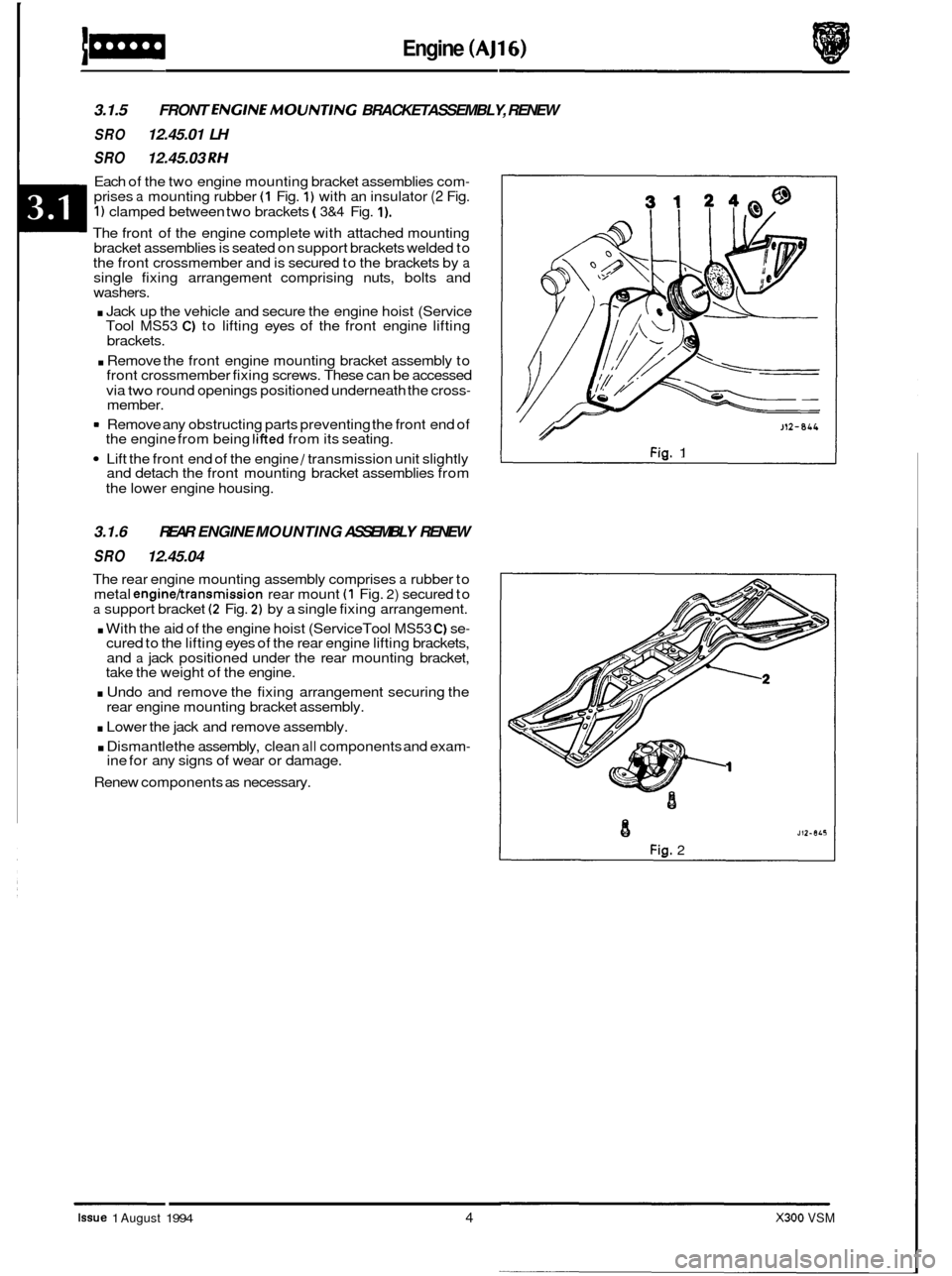
3.1.5 FRONT ENGINEMOUNTING BRACKETASSEMBLY, RENEW
SRO 12.45.01 LH
SRO 12.45.03 RH
Each of the two engine mounting bracket assemblies com- prises a mounting rubber (1 Fig. 1) with an insulator (2 Fig.
1) clamped between two brackets ( 3&4 Fig. I).
The front of the engine complete with attached mounting
bracket assemblies is seated on support brackets welded to
the front crossmember and is secured to the brackets by
a single fixing arrangement comprising nuts, bolts and
washers.
. Jack up the vehicle and secure the engine hoist (Service
Tool MS53 C) to lifting eyes of the front engine lifting
brackets.
. Remove the front engine mounting bracket assembly to
front crossmember fixing screws. These can be accessed
via
two round openings positioned underneath the cross- member.
= Remove any obstructing parts preventing the front end of
the engine from being lifted from its seating.
Lift the front end of the engine / transmission unit slightly
and detach the front mounting bracket assemblies from
the lower engine housing.
3.1.6
SRO 12.45.04 REAR
ENGINE MOUNTING ASSEMBLY RENEW
The rear engine mounting assembly comprises a rubber to
metal engine/transmission rear mount (1 Fig. 2) secured to a support bracket (2 Fig. 2) by a single fixing arrangement.
. With the aid of the engine hoist (Service Tool MS53 C) se- cured to the lifting eyes of the rear engine lifting brackets,
and a jack positioned under the rear mounting bracket,
take the weight of the engine.
. Undo and remove the fixing arrangement securing the
rear engine mounting bracket assembly.
. Lower the jack and remove assembly.
. Dismantle the assembly, clean all components and exam- ine for any signs of wear or damage.
Renew components as necessary.
J12-8LL
Fig. 1
J 12- 8 LS
Fig. 2
8
Issue 1 August 1994 4 X300 VSM
Page 47 of 521
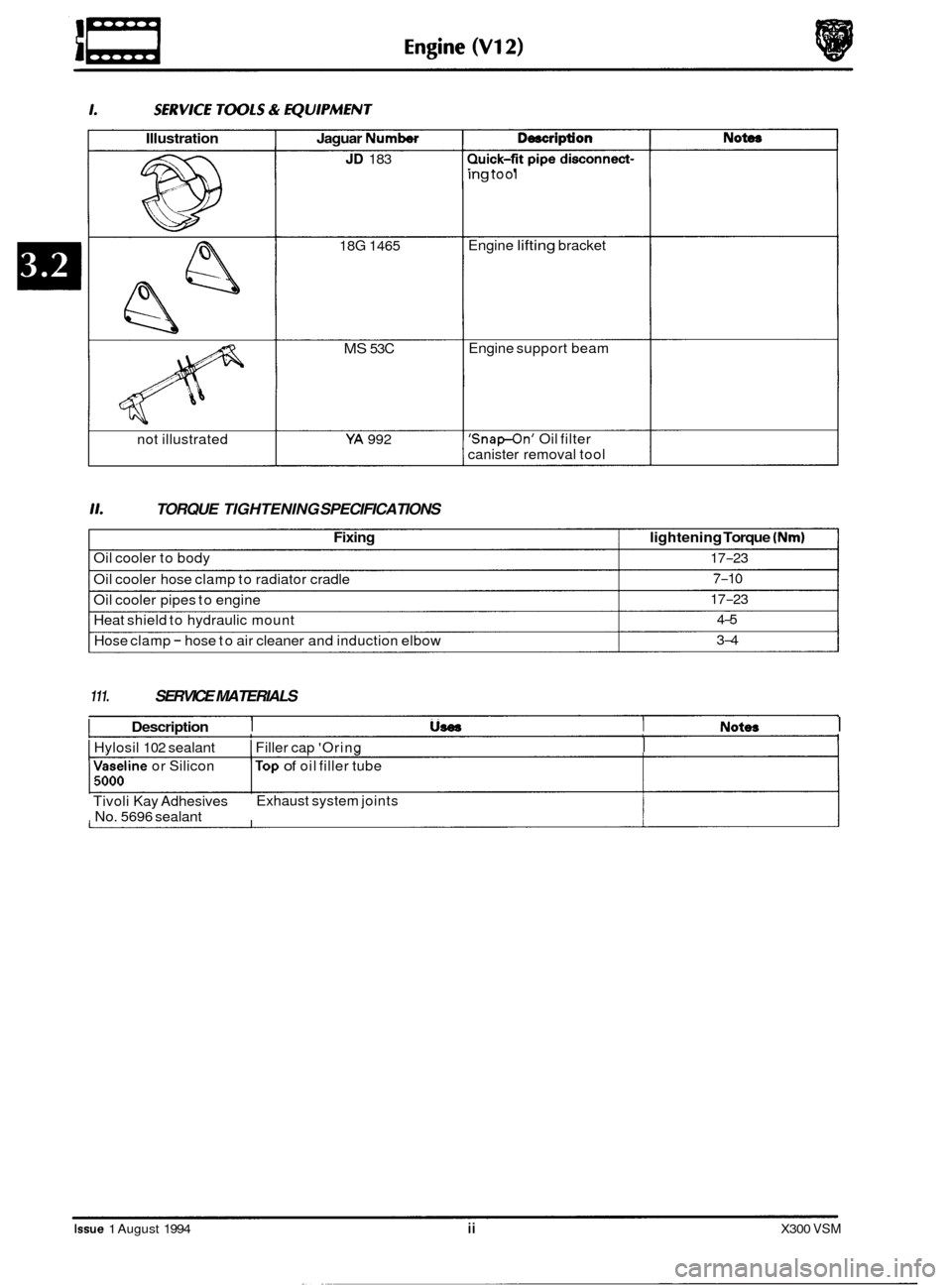
Illustration
not illustrated
Jaguar Number
JD 183
18G 1465
MS 53C
YA 992
11. TORQUE TIGHTENING SPECIFICATIONS
ing tool
Engine
lifting bracket
Engine support beam
'Snap-On' Oil filter
canister removal tool
Fixing lightening Torque (Nm)
Oil cooler to body 17-23
Oil cooler hose clamp to radiator cradle
Oil cooler pipes to engine
Heat shield to hydraulic mount
Hose clamp
- hose to air cleaner and induction elbow
7-10
17
-23
4
-5
3
-4
111. SERVICE MATERIALS
I Description I US88 I Notem I
I Hylosil 102 sealant I Filler cap 'Oring I I
Vaseline or Silicon lTop of oil filler tube 15000
Tivoli Kay Adhesives
No. 5696 sealant Exhaust
system joints
Issue 1 August 1994 ii X300 VSM
Page 48 of 521
Engine (V12)
3.2.1 ENGINE, GENERAL
The twelve cylinder, vee formation engine has a capacity of 6.0 liters. Each cylinder bank has a single overhead
camshaft and two valves percylinder. The engine has a fully mapped engine management system with digital ignition
and two ignition coils.
This section describes the service procedures to be carried out with the engine in situ.
It also covers the renewal of
the engine / transmission unit.
For information relating
tostrip-down, inspedion,fault diagnosis, renovation and rebuild work, referto the VI2 Engine
Service Manual.
X300 VSM 1 Issue 1 August 1994
Page 49 of 521
3.2.2 ENGINE - GEARBOX/ TRANSMISSION
ASSEMBLY, RENEW
SRO 12.37.01/90
The engine /transmission unit on the V12 6.0 liter model is mounted on three engine mounting / bracket assemblies
fitted to the front crossmember on either side of the engine bay. The engine/ transmission rear mount is a mounting
bracket and spring assembly fitted and secured to body underframe longitudinal members. For access to remove the
engine carry
out the following procedures:
WARNING: WHEN WORKING WITHIN THE ENGINE COMPARTMENT, KEEP CLEAR OF THE RADIATOR COOLING
FANS AS THEY COULD START WITHOUT WARNING, EVEN IF THE ENGINE IS NOT RUNNING.
. Remove the hood, see SRO 76.16.01, section 13.
. Remove the two air cleaner assemblies, see SRO’s 19.10.01 & 19.10.02.
. Remove the engine cover, see SRO 12.29.93 (V12 Engine Service Manual).
Depressurize the fuel system, see SRO 19.50.02, section 5.1.
In line with the relevant SRO’s and sections, remove all appropriate obstructing parts, including their fixing and
. Disconnect all mechanical and isolate all electrical linkages leading to and from the engine.
. De-gas the air conditioning system, see section 14, Charge Recovery (System depressurization).
Disconnect
the battery.
mounting arrangements.
CAUTION: Do
not vent refrigerant directly to the atmosphere and always use Jaguar approved recovery/recycle/ra charge equipment.
Drain the engine oil, see 3.2.3 this section.
Drain the coolant, see SRO 26.10.01, section 4.1.
WARNING: DO NOT REMOVE THE HEADER TANK PRESSURE CAP WHILE THE ENGINE IS HOT. IF THE CAP MUST
BE REMOVED, PROTECT THE HANDS AGAINST ESCAPING STEAM AND SLOWLY TURN THE CAP ANTI- CLOCKWISE UNTIL THE EXCESS PRESSURE CAN ESCAPE. LEAVE THE CAP IN THIS POSITION UNTIL ALL
STEAM AND PRESSURE HAS ESCAPED AND THEN REMOVE THE CAP COMPLETELY.
Before
lifting the complete engine/transmission unit with an engine hoist from the engine bay, ensure that two engine
lifting brackets (tool 18G. 1465) are secured equallyspaced to the inlet manifold studs. The four engine lifting brackets
should be positioned towards the front and the rear of the assembly. Ensure the front of thevehicle is jacked
up secure- ly on stands when removing the assembly.
X300 VSM Issue 1 August 1994 2
Page 51 of 521
Engine (V12)
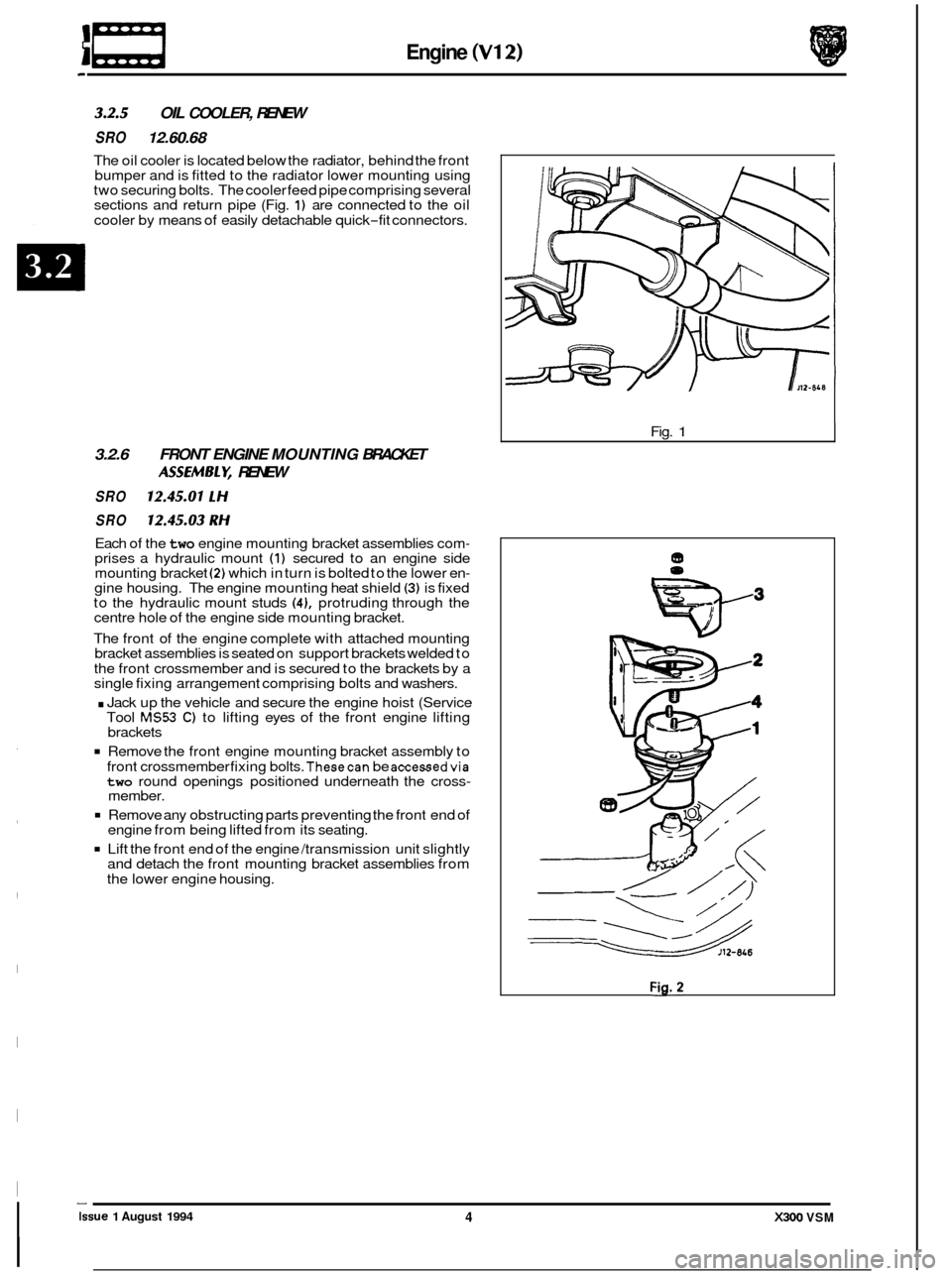
3.2.5 OIL COOLER, RENEW
SRO 12.60.68
The oil cooler is located below the radiator, behind the front
bumper and is fitted to the radiator lower mounting using
two securing bolts. The cooler feed pipe comprising several
sections and return pipe (Fig.
1) are connected to the oil
cooler by means of easily detachable quick
-fit connectors.
3.2.6 FRONT ENGINE MOUNTING BRACKET
SRO 12.45.01 LH
SRO 12.45.03 RH
Each of the two engine mounting bracket assemblies com- prises a hydraulic mount (1) secured to an engine side
mounting bracket (2) which in turn is bolted to the lower en- gine housing. The engine mounting heat shield (3) is fixed
to the hydraulic mount studs (41, protruding through the
centre hole of the engine side mounting bracket.
The front of the engine complete with attached mounting
bracket assemblies is seated on support brackets welded to
the front crossmember and is secured to the brackets by a
single fixing arrangement comprising bolts and washers.
. Jack up the vehicle and secure the engine hoist (Service
Tool MS53 C) to lifting eyes of the front engine lifting
brackets
Remove the front engine mounting bracket assembly to
front crossmember fixing bolts.
Thesecan be accessedvia two round openings positioned underneath the cross- member.
Remove any obstructing parts preventing the front end of
engine from being lifted from its seating.
Lift the front end of the engine /transmission unit slightly
and detach the front mounting bracket assemblies from
the lower engine housing.
ASSEMBLV, RENEW
Fig. 1
4 X300 VSM Issue 1 August 1994
Page 52 of 521

Engine (V12)
3.2.7 REAR ENGINEMOUNTlNGASSEMBLY, RENEW
SRO
12.45.04
The rear engine mounting assembly (Fig. 1) comprises a
mounting bracket and spring assembly, secured to body un- derframe longitudinal members using nuts and washers.
With the aid of the engine hoist (Service Tool MS53 C) se- cured to the lifting eyes of the rear engine lifting brackets,
and a jack positioned underthe rear mounting brackettake
the weight of the engine.
. Undo and remove the mounting bracket and spring as-
sembly fixing arrangement.
rn Lower the jack and remove assembly.
Dismantle the assembly, clean all components and exam-
ine for any signs of wear or damage.
Renew components as necessary.
8 112-8'7
Fig. 1
I Issue 1 August 1994 X300 VSM 5
Page 54 of 521
Cooling System
SECTION CON TENTS
Sub-section Title SRO Page
I to IV ............ Preliminary Pages .................................................................... i
4.7.7 ............. Cooling System Description ........................................................... 7
4.1.7.7 ........... Cooling System Description. Major Components .......................................... 7
4.7.7.2 ........... Cooling System Description. Components for Climate Control System ........................ 7
4.7.1.3 ........... Cooling System Description. Components for Superchargwl Engine .......................... 7
4.7.7.4 ........... Cooling System Description. Operation .................................................. 7
4.7.2 ............. Cooling System Configuration .......................................................... 2
4.7.3 ............. Service Procedures ................................................................... 3
4.7.3.7 ........... Service Procedures. Safety Precautions .................................................. 3
4.7.3.2
........... Service Procedures. Working Practices .................................................. 3
4.7.3.3
........... Service Procedures. Coolant Change .................................................... 3
4.7.4.
............ Drain and Fill Procedures ............................................................. 4
4.7.4.7
........... Drain and Fill Procedures. Radiator, Drain ............................................... 4
4.7.4.2
........... Drain and Fill Procedures. Engine. Drain ................................................. 4
4.1.4.3
........... Drain and Fill Procedures. Radiator, Fill ................................................. 4
4.7.4.4
........... Drain and Fill Procedures. Complete System. Fill .......................................... 5
4.7.5 ............. Fault Diagnosis ...................................................................... 6
4.1.5.7 ........... Fault Diagnosis. Introduction ........................................................... 6
4.7.5.2 ........... Fault Diagnosis. Diagnostic Procedures .................................................. 6
Issue 1 August 19! X300 VSM i
Page 55 of 521
€3 Cooling System (AJ16)
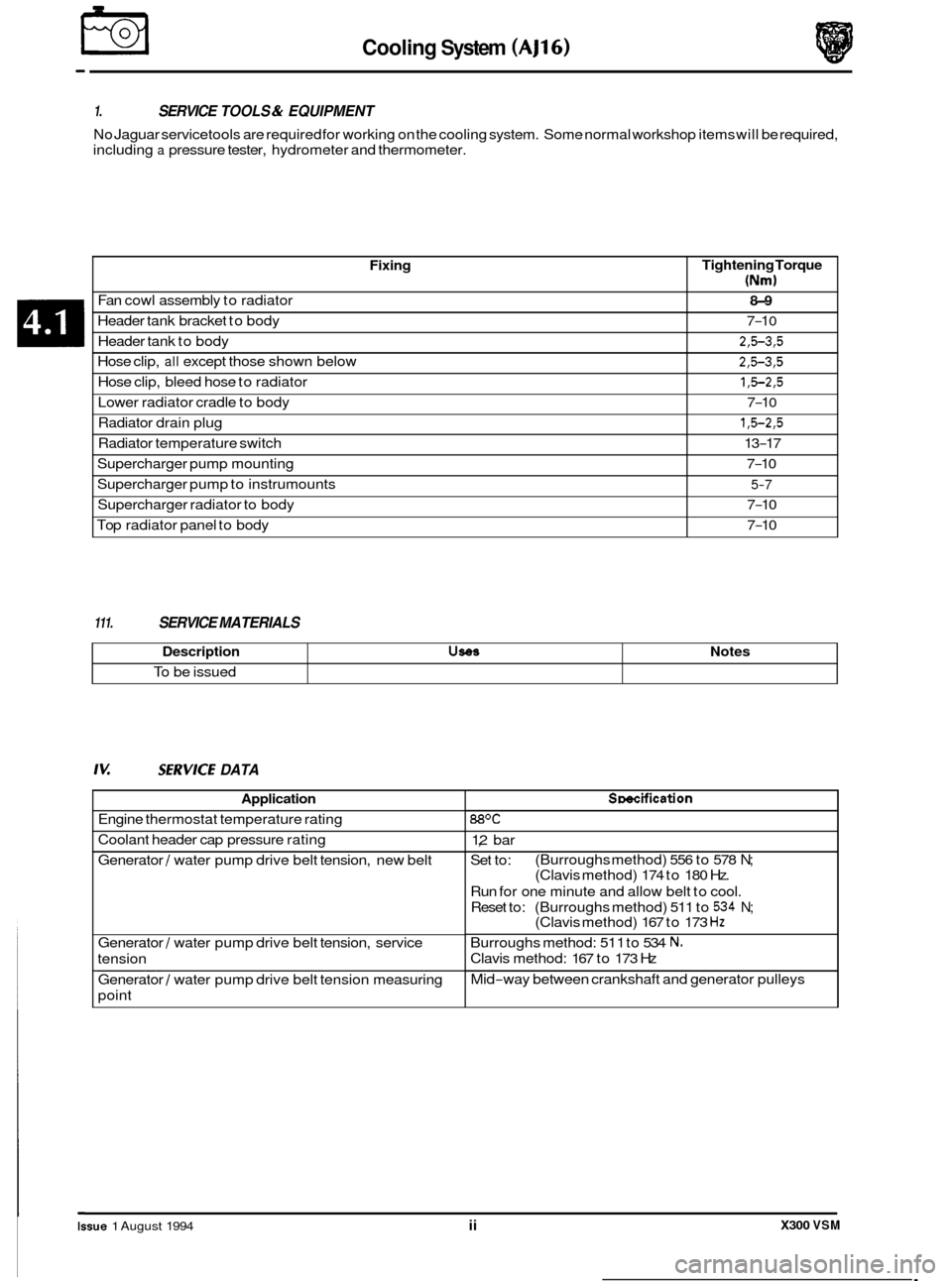
Fixing
Fan cowl assembly to radiator
Header tank bracket to body
Header tank to body
Hose clip,
all except those shown below
Hose clip, bleed hose to radiator
Radiator drain plug
Radiator temperature switch
Lower
radiator cradle to body
Supercharger pump mounting
Supercharger pump to instrumounts
Supercharger radiator to body
Top radiator panel to body
1. SERVICE TOOLS & EQUIPMENT
No Jaguar service tools are required for working on the cooling system. Some normal workshop items will be required,
including
a pressure tester, hydrometer and thermometer.
Tightening Torque
(Nm)
8-9
7-1 0
2,5-3,5
2,5-3,5
1,5-2,5
1,5-2,5
13-17
7
-1 0
7-10
5-7
7-10
7
-10
Description UseS
To be issued
111. SERVICE MATERIALS
Notes
Iv: SZRVICE DATA
Application
Engine thermostat temperature rating
Coolant header cap pressure rating
Generator
/ water pump drive belt tension, new belt
Generator
/ water pump drive belt tension, service
tension
_____ ~~ Generator / water
pump drive belt tension measuring
point
Smcification
88OC
1,2 bar
Set to:
Run for one minute and allow belt to cool.
Reset to: (Burroughs method) 511 to
534 N;
Burroughs method: 51 1 to 534 N.
Clavis method: 167 to 173 Hz
Mid
-way between crankshaft and generator pulleys
(Burroughs method)
556 to 578
N;
(Clavis method) 174 to 180 Hz.
(Clavis method) 167 to 173
Hz
0
0
0
0
X300 VSM Issue 1 August 1994 ii
Page 58 of 521
area washed to remove all traces of coolant.
CAUTION: To prevent the possibility of damage to the heater circuit pump and supercharger pump (where fitted),
the pumps should be electrically isolated if the ignition has to be turned ON while the cooling system is
drained.
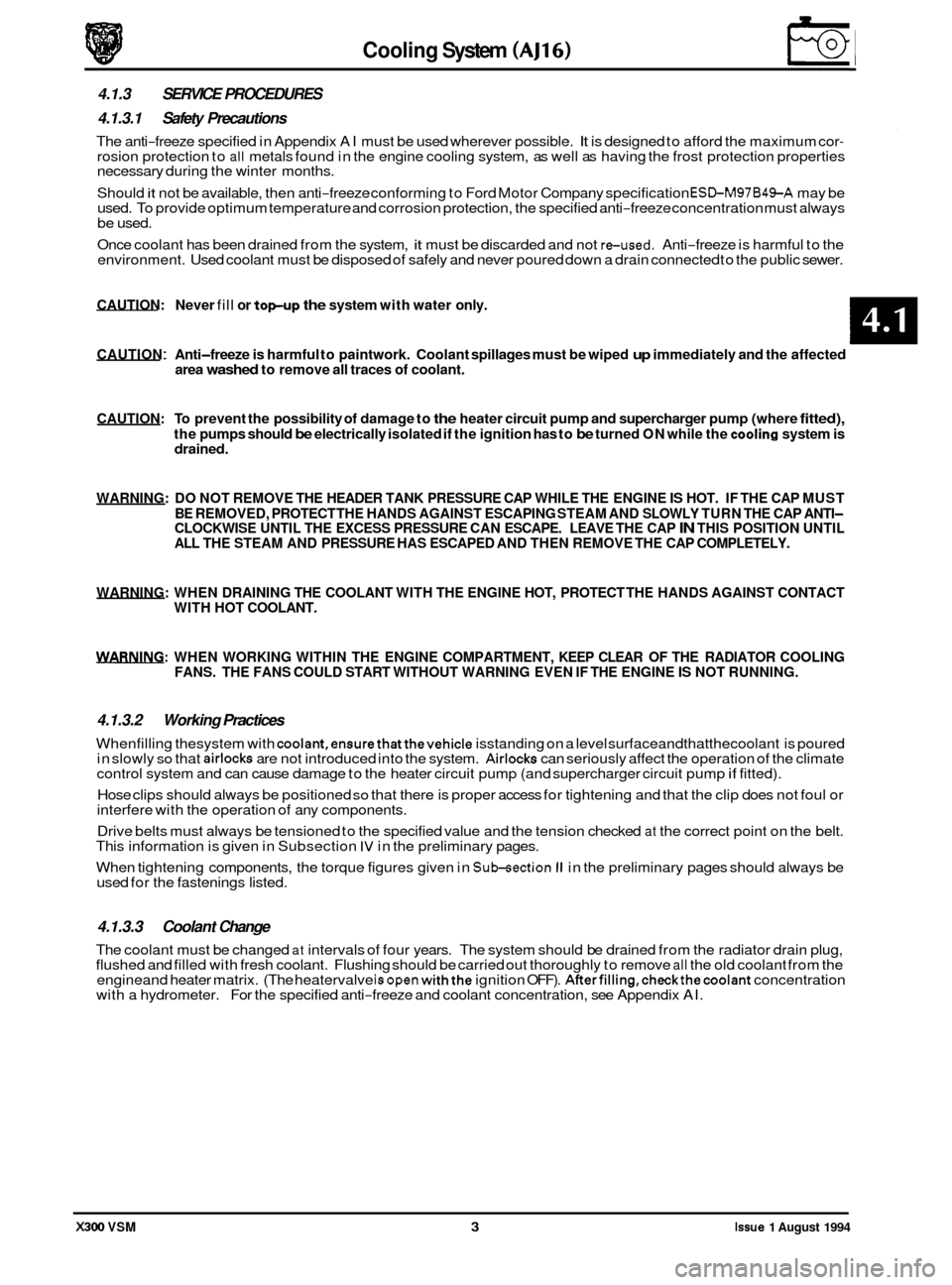
WARNING: DO NOT REMOVE THE HEADER TANK PRESSURE CAP WHILE THE ENGINE IS HOT. IF THE CAP MUST
BE REMOVED, PROTECT THE HANDS AGAINST ESCAPING STEAM AND SLOWLY TURN THE CAP ANTI
- CLOCKWISE UNTIL THE EXCESS PRESSURE CAN ESCAPE. LEAVE THE CAP IN THIS POSITION UNTIL
ALL THE STEAM AND PRESSURE HAS ESCAPED AND THEN REMOVE THE CAP COMPLETELY.
WARNING: WHEN DRAINING THE COOLANT WITH THE ENGINE HOT, PROTECT THE HANDS AGAINST CONTACT
WITH HOT COOLANT.
WARNING: WHEN WORKING WITHIN THE ENGINE COMPARTMENT, KEEP CLEAR OF THE RADIATOR COOLING
FANS. THE FANS COULD START WITHOUT WARNING EVEN IF THE ENGINE IS NOT RUNNING.
4.1.3.2 Working Practices
Whenfilling thesystem with coolant,ensurethatthevehicle isstanding on a level surfaceandthatthecoolant is poured
in slowly so that airlocks are not introduced into the system. Airlocks can seriously affect the operation of the climate
control system and can cause damage to the heater circuit pump (and supercharger circuit pump if fitted).
Cooling System (AJ16)
4.1.3 SERVICE PROCEDURES
4.1.3.1 Safety Precautions
The anti-freeze specified in Appendix AI must be used wherever possible. It is designed to afford the maximum cor- rosion protection to all metals found in the engine cooling system, as well as having the frost protection properties
necessary during the winter months.
Should
it not be available, then anti-freeze conforming to Ford Motor Company specification ESLbM97B49-A may be
used. To provide optimum temperature and corrosion protection, the specified anti-freeze concentration must always
be used.
Once coolant has been drained from the system,
it must be discarded and not reused. Anti-freeze is harmful to the
environment. Used coolant must be disposed of safely and never poured down a drain connected to the public sewer.
CAUTION: Never fill or topup the system with water only.
CAUTION : Anti-freeze is harmful to paintwork. Coolant spillages must be wiped up immediately and the affected
Hose clips should always be positioned so that there is proper access for tightening and that the clip does not foul or
interfere with the operation of any components.
Drive belts must always be tensioned to the specified value and the tension checked
at the correct point on the belt.
This information is given in Subsection IV in the preliminary pages.
0
When tightening components, the torque figures given in Sukection II in the preliminary pages should always be
used for the fastenings listed.
4.1.3.3 Coolant Change
The coolant must be changed at intervals of four years. The system should be drained from the radiator drain plug,
flushed and filled with fresh coolant. Flushing should be carried out thoroughly to remove all the old coolant from the
engineand heater matrix. (The heatervalve isopen withthe ignition OFF). AfterfiIling,checkthecoolant concentration
with a hydrometer. For the specified anti-freeze and coolant concentration, see Appendix AI.
X300 VSM 3 Issue 1 August 1994
Page 64 of 521
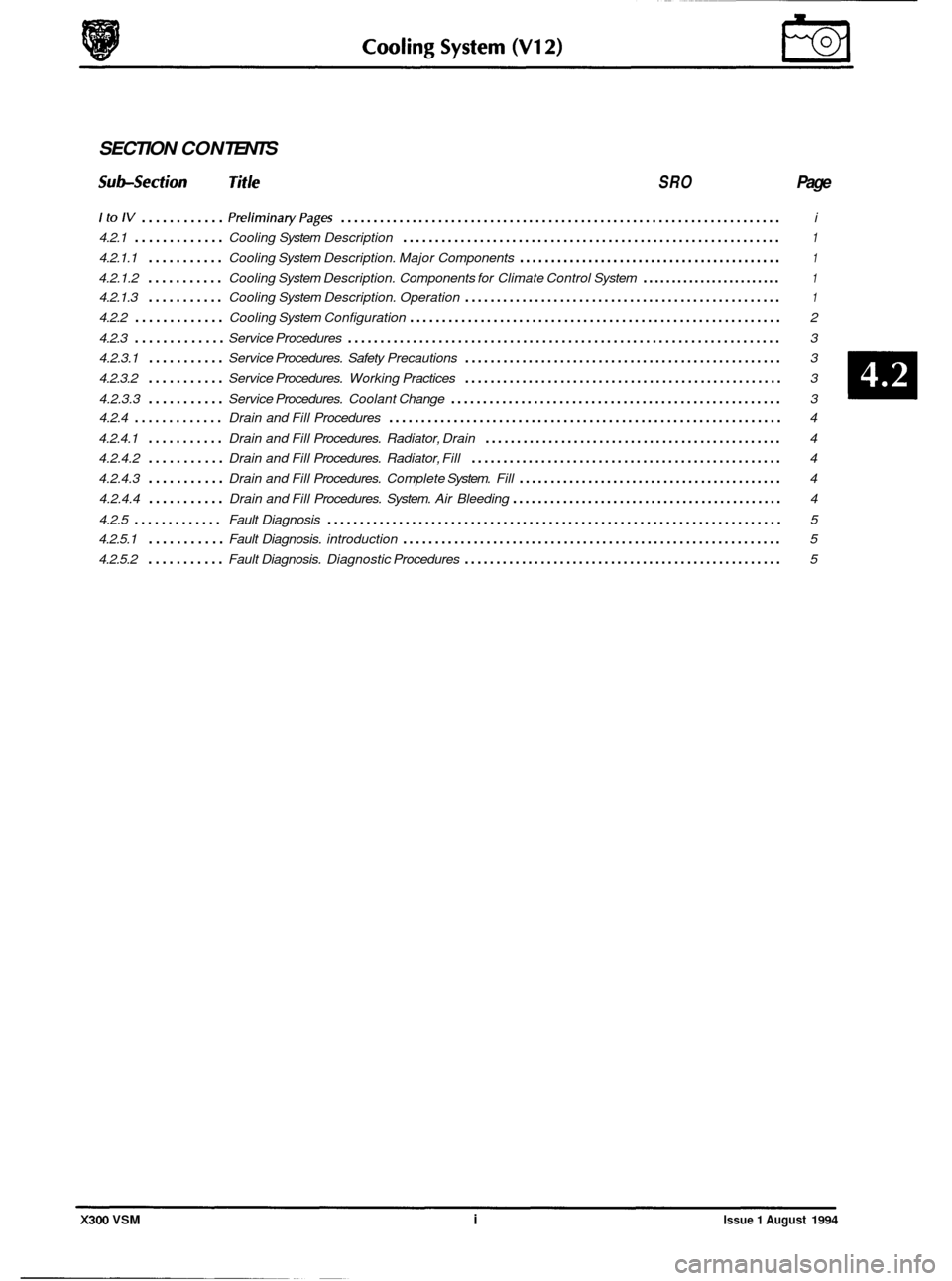
SECTION CON TENTS
Subsection Titie SRO Page
it0 IV ............ Preliminarypages .................................................................... i
4.2.1 ............. Cooling System Description ........................................................... 1
4.2.1.1 ........... Cooling System Description. Major Components .......................................... 1
4.2.1.2 ........... Cooling System Description. Components for Climate Control System ........................ 1
4.2.1.3 ........... Cooling System Description. Operation .................................................. 1
4.2.2 ............. Cooling System Configuration .......................................................... 2
4.2.3
............. Service Procedures ................................................................... 3
4.2.3.1
........... Service Procedures. Safety Precautions .................................................. 3
4.2.3.2
........... Service Procedures. Working Practices .................................................. 3
4.2.3.3
........... Service Procedures. Coolant Change .................................................... 3
4.2.4
............. Drain and Fill Procedures ............................................................. 4
4.2.4.1
........... Drain and Fill Procedures. Radiator, Drain ............................................... 4
4.2.4.2
........... Drain and Fill Procedures. Radiator, Fill ................................................. 4
* 4.2.4.3 ........... Drain and Fill Procedures. Complete System. Fill .......................................... 4
4.2.4.4
........... Drain and Fill Procedures. System. Air Bleeding ........................................... 4
4.2.5
............. Fault Diagnosis ...................................................................... 5
4.2.5.1
........... Fault Diagnosis. introduction ........................................................... 5
4.2.5.2
........... Fault Diagnosis. Diagnostic Procedures .................................................. 5
X300 VSM i Issue 1 August 1994