differential JAGUAR XJ6 1997 2.G User Guide
[x] Cancel search | Manufacturer: JAGUAR, Model Year: 1997, Model line: XJ6, Model: JAGUAR XJ6 1997 2.GPages: 227, PDF Size: 7.2 MB
Page 124 of 227
Test the brakes at various speeds with both
light and heavy pedal pressure. The vehicle
should stop evenly without pulling to one side
or the other. Avoid locking the brakes,
because this slides the tyres and diminishes
braking efficiency and control of the vehicle.
Tyres, vehicle load and wheel alignment are
factors which also affect braking performance.
2 Anti-lock Brake system
(ABS)- general information
The Anti-lock Brake System is designed to
maintain vehicle steerability, directional stability
and optimum deceleration under severe
braking conditions on most road surfaces. It
does so by monitoring the rotational speed of
each wheel and controlling the brake line
pressure to each wheel during braking. This
prevents the wheels from locking up.
The ABS system has three main units - the
wheel speed sensors, the electronic control unit
and the modulator (hydraulic control unit). The
sensors - one at each wheel - send a variable
voltage signal to the electronic control unit,
which monitors these signals, compares them
to its program and determines whether a wheel
is about to lock up. When a wheel is about to
lock up, the control unit signals the hydraulic
unit to reduce hydraulic pressure (or not
increase it further) at that wheel’s brake caliper.
Pressure modulation is handled by three
electrically-operated solenoid valves - one for
each front wheel and one for the rear wheels -
inside the modulator.
If a problem develops within the system, an
“ABS” warning light will glow on the dashboard.
Sometimes, a visual inspection of the ABS
system can help you locate the problem.
Carefully inspect the ABS wiring harness. Pay
particularly close attention to the harness and
connections near each wheel. Look for signs of
chafing and other damage caused by
incorrectly routed wires. If a wheel sensor
harness is damaged, the sensor should be
replaced (the harness and sensor are integral).
Warning: Do NOT try to repair an
ABS wiring harness. The ABS
system is sensitive to even thesmallest changes in resistance. Repairing
the harness could alter resistance values
and cause the system to malfunction. If the
ABS wiring harness is damaged in any way,
it must be replaced.
Caution: Make sure the ignition is turned
off before unplugging or reattaching any
electrical connections.
Diagnosis and repair
If a dashboard warning light comes on and
stays on while the vehicle is in operation, the
ABS system requires attention. Although
special electronic ABS diagnostic testing tools
are necessary to properly diagnose the system,
you can perform a few preliminary checks
before taking the vehicle to a dealer service
department or other qualified repair workshop.
a) Check the brake fluid level in the master
cylinder reservoir.
b) Verify that all ABS system electrical
connectors in the engine compartment
are plugged in.
c) Check the fuses.
d) Follow the wiring harness to each front
wheel and to the differential sensor and
verify that all connections are secure and
that the wiring is undamaged.
If the above preliminary checks do not
rectify the problem, the vehicle should be
diagnosed by a dealer service department.
Due to the complex nature of this system, all
actual repair work must be done by a dealer
service department or other qualified repair
workshop.
3 Disc brake pads- renewal
2
Warning: Disc brake pads must
be replaced on both front wheels
or both rear wheels at the same
time - never renew the pads on
only one wheel. Also, the dust created by
the brake system may contain asbestos,
which is harmful to your health. Never blow
it out with compressed air and don’t inhale
any of it. An approved filtering mask should
be worn when working on the brakes. Do
not, under any circumstances, use
petroleum-based solvents to clean brake
parts. Use brake system cleaner only!
Note:The following procedure applies to both
the front and rear brake pads.
1Remove the cap from the brake fluid
reservoir and siphon off about two-thirds of
the fluid from the reservoir. Failing to do this
could result in fluid overflowing when the
caliper pistons are pressed into their bores.
2Loosen the wheel nuts, raise the front of the
vehicle and support it securely on axle stands.
3Remove the front wheels. Work on one
brake assembly at a time, using the
assembled brake for reference if necessary.
4Inspect the brake disc (see Section 5).
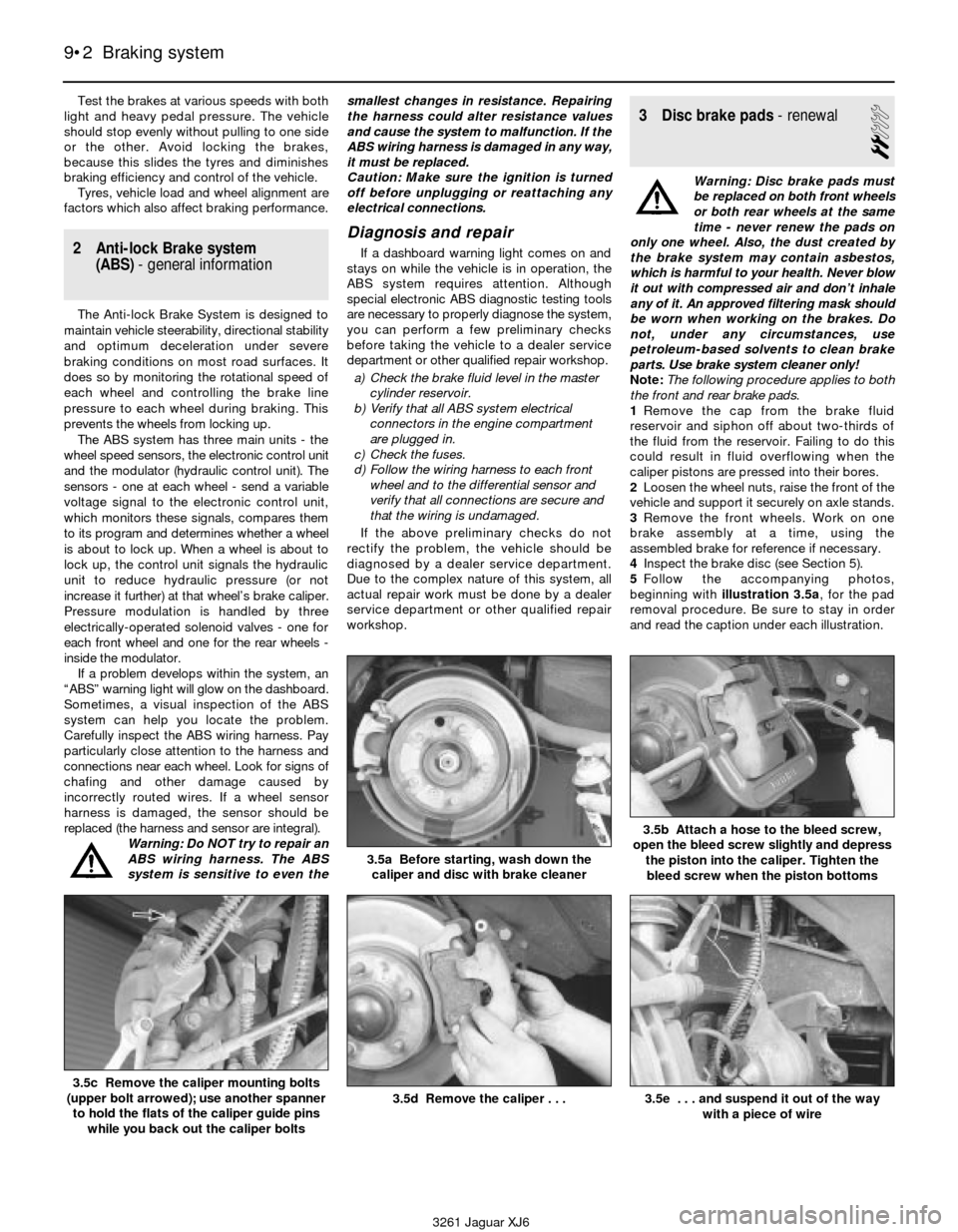
5Follow the accompanying photos,
beginning with illustration 3.5a, for the pad
removal procedure. Be sure to stay in order
and read the caption under each illustration.
9•2 Braking system
3.5a Before starting, wash down the
caliper and disc with brake cleaner
3.5b Attach a hose to the bleed screw,
open the bleed screw slightly and depress
the piston into the caliper. Tighten the
bleed screw when the piston bottoms
3.5c Remove the caliper mounting bolts
(upper bolt arrowed); use another spanner
to hold the flats of the caliper guide pins
while you back out the caliper bolts3.5d Remove the caliper . . .3.5e . . . and suspend it out of the way
with a piece of wire
3261 Jaguar XJ6
Page 132 of 227
6Carefully check to make sure the
suspension and steering components do not
make contact with the hoses. Have an
assistant push on the vehicle and also turn the
steering wheel from lock-to-lock during
inspection.
7Bleed the brake system (see Section 9).
Metal brake line renewal
8When replacing brake lines, use the proper
parts only. Do not use copper line for any
brake system connections. Purchase steel
brake lines from a dealer or motor factors..
9Unless you’re using factory renewal brake
lines, you may need a tubing bender to bend
the lines to the proper shape.
10First, remove the line you intend to renew,
lay it on a clean workbench and measure it
carefully. Obtain a new line of the same length
and bend it to match the pattern of the old
line.
Warning: Do not crimp or
damage the line. No bend should
have a smaller radius than
9/16-inch. Make sure the
protective coating on the new line is
undamaged at the bends.
11When refitting the new line, make sure it’s
well supported by the brackets, the routing
matches the original and there’s plenty of
clearance between moving or hot
components.
12After refitting, check the master cylinder
fluid level and add fluid as necessary. Bleed
the brake system as outlined in Section 9 and
test the brakes carefully before driving the
vehicle. Be sure there are no leaks.
9 Brake hydraulic system-
bleeding
2
Warning: Wear eye protection
when bleeding the brake
system. If the fluid comes in
contact with your eyes,
immediately rinse them with water and
seek medical attention.Note:Bleeding the hydraulic system is
necessary to remove any air which has entered
the system during removal and refitting of a
hose, line, caliper or master cylinder.
1It will probably be necessary to bleed the
system at all four brakes if air has entered the
system due to low fluid level or if the brake
lines have been disconnected at the master
cylinder.
2If a brake line was disconnected at only one
wheel, then only that caliper or wheel cylinder
must be bled.
3If a brake line is disconnected at a fitting
located between the master cylinder and any
of the brakes, that part of the system served
by the disconnected line must be bled.
4Bleed the right rear, the left rear, the right
front and the left front caliper, in that order,
when the entire system is involved.
5Remove any residual vacuum from the
servo and pressure in the anti-lock braking
system (if equipped) by applying the brake
about 30 times with the engine off.
6Remove the master cylinder reservoir cover
and fill the reservoir with brake fluid. Refit the
cover. Note:Check the fluid level often during
the bleeding operation and add fluid as
necessary to prevent the fluid level from falling
low enough to allow air into the master
cylinder.
7Have an assistant on hand, as well as a
supply of new brake fluid, an empty clear
plastic container, a length of 3/16-inch clear
tubing to fit over the bleed screws and a
spanner to open and close the bleed screws.
8Beginning at the right rear wheel, loosen the
bleed screw slightly, then tighten it to a point
where it is snug but can still be loosened
quickly and easily.
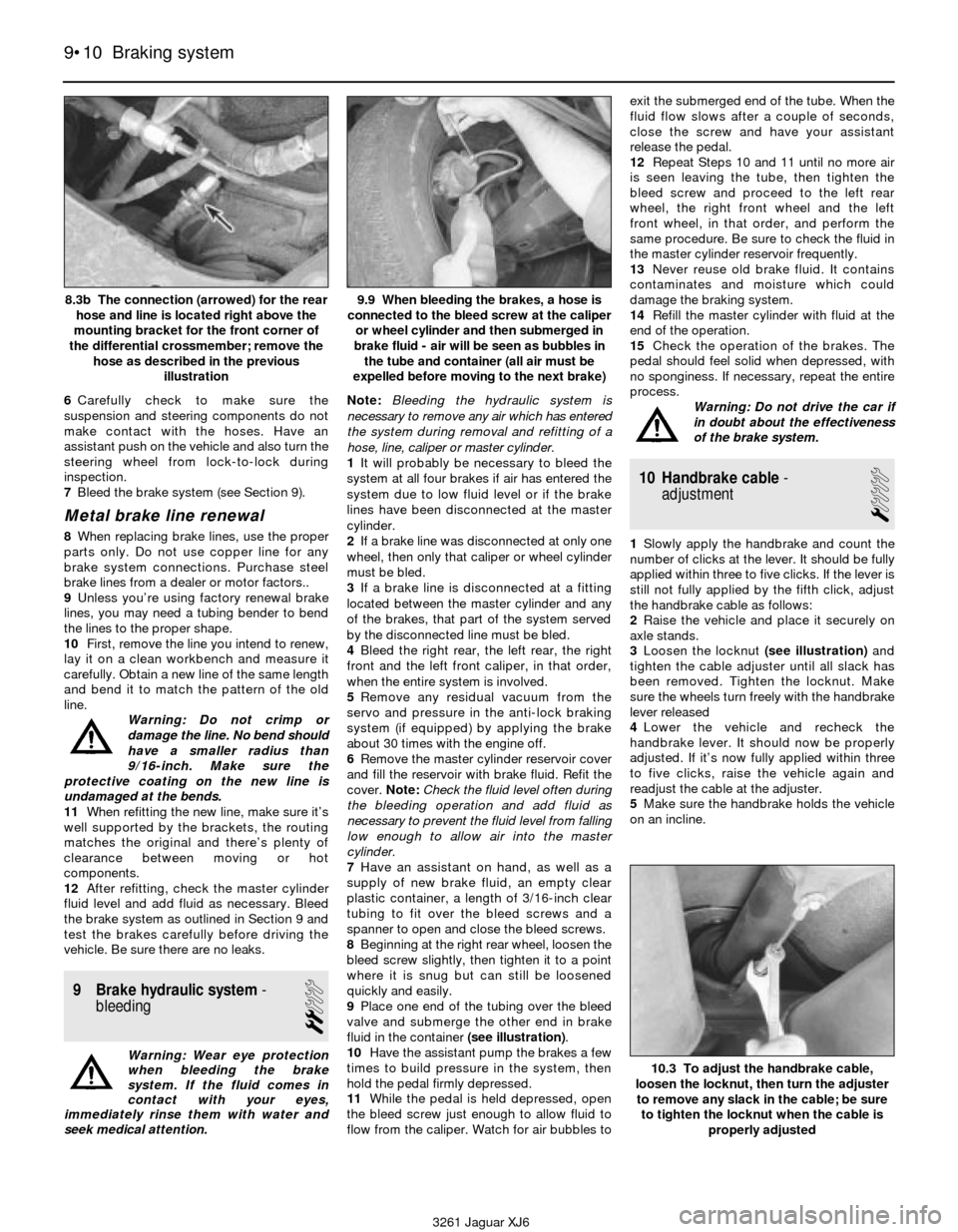
9Place one end of the tubing over the bleed
valve and submerge the other end in brake
fluid in the container (see illustration).
10Have the assistant pump the brakes a few
times to build pressure in the system, then
hold the pedal firmly depressed.
11While the pedal is held depressed, open
the bleed screw just enough to allow fluid to
flow from the caliper. Watch for air bubbles toexit the submerged end of the tube. When the
fluid flow slows after a couple of seconds,
close the screw and have your assistant
release the pedal.
12Repeat Steps 10 and 11 until no more air
is seen leaving the tube, then tighten the
bleed screw and proceed to the left rear
wheel, the right front wheel and the left
front wheel, in that order, and perform the
same procedure. Be sure to check the fluid in
the master cylinder reservoir frequently.
13Never reuse old brake fluid. It contains
contaminates and moisture which could
damage the braking system.
14Refill the master cylinder with fluid at the
end of the operation.
15Check the operation of the brakes. The
pedal should feel solid when depressed, with
no sponginess. If necessary, repeat the entire
process.
Warning: Do not drive the car if
in doubt about the effectiveness
of the brake system.
10 Handbrake cable-
adjustment
1
1Slowly apply the handbrake and count the
number of clicks at the lever. It should be fully
applied within three to five clicks. If the lever is
still not fully applied by the fifth click, adjust
the handbrake cable as follows:
2Raise the vehicle and place it securely on
axle stands.
3Loosen the locknut (see illustration)and
tighten the cable adjuster until all slack has
been removed. Tighten the locknut. Make
sure the wheels turn freely with the handbrake
lever released
4Lower the vehicle and recheck the
handbrake lever. It should now be properly
adjusted. If it’s now fully applied within three
to five clicks, raise the vehicle again and
readjust the cable at the adjuster.
5Make sure the handbrake holds the vehicle
on an incline.
9•10 Braking system
8.3b The connection (arrowed) for the rear
hose and line is located right above the
mounting bracket for the front corner of
the differential crossmember; remove the
hose as described in the previous
illustration9.9 When bleeding the brakes, a hose is
connected to the bleed screw at the caliper
or wheel cylinder and then submerged in
brake fluid - air will be seen as bubbles in
the tube and container (all air must be
expelled before moving to the next brake)
10.3 To adjust the handbrake cable,
loosen the locknut, then turn the adjuster
to remove any slack in the cable; be sure
to tighten the locknut when the cable is
properly adjusted
3261 Jaguar XJ6
Page 144 of 227
11If you installed another pair of self-
levelling shocks, or removed and installed the
same pair of self-levelling shocks, be sure to
top up the power hydraulic system reservoir
(see Chapter 1).
11 Hub carrier (rear)-
removal and refitting
4
1Loosen the wheel nuts, raise the rear of the
vehicle and support it securely on axle stands.
Remove the wheel.
2Remove the rear caliper and brake pads,
the caliper bracket, the brake disc, the
handbrake cable and the handbrake shoe
assembly (see Chapter 9).
3Disconnect the outer end of the propshaft
from the hub carrier (see Chapter 8).
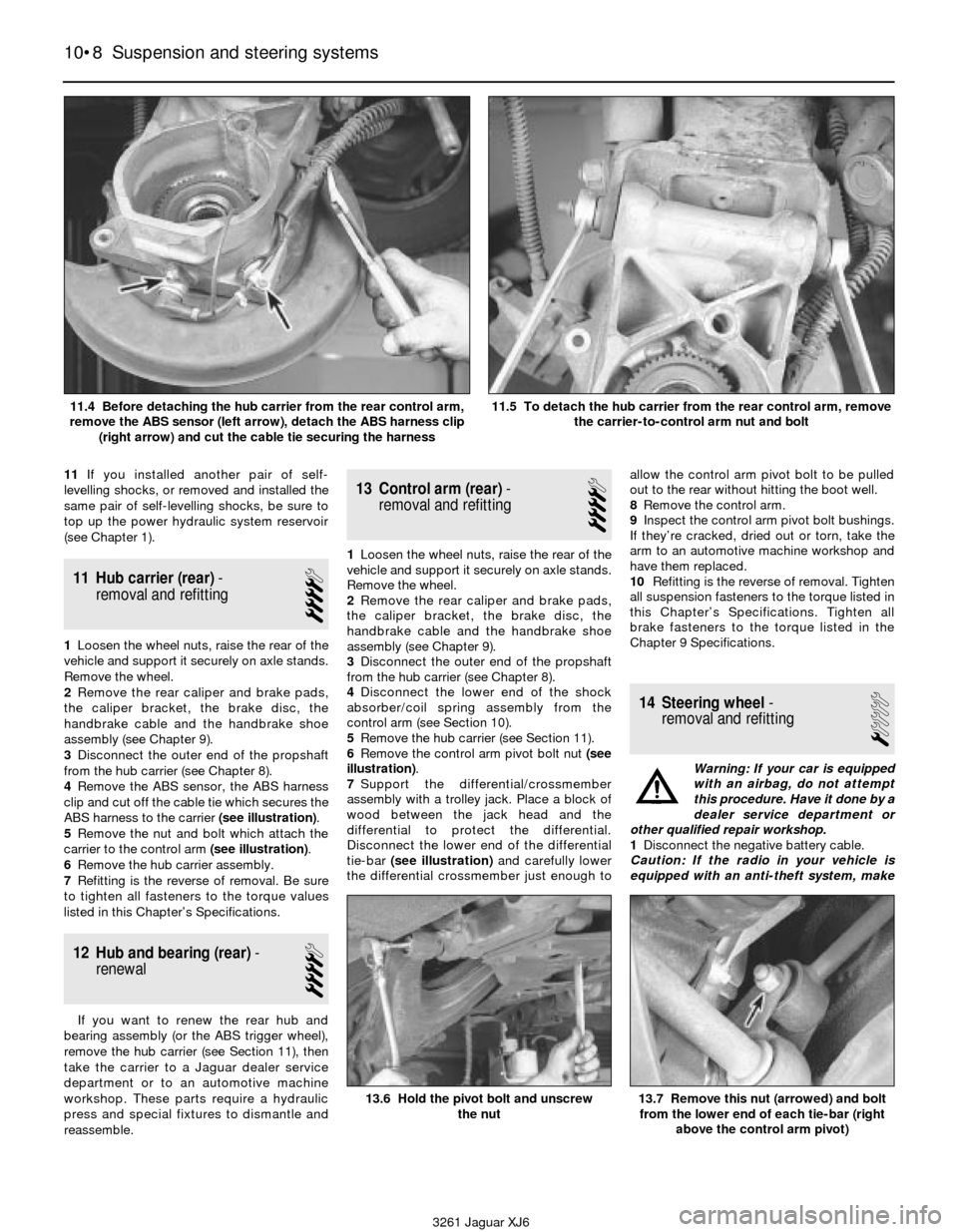
4Remove the ABS sensor, the ABS harness
clip and cut off the cable tie which secures the
ABS harness to the carrier (see illustration).
5Remove the nut and bolt which attach the
carrier to the control arm (see illustration).
6Remove the hub carrier assembly.
7Refitting is the reverse of removal. Be sure
to tighten all fasteners to the torque values
listed in this Chapter’s Specifications.
12 Hub and bearing (rear)-
renewal
4
If you want to renew the rear hub and
bearing assembly (or the ABS trigger wheel),
remove the hub carrier (see Section 11), then
take the carrier to a Jaguar dealer service
department or to an automotive machine
workshop. These parts require a hydraulic
press and special fixtures to dismantle and
reassemble.
13 Control arm (rear)-
removal and refitting
4
1Loosen the wheel nuts, raise the rear of the
vehicle and support it securely on axle stands.
Remove the wheel.
2Remove the rear caliper and brake pads,
the caliper bracket, the brake disc, the
handbrake cable and the handbrake shoe
assembly (see Chapter 9).
3Disconnect the outer end of the propshaft
from the hub carrier (see Chapter 8).
4Disconnect the lower end of the shock
absorber/coil spring assembly from the
control arm (see Section 10).
5Remove the hub carrier (see Section 11).
6Remove the control arm pivot bolt nut (see
illustration).
7Support the differential/crossmember
assembly with a trolley jack. Place a block of
wood between the jack head and the
differential to protect the differential.
Disconnect the lower end of the differential
tie-bar (see illustration)and carefully lower
the differential crossmember just enough toallow the control arm pivot bolt to be pulled
out to the rear without hitting the boot well.
8Remove the control arm.
9Inspect the control arm pivot bolt bushings.
If they’re cracked, dried out or torn, take the
arm to an automotive machine workshop and
have them replaced.
10Refitting is the reverse of removal. Tighten
all suspension fasteners to the torque listed in
this Chapter’s Specifications. Tighten all
brake fasteners to the torque listed in the
Chapter 9 Specifications.
14 Steering wheel-
removal and refitting
1
Warning: If your car is equipped
with an airbag, do not attempt
this procedure. Have it done by a
dealer service department or
other qualified repair workshop.
1Disconnect the negative battery cable.
Caution: If the radio in your vehicle is
equipped with an anti-theft system, make
10•8 Suspension and steering systems
13.6 Hold the pivot bolt and unscrew
the nut13.7 Remove this nut (arrowed) and bolt
from the lower end of each tie-bar (right
above the control arm pivot)
3261 Jaguar XJ6 11.4 Before detaching the hub carrier from the rear control arm,
remove the ABS sensor (left arrow), detach the ABS harness clip
(right arrow) and cut the cable tie securing the harness
11.5 To detach the hub carrier from the rear control arm, remove
the carrier-to-control arm nut and bolt
Page 204 of 227

3261 Jaguar XJ6
Use of EnglishREF•3
As the main part of this book has been written in the US, it uses the appropriate US component names, phrases, and spelling. Some of these
differ from those used in the UK. Normally, these cause no difficulty, but to make sure, a glossary is printed below. When ordering spare parts,
remember the parts list may use some of these words:
AMERICAN ENGLISH
Aluminum Aluminium
Antenna Aerial
Authorized Authorised
Auto parts stores Motor factors
Axleshaft Halfshaft
Back-up Reverse
Barrel Choke/venturi
Block Chock
Box-end wrench Ring spanner
Bushing Bush
Carburetor Carburettor
Center Centre
Coast Freewheel
Color Colour
Convertible Drop head coupe
Cotter pin Split pin
Counterclockwise Anti-clockwise
Countershaft (of gearbox) Layshaft
Dashboard Facia
Denatured alcohol Methylated spirit
Dome lamp Interior light
Driveaxle Driveshaft
Driveshaft Propeller shaft
Fender Wing/mudguard
Firewall Bulkhead
Flashlight Torch
Float bowl Float chamber
Floor jack Trolley jack
Freeway, turnpike etc Motorway
Freeze plug Core plug
Frozen Seized
Gas tank Petrol tank
Gasoline (gas) Petrol
Gearshift Gearchange
Generator (DC) Dynamo
Ground (electrical) Earth
Header Exhaust manifold
Heat riser Hot spot
High Top gear
Hood (engine cover) Bonnet
Installation Refitting
Intake Inlet
Jackstands Axle stands
Jumper cable Jump lead
Keeper Collet
Kerosene Paraffin
Knock pin Roll pin
Lash Clearance
Lash Free-play
Latch Catch
Latches Locks
License plate Number plate
Light Lamp
Lock (for valve spring retainer) Split cotter (for valve spring cap)
Lopes Hunts
Lug nut/bolt Wheel nut/bolt
Metal chips or debris Swarf
Misses Misfires
AMERICAN ENGLISH
Muffler Silencer
Odor Odour
Oil pan Sump
Open flame Naked flame
Panel wagon/van Van
Parking brake Handbrake
Parking light Sidelight
Pinging Pinking
Piston pin or wrist pin Gudgeon pin
Piston pin or wrist pin Small end, little end
Pitman arm Drop arm
Power brake booster Servo unit
Primary shoe (of brake) Leading shoe (of brake)
Prussian blue Engineer’s blue
Pry Prise (force apart)
Prybar Lever
Prying Levering
Quarter window Quarterlight
Recap Retread
Release cylinder Slave cylinder
Repair shop Garage
Replacement Renewal
Ring gear (of differential) Crownwheel
Rocker panel (beneath doors) Sill panel (beneath doors)
Rod bearing Big-end bearing
Rotor/disk Disc (brake)
Secondary shoe (of brake) Trailing shoe (of brake)
Sedan Saloon
Setscrew, Allen screw Grub screw
Shock absorber, shock Damper
Snap-ring Circlip
Soft top Hood
Spacer Distance piece
Spare tire Spare wheel
Spark plug wires HT leads
Spindle arm Steering arm
Stabilizer or sway bar Anti-roll bar
Station wagon Estate car
Stumbles Hesitates
Tang or lock Tab washer
Throw-out bearing Thrust bearing
Tie-rod or connecting rod (of steering) Trackrod
Tire Tyre
Transmission Gearbox
Troubleshooting Fault finding/diagnosis
Trunk Boot (luggage compartment)
Turn signal Indicator
TV (throttle valve) cable Kickdown cable
Unpublicized Unpublicised
Valve cover Rocker cover
Valve lifter Tappet
Valve lifter or tappet Cam follower or tappet
Vapor Vapour
Vise Vice
Wheel cover Roadwheel trim
Whole drive line Transmission
Windshield Windscreen
Wrench Spanner
Page 219 of 227
3261 Jaguar XJ6
REF•18Glossary of technical terms
A
ABS (Anti-lock brake system)A system,
usually electronically controlled, that senses
incipient wheel lockup during braking and
relieves hydraulic pressure at wheels that are
about to skid.
Air bag An inflatable bag hidden in the
steering wheel (driver’s side) or the dash or
glovebox (passenger side). In a head-on
collision, the bags inflate, preventing the
driver and front passenger from being thrown
forward into the steering wheel or windscreen.
Air cleanerA metal or plastic housing,
containing a filter element, which removes
dust and dirt from the air being drawn into the
engine.
Air filter elementThe actual filter in an air
cleaner system, usually manufactured from
pleated paper and requiring renewal at regular
intervals.
Allen keyA hexagonal wrench which fits into
a recessed hexagonal hole.
Alligator clipA long-nosed spring-loaded
metal clip with meshing teeth. Used to make
temporary electrical connections.
AlternatorA component in the electrical
system which converts mechanical energy
from a drivebelt into electrical energy to
charge the battery and to operate the starting
system, ignition system and electrical
accessories.
Ampere (amp)A unit of measurement for the
flow of electric current. One amp is the
amount of current produced by one volt
acting through a resistance of one ohm.
Anaerobic sealerA substance used to
prevent bolts and screws from loosening.
Anaerobic means that it does not require
oxygen for activation. The Loctite brand is
widely used.
AntifreezeA substance (usually ethylene
glycol) mixed with water, and added to a
vehicle’s cooling system, to prevent freezing
of the coolant in winter. Antifreeze also
contains chemicals to inhibit corrosion and
the formation of rust and other deposits that
would tend to clog the radiator and coolant
passages and reduce cooling efficiency.
Anti-seize compoundA coating that
reduces the risk of seizing on fasteners that
are subjected to high temperatures, such as
exhaust manifold bolts and nuts.
AsbestosA natural fibrous mineral with great
heat resistance, commonly used in the
composition of brake friction materials.Asbestos is a health hazard and the dust
created by brake systems should never be
inhaled or ingested.
AxleA shaft on which a wheel revolves, or
which revolves with a wheel. Also, a solid
beam that connects the two wheels at one
end of the vehicle. An axle which also
transmits power to the wheels is known as a
live axle.
AxleshaftA single rotating shaft, on either
side of the differential, which delivers power
from the final drive assembly to the drive
wheels. Also called a driveshaft or a halfshaft.
BBall bearingAn anti-friction bearing
consisting of a hardened inner and outer race
with hardened steel balls between two races.
BearingThe curved surface on a shaft or in a
bore, or the part assembled into either, that
permits relative motion between them with
minimum wear and friction.
Big-end bearingThe bearing in the end of
the connecting rod that’s attached to the
crankshaft.
Bleed nippleA valve on a brake wheel
cylinder, caliper or other hydraulic component
that is opened to purge the hydraulic system
of air. Also called a bleed screw.
Brake bleedingProcedure for removing air
from lines of a hydraulic brake system.
Brake discThe component of a disc brake
that rotates with the wheels.Brake drumThe component of a drum brake
that rotates with the wheels.
Brake liningsThe friction material which
contacts the brake disc or drum to retard the
vehicle’s speed. The linings are bonded or
riveted to the brake pads or shoes.
Brake padsThe replaceable friction pads
that pinch the brake disc when the brakes are
applied. Brake pads consist of a friction
material bonded or riveted to a rigid backing
plate.
Brake shoeThe crescent-shaped carrier to
which the brake linings are mounted and
which forces the lining against the rotating
drum during braking.
Braking systemsFor more information on
braking systems, consult the Haynes
Automotive Brake Manual.
Breaker barA long socket wrench handle
providing greater leverage.
BulkheadThe insulated partition between
the engine and the passenger compartment.
CCaliperThe non-rotating part of a disc-brake
assembly that straddles the disc and carries
the brake pads. The caliper also contains the
hydraulic components that cause the pads to
pinch the disc when the brakes are applied. A
caliper is also a measuring tool that can be set
to measure inside or outside dimensions of an
object.
CamshaftA rotating shaft on which a series
of cam lobes operate the valve mechanisms.
The camshaft may be driven by gears, by
sprockets and chain or by sprockets and a
belt.
CanisterA container in an evaporative
emission control system; contains activated
charcoal granules to trap vapours from the
fuel system.
CarburettorA device which mixes fuel with
air in the proper proportions to provide a
desired power output from a spark ignition
internal combustion engine.
CastellatedResembling the parapets along
the top of a castle wall. For example, a
castellated balljoint stud nut.
CastorIn wheel alignment, the backward or
forward tilt of the steering axis. Castor is
positive when the steering axis is inclined
rearward at the top.
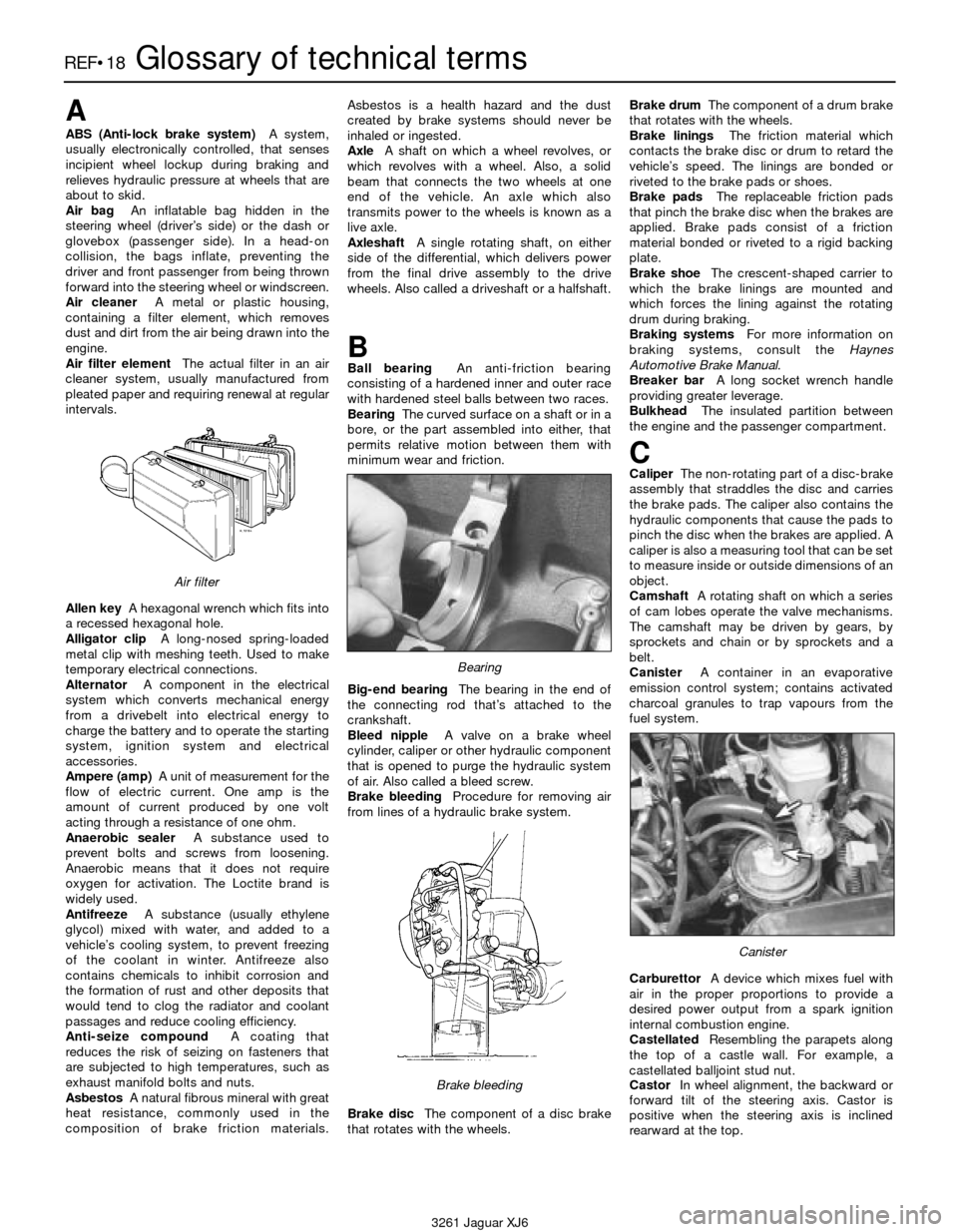
Canister
Brake bleeding
Bearing
Air filter
Page 221 of 227
3261 Jaguar XJ6
REF•20Glossary of technical terms
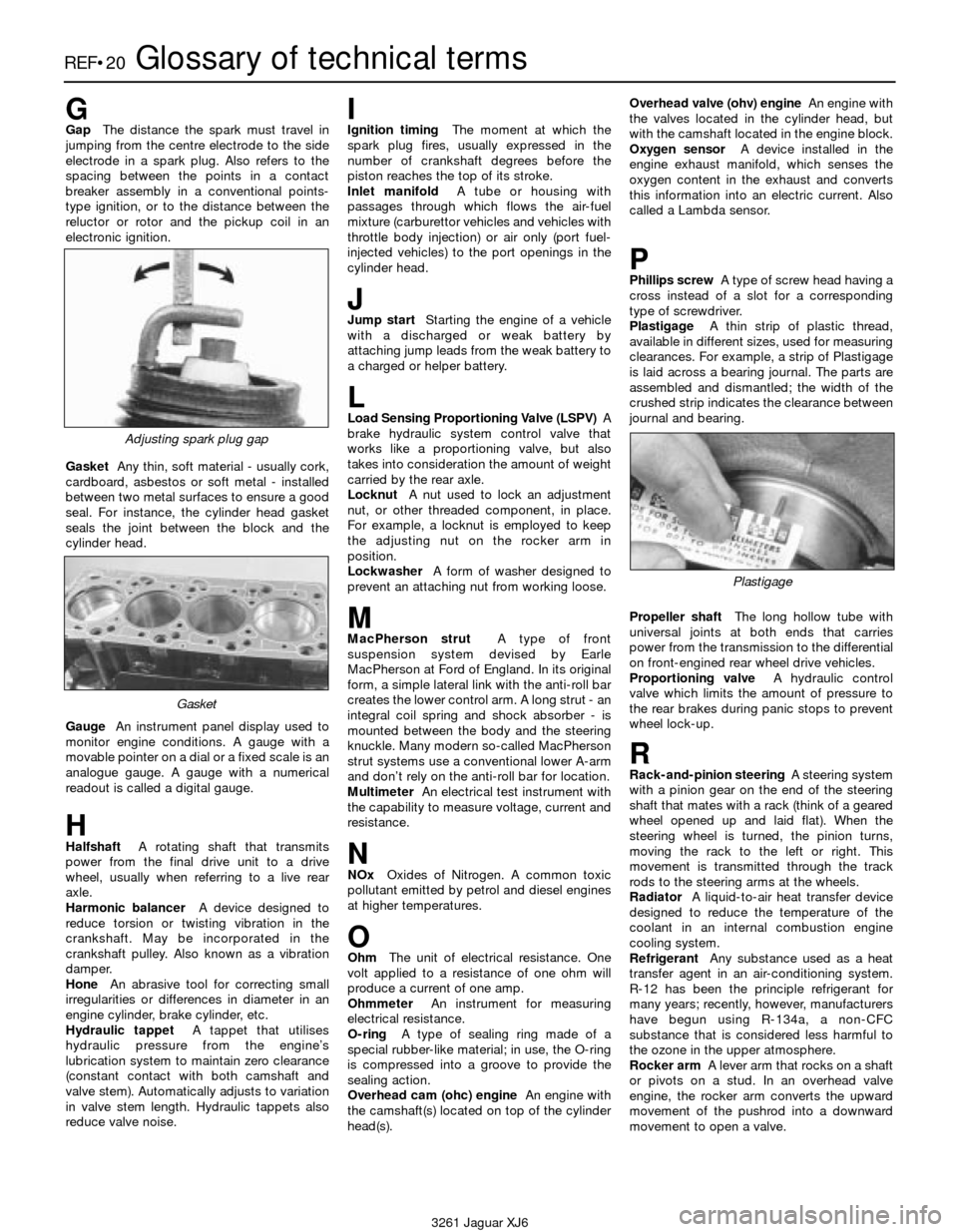
GGapThe distance the spark must travel in
jumping from the centre electrode to the side
electrode in a spark plug. Also refers to the
spacing between the points in a contact
breaker assembly in a conventional points-
type ignition, or to the distance between the
reluctor or rotor and the pickup coil in an
electronic ignition.
GasketAny thin, soft material - usually cork,
cardboard, asbestos or soft metal - installed
between two metal surfaces to ensure a good
seal. For instance, the cylinder head gasket
seals the joint between the block and the
cylinder head.
GaugeAn instrument panel display used to
monitor engine conditions. A gauge with a
movable pointer on a dial or a fixed scale is an
analogue gauge. A gauge with a numerical
readout is called a digital gauge.
HHalfshaftA rotating shaft that transmits
power from the final drive unit to a drive
wheel, usually when referring to a live rear
axle.
Harmonic balancerA device designed to
reduce torsion or twisting vibration in the
crankshaft. May be incorporated in the
crankshaft pulley. Also known as a vibration
damper.
HoneAn abrasive tool for correcting small
irregularities or differences in diameter in an
engine cylinder, brake cylinder, etc.
Hydraulic tappetA tappet that utilises
hydraulic pressure from the engine’s
lubrication system to maintain zero clearance
(constant contact with both camshaft and
valve stem). Automatically adjusts to variation
in valve stem length. Hydraulic tappets also
reduce valve noise.
IIgnition timingThe moment at which the
spark plug fires, usually expressed in the
number of crankshaft degrees before the
piston reaches the top of its stroke.
Inlet manifoldA tube or housing with
passages through which flows the air-fuel
mixture (carburettor vehicles and vehicles with
throttle body injection) or air only (port fuel-
injected vehicles) to the port openings in the
cylinder head.
JJump startStarting the engine of a vehicle
with a discharged or weak battery by
attaching jump leads from the weak battery to
a charged or helper battery.
LLoad Sensing Proportioning Valve (LSPV)A
brake hydraulic system control valve that
works like a proportioning valve, but also
takes into consideration the amount of weight
carried by the rear axle.
LocknutA nut used to lock an adjustment
nut, or other threaded component, in place.
For example, a locknut is employed to keep
the adjusting nut on the rocker arm in
position.
LockwasherA form of washer designed to
prevent an attaching nut from working loose.
MMacPherson strutA type of front
suspension system devised by Earle
MacPherson at Ford of England. In its original
form, a simple lateral link with the anti-roll bar
creates the lower control arm. A long strut - an
integral coil spring and shock absorber - is
mounted between the body and the steering
knuckle. Many modern so-called MacPherson
strut systems use a conventional lower A-arm
and don’t rely on the anti-roll bar for location.
MultimeterAn electrical test instrument with
the capability to measure voltage, current and
resistance.
NNOxOxides of Nitrogen. A common toxic
pollutant emitted by petrol and diesel engines
at higher temperatures.
OOhmThe unit of electrical resistance. One
volt applied to a resistance of one ohm will
produce a current of one amp.
OhmmeterAn instrument for measuring
electrical resistance.
O-ringA type of sealing ring made of a
special rubber-like material; in use, the O-ring
is compressed into a groove to provide the
sealing action.
Overhead cam (ohc) engineAn engine with
the camshaft(s) located on top of the cylinder
head(s).Overhead valve (ohv) engineAn engine with
the valves located in the cylinder head, but
with the camshaft located in the engine block.
Oxygen sensorA device installed in the
engine exhaust manifold, which senses the
oxygen content in the exhaust and converts
this information into an electric current. Also
called a Lambda sensor.
PPhillips screwA type of screw head having a
cross instead of a slot for a corresponding
type of screwdriver.
PlastigageA thin strip of plastic thread,
available in different sizes, used for measuring
clearances. For example, a strip of Plastigage
is laid across a bearing journal. The parts are
assembled and dismantled; the width of the
crushed strip indicates the clearance between
journal and bearing.
Propeller shaftThe long hollow tube with
universal joints at both ends that carries
power from the transmission to the differential
on front-engined rear wheel drive vehicles.
Proportioning valveA hydraulic control
valve which limits the amount of pressure to
the rear brakes during panic stops to prevent
wheel lock-up.
RRack-and-pinion steeringA steering system
with a pinion gear on the end of the steering
shaft that mates with a rack (think of a geared
wheel opened up and laid flat). When the
steering wheel is turned, the pinion turns,
moving the rack to the left or right. This
movement is transmitted through the track
rods to the steering arms at the wheels.
RadiatorA liquid-to-air heat transfer device
designed to reduce the temperature of the
coolant in an internal combustion engine
cooling system.
RefrigerantAny substance used as a heat
transfer agent in an air-conditioning system.
R-12 has been the principle refrigerant for
many years; recently, however, manufacturers
have begun using R-134a, a non-CFC
substance that is considered less harmful to
the ozone in the upper atmosphere.
Rocker armA lever arm that rocks on a shaft
or pivots on a stud. In an overhead valve
engine, the rocker arm converts the upward
movement of the pushrod into a downward
movement to open a valve.
Adjusting spark plug gap
Plastigage
Gasket
Page 223 of 227

3261 Jaguar XJ6
REF•22Index
AABS fault finding -9•2
Accelerator cable -4•8
Acknowledgements -0•4
Aerial - 12•8
Air cleaner -1•14, 4•7
Air conditioning -3•2, 3•7, 3•10, 3•11, 3•13, 3•14
Air induction system -4•9
Air Injector Reactor (AIR) system -6•8
Air intake plenum -4•13
Airbag - 0•5, 12•14
Alternator -5•6
Amplifier -5•3
Anti-lock Brake system (ABS) -9•2
Anti-roll bar - 10•3
Anti-theft system - REF•1
Antifreeze -0•11, 0•16, 1•2, 1•20, 3•2
Asbestos -0•5
ATF -0•16
Automatic transmission-7•1et seq
fault finding - 7•1, REF•15
fluid - 0•16, 1•2, 1•11, 1•19
filter - 1•19
Auxiliary shaft -2A•8
BBalljoints - 10•4
Battery -0•5, 0•15, 1•9, 5•1, 5•1
Big-end bearings -2B•13, 2B•17
Bleeding
brake system - 9•10
power steering - 10•11
Block -2B•10, 2B•11
Blower motors -3•7
Body corrosion - REF•11
Body electrical system- 12•1et seq
Bodywork and fittings- 11•1et seq
Bonnet - 11•3, 11•4
Boot - 11•7
lid - 11•3, 11•6, 11•7,
Boots (steering) - 10•9
Brake fluid -0•12, 0•16, 1•20
Brake lights - 12•12
switch - 9•13
Brake servo -1•12
Braking system-1•12, 9•1et seq
fault finding - REF•15, REF•16
MOT checks - REF•8 to REF•10
Bulbs -0•15, 12•11
Bumpers - 11•5
Burning -0•5
CCables -4•8, 5•2, 7•2, 7•4, 9•10, 9•11, 11•4, 11•10
Calipers -9•3
Camshafts -2A•9
Capacities -1•2
Carpets - 11•1
Cassette - REF•1
Catalytic converter -6•12
Central locking - 12•13
Centre console - 11•11
Charcoal canister -6•11
Charging -1•10
Charging system -5•5
Circuit breakers - 12•3
CO emissions (mixture) - REF•11
Coil (HT) -5•3
Coil spring - 10•5, 10•6
Compression check -2B•3
Compressor -3•13
Condenser -3•13
Connecting rods -2B•9, 2B•12, 2B•17, 2B•18
Console - 11•11, 11•12
Continuity check - 12•2
Control arms - 10•5, 10•6, 10•8
Conversion factors - REF•2
Coolant -0•11, 0•16, 1•2, 1•20, 3•2
Coolant reservoir -3•4, 3•5
Coolant temperature sensor -6•3
Cooling fans -3•3
Cooling system fault finding - REF•14
Cooling,heating and air conditioning systems-3•1et seq
Courtesy lights - 12•12
Cowl cover - 11•14
Crankcase ventilation system -1•16, 6•11
Crankshaft -2A•5, 2A•17, 2B•10, 2B•13, 2B•16
position sensor - 6•7
Cruise control - 12•13
Crushing -0•5
Cylinder head -2A•13, 2B•6, 2B•7, 2B•8
Cylinder honing -2B•12
DDashboard - 11•13
Dents - 11•2
Differential -8•1, 8•5
oil - 1•2, 1•11, 1•20
Dimensions - REF•1
Direction indicators - 12•4, 12•11, 12•12
Discs -9•4
Distributor -5•4
Doors - 11•7, 11•8, 11•9, 11•10, 11•10, REF•9
Drivebelt -1•16
Driveplate -2A•16
Driveshafts -8•1, 8•4, 8•5, REF•10
Drivetrain-1•14, 8•1et seq
Note:References throughout this index are in the form - “Chapter number” • “page number”
Page 225 of 227

3261 Jaguar XJ6
NNeutral start switch -7•5
Notes for UK readers -0•4, REF•3
Number plate light - 12•12
OObtaining diagnostic code output -6•3
Oil cooler -3•6
Oil filter -1•6
Oil gauge - 12•7
Oil pump -2A•15
Oil seals -2A•5, 2A•17, 2B•17, 7•7, 8•4, 8•5, REF•5
Oil,differential -1•2, 1•11, 1•20
Oil,engine -0•11, 0•16, 1•2, 1•6
On Board Diagnosis (OBD) system -6•2
Open circuit check - 12•2
Output shaft -7•7
Oxygen sensor -6•4
PPads (brake) -9•1, 9•2
Painting - 11•2
Parking lights - 12•11
Piston rings -2B•15
Pistons -2B•9, 2B•12, 2B•17
Poisonous or irritant substances -0•5
Power hydraulic system -0•16
fluid - 1•9
Power steering - 10•10, 10•11
fluid - 0•13, 0•16
Propshaft -1•18, 8•1, 8•2, 8•3
Punctures- 0•8
RRadiator -3•4
grille - 11•5
Radio - 12•7, REF•1
Rear lights - 12•12
Receiver/drier -3•12
Regulator (window) - 11•10
Relays - 12•3
Repair procedures - REF•5
Reversing lights -7•5, 12•12
Road test -1•14
Roadside repairs-0•6et seq
Routine maintenance and servicing-1•1et seq
Rust holes - 11•2
SSafety first -0•5
Scalding -0•5
Scratches - 11•2Screw threads and fastenings - REF•5
Seat belts -1•13, REF•9
Seats - 11•14, REF•9
Self-levelling rear suspension system - 10•3
Servo -1•12, 9•1, 9•9
Shift cable -7•4
Shock absorber - 10•4, 10•6, REF•9, REF•10
Shoes (brake) -1•20, 9•11
Short circuit check - 12•1
Side marker lights - 12•11
Spare parts - REF•4
Spark plugs -1•7, 1•14
Speakers - 12•7
Speed sensor -6•7
Spoiler - 11•5
Springs - 10•5, 10•6, REF•10
Starter motor -5•7
Steering - See Suspension and steering systems
Steering wheel and column - 11•13, 12•5, REF•8
Sump -2A•14
Sunroof - 12•14
Supplementary air valve -4•13
Suspension and steering systems- 1•12, 10•1et seq, REF•9, REF•10
fault finding - REF•16, REF•17
Switches -4•1, 7•5, 9•13, 12•5, 12•6, 12•12
TTail lights - 12•12
Temperature gauge - 12•7
Temperature sender unit -3•7
Thermostat -3•2
Throttle body -4•10
Throttle potentiometer -6•5
Tie-rod ends - 10•9
Timing chains -2A•6
Tools - REF•5, REF•6, REF•7
Top Dead Centre (TDC) for number one piston -2A•2
Torque converter -7•7
Towing -0•6
Trim panels - 11•7, 11•13
Tyres - 0•14, 10•11, REF•11
UUK readers information -0•4, REF•3
Universal joint -8•1, 8•2, 8•5
Upholstery - 11•1
VVacuum gauge checks -2B•3
Valve cover -2A•3
Valve lifters -2A•9
Valves -2B•8
Vehicle identification - REF•4, REF•9
Vehicle support - REF•1
Vinyl trim - 11•1
Voltage checks - 12•1
REF•24Index