steering wheel JAGUAR XJ6 1997 2.G User Guide
[x] Cancel search | Manufacturer: JAGUAR, Model Year: 1997, Model line: XJ6, Model: JAGUAR XJ6 1997 2.GPages: 227, PDF Size: 7.2 MB
Page 30 of 227
16 Spark plug renewal
2
Refer to Section 4, renewing the plugs
regardless of their apparent condition.
17 Air cleaner element renewal
1
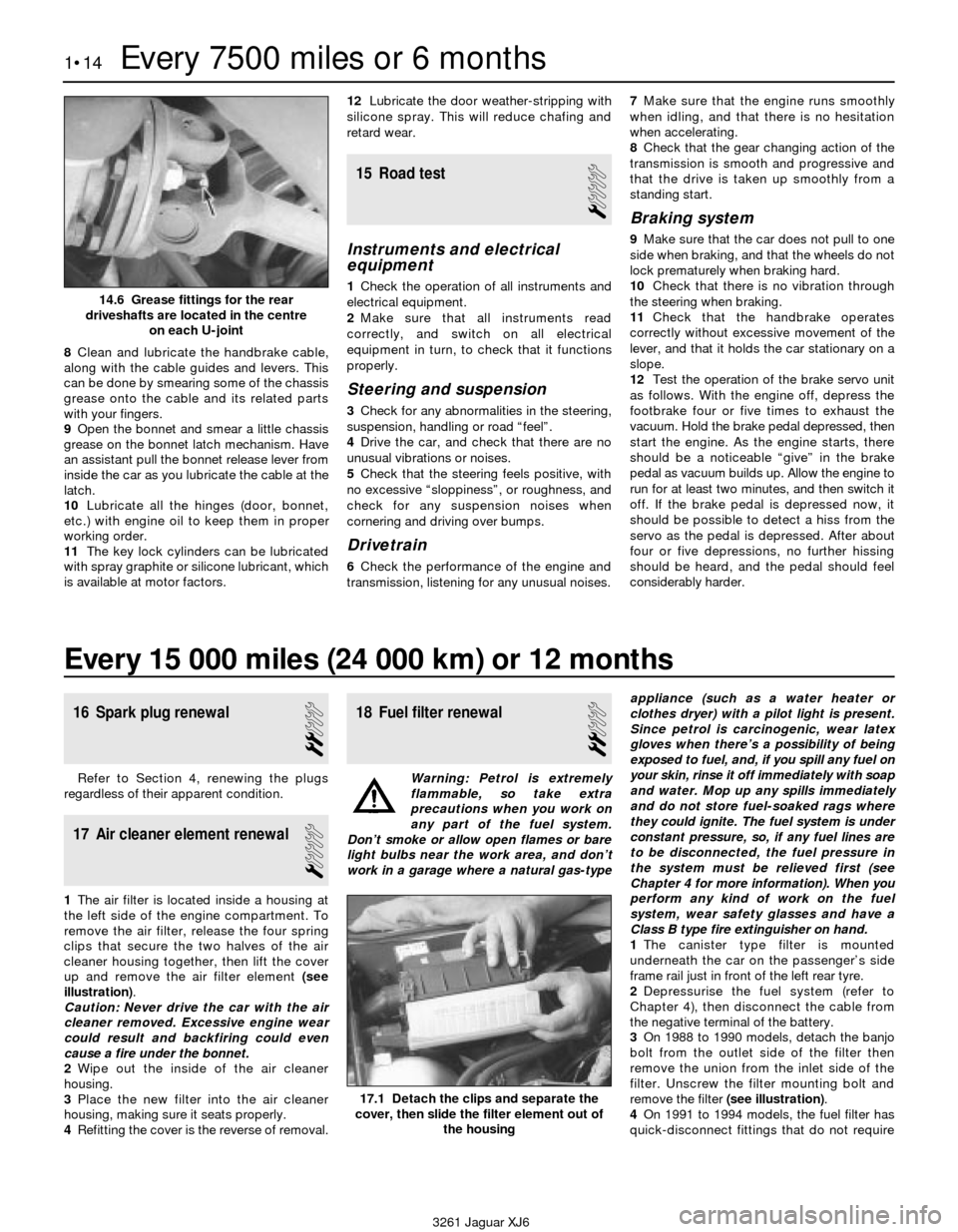
1The air filter is located inside a housing at
the left side of the engine compartment. To
remove the air filter, release the four spring
clips that secure the two halves of the air
cleaner housing together, then lift the cover
up and remove the air filter element (see
illustration).
Caution: Never drive the car with the air
cleaner removed. Excessive engine wear
could result and backfiring could even
cause a fire under the bonnet.
2Wipe out the inside of the air cleaner
housing.
3Place the new filter into the air cleaner
housing, making sure it seats properly.
4Refitting the cover is the reverse of removal.
18 Fuel filter renewal
2
Warning: Petrol is extremely
flammable, so take extra
precautions when you work on
any part of the fuel system.
Don’t smoke or allow open flames or bare
light bulbs near the work area, and don’t
work in a garage where a natural gas-typeappliance (such as a water heater or
clothes dryer) with a pilot light is present.
Since petrol is carcinogenic, wear latex
gloves when there’s a possibility of being
exposed to fuel, and, if you spill any fuel on
your skin, rinse it off immediately with soap
and water. Mop up any spills immediately
and do not store fuel-soaked rags where
they could ignite. The fuel system is under
constant pressure, so, if any fuel lines are
to be disconnected, the fuel pressure in
the system must be relieved first (see
Chapter 4 for more information). When you
perform any kind of work on the fuel
system, wear safety glasses and have a
Class B type fire extinguisher on hand.
1The canister type filter is mounted
underneath the car on the passenger’s side
frame rail just in front of the left rear tyre.
2Depressurise the fuel system (refer to
Chapter 4), then disconnect the cable from
the negative terminal of the battery.
3On 1988 to 1990 models, detach the banjo
bolt from the outlet side of the filter then
remove the union from the inlet side of the
filter. Unscrew the filter mounting bolt and
remove the filter (see illustration).
4On 1991 to 1994 models, the fuel filter has
quick-disconnect fittings that do not require 8Clean and lubricate the handbrake cable,
along with the cable guides and levers. This
can be done by smearing some of the chassis
grease onto the cable and its related parts
with your fingers.
9Open the bonnet and smear a little chassis
grease on the bonnet latch mechanism. Have
an assistant pull the bonnet release lever from
inside the car as you lubricate the cable at the
latch.
10Lubricate all the hinges (door, bonnet,
etc.) with engine oil to keep them in proper
working order.
11The key lock cylinders can be lubricated
with spray graphite or silicone lubricant, which
is available at motor factors.12Lubricate the door weather-stripping with
silicone spray. This will reduce chafing and
retard wear.
15 Road test
1
Instruments and electrical
equipment
1Check the operation of all instruments and
electrical equipment.
2Make sure that all instruments read
correctly, and switch on all electrical
equipment in turn, to check that it functions
properly.
Steering and suspension
3Check for any abnormalities in the steering,
suspension, handling or road “feel”.
4Drive the car, and check that there are no
unusual vibrations or noises.
5Check that the steering feels positive, with
no excessive “sloppiness”, or roughness, and
check for any suspension noises when
cornering and driving over bumps.
Drivetrain
6Check the performance of the engine and
transmission, listening for any unusual noises.7Make sure that the engine runs smoothly
when idling, and that there is no hesitation
when accelerating.
8Check that the gear changing action of the
transmission is smooth and progressive and
that the drive is taken up smoothly from a
standing start.
Braking system
9Make sure that the car does not pull to one
side when braking, and that the wheels do not
lock prematurely when braking hard.
10Check that there is no vibration through
the steering when braking.
11Check that the handbrake operates
correctly without excessive movement of the
lever, and that it holds the car stationary on a
slope.
12Test the operation of the brake servo unit
as follows. With the engine off, depress the
footbrake four or five times to exhaust the
vacuum. Hold the brake pedal depressed, then
start the engine. As the engine starts, there
should be a noticeable “give” in the brake
pedal as vacuum builds up. Allow the engine to
run for at least two minutes, and then switch it
off. If the brake pedal is depressed now, it
should be possible to detect a hiss from the
servo as the pedal is depressed. After about
four or five depressions, no further hissing
should be heard, and the pedal should feel
considerably harder.
1•14Every 7500 miles or 6 months
17.1 Detach the clips and separate the
cover, then slide the filter element out of
the housing
3261 Jaguar XJ6
14.6 Grease fittings for the rear
driveshafts are located in the centre
on each U-joint
Every 15 000 miles (24 000 km) or 12 months
Page 39 of 227
Torque wrench settings*Nm lbf ft
Camshaft bearing cap bolts . . . . . . . . . . . . . . . . . . . . . . . . . . . . . . . . . . 23 to 27 16 to 20
Camshaft sprocket bolts . . . . . . . . . . . . . . . . . . . . . . . . . . . . . . . . . . . . 23 to 27 16 to 20
Crankshaft damper-to-crankshaft bolt
3.2 and 3.6 litre . . . . . . . . . . . . . . . . . . . . . . . . . . . . . . . . . . . . . . . . . . 204 151
4.0 litre . . . . . . . . . . . . . . . . . . . . . . . . . . . . . . . . . . . . . . . . . . . . . . . . 180 to 220 133 to 162
Crankshaft pulley to damper bolts . . . . . . . . . . . . . . . . . . . . . . . . . . . . . 23 to 27 16 to 20
Crankshaft rear oil seal retainer bolts . . . . . . . . . . . . . . . . . . . . . . . . . . . 23 to 27 16 to 20
Crankshaft sensor bolts . . . . . . . . . . . . . . . . . . . . . . . . . . . . . . . . . . . . . 23 to 27 16 to 20
Cylinder head bolts
Step 1 . . . . . . . . . . . . . . . . . . . . . . . . . . . . . . . . . . . . . . . . . . . . . . . . . 60 44
Step 2 . . . . . . . . . . . . . . . . . . . . . . . . . . . . . . . . . . . . . . . . . . . . . . . . . Tighten an additional 90° (1/4 turn)
Driveplate bolts . . . . . . . . . . . . . . . . . . . . . . . . . . . . . . . . . . . . . . . . . . . . 123 to 149 91 to 110
Engine mounts
To engine block . . . . . . . . . . . . . . . . . . . . . . . . . . . . . . . . . . . . . . . . . 49 to 66 36 to 39
To chassis . . . . . . . . . . . . . . . . . . . . . . . . . . . . . . . . . . . . . . . . . . . . . . 22 to 24 16 to 18
Exhaust manifold heat shield fasteners . . . . . . . . . . . . . . . . . . . . . . . . . 23 to 27 16 to 20
Exhaust manifold nuts . . . . . . . . . . . . . . . . . . . . . . . . . . . . . . . . . . . . . . 23 to 27 16 to 20
Intake manifold nuts . . . . . . . . . . . . . . . . . . . . . . . . . . . . . . . . . . . . . . . . 23 to 27 16 to 20
Oil pump bolts . . . . . . . . . . . . . . . . . . . . . . . . . . . . . . . . . . . . . . . . . . . . 23 to 27 16 to 20
Sump bolts . . . . . . . . . . . . . . . . . . . . . . . . . . . . . . . . . . . . . . . . . . . . . . . 23 to 27 16 to 20
Sump bolts, adapter to pan . . . . . . . . . . . . . . . . . . . . . . . . . . . . . . . . . . 49 to 54 36 to 40
Timing chain cover . . . . . . . . . . . . . . . . . . . . . . . . . . . . . . . . . . . . . . . . . 23 to 27 16 to 20
Valve cover screws . . . . . . . . . . . . . . . . . . . . . . . . . . . . . . . . . . . . . . . . . 10 to 12 7 to 9
*Note:Refer to Part B for additional specifications
2A•2 Engine in-car repair procedures
3261 Jaguar XJ6
1 General information
This Part of Chapter 2 is devoted to in-car
repair procedures for the in-line six-cylinder
engines. All information concerning engine
removal and refitting and engine block and
cylinder head overhaul can be found in Part B
of this Chapter.
The following repair procedures are based
on the assumption that the engine is installed
in the car. If the engine has been removed
from the car and mounted on a stand, many of
the steps outlined in this Part of Chapter 2 will
not apply. We have photographed some in-
car engine procedures with the engine on a
stand for photographic purposes.
The Specifications included in this Part of
Chapter 2 apply only to the procedures
contained in this Part. Part B of Chapter 2
includes the Specifications necessary for
cylinder head and engine block rebuilding.
2 Repair operations possible
with the engine in the car
Many repair operations can be
accomplished without removing the engine
from the car.
Clean the engine compartment and the
exterior of the engine with some type of
degreaser before any work is done. It will
make the job easier and help keep dirt out of
the internal areas of the engine.
Depending on the components involved, itmay be helpful to remove the bonnet to
improve access to the engine as repairs are
performed (refer to Chapter 11 if necessary).
Cover the wings to prevent damage to the
paint. Special pads are available, but an old
bedspread or blanket will also work.
If vacuum, exhaust, oil or coolant leaks
develop, indicating a need for gasket or seal
renewal, the repairs can generally be made
with the engine in the car. The intake and
exhaust manifold gaskets, crankshaft oil seals
and cylinder head gasket are all accessible
with the engine in place (although rear oil seal
renewal involves removal of the transmission).
The sump is difficult for a home mechanic to
replace without a hoist and other specialised
equipment, since the front suspension,
steering and crossmember must be lowered
to allow enough clearance for sump removal.
If such equipment is not available, the
alternative would be to remove the engine for
renewal of the sump or oil pump. Note:We
assume that the home mechanic does not
have access to the specialised equipment,
and have photographed our subject engine
out of the car for some procedures.
Exterior engine components, such as the
intake and exhaust manifolds, the water
pump, the starter motor, the alternator, the
distributor and the fuel system components
can be removed for repair with the engine in
place.
Since the cylinder head can be removed
with the engine in-car, camshaft and valve
component servicing can also be
accomplished. Renewal of the timing chains
and sprockets is also possible with the engine
in-car.
3 Top Dead Centre (TDC) for
number one piston- locating
1
Note:The following procedure is based on the
assumption that the distributor is correctly
installed. If you are trying to locate TDC to refit
the distributor correctly, piston position must
be determined by feeling for compression at
the number one spark plug hole, then aligning
the ignition timing marks (see paragraph 8).
1Top Dead Centre (TDC) is the highest point
in the cylinder that each piston reaches as it
travels up the cylinder bore. Each piston
reaches TDC on the compression stroke and
again on the exhaust stroke, but TDC
generally refers to piston position on the
compression stroke.
2Positioning the piston(s) at TDC is an
essential part of many procedures such as
camshaft and timing chain/sprocket removal
and distributor removal.
3Before beginning this procedure, be sure to
place the transmission in Neutral and apply
the handbrake or block the rear wheels. Also,
disable the ignition system by detaching the
coil wire from the centre terminal of the
distributor cap and grounding it on the engine
block with a jumper wire. Remove the spark
plugs (see Chapter 1).
4In order to bring any piston to TDC, the
crankshaft must be turned using one of the
methods outlined below. When looking at the
timing chain end of the engine, normal
crankshaft rotation is clockwise.
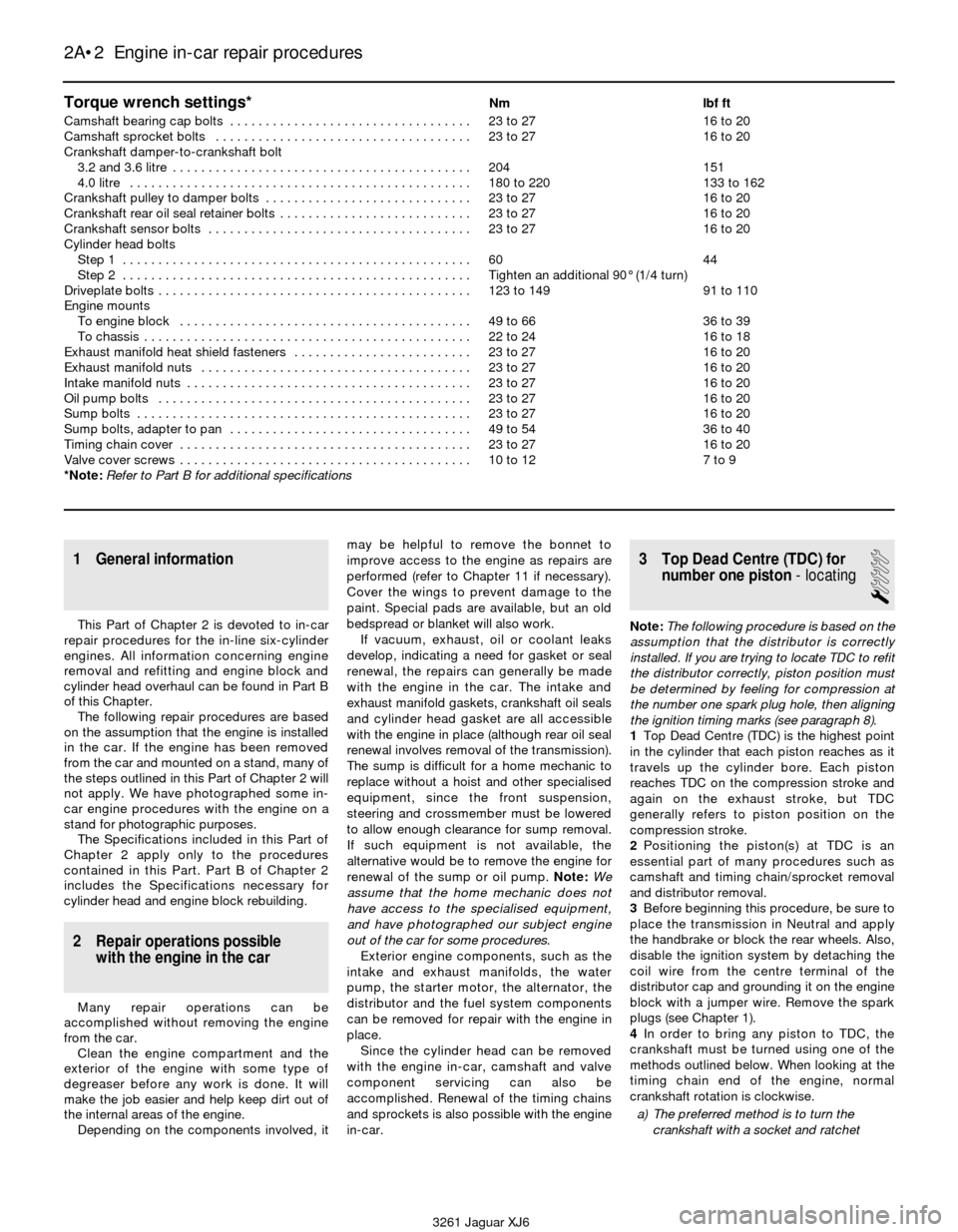
a) The preferred method is to turn the
crankshaft with a socket and ratchet
Page 60 of 227
11Disconnect the throttle linkage,
transmission linkage (and dipstick tube) and
speed control cable, if equipped, from the
engine (see Chapters 4 and 7).
12Refer to Part A of this Chapter and
remove the intake and exhaust manifolds.
13Unbolt the power steering pump (see
Chapter 10). Tie the pump aside without
disconnecting the hoses. Refer to Part A for
removal of the hydraulic pump (if equipped)
from the timing chain cover.
14On air-conditioned models, unbolt the
compressor and set it aside. Do not
disconnect the refrigerant hoses. Note:Wire
the compressor out of the way with a coat
hanger, don’t let the compressor hang on the
hoses.
15Refer to Part A of this Chapter and
remove the drivebelts, water pump pulley and
crankshaft pulley.
16Attach a lifting sling to the engine.
Position a hoist and connect the sling to it.
Take up the slack until there is slight tension
on the hoist.
17With a trolley jack and piece of wood
supporting the bottom of the transmission
sump, refer to Chapter 8 and remove the
driveshaft and rear transmission mount.
Warning: Do not place any part
of your body under the
engine/transmission when it’s
supported only by a hoist or
other lifting device.
18With the hoist taking the weight of the
engine, unbolt the engine mounts (see Part A
of this Chapter).
19Recheck to be sure nothing is still
connecting the engine or transmission to the
vehicle. Disconnect and label anything still
remaining.
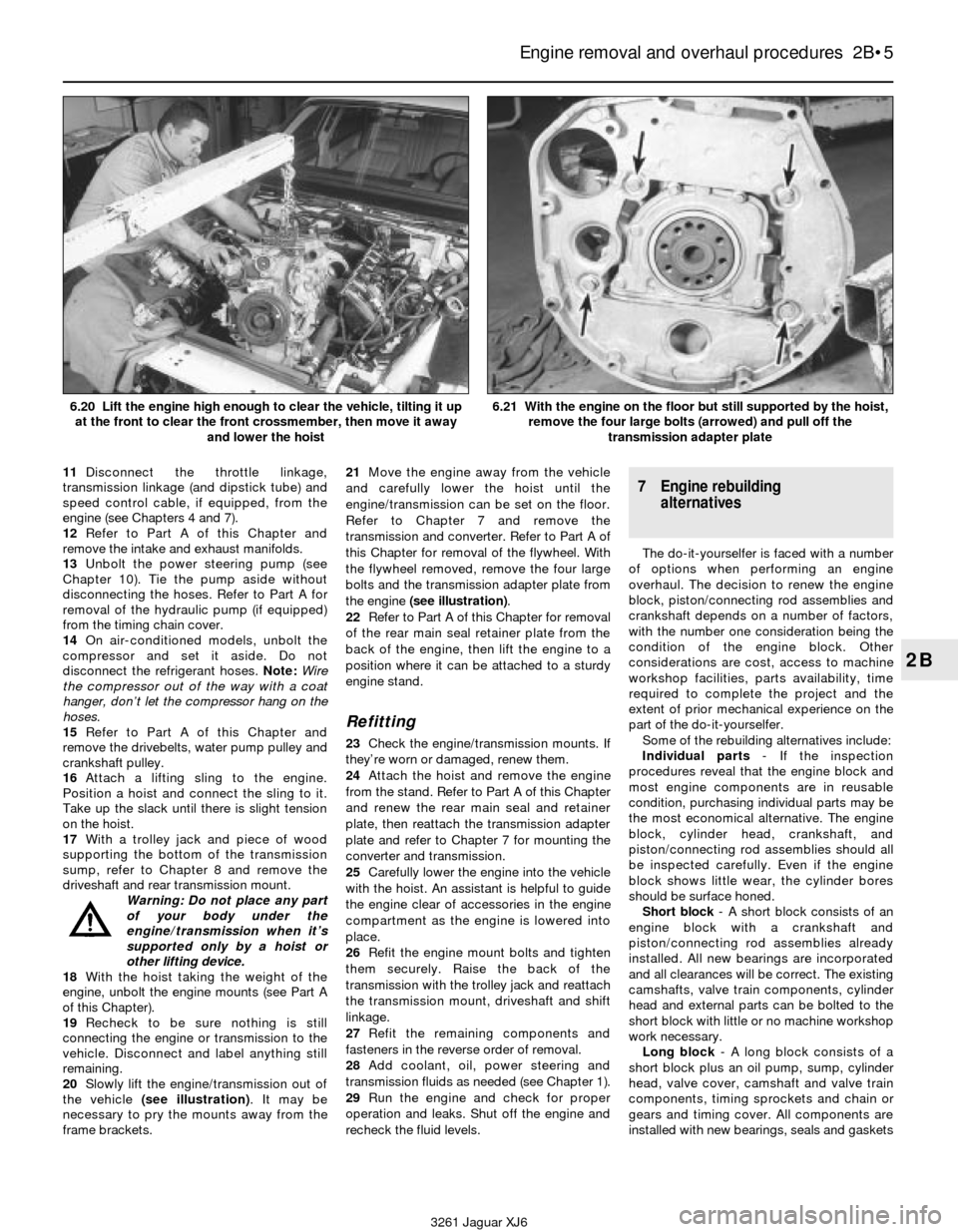
20Slowly lift the engine/transmission out of
the vehicle (see illustration). It may be
necessary to pry the mounts away from the
frame brackets.21Move the engine away from the vehicle
and carefully lower the hoist until the
engine/transmission can be set on the floor.
Refer to Chapter 7 and remove the
transmission and converter. Refer to Part A of
this Chapter for removal of the flywheel. With
the flywheel removed, remove the four large
bolts and the transmission adapter plate from
the engine (see illustration).
22Refer to Part A of this Chapter for removal
of the rear main seal retainer plate from the
back of the engine, then lift the engine to a
position where it can be attached to a sturdy
engine stand.
Refitting
23Check the engine/transmission mounts. If
they’re worn or damaged, renew them.
24Attach the hoist and remove the engine
from the stand. Refer to Part A of this Chapter
and renew the rear main seal and retainer
plate, then reattach the transmission adapter
plate and refer to Chapter 7 for mounting the
converter and transmission.
25Carefully lower the engine into the vehicle
with the hoist. An assistant is helpful to guide
the engine clear of accessories in the engine
compartment as the engine is lowered into
place.
26Refit the engine mount bolts and tighten
them securely. Raise the back of the
transmission with the trolley jack and reattach
the transmission mount, driveshaft and shift
linkage.
27Refit the remaining components and
fasteners in the reverse order of removal.
28Add coolant, oil, power steering and
transmission fluids as needed (see Chapter 1).
29Run the engine and check for proper
operation and leaks. Shut off the engine and
recheck the fluid levels.
7 Engine rebuilding
alternatives
The do-it-yourselfer is faced with a number
of options when performing an engine
overhaul. The decision to renew the engine
block, piston/connecting rod assemblies and
crankshaft depends on a number of factors,
with the number one consideration being the
condition of the engine block. Other
considerations are cost, access to machine
workshop facilities, parts availability, time
required to complete the project and the
extent of prior mechanical experience on the
part of the do-it-yourselfer.
Some of the rebuilding alternatives include:
Individual parts- If the inspection
procedures reveal that the engine block and
most engine components are in reusable
condition, purchasing individual parts may be
the most economical alternative. The engine
block, cylinder head, crankshaft, and
piston/connecting rod assemblies should all
be inspected carefully. Even if the engine
block shows little wear, the cylinder bores
should be surface honed.
Short block- A short block consists of an
engine block with a crankshaft and
piston/connecting rod assemblies already
installed. All new bearings are incorporated
and all clearances will be correct. The existing
camshafts, valve train components, cylinder
head and external parts can be bolted to the
short block with little or no machine workshop
work necessary.
Long block- A long block consists of a
short block plus an oil pump, sump, cylinder
head, valve cover, camshaft and valve train
components, timing sprockets and chain or
gears and timing cover. All components are
installed with new bearings, seals and gaskets
Engine removal and overhaul procedures 2B•5
2B
3261 Jaguar XJ6 6.20 Lift the engine high enough to clear the vehicle, tilting it up
at the front to clear the front crossmember, then move it away
and lower the hoist
6.21 With the engine on the floor but still supported by the hoist,
remove the four large bolts (arrowed) and pull off the
transmission adapter plate
Page 80 of 227
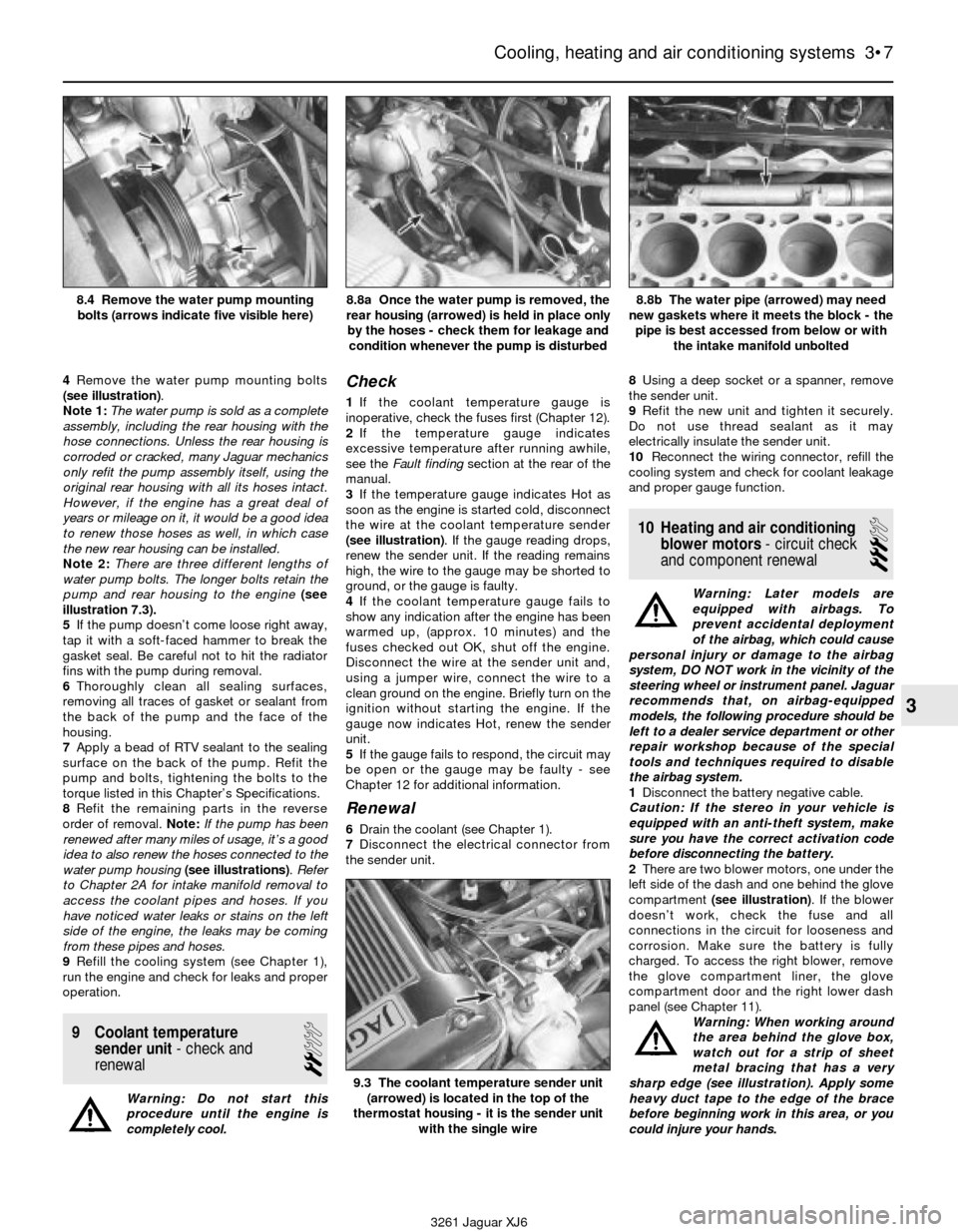
4Remove the water pump mounting bolts
(see illustration).
Note 1:The water pump is sold as a complete
assembly, including the rear housing with the
hose connections. Unless the rear housing is
corroded or cracked, many Jaguar mechanics
only refit the pump assembly itself, using the
original rear housing with all its hoses intact.
However, if the engine has a great deal of
years or mileage on it, it would be a good idea
to renew those hoses as well, in which case
the new rear housing can be installed.
Note 2:There are three different lengths of
water pump bolts. The longer bolts retain the
pump and rear housing to the engine(see
illustration 7.3).
5If the pump doesn’t come loose right away,
tap it with a soft-faced hammer to break the
gasket seal. Be careful not to hit the radiator
fins with the pump during removal.
6Thoroughly clean all sealing surfaces,
removing all traces of gasket or sealant from
the back of the pump and the face of the
housing.
7Apply a bead of RTV sealant to the sealing
surface on the back of the pump. Refit the
pump and bolts, tightening the bolts to the
torque listed in this Chapter’s Specifications.
8Refit the remaining parts in the reverse
order of removal. Note:If the pump has been
renewed after many miles of usage, it’s a good
idea to also renew the hoses connected to the
water pump housing(see illustrations). Refer
to Chapter 2A for intake manifold removal to
access the coolant pipes and hoses. If you
have noticed water leaks or stains on the left
side of the engine, the leaks may be coming
from these pipes and hoses.
9Refill the cooling system (see Chapter 1),
run the engine and check for leaks and proper
operation.
9 Coolant temperature
sender unit- check and
renewal
2
Warning: Do not start this
procedure until the engine is
completely cool.
Check
1If the coolant temperature gauge is
inoperative, check the fuses first (Chapter 12).
2If the temperature gauge indicates
excessive temperature after running awhile,
see the Fault finding section at the rear of the
manual.
3If the temperature gauge indicates Hot as
soon as the engine is started cold, disconnect
the wire at the coolant temperature sender
(see illustration). If the gauge reading drops,
renew the sender unit. If the reading remains
high, the wire to the gauge may be shorted to
ground, or the gauge is faulty.
4If the coolant temperature gauge fails to
show any indication after the engine has been
warmed up, (approx. 10 minutes) and the
fuses checked out OK, shut off the engine.
Disconnect the wire at the sender unit and,
using a jumper wire, connect the wire to a
clean ground on the engine. Briefly turn on the
ignition without starting the engine. If the
gauge now indicates Hot, renew the sender
unit.
5If the gauge fails to respond, the circuit may
be open or the gauge may be faulty - see
Chapter 12 for additional information.
Renewal
6Drain the coolant (see Chapter 1).
7Disconnect the electrical connector from
the sender unit.8Using a deep socket or a spanner, remove
the sender unit.
9Refit the new unit and tighten it securely.
Do not use thread sealant as it may
electrically insulate the sender unit.
10Reconnect the wiring connector, refill the
cooling system and check for coolant leakage
and proper gauge function.
10 Heating and air conditioning
blower motors- circuit check
and component renewal
3
Warning: Later models are
equipped with airbags. To
prevent accidental deployment
of the airbag, which could cause
personal injury or damage to the airbag
system, DO NOT work in the vicinity of the
steering wheel or instrument panel. Jaguar
recommends that, on airbag-equipped
models, the following procedure should be
left to a dealer service department or other
repair workshop because of the special
tools and techniques required to disable
the airbag system.
1Disconnect the battery negative cable.
Caution: If the stereo in your vehicle is
equipped with an anti-theft system, make
sure you have the correct activation code
before disconnecting the battery.
2There are two blower motors, one under the
left side of the dash and one behind the glove
compartment (see illustration). If the blower
doesn’t work, check the fuse and all
connections in the circuit for looseness and
corrosion. Make sure the battery is fully
charged. To access the right blower, remove
the glove compartment liner, the glove
compartment door and the right lower dash
panel (see Chapter 11).
Warning: When working around
the area behind the glove box,
watch out for a strip of sheet
metal bracing that has a very
sharp edge (see illustration). Apply some
heavy duct tape to the edge of the brace
before beginning work in this area, or you
could injure your hands.
Cooling, heating and air conditioning systems 3•7
3
8.4 Remove the water pump mounting
bolts (arrows indicate five visible here)8.8a Once the water pump is removed, the
rear housing (arrowed) is held in place only
by the hoses - check them for leakage and
condition whenever the pump is disturbed8.8b The water pipe (arrowed) may need
new gaskets where it meets the block - the
pipe is best accessed from below or with
the intake manifold unbolted
9.3 The coolant temperature sender unit
(arrowed) is located in the top of the
thermostat housing - it is the sender unit
with the single wire
3261 Jaguar XJ6
Page 82 of 227

11Separate the housing halves and pull up
the plastic plate holding the motor and fan
(see illustration). The fan doesn’t come off
the motor, but loosen the clamp-bolt on the
motor’s mount bracket and slide the motor
and fan out for renewal (see illustration).
Note:Some 1988 models had problems with
cracking of the fan blades and noise from the
blowers. These blowers and fans have been
superseded with improved parts, available
from your Jaguar dealer.
12When either blower housing is separated,
you’ll find two relays mounted inside (see
illustration). These are the blower isolation
relay and blower relay. Before refitting the
blower housing in the car, refer to Chapter 12
for testing of these relays.
13Refitting is the reverse of removal. Check
for proper operation.11 Heater core-
removal and refitting
4
Warning: Later model vehicles
are equipped with airbags. To
prevent the accidental deploy-
ment of the airbag, which could
cause personal injury or damage to the
airbag system, DO NOT work in the vicinity
of the steering wheel or instrument panel.
The manufacturer recommends that, on
airbag-equipped models, the following
procedure should be left to a dealer service
department or other repair workshop
because of the special tools and techniques
required to disable the airbag system.1Disconnect the battery negative cable.
Caution: If the stereo in your vehicle is
equipped with an anti-theft system, make
sure you have the correct activation code
before disconnecting the battery.
2Drain the cooling system (see Chapter 1).
Disconnect the heater hoses where they enter
the bulkhead (see illustration). Note:Use
compressed air in one of the pipes to blow out
any remaining coolant and collect it. This will
prevent any spills on the carpeting when the
heater core is removed. Plug the pipes to
prevent any remaining coolant from spilling out.
3Refer to Chapter 11 for removal of the
under-dash panels on both the driver and
passenger sides, and removal of the glovebox.
Warning: When working around
the area behind the glove box,
watch out for a strip of sheet
Cooling, heating and air conditioning systems 3•9
3
3261 Jaguar XJ6 10.11a Separate the housing halves - the blower motor (arrowed)
is attached to a plastic plate sandwiched between the
two housing halves
10.11b Loosen the clamp bolt (arrowed) on the motor bracket and
then pull the motor and fan out as an assembly
10.12 Inside the blower case are the blower and isolation relays
(arrowed) - while the case is apart, test these relays for
proper operation11.2 Disconnect the heater hoses from the pipes at the bulkhead
(small arrows) - the large arrow indicates the evaporator case
retaining nut
Page 83 of 227
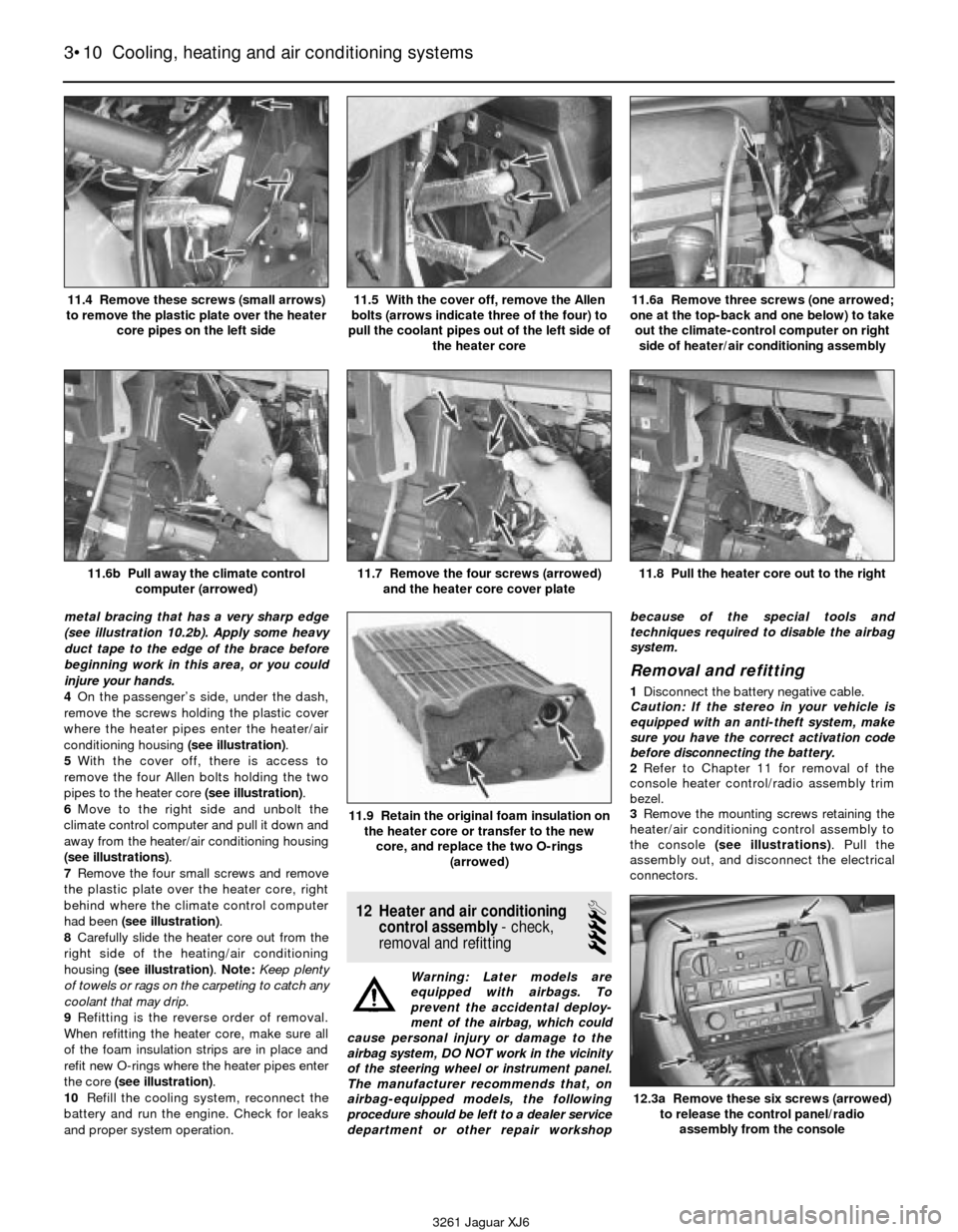
metal bracing that has a very sharp edge
(see illustration 10.2b). Apply some heavy
duct tape to the edge of the brace before
beginning work in this area, or you could
injure your hands.
4On the passenger’s side, under the dash,
remove the screws holding the plastic cover
where the heater pipes enter the heater/air
conditioning housing (see illustration).
5With the cover off, there is access to
remove the four Allen bolts holding the two
pipes to the heater core (see illustration).
6Move to the right side and unbolt the
climate control computer and pull it down and
away from the heater/air conditioning housing
(see illustrations).
7Remove the four small screws and remove
the plastic plate over the heater core, right
behind where the climate control computer
had been (see illustration).
8Carefully slide the heater core out from the
right side of the heating/air conditioning
housing (see illustration). Note:Keep plenty
of towels or rags on the carpeting to catch any
coolant that may drip.
9Refitting is the reverse order of removal.
When refitting the heater core, make sure all
of the foam insulation strips are in place and
refit new O-rings where the heater pipes enter
the core (see illustration).
10Refill the cooling system, reconnect the
battery and run the engine. Check for leaks
and proper system operation.
12 Heater and air conditioning
control assembly- check,
removal and refitting
4
Warning: Later models are
equipped with airbags. To
prevent the accidental deploy-
ment of the airbag, which could
cause personal injury or damage to the
airbag system, DO NOT work in the vicinity
of the steering wheel or instrument panel.
The manufacturer recommends that, on
airbag-equipped models, the following
procedure should be left to a dealer service
department or other repair workshopbecause of the special tools and
techniques required to disable the airbag
system.
Removal and refitting
1Disconnect the battery negative cable.
Caution: If the stereo in your vehicle is
equipped with an anti-theft system, make
sure you have the correct activation code
before disconnecting the battery.
2Refer to Chapter 11 for removal of the
console heater control/radio assembly trim
bezel.
3Remove the mounting screws retaining the
heater/air conditioning control assembly to
the console (see illustrations). Pull the
assembly out, and disconnect the electrical
connectors.
3•10 Cooling, heating and air conditioning systems
11.4 Remove these screws (small arrows)
to remove the plastic plate over the heater
core pipes on the left side11.5 With the cover off, remove the Allen
bolts (arrows indicate three of the four) to
pull the coolant pipes out of the left side of
the heater core11.6a Remove three screws (one arrowed;
one at the top-back and one below) to take
out the climate-control computer on right
side of heater/air conditioning assembly
11.6b Pull away the climate control
computer (arrowed)11.7 Remove the four screws (arrowed)
and the heater core cover plate11.8 Pull the heater core out to the right
3261 Jaguar XJ6
11.9 Retain the original foam insulation on
the heater core or transfer to the new
core, and replace the two O-rings
(arrowed)
12.3a Remove these six screws (arrowed)
to release the control panel/radio
assembly from the console
Page 87 of 227
cushions fit on the mounting points and that
any foam insulator strips are still in place or
transferred to the new condenser.
6Reconnect the refrigerant lines, using new
O-rings. If a new condenser has been
installed, add 84 cc (3 fluid ounces) of new
refrigerant oil. Note:The oil and O-rings must
be compatible with the type of refrigerant you
are using.
7Refit the remaining parts in the reverse
order of removal.
8Have the system evacuated, charged and
leak tested by the workshop that discharged
it.
17 Air conditioning evaporator
and expansion valve-
removal and refitting
4
Warning 1: The air conditioning
system is under high pressure.
Do not loosen any hose fittings
or remove any components until
the system has been discharged. Air
conditioning refrigerant should be properly
discharged into an EPA-approved
recovery/recycling unit by a dealer service
department or an automotive airconditioning repair facility. Always wear
eye protection when disconnecting air
conditioning system fittings.
Warning 2: Later model vehicles
are equipped with airbags. To
prevent the accidental
deployment of the airbag, which
could cause personal injury or damage to
the airbag system, DO NOT work in the
vicinity of the steering wheel or instrument
panel. The manufacturer recommends
that, on airbag-equipped models, the
following procedure should be left to a
dealer service department or other repair
workshop because of the special tools and
techniques required to disable the airbag
system.
1Refer to Chapter 11 for removal of the glove
compartment, under-dash panels and
console. Note:The removal of the
heater/evaporator housing is difficult and
time-consuming, much more so than the
removal of the heater core (see Section 11).
For some home mechanics, the job is better
left to a Jaguar dealership or other qualified
repair workshop.
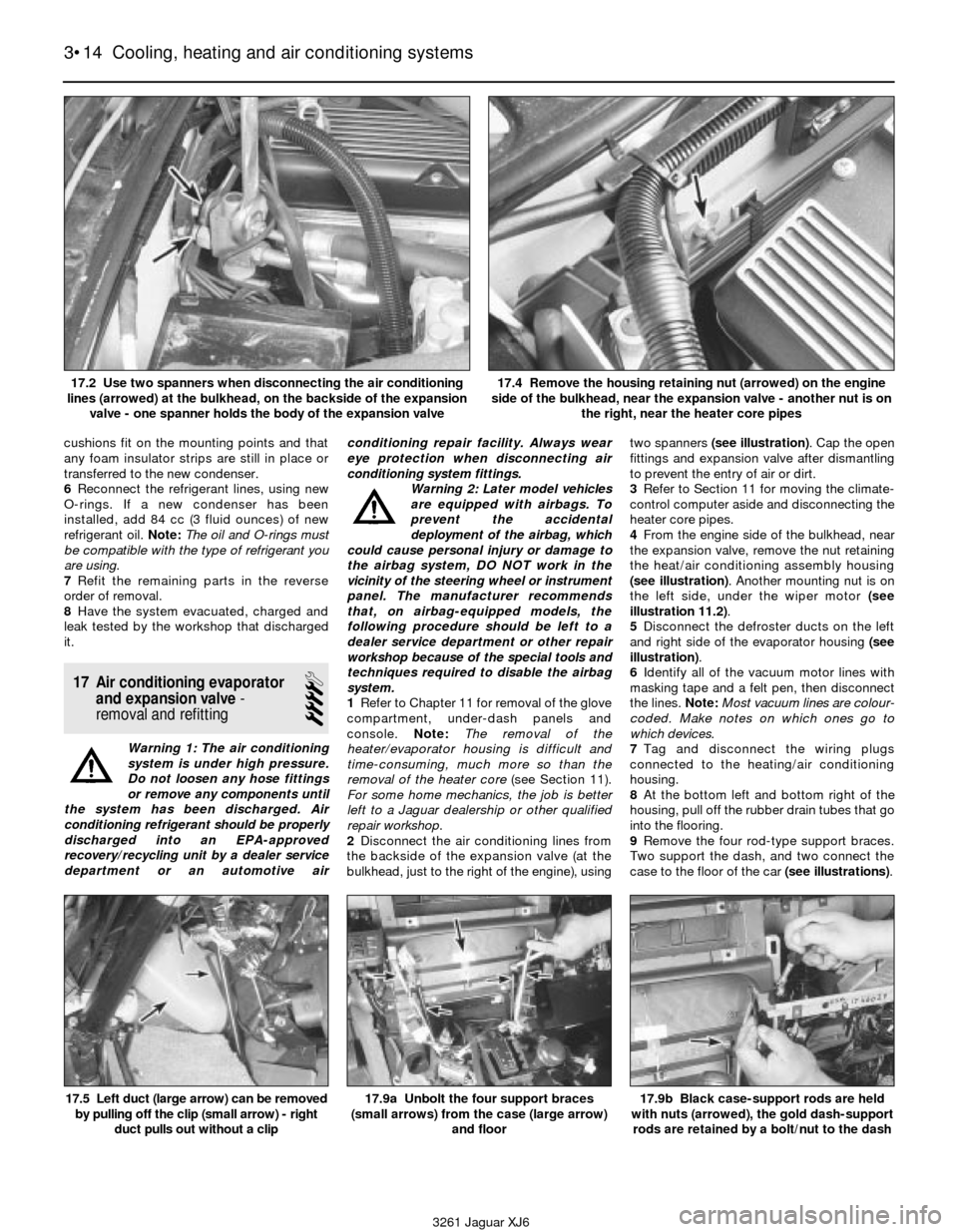
2Disconnect the air conditioning lines from
the backside of the expansion valve (at the
bulkhead, just to the right of the engine), usingtwo spanners (see illustration). Cap the open
fittings and expansion valve after dismantling
to prevent the entry of air or dirt.
3Refer to Section 11 for moving the climate-
control computer aside and disconnecting the
heater core pipes.
4From the engine side of the bulkhead, near
the expansion valve, remove the nut retaining
the heat/air conditioning assembly housing
(see illustration). Another mounting nut is on
the left side, under the wiper motor (see
illustration 11.2).
5Disconnect the defroster ducts on the left
and right side of the evaporator housing (see
illustration).
6Identify all of the vacuum motor lines with
masking tape and a felt pen, then disconnect
the lines. Note:Most vacuum lines are colour-
coded. Make notes on which ones go to
which devices.
7Tag and disconnect the wiring plugs
connected to the heating/air conditioning
housing.
8At the bottom left and bottom right of the
housing, pull off the rubber drain tubes that go
into the flooring.
9Remove the four rod-type support braces.
Two support the dash, and two connect the
case to the floor of the car (see illustrations).
3•14 Cooling, heating and air conditioning systems
17.5 Left duct (large arrow) can be removed
by pulling off the clip (small arrow) - right
duct pulls out without a clip17.9a Unbolt the four support braces
(small arrows) from the case (large arrow)
and floor17.9b Black case-support rods are held
with nuts (arrowed), the gold dash-support
rods are retained by a bolt/nut to the dash
3261 Jaguar XJ6 17.2 Use two spanners when disconnecting the air conditioning
lines (arrowed) at the bulkhead, on the backside of the expansion
valve - one spanner holds the body of the expansion valve
17.4 Remove the housing retaining nut (arrowed) on the engine
side of the bulkhead, near the expansion valve - another nut is on
the right, near the heater core pipes
Page 132 of 227
6Carefully check to make sure the
suspension and steering components do not
make contact with the hoses. Have an
assistant push on the vehicle and also turn the
steering wheel from lock-to-lock during
inspection.
7Bleed the brake system (see Section 9).
Metal brake line renewal
8When replacing brake lines, use the proper
parts only. Do not use copper line for any
brake system connections. Purchase steel
brake lines from a dealer or motor factors..
9Unless you’re using factory renewal brake
lines, you may need a tubing bender to bend
the lines to the proper shape.
10First, remove the line you intend to renew,
lay it on a clean workbench and measure it
carefully. Obtain a new line of the same length
and bend it to match the pattern of the old
line.
Warning: Do not crimp or
damage the line. No bend should
have a smaller radius than
9/16-inch. Make sure the
protective coating on the new line is
undamaged at the bends.
11When refitting the new line, make sure it’s
well supported by the brackets, the routing
matches the original and there’s plenty of
clearance between moving or hot
components.
12After refitting, check the master cylinder
fluid level and add fluid as necessary. Bleed
the brake system as outlined in Section 9 and
test the brakes carefully before driving the
vehicle. Be sure there are no leaks.
9 Brake hydraulic system-
bleeding
2
Warning: Wear eye protection
when bleeding the brake
system. If the fluid comes in
contact with your eyes,
immediately rinse them with water and
seek medical attention.Note:Bleeding the hydraulic system is
necessary to remove any air which has entered
the system during removal and refitting of a
hose, line, caliper or master cylinder.
1It will probably be necessary to bleed the
system at all four brakes if air has entered the
system due to low fluid level or if the brake
lines have been disconnected at the master
cylinder.
2If a brake line was disconnected at only one
wheel, then only that caliper or wheel cylinder
must be bled.
3If a brake line is disconnected at a fitting
located between the master cylinder and any
of the brakes, that part of the system served
by the disconnected line must be bled.
4Bleed the right rear, the left rear, the right
front and the left front caliper, in that order,
when the entire system is involved.
5Remove any residual vacuum from the
servo and pressure in the anti-lock braking
system (if equipped) by applying the brake
about 30 times with the engine off.
6Remove the master cylinder reservoir cover
and fill the reservoir with brake fluid. Refit the
cover. Note:Check the fluid level often during
the bleeding operation and add fluid as
necessary to prevent the fluid level from falling
low enough to allow air into the master
cylinder.
7Have an assistant on hand, as well as a
supply of new brake fluid, an empty clear
plastic container, a length of 3/16-inch clear
tubing to fit over the bleed screws and a
spanner to open and close the bleed screws.
8Beginning at the right rear wheel, loosen the
bleed screw slightly, then tighten it to a point
where it is snug but can still be loosened
quickly and easily.
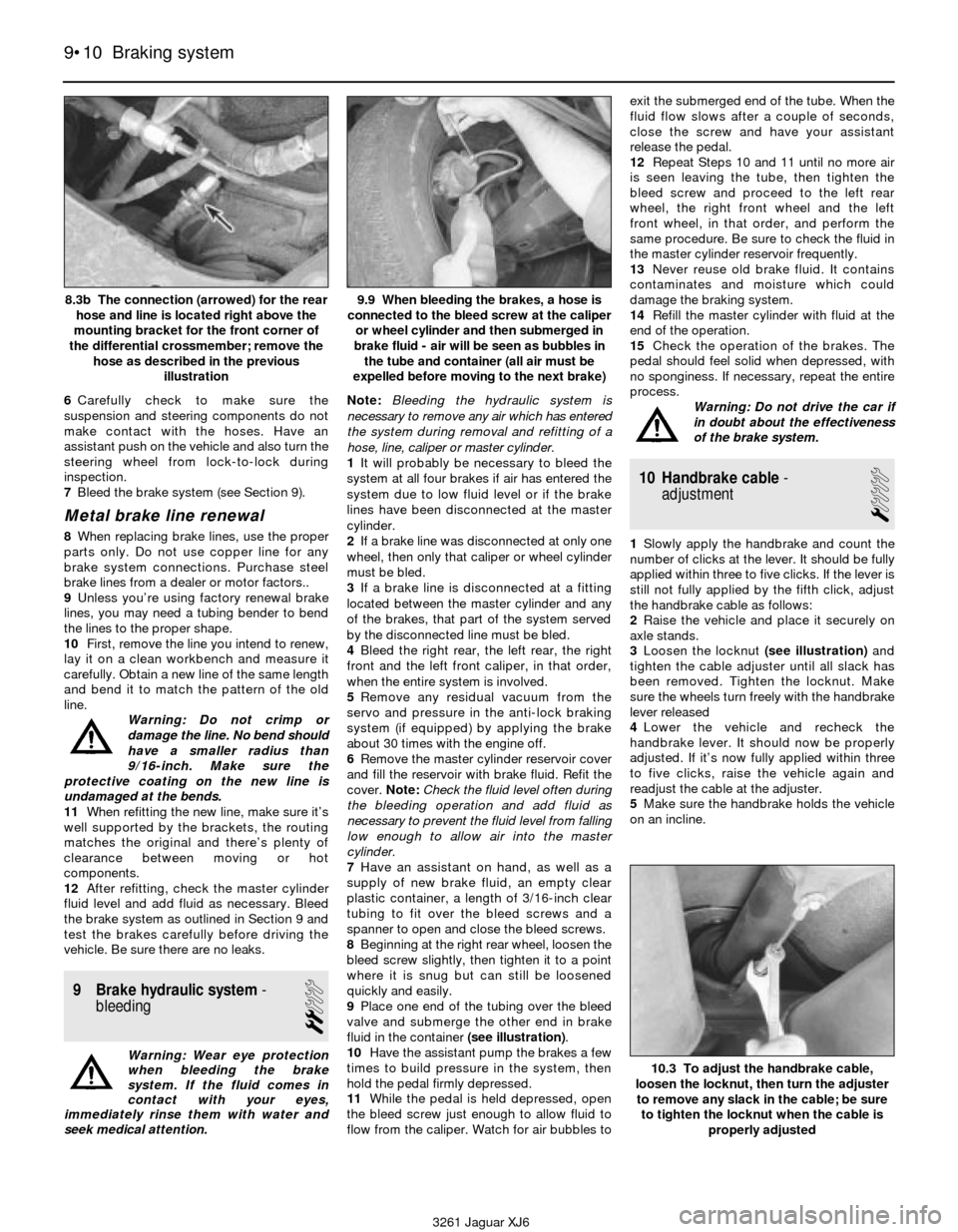
9Place one end of the tubing over the bleed
valve and submerge the other end in brake
fluid in the container (see illustration).
10Have the assistant pump the brakes a few
times to build pressure in the system, then
hold the pedal firmly depressed.
11While the pedal is held depressed, open
the bleed screw just enough to allow fluid to
flow from the caliper. Watch for air bubbles toexit the submerged end of the tube. When the
fluid flow slows after a couple of seconds,
close the screw and have your assistant
release the pedal.
12Repeat Steps 10 and 11 until no more air
is seen leaving the tube, then tighten the
bleed screw and proceed to the left rear
wheel, the right front wheel and the left
front wheel, in that order, and perform the
same procedure. Be sure to check the fluid in
the master cylinder reservoir frequently.
13Never reuse old brake fluid. It contains
contaminates and moisture which could
damage the braking system.
14Refill the master cylinder with fluid at the
end of the operation.
15Check the operation of the brakes. The
pedal should feel solid when depressed, with
no sponginess. If necessary, repeat the entire
process.
Warning: Do not drive the car if
in doubt about the effectiveness
of the brake system.
10 Handbrake cable-
adjustment
1
1Slowly apply the handbrake and count the
number of clicks at the lever. It should be fully
applied within three to five clicks. If the lever is
still not fully applied by the fifth click, adjust
the handbrake cable as follows:
2Raise the vehicle and place it securely on
axle stands.
3Loosen the locknut (see illustration)and
tighten the cable adjuster until all slack has
been removed. Tighten the locknut. Make
sure the wheels turn freely with the handbrake
lever released
4Lower the vehicle and recheck the
handbrake lever. It should now be properly
adjusted. If it’s now fully applied within three
to five clicks, raise the vehicle again and
readjust the cable at the adjuster.
5Make sure the handbrake holds the vehicle
on an incline.
9•10 Braking system
8.3b The connection (arrowed) for the rear
hose and line is located right above the
mounting bracket for the front corner of
the differential crossmember; remove the
hose as described in the previous
illustration9.9 When bleeding the brakes, a hose is
connected to the bleed screw at the caliper
or wheel cylinder and then submerged in
brake fluid - air will be seen as bubbles in
the tube and container (all air must be
expelled before moving to the next brake)
10.3 To adjust the handbrake cable,
loosen the locknut, then turn the adjuster
to remove any slack in the cable; be sure
to tighten the locknut when the cable is
properly adjusted
3261 Jaguar XJ6
Page 137 of 227
3261 Jaguar XJ6
10
Chapter 10
Suspension and steering systems
General
Power steering fluid type . . . . . . . . . . . . . . . . . . . . . . . . . . . . . . . . . . . . See Chapter 1
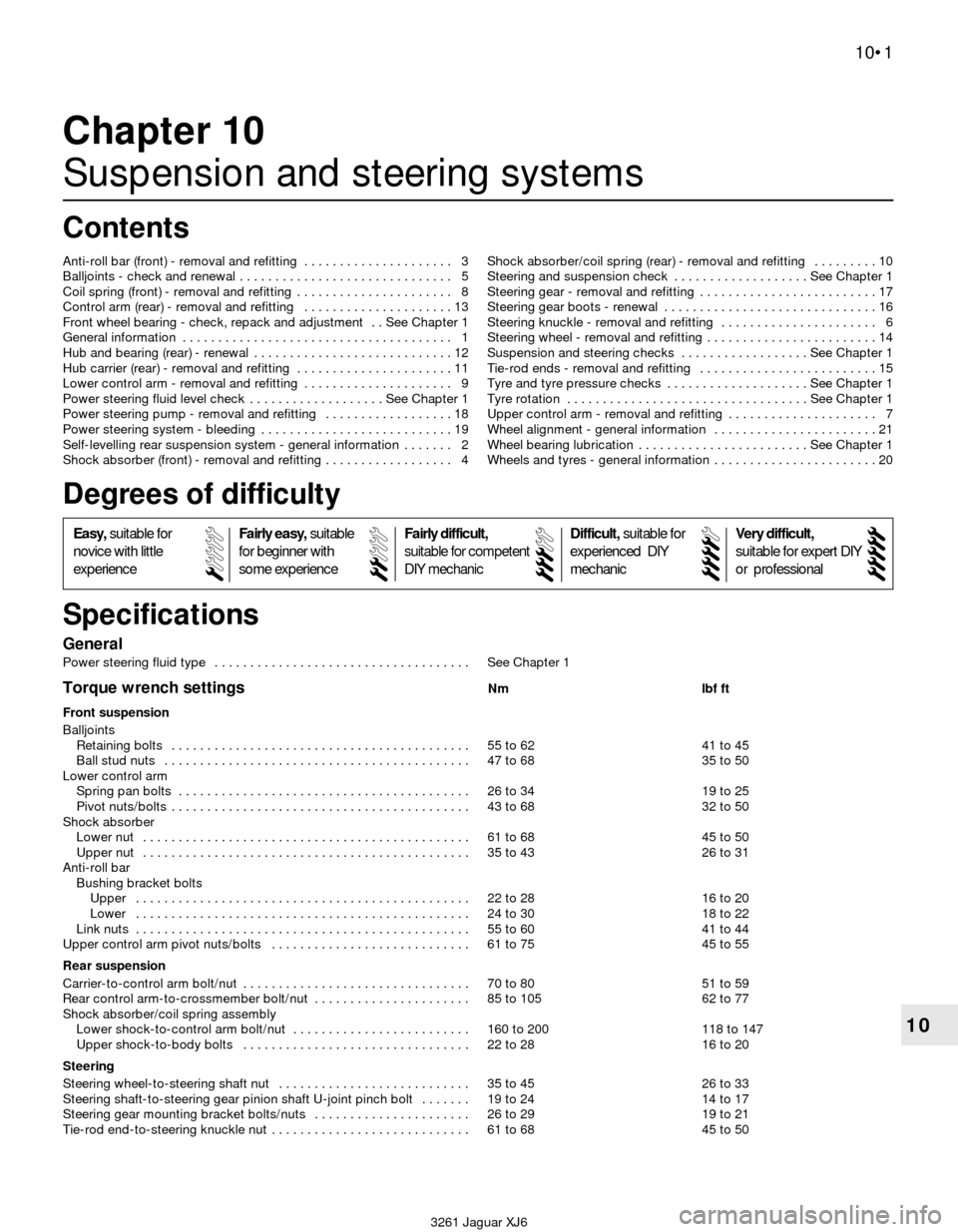
Torque wrench settingsNm lbf ft
Front suspension
Balljoints
Retaining bolts . . . . . . . . . . . . . . . . . . . . . . . . . . . . . . . . . . . . . . . . . . 55 to 62 41 to 45
Ball stud nuts . . . . . . . . . . . . . . . . . . . . . . . . . . . . . . . . . . . . . . . . . . . 47 to 68 35 to 50
Lower control arm
Spring pan bolts . . . . . . . . . . . . . . . . . . . . . . . . . . . . . . . . . . . . . . . . . 26 to 34 19 to 25
Pivot nuts/bolts . . . . . . . . . . . . . . . . . . . . . . . . . . . . . . . . . . . . . . . . . . 43 to 68 32 to 50
Shock absorber
Lower nut . . . . . . . . . . . . . . . . . . . . . . . . . . . . . . . . . . . . . . . . . . . . . . 61 to 68 45 to 50
Upper nut . . . . . . . . . . . . . . . . . . . . . . . . . . . . . . . . . . . . . . . . . . . . . . 35 to 43 26 to 31
Anti-roll bar
Bushing bracket bolts
Upper . . . . . . . . . . . . . . . . . . . . . . . . . . . . . . . . . . . . . . . . . . . . . . . 22 to 28 16 to 20
Lower . . . . . . . . . . . . . . . . . . . . . . . . . . . . . . . . . . . . . . . . . . . . . . . 24 to 30 18 to 22
Link nuts . . . . . . . . . . . . . . . . . . . . . . . . . . . . . . . . . . . . . . . . . . . . . . . 55 to 60 41 to 44
Upper control arm pivot nuts/bolts . . . . . . . . . . . . . . . . . . . . . . . . . . . . 61 to 75 45 to 55
Rear suspension
Carrier-to-control arm bolt/nut . . . . . . . . . . . . . . . . . . . . . . . . . . . . . . . . 70 to 80 51 to 59
Rear control arm-to-crossmember bolt/nut . . . . . . . . . . . . . . . . . . . . . . 85 to 105 62 to 77
Shock absorber/coil spring assembly
Lower shock-to-control arm bolt/nut . . . . . . . . . . . . . . . . . . . . . . . . . 160 to 200 118 to 147
Upper shock-to-body bolts . . . . . . . . . . . . . . . . . . . . . . . . . . . . . . . . 22 to 28 16 to 20
Steering
Steering wheel-to-steering shaft nut . . . . . . . . . . . . . . . . . . . . . . . . . . . 35 to 45 26 to 33
Steering shaft-to-steering gear pinion shaft U-joint pinch bolt . . . . . . . 19 to 24 14 to 17
Steering gear mounting bracket bolts/nuts . . . . . . . . . . . . . . . . . . . . . . 26 to 29 19 to 21
Tie-rod end-to-steering knuckle nut . . . . . . . . . . . . . . . . . . . . . . . . . . . . 61 to 68 45 to 50 Anti-roll bar (front) - removal and refitting . . . . . . . . . . . . . . . . . . . . . 3
Balljoints - check and renewal . . . . . . . . . . . . . . . . . . . . . . . . . . . . . . 5
Coil spring (front) - removal and refitting . . . . . . . . . . . . . . . . . . . . . . 8
Control arm (rear) - removal and refitting . . . . . . . . . . . . . . . . . . . . . 13
Front wheel bearing - check, repack and adjustment . . See Chapter 1
General information . . . . . . . . . . . . . . . . . . . . . . . . . . . . . . . . . . . . . . 1
Hub and bearing (rear) - renewal . . . . . . . . . . . . . . . . . . . . . . . . . . . . 12
Hub carrier (rear) - removal and refitting . . . . . . . . . . . . . . . . . . . . . . 11
Lower control arm - removal and refitting . . . . . . . . . . . . . . . . . . . . . 9
Power steering fluid level check . . . . . . . . . . . . . . . . . . . See Chapter 1
Power steering pump - removal and refitting . . . . . . . . . . . . . . . . . . 18
Power steering system - bleeding . . . . . . . . . . . . . . . . . . . . . . . . . . . 19
Self-levelling rear suspension system - general information . . . . . . . 2
Shock absorber (front) - removal and refitting . . . . . . . . . . . . . . . . . . 4Shock absorber/coil spring (rear) - removal and refitting . . . . . . . . . 10
Steering and suspension check . . . . . . . . . . . . . . . . . . . See Chapter 1
Steering gear - removal and refitting . . . . . . . . . . . . . . . . . . . . . . . . . 17
Steering gear boots - renewal . . . . . . . . . . . . . . . . . . . . . . . . . . . . . . 16
Steering knuckle - removal and refitting . . . . . . . . . . . . . . . . . . . . . . 6
Steering wheel - removal and refitting . . . . . . . . . . . . . . . . . . . . . . . . 14
Suspension and steering checks . . . . . . . . . . . . . . . . . . See Chapter 1
Tie-rod ends - removal and refitting . . . . . . . . . . . . . . . . . . . . . . . . . 15
Tyre and tyre pressure checks . . . . . . . . . . . . . . . . . . . . See Chapter 1
Tyre rotation . . . . . . . . . . . . . . . . . . . . . . . . . . . . . . . . . . See Chapter 1
Upper control arm - removal and refitting . . . . . . . . . . . . . . . . . . . . . 7
Wheel alignment - general information . . . . . . . . . . . . . . . . . . . . . . . 21
Wheel bearing lubrication . . . . . . . . . . . . . . . . . . . . . . . . See Chapter 1
Wheels and tyres - general information . . . . . . . . . . . . . . . . . . . . . . . 20
10•1
Specifications Contents
Easy,suitable for
novice with little
experienceFairly easy,suitable
for beginner with
some experienceFairly difficult,
suitable for competent
DIY mechanic
Difficult,suitable for
experienced DIY
mechanicVery difficult,
suitable for expert DIY
or professional
Degrees of difficulty
54321
Page 139 of 227
1 General information
Warning: Whenever any of the
suspension or steering fasteners
are loosened or removed, they
must be inspected and if
necessary, replaced with new ones of the
same part number or of original equipment
quality and design. Torque wrench settings
must be followed for proper reassembly
and component retention. Never attempt
to heat, straighten or weld any suspension
or steering component. Instead, renew any
bent or damaged part.
The front suspension (see illustrations)
consists of unequal-length upper and lower
control arms, shock absorbers and coil
springs. The upper ends of the shocks are
attached to the body; the lower ends
are attached to the lower control arms. The
upper ends of the coil springs are seated
against the suspension crossmember; the
lower ends are seated against removable
plates which are bolted to the lower control
arms. The steering knuckles are attached to
balljoints in the upper and lower control arms.
An anti-roll bar is attached to the suspension
crossmember with a pair of bushing brackets
and to the lower control arms via a connecting
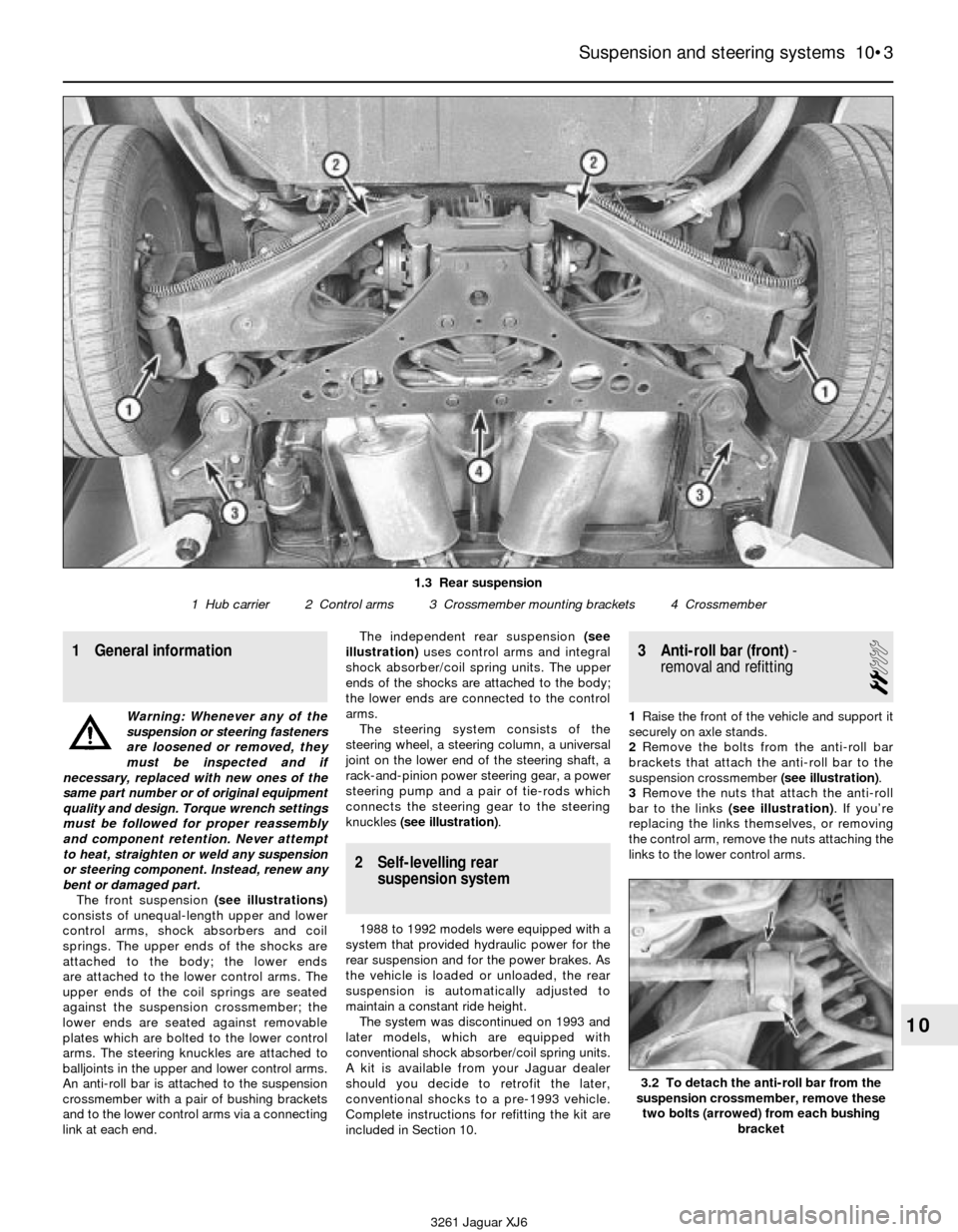
link at each end.The independent rear suspension (see
illustration)uses control arms and integral
shock absorber/coil spring units. The upper
ends of the shocks are attached to the body;
the lower ends are connected to the control
arms.
The steering system consists of the
steering wheel, a steering column, a universal
joint on the lower end of the steering shaft, a
rack-and-pinion power steering gear, a power
steering pump and a pair of tie-rods which
connects the steering gear to the steering
knuckles (see illustration).
2 Self-levelling rear
suspension system
1988 to 1992 models were equipped with a
system that provided hydraulic power for the
rear suspension and for the power brakes. As
the vehicle is loaded or unloaded, the rear
suspension is automatically adjusted to
maintain a constant ride height.
The system was discontinued on 1993 and
later models, which are equipped with
conventional shock absorber/coil spring units.
A kit is available from your Jaguar dealer
should you decide to retrofit the later,
conventional shocks to a pre-1993 vehicle.
Complete instructions for refitting the kit are
included in Section 10.
3 Anti-roll bar (front)-
removal and refitting
2
1Raise the front of the vehicle and support it
securely on axle stands.
2Remove the bolts from the anti-roll bar
brackets that attach the anti-roll bar to the
suspension crossmember (see illustration).
3Remove the nuts that attach the anti-roll
bar to the links (see illustration). If you’re
replacing the links themselves, or removing
the control arm, remove the nuts attaching the
links to the lower control arms.
Suspension and steering systems 10•3
10
1.3 Rear suspension
1 Hub carrier 2 Control arms 3 Crossmember mounting brackets 4 Crossmember
3.2 To detach the anti-roll bar from the
suspension crossmember, remove these
two bolts (arrowed) from each bushing
bracket
3261 Jaguar XJ6