wheel alignment JAGUAR XJ6 1997 2.G User Guide
[x] Cancel search | Manufacturer: JAGUAR, Model Year: 1997, Model line: XJ6, Model: JAGUAR XJ6 1997 2.GPages: 227, PDF Size: 7.2 MB
Page 147 of 227
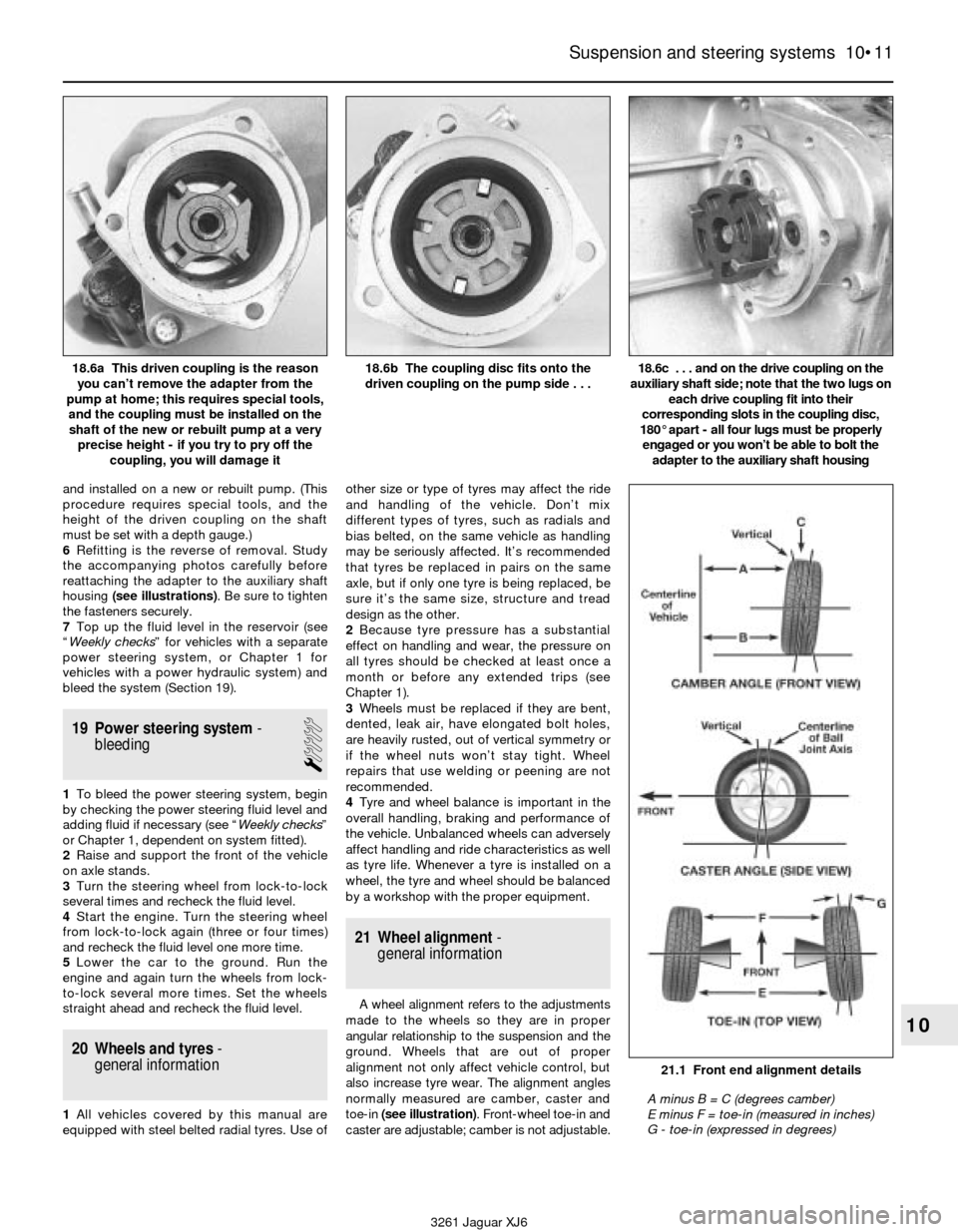
and installed on a new or rebuilt pump. (This
procedure requires special tools, and the
height of the driven coupling on the shaft
must be set with a depth gauge.)
6Refitting is the reverse of removal. Study
the accompanying photos carefully before
reattaching the adapter to the auxiliary shaft
housing (see illustrations). Be sure to tighten
the fasteners securely.
7Top up the fluid level in the reservoir (see
“Weekly checks” for vehicles with a separate
power steering system, or Chapter 1 for
vehicles with a power hydraulic system) and
bleed the system (Section 19).
19 Power steering system-
bleeding
1
1To bleed the power steering system, begin
by checking the power steering fluid level and
adding fluid if necessary (see “Weekly checks”
or Chapter 1, dependent on system fitted).
2Raise and support the front of the vehicle
on axle stands.
3Turn the steering wheel from lock-to-lock
several times and recheck the fluid level.
4Start the engine. Turn the steering wheel
from lock-to-lock again (three or four times)
and recheck the fluid level one more time.
5Lower the car to the ground. Run the
engine and again turn the wheels from lock-
to-lock several more times. Set the wheels
straight ahead and recheck the fluid level.
20 Wheels and tyres-
general information
1All vehicles covered by this manual are
equipped with steel belted radial tyres. Use ofother size or type of tyres may affect the ride
and handling of the vehicle. Don’t mix
different types of tyres, such as radials and
bias belted, on the same vehicle as handling
may be seriously affected. It’s recommended
that tyres be replaced in pairs on the same
axle, but if only one tyre is being replaced, be
sure it’s the same size, structure and tread
design as the other.
2Because tyre pressure has a substantial
effect on handling and wear, the pressure on
all tyres should be checked at least once a
month or before any extended trips (see
Chapter 1).
3Wheels must be replaced if they are bent,
dented, leak air, have elongated bolt holes,
are heavily rusted, out of vertical symmetry or
if the wheel nuts won’t stay tight. Wheel
repairs that use welding or peening are not
recommended.
4Tyre and wheel balance is important in the
overall handling, braking and performance of
the vehicle. Unbalanced wheels can adversely
affect handling and ride characteristics as well
as tyre life. Whenever a tyre is installed on a
wheel, the tyre and wheel should be balanced
by a workshop with the proper equipment.
21 Wheel alignment-
general information
A wheel alignment refers to the adjustments
made to the wheels so they are in proper
angular relationship to the suspension and the
ground. Wheels that are out of proper
alignment not only affect vehicle control, but
also increase tyre wear. The alignment angles
normally measured are camber, caster and
toe-in (see illustration). Front-wheel toe-in and
caster are adjustable; camber is not adjustable.
Suspension and steering systems 10•11
10
3261 Jaguar XJ6 18.6a This driven coupling is the reason
you can’t remove the adapter from the
pump at home; this requires special tools,
and the coupling must be installed on the
shaft of the new or rebuilt pump at a very
precise height - if you try to pry off the
coupling, you will damage it
18.6b The coupling disc fits onto the
driven coupling on the pump side . . .18.6c . . . and on the drive coupling on the
auxiliary shaft side; note that the two lugs on
each drive coupling fit into their
corresponding slots in the coupling disc,
180° apart - all four lugs must be properly
engaged or you won’t be able to bolt the
adapter to the auxiliary shaft housing
21.1 Front end alignment details
A minus B = C (degrees camber)
E minus F = toe-in (measured in inches)
G - toe-in (expressed in degrees)
Page 148 of 227

None of these three angles are adjustable on
the rear wheels. Even the non-adjustable
angles should be checked to determine if any
of the suspension components are bent.
Getting the proper wheel alignment is a
very exacting process, one in which
complicated and expensive machines are
necessary to perform the job properly.
Because of this, you should have a technician
with the proper equipment perform these
tasks. We will, however, use this space to give
you a basic idea of what is involved with a
wheel alignment so you can better understand
the process and deal intelligently with the
workshop that does the work.Toe-in is the turning in of the wheels. The
purpose of a toe specification is to ensure
parallel rolling of the wheels. In a vehicle with
zero toe-in, the distance between the front
edges of the wheels will be the same as the
distance between the rear edges of the
wheels. The actual amount of toe-in is
normally only a fraction of an inch. Toe-in is
controlled by the tie-rod end position on the
tie-rod. Incorrect toe-in will cause the tyres to
wear improperly by making them scrub
against the road surface.
Camber is the tilting of the wheels from
vertical when viewed from one end of the
vehicle. When the wheels tilt out at the top, the camber is said to be positive (+). When
the wheels tilt in at the top the camber is
negative (-). The amount of tilt is measured in
degrees from vertical and this measurement is
called the camber angle. This angle affects the
amount of tyre tread which contacts the road
and compensates for changes in the suspension
geometry when the vehicle is cornering or
travelling over an undulating surface.
Caster is the tilting of the front steering axis
from the vertical. A tilt toward the rear is
positive caster and a tilt toward the front is
negative caster. Caster is adjusted by moving
shims from one side of the upper control arm
balljoint to the other.
10•12 Suspension and steering systems
3261 Jaguar XJ6
Page 154 of 227

3Remove two bumper retaining bolts located
on the bottom side of the bumper (see
illustration). Pull the bumper assembly out
and away from the vehicle to remove it.
4Refitting is the reverse of removal.
15 Front wing-
removal and refitting
3
1Loosen the front wheel nuts. Raise the
vehicle, support it securely on axle stands and
remove the front wheel.
2Remove the front bumper assembly (see
Section 14).
3Remove the front spoiler (see Section 13).4Detach the inner wing splash shield (see
illustration).
5On 1988 and 1989 models, remove the
coolant overflow reservoir located behind the
splash shield (see Chapter 3).
6On models with round headlights, remove
the headlight bezel. On models with
composite headlights (1992 Vanden Plas, all
1993 and later models), remove the headlight
(see Chapter 12).
7Remove the wing mounting bolts and nuts
(see illustrations).
8Detach the wing. It’s a good idea to have an
assistant support the wing while it’s being
moved away from the vehicle to prevent
damage to the surrounding body panels.
9Refitting is the reverse of removal.
16 Boot lid- removal,
refitting and adjustment
2
Note:The boot lid is heavy and somewhat
awkward to remove and refit - at least two
people should perform this procedure.
Removal and refitting
1Open the boot lid and cover the edges of
the boot compartment with pads or cloths to
protect the painted surfaces when the lid is
removed.
2Disconnect any cables or wire harness
connectors attached to the boot lid that would
interfere with removal.
3Make alignment marks around the hinge
mounting bolts with a marking pen.
4While an assistant supports the boot lid,
remove the lid-to-hinge bolts on both sides
and lift it off(see illustration).
5Refitting is the reverse of removal. Note:
When refitting the boot lid, align the lid-to-
hinge bolts with the marks made during
removal.
Adjustment
6Fore-and-aft and side-to-side adjustment
of the boot lid is done by moving the bonnet in
relation to the hinge plate after loosening the
bolts or nuts.
7Scribe a line around the entire hinge plate
as described earlier in this section so you can
judge the amount of movement.
11•6 Bodywork and fittings
14.3 Remove the two retaining bolts from
the bottom of the bumper, then remove the
bumper from the vehicle15.4 Remove the bolts (arrowed) securing
the inner wing splash shield15.7a Detach the wing retaining bolts
(arrowed) at the front of the wing
15.7c Working in the wheel opening,
remove the wing-to-rocker panel bolt
(arrowed)
15.7d Remove the wing-to-door pillar bolt
(arrow; lower bolt not visible)15.7e Detach the bolts along the
top of the wing
3261 Jaguar XJ6
15.7b Remove the wing-to-radiator
support bolt (arrowed)
16.4 With the help of an assistant to hold
the boot lid, remove the retaining bolts and
lift off the boot lid
Page 210 of 227

3261 Jaguar XJ6
MOT test checksREF•9
Seat belts and seats
Note: The following checks are applicable to
all seat belts, front and rear.
MExamine the webbing of all the belts
(including rear belts if fitted) for cuts, serious
fraying or deterioration. Fasten and unfasten
each belt to check the buckles. If applicable,
check the retracting mechanism. Check the
security of all seat belt mountings accessible
from inside the vehicle.
MThe front seats themselves must be
securely attached and the backrests must
lock in the upright position.
Doors
MBoth front doors must be able to be opened
and closed from outside and inside, and must
latch securely when closed.
Vehicle identification
MNumber plates must be in good condition,
secure and legible, with letters and numbers
correctly spaced – spacing at (A) should be
twice that at (B).
MThe VIN plate and/or homologation plate
must be legible.
Electrical equipment
MSwitch on the ignition and check the
operation of the horn.
MCheck the windscreen washers and wipers,
examining the wiper blades; renew damaged
or perished blades. Also check the operation
of the stop-lights.
MCheck the operation of the sidelights and
number plate lights. The lenses and reflectors
must be secure, clean and undamaged.
MCheck the operation and alignment of the
headlights. The headlight reflectors must not
be tarnished and the lenses must be
undamaged.
MSwitch on the ignition and check the
operation of the direction indicators (including
the instrument panel tell-tale) and the hazard
warning lights. Operation of the sidelights and
stop-lights must not affect the indicators - if it
does, the cause is usually a bad earth at the
rear light cluster.
MCheck the operation of the rear foglight(s),
including the warning light on the instrument
panel or in the switch.
Footbrake
MExamine the master cylinder, brake pipes
and servo unit for leaks, loose mountings,
corrosion or other damage.
MThe fluid reservoir must be secure and the
fluid level must be between the upper (A) and
lower (B) markings.MInspect both front brake flexible hoses for
cracks or deterioration of the rubber. Turn the
steering from lock to lock, and ensure that the
hoses do not contact the wheel, tyre, or any
part of the steering or suspension mechanism.
With the brake pedal firmly depressed, check
the hoses for bulges or leaks under pressure.
Steering and suspension
MHave your assistant turn the steering wheel
from side to side slightly, up to the point where
the steering gear just begins to transmit this
movement to the roadwheels. Check for
excessive free play between the steering
wheel and the steering gear, indicating wear or
insecurity of the steering column joints, the
column-to-steering gear coupling, or the
steering gear itself.
MHave your assistant turn the steering wheel
more vigorously in each direction, so that the
roadwheels just begin to turn. As this is done,
examine all the steering joints, linkages,
fittings and attachments. Renew any
component that shows signs of wear or
damage. On vehicles with power steering,
check the security and condition of the
steering pump, drivebelt and hoses.
MCheck that the vehicle is standing level,
and at approximately the correct ride height.
Shock absorbers
MDepress each corner of the vehicle in turn,
then release it. The vehicle should rise and
then settle in its normal position. If the vehicle
continues to rise and fall, the shock absorber
is defective. A shock absorber which has
seized will also cause the vehicle to fail.
2Checks carried out
WITH THE VEHICLE ON THE
GROUND
Page 212 of 227
3261 Jaguar XJ6
MOT test checksREF•11
MExamine the handbrake mechanism,
checking for frayed or broken cables,
excessive corrosion, or wear or insecurity of
the linkage. Check that the mechanism works
on each relevant wheel, and releases fully,
without binding.
MIt is not possible to test brake efficiency
without special equipment, but a road test can
be carried out later to check that the vehicle
pulls up in a straight line.
Fuel and exhaust systems
MInspect the fuel tank (including the filler
cap), fuel pipes, hoses and unions. All
components must be secure and free from
leaks.
MExamine the exhaust system over its entire
length, checking for any damaged, broken or
missing mountings, security of the retaining
clamps and rust or corrosion.
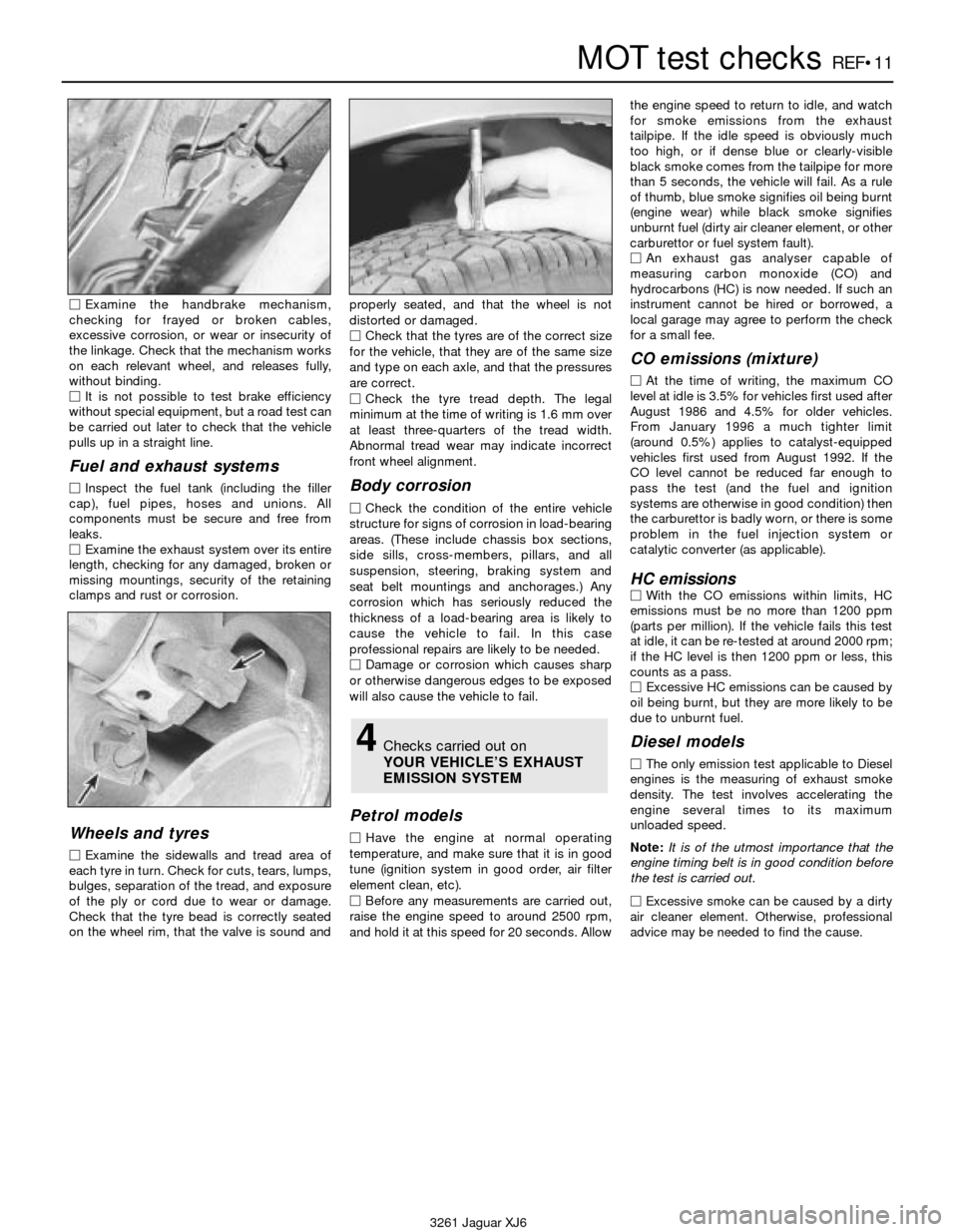
Wheels and tyres
MExamine the sidewalls and tread area of
each tyre in turn. Check for cuts, tears, lumps,
bulges, separation of the tread, and exposure
of the ply or cord due to wear or damage.
Check that the tyre bead is correctly seated
on the wheel rim, that the valve is sound andproperly seated, and that the wheel is not
distorted or damaged.
MCheck that the tyres are of the correct size
for the vehicle, that they are of the same size
and type on each axle, and that the pressures
are correct.
MCheck the tyre tread depth. The legal
minimum at the time of writing is 1.6 mm over
at least three-quarters of the tread width.
Abnormal tread wear may indicate incorrect
front wheel alignment.
Body corrosion
MCheck the condition of the entire vehicle
structure for signs of corrosion in load-bearing
areas. (These include chassis box sections,
side sills, cross-members, pillars, and all
suspension, steering, braking system and
seat belt mountings and anchorages.) Any
corrosion which has seriously reduced the
thickness of a load-bearing area is likely to
cause the vehicle to fail. In this case
professional repairs are likely to be needed.
MDamage or corrosion which causes sharp
or otherwise dangerous edges to be exposed
will also cause the vehicle to fail.
Petrol models
MHave the engine at normal operating
temperature, and make sure that it is in good
tune (ignition system in good order, air filter
element clean, etc).
MBefore any measurements are carried out,
raise the engine speed to around 2500 rpm,
and hold it at this speed for 20 seconds. Allowthe engine speed to return to idle, and watch
for smoke emissions from the exhaust
tailpipe. If the idle speed is obviously much
too high, or if dense blue or clearly-visible
black smoke comes from the tailpipe for more
than 5 seconds, the vehicle will fail. As a rule
of thumb, blue smoke signifies oil being burnt
(engine wear) while black smoke signifies
unburnt fuel (dirty air cleaner element, or other
carburettor or fuel system fault).
MAn exhaust gas analyser capable of
measuring carbon monoxide (CO) and
hydrocarbons (HC) is now needed. If such an
instrument cannot be hired or borrowed, a
local garage may agree to perform the check
for a small fee.
CO emissions (mixture)
MAt the time of writing, the maximum CO
level at idle is 3.5% for vehicles first used after
August 1986 and 4.5% for older vehicles.
From January 1996 a much tighter limit
(around 0.5%) applies to catalyst-equipped
vehicles first used from August 1992. If the
CO level cannot be reduced far enough to
pass the test (and the fuel and ignition
systems are otherwise in good condition) then
the carburettor is badly worn, or there is some
problem in the fuel injection system or
catalytic converter (as applicable).
HC emissionsMWith the CO emissions within limits, HC
emissions must be no more than 1200 ppm
(parts per million). If the vehicle fails this test
at idle, it can be re-tested at around 2000 rpm;
if the HC level is then 1200 ppm or less, this
counts as a pass.
MExcessive HC emissions can be caused by
oil being burnt, but they are more likely to be
due to unburnt fuel.
Diesel models
MThe only emission test applicable to Diesel
engines is the measuring of exhaust smoke
density. The test involves accelerating the
engine several times to its maximum
unloaded speed.
Note: It is of the utmost importance that the
engine timing belt is in good condition before
the test is carried out.
M
Excessive smoke can be caused by a dirty
air cleaner element. Otherwise, professional
advice may be needed to find the cause.
4Checks carried out on
YOUR VEHICLE’S EXHAUST
EMISSION SYSTEM
Page 217 of 227
3261 Jaguar XJ6
REF•16Fault finding
6 Suspension and steering systems
5 Braking system (continued)
Brake pedal feels spongy when depressed
m mAir in hydraulic lines (Chapter 9).
m mMaster cylinder mounting bolts loose (Chapter 9).
m mMaster cylinder defective (Chapter 9).
Brake pedal travels to the floor - no resistance
m
mLittle or no fluid in the master cylinder reservoir caused by leaking
caliper piston(s), damaged or disconnected brake lines (Chapter 9).
Handbrake does not hold
m mHandbrake cable or handbrake shoes improperly adjusted
(Chapter 9).
m mHandbrake shoes need replacement (Chapter 9).
Note:Before attempting to diagnose the suspension and steering
systems, perform the following preliminary checks:
a) Tyres for wrong pressure and uneven wear.
b) Steering universal joints from the column to the steering gear for
loose connectors or wear.
c) Front and rear suspension and the rack and pinion assembly for
loose or damaged parts.
d) Out-of-round or out-of-balance tyres, bent rims and loose and/or
rough wheel bearings.
Vehicle pulls to one side
m mMismatched or uneven tyres (Chapter 10).
m mBroken or sagging springs (Chapter 10).
m mWheel alignment out of specifications (Chapter 10).
m mFront brakes dragging (Chapter 9).
Abnormal or excessive tyre wear
m
mWheel alignment out of specifications (Chapter 10).
m mSagging or broken springs (Chapter 10).
m mTyre out-of-balance (Chapter 10).
m mWorn shock absorber (Chapter 10).
m mOverloaded vehicle.
m mTyres not rotated regularly.
Wheel makes a “thumping” noise
m
mBlister or bump on tyre (Chapter 10).
m mImproper shock absorber action (Chapter 10).
Shimmy, shake or vibration
m
mTyre or wheel out-of-balance or out-of-round (Chapter 10).
m mLoose, worn or out-of-adjustment wheel bearings (Chapter 1).
m mWorn tie-rod ends (Chapter 10).
m mWorn balljoints (Chapter 10).
m mExcessive wheel runout (Chapter 10).
m mBlister or bump on tyre (Chapter 10).
Hard steering
m
mLack of lubrication at balljoints, tie-rod ends and rack-and-pinion
assembly (Chapter 1).
m mFront wheel alignment (Chapter 10).
m mLow tyre pressure(s) (Chapter 1).
Poor returnability of steering to centre
m
mLack of lubrication at balljoints and tie-rod ends (Chapter 1).
m mBinding in balljoints (Chapter 10).
m mBinding in steering column (Chapter 10).
m mLack of lubricant in rack-and-pinion assembly (Chapter 10).
m mFront wheel alignment (Chapter 10).
Abnormal noise at the front end
m
mLack of lubrication at balljoints and tie-rod ends (Chapter 1).
m mDamaged shock absorber mounting (Chapter 10).m mWorn control arm bushings or tie-rod ends (Chapter 10).
m mLoose stabiliser bar (Chapter 10).
m mLoose wheel nuts (Chapter).
m mLoose suspension bolts (Chapter 10).
Wander or poor steering stability
m
mMismatched or uneven tyres (Chapter 10).
m mLack of lubrication at balljoints and tie-rod ends (Chapter 1).
m mWorn shock absorbers (Chapter 10).
m mLoose stabiliser bar (Chapter 10).
m mBroken or sagging springs (Chapter 10).
m mFront or rear wheel alignment (Chapter 10).
Erratic steering when braking
m
mWheel bearings worn (Chapter 1).
m mBroken or sagging springs (Chapter 10).
m mLeaking wheel cylinder or caliper (Chapter 9).
m mWarped discs (Chapter 9).
Excessive pitching and/or rolling around corners
or during braking
m mLoose stabiliser bar (Chapter 10).
m mWorn shock absorbers or mounts (Chapter 10).
m mBroken or sagging springs (Chapter 10).
m mOverloaded vehicle.
Suspension bottoms
m
mOverloaded vehicle.
m mWorn shock absorbers (Chapter 10).
m mIncorrect, broken or sagging springs (Chapter 10).
m mDefective power hydraulic system or leaking rear shock absorbers
(Chapter 10).
Cupped tyres (wear on both edges)
m mFront wheel or rear wheel alignment (Chapter 10).
m mWorn shock absorbers (Chapter 10).
m mWheel bearings worn (Chapter 10).
m mExcessive tyre or wheel runout (Chapter 10).
m mWorn balljoints (Chapter 10).
Excessive tyre wear on outside edge
m
mInflation pressures incorrect (Chapter 1).
m mExcessive speed in turns.
m mFront end alignment incorrect (excessive toe-in). Have
professionally aligned.
m mSuspension arm bent or twisted (Chapter 10).
Excessive tyre wear on inside edge
m
mInflation pressures incorrect (Chapter 1).
m mFront end alignment incorrect (toe-out). Have professionally
aligned.
m mLoose or damaged steering components (Chapter 10).
Page 219 of 227
3261 Jaguar XJ6
REF•18Glossary of technical terms
A
ABS (Anti-lock brake system)A system,
usually electronically controlled, that senses
incipient wheel lockup during braking and
relieves hydraulic pressure at wheels that are
about to skid.
Air bag An inflatable bag hidden in the
steering wheel (driver’s side) or the dash or
glovebox (passenger side). In a head-on
collision, the bags inflate, preventing the
driver and front passenger from being thrown
forward into the steering wheel or windscreen.
Air cleanerA metal or plastic housing,
containing a filter element, which removes
dust and dirt from the air being drawn into the
engine.
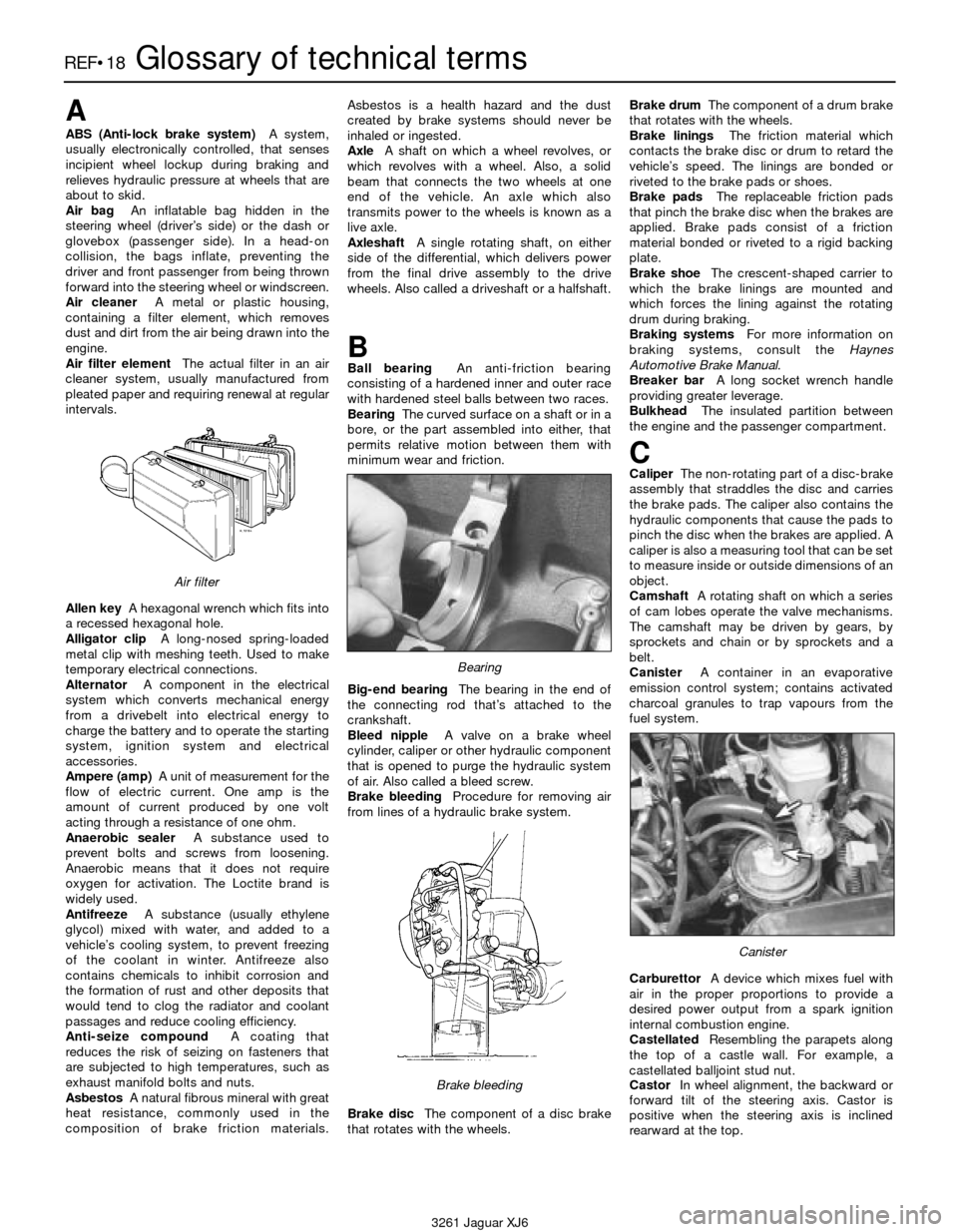
Air filter elementThe actual filter in an air
cleaner system, usually manufactured from
pleated paper and requiring renewal at regular
intervals.
Allen keyA hexagonal wrench which fits into
a recessed hexagonal hole.
Alligator clipA long-nosed spring-loaded
metal clip with meshing teeth. Used to make
temporary electrical connections.
AlternatorA component in the electrical
system which converts mechanical energy
from a drivebelt into electrical energy to
charge the battery and to operate the starting
system, ignition system and electrical
accessories.
Ampere (amp)A unit of measurement for the
flow of electric current. One amp is the
amount of current produced by one volt
acting through a resistance of one ohm.
Anaerobic sealerA substance used to
prevent bolts and screws from loosening.
Anaerobic means that it does not require
oxygen for activation. The Loctite brand is
widely used.
AntifreezeA substance (usually ethylene
glycol) mixed with water, and added to a
vehicle’s cooling system, to prevent freezing
of the coolant in winter. Antifreeze also
contains chemicals to inhibit corrosion and
the formation of rust and other deposits that
would tend to clog the radiator and coolant
passages and reduce cooling efficiency.
Anti-seize compoundA coating that
reduces the risk of seizing on fasteners that
are subjected to high temperatures, such as
exhaust manifold bolts and nuts.
AsbestosA natural fibrous mineral with great
heat resistance, commonly used in the
composition of brake friction materials.Asbestos is a health hazard and the dust
created by brake systems should never be
inhaled or ingested.
AxleA shaft on which a wheel revolves, or
which revolves with a wheel. Also, a solid
beam that connects the two wheels at one
end of the vehicle. An axle which also
transmits power to the wheels is known as a
live axle.
AxleshaftA single rotating shaft, on either
side of the differential, which delivers power
from the final drive assembly to the drive
wheels. Also called a driveshaft or a halfshaft.
BBall bearingAn anti-friction bearing
consisting of a hardened inner and outer race
with hardened steel balls between two races.
BearingThe curved surface on a shaft or in a
bore, or the part assembled into either, that
permits relative motion between them with
minimum wear and friction.
Big-end bearingThe bearing in the end of
the connecting rod that’s attached to the
crankshaft.
Bleed nippleA valve on a brake wheel
cylinder, caliper or other hydraulic component
that is opened to purge the hydraulic system
of air. Also called a bleed screw.
Brake bleedingProcedure for removing air
from lines of a hydraulic brake system.
Brake discThe component of a disc brake
that rotates with the wheels.Brake drumThe component of a drum brake
that rotates with the wheels.
Brake liningsThe friction material which
contacts the brake disc or drum to retard the
vehicle’s speed. The linings are bonded or
riveted to the brake pads or shoes.
Brake padsThe replaceable friction pads
that pinch the brake disc when the brakes are
applied. Brake pads consist of a friction
material bonded or riveted to a rigid backing
plate.
Brake shoeThe crescent-shaped carrier to
which the brake linings are mounted and
which forces the lining against the rotating
drum during braking.
Braking systemsFor more information on
braking systems, consult the Haynes
Automotive Brake Manual.
Breaker barA long socket wrench handle
providing greater leverage.
BulkheadThe insulated partition between
the engine and the passenger compartment.
CCaliperThe non-rotating part of a disc-brake
assembly that straddles the disc and carries
the brake pads. The caliper also contains the
hydraulic components that cause the pads to
pinch the disc when the brakes are applied. A
caliper is also a measuring tool that can be set
to measure inside or outside dimensions of an
object.
CamshaftA rotating shaft on which a series
of cam lobes operate the valve mechanisms.
The camshaft may be driven by gears, by
sprockets and chain or by sprockets and a
belt.
CanisterA container in an evaporative
emission control system; contains activated
charcoal granules to trap vapours from the
fuel system.
CarburettorA device which mixes fuel with
air in the proper proportions to provide a
desired power output from a spark ignition
internal combustion engine.
CastellatedResembling the parapets along
the top of a castle wall. For example, a
castellated balljoint stud nut.
CastorIn wheel alignment, the backward or
forward tilt of the steering axis. Castor is
positive when the steering axis is inclined
rearward at the top.
Canister
Brake bleeding
Bearing
Air filter
Page 226 of 227

3261 Jaguar XJ6
WWasher fluid -0•12
Water pump -3•6
Weekly checks-0•10et seq
Weights - REF•1
Wheel alignment -1•18, 10•11
Wheel bearings -1•17, 10•8, REF•10
Wheel changing -0•8Wheels - 10•11, REF•11
Windows - 11•10, 11•11, 12•13
Windscreen - 11•3, REF•8
Wing - 11•6
Wiper blades -0•13
Wiper motor - 12•8
Wiring diagrams- 12•15et seq
Working facilities- REF•7
IndexREF•25