brake JAGUAR XJ6 1997 2.G Owner's Manual
[x] Cancel search | Manufacturer: JAGUAR, Model Year: 1997, Model line: XJ6, Model: JAGUAR XJ6 1997 2.GPages: 227, PDF Size: 7.2 MB
Page 33 of 227
compressor belt first because of the way they
are arranged on the crankshaft pulley.
Because of this and because belts tend to
wear out more or less together, it is a good
idea to replace both belts at the same time.
Mark each belt and its appropriate pulley
groove so the new belts can be installed in
their proper positions.
10Take the old belts to the parts store in
order to make a direct comparison for length,
width and design.
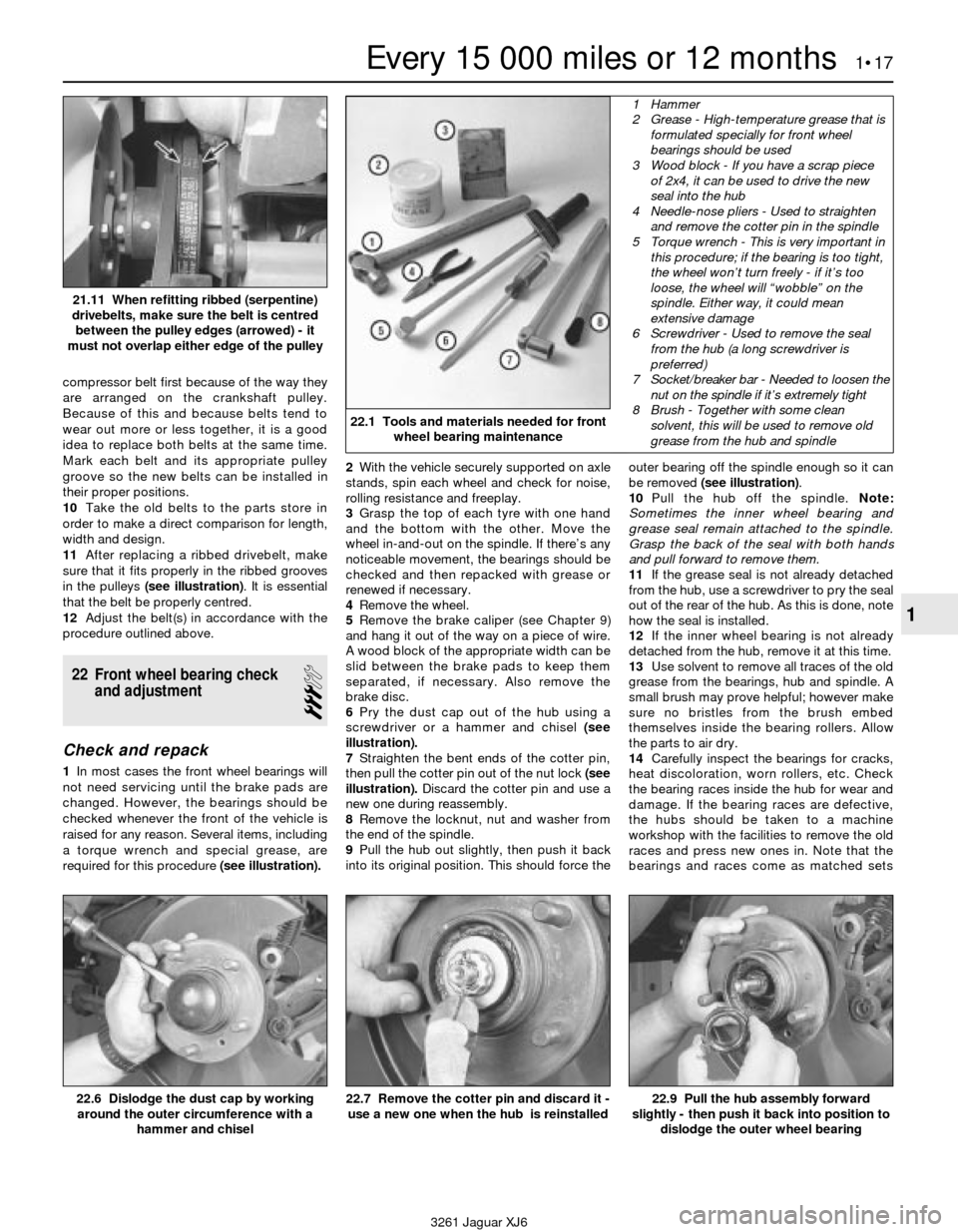
11After replacing a ribbed drivebelt, make
sure that it fits properly in the ribbed grooves
in the pulleys (see illustration). It is essential
that the belt be properly centred.
12Adjust the belt(s) in accordance with the
procedure outlined above.
22 Front wheel bearing check
and adjustment
3
Check and repack
1In most cases the front wheel bearings will
not need servicing until the brake pads are
changed. However, the bearings should be
checked whenever the front of the vehicle is
raised for any reason. Several items, including
a torque wrench and special grease, are
required for this procedure (see illustration).2With the vehicle securely supported on axle
stands, spin each wheel and check for noise,
rolling resistance and freeplay.
3Grasp the top of each tyre with one hand
and the bottom with the other. Move the
wheel in-and-out on the spindle. If there’s any
noticeable movement, the bearings should be
checked and then repacked with grease or
renewed if necessary.
4Remove the wheel.
5Remove the brake caliper (see Chapter 9)
and hang it out of the way on a piece of wire.
A wood block of the appropriate width can be
slid between the brake pads to keep them
separated, if necessary. Also remove the
brake disc.
6Pry the dust cap out of the hub using a
screwdriver or a hammer and chisel (see
illustration).
7Straighten the bent ends of the cotter pin,
then pull the cotter pin out of the nut lock (see
illustration).Discard the cotter pin and use a
new one during reassembly.
8Remove the locknut, nut and washer from
the end of the spindle.
9Pull the hub out slightly, then push it back
into its original position. This should force theouter bearing off the spindle enough so it can
be removed (see illustration).
10Pull the hub off the spindle. Note:
Sometimes the inner wheel bearing and
grease seal remain attached to the spindle.
Grasp the back of the seal with both hands
and pull forward to remove them.
11If the grease seal is not already detached
from the hub, use a screwdriver to pry the seal
out of the rear of the hub. As this is done, note
how the seal is installed.
12If the inner wheel bearing is not already
detached from the hub, remove it at this time.
13Use solvent to remove all traces of the old
grease from the bearings, hub and spindle. A
small brush may prove helpful; however make
sure no bristles from the brush embed
themselves inside the bearing rollers. Allow
the parts to air dry.
14Carefully inspect the bearings for cracks,
heat discoloration, worn rollers, etc. Check
the bearing races inside the hub for wear and
damage. If the bearing races are defective,
the hubs should be taken to a machine
workshop with the facilities to remove the old
races and press new ones in. Note that the
bearings and races come as matched sets
Every 15 000 miles or 12 months 1•17
1
22.1 Tools and materials needed for front
wheel bearing maintenance
1 Hammer
2 Grease - High-temperature grease that is
formulated specially for front wheel
bearings should be used
3 Wood block - If you have a scrap piece
of 2x4, it can be used to drive the new
seal into the hub
4 Needle-nose pliers - Used to straighten
and remove the cotter pin in the spindle
5 Torque wrench - This is very important in
this procedure; if the bearing is too tight,
the wheel won’t turn freely - if it’s too
loose, the wheel will “wobble” on the
spindle. Either way, it could mean
extensive damage
6 Screwdriver - Used to remove the seal
from the hub (a long screwdriver is
preferred)
7 Socket/breaker bar - Needed to loosen the
nut on the spindle if it’s extremely tight
8 Brush - Together with some clean
solvent, this will be used to remove old
grease from the hub and spindle
22.6 Dislodge the dust cap by working
around the outer circumference with a
hammer and chisel
22.7 Remove the cotter pin and discard it -
use a new one when the hub is reinstalled22.9 Pull the hub assembly forward
slightly - then push it back into position to
dislodge the outer wheel bearing
3261 Jaguar XJ6 21.11 When refitting ribbed (serpentine)
drivebelts, make sure the belt is centred
between the pulley edges (arrowed) - it
must not overlap either edge of the pulley
Page 34 of 227
and old bearings should never be installed on
new races.
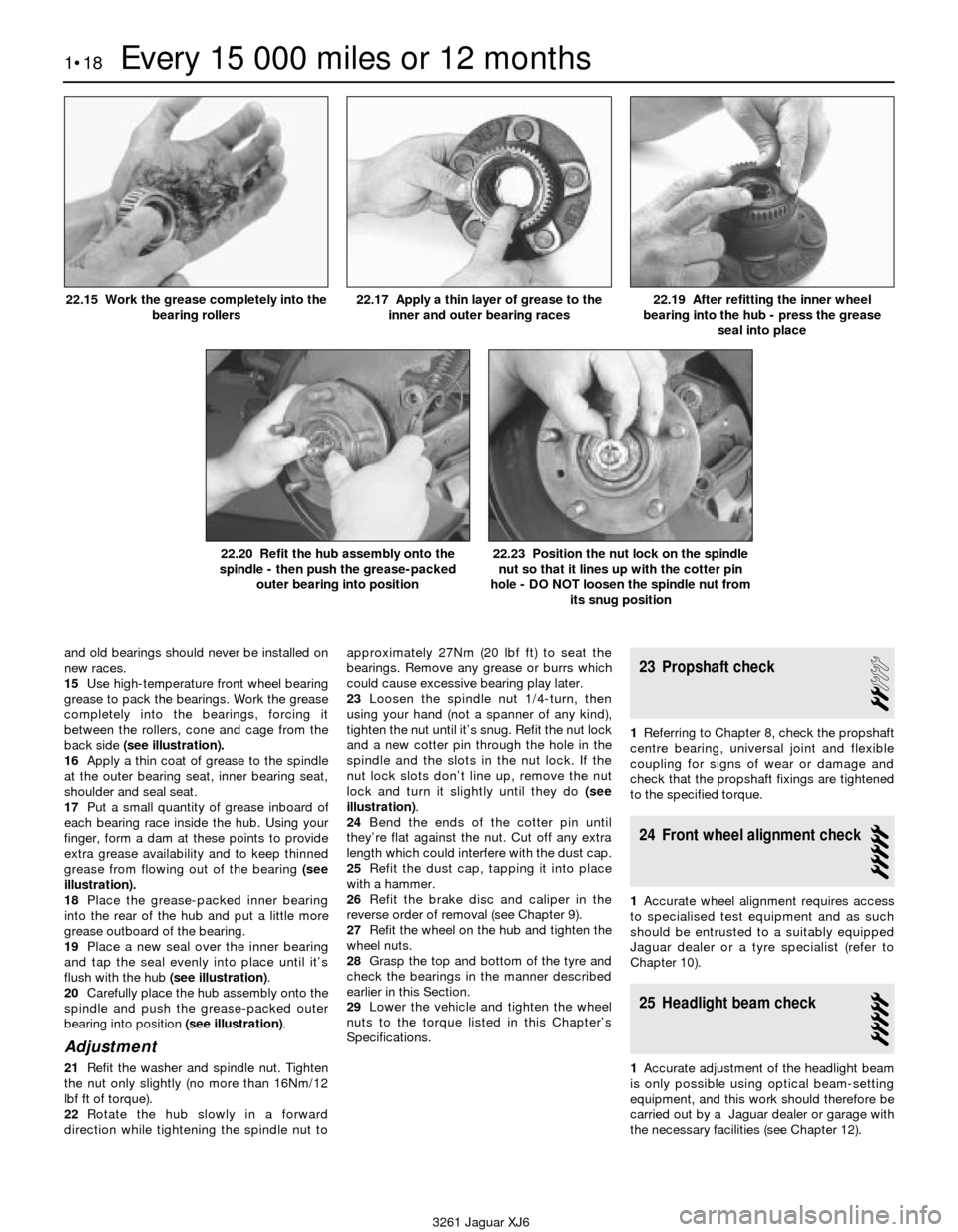
15Use high-temperature front wheel bearing
grease to pack the bearings. Work the grease
completely into the bearings, forcing it
between the rollers, cone and cage from the
back side (see illustration).
16Apply a thin coat of grease to the spindle
at the outer bearing seat, inner bearing seat,
shoulder and seal seat.
17Put a small quantity of grease inboard of
each bearing race inside the hub. Using your
finger, form a dam at these points to provide
extra grease availability and to keep thinned
grease from flowing out of the bearing (see
illustration).
18Place the grease-packed inner bearing
into the rear of the hub and put a little more
grease outboard of the bearing.
19Place a new seal over the inner bearing
and tap the seal evenly into place until it’s
flush with the hub (see illustration).
20Carefully place the hub assembly onto the
spindle and push the grease-packed outer
bearing into position (see illustration).
Adjustment
21Refit the washer and spindle nut. Tighten
the nut only slightly (no more than 16Nm/12
lbf ft of torque).
22Rotate the hub slowly in a forward
direction while tightening the spindle nut toapproximately 27Nm (20 lbf ft) to seat the
bearings. Remove any grease or burrs which
could cause excessive bearing play later.
23Loosen the spindle nut 1/4-turn, then
using your hand (not a spanner of any kind),
tighten the nut until it’s snug. Refit the nut lock
and a new cotter pin through the hole in the
spindle and the slots in the nut lock. If the
nut lock slots don’t line up, remove the nut
lock and turn it slightly until they do (see
illustration).
24Bend the ends of the cotter pin until
they’re flat against the nut. Cut off any extra
length which could interfere with the dust cap.
25Refit the dust cap, tapping it into place
with a hammer.
26Refit the brake disc and caliper in the
reverse order of removal (see Chapter 9).
27Refit the wheel on the hub and tighten the
wheel nuts.
28Grasp the top and bottom of the tyre and
check the bearings in the manner described
earlier in this Section.
29Lower the vehicle and tighten the wheel
nuts to the torque listed in this Chapter’s
Specifications.
23 Propshaft check
2
1Referring to Chapter 8, check the propshaft
centre bearing, universal joint and flexible
coupling for signs of wear or damage and
check that the propshaft fixings are tightened
to the specified torque.
24 Front wheel alignment check
5
1Accurate wheel alignment requires access
to specialised test equipment and as such
should be entrusted to a suitably equipped
Jaguar dealer or a tyre specialist (refer to
Chapter 10).
25 Headlight beam check
5
1Accurate adjustment of the headlight beam
is only possible using optical beam-setting
equipment, and this work should therefore be
carried out by a Jaguar dealer or garage with
the necessary facilities (see Chapter 12).
1•18Every 15 000 miles or 12 months
22.15 Work the grease completely into the
bearing rollers22.17 Apply a thin layer of grease to the
inner and outer bearing races22.19 After refitting the inner wheel
bearing into the hub - press the grease
seal into place
22.20 Refit the hub assembly onto the
spindle - then push the grease-packed
outer bearing into position22.23 Position the nut lock on the spindle
nut so that it lines up with the cotter pin
hole - DO NOT loosen the spindle nut from
its snug position
3261 Jaguar XJ6
Page 35 of 227
26 Automatic transmission fluid
and filter renewal
2
1At the specified time intervals, the
transmission fluid should be drained and
renewed. Since the fluid will remain hot long
after driving, perform this procedure only after
the engine has cooled down completely.
2Before beginning work, purchase the
specified transmission fluid and a new filter.
3Other tools necessary for this job include
axle stands to support the vehicle in a raised
position, a drain pan capable of holding at
least eight pints, newspapers and clean rags.4Raise the vehicle and support it securely on
axle stands.
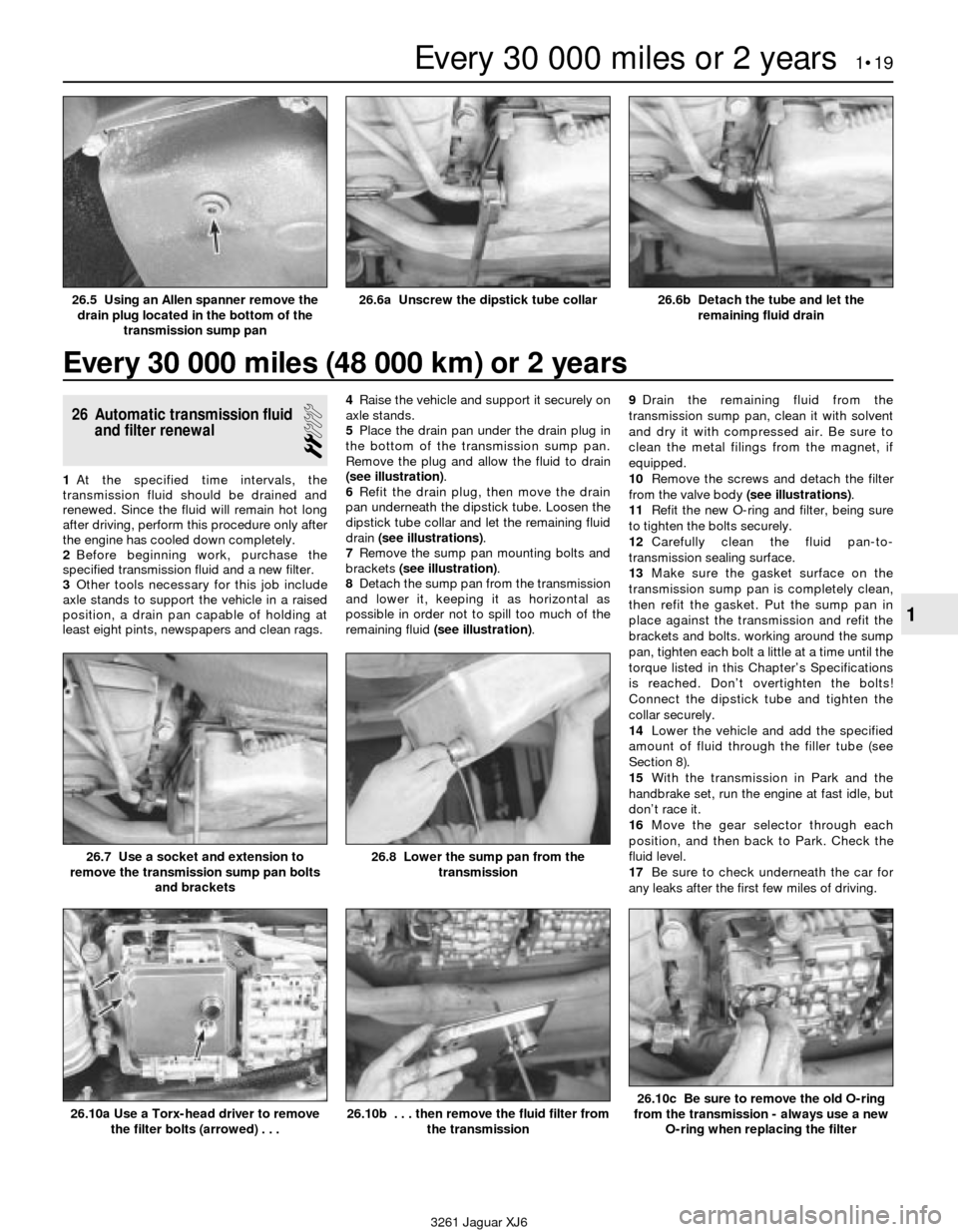
5Place the drain pan under the drain plug in
the bottom of the transmission sump pan.
Remove the plug and allow the fluid to drain
(see illustration).
6Refit the drain plug, then move the drain
pan underneath the dipstick tube. Loosen the
dipstick tube collar and let the remaining fluid
drain (see illustrations).
7Remove the sump pan mounting bolts and
brackets (see illustration).
8Detach the sump pan from the transmission
and lower it, keeping it as horizontal as
possible in order not to spill too much of the
remaining fluid (see illustration).9Drain the remaining fluid from the
transmission sump pan, clean it with solvent
and dry it with compressed air. Be sure to
clean the metal filings from the magnet, if
equipped.
10Remove the screws and detach the filter
from the valve body (see illustrations).
11Refit the new O-ring and filter, being sure
to tighten the bolts securely.
12Carefully clean the fluid pan-to-
transmission sealing surface.
13Make sure the gasket surface on the
transmission sump pan is completely clean,
then refit the gasket. Put the sump pan in
place against the transmission and refit the
brackets and bolts. working around the sump
pan, tighten each bolt a little at a time until the
torque listed in this Chapter’s Specifications
is reached. Don’t overtighten the bolts!
Connect the dipstick tube and tighten the
collar securely.
14Lower the vehicle and add the specified
amount of fluid through the filler tube (see
Section 8).
15With the transmission in Park and the
handbrake set, run the engine at fast idle, but
don’t race it.
16Move the gear selector through each
position, and then back to Park. Check the
fluid level.
17Be sure to check underneath the car for
any leaks after the first few miles of driving.
Every 30 000 miles (48 000 km) or 2 years
Every 30 000 miles or 2 years 1•19
1
26.6a Unscrew the dipstick tube collar26.6b Detach the tube and let the
remaining fluid drain
26.7 Use a socket and extension to
remove the transmission sump pan bolts
and brackets26.8 Lower the sump pan from the
transmission
26.10a Use a Torx-head driver to remove
the filter bolts (arrowed) . . .
3261 Jaguar XJ6
26.5 Using an Allen spanner remove the
drain plug located in the bottom of the
transmission sump pan
26.10b . . . then remove the fluid filter from
the transmission26.10c Be sure to remove the old O-ring
from the transmission - always use a new
O-ring when replacing the filter
Page 36 of 227
30 Coolant renewal
2
Warning: Do not allow engine
coolant (antifreeze) to come in
contact with your skin or painted
surfaces of the vehicle. Rinse off
spills immediately with plenty of water.
Antifreeze is highly toxic if ingested. Never
leave antifreeze laying around in an open
container or in puddles on the floor;
children and pets are attracted by it’s
sweet smell and may drink it. Check with
local authorities about disposing of used
antifreeze. Your local authority may have
collection centres which will see that
antifreeze is disposed of safely.1Periodically, the cooling system should be
drained, flushed and refilled to replenish the
antifreeze mixture and prevent formation of
rust and corrosion, which can impair the
performance of the cooling system and
cause engine damage. When the cooling
system is serviced, all hoses and the radiator
cap should be checked and renewed if
necessary.
Draining
2Apply the handbrake and block the wheels.
If the vehicle has just been driven, wait several
hours to allow the engine to cool down before
beginning this procedure.
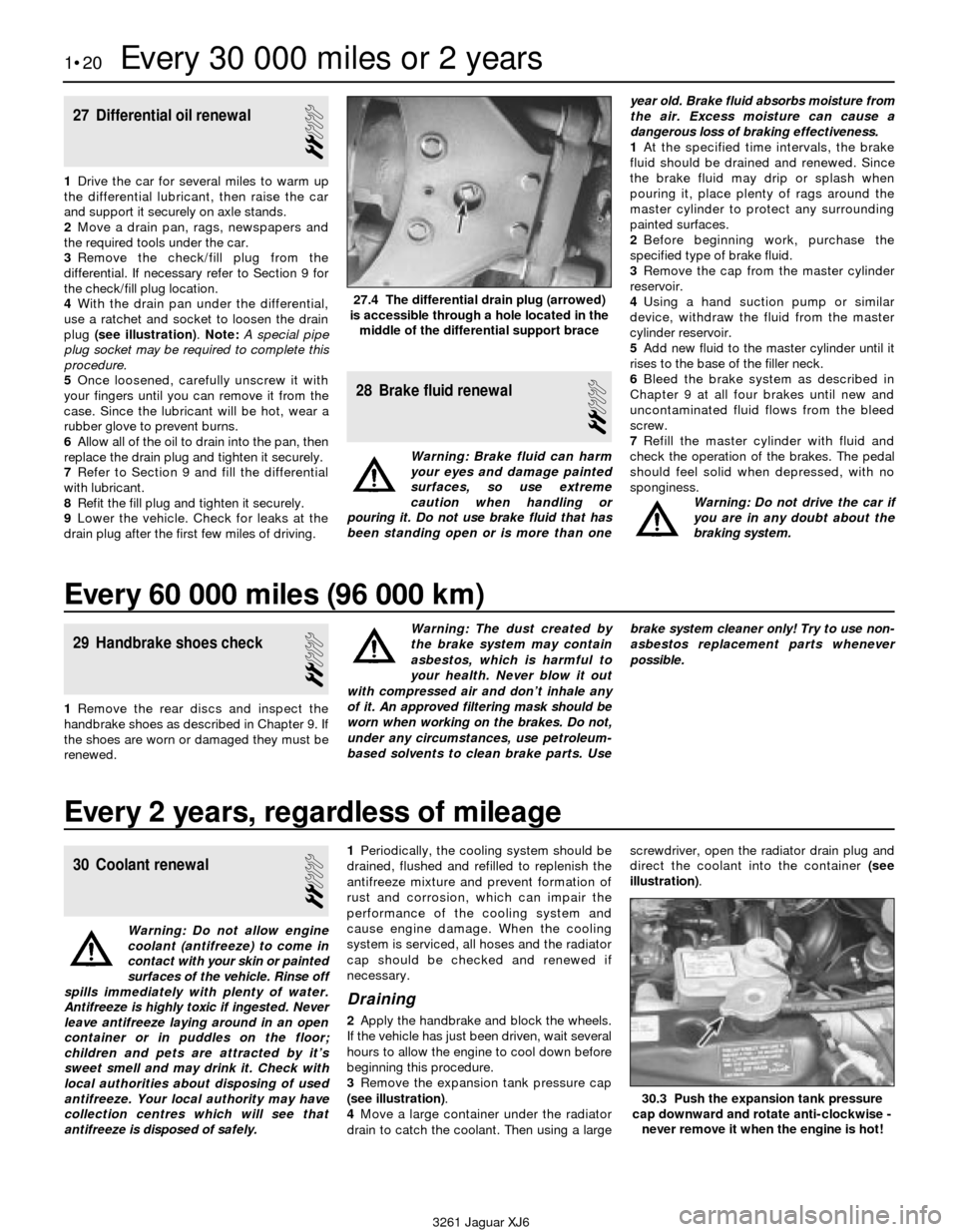
3Remove the expansion tank pressure cap
(see illustration).
4Move a large container under the radiator
drain to catch the coolant. Then using a largescrewdriver, open the radiator drain plug and
direct the coolant into the container (see
illustration).
27 Differential oil renewal
2
1Drive the car for several miles to warm up
the differential lubricant, then raise the car
and support it securely on axle stands.
2Move a drain pan, rags, newspapers and
the required tools under the car.
3Remove the check/fill plug from the
differential. If necessary refer to Section 9 for
the check/fill plug location.
4With the drain pan under the differential,
use a ratchet and socket to loosen the drain
plug (see illustration). Note:A special pipe
plug socket may be required to complete this
procedure.
5Once loosened, carefully unscrew it with
your fingers until you can remove it from the
case. Since the lubricant will be hot, wear a
rubber glove to prevent burns.
6Allow all of the oil to drain into the pan, then
replace the drain plug and tighten it securely.
7Refer to Section 9 and fill the differential
with lubricant.
8Refit the fill plug and tighten it securely.
9Lower the vehicle. Check for leaks at the
drain plug after the first few miles of driving.
28 Brake fluid renewal
2
Warning: Brake fluid can harm
your eyes and damage painted
surfaces, so use extreme
caution when handling or
pouring it. Do not use brake fluid that has
been standing open or is more than oneyear old. Brake fluid absorbs moisture from
the air. Excess moisture can cause a
dangerous loss of braking effectiveness.
1At the specified time intervals, the brake
fluid should be drained and renewed. Since
the brake fluid may drip or splash when
pouring it, place plenty of rags around the
master cylinder to protect any surrounding
painted surfaces.
2Before beginning work, purchase the
specified type of brake fluid.
3Remove the cap from the master cylinder
reservoir.
4Using a hand suction pump or similar
device, withdraw the fluid from the master
cylinder reservoir.
5Add new fluid to the master cylinder until it
rises to the base of the filler neck.
6Bleed the brake system as described in
Chapter 9 at all four brakes until new and
uncontaminated fluid flows from the bleed
screw.
7Refill the master cylinder with fluid and
check the operation of the brakes. The pedal
should feel solid when depressed, with no
sponginess.
Warning: Do not drive the car if
you are in any doubt about the
braking system.
1•20Every 30 000 miles or 2 years
27.4 The differential drain plug (arrowed)
is accessible through a hole located in the
middle of the differential support brace
30.3 Push the expansion tank pressure
cap downward and rotate anti-clockwise -
never remove it when the engine is hot!
3261 Jaguar XJ6
Every 60 000 miles (96 000 km)
29 Handbrake shoes check
2
1Remove the rear discs and inspect the
handbrake shoes as described in Chapter 9. If
the shoes are worn or damaged they must be
renewed.Warning: The dust created by
the brake system may contain
asbestos, which is harmful to
your health. Never blow it out
with compressed air and don’t inhale any
of it. An approved filtering mask should be
worn when working on the brakes. Do not,
under any circumstances, use petroleum-
based solvents to clean brake parts. Usebrake system cleaner only! Try to use non-
asbestos replacement parts whenever
possible.
Every 2 years, regardless of mileage
Page 39 of 227
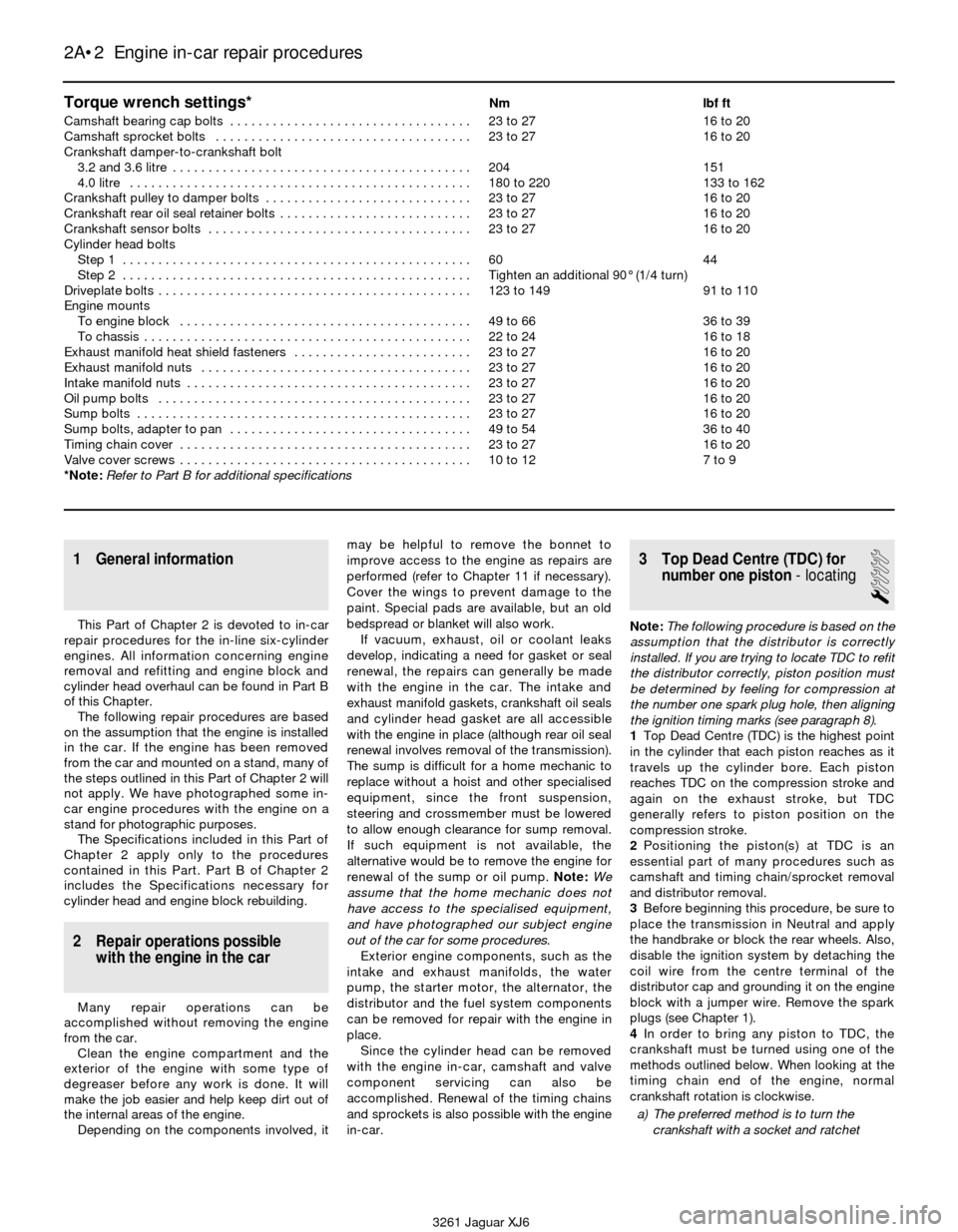
Torque wrench settings*Nm lbf ft
Camshaft bearing cap bolts . . . . . . . . . . . . . . . . . . . . . . . . . . . . . . . . . . 23 to 27 16 to 20
Camshaft sprocket bolts . . . . . . . . . . . . . . . . . . . . . . . . . . . . . . . . . . . . 23 to 27 16 to 20
Crankshaft damper-to-crankshaft bolt
3.2 and 3.6 litre . . . . . . . . . . . . . . . . . . . . . . . . . . . . . . . . . . . . . . . . . . 204 151
4.0 litre . . . . . . . . . . . . . . . . . . . . . . . . . . . . . . . . . . . . . . . . . . . . . . . . 180 to 220 133 to 162
Crankshaft pulley to damper bolts . . . . . . . . . . . . . . . . . . . . . . . . . . . . . 23 to 27 16 to 20
Crankshaft rear oil seal retainer bolts . . . . . . . . . . . . . . . . . . . . . . . . . . . 23 to 27 16 to 20
Crankshaft sensor bolts . . . . . . . . . . . . . . . . . . . . . . . . . . . . . . . . . . . . . 23 to 27 16 to 20
Cylinder head bolts
Step 1 . . . . . . . . . . . . . . . . . . . . . . . . . . . . . . . . . . . . . . . . . . . . . . . . . 60 44
Step 2 . . . . . . . . . . . . . . . . . . . . . . . . . . . . . . . . . . . . . . . . . . . . . . . . . Tighten an additional 90° (1/4 turn)
Driveplate bolts . . . . . . . . . . . . . . . . . . . . . . . . . . . . . . . . . . . . . . . . . . . . 123 to 149 91 to 110
Engine mounts
To engine block . . . . . . . . . . . . . . . . . . . . . . . . . . . . . . . . . . . . . . . . . 49 to 66 36 to 39
To chassis . . . . . . . . . . . . . . . . . . . . . . . . . . . . . . . . . . . . . . . . . . . . . . 22 to 24 16 to 18
Exhaust manifold heat shield fasteners . . . . . . . . . . . . . . . . . . . . . . . . . 23 to 27 16 to 20
Exhaust manifold nuts . . . . . . . . . . . . . . . . . . . . . . . . . . . . . . . . . . . . . . 23 to 27 16 to 20
Intake manifold nuts . . . . . . . . . . . . . . . . . . . . . . . . . . . . . . . . . . . . . . . . 23 to 27 16 to 20
Oil pump bolts . . . . . . . . . . . . . . . . . . . . . . . . . . . . . . . . . . . . . . . . . . . . 23 to 27 16 to 20
Sump bolts . . . . . . . . . . . . . . . . . . . . . . . . . . . . . . . . . . . . . . . . . . . . . . . 23 to 27 16 to 20
Sump bolts, adapter to pan . . . . . . . . . . . . . . . . . . . . . . . . . . . . . . . . . . 49 to 54 36 to 40
Timing chain cover . . . . . . . . . . . . . . . . . . . . . . . . . . . . . . . . . . . . . . . . . 23 to 27 16 to 20
Valve cover screws . . . . . . . . . . . . . . . . . . . . . . . . . . . . . . . . . . . . . . . . . 10 to 12 7 to 9
*Note:Refer to Part B for additional specifications
2A•2 Engine in-car repair procedures
3261 Jaguar XJ6
1 General information
This Part of Chapter 2 is devoted to in-car
repair procedures for the in-line six-cylinder
engines. All information concerning engine
removal and refitting and engine block and
cylinder head overhaul can be found in Part B
of this Chapter.
The following repair procedures are based
on the assumption that the engine is installed
in the car. If the engine has been removed
from the car and mounted on a stand, many of
the steps outlined in this Part of Chapter 2 will
not apply. We have photographed some in-
car engine procedures with the engine on a
stand for photographic purposes.
The Specifications included in this Part of
Chapter 2 apply only to the procedures
contained in this Part. Part B of Chapter 2
includes the Specifications necessary for
cylinder head and engine block rebuilding.
2 Repair operations possible
with the engine in the car
Many repair operations can be
accomplished without removing the engine
from the car.
Clean the engine compartment and the
exterior of the engine with some type of
degreaser before any work is done. It will
make the job easier and help keep dirt out of
the internal areas of the engine.
Depending on the components involved, itmay be helpful to remove the bonnet to
improve access to the engine as repairs are
performed (refer to Chapter 11 if necessary).
Cover the wings to prevent damage to the
paint. Special pads are available, but an old
bedspread or blanket will also work.
If vacuum, exhaust, oil or coolant leaks
develop, indicating a need for gasket or seal
renewal, the repairs can generally be made
with the engine in the car. The intake and
exhaust manifold gaskets, crankshaft oil seals
and cylinder head gasket are all accessible
with the engine in place (although rear oil seal
renewal involves removal of the transmission).
The sump is difficult for a home mechanic to
replace without a hoist and other specialised
equipment, since the front suspension,
steering and crossmember must be lowered
to allow enough clearance for sump removal.
If such equipment is not available, the
alternative would be to remove the engine for
renewal of the sump or oil pump. Note:We
assume that the home mechanic does not
have access to the specialised equipment,
and have photographed our subject engine
out of the car for some procedures.
Exterior engine components, such as the
intake and exhaust manifolds, the water
pump, the starter motor, the alternator, the
distributor and the fuel system components
can be removed for repair with the engine in
place.
Since the cylinder head can be removed
with the engine in-car, camshaft and valve
component servicing can also be
accomplished. Renewal of the timing chains
and sprockets is also possible with the engine
in-car.
3 Top Dead Centre (TDC) for
number one piston- locating
1
Note:The following procedure is based on the
assumption that the distributor is correctly
installed. If you are trying to locate TDC to refit
the distributor correctly, piston position must
be determined by feeling for compression at
the number one spark plug hole, then aligning
the ignition timing marks (see paragraph 8).
1Top Dead Centre (TDC) is the highest point
in the cylinder that each piston reaches as it
travels up the cylinder bore. Each piston
reaches TDC on the compression stroke and
again on the exhaust stroke, but TDC
generally refers to piston position on the
compression stroke.
2Positioning the piston(s) at TDC is an
essential part of many procedures such as
camshaft and timing chain/sprocket removal
and distributor removal.
3Before beginning this procedure, be sure to
place the transmission in Neutral and apply
the handbrake or block the rear wheels. Also,
disable the ignition system by detaching the
coil wire from the centre terminal of the
distributor cap and grounding it on the engine
block with a jumper wire. Remove the spark
plugs (see Chapter 1).
4In order to bring any piston to TDC, the
crankshaft must be turned using one of the
methods outlined below. When looking at the
timing chain end of the engine, normal
crankshaft rotation is clockwise.
a) The preferred method is to turn the
crankshaft with a socket and ratchet
Page 43 of 227
damage the crankshaft in the process (if the
crankshaft is damaged, the new seal will end
up leaking).
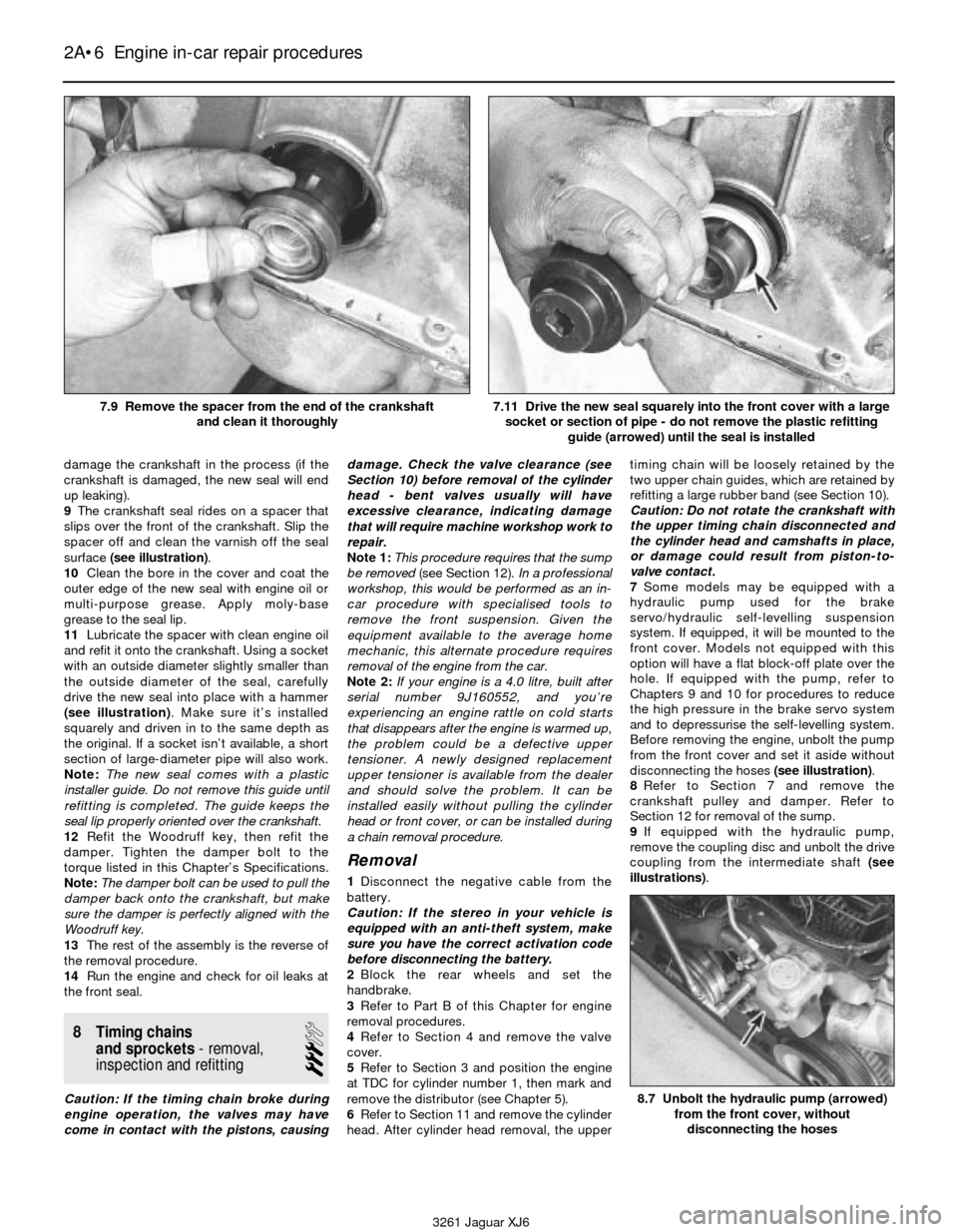
9The crankshaft seal rides on a spacer that
slips over the front of the crankshaft. Slip the
spacer off and clean the varnish off the seal
surface (see illustration).
10Clean the bore in the cover and coat the
outer edge of the new seal with engine oil or
multi-purpose grease. Apply moly-base
grease to the seal lip.
11Lubricate the spacer with clean engine oil
and refit it onto the crankshaft. Using a socket
with an outside diameter slightly smaller than
the outside diameter of the seal, carefully
drive the new seal into place with a hammer
(see illustration). Make sure it’s installed
squarely and driven in to the same depth as
the original. If a socket isn’t available, a short
section of large-diameter pipe will also work.
Note:The new seal comes with a plastic
installer guide. Do not remove this guide until
refitting is completed. The guide keeps the
seal lip properly oriented over the crankshaft.
12Refit the Woodruff key, then refit the
damper. Tighten the damper bolt to the
torque listed in this Chapter’s Specifications.
Note:The damper bolt can be used to pull the
damper back onto the crankshaft, but make
sure the damper is perfectly aligned with the
Woodruff key.
13The rest of the assembly is the reverse of
the removal procedure.
14Run the engine and check for oil leaks at
the front seal.
8 Timing chains
and sprockets- removal,
inspection and refitting
3
Caution: If the timing chain broke during
engine operation, the valves may have
come in contact with the pistons, causingdamage. Check the valve clearance (see
Section 10) before removal of the cylinder
head - bent valves usually will have
excessive clearance, indicating damage
that will require machine workshop work to
repair.
Note 1:This procedure requires that the sump
be removed (see Section 12).In a professional
workshop, this would be performed as an in-
car procedure with specialised tools to
remove the front suspension. Given the
equipment available to the average home
mechanic, this alternate procedure requires
removal of the engine from the car.
Note 2:If your engine is a 4.0 litre, built after
serial number 9J160552, and you’re
experiencing an engine rattle on cold starts
that disappears after the engine is warmed up,
the problem could be a defective upper
tensioner. A newly designed replacement
upper tensioner is available from the dealer
and should solve the problem. It can be
installed easily without pulling the cylinder
head or front cover, or can be installed during
a chain removal procedure.
Removal
1Disconnect the negative cable from the
battery.
Caution: If the stereo in your vehicle is
equipped with an anti-theft system, make
sure you have the correct activation code
before disconnecting the battery.
2Block the rear wheels and set the
handbrake.
3Refer to Part B of this Chapter for engine
removal procedures.
4Refer to Section 4 and remove the valve
cover.
5Refer to Section 3 and position the engine
at TDC for cylinder number 1, then mark and
remove the distributor (see Chapter 5).
6Refer to Section 11 and remove the cylinder
head. After cylinder head removal, the uppertiming chain will be loosely retained by the
two upper chain guides, which are retained by
refitting a large rubber band (see Section 10).
Caution: Do not rotate the crankshaft with
the upper timing chain disconnected and
the cylinder head and camshafts in place,
or damage could result from piston-to-
valve contact.
7Some models may be equipped with a
hydraulic pump used for the brake
servo/hydraulic self-levelling suspension
system. If equipped, it will be mounted to the
front cover. Models not equipped with this
option will have a flat block-off plate over the
hole. If equipped with the pump, refer to
Chapters 9 and 10 for procedures to reduce
the high pressure in the brake servo system
and to depressurise the self-levelling system.
Before removing the engine, unbolt the pump
from the front cover and set it aside without
disconnecting the hoses (see illustration).
8Refer to Section 7 and remove the
crankshaft pulley and damper. Refer to
Section 12 for removal of the sump.
9If equipped with the hydraulic pump,
remove the coupling disc and unbolt the drive
coupling from the intermediate shaft (see
illustrations).
2A•6 Engine in-car repair procedures
8.7 Unbolt the hydraulic pump (arrowed)
from the front cover, without
disconnecting the hoses
3261 Jaguar XJ6 7.9 Remove the spacer from the end of the crankshaft
and clean it thoroughly
7.11 Drive the new seal squarely into the front cover with a large
socket or section of pipe - do not remove the plastic refitting
guide (arrowed) until the seal is installed
Page 58 of 227
rebuilt engine or short block, some rebuilders
will not warranty their engines unless the
radiator has been professionally flushed. Also,
we don’t recommend overhauling the oil
pump - always refit a new one when an engine
is rebuilt.
Before beginning the engine overhaul, read
through the entire procedure to familiarise
yourself with the scope and requirements of
the job. Overhauling an engine isn’t difficult,
but it is time-consuming. Plan on the vehicle
being tied up for a minimum of two weeks,
especially if parts must be taken to an
automotive machine workshop for repair or
reconditioning. Check on availability of parts
and make sure that any necessary special
tools and equipment are obtained in advance.
Most work can be done with typical hand
tools, although a number of precision
measuring tools are required for inspecting
parts to determine if they must be renewed.
Often an automotive machine workshop will
handle the inspection of parts and offer
advice concerning reconditioning and
renewal. Note:Always wait until the engine
has been completely dismantled and all
components, especially the engine block,
have been inspected before deciding what
service and repair operations must be
performed by an automotive machine
workshop. Since the engine block’s condition
will be the major factor to consider when
determining whether to overhaul the original
engine or buy a rebuilt one, never purchase
parts or have machine work done on other
components until the engine block has been
thoroughly inspected. As a general rule, time
is the primary cost of an overhaul, so it
doesn’t pay to refit worn or substandard
parts.
If it turns out that a number of major
components are beyond reconditioning, it
may be cost effective to buy a factory-rebuilt
engine from a Jaguar dealership.
As a final note, to ensure maximum life and
minimum trouble from a rebuilt engine,
everything must be assembled with care in a
spotlessly-clean environment.
3 Vacuum gauge
diagnostic checks
2
A vacuum gauge provides valuable
information about what is going on in the
engine at a low cost. You can check for worn
rings or cylinder walls, leaking cylinder head or
intake manifold gaskets, incorrect carburettor
adjustments, restricted exhaust, stuck or
burned valves, weak valve springs, improper
ignition or valve timing and ignition problems.
Unfortunately, vacuum gauge readings are
easy to misinterpret, so they should be used
with other tests to confirm the diagnosis.
Both the absolute readings and the rate of
needle movement are important for accurate
interpretation. Most gauges measure vacuumin inches of mercury (in-Hg). As vacuum
increases (or atmospheric pressure decreases),
the reading will decrease. Also, for every
1000 foot increase in elevation above sea level;
the gauge readings will decrease about one
inch of mercury.
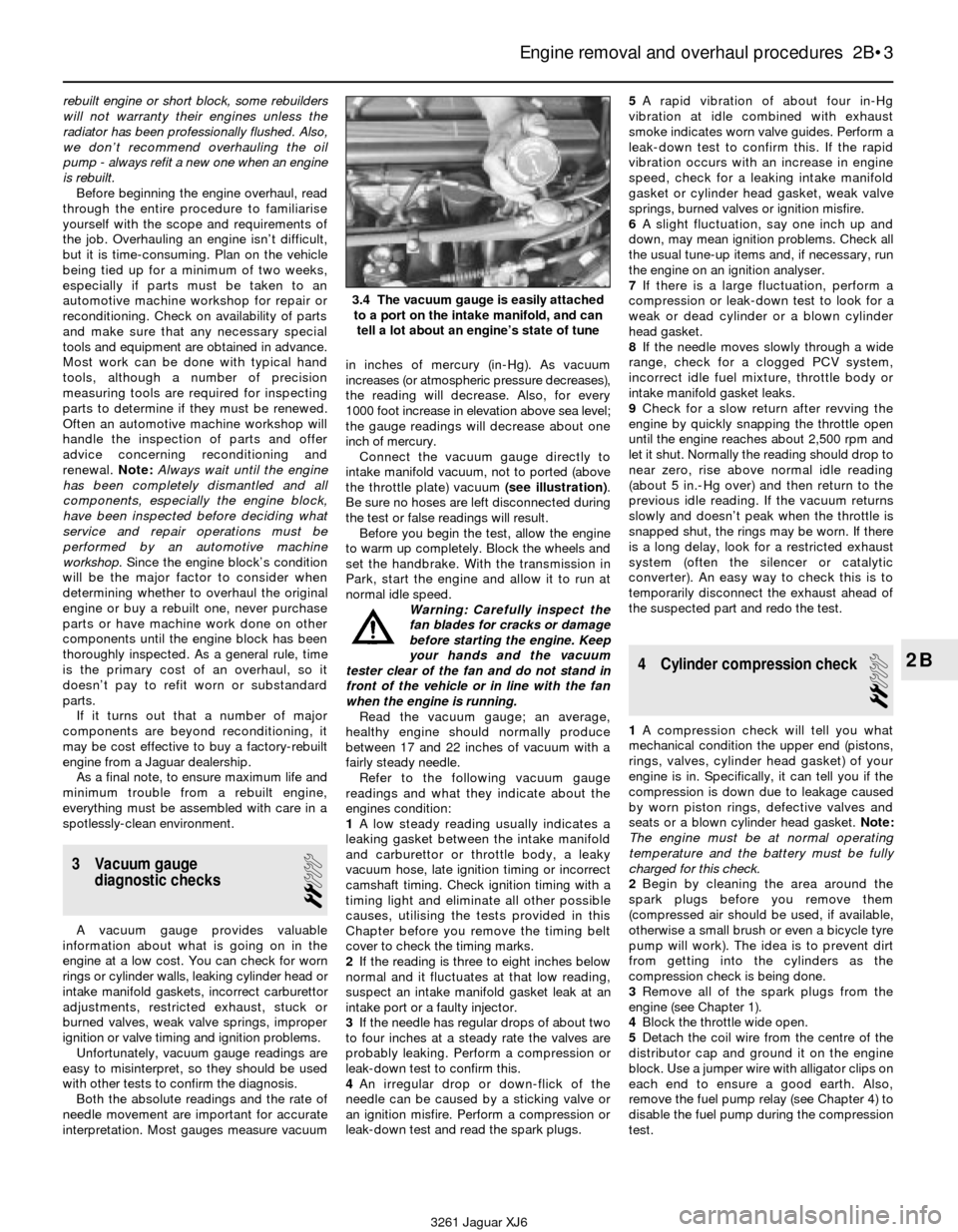
Connect the vacuum gauge directly to
intake manifold vacuum, not to ported (above
the throttle plate) vacuum (see illustration).
Be sure no hoses are left disconnected during
the test or false readings will result.
Before you begin the test, allow the engine
to warm up completely. Block the wheels and
set the handbrake. With the transmission in
Park, start the engine and allow it to run at
normal idle speed.
Warning: Carefully inspect the
fan blades for cracks or damage
before starting the engine. Keep
your hands and the vacuum
tester clear of the fan and do not stand in
front of the vehicle or in line with the fan
when the engine is running.
Read the vacuum gauge; an average,
healthy engine should normally produce
between 17 and 22 inches of vacuum with a
fairly steady needle.
Refer to the following vacuum gauge
readings and what they indicate about the
engines condition:
1A low steady reading usually indicates a
leaking gasket between the intake manifold
and carburettor or throttle body, a leaky
vacuum hose, late ignition timing or incorrect
camshaft timing. Check ignition timing with a
timing light and eliminate all other possible
causes, utilising the tests provided in this
Chapter before you remove the timing belt
cover to check the timing marks.
2If the reading is three to eight inches below
normal and it fluctuates at that low reading,
suspect an intake manifold gasket leak at an
intake port or a faulty injector.
3If the needle has regular drops of about two
to four inches at a steady rate the valves are
probably leaking. Perform a compression or
leak-down test to confirm this.
4An irregular drop or down-flick of the
needle can be caused by a sticking valve or
an ignition misfire. Perform a compression or
leak-down test and read the spark plugs.5A rapid vibration of about four in-Hg
vibration at idle combined with exhaust
smoke indicates worn valve guides. Perform a
leak-down test to confirm this. If the rapid
vibration occurs with an increase in engine
speed, check for a leaking intake manifold
gasket or cylinder head gasket, weak valve
springs, burned valves or ignition misfire.
6A slight fluctuation, say one inch up and
down, may mean ignition problems. Check all
the usual tune-up items and, if necessary, run
the engine on an ignition analyser.
7If there is a large fluctuation, perform a
compression or leak-down test to look for a
weak or dead cylinder or a blown cylinder
head gasket.
8If the needle moves slowly through a wide
range, check for a clogged PCV system,
incorrect idle fuel mixture, throttle body or
intake manifold gasket leaks.
9Check for a slow return after revving the
engine by quickly snapping the throttle open
until the engine reaches about 2,500 rpm and
let it shut. Normally the reading should drop to
near zero, rise above normal idle reading
(about 5 in.-Hg over) and then return to the
previous idle reading. If the vacuum returns
slowly and doesn’t peak when the throttle is
snapped shut, the rings may be worn. If there
is a long delay, look for a restricted exhaust
system (often the silencer or catalytic
converter). An easy way to check this is to
temporarily disconnect the exhaust ahead of
the suspected part and redo the test.
4 Cylinder compression check
2
1A compression check will tell you what
mechanical condition the upper end (pistons,
rings, valves, cylinder head gasket) of your
engine is in. Specifically, it can tell you if the
compression is down due to leakage caused
by worn piston rings, defective valves and
seats or a blown cylinder head gasket. Note:
The engine must be at normal operating
temperature and the battery must be fully
charged for this check.
2Begin by cleaning the area around the
spark plugs before you remove them
(compressed air should be used, if available,
otherwise a small brush or even a bicycle tyre
pump will work). The idea is to prevent dirt
from getting into the cylinders as the
compression check is being done.
3Remove all of the spark plugs from the
engine (see Chapter 1).
4Block the throttle wide open.
5Detach the coil wire from the centre of the
distributor cap and ground it on the engine
block. Use a jumper wire with alligator clips on
each end to ensure a good earth. Also,
remove the fuel pump relay (see Chapter 4) to
disable the fuel pump during the compression
test.
Engine removal and overhaul procedures 2B•3
2B
3.4 The vacuum gauge is easily attached
to a port on the intake manifold, and can
tell a lot about an engine’s state of tune
3261 Jaguar XJ6
Page 90 of 227
special electrical device that provides circuit
protection by switching off the ignition and
fuel pump upon impact in the event of vehicle
collision. Later Jaguar models are equipped
with an additional specialised inertia switch.
This later device switches OFF all ignition fed
circuits, locks the fuel filler cap, locks the boot
(only if doors are locked) and unlocks the
doors if they are locked during the accident.
All these functions are directed by the inertia
switch. The inertia switch is located behind
the left kick panel. Refer to Chapter 12 for
more information.
Exhaust system
The exhaust system includes an exhaust
manifold equipped with an exhaust oxygen
sensor, a catalytic converter, an exhaust pipe,
and a silencer.
The catalytic converter is an emission
control device added to the exhaust system to
reduce pollutants. A single-bed converter is
used in combination with a three-way
(reduction) catalyst. See Chapter 6 for more
information regarding the catalytic converter.
2 Fuel pressure relief
1
Warning: Petrol is extremely
flammable, so take extra
precautions when you work on
any part of the fuel system.
Don’t smoke or allow open flames or bare
light bulbs near the work area, and don’t
work in a garage where a natural gas-type
appliance (such as a water heater or a
clothes dryer) with a pilot light is present.
Since petrol is carcinogenic, wear latex
gloves when there’s a possibility of being
exposed to fuel, and, if you spill any fuel on
your skin, rinse it off immediately with soap
and water. Mop up any spills immediately
and do not store fuel-soaked rags wherethey could ignite. The fuel system is under
constant pressure, so, if any fuel lines are
to be disconnected, the fuel pressure in
the system must be relieved first. When
you perform any kind of work on the fuel
system, wear safety glasses and have a
Class B type fire extinguisher on hand.
1Before servicing any fuel system
component, you must relieve the fuel pressure
to minimise the risk of fire or personal injury.
2Remove the fuel filler cap - this will relieve
any pressure built up in the tank.
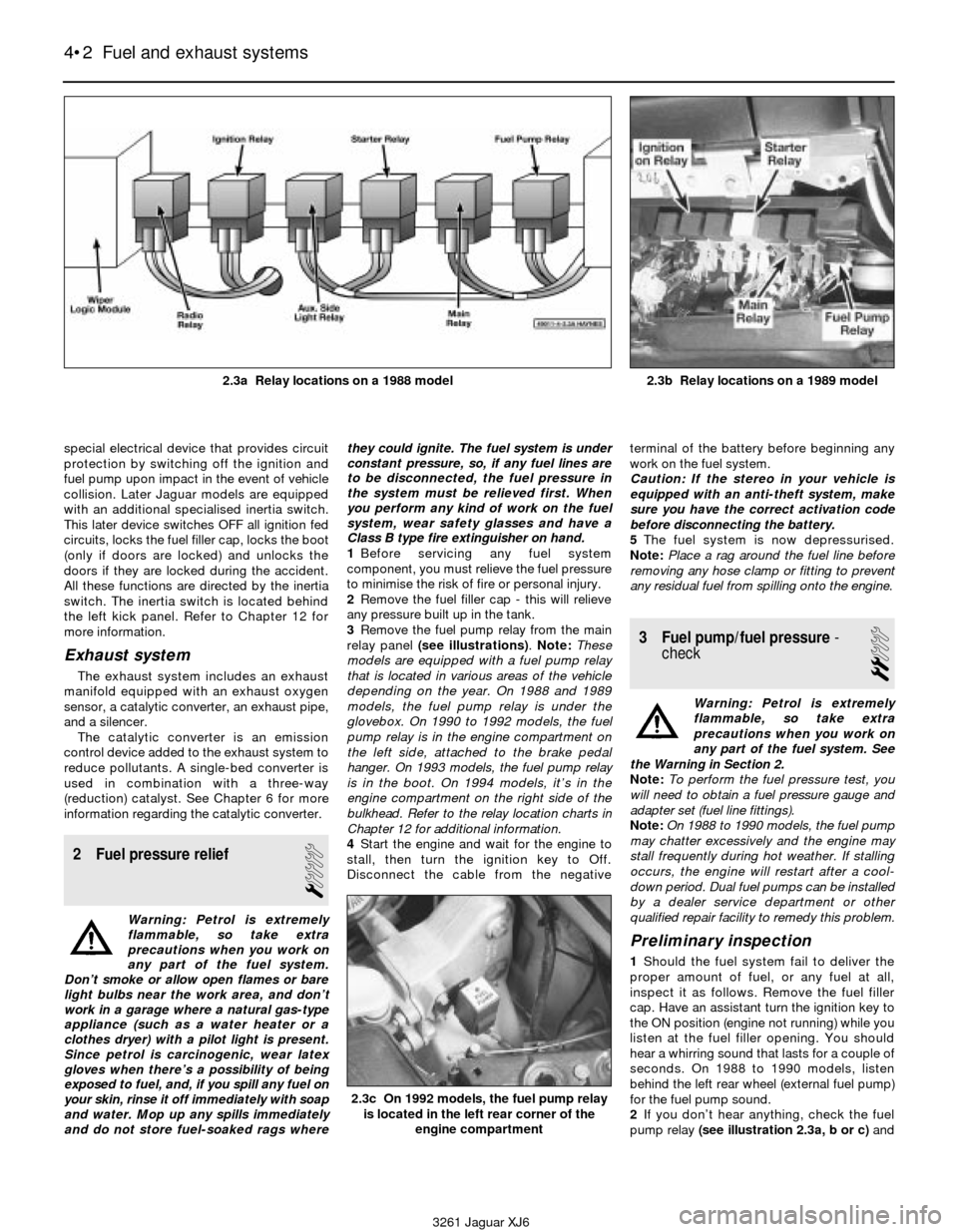
3Remove the fuel pump relay from the main
relay panel (see illustrations). Note:These
models are equipped with a fuel pump relay
that is located in various areas of the vehicle
depending on the year. On 1988 and 1989
models, the fuel pump relay is under the
glovebox. On 1990 to 1992 models, the fuel
pump relay is in the engine compartment on
the left side, attached to the brake pedal
hanger. On 1993 models, the fuel pump relay
is in the boot. On 1994 models, it’s in the
engine compartment on the right side of the
bulkhead. Refer to the relay location charts in
Chapter 12 for additional information.
4Start the engine and wait for the engine to
stall, then turn the ignition key to Off.
Disconnect the cable from the negativeterminal of the battery before beginning any
work on the fuel system.
Caution: If the stereo in your vehicle is
equipped with an anti-theft system, make
sure you have the correct activation code
before disconnecting the battery.
5The fuel system is now depressurised.
Note:Place a rag around the fuel line before
removing any hose clamp or fitting to prevent
any residual fuel from spilling onto the engine.
3 Fuel pump/fuel pressure-
check
2
Warning: Petrol is extremely
flammable, so take extra
precautions when you work on
any part of the fuel system. See
the Warning in Section 2.
Note: To perform the fuel pressure test, you
will need to obtain a fuel pressure gauge and
adapter set (fuel line fittings).
Note: On 1988 to 1990 models, the fuel pump
may chatter excessively and the engine may
stall frequently during hot weather. If stalling
occurs, the engine will restart after a cool-
down period. Dual fuel pumps can be installed
by a dealer service department or other
qualified repair facility to remedy this problem.
Preliminary inspection
1Should the fuel system fail to deliver the
proper amount of fuel, or any fuel at all,
inspect it as follows. Remove the fuel filler
cap. Have an assistant turn the ignition key to
the ON position (engine not running) while you
listen at the fuel filler opening. You should
hear a whirring sound that lasts for a couple of
seconds. On 1988 to 1990 models, listen
behind the left rear wheel (external fuel pump)
for the fuel pump sound.
2If you don’t hear anything, check the fuel
pump relay (see illustration 2.3a, b or c)and
4•2 Fuel and exhaust systems
2.3c On 1992 models, the fuel pump relay
is located in the left rear corner of the
engine compartment
3261 Jaguar XJ6 2.3a Relay locations on a 1988 model
2.3b Relay locations on a 1989 model
Page 96 of 227

10 Accelerator cable- removal,
refitting and adjustment
3
Removal
1Detach the cable from the negative terminal
of the battery.
Caution: If the stereo in your vehicle is
equipped with an anti-theft system, make
sure you have the correct activation code
before disconnecting the battery.
2Loosen the locknut on the threaded portion
of the throttle cable at the throttle body (see
illustration).
3Rotate the throttle lever, then slip the
throttle cable end out of the slot in the lever
(see illustration).
4Detach the throttle cable from the
accelerator pedal (see illustration).
5From inside the vehicle, pull the cable
through the bulkhead.
Refitting and adjustment
6Refitting is the reverse of removal.
7To adjust the cable, fully depress the
accelerator pedal and check that the throttle
is fully opened.
8If not fully opened, loosen the locknuts,
depress accelerator pedal and adjust the
cable until the throttle is fully open.
9Tighten the locknuts and recheck the
adjustment. Make sure the throttle closes fully
when the pedal is released (see illustration).
10After the cable is adjusted, check the
adjustment of the bellcrank. Use a small
clamp and a straight rod or stiff wire (coat
hanger) and attach it to the brake master
cylinder in such a way that the tip acts as a
pointer. Align the pointer with “A” (automatic
transmission) or “M” (manual transmission) on
the bellcrank (see illustration),depending on
what type of transmission is installed in the
vehicle.
11Slowly rotate the bellcrank until it reaches
the throttle stop (wide open throttle) andcheck to make sure the pointer aligns with the
notch in the bellcrank (see illustration).
12If necessary, adjust the position of
the throttle stop using a spanner and turn the
throttle stop screw until the bellcrank reaches
the correct position. Lock the throttle stop
screw in place.
4•8 Fuel and exhaust systems
3261 Jaguar XJ6 10.4 Remove circlip (arrowed) and separate cable from the
accelerator pedal by pulling the pin from the pedal assembly
10.2 Loosen the locknuts on the accelerator cable10.3 Rotate the bellcrank and remove the cable end from the slot
10.9 Make sure the throttle closes completely and there is a
slight amount of flex in the cable
10.10 Attach a strong wire (coat hanger)
to the master cylinder using a clamp and
align it with the notch on the bellcrank
Page 123 of 227
3261 Jaguar XJ6
9
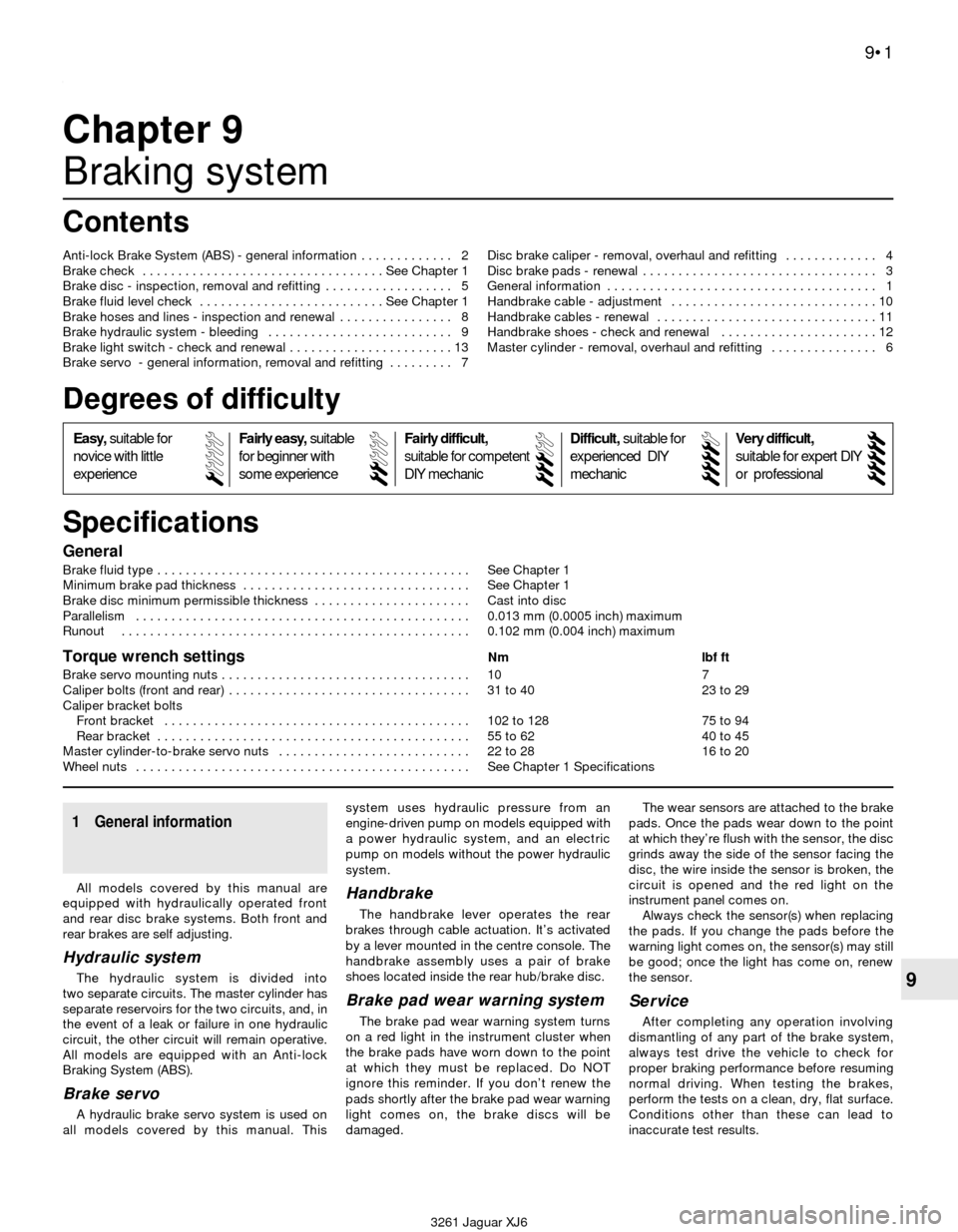
Chapter 9
Braking system
General
Brake fluid type . . . . . . . . . . . . . . . . . . . . . . . . . . . . . . . . . . . . . . . . . . . . See Chapter 1
Minimum brake pad thickness . . . . . . . . . . . . . . . . . . . . . . . . . . . . . . . . See Chapter 1
Brake disc minimum permissible thickness . . . . . . . . . . . . . . . . . . . . . . Cast into disc
Parallelism . . . . . . . . . . . . . . . . . . . . . . . . . . . . . . . . . . . . . . . . . . . . . . . 0.013 mm (0.0005 inch) maximum
Runout . . . . . . . . . . . . . . . . . . . . . . . . . . . . . . . . . . . . . . . . . . . . . . . . . 0.102 mm (0.004 inch) maximum
Torque wrench settingsNm lbf ft
Brake servo mounting nuts . . . . . . . . . . . . . . . . . . . . . . . . . . . . . . . . . . . 10 7
Caliper bolts (front and rear) . . . . . . . . . . . . . . . . . . . . . . . . . . . . . . . . . . 31 to 40 23 to 29
Caliper bracket bolts
Front bracket . . . . . . . . . . . . . . . . . . . . . . . . . . . . . . . . . . . . . . . . . . . 102 to 128 75 to 94
Rear bracket . . . . . . . . . . . . . . . . . . . . . . . . . . . . . . . . . . . . . . . . . . . . 55 to 62 40 to 45
Master cylinder-to-brake servo nuts . . . . . . . . . . . . . . . . . . . . . . . . . . . 22 to 28 16 to 20
Wheel nuts . . . . . . . . . . . . . . . . . . . . . . . . . . . . . . . . . . . . . . . . . . . . . . . See Chapter 1 Specifications Anti-lock Brake System (ABS) - general information . . . . . . . . . . . . . 2
Brake check . . . . . . . . . . . . . . . . . . . . . . . . . . . . . . . . . . See Chapter 1
Brake disc - inspection, removal and refitting . . . . . . . . . . . . . . . . . . 5
Brake fluid level check . . . . . . . . . . . . . . . . . . . . . . . . . . See Chapter 1
Brake hoses and lines - inspection and renewal . . . . . . . . . . . . . . . . 8
Brake hydraulic system - bleeding . . . . . . . . . . . . . . . . . . . . . . . . . . 9
Brake light switch - check and renewal . . . . . . . . . . . . . . . . . . . . . . . 13
Brake servo - general information, removal and refitting . . . . . . . . . 7Disc brake caliper - removal, overhaul and refitting . . . . . . . . . . . . . 4
Disc brake pads - renewal . . . . . . . . . . . . . . . . . . . . . . . . . . . . . . . . . 3
General information . . . . . . . . . . . . . . . . . . . . . . . . . . . . . . . . . . . . . . 1
Handbrake cable - adjustment . . . . . . . . . . . . . . . . . . . . . . . . . . . . . 10
Handbrake cables - renewal . . . . . . . . . . . . . . . . . . . . . . . . . . . . . . . 11
Handbrake shoes - check and renewal . . . . . . . . . . . . . . . . . . . . . . 12
Master cylinder - removal, overhaul and refitting . . . . . . . . . . . . . . . 6
9•1
Specifications Contents
Easy,suitable for
novice with little
experienceFairly easy,suitable
for beginner with
some experienceFairly difficult,
suitable for competent
DIY mechanic
Difficult,suitable for
experienced DIY
mechanicVery difficult,
suitable for expert DIY
or professional
Degrees of difficulty
54321
1 General information
All models covered by this manual are
equipped with hydraulically operated front
and rear disc brake systems. Both front and
rear brakes are self adjusting.
Hydraulic system
The hydraulic system is divided into
two separate circuits. The master cylinder has
separate reservoirs for the two circuits, and, in
the event of a leak or failure in one hydraulic
circuit, the other circuit will remain operative.
All models are equipped with an Anti-lock
Braking System (ABS).
Brake servo
A hydraulic brake servo system is used on
all models covered by this manual. Thissystem uses hydraulic pressure from an
engine-driven pump on models equipped with
a power hydraulic system, and an electric
pump on models without the power hydraulic
system.
Handbrake
The handbrake lever operates the rear
brakes through cable actuation. It’s activated
by a lever mounted in the centre console. The
handbrake assembly uses a pair of brake
shoes located inside the rear hub/brake disc.
Brake pad wear warning system
The brake pad wear warning system turns
on a red light in the instrument cluster when
the brake pads have worn down to the point
at which they must be replaced. Do NOT
ignore this reminder. If you don’t renew the
pads shortly after the brake pad wear warning
light comes on, the brake discs will be
damaged.The wear sensors are attached to the brake
pads. Once the pads wear down to the point
at which they’re flush with the sensor, the disc
grinds away the side of the sensor facing the
disc, the wire inside the sensor is broken, the
circuit is opened and the red light on the
instrument panel comes on.
Always check the sensor(s) when replacing
the pads. If you change the pads before the
warning light comes on, the sensor(s) may still
be good; once the light has come on, renew
the sensor.
Service
After completing any operation involving
dismantling of any part of the brake system,
always test drive the vehicle to check for
proper braking performance before resuming
normal driving. When testing the brakes,
perform the tests on a clean, dry, flat surface.
Conditions other than these can lead to
inaccurate test results.