handbrake JAGUAR XJ6 1997 2.G Owner's Manual
[x] Cancel search | Manufacturer: JAGUAR, Model Year: 1997, Model line: XJ6, Model: JAGUAR XJ6 1997 2.GPages: 227, PDF Size: 7.2 MB
Page 134 of 227
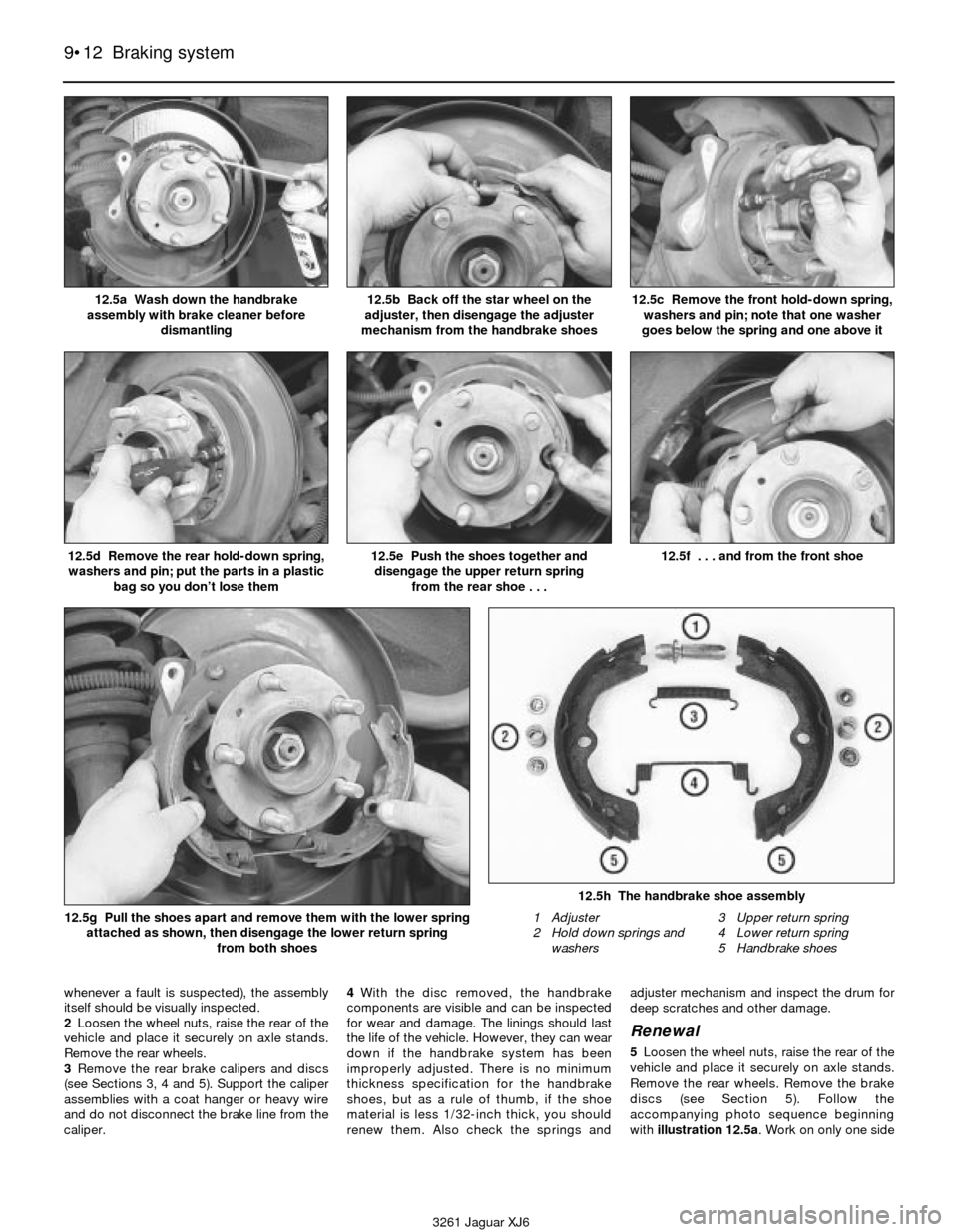
whenever a fault is suspected), the assembly
itself should be visually inspected.
2Loosen the wheel nuts, raise the rear of the
vehicle and place it securely on axle stands.
Remove the rear wheels.
3Remove the rear brake calipers and discs
(see Sections 3, 4 and 5). Support the caliper
assemblies with a coat hanger or heavy wire
and do not disconnect the brake line from the
caliper.4With the disc removed, the handbrake
components are visible and can be inspected
for wear and damage. The linings should last
the life of the vehicle. However, they can wear
down if the handbrake system has been
improperly adjusted. There is no minimum
thickness specification for the handbrake
shoes, but as a rule of thumb, if the shoe
material is less 1/32-inch thick, you should
renew them. Also check the springs andadjuster mechanism and inspect the drum for
deep scratches and other damage.
Renewal
5Loosen the wheel nuts, raise the rear of the
vehicle and place it securely on axle stands.
Remove the rear wheels. Remove the brake
discs (see Section 5). Follow the
accompanying photo sequence beginning
with illustration 12.5a. Work on only one side 1 Adjuster
2 Hold down springs and
washers3 Upper return spring
4 Lower return spring
5 Handbrake shoes
9•12 Braking system
12.5a Wash down the handbrake
assembly with brake cleaner before
dismantling12.5b Back off the star wheel on the
adjuster, then disengage the adjuster
mechanism from the handbrake shoes12.5c Remove the front hold-down spring,
washers and pin; note that one washer
goes below the spring and one above it
12.5d Remove the rear hold-down spring,
washers and pin; put the parts in a plastic
bag so you don’t lose them12.5e Push the shoes together and
disengage the upper return spring
from the rear shoe . . .12.5f . . . and from the front shoe
3261 Jaguar XJ6 12.5g Pull the shoes apart and remove them with the lower spring
attached as shown, then disengage the lower return spring
from both shoes
12.5h The handbrake shoe assembly
Page 135 of 227
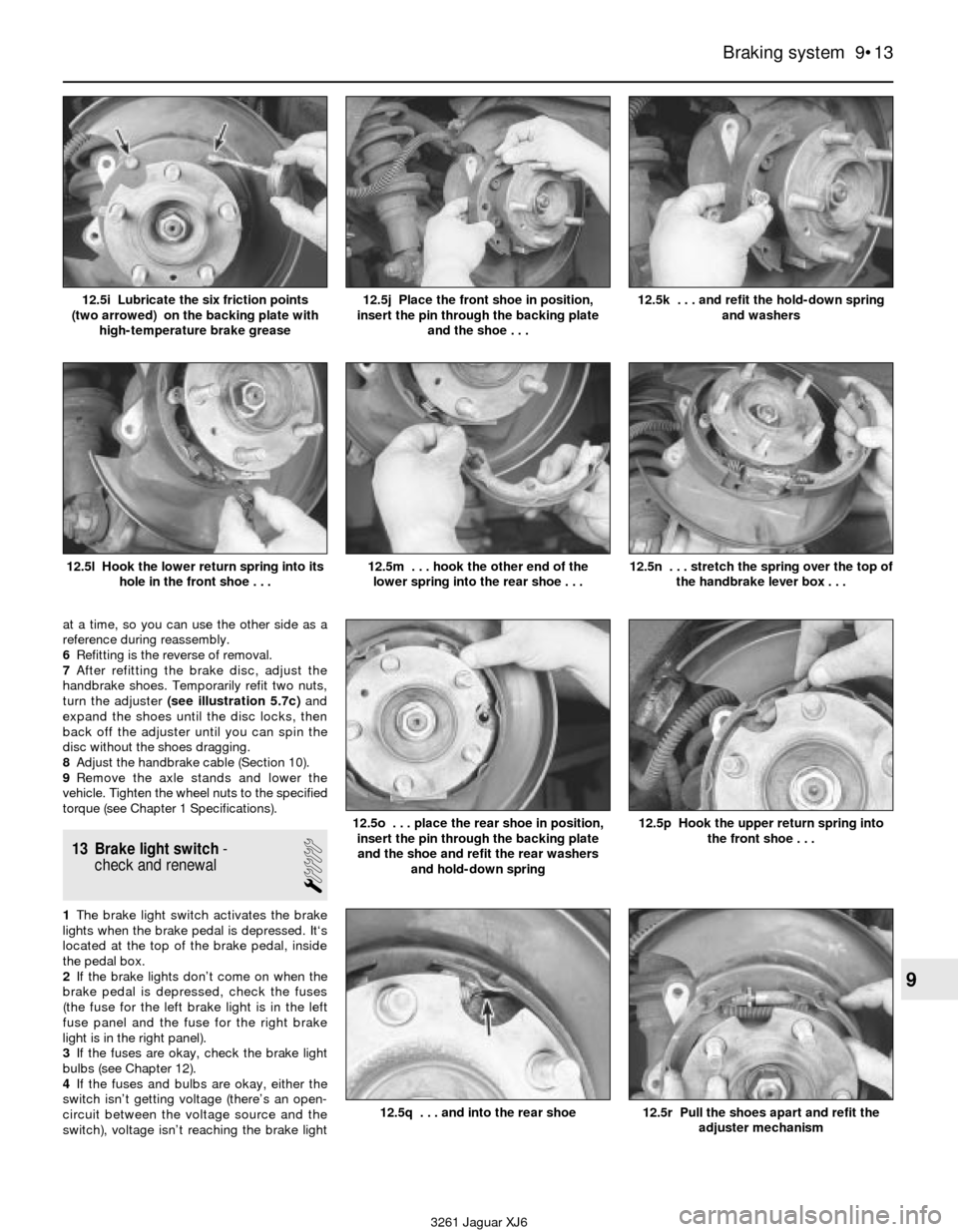
at a time, so you can use the other side as a
reference during reassembly.
6Refitting is the reverse of removal.
7After refitting the brake disc, adjust the
handbrake shoes. Temporarily refit two nuts,
turn the adjuster (see illustration 5.7c)and
expand the shoes until the disc locks, then
back off the adjuster until you can spin the
disc without the shoes dragging.
8Adjust the handbrake cable (Section 10).
9Remove the axle stands and lower the
vehicle. Tighten the wheel nuts to the specified
torque (see Chapter 1 Specifications).
13 Brake light switch-
check and renewal
1
1The brake light switch activates the brake
lights when the brake pedal is depressed. It‘s
located at the top of the brake pedal, inside
the pedal box.
2If the brake lights don’t come on when the
brake pedal is depressed, check the fuses
(the fuse for the left brake light is in the left
fuse panel and the fuse for the right brake
light is in the right panel).
3If the fuses are okay, check the brake light
bulbs (see Chapter 12).
4If the fuses and bulbs are okay, either the
switch isn’t getting voltage (there’s an open-
circuit between the voltage source and the
switch), voltage isn’t reaching the brake light
Braking system 9•13
9
12.5j Place the front shoe in position,
insert the pin through the backing plate
and the shoe . . .12.5k . . . and refit the hold-down spring
and washers12.5i Lubricate the six friction points
(two arrowed) on the backing plate with
high-temperature brake grease
3261 Jaguar XJ6 12.5l Hook the lower return spring into its
hole in the front shoe . . .
12.5m . . . hook the other end of the
lower spring into the rear shoe . . .12.5n . . . stretch the spring over the top of
the handbrake lever box . . .
12.5o . . . place the rear shoe in position,
insert the pin through the backing plate
and the shoe and refit the rear washers
and hold-down spring12.5p Hook the upper return spring into
the front shoe . . .
12.5q . . . and into the rear shoe12.5r Pull the shoes apart and refit the
adjuster mechanism
Page 144 of 227
11If you installed another pair of self-
levelling shocks, or removed and installed the
same pair of self-levelling shocks, be sure to
top up the power hydraulic system reservoir
(see Chapter 1).
11 Hub carrier (rear)-
removal and refitting
4
1Loosen the wheel nuts, raise the rear of the
vehicle and support it securely on axle stands.
Remove the wheel.
2Remove the rear caliper and brake pads,
the caliper bracket, the brake disc, the
handbrake cable and the handbrake shoe
assembly (see Chapter 9).
3Disconnect the outer end of the propshaft
from the hub carrier (see Chapter 8).
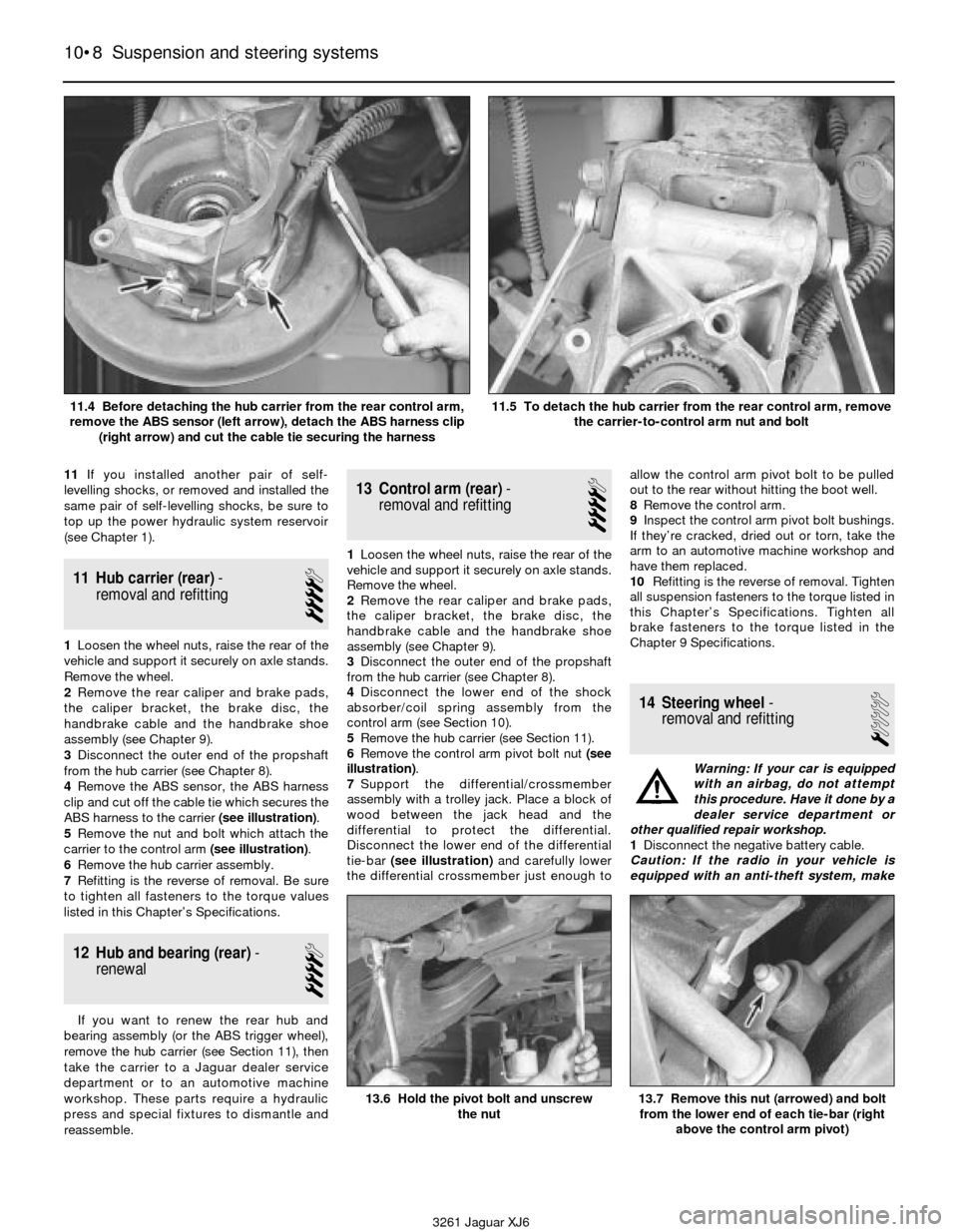
4Remove the ABS sensor, the ABS harness
clip and cut off the cable tie which secures the
ABS harness to the carrier (see illustration).
5Remove the nut and bolt which attach the
carrier to the control arm (see illustration).
6Remove the hub carrier assembly.
7Refitting is the reverse of removal. Be sure
to tighten all fasteners to the torque values
listed in this Chapter’s Specifications.
12 Hub and bearing (rear)-
renewal
4
If you want to renew the rear hub and
bearing assembly (or the ABS trigger wheel),
remove the hub carrier (see Section 11), then
take the carrier to a Jaguar dealer service
department or to an automotive machine
workshop. These parts require a hydraulic
press and special fixtures to dismantle and
reassemble.
13 Control arm (rear)-
removal and refitting
4
1Loosen the wheel nuts, raise the rear of the
vehicle and support it securely on axle stands.
Remove the wheel.
2Remove the rear caliper and brake pads,
the caliper bracket, the brake disc, the
handbrake cable and the handbrake shoe
assembly (see Chapter 9).
3Disconnect the outer end of the propshaft
from the hub carrier (see Chapter 8).
4Disconnect the lower end of the shock
absorber/coil spring assembly from the
control arm (see Section 10).
5Remove the hub carrier (see Section 11).
6Remove the control arm pivot bolt nut (see
illustration).
7Support the differential/crossmember
assembly with a trolley jack. Place a block of
wood between the jack head and the
differential to protect the differential.
Disconnect the lower end of the differential
tie-bar (see illustration)and carefully lower
the differential crossmember just enough toallow the control arm pivot bolt to be pulled
out to the rear without hitting the boot well.
8Remove the control arm.
9Inspect the control arm pivot bolt bushings.
If they’re cracked, dried out or torn, take the
arm to an automotive machine workshop and
have them replaced.
10Refitting is the reverse of removal. Tighten
all suspension fasteners to the torque listed in
this Chapter’s Specifications. Tighten all
brake fasteners to the torque listed in the
Chapter 9 Specifications.
14 Steering wheel-
removal and refitting
1
Warning: If your car is equipped
with an airbag, do not attempt
this procedure. Have it done by a
dealer service department or
other qualified repair workshop.
1Disconnect the negative battery cable.
Caution: If the radio in your vehicle is
equipped with an anti-theft system, make
10•8 Suspension and steering systems
13.6 Hold the pivot bolt and unscrew
the nut13.7 Remove this nut (arrowed) and bolt
from the lower end of each tie-bar (right
above the control arm pivot)
3261 Jaguar XJ6 11.4 Before detaching the hub carrier from the rear control arm,
remove the ABS sensor (left arrow), detach the ABS harness clip
(right arrow) and cut the cable tie securing the harness
11.5 To detach the hub carrier from the rear control arm, remove
the carrier-to-control arm nut and bolt
Page 159 of 227
22 Door window glass-
removal and refitting
3
1Raise the window to its full upright position,
then remove the door trim panel and
watershield as described in Section 18.
2Tape the window to the door glass frame to
secure the window in the full upright position.
3Detach the regulator assembly (Section 21)
and lower it to the bottom of the door.
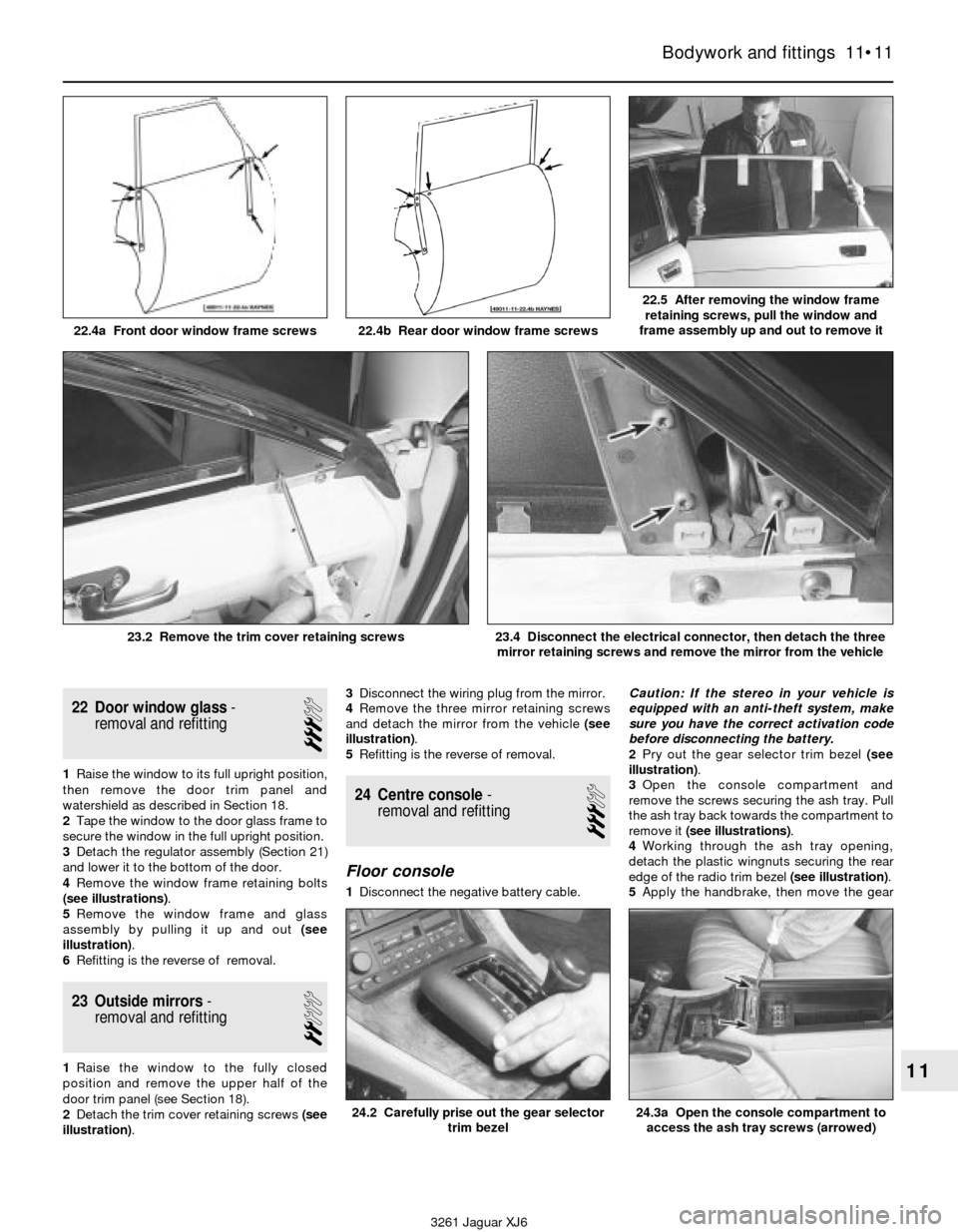
4Remove the window frame retaining bolts
(see illustrations).
5Remove the window frame and glass
assembly by pulling it up and out (see
illustration).
6Refitting is the reverse of removal.
23 Outside mirrors-
removal and refitting
2
1Raise the window to the fully closed
position and remove the upper half of the
door trim panel (see Section 18).
2Detach the trim cover retaining screws (see
illustration).3Disconnect the wiring plug from the mirror.
4Remove the three mirror retaining screws
and detach the mirror from the vehicle (see
illustration).
5Refitting is the reverse of removal.
24 Centre console-
removal and refitting
3
Floor console
1Disconnect the negative battery cable.Caution: If the stereo in your vehicle is
equipped with an anti-theft system, make
sure you have the correct activation code
before disconnecting the battery.
2Pry out the gear selector trim bezel (see
illustration).
3Open the console compartment and
remove the screws securing the ash tray. Pull
the ash tray back towards the compartment to
remove it (see illustrations).
4Working through the ash tray opening,
detach the plastic wingnuts securing the rear
edge of the radio trim bezel (see illustration).
5Apply the handbrake, then move the gear
Bodywork and fittings 11•11
11
22.4a Front door window frame screws 22.4b Rear door window frame screws
22.5 After removing the window frame
retaining screws, pull the window and
frame assembly up and out to remove it
3261 Jaguar XJ6 23.2 Remove the trim cover retaining screws
23.4 Disconnect the electrical connector, then detach the three
mirror retaining screws and remove the mirror from the vehicle
24.3a Open the console compartment to
access the ash tray screws (arrowed)24.2 Carefully prise out the gear selector
trim bezel
Page 204 of 227

3261 Jaguar XJ6
Use of EnglishREF•3
As the main part of this book has been written in the US, it uses the appropriate US component names, phrases, and spelling. Some of these
differ from those used in the UK. Normally, these cause no difficulty, but to make sure, a glossary is printed below. When ordering spare parts,
remember the parts list may use some of these words:
AMERICAN ENGLISH
Aluminum Aluminium
Antenna Aerial
Authorized Authorised
Auto parts stores Motor factors
Axleshaft Halfshaft
Back-up Reverse
Barrel Choke/venturi
Block Chock
Box-end wrench Ring spanner
Bushing Bush
Carburetor Carburettor
Center Centre
Coast Freewheel
Color Colour
Convertible Drop head coupe
Cotter pin Split pin
Counterclockwise Anti-clockwise
Countershaft (of gearbox) Layshaft
Dashboard Facia
Denatured alcohol Methylated spirit
Dome lamp Interior light
Driveaxle Driveshaft
Driveshaft Propeller shaft
Fender Wing/mudguard
Firewall Bulkhead
Flashlight Torch
Float bowl Float chamber
Floor jack Trolley jack
Freeway, turnpike etc Motorway
Freeze plug Core plug
Frozen Seized
Gas tank Petrol tank
Gasoline (gas) Petrol
Gearshift Gearchange
Generator (DC) Dynamo
Ground (electrical) Earth
Header Exhaust manifold
Heat riser Hot spot
High Top gear
Hood (engine cover) Bonnet
Installation Refitting
Intake Inlet
Jackstands Axle stands
Jumper cable Jump lead
Keeper Collet
Kerosene Paraffin
Knock pin Roll pin
Lash Clearance
Lash Free-play
Latch Catch
Latches Locks
License plate Number plate
Light Lamp
Lock (for valve spring retainer) Split cotter (for valve spring cap)
Lopes Hunts
Lug nut/bolt Wheel nut/bolt
Metal chips or debris Swarf
Misses Misfires
AMERICAN ENGLISH
Muffler Silencer
Odor Odour
Oil pan Sump
Open flame Naked flame
Panel wagon/van Van
Parking brake Handbrake
Parking light Sidelight
Pinging Pinking
Piston pin or wrist pin Gudgeon pin
Piston pin or wrist pin Small end, little end
Pitman arm Drop arm
Power brake booster Servo unit
Primary shoe (of brake) Leading shoe (of brake)
Prussian blue Engineer’s blue
Pry Prise (force apart)
Prybar Lever
Prying Levering
Quarter window Quarterlight
Recap Retread
Release cylinder Slave cylinder
Repair shop Garage
Replacement Renewal
Ring gear (of differential) Crownwheel
Rocker panel (beneath doors) Sill panel (beneath doors)
Rod bearing Big-end bearing
Rotor/disk Disc (brake)
Secondary shoe (of brake) Trailing shoe (of brake)
Sedan Saloon
Setscrew, Allen screw Grub screw
Shock absorber, shock Damper
Snap-ring Circlip
Soft top Hood
Spacer Distance piece
Spare tire Spare wheel
Spark plug wires HT leads
Spindle arm Steering arm
Stabilizer or sway bar Anti-roll bar
Station wagon Estate car
Stumbles Hesitates
Tang or lock Tab washer
Throw-out bearing Thrust bearing
Tie-rod or connecting rod (of steering) Trackrod
Tire Tyre
Transmission Gearbox
Troubleshooting Fault finding/diagnosis
Trunk Boot (luggage compartment)
Turn signal Indicator
TV (throttle valve) cable Kickdown cable
Unpublicized Unpublicised
Valve cover Rocker cover
Valve lifter Tappet
Valve lifter or tappet Cam follower or tappet
Vapor Vapour
Vise Vice
Wheel cover Roadwheel trim
Whole drive line Transmission
Windshield Windscreen
Wrench Spanner
Page 209 of 227

3261 Jaguar XJ6
REF•8MOT test checks
This is a guide to getting your vehicle through the MOT test.
Obviously it will not be possible to examine the vehicle to the same
standard as the professional MOT tester. However, working through
the following checks will enable you to identify any problem areas
before submitting the vehicle for the test.
Where a testable component is in borderline condition, the tester
has discretion in deciding whether to pass or fail it. The basis of such
discretion is whether the tester would be happy for a close relative or
friend to use the vehicle with the component in that condition. If the
vehicle presented is clean and evidently well cared for, the tester may
be more inclined to pass a borderline component than if the vehicle is
scruffy and apparently neglected.
It has only been possible to summarise the test requirements here,
based on the regulations in force at the time of printing. Test standards
are becoming increasingly stringent, although there are some
exemptions for older vehicles. For full details obtain a copy of the Haynes
publication Pass the MOT! (available from stockists of Haynes manuals).
An assistant will be needed to help carry out some of these checks.
The checks have been sub-divided into four categories, as follows:
HandbrakeMTest the operation of the handbrake.
Excessive travel (too many clicks) indicates
incorrect brake or cable adjustment.
MCheck that the handbrake cannot be
released by tapping the lever sideways. Check
the security of the lever mountings.
Footbrake
MDepress the brake pedal and check that it
does not creep down to the floor, indicating a
master cylinder fault. Release the pedal, wait
a few seconds, then depress it again. If the
pedal travels nearly to the floor before firm
resistance is felt, brake adjustment or repair is
necessary. If the pedal feels spongy, there is
air in the hydraulic system which must be
removed by bleeding.MCheck that the brake pedal is secure and in
good condition. Check also for signs of fluid
leaks on the pedal, floor or carpets, which
would indicate failed seals in the brake master
cylinder.
MCheck the servo unit (when applicable) by
operating the brake pedal several times, then
keeping the pedal depressed and starting the
engine. As the engine starts, the pedal will
move down slightly. If not, the vacuum hose or
the servo itself may be faulty.
Steering wheel and column
MExamine the steering wheel for fractures or
looseness of the hub, spokes or rim.
MMove the steering wheel from side to side
and then up and down. Check that the
steering wheel is not loose on the column,
indicating wear or a loose retaining nut.
Continue moving the steering wheel as before,
but also turn it slightly from left to right.
MCheck that the steering wheel is not loose
on the column, and that there is no abnormalmovement of the steering wheel, indicating
wear in the column support bearings or
couplings.
Windscreen and mirrors
MThe windscreen must be free of cracks or
other significant damage within the driver’s
field of view. (Small stone chips are
acceptable.) Rear view mirrors must be
secure, intact, and capable of being adjusted.
1Checks carried out
FROM THE DRIVER’S SEAT
1Checks carried out
FROM THE DRIVER’S
SEAT2Checks carried out
WITH THE VEHICLE
ON THE GROUND3Checks carried out
WITH THE VEHICLE
RAISED AND THE
WHEELS FREE TO
TURN4Checks carried out on
YOUR VEHICLE’S
EXHAUST EMISSION
SYSTEM
Page 212 of 227
3261 Jaguar XJ6
MOT test checksREF•11
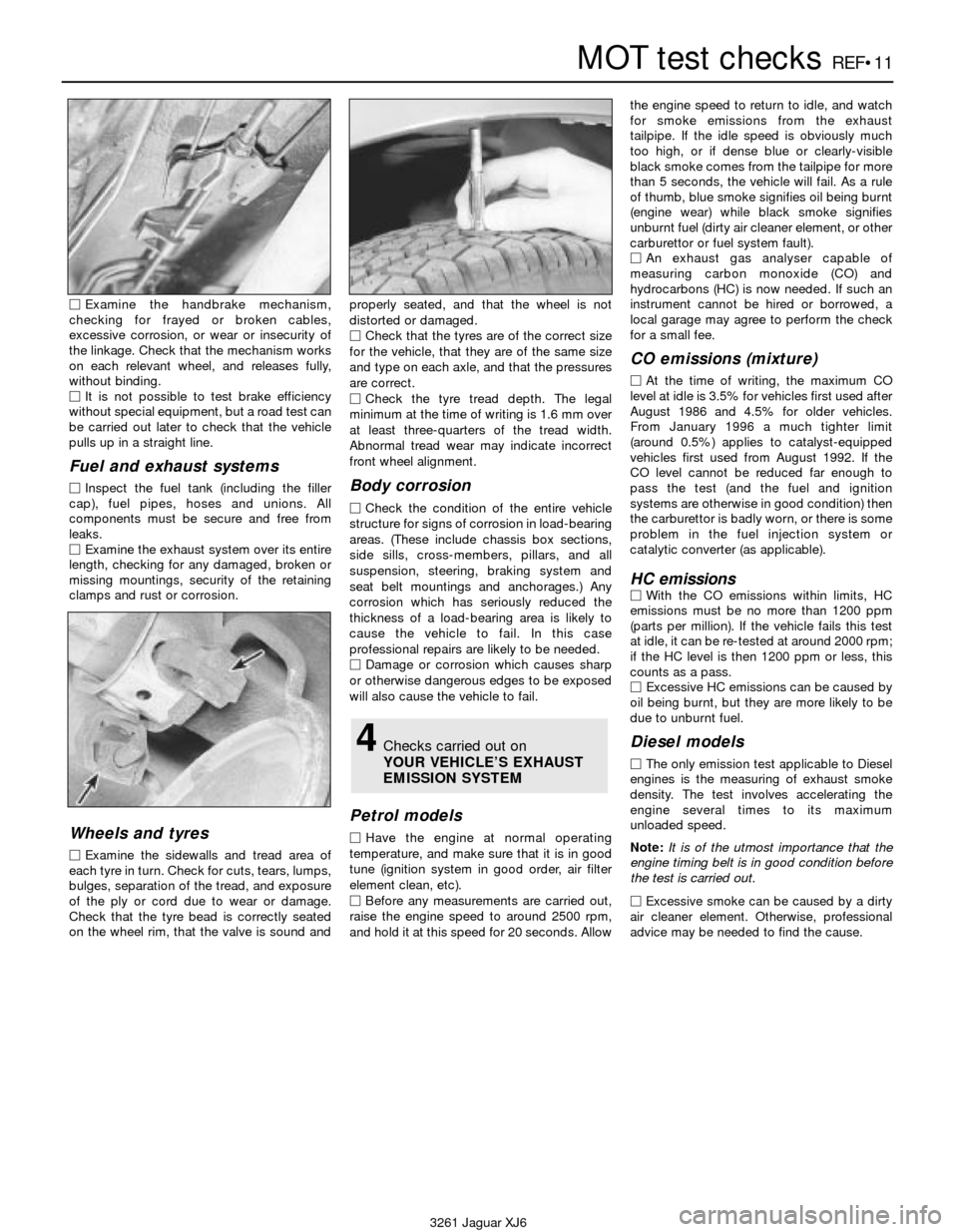
MExamine the handbrake mechanism,
checking for frayed or broken cables,
excessive corrosion, or wear or insecurity of
the linkage. Check that the mechanism works
on each relevant wheel, and releases fully,
without binding.
MIt is not possible to test brake efficiency
without special equipment, but a road test can
be carried out later to check that the vehicle
pulls up in a straight line.
Fuel and exhaust systems
MInspect the fuel tank (including the filler
cap), fuel pipes, hoses and unions. All
components must be secure and free from
leaks.
MExamine the exhaust system over its entire
length, checking for any damaged, broken or
missing mountings, security of the retaining
clamps and rust or corrosion.
Wheels and tyres
MExamine the sidewalls and tread area of
each tyre in turn. Check for cuts, tears, lumps,
bulges, separation of the tread, and exposure
of the ply or cord due to wear or damage.
Check that the tyre bead is correctly seated
on the wheel rim, that the valve is sound andproperly seated, and that the wheel is not
distorted or damaged.
MCheck that the tyres are of the correct size
for the vehicle, that they are of the same size
and type on each axle, and that the pressures
are correct.
MCheck the tyre tread depth. The legal
minimum at the time of writing is 1.6 mm over
at least three-quarters of the tread width.
Abnormal tread wear may indicate incorrect
front wheel alignment.
Body corrosion
MCheck the condition of the entire vehicle
structure for signs of corrosion in load-bearing
areas. (These include chassis box sections,
side sills, cross-members, pillars, and all
suspension, steering, braking system and
seat belt mountings and anchorages.) Any
corrosion which has seriously reduced the
thickness of a load-bearing area is likely to
cause the vehicle to fail. In this case
professional repairs are likely to be needed.
MDamage or corrosion which causes sharp
or otherwise dangerous edges to be exposed
will also cause the vehicle to fail.
Petrol models
MHave the engine at normal operating
temperature, and make sure that it is in good
tune (ignition system in good order, air filter
element clean, etc).
MBefore any measurements are carried out,
raise the engine speed to around 2500 rpm,
and hold it at this speed for 20 seconds. Allowthe engine speed to return to idle, and watch
for smoke emissions from the exhaust
tailpipe. If the idle speed is obviously much
too high, or if dense blue or clearly-visible
black smoke comes from the tailpipe for more
than 5 seconds, the vehicle will fail. As a rule
of thumb, blue smoke signifies oil being burnt
(engine wear) while black smoke signifies
unburnt fuel (dirty air cleaner element, or other
carburettor or fuel system fault).
MAn exhaust gas analyser capable of
measuring carbon monoxide (CO) and
hydrocarbons (HC) is now needed. If such an
instrument cannot be hired or borrowed, a
local garage may agree to perform the check
for a small fee.
CO emissions (mixture)
MAt the time of writing, the maximum CO
level at idle is 3.5% for vehicles first used after
August 1986 and 4.5% for older vehicles.
From January 1996 a much tighter limit
(around 0.5%) applies to catalyst-equipped
vehicles first used from August 1992. If the
CO level cannot be reduced far enough to
pass the test (and the fuel and ignition
systems are otherwise in good condition) then
the carburettor is badly worn, or there is some
problem in the fuel injection system or
catalytic converter (as applicable).
HC emissionsMWith the CO emissions within limits, HC
emissions must be no more than 1200 ppm
(parts per million). If the vehicle fails this test
at idle, it can be re-tested at around 2000 rpm;
if the HC level is then 1200 ppm or less, this
counts as a pass.
MExcessive HC emissions can be caused by
oil being burnt, but they are more likely to be
due to unburnt fuel.
Diesel models
MThe only emission test applicable to Diesel
engines is the measuring of exhaust smoke
density. The test involves accelerating the
engine several times to its maximum
unloaded speed.
Note: It is of the utmost importance that the
engine timing belt is in good condition before
the test is carried out.
M
Excessive smoke can be caused by a dirty
air cleaner element. Otherwise, professional
advice may be needed to find the cause.
4Checks carried out on
YOUR VEHICLE’S EXHAUST
EMISSION SYSTEM
Page 213 of 227
3261 Jaguar XJ6
REF•12Fault finding
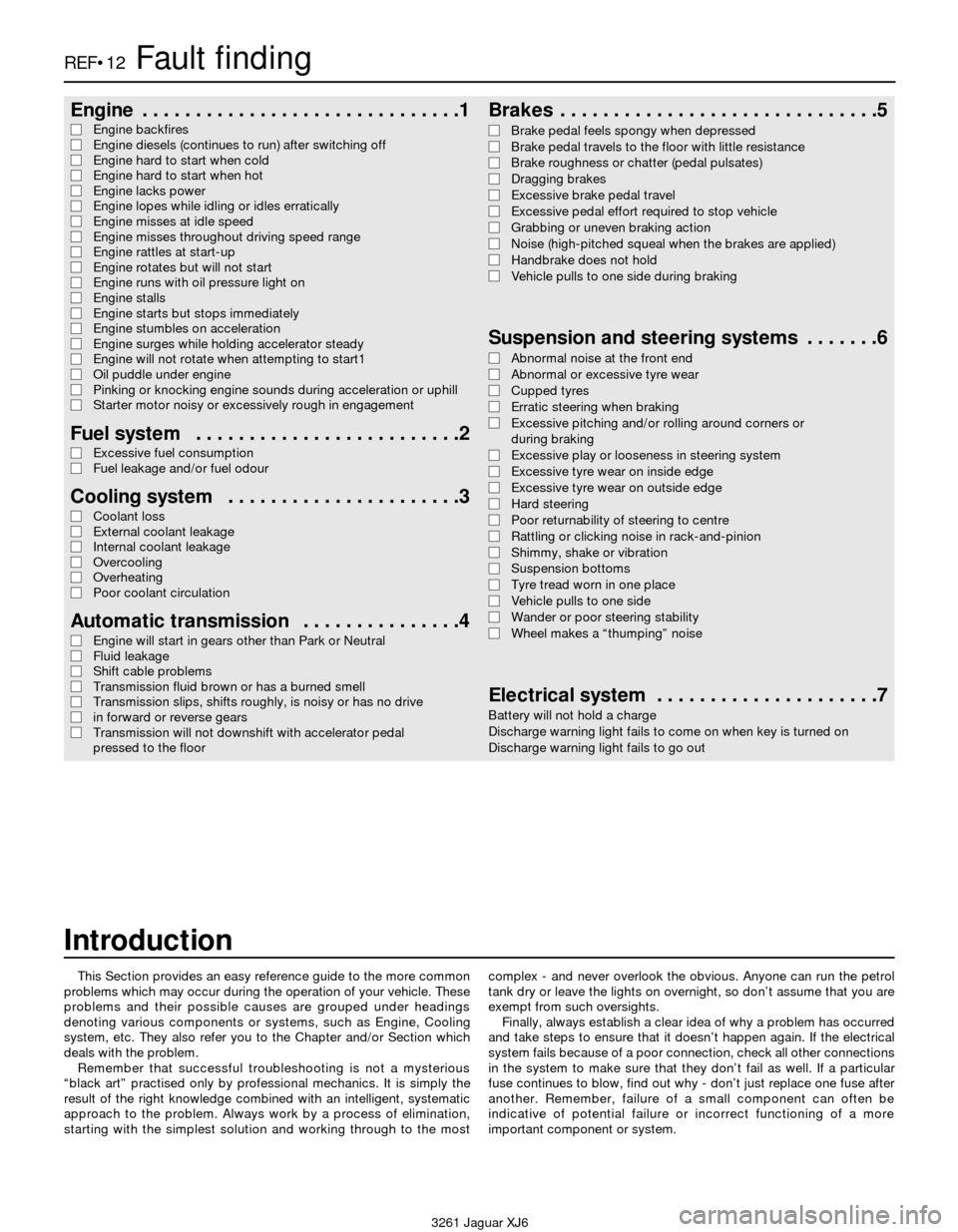
Introduction
This Section provides an easy reference guide to the more common
problems which may occur during the operation of your vehicle. These
problems and their possible causes are grouped under headings
denoting various components or systems, such as Engine, Cooling
system, etc. They also refer you to the Chapter and/or Section which
deals with the problem.
Remember that successful troubleshooting is not a mysterious
“black art” practised only by professional mechanics. It is simply the
result of the right knowledge combined with an intelligent, systematic
approach to the problem. Always work by a process of elimination,
starting with the simplest solution and working through to the mostcomplex - and never overlook the obvious. Anyone can run the petrol
tank dry or leave the lights on overnight, so don’t assume that you are
exempt from such oversights.
Finally, always establish a clear idea of why a problem has occurred
and take steps to ensure that it doesn’t happen again. If the electrical
system fails because of a poor connection, check all other connections
in the system to make sure that they don’t fail as well. If a particular
fuse continues to blow, find out why - don’t just replace one fuse after
another. Remember, failure of a small component can often be
indicative of potential failure or incorrect functioning of a more
important component or system.
Engine . . . . . . . . . . . . . . . . . . . . . . . . . . . . . .1
m mEngine backfires
m mEngine diesels (continues to run) after switching off
m mEngine hard to start when cold
m mEngine hard to start when hot
m mEngine lacks power
m mEngine lopes while idling or idles erratically
m mEngine misses at idle speed
m mEngine misses throughout driving speed range
m mEngine rattles at start-up
m mEngine rotates but will not start
m mEngine runs with oil pressure light on
m mEngine stalls
m mEngine starts but stops immediately
m mEngine stumbles on acceleration
m mEngine surges while holding accelerator steady
m mEngine will not rotate when attempting to start1
m mOil puddle under engine
m mPinking or knocking engine sounds during acceleration or uphill
m mStarter motor noisy or excessively rough in engagement
Fuel system . . . . . . . . . . . . . . . . . . . . . . . . .2
m
mExcessive fuel consumption
m mFuel leakage and/or fuel odour
Cooling system . . . . . . . . . . . . . . . . . . . . . .3
m
mCoolant loss
m mExternal coolant leakage
m mInternal coolant leakage
m mOvercooling
m mOverheating
m mPoor coolant circulation
Automatic transmission . . . . . . . . . . . . . . .4
m
mEngine will start in gears other than Park or Neutral
m mFluid leakage
m mShift cable problems
m mTransmission fluid brown or has a burned smell
m mTransmission slips, shifts roughly, is noisy or has no drive
m min forward or reverse gears
m mTransmission will not downshift with accelerator pedal
pressed to the floor
Brakes . . . . . . . . . . . . . . . . . . . . . . . . . . . . . .5
m mBrake pedal feels spongy when depressed
m mBrake pedal travels to the floor with little resistance
m mBrake roughness or chatter (pedal pulsates)
m mDragging brakes
m mExcessive brake pedal travel
m mExcessive pedal effort required to stop vehicle
m mGrabbing or uneven braking action
m mNoise (high-pitched squeal when the brakes are applied)
m mHandbrake does not hold
m mVehicle pulls to one side during braking
Suspension and steering systems . . . . . . .6
m
mAbnormal noise at the front end
m mAbnormal or excessive tyre wear
m mCupped tyres
m mErratic steering when braking
m mExcessive pitching and/or rolling around corners or
during braking
m mExcessive play or looseness in steering system
m mExcessive tyre wear on inside edge
m mExcessive tyre wear on outside edge
m mHard steering
m mPoor returnability of steering to centre
m mRattling or clicking noise in rack-and-pinion
m mShimmy, shake or vibration
m mSuspension bottoms
m mTyre tread worn in one place
m mVehicle pulls to one side
m mWander or poor steering stability
m mWheel makes a “thumping” noise
Electrical system . . . . . . . . . . . . . . . . . . . . .7
Battery will not hold a charge
Discharge warning light fails to come on when key is turned on
Discharge warning light fails to go out
Page 216 of 227
3261 Jaguar XJ6
Fault findingREF•15
4 Automatic transmission
Note:Due to the complexity of the automatic transmission, it is difficult
for the home mechanic to properly diagnose and service this
component. For problems other than the following, the vehicle should
be taken to a dealer or transmission workshop.
Fluid leakage
m mAutomatic transmission fluid is a deep red colour. Fluid leaks
should not be confused with engine oil, which can easily be blown
by air flow to the transmission.
m mTo pinpoint a leak, first remove all built-up dirt and grime from the
transmission housing with degreasing agents and/or steam
cleaning. Then drive the vehicle at low speeds so air flow will not
blow the leak far from its source. Raise the vehicle and determine
where the leak is coming from. Common areas of leakage are:
a) Sump pan (Chapters 1 and 7)
b) Dipstick/filler tube (see below)
c) Transmission fluid cooler lines (Chapter 7)
d) Speedometer sensor (Chapter 7)
m mMake sure the dipstick is a tight fit inside the filler tube. If the seal
at the top of the dipstick is worn or damaged, replace the seal or
the dipstick. If fluid continues to leak from the top of the dipstick
tube, inspect the breather, which is a plastic cap secured by a clip
to the top of the extension housing. This breather can be plugged
by the noise-deadening foam installed in the transmission tunnel,
causing transmission fluid to leak from the top of the dipstick
tube.
Transmission fluid brown or has a burned smell
m mTransmission fluid burned (Chapter 1).
Shift cable problems
m
mChapter 7 deals with adjusting the shift cable. Common problems
which may be attributed to a poorly adjusted shift cable are:
a) Engine starting in gears other than Park or Neutral.
b) Indicator on shift lever pointing to a gear other than the one
actually being used.
c) Vehicle moves when in Park.
m mRefer to Chapter 7 for the shift cable adjustment procedure.
Transmission will not downshift
with accelerator pedal pressed to the floor
m mKickdown cable out of adjustment (Chapter 7).
Engine will start in gears
other than Park or Neutral
m mNeutral start/reversing light switch malfunctioning (Chapter 7).
m mShift cable out of adjustment (Chapter 7).
Transmission slips, shifts roughly, is noisy,
or has no drive in forward or reverse gears
m mThere are many probable causes for the above problems, but the
home mechanic should be concerned with only one possibility -
fluid level. Before taking the vehicle to a dealer service department
or transmission repair workshop, check the level and condition of
the fluid as described in Chapter 1. Correct the fluid level as
necessary or change the fluid if needed. If the problem persists,
have a professional diagnose the probable cause.
5 Brakes
Note:Before assuming that a brake problem exists, make sure that:
a) The tyres are in good condition and properly inflated (Chapter 1).
b) The front end alignment is correct (Chapter 10).
c) The vehicle is not loaded with weight in an unequal manner.
Vehicle pulls to one side during braking
m mIncorrect tyre pressures (Chapter 1).
m mFront end out of line (have the front end aligned).
m mUnmatched tyres on same axle.
m mRestricted brake lines or hoses (Chapter 9).
m mMalfunctioning caliper assembly (Chapter 9).
m mLoose suspension parts (Chapter 10).
m mLoose calipers (Chapter 9).
m mBrake pads contaminated with oil or grease (Chapter 9).
Noise (high-pitched squeal
when the brakes are applied)
m mFront and/or rear disc brake pads worn out. The noise comes from
the wear sensor rubbing against the disc. Replace pads with new
ones immediately (Chapter 9).
Brake roughness or chatter (pedal pulsates)
m mExcessive lateral disc runout (Chapter 9).
m mParallelism not within specifications (Chapter 9).
m mUneven pad wear caused by caliper not sliding due to improper
clearance or dirt (Chapter 9).
m mDefective disc (Chapter 9).
Excessive pedal effort required to stop vehicle
m
mMalfunctioning power brake servo (Chapter 9).
m mPartial system failure (Chapter 9).
m mExcessively worn pads (Chapter 9).
m mPiston in caliper stuck or sluggish (Chapter 9).
m mBrake pads contaminated with oil or grease (Chapter 9).
m mNew pads installed and not yet seated. It will take a while for the
new material to seat against the disc.
m mAccumulator in power hydraulic system defective (see a Jaguar
dealer).
Excessive brake pedal travel
m mPartial brake system failure (Chapter 9).
m mInsufficient fluid in master cylinder (Chapters 1 and 9).
m mAir trapped in system (Chapters 1 and 9).
Dragging brakes
m
mMaster cylinder pistons not returning correctly (Chapter 9).
m mRestricted brakes lines or hoses (Chapters 1 and 9).
m mIncorrect handbrake adjustment (Chapter 9).
Grabbing or uneven braking action
m
mMalfunction of power brake servo unit (Chapter 9).
m mBinding brake pedal mechanism (Chapter 9).
m mBrake pads contaminated with oil or grease (Chapter 9).
Page 217 of 227
3261 Jaguar XJ6
REF•16Fault finding
6 Suspension and steering systems
5 Braking system (continued)
Brake pedal feels spongy when depressed
m mAir in hydraulic lines (Chapter 9).
m mMaster cylinder mounting bolts loose (Chapter 9).
m mMaster cylinder defective (Chapter 9).
Brake pedal travels to the floor - no resistance
m
mLittle or no fluid in the master cylinder reservoir caused by leaking
caliper piston(s), damaged or disconnected brake lines (Chapter 9).
Handbrake does not hold
m mHandbrake cable or handbrake shoes improperly adjusted
(Chapter 9).
m mHandbrake shoes need replacement (Chapter 9).
Note:Before attempting to diagnose the suspension and steering
systems, perform the following preliminary checks:
a) Tyres for wrong pressure and uneven wear.
b) Steering universal joints from the column to the steering gear for
loose connectors or wear.
c) Front and rear suspension and the rack and pinion assembly for
loose or damaged parts.
d) Out-of-round or out-of-balance tyres, bent rims and loose and/or
rough wheel bearings.
Vehicle pulls to one side
m mMismatched or uneven tyres (Chapter 10).
m mBroken or sagging springs (Chapter 10).
m mWheel alignment out of specifications (Chapter 10).
m mFront brakes dragging (Chapter 9).
Abnormal or excessive tyre wear
m
mWheel alignment out of specifications (Chapter 10).
m mSagging or broken springs (Chapter 10).
m mTyre out-of-balance (Chapter 10).
m mWorn shock absorber (Chapter 10).
m mOverloaded vehicle.
m mTyres not rotated regularly.
Wheel makes a “thumping” noise
m
mBlister or bump on tyre (Chapter 10).
m mImproper shock absorber action (Chapter 10).
Shimmy, shake or vibration
m
mTyre or wheel out-of-balance or out-of-round (Chapter 10).
m mLoose, worn or out-of-adjustment wheel bearings (Chapter 1).
m mWorn tie-rod ends (Chapter 10).
m mWorn balljoints (Chapter 10).
m mExcessive wheel runout (Chapter 10).
m mBlister or bump on tyre (Chapter 10).
Hard steering
m
mLack of lubrication at balljoints, tie-rod ends and rack-and-pinion
assembly (Chapter 1).
m mFront wheel alignment (Chapter 10).
m mLow tyre pressure(s) (Chapter 1).
Poor returnability of steering to centre
m
mLack of lubrication at balljoints and tie-rod ends (Chapter 1).
m mBinding in balljoints (Chapter 10).
m mBinding in steering column (Chapter 10).
m mLack of lubricant in rack-and-pinion assembly (Chapter 10).
m mFront wheel alignment (Chapter 10).
Abnormal noise at the front end
m
mLack of lubrication at balljoints and tie-rod ends (Chapter 1).
m mDamaged shock absorber mounting (Chapter 10).m mWorn control arm bushings or tie-rod ends (Chapter 10).
m mLoose stabiliser bar (Chapter 10).
m mLoose wheel nuts (Chapter).
m mLoose suspension bolts (Chapter 10).
Wander or poor steering stability
m
mMismatched or uneven tyres (Chapter 10).
m mLack of lubrication at balljoints and tie-rod ends (Chapter 1).
m mWorn shock absorbers (Chapter 10).
m mLoose stabiliser bar (Chapter 10).
m mBroken or sagging springs (Chapter 10).
m mFront or rear wheel alignment (Chapter 10).
Erratic steering when braking
m
mWheel bearings worn (Chapter 1).
m mBroken or sagging springs (Chapter 10).
m mLeaking wheel cylinder or caliper (Chapter 9).
m mWarped discs (Chapter 9).
Excessive pitching and/or rolling around corners
or during braking
m mLoose stabiliser bar (Chapter 10).
m mWorn shock absorbers or mounts (Chapter 10).
m mBroken or sagging springs (Chapter 10).
m mOverloaded vehicle.
Suspension bottoms
m
mOverloaded vehicle.
m mWorn shock absorbers (Chapter 10).
m mIncorrect, broken or sagging springs (Chapter 10).
m mDefective power hydraulic system or leaking rear shock absorbers
(Chapter 10).
Cupped tyres (wear on both edges)
m mFront wheel or rear wheel alignment (Chapter 10).
m mWorn shock absorbers (Chapter 10).
m mWheel bearings worn (Chapter 10).
m mExcessive tyre or wheel runout (Chapter 10).
m mWorn balljoints (Chapter 10).
Excessive tyre wear on outside edge
m
mInflation pressures incorrect (Chapter 1).
m mExcessive speed in turns.
m mFront end alignment incorrect (excessive toe-in). Have
professionally aligned.
m mSuspension arm bent or twisted (Chapter 10).
Excessive tyre wear on inside edge
m
mInflation pressures incorrect (Chapter 1).
m mFront end alignment incorrect (toe-out). Have professionally
aligned.
m mLoose or damaged steering components (Chapter 10).