lock JEEP CHEROKEE 1994 Service User Guide
[x] Cancel search | Manufacturer: JEEP, Model Year: 1994, Model line: CHEROKEE, Model: JEEP CHEROKEE 1994Pages: 1784, PDF Size: 77.09 MB
Page 36 of 1784
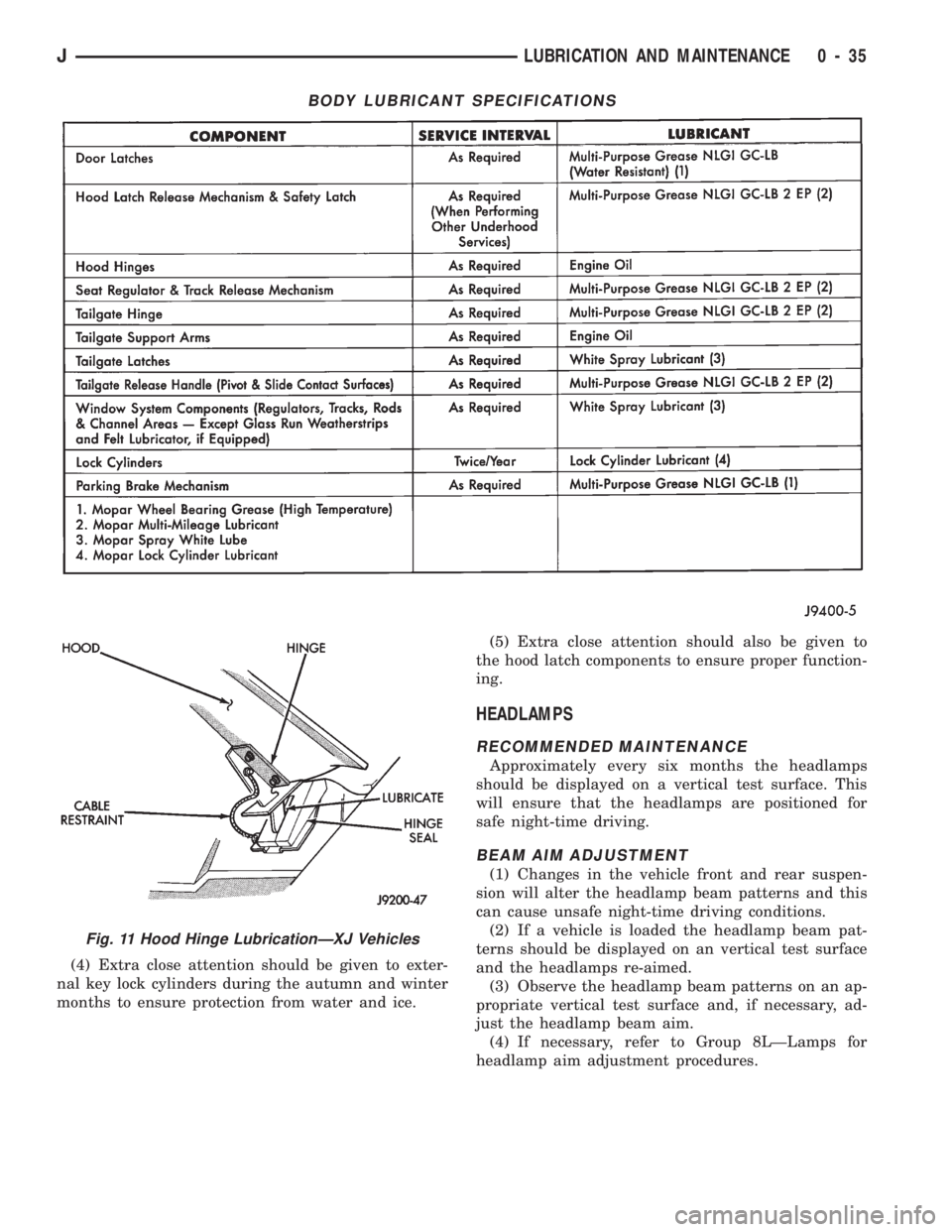
(4) Extra close attention should be given to exter-
nal key lock cylinders during the autumn and winter
months to ensure protection from water and ice.(5) Extra close attention should also be given to
the hood latch components to ensure proper function-
ing.
HEADLAMPS
RECOMMENDED MAINTENANCE
Approximately every six months the headlamps
should be displayed on a vertical test surface. This
will ensure that the headlamps are positioned for
safe night-time driving.
BEAM AIM ADJUSTMENT
(1) Changes in the vehicle front and rear suspen-
sion will alter the headlamp beam patterns and this
can cause unsafe night-time driving conditions.
(2) If a vehicle is loaded the headlamp beam pat-
terns should be displayed on an vertical test surface
and the headlamps re-aimed.
(3) Observe the headlamp beam patterns on an ap-
propriate vertical test surface and, if necessary, ad-
just the headlamp beam aim.
(4) If necessary, refer to Group 8LÐLamps for
headlamp aim adjustment procedures.
BODY LUBRICANT SPECIFICATIONS
Fig. 11 Hood Hinge LubricationÐXJ Vehicles
JLUBRICATION AND MAINTENANCE 0 - 35
Page 57 of 1784
MODEL 30 AXLE AND TUBE AXLE (2WD)
INDEX
page page
Axle Bushing Replacement................. 32
Axle Shaft Ð Cardan U-Joint................ 25
Axle Specifications....................... 46
Backlash and Contact Pattern Analysis........ 44
Cleaning/Inspection....................... 35
Differential and Pinion Measurement.......... 38
Differential Assembly...................... 36
Differential Disassembly.................... 34
Differential Installation..................... 43
Differential Removal...................... 32
Differential Shim Pack Measurement and Adjustment.42
Drive Axle Assembly ReplacementÐXJ Vehicles . 21
Drive Axle Assembly ReplacementÐYJ Vehicles . 21Final Assembly.......................... 44
Hub Bearing and Axle Shaft................ 24
Information............................. 20
Inner Axle Shaft Oil Seal Replacement........ 33
Lubricant Change........................ 22
Lubricant Specifications.................... 20
Pinion Gear Assembly/Installation............ 40
Pinion Gear Depth Information.............. 37
Pinion Removal/Disassembly................ 34
Pinion Seal Replacement.................. 23
Steering Knuckle and Ball Studs............. 30
Vacuum Disconnect Axle Ð YJ Vehicles....... 26
INFORMATION
The housing for Model 30 front axles consists of an
iron center casting (differential housing) with axle
shaft tubes extending from either side. The tubes are
pressed into and welded to the differential housing to
form a one-piece axle housing.
The integral type housing, hypoid gear design has
the centerline of the pinion set above the centerline
of the ring gear.
The axle has a fitting for a vent hose used to re-
lieve internal pressure caused by lubricant vaporiza-
tion and internal expansion.
The axles are equipped with semi-floating axle
shafts, meaning that loads are supported by the hub
bearings. The axle shafts are retained by nuts at the
hub bearings. The hub bearings are bolted to the
steering knuckle at the outboard end of the axle tube
yoke. The hub bearings are serviced as an assembly.
The axles are equipped with ABS brake sensors.
The sensors are attached to the knuckle assemblies
and tone rings are pressed on the axle shaft.Use
care when removing axle shafts as NOT to dam-
age the tone wheel or the sensor.
The stamped steel cover provides a means for in-
spection and servicing the differential.
The Model 30 axle has the assembly part number
and gear ratio listed on a tag. The tag is attached to
the housing cover. Build date identification codes are
stamped on the axle shaft tube cover side.
The differential case is a one-piece design. The dif-
ferential pinion mate shaft is retained with a roll
pin. Differential bearing preload and ring gear back-
lash is adjusted by the use of shims (select thick-
ness). The shims are located between the differential
bearing cones and case. Pinion bearing preload is set
and maintained by the use of collapsible spacer.
PINION GEAR DEPTH MEASUREMENT WITH
PINION GAUGE SET 6774, Pinion Block 6733 and
Dial Indicator C-3339 is performed when;²Axle/differential housing is being replaced
²Original pinion depth shim pack is lost or mis-
placed
²Replacing the differential case
²Original differential bearing shim pack is lost or
misplaced
COMMAND-TRACÐYJ VEHICLES
The Command-Trac system is a vacuum disconnect
axle. The system has a two-piece axle shaft coupled
together by a shift collar. For two-wheel drive oper-
ation, the vacuum motor and shift fork disengages
the axle shaft splines. For four-wheel drive opera-
tion, the vacuum motor and shift fork engages the
splines.
SELEC-TRACÐXJ VEHICLES
The Selec-Trac system is a non-disconnect axle.
Shifting from two-wheel to four-wheel drive is at the
transfer case.
For XJ vehicles equipped withSelec-Tracand
ABS brake system, refer to Group 5ÐBrakes for ad-
ditional service information.
LUBRICANT SPECIFICATIONS
Multi-purpose, hypoid gear lubricant should be
used for Model 30 axles. The lubricant should have
MIL-L-2105C and API GL 5 quality specifications.
MOPARtHypoid Gear Lubricant conforms to both of
these specifications.
²The factory fill for the Model 30 axle is SAE 75W
gear lubricant.Do not use heavier weight lubri-
cant, this will cause axle engagement difficulties.
²The factory installed lubricant quantity for the
NON-DISCONNECT TYPE AXLE is 5061 fluid oz..
²The factory installed lubricant quantity for the
VACUUM-DISCONNECT TYPE AXLE is 5661 fluid
oz..
2 - 20 FRONT SUSPENSION AND AXLEJ
Page 71 of 1784
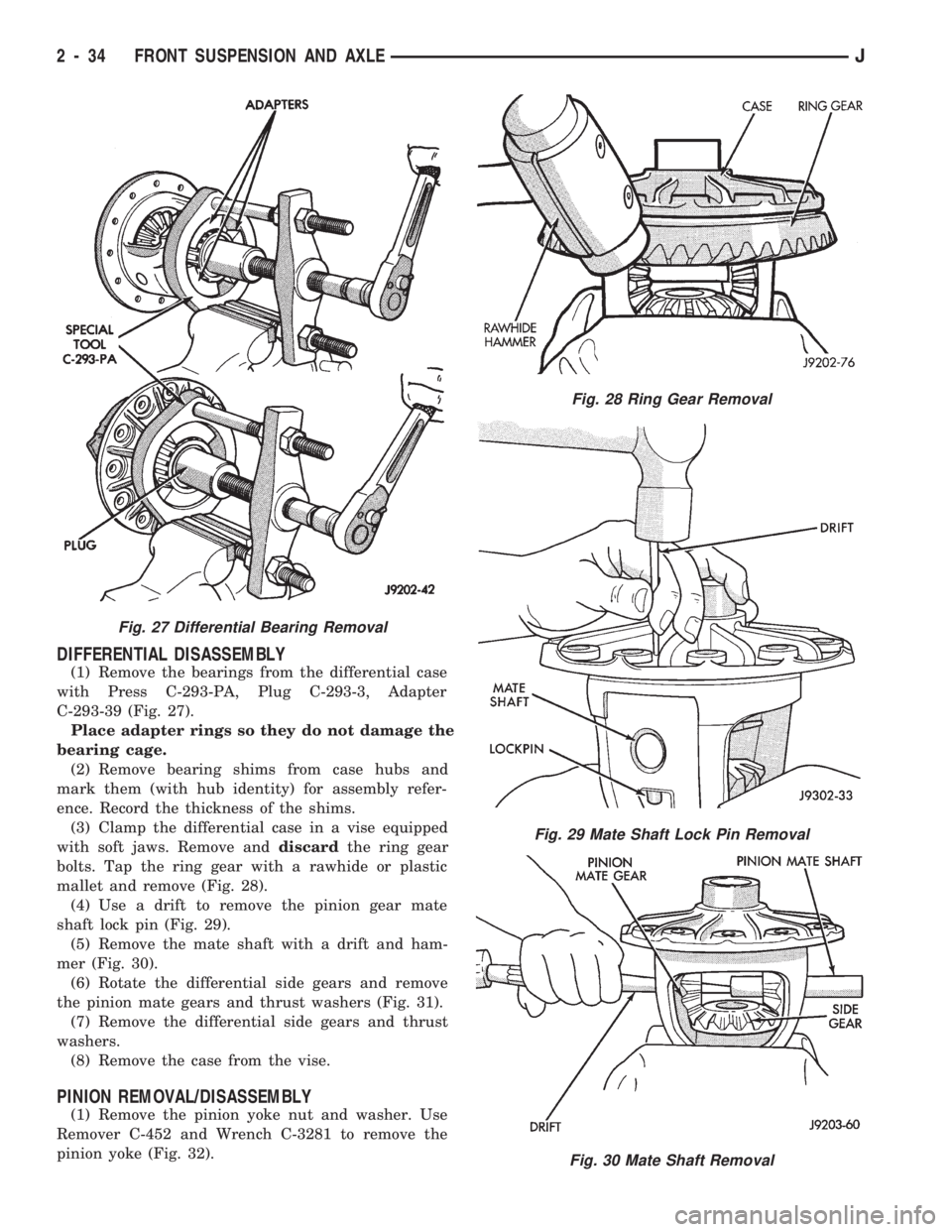
DIFFERENTIAL DISASSEMBLY
(1) Remove the bearings from the differential case
with Press C-293-PA, Plug C-293-3, Adapter
C-293-39 (Fig. 27).
Place adapter rings so they do not damage the
bearing cage.
(2) Remove bearing shims from case hubs and
mark them (with hub identity) for assembly refer-
ence. Record the thickness of the shims.
(3) Clamp the differential case in a vise equipped
with soft jaws. Remove anddiscardthe ring gear
bolts. Tap the ring gear with a rawhide or plastic
mallet and remove (Fig. 28).
(4) Use a drift to remove the pinion gear mate
shaft lock pin (Fig. 29).
(5) Remove the mate shaft with a drift and ham-
mer (Fig. 30).
(6) Rotate the differential side gears and remove
the pinion mate gears and thrust washers (Fig. 31).
(7) Remove the differential side gears and thrust
washers.
(8) Remove the case from the vise.
PINION REMOVAL/DISASSEMBLY
(1) Remove the pinion yoke nut and washer. Use
Remover C-452 and Wrench C-3281 to remove the
pinion yoke (Fig. 32).
Fig. 27 Differential Bearing Removal
Fig. 28 Ring Gear Removal
Fig. 29 Mate Shaft Lock Pin Removal
Fig. 30 Mate Shaft Removal
2 - 34 FRONT SUSPENSION AND AXLEJ
Page 73 of 1784
Wash bearings with solvent and towel dry, do not
dry with compressed air.Cup and bearing must be
replaced as a matched sets only.
Clean the axle shaft tubes with a clean cloth.
Inspect for;
²Smooth appearance with no broken/dented surfaces
on the bearing rollers or the roller contact surfaces.
²Bearing cups must not be distorted or cracked.
²Machined surfaces should be smooth and without
any raised edges.
²Raised metal on shoulders of cup bores should be
removed with a hand stone.²Wear or damage to pinion gear mate shaft, pinion
gears, side gears and thrust washers. Replace as a
matched set only.
²Worn or chipped teeth to ring and pinion gears.
²Damaged bolt threads to ring gear. Replaced as a
matched set only.
²Pinion yoke for cracks, worn splines, pitted areas,
and a rough/corroded seal contact surface. Repair or
replace the as necessary.
DIFFERENTIAL ASSEMBLY
ASSEMBLY
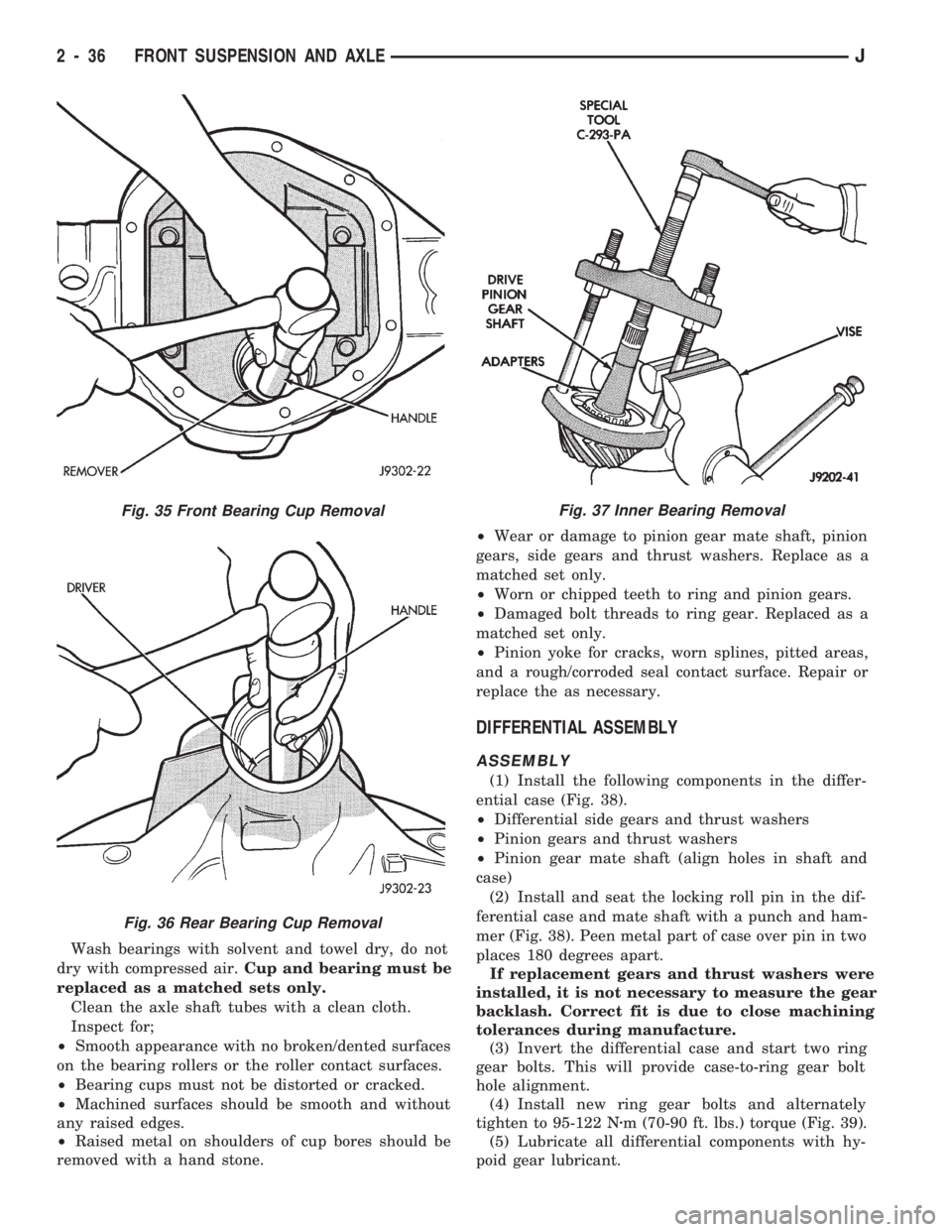
(1) Install the following components in the differ-
ential case (Fig. 38).
²Differential side gears and thrust washers
²Pinion gears and thrust washers
²Pinion gear mate shaft (align holes in shaft and
case)
(2) Install and seat the locking roll pin in the dif-
ferential case and mate shaft with a punch and ham-
mer (Fig. 38). Peen metal part of case over pin in two
places 180 degrees apart.
If replacement gears and thrust washers were
installed, it is not necessary to measure the gear
backlash. Correct fit is due to close machining
tolerances during manufacture.
(3) Invert the differential case and start two ring
gear bolts. This will provide case-to-ring gear bolt
hole alignment.
(4) Install new ring gear bolts and alternately
tighten to 95-122 Nzm (70-90 ft. lbs.) torque (Fig. 39).
(5) Lubricate all differential components with hy-
poid gear lubricant.
Fig. 35 Front Bearing Cup Removal
Fig. 36 Rear Bearing Cup Removal
Fig. 37 Inner Bearing Removal
2 - 36 FRONT SUSPENSION AND AXLEJ
Page 76 of 1784
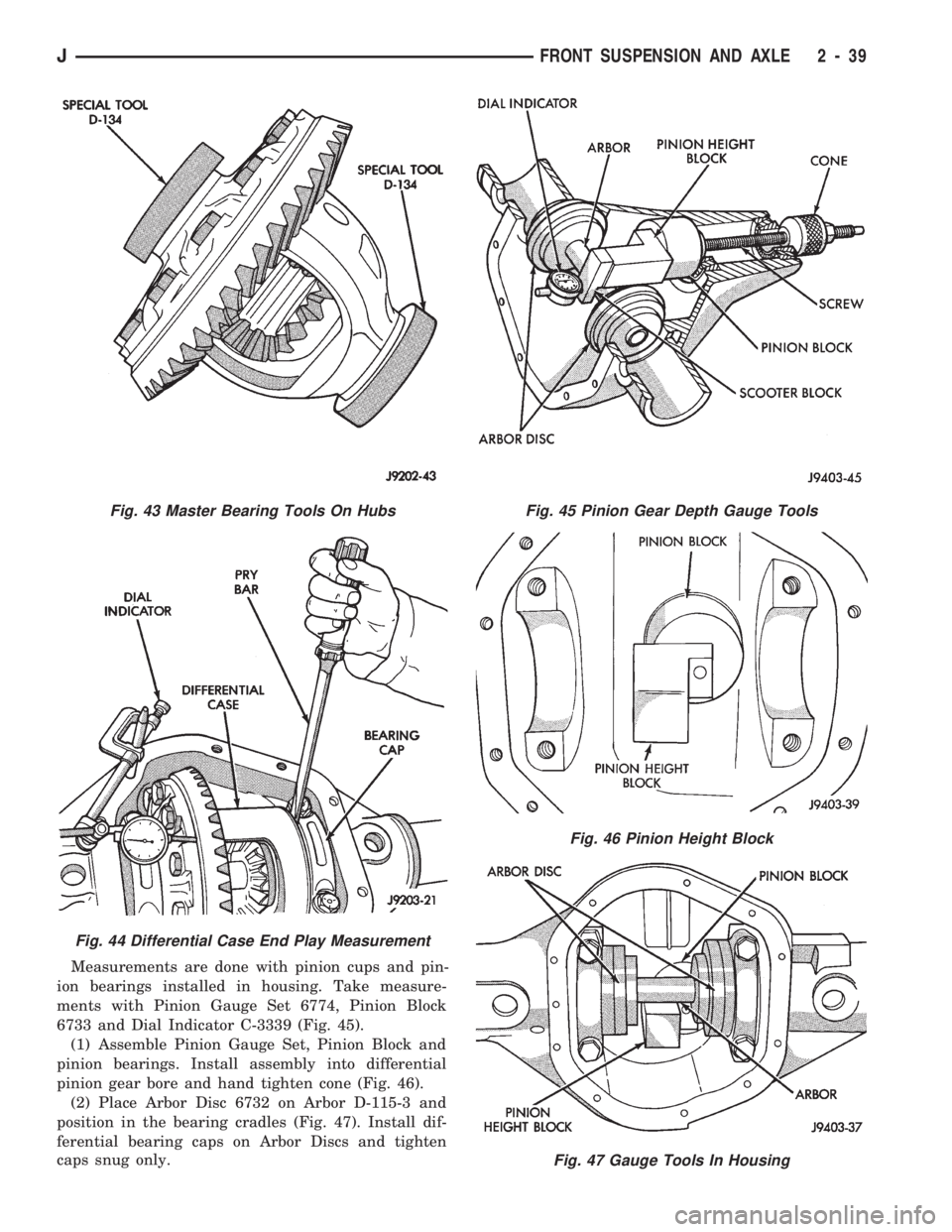
Measurements are done with pinion cups and pin-
ion bearings installed in housing. Take measure-
ments with Pinion Gauge Set 6774, Pinion Block
6733 and Dial Indicator C-3339 (Fig. 45).
(1) Assemble Pinion Gauge Set, Pinion Block and
pinion bearings. Install assembly into differential
pinion gear bore and hand tighten cone (Fig. 46).
(2) Place Arbor Disc 6732 on Arbor D-115-3 and
position in the bearing cradles (Fig. 47). Install dif-
ferential bearing caps on Arbor Discs and tighten
caps snug only.
Fig. 45 Pinion Gear Depth Gauge Tools
Fig. 46 Pinion Height Block
Fig. 47 Gauge Tools In Housing
Fig. 43 Master Bearing Tools On Hubs
Fig. 44 Differential Case End Play Measurement
JFRONT SUSPENSION AND AXLE 2 - 39
Page 77 of 1784
Arbor Discs have different steps to fit other
axle sizes. Pick correct size step for axle being
serviced.
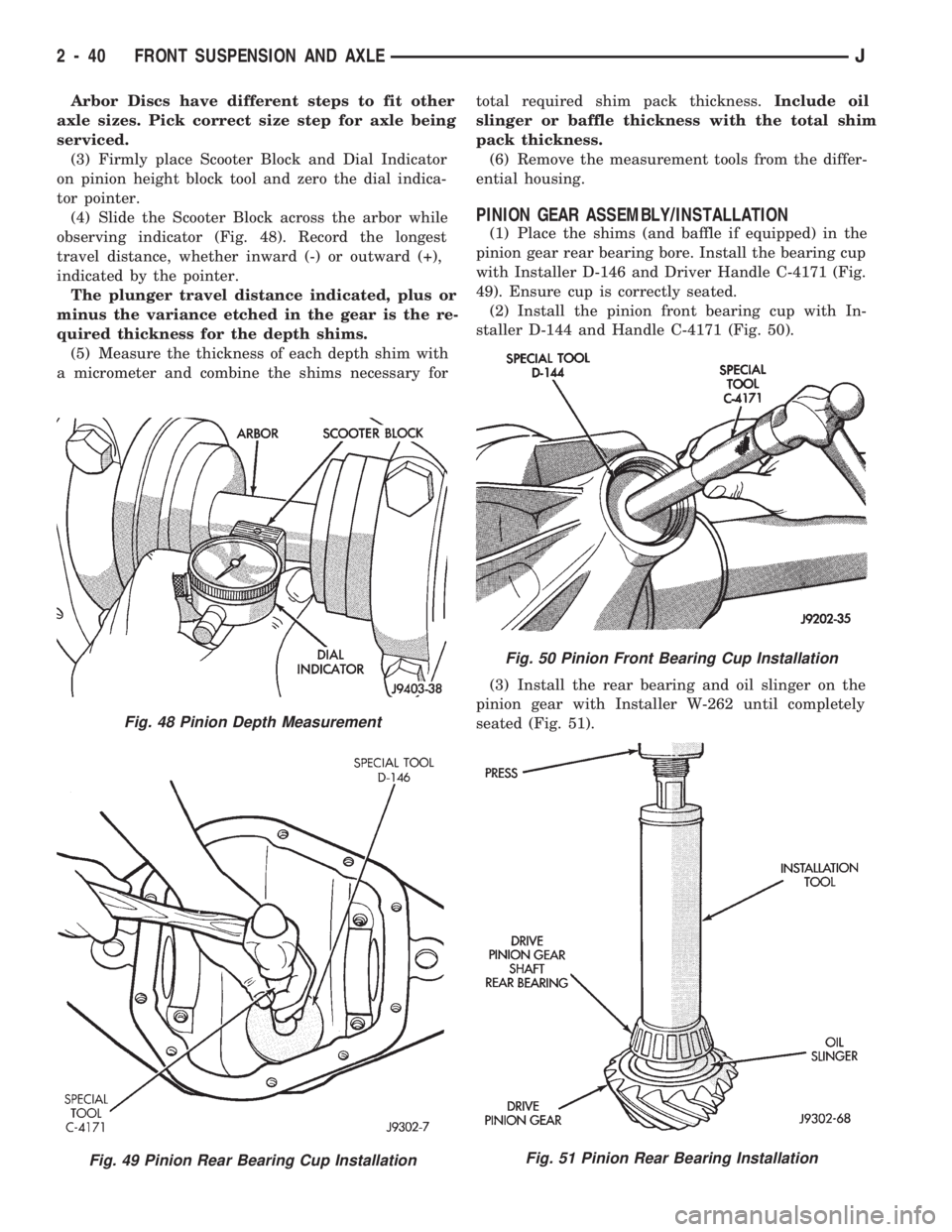
(3) Firmly place Scooter Block and Dial Indicator
on pinion height block tool and zero the dial indica-
tor pointer.
(4) Slide the Scooter Block across the arbor while
observing indicator (Fig. 48). Record the longest
travel distance, whether inward (-) or outward (+),
indicated by the pointer.
The plunger travel distance indicated, plus or
minus the variance etched in the gear is the re-
quired thickness for the depth shims.
(5) Measure the thickness of each depth shim with
a micrometer and combine the shims necessary fortotal required shim pack thickness.Include oil
slinger or baffle thickness with the total shim
pack thickness.
(6) Remove the measurement tools from the differ-
ential housing.
PINION GEAR ASSEMBLY/INSTALLATION
(1) Place the shims (and baffle if equipped) in the
pinion gear rear bearing bore. Install the bearing cup
with Installer D-146 and Driver Handle C-4171 (Fig.
49). Ensure cup is correctly seated.
(2) Install the pinion front bearing cup with In-
staller D-144 and Handle C-4171 (Fig. 50).
(3) Install the rear bearing and oil slinger on the
pinion gear with Installer W-262 until completely
seated (Fig. 51).
Fig. 48 Pinion Depth Measurement
Fig. 49 Pinion Rear Bearing Cup Installation
Fig. 50 Pinion Front Bearing Cup Installation
Fig. 51 Pinion Rear Bearing Installation
2 - 40 FRONT SUSPENSION AND AXLEJ
Page 88 of 1784
WARNING: WRAP SHOP TOWELS AROUND FUEL
HOSES TO ABSORB ANY FUEL SPILLAGE DURING
FUEL TANK REMOVAL.
(5) Disconnect fuel vent supply and return tubes
from fittings on fuel pump module.
(6) Disconnect fuel pump module electrical harness
connector from main harness.
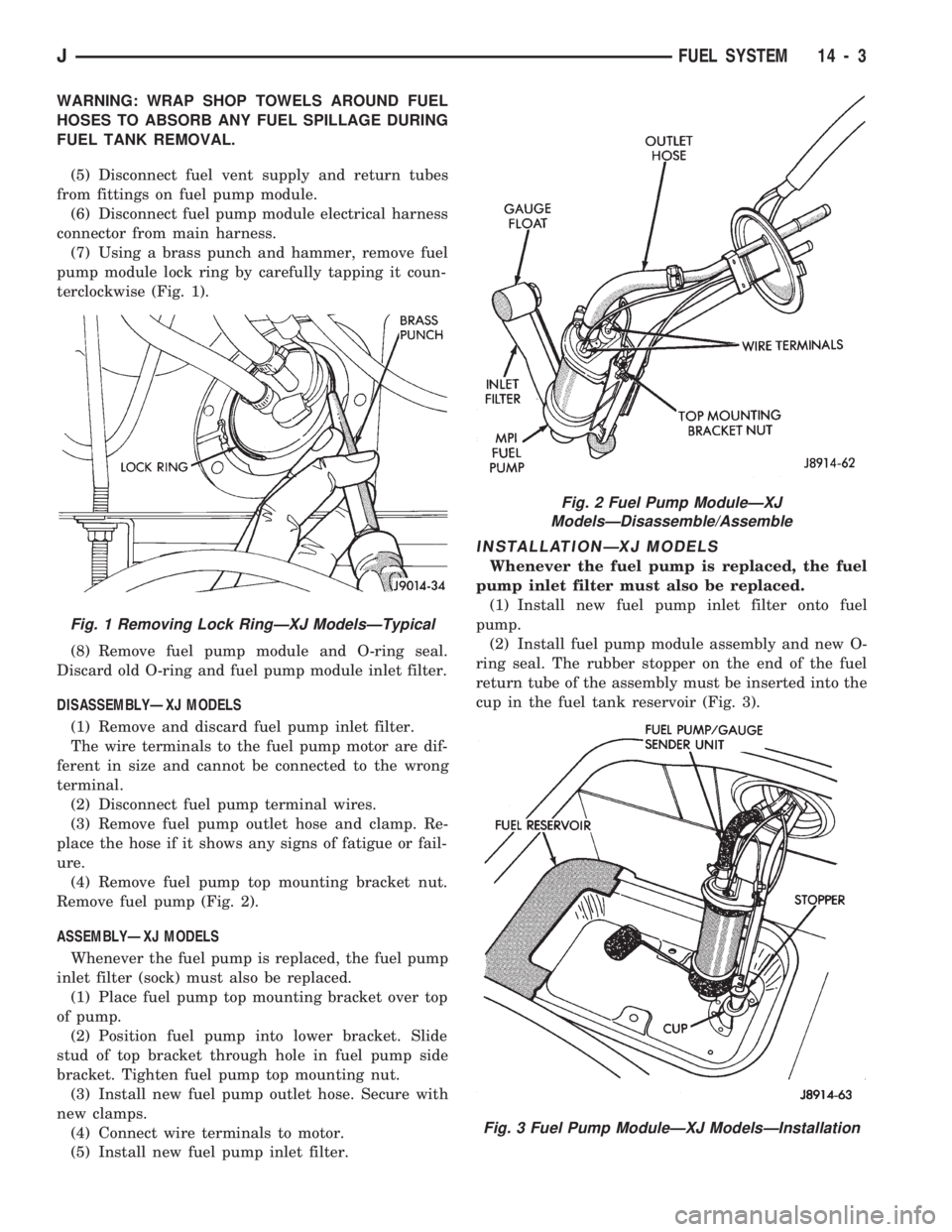
(7) Using a brass punch and hammer, remove fuel
pump module lock ring by carefully tapping it coun-
terclockwise (Fig. 1).
(8) Remove fuel pump module and O-ring seal.
Discard old O-ring and fuel pump module inlet filter.
DISASSEMBLYÐXJ MODELS
(1) Remove and discard fuel pump inlet filter.
The wire terminals to the fuel pump motor are dif-
ferent in size and cannot be connected to the wrong
terminal.
(2) Disconnect fuel pump terminal wires.
(3) Remove fuel pump outlet hose and clamp. Re-
place the hose if it shows any signs of fatigue or fail-
ure.
(4) Remove fuel pump top mounting bracket nut.
Remove fuel pump (Fig. 2).
ASSEMBLYÐXJ MODELS
Whenever the fuel pump is replaced, the fuel pump
inlet filter (sock) must also be replaced.
(1) Place fuel pump top mounting bracket over top
of pump.
(2) Position fuel pump into lower bracket. Slide
stud of top bracket through hole in fuel pump side
bracket. Tighten fuel pump top mounting nut.
(3) Install new fuel pump outlet hose. Secure with
new clamps.
(4) Connect wire terminals to motor.
(5) Install new fuel pump inlet filter.
INSTALLATIONÐXJ MODELS
Whenever the fuel pump is replaced, the fuel
pump inlet filter must also be replaced.
(1) Install new fuel pump inlet filter onto fuel
pump.
(2) Install fuel pump module assembly and new O-
ring seal. The rubber stopper on the end of the fuel
return tube of the assembly must be inserted into the
cup in the fuel tank reservoir (Fig. 3).
Fig. 1 Removing Lock RingÐXJ ModelsÐTypical
Fig. 2 Fuel Pump ModuleÐXJ
ModelsÐDisassemble/Assemble
Fig. 3 Fuel Pump ModuleÐXJ ModelsÐInstallation
JFUEL SYSTEM 14 - 3
Page 89 of 1784
(3) Using a brass punch and a hammer, install
lock ring. Carefully tap lock ring clockwise until it
seats against stop on fuel tank.
(4) Connect fuel supply and return hoses to fittings
on fuel pump module. Tighten hose clamps.
(5) Connect fuel pump module electrical harness
connector to main harness connector.
(6) Lower vehicle.
(7) Fill fuel tank. Install fuel tank cap.
(8) Connect negative battery cable.
(9) Start vehicle and inspect for leaks.
REMOVALÐYJ MODELS
The fuel tank must be removed to remove the fuel
pump module.
WARNING: THE FUEL SYSTEM IS UNDER A CON-
STANT PRESSURE (EVEN WITH THE ENGINE OFF).
BEFORE SERVICING THE FUEL PUMP MODULE,
THE FUEL SYSTEM PRESSURE MUST BE RE-
LEASED. REFER TO THE FUEL PRESSURE RE-
LEASE PROCEDURE IN THIS GROUP.
WARNING: EXTINGUISH ALL TOBACCO SMOKING
PRODUCTS BEFORE SERVICING THE FUEL SYS-
TEM. KEEP OPEN FLAME AWAY FROM FUEL SYS-
TEM COMPONENTS.
(1) Remove negative battery cable.
(2) Remove fuel filler cap. Perform the Fuel Pres-
sure Release Procedure as outlined in this group.
(3) Remove fuel tank. Refer to Fuel Tank Remov-
alÐYJ Models.
(4) Remove fuel pump module assembly.
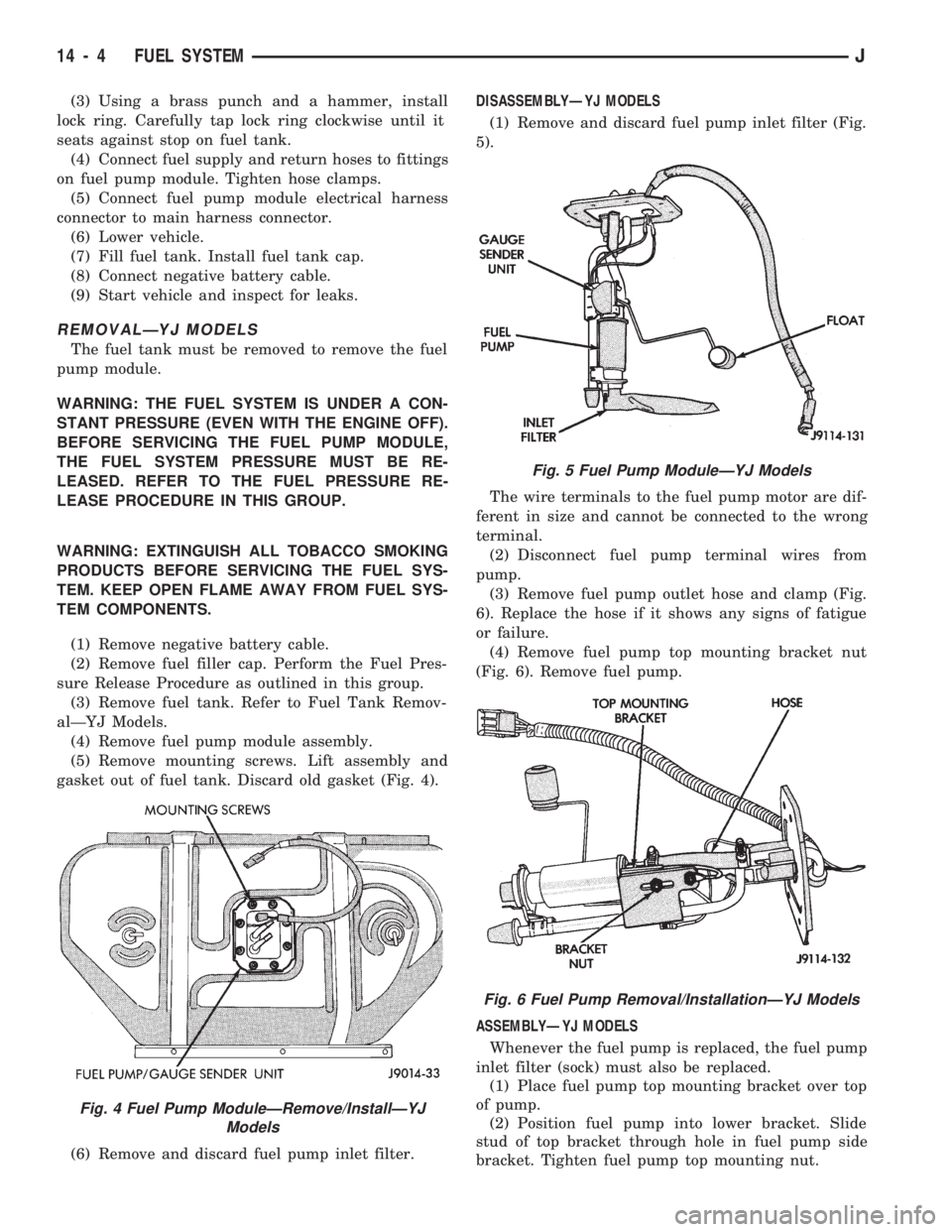
(5) Remove mounting screws. Lift assembly and
gasket out of fuel tank. Discard old gasket (Fig. 4).
(6) Remove and discard fuel pump inlet filter.DISASSEMBLYÐYJ MODELS
(1) Remove and discard fuel pump inlet filter (Fig.
5).
The wire terminals to the fuel pump motor are dif-
ferent in size and cannot be connected to the wrong
terminal.
(2) Disconnect fuel pump terminal wires from
pump.
(3) Remove fuel pump outlet hose and clamp (Fig.
6). Replace the hose if it shows any signs of fatigue
or failure.
(4) Remove fuel pump top mounting bracket nut
(Fig. 6). Remove fuel pump.
ASSEMBLYÐYJ MODELS
Whenever the fuel pump is replaced, the fuel pump
inlet filter (sock) must also be replaced.
(1) Place fuel pump top mounting bracket over top
of pump.
(2) Position fuel pump into lower bracket. Slide
stud of top bracket through hole in fuel pump side
bracket. Tighten fuel pump top mounting nut.
Fig. 4 Fuel Pump ModuleÐRemove/InstallÐYJ
Models
Fig. 5 Fuel Pump ModuleÐYJ Models
Fig. 6 Fuel Pump Removal/InstallationÐYJ Models
14 - 4 FUEL SYSTEMJ
Page 91 of 1784
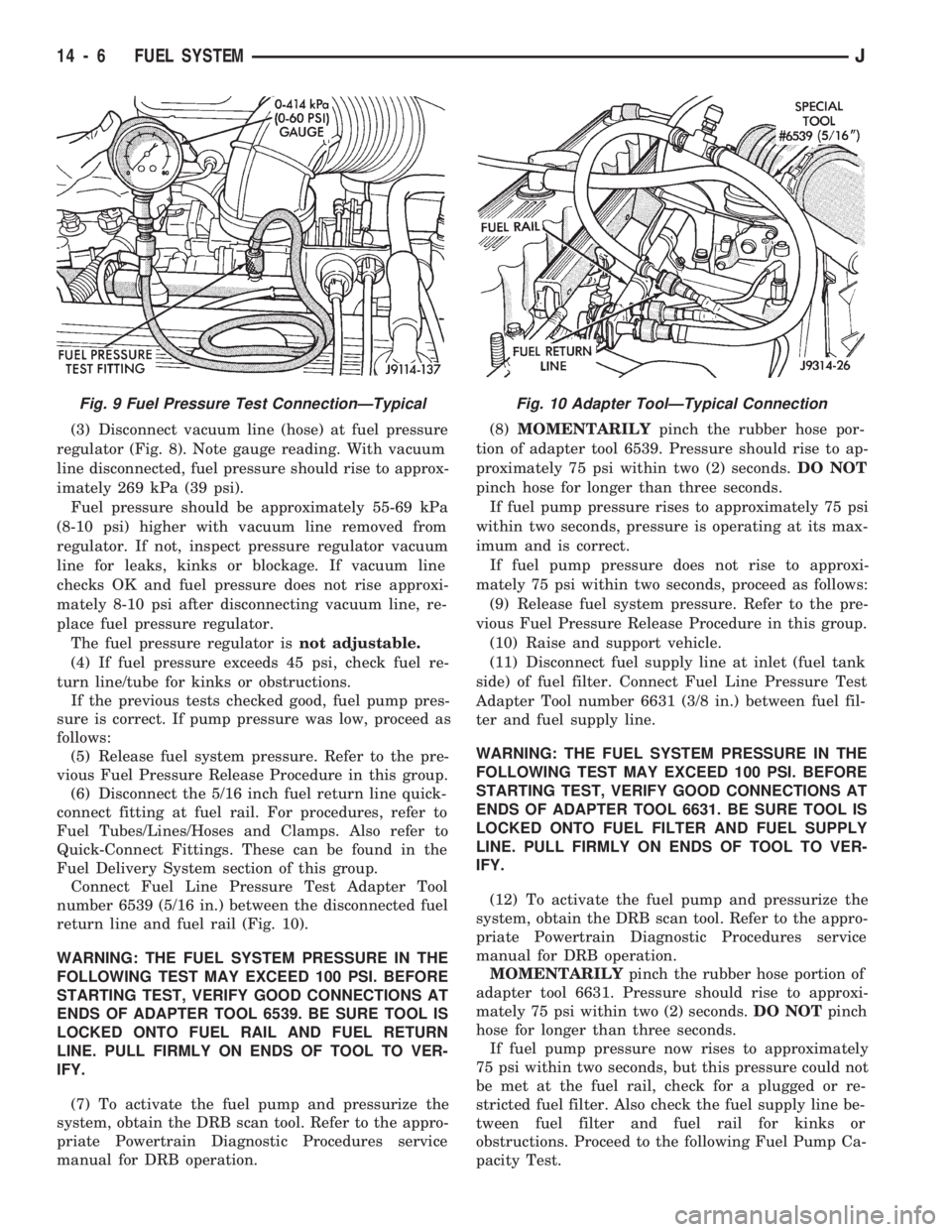
(3) Disconnect vacuum line (hose) at fuel pressure
regulator (Fig. 8). Note gauge reading. With vacuum
line disconnected, fuel pressure should rise to approx-
imately 269 kPa (39 psi).
Fuel pressure should be approximately 55-69 kPa
(8-10 psi) higher with vacuum line removed from
regulator. If not, inspect pressure regulator vacuum
line for leaks, kinks or blockage. If vacuum line
checks OK and fuel pressure does not rise approxi-
mately 8-10 psi after disconnecting vacuum line, re-
place fuel pressure regulator.
The fuel pressure regulator isnot adjustable.
(4) If fuel pressure exceeds 45 psi, check fuel re-
turn line/tube for kinks or obstructions.
If the previous tests checked good, fuel pump pres-
sure is correct. If pump pressure was low, proceed as
follows:
(5) Release fuel system pressure. Refer to the pre-
vious Fuel Pressure Release Procedure in this group.
(6) Disconnect the 5/16 inch fuel return line quick-
connect fitting at fuel rail. For procedures, refer to
Fuel Tubes/Lines/Hoses and Clamps. Also refer to
Quick-Connect Fittings. These can be found in the
Fuel Delivery System section of this group.
Connect Fuel Line Pressure Test Adapter Tool
number 6539 (5/16 in.) between the disconnected fuel
return line and fuel rail (Fig. 10).
WARNING: THE FUEL SYSTEM PRESSURE IN THE
FOLLOWING TEST MAY EXCEED 100 PSI. BEFORE
STARTING TEST, VERIFY GOOD CONNECTIONS AT
ENDS OF ADAPTER TOOL 6539. BE SURE TOOL IS
LOCKED ONTO FUEL RAIL AND FUEL RETURN
LINE. PULL FIRMLY ON ENDS OF TOOL TO VER-
IFY.
(7) To activate the fuel pump and pressurize the
system, obtain the DRB scan tool. Refer to the appro-
priate Powertrain Diagnostic Procedures service
manual for DRB operation.(8)MOMENTARILYpinch the rubber hose por-
tion of adapter tool 6539. Pressure should rise to ap-
proximately 75 psi within two (2) seconds.DO NOT
pinch hose for longer than three seconds.
If fuel pump pressure rises to approximately 75 psi
within two seconds, pressure is operating at its max-
imum and is correct.
If fuel pump pressure does not rise to approxi-
mately 75 psi within two seconds, proceed as follows:
(9) Release fuel system pressure. Refer to the pre-
vious Fuel Pressure Release Procedure in this group.
(10) Raise and support vehicle.
(11) Disconnect fuel supply line at inlet (fuel tank
side) of fuel filter. Connect Fuel Line Pressure Test
Adapter Tool number 6631 (3/8 in.) between fuel fil-
ter and fuel supply line.
WARNING: THE FUEL SYSTEM PRESSURE IN THE
FOLLOWING TEST MAY EXCEED 100 PSI. BEFORE
STARTING TEST, VERIFY GOOD CONNECTIONS AT
ENDS OF ADAPTER TOOL 6631. BE SURE TOOL IS
LOCKED ONTO FUEL FILTER AND FUEL SUPPLY
LINE. PULL FIRMLY ON ENDS OF TOOL TO VER-
IFY.
(12) To activate the fuel pump and pressurize the
system, obtain the DRB scan tool. Refer to the appro-
priate Powertrain Diagnostic Procedures service
manual for DRB operation.
MOMENTARILYpinch the rubber hose portion of
adapter tool 6631. Pressure should rise to approxi-
mately 75 psi within two (2) seconds.DO NOTpinch
hose for longer than three seconds.
If fuel pump pressure now rises to approximately
75 psi within two seconds, but this pressure could not
be met at the fuel rail, check for a plugged or re-
stricted fuel filter. Also check the fuel supply line be-
tween fuel filter and fuel rail for kinks or
obstructions. Proceed to the following Fuel Pump Ca-
pacity Test.
Fig. 9 Fuel Pressure Test ConnectionÐTypicalFig. 10 Adapter ToolÐTypical Connection
14 - 6 FUEL SYSTEMJ
Page 95 of 1784
CAUTION: If this release tab is not pressed prior to
releasing the pull tab, the pull tab will be damaged.
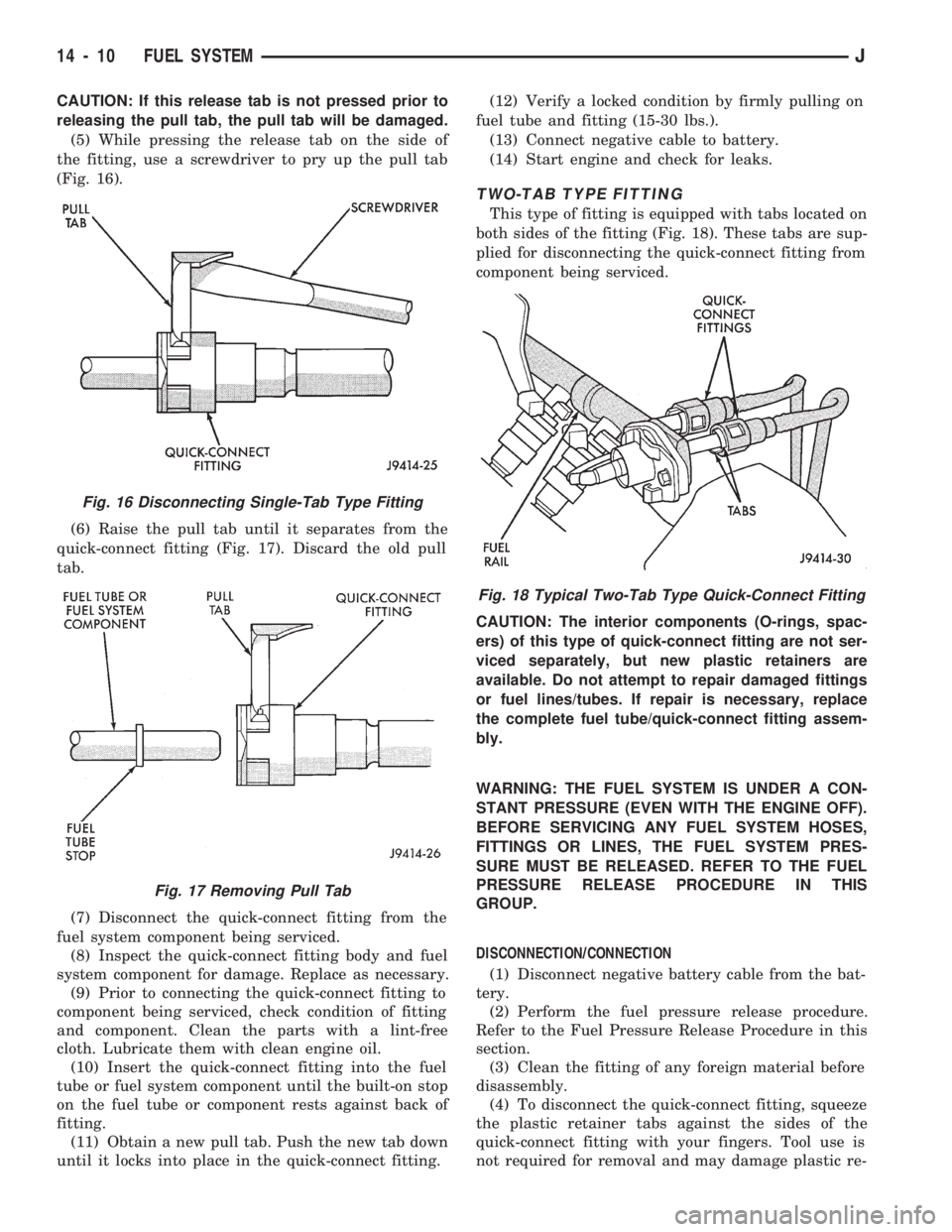
(5) While pressing the release tab on the side of
the fitting, use a screwdriver to pry up the pull tab
(Fig. 16).
(6) Raise the pull tab until it separates from the
quick-connect fitting (Fig. 17). Discard the old pull
tab.
(7) Disconnect the quick-connect fitting from the
fuel system component being serviced.
(8) Inspect the quick-connect fitting body and fuel
system component for damage. Replace as necessary.
(9) Prior to connecting the quick-connect fitting to
component being serviced, check condition of fitting
and component. Clean the parts with a lint-free
cloth. Lubricate them with clean engine oil.
(10) Insert the quick-connect fitting into the fuel
tube or fuel system component until the built-on stop
on the fuel tube or component rests against back of
fitting.
(11) Obtain a new pull tab. Push the new tab down
until it locks into place in the quick-connect fitting.(12) Verify a locked condition by firmly pulling on
fuel tube and fitting (15-30 lbs.).
(13) Connect negative cable to battery.
(14) Start engine and check for leaks.
TWO-TAB TYPE FITTING
This type of fitting is equipped with tabs located on
both sides of the fitting (Fig. 18). These tabs are sup-
plied for disconnecting the quick-connect fitting from
component being serviced.
CAUTION: The interior components (O-rings, spac-
ers) of this type of quick-connect fitting are not ser-
viced separately, but new plastic retainers are
available. Do not attempt to repair damaged fittings
or fuel lines/tubes. If repair is necessary, replace
the complete fuel tube/quick-connect fitting assem-
bly.
WARNING: THE FUEL SYSTEM IS UNDER A CON-
STANT PRESSURE (EVEN WITH THE ENGINE OFF).
BEFORE SERVICING ANY FUEL SYSTEM HOSES,
FITTINGS OR LINES, THE FUEL SYSTEM PRES-
SURE MUST BE RELEASED. REFER TO THE FUEL
PRESSURE RELEASE PROCEDURE IN THIS
GROUP.
DISCONNECTION/CONNECTION
(1) Disconnect negative battery cable from the bat-
tery.
(2) Perform the fuel pressure release procedure.
Refer to the Fuel Pressure Release Procedure in this
section.
(3) Clean the fitting of any foreign material before
disassembly.
(4) To disconnect the quick-connect fitting, squeeze
the plastic retainer tabs against the sides of the
quick-connect fitting with your fingers. Tool use is
not required for removal and may damage plastic re-
Fig. 16 Disconnecting Single-Tab Type Fitting
Fig. 17 Removing Pull Tab
Fig. 18 Typical Two-Tab Type Quick-Connect Fitting
14 - 10 FUEL SYSTEMJ