lock JEEP CHEROKEE 1995 Service Repair Manual
[x] Cancel search | Manufacturer: JEEP, Model Year: 1995, Model line: CHEROKEE, Model: JEEP CHEROKEE 1995Pages: 2198, PDF Size: 82.83 MB
Page 1521 of 2198
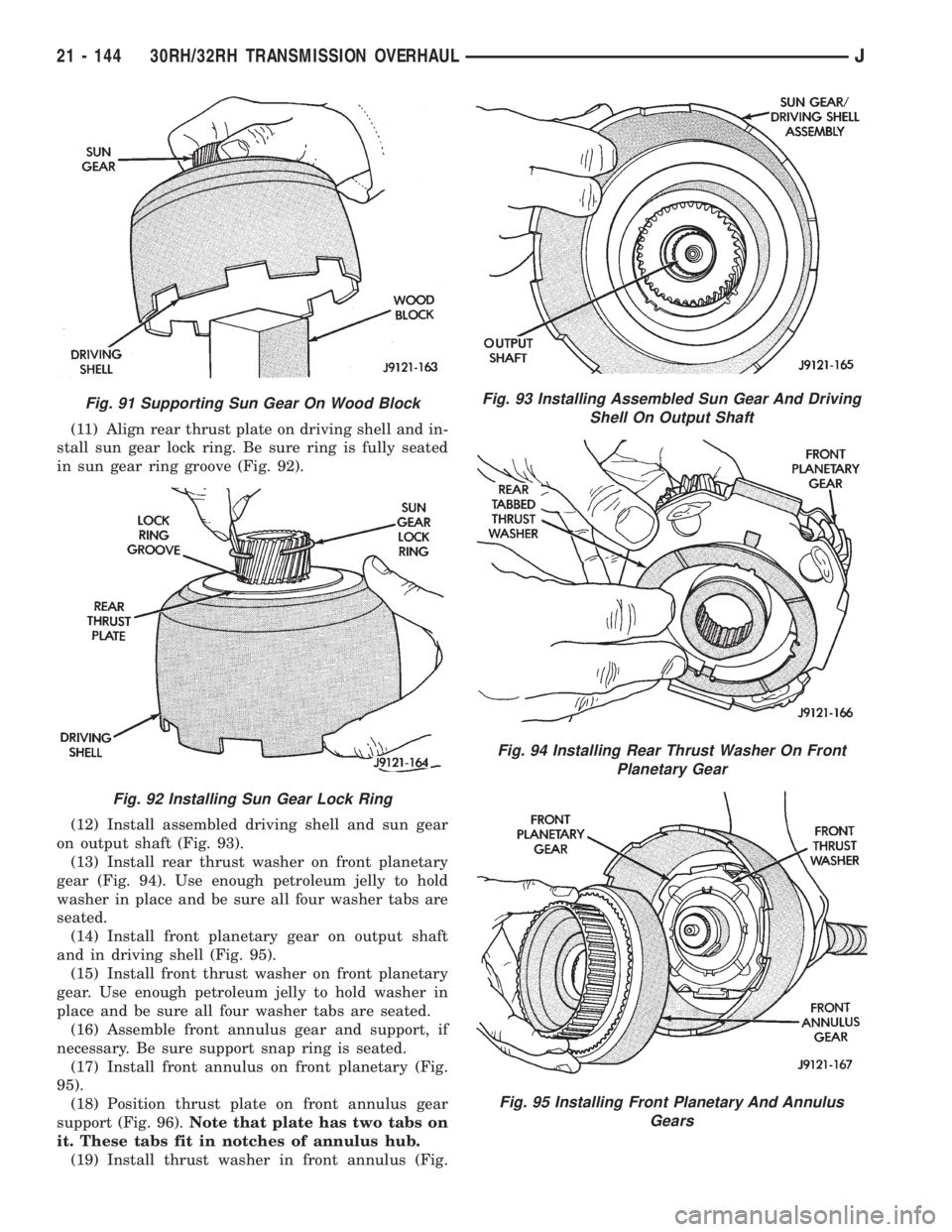
(11) Align rear thrust plate on driving shell and in-
stall sun gear lock ring. Be sure ring is fully seated
in sun gear ring groove (Fig. 92).
(12) Install assembled driving shell and sun gear
on output shaft (Fig. 93).
(13) Install rear thrust washer on front planetary
gear (Fig. 94). Use enough petroleum jelly to hold
washer in place and be sure all four washer tabs are
seated.
(14) Install front planetary gear on output shaft
and in driving shell (Fig. 95).
(15) Install front thrust washer on front planetary
gear. Use enough petroleum jelly to hold washer in
place and be sure all four washer tabs are seated.
(16) Assemble front annulus gear and support, if
necessary. Be sure support snap ring is seated.
(17) Install front annulus on front planetary (Fig.
95).
(18) Position thrust plate on front annulus gear
support (Fig. 96).Note that plate has two tabs on
it. These tabs fit in notches of annulus hub.
(19) Install thrust washer in front annulus (Fig.
Fig. 91 Supporting Sun Gear On Wood Block
Fig. 92 Installing Sun Gear Lock Ring
Fig. 93 Installing Assembled Sun Gear And Driving
Shell On Output Shaft
Fig. 94 Installing Rear Thrust Washer On Front
Planetary Gear
Fig. 95 Installing Front Planetary And Annulus
Gears
21 - 144 30RH/32RH TRANSMISSION OVERHAULJ
Page 1522 of 2198
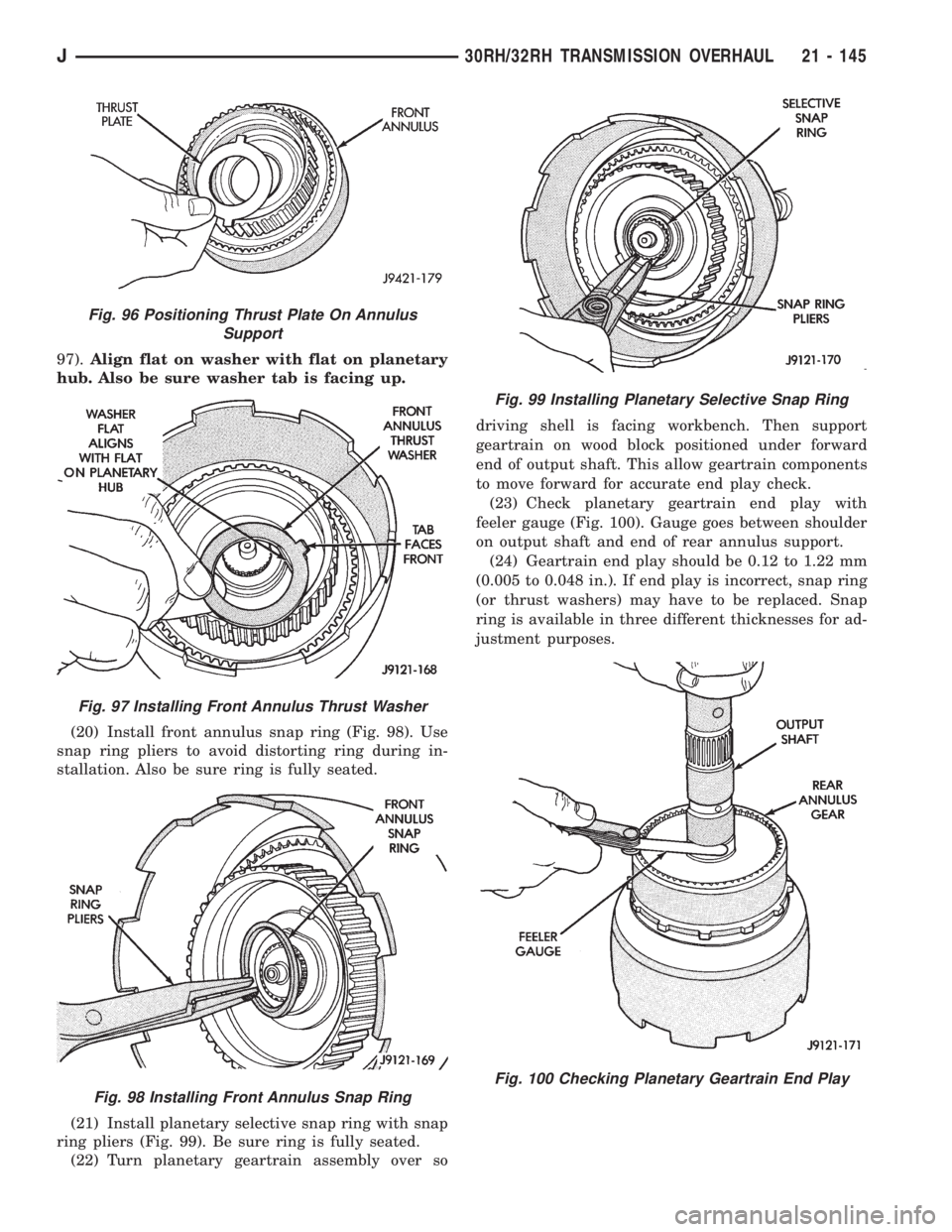
97).Align flat on washer with flat on planetary
hub. Also be sure washer tab is facing up.
(20) Install front annulus snap ring (Fig. 98). Use
snap ring pliers to avoid distorting ring during in-
stallation. Also be sure ring is fully seated.
(21) Install planetary selective snap ring with snap
ring pliers (Fig. 99). Be sure ring is fully seated.
(22) Turn planetary geartrain assembly over sodriving shell is facing workbench. Then support
geartrain on wood block positioned under forward
end of output shaft. This allow geartrain components
to move forward for accurate end play check.
(23) Check planetary geartrain end play with
feeler gauge (Fig. 100). Gauge goes between shoulder
on output shaft and end of rear annulus support.
(24) Geartrain end play should be 0.12 to 1.22 mm
(0.005 to 0.048 in.). If end play is incorrect, snap ring
(or thrust washers) may have to be replaced. Snap
ring is available in three different thicknesses for ad-
justment purposes.
Fig. 96 Positioning Thrust Plate On Annulus
Support
Fig. 97 Installing Front Annulus Thrust Washer
Fig. 98 Installing Front Annulus Snap Ring
Fig. 99 Installing Planetary Selective Snap Ring
Fig. 100 Checking Planetary Geartrain End Play
J30RH/32RH TRANSMISSION OVERHAUL 21 - 145
Page 1523 of 2198
FRONT SERVO AND BAND OVERHAUL
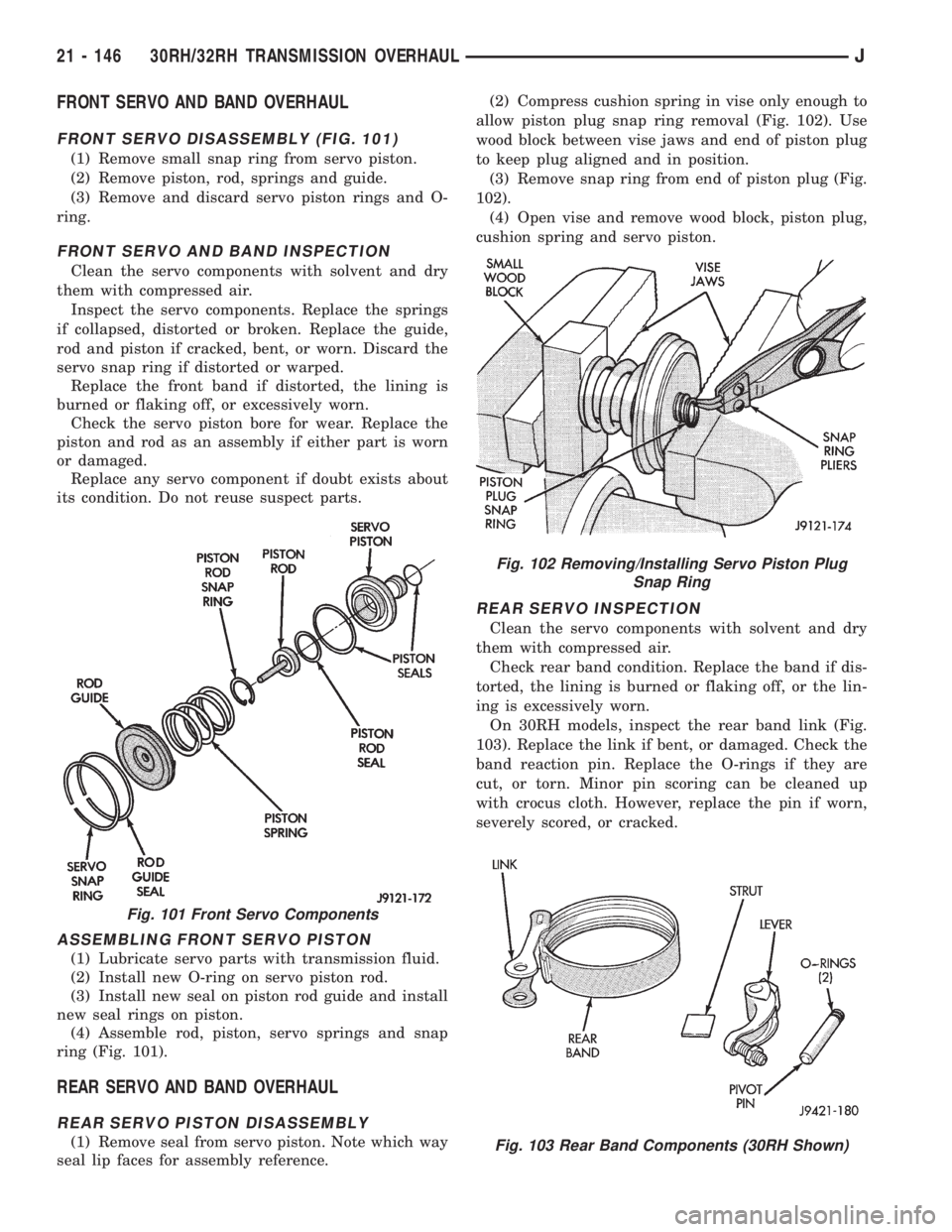
FRONT SERVO DISASSEMBLY (FIG. 101)
(1) Remove small snap ring from servo piston.
(2) Remove piston, rod, springs and guide.
(3) Remove and discard servo piston rings and O-
ring.
FRONT SERVO AND BAND INSPECTION
Clean the servo components with solvent and dry
them with compressed air.
Inspect the servo components. Replace the springs
if collapsed, distorted or broken. Replace the guide,
rod and piston if cracked, bent, or worn. Discard the
servo snap ring if distorted or warped.
Replace the front band if distorted, the lining is
burned or flaking off, or excessively worn.
Check the servo piston bore for wear. Replace the
piston and rod as an assembly if either part is worn
or damaged.
Replace any servo component if doubt exists about
its condition. Do not reuse suspect parts.
ASSEMBLING FRONT SERVO PISTON
(1) Lubricate servo parts with transmission fluid.
(2) Install new O-ring on servo piston rod.
(3) Install new seal on piston rod guide and install
new seal rings on piston.
(4) Assemble rod, piston, servo springs and snap
ring (Fig. 101).
REAR SERVO AND BAND OVERHAUL
REAR SERVO PISTON DISASSEMBLY
(1) Remove seal from servo piston. Note which way
seal lip faces for assembly reference.(2) Compress cushion spring in vise only enough to
allow piston plug snap ring removal (Fig. 102). Use
wood block between vise jaws and end of piston plug
to keep plug aligned and in position.
(3) Remove snap ring from end of piston plug (Fig.
102).
(4) Open vise and remove wood block, piston plug,
cushion spring and servo piston.
REAR SERVO INSPECTION
Clean the servo components with solvent and dry
them with compressed air.
Check rear band condition. Replace the band if dis-
torted, the lining is burned or flaking off, or the lin-
ing is excessively worn.
On 30RH models, inspect the rear band link (Fig.
103). Replace the link if bent, or damaged. Check the
band reaction pin. Replace the O-rings if they are
cut, or torn. Minor pin scoring can be cleaned up
with crocus cloth. However, replace the pin if worn,
severely scored, or cracked.
Fig. 101 Front Servo Components
Fig. 102 Removing/Installing Servo Piston Plug
Snap Ring
Fig. 103 Rear Band Components (30RH Shown)
21 - 146 30RH/32RH TRANSMISSION OVERHAULJ
Page 1526 of 2198
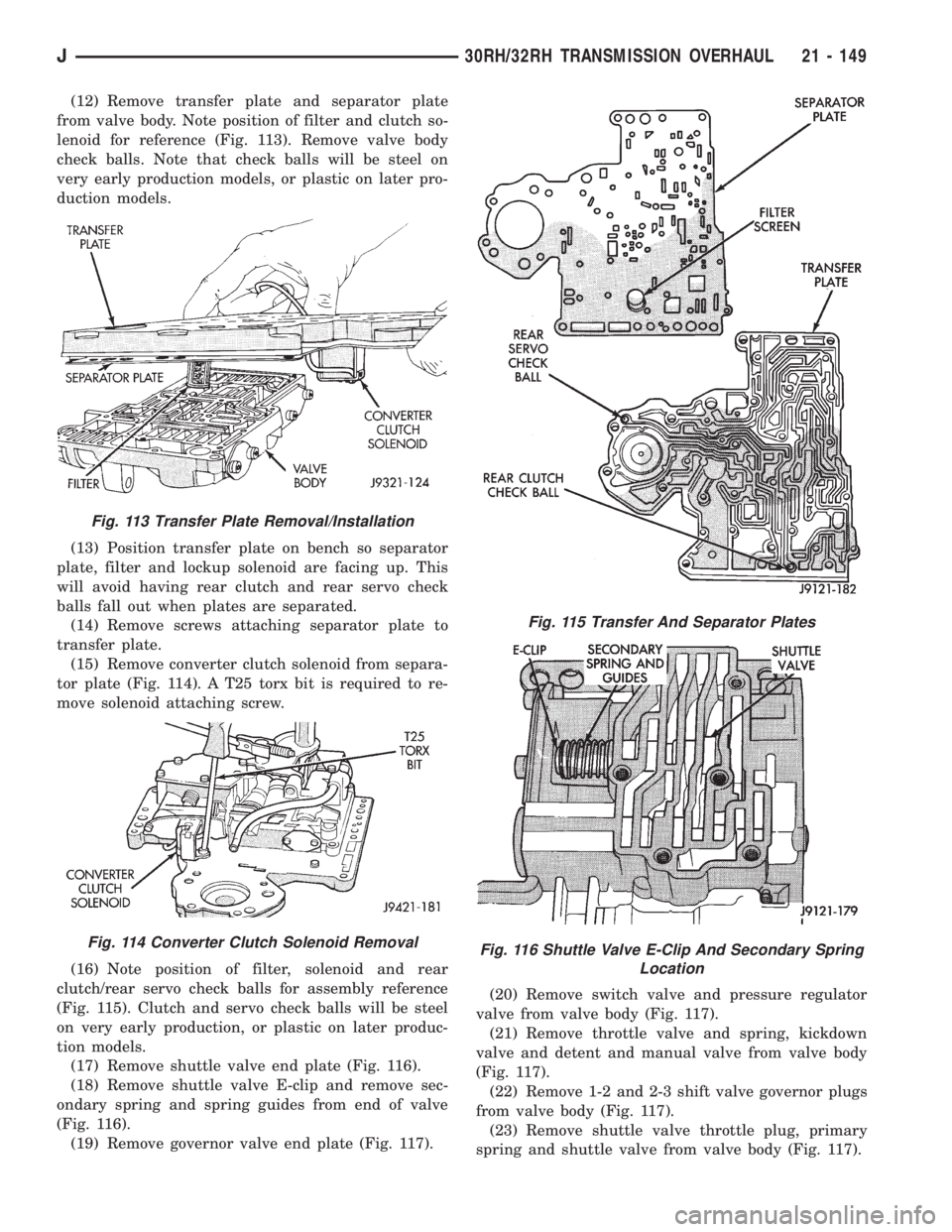
(12) Remove transfer plate and separator plate
from valve body. Note position of filter and clutch so-
lenoid for reference (Fig. 113). Remove valve body
check balls. Note that check balls will be steel on
very early production models, or plastic on later pro-
duction models.
(13) Position transfer plate on bench so separator
plate, filter and lockup solenoid are facing up. This
will avoid having rear clutch and rear servo check
balls fall out when plates are separated.
(14) Remove screws attaching separator plate to
transfer plate.
(15) Remove converter clutch solenoid from separa-
tor plate (Fig. 114). A T25 torx bit is required to re-
move solenoid attaching screw.
(16) Note position of filter, solenoid and rear
clutch/rear servo check balls for assembly reference
(Fig. 115). Clutch and servo check balls will be steel
on very early production, or plastic on later produc-
tion models.
(17) Remove shuttle valve end plate (Fig. 116).
(18) Remove shuttle valve E-clip and remove sec-
ondary spring and spring guides from end of valve
(Fig. 116).
(19) Remove governor valve end plate (Fig. 117).(20) Remove switch valve and pressure regulator
valve from valve body (Fig. 117).
(21) Remove throttle valve and spring, kickdown
valve and detent and manual valve from valve body
(Fig. 117).
(22) Remove 1-2 and 2-3 shift valve governor plugs
from valve body (Fig. 117).
(23) Remove shuttle valve throttle plug, primary
spring and shuttle valve from valve body (Fig. 117).
Fig. 113 Transfer Plate Removal/Installation
Fig. 114 Converter Clutch Solenoid Removal
Fig. 115 Transfer And Separator Plates
Fig. 116 Shuttle Valve E-Clip And Secondary Spring
Location
J30RH/32RH TRANSMISSION OVERHAUL 21 - 149
Page 1527 of 2198
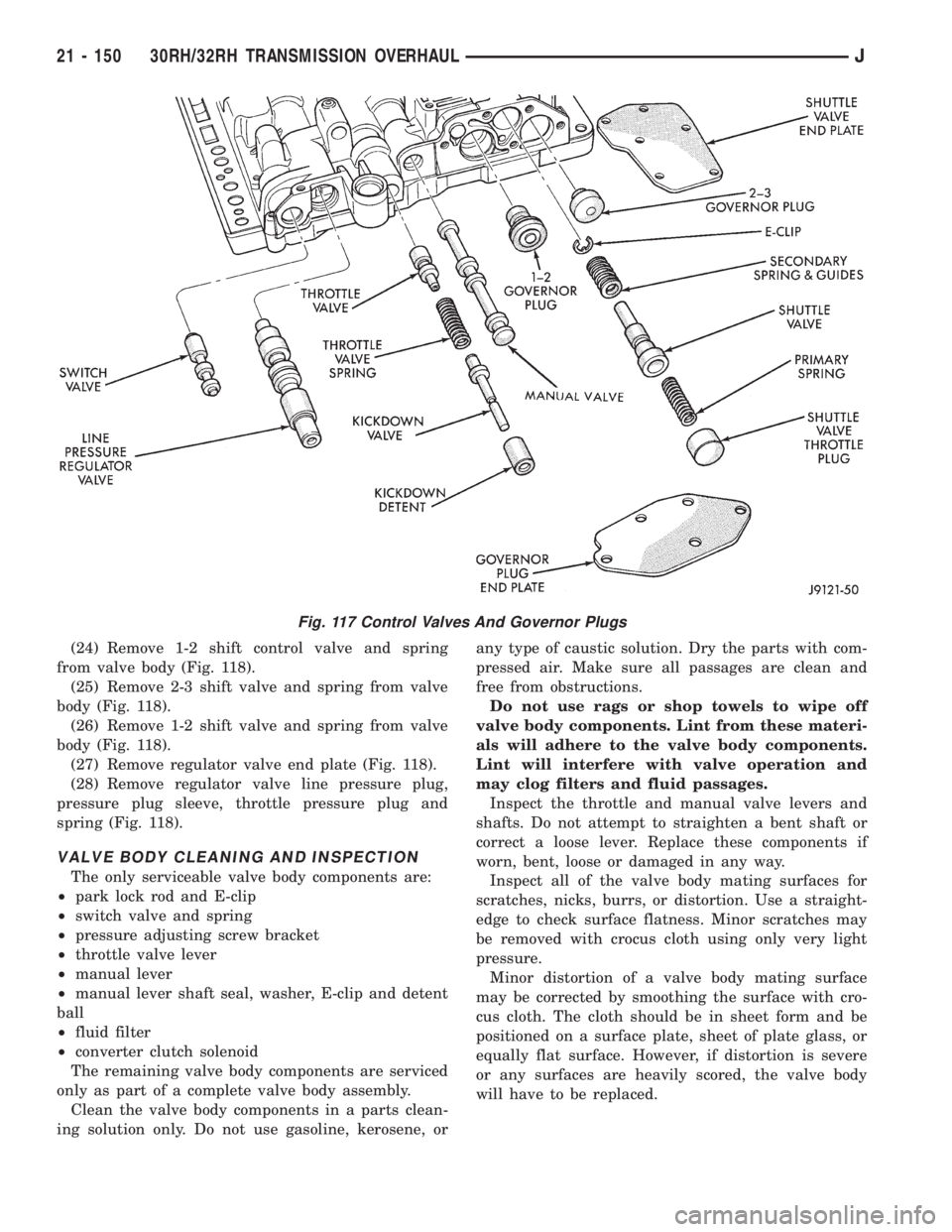
(24) Remove 1-2 shift control valve and spring
from valve body (Fig. 118).
(25) Remove 2-3 shift valve and spring from valve
body (Fig. 118).
(26) Remove 1-2 shift valve and spring from valve
body (Fig. 118).
(27) Remove regulator valve end plate (Fig. 118).
(28) Remove regulator valve line pressure plug,
pressure plug sleeve, throttle pressure plug and
spring (Fig. 118).
VALVE BODY CLEANING AND INSPECTION
The only serviceable valve body components are:
²park lock rod and E-clip
²switch valve and spring
²pressure adjusting screw bracket
²throttle valve lever
²manual lever
²manual lever shaft seal, washer, E-clip and detent
ball
²fluid filter
²converter clutch solenoid
The remaining valve body components are serviced
only as part of a complete valve body assembly.
Clean the valve body components in a parts clean-
ing solution only. Do not use gasoline, kerosene, orany type of caustic solution. Dry the parts with com-
pressed air. Make sure all passages are clean and
free from obstructions.
Do not use rags or shop towels to wipe off
valve body components. Lint from these materi-
als will adhere to the valve body components.
Lint will interfere with valve operation and
may clog filters and fluid passages.
Inspect the throttle and manual valve levers and
shafts. Do not attempt to straighten a bent shaft or
correct a loose lever. Replace these components if
worn, bent, loose or damaged in any way.
Inspect all of the valve body mating surfaces for
scratches, nicks, burrs, or distortion. Use a straight-
edge to check surface flatness. Minor scratches may
be removed with crocus cloth using only very light
pressure.
Minor distortion of a valve body mating surface
may be corrected by smoothing the surface with cro-
cus cloth. The cloth should be in sheet form and be
positioned on a surface plate, sheet of plate glass, or
equally flat surface. However, if distortion is severe
or any surfaces are heavily scored, the valve body
will have to be replaced.
Fig. 117 Control Valves And Governor Plugs
21 - 150 30RH/32RH TRANSMISSION OVERHAULJ
Page 1530 of 2198
VALVE BODY ASSEMBLY AND ADJUSTMENT
CAUTION: Do not force valves or plugs into place
during reassembly. If the valve body bores, valves
and plugs are free of distortion or burrs, the valve
body components should all slide into place easily.
In addition, do not overtighten the transfer plate
and valve body screws during reassembly. Over-
tightening can distort the valve body resulting in
valve sticking, cross leakage and unsatisfactory op-
eration. Tighten valve body screws to recom-
mended torque only.
(1) Lubricate valve body bores, valves and plugs
with Mopar ATF Plus transmission fluid.
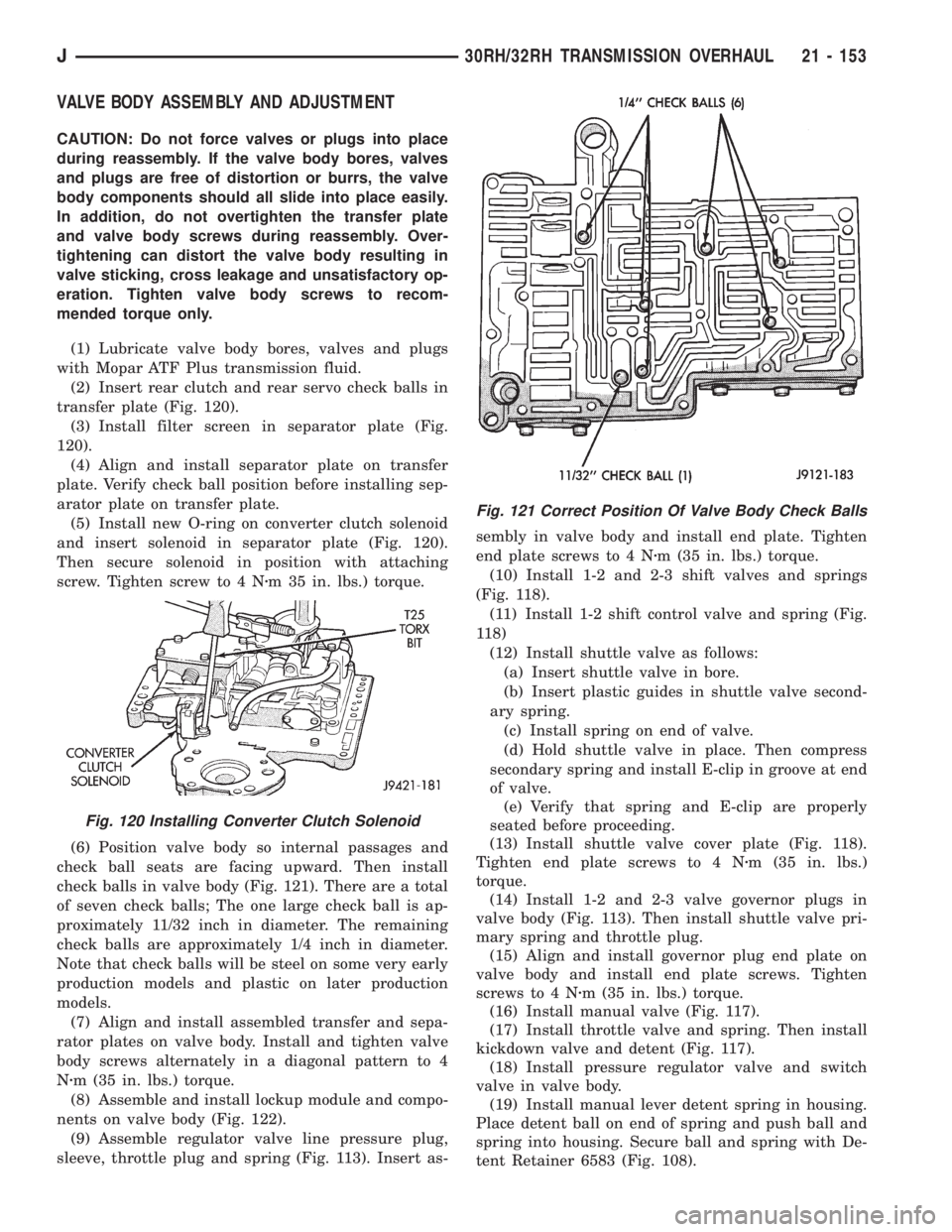
(2) Insert rear clutch and rear servo check balls in
transfer plate (Fig. 120).
(3) Install filter screen in separator plate (Fig.
120).
(4) Align and install separator plate on transfer
plate. Verify check ball position before installing sep-
arator plate on transfer plate.
(5) Install new O-ring on converter clutch solenoid
and insert solenoid in separator plate (Fig. 120).
Then secure solenoid in position with attaching
screw. Tighten screw to 4 Nzm 35 in. lbs.) torque.
(6) Position valve body so internal passages and
check ball seats are facing upward. Then install
check balls in valve body (Fig. 121). There are a total
of seven check balls; The one large check ball is ap-
proximately 11/32 inch in diameter. The remaining
check balls are approximately 1/4 inch in diameter.
Note that check balls will be steel on some very early
production models and plastic on later production
models.
(7) Align and install assembled transfer and sepa-
rator plates on valve body. Install and tighten valve
body screws alternately in a diagonal pattern to 4
Nzm (35 in. lbs.) torque.
(8) Assemble and install lockup module and compo-
nents on valve body (Fig. 122).
(9) Assemble regulator valve line pressure plug,
sleeve, throttle plug and spring (Fig. 113). Insert as-sembly in valve body and install end plate. Tighten
end plate screws to 4 Nzm (35 in. lbs.) torque.
(10) Install 1-2 and 2-3 shift valves and springs
(Fig. 118).
(11) Install 1-2 shift control valve and spring (Fig.
118)
(12) Install shuttle valve as follows:
(a) Insert shuttle valve in bore.
(b) Insert plastic guides in shuttle valve second-
ary spring.
(c) Install spring on end of valve.
(d) Hold shuttle valve in place. Then compress
secondary spring and install E-clip in groove at end
of valve.
(e) Verify that spring and E-clip are properly
seated before proceeding.
(13) Install shuttle valve cover plate (Fig. 118).
Tighten end plate screws to 4 Nzm (35 in. lbs.)
torque.
(14) Install 1-2 and 2-3 valve governor plugs in
valve body (Fig. 113). Then install shuttle valve pri-
mary spring and throttle plug.
(15) Align and install governor plug end plate on
valve body and install end plate screws. Tighten
screws to 4 Nzm (35 in. lbs.) torque.
(16) Install manual valve (Fig. 117).
(17) Install throttle valve and spring. Then install
kickdown valve and detent (Fig. 117).
(18) Install pressure regulator valve and switch
valve in valve body.
(19) Install manual lever detent spring in housing.
Place detent ball on end of spring and push ball and
spring into housing. Secure ball and spring with De-
tent Retainer 6583 (Fig. 108).
Fig. 120 Installing Converter Clutch Solenoid
Fig. 121 Correct Position Of Valve Body Check Balls
J30RH/32RH TRANSMISSION OVERHAUL 21 - 153
Page 1532 of 2198
justment must be performed properly and in the cor-
rect sequence. The correct sequence is line pressure
adjustment first and throttle pressure adjustment
last.
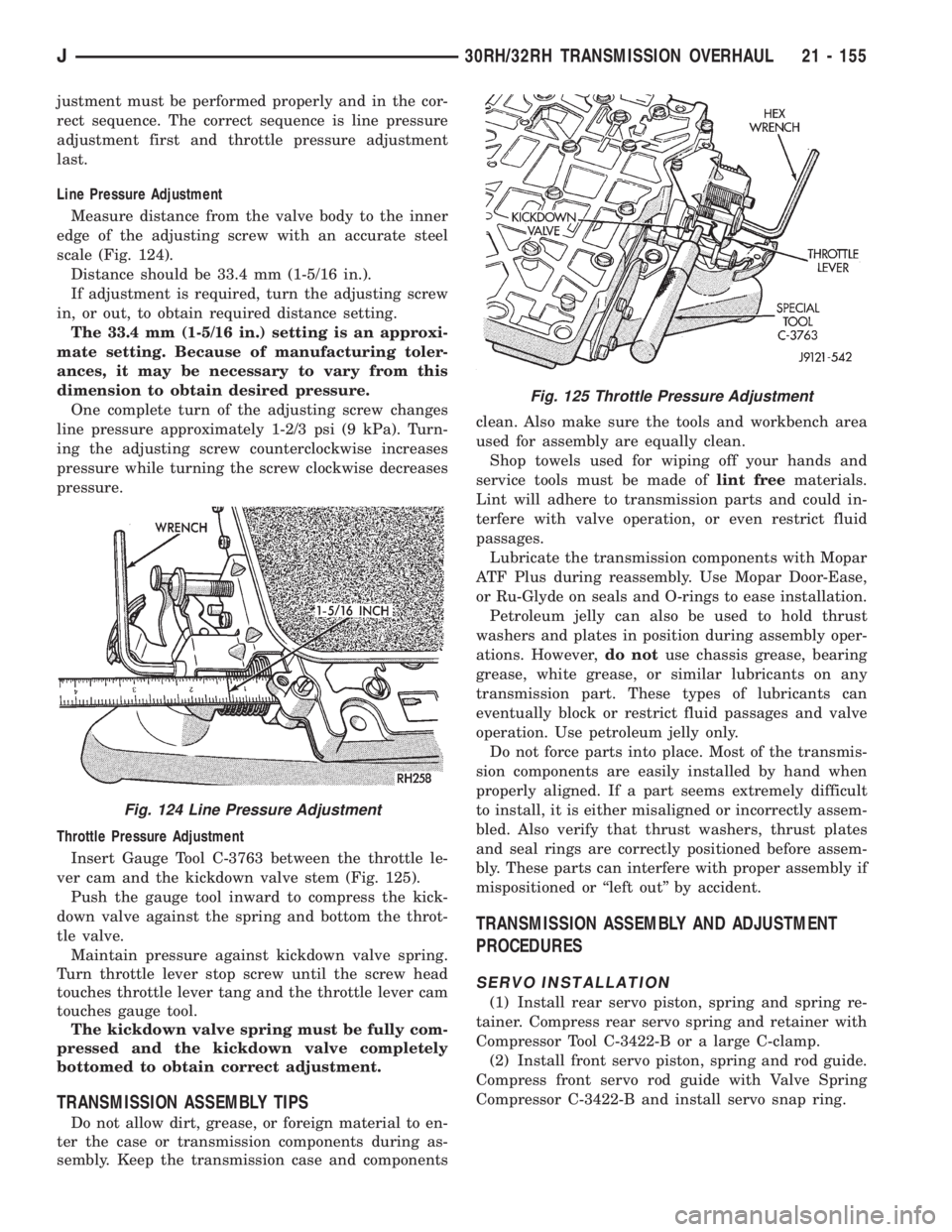
Line Pressure Adjustment
Measure distance from the valve body to the inner
edge of the adjusting screw with an accurate steel
scale (Fig. 124).
Distance should be 33.4 mm (1-5/16 in.).
If adjustment is required, turn the adjusting screw
in, or out, to obtain required distance setting.
The 33.4 mm (1-5/16 in.) setting is an approxi-
mate setting. Because of manufacturing toler-
ances, it may be necessary to vary from this
dimension to obtain desired pressure.
One complete turn of the adjusting screw changes
line pressure approximately 1-2/3 psi (9 kPa). Turn-
ing the adjusting screw counterclockwise increases
pressure while turning the screw clockwise decreases
pressure.
Throttle Pressure Adjustment
Insert Gauge Tool C-3763 between the throttle le-
ver cam and the kickdown valve stem (Fig. 125).
Push the gauge tool inward to compress the kick-
down valve against the spring and bottom the throt-
tle valve.
Maintain pressure against kickdown valve spring.
Turn throttle lever stop screw until the screw head
touches throttle lever tang and the throttle lever cam
touches gauge tool.
The kickdown valve spring must be fully com-
pressed and the kickdown valve completely
bottomed to obtain correct adjustment.
TRANSMISSION ASSEMBLY TIPS
Do not allow dirt, grease, or foreign material to en-
ter the case or transmission components during as-
sembly. Keep the transmission case and componentsclean. Also make sure the tools and workbench area
used for assembly are equally clean.
Shop towels used for wiping off your hands and
service tools must be made oflint freematerials.
Lint will adhere to transmission parts and could in-
terfere with valve operation, or even restrict fluid
passages.
Lubricate the transmission components with Mopar
ATF Plus during reassembly. Use Mopar Door-Ease,
or Ru-Glyde on seals and O-rings to ease installation.
Petroleum jelly can also be used to hold thrust
washers and plates in position during assembly oper-
ations. However,do notuse chassis grease, bearing
grease, white grease, or similar lubricants on any
transmission part. These types of lubricants can
eventually block or restrict fluid passages and valve
operation. Use petroleum jelly only.
Do not force parts into place. Most of the transmis-
sion components are easily installed by hand when
properly aligned. If a part seems extremely difficult
to install, it is either misaligned or incorrectly assem-
bled. Also verify that thrust washers, thrust plates
and seal rings are correctly positioned before assem-
bly. These parts can interfere with proper assembly if
mispositioned or ``left out'' by accident.
TRANSMISSION ASSEMBLY AND ADJUSTMENT
PROCEDURES
SERVO INSTALLATION
(1) Install rear servo piston, spring and spring re-
tainer. Compress rear servo spring and retainer with
Compressor Tool C-3422-B or a large C-clamp.
(2) Install front servo piston, spring and rod guide.
Compress front servo rod guide with Valve Spring
Compressor C-3422-B and install servo snap ring.
Fig. 124 Line Pressure Adjustment
Fig. 125 Throttle Pressure Adjustment
J30RH/32RH TRANSMISSION OVERHAUL 21 - 155
Page 1534 of 2198
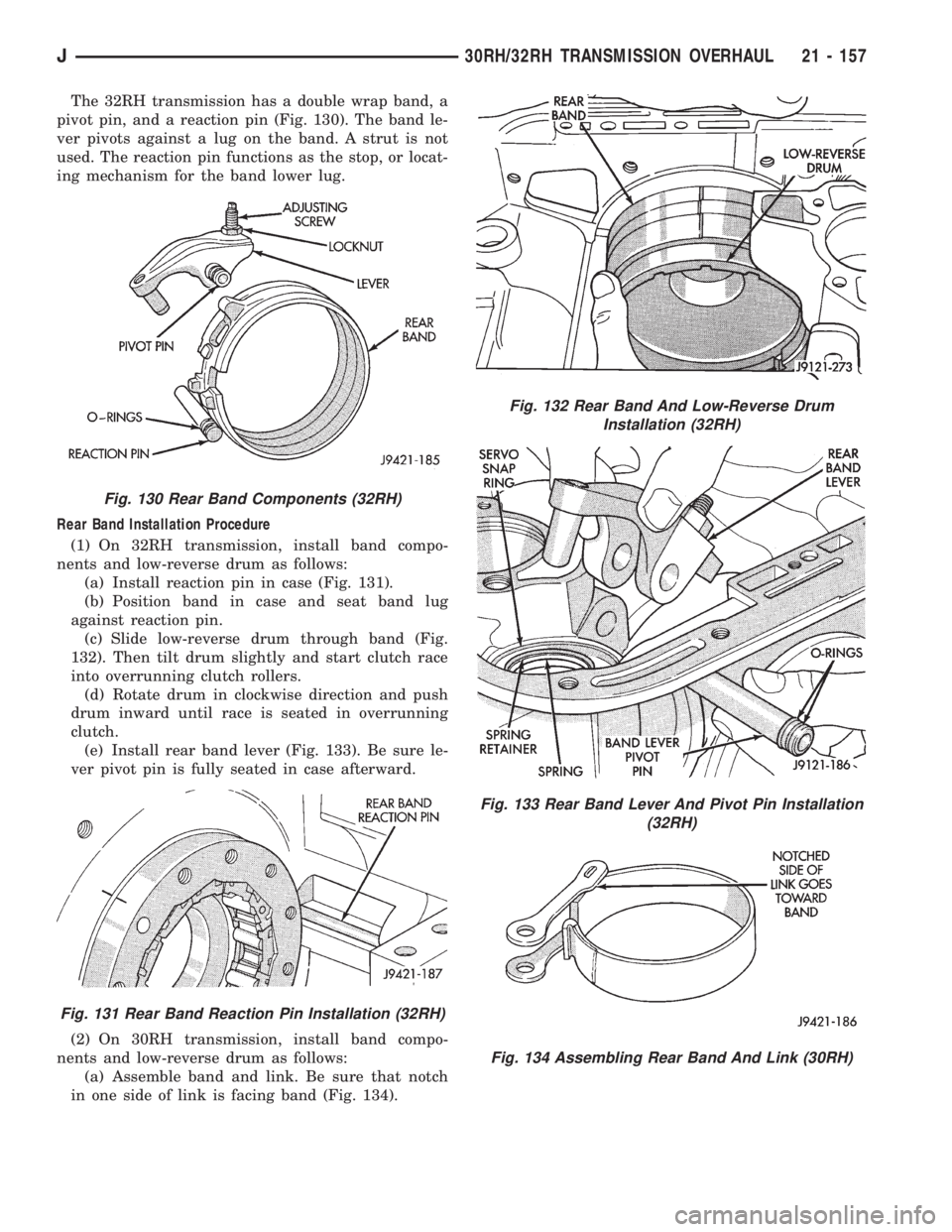
The 32RH transmission has a double wrap band, a
pivot pin, and a reaction pin (Fig. 130). The band le-
ver pivots against a lug on the band. A strut is not
used. The reaction pin functions as the stop, or locat-
ing mechanism for the band lower lug.
Rear Band Installation Procedure
(1) On 32RH transmission, install band compo-
nents and low-reverse drum as follows:
(a) Install reaction pin in case (Fig. 131).
(b) Position band in case and seat band lug
against reaction pin.
(c) Slide low-reverse drum through band (Fig.
132). Then tilt drum slightly and start clutch race
into overrunning clutch rollers.
(d) Rotate drum in clockwise direction and push
drum inward until race is seated in overrunning
clutch.
(e) Install rear band lever (Fig. 133). Be sure le-
ver pivot pin is fully seated in case afterward.
(2) On 30RH transmission, install band compo-
nents and low-reverse drum as follows:
(a) Assemble band and link. Be sure that notch
in one side of link is facing band (Fig. 134).
Fig. 130 Rear Band Components (32RH)
Fig. 131 Rear Band Reaction Pin Installation (32RH)
Fig. 132 Rear Band And Low-Reverse Drum
Installation (32RH)
Fig. 133 Rear Band Lever And Pivot Pin Installation
(32RH)
Fig. 134 Assembling Rear Band And Link (30RH)
J30RH/32RH TRANSMISSION OVERHAUL 21 - 157
Page 1535 of 2198
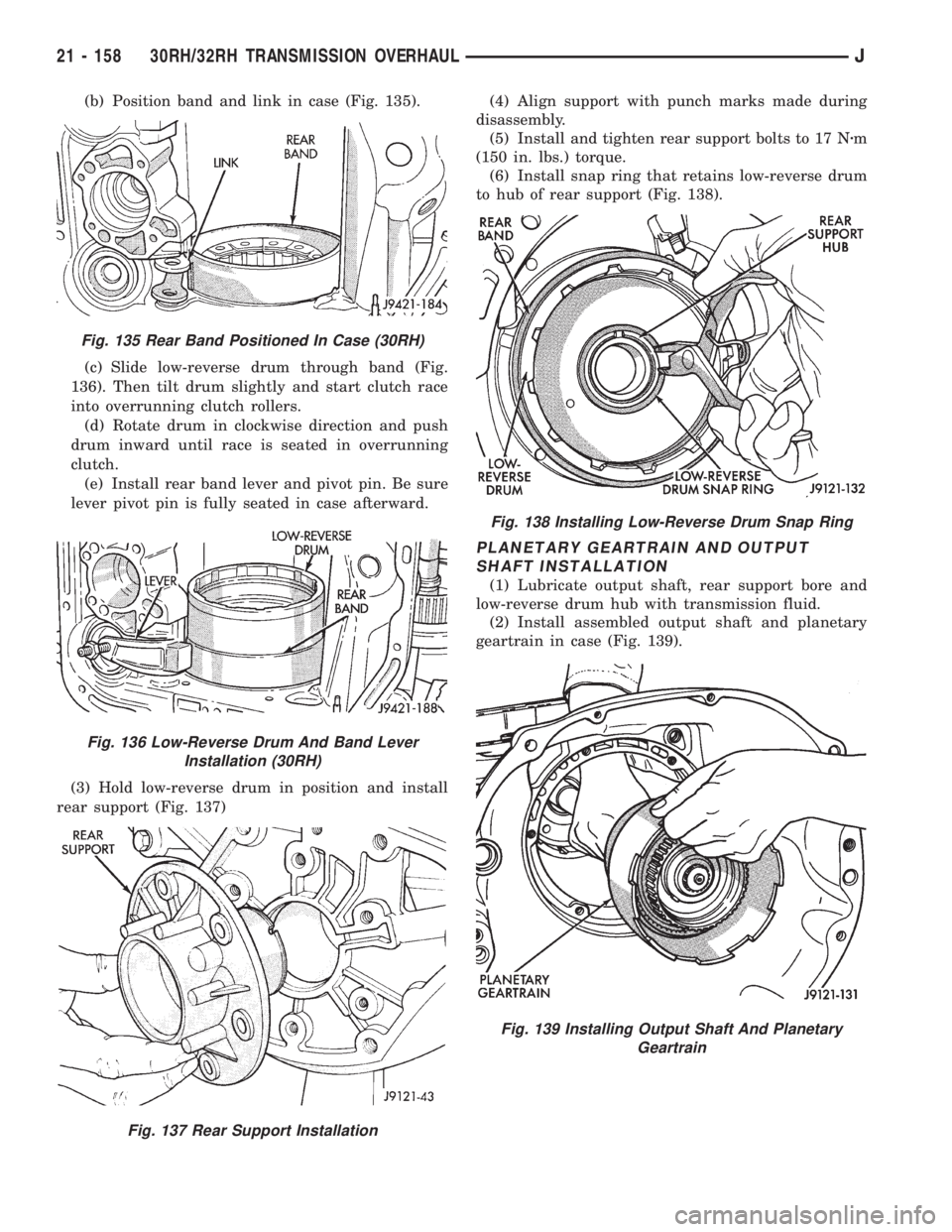
(b) Position band and link in case (Fig. 135).
(c) Slide low-reverse drum through band (Fig.
136). Then tilt drum slightly and start clutch race
into overrunning clutch rollers.
(d) Rotate drum in clockwise direction and push
drum inward until race is seated in overrunning
clutch.
(e) Install rear band lever and pivot pin. Be sure
lever pivot pin is fully seated in case afterward.
(3) Hold low-reverse drum in position and install
rear support (Fig. 137)(4) Align support with punch marks made during
disassembly.
(5) Install and tighten rear support bolts to 17 Nzm
(150 in. lbs.) torque.
(6) Install snap ring that retains low-reverse drum
to hub of rear support (Fig. 138).
PLANETARY GEARTRAIN AND OUTPUT
SHAFT INSTALLATION
(1) Lubricate output shaft, rear support bore and
low-reverse drum hub with transmission fluid.
(2) Install assembled output shaft and planetary
geartrain in case (Fig. 139).
Fig. 135 Rear Band Positioned In Case (30RH)
Fig. 136 Low-Reverse Drum And Band Lever
Installation (30RH)
Fig. 137 Rear Support Installation
Fig. 138 Installing Low-Reverse Drum Snap Ring
Fig. 139 Installing Output Shaft And Planetary
Geartrain
21 - 158 30RH/32RH TRANSMISSION OVERHAULJ
Page 1538 of 2198
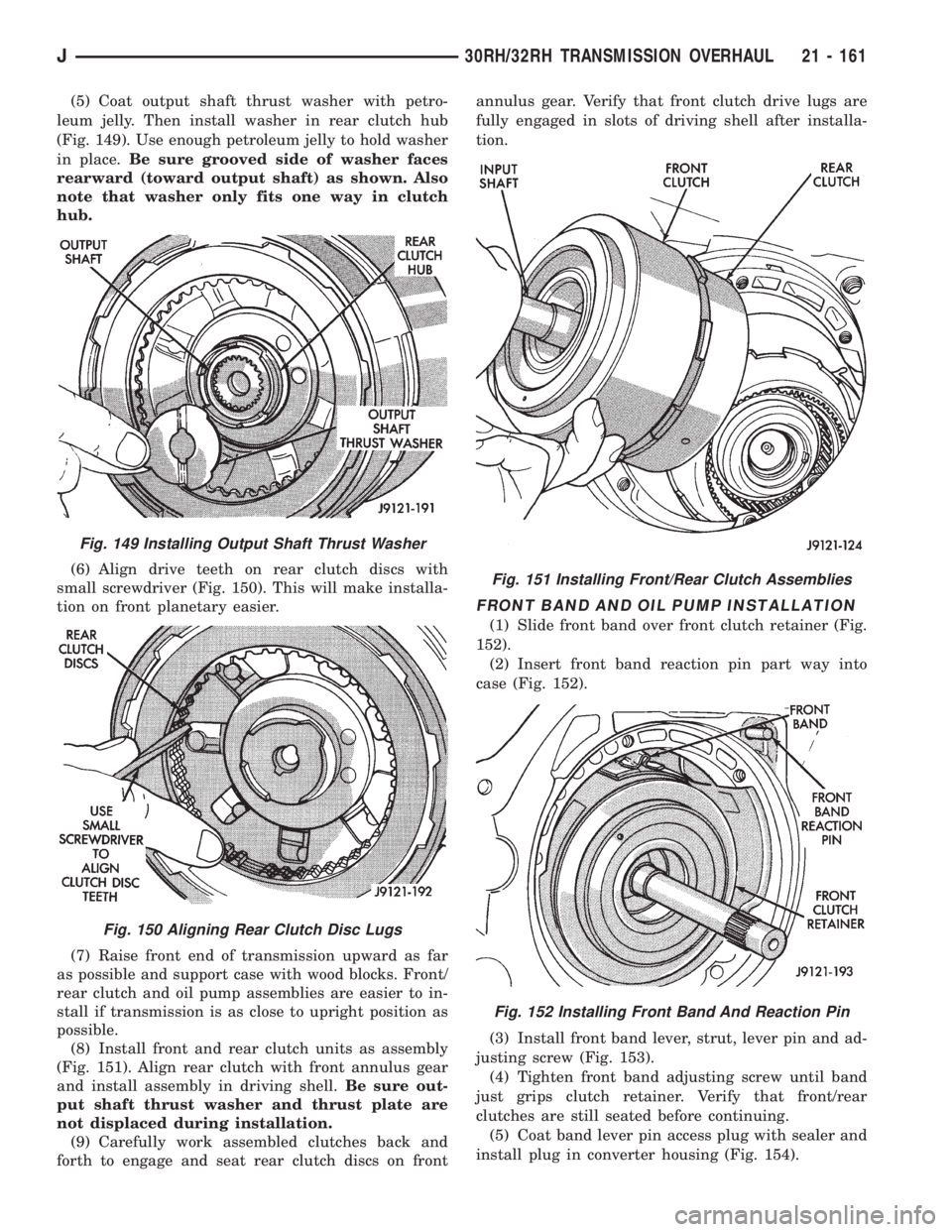
(5) Coat output shaft thrust washer with petro-
leum jelly. Then install washer in rear clutch hub
(Fig. 149). Use enough petroleum jelly to hold washer
in place.Be sure grooved side of washer faces
rearward (toward output shaft) as shown. Also
note that washer only fits one way in clutch
hub.
(6) Align drive teeth on rear clutch discs with
small screwdriver (Fig. 150). This will make installa-
tion on front planetary easier.
(7) Raise front end of transmission upward as far
as possible and support case with wood blocks. Front/
rear clutch and oil pump assemblies are easier to in-
stall if transmission is as close to upright position as
possible.
(8) Install front and rear clutch units as assembly
(Fig. 151). Align rear clutch with front annulus gear
and install assembly in driving shell.Be sure out-
put shaft thrust washer and thrust plate are
not displaced during installation.
(9) Carefully work assembled clutches back and
forth to engage and seat rear clutch discs on frontannulus gear. Verify that front clutch drive lugs are
fully engaged in slots of driving shell after installa-
tion.
FRONT BAND AND OIL PUMP INSTALLATION
(1) Slide front band over front clutch retainer (Fig.
152).
(2) Insert front band reaction pin part way into
case (Fig. 152).
(3) Install front band lever, strut, lever pin and ad-
justing screw (Fig. 153).
(4) Tighten front band adjusting screw until band
just grips clutch retainer. Verify that front/rear
clutches are still seated before continuing.
(5) Coat band lever pin access plug with sealer and
install plug in converter housing (Fig. 154).
Fig. 149 Installing Output Shaft Thrust Washer
Fig. 150 Aligning Rear Clutch Disc Lugs
Fig. 151 Installing Front/Rear Clutch Assemblies
Fig. 152 Installing Front Band And Reaction Pin
J30RH/32RH TRANSMISSION OVERHAUL 21 - 161