light JEEP CJ 1953 Workshop Manual
[x] Cancel search | Manufacturer: JEEP, Model Year: 1953, Model line: CJ, Model: JEEP CJ 1953Pages: 376, PDF Size: 19.96 MB
Page 94 of 376
Dl
DAUNTLESS
V-6
ENGINE
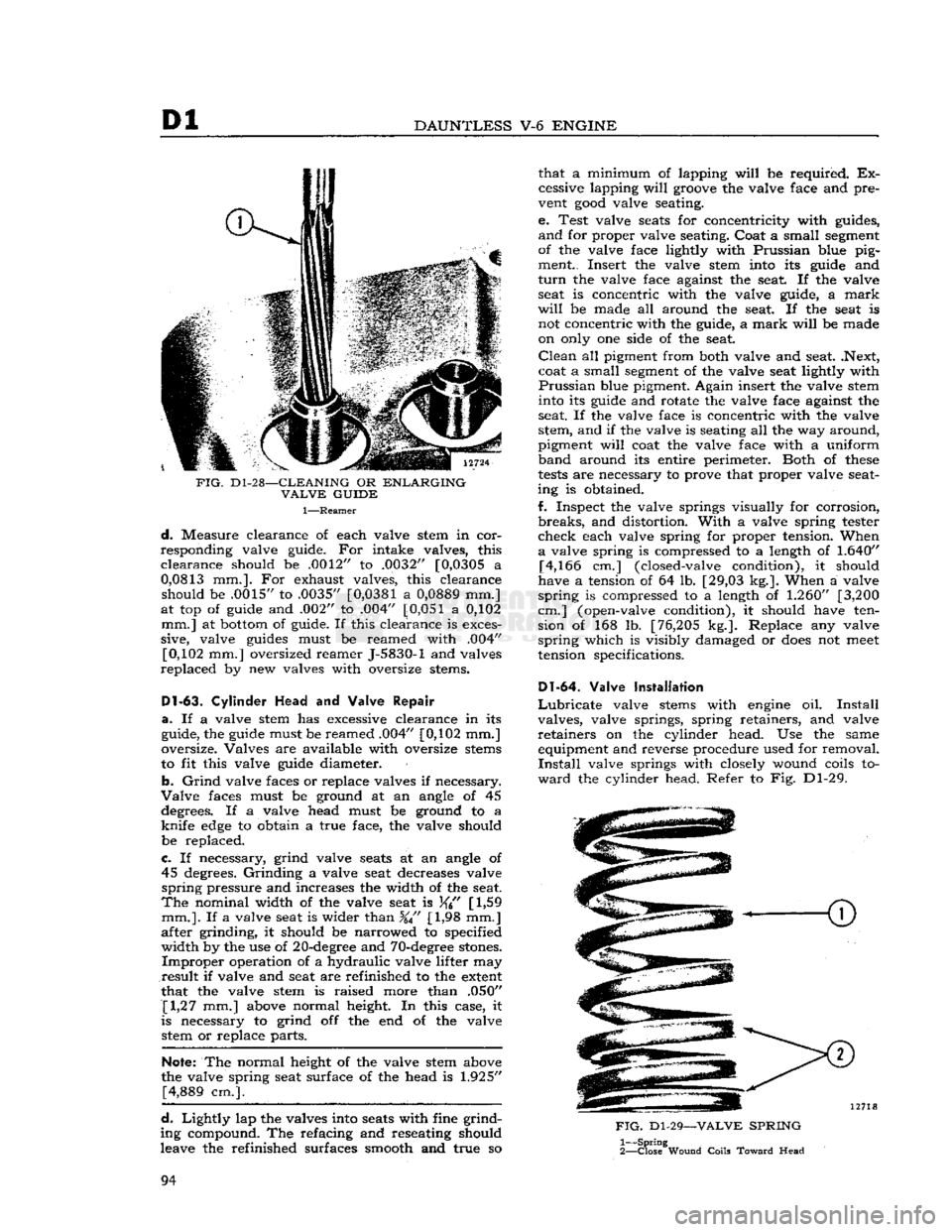
FIG.
D1-28—CLEANING
OR
ENLARGING
VALVE
GUIDE
1—Reamer
d.
Measure clearance of each valve stem in cor
responding valve guide. For intake valves, this
clearance
should be .0012" to .0032" [0,0305 a
0,0813
mm.]. For exhaust valves, this clearance should be .0015" to .0035"
[0,0381
a
0,0889
mm.]
at top of guide and .002" to .004"
[0,051
a 0,102 mm.] at bottom of guide. If this clearance is exces
sive, valve guides must be reamed with .004" [0,102 mm.] oversized reamer J-5830-1 and valves
replaced
by new valves with oversize stems.
Dl-63.
Cylinder
Head
and Valve
Repair
a.
If a valve stem has excessive clearance in its
guide, the guide must be reamed .004" [0,102 mm.]
oversize. Valves are available with oversize stems
to fit this valve guide diameter.
b.
Grind
valve faces or replace valves if necessary.
Valve
faces must be ground at an angle of 45 degrees. If a valve head must be ground to a
knife
edge
to obtain a true face, the valve should
be replaced.
c.
If necessary, grind valve seats at an angle of 45 degrees.
Grinding
a valve seat decreases valve
spring
pressure and increases the width of the seat.
The
nominal width of the valve seat is
[
1,59
mm.].
If a valve seat is wider than %" [1,98 mm.]
after grinding, it should be narrowed to specified
width
by the use of 20-degree and 70-degree stones.
Improper
operation of a hydraulic valve lifter may
result
if valve and seat are refinished to the extent
that the valve stem is raised more than .050" [1,27 mm.] above normal height. In this case, it
is necessary to grind off the end of the valve stetti or replace parts.
Note:
The normal height of the valve stem above
the valve spring seat surface of the head is
1.925"
[4,889 cm.].
d.
Lightly
lap the valves into seats with fine grind
ing compound. The refacing and reseating should
leave the refinished surfaces smooth and true so that a minimum of lapping
will
be required. Ex
cessive lapping
will
groove the valve face and pre
vent
good
valve seating.
e. Test valve seats for concentricity with guides,
and
for proper valve seating. Coat a small segment
of the valve face lightly with Prussian blue pig ment.. Insert the valve stem into its guide and
turn
the valve face against the seat. If the valve seat is concentric with the valve guide, a
mark
will
be made all around the seat. If the seat is not concentric with the guide, a
mark
will
be made
on only one side of the seat.
Clean
all pigment from both valve and seat. .Next,
coat a small segment of the valve seat lightly with
Prussian
blue pigment. Again insert the valve stem into its guide and rotate the valve face against the
seat. If the valve face is concentric with the valve
stem, and if the valve is seating all the way around,
pigment
will
coat the valve face with a uniform
band
around its entire perimeter. Both of
these
tests
are necessary to prove that proper valve seat
ing is obtained.
f. Inspect the valve springs visually for corrosion,
breaks,
and distortion.
With
a valve spring tester
check
each valve spring for proper tension. When
a
valve spring is compressed to a length of
1.640"
[4,166 cm.] (closed-valve condition), it should
have a tension of 64 lb. [29,03 kg.]. When a valve
spring
is compressed to a length of
1.260"
[3,200
cm.] (open-valve condition), it should have ten sion of 168 lb. [76,205 kg.]. Replace any valve
spring
which is visibly damaged or
does
not
meet
tension specifications.
Dl-64.
Valve Installation
Lubricate
valve stems with engine oil.
Install
valves, valve springs, spring retainers, and valve
retainers
on the cylinder head. Use the same equipment and reverse procedure used for removal.
Install
valve springs with closely wound coils to
ward
the cylinder head. Refer to Fig. Dl-29.
FIG.
Dl-29—VALVE
SPRING
1—
Spring
2—
Close
Wound
Coils
Toward
Head
94
Page 96 of 376
Dl
DAUNTLESS
V-6
ENGINE
Note:
During
engine
reassembly, use Perfect Seal
Aerosol
Spray Sealer
Part
No.
994757
on all en
gine
gaskets to ensure against vacuum, oil, gasoline
and
water leaks. Apply to head gaskets, valve covers, water pumps, oil pan gaskets, radiator and
heater
hose
connections, felt gaskets, gasoline and
oil
line connections, stud bolts, spark plug threads,
and
grease retainer washers. Refer to manufac
turer's
instructions on container for proper appli
cation procedure.
Dl-72.
Cylinder
Block
and Crankshaft
Rear
Oil Seals
Braided
fabric seals are pressed into
grooves
of
cylinder
block and
rear
main bearing cap, to
rear
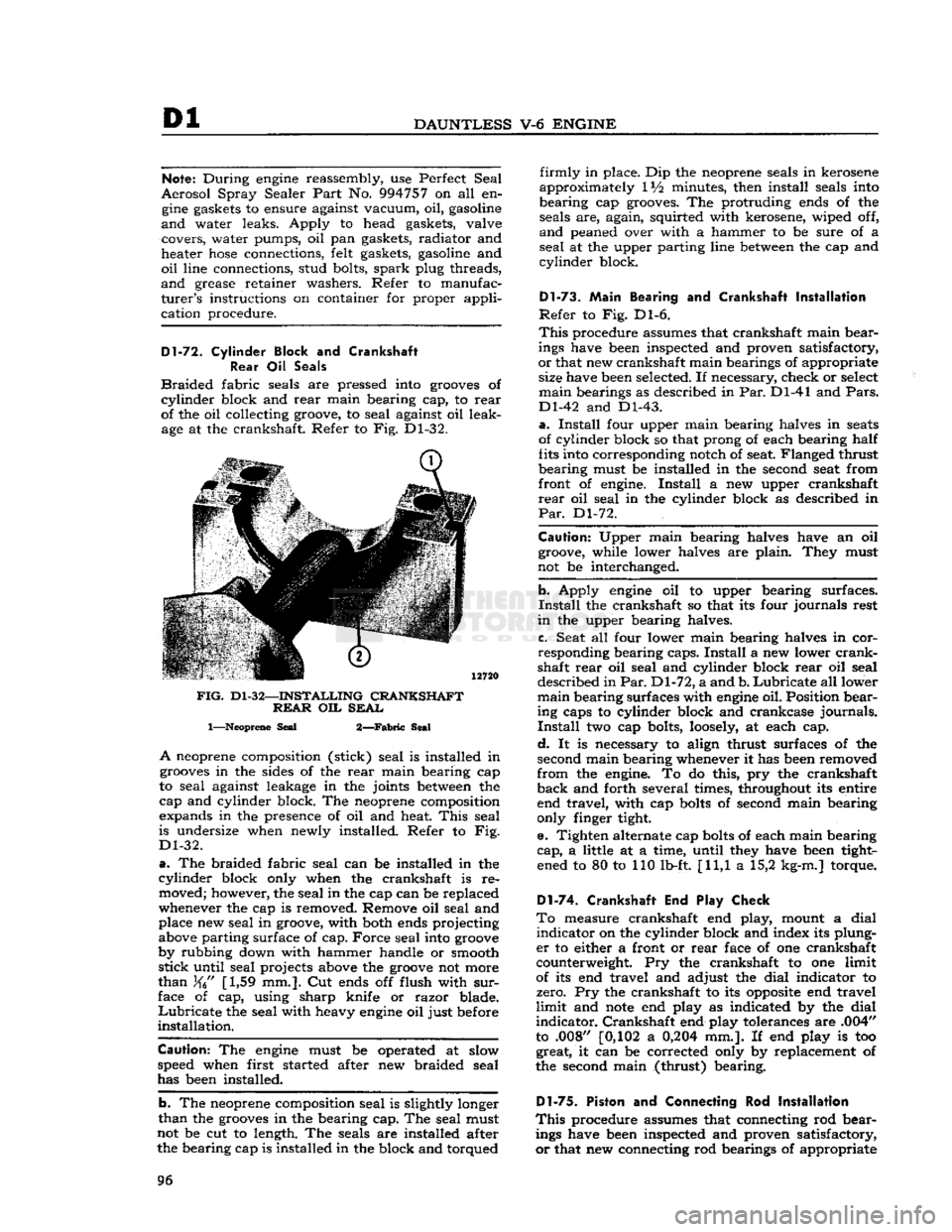
of the oil collecting groove, to seal against oil leak age at the crankshaft. Refer to Fig. Dl-32.
FIG.
Dl-32—INSTALLING
CRANKSHAFT REAR
OIL
SEAL
1—Neoprene
Seal
2—Fabric
Seal
A
neoprene composition (stick) seal is installed in
grooves
in the sides of the
rear
main bearing cap
to seal against leakage in the joints
between
the
cap and cylinder block. The neoprene composition
expands in the presence of oil and heat.
This
seal
is undersize when newly installed. Refer to Fig.
Dl-32.
a.
The braided fabric seal can be installed in the
cylinder
block only when the crankshaft is re moved; however, the seal in the cap can be replaced
whenever the cap is removed. Remove oil seal and place new seal in groove, with both ends projecting
above parting surface of cap. Force seal into
groove
by rubbing down with hammer handle or smooth
stick
until seal projects above the
groove
not more
than
[1,59 mm.]. Cut ends off flush with
sur
face of cap, using sharp knife or razor blade.
Lubricate
the seal with heavy
engine
oil just before
installation.
Caution:
The
engine
must be operated at slow
speed when first started after new braided seal
has been installed.
b. The neoprene composition seal is slightly longer
than
the
grooves
in the bearing cap. The seal must
not be cut to length. The seals are installed after the bearing cap is installed in the block and torqued
firmly
in place. Dip the neoprene seals in kerosene
approximately IV2 minutes, then install seals into
bearing cap grooves. The protruding ends of the seals are, again, squirted with kerosene, wiped off,
and
peaned over with a hammer to be sure of a
seal
at the upper parting line
between
the cap and
cylinder
block.
Dl-73.
Main
Bearing and Crankshaft
Installation
Refer
to Fig. Dl-6.
This
procedure assumes that crankshaft main bear
ings have been inspected and proven satisfactory,
or
that new crankshaft main bearings of appropriate size have been selected. If necessary, check or select
main
bearings as described in Par. Dl-41 and
Pars.
Dl-42 and Dl-43.
a.
Install
four upper main bearing halves in
seats
of cylinder block so that prong of each bearing half
fits into corresponding notch of seat. Flanged thrust
bearing must be installed in the second seat from
front of engine.
Install
a new upper crankshaft
rear
oil seal in the cylinder block as described in
Par.
Dl-72.
Caution:
Upper main bearing halves have an oil groove, while lower halves are plain. They must
not be interchanged.
b. Apply
engine
oil to upper bearing surfaces.
Install
the crankshaft so that its four journals rest
in
the upper bearing halves.
c. Seat all four lower main bearing halves in cor
responding bearing caps.
Install
a new lower
crank
shaft
rear
oil seal and cylinder block
rear
oil seal
described in
Par.
Dl-72, a and b.
Lubricate
all lower
main
bearing surfaces with
engine
oil. Position bear ing caps to cylinder block and crankcase journals.
Install
two cap bolts,
loosely,
at each cap.
d.
It is necessary to align thrust surfaces of the
second main bearing whenever it has been removed
from
the engine. To do this, pry the crankshaft
back
and forth several times, throughout its entire end travel, with cap
bolts
of second main bearing
only finger tight.
e. Tighten alternate cap
bolts
of each main bearing
cap,
a little at a time, until they have been tight ened to 80 to 110 lb-ft. [11,1 a 15,2 kg-m.] torque.
D1-74. Crankshaft End Play Check
To
measure crankshaft end play, mount a dial
indicator
on the cylinder block and index its plung
er
to either a front or
rear
face of one crankshaft
counterweight. Pry the crankshaft to one limit
of its end travel and adjust the dial indicator to
zero. Pry the crankshaft to its
opposite
end travel
limit
and
note
end play as indicated by the dial
indicator.
Crankshaft end play tolerances are .004"
to .008" [0,102 a
0,204
mm.]. If end play is too great, it can be corrected only by replacement of
the second main (thrust) bearing.
Dl-75.
Piston and Connecting Rod
Installation
This
procedure assumes that connecting rod bear ings have been inspected and proven satisfactory,
or
that new connecting rod bearings of appropriate 96
Page 103 of 376
'Jeep1
UNIVERSAL
SERIES
SERVICE
MANUAL
Dl
FIG.
D1-43—INTAKE
MANIFOLD
SEAL
INSTALLATION
1—Seal 2—Cylinder Head ing
hole
at left side of timing chain cover. If timing
chain
and sprockets have not been removed from
engine, install distributor with rotor in position
noted during distributor removal. Fasten distributor
to timing chain cover with retaining bracket and
mounting screws. If distributor is aligned, torque
screw
18 to 20 lb-ft. [2,5 a 2,8 kg-m.].
Dl-100.
Install Spark Plugs
Install
spark
plugs in cylinder heads. Torque 25
to 33 lb-ft. [3,5 a 4,6 kg-m.].
Install
spark
plug cable retainers on brackets welded to rocker arm
covers. Fit cables into retainers and connect to
spark
plugs, as indicated by cable numbers molded
into distributor cap and by
spark
plug firing order
pressed into each rocker arm cover.
Dl-101.
Install Intake Manifold
and
Carburetor
Assembly
a.
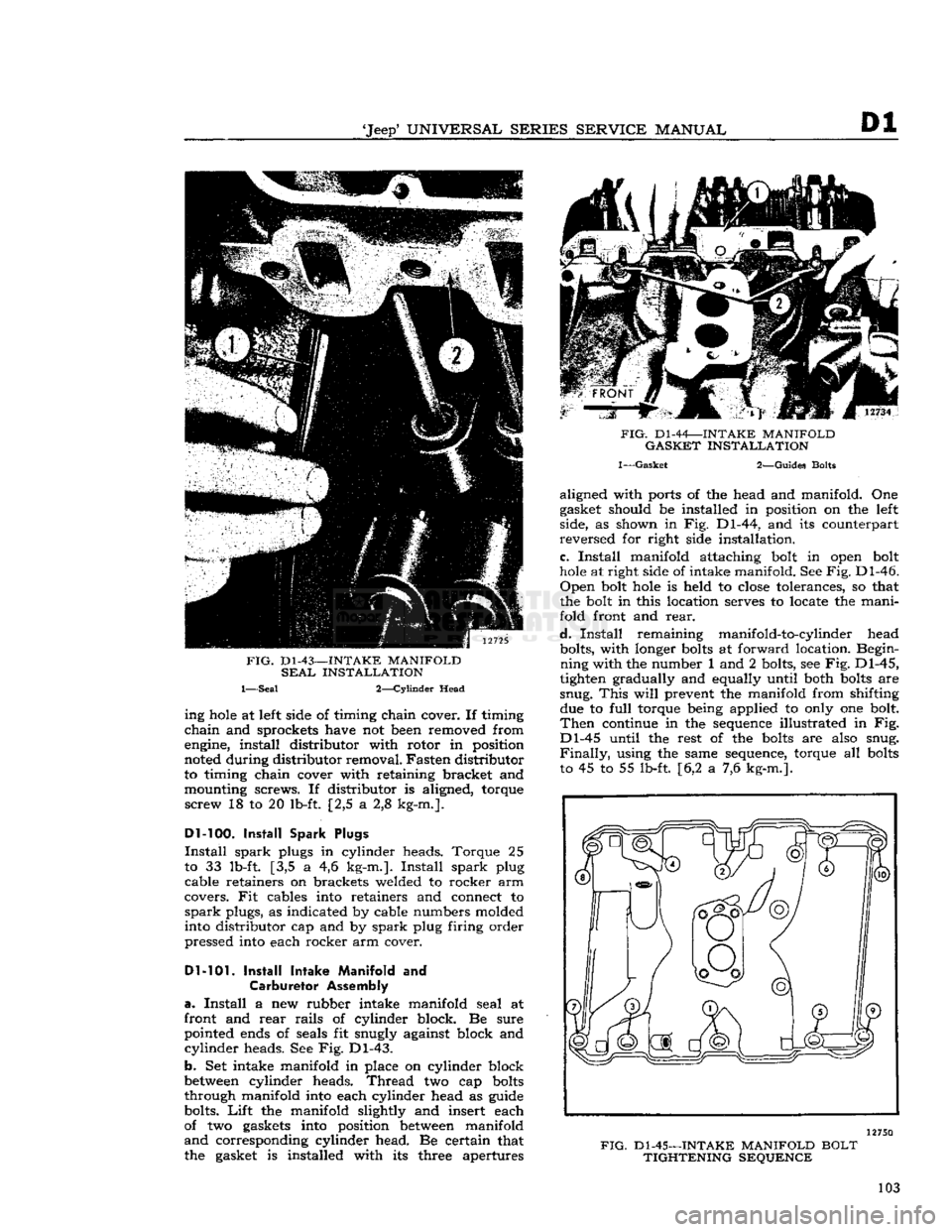
Install
a new rubber intake manifold seal at
front and
rear
rails
of cylinder block. Be sure
pointed ends of seals fit snugly against block and
cylinder
heads. See Fig. Dl-43.
b.
Set intake manifold in place on cylinder block
between
cylinder heads.
Thread
two cap
bolts
through manifold into each cylinder head as guide
bolts.
Lift
the manifold slightly and insert each
of two gaskets into position
between
manifold
and
corresponding cylinder head. Be certain that
the gasket is installed with its three apertures
FIG.
Dl-44—INTAKE
MANIFOLD
GASKET
INSTALLATION
1—Gasket
2—Guides Bolts aligned with ports of the head and manifold. One
gasket should be installed in position on the left
side, as shown in Fig. Dl-44, and its counterpart
reversed
for right side installation.
c.
Install
manifold attaching bolt in open bolt
hole
at right side of intake manifold. See
Fig.
Dl-46.
Open
bolt
hole
is held to
close
tolerances, so that
the bolt in this location serves to locate the mani
fold front and
rear.
d.
Install
remaining manifold-to-cylinder head bolts, with longer
bolts
at forward location. Begin
ning
with the number 1 and 2 bolts, see
Fig.
Dl-45,
tighten gradually and equally until both
bolts
are
snug.
This
will
prevent the manifold from shifting due to
full
torque being applied to only one bolt.
Then
continue in the sequence illustrated in Fig.
Dl-45
until the rest of the
bolts
are also snug.
Finally,
using the same sequence, torque all
bolts
to 45 to 55 lb-ft. [6,2 a 7,6 kg-m.].
12750
FIG.
Dl-45—INTAKE
MANIFOLD
BOLT
TIGHTENING
SEQUENCE
103
Page 117 of 376
'Jeep*
UNIVERSAL
SERIES
SERVICE
MANUAL
E
Note:
The
Carter
YF-6115S Carburetor has a
throttle
return spring
attached
from the carburetor
main
body
to the carburetor
throttle
shaft. The
purpose
of
this
spring is to return the
throttle
to
idle
speed
position
should a linkage failure occur.
E-21.
Carburetor Disassembly
•
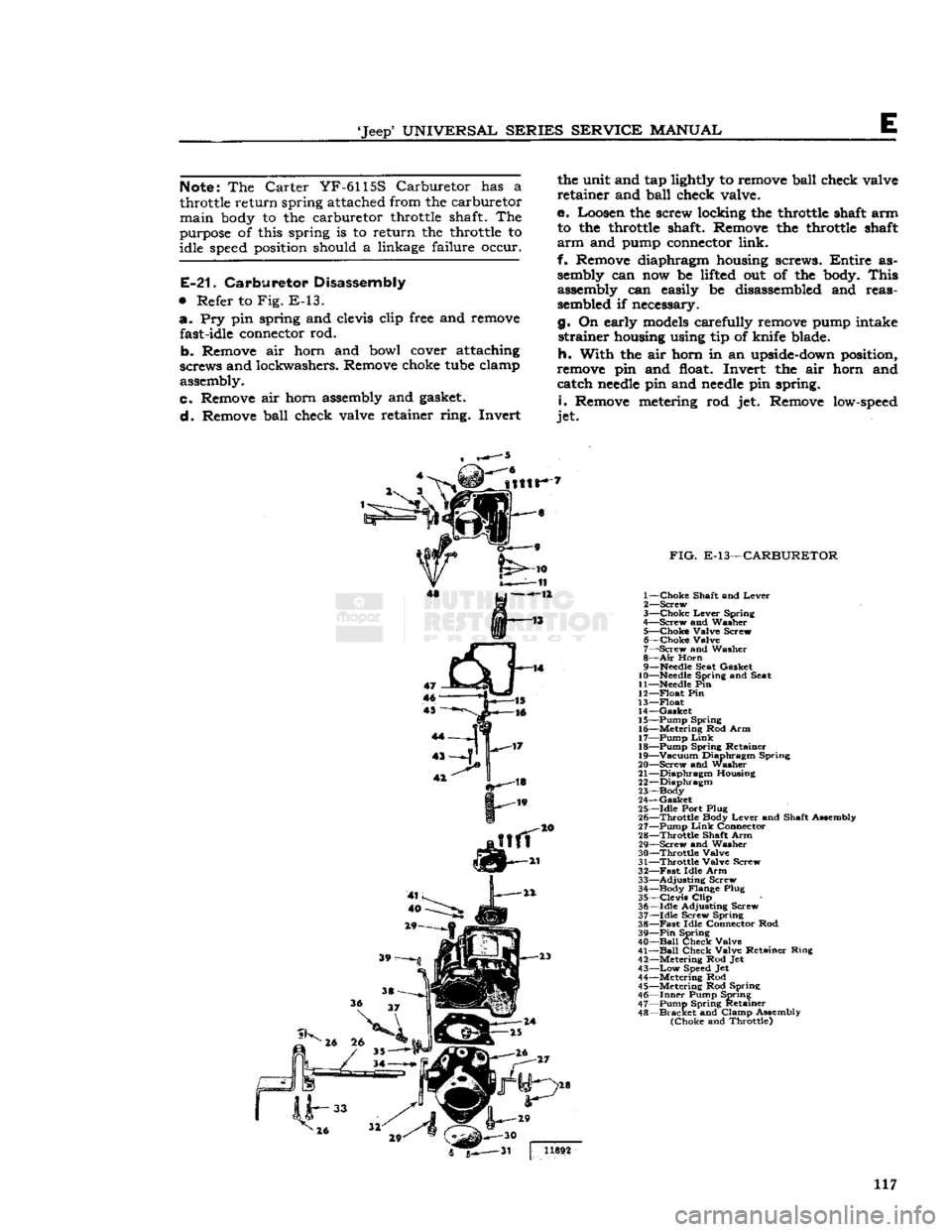
Refer to Fig. E-13. a. Pry pin spring and
clevis
clip
free
and
remove
fast-idle
connector
rod.
b- Remove air horn and bowl
cover
attaching
screws and lockwashers. Remove
choke
tube
clamp
assembly.
c. Remove air horn
assembly
and
gasket.
d. Remove ball check valve retainer ring. Invert the unit and tap
lightly
to
remove
ball check valve
retainer and ball check valve.
e. Loosen the screw locking the
throttle
shaft
arm to the
throttle
shaft. Remove the
throttle
shaft
arm
and
pump
connector
link.
f. Remove diaphragm
housing
screws.
Entire
as
sembly
can now be
lifted
out of the
body.
This
assembly
can easily be
disassembled
and reas
sembled
if necessary.
g. On early
models
carefully
remove
pump
intake strainer
housing
using tip of knife blade.
h. With the air horn in an
upside-down
position,
remove
pin and
float.
Invert the air horn and catch
needle
pin and
needle
pin spring.
i.
Remove
metering
rod jet. Remove
low-speed
jet.
FIG.
E-13—CARBURETOR
1— Choke Shaft and Lever
2— Screw
3— Choke Lever Spring
4— Screw and Washer
5— Choke Valve Screw 6— Choke Valve
7— Screw and Washer
8—
Air
Horn
9—
Needle
Seat Gasket
10—
Needle
Spring and Seat
11—Needle
Pin
12— Float Pin
13— Float
14— Gasket 15— Pump Spring
16— Metering Rod Arm
17— Pump
Link
18— Pump Spring Retainer
19— Vacuum Diaphragm Spring
20— Screw and washer
21— Diaphragm Housing
22— Diaphragm
23—Body
24— Gasket
25— Idle Port Plug
26— Throttle Body Lever and Shaft Assembly
27— Pump
Link
Connector
28— Throttle Shaft Arm 29— Screw and Washer
30— Throttle Valve
31— Throttle Valve Screw
32—
Fast
Idle Arm 33— Adjusting Screw
34— Body Flange Plug
35— Clevis
Clip
36— Idle Adjusting Screw
37— Idle Screw Spring
38—
Fast
Idle Connector Rod 39—
Pin
Spring
40—
Ball
Check Valve
41—
Ball
Check Valve Retainer Ring
42— Metering Rod Jet
43—
Low
Speed
Jet
44— Metering Rod
45— Metering Rod Spring 46—
Inner
Pump Spring
47— Pump Spring Retainer
48—
Bracket
and Clamp Assembly (Choke and Throttle) 5^—31 | 1X892
117
Page 118 of 376
E
FUEL
SYSTEM
Note:
Do not remove pressed-in parts such as
nozzle, pump jet, or antipercolator air bleed.
j.
Remove body flange attaching screws, body flange assembly, and gasket.
k.
Remove idle-adjustment screw, spring, idle
port
rivet, throttle lever assembly, washer, fast
idle arm, throttle plate screws, throttle plate, and throttle shaft.
1. Remove throttle shaft seal by prying out seal
retainer.
Note:
Do not remove pressed-in vacuum passage
orifice.
m.
Remove choke valve screws and choke valve.
Unhook
choke spring and slide shaft from housing,
n.
Wash all parts in carburetor cleaning solution
and
blow out passages with compressed air. Do not immerse diaphragm or seals in cleaning solution.
Inspect
all parts for wear or damage. Always use
new gaskets when reassembling.
E-22.
Carburetor
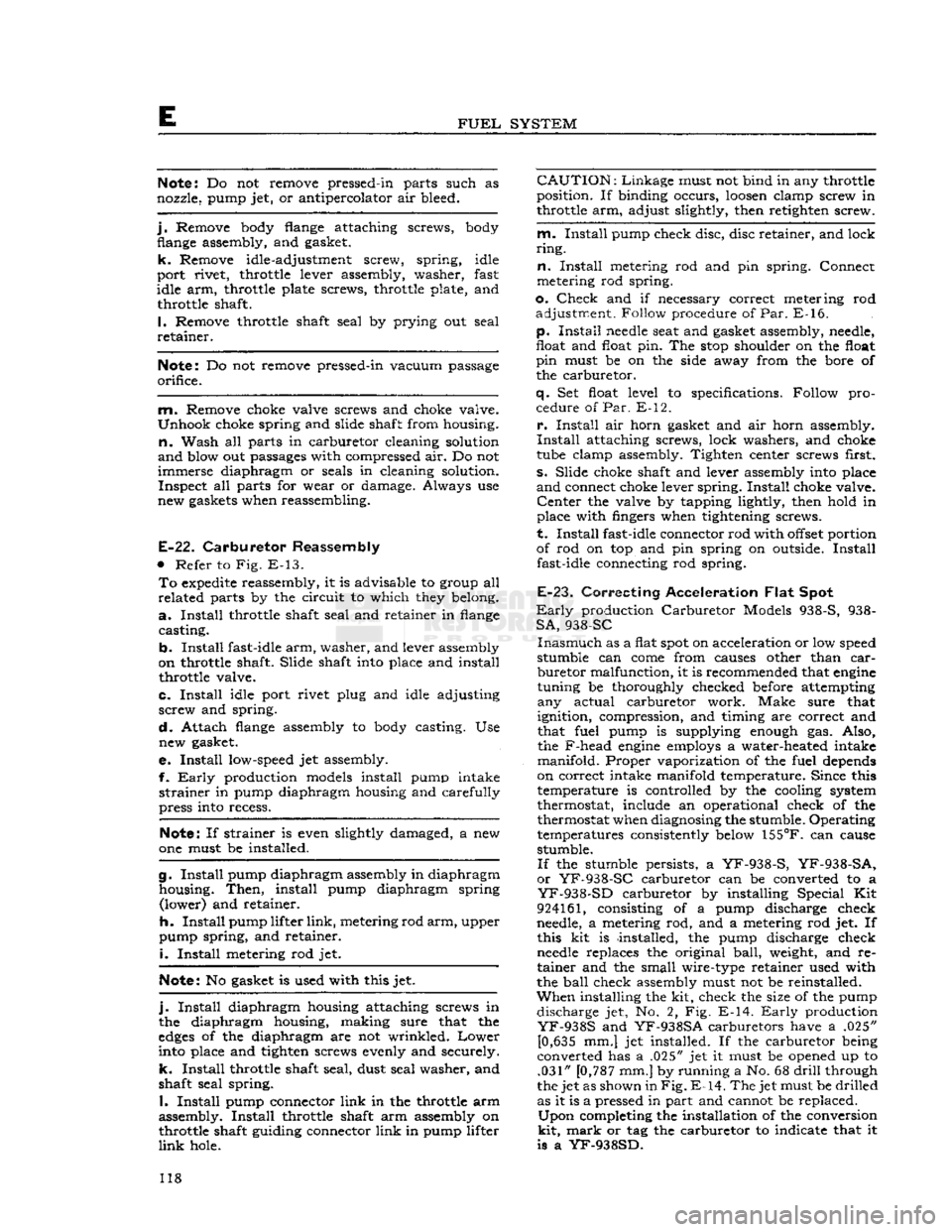
Reassembly
•
Refer to Fig. E-13.
To
expedite
reassembly, it is advisable to group all
related
parts by the circuit to which they belong.
a.
Install
throttle shaft seal and retainer in flange casting.
b.
Install
fast-idle
arm,
washer, and lever assembly
on throttle shaft. Slide shaft into place and install throttle valve.
c.
Install
idle port rivet plug and idle adjusting
screw
and spring.
d.
Attach flange assembly to body casting. Use new gasket.
e.
Install
low-speed jet assembly.
f.
Early
production models install pump intake
strainer
in pump diaphragm housing and carefully
press into recess.
Note:
If strainer is even slightly damaged, a new
one must be installed.
g.
Install
pump diaphragm assembly in diaphragm housing.
Then,
install pump diaphragm spring
(lower)
and retainer.
h.
Install
pump lifter
link,
metering rod
arm,
upper
pump spring, and retainer.
I.
Install
metering rod jet.
Note:
No gasket is used with this jet.
j.
Install
diaphragm housing attaching screws in
the diaphragm housing, making sure that the
edges
of the diaphragm are not wrinkled.
Lower
into place and tighten screws evenly and securely,
k.
Install
throttle shaft seal, dust seal washer, and
shaft seal spring.
I.
Install
pump connector
link
in the throttle arm
assembly.
Install
throttle shaft arm assembly on
throttle shaft guiding connector
link
in pump lifter
link
hole.
CAUTION:
Linkage
must not bind in any throttle
position. If binding occurs,
loosen
clamp screw in
throttle arm, adjust slightly, then retighten screw.
m.
Install
pump check disc, disc retainer, and lock
ring.
n.
Install
metering rod and pin spring. Connect
metering rod spring.
o.
Check
and if necessary correct meter ing rod adjustment. Follow procedure of
Par.
E-16.
p.
Install
needle
seat and gasket assembly, needle,
float
and
float pin. The
stop
shoulder on the float
pin
must be on the side away from the bore of
the carburetor.
q.
Set float level to specifications. Follow pro cedure of
Par.
E-12.
r.
Install
air horn gasket and air horn assembly.
Install
attaching screws, lock washers, and choke
tube clamp assembly. Tighten center screws first,
s. Slide choke shaft and lever assembly into place
and
connect choke lever
spring.
Install
choke valve.
Center
the valve by tapping lightly, then hold in
place with fingers when tightening screws,
t.
Install
fast-idle connector rod with
offset
portion
of rod on top and pin spring on outside.
Install
fast-idle connecting rod spring.
E-23.
Correcting Acceleration
Flat
Spot
Early
production
Carburetor
Models 938-S, 938-
SA,
938-SC
Inasmuch
as a flat
spot
on acceleration or low speed
stumble can
come
from causes other than
car
buretor
malfunction, it is recommended that
engine
tuning be thoroughly checked before attempting
any
actual carburetor work. Make sure that
ignition, compression, and timing are correct and
that fuel pump is supplying enough gas. Also, the F-head
engine
employs a water-heated intake
manifold.
Proper vaporization of the fuel depends
on correct intake manifold temperature. Since this
temperature is controlled by the cooling system
thermostat, include an operational check of the
thermostat when diagnosing the stumble. Operating
temperatures consistently below
155°F.
can cause stumble.
If
the stumble persists, a
YF-938-S,
YF-938-SA,
or
YF-938-SC
carburetor can be converted to a
YF-938-SD
carburetor by installing Special Kit
924161, consisting of a pump discharge check
needle, a metering rod, and a metering rod jet. If this kit is installed, the pump discharge check
needle
replaces the original
ball,
weight, and re
tainer
and the small wire-type retainer used with
the
ball
check assembly must not be reinstalled.
When
installing the kit, check the size of the pump discharge jet, No. 2, Fig. E-14.
Early
production
YF-938S
and
YF-938SA
carburetors have a .025" [0,635 mm.] jet installed. If the carburetor being
converted has a .025" jet it must be opened up to .031" [0,787 mm.] by running a No. 68
drill
through
the jet as shown in
Fig.
E-14.
The jet must be drilled
as it is a pressed in part and cannot be replaced.
Upon
completing the installation of the conversion
kit,
mark
or tag the carburetor to indicate that it
is a
YF-938SD.
118
Page 120 of 376
E
FUEL
SYSTEM
There
are six adjustments: curb idle speed, curb
idle mixture, float level, float drop, accelerator pump, and fast idle.
This
carburetor has six basic systems: float, low
speed, main metering, power, accelerator pump
and
choke.
E-26.
Float System
The
float system controls fuel level in the
car
buretor fuel bowl. It maintains constant fuel level
to assure proper metering through all operating
ranges.
Fuel
enters the carburetor through the inlet screen
and
inlet valve. It flows past the valve
needle
and into the fuel bowl.
Fuel
continues to flow until
increasing
fuel level raises the float to a position
in
which it forces the inlet valve
needle
into its seat.
This
closes
the inlet valve. As fuel is used
from
the bowl, the float
moves
downward slightly.
This
allows the valve
needle
to
move
away from its
seat.
This
again allows fuel to enter the fuel bowl
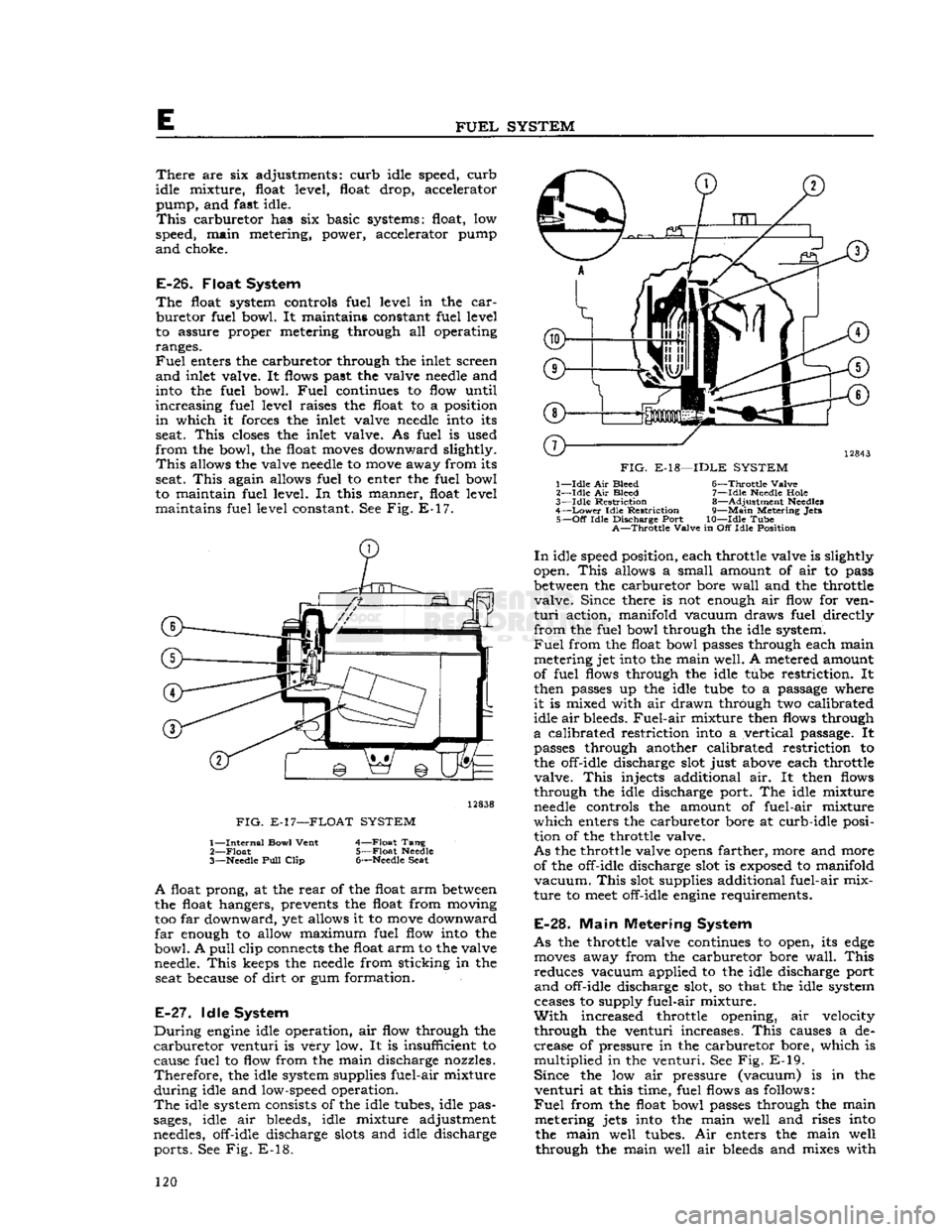
to maintain fuel level. In this manner, float level maintains fuel level constant. See Fig. E-17. 12838
FIG.
E-17—FLOAT
SYSTEM
1—
Internal
Bowl
Vent
4—Float Tang
2—
Float
5—Float Needle
3— Needle
Pull
Clip
6—Needle
Seat
A
float prong, at the
rear
of the float arm
between
the float hangers, prevents the float from moving too far downward, yet allows it to
move
downward
far
enough to allow maximum fuel flow into the
bowl. A
pull
clip connects the float arm to the valve needle.
This
keeps the
needle
from sticking in the seat because of
dirt
or gum formation.
E-27.
Idle System
During
engine
idle operation, air flow through the
carburetor
venturi is very low. It is insufficient to
cause fuel to flow from the main discharge nozzles.
Therefore,
the idle system supplies fuel-air mixture
during
idle and low-speed operation.
The
idle system consists of the idle tubes, idle pas
sages,
idle air bleeds, idle mixture adjustment
needles, off-idle discharge
slots
and idle discharge ports. See Fig. E-18.
FIG.
E-18—IDLE
SYSTEM
1—
Idle
Air Bleed 6—Throttle
Valve
2—
Idle
Air Bleed 7—Idle Needle
Hole
3—
Idle
Restriction
8—Adjustment Needles
4—
Lower
Idle
Restriction
9—Main
Metering
Jets
5—
Off
Idle
Discharge Port 10—Idle Tube
A—Throttle
Valve
in Off
Idle
Position
In
idle speed position, each throttle valve is slightly
open.
This
allows a small amount of air to pass
between
the carburetor bore
wall
and the throttle valve. Since there is not enough air flow for ven
turi
action, manifold vacuum draws fuel directly
from
the fuel bowl through the idle system.
Fuel
from the float bowl passes through each main metering jet into the main well. A metered amount
of fuel flows through the idle tube restriction. It
then passes up the idle tube to a passage where
it
is mixed with air drawn through two calibrated
idle air bleeds.
Fuel-air
mixture then flows through
a
calibrated restriction into a vertical passage. It passes through another calibrated restriction to the off-idle discharge slot just above each throttle
valve.
This
injects additional air. It then flows
through the idle discharge port. The idle mixture
needle
controls the amount of fuel-air mixture
which
enters the carburetor bore at curb-idle posi tion of the throttle valve.
As
the throttle valve
opens
farther, more and more of the off-idle discharge slot is
exposed
to manifold
vacuum.
This
slot supplies additional fuel-air mix
ture to
meet
off-idle
engine
requirements.
E-28.
Main
Metering System
As
the throttle valve continues to open, its
edge
moves
away from the carburetor bore
wall.
This
reduces vacuum applied to the idle discharge port
and
off-idle discharge slot, so that the idle system
ceases
to supply fuel-air mixture.
With
increased throttle opening, air velocity through the venturi increases.
This
causes a de
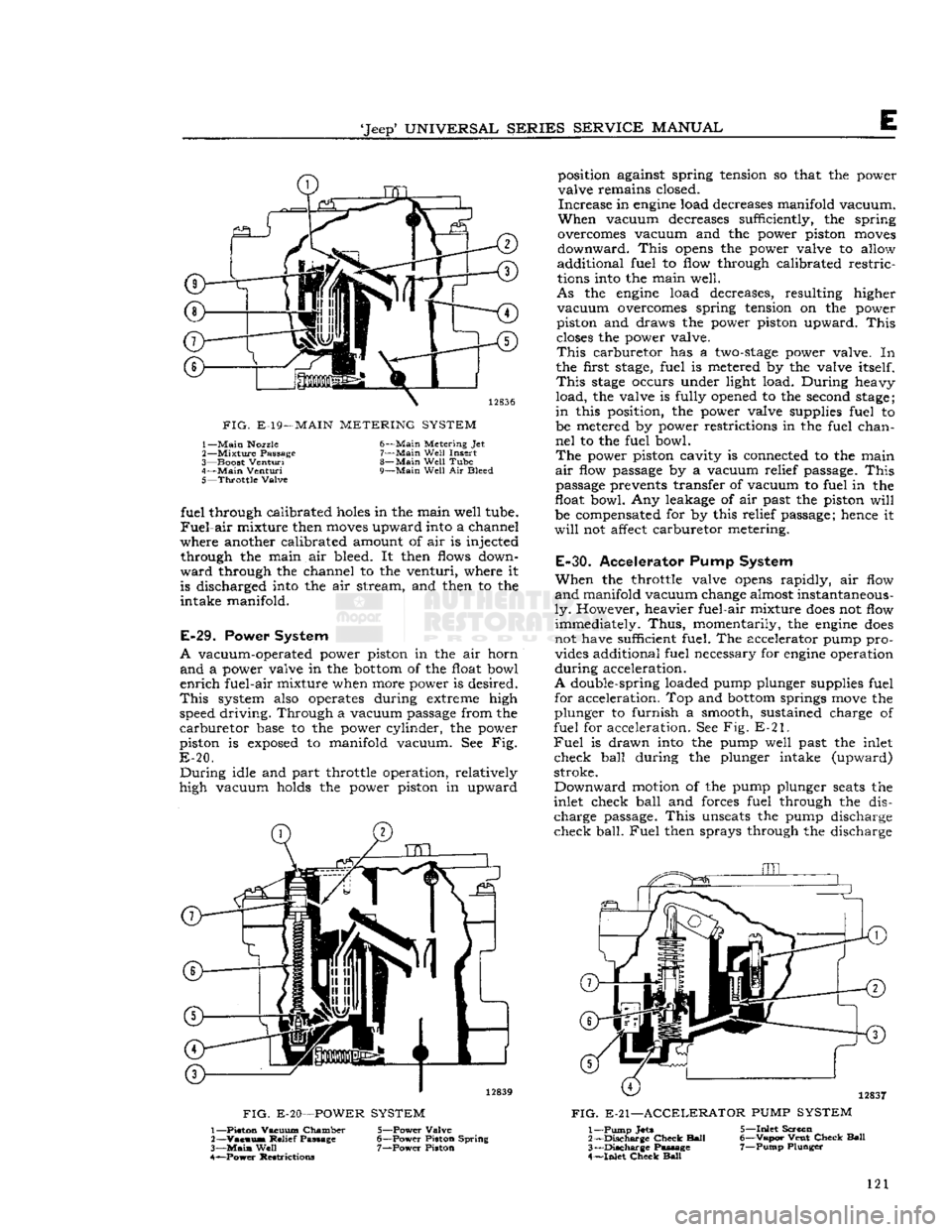
crease of pressure in the carburetor bore, which is multiplied in the venturi. See Fig. E-19.
Since
the low air pressure (vacuum) is in the
venturi
at this time, fuel flows as follows:
Fuel
from the float bowl passes through the main metering jets into the main well and rises into the main well tubes. Air enters the main well through the main well air
bleeds
and mixes with 120
Page 121 of 376
'Jeep'
UNIVERSAL SERIES SERVICE
MANUAL
FIG.
E-19—
MAIN
METERING SYSTEM
1—
Main
Nozzle
2—
Mixture
Passage
3—
Boost
Venturi
4—
Main
Venturi
5—
Throttle
Valve 6—
Main
Metering Jet
7—
Main
Well
Insert
8—
Main
Well
Tube
9—
Main
Well
Air Bleed fuel through calibrated
holes
in the main well tube.
Fuel-air
mixture then
moves
upward into a channel
where another calibrated amount of air is injected through the main air bleed. It then flows down
ward
through the channel to the venturi, where it is discharged into the air stream, and then to the
intake manifold.
E-29.
Power System
A
vacuum-operated power piston in the air horn
and
a power valve in the
bottom
of the float bowl
enrich
fuel-air mixture when more power is desired.
This
system also operates during extreme high
speed driving. Through a vacuum passage from the
carburetor
base to the power cylinder, the power
piston is
exposed
to manifold vacuum. See Fig.
E-20.
During
idle and part throttle operation, relatively
high vacuum holds the power piston in upward
FIG.
E-20—POWER
SYSTEM
position against spring tension so that the power
valve remains closed.
Increase
in
engine
load decreases manifold vacuum.
When
vacuum decreases sufficiently, the spring
overcomes vacuum and the power piston
moves
downward.
This
opens
the power valve to allow
additional fuel to flow through calibrated restric
tions into the main well.
As
the
engine
load decreases, resulting higher
vacuum
overcomes spring tension on the power
piston and draws the power piston upward.
This
closes
the power valve.
This
carburetor has a
two-stage
power valve. In
the first
stage,
fuel is metered by the valve itself.
This
stage
occurs under light load. During heavy
load,
the valve is fully opened to the second
stage;
in
this position, the power valve supplies fuel to
be metered by power restrictions in the fuel chan
nel
to the fuel bowl.
The
power piston cavity is connected to the main
air
flow passage by a vacuum relief passage.
This
passage prevents transfer of vacuum to fuel in the
float bowl. Any leakage of air past the piston
will
be compensated for by this relief passage; hence it
will
not affect carburetor metering.
E-30.
Accelerator Pump System
When
the throttle valve
opens
rapidly, air flow
and
manifold vacuum change almost instantaneous
ly.
However, heavier fuel-air mixture
does
not flow immediately.
Thus,
momentarily, the
engine
does
not have sufficient fuel. The accelerator pump pro vides additional fuel necessary for
engine
operation
during
acceleration.
A
double-spring loaded pump plunger supplies fuel for acceleration. Top and
bottom
springs
move
the
plunger to furnish a smooth, sustained charge of
fuel for acceleration. See Fig. E-21.
Fuel
is drawn into the pump well past the inlet
check ball during the plunger intake (upward)
stroke.
Downward
motion of the pump plunger
seats
the
inlet check ball and forces fuel through the dis charge
passage.
This
unseats
the pump discharge
check
ball.
Fuel
then sprays through the discharge
12837
FIG.
E-21—ACCELERATOR
PUMP
SYSTEM
1— Piston Vacuum Chamber
2—
Vacuus*
Relief Passage
3—
Main
Well
4— ^Power Restrictions 5— Power Valve
6— Power Piston Spring 7— Power Piston 1— Pump
Jets
2—
Discharge
Check
Ball
3—
Discharge
Passage
4—
Inlet
Check
Ball
5—
Inlet
Screen
6—
Vapor
Vent
Check
Ball
7—
Pump
Plunger
121
Page 123 of 376
'Jeep9
UNIVERSAL
SERIES
SERVICE
MANUAL
E
exterior moving parts of a carburetor are
often
responsible for unsatisfactory performance.
For
this
reason,
efficient carburetion depends upon careful cleaning and inspection while servicing.
a.
Thoroughly clean carburetor castings and metal
parts
in carburetor cleaning solvent.
Caution:
Accelerator pump plunger and any fiber
or
rubber parts should never be immersed in
car
buretor
cleaner. Wash pump plunger in cleaning
solvent.
b.
Blow out all passages in the castings with com
pressed air. Dry all parts with compressed air.
Make
sure all jets and passages are clean. Do
not use wire to clean fuel passages or air bleeds.
c.
Check
inlet valve
needle
and seat for wear. If
wear
is noted, the assembly must be replaced.
d.
Check
float hinge pin for wear and check float
for damage.
e.
Check
throttle and choke shaft bores for wear
and
out-of-round.
f. Inspect idle mixture adjustment
needles
for
burrs
or
grooves; replace if damaged.
g. Inspect cup of accelerator pump plunger; re
place if damaged, worn, or hardened. Inspect pump
well
in bowl for wear or scoring.
h.
Check
filter screens for
dirt
or lint.
Clean,
and
if
they remain
clogged,
replace.
i.
If for any reason parts have
become
loose
or
damaged in the cluster assembly, the assembly
must be replaced.
Note:
Use ijew gaskets whenever the carburetor
is disassembled.
E-37.
Throttle Body Assembly
a.
Install
idle mixture adjustment
needles
and
springs in throttle body. Tighten finger-tight, then
unthread
one
turn
as a preliminary adjustment
setting.
Caution:
Do not force idle mixture adjustment
needles
against
seats
or damage may result.
b.
Invert
fuel bowl body and place new throttle
body gasket on bowl. Fasten throttle body to bowl
body with three screws and lockwashers; tighten
securely.
E-38.
Fuel
Bowl Body Assembly
a.
Drop steel discharge check
tall
of accelerator
pump into discharge hole.
Install
pump discharge
spring
and T-shaped retainer. Stake retainer in
place.
Note:
Top of retainer must be flush with flat
surface
of fuel bowl body.
b.
Install
two inserts in main well. Align surface
on lip of insert with flat surface in recess on top
of main well.
Install
venturi cluster with gasket,
and
tighten mounting screws evenly and securely.
Be
certain that center screw is fitted with fiber gasket, and that a special smooth shank screw is
used.
c.
Install
two main metering jets, power valve
gasket and power valve.
d.
Install
small aluminum inlet check
ball
in ac
celerator
pump inlet at
bottom
of pump well. In
sert
pump return spring into well, and center by
pressing spring downward with finger.
e.
Install
pump inlet screen in
bottom
of fuel
bowl.
E-39.
Air
Horn Body
Assembly
a.
Install
choke lever and collar on choke shaft.
Prong
on choke lever must face away from air
horn
body and be on top of choke trip lever.
b.
Install
choke shaft and lever assembly into the
air
horn. Choke rod
hole
in the choke lever must
face fuel inlet side of carburetor.
c.
Install
choke valve plate in choke shaft so that
letters RP
will
face upward in finished carburetor.
Install
two new valve plate attaching screws, but
do not tighten securely until valve plate is centered.
To
center choke valve plate on choke shaft, hold
choke valve tightly closed, then slide choke shaft
inward
to obtain approximately .020" [0,508 mm.]
clearance
between
choke trip lever and choke lever
and
collar assembly. Tighten choke valve screws
securely,
and stake lightly in place. Choke valve
will
be perfectly free in all positions when installed
correctly.
d.
Insert
outer accelerator pump lever and shaft as sembly into air horn body, with lever pointing to
ward
choke shaft.
Install
inner pump arm, with plunger
hole
inward,
and tighten set screw securely.
Position pump plunger assembly on inner pump
arm,
with pump shaft pointing
inward,
and install
retainer.
e.
Install
needle
seat screen on inlet valve seat. In
stall
seat and gasket in air horn body. Tighten seat
securely with a wide-blade screwdriver.
f.
Install
power piston into vacuum cavity.
Lightly
stake piston retainer washer in place. Piston should
travel
freely in cavity.
g.
Install
air horn gasket on air horn body, fitting
gasket over guide pin.
h.
Attach inlet valve
needle
to float.
Carefully
position float and insert float hinge pin. Drop tang
at
rear
of float arm downward toward air horn.
i.
Install
fuel inlet fitting, if removed.
j.
With
air horn assembly inverted, measure the distance from the air horn gasket to top of float
at toe \%£f [27,78 mm.] for standard carburetors
and
\%i [29,36 mm.] for exhaust emission control
equipped carburetors, as shown in Fig. E-23. Use
float level
gauge
J-5127-2. Bend float arm as re
quired
to adjust float level.
k.
With
air horn body held upright, measure dis
tance from gasket to
bottom
of float
pontoon
at outer end. Use a l7/s" [47,625 mm.] float drop
gauge.
Bend float tang, as required, to adjust float
drop.
See Fig. E-24.
I.
Carefully
place air horn body on fuel bowl
body, making certain that the accelerator pump
plunger is properly positioned in the pump well.
Lower
the cover gently, straight down; install air 123
Page 127 of 376
'Jeep'
UNIVERSAL
SERIES
SERVICE
MANUAL
E
E-47.
Reassembly
•
Refer to Fig. E-29.
Install
the valve gaskets, valves, valve retainer and
secure them with the valve retainer screws. Make
sure that the inlet and
outlet
valves are in their proper positions. Place the diaphragm spring re
tainer in position on the diaphragm
pull
rod
and
install diaphragm spring. Position the
dia
phragm assembly in pump
body
and attach the
cover to pump body, with file marks aligned, with
the six attaching screws. Do not draw the screws
up tight.
Install
rocker arm spring, rocker arm
pin
washers, rocker arm and rocker arm pin.
With
rocker
arm positioned on the diaphragm rod, draw
the six pump
body
screws up evenly and securely.
Install
the filter screen, cork gasket and sediment
bowl and secure them firmly with the thumb screw
on the bowl clamp.
E-48.
Vacuum
Pump
The
double-action fuel pump resembles two single-
action pumps placed one
above
the other. A single
fuel pump rocker arm actuates the two separate diaphragms. One diaphragm is part of the fuel
delivery pump and operates as described in Par.
E-45.
The other diaphragm is part of the vacuum
pump and operates as described here.
As
the actuating lever forces the diaphragm upward against spring pressure, air is forced through the
outlet
port
into
the
engine's
intake manifold. On
the return stroke, spring pressure forces the
dia
phragm downward, creating a
partial
vacuum and
opening the inlet valve. In this manner, air is pumped out of the windshield wiper motor and
into
the intake manifold. When the wiper motor is shut off, manifold vacuum holds the diaphragm against its spring so that the
full
motion of the actuating
lever is not accompanied by a
complete
up-and-
down motion of the diaphragm.
When
the windshield wiper motor is turned on, but manifold vacuum is greater than the vacuum
created by the
booster
pump, air
flows
from the
wiper motor through both valves of the vacuum
booster.
As manifold vacuum drops off as a result
of the
engine
operating under low
speed
and high load, the vacuum created by the vacuum
booster
will
be greater than
engine
intake manifold vacuum
and
the pump
will
operate the wiper motor when the wiper control switch is turned on.
•
Refer to Fig. E-29. Remove the
eight
cover attaching screws and
lockwashers, and remove the cover, diaphragm
spring
and spring seat. Detach the diaphragm rod
from the rocker arm and remove the diaphragm.
The
valve assemblies are pressed
into
the cover
and
body
and lightly staked. They may be removed
with the point of a knife blade. If installing new valves be sure the inlet and
outlet
valves are
correctly positioned and stake them lightly with
a
small punch.
Assemble the vacuum pump in the reverse order
of disassembly, drawing the cover attaching screws up evenly and tightly.
E-49.
Fuel
Pump
Testing
Four
tests
are presented in following paragraphs to
test
for proper operation of the fuel pump. In addi
tion, check the following:
a.
Check
for secure mounting of the fuel pump.
The
rocker arm may be working the entire pump
up and down, rather than just the pump
dia
phragms.
b. Remove and clean the fuel sediment bowl.
c.
Check
all fuel lines.
E-50.
Volume
Check
To
measure fuel pump capacity (amount of fuel
delivered in a given time) disconnect the pump-to-
carburetor
line at the carburetor end. Place the
open
end of the line in a suitable container.
Start
the
engine
and operate at normal idle speed.
Delivery
should be one quart U.S. [1 ltr.] within
one minute.
E-51.
Pressure
Check
To
measure fuel pump pressure (force of fuel de
livery)
disconnect the pump-to-carburetor line
at the carburetor end. Plug a pressure
gauge
and T-fitting
into
the
open
end of this line and
into
the
carburetor.
Start
the
engine
and operate at normal
idle speed. Pressure should be 2J4 to 3% psi.
[0,716
a
0,264
kg-cm2] at 1800 rpm. and at 16"
[406 mm.]
above
the
outlet.
E-52.
Vacuum
Check
To
measure fuel pump vacuum (pull of. the pump
at the inlet side) disconnect the pump-to-fuel-tank
line at the fuel pump. Attach a vacuum
gauge
to the fuel pump inlet.
Start
the
engine,
accelerate to
specified speed, and hold this
engine
speed
while
taking a
gauge
reading. Permissible
gauge
reading
is 8* [203 mm.] of mercury [Hg] at 1200 rpm. and
10j^'
[267 mm.] at 1800 rpm.
E-53.
Vacuum
Booster
Check
To
test
the condition of the vacuum
booster
pump,
disconnect both inlet and
outlet
lines at the pump.
Attach
a vacuum
gauge
to the windshield wiper
connection at the pump.
Start
the
engine,
accelerate
to
2000
rpm., and hold this
engine
speed
while taking a
gauge
reading. Permissible
gauge
reading
is 10* to 14" [254 a 356 cm.] of mercury [Hg].
E-54.'
FUEL
PUMP
(SINGLE-ACTION)
—
HURRICANE
F4
ENGINE
•
Early
Models.
Vehicles with electric windshield wiper motors are
equipped with a single-action fuel pump (Fig.
E-30).
The fuel pump cam lever is activated by an eccentric on the
engine
camshaft. When the
car
buretor float
needle
valve closes, accumulation of
fuel in the pump
extends
the diaphragm spring.
This
action causes the rocker arm linkage to be
come
inoperative until the pressure on the
dia
phragm and spring is reduced. The fuel pump dis
charge pressure is thus controlled by the diaphragm
spring.
This
provides a steady supply of fuel to the
carburetor
at a fairly constant pressure. 127
Page 132 of 376
FUEL
SYSTEM
14417
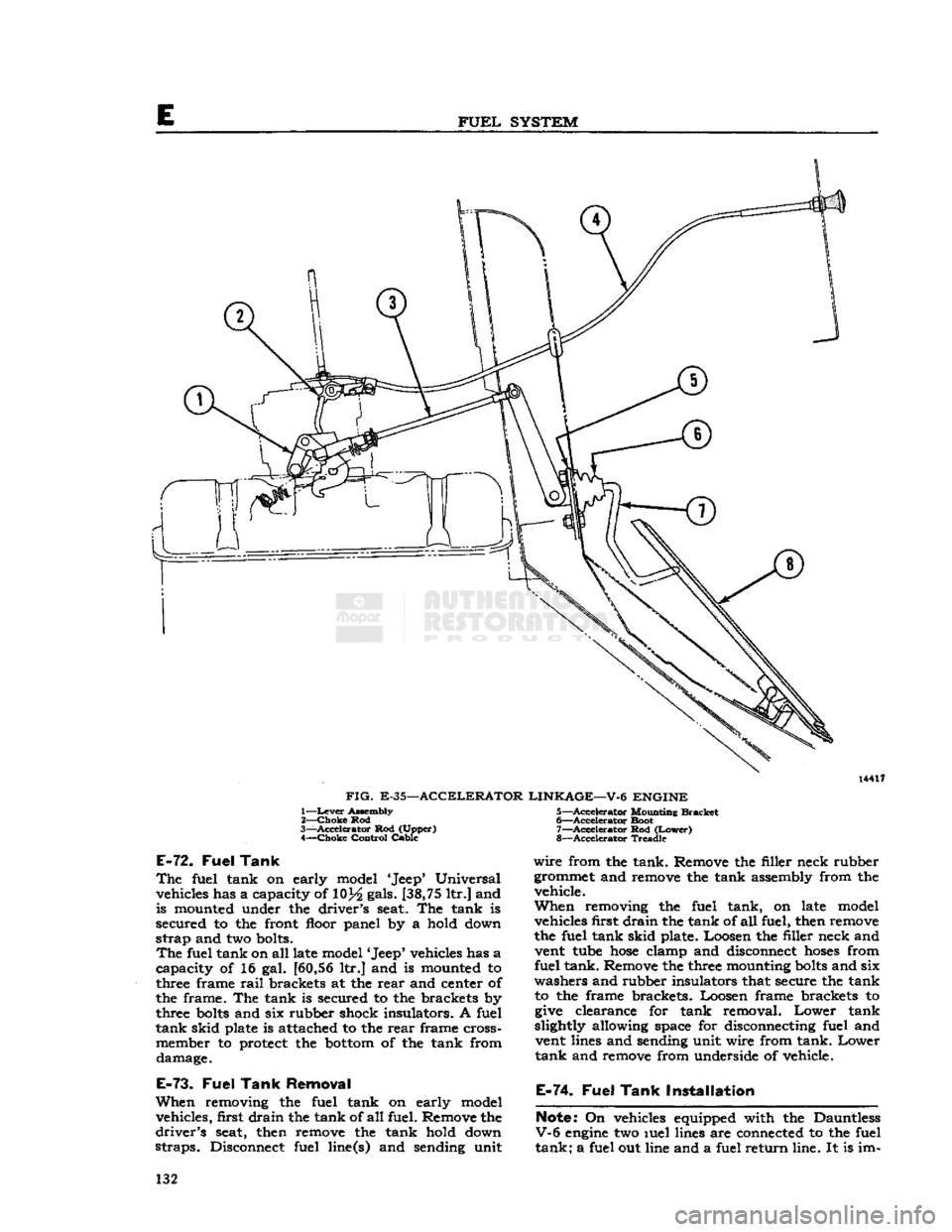
FIG.
E-35—ACCELERATOR LINKAGE—V-6 ENGINE
1— Lever
Assembly
2—
Choke
Rod
3—
-Accelerator
Rod (Upper) 4—
Choke
Control Cable
E-72.
Fuel
Tank
The
fuel tank on early model 'Jeep* Universal vehicles has a capacity of 10}4 gals. [38,75 ltr.] and
is mounted under the driver's seat. The tank is
secured to the front floor panel by a hold down
strap
and two bolts.
The
fuel tank on all late model 'Jeep* vehicles has a
capacity of 16 gal. [60,56 ltr.] and is mounted to
three frame
rail
brackets at the
rear
and center of
the frame. The tank is secured to the brackets by
three
bolts
and six rubber shock insulators. A fuel
tank
skid plate is attached to the
rear
frame cross- member to protect the
bottom
of the tank from damage.
E-73.
Fuel
Tank
Removal
When
removing the fuel tank on early model vehicles, first drain the tank of
all
fuel. Remove the
driver's
seat, then remove the tank hold down
straps.
Disconnect fuel line(s) and sending unit 5—
Accelerator
Mounting Bracket
6—
-Accelerator
Boot
7—
Accelerator
Rod
(Lower)
8—
Accelerator
Treadle
wire
from the tank. Remove the filler neck rubber
grommet and remove the tank assembly from the vehicle.
When
removing the fuel tank, on late model vehicles first
drain
the tank of
all
fuel, then remove
the fuel tank skid plate. Loosen the filler neck and vent tube
hose
clamp and disconnect
hoses
from fuel tank. Remove the three mounting
bolts
and six
washers and rubber insulators that secure the tank to the frame brackets. Loosen frame brackets to
give
clearance for tank removal.
Lower
tank
slightly allowing space for disconnecting fuel and vent lines and sending unit wire from tank.
Lower
tank
and remove from underside of vehicle.
E-74.
Fuel Tank Installation
Note:
On vehicles equipped with the Dauntless
V-6
engine
two luel lines are connected to the fuel
tank;
a fuel out line and a fuel return line. It is im- 132