oil type JEEP DJ 1953 Repair Manual
[x] Cancel search | Manufacturer: JEEP, Model Year: 1953, Model line: DJ, Model: JEEP DJ 1953Pages: 376, PDF Size: 19.96 MB
Page 266 of 376
Jl
FOUR-SPEED
TRANSMISSION
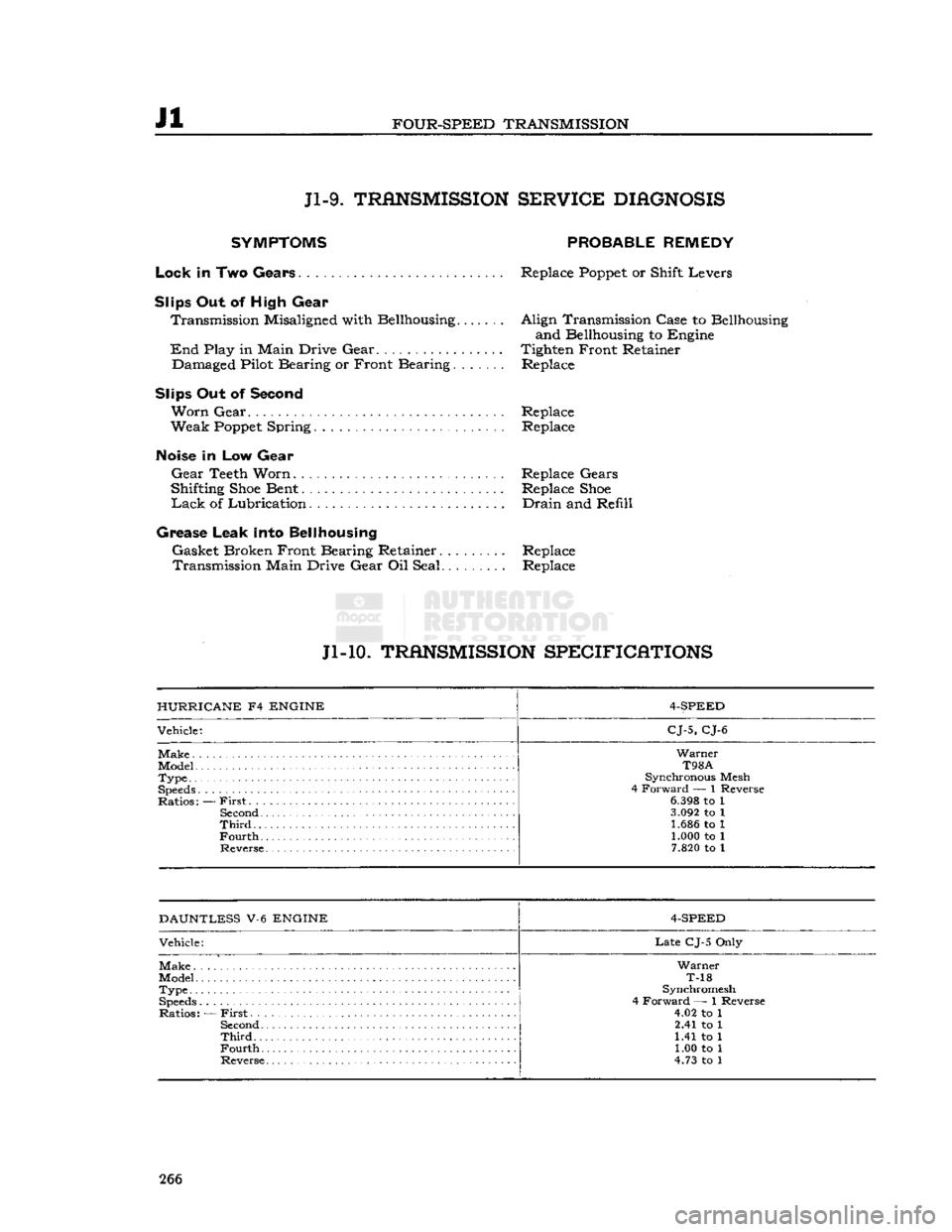
Jl-9.
TRANSMISSION
SER¥ICE
DIAGNOSIS
SYMPTOMS
Lock
In Two Gears
Slips
Out of High Gear Transmission Misaligned with Bellhousing
End
Play in Main Drive Gear Damaged Pilot Bearing or Front Bearing.
Slips Out of
Second
Worn
Gear
Weak
Poppet
Spring
PROBABLE
REMEDY
Replace
Poppet
or Shift Levers
Align Transmission Case to Bellhousing and Bellhousing to Engine
Tighten Front Retainer Replace
Replace Replace
Noise
in Low Gear
Gear
Teeth Worn. Replace Gears
Shifting
Shoe
Bent Replace
Shoe
Lack
of Lubrication Drain and Refill
Grease
Leak into Bellhousing Gasket Broken Front Bearing Retainer......... Replace Transmission Main Drive Gear Oil Seal Replace
Jl-10.
TRANSMISSION
SPECIFICATIONS
HURRICANE
F4
ENGINE
4-SPEED
Vehicle:
CJ-5,
CJ-6
Warner
T98A
Type..
• Synchronous Mesh
4 Forward — 1 Reverse
Ratios: —
First
. .
6.398
to 1
Second
3.092
to 1
Third
1.686 to 1
Fourth
1.000 to 1
7.820
to 1
DAUNTLESS
V-6
ENGINE
4-SPEED
Vehicle:
Late
CJ-5 Only
Warner
Model T-18
Type Synchromesh
4 Forward — 1 Reverse
Ratios: —
First
4.02 to 1
Second
2.41 to 1
Third
1.41 to 1
Fourth
1.00 to 1
Reverse 4.73 to 1 266
Page 277 of 376
'Jeep*
UNIVERSAL SERIES SERVICE
MANUAL
m
FRONT fiXLE
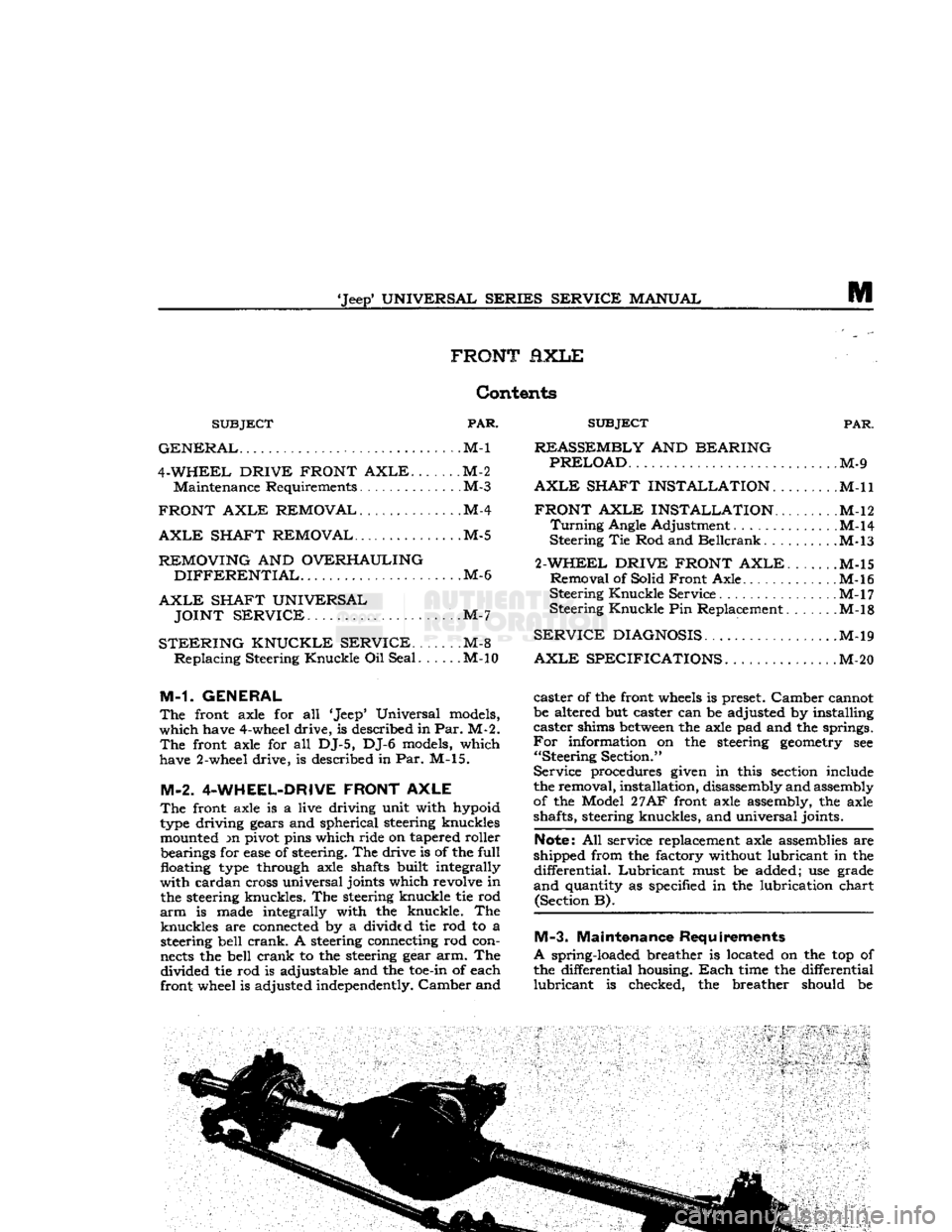
Contents
SUBJECT
PAR.
GENERAL.
M-l
4-WHEEL DRIVE FRONT
AXLE.
M-2
Maintenance
Requirements M-3
FRONT AXLE REMOVAL
.M-4
AXLE
SHAFT REMOVAL
M-5
REMOVING
AND
OVERHAULING
DIFFERENTIAL
.M-6
AXLE
SHAFT UNIVERSAL JOINT SERVICE
M-7
STEERING
KNUCKLE SERVICE
M-8
Replacing
Steering
Knuckle
Oil Seal M-10
M-1. GENERAL
The
front axle for all 'Jeep* Universal models,
which
have 4-wheel drive, is described in
Par.
M-2.
The
front axle for all DJ-5, DJ-6 models, which
have 2-wheel drive, is described in
Par.
M-l5.
M-2. 4-WHEEL-DRIVE FRONT AXLE
The
front axle is a live driving unit with hypoid
type
driving gears and spherical steering knuckles mounted m pivot pins which ride on tapered roller bearings for
ease
of steering. The drive is of the
full
floating
type
through axle shafts built integrally
with
cardan cross universal joints which revolve in the steering knuckles. The steering knuckle tie rod
arm
is made integrally with the knuckle. The
knuckles
are connected by a divided tie rod to a steering bell
crank.
A steering connecting rod con
nects
the bell
crank
to the steering gear arm. The
divided
tie rod is adjustable and the
toe-in
of each
front wheel is adjusted independently.
Camber
and
SUBJECT
PAR.
REASSEMBLY
AND
BEARING PRELOAD
M-9
AXLE
SHAFT INSTALLATION
M-ll
FRONT AXLE INSTALLATION........
.M-l2
Turning
Angle Adjustment . .M-14
Steering
Tie Rod and
Beilcrank
M-l3
2-WHEEL DRIVE FRONT AXLE
M-15
Removal
of Solid
Front
Axle M-l6
Steering
Knuckle
Service M-l7
Steering
Knuckle
Pin Replacement. ......M-l8
SERVICE
DIAGNOSIS
M-19
AXLE
SPECIFICATIONS.
M-20
caster
of the front
wheels
is preset.
Camber
cannot
be altered but caster can be adjusted by installing
caster
shims
between
the axle pad and the springs.
For
information on the steering
geometry
see
"Steering
Section."
Service
procedures given in this section include
the removal, installation, disassembly and assembly
of the Model
27AF
front axle assembly, the axle
shafts, steering knuckles, and
universal
joints.
Note:
All service replacement axle assemblies are
shipped from the factory without lubricant in the
differential.
Lubricant
must be added; use grade
and
quantity as specified in the lubrication chart (Section B).
M-3.
Maintenance Requirements
A
spring-loaded breather is located on the top of
the differential housing.
Each
time the differential
lubricant
is checked, the breather should be
Page 279 of 376
'Jeep*
UNIVERSAL
SERIES
SERVICE
MANUAL
m f. Disconnect propeller shaft from the differential
companion flange.
g.
Disconnect both front springs from front spring hangers.
h.
Remove spring clip and spring clip plates secur
ing axle to front springs.
i.
Remove front
wheels
from axle assembly.
j.
Lower
jack
slightly and
pull
axle forward from
under
vehicle.
M-5.
FRONT AXLE SHAFT REMOVAL
Refer
to Fig. M-2.
The
following procedure applies to either right or
left
front axle shaft.
Note:
Axle shafts can be removed without remov
ing the axle housing from the vehicle. Use the fol
lowing procedure.
First
raise and support front end
of vehicle, and remove front wheels.
a.
Remove drive
flange
snap
ring.
b-
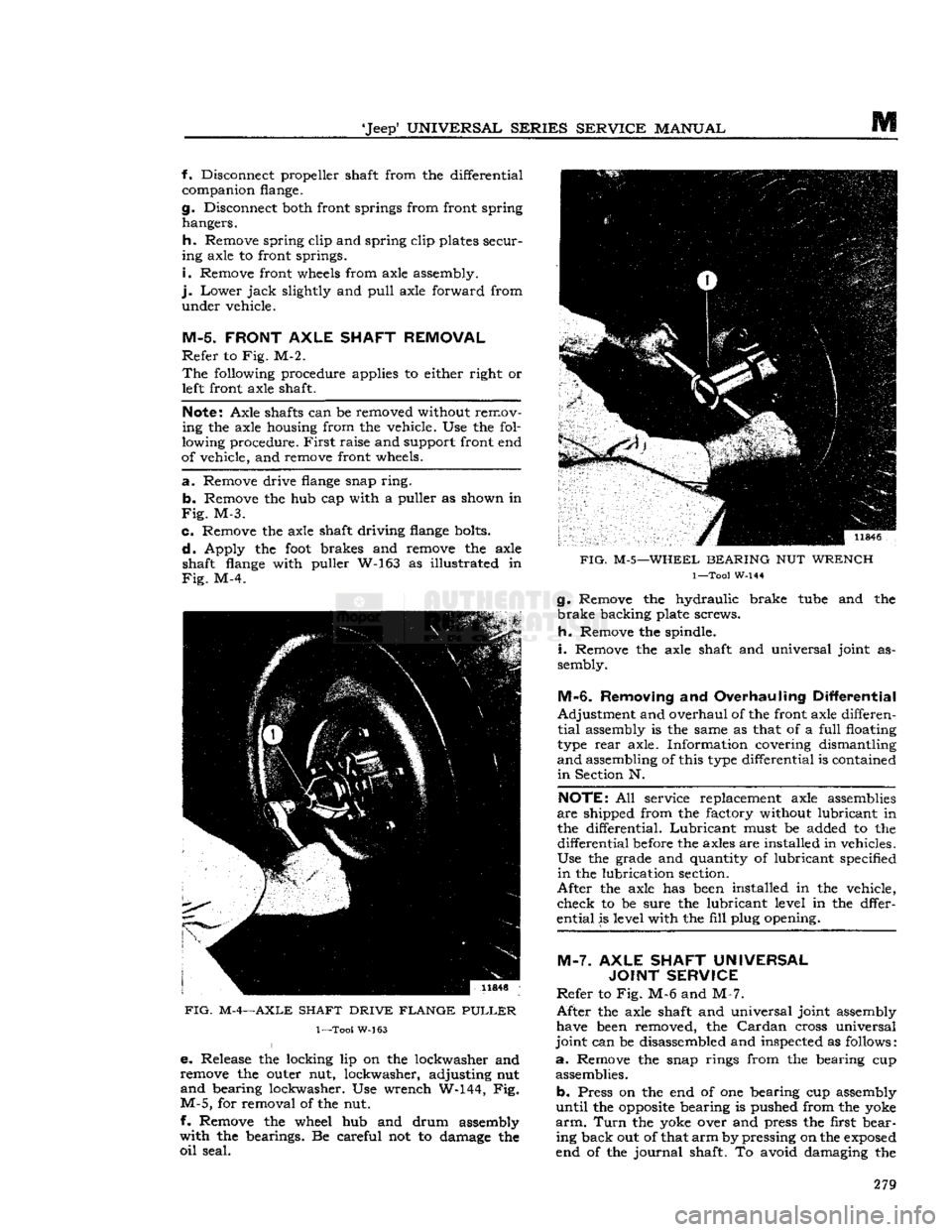
Remove the hub cap with a puller as shown in
Fig.
M-3.
c.
Remove the axle shaft driving
flange
bolts.
d.
Apply the
foot
brakes and remove the axle shaft
flange
with puller W-163 as illustrated in
Fig.
M-4.
FIG.
M-4—AXLE
SHAFT
DRIVE
FLANGE
PULLER
1—Too!
W-163
e.
Release the locking lip on the lockwasher and
remove the outer nut, lockwasher, adjusting nut
and
bearing lockwasher. Use wrench W-144, Fig.
M-5,
for removal of the nut.
f- Remove the wheel hub and drum assembly
with
the bearings. Be careful not to damage the
oil
seal.
FIG.
M-5—WHEEL
BEARING
NUT
WRENCH
1—Tool
W-144
g.
Remove the hydraulic brake
tube
and the
brake
backing plate screws.
h.
Remove the spindle.
i.
Remove the axle shaft and universal joint as
sembly.
M-6.
Removing
and
Overhauling Differential
Adjustment
and overhaul of the front axle differen
tial
assembly is the same as that of a
full
floating
type
rear
axle. Information covering dismantling
and
assembling of this
type
differential is contained
in
Section N.
NOTE:
All service replacement axle assemblies
are
shipped from the factory without lubricant in
the differential.
Lubricant
must be added to the
differential
before
the axles are installed in vehicles.
Use
the grade and quantity of lubricant specified
in
the lubrication section.
After
the axle has
been
installed in the vehicle,
check
to be sure the lubricant level in the dffer-
ential
is level with the
fill
plug opening.
M-7.
AXLE SHAFT UNIVERSAL JOINT SERVICE
Refer
to Fig. M-6 and M-7.
After
the axle shaft and universal joint assembly have
been
removed, the
Cardan
cross universal
joint
can be disassembled and inspected as follows:
a.
Remove the snap rings from the bearing cup assemblies.
b.
Press on the end of one bearing cup assembly
until
the
opposite
bearing is pushed from the yoke
arm.
Turn
the yoke over and press the first bear ing back out of that
arm
by pressing on the
exposed
end of the
journal
shaft. To avoid damaging the 279
Page 282 of 376
FRONT
AXLE
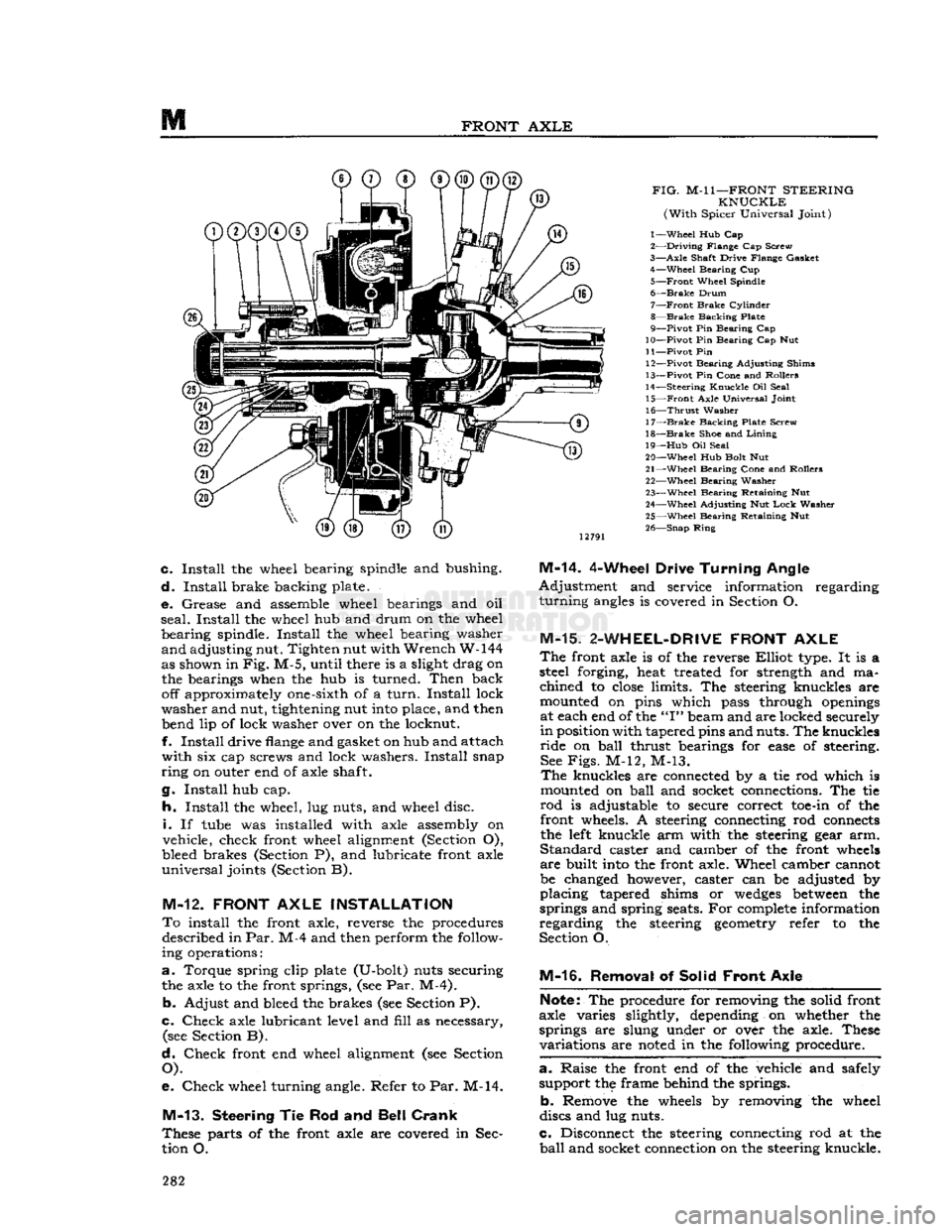
FIG.
M-l
1—FRONT
STEERING
KNUCKLE
(With
Spicer Universal Joint)
1—
Wheel
Hub Cap
2—
Driving
Flange Cap Screw
3—
Axle
Shaft Drive Flange Gasket 4—
Wheel
Bearing Cup
5—
Front
Wheel Spindle
6—
Brake
Drum
7—
Front
Brake
Cylinder
8—
Brake
Backing Plate
9—
Pivot
Pin Bearing Cap
10—
Pivot
Pin Bearing Cap Nut
11—
Pivot
Pin 12—
Pivot
Bearing Adjusting Shims
13—
Pivot
Pin Cone and Rollers
14—
Steering
Knuckle
Oil Seal 15—
Front
Axle Universal Joint
16—
Thrust
Washer
17—
Brake
Backing Plate Screw
18—
Brake
Shoe and
Lining
19—
Hub
Oil Seal
20—
Wheel
Hub Bolt Nut
21—
Wheel
Bearing Cone and Rollers 22—
Wheel
Bearing Washer
23—
Wheel
Bearing Retaining Nut
24—
Wheel
Adjusting Nut
Lock
Washer
25—
Wheel
Bearing Retaining Nut
26—
Snap
Ring
c.
Install
the wheel bearing spindle and bushing.
d.
Install
brake backing plate.
e.
Grease and assemble wheel bearings and oil
seal.
Install
the wheel hub and drum on the wheel
bearing
spindle.
Install
the wheel bearing washer
and
adjusting nut. Tighten nut with
Wrench
W-144
as shown in
Fig.
M-5, until there is a slight drag on the bearings when the hub is turned.
Then
back off approximately one-sixth of a
turn.
Install
lock
washer
and nut, tightening nut
into
place, and then bend lip of lock washer over on the locknut.
f.
Install
drive
flange
and gasket on hub and attach
with
six cap screws and lock washers.
Install
snap
ring
on outer end of axle shaft.
g.
Install
hub cap.
h.
Install
the wheel, lug nuts, and wheel disc.
i.
If
tube
was installed with axle assembly on
vehicle, check front wheel alignment (Section O),
bleed brakes (Section P), and lubricate front axle
universal
joints (Section B).
M-12.
FRONT
AXLE
INSTALLATION
To
install the front axle, reverse the procedures described in
Par.
M-4 and then perform the follow
ing operations:
a.
Torque spring clip plate (U-bolt) nuts securing the axle to the front springs, (see Par. M-4).
b.
Adjust and bleed the brakes (see Section P).
c.
Check
axle lubricant level and
fill
as necessary, (see Section B).
d.
Check
front end wheel alignment (see Section
O).
e.
Check
wheel turning angle. Refer to Par. M-14.
M-13.
Steering
Tie Rod and
Bell Crank
These
parts of the front axle are covered in Sec
tion O.
M-14.
4-Wheel Drive
Turning
Angle
Adjustment
and service information regarding
turning
angles
is covered in Section O.
M-15.
2-WHEEL-DRIVE
FRONT
AXLE
The
front axle is of the reverse
Elliot
type. It is a
steel forging, heat treated for strength and ma
chined
to
close
limits. The steering knuckles are
mounted on pins which pass through
openings
at each end of the
"I"
beam and are locked securely
in
position with tapered pins and nuts. The knuckles
ride
on
ball
thrust bearings for
ease
of steering. See
Figs.
M-12, M-13.
The
knuckles are connected by a tie rod which is
mounted on
ball
and socket connections. The tie
rod
is adjustable to secure correct
toe-in
of the front wheels. A steering connecting rod
connects
the
left
knuckle arm with the steering gear arm.
Standard
caster and camber of the front
wheels
are
built
into
the front axle. Wheel camber cannot
be changed however, caster can be adjusted by
placing
tapered shims or
wedges
between
the
springs and spring seats. For
complete
information
regarding
the steering
geometry
refer to the
Section O.
M-16.
Removal of Solid
Front
Axle
Note:
The procedure for removing the solid front
axle varies slightly, depending on whether the
springs are slung under or over the axle. These
variations
are
noted
in the following procedure.
a. -
Raise the front end of the vehicle and safely support the frame behind the springs.
b.
Remove the
wheels
by removing the wheel
discs and lug nuts.
c.
Disconnect the steering connecting rod at the
ball
and socket connection on the steering knuckle. 282
Page 290 of 376
N
REAR
AXLE
14153
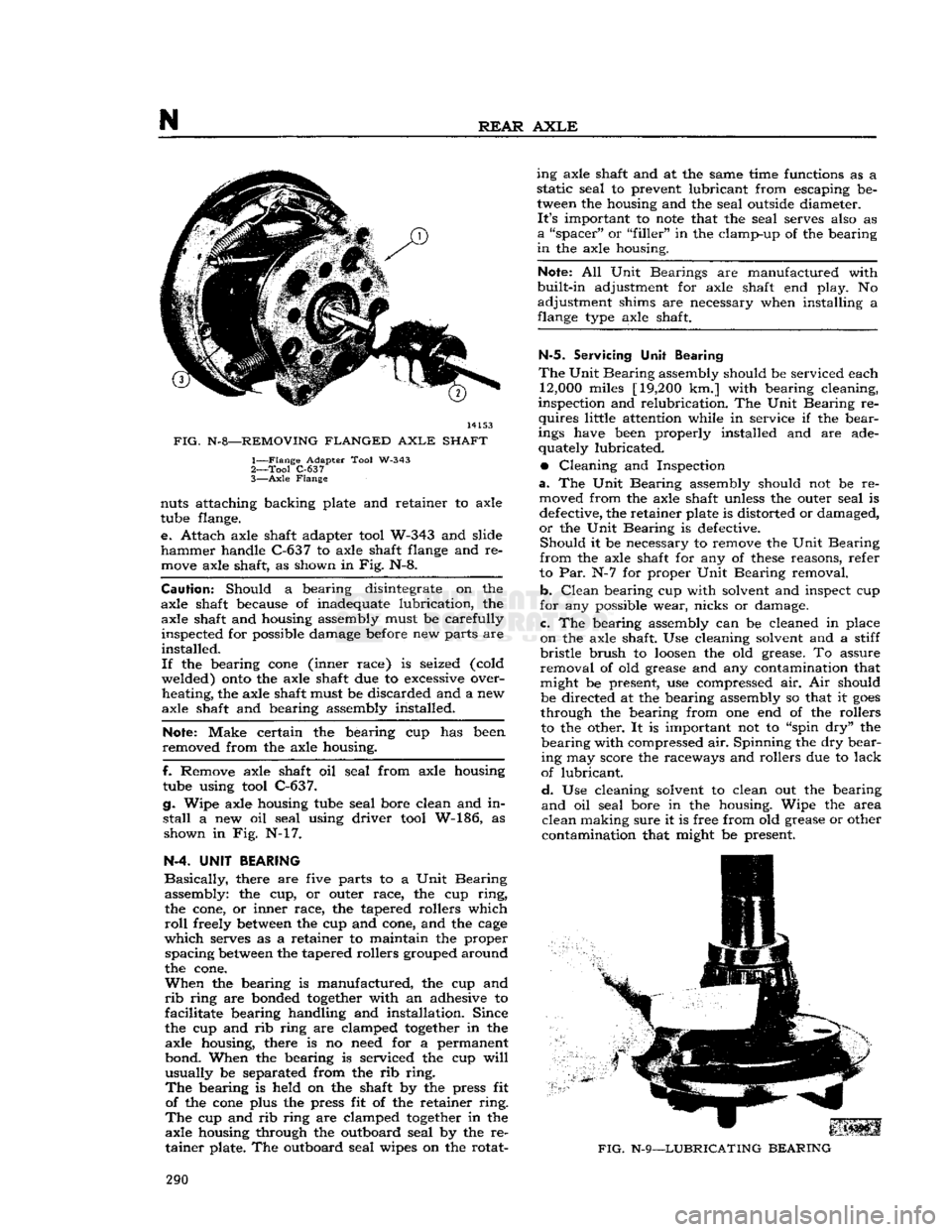
FIG.
N-8—REMOVING FLANGED
AXLE
SHAFT
1—
Flange
Adapter Tool W-343
2—
Tool
C-637
3—
Axle
Flange nuts attaching backing plate and retainer to axle
tube flange.
e. Attach axle shaft adapter tool W-343 and slide
hammer
handle C-637 to axle shaft flange and re
move
axle shaft, as shown in Fig. N-8.
Caution:
Should a bearing disintegrate on the
axle shaft because of inadequate lubrication, the axle shaft and housing assembly must be carefully inspected for possible damage before new parts are
installed.
If
the bearing
cone
(inner race) is seized (cold
welded)
onto
the axle shaft due to excessive over heating, the axle shaft must be discarded and a new
axle shaft and bearing assembly installed.
Note:
Make certain the bearing cup has been
removed from the axle housing.
f. Remove axle shaft oil seal from axle housing tube using tool C-637.
g. Wipe axle housing tube seal bore clean and in
stall
a new oil seal using driver tool W-186, as shown in Fig. N-l7.
N-4.
UNIT BEARING
Basically,
there are five parts to a Unit Bearing assembly: the cup, or outer race, the cup
ring,
the cone, or inner race, the tapered rollers which
roll
freely
between
the cup and cone, and the
cage
which
serves as a retainer to maintain the proper spacing
between
the tapered rollers grouped around
the cone.
When
the bearing is manufactured, the cup and
rib
ring are bonded
together
with an adhesive to
facilitate bearing handling and installation. Since the cup and rib ring are clamped
together
in the axle housing, there is no need for a permanent
bond. When the bearing is serviced the cup
will
usually
be separated from the rib
ring.
The
bearing is held on the shaft by the press fit of the
cone
plus the press fit of the retainer
ring.
The
cup and rib ring are clamped
together
in the axle housing through the outboard seal by the re
tainer
plate. The outboard seal wipes on the rotat ing axle shaft and at the same time functions as a
static seal to prevent lubricant from escaping be
tween the housing and the seal outside diameter.
It's
important to
note
that the seal serves also as
a
"spacer" or "filler" in the clamp-up of the bearing
in
the axle housing.
Note:
All Unit Bearings are manufactured with
built-in
adjustment for axle shaft end play. No adjustment shims are necessary when installing a
flange type axle shaft.
N-5.
Servicing Unit Bearing
The
Unit
Bearing
assembly should be serviced each
12,000
miles [
19,200
km.] with bearing cleaning,
inspection and relubrication. The Unit Bearing re
quires
little attention while in service if the bear
ings have been properly installed and are ade
quately lubricated.
•
Cleaning and Inspection
a.
The Unit Bearing assembly should not be re moved from the axle shaft unless the outer seal is defective, the retainer plate is distorted or damaged,
or
the Unit Bearing is defective.
Should
it be necessary to remove the Unit Bearing
from
the axle shaft for any of
these
reasons, refer
to Par. N-7 for proper Unit Bearing removal.
b.
Clean
bearing cup with solvent and inspect cup
for any possible wear, nicks or damage.
c.
The bearing assembly can be cleaned in place
on the axle shaft. Use cleaning solvent and a stiff
bristle
brush to
loosen
the old grease. To assure
removal
of old grease and any contamination that
might be present, use compressed air. Air should be directed at the bearing assembly so that it
goes
through the bearing from one end of the rollers to the other. It is important not to "spin dry" the
bearing
with compressed
air.
Spinning the dry bearing may score the raceways and rollers due to
lack
of lubricant.
d.
Use cleaning solvent to clean out the bearing
and
oil seal bore in the housing. Wipe the area
clean
making sure it is free from old grease or other
contamination that might be present.
FIG.
N-9—LUBRICATING BEARING
290
Page 294 of 376
N
REAR AXLE
N-l2.
Differential Case
Disassembly
Refer
to
Fig.
N-3 and N-7.
a.
Remove
the
axle shafts. Refer
to
Par.
N-ll for
rear
axle removal
and
Par.
M-4 for
front axle
re
moval.
b.
Remove
the
housing cover
and
four
cap
screws
holding
the two
differential side bearing caps
in
position. Make sure there
are
matching letters
or
some
type
of
identification marks
on the
caps
and
housing
so
that each
cap can be
reinstalled
in the
same position
and
location from which
it is re
moved.
c.
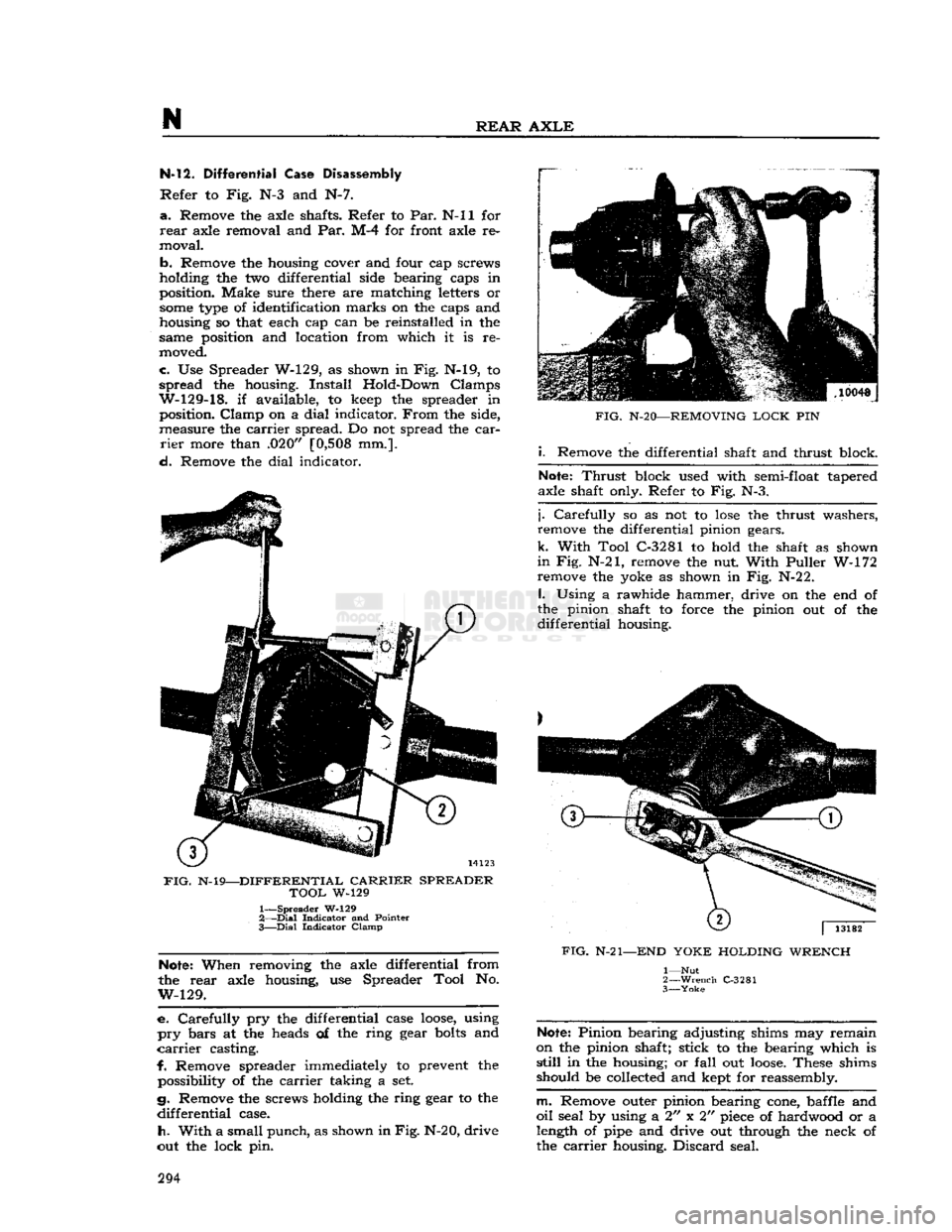
Use
Spreader W-129,
as
shown
in
Fig. N-l9,
to
spread
the
housing.
Install
Hold-Down Clamps
W-129-18.
if
available,
to
keep
the
spreader
in
position.
Clamp
on a
dial
indicator.
From
the
side,
measure
the
carrier
spread.
Do not
spread
the
car
rier
more than
.020"
[0,508
mm.].
d.
Remove
the
dial
indicator.
FIG.
N-19—DIFFERENTIAL
CARRIER
SPREADER
TOOL
W-129
1—
Spreader
W-129
2—
Dial
Indicator
and
Pointer
3—
Dial
Indicator
Clamp
Note:
When removing
the
axle differential from
the
rear
axle housing,
use
Spreader Tool
No.
W-129.
e.
Carefully
pry the
differential case
loose,
using
pry
bars
at the
heads
of the
ring gear
bolts
and
carrier
casting.
f.
Remove spreader immediately
to
prevent
the
possibility
of the
carrier
taking
a set.
g. Remove
the
screws holding
the
ring gear
to the
differential
case.
h.
With
a
small punch,
as
shown in
Fig.
N-20, drive
out
the
lock
pin.
FIG.
N-20—REMOVING
LOCK
PIN
i.
Remove
the
differential shaft
and
thrust block.
Note:
Thrust
block used with semi-float tapered
axle shaft only. Refer
to
Fig.
N-3.
j.
Carefully
so as not to
lose
the
thrust washers,
remove
the
differential pinion gears.
k.
With
Tool C-3281
to
hold
the
shaft
as
shown
in
Fig.
N-21,
remove
the nut.
With
Puller
W-172
remove
the
yoke
as
shown
in
Fig. N-2
2.
I.
Using
a
rawhide hammer, drive
on the end of
the pinion shaft
to
force
the
pinion
out of the
differential
housing.
FIG.
N-21—END
YOKE
HOLDING WRENCH
1— Nut
2—
Wrench
C-3281
3—
Yoke
Note:
Pinion bearing adjusting shims
may
remain
on
the
pinion shaft; stick
to the
bearing which
is
still
in the
housing;
or
fall
out
loose.
These shims
should
be
collected
and
kept
for
reassembly.
m.
Remove outer pinion bearing
cone,
baffle
and
oil
seal
by
using
a 2" x 2"
piece
of
hardwood
or a
length
of
pipe
and
drive
out
through
the
neck
of
the
carrier
housing.
Discard
seal. 294
Page 301 of 376
'Jeep'
UNIVERSAL
SERIES SERVICE
MANUAL
N
13189
FIG.
N-36—PINION
SHAFT OIL
SEAL
INSTALLER
1—Tool
W-147
p.
Remove
the
sleeve
previously installed in
place
of
the yoke. Install the oil
seal
with
Tool
W-147 shown in Fig. N-36.
q. Install the yoke
with
Flange
Installer W-162,
as shown in Fig. N-3 7.
r.
Install pinion nut and cotter pin.
s. Install axle
shafts
and housing cover.
N-20.
POWR-LOK
DIFFERENTIAL
As
optional equipment, Powr-Lok was previously available on all
Jeep
Universal
models
equipped
with
semi-float
tapered
axle
shafts.
The Powr-Lok
differential
may be identified by a tag located on
the opposite
side
of the differential housing
from
the ratio tag (Fig. N-2) and
stamped
with
either a "T" or
with
the words, "USE
LIMITED
SLIP
FIG.
N-37—YOKE INSTALLING TOOL
DIFF.
LUBE
ONLY."
This differential is available
for
rear
axles
only.
Whenever a
replacement
or conversion Powr-Lok
differential
is to be installed in an axle which has
been
previously in
service
and acquired mileage, be
sure
to record the amount of backlash
between
the ring
gear
and pinion at the time of
disassembly.
When the axle is again
assembled
the ring
gear
and pinion must be set to this
same
amount of
back
lash.
Axle
ratios and
speedometer
gear
application is very important. In
like
model
axles,
the ratio may
be
changed
by simply changing to the desired ring
gear
and pinion;
except
in the
case
of the
3.73:1
or higher ratios. When changing
from
a
3.73:1
or higher to 3.54 or lower ratio, or vice
versa,
the
differential
case
must
also
be
changed
on a
stand
ard differential
assembly,
and the differential as sembly,
less
ring
gear
and pinion, when a Powr-Lok
differential
assembly
is involved. When changing
from
any ratio to
another,
it
will
also
be
necessary
to
change
speedometer
gears.
Speedometer
gears
for
Powr-Lok and
standard
differentials of the
same
ratio, are
interchangeable.
A complete
rear
axle
assembly
replacement
is
necessary,
if a con
version
from
one type of differential
assembly
to
another
is desired.
Note: Powr-Lok differentials use a special
lubri
cant.
Refer to the Lubrication Chart.
N-21.
Trouble Symptoms and
Possible
Causes
If
noises
such
as
chatter
are
detected,
when turning
a corner, the probable
reason
for this is that incor
rect
gear
lubricant has
been
installed in the axle.
Axles
equipped
with
a
limited
slip differential require special lubricant. Refer to Lubrication
Sec
tion,
Par. B-52.
Note: It may be
necessary
to use an additive to
attempt to eliminate
chatter.
If this is not
success
ful
then
disassembly
and inspection of the differen
tial
becomes
necessary.
Warning:
Extreme
care
must be exercised on a
Powr-Lok
equipped vehicle to be
sure
the transmis
sion is in the neutral position
whenever
the
engine
is
started
with
one wheel jacked up. Otherwise the
vehicle may lurch unexpectedly and
fall
off the
jack.
N-22. Torque Test
Procedure
for testing torque Powr-Lok differentials
on
Jeep
Universal
Series
vehicles is as follows:
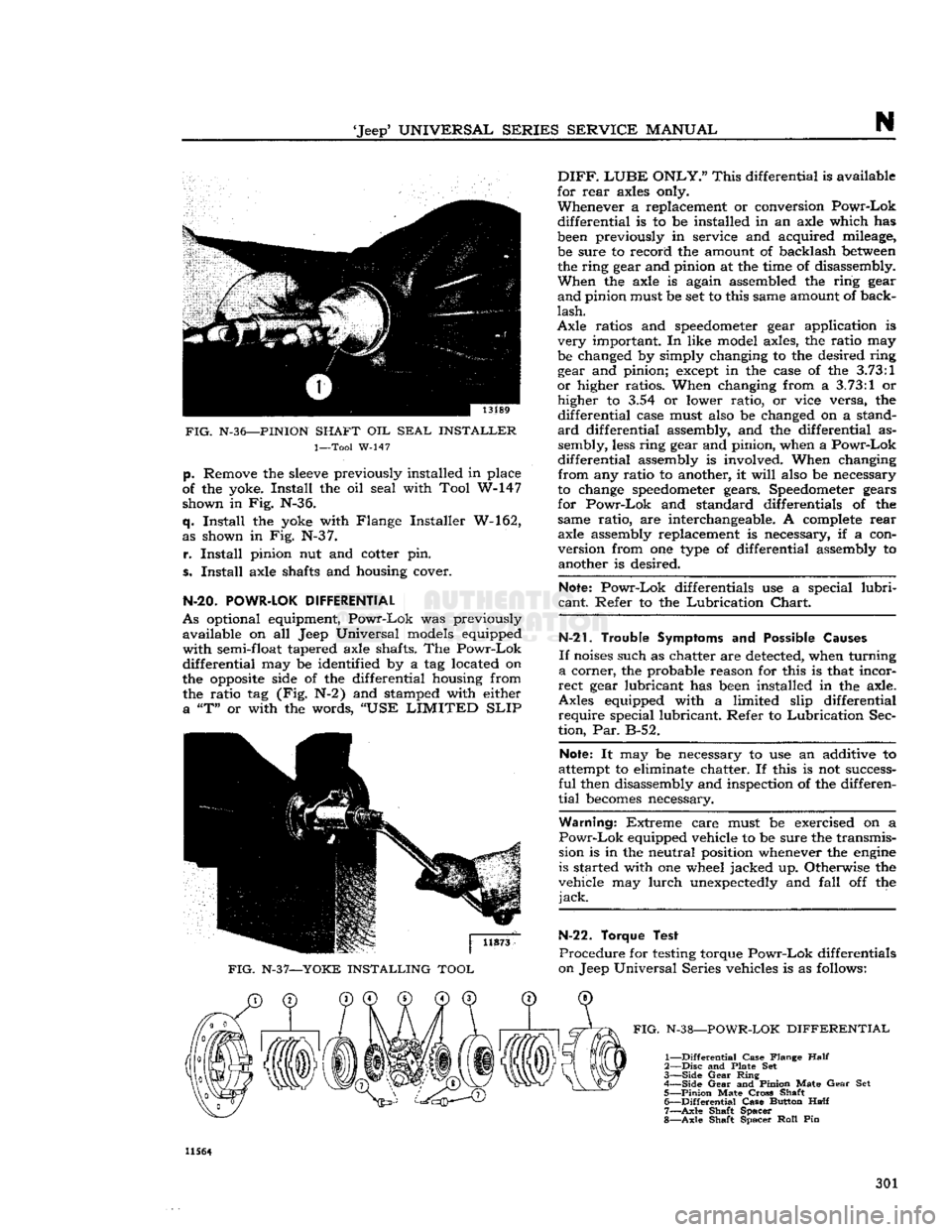
FIG.
N-38—POWR-LOK DIFFERENTIAL
1—
Differential
Case Flange
Half
2—
Disc
and Plate Set
3—
Side
Gear
Ring
4— Side
Gear
and Pinion Mate
Gear
Set
5—
Pinion
Mate
Cross
Shaft 6—
Differential
Case Button
Half
7—
Axle
Shaft Spacer
8—
Axle
Shaft Spacer
Roll
Pin 11564
301
Page 314 of 376
STEERING
SYSTEM
O-L
GENERAL
The
steering system on all Jeep Universal vehicles
consists of the steering gear, steering wheel, steering column and shaft, and steering linkage.
This
section covers wheel alignment, steering linkage,
steering gear, steering column and steering wheel.
0-2. Steering
Gear
Function
The
steering gear is a reducing gear. It exchanges a
relatively
large amount of movement with a small force (applied by the driver at the steering wheel), for a much smaller amount of movement with a
greatly increased force through a cam and lever
action type steering gear. The steering gear ratio is 17.9 to 1 on vehicles equipped with the F4
engine
and
19 to 1 with the V6 engine.
0-3. Steering
Linkage
Refer
to Fig. O-l.
The
steering linkage consists of a steering arm at
tached to the steering gear, a steering connecting
rod,
(drag
link),
connecting the steering arm to the
beilcrank,
and a steering tie rod connecting the
beilcrank
to the axle tie rod. The beilcrank pivots
on a pin mounted just to the left of the frame front crossmember. The steering tie rod is connected to
the beilcrank and
extends
to the right
ball
joint as sembly of tie rod. The tie rod
extends
to the wheels,
being connected to their respective steering knuckle
arms
at the wheels.
With
this linkage arrangement,
as the steering arm
moves
rearward,
the front
wheels
turn
to the left. As the steering arm
moves
forward,
the wheels
turn
to the right.
Ball
joints are used to secure the drag
link,
steering
connecting rod and tie rod ends. The
ball
joints
assist in maintaining
good
steering control and con
stant toe-in of the front wheels under all driving conditions. If the
ball
joints
become
worn enough
to allow free motion in the linkage, they should be,
replaced.
Note:
Ball
joint replacement of the tie rod requires
resetting of the wheel toe-in adjustment.
0-4.
Steering
Column
and Gear
Alignment
When
adjusting a steering gear remove all loads
from
the unit by disconnecting the steering con
necting rod (drag
link)
from the steering arm and
also
loosen
the instrument panel bracket and the
steering gear to frame
bolts
to allow the steering
post
to correctly align itself. When retightening the
steering gear to frame
bolts
use a torque wrench
pull
of 45 to 55 lb-ft. [6,2 a 7,6 kg-m.] on the
Vk*
bolts
and 30 to 40 lb-ft. [4,15 a 5,5 kg-m.] on the
Vs"
bolts. 10811
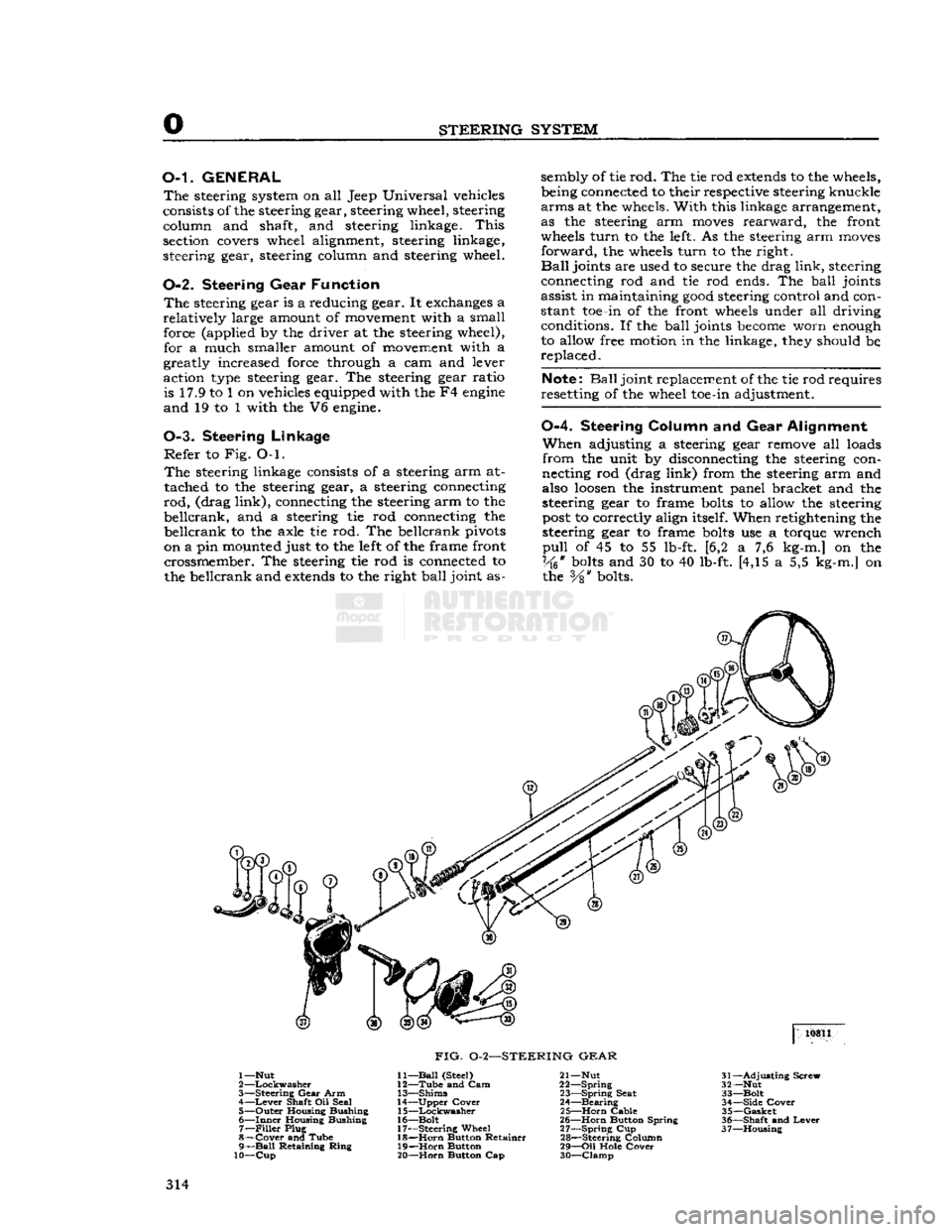
FIG.
0-2—STEERING
GEAR
1—Nut
2
—Lockwasher
3—
Steering
Gear
Arm 4—
Lever
Shaft Oil Seal
5—
Outer
Housing Bushing
6—
Inner
Housing Bushing 7—
Filler
Plug
8—
Cover
and Tube
9—
Ball
Retaining
Ring
10—Cup
11—
Ball
(Steel)
12—
Tube
and Cam
13—
Shims
14—
Upper
Cover
15—
Lockwasher
16—
Bolt
17—
Steering
Wheel 18—
Horn
Button Retainer
19—
Horn
Button
20—
Horn
Button Cap 21— Nut
22—
Spring
23—
Spring
Seat
24—
Bearing
25—
Horn
Cable
26—
Horn
Button Spring
27—
Spring
Cup
28—
Steering Column
29—
Oil
Hole
Cover
30—
Clamp
31—
Adjusting
Screw
32— Nut
33—
Bolt
34—
Side
Cover
35—
Gasket
36—
Shaft
and
Lever
37—
Housing
314
Page 321 of 376
'Jeep'
UNIVERSAL
SERIES SERVICE
MANUAL
O
column assembly down through the floor pan open
ing and out from under vehicle.
0-24.
Disassembly
of
Steering
Gear
Refer
to Fig. 0-2.
When
the steering gear arm is installed on early
production vehicles, the line across the face of the
arm
and the end of the shaft should be in align ment. On later production vehicles, blind splines
on the lever shaft and in the steering gear arm en
sure
correct positioning of the arm.
a.
Remove the steering gear arm with a puller
C-3646.
Caution:
Do not use a hammer or
wedge
to re
move
the steering arm from the shaft and lever.
This
can cause damage to the shaft assembly.
b.
Loosen the lock nut and unscrew the adjusting
screw
two turns.
c.
Remove the side cover screws and washers. Re
move
the side cover and gasket.
d.
Remove lever shaft.
e.
Remove upper cover plate screws. Remove cam,
wheel tube, and bearing assembly from the housing.
f.
Clean
all parts with suitable cleaning solvent and wipe dry.
g.
After dismantling as outlined above is com
pleted, inspect cam
grooves
for wear, chipping and
scoring,
also the
ball
races on the cam ends and the
separate
ball
cups. Existence of any of
these
condi tions indicates the necessity for parts replacement.
h.
Inspect the tapered stud mounted on the lever
shaft for flat
spots
and chipping. In the case of
either, replacement is usually advisable. Inspect the
lever shaft for wear and
test
the fit of the shaft in
the bushings.
i.
Inspect condition of the oil seal at outer end of
lever shaft and the bearing at top end of steering
column.
0-25.
Reassembly
of
Steering
Gear
e Refer to Fig. 0-2.
Reassemble all parts to wheel tube in reverse order
of dismantling. Assemble cam, wheel tube and
bearing
assembly in housing, seating the lower
bearing
ball
cup in the housing.
Note:
New plastic retainer type cam bearings are
now available for the Ross steering gears. The new
bearings replace, and are interchangeable with,
the lock ring type cam bearings on gears equipped
with
early type cams.
With
adjusting shims in place, assemble upper
cover and adjust the cam bearings.
Assemble lever shaft in housing and with gasket
in
place assemble the side cover and set adjusting
screw
for a minimum backlash of the studs in the
cam
groove, with the steering gear at the center
point of travel.
When
assembling upper bearing spring and spring
seat in jacket tube make sure that the spring seat
is positioned correctly. It must be installed with
the lengthwise flange down against the bearing and
not up inside of spring coil.
0-26.
Installation
of
Steering
Gear
a.
After the gear has been properly adjusted, as
outlined in Par. 0-5, install steering gear assembly
in
chassis in the reverse order in which it was re
moved.
b.
After installing the assembly in the vehicle,
jack
up front of vehicle and place the front wheels
in
the straight ahead position.
c.
Temporarily install the steering wheel to locate
the mid-position of the steering gear. To locate the mid-position,
turn
the steering wheel as far to the
right
as possible and then
turn
in the
opposite
di
rection
as far as possible, noting the total number
of turns.
Turn
the wheel back just ^ of the total movement to place the gear in mid-position.
d.
With
the steering gear in mid-position and the
wheels in the straight ahead position install steer ing gear arm on lever shaft with the
ball
end down.
When
installed the line across the face of the arm
and
end of shaft should be in alignment.
0-27.
Steering
Wheel
Installation
•
Refer to Fig. 0-2.
a.
Install
steering wheel and spring on shaft.
Align
scribe marks on shaft and hub of wheel.
b.
Install
steering shaft nut and torque 20 to 25
lb-ft. [2,8 a 3,4 kg-m.].
c.
Install
horn cap. Test horn.
321
Page 329 of 376
'Jeep'
UNIVERSAL
SERIES
SERVICE
MANUAL
P
FIG.
P-9—WHEEL HUB OIL
SEAL
DRIVER
•
Removing the
Rear
Brake
Shoes.
•
Refer to Fig. P-ll.
a.
Using Tool C-3785 or equivalent remove the
upper linkage rod and brake
shoe
return springs.
b. Remove the brake
shoe
retainer, spring and pins.
c. Remove the anchor pin plate and tilt the brake
shoe
assembly out from the backing plate.
d.
On vehicles without a transmission brake,
spread the anchor
ends
of the primary and second
ary
shoes
and remove the parking brake strut and
spring.
e. On vehicles without a transmission brake, dis
engage
the parking brake cable from the parking
brake
lever and remove the brake assembly.
f. Overlap the anchor
ends
of the primary and
secondary
shoes
and remove the adjusting screw,
adjusting lever, lower return spring, and linkage
rods.
P-17. Inspection
Inspect the oil seals in the wheel hubs. If the con
dition of any oil seal is doubtful, replace it. Install
the oil seal with an oil seal driver as shown in Fig.
P-9.
Brake
shoes
may be distorted by improper lining installation and linings should be ground true. For
this reason it is recommended that new or re
placement
shoe
and lining assemblies be installed.
Using
brake drum micrometer C-3920 or equi
valent, check all drums. Should a brake drum be rough and scored, it may be reconditioned by grinding or turning in a lathe. Do not remove more
than .030"
[0,762
mm.] thickness of metal .060" [1,52 mm.] overall diameter. If a drum is recon
ditioned in this manner, either the correct factory-
supplied, oversize lining .030"
[0,762
mm.] must be
installed or a shim equal in thickness to the metal
removed must be placed
between
the lining and
shoe
so that the arc of the lining
will
be the same
as that of the drum.
If
it is found when
wheels
are removed that there
is brake fluid leakage at any of the wheel cylinders, it
will
be necessary to replace or recondition the
wheel cylinder (Par. P-21) and bleed the brake lines (Par. P-7).
Whenever the brake lining is replaced in one front
or one rear wheel, be sure to perform the same
operation in the
opposite
front or rear wheel, us
ing the same brake lining part number. Otherwise, unequal brake action
will
result.
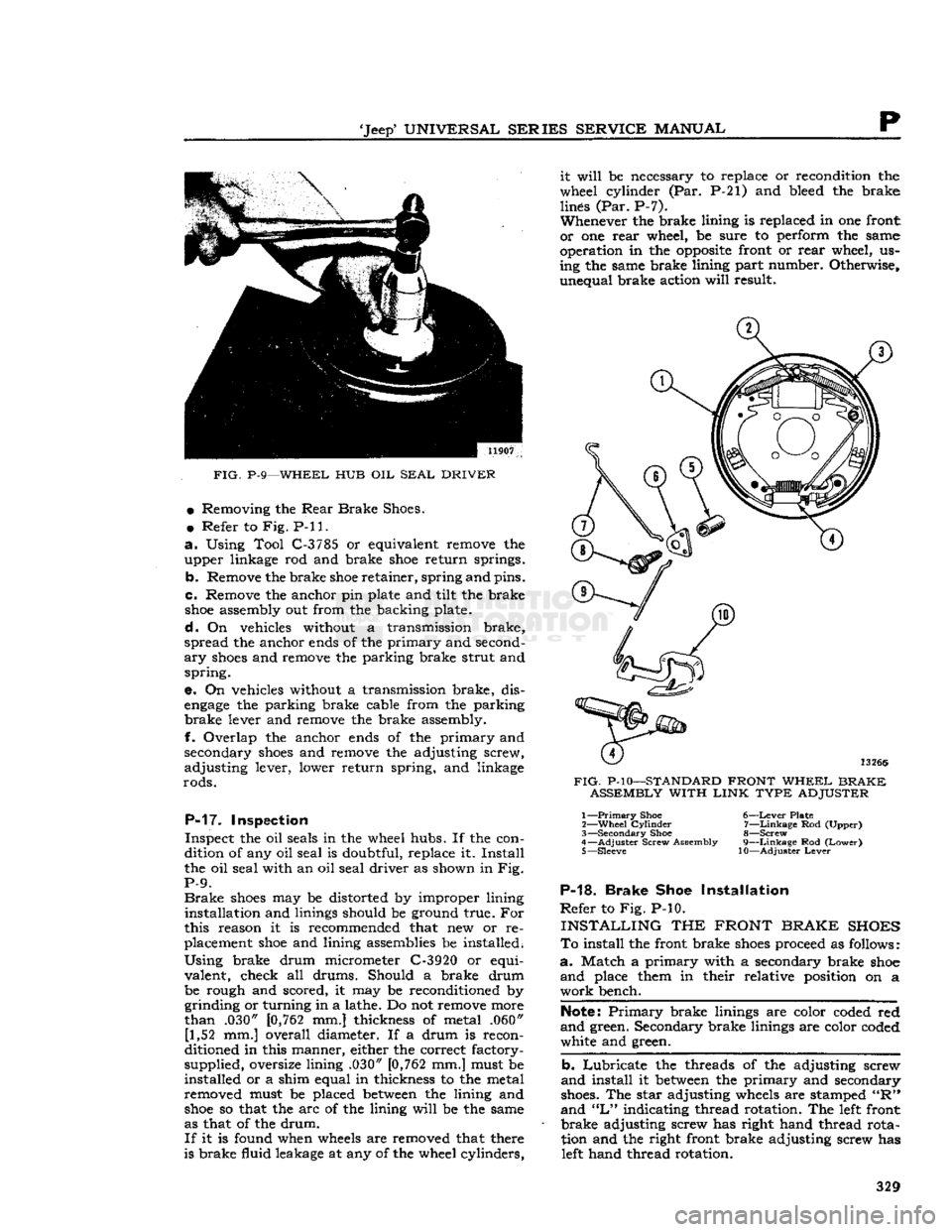
FIG.
P-10—STANDARD
FRONT
WHEEL
BRAKE
ASSEMBLY
WITH
LINK
TYPE
ADJUSTER 1—
Primary
Shoe
6—Lever
Plate
2—
Wheel
Cylinder
7—Linkage Rod (Upper)
3—
Secondary
Shoe 8—Screw
4—
Adjuster
Screw Assembly 9—Linkage Rod
(Lower)
5— Sleeve 10—Adjuster
Lever
P-18.
Brake
Shoe Installation
Refer
to Fig. P-10.
INSTALLING
THE
FRONT
BRAKE
SHOES
To
install the front brake
shoes
proceed as follows:
a.
Match a primary with a secondary brake
shoe
and
place them in their relative position on a
work
bench.
Note:
Primary
brake linings are color coded red
and
green. Secondary brake linings are color coded
white and green.
b. Lubricate the threads of the adjusting screw
and
install it
between
the primary and secondary
shoes.
The star adjusting
wheels
are stamped "R"
and
"L"
indicating thread rotation. The
left
front
brake
adjusting screw has right hand thread rota
tion and the right front brake adjusting screw has
left
hand thread rotation. 329