lock JEEP GLADIATOR 2023 Owner's Manual
[x] Cancel search | Manufacturer: JEEP, Model Year: 2023, Model line: GLADIATOR, Model: JEEP GLADIATOR 2023Pages: 448, PDF Size: 17.37 MB
Page 30 of 448
28GETTING TO KNOW YOUR VEHICLE
NOTE:Always use this device when carrying children.
After engaging the child lock on both rear doors,
check for effective engagement by trying to open a
door with the internal handle. Once the
Child-Protection Door Lock system is engaged, it is
impossible to open the doors from inside the
vehicle. Before getting out of the vehicle, be sure to
check that there is no one left inside.
FRONT DOOR REMOVAL
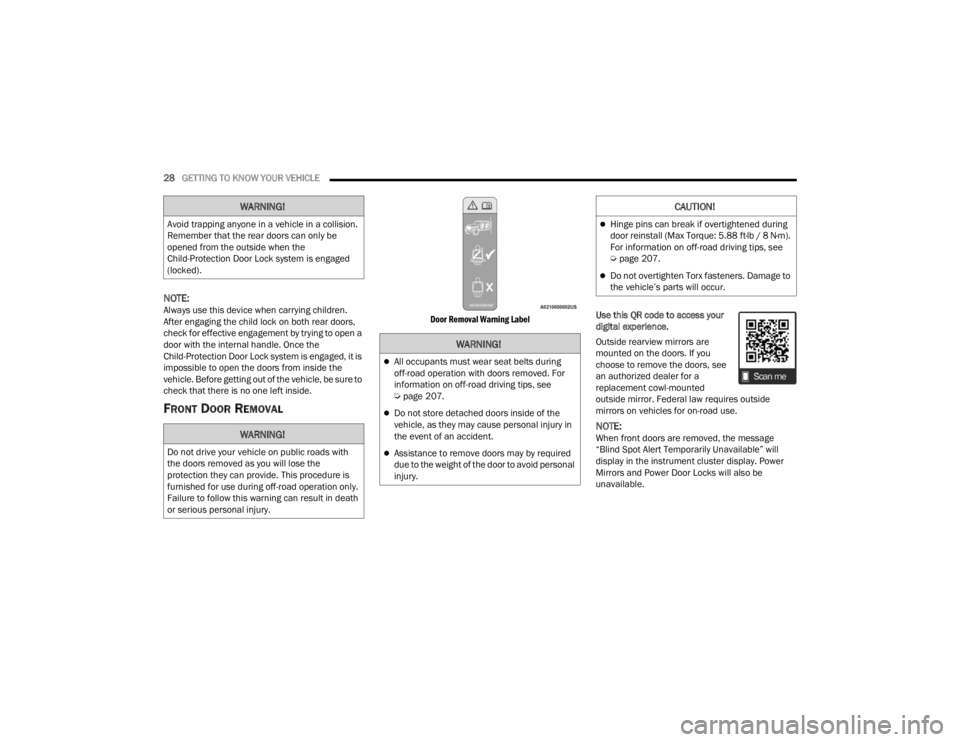
Door Removal Warning Label
Use this QR code to access your
digital experience.
Outside rearview mirrors are
mounted on the doors. If you
choose to remove the doors, see
an authorized dealer for a
replacement cowl-mounted
outside mirror. Federal law requires outside
mirrors on vehicles for on-road use.
NOTE:When front doors are removed, the message
“Blind Spot Alert Temporarily Unavailable” will
display in the instrument cluster display. Power
Mirrors and Power Door Locks will also be
unavailable.
WARNING!
Avoid trapping anyone in a vehicle in a collision.
Remember that the rear doors can only be
opened from the outside when the
Child-Protection Door Lock system is engaged
(locked).
WARNING!
Do not drive your vehicle on public roads with
the doors removed as you will lose the
protection they can provide. This procedure is
furnished for use during off-road operation only.
Failure to follow this warning can result in death
or serious personal injury.
WARNING!
All occupants must wear seat belts during
off-road operation with doors removed. For
information on off-road driving tips, see
Ú
page 207.
Do not store detached doors inside of the
vehicle, as they may cause personal injury in
the event of an accident.
Assistance to remove doors may by required
due to the weight of the door to avoid personal
injury.
CAUTION!
Hinge pins can break if overtightened during
door reinstall (Max Torque: 5.88 ft·lb / 8 N·m).
For information on off-road driving tips, see
Úpage 207.
Do not overtighten Torx fasteners. Damage to
the vehicle’s parts will occur.
23_JT_OM_EN_USC_t.book Page 28
Page 31 of 448
GETTING TO KNOW YOUR VEHICLE29
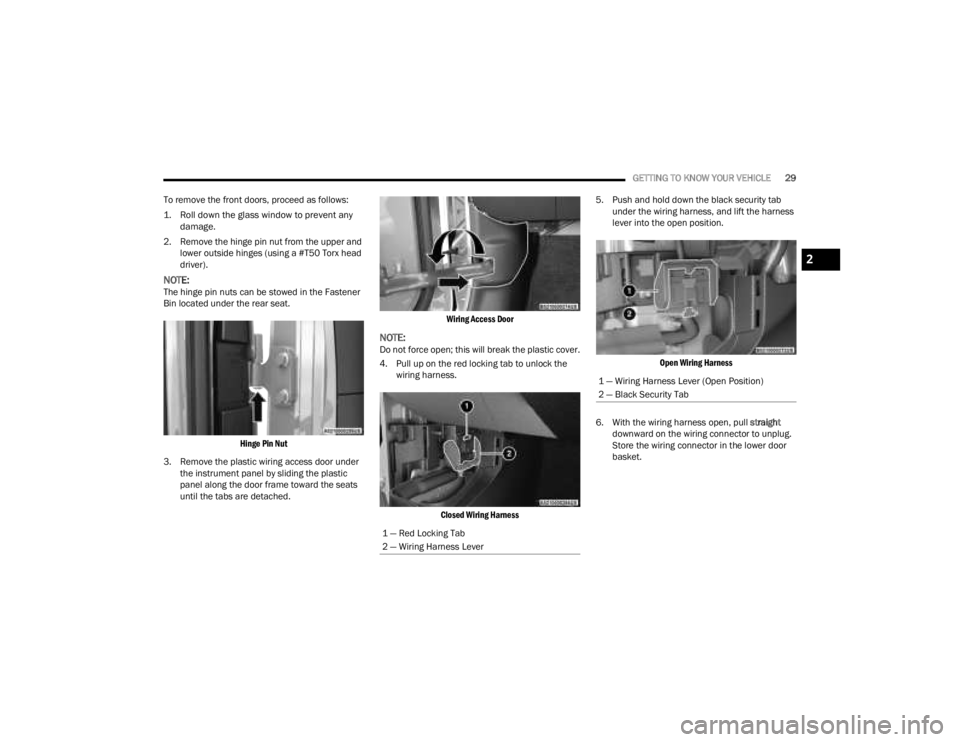
To remove the front doors, proceed as follows:
1. Roll down the glass window to prevent any damage.
2. Remove the hinge pin nut from the upper and lower outside hinges (using a #T50 Torx head
driver).
NOTE:The hinge pin nuts can be stowed in the Fastener
Bin located under the rear seat.
Hinge Pin Nut
3. Remove the plastic wiring access door under the instrument panel by sliding the plastic
panel along the door frame toward the seats
until the tabs are detached.
Wiring Access Door
NOTE:Do not force open; this will break the plastic cover.
4. Pull up on the red locking tab to unlock the
wiring harness.
Closed Wiring Harness
5. Push and hold down the black security tab
under the wiring harness, and lift the harness
lever into the open position.
Open Wiring Harness
6. With the wiring harness open, pull straight
downward on the wiring connector to unplug.
Store the wiring connector in the lower door
basket.
1 — Red Locking Tab
2 — Wiring Harness Lever
1 — Wiring Harness Lever (Open Position)
2 — Black Security Tab
2
23_JT_OM_EN_USC_t.book Page 29
Page 32 of 448
30GETTING TO KNOW YOUR VEHICLE
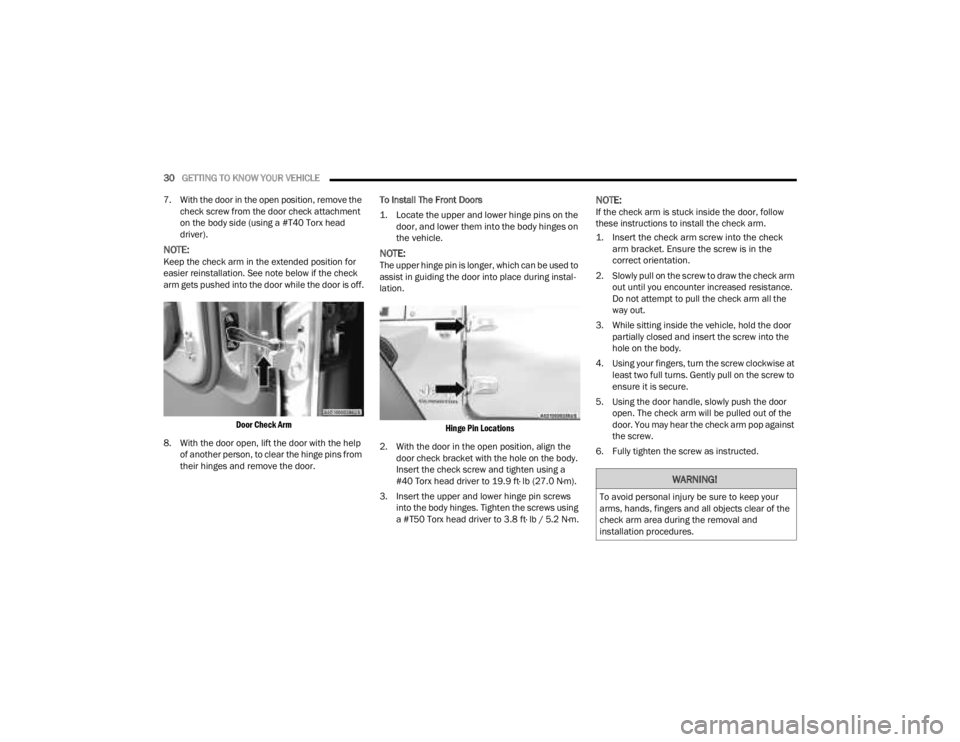
7. With the door in the open position, remove the check screw from the door check attachment
on the body side (using a #T40 Torx head
driver).
NOTE:Keep the check arm in the extended position for
easier reinstallation. See note below if the check
arm gets pushed into the door while the door is off.
Door Check Arm
8. With the door open, lift the door with the help of another person, to clear the hinge pins from
their hinges and remove the door. To Install The Front Doors
1. Locate the upper and lower hinge pins on the
door, and lower them into the body hinges on
the vehicle.
NOTE:The upper hinge pin is longer, which can be used to
assist in guiding the door into place during instal -
lation.
Hinge Pin Locations
2. With the door in the open position, align the door check bracket with the hole on the body.
Insert the check screw and tighten using a
#40 Torx head driver to 19.9 ft· lb (27.0 N·m).
3. Insert the upper and lower hinge pin screws into the body hinges. Tighten the screws using
a #T50 Torx head driver to 3.8 ft· lb / 5.2 N·m.
NOTE:If the check arm is stuck inside the door, follow
these instructions to install the check arm.
1. Insert the check arm screw into the check arm bracket. Ensure the screw is in the
correct orientation.
2. Slowly pull on the screw to draw the check arm out until you encounter increased resistance.
Do not attempt to pull the check arm all the
way out.
3. While sitting inside the vehicle, hold the door partially closed and insert the screw into the
hole on the body.
4. Using your fingers, turn the screw clockwise at least two full turns. Gently pull on the screw to
ensure it is secure.
5. Using the door handle, slowly push the door open. The check arm will be pulled out of the
door. You may hear the check arm pop against
the screw.
6. Fully tighten the screw as instructed.
WARNING!
To avoid personal injury be sure to keep your
arms, hands, fingers and all objects clear of the
check arm area during the removal and
installation procedures.
23_JT_OM_EN_USC_t.book Page 30
Page 33 of 448
GETTING TO KNOW YOUR VEHICLE31
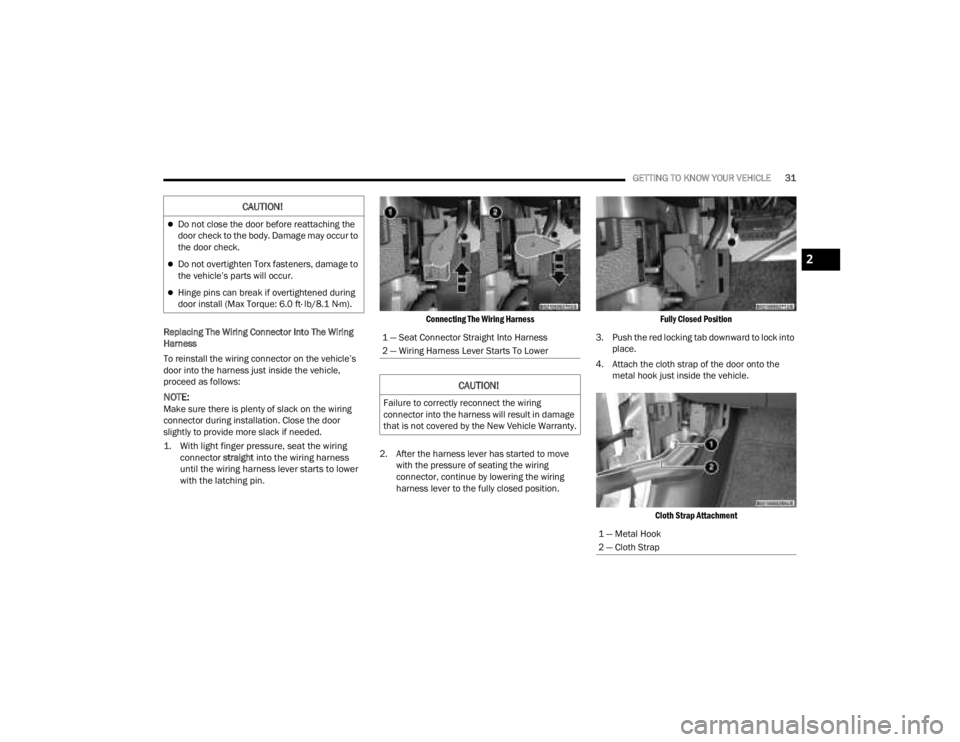
Replacing The Wiring Connector Into The Wiring
Harness
To reinstall the wiring connector on the vehicle’s
door into the harness just inside the vehicle,
proceed as follows:
NOTE:Make sure there is plenty of slack on the wiring
connector during installation. Close the door
slightly to provide more slack if needed.
1. With light finger pressure, seat the wiring connector
straight
into the wiring harness
until the wiring harness lever starts to lower
with the latching pin.
Connecting The Wiring Harness
2. After the harness lever has started to move with the pressure of seating the wiring
connector, continue by lowering the wiring
harness lever to the fully closed position.
Fully Closed Position
3. Push the red locking tab downward to lock into place.
4. Attach the cloth strap of the door onto the metal hook just inside the vehicle.
Cloth Strap Attachment
CAUTION!
Do not close the door before reattaching the
door check to the body. Damage may occur to
the door check.
Do not overtighten Torx fasteners, damage to
the vehicle’s parts will occur.
Hinge pins can break if overtightened during
door install (Max Torque: 6.0 ft· lb/8.1 N·m).
1 — Seat Connector Straight Into Harness
2 — Wiring Harness Lever Starts To Lower
CAUTION!
Failure to correctly reconnect the wiring
connector into the harness will result in damage
that is not covered by the New Vehicle Warranty.
1 — Metal Hook
2 — Cloth Strap
2
23_JT_OM_EN_USC_t.book Page 31
Page 35 of 448
GETTING TO KNOW YOUR VEHICLE33
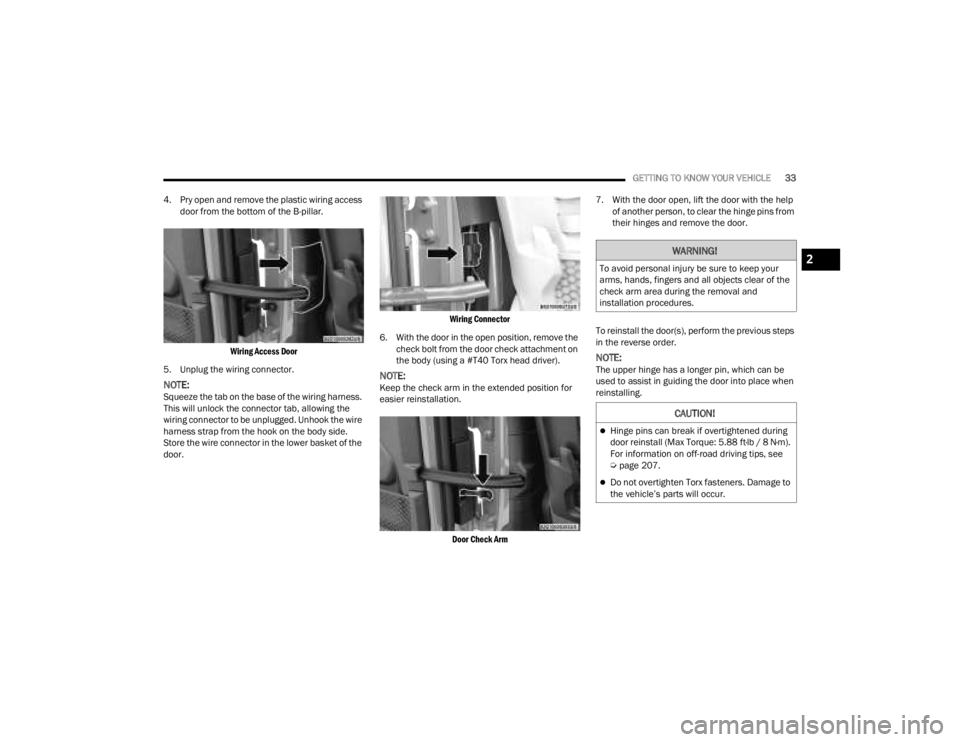
4. Pry open and remove the plastic wiring access door from the bottom of the B-pillar.
Wiring Access Door
5. Unplug the wiring connector.
NOTE:Squeeze the tab on the base of the wiring harness.
This will unlock the connector tab, allowing the
wiring connector to be unplugged. Unhook the wire
harness strap from the hook on the body side.
Store the wire connector in the lower basket of the
door.
Wiring Connector
6. With the door in the open position, remove the check bolt from the door check attachment on
the body (using a #T40 Torx head driver).
NOTE:Keep the check arm in the extended position for
easier reinstallation.
Door Check Arm
7. With the door open, lift the door with the help
of another person, to clear the hinge pins from
their hinges and remove the door.
To reinstall the door(s), perform the previous steps
in the reverse order.
NOTE:The upper hinge has a longer pin, which can be
used to assist in guiding the door into place when
reinstalling.
WARNING!
To avoid personal injury be sure to keep your
arms, hands, fingers and all objects clear of the
check arm area during the removal and
installation procedures.
CAUTION!
Hinge pins can break if overtightened during
door reinstall (Max Torque: 5.88 ft·lb / 8 N·m).
For information on off-road driving tips, see
Ú page 207.
Do not overtighten Torx fasteners. Damage to
the vehicle’s parts will occur.
2
23_JT_OM_EN_USC_t.book Page 33
Page 42 of 448
40GETTING TO KNOW YOUR VEHICLE
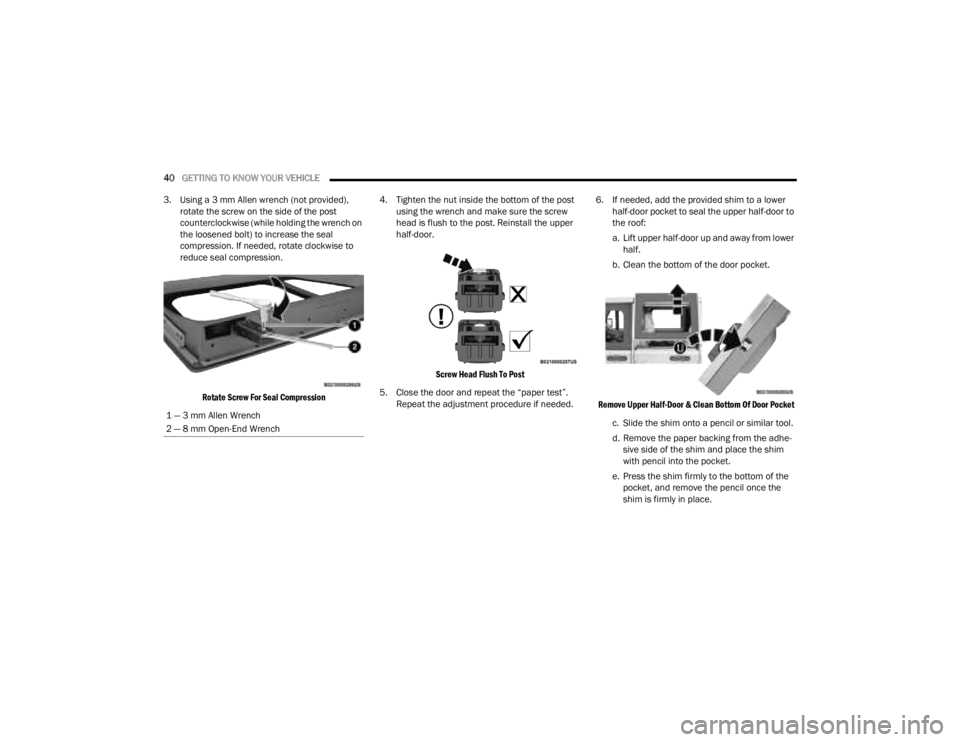
3. Using a 3 mm Allen wrench (not provided), rotate the screw on the side of the post
counterclockwise (while holding the wrench on
the loosened bolt) to increase the seal
compression. If needed, rotate clockwise to
reduce seal compression.
Rotate Screw For Seal Compression
4. Tighten the nut inside the bottom of the post
using the wrench and make sure the screw
head is flush to the post. Reinstall the upper
half-door.
Screw Head Flush To Post
5. Close the door and repeat the “paper test”. Repeat the adjustment procedure if needed. 6. If needed, add the provided shim to a lower
half-door pocket to seal the upper half-door to
the roof:
a. Lift upper half-door up and away from lower half.
b. Clean the bottom of the door pocket.
Remove Upper Half-Door & Clean Bottom Of Door Pocket
c. Slide the shim onto a pencil or similar tool.
d. Remove the paper backing from the adhe -
sive side of the shim and place the shim
with pencil into the pocket.
e. Press the shim firmly to the bottom of the pocket, and remove the pencil once the
shim is firmly in place.
1 — 3 mm Allen Wrench
2 — 8 mm Open-End Wrench
23_JT_OM_EN_USC_t.book Page 40
Page 44 of 448
42GETTING TO KNOW YOUR VEHICLE
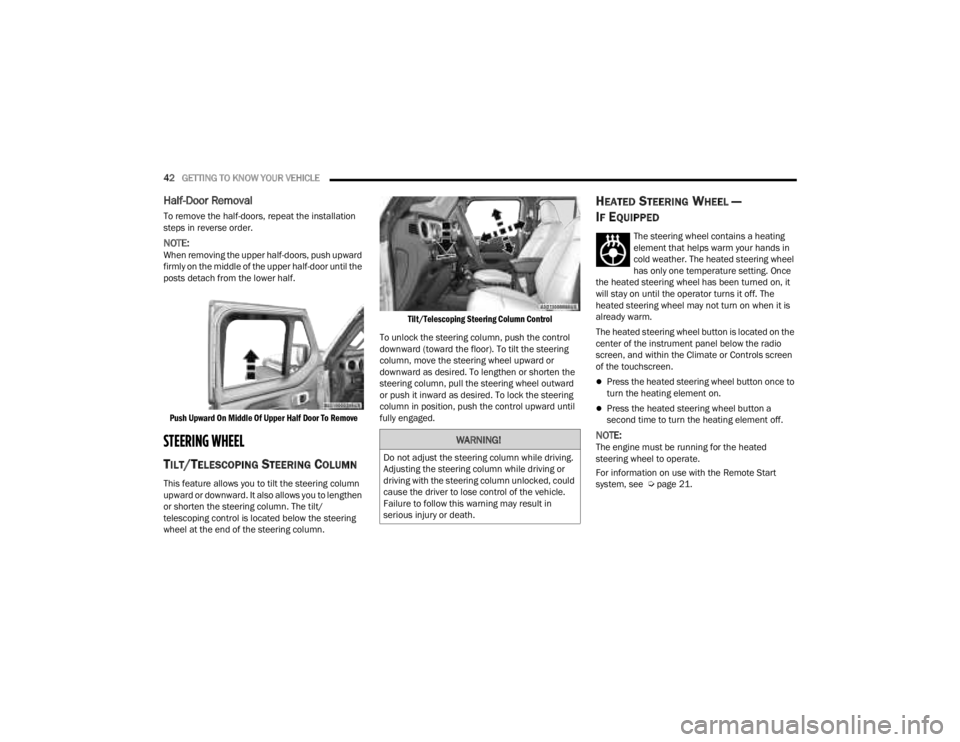
Half-Door Removal
To remove the half-doors, repeat the installation
steps in reverse order.
NOTE:When removing the upper half-doors, push upward
firmly on the middle of the upper half-door until the
posts detach from the lower half.
Push Upward On Middle Of Upper Half Door To Remove
STEERING WHEEL
TILT/TELESCOPING STEERING COLUMN
This feature allows you to tilt the steering column
upward or downward. It also allows you to lengthen
or shorten the steering column. The tilt/
telescoping control is located below the steering
wheel at the end of the steering column.
Tilt/Telescoping Steering Column Control
To unlock the steering column, push the control
downward (toward the floor). To tilt the steering
column, move the steering wheel upward or
downward as desired. To lengthen or shorten the
steering column, pull the steering wheel outward
or push it inward as desired. To lock the steering
column in position, push the control upward until
fully engaged.
HEATED STEERING WHEEL —
I
F EQUIPPED
The steering wheel contains a heating
element that helps warm your hands in
cold weather. The heated steering wheel
has only one temperature setting. Once
the heated steering wheel has been turned on, it
will stay on until the operator turns it off. The
heated steering wheel may not turn on when it is
already warm.
The heated steering wheel button is located on the
center of the instrument panel below the radio
screen, and within the Climate or Controls screen
of the touchscreen.
Press the heated steering wheel button once to
turn the heating element on.
Press the heated steering wheel button a
second time to turn the heating element off.
NOTE:The engine must be running for the heated
steering wheel to operate.
For information on use with the Remote Start
system, see Ú page 21.WARNING!
Do not adjust the steering column while driving.
Adjusting the steering column while driving or
driving with the steering column unlocked, could
cause the driver to lose control of the vehicle.
Failure to follow this warning may result in
serious injury or death.
23_JT_OM_EN_USC_t.book Page 42
Page 46 of 448
44GETTING TO KNOW YOUR VEHICLE
Manual Seat Height Adjustment
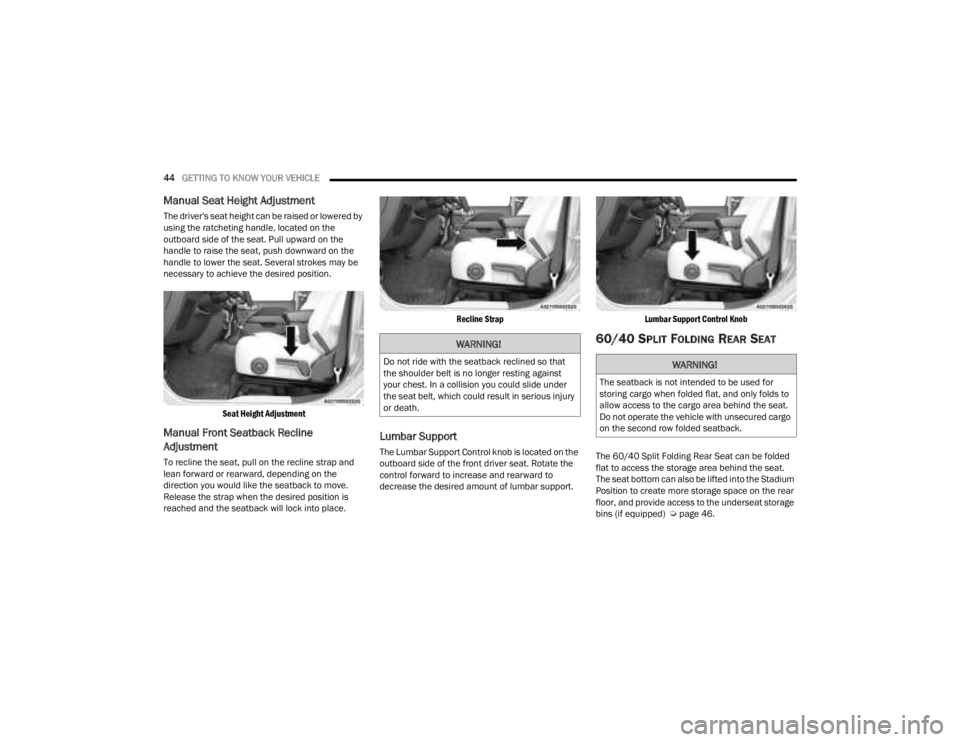
The driver's seat height can be raised or lowered by
using the ratcheting handle, located on the
outboard side of the seat. Pull upward on the
handle to raise the seat, push downward on the
handle to lower the seat. Several strokes may be
necessary to achieve the desired position.
Seat Height Adjustment
Manual Front Seatback Recline
Adjustment
To recline the seat, pull on the recline strap and
lean forward or rearward, depending on the
direction you would like the seatback to move.
Release the strap when the desired position is
reached and the seatback will lock into place.
Recline Strap
Lumbar Support
The Lumbar Support Control knob is located on the
outboard side of the front driver seat. Rotate the
control forward to increase and rearward to
decrease the desired amount of lumbar support.
Lumbar Support Control Knob
60/40 SPLIT FOLDING REAR SEAT
The 60/40 Split Folding Rear Seat can be folded
flat to access the storage area behind the seat.
The seat bottom can also be lifted into the Stadium
Position to create more storage space on the rear
floor, and provide access to the underseat storage
bins (if equipped) Ú
page 46.
WARNING!
Do not ride with the seatback reclined so that
the shoulder belt is no longer resting against
your chest. In a collision you could slide under
the seat belt, which could result in serious injury
or death.WARNING!
The seatback is not intended to be used for
storing cargo when folded flat, and only folds to
allow access to the cargo area behind the seat.
Do not operate the vehicle with unsecured cargo
on the second row folded seatback.
23_JT_OM_EN_USC_t.book Page 44
Page 47 of 448
GETTING TO KNOW YOUR VEHICLE45
NOTE:
Be sure that the front seats are fully upright and
positioned forward. This will allow the rear seat
to fold down easily.
The center head restraints must be in the lowest
position to avoid contact with the center console
when folding the seat.
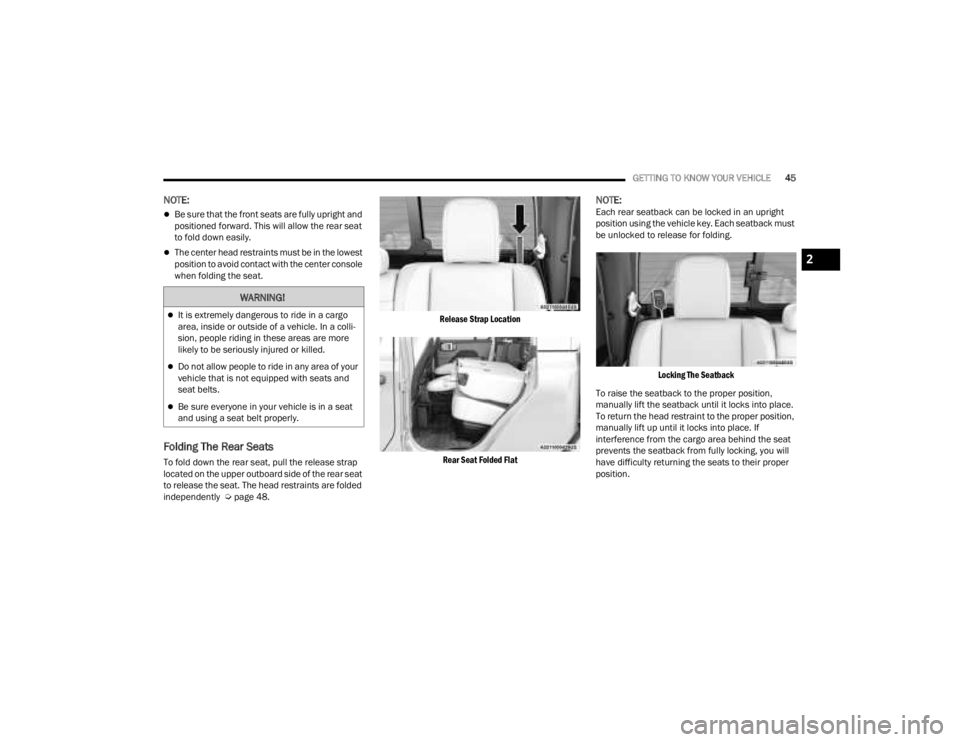
Folding The Rear Seats
To fold down the rear seat, pull the release strap
located on the upper outboard side of the rear seat
to release the seat. The head restraints are folded
independently Úpage 48.
Release Strap Location
Rear Seat Folded Flat
NOTE:Each rear seatback can be locked in an upright
position using the vehicle key. Each seatback must
be unlocked to release for folding.
Locking The Seatback
To raise the seatback to the proper position,
manually lift the seatback until it locks into place.
To return the head restraint to the proper position,
manually lift up until it locks into place. If
interference from the cargo area behind the seat
prevents the seatback from fully locking, you will
have difficulty returning the seats to their proper
position.
WARNING!
It is extremely dangerous to ride in a cargo
area, inside or outside of a vehicle. In a colli -
sion, people riding in these areas are more
likely to be seriously injured or killed.
Do not allow people to ride in any area of your
vehicle that is not equipped with seats and
seat belts.
Be sure everyone in your vehicle is in a seat
and using a seat belt properly.
2
23_JT_OM_EN_USC_t.book Page 45
Page 48 of 448
46GETTING TO KNOW YOUR VEHICLE
NOTE:
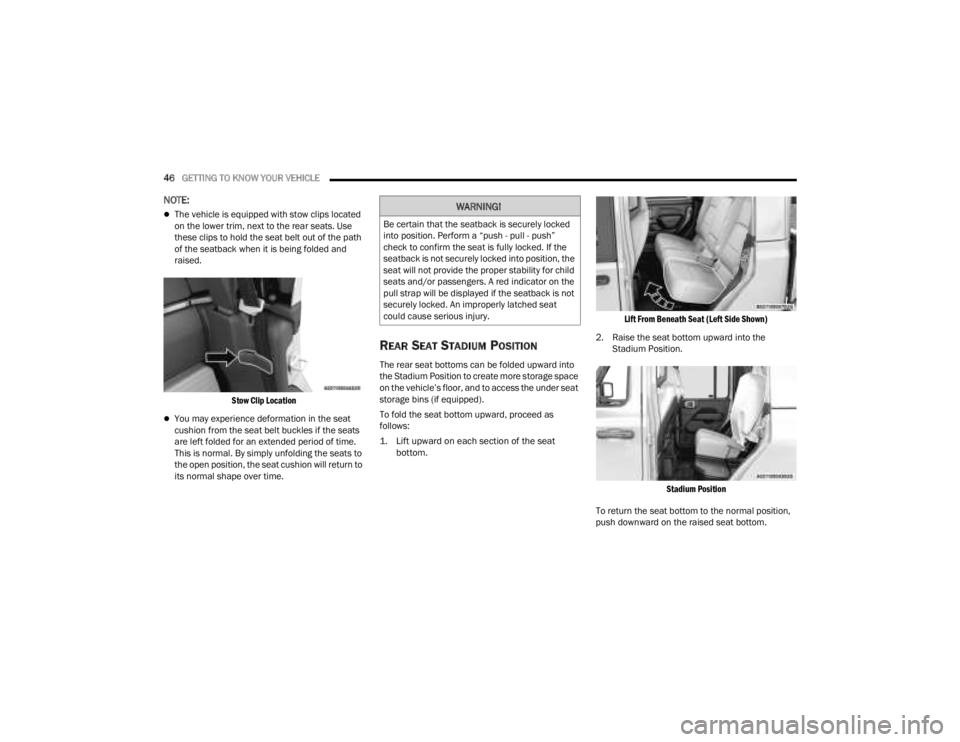
The vehicle is equipped with stow clips located
on the lower trim, next to the rear seats. Use
these clips to hold the seat belt out of the path
of the seatback when it is being folded and
raised.
Stow Clip Location
You may experience deformation in the seat
cushion from the seat belt buckles if the seats
are left folded for an extended period of time.
This is normal. By simply unfolding the seats to
the open position, the seat cushion will return to
its normal shape over time.
REAR SEAT STADIUM POSITION
The rear seat bottoms can be folded upward into
the Stadium Position to create more storage space
on the vehicle’s floor, and to access the under seat
storage bins (if equipped).
To fold the seat bottom upward, proceed as
follows:
1. Lift upward on each section of the seat bottom.
Lift From Beneath Seat (Left Side Shown)
2. Raise the seat bottom upward into the Stadium Position.
Stadium Position
To return the seat bottom to the normal position,
push downward on the raised seat bottom.
WARNING!
Be certain that the seatback is securely locked
into position. Perform a “push - pull - push”
check to confirm the seat is fully locked. If the
seatback is not securely locked into position, the
seat will not provide the proper stability for child
seats and/or passengers. A red indicator on the
pull strap will be displayed if the seatback is not
securely locked. An improperly latched seat
could cause serious injury.
23_JT_OM_EN_USC_t.book Page 46