belt JEEP GRAND CHEROKEE 2013 Owner handbook (in English)
[x] Cancel search | Manufacturer: JEEP, Model Year: 2013, Model line: GRAND CHEROKEE, Model: JEEP GRAND CHEROKEE 2013Pages: 408, PDF Size: 3.21 MB
Page 105 of 408
NOTE:
•Do not fold the 60% rear seat down with
the left outboard or rear center seat belt
buckled.
• Do not fold the 40% rear seat down with
the right outboard seat belt buckled.
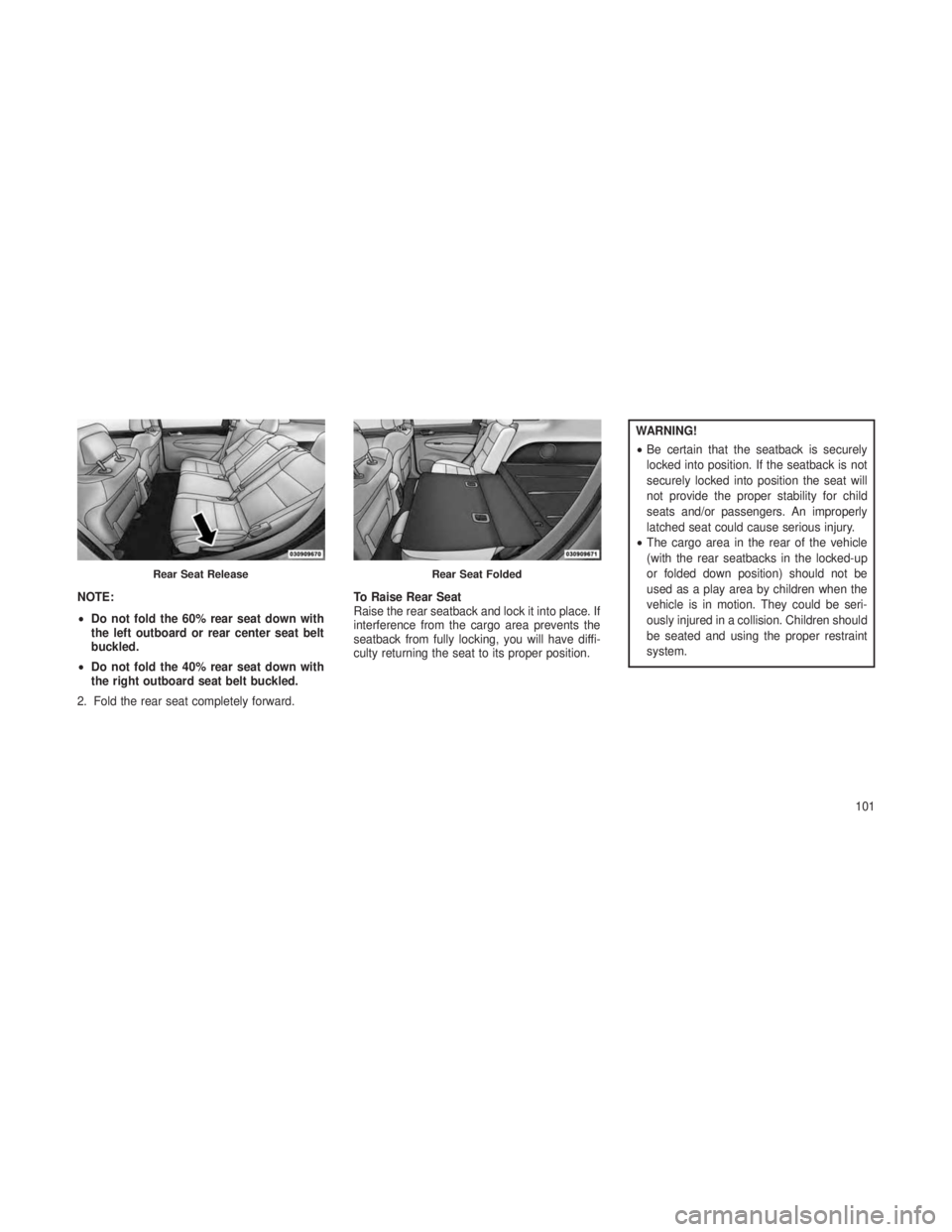
2. Fold the rear seat completely forward. To Raise Rear Seat
Raise the rear seatback and lock it into place. If
interference from the cargo area prevents the
seatback from fully locking, you will have diffi-
culty returning the seat to its proper position.
WARNING!
•
Be certain that the seatback is securely
locked into position. If the seatback is not
securely locked into position the seat will
not provide the proper stability for child
seats and/or passengers. An improperly
latched seat could cause serious injury.
• The cargo area in the rear of the vehicle
(with the rear seatbacks in the locked-up
or folded down position) should not be
used as a play area by children when the
vehicle is in motion. They could be seri-
ously injured in a collision. Children should
be seated and using the proper restraint
system.
Rear Seat ReleaseRear Seat Folded
101
Page 106 of 408
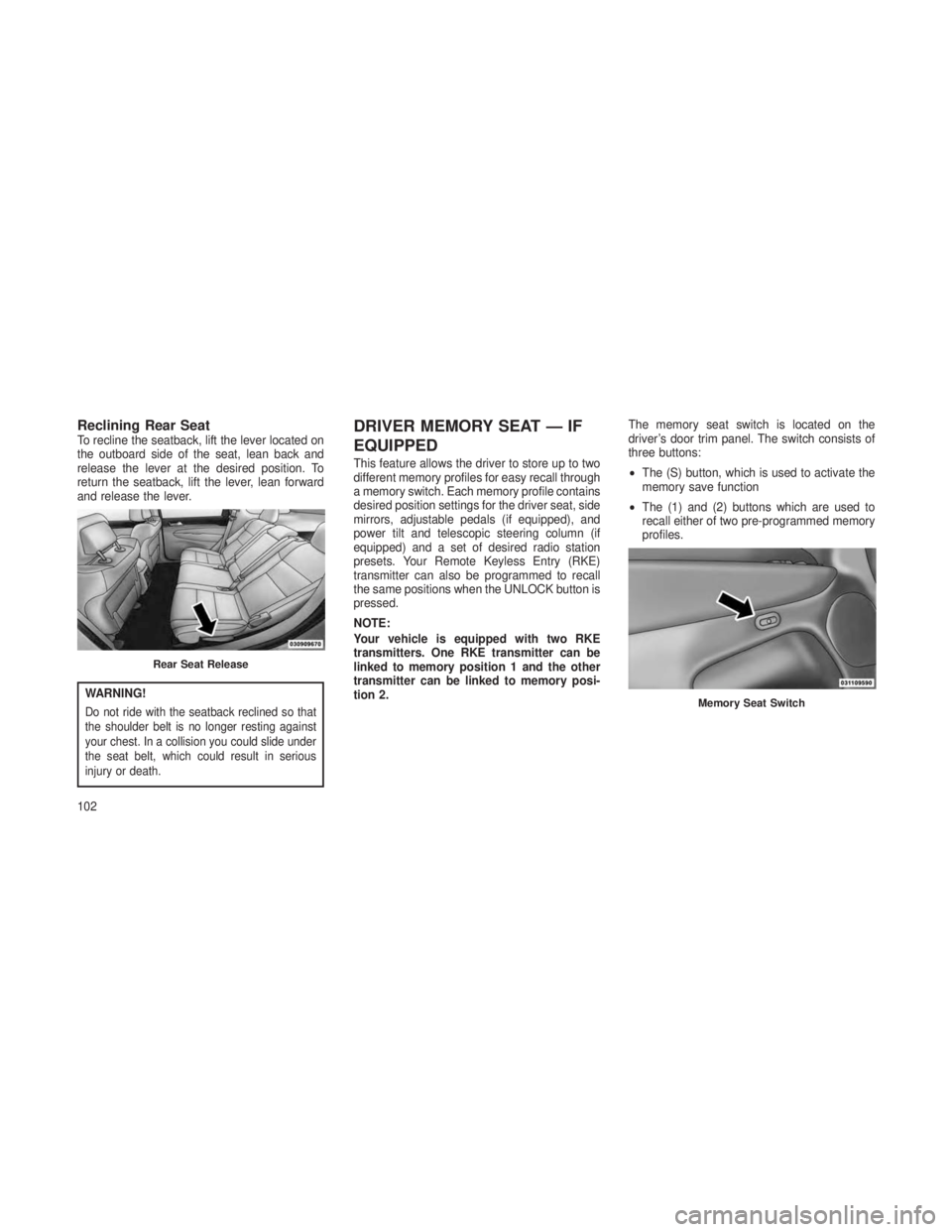
Reclining Rear SeatTo recline the seatback, lift the lever located on
the outboard side of the seat, lean back and
release the lever at the desired position. To
return the seatback, lift the lever, lean forward
and release the lever.
WARNING!
Do not ride with the seatback reclined so that
the shoulder belt is no longer resting against
your chest. In a collision you could slide under
the seat belt, which could result in serious
injury or death.
DRIVER MEMORY SEAT — IF
EQUIPPED
This feature allows the driver to store up to two
different memory profiles for easy recall through
a memory switch. Each memory profile contains
desired position settings for the driver seat, side
mirrors, adjustable pedals (if equipped), and
power tilt and telescopic steering column (if
equipped) and a set of desired radio station
presets. Your Remote Keyless Entry (RKE)
transmitter can also be programmed to recall
the same positions when the UNLOCK button is
pressed.
NOTE:
Your vehicle is equipped with two RKE
transmitters. One RKE transmitter can be
linked to memory position 1 and the other
transmitter can be linked to memory posi-
tion 2.The memory seat switch is located on the
driver’s door trim panel. The switch consists of
three buttons:
•
The (S) button, which is used to activate the
memory save function
• The (1) and (2) buttons which are used to
recall either of two pre-programmed memory
profiles.
Rear Seat Release
Memory Seat Switch
102
Page 146 of 408
POWER SUNROOF — IF
EQUIPPED
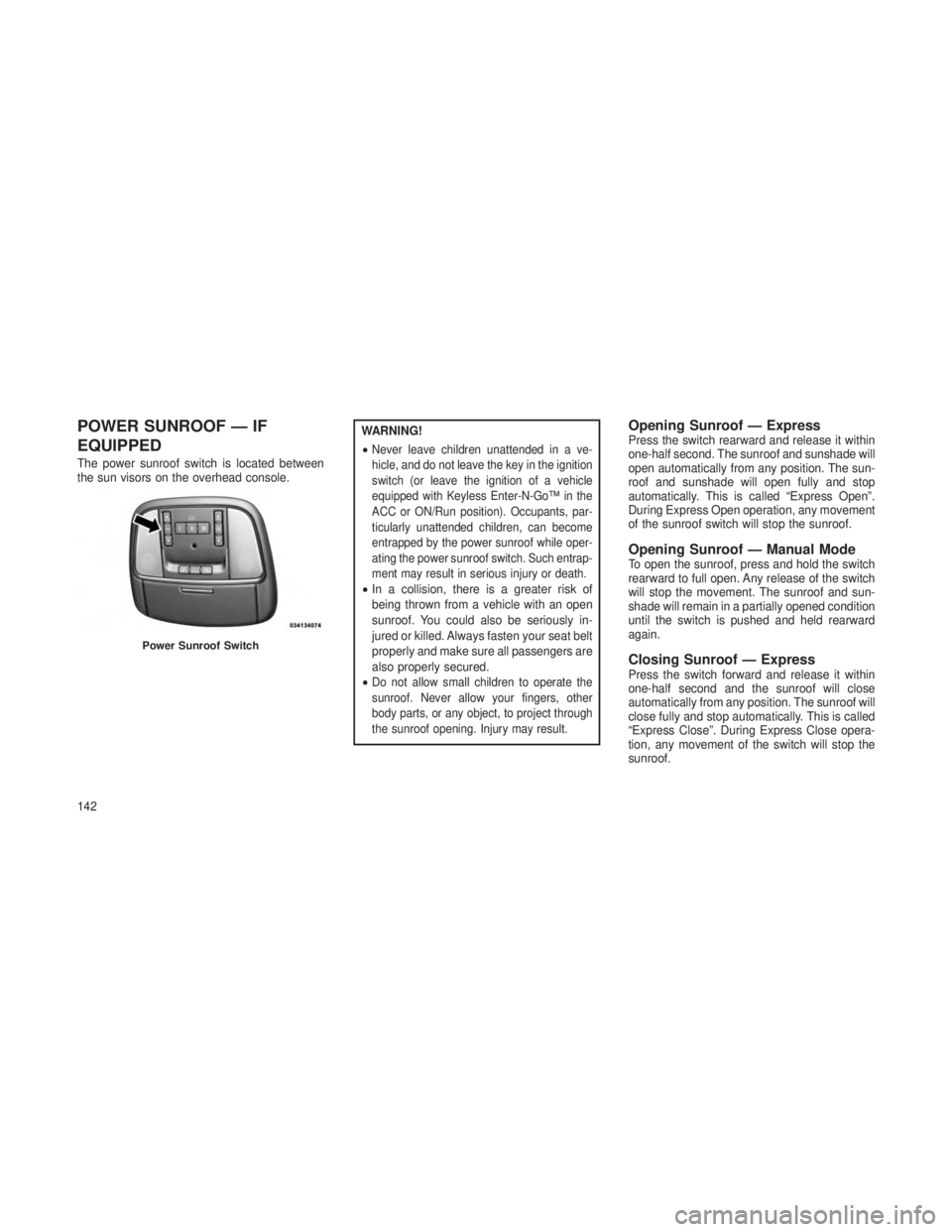
The power sunroof switch is located between
the sun visors on the overhead console.
WARNING!
•
Never leave children unattended in a ve-
hicle, and do not leave the key in the ignition
switch (or leave the ignition of a vehicle
equipped with Keyless Enter-N-Go™ in the
ACC or ON/Run position). Occupants, par-
ticularly unattended children, can become
entrapped by the power sunroof while oper-
ating the power sunroof switch. Such entrap-
ment may result in serious injury or death.
•In a collision, there is a greater risk of
being thrown from a vehicle with an open
sunroof. You could also be seriously in-
jured or killed. Always fasten your seat belt
properly and make sure all passengers are
also properly secured.
•
Do not allow small children to operate the
sunroof. Never allow your fingers, other
body parts, or any object, to project through
the sunroof opening. Injury may result.
Opening Sunroof — ExpressPress the switch rearward and release it within
one-half second. The sunroof and sunshade will
open automatically from any position. The sun-
roof and sunshade will open fully and stop
automatically. This is called “Express Open”.
During Express Open operation, any movement
of the sunroof switch will stop the sunroof.
Opening Sunroof — Manual ModeTo open the sunroof, press and hold the switch
rearward to full open. Any release of the switch
will stop the movement. The sunroof and sun-
shade will remain in a partially opened condition
until the switch is pushed and held rearward
again.
Closing Sunroof — ExpressPress the switch forward and release it within
one-half second and the sunroof will close
automatically from any position. The sunroof will
close fully and stop automatically. This is called
“Express Close”. During Express Close opera-
tion, any movement of the switch will stop the
sunroof.
Power Sunroof Switch
142
Page 148 of 408
COMMANDVIEW® SUNROOF
WITH POWER SHADE — IF
EQUIPPED
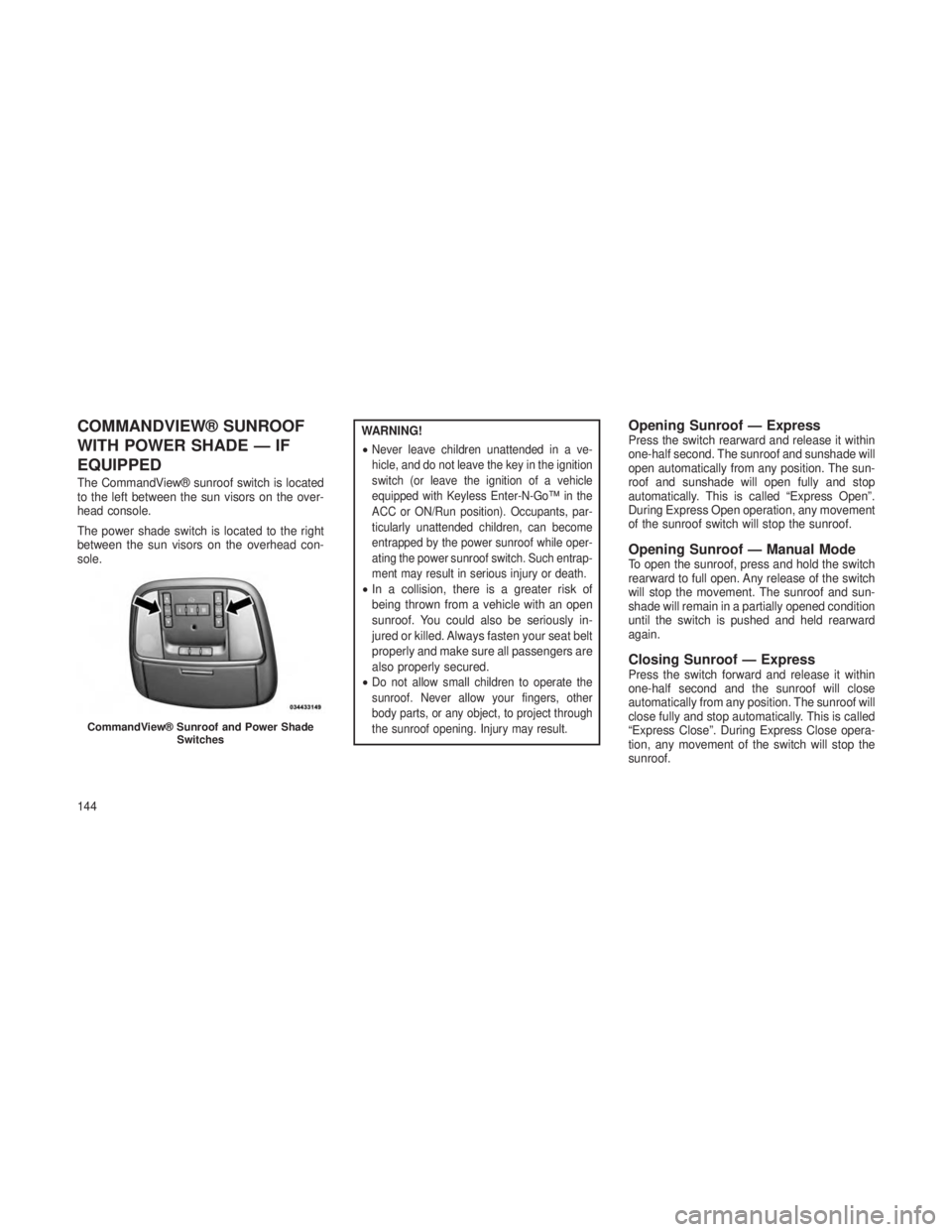
The CommandView® sunroof switch is located
to the left between the sun visors on the over-
head console.
The power shade switch is located to the right
between the sun visors on the overhead con-
sole.
WARNING!
•
Never leave children unattended in a ve-
hicle, and do not leave the key in the ignition
switch (or leave the ignition of a vehicle
equipped with Keyless Enter-N-Go™ in the
ACC or ON/Run position). Occupants, par-
ticularly unattended children, can become
entrapped by the power sunroof while oper-
ating the power sunroof switch. Such entrap-
ment may result in serious injury or death.
•In a collision, there is a greater risk of
being thrown from a vehicle with an open
sunroof. You could also be seriously in-
jured or killed. Always fasten your seat belt
properly and make sure all passengers are
also properly secured.
•
Do not allow small children to operate the
sunroof. Never allow your fingers, other
body parts, or any object, to project through
the sunroof opening. Injury may result.
Opening Sunroof — ExpressPress the switch rearward and release it within
one-half second. The sunroof and sunshade will
open automatically from any position. The sun-
roof and sunshade will open fully and stop
automatically. This is called “Express Open”.
During Express Open operation, any movement
of the sunroof switch will stop the sunroof.
Opening Sunroof — Manual ModeTo open the sunroof, press and hold the switch
rearward to full open. Any release of the switch
will stop the movement. The sunroof and sun-
shade will remain in a partially opened condition
until the switch is pushed and held rearward
again.
Closing Sunroof — ExpressPress the switch forward and release it within
one-half second and the sunroof will close
automatically from any position. The sunroof will
close fully and stop automatically. This is called
“Express Close”. During Express Close opera-
tion, any movement of the switch will stop the
sunroof.
CommandView® Sunroof and Power Shade Switches
144
Page 157 of 408
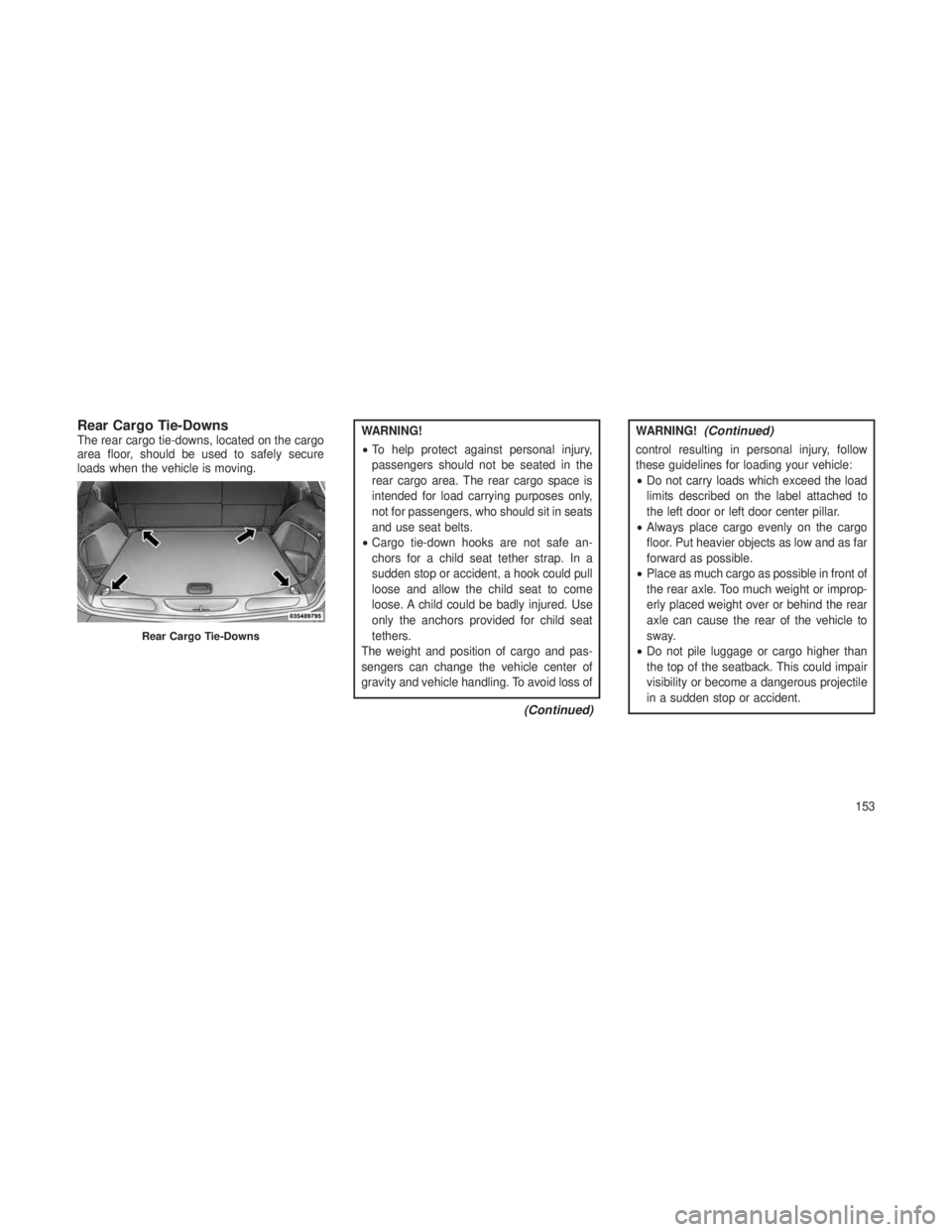
Rear Cargo Tie-DownsThe rear cargo tie-downs, located on the cargo
area floor, should be used to safely secure
loads when the vehicle is moving.WARNING!
•To help protect against personal injury,
passengers should not be seated in the
rear cargo area. The rear cargo space is
intended for load carrying purposes only,
not for passengers, who should sit in seats
and use seat belts.
• Cargo tie-down hooks are not safe an-
chors for a child seat tether strap. In a
sudden stop or accident, a hook could pull
loose and allow the child seat to come
loose. A child could be badly injured. Use
only the anchors provided for child seat
tethers.
The weight and position of cargo and pas-
sengers can change the vehicle center of
gravity and vehicle handling. To avoid loss of
(Continued)
WARNING!(Continued)
control resulting in personal injury, follow
these guidelines for loading your vehicle:
• Do not carry loads which exceed the load
limits described on the label attached to
the left door or left door center pillar.
• Always place cargo evenly on the cargo
floor. Put heavier objects as low and as far
forward as possible.
• Place as much cargo as possible in front of
the rear axle. Too much weight or improp-
erly placed weight over or behind the rear
axle can cause the rear of the vehicle to
sway.
• Do not pile luggage or cargo higher than
the top of the seatback. This could impair
visibility or become a dangerous projectile
in a sudden stop or accident.
Rear Cargo Tie-Downs
153
Page 169 of 408
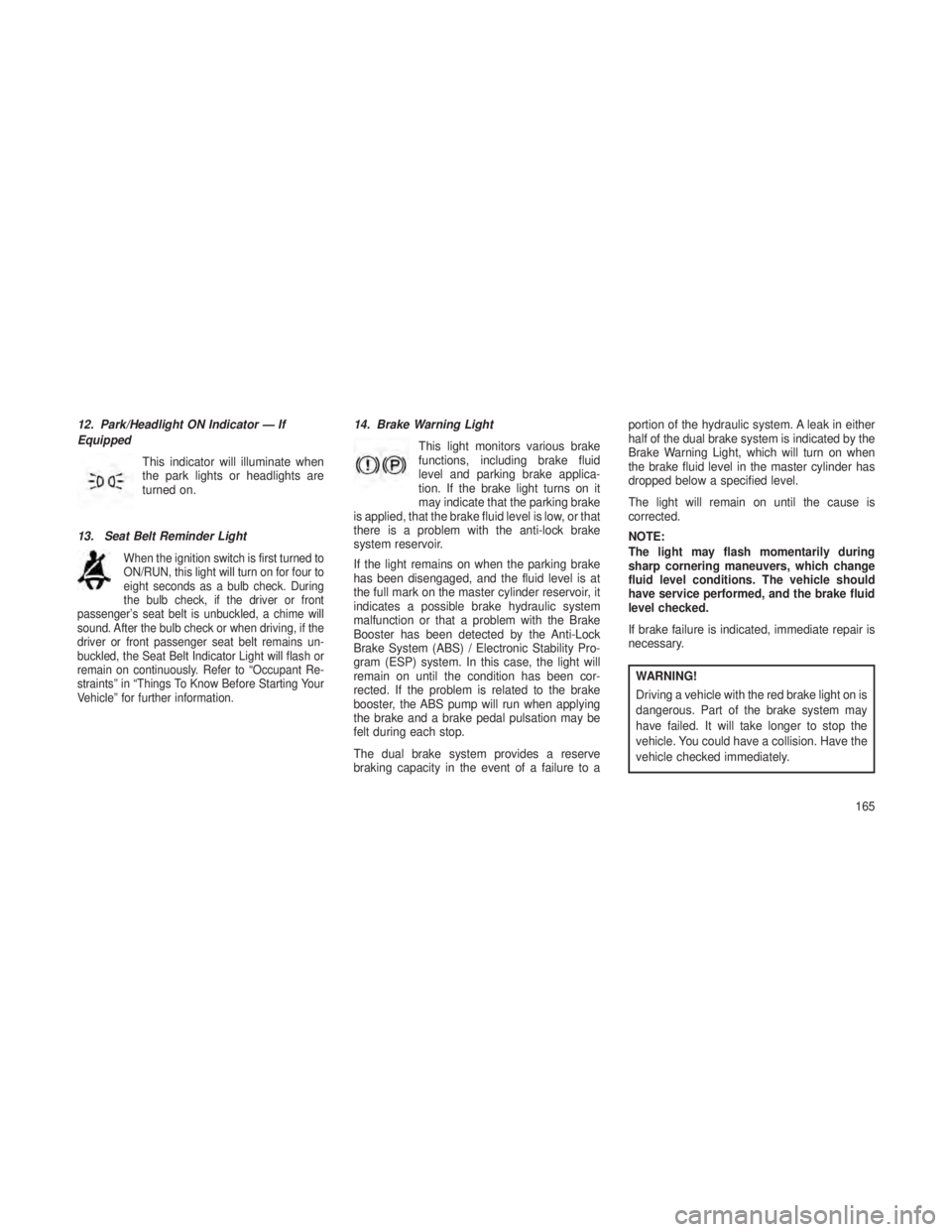
12. Park/Headlight ON Indicator — If
EquippedThis indicator will illuminate when
the park lights or headlights are
turned on.
13. Seat Belt Reminder Light
When the ignition switch is first turned to
ON/RUN, this light will turn on for four to
eight seconds as a bulb check. During
the bulb check, if the driver or front
passenger’s seat belt is unbuckled, a chime will
sound. After the bulb check or when driving, if the
driver or front passenger seat belt remains un-
buckled, the Seat Belt Indicator Light will flash or
remain on continuously. Refer to “Occupant Re-
straints” in “Things To Know Before Starting Your
Vehicle” for further information.
14. Brake Warning Light
This light monitors various brake
functions, including brake fluid
level and parking brake applica-
tion. If the brake light turns on it
may indicate that the parking brake
is applied, that the brake fluid level is low, or that
there is a problem with the anti-lock brake
system reservoir.
If the light remains on when the parking brake
has been disengaged, and the fluid level is at
the full mark on the master cylinder reservoir, it
indicates a possible brake hydraulic system
malfunction or that a problem with the Brake
Booster has been detected by the Anti-Lock
Brake System (ABS) / Electronic Stability Pro-
gram (ESP) system. In this case, the light will
remain on until the condition has been cor-
rected. If the problem is related to the brake
booster, the ABS pump will run when applying
the brake and a brake pedal pulsation may be
felt during each stop.
The dual brake system provides a reserve
braking capacity in the event of a failure to a portion of the hydraulic system. A leak in either
half of the dual brake system is indicated by the
Brake Warning Light, which will turn on when
the brake fluid level in the master cylinder has
dropped below a specified level.
The light will remain on until the cause is
corrected.
NOTE:
The light may flash momentarily during
sharp cornering maneuvers, which change
fluid level conditions. The vehicle should
have service performed, and the brake fluid
level checked.
If brake failure is indicated, immediate repair is
necessary.
WARNING!
Driving a vehicle with the red brake light on is
dangerous. Part of the brake system may
have failed. It will take longer to stop the
vehicle. You could have a collision. Have the
vehicle checked immediately.
165
Page 176 of 408
•Memory System Unavailable — Not in Park
• Memory System Unavailable — Seatbelt
buckled
• Memory 1 Profile Recall
• Memory 2 Profile Recall
• Press Brake Pedal And Push Button To Start
• Wrong Key
• Damaged Key
• Key Not Programmed
• Function Currently Unavailable — Power
Liftgate
• Unlock To Operate — Power Liftgate
• Put In Park To Operate — Power Liftgate
• Automatic High Beams On
• Automatic High Beams Off
• Service Four Wheel Drive System
• Eco — Fuel Saver Indicator
• Terrain Settings — Automatic
• Terrain Settings — Rock •
Terrain Settings — Sand/Mud
• Terrain Settings — Snow
• Terrain Settings — Sport
• Sport Not Available In 4 Low 4 High Is
Required
• Rock Not Available In 4 Low 4 High Is
Required
• To Tow Vehicle Safely, Read Neutral Shift
Procedure In Owners Manual
• For 4x4 Low Slow Below 5 Mph Or 8 Kph Put
Trans In N Press 4 Low
• For 4x4 High Slow Below 5 Mph Or 8 Kph Put
Trans In N Press 4 Low
• Terrain System Settings Not Available
• Raising Vehicle Ride Height (with icon)
• Lowering Vehicle Ride Height (with icon)
• Normal Vehicle Ride Height — This message
is displayed (for five seconds) when the
vehicle has achieved the Normal Vehicle
Ride Height. •
Off Road Ride Height Level 1 — This mes-
sage is displayed (for five seconds) when the
vehicle has achieved the Off Road Height
Level 1.
• Off Road Ride Height Level 2 — This mes-
sage is displayed (for five seconds) when the
vehicle has achieved the Off Road Height
Level 2.
•
Vehicle Lowered To Entry/Exit (Park) Height —
This message is displayed (for five seconds)
when the vehicle has achieved the Park
Height.
• Entry/Exit (Park) Height in Progress — This
message is displayed (for five seconds)
when the request is made to go into Entry/
Exit Height while the vehicle speed is be-
tween 15 and 25 mph. This shows that the
request has been recognized and will lower
to Entry/Exit height when vehicle is below
15 mph.
• Service Air Suspension System — This is
displayed when a fault has occurred in the
system. The system will have limited opera-
tion at that point.
172
Page 224 of 408
STARTING PROCEDURES
Before starting your vehicle, adjust your seat,
adjust the inside and outside mirrors, fasten
your seat belt, and if present, instruct all other
occupants to buckle their seat belts.
WARNING!
•When leaving the vehicle, always remove
the key fob from the ignition and lock your
vehicle.
• Never leave children alone in a vehicle, or
with access to an unlocked vehicle. Allow-
ing children to be in a vehicle unattended
is dangerous for a number of reasons.
A child or others could be seriously or
fatally injured. Children should be warned
not to touch the parking brake, brake pedal
or the shift lever.
(Continued)
WARNING!(Continued)
•Do not leave the key fob in or near the
vehicle (or in a location accessible to chil-
dren), and do not leave a vehicle equipped
with Keyless Enter-N-Go™ in the ACC or
ON/RUN mode. A child could operate
power windows, other controls, or move
the vehicle.
Automatic TransmissionThe shift lever must be in the NEUTRAL or PARK
position before you can start the engine. Apply the
brakes before shifting into any driving gear.
CAUTION!
Damage to the transmission may occur if the
following precautions are not observed:
•Do not shift from REVERSE, PARK, or
NEUTRAL into any forward gear when the
engine is above idle speed.
(Continued)
CAUTION!(Continued)
•Shift into PARK only after the vehicle has
come to a complete stop.
• Shift into or out of REVERSE only after the
vehicle has come to a complete stop and
the engine is at idle speed.
• Before shifting into any gear, make sure
your foot is firmly on the brake pedal.
Using Fob With Integrated Key (Tip Start)
NOTE:
Normal starting of either a cold or a warm
engine is obtained without pumping or press-
ing the accelerator pedal.
Do not press the accelerator. Use the Fob with
Integrated Key to briefly turn the ignition switch to
the START position and release it as soon as the
starter engages. The starter motor will continue to
run, and it will disengage automatically when the
engine is running. If the engine fails to start, the
starter will disengage automatically in 10 sec-
onds. If this occurs, turn the ignition switch to the
LOCK position, wait 10 to 15 seconds, then
repeat the “Normal Starting” procedure.
220
Page 320 of 408
Maintenance-Free BatteryYour vehicle is equipped with a maintenance-
free battery. You will never have to add water,
nor is periodic maintenance required.
WARNING!
•Battery fluid is a corrosive acid solution
and can burn or even blind you. Do not
allow battery fluid to contact your eyes,
skin, or clothing. Do not lean over a battery
when attaching clamps. If acid splashes in
eyes or on skin, flush the area immediately
with large amounts of water. Refer to
“Jump-Starting Procedures” in “What To
Do In Emergencies” for further information.
• Battery gas is flammable and explosive.
Keep flame or sparks away from the bat-
tery. Do not use a booster battery or any
other booster source with an output
greater than 12 Volts. Do not allow cable
clamps to touch each other.
(Continued)
WARNING!(Continued)
•Battery posts, terminals, and related ac-
cessories contain lead and lead com-
pounds. Wash hands after handling.
CAUTION!
•It is essential when replacing the cables on
the battery that the positive cable is at-
tached to the positive post and the nega-
tive cable is attached to the negative post.
Battery posts are marked positive (+) and
negative (-) and are identified on the bat-
tery case. Cable clamps should be tight on
the terminal posts and free of corrosion.
• If a “fast charger” is used while the battery
is in the vehicle, disconnect both vehicle
battery cables before connecting the char-
ger to the battery. Do not use a “fast
charger” to provide starting voltage.
Air Conditioner MaintenanceFor best possible performance, your air condi-
tioner should be checked and serviced by an
authorized dealer at the start of each warm
season. This service should include cleaning of
the condenser fins and a performance test.
Drive belt condition should also be checked at
this time.
CAUTION!
Do not use chemical flushes in your air
conditioning system as the chemicals can
damage your air conditioning components.
Such damage is not covered by the New
Vehicle Limited Warranty.
316
Page 335 of 408
Glass Surfaces
All glass surfaces should be cleaned on a
regular basis with MOPAR® Glass Cleaner, or
any commercial household-type glass cleaner.
Never use an abrasive type cleaner. Use cau-
tion when cleaning the inside rear window
equipped with electric defrosters or the right
rear quarter window equipped with the radio
antenna. Do not use scrapers or other sharp
instrument that may scratch the elements.
When cleaning the rear view mirror, spray
cleaner on the towel or rag that you are using.
Do not spray cleaner directly on the mirror.
Cleaning Plastic Instrument Cluster Lenses
The lenses in front of the instruments in this
vehicle are molded in clear plastic. When clean-
ing the lenses, care must be taken to avoid
scratching the plastic.
1. Clean with a wet soft rag. A mild soap
solution may be used, but do not use high
alcohol content or abrasive cleaners. If soap is
used, wipe clean with a clean damp rag.
2. Dry with a soft cloth.Seat Belt Maintenance
Do not bleach, dye or clean the belts with
chemical solvents or abrasive cleaners. This will
weaken the fabric. Sun damage can also
weaken the fabric.
If the belts need cleaning, use a mild soap
solution or lukewarm water. Do not remove the
belts from the car to wash them. Dry with a soft
cloth.
Replace the belts if they appear frayed or worn
or if the buckles do not work properly.
FUSES
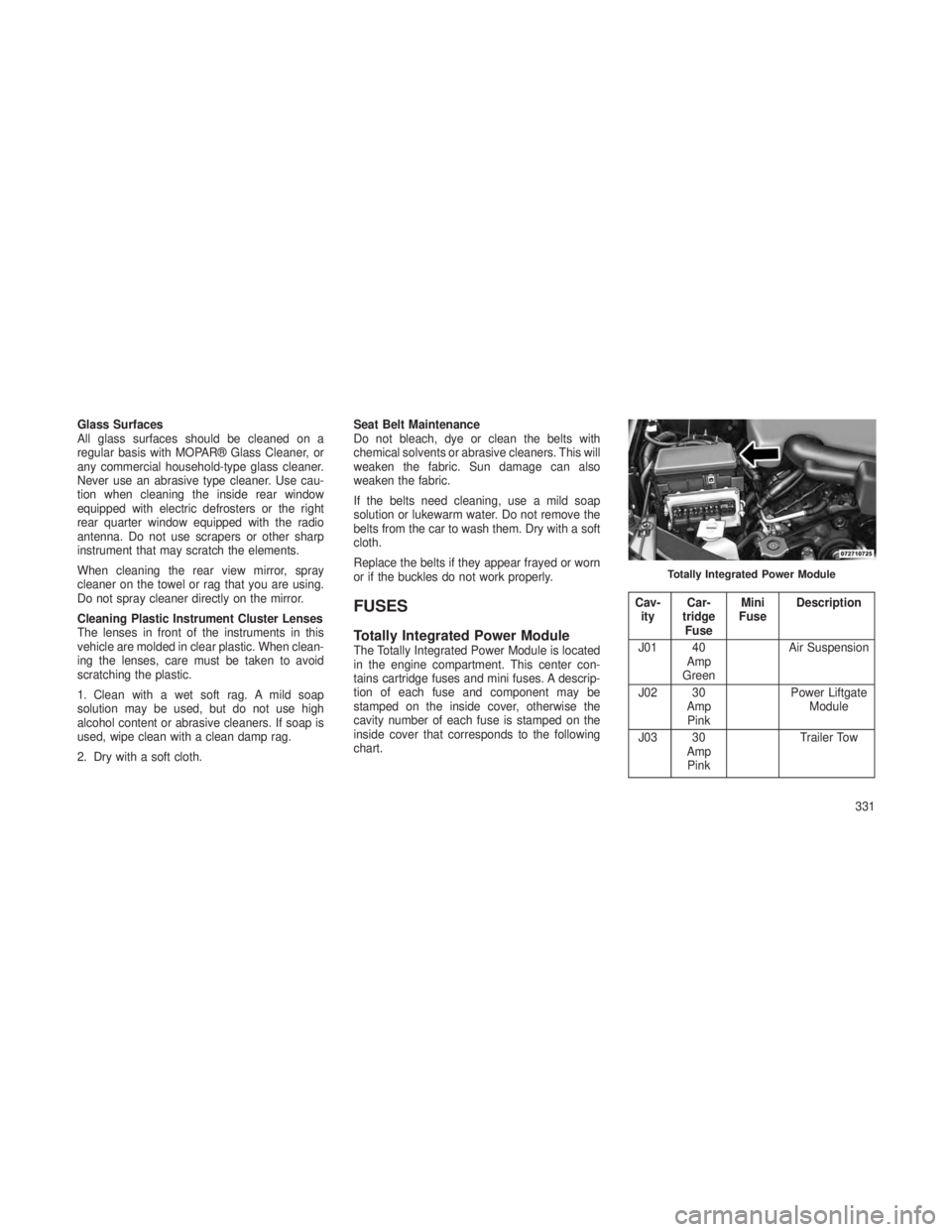
Totally Integrated Power ModuleThe Totally Integrated Power Module is located
in the engine compartment. This center con-
tains cartridge fuses and mini fuses. A descrip-
tion of each fuse and component may be
stamped on the inside cover, otherwise the
cavity number of each fuse is stamped on the
inside cover that corresponds to the following
chart.
Cav-
ity Car-
tridge Fuse Mini
Fuse Description
J01 40 Amp
Green Air Suspension
J02 30 AmpPink Power Liftgate
Module
J03 30 AmpPink Trailer Tow
Totally Integrated Power Module
331