removal JEEP LIBERTY 2002 KJ / 1.G Workshop Manual
[x] Cancel search | Manufacturer: JEEP, Model Year: 2002, Model line: LIBERTY, Model: JEEP LIBERTY 2002 KJ / 1.GPages: 1803, PDF Size: 62.3 MB
Page 321 of 1803

controls the ground for the heated seat switch indi-
cator lamps (LED's).
When a heated seat switch (Driver or Passenger) is
depressed a signal is received by the heated seat
module, the module energizes the proper indicator
LED (Low or High) in the switch by grounding the
indicator lamp circuit to indicate that the heated seat
system is operating. At the same time, the heated
seat module energizes the selected heated seat sensor
circuit and the sensor provides the module with an
input indicating the surface temperature of the
selected seat cushion.
The Low heat set point is about 36É C (96.8É F),
and the High heat set point is about 42É C (107.6É F).
If the seat cushion surface temperature input is
below the temperature set point for the selected tem-
perature setting, the heated seat module energizes
an N-channel Field Effect Transistor (N-FET) within
the module which energizes the heated seat elements
in the selected seat cushion and back. When the sen-
sor input to the module indicates the correct temper-
ature set point has been achieved, the module
de-energizes the N-FET which de-energizes the
heated seat elements. The heated seat module will
continue to cycle the N-FET as needed to maintain
the selected temperature set point.
If the heated seat module detects a heated seat
sensor value input that is out of range or a shorted
or open heated seat element circuit, it will notify the
vehicle operator or the repair technician of this con-
dition by flashing the High and/or Low indicator
lamps in the affected heated seat switch. Refer to
Diagnosis and Testing Heated Seat Systemin
Heated Systems for flashing LED diagnosis and test-
ing procedures. Refer toDiagnosis and Testing
Heated Seat Modulein this section for heated seat
module diagnosis and testing procedures. Also refer
to the Body Diagnostic Manual for additional diagno-
sis and testing procedures.
DIAGNOSIS AND TESTING - HEATED SEAT
MODULE
If a heated seat fails to heat and one or both of the
indicator lamps on a heated seat switch flash, refer
toHeated Seat System Diagnosis and Testingin
Heated Systems for flashing LED failure identifica-
tion. Refer toWiring Diagramsin for complete
heated seat system wiring diagrams.
(1) Remove the heated seat module from its
mounting location (Refer to 8 - ELECTRICAL/ELEC-
TRONIC CONTROL MODULES/MEMORY HEATED
SEAT/MIRROR MODULE - REMOVAL).NOTE: ANY RESISTANCE VALUES (OHMSV) GIVEN
IN THE FOLLOWING TEXT ARE SUPPLIED USING
THE AUTOMATIC RANGE GENERATED BY A
FLUKETAUTOMOTIVE METER. IF ANOTHER TYPE
OF MEASURING DEVICE IS USED THE VALUES
GENERATED MAY NOT BE THE SAME AS THE
RESULTS SHOWN HERE, OR MAY HAVE TO BE
CONVERTED TO THE RANGE USED HERE.
RIGHT SEAT HEATER INOPERATIVE
(1) If a heated seat heats but one or both indicator
lamps (LED's) on the heated seat switch fail to illu-
minate, check the driver circuit with the inoperative
LED for a short to ground. If OK, replace the heated
seat switch. If NOT OK repair the short to ground as
required and than replace the heated seat switch.
NOTE: IF THE RIGHT SEAT CUSHION IS ALREADY
WARM THE FOLLOWING STEP WILL NOT PROVE
CONCLUSIVE.
(2) Back-probe the heated seat module wire har-
ness connector (Fig. 15), do not disconnect. Check
cavity #3 for battery voltage when the right heated
seat switch is turned ªONº, voltage should be
present, If OK go to Step 3 If NOT OK, test the right
heated seat switch (Refer to 8 - ELECTRICAL/
HEATED SEATS/PASSENGER HEATED SEAT
SWITCH - DIAGNOSIS AND TESTING). If the
switch tests OK, check for continuity between the
switch and control module on the MUX circuit, If OK
replace the heated seat control module. If NOT OK,
repair the open or shorted MUX circuit as required.
Fig. 15 Heated Seat Module Electrical Connector
8E - 22 ELECTRONIC CONTROL MODULESKJ
HEATED SEAT MODULE (Continued)
Page 323 of 1803

BOTH SEATS INOPERATIVE
If both seats (driver and passenger) fail to heat
and the indicator lamps on the heated seat switches
for both seats fail to operate, test the heated seat
fuses in the junction block. If the heated seat fuses
check OK, go to Step 1.
(1) Back-probe the heated seat module wire har-
ness connector, do not disconnect. Check for continu-
ity between the ground circuit cavity #13 of the
heated seat module connector and a good ground. If
OK go to Step 2. If NOT OK, repair the open or
shorted ground circuit as required.
(2) Back-probe the heated seat module wire har-
ness connector, do not disconnect. Check cavity #4
and #6 for battery voltage, voltage should be present,
If OK go to Step 3. If NOT OK repair the open or
shorted fused B(+) circuit as required.
(3) Back-probe the heated seat module wire har-
ness connector, do not disconnect. Check cavity #2 for
approx. 5v, voltage should be present, replace the
heated seat control module with a known good mod-
ule and verify system operation.
REMOVAL
(1) Working under the front seat cushion (Fig. 16),
remove the heated seat module from its mounting
bracket by gently prying the module off of the two
mounting pushpins.
(2) Disconnect the seat wire harness connector
from the connector receptacle on the side of the
heated seat module.
(3) Remove the heated seat module from the vehi-
cle.
INSTALLATION
(1) Connect the seat wire harness connector to the
connector receptacle on the side of the heated seat
module.
(2) Install the heated seat module on its mounting
bracket under the front seat.
(3) Verify heated seat system operation.
Fig. 16 Heated Seat Module Location
1 - Front Seat Cushion
2 - Heated Seat Module
3 - Electrical Connector
8E - 24 ELECTRONIC CONTROL MODULESKJ
HEATED SEAT MODULE (Continued)
Page 324 of 1803

ENGINE SYSTEMS
TABLE OF CONTENTS
page page
BATTERY SYSTEM......................... 1
CHARGING SYSTEM....................... 22STARTING SYSTEM....................... 32
BATTERY SYSTEM
TABLE OF CONTENTS
page page
BATTERY SYSTEM
DESCRIPTION..........................1
OPERATION............................2
DIAGNOSIS AND TESTING - BATTERY
SYSTEM.............................2
CLEANING.............................5
INSPECTION...........................6
SPECIFICATIONS........................6
SPECIAL TOOLS........................7
BATTERY
DESCRIPTION..........................7
DIAGNOSIS AND TESTING - BATTERY.......8
STANDARD PROCEDURE
STANDARD PROCEDURE - BATTERY
CHARGING...........................8
STANDARD PROCEDURE - BUILT-IN
INDICATOR TEST.....................10
STANDARD PROCEDURE - HYDROMETER
TEST...............................11
STANDARD PROCEDURE - OPEN-CIRCUIT
VOLTAGE TEST.......................12
STANDARD PROCEDURE - LOAD TEST....12
STANDARD PROCEDURE - IGNITION-OFF
DRAW TEST.........................14STANDARD PROCEDURE - USING
MIDTRONICS ELECTRICAL TESTER.......15
REMOVAL.............................16
INSTALLATION.........................16
BATTERY HOLDDOWN
DESCRIPTION.........................17
OPERATION...........................17
REMOVAL.............................17
INSTALLATION.........................17
BATTERY CABLES
DESCRIPTION.........................18
OPERATION...........................18
DIAGNOSIS AND TESTING - BATTERY
CABLES............................19
THERMAL GUARD
DESCRIPTION.........................20
OPERATION...........................20
REMOVAL.............................20
INSTALLATION.........................20
BATTERY TRAY
DESCRIPTION.........................21
OPERATION...........................21
REMOVAL.............................21
INSTALLATION.........................21
BATTERY SYSTEM
DESCRIPTION
A single 12-volt battery system is standard factory-
installed equipment on this model. All of the compo-
nents of the battery system are located within the
engine compartment of the vehicle. The service infor-
mation for the battery system in this vehicle covers
the following related components, which are covered
in further detail elsewhere in this service manual:²Battery- The storage battery provides a reli-
able means of storing a renewable source of electrical
energy within the vehicle.
²Battery Cable- The battery cables connect the
battery terminal posts to the vehicle electrical sys-
tem.
²Battery Holddown- The battery holddown
hardware secures the battery in the battery tray in
the engine compartment.
KJENGINE SYSTEMS 8F - 1
Page 339 of 1803
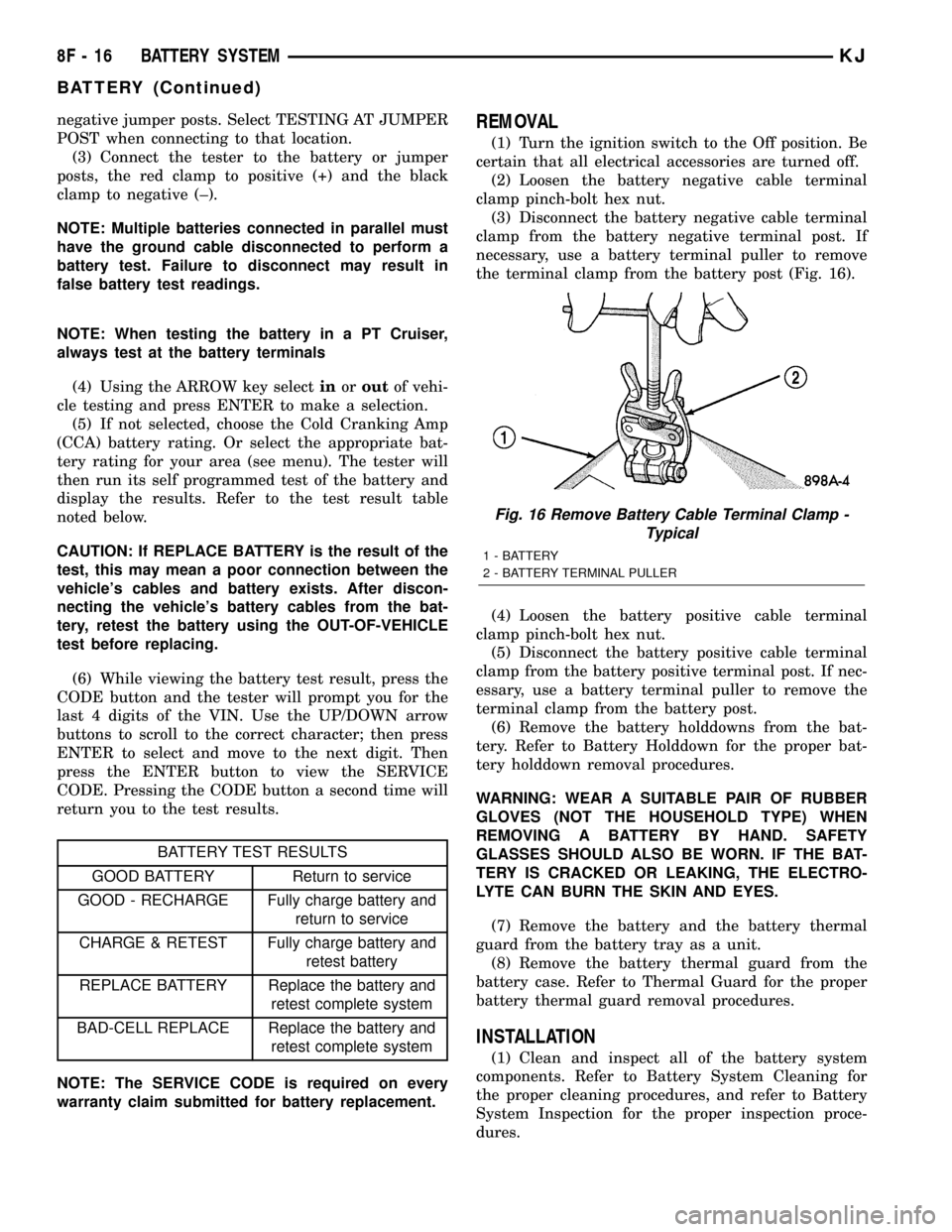
negative jumper posts. Select TESTING AT JUMPER
POST when connecting to that location.
(3) Connect the tester to the battery or jumper
posts, the red clamp to positive (+) and the black
clamp to negative (±).
NOTE: Multiple batteries connected in parallel must
have the ground cable disconnected to perform a
battery test. Failure to disconnect may result in
false battery test readings.
NOTE: When testing the battery in a PT Cruiser,
always test at the battery terminals
(4) Using the ARROW key selectinoroutof vehi-
cle testing and press ENTER to make a selection.
(5) If not selected, choose the Cold Cranking Amp
(CCA) battery rating. Or select the appropriate bat-
tery rating for your area (see menu). The tester will
then run its self programmed test of the battery and
display the results. Refer to the test result table
noted below.
CAUTION: If REPLACE BATTERY is the result of the
test, this may mean a poor connection between the
vehicle's cables and battery exists. After discon-
necting the vehicle's battery cables from the bat-
tery, retest the battery using the OUT-OF-VEHICLE
test before replacing.
(6) While viewing the battery test result, press the
CODE button and the tester will prompt you for the
last 4 digits of the VIN. Use the UP/DOWN arrow
buttons to scroll to the correct character; then press
ENTER to select and move to the next digit. Then
press the ENTER button to view the SERVICE
CODE. Pressing the CODE button a second time will
return you to the test results.
BATTERY TEST RESULTS
GOOD BATTERY Return to service
GOOD - RECHARGE Fully charge battery and
return to service
CHARGE & RETEST Fully charge battery and
retest battery
REPLACE BATTERY Replace the battery and
retest complete system
BAD-CELL REPLACE Replace the battery and
retest complete system
NOTE: The SERVICE CODE is required on every
warranty claim submitted for battery replacement.
REMOVAL
(1) Turn the ignition switch to the Off position. Be
certain that all electrical accessories are turned off.
(2) Loosen the battery negative cable terminal
clamp pinch-bolt hex nut.
(3) Disconnect the battery negative cable terminal
clamp from the battery negative terminal post. If
necessary, use a battery terminal puller to remove
the terminal clamp from the battery post (Fig. 16).
(4) Loosen the battery positive cable terminal
clamp pinch-bolt hex nut.
(5) Disconnect the battery positive cable terminal
clamp from the battery positive terminal post. If nec-
essary, use a battery terminal puller to remove the
terminal clamp from the battery post.
(6) Remove the battery holddowns from the bat-
tery. Refer to Battery Holddown for the proper bat-
tery holddown removal procedures.
WARNING: WEAR A SUITABLE PAIR OF RUBBER
GLOVES (NOT THE HOUSEHOLD TYPE) WHEN
REMOVING A BATTERY BY HAND. SAFETY
GLASSES SHOULD ALSO BE WORN. IF THE BAT-
TERY IS CRACKED OR LEAKING, THE ELECTRO-
LYTE CAN BURN THE SKIN AND EYES.
(7) Remove the battery and the battery thermal
guard from the battery tray as a unit.
(8) Remove the battery thermal guard from the
battery case. Refer to Thermal Guard for the proper
battery thermal guard removal procedures.
INSTALLATION
(1) Clean and inspect all of the battery system
components. Refer to Battery System Cleaning for
the proper cleaning procedures, and refer to Battery
System Inspection for the proper inspection proce-
dures.
Fig. 16 Remove Battery Cable Terminal Clamp -
Typical
1 - BATTERY
2 - BATTERY TERMINAL PULLER
8F - 16 BATTERY SYSTEMKJ
BATTERY (Continued)
Page 340 of 1803

(2) Reinstall the battery thermal guard onto the
battery case. Refer to Thermal Guard for the proper
battery thermal guard installation procedures.
(3) Position the battery and the battery thermal
guard onto the battery tray as a unit. Ensure that
the battery positive and negative terminal posts are
correctly positioned. The battery cable terminal
clamps must reach the correct battery terminal post
without stretching the cables (Fig. 17).
(4) Reinstall the battery holddowns onto the bat-
tery. Refer to Battery Holddown for the proper instal-
lation procedure.
CAUTION: Be certain that the battery cable terminal
clamps are connected to the correct battery termi-
nal posts. Reversed battery polarity may damage
electrical components of the vehicle.
(5) Clean the battery cable terminal clamps and
the battery terminal posts. Refer to Battery System
Cleaning for cleaning procedure.
(6) Reconnect the battery positive cable terminal
clamp to the battery positive terminal post. Tighten
the terminal clamp pinch-bolt hex nut to 45 in. lbs.
(7) Reconnect the battery negative cable terminal
clamp to the battery negative terminal post. Tighten
the terminal clamp pinch-bolt hex nut to 45 in. lbs.
(8) Apply a thin coating of petroleum jelly or chas-
sis grease to the exposed surfaces of the battery cable
terminal clamps and the battery terminal posts.BATTERY HOLDDOWN
DESCRIPTION
The battery holddown hardware includes a plastic
holddown bracket and retaining bolt. The battery
holddown bracket meshes with the battery tray to
secure the battery to the battery tray.
When installing a battery into the battery tray, it
is important that the holddown hardware is properly
installed and that the fastener is tightened to the
proper specifications. Improper holddown fastener
tightness, whether too loose or too tight, can result in
damage to the battery, the vehicle, or both. Refer to
Battery Holddown for the proper installation proce-
dure, including the proper holddown fastener torque
specifications.
OPERATION
The battery holddown secures the battery in the
battery tray. This holddown is designed to prevent
battery movement during the most extreme vehicle
operation conditions. Periodic removal and lubrica-
tion of the battery holddown hardware is recom-
mended to prevent hardware seizure at a later date.
CAUTION: Never operate a vehicle without a battery
holddown device properly installed. Damage to the
vehicle, components and battery could result.
REMOVAL
(1) Turn the ignition switch to the Off position. Be
certain that all electrical accessories are turned off.
(2) Loosen the battery negative cable terminal
clamp pinch-bolt hex nut.
(3) Disconnect the battery negative cable terminal
clamp from the battery negative terminal post. If
necessary, use a battery terminal puller to remove
the terminal clamp from the battery post.
(4) Remove the battery hold down bracket retain-
ing bolt from the threaded insert in the battery tray
assembly.
INSTALLATION
(1) Clean and inspect the battery hold down hard-
ware. Refer to Battery Cleaning for the proper bat-
tery system component cleaning procedures, and
Battery Inspection for the proper battery system
component inspection procedures.
(2) Position the battery hold down bracket onto the
battery tray.
Fig. 17 Battery Cables - Typical
1 - RADIATOR CROSSMEMBER
2 - WHEELHOUSE INNER PANEL
3 - NEGATIVE CABLE
4 - POSITIVE CABLE
5 - BATTERY
KJBATTERY SYSTEM 8F - 17
BATTERY (Continued)
Page 343 of 1803

nection at the starter solenoid B(+) terminal stud.
Repeat the test. If the reading is still above 0.2 volt,
replace the faulty battery positive cable.
(4) Connect the voltmeter to measure between the
battery negative cable terminal clamp and a good
clean ground on the engine block (Fig. 22). Rotate
and hold the ignition switch in the Start position.
Observe the voltmeter. If the reading is above 0.2
volt, clean and tighten the battery negative cable
eyelet terminal connection to the engine block.
Repeat the test. If the reading is still above 0.2 volt,
replace the faulty battery negative cable.THERMAL GUARD
DESCRIPTION
A flexible plastic bubble-wrap style thermal guard
(Fig. 23) slides over the battery case to enclose the
sides of the battery. The thermal guard consists of a
heavy black plastic outer skin and two lighter plies of
plastic that have been formed into a sheet with hun-
dreds of small air pockets entrapped between them.
The resulting material is very similar to the bubble-
wrap used to protect items in many parcel packaging
and shipping applications.
OPERATION
The thermal guard protects the battery from
engine compartment temperature extremes. The tem-
perature of the battery can affect battery perfor-
mance. The air trapped between the plastic plies of
the thermal guard create a dead air space, which
helps to insulate the sides of the battery case from
the air temperature found in the surrounding engine
compartment.
REMOVAL
(1) Remove the battery and the battery thermal
guard from the battery tray as a unit. Refer to Bat-
tery Removal for the proper battery removal proce-
dures.
(2) Carefully and evenly slide the battery thermal
guard up off of the battery case (Fig. 24).
INSTALLATION
(1) Clean and inspect the battery thermal guard.
Refer to Battery System Cleaning for the proper
cleaning procedures, and refer to Battery System
Inspection for the proper inspection procedures.
Fig. 21 TEST BATTERY POSITIVE CABLE
RESISTANCE - TYPICAL
1 - BATTERY
2 - VOLTMETER
3 - STARTER MOTOR
Fig. 22 TEST GROUND CIRCUIT RESISTANCE -
TYPICAL
1 - VOLTMETER
2 - BATTERY
3 - ENGINE GROUND
Fig. 23 Battery Thermal guard
1 - THERMAL GUARD
2 - BATTERY
8F - 20 BATTERY SYSTEMKJ
BATTERY CABLES (Continued)
Page 344 of 1803

(2) Carefully and evenly slide the battery thermal
guard down over the battery case.
(3) Install the battery and the battery thermal
guard into the battery tray as a unit. Refer to Bat-
tery Installation for the proper battery installation
procedures.
BATTERY TRAY
DESCRIPTION
The battery is placed in a molded plastic tray
located in the left front corner of the engine compart-
ment (Fig. 25). The battery hold down hardware is
contained within the battery tray. A hole in the bot-
tom of the battery tray is fitted with a battery tem-
perature sensor. Refer to Charging System for more
information on the battery temperature sensor. Refer
to Battery Hold down for more information on hold
down hardware.
OPERATION
The battery tray provides a secure mounting loca-
tion and supports the battery. On some vehicles, the
battery tray also provides the anchor point/s for the
battery holddown hardware. The battery tray and
the battery holddown hardware combine to secure
and stabilize the battery in the engine compartment,
which prevents battery movement during vehicle
operation. Unrestrained battery movement during
vehicle operation could result in damage to the vehi-
cle, the battery, or both.
REMOVAL
(1) Remove the battery from the battery tray
(Refer to 8 - ELECTRICAL/BATTERY SYSTEM/BAT-
TERY - REMOVAL).
(2) Unlatch and remove the PDC from the battery
tray.
(3) Remove the battery temperature sensor from
the battery tray (Refer to 8 - ELECTRICAL/CHARG-
ING/BATTERY TEMPERATURE SENSOR -
REMOVAL).
(4) Remove the three nuts that secure the battery
tray to the weld studs on the front extension of the
left front wheelhouse inner panel (Fig. 25).
(5) Remove the battery tray from the vehicle.
INSTALLATION
(1) Clean and inspect the battery tray (Refer to 8 -
ELECTRICAL/BATTERY SYSTEM - CLEANING).
(2) Position the battery tray onto the weld studs
on the front extension of the left front wheelhouse
inner panel.
(3) Install the battery temperature sensor onto the
battery tray (Refer to 8 - ELECTRICAL/CHARGING/
BATTERY TEMPERATURE SENSOR - INSTALLA-
TION).
(4) Install and tighten the three nuts that secure
the battery tray to the weld studs on the front exten-
sion of the left front wheelhouse inner panel. Tighten
the nuts to 5 N´m (45 in. lbs.).
(5) Install the PDC on the battery tray.
(6) Install the battery onto the battery tray (Refer
to 8 - ELECTRICAL/BATTERY SYSTEM/BATTERY -
INSTALLATION).
Fig. 24 Battery thermal guard
1 - THERMAL GUARD
2 - BATTERY
Fig. 25 Battery Tray Location
1 - Battery Tray
2 - Battery Tray Retaining Nuts
KJBATTERY SYSTEM 8F - 21
THERMAL GUARD (Continued)
Page 345 of 1803

CHARGING SYSTEM
TABLE OF CONTENTS
page page
CHARGING SYSTEM
DESCRIPTION.........................22
OPERATION...........................22
DIAGNOSIS AND TESTING - CHARGING
SYSTEM............................22
SPECIFICATIONS
TORQUE - EXCEPT DIESEL.............23
GENERATOR RATINGS - GAS ENGINES . . . 23
SPECIAL TOOLS.......................24
BATTERY TEMPERATURE SENSOR
DESCRIPTION.........................24
OPERATION...........................24
REMOVAL.............................24
INSTALLATION.........................24
GENERATOR
DESCRIPTION.........................25OPERATION...........................25
REMOVAL.............................25
INSTALLATION.........................26
GENERATOR DECOUPLER PULLEY
DESCRIPTION.........................26
OPERATION...........................27
DIAGNOSIS AND TESTING - GENERATOR
DECOUPLER.........................27
REMOVAL.............................27
INSTALLATION.........................30
VOLTAGE REGULATOR
DESCRIPTION.........................31
OPERATION...........................31
CHARGING SYSTEM
DESCRIPTION
The charging system consists of:
²Generator
²Electronic Voltage Regulator (EVR) circuitry
within the Powertrain Control Module (PCM)
²Ignition switch
²Battery (refer to 8, Battery for information)
²Battery temperature sensor
²Generator Lamp (if equipped)
²Check Gauges Lamp (if equipped)
²Wiring harness and connections (refer to 8, Wir-
ing for information)
OPERATION
The charging system is turned on and off with the
ignition switch. The system is on when the engine is
running and the ASD relay is energized. When the
ASD relay is on, voltage is supplied to the ASD relay
sense circuit at the PCM. This voltage is connected
through the PCM and supplied to one of the genera-
tor field terminals (Gen. Source +) at the back of the
generator.
The amount of DC current produced by the gener-
ator is controlled by the EVR (field control) circuitry
contained within the PCM. This circuitry is con-
nected in series with the second rotor field terminal
and ground.
A battery temperature sensor, located in the bat-
tery tray housing, is used to sense battery tempera-ture. This temperature data, along with data from
monitored line voltage, is used by the PCM to vary
the battery charging rate. This is done by cycling the
ground path to control the strength of the rotor mag-
netic field. The PCM then compensates and regulates
generator current output accordingly.
All vehicles are equipped with On-Board Diagnos-
tics (OBD). All OBD-sensed systems, including EVR
(field control) circuitry, are monitored by the PCM.
Each monitored circuit is assigned a Diagnostic Trou-
ble Code (DTC). The PCM will store a DTC in elec-
tronic memory for certain failures it detects. Refer to
Diagnostic Trouble Codes in; Powertrain Control
Module; Electronic Control Modules for more DTC
information.
The Check Gauges Lamp (if equipped) monitors:
charging system voltage,engine coolant tempera-
ture and engine oil pressure. If an extreme condition
is indicated, the lamp will be illuminated. This is
done as reminder to check the three gauges. The sig-
nal to activate the lamp is sent via the CCD bus cir-
cuits. The lamp is located on the instrument panel.
Refer to 8, Instrument Cluster for additional infor-
mation.
DIAGNOSIS AND TESTING - CHARGING
SYSTEM
The following procedures may be used to diagnose
the charging system if:
²the check gauges lamp (if equipped) is illumi-
nated with the engine running
8F - 22 CHARGING SYSTEMKJ
Page 346 of 1803

²the voltmeter (if equipped) does not register
properly
²an undercharged or overcharged battery condi-
tion occurs.
Remember that an undercharged battery is often
caused by:
²accessories being left on with the engine not
running
²a faulty or improperly adjusted switch that
allows a lamp to stay on. Refer to Ignition-Off Draw
Test in 8, Battery for more information.
INSPECTION
The Powertrain Control Module (PCM) monitors
critical input and output circuits of the charging sys-
tem, making sure they are operational. A Diagnostic
Trouble Code (DTC) is assigned to each input and
output circuit monitored by the On-Board Diagnostic
(OBD) system. Some charging system circuits are
checked continuously, and some are checked only
under certain conditions.
Refer to Diagnostic Trouble Codes in; Powertrain
Control Module; Electronic Control Modules for more
DTC information. This will include a complete list of
DTC's including DTC's for the charging system.
To perform a complete test of the charging system,
refer to the appropriate Powertrain Diagnostic Proce-
dures service manual and the DRBtscan tool. Per-form the following inspections before attaching the
scan tool.
(1) Inspect the battery condition. Refer to 8, Bat-
tery for procedures.
(2) Inspect condition of battery cable terminals,
battery posts, connections at engine block, starter
solenoid and relay. They should be clean and tight.
Repair as required.
(3) Inspect all fuses in both the fuseblock and
Power Distribution Center (PDC) for tightness in
receptacles. They should be properly installed and
tight. Repair or replace as required.
(4) Inspect generator mounting bolts for tightness.
Replace or tighten bolts if required. Refer to the Gen-
erator Removal/Installation section of this group for
torque specifications.
(5) Inspect generator drive belt condition and ten-
sion. Tighten or replace belt as required. Refer to
Belt Tension Specifications in 7, Cooling System.
(6) Inspect automatic belt tensioner (if equipped).
Refer to 7, Cooling System for information.
(7) Inspect generator electrical connections at gen-
erator field, battery output, and ground terminal (if
equipped). Also check generator ground wire connec-
tion at engine (if equipped). They should all be clean
and tight. Repair as required.
SPECIFICATIONS
TORQUE - EXCEPT DIESEL
DESCRIPTION N-m Ft. Lbs. In. Lbs.
Generator Horizontal Mounting Bolts - 3.7L 57 42 -
Generator Vertical Mounting Bolt - 3.7L 40 29 -
Generator Mounting Bolts - 2.4L 57 42 -
B+ Terminal Nut at Top of Generator 13 - 115
Generator Decoupler 110 81 -
GENERATOR RATINGS - GAS ENGINES
TYPE PART NUMBER RATED SAE AMPS ENGINES MINIMUM TEST AMPS
DENSO 56044530AB 124 2.4L 88
DENSO 56044532AB 136 2.4L 96
DENSO 56041693AA 136 3.7L 96
DENSO 56029914AA 160 3.7L 112
KJCHARGING SYSTEM 8F - 23
CHARGING SYSTEM (Continued)
Page 347 of 1803

SPECIAL TOOLS
BATTERY TEMPERATURE
SENSOR
DESCRIPTION
The Battery Temperature Sensor (BTS) is attached
to the battery tray located under the battery.
OPERATION
The BTS is used to determine the battery temper-
ature and control battery charging rate. This temper-
ature data, along with data from monitored line
voltage, is used by the PCM to vary the battery
charging rate. System voltage will be higher at colder
temperatures and is gradually reduced at warmer
temperatures.
The PCM sends 5 volts to the sensor and is
grounded through the sensor return line. As temper-
ature increases, resistance in the sensor decreases
and the detection voltage at the PCM increases.The BTS is also used for OBD II diagnostics. Cer-
tain faults and OBD II monitors are either enabled
or disabled, depending upon BTS input (for example,
disable purge and enable Leak Detection Pump
(LDP) and O2 sensor heater tests). Most OBD II
monitors are disabled below 20 degrees F.
REMOVAL
The battery temperature sensor is located under
the vehicle battery (Fig. 1) and is attached to a
mounting hole on battery tray.
(1) Remove battery. Refer to 8, Battery for proce-
dures.
(2) Disconnect sensor pigtail harness from engine
wire harness electrical connector.
(3) Pry sensor straight up from battery tray
mounting hole.
INSTALLATION
The battery temperature sensor is located under
vehicle battery and is attached to a mounting hole on
battery tray.
(1) Feed pigtail harness through hole in top of bat-
tery tray and press sensor into top of battery tray.
(2) Connect pigtail harness.
(3) Install battery. Refer to 8, Battery for proce-
dures.
GENERATOR DECOUPLER TOOL #8433
GENERATOR DECOUPLER TOOL #8823
Fig. 1 BATTERY TEMPERATURE SENSOR
1 - BATTERY TEMPERATURE SENSOR
2 - BATTERY TRAY
3 - ELECTRICAL CONNECTOR
8F - 24 CHARGING SYSTEMKJ
CHARGING SYSTEM (Continued)