removal JEEP LIBERTY 2002 KJ / 1.G Workshop Manual
[x] Cancel search | Manufacturer: JEEP, Model Year: 2002, Model line: LIBERTY, Model: JEEP LIBERTY 2002 KJ / 1.GPages: 1803, PDF Size: 62.3 MB
Page 348 of 1803

GENERATOR
DESCRIPTION
The generator is belt-driven by the engine using a
serpentine type drive belt. It is serviced only as a
complete assembly. If the generator fails for any rea-
son, the entire assembly must be replaced.
OPERATION
As the energized rotor begins to rotate within the
generator, the spinning magnetic field induces a cur-
rent into the windings of the stator coil. Once the
generator begins producing sufficient current, it also
provides the current needed to energize the rotor.
The stator winding connections deliver the induced
AC current to 3 positive and 3 negative diodes for
rectification. From the diodes, rectified DC current is
delivered to the vehicle electrical system through the
generator battery terminal.
Although the generators appear the same exter-
nally, different generators with different output rat-
ings are used on this vehicle. Be certain that the
replacement generator has the same output rating
and part number as the original unit. Refer to Spec-
ifications and see Generator Ratings for amperage
ratings and part numbers.
Noise emitting from the generator may be caused
by: worn, loose or defective bearings; a loose or defec-
tive drive pulley; incorrect, worn, damaged or misad-
justed fan drive belt; loose mounting bolts; a
misaligned drive pulley or a defective stator or diode.
REMOVAL
Gasoline Powered Engines
CAUTION: DISCONNECT NEGATIVE CABLE FROM
BATTERY BEFORE REMOVING BATTERY OUTPUT
WIRE FROM GENERATOR. FAILURE TO DO SO
CAN RESULT IN INJURY.
(1) Disconnect and isolate negative battery cable
at battery.
CAUTION: Never force a belt over a pulley rim
using a screwdriver. The synthetic fiber of the belt
can be damaged.CAUTION: When installing a serpentine accessory
drive belt, the belt MUST be routed correctly. The
water pump will be rotating in the wrong direction if
the belt is installed incorrectly, causing the engine
to overheat. Refer to belt routing label in engine
compartment, or refer to Belt Schematics in Cooling
System.
(2) Remove generator drive belt. Refer to 7, Cool-
ing System for procedures.
(3) Unsnap plastic protective cover (Fig. 2) from
B+ mounting stud.
(4) Remove B+ terminal mounting nut (Fig. 2) at
top of generator.
(5) Disconnect field wire electrical connector at
rear of generator (Fig. 2) by pushing on connector
tab.
(6) 2.4L Engine: Remove 2 generator mounting
bolts (Fig. 3).
(7) 3.7L Engine: Remove 1 vertical generator
mounting bolt and 2 horizontal mounting bolts (Fig.
4).
(8) Remove generator from vehicle.
Fig. 2 GENERATOR ELECTRICAL CONNECTORS -
TYPICAL
1 - PROTECTIVE CAP
2-B+NUT
3 - B+ TERMINAL
4 - FIELD ELECTRICAL CONNECTOR
KJCHARGING SYSTEM 8F - 25
Page 350 of 1803
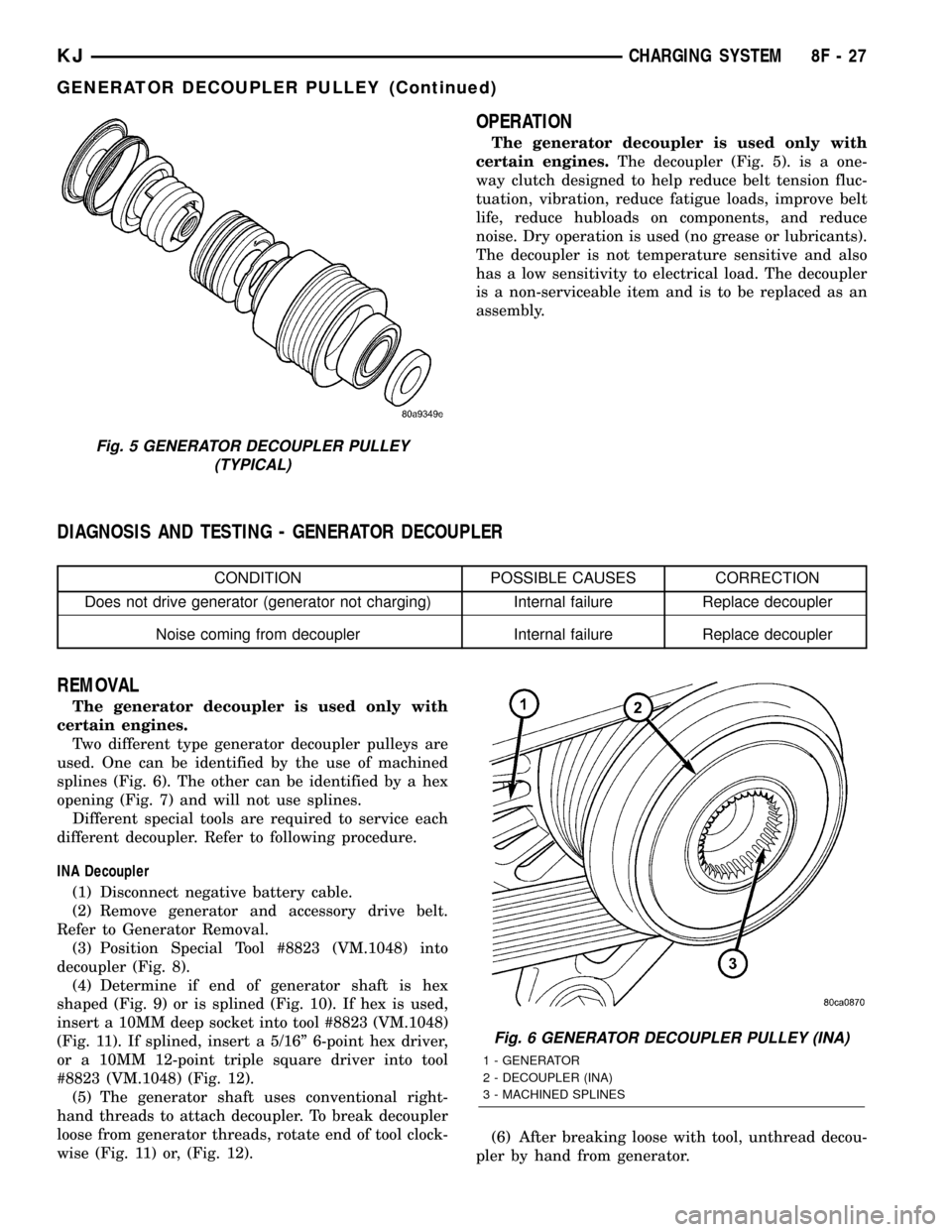
OPERATION
The generator decoupler is used only with
certain engines.The decoupler (Fig. 5). is a one-
way clutch designed to help reduce belt tension fluc-
tuation, vibration, reduce fatigue loads, improve belt
life, reduce hubloads on components, and reduce
noise. Dry operation is used (no grease or lubricants).
The decoupler is not temperature sensitive and also
has a low sensitivity to electrical load. The decoupler
is a non-serviceable item and is to be replaced as an
assembly.
DIAGNOSIS AND TESTING - GENERATOR DECOUPLER
CONDITION POSSIBLE CAUSES CORRECTION
Does not drive generator (generator not charging) Internal failure Replace decoupler
Noise coming from decoupler Internal failure Replace decoupler
REMOVAL
The generator decoupler is used only with
certain engines.
Two different type generator decoupler pulleys are
used. One can be identified by the use of machined
splines (Fig. 6). The other can be identified by a hex
opening (Fig. 7) and will not use splines.
Different special tools are required to service each
different decoupler. Refer to following procedure.
INA Decoupler
(1) Disconnect negative battery cable.
(2) Remove generator and accessory drive belt.
Refer to Generator Removal.
(3) Position Special Tool #8823 (VM.1048) into
decoupler (Fig. 8).
(4) Determine if end of generator shaft is hex
shaped (Fig. 9) or is splined (Fig. 10). If hex is used,
insert a 10MM deep socket into tool #8823 (VM.1048)
(Fig. 11). If splined, insert a 5/16º 6-point hex driver,
or a 10MM 12-point triple square driver into tool
#8823 (VM.1048) (Fig. 12).
(5) The generator shaft uses conventional right-
hand threads to attach decoupler. To break decoupler
loose from generator threads, rotate end of tool clock-
wise (Fig. 11) or, (Fig. 12).(6) After breaking loose with tool, unthread decou-
pler by hand from generator.
Fig. 5 GENERATOR DECOUPLER PULLEY
(TYPICAL)
Fig. 6 GENERATOR DECOUPLER PULLEY (INA)
1 - GENERATOR
2 - DECOUPLER (INA)
3 - MACHINED SPLINES
KJCHARGING SYSTEM 8F - 27
GENERATOR DECOUPLER PULLEY (Continued)
Page 352 of 1803

Litens Decoupler
(1) Disconnect negative battery cable.(2) Remove generator and accessory drive belt.
Refer to Generator Removal.
(3) Position Special Tool #8433 (Fig. 13) into
decoupler. Align to hex end of generator shaft.
(4) The generator shaft uses conventional right-
hand threads to attach decoupler. To break decoupler
loose from generator threads, rotate end of tool clock-
wise (Fig. 14).
(5) After breaking loose with tool, unthread decou-
pler by hand from generator.
Fig. 11 DECOUPLER REMOVAL (INA-HEX)
1 - DEEP 10 MM SOCKET
2 - TOOL #8823 (VM.1048)
Fig. 12 DECOUPLER REMOVAL (INA-SPLINED)
1 - DRIVER
2 - TOOL #8823 (VM.1048)
3 - 17 MM WRENCH
Fig. 13 # 8433 TOOL AND LITENS DECOUPLER
Fig. 14 DECOUPLER REMOVAL (LITENS)
KJCHARGING SYSTEM 8F - 29
GENERATOR DECOUPLER PULLEY (Continued)
Page 355 of 1803

STARTING SYSTEM
TABLE OF CONTENTS
page page
STARTING SYSTEM
DESCRIPTION.........................32
OPERATION...........................32
DIAGNOSIS AND TESTING - STARTING
SYSTEM............................33
INSPECTION - STARTING SYSTEM.........37
SPECIFICATIONS
TORQUE - GAS POWERED.............38
STARTER MOTOR - GAS POWERED......39
STARTER MOTOR
DIAGNOSIS AND TESTING - STARTER
MOTOR .............................39REMOVAL.............................39
INSTALLATION.........................41
STARTER MOTOR RELAY
DESCRIPTION.........................41
OPERATION...........................42
DIAGNOSIS AND TESTING -
STARTER RELAY......................42
REMOVAL.............................43
INSTALLATION.........................43
STARTING SYSTEM
DESCRIPTION
The starting system consists of:
²Starter relay
²Starter motor (including an integral starter sole-
noid)
Other components to be considered as part of start-
ing system are:
²Battery
²Battery cables
²Ignition switch and key lock cylinder
²Clutch pedal position switch (manual transmis-
sion)
²Park/neutral position switch (automatic trans-
mission)
²Wire harnesses and connections.
The Battery, Starting, and Charging systems oper-
ate in conjunction with one another, and must be
tested as a complete system. For correct operation of
starting/charging systems, all components used in
these 3 systems must perform within specifications.
When attempting to diagnose any of these systems, it
is important that you keep their interdependency in
mind.
The diagnostic procedures used in each of these
groups include the most basic conventional diagnostic
methods, to the more sophisticated On-Board Diag-
nostics (OBD) built into the Powertrain Control Mod-
ule (PCM). Use of an induction-type milliampere
ammeter, volt/ohmmeter, battery charger, carbon pile
rheostat (load tester), and 12-volt test lamp may be
required.Certain starting system components are monitored
by the PCM and may produce a Diagnostic Trouble
Code (DTC). Refer to Emission Control. See Diagnos-
tic Trouble Codes for additional information and a
list of codes.
OPERATION
The starting system components form two separate
circuits. A high-amperage feed circuit that feeds the
starter motor between 150 and 350 amperes (700
amperes - diesel engine), and a low-amperage control
circuit that operates on less than 20 amperes. The
high-amperage feed circuit components include the
battery, the battery cables, the contact disc portion of
the starter solenoid, and the starter motor. The low-
amperage control circuit components include the igni-
tion switch, the clutch pedal position switch (manual
transmission), the park/neutral position switch (auto-
matic transmission), the starter relay, the electro-
magnetic windings of the starter solenoid, and the
connecting wire harness components.
If the vehicle is equipped with a manual transmis-
sion, it has a clutch pedal position switch installed in
series between the ignition switch and the coil bat-
tery terminal of the starter relay. This normally open
switch prevents the starter relay from being ener-
gized when the ignition switch is turned to the
momentary Start position, unless the clutch pedal is
depressed. This feature prevents starter motor oper-
ation while the clutch disc and the flywheel are
engaged. The starter relay coil ground terminal is
always grounded on vehicles with a manual trans-
mission.
8F - 32 STARTING SYSTEMKJ
Page 357 of 1803
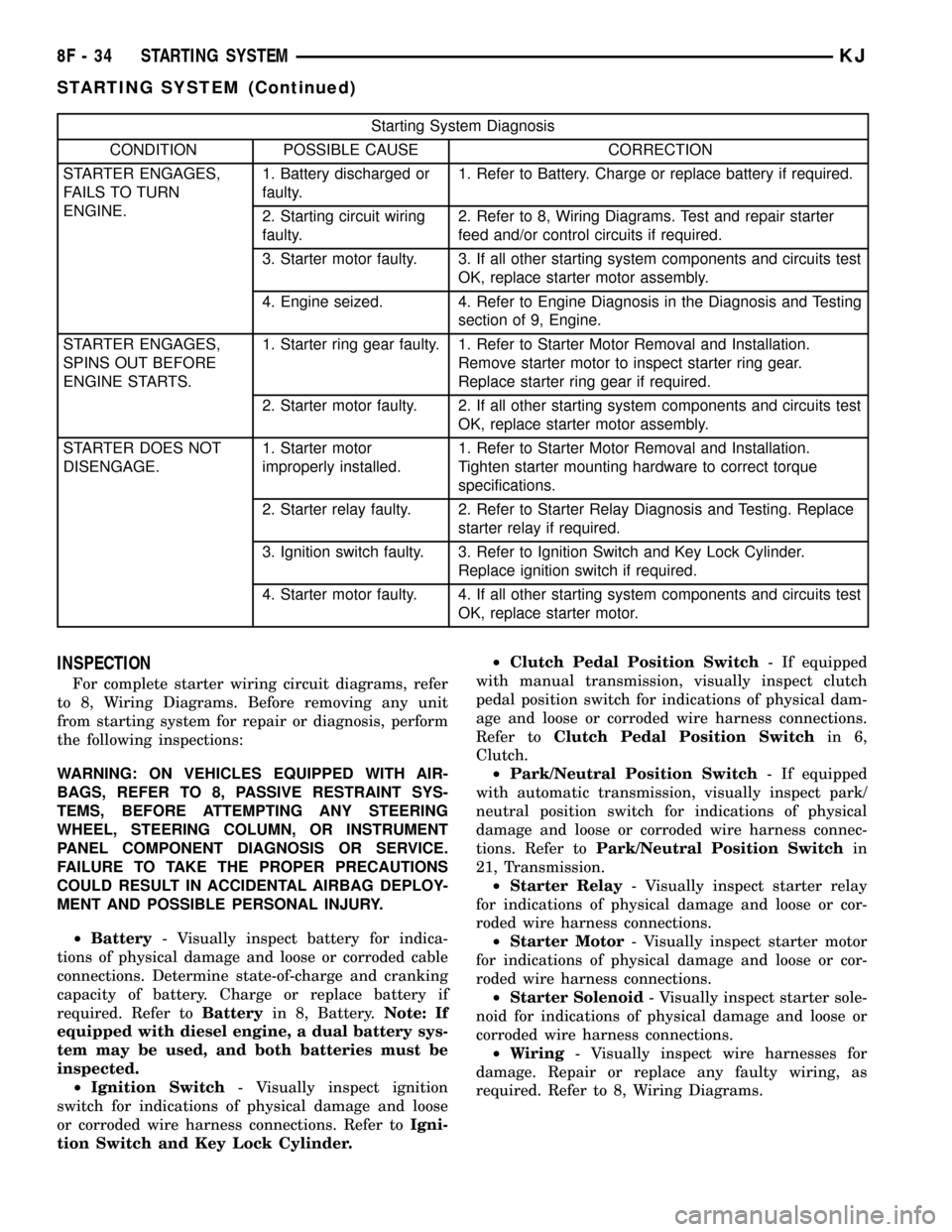
Starting System Diagnosis
CONDITION POSSIBLE CAUSE CORRECTION
STARTER ENGAGES,
FAILS TO TURN
ENGINE.1. Battery discharged or
faulty.1. Refer to Battery. Charge or replace battery if required.
2. Starting circuit wiring
faulty.2. Refer to 8, Wiring Diagrams. Test and repair starter
feed and/or control circuits if required.
3. Starter motor faulty. 3. If all other starting system components and circuits test
OK, replace starter motor assembly.
4. Engine seized. 4. Refer to Engine Diagnosis in the Diagnosis and Testing
section of 9, Engine.
STARTER ENGAGES,
SPINS OUT BEFORE
ENGINE STARTS.1. Starter ring gear faulty. 1. Refer to Starter Motor Removal and Installation.
Remove starter motor to inspect starter ring gear.
Replace starter ring gear if required.
2. Starter motor faulty. 2. If all other starting system components and circuits test
OK, replace starter motor assembly.
STARTER DOES NOT
DISENGAGE.1. Starter motor
improperly installed.1. Refer to Starter Motor Removal and Installation.
Tighten starter mounting hardware to correct torque
specifications.
2. Starter relay faulty. 2. Refer to Starter Relay Diagnosis and Testing. Replace
starter relay if required.
3. Ignition switch faulty. 3. Refer to Ignition Switch and Key Lock Cylinder.
Replace ignition switch if required.
4. Starter motor faulty. 4. If all other starting system components and circuits test
OK, replace starter motor.
INSPECTION
For complete starter wiring circuit diagrams, refer
to 8, Wiring Diagrams. Before removing any unit
from starting system for repair or diagnosis, perform
the following inspections:
WARNING: ON VEHICLES EQUIPPED WITH AIR-
BAGS, REFER TO 8, PASSIVE RESTRAINT SYS-
TEMS, BEFORE ATTEMPTING ANY STEERING
WHEEL, STEERING COLUMN, OR INSTRUMENT
PANEL COMPONENT DIAGNOSIS OR SERVICE.
FAILURE TO TAKE THE PROPER PRECAUTIONS
COULD RESULT IN ACCIDENTAL AIRBAG DEPLOY-
MENT AND POSSIBLE PERSONAL INJURY.
²Battery- Visually inspect battery for indica-
tions of physical damage and loose or corroded cable
connections. Determine state-of-charge and cranking
capacity of battery. Charge or replace battery if
required. Refer toBatteryin 8, Battery.Note: If
equipped with diesel engine, a dual battery sys-
tem may be used, and both batteries must be
inspected.
²Ignition Switch- Visually inspect ignition
switch for indications of physical damage and loose
or corroded wire harness connections. Refer toIgni-
tion Switch and Key Lock Cylinder.²Clutch Pedal Position Switch- If equipped
with manual transmission, visually inspect clutch
pedal position switch for indications of physical dam-
age and loose or corroded wire harness connections.
Refer toClutch Pedal Position Switchin 6,
Clutch.
²Park/Neutral Position Switch- If equipped
with automatic transmission, visually inspect park/
neutral position switch for indications of physical
damage and loose or corroded wire harness connec-
tions. Refer toPark/Neutral Position Switchin
21, Transmission.
²Starter Relay- Visually inspect starter relay
for indications of physical damage and loose or cor-
roded wire harness connections.
²Starter Motor- Visually inspect starter motor
for indications of physical damage and loose or cor-
roded wire harness connections.
²Starter Solenoid- Visually inspect starter sole-
noid for indications of physical damage and loose or
corroded wire harness connections.
²Wiring- Visually inspect wire harnesses for
damage. Repair or replace any faulty wiring, as
required. Refer to 8, Wiring Diagrams.
8F - 34 STARTING SYSTEMKJ
STARTING SYSTEM (Continued)
Page 361 of 1803

Clutch Pedal Position Switch
²If vehicle is equipped with a manual transmis-
sion, visually inspect clutch pedal position switch for
indications of physical damage and loose or corroded
wire harness connections. Clean corroded connections
as required. Refer toClutch Hydraulic Linkagefor
clutch pedal position switch service procedures.
Park/Neutral Position Switch
²If vehicle is equipped with an automatic trans-
mission, visually inspect park/neutral position switch
for indications of physical damage and loose or cor-
roded wire harness connections. Clean corroded con-
nections as required. Refer toPark/Neutral
Position Switchfor park/neutral position switch
service procedures.
Starter Relay
²Visually inspect starter relay for indications of
physical damage and loose or corroded wire harness
connections. Clean corroded connections as required.
Refer toStarter Relayfor starter relay service pro-
cedures.
Starter Motor
²Visually inspect starter motor for indications of
physical damage and loose or corroded wire harness
connections. Clean corroded connections as required.
If problem being diagnosed involves improper starter
engagement, disengagement or noise complaints,
starter motor should be removed. With starter motor
removed, inspect starter pinion and ring gears for
damaged or missing teeth. Replace faulty compo-
nents as required. Refer toStarter Motorfor
removal/installation procedures.
Starter Solenoid
²Visually inspect starter solenoid for indications
of physical damage and loose or corroded wire har-
ness connections. Clean corroded connections as
required. Refer toStarter Motorfor starter solenoid
service procedures.
Wiring
²Visually inspect starting system wire harnesses
for indications of physical damage. Repair or replace
any faulty wiring, as required. Refer toWiring Dia-
gramsfor repair or connector and terminal service
procedures.
SPECIFICATIONS
TORQUE - GAS POWERED
DESCRIPTION N-m Ft. Lbs. In. Lbs.
Starter Solenoid Battery
Cable Nut11 - 100
Starter Mounting Bolts -
2.4L54 40 -
Starter Mounting Bolts
-3.7L54 40 -
Starter Heat Shield
Mounting Bolts6-55
8F - 38 STARTING SYSTEMKJ
STARTING SYSTEM (Continued)
Page 362 of 1803
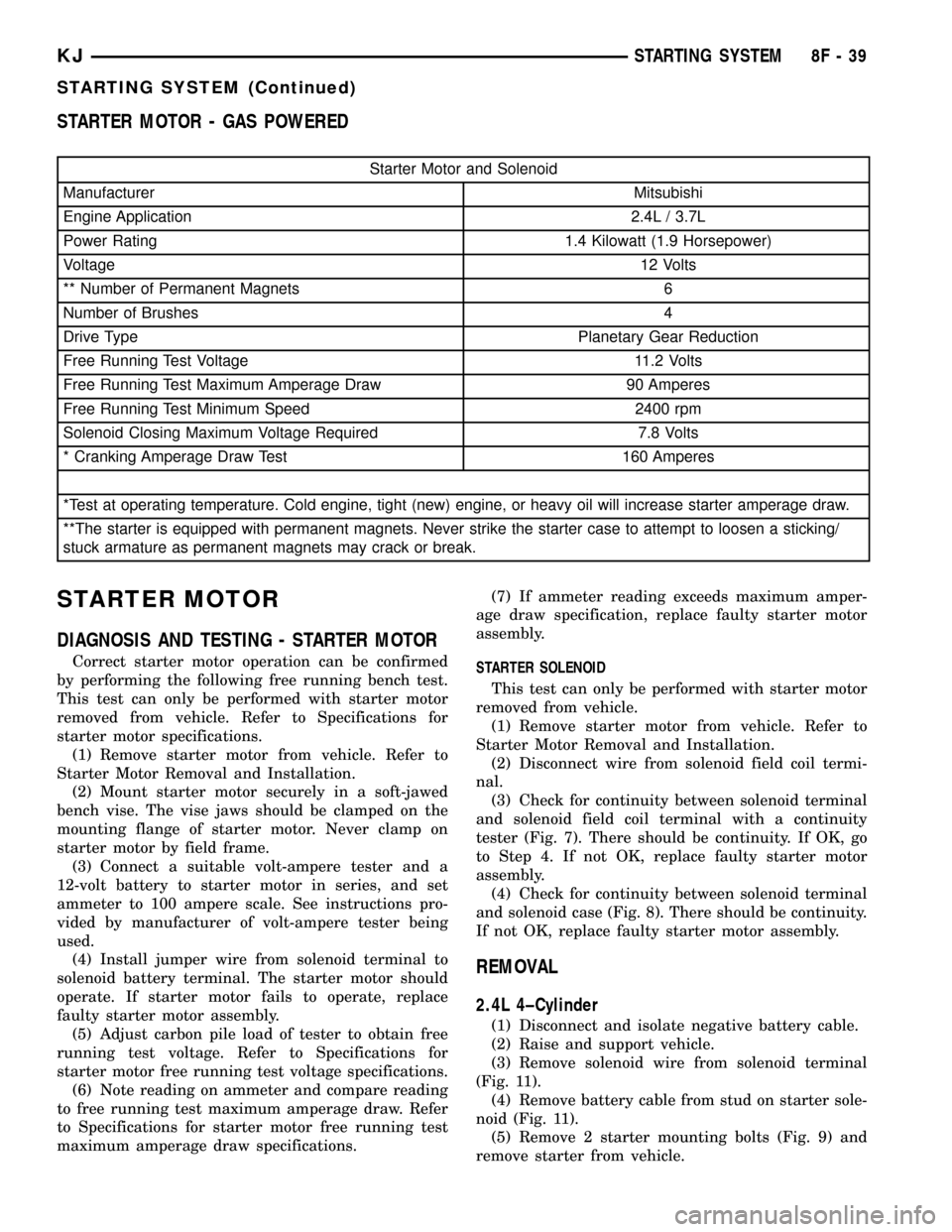
STARTER MOTOR - GAS POWERED
Starter Motor and Solenoid
Manufacturer Mitsubishi
Engine Application 2.4L / 3.7L
Power Rating 1.4 Kilowatt (1.9 Horsepower)
Voltage12 Volts
** Number of Permanent Magnets 6
Number of Brushes 4
Drive Type Planetary Gear Reduction
Free Running Test Voltage 11.2 Volts
Free Running Test Maximum Amperage Draw 90 Amperes
Free Running Test Minimum Speed 2400 rpm
Solenoid Closing Maximum Voltage Required 7.8 Volts
* Cranking Amperage Draw Test 160 Amperes
*Test at operating temperature. Cold engine, tight (new) engine, or heavy oil will increase starter amperage draw.
**The starter is equipped with permanent magnets. Never strike the starter case to attempt to loosen a sticking/
stuck armature as permanent magnets may crack or break.
STARTER MOTOR
DIAGNOSIS AND TESTING - STARTER MOTOR
Correct starter motor operation can be confirmed
by performing the following free running bench test.
This test can only be performed with starter motor
removed from vehicle. Refer to Specifications for
starter motor specifications.
(1) Remove starter motor from vehicle. Refer to
Starter Motor Removal and Installation.
(2) Mount starter motor securely in a soft-jawed
bench vise. The vise jaws should be clamped on the
mounting flange of starter motor. Never clamp on
starter motor by field frame.
(3) Connect a suitable volt-ampere tester and a
12-volt battery to starter motor in series, and set
ammeter to 100 ampere scale. See instructions pro-
vided by manufacturer of volt-ampere tester being
used.
(4) Install jumper wire from solenoid terminal to
solenoid battery terminal. The starter motor should
operate. If starter motor fails to operate, replace
faulty starter motor assembly.
(5) Adjust carbon pile load of tester to obtain free
running test voltage. Refer to Specifications for
starter motor free running test voltage specifications.
(6) Note reading on ammeter and compare reading
to free running test maximum amperage draw. Refer
to Specifications for starter motor free running test
maximum amperage draw specifications.(7) If ammeter reading exceeds maximum amper-
age draw specification, replace faulty starter motor
assembly.
STARTER SOLENOID
This test can only be performed with starter motor
removed from vehicle.
(1) Remove starter motor from vehicle. Refer to
Starter Motor Removal and Installation.
(2) Disconnect wire from solenoid field coil termi-
nal.
(3) Check for continuity between solenoid terminal
and solenoid field coil terminal with a continuity
tester (Fig. 7). There should be continuity. If OK, go
to Step 4. If not OK, replace faulty starter motor
assembly.
(4) Check for continuity between solenoid terminal
and solenoid case (Fig. 8). There should be continuity.
If not OK, replace faulty starter motor assembly.
REMOVAL
2.4L 4±Cylinder
(1) Disconnect and isolate negative battery cable.
(2) Raise and support vehicle.
(3) Remove solenoid wire from solenoid terminal
(Fig. 11).
(4) Remove battery cable from stud on starter sole-
noid (Fig. 11).
(5) Remove 2 starter mounting bolts (Fig. 9) and
remove starter from vehicle.
KJSTARTING SYSTEM 8F - 39
STARTING SYSTEM (Continued)
Page 363 of 1803

3.7L V-6
(1) Disconnect and isolate negative battery cable.
(2) Raise and support vehicle.
(3) Remove 2 flange bolts securing left exhaust
downpipe to crossover pipe. Lower pipe slightly to
allow front propeller shaft removal.
(4) Remove front propeller shaft.
(5) Remove 2 starter heat shield bolts at side of
starter (Fig. 10).
(6) Remove starter heat shield nut at front of
starter (Fig. 10).
(7) Remove starter heat shield.
(8) Remove solenoid wire from solenoid terminal
(Fig. 11).
(9) Remove battery cable from stud on starter sole-
noid (Fig. 11).
(10) Remove 2 starter mounting bolts (Fig. 12).
(11) Position front of starter to face rear of vehicle.
Rotate starter until solenoid position is located below
starter.
(12) Remove starter from vehicle by passing it
between exhaust pipe and transmission bellhousing.
Fig. 7 CONTINUITY BETWEEN SOLENOID AND
FIELD COIL TERMINALS - TYPICAL
1 - OHMMETER
2 - SOLENOID TERMINAL
3 - FIELD COIL TERMINAL
Fig. 8 CONTINUITY BETWEEN SOLENOID
TERMINAL AND CASE - TYPICAL
1 - SOLENOID TERMINAL
2 - OHMMETER
3 - SOLENOID
Fig. 9 STARTER - 2.4L
1-STARTER
2 - MOUNTING BOLTS (2)
Fig. 10 STARTER HEAT SHIELD - 3.7L
1 - STARTER HEAT SHIELD
2 - HEAT SHIELD BOLTS
3 - HEAT SHIELD BOLTS
4-STARTER
8F - 40 STARTING SYSTEMKJ
STARTER MOTOR (Continued)
Page 366 of 1803

REMOVAL
The starter relay is located in the Power Distribu-
tion Center (PDC) (Fig. 14). Refer to label on PDC
cover for relay location.(1) Remove PDC cover.
(2) Remove relay from PDC.
(3) Check condition of relay terminals and PDC
connector terminals for damage or corrosion. Repair
if necessary before installing relay.
(4) Check for pin height (pin height should be the
same for all terminals within the PDC connector).
Repair if necessary before installing relay.
INSTALLATION
(1) Refer to Power Distribution Center (PDC) cover
for starter relay location.
(2) Install relay to PDC.
(3) Install cover to PDC.
Fig. 14 POWER DISTRIBUTION CENTER (PDC)
1 - BATTERY
2 - PDC
3 - PDC COVER
KJSTARTING SYSTEM 8F - 43
STARTER MOTOR RELAY (Continued)
Page 368 of 1803

HEATED SYSTEMS
TABLE OF CONTENTS
page page
HEATED MIRRORS......................... 1
WINDOW DEFOGGER....................... 3HEATED SEAT SYSTEM.................... 10
HEATED MIRRORS
TABLE OF CONTENTS
page page
HEATED MIRRORS
DESCRIPTION..........................1
OPERATION............................1DIAGNOSIS AND TESTING - HEATED
MIRRORS............................1
HEATED MIRRORS
DESCRIPTION
Vehicles equipped with the optional heated mirror
package have an electric heating grid located behind
the mirror glass of each outside rear view mirror.
The heated mirrors are controlled by the rear win-
dow defogger switch. Electrical current is directed to
the heating grid inside the mirror only when the rear
window defogger switch is in the On position.
If the outside mirror heating grids and the rear
window heating grid are all inoperative, (Refer to 8 -
ELECTRICAL/HEATED GLASS - DIAGNOSIS AND
TESTING). If the outside mirror heating grids are
inoperative, but the rear window heating grid is
operating as designed, (Refer to 8 - ELECTRICAL/
HEATED MIRRORS - DIAGNOSIS AND TESTING).
The heating grid behind each outside mirror glass
cannot be repaired and, if faulty or damaged, the
entire power mirror unit must be replaced(Refer to 8
- ELECTRICAL/POWER MIRRORS/SIDEVIEW MIR-
ROR - REMOVAL) and (Refer to 8 - ELECTRICAL/
POWER MIRRORS/SIDEVIEW MIRROR -
INSTALLATION).
OPERATION
The heated mirror is controlled by the rear window
defogger switch. The only time that the heated mir-
ror is on is when the rear window defogger is on. The
mirror should become warm to the touch.
DIAGNOSIS AND TESTING - HEATED MIRRORS
For circuit descriptions and diagrams (Refer to
Appropriate Wiring Information).
(1) Check the fuse in the junction block. If OK, go
to Step 2. If not OK, repair the shorted circuit or
component as required and replace the faulty fuse.
(2) Turn the ignition switch to the On position.
Check for battery voltage at the fuse in the junction
block. If OK, go to Step 3. If not OK, repair the open
circuit to the ignition switch as required.
(3) Disconnect and isolate the battery negative
cable. Remove the front door trim panel on the side
of the vehicle with the inoperative mirror heating
grid. Unplug the wire harness connector at the mir-
ror. Check for continuity between the ground circuit
cavity in the body half of the power mirror wire har-
ness connector and a good ground. If OK, go to Step
4. If not OK, repair the open circuit to ground as
required.
(4) Connect the battery negative cable. Turn the
ignition switch to the On position. Turn on the rear
window defogger system. Check for battery voltage at
the rear window defogger relay output circuit cavity
in the body half of the power mirror wire harness
connector. If OK, go to Step 5. If not OK, repair the
open circuit to the rear window defogger relay as
required.
KJHEATED SYSTEMS 8G - 1